MODULE 3:
RECOGNIZE A
POTENTIAL
MARKET
LEARNING OBJECTIVES
In this module, you will know the following:
• Associate the market problem to be solved or the market need to be
met.
• Look for solution/s in terms of product/s and service/s that will meet
the need using techniques on seeking, screening, and seizing
opportunities.
• Break down the market need.
• Detect the possible product/s or service/s that will meet the need of
your locality.
• Screen the proposed solution/s based on viability, profitability, and
customer need in developing a Business Plan.
• Choose the best product or service that will meet the market need.
ENTREPRENEURIAL IDEAS
• the creation of an
entrepreneurial idea leads
to the identification of
entrepreneurial
opportunities, which in
turn results in the opening
of an entrepreneurial
venture.
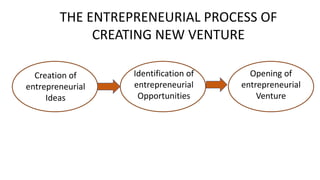
Creation of
entrepreneurial Ideas
Creation of
entrepreneurial
Ideas
Identification of
entrepreneurial
Opportunities
Opening of
entrepreneurial
Venture
THE ENTREPRENEURIAL PROCESS OF
CREATING NEW VENTURE
ESSENTIALS IN ENTREPRENEUR’S
OPPORTUNITY – SEEKING
a.) Entrepreneurial Mind Frame
•This allows the entrepreneur to
see things in a very positive and
optimistic way in the midst of
difficult situation. Being a risk -
taker, an entrepreneur can find
solutions when problems arise.
Essentials in Entrepreneur’s Opportunity –
Seeking
Entrepreneurial Heart Flame
 Entrepreneurs are driven by passion;
they are attracted to discover satisfaction
in the act and process of discovery.
Passion is the great desire of an
entrepreneur to achieve his/her goals.
Essentials in Entrepreneur’s
Opportunity – Seeking
Entrepreneurial Gut Game
 This refers to the ability of the
entrepreneur of being intuitive.
This also known as intuition.
The gut game also means
confidence in one’s self and the
firm belief that everything you
aspire can be reached.
SOURCES OF OPPORTUNITIES
1.Changes in the environment
Entrepreneurial ideas arise
when changes happen in the
external environment. A person
with an entrepreneurial drive
views these changes positively.
External environment - refers to the physical
environment, societal environment, and industry
environment where the business operates.
 1.1 The Physical environment includes Creation of
entrepreneurial Ideas Identification of entrepreneurial
Opportunities Opening of entrepreneurial Venture
a. Climate – the weather conditions.
b. Natural resources – such as minerals, forests, water, and
fertile land that occur in nature and can be used for
economic gain.
c. Wildlife – includes all mammals, birds, reptiles, fish, etc.,
that live in the wild.
SOURCES OF OPPORTUNITIES
The Societal environment includes the various forces like
a. Political forces – includes all the laws, rules, and regulations that
govern business practices as well as the permits, approvals, and
licenses necessary to operate the business.
b. Economic forces – such as income level and employment rate.
c. Sociocultural forces – customs, lifestyles and values that
characterize a society.
d. Technological environment – new inventions and technology
innovations.
The Industry environment of the
business includes:
a. Competitors
b. Customers
c. Creditors
d. Employees
e. Government f. Suppliers
SOURCES OF OPPORTUNITIES
2. Technological discovery and
advancement
a person with entrepreneurial
interest sees possibility of
business opportunities in any
new discovery or because of the
use of latest technology.
SOURCES OF OPPORTUNITIES
3. Government’s thrust,
programs, and policies The
priorities, projects,
programs, and policies of
the government are also
good sources of ideas.
SOURCES OF OPPORTUNITIES
4. People’s interest
The interest, hobbies, and
preferences of people are rich
sources of entrepreneurial ideas, like
the increasing number of Internet
Cafés at present could lead to the
strong attachment of young people
to computers.
SOURCES OF OPPORTUNITIES
5. Past experiences
The expertise and skills
developed by a person who
has worked in a particular
field may lead to the opening
of a related business
enterprise.
Forces Of Competition Model
It is also known as the “five
forces of competition”. An
industry environment is a
competitive environment.
Regardless of what product or
services you have, competition
is always present.
FORCES OF COMPETITION MODEL
Competition – it is the
act or process of trying
to get or win
something.
Forces of Competition Model
These are the five forces
competing within the industry:
Buyers
Potential new entrants
Rivalry among existing firms
Substitute products
Supplier
FORCES OF COMPETITION MODEL
1.Buyers
The buyers are the ones that pay
cash in exchange for your goods
and services. One example is the
influence of the price or in the
bargaining strategy. The buyer
has a strong and magnified
bargaining power.
FORCES OF COMPETITION MODEL
2. Potential New Entrants
A new entrant is defined as
companies or businesses
that have the ability to
penetrate or enter into a
particular industry.
Forces of Competition Model
3. Rivalry among Existing
Firms
Rivalry is a state or
situation wherein business
organizations are
competing with each other
in a particular market.
Forces of Competition Model
4. Substitute Products
Substitute is one that
serves the same
purpose as another
product in the market.
FORCES OF COMPETITION MODEL
5. Suppliers
The Suppliers are the one
that provide something that is
needed in business operations
such as office supplies and
equipment.
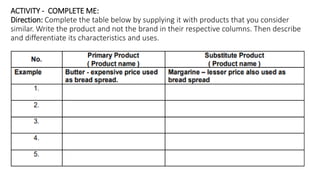
ACTIVITY - COMPLETE ME:
Direction: Complete the table below by supplying it with products that you consider
similar. Write the product and not the brand in their respective columns. Then describe
and differentiate its characteristics and uses.

PART 2-LESSON 3.pptx

  • 1.
  • 2.
    LEARNING OBJECTIVES In thismodule, you will know the following: • Associate the market problem to be solved or the market need to be met. • Look for solution/s in terms of product/s and service/s that will meet the need using techniques on seeking, screening, and seizing opportunities. • Break down the market need. • Detect the possible product/s or service/s that will meet the need of your locality. • Screen the proposed solution/s based on viability, profitability, and customer need in developing a Business Plan. • Choose the best product or service that will meet the market need.
  • 3.
    ENTREPRENEURIAL IDEAS • thecreation of an entrepreneurial idea leads to the identification of entrepreneurial opportunities, which in turn results in the opening of an entrepreneurial venture.
  • 4.
    Creation of entrepreneurial Ideas Creationof entrepreneurial Ideas Identification of entrepreneurial Opportunities Opening of entrepreneurial Venture THE ENTREPRENEURIAL PROCESS OF CREATING NEW VENTURE
  • 5.
    ESSENTIALS IN ENTREPRENEUR’S OPPORTUNITY– SEEKING a.) Entrepreneurial Mind Frame •This allows the entrepreneur to see things in a very positive and optimistic way in the midst of difficult situation. Being a risk - taker, an entrepreneur can find solutions when problems arise.
  • 6.
    Essentials in Entrepreneur’sOpportunity – Seeking Entrepreneurial Heart Flame  Entrepreneurs are driven by passion; they are attracted to discover satisfaction in the act and process of discovery. Passion is the great desire of an entrepreneur to achieve his/her goals.
  • 7.
    Essentials in Entrepreneur’s Opportunity– Seeking Entrepreneurial Gut Game  This refers to the ability of the entrepreneur of being intuitive. This also known as intuition. The gut game also means confidence in one’s self and the firm belief that everything you aspire can be reached.
  • 8.
    SOURCES OF OPPORTUNITIES 1.Changesin the environment Entrepreneurial ideas arise when changes happen in the external environment. A person with an entrepreneurial drive views these changes positively.
  • 9.
    External environment -refers to the physical environment, societal environment, and industry environment where the business operates.  1.1 The Physical environment includes Creation of entrepreneurial Ideas Identification of entrepreneurial Opportunities Opening of entrepreneurial Venture a. Climate – the weather conditions. b. Natural resources – such as minerals, forests, water, and fertile land that occur in nature and can be used for economic gain. c. Wildlife – includes all mammals, birds, reptiles, fish, etc., that live in the wild. SOURCES OF OPPORTUNITIES
  • 10.
    SOURCES OF OPPORTUNITIES TheSocietal environment includes the various forces like a. Political forces – includes all the laws, rules, and regulations that govern business practices as well as the permits, approvals, and licenses necessary to operate the business. b. Economic forces – such as income level and employment rate. c. Sociocultural forces – customs, lifestyles and values that characterize a society. d. Technological environment – new inventions and technology innovations.
  • 11.
    The Industry environmentof the business includes: a. Competitors b. Customers c. Creditors d. Employees e. Government f. Suppliers
  • 12.
    SOURCES OF OPPORTUNITIES 2.Technological discovery and advancement a person with entrepreneurial interest sees possibility of business opportunities in any new discovery or because of the use of latest technology.
  • 13.
    SOURCES OF OPPORTUNITIES 3.Government’s thrust, programs, and policies The priorities, projects, programs, and policies of the government are also good sources of ideas.
  • 14.
    SOURCES OF OPPORTUNITIES 4.People’s interest The interest, hobbies, and preferences of people are rich sources of entrepreneurial ideas, like the increasing number of Internet Cafés at present could lead to the strong attachment of young people to computers.
  • 15.
    SOURCES OF OPPORTUNITIES 5.Past experiences The expertise and skills developed by a person who has worked in a particular field may lead to the opening of a related business enterprise.
  • 16.
    Forces Of CompetitionModel It is also known as the “five forces of competition”. An industry environment is a competitive environment. Regardless of what product or services you have, competition is always present.
  • 17.
    FORCES OF COMPETITIONMODEL Competition – it is the act or process of trying to get or win something.
  • 18.
    Forces of CompetitionModel These are the five forces competing within the industry: Buyers Potential new entrants Rivalry among existing firms Substitute products Supplier
  • 19.
    FORCES OF COMPETITIONMODEL 1.Buyers The buyers are the ones that pay cash in exchange for your goods and services. One example is the influence of the price or in the bargaining strategy. The buyer has a strong and magnified bargaining power.
  • 20.
    FORCES OF COMPETITIONMODEL 2. Potential New Entrants A new entrant is defined as companies or businesses that have the ability to penetrate or enter into a particular industry.
  • 21.
    Forces of CompetitionModel 3. Rivalry among Existing Firms Rivalry is a state or situation wherein business organizations are competing with each other in a particular market.
  • 22.
    Forces of CompetitionModel 4. Substitute Products Substitute is one that serves the same purpose as another product in the market.
  • 23.
    FORCES OF COMPETITIONMODEL 5. Suppliers The Suppliers are the one that provide something that is needed in business operations such as office supplies and equipment.
  • 24.
    ACTIVITY - COMPLETEME: Direction: Complete the table below by supplying it with products that you consider similar. Write the product and not the brand in their respective columns. Then describe and differentiate its characteristics and uses.

Editor's Notes

  • #2 What is Unique Selling Proposition (USP) and Value Proposition (VP)? This part allows the entrepreneur to prepare himself on how to advertise and sell his product even if it is similar to others. In this lesson, you will find out the answers and understand more about the market.
  • #3 What is Unique Selling Proposition (USP) and Value Proposition (VP)? This part allows the entrepreneur to prepare himself on how to advertise and sell his product even if it is similar to others. In this lesson, you will find out the answers and understand more about the market.
  • #6 These are the basic foundation that the entrepreneur must have in seeking opportunities:
  • #7 These are the basic foundation that the entrepreneur must have in seeking opportunities:
  • #8 These are the basic foundation that the entrepreneur must have in seeking opportunities:
  • #9 There are many ways to discover opportunities. Looking at the big picture, some have noticed the emerging trends and patterns for business opportunities. While others are trying to find out their target market. The following are some sources of opportunities:
  • #10 The Physical environment includes Creation of entrepreneurial Ideas Identification of entrepreneurial Opportunities Opening of entrepreneurial Venture CO_Q1_Entrepreneurship SHS Module 2 5 a. Climate – the weather conditions. b. Natural resources – such as minerals, forests, water, and fertile land that occur in nature and can be used for economic gain. c. Wildlife – includes all mammals, birds, reptiles, fish, etc., that live in the wild.
  • #11 The Physical environment includes Creation of entrepreneurial Ideas Identification of entrepreneurial Opportunities Opening of entrepreneurial Venture CO_Q1_Entrepreneurship SHS Module 2 5 a. Climate – the weather conditions. b. Natural resources – such as minerals, forests, water, and fertile land that occur in nature and can be used for economic gain. c. Wildlife – includes all mammals, birds, reptiles, fish, etc., that live in the wild.
  • #12 The Physical environment includes Creation of entrepreneurial Ideas Identification of entrepreneurial Opportunities Opening of entrepreneurial Venture CO_Q1_Entrepreneurship SHS Module 2 5 a. Climate – the weather conditions. b. Natural resources – such as minerals, forests, water, and fertile land that occur in nature and can be used for economic gain. c. Wildlife – includes all mammals, birds, reptiles, fish, etc., that live in the wild.
  • #14 The Physical environment includes Creation of entrepreneurial Ideas Identification of entrepreneurial Opportunities Opening of entrepreneurial Venture CO_Q1_Entrepreneurship SHS Module 2 5 a. Climate – the weather conditions. b. Natural resources – such as minerals, forests, water, and fertile land that occur in nature and can be used for economic gain. c. Wildlife – includes all mammals, birds, reptiles, fish, etc., that live in the wild.
  • #15 The Physical environment includes Creation of entrepreneurial Ideas Identification of entrepreneurial Opportunities Opening of entrepreneurial Venture CO_Q1_Entrepreneurship SHS Module 2 5 a. Climate – the weather conditions. b. Natural resources – such as minerals, forests, water, and fertile land that occur in nature and can be used for economic gain. c. Wildlife – includes all mammals, birds, reptiles, fish, etc., that live in the wild.
  • #16 The Physical environment includes Creation of entrepreneurial Ideas Identification of entrepreneurial Opportunities Opening of entrepreneurial Venture CO_Q1_Entrepreneurship SHS Module 2 5 a. Climate – the weather conditions. b. Natural resources – such as minerals, forests, water, and fertile land that occur in nature and can be used for economic gain. c. Wildlife – includes all mammals, birds, reptiles, fish, etc., that live in the wild.
  • #17 The Physical environment includes Creation of entrepreneurial Ideas Identification of entrepreneurial Opportunities Opening of entrepreneurial Venture CO_Q1_Entrepreneurship SHS Module 2 5 a. Climate – the weather conditions. b. Natural resources – such as minerals, forests, water, and fertile land that occur in nature and can be used for economic gain. c. Wildlife – includes all mammals, birds, reptiles, fish, etc., that live in the wild.
  • #18 The Physical environment includes Creation of entrepreneurial Ideas Identification of entrepreneurial Opportunities Opening of entrepreneurial Venture CO_Q1_Entrepreneurship SHS Module 2 5 a. Climate – the weather conditions. b. Natural resources – such as minerals, forests, water, and fertile land that occur in nature and can be used for economic gain. c. Wildlife – includes all mammals, birds, reptiles, fish, etc., that live in the wild.
  • #19 The Physical environment includes Creation of entrepreneurial Ideas Identification of entrepreneurial Opportunities Opening of entrepreneurial Venture CO_Q1_Entrepreneurship SHS Module 2 5 a. Climate – the weather conditions. b. Natural resources – such as minerals, forests, water, and fertile land that occur in nature and can be used for economic gain. c. Wildlife – includes all mammals, birds, reptiles, fish, etc., that live in the wild.
  • #20 The Physical environment includes Creation of entrepreneurial Ideas Identification of entrepreneurial Opportunities Opening of entrepreneurial Venture CO_Q1_Entrepreneurship SHS Module 2 5 a. Climate – the weather conditions. b. Natural resources – such as minerals, forests, water, and fertile land that occur in nature and can be used for economic gain. c. Wildlife – includes all mammals, birds, reptiles, fish, etc., that live in the wild.
  • #21 The Physical environment includes Creation of entrepreneurial Ideas Identification of entrepreneurial Opportunities Opening of entrepreneurial Venture CO_Q1_Entrepreneurship SHS Module 2 5 a. Climate – the weather conditions. b. Natural resources – such as minerals, forests, water, and fertile land that occur in nature and can be used for economic gain. c. Wildlife – includes all mammals, birds, reptiles, fish, etc., that live in the wild.
  • #22 The Physical environment includes Creation of entrepreneurial Ideas Identification of entrepreneurial Opportunities Opening of entrepreneurial Venture CO_Q1_Entrepreneurship SHS Module 2 5 a. Climate – the weather conditions. b. Natural resources – such as minerals, forests, water, and fertile land that occur in nature and can be used for economic gain. c. Wildlife – includes all mammals, birds, reptiles, fish, etc., that live in the wild.
  • #23 The Physical environment includes Creation of entrepreneurial Ideas Identification of entrepreneurial Opportunities Opening of entrepreneurial Venture CO_Q1_Entrepreneurship SHS Module 2 5 a. Climate – the weather conditions. b. Natural resources – such as minerals, forests, water, and fertile land that occur in nature and can be used for economic gain. c. Wildlife – includes all mammals, birds, reptiles, fish, etc., that live in the wild.
  • #24 The Physical environment includes Creation of entrepreneurial Ideas Identification of entrepreneurial Opportunities Opening of entrepreneurial Venture CO_Q1_Entrepreneurship SHS Module 2 5 a. Climate – the weather conditions. b. Natural resources – such as minerals, forests, water, and fertile land that occur in nature and can be used for economic gain. c. Wildlife – includes all mammals, birds, reptiles, fish, etc., that live in the wild.