PROBLEM 4.23
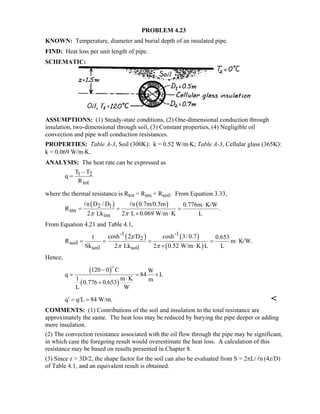
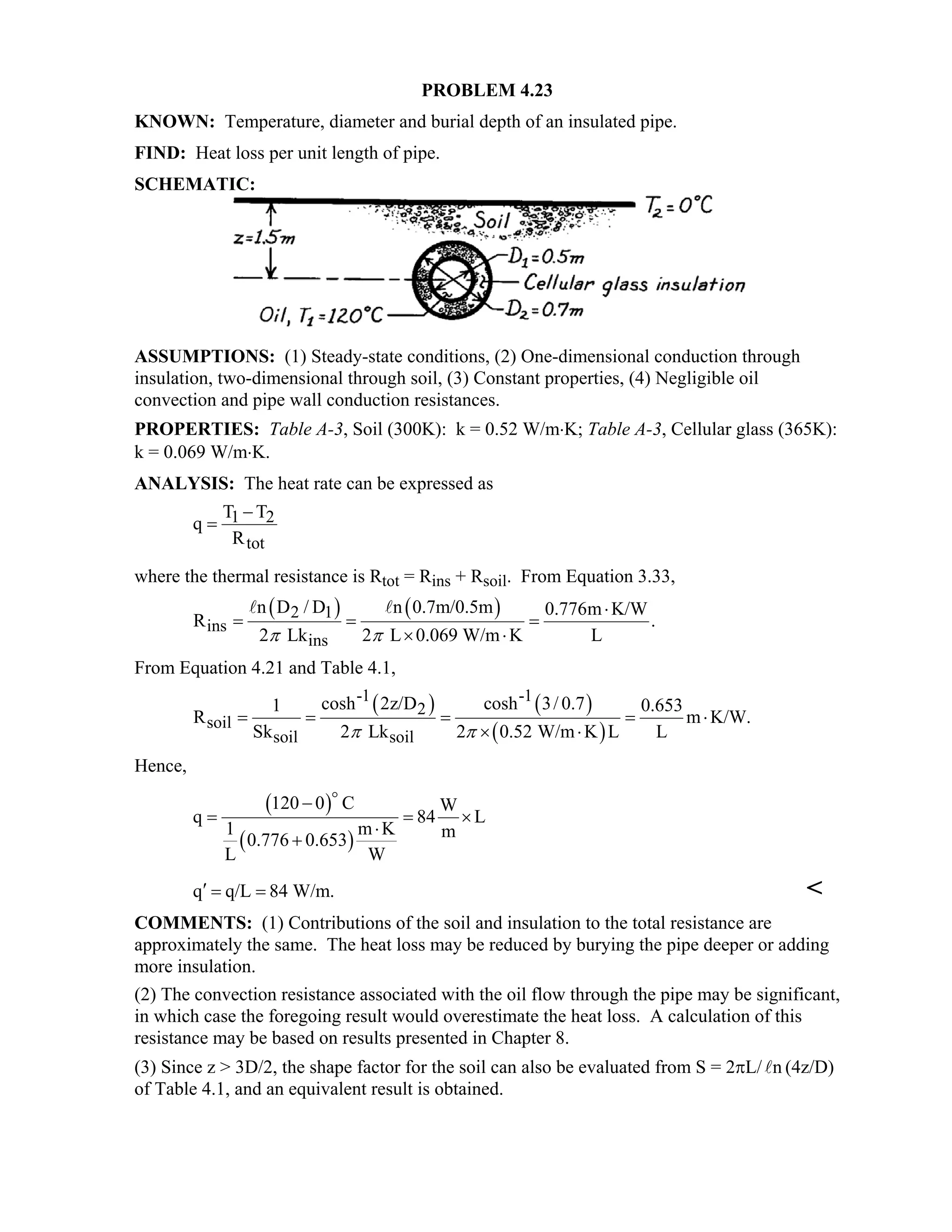
KNOWN: Temperature, diameter and burial depth of an insulated pipe.
FIND: Heat loss per unit length of pipe.
SCHEMATIC:
ASSUMPTIONS: (1) Steady-state conditions, (2) One-dimensional conduction through
insulation, two-dimensional through soil, (3) Constant properties, (4) Negligible oil
convection and pipe wall conduction resistances.
PROPERTIES: Table A-3, Soil (300K): k = 0.52 W/m⋅K; Table A-3, Cellular glass (365K):
k = 0.069 W/m⋅K.
ANALYSIS: The heat rate can be expressed as
1 2
tot
T T
q
R
−
=
where the thermal resistance is Rtot = Rins + Rsoil. From Equation 3.33,
( ) ( )2 1
ins
ins
n D / D n 0.7m/0.5m 0.776m K/W
R .
2 Lk 2 L 0.069 W/m K Lπ π
⋅
= = =
× ⋅
l l
From Equation 4.21 and Table 4.1,
( ) ( )
( )
-1 -1
2
soil
soil soil
cosh 2z/D cosh 3/ 0.71 0.653
R m K/W.
Sk 2 Lk 2 0.52 W/m K L L
= = = = ⋅
× ⋅π π
Hence,
( )
( )
120 0 C W
q 84 L
1 m K m0.776 0.653
L W
−
= = ×
⋅
+
o
q q/L 84 W/m.′ = = <
COMMENTS: (1) Contributions of the soil and insulation to the total resistance are
approximately the same. The heat loss may be reduced by burying the pipe deeper or adding
more insulation.
(2) The convection resistance associated with the oil flow through the pipe may be significant,
in which case the foregoing result would overestimate the heat loss. A calculation of this
resistance may be based on results presented in Chapter 8.
(3) Since z > 3D/2, the shape factor for the soil can also be evaluated from S = 2πL/ nl (4z/D)
of Table 4.1, and an equivalent result is obtained.

Sm4 023

  • 1.
    PROBLEM 4.23 KNOWN: Temperature,diameter and burial depth of an insulated pipe. FIND: Heat loss per unit length of pipe. SCHEMATIC: ASSUMPTIONS: (1) Steady-state conditions, (2) One-dimensional conduction through insulation, two-dimensional through soil, (3) Constant properties, (4) Negligible oil convection and pipe wall conduction resistances. PROPERTIES: Table A-3, Soil (300K): k = 0.52 W/m⋅K; Table A-3, Cellular glass (365K): k = 0.069 W/m⋅K. ANALYSIS: The heat rate can be expressed as 1 2 tot T T q R − = where the thermal resistance is Rtot = Rins + Rsoil. From Equation 3.33, ( ) ( )2 1 ins ins n D / D n 0.7m/0.5m 0.776m K/W R . 2 Lk 2 L 0.069 W/m K Lπ π ⋅ = = = × ⋅ l l From Equation 4.21 and Table 4.1, ( ) ( ) ( ) -1 -1 2 soil soil soil cosh 2z/D cosh 3/ 0.71 0.653 R m K/W. Sk 2 Lk 2 0.52 W/m K L L = = = = ⋅ × ⋅π π Hence, ( ) ( ) 120 0 C W q 84 L 1 m K m0.776 0.653 L W − = = × ⋅ + o q q/L 84 W/m.′ = = < COMMENTS: (1) Contributions of the soil and insulation to the total resistance are approximately the same. The heat loss may be reduced by burying the pipe deeper or adding more insulation. (2) The convection resistance associated with the oil flow through the pipe may be significant, in which case the foregoing result would overestimate the heat loss. A calculation of this resistance may be based on results presented in Chapter 8. (3) Since z > 3D/2, the shape factor for the soil can also be evaluated from S = 2πL/ nl (4z/D) of Table 4.1, and an equivalent result is obtained.