Monetary and Fiscal policy measures alone cannot do the trick. Sustained growth
require reforms policy.
Nishant Kumar
MBA (Previous)
1911006
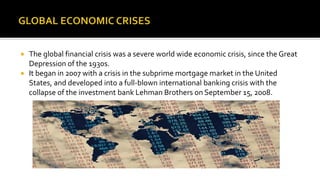
 The global financial crisis was a severe world wide economic crisis, since the Great
Depression of the 1930s.
 It began in 2007 with a crisis in the subprime mortgage market in the United
States, and developed into a full-blown international banking crisis with the
collapse of the investment bank Lehman Brothers on September 15, 2008.
Here are some warning signs for that
Escalation in US-China tariff war
Slowing US growth
Long recession in Germany
Chinese debt crisis
Brexit
Crisis in Argentina, Iran, South Africa,Turkey and
Venezuela
Financial market jitters
Amid an economic slowdown, Moody’s Investors Service has cut India’s gross
domestic product (GDP) growth rate to 6.2 per cent for calendar year 2019
against its earlier projection of 6.8 per cent.
Automobile industry has been hit badly, due to decline in sales.
Housing sales has also declined
The volume growth or the number packs sold, of FMCG companies has
slowed down over the last one year.
The value of new projects announced during April to June 2019 fell by
79.5% year on year.
Net exports for April to June 2019 stood at $46 billion almost equal to last
year.
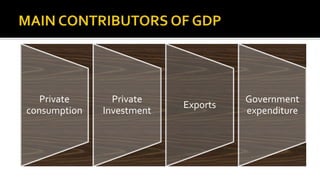
Private
consumption
Private
Investment
Exports
Government
expenditure
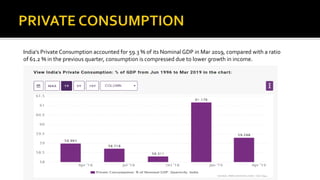
India's Private Consumption accounted for 59.3 % of its Nominal GDP in Mar 2019, compared with a ratio
of 61.2 % in the previous quarter, consumption is compressed due to lower growth in income.
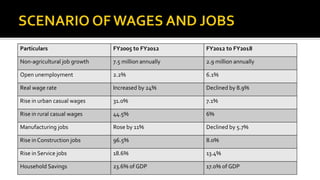
Particulars FY2005 to FY2012 FY2012 to FY2018
Non-agricultural job growth 7.5 million annually 2.9 million annually
Open unemployment 2.2% 6.1%
Real wage rate Increased by 24% Declined by 8.9%
Rise in urban casual wages 31.0% 7.1%
Rise in rural casual wages 44.5% 6%
Manufacturing jobs Rose by 11% Declined by 5.7%
Rise in Construction jobs 96.5% 8.0%
Rise in Service jobs 18.6% 13.4%
Household Savings 23.6% of GDP 17.0% of GDP
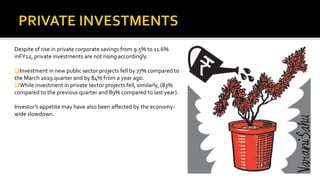
Despite of rise in private corporate savings from 9.5% to 11.6%
inFY12, private investments are not rising accordingly.
Investment in new public sector projects fell by 77% compared to
the March 2019 quarter and by 84% from a year ago.
While investment in private sector projects fell, similarly, (83%
compared to the previous quarter and 89% compared to last year).
Investor’s appetite may have also been affected by the economy-
wide slowdown.
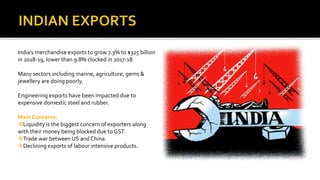
India’s merchandise exports to grow 7.3% to $325 billion
in 2018-19, lower than 9.8% clocked in 2017-18.
Many sectors including marine, agriculture, gems &
jewellery are doing poorly.
Engineering exports have been impacted due to
expensive domestic steel and rubber.
Main Concerns:
Liquidity is the biggest concern of exporters along
with their money being blocked due to GST.
Trade war between US and China.
Declining exports of labour intensive products.
Fiscal Policy measures:
Capital expenditure budgeted to 1.3% of GDP in FY20 as compared to 1.4% I FY19.
In 2014 the fiscal deficit was at 4.5% of GDP and government want to bring it to 3.4% in FY19. Hence,
public investment to stimulate economy is not an option.
Monetary Policy measures:
Since November,2014 the real repo rate is 4% and has remained to2-3% in real terms.
That is why inflation is impacting the growth rates negatively.
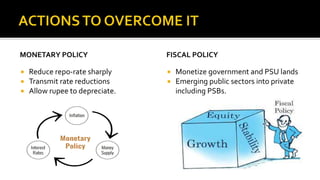
MONETARY POLICY
 Reduce repo-rate sharply
 Transmit rate reductions
 Allow rupee to depreciate.
FISCAL POLICY
 Monetize government and PSU lands
 Emerging public sectors into private
including PSBs.
Monetary and Fiscal policies are not enough to do the trick.
India requires industrial policy and other structural reforms,
especially financial structure reforms.
Agricultural growth is to be 4%.
India have potential to grow at 7-8% pa in real terms and can
become a $5trn economy.

Slowdown is structural or cyclical

  • 1.
    Monetary and Fiscalpolicy measures alone cannot do the trick. Sustained growth require reforms policy. Nishant Kumar MBA (Previous) 1911006
  • 2.
     The globalfinancial crisis was a severe world wide economic crisis, since the Great Depression of the 1930s.  It began in 2007 with a crisis in the subprime mortgage market in the United States, and developed into a full-blown international banking crisis with the collapse of the investment bank Lehman Brothers on September 15, 2008.
  • 3.
    Here are somewarning signs for that Escalation in US-China tariff war Slowing US growth Long recession in Germany Chinese debt crisis Brexit Crisis in Argentina, Iran, South Africa,Turkey and Venezuela Financial market jitters
  • 4.
    Amid an economicslowdown, Moody’s Investors Service has cut India’s gross domestic product (GDP) growth rate to 6.2 per cent for calendar year 2019 against its earlier projection of 6.8 per cent. Automobile industry has been hit badly, due to decline in sales. Housing sales has also declined The volume growth or the number packs sold, of FMCG companies has slowed down over the last one year. The value of new projects announced during April to June 2019 fell by 79.5% year on year. Net exports for April to June 2019 stood at $46 billion almost equal to last year.
  • 6.
  • 7.
    India's Private Consumptionaccounted for 59.3 % of its Nominal GDP in Mar 2019, compared with a ratio of 61.2 % in the previous quarter, consumption is compressed due to lower growth in income.
  • 8.
    Particulars FY2005 toFY2012 FY2012 to FY2018 Non-agricultural job growth 7.5 million annually 2.9 million annually Open unemployment 2.2% 6.1% Real wage rate Increased by 24% Declined by 8.9% Rise in urban casual wages 31.0% 7.1% Rise in rural casual wages 44.5% 6% Manufacturing jobs Rose by 11% Declined by 5.7% Rise in Construction jobs 96.5% 8.0% Rise in Service jobs 18.6% 13.4% Household Savings 23.6% of GDP 17.0% of GDP
  • 9.
    Despite of risein private corporate savings from 9.5% to 11.6% inFY12, private investments are not rising accordingly. Investment in new public sector projects fell by 77% compared to the March 2019 quarter and by 84% from a year ago. While investment in private sector projects fell, similarly, (83% compared to the previous quarter and 89% compared to last year). Investor’s appetite may have also been affected by the economy- wide slowdown.
  • 10.
    India’s merchandise exportsto grow 7.3% to $325 billion in 2018-19, lower than 9.8% clocked in 2017-18. Many sectors including marine, agriculture, gems & jewellery are doing poorly. Engineering exports have been impacted due to expensive domestic steel and rubber. Main Concerns: Liquidity is the biggest concern of exporters along with their money being blocked due to GST. Trade war between US and China. Declining exports of labour intensive products.
  • 11.
    Fiscal Policy measures: Capitalexpenditure budgeted to 1.3% of GDP in FY20 as compared to 1.4% I FY19. In 2014 the fiscal deficit was at 4.5% of GDP and government want to bring it to 3.4% in FY19. Hence, public investment to stimulate economy is not an option. Monetary Policy measures: Since November,2014 the real repo rate is 4% and has remained to2-3% in real terms. That is why inflation is impacting the growth rates negatively.
  • 12.
    MONETARY POLICY  Reducerepo-rate sharply  Transmit rate reductions  Allow rupee to depreciate. FISCAL POLICY  Monetize government and PSU lands  Emerging public sectors into private including PSBs.
  • 13.
    Monetary and Fiscalpolicies are not enough to do the trick. India requires industrial policy and other structural reforms, especially financial structure reforms. Agricultural growth is to be 4%. India have potential to grow at 7-8% pa in real terms and can become a $5trn economy.