FE Numerical Coding and Analysis on
Seepage & Slope Stability
Presented by: Wang Xuejun
Email: wangxuejun@gmail.com
LinkedIn: www.linkedin.com/in/wangxuejun
Master thesis work in Tianjin Univ. (1996- 1999)
Outline
 Introduction
 Methodology
 FE ground water seepage analysis
 FE soil slope stability analysis
 Applications
 Concluding remarks
Introduction
 Seepage reduces the stability of soil slope
 Seepage makes it easier for soil particles to slide
over each other during failure
 Pore water pressures reduce the inherent strength
and stability of a soil mass
 Analysis methods
 The classical slope stability analysis based on
limit equilibrium (generally using method of slices)
 Numeric solutions mostly based on the finite
elements method
Introduction
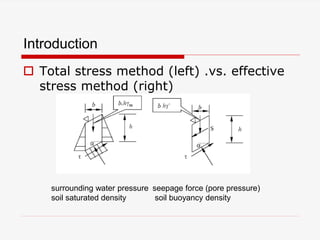
 Total stress method (left) .vs. effective
stress method (right)
surrounding water pressure
soil saturated density
seepage force (pore pressure)
soil buoyancy density
Introduction
A FEM based program is developed to analyze
slope stability under seepage
 Stead state flow modeling
 Phreatic surface & pore pressure distribution
 Seepage force
 Elasto-plastic soil stress-strain modeling
 Plastic zone to predict the slope failure
 Result comparison between the FE method and
Classic method
Methodology-seepage analysis
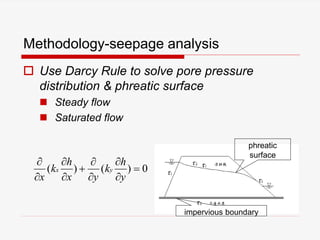
 Use Darcy Rule to solve pore pressure
distribution & phreatic surface
 Steady flow
 Saturated flow
0)()( 









y
h
k
yx
h
k
x
yx
impervious boundary
phreatic
surface
Methodology-seepage analysis
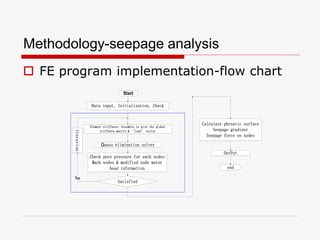
 FE program implementation-flow chart
Start
Data input, Initialization, Check
Element stiffness; Assemble to give the global
stiffness matrix & ‘load’ vector
Gauss elimination solver
Check pore pressure for each nodes
Mark nodes & modified node water
head information
Satisfied
Calculate phreatic surface
Seepage gradient
Seepage force on nodes
Iteration
OutPut
end
No
Methodology-seepage analysis
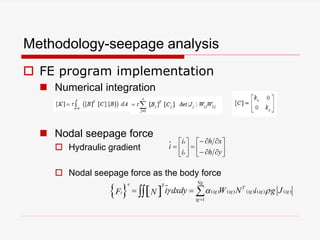
 FE program implementation
 Numerical integration
 Nodal seepage force
 Hydraulic gradient
 Nodal seepage force as the body force















yh
xh
i
i
i
y
x
    ( ) ( ) ( ) ( ) ( )
1
Nge T T
ig ig ig ig igi
ig
i dxdy W N i g JF N   

  
Methodology-seepage analysis
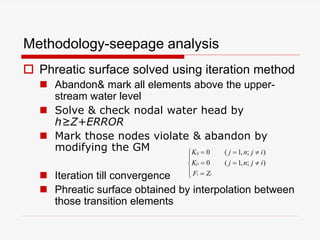
 Phreatic surface solved using iteration method
 Abandon& mark all elements above the upper-
stream water level
 Solve & check nodal water head by
h≥Z+ERROR
 Mark those nodes violate & abandon by
modifying the GM
 Iteration till convergence
 Phreatic surface obtained by interpolation between
those transition elements








ii
ji
ij
ZF
ijnjK
ijnjK
);,1(0
);,1(0
Methodology-seepage analysis
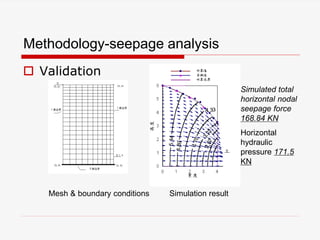
 Validation
Mesh & boundary conditions Simulation result
Simulated total
horizontal nodal
seepage force
168.84 KN
Horizontal
hydraulic
pressure 171.5
KN
Methodology-FE soil stress-strain analysis
 Elasto-plastic constitutive model
 Mohr-column criterion in terms of principal
stresses
Methodology-FE soil stress-strain analysis
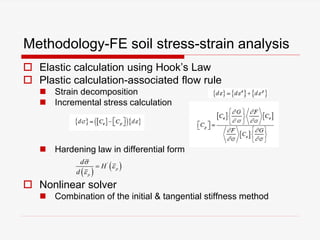
 Elastic calculation using Hook’s Law
 Plastic calculation-associated flow rule
 Strain decomposition
 Incremental stress calculation
 Hardening law in differential form
 Nonlinear solver
 Combination of the initial & tangential stiffness method
 
 '
p
p
d
H
d




Methodology-FE soil stress-strain analysis
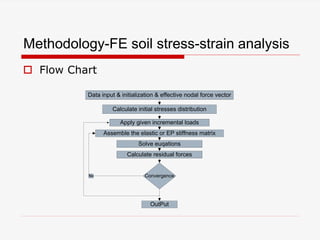
 Flow Chart
Data input & initialization & effective nodal force vector
Calculate initial stresses distribution
Apply given incremental loads
Assemble the elastic or EP stiffness matrix
Solve euqations
Calculate residual forces
ConvergenceNo
OutPut
Methodology-FE soil stress-strain analysis
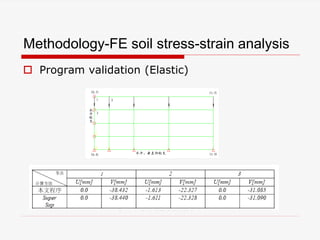
 Program validation (Elastic)
Applications -slope stability under seepage
analysis
 Consider hydraulic conductivity
heterogeneity in soil slope by dividing
into two different zones
 Use soil plastic zone to predict potential
sliding surface
 Used other methods based on the FE
simulated stress distributions
 Use limited equilibrium methods
Applications
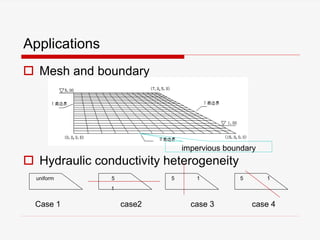
 Mesh and boundary
 Hydraulic conductivity heterogeneity
impervious boundary
Case 1 case2 case 3 case 4
uniform 5 5 1 5 1
1
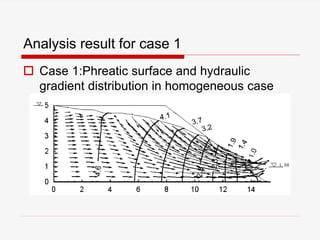
Analysis result for case 1
 Case 1:Phreatic surface and hydraulic
gradient distribution in homogeneous case
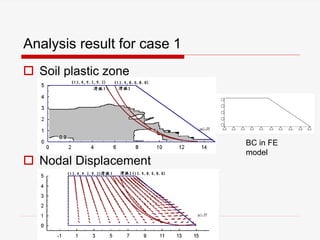
Analysis result for case 1
 Soil plastic zone
 Nodal Displacement
BC in FE
model
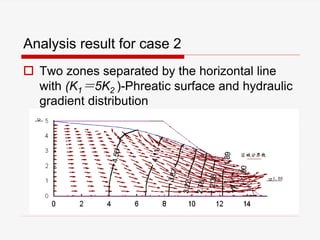
Analysis result for case 2
 Two zones separated by the horizontal line
with (K1=5K2 )-Phreatic surface and hydraulic
gradient distribution
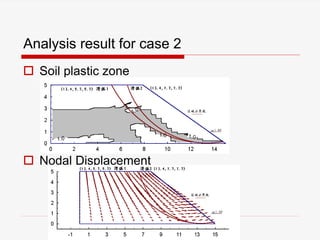
Analysis result for case 2
 Soil plastic zone
 Nodal Displacement
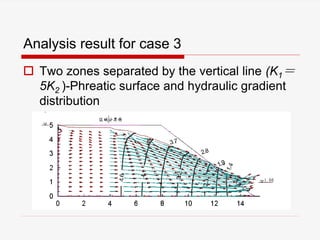
Analysis result for case 3
 Two zones separated by the vertical line (K1=
5K2 )-Phreatic surface and hydraulic gradient
distribution
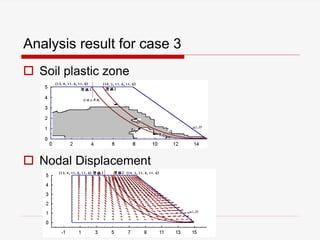
Analysis result for case 3
 Soil plastic zone
 Nodal Displacement
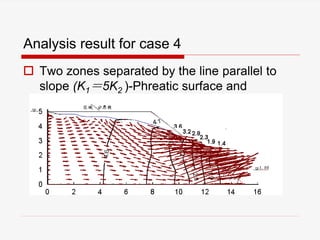
Analysis result for case 4
 Two zones separated by the line parallel to
slope (K1=5K2 )-Phreatic surface and
hydraulic gradient distribution
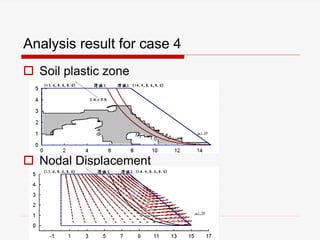
Analysis result for case 4
 Soil plastic zone
 Nodal Displacement
Other methods based on FE results
 Factor of safety method (for a given
potential sliding surface)
 Force equilibrium method



F

i i
S
i
l
K
l




( )
n
i i i i
i
F n
i i
i
f c l
K
l


 




Potential sliding
surface
Element cut by
potential sliding
surface
Results
 Comparison of different methods
FE Limited Equilibrium
KS KF KB
Case 1 Surface 1 [13.4 , 9.2 , 9.2 ] 1.190 1.095 1.069
surface 2 [13.4 , 8.0 , 8.0 ] 1.216 1.088 1.155
Case 2 Surface 1 [13.4 , 9.2 , 9.2 ] 1.125 1.070 1.031
surface 2 [13.4 , 8.0 , 8.0 ] 1.172 1.075 1.057
Case 3 Surface 1 [13.4 , 9.2 , 9.2 ] 1.078 1.119 1.067
surface 2 [13.4 , 8.0 , 8.0 ] 1.215 1.100 1.067
Case 4 Surface 1 [13.4 , 9.2 , 9.2 ] 1.075 1.030 0.994
surface 2 [13.4 , 8.0 , 8.0 ] 1.077 1.018 1.067
Concluding remarks
 An alternative method to predict the slope
failure surface induced by the seepage.
 Result shows good agreement with that by
limited equilibrium method (simplified Bishop
method) using FE predicted ground water
table.
 Non-homogenous hydraulic conductivity has
great influence on the soil slope stability.
Thank you

FE coding and Analysis on Seepage and slope stability

  • 1.
    FE Numerical Codingand Analysis on Seepage & Slope Stability Presented by: Wang Xuejun Email: wangxuejun@gmail.com LinkedIn: www.linkedin.com/in/wangxuejun Master thesis work in Tianjin Univ. (1996- 1999)
  • 2.
    Outline  Introduction  Methodology FE ground water seepage analysis  FE soil slope stability analysis  Applications  Concluding remarks
  • 3.
    Introduction  Seepage reducesthe stability of soil slope  Seepage makes it easier for soil particles to slide over each other during failure  Pore water pressures reduce the inherent strength and stability of a soil mass  Analysis methods  The classical slope stability analysis based on limit equilibrium (generally using method of slices)  Numeric solutions mostly based on the finite elements method
  • 4.
    Introduction  Total stressmethod (left) .vs. effective stress method (right) surrounding water pressure soil saturated density seepage force (pore pressure) soil buoyancy density
  • 5.
    Introduction A FEM basedprogram is developed to analyze slope stability under seepage  Stead state flow modeling  Phreatic surface & pore pressure distribution  Seepage force  Elasto-plastic soil stress-strain modeling  Plastic zone to predict the slope failure  Result comparison between the FE method and Classic method
  • 6.
    Methodology-seepage analysis  UseDarcy Rule to solve pore pressure distribution & phreatic surface  Steady flow  Saturated flow 0)()(           y h k yx h k x yx impervious boundary phreatic surface
  • 7.
    Methodology-seepage analysis  FEprogram implementation-flow chart Start Data input, Initialization, Check Element stiffness; Assemble to give the global stiffness matrix & ‘load’ vector Gauss elimination solver Check pore pressure for each nodes Mark nodes & modified node water head information Satisfied Calculate phreatic surface Seepage gradient Seepage force on nodes Iteration OutPut end No
  • 8.
    Methodology-seepage analysis  FEprogram implementation  Numerical integration  Nodal seepage force  Hydraulic gradient  Nodal seepage force as the body force                yh xh i i i y x     ( ) ( ) ( ) ( ) ( ) 1 Nge T T ig ig ig ig igi ig i dxdy W N i g JF N       
  • 9.
    Methodology-seepage analysis  Phreaticsurface solved using iteration method  Abandon& mark all elements above the upper- stream water level  Solve & check nodal water head by h≥Z+ERROR  Mark those nodes violate & abandon by modifying the GM  Iteration till convergence  Phreatic surface obtained by interpolation between those transition elements         ii ji ij ZF ijnjK ijnjK );,1(0 );,1(0
  • 10.
    Methodology-seepage analysis  Validation Mesh& boundary conditions Simulation result Simulated total horizontal nodal seepage force 168.84 KN Horizontal hydraulic pressure 171.5 KN
  • 11.
    Methodology-FE soil stress-strainanalysis  Elasto-plastic constitutive model  Mohr-column criterion in terms of principal stresses
  • 12.
    Methodology-FE soil stress-strainanalysis  Elastic calculation using Hook’s Law  Plastic calculation-associated flow rule  Strain decomposition  Incremental stress calculation  Hardening law in differential form  Nonlinear solver  Combination of the initial & tangential stiffness method    ' p p d H d    
  • 13.
    Methodology-FE soil stress-strainanalysis  Flow Chart Data input & initialization & effective nodal force vector Calculate initial stresses distribution Apply given incremental loads Assemble the elastic or EP stiffness matrix Solve euqations Calculate residual forces ConvergenceNo OutPut
  • 14.
    Methodology-FE soil stress-strainanalysis  Program validation (Elastic)
  • 15.
    Applications -slope stabilityunder seepage analysis  Consider hydraulic conductivity heterogeneity in soil slope by dividing into two different zones  Use soil plastic zone to predict potential sliding surface  Used other methods based on the FE simulated stress distributions  Use limited equilibrium methods
  • 16.
    Applications  Mesh andboundary  Hydraulic conductivity heterogeneity impervious boundary Case 1 case2 case 3 case 4 uniform 5 5 1 5 1 1
  • 17.
    Analysis result forcase 1  Case 1:Phreatic surface and hydraulic gradient distribution in homogeneous case
  • 18.
    Analysis result forcase 1  Soil plastic zone  Nodal Displacement BC in FE model
  • 19.
    Analysis result forcase 2  Two zones separated by the horizontal line with (K1=5K2 )-Phreatic surface and hydraulic gradient distribution
  • 20.
    Analysis result forcase 2  Soil plastic zone  Nodal Displacement
  • 21.
    Analysis result forcase 3  Two zones separated by the vertical line (K1= 5K2 )-Phreatic surface and hydraulic gradient distribution
  • 22.
    Analysis result forcase 3  Soil plastic zone  Nodal Displacement
  • 23.
    Analysis result forcase 4  Two zones separated by the line parallel to slope (K1=5K2 )-Phreatic surface and hydraulic gradient distribution
  • 24.
    Analysis result forcase 4  Soil plastic zone  Nodal Displacement
  • 25.
    Other methods basedon FE results  Factor of safety method (for a given potential sliding surface)  Force equilibrium method    F  i i S i l K l     ( ) n i i i i i F n i i i f c l K l         Potential sliding surface Element cut by potential sliding surface
  • 26.
    Results  Comparison ofdifferent methods FE Limited Equilibrium KS KF KB Case 1 Surface 1 [13.4 , 9.2 , 9.2 ] 1.190 1.095 1.069 surface 2 [13.4 , 8.0 , 8.0 ] 1.216 1.088 1.155 Case 2 Surface 1 [13.4 , 9.2 , 9.2 ] 1.125 1.070 1.031 surface 2 [13.4 , 8.0 , 8.0 ] 1.172 1.075 1.057 Case 3 Surface 1 [13.4 , 9.2 , 9.2 ] 1.078 1.119 1.067 surface 2 [13.4 , 8.0 , 8.0 ] 1.215 1.100 1.067 Case 4 Surface 1 [13.4 , 9.2 , 9.2 ] 1.075 1.030 0.994 surface 2 [13.4 , 8.0 , 8.0 ] 1.077 1.018 1.067
  • 27.
    Concluding remarks  Analternative method to predict the slope failure surface induced by the seepage.  Result shows good agreement with that by limited equilibrium method (simplified Bishop method) using FE predicted ground water table.  Non-homogenous hydraulic conductivity has great influence on the soil slope stability.
  • 28.