Rate of Change & Slope
Rate of Change
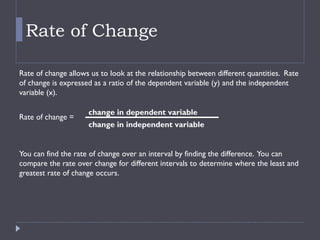
Rate of change allows us to look at the relationship between different quantities. Rate
of change is expressed as a ratio of the dependent variable (y) and the independent
variable (x).
Rate of change =
You can find the rate of change over an interval by finding the difference. You can
compare the rate over change for different intervals to determine where the least and
greatest rate of change occurs.
change in dependent variable
change in independent variable
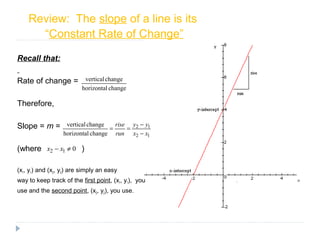
Review: The slope of a line is its
“Constant Rate of Change”
Recall that:
Rate of change =
Therefore,
Slope = m =
(where )
(x1, y1) and (x2, y2) are simply an easy
way to keep track of the first point, (x1, y1), you
use and the second point, (x2, y2), you use.
012 ≠− xx
changehorizontal
changevertical
12
12
changehorizontal
changevertical
xx
yy
run
rise
−
−
==
Let’s look at a table
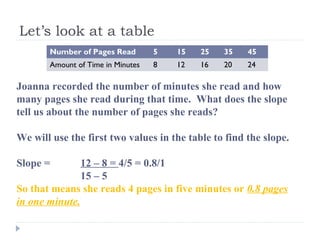
Number of Pages Read 5 15 25 35 45
Amount of Time in Minutes 8 12 16 20 24
Joanna recorded the number of minutes she read and how
many pages she read during that time. What does the slope
tell us about the number of pages she reads?
We will use the first two values in the table to find the slope.
Slope = 12 – 8 = 4/5 = 0.8/1
15 – 5
So that means she reads 4 pages in five minutes or 0.8 pages
in one minute.
Let’s try another one!
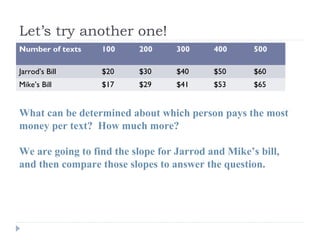
Number of texts 100 200 300 400 500
Jarrod’s Bill $20 $30 $40 $50 $60
Mike’s Bill $17 $29 $41 $53 $65
What can be determined about which person pays the most
money per text? How much more?
We are going to find the slope for Jarrod and Mike’s bill,
and then compare those slopes to answer the question.
Let’s Compare Slopes
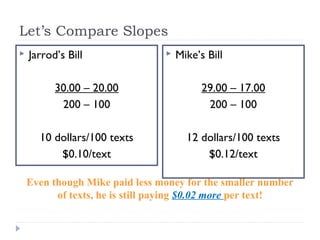
 Jarrod’s Bill
30.00 – 20.00
200 – 100
10 dollars/100 texts
$0.10/text
 Mike’s Bill
29.00 – 17.00
200 – 100
12 dollars/100 texts
$0.12/text
Even though Mike paid less money for the smaller number
of texts, he is still paying $0.02 more per text!
Understanding Slope
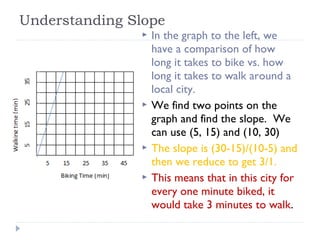
 In the graph to the left, we
have a comparison of how
long it takes to bike vs. how
long it takes to walk around a
local city.
 We find two points on the
graph and find the slope. We
can use (5, 15) and (10, 30)
 The slope is (30-15)/(10-5) and
then we reduce to get 3/1.
 This means that in this city for
every one minute biked, it
would take 3 minutes to walk.
What do we do with slope?
 We can use the slope to understand the relationship between the variables.
 Example: When Marvin works 8 hours, he earns $78 He
earns $68.25 when he works for 7 hours. What is the rate
of change?
 So, we use our slope formula:
78 – 68.25 = 9.75 (dollars)
8 – 7 1 (hour)
If we think about the units of the slope, we realize that
this is saying he makes $9.75 for working one hour. So
Marvin makes $9.75 an hour.
In terms of an equation
 A local cab company charges by the mile to drive
passengers from one location to another. The equation
can be written as C(m) = 0.85m + $3.00 where m stands
for the number of miles and C(m) stands for the total
cost. What can we conclude about the equation
according to its slope?
 If we think about this equation, we have two numbers in play.
The $3.00 is just a flat rate. You would need to pay that $3.00
just for using the cab.
 We notice that the $0.85/1 is multiplied by the number of
miles, so that is our slope and tells us that each mile travelled
will cost $0.85.
Balloon Example
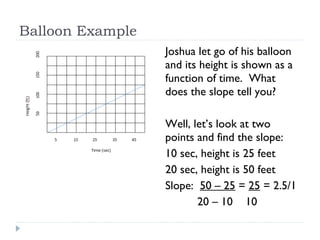
Joshua let go of his balloon
and its height is shown as a
function of time. What
does the slope tell you?
Well, let’s look at two
points and find the slope:
10 sec, height is 25 feet
20 sec, height is 50 feet
Slope: 50 – 25 = 25 = 2.5/1
20 – 10 10
So what does this mean?
It means that it takes the balloon
10 seconds to travel 25 feet, or
one second to take 2.5 feet. So,
we can say that the balloon
travels 2.5 feet/second.
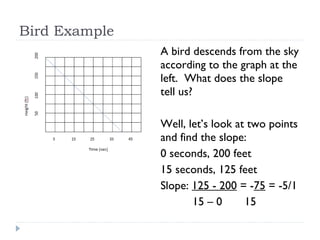
Bird Example
A bird descends from the sky
according to the graph at the
left. What does the slope
tell us?
Well, let’s look at two points
and find the slope:
0 seconds, 200 feet
15 seconds, 125 feet
Slope: 125 - 200 = -75 = -5/1
15 – 0 15
So what does this mean?
It means that over a time of 15
seconds, the bird descends 75
feet. Or, after one second, the
bird descends 5 feet. So the bird
travels down 5 feet/second.

Slope notes

  • 1.
  • 2.
    Rate of Change Rateof change allows us to look at the relationship between different quantities. Rate of change is expressed as a ratio of the dependent variable (y) and the independent variable (x). Rate of change = You can find the rate of change over an interval by finding the difference. You can compare the rate over change for different intervals to determine where the least and greatest rate of change occurs. change in dependent variable change in independent variable
  • 3.
    Review: The slopeof a line is its “Constant Rate of Change” Recall that: Rate of change = Therefore, Slope = m = (where ) (x1, y1) and (x2, y2) are simply an easy way to keep track of the first point, (x1, y1), you use and the second point, (x2, y2), you use. 012 ≠− xx changehorizontal changevertical 12 12 changehorizontal changevertical xx yy run rise − − ==
  • 4.
    Let’s look ata table Number of Pages Read 5 15 25 35 45 Amount of Time in Minutes 8 12 16 20 24 Joanna recorded the number of minutes she read and how many pages she read during that time. What does the slope tell us about the number of pages she reads? We will use the first two values in the table to find the slope. Slope = 12 – 8 = 4/5 = 0.8/1 15 – 5 So that means she reads 4 pages in five minutes or 0.8 pages in one minute.
  • 5.
    Let’s try anotherone! Number of texts 100 200 300 400 500 Jarrod’s Bill $20 $30 $40 $50 $60 Mike’s Bill $17 $29 $41 $53 $65 What can be determined about which person pays the most money per text? How much more? We are going to find the slope for Jarrod and Mike’s bill, and then compare those slopes to answer the question.
  • 6.
    Let’s Compare Slopes Jarrod’s Bill 30.00 – 20.00 200 – 100 10 dollars/100 texts $0.10/text  Mike’s Bill 29.00 – 17.00 200 – 100 12 dollars/100 texts $0.12/text Even though Mike paid less money for the smaller number of texts, he is still paying $0.02 more per text!
  • 7.
    Understanding Slope  Inthe graph to the left, we have a comparison of how long it takes to bike vs. how long it takes to walk around a local city.  We find two points on the graph and find the slope. We can use (5, 15) and (10, 30)  The slope is (30-15)/(10-5) and then we reduce to get 3/1.  This means that in this city for every one minute biked, it would take 3 minutes to walk.
  • 8.
    What do wedo with slope?  We can use the slope to understand the relationship between the variables.  Example: When Marvin works 8 hours, he earns $78 He earns $68.25 when he works for 7 hours. What is the rate of change?  So, we use our slope formula: 78 – 68.25 = 9.75 (dollars) 8 – 7 1 (hour) If we think about the units of the slope, we realize that this is saying he makes $9.75 for working one hour. So Marvin makes $9.75 an hour.
  • 9.
    In terms ofan equation  A local cab company charges by the mile to drive passengers from one location to another. The equation can be written as C(m) = 0.85m + $3.00 where m stands for the number of miles and C(m) stands for the total cost. What can we conclude about the equation according to its slope?  If we think about this equation, we have two numbers in play. The $3.00 is just a flat rate. You would need to pay that $3.00 just for using the cab.  We notice that the $0.85/1 is multiplied by the number of miles, so that is our slope and tells us that each mile travelled will cost $0.85.
  • 10.
    Balloon Example Joshua letgo of his balloon and its height is shown as a function of time. What does the slope tell you? Well, let’s look at two points and find the slope: 10 sec, height is 25 feet 20 sec, height is 50 feet Slope: 50 – 25 = 25 = 2.5/1 20 – 10 10
  • 11.
    So what doesthis mean? It means that it takes the balloon 10 seconds to travel 25 feet, or one second to take 2.5 feet. So, we can say that the balloon travels 2.5 feet/second.
  • 12.
    Bird Example A birddescends from the sky according to the graph at the left. What does the slope tell us? Well, let’s look at two points and find the slope: 0 seconds, 200 feet 15 seconds, 125 feet Slope: 125 - 200 = -75 = -5/1 15 – 0 15
  • 13.
    So what doesthis mean? It means that over a time of 15 seconds, the bird descends 75 feet. Or, after one second, the bird descends 5 feet. So the bird travels down 5 feet/second.

Editor's Notes

  • #2 Welcome to the slope notes!
  • #3 Rate of change allows us to look at the relationship between different quantities and can be viewed as the change in the dependent variable divided by the change in the independent variable.
  • #4 The slope of line is its constant rate of change. It’s the vertical change over the horizontal change. We can use y2 – y1 over x2 – x1, which is the rise over the run, which is the slope. To do this, we find two points on the line.
  • #5 Let’s look at a table. How many pages Joanna read over a certain amount of time. By choosing two points, on the table, (15, 12) and (5, 8), we can calculate the slope. We see that the slope is 4/5 or 0.8 over one. That means she reads four pages in five minutes or 0.8 pages each minute.
  • #6 This table shows us a comparison of two different cell phone bills based on the number of texts sent. By using the slope, we can find out who pays more for each text and how much more.
  • #7 For Jarrod, if he sends 200 texts he pays $30 and if he sends 100 texts he pays $20. His slope reduces to 10 dollars for 100 texts or $0.10 per text. Mike pays $29 if he sends 200 texts and $17 if he sends 100 texts. Mike pays $12 to send 100 texts, or $0.12/text. So, Mike pays two cents more per text.
  • #8 The graph shows a comparison of how long it takes to bike versus how long it takes to walk to various destinations in a city. We find two points on the graph, (5, 15) and (10, 30) and use our slope formula to calculate the slope. Reduced the slope is 3/1. This means that in this city for every one minute to takes to get somewhere by biking, it would take 3 minutes to get there by walking.
  • #9 We can use the slope to understand the relationship between variables. When Marvin works for eight hours, he earns $78. When he works for 7, he earns $68.25. The problem asks us to find the rate of change, which is the slope. So using our slope formula, we find that Marvin actually makes about $9.75 per hour.
  • #10 A local cab company charges a flat rate as well as by the mile to drive passengers to their destinations. The equation c(m) = 0.85m + $3.00 represents this charge. So what does the slope mean? Well, $3.00 is the flat rate, since it doesn’t depend on the numbers of miles drive. If you get into the cab and have the driver go nowhere, you pay $3.00. But, the 0.85 stands for $0.85 that you will pay for each mile traveled.
  • #11 In this example, Joshua let go of his balloon and it’s height as a function of time is shown. We notice that as time passes, the height increases. We can find the slope by using two points on the graph. In 10 sec, the height is 25 feet. In 20 sec, the height is 50 feet. Reducing the slope, we get 2.5 over one.
  • #12 This tell us that it takes one second for the balloon to travel 2.5 feet. So, this balloon travels 2.5 feet/second.
  • #13 A bird descends from the sky according to this graph. Notice as time passes, the height of the bird decreases. By using the points, (0, 200) and (15, 125), we use our slope formula and find the slope.
  • #14 So, this means that over a time of 15 seconds, the bird descends 75 feet. Or, after one second it descends 5 feet. So, we can say that the bird travels downward at a rate of 5 feet/second.