(slightly) smarter
SMART PTRS
www.italiancpp.org
C++ Day 2017
2 Dicembre, Modena
Carlo Pescio
C++ DAY 2017 – UN EVENTO DELL’ITALIAN C++ COMMUNITY
Carlo Pescio http://carlopescio.com http://eptacom.net
Anyone not using smart ptrs?
Carlo Pescio http://carlopescio.com http://eptacom.net
Smart Pointers are cool
- (good) smart pointers enable explicit lifetime design
- Still smart pointers have some run-time overhead
- Talk is focusing on that overhead, not lifetime design
- Specifically, shared pointers
Carlo Pescio http://carlopescio.com http://eptacom.net
Just a proof of concept
- Code lacks support for polymorphic conversion etc.
- I’ve kept this thing in a closet way too long :-)
- Probably the “invention” process is more interesting
than the thing itself.
Carlo Pescio http://carlopescio.com http://eptacom.net
Shared pointers
• Shared ownership of an object
• Last pointer to go destroys the pointed object
• Usually keeps a count of incoming references to obj
• Count must be shared as well
Carlo Pescio http://carlopescio.com http://eptacom.net
Shared pointers in practice
• 3 basic implementations
• (+ an uncommon one)
• C++11 implementation
Carlo Pescio http://carlopescio.com http://eptacom.net
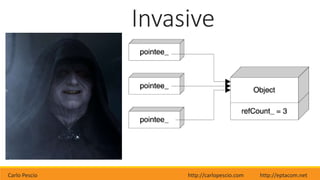
Invasive
Carlo Pescio http://carlopescio.com http://eptacom.net
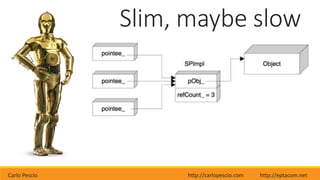
Slim, maybe slow
Carlo Pescio http://carlopescio.com http://eptacom.net
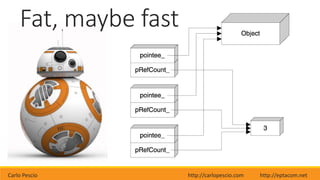
Fat, maybe fast
Carlo Pescio http://carlopescio.com http://eptacom.net
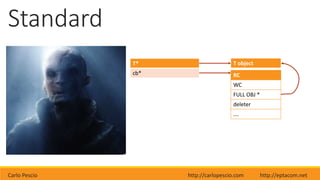
Standard
T*
cb*
T object
RC
WC
FULL OBJ *
deleter
….
Carlo Pescio http://carlopescio.com http://eptacom.net
Standard + make_shared
T*
cb*
T object
RC
WC
FULL OBJ *
[deleter]
….
+
Carlo Pescio http://carlopescio.com http://eptacom.net
<Interlude>
Rant is coming
Carlo Pescio http://carlopescio.com http://eptacom.net
Why I don’t like shared_ptr
OPINION <<< BEWARE : )
“C was designed on the assumption that the programmer
is someone sensible who knows what he's doing”
(Kernighan and Ritchie)
“What you don't use, you don't pay for” (Stroustrup)
Carlo Pescio http://carlopescio.com http://eptacom.net
shared_ptr: the dark side
You pay the overhead of weak even if you don’t use it
Trying to protect you from absence of virtual destructor
You lose a standalone weak ptr
make_shared is a virus (factory -> unique -> penalty)
Carlo Pescio http://carlopescio.com http://eptacom.net
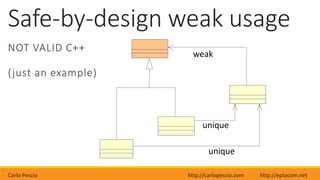
Safe-by-design weak usage
NOT VALID C++
(just an example)
unique
unique
weak
Carlo Pescio http://carlopescio.com http://eptacom.net
</Interlude>
Sorry for ranting
Carlo Pescio http://carlopescio.com http://eptacom.net
A little benchmark
- Not much science, just a few reasonable tests, should
be expanded, tested with more compilers, etc.
- 3 tests: allocation, dereferencing, “complex” usage.
- Tested raw, std::shared_ptr, std:shared_ptr +
make_shared, a slim and a fat version I implemented.
Carlo Pescio http://carlopescio.com http://eptacom.net
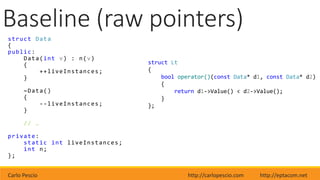
Baseline (raw pointers)
struct Data
{
public:
Data(int v) : n(v)
{
++liveInstances;
}
~Data()
{
--liveInstances;
}
// …
private:
static int liveInstances;
int n;
};
struct Lt
{
bool operator()(const Data* d1, const Data* d2)
{
return d1->Value() < d2->Value();
}
};
Carlo Pescio http://carlopescio.com http://eptacom.net
Test 1
vector<Data*> v0;
v0.reserve(N);
for (int j = 0; j < 10; ++j)
{
for (int i = 0; i < N; ++i)
v0.push_back(new Data(i));
for (int i = 0; i < N; ++i)
delete v0[i];
v0.clear();
}
N = 500000
Just a lot of construction /
destruction, no usage
Carlo Pescio http://carlopescio.com http://eptacom.net
Test 2
for (int j = 0; j < 1000; ++j)
{
for (int i = 0; i < N; ++i)
n += v1[i]->Value();
}
V1 prefilled with N random values.
n used after to prevent optimization
Lot of usage, no creation / destructions
Carlo Pescio http://carlopescio.com http://eptacom.net
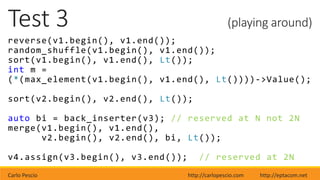
Test 3 (playing around)
reverse(v1.begin(), v1.end());
random_shuffle(v1.begin(), v1.end());
sort(v1.begin(), v1.end(), Lt());
int m =
(*(max_element(v1.begin(), v1.end(), Lt())))->Value();
sort(v2.begin(), v2.end(), Lt());
auto bi = back_inserter(v3); // reserved at N not 2N
merge(v1.begin(), v1.end(),
v2.begin(), v2.end(), bi, Lt());
v4.assign(v3.begin(), v3.end()); // reserved at 2N
Carlo Pescio http://carlopescio.com http://eptacom.net
Notes:
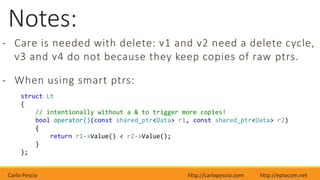
- Care is needed with delete: v1 and v2 need a delete cycle,
v3 and v4 do not because they keep copies of raw ptrs.
- When using smart ptrs:
struct Lt
{
// intentionally without a & to trigger more copies!
bool operator()(const shared_ptr<Data> r1, const shared_ptr<Data> r2)
{
return r1->Value() < r2->Value();
}
};
Carlo Pescio http://carlopescio.com http://eptacom.net
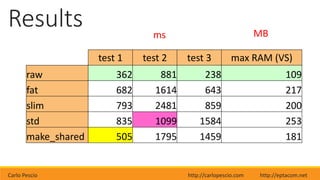
Results
test 1 test 2 test 3 max RAM (VS)
raw 362 881 238 109
fat 682 1614 643 217
slim 793 2481 859 200
std 835 1099 1584 253
make_shared 505 1795 1459 181
ms MB
Carlo Pescio http://carlopescio.com http://eptacom.net
Can we make it faster?
- The weird one
- Some physics of software (run-time space)
- Use the physics, Luke
Carlo Pescio http://carlopescio.com http://eptacom.net
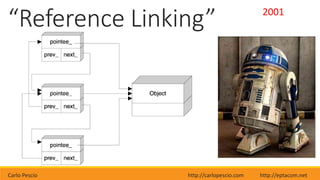
“Reference Linking” 2001
Carlo Pescio http://carlopescio.com http://eptacom.net
Look, no counter…
Constructor won’t throw
as it does not allocate extra storage
No need for make_shared
no need to use shared ptrs everywhere
Fat (200% overhead)
Carlo Pescio http://carlopescio.com http://eptacom.net
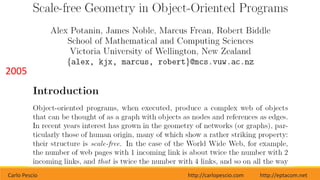
2005
Carlo Pescio http://carlopescio.com http://eptacom.net
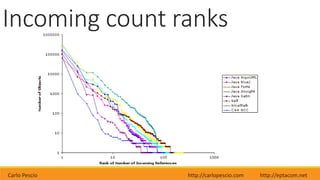
Incoming count ranks
Carlo Pescio http://carlopescio.com http://eptacom.net
Quick check
Max counter was 3
in the previous
benchmark
(tested in my FAT
implementation)
Carlo Pescio http://carlopescio.com http://eptacom.net
So?
Two steps:
1) Optimize for the small
2) Turn into FAT when count > K, K small (3-4)
Must keep the same memory footprint between 1 -> 2
Carlo Pescio http://carlopescio.com http://eptacom.net
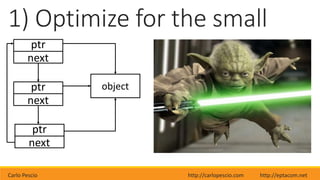
1) Optimize for the small
object
ptr
next
ptr
next
ptr
next
Carlo Pescio http://carlopescio.com http://eptacom.net
Trivial implementation
Single linked list
Predecessor -> while loop (short path anyway)
Alternatives / experiments needed
watch code size / inlining
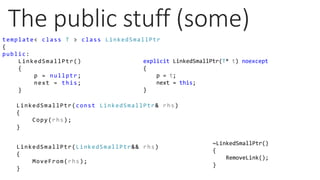
The public stuff (some)
template< class T > class LinkedSmallPtr
{
public:
LinkedSmallPtr()
{
p = nullptr;
next = this;
}
LinkedSmallPtr(LinkedSmallPtr&& rhs)
{
MoveFrom(rhs);
}
explicit LinkedSmallPtr(T* t) noexcept
{
p = t;
next = this;
}
LinkedSmallPtr(const LinkedSmallPtr& rhs)
{
Copy(rhs);
}
~LinkedSmallPtr()
{
RemoveLink();
}
The public stuff (some)
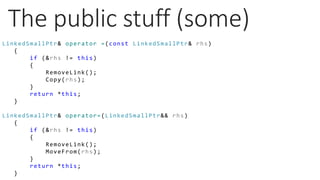
LinkedSmallPtr& operator =(const LinkedSmallPtr& rhs)
{
if (&rhs != this)
{
RemoveLink();
Copy(rhs);
}
return *this;
}
LinkedSmallPtr& operator=(LinkedSmallPtr&& rhs)
{
if (&rhs != this)
{
RemoveLink();
MoveFrom(rhs);
}
return *this;
}
Carlo Pescio http://carlopescio.com http://eptacom.net
The private stuff
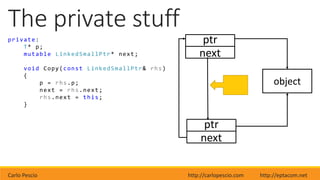
private:
T* p;
mutable LinkedSmallPtr* next;
void Copy(const LinkedSmallPtr& rhs)
{
p = rhs.p;
next = rhs.next;
rhs.next = this;
}
object
ptr
next
ptr
next
Carlo Pescio http://carlopescio.com http://eptacom.net
The private stuff
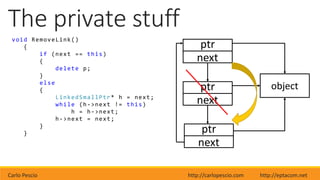
void RemoveLink()
{
if (next == this)
{
delete p;
}
else
{
LinkedSmallPtr* h = next;
while (h->next != this)
h = h->next;
h->next = next;
}
}
object
ptr
next
ptr
next
ptr
next
Carlo Pescio http://carlopescio.com http://eptacom.net
The private stuff
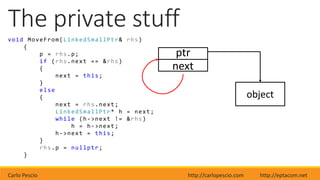
void MoveFrom(LinkedSmallPtr& rhs)
{
p = rhs.p;
if (rhs.next == &rhs)
{
next = this;
}
else
{
next = rhs.next;
LinkedSmallPtr* h = next;
while (h->next != &rhs)
h = h->next;
h->next = this;
}
rhs.p = nullptr;
}
object
ptr
next
Carlo Pescio http://carlopescio.com http://eptacom.net
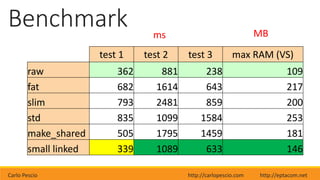
Benchmark
test 1 test 2 test 3 max RAM (VS)
raw 362 881 238 109
fat 682 1614 643 217
slim 793 2481 859 200
std 835 1099 1584 253
make_shared 505 1795 1459 181
small linked 339 1089 633 146
ms MB
Carlo Pescio http://carlopescio.com http://eptacom.net
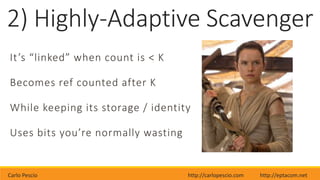
2) Highly-Adaptive Scavenger
It’s “linked” when count is < K
Becomes ref counted after K
While keeping its storage / identity
Uses bits you’re normally wasting
Carlo Pescio http://carlopescio.com http://eptacom.net
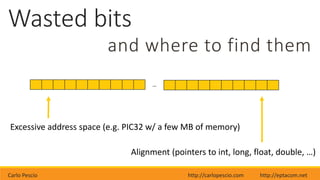
Wasted bits
and where to find them
…
Excessive address space (e.g. PIC32 w/ a few MB of memory)
Alignment (pointers to int, long, float, double, …)
Carlo Pescio http://carlopescio.com http://eptacom.net
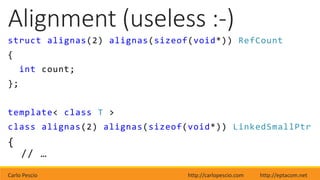
Alignment (useless :-)
struct alignas(2) alignas(sizeof(void*)) RefCount
{
int count;
};
template< class T >
class alignas(2) alignas(sizeof(void*)) LinkedSmallPtr
{
// …
Carlo Pescio http://carlopescio.com http://eptacom.net
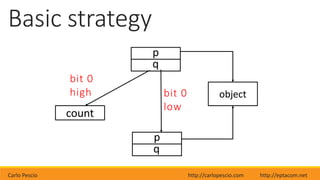
Basic strategy
object
p
q
p
q
bit 0
low
count
bit 0
high
Carlo Pescio http://carlopescio.com http://eptacom.net
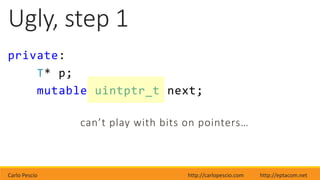
Ugly, step 1
private:
T* p;
mutable uintptr_t next;
can’t play with bits on pointers…
Carlo Pescio http://carlopescio.com http://eptacom.net
How do you “count”?
On copy: hard / probably inefficient / more bits (?)
On destruction: easy / statistically ok
Better ideas welcome 
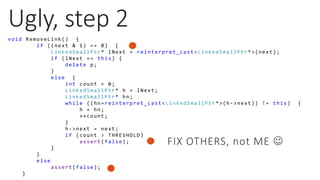
Ugly, step 2
void RemoveLink() {
if ((next & 1) == 0) {
LinkedSmallPtr* lNext = reinterpret_cast<LinkedSmallPtr*>(next);
if (lNext == this) {
delete p;
}
else {
int count = 0;
LinkedSmallPtr* h = lNext;
LinkedSmallPtr* hn;
while ((hn=reinterpret_cast<LinkedSmallPtr*>(h->next)) != this) {
h = hn;
++count;
}
h->next = next;
if (count > THRESHOLD)
assert(false);
}
}
else
assert(false);
}
FIX OTHERS, not ME 
Carlo Pescio http://carlopescio.com http://eptacom.net
“Promotion cost”
Once you get over threshold, you need to remap ALL the
nodes from linked to counted.
Careful not to oscillate around this point!
Carlo Pescio http://carlopescio.com http://eptacom.net
If you grow big, you stay big
- Once you get promoted
from linked to counted, you
stay counted even if the
count goes down.
Carlo Pescio http://carlopescio.com http://eptacom.net
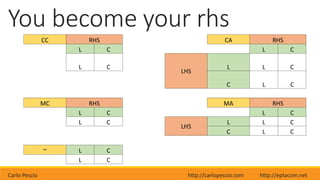
You become your rhs
CC RHS CA RHS
L C L C
L C
LHS
L L C
C L C
MC RHS MA RHS
L C L C
L C
LHS
L L C
C L C
~ L C
L C
Carlo Pescio http://carlopescio.com http://eptacom.net
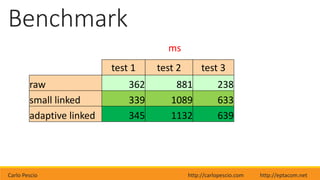
Benchmark
test 1 test 2 test 3
raw 362 881 238
small linked 339 1089 633
adaptive linked 345 1132 639
ms
Carlo Pescio http://carlopescio.com http://eptacom.net
What’s the catch?
Code is significantly more complex
simplification welcome
Degenerate behavior potentially costly
reference a lot, then release all
Carlo Pescio http://carlopescio.com http://eptacom.net
Conclusions
The “big” idea is building something that responds well to
the most common real-world scenarios, while adapting to
the “long tail” of unusual cases.
Extends well beyond this case
lots of experiments still needed
Carlo Pescio http://carlopescio.com http://eptacom.net
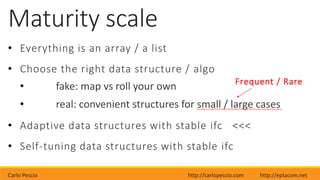
Maturity scale
• Everything is an array / a list
• Choose the right data structure / algo
• fake: map vs roll your own
• real: convenient structures for small / large cases
• Adaptive data structures with stable ifc <<<
• Self-tuning data structures with stable ifc
Frequent / Rare
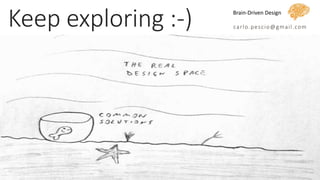
Keep exploring :-) Brain-Driven Design
carlo.pescio@gmail.com

(Slightly) Smarter Smart Pointers

  • 1.
    (slightly) smarter SMART PTRS www.italiancpp.org C++Day 2017 2 Dicembre, Modena Carlo Pescio C++ DAY 2017 – UN EVENTO DELL’ITALIAN C++ COMMUNITY
  • 2.
    Carlo Pescio http://carlopescio.comhttp://eptacom.net Anyone not using smart ptrs?
  • 3.
    Carlo Pescio http://carlopescio.comhttp://eptacom.net Smart Pointers are cool - (good) smart pointers enable explicit lifetime design - Still smart pointers have some run-time overhead - Talk is focusing on that overhead, not lifetime design - Specifically, shared pointers
  • 4.
    Carlo Pescio http://carlopescio.comhttp://eptacom.net Just a proof of concept - Code lacks support for polymorphic conversion etc. - I’ve kept this thing in a closet way too long :-) - Probably the “invention” process is more interesting than the thing itself.
  • 5.
    Carlo Pescio http://carlopescio.comhttp://eptacom.net Shared pointers • Shared ownership of an object • Last pointer to go destroys the pointed object • Usually keeps a count of incoming references to obj • Count must be shared as well
  • 6.
    Carlo Pescio http://carlopescio.comhttp://eptacom.net Shared pointers in practice • 3 basic implementations • (+ an uncommon one) • C++11 implementation
  • 7.
    Carlo Pescio http://carlopescio.comhttp://eptacom.net Invasive
  • 8.
    Carlo Pescio http://carlopescio.comhttp://eptacom.net Slim, maybe slow
  • 9.
    Carlo Pescio http://carlopescio.comhttp://eptacom.net Fat, maybe fast
  • 10.
    Carlo Pescio http://carlopescio.comhttp://eptacom.net Standard T* cb* T object RC WC FULL OBJ * deleter ….
  • 11.
    Carlo Pescio http://carlopescio.comhttp://eptacom.net Standard + make_shared T* cb* T object RC WC FULL OBJ * [deleter] …. +
  • 12.
    Carlo Pescio http://carlopescio.comhttp://eptacom.net <Interlude> Rant is coming
  • 13.
    Carlo Pescio http://carlopescio.comhttp://eptacom.net Why I don’t like shared_ptr OPINION <<< BEWARE : ) “C was designed on the assumption that the programmer is someone sensible who knows what he's doing” (Kernighan and Ritchie) “What you don't use, you don't pay for” (Stroustrup)
  • 14.
    Carlo Pescio http://carlopescio.comhttp://eptacom.net shared_ptr: the dark side You pay the overhead of weak even if you don’t use it Trying to protect you from absence of virtual destructor You lose a standalone weak ptr make_shared is a virus (factory -> unique -> penalty)
  • 15.
    Carlo Pescio http://carlopescio.comhttp://eptacom.net Safe-by-design weak usage NOT VALID C++ (just an example) unique unique weak
  • 16.
    Carlo Pescio http://carlopescio.comhttp://eptacom.net </Interlude> Sorry for ranting
  • 17.
    Carlo Pescio http://carlopescio.comhttp://eptacom.net A little benchmark - Not much science, just a few reasonable tests, should be expanded, tested with more compilers, etc. - 3 tests: allocation, dereferencing, “complex” usage. - Tested raw, std::shared_ptr, std:shared_ptr + make_shared, a slim and a fat version I implemented.
  • 18.
    Carlo Pescio http://carlopescio.comhttp://eptacom.net Baseline (raw pointers) struct Data { public: Data(int v) : n(v) { ++liveInstances; } ~Data() { --liveInstances; } // … private: static int liveInstances; int n; }; struct Lt { bool operator()(const Data* d1, const Data* d2) { return d1->Value() < d2->Value(); } };
  • 19.
    Carlo Pescio http://carlopescio.comhttp://eptacom.net Test 1 vector<Data*> v0; v0.reserve(N); for (int j = 0; j < 10; ++j) { for (int i = 0; i < N; ++i) v0.push_back(new Data(i)); for (int i = 0; i < N; ++i) delete v0[i]; v0.clear(); } N = 500000 Just a lot of construction / destruction, no usage
  • 20.
    Carlo Pescio http://carlopescio.comhttp://eptacom.net Test 2 for (int j = 0; j < 1000; ++j) { for (int i = 0; i < N; ++i) n += v1[i]->Value(); } V1 prefilled with N random values. n used after to prevent optimization Lot of usage, no creation / destructions
  • 21.
    Carlo Pescio http://carlopescio.comhttp://eptacom.net Test 3 (playing around) reverse(v1.begin(), v1.end()); random_shuffle(v1.begin(), v1.end()); sort(v1.begin(), v1.end(), Lt()); int m = (*(max_element(v1.begin(), v1.end(), Lt())))->Value(); sort(v2.begin(), v2.end(), Lt()); auto bi = back_inserter(v3); // reserved at N not 2N merge(v1.begin(), v1.end(), v2.begin(), v2.end(), bi, Lt()); v4.assign(v3.begin(), v3.end()); // reserved at 2N
  • 22.
    Carlo Pescio http://carlopescio.comhttp://eptacom.net Notes: - Care is needed with delete: v1 and v2 need a delete cycle, v3 and v4 do not because they keep copies of raw ptrs. - When using smart ptrs: struct Lt { // intentionally without a & to trigger more copies! bool operator()(const shared_ptr<Data> r1, const shared_ptr<Data> r2) { return r1->Value() < r2->Value(); } };
  • 23.
    Carlo Pescio http://carlopescio.comhttp://eptacom.net Results test 1 test 2 test 3 max RAM (VS) raw 362 881 238 109 fat 682 1614 643 217 slim 793 2481 859 200 std 835 1099 1584 253 make_shared 505 1795 1459 181 ms MB
  • 24.
    Carlo Pescio http://carlopescio.comhttp://eptacom.net Can we make it faster? - The weird one - Some physics of software (run-time space) - Use the physics, Luke
  • 25.
    Carlo Pescio http://carlopescio.comhttp://eptacom.net “Reference Linking” 2001
  • 26.
    Carlo Pescio http://carlopescio.comhttp://eptacom.net Look, no counter… Constructor won’t throw as it does not allocate extra storage No need for make_shared no need to use shared ptrs everywhere Fat (200% overhead)
  • 27.
    Carlo Pescio http://carlopescio.comhttp://eptacom.net 2005
  • 28.
    Carlo Pescio http://carlopescio.comhttp://eptacom.net Incoming count ranks
  • 29.
    Carlo Pescio http://carlopescio.comhttp://eptacom.net Quick check Max counter was 3 in the previous benchmark (tested in my FAT implementation)
  • 30.
    Carlo Pescio http://carlopescio.comhttp://eptacom.net So? Two steps: 1) Optimize for the small 2) Turn into FAT when count > K, K small (3-4) Must keep the same memory footprint between 1 -> 2
  • 31.
    Carlo Pescio http://carlopescio.comhttp://eptacom.net 1) Optimize for the small object ptr next ptr next ptr next
  • 32.
    Carlo Pescio http://carlopescio.comhttp://eptacom.net Trivial implementation Single linked list Predecessor -> while loop (short path anyway) Alternatives / experiments needed watch code size / inlining
  • 33.
    The public stuff(some) template< class T > class LinkedSmallPtr { public: LinkedSmallPtr() { p = nullptr; next = this; } LinkedSmallPtr(LinkedSmallPtr&& rhs) { MoveFrom(rhs); } explicit LinkedSmallPtr(T* t) noexcept { p = t; next = this; } LinkedSmallPtr(const LinkedSmallPtr& rhs) { Copy(rhs); } ~LinkedSmallPtr() { RemoveLink(); }
  • 34.
    The public stuff(some) LinkedSmallPtr& operator =(const LinkedSmallPtr& rhs) { if (&rhs != this) { RemoveLink(); Copy(rhs); } return *this; } LinkedSmallPtr& operator=(LinkedSmallPtr&& rhs) { if (&rhs != this) { RemoveLink(); MoveFrom(rhs); } return *this; }
  • 35.
    Carlo Pescio http://carlopescio.comhttp://eptacom.net The private stuff private: T* p; mutable LinkedSmallPtr* next; void Copy(const LinkedSmallPtr& rhs) { p = rhs.p; next = rhs.next; rhs.next = this; } object ptr next ptr next
  • 36.
    Carlo Pescio http://carlopescio.comhttp://eptacom.net The private stuff void RemoveLink() { if (next == this) { delete p; } else { LinkedSmallPtr* h = next; while (h->next != this) h = h->next; h->next = next; } } object ptr next ptr next ptr next
  • 37.
    Carlo Pescio http://carlopescio.comhttp://eptacom.net The private stuff void MoveFrom(LinkedSmallPtr& rhs) { p = rhs.p; if (rhs.next == &rhs) { next = this; } else { next = rhs.next; LinkedSmallPtr* h = next; while (h->next != &rhs) h = h->next; h->next = this; } rhs.p = nullptr; } object ptr next
  • 38.
    Carlo Pescio http://carlopescio.comhttp://eptacom.net Benchmark test 1 test 2 test 3 max RAM (VS) raw 362 881 238 109 fat 682 1614 643 217 slim 793 2481 859 200 std 835 1099 1584 253 make_shared 505 1795 1459 181 small linked 339 1089 633 146 ms MB
  • 39.
    Carlo Pescio http://carlopescio.comhttp://eptacom.net 2) Highly-Adaptive Scavenger It’s “linked” when count is < K Becomes ref counted after K While keeping its storage / identity Uses bits you’re normally wasting
  • 40.
    Carlo Pescio http://carlopescio.comhttp://eptacom.net Wasted bits and where to find them … Excessive address space (e.g. PIC32 w/ a few MB of memory) Alignment (pointers to int, long, float, double, …)
  • 41.
    Carlo Pescio http://carlopescio.comhttp://eptacom.net Alignment (useless :-) struct alignas(2) alignas(sizeof(void*)) RefCount { int count; }; template< class T > class alignas(2) alignas(sizeof(void*)) LinkedSmallPtr { // …
  • 42.
    Carlo Pescio http://carlopescio.comhttp://eptacom.net Basic strategy object p q p q bit 0 low count bit 0 high
  • 43.
    Carlo Pescio http://carlopescio.comhttp://eptacom.net Ugly, step 1 private: T* p; mutable uintptr_t next; can’t play with bits on pointers…
  • 44.
    Carlo Pescio http://carlopescio.comhttp://eptacom.net How do you “count”? On copy: hard / probably inefficient / more bits (?) On destruction: easy / statistically ok Better ideas welcome 
  • 45.
    Ugly, step 2 voidRemoveLink() { if ((next & 1) == 0) { LinkedSmallPtr* lNext = reinterpret_cast<LinkedSmallPtr*>(next); if (lNext == this) { delete p; } else { int count = 0; LinkedSmallPtr* h = lNext; LinkedSmallPtr* hn; while ((hn=reinterpret_cast<LinkedSmallPtr*>(h->next)) != this) { h = hn; ++count; } h->next = next; if (count > THRESHOLD) assert(false); } } else assert(false); } FIX OTHERS, not ME 
  • 46.
    Carlo Pescio http://carlopescio.comhttp://eptacom.net “Promotion cost” Once you get over threshold, you need to remap ALL the nodes from linked to counted. Careful not to oscillate around this point!
  • 47.
    Carlo Pescio http://carlopescio.comhttp://eptacom.net If you grow big, you stay big - Once you get promoted from linked to counted, you stay counted even if the count goes down.
  • 48.
    Carlo Pescio http://carlopescio.comhttp://eptacom.net You become your rhs CC RHS CA RHS L C L C L C LHS L L C C L C MC RHS MA RHS L C L C L C LHS L L C C L C ~ L C L C
  • 49.
    Carlo Pescio http://carlopescio.comhttp://eptacom.net Benchmark test 1 test 2 test 3 raw 362 881 238 small linked 339 1089 633 adaptive linked 345 1132 639 ms
  • 50.
    Carlo Pescio http://carlopescio.comhttp://eptacom.net What’s the catch? Code is significantly more complex simplification welcome Degenerate behavior potentially costly reference a lot, then release all
  • 51.
    Carlo Pescio http://carlopescio.comhttp://eptacom.net Conclusions The “big” idea is building something that responds well to the most common real-world scenarios, while adapting to the “long tail” of unusual cases. Extends well beyond this case lots of experiments still needed
  • 52.
    Carlo Pescio http://carlopescio.comhttp://eptacom.net Maturity scale • Everything is an array / a list • Choose the right data structure / algo • fake: map vs roll your own • real: convenient structures for small / large cases • Adaptive data structures with stable ifc <<< • Self-tuning data structures with stable ifc Frequent / Rare
  • 53.
    Keep exploring :-)Brain-Driven Design carlo.pescio@gmail.com