Pre-Retirement Financial Planning Making sense of your financial future Presentation by …
One of the UK’s foremost financial commentators
Your concerns Money management/Pension issues Threats to capital Guide to Taxation and Inheritance Tax Investments and investing The way forward Agenda
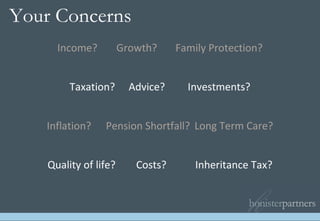
Income? Growth? Family Protection? Taxation? Advice? Investments? Inflation? Pension Shortfall? Long Term Care? Quality of life? Costs? Inheritance Tax? Your Concerns
Money Management
Our experience shows that by reviewing your personal financial situation most people can continue to meet day-to-day living expenses Money Management – Our Belief
Example: Figures are based on 40/80 final salary (contracted-out) with pension contribution of 6.00% of earnings.  Based on 2009/10 Tax Year. Retirement Pension (Pre 65 – assuming 40 years service) Pre-retirement Salary Money Management £11,295 Net Income £18,645 £0 Pension Contribution 6% £1,500 £0 National Insurance £1,812 £1,205 Tax Payable £3,043 £6,475 Personal Allowance £6,475 £12,500 (50%) Gross Income £25,000
Plus ………. £30,000 Money Management
Question: Do you wish to continue these outgoings in retirement? NB: The amounts quoted are for illustrative purposes only What course of action? Approximately £50 per month Savings (Endowment) Approximately £150 per month Savings (Bank) Approximately £80 per month Loan / Credit Card Approximately £250 per month Mortgage
Review all your regular outgoings Review mortgage Consider repaying loans Re-appraise your regular savings account and  policies  Your guide to planning retirement income
Pay Off? Consider Life Policies? Reduce your outgoings? Comfort factor Retain? Access to capital Investment Potential Re-negotiate Low interest rates Your Mortgage Guide
Loans tend to be shorter term 3 – 5 years Credit cards can be expensive Check high APR Check surrender/penalties on loan Your Guide to Loans and Debts
Savings to Bank – Don’t Rob Peter….! Mortgage Endowment – see it through to maturity for best results “ To find out more about any of these issues, please tick the coloured priority form” Your Guide to Savings
Up to half final salary as pension and a lump sum Index Linked Pension Cash can be invested Lump sum is tax free Surviving Spouse’s pension This is dependent on number of years pensionable service in the scheme Pension Issues – What will you receive
Check if your pension scheme will exchange for added   years, or enhanced rates Ask whether you qualify for enhanced rates or  impaired life annuity rates Open Market Options (OMO) From “A-Day” (6th April 2006) up to 25% of your     AVC/FSAVC fund may be available as tax-free cash Seek Advice Your Guide to AVC or FSAVC
Interest Rates – where are they heading? Threats to your capital and income
Is Inflation still a threat? Inflation rates displayed are for illustration purposes only and should not be viewed as proposed past or future inflation values.  Figures are based on the value of £1,000 189 358 544 20 434 599 738 10 659 774 858 5 920 950 970 1  8% 5% 3% Annual Rate of Inflation Years Ahead
Source:  Office for National Statistics - ‘Focus on CPI February 2010’ Guide to Goods and Services Prices: 1980 vs Today * Average beer prices not recorded prior to this date ONS 303% £1.21 30p Loaf of Bread ONS 191% £1.12 38.46p Litre of Petrol ONS 159% 44p 17p Pint of Milk ONS 1987* 248% £2.89 83p Pint of Lager Source Increase Average Price Feb 10 Average  Price 1980’s
Source: Office of National Statistics website April 10 Guide to Commodity Prices   RPI 128% 217.09 95.23 Increase March 2010 July 1985
Your Guide to Taxation
“ I believe we should all pay our taxes with a smile – I tried, but they wanted cash!” - Anon Your Guide to Taxation
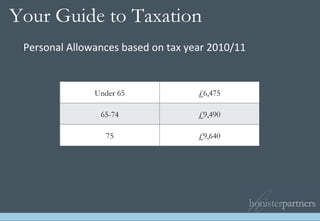
Personal Allowances based on tax year 2010/11 Your Guide to Taxation   £9,640 75 £9,490 65-74 £6,475 Under 65
Your personal allowance is the amount you can earn each year before paying any tax. Tax is then payable as follows: £0 - £37,400  20% £37,401 – 150,000 40% Over £150,001 50% Taxable income based on tax year 10/11
Tax on Capital Assets on Death Inheritance Tax
What does this mean? 40% Is it a voluntary tax? What is the current rate of tax? What is the Nil Rate Band? Inheritance Tax £325,000  Some would say YES! IHT Levels and bases of, and reliefs from taxation are subject to change Your Guide to Estate Planning
Tax on capital assets on death First £325,000 of estate -  0% tax Balance of estate - 40% tax Inheritance Tax  - based on tax year 10/11
Worldwide assets House Savings Investments Cars Caravans Holiday homes (UK and Abroad) House contents Capital value of life interest trusts Some pension funds What is Inheritance Tax payable on?
Gifts to s pouse Main Exemptions First £3,000 each year – annual exemption “ Normal expenditure” Potentially Exempt Transfers (PETs) Inheritance Tax -  based on tax year 10/11
Donations To Charity Donations To Political Parties Other exemptions Inheritance Tax -  based on tax year 10/11
On consideration of marriage Child (for each parent) £5,000 Grandchild £2,500 Other £1,000 Small gifts £250   Levels and bases of, and reliefs from taxation are subject to change Inheritance Tax -  based on tax year 10/11
All gifts other than exemptions and chargeable lifetime transfers are known as PETs After 7 years asset does not form part of estate Possible  Tax relief on a sliding scale (rules apply however) Potentially exempt transfers   Early Planning!
Making a gift but still retaining an interest in it Inland Revenue will treat the asset as still belonging to you Gifts with reservation
Gifts out of income?   Gifts from excess income could be used in the same way as annual allowances But watch out where income comes from*   * Surplus income should be shown to be able to come from normal income-producing assets such as pensions, deposit-based accounts, annuities and certain other types of investments.
Do Nothing Spend It/Give it away! Make lifetime gifts Plan to mitigate it What can you do?
Alleviation for Middle England   On death Mr Smith passes all of his estate (plus jointly owned assets) to his wife free from IHT. However, this wastes 100% of his Nil Rate Band. Nil Rate Band £325,000  (As of April 2010)   Mrs Smith total Sole Estate  = £650,000 Mr & Mrs Smith’s total joint Estate £650,000. A transferable Nil Rate Band now arises when one party to a marriage/civil partnership dies and the amount of their estate chargeable to IHT does not use up all of the Nil Rate Band. Where this happens, the unused part can now be transferred to the surviving spouse/civil partner when they die. Assuming  Mrs  Smith dies after 9 October 2007, her executors may also utilise the late Mr Smith’s Nil Rate Band which he wasted by leaving everything to his widow. Less 2 x Nil Rate Bands = £650,000 Taxable Estate = £0
Personal representatives will need to ensure that the surviving spouse/civil partner has sufficient documents and information about the transferable Nil Rate Band when first death occur.  The surviving spouse should therefore receive: A copy of the HMRC return (IHT200 or 205) Copy of the deceased’s Will Important documents e.g. deed of variation Valuation of assets that did not pass to the survivor etc A claim must be made within 24 months from the end of the month in which the surviving spouse/civil partner dies. It is the relevant percentage of the unused historic nil rate band that is carried forward – not the nil rate band itself. The appropriate percentage is then applied to the prevailing nil rate band in the year of second death.  The Unused Nil Rate Band
Levels and bases of, and reliefs from taxation are subject to change. Inheritance Tax Solution   Mr Smith’s Estate £325,000 Mrs Smith’s Estate £325,000 Mr Smith leaves the £325,000 in a Discretionary Will Trust. Total Estate = £325,000 Taxable Estate = Nil Nil Rate Band £325,000   (As of April 2010)   If the potential growth in value of an asset is likely to outstrip future increases in the Nil Rate Band, tax planned Wills on first death leaving an amount up to £325,000 [2010/11] to a trust should still be considered. TAX DUE @ 40% NIL TAX DUE @ 40% =  NIL Year 2010 value of trust - £390,000 (available NRB - £325,000 had asset passed to surviving spouse on first death.)
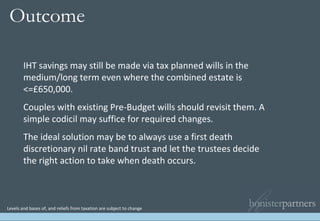
Levels and bases of, and reliefs from taxation are subject to change IHT savings may still be made via tax planned wills in the medium/long term even where the combined estate is <=£650,000. Couples with existing Pre-Budget wills should revisit them. A simple codicil may suffice for required changes. The ideal solution may be to always use a first death discretionary nil rate band trust and let the trustees decide the right action to take when death occurs. Outcome
Your Guide to Wills and Estate Planning
To ensure your wishes are carried out after your death To ensure the right people get the right assets To speed up the transfer of assets (via Probate) To reduce Inheritance Tax through Will Trusts Why make a Will?
Laws of Intestacy – the State determines who gets your estate Loss of absolute control over your assets  Unmarried partners may suffer financially Long delays in transferring  £250,000 to spouse plus a life interest in 50% of residue The remaining 50% interest for children (in trust under 18) What happens without a Will?
Review it regularly Marriage will annul a Will Divorce will affect a Will Have you appointed Guardians? Do you have stepchildren? Is your Will tax-efficient? Existing Will
Lasting Powers of Attorney Trustees must take financial advice Where to keep your Will Other Legal Matters
Specialist financial advice needed to ensure your estate is equalised so that each can use nil rate bands.  Possibly need to review life assurance and place in trust Need to look at death in service benefits and rules in connection with their payment Need to look at the value of your home and ensure that it is split 50/50.  This may require severance of tenancy   options Why would I need a Financial Adviser?
Your Guide to Investment
Security Income: now or later? Capital growth Tax efficiency Access to capital Rate of return What are your aims and objectives?
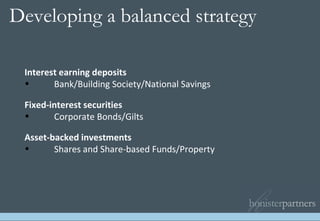
Interest earning deposits  Bank/Building Society/National Savings Fixed-interest securities Corporate Bonds/Gilts Asset-backed investments Shares and Share-based Funds/Property Developing a balanced strategy
Honister Scale – Investment Risk   High Low Venture Capital Trusts  Emerging Markets  Far East / Japan UK Smaller Co’s Global & UK Equity Growth / Income Funds  Tracker and Manager Funds Cautious Managed / Distribution  Commercial Property or With Profit Funds Individual Gilts and Fixed Interest / Cash Banks/Building Societies / National Savings Single  Company  Shares  Futures/Options
Gilts Government Stock Corporate Bonds IOUs issued by companies Fixed Interest Investments
Long-term growth prospects Potential to beat inflation Disadvantages/risk Spread your risk Stock Market Activity Past Performance is not a guide to future performance Equities (Shares)
Cash   Bonds   Shares Security and Accessibility  Income is dependent upon Interest rates set by Bank of England Returns unlikely to match Inflation Minimal potential for income growth Minimal potential for capital growth  Low volatility Behave differently from shares so can provide differentiation Relatively high and consistent income Limited potential for growth of income Limited potential for growth of capital Can be volatile Lower income than bonds Income can fluctuate Potential for rising income Potential for capital growth over long term Your Guide to Investment
£5,000 invested for 10 years – Invesco Perpetual Income, with NET income re-invested Your Guide to Investment   Past performance will not necessarily be repeated in the future. Capital held in a deposit account is guaranteed not to fall in value,   whereas the value of units and income from an equity- based investment can fall as well as rise and is not guaranteed.  Equity based investments should be considered as medium to long term investments, therefore if you withdraw in the early years you may not get back your original investment.
FTSE 100 vs Halifax House Price Index Your Guide to Investment Past performance will not necessarily be repeated in the future. Capital held in a deposit account is guaranteed not to fall in value,   whereas the value of units and income from an equity- based investment can fall as well as rise and is not guaranteed.  Equity based investments should be considered as medium to long term investments, therefore if you withdraw in the early years you may not get back your original investment.
Source: Fidelity Total Return 31/01/94 to 30/01/09 excluding charges Be Invested… Stay Invested…   -6.14% 0.40% 4.54% FTSE All Share UK Best 40 days missed Best 10 days missed Annual & return stayed invested Index Market
Annual allowance for tax year 2009/10 is £10,200 Two types of ISA - ‘Cash’ or ‘Stocks & Shares’  Can invest total allowance in Stocks & Shares ISA  Can split the annual allowance across the two ISA types but maximum allowance of £5,100 in Cash ISA per year Could choose to invest less than £5,100 in a Cash ISA and place more in a Stocks & Shares ISA e.g. £2,500 Cash and £7,700 in Stocks & Shares ISA, provided annual allowance not exceeded ISA Year Subscription Process
Tax-efficient wrapper No minimum savings period World-Wide Scope Choice of underlying investment is key Facts about ISAs
Complete and hand in the Priority Coupon Book a one-to-one consultation Contact marketingservices@honistercapital.com Call us on 0845 013 5600 We wish you good luck!! The way forward…
Thank You
Honister Partners 62 Anchorange Road Sutton Coldfield West Midlands B74 2PG Telephone:  0845 013 5600  Facsimile:  0121 362 1010 Website:  www.honisterpartners.com Honister Partners Ltd is an appointed representative of Sage Financial Services Ltd. The Financial Services Authority does not regulate taxation advice or will writing.  Past performance is not a guide to future performance. The information given is based on our current understanding of Law and Inland Revenue practice.  Tax rates and reliefs may change and their value depends on the individual circumstances of the investor.  The information provided in this presentation has been provided as information only and does not represent individual advice. It is unrealistic to assume that markets/funds or indexes will perform as they have done in the past.  Honister Partners offer advice based on the whole of the market.

Slides Pre Retirement

  • 1.
    Pre-Retirement Financial PlanningMaking sense of your financial future Presentation by …
  • 2.
    One of theUK’s foremost financial commentators
  • 3.
    Your concerns Moneymanagement/Pension issues Threats to capital Guide to Taxation and Inheritance Tax Investments and investing The way forward Agenda
  • 4.
    Income? Growth? FamilyProtection? Taxation? Advice? Investments? Inflation? Pension Shortfall? Long Term Care? Quality of life? Costs? Inheritance Tax? Your Concerns
  • 5.
  • 6.
    Our experience showsthat by reviewing your personal financial situation most people can continue to meet day-to-day living expenses Money Management – Our Belief
  • 7.
    Example: Figures arebased on 40/80 final salary (contracted-out) with pension contribution of 6.00% of earnings. Based on 2009/10 Tax Year. Retirement Pension (Pre 65 – assuming 40 years service) Pre-retirement Salary Money Management £11,295 Net Income £18,645 £0 Pension Contribution 6% £1,500 £0 National Insurance £1,812 £1,205 Tax Payable £3,043 £6,475 Personal Allowance £6,475 £12,500 (50%) Gross Income £25,000
  • 8.
    Plus ………. £30,000Money Management
  • 9.
    Question: Do youwish to continue these outgoings in retirement? NB: The amounts quoted are for illustrative purposes only What course of action? Approximately £50 per month Savings (Endowment) Approximately £150 per month Savings (Bank) Approximately £80 per month Loan / Credit Card Approximately £250 per month Mortgage
  • 10.
    Review all yourregular outgoings Review mortgage Consider repaying loans Re-appraise your regular savings account and policies Your guide to planning retirement income
  • 11.
    Pay Off? ConsiderLife Policies? Reduce your outgoings? Comfort factor Retain? Access to capital Investment Potential Re-negotiate Low interest rates Your Mortgage Guide
  • 12.
    Loans tend tobe shorter term 3 – 5 years Credit cards can be expensive Check high APR Check surrender/penalties on loan Your Guide to Loans and Debts
  • 13.
    Savings to Bank– Don’t Rob Peter….! Mortgage Endowment – see it through to maturity for best results “ To find out more about any of these issues, please tick the coloured priority form” Your Guide to Savings
  • 14.
    Up to halffinal salary as pension and a lump sum Index Linked Pension Cash can be invested Lump sum is tax free Surviving Spouse’s pension This is dependent on number of years pensionable service in the scheme Pension Issues – What will you receive
  • 15.
    Check if yourpension scheme will exchange for added years, or enhanced rates Ask whether you qualify for enhanced rates or impaired life annuity rates Open Market Options (OMO) From “A-Day” (6th April 2006) up to 25% of your AVC/FSAVC fund may be available as tax-free cash Seek Advice Your Guide to AVC or FSAVC
  • 16.
    Interest Rates –where are they heading? Threats to your capital and income
  • 17.
    Is Inflation stilla threat? Inflation rates displayed are for illustration purposes only and should not be viewed as proposed past or future inflation values. Figures are based on the value of £1,000 189 358 544 20 434 599 738 10 659 774 858 5 920 950 970 1 8% 5% 3% Annual Rate of Inflation Years Ahead
  • 18.
    Source: Officefor National Statistics - ‘Focus on CPI February 2010’ Guide to Goods and Services Prices: 1980 vs Today * Average beer prices not recorded prior to this date ONS 303% £1.21 30p Loaf of Bread ONS 191% £1.12 38.46p Litre of Petrol ONS 159% 44p 17p Pint of Milk ONS 1987* 248% £2.89 83p Pint of Lager Source Increase Average Price Feb 10 Average Price 1980’s
  • 19.
    Source: Office ofNational Statistics website April 10 Guide to Commodity Prices RPI 128% 217.09 95.23 Increase March 2010 July 1985
  • 20.
    Your Guide toTaxation
  • 21.
    “ I believewe should all pay our taxes with a smile – I tried, but they wanted cash!” - Anon Your Guide to Taxation
  • 22.
    Personal Allowances basedon tax year 2010/11 Your Guide to Taxation £9,640 75 £9,490 65-74 £6,475 Under 65
  • 23.
    Your personal allowanceis the amount you can earn each year before paying any tax. Tax is then payable as follows: £0 - £37,400 20% £37,401 – 150,000 40% Over £150,001 50% Taxable income based on tax year 10/11
  • 24.
    Tax on CapitalAssets on Death Inheritance Tax
  • 25.
    What does thismean? 40% Is it a voluntary tax? What is the current rate of tax? What is the Nil Rate Band? Inheritance Tax £325,000 Some would say YES! IHT Levels and bases of, and reliefs from taxation are subject to change Your Guide to Estate Planning
  • 26.
    Tax on capitalassets on death First £325,000 of estate - 0% tax Balance of estate - 40% tax Inheritance Tax - based on tax year 10/11
  • 27.
    Worldwide assets HouseSavings Investments Cars Caravans Holiday homes (UK and Abroad) House contents Capital value of life interest trusts Some pension funds What is Inheritance Tax payable on?
  • 28.
    Gifts to spouse Main Exemptions First £3,000 each year – annual exemption “ Normal expenditure” Potentially Exempt Transfers (PETs) Inheritance Tax - based on tax year 10/11
  • 29.
    Donations To CharityDonations To Political Parties Other exemptions Inheritance Tax - based on tax year 10/11
  • 30.
    On consideration ofmarriage Child (for each parent) £5,000 Grandchild £2,500 Other £1,000 Small gifts £250 Levels and bases of, and reliefs from taxation are subject to change Inheritance Tax - based on tax year 10/11
  • 31.
    All gifts otherthan exemptions and chargeable lifetime transfers are known as PETs After 7 years asset does not form part of estate Possible Tax relief on a sliding scale (rules apply however) Potentially exempt transfers Early Planning!
  • 32.
    Making a giftbut still retaining an interest in it Inland Revenue will treat the asset as still belonging to you Gifts with reservation
  • 33.
    Gifts out ofincome? Gifts from excess income could be used in the same way as annual allowances But watch out where income comes from* * Surplus income should be shown to be able to come from normal income-producing assets such as pensions, deposit-based accounts, annuities and certain other types of investments.
  • 34.
    Do Nothing SpendIt/Give it away! Make lifetime gifts Plan to mitigate it What can you do?
  • 35.
    Alleviation for MiddleEngland On death Mr Smith passes all of his estate (plus jointly owned assets) to his wife free from IHT. However, this wastes 100% of his Nil Rate Band. Nil Rate Band £325,000 (As of April 2010) Mrs Smith total Sole Estate = £650,000 Mr & Mrs Smith’s total joint Estate £650,000. A transferable Nil Rate Band now arises when one party to a marriage/civil partnership dies and the amount of their estate chargeable to IHT does not use up all of the Nil Rate Band. Where this happens, the unused part can now be transferred to the surviving spouse/civil partner when they die. Assuming Mrs Smith dies after 9 October 2007, her executors may also utilise the late Mr Smith’s Nil Rate Band which he wasted by leaving everything to his widow. Less 2 x Nil Rate Bands = £650,000 Taxable Estate = £0
  • 36.
    Personal representatives willneed to ensure that the surviving spouse/civil partner has sufficient documents and information about the transferable Nil Rate Band when first death occur. The surviving spouse should therefore receive: A copy of the HMRC return (IHT200 or 205) Copy of the deceased’s Will Important documents e.g. deed of variation Valuation of assets that did not pass to the survivor etc A claim must be made within 24 months from the end of the month in which the surviving spouse/civil partner dies. It is the relevant percentage of the unused historic nil rate band that is carried forward – not the nil rate band itself. The appropriate percentage is then applied to the prevailing nil rate band in the year of second death. The Unused Nil Rate Band
  • 37.
    Levels and basesof, and reliefs from taxation are subject to change. Inheritance Tax Solution Mr Smith’s Estate £325,000 Mrs Smith’s Estate £325,000 Mr Smith leaves the £325,000 in a Discretionary Will Trust. Total Estate = £325,000 Taxable Estate = Nil Nil Rate Band £325,000 (As of April 2010) If the potential growth in value of an asset is likely to outstrip future increases in the Nil Rate Band, tax planned Wills on first death leaving an amount up to £325,000 [2010/11] to a trust should still be considered. TAX DUE @ 40% NIL TAX DUE @ 40% = NIL Year 2010 value of trust - £390,000 (available NRB - £325,000 had asset passed to surviving spouse on first death.)
  • 38.
    Levels and basesof, and reliefs from taxation are subject to change IHT savings may still be made via tax planned wills in the medium/long term even where the combined estate is <=£650,000. Couples with existing Pre-Budget wills should revisit them. A simple codicil may suffice for required changes. The ideal solution may be to always use a first death discretionary nil rate band trust and let the trustees decide the right action to take when death occurs. Outcome
  • 39.
    Your Guide toWills and Estate Planning
  • 40.
    To ensure yourwishes are carried out after your death To ensure the right people get the right assets To speed up the transfer of assets (via Probate) To reduce Inheritance Tax through Will Trusts Why make a Will?
  • 41.
    Laws of Intestacy– the State determines who gets your estate Loss of absolute control over your assets Unmarried partners may suffer financially Long delays in transferring £250,000 to spouse plus a life interest in 50% of residue The remaining 50% interest for children (in trust under 18) What happens without a Will?
  • 42.
    Review it regularlyMarriage will annul a Will Divorce will affect a Will Have you appointed Guardians? Do you have stepchildren? Is your Will tax-efficient? Existing Will
  • 43.
    Lasting Powers ofAttorney Trustees must take financial advice Where to keep your Will Other Legal Matters
  • 44.
    Specialist financial adviceneeded to ensure your estate is equalised so that each can use nil rate bands. Possibly need to review life assurance and place in trust Need to look at death in service benefits and rules in connection with their payment Need to look at the value of your home and ensure that it is split 50/50. This may require severance of tenancy options Why would I need a Financial Adviser?
  • 45.
    Your Guide toInvestment
  • 46.
    Security Income: nowor later? Capital growth Tax efficiency Access to capital Rate of return What are your aims and objectives?
  • 47.
    Interest earning deposits Bank/Building Society/National Savings Fixed-interest securities Corporate Bonds/Gilts Asset-backed investments Shares and Share-based Funds/Property Developing a balanced strategy
  • 48.
    Honister Scale –Investment Risk High Low Venture Capital Trusts Emerging Markets Far East / Japan UK Smaller Co’s Global & UK Equity Growth / Income Funds Tracker and Manager Funds Cautious Managed / Distribution Commercial Property or With Profit Funds Individual Gilts and Fixed Interest / Cash Banks/Building Societies / National Savings Single Company Shares Futures/Options
  • 49.
    Gilts Government StockCorporate Bonds IOUs issued by companies Fixed Interest Investments
  • 50.
    Long-term growth prospectsPotential to beat inflation Disadvantages/risk Spread your risk Stock Market Activity Past Performance is not a guide to future performance Equities (Shares)
  • 51.
    Cash Bonds Shares Security and Accessibility Income is dependent upon Interest rates set by Bank of England Returns unlikely to match Inflation Minimal potential for income growth Minimal potential for capital growth Low volatility Behave differently from shares so can provide differentiation Relatively high and consistent income Limited potential for growth of income Limited potential for growth of capital Can be volatile Lower income than bonds Income can fluctuate Potential for rising income Potential for capital growth over long term Your Guide to Investment
  • 52.
    £5,000 invested for10 years – Invesco Perpetual Income, with NET income re-invested Your Guide to Investment Past performance will not necessarily be repeated in the future. Capital held in a deposit account is guaranteed not to fall in value, whereas the value of units and income from an equity- based investment can fall as well as rise and is not guaranteed. Equity based investments should be considered as medium to long term investments, therefore if you withdraw in the early years you may not get back your original investment.
  • 53.
    FTSE 100 vsHalifax House Price Index Your Guide to Investment Past performance will not necessarily be repeated in the future. Capital held in a deposit account is guaranteed not to fall in value, whereas the value of units and income from an equity- based investment can fall as well as rise and is not guaranteed. Equity based investments should be considered as medium to long term investments, therefore if you withdraw in the early years you may not get back your original investment.
  • 54.
    Source: Fidelity TotalReturn 31/01/94 to 30/01/09 excluding charges Be Invested… Stay Invested… -6.14% 0.40% 4.54% FTSE All Share UK Best 40 days missed Best 10 days missed Annual & return stayed invested Index Market
  • 55.
    Annual allowance fortax year 2009/10 is £10,200 Two types of ISA - ‘Cash’ or ‘Stocks & Shares’ Can invest total allowance in Stocks & Shares ISA Can split the annual allowance across the two ISA types but maximum allowance of £5,100 in Cash ISA per year Could choose to invest less than £5,100 in a Cash ISA and place more in a Stocks & Shares ISA e.g. £2,500 Cash and £7,700 in Stocks & Shares ISA, provided annual allowance not exceeded ISA Year Subscription Process
  • 56.
    Tax-efficient wrapper Nominimum savings period World-Wide Scope Choice of underlying investment is key Facts about ISAs
  • 57.
    Complete and handin the Priority Coupon Book a one-to-one consultation Contact marketingservices@honistercapital.com Call us on 0845 013 5600 We wish you good luck!! The way forward…
  • 58.
  • 59.
    Honister Partners 62Anchorange Road Sutton Coldfield West Midlands B74 2PG Telephone: 0845 013 5600 Facsimile: 0121 362 1010 Website: www.honisterpartners.com Honister Partners Ltd is an appointed representative of Sage Financial Services Ltd. The Financial Services Authority does not regulate taxation advice or will writing. Past performance is not a guide to future performance. The information given is based on our current understanding of Law and Inland Revenue practice. Tax rates and reliefs may change and their value depends on the individual circumstances of the investor. The information provided in this presentation has been provided as information only and does not represent individual advice. It is unrealistic to assume that markets/funds or indexes will perform as they have done in the past. Honister Partners offer advice based on the whole of the market.