1/34
Large Partially-connected Erlang
Clusters
Motiejus Jakˇstys @mo kelione
Sr. backend developer
Erlang User Conference 2014
Stockholm
2/34
Background and Agenda
Big service-oriented backend infrastructure.
Infrastructure which provides API for our
gaming portals
A couple of dozen servers running about 50
services each
2/34
Background and Agenda
Big service-oriented backend infrastructure.
Infrastructure which provides API for our
gaming portals
A couple of dozen servers running about 50
services each
Agenda:
Historical introduction
Technical stuff
2/34
Background and Agenda
Big service-oriented backend infrastructure.
Infrastructure which provides API for our
gaming portals
A couple of dozen servers running about 50
services each
Agenda:
Historical introduction
Technical stuff
Don’t hesitate to interrupt!
3/34
My point today
3/34
My point today
Management of big battles is very similar to running
distributed systems.
3/34
My point today
Management of big battles is very similar to running
distributed systems.
I have a good example for you.
4/34
Battle of Stalingrad
1942.08.23 – 1943.02.02
Image source: Deutsches Bundesarchiv, RIA Novosti Archive
5/34
Rubble battle
Image source: Deutsches Bundesarchiv, RIA Novosti Archive
6/34
Peer-to-peer communication
Impossible to determine location.
Radio was unreliable and useless.
Reinforcement/supply requests were just voice.
7/34
Heterogeneous
Infantry
Tank fleet
Air Force
Medical staff
Commanders
...
Image source: http://navy.mil
8/34
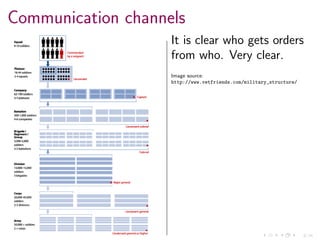
Communication channels
It is clear who gets orders
from who. Very clear.
Image source:
http://www.vetfriends.com/military_structure/
9/34
Dynamic environment
Nature of the battle is dynamic:
9/34
Dynamic environment
Nature of the battle is dynamic:
Losses and reinforcements change the dynamics of
the battlefield.
10/34
Big Plan
It is not enough to only take care of your business.
All units must work to achieve a common goal.
11/34
Situation at 1942.11.15
Dire Soviet situation:
Huge causalities
11/34
Situation at 1942.11.15
Dire Soviet situation:
Huge causalities
Red Army life
expectancy:
Soldier: < 1 day
Officer: < 3 days
11/34
Situation at 1942.11.15
Dire Soviet situation:
Huge causalities
Red Army life
expectancy:
Soldier: < 1 day
Officer: < 3 days
Germans have 90%
of the city
Image source: Antill, P., Dennis, P. Stalingrad 1942
(Campaign). Osprey Publishing (June 19, 2007).
12/34
Situation after 1942.11.23
Germans surrounded
by soviets
12/34
Situation after 1942.11.23
Germans surrounded
by soviets
City is Germans’,
Germans’ are
Soviets’
12/34
Situation after 1942.11.23
Germans surrounded
by soviets
City is Germans’,
Germans’ are
Soviets’
Turning point of the
battle
12/34
Situation after 1942.11.23
Germans surrounded
by soviets
City is Germans’,
Germans’ are
Soviets’
Turning point of the
battle
6’th Army (the
surrounded one) was
destroyed.
Image source: Antill, P., Dennis, P. Stalingrad 1942
(Campaign). Osprey Publishing (June 19, 2007).
13/34
Outline
1 Historical introduction
2 Technical stuff
Motivation
Features
API
3 QA
You sure you have no questions?
14/34
Set the grounds
We have a lot of Erlang nodes trying to achieve a
common goal.
14/34
Set the grounds
We have a lot of Erlang nodes trying to achieve a
common goal.
≈ 50 nodes per server
14/34
Set the grounds
We have a lot of Erlang nodes trying to achieve a
common goal.
≈ 50 nodes per server
a couple of dozens of servers
14/34
Set the grounds
We have a lot of Erlang nodes trying to achieve a
common goal.
≈ 50 nodes per server
a couple of dozens of servers
Example services:
Higscores
14/34
Set the grounds
We have a lot of Erlang nodes trying to achieve a
common goal.
≈ 50 nodes per server
a couple of dozens of servers
Example services:
Higscores
Authentication
14/34
Set the grounds
We have a lot of Erlang nodes trying to achieve a
common goal.
≈ 50 nodes per server
a couple of dozens of servers
Example services:
Higscores
Authentication
Chat
14/34
Set the grounds
We have a lot of Erlang nodes trying to achieve a
common goal.
≈ 50 nodes per server
a couple of dozens of servers
Example services:
Higscores
Authentication
Chat
User profiles
14/34
Set the grounds
We have a lot of Erlang nodes trying to achieve a
common goal.
≈ 50 nodes per server
a couple of dozens of servers
Example services:
Higscores
Authentication
Chat
User profiles
...
14/34
Set the grounds
We have a lot of Erlang nodes trying to achieve a
common goal.
≈ 50 nodes per server
a couple of dozens of servers
Example services:
Higscores
Authentication
Chat
User profiles
...
How to connect them?
15/34
Peer-to-peer communication
You don’t want bottlenecks.
You don’t want single points of failure.
16/34
Dynamic nodes
Nodes and services start and stop all the time.
16/34
Dynamic nodes
Nodes and services start and stop all the time.
The system must continue to function and self-heal.
17/34
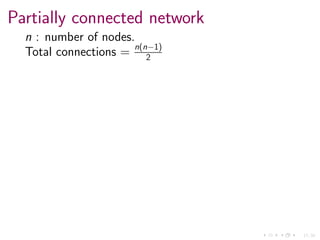
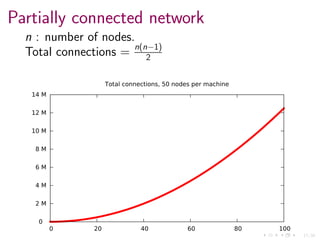
Partially connected network
n : number of nodes.
Total connections = n(n−1)
2
17/34
Partially connected network
n : number of nodes.
Total connections = n(n−1)
2
0
2 M
4 M
6 M
8 M
10 M
12 M
14 M
0 20 40 60 80 100
Total connections, 50 nodes per machine
18/34
Conclusions (for now)
It pays off to optimize the topology so
communication is more effective, e.g.:
Army
Software Defined Networking
Management
19/34
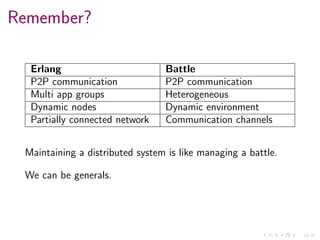
Remember?
Erlang Battle
P2P communication P2P communication
Multi app groups Heterogeneous
Dynamic nodes Dynamic environment
Partially connected network Communication channels
19/34
Remember?
Erlang Battle
P2P communication P2P communication
Multi app groups Heterogeneous
Dynamic nodes Dynamic environment
Partially connected network Communication channels
Maintaining a distributed system is like managing a battle.
19/34
Remember?
Erlang Battle
P2P communication P2P communication
Multi app groups Heterogeneous
Dynamic nodes Dynamic environment
Partially connected network Communication channels
Maintaining a distributed system is like managing a battle.
We can be generals.
20/34
We need to solve this
What spapi-router pg2 gproc
P2P communication
Multi app groups
Dynamic nodes
Partially connected network
by limiting connections
x x
21/34
spapi-router features in a nutshell
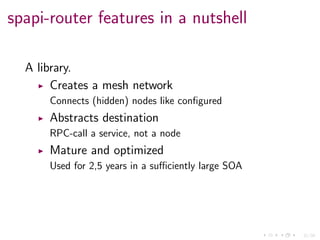
A library.
Creates a mesh network
Connects (hidden) nodes like configured
21/34
spapi-router features in a nutshell
A library.
Creates a mesh network
Connects (hidden) nodes like configured
Abstracts destination
RPC-call a service, not a node
21/34
spapi-router features in a nutshell
A library.
Creates a mesh network
Connects (hidden) nodes like configured
Abstracts destination
RPC-call a service, not a node
Mature and optimized
Used for 2,5 years in a sufficiently large SOA
21/34
spapi-router features in a nutshell
A library.
Creates a mesh network
Connects (hidden) nodes like configured
Abstracts destination
RPC-call a service, not a node
Mature and optimized
Used for 2,5 years in a sufficiently large SOA
Instrumented
22/34
For example
pagebuilder@host3.fqdn
kernel stdlib
pagebuilder
spapi_router
kernel
stdlib
header
kernel
stdlib
mainsection
kernel
stdlib
mainsection
header@host1.fqdn
mainsec2@host2.fqdn
mainsec1@host1.fqdn
test2@host2.fqdn
kernel
stdlib
mainsection
22/34
For example
pagebuilder@host3.fqdn
kernel stdlib
pagebuilder
spapi_router
kernel
stdlib
header
kernel
stdlib
mainsection
kernel
stdlib
mainsection
header@host1.fqdn
mainsec2@host2.fqdn
mainsec1@host1.fqdn
test2@host2.fqdn
kernel
stdlib
mainsection
Configuration of
pagebuilder@host3.fqdn:
{spapi_router, [
{host_names, [
"host1.fqdn",
"host2.fqdn",
]},
{workers, [
{"^header[0-9]*", [header]},
{"^mainsec[0-9]*", [mainsection]},
]}
]}
23/34
More configuration
hosts monitor interval ms
world monitor interval ms
worker monitor interval ms
callback module
24/34
How it works
{spapi_router, [
{host_names, [
"host1.fqdn",
"host2.fqdn",
]},
{workers, [
{"^header[0-9]*", [header]},
{"^mainsec[0-9]*", [mainsection]},
]}
]}
24/34
How it works
{spapi_router, [
{host_names, [
"host1.fqdn",
"host2.fqdn",
]},
{workers, [
{"^header[0-9]*", [header]},
{"^mainsec[0-9]*", [mainsection]},
]}
]}
1. Connects to
host names
24/34
How it works
{spapi_router, [
{host_names, [
"host1.fqdn",
"host2.fqdn",
]},
{workers, [
{"^header[0-9]*", [header]},
{"^mainsec[0-9]*", [mainsection]},
]}
]}
1. Connects to
host names
2. Asks EPMD for
running nodes
24/34
How it works
{spapi_router, [
{host_names, [
"host1.fqdn",
"host2.fqdn",
]},
{workers, [
{"^header[0-9]*", [header]},
{"^mainsec[0-9]*", [mainsection]},
]}
]}
1. Connects to
host names
2. Asks EPMD for
running nodes
3. Connects to nodes
matching regexp
24/34
How it works
{spapi_router, [
{host_names, [
"host1.fqdn",
"host2.fqdn",
]},
{workers, [
{"^header[0-9]*", [header]},
{"^mainsec[0-9]*", [mainsection]},
]}
]}
1. Connects to
host names
2. Asks EPMD for
running nodes
3. Connects to nodes
matching regexp
4. Checks for
applications in
nodes
24/34
How it works
{spapi_router, [
{host_names, [
"host1.fqdn",
"host2.fqdn",
]},
{workers, [
{"^header[0-9]*", [header]},
{"^mainsec[0-9]*", [mainsection]},
]}
]}
1. Connects to
host names
2. Asks EPMD for
running nodes
3. Connects to nodes
matching regexp
4. Checks for
applications in
nodes
5. Connects to
relevant nodes
25/34
Why instrument?
Helps understand the system is sound.
The first thing you want to instrument is the border of your
service.
Effortless instrumentation for all calls via spapi-router.
26/34
callback module #1
%% New resource is detected
-callback new_resource({Service :: atom(), node()},
opts()) -> any().
%% Existing resource is lost
%% (node disconnect, shutdown, etc).
-callback lost_resource({Service :: atom(), node()},
opts()) -> any().
27/34
callback module #2
-type log_spec() :: {
Service :: atom(),
Module :: atom(),
Function :: atom()
}.
%% Time instrumentation
-callback measure(log_spec(),
fun(() -> A), opts()) -> A.
%% Called on success/failure of a function call.
-callback success(log_spec(), opts()) -> term().
-callback failure(log_spec(), opts()) -> term().
28/34
Calling others
28/34
Calling others
spr_router:call(piqi_rpc, erlang, node, []).
28/34
Calling others
spr_router:call(piqi_rpc, erlang, node, []).
spr_router:call_all(piqi_rpc, erlang, node, []).
28/34
Calling others
spr_router:call(piqi_rpc, erlang, node, []).
spr_router:call_all(piqi_rpc, erlang, node, []).
Extras:
call/5
call all/5
list workers/0
list workers/1
list hosts/0
29/34
Future optimizations
Takes time to figure out a ’stop’.
Monitor application controller instead of
node.
One node == one service.
30/34
How to change nodes?
Puppet plus
RelUp
... or anything really:
spr app:config change([], [], []).
31/34
Battle stories
31/34
Battle stories
Tried to disconnect from irrelevant nodes first
31/34
Battle stories
Tried to disconnect from irrelevant nodes first
what if relationship is one-way?
31/34
Battle stories
Tried to disconnect from irrelevant nodes first
what if relationship is one-way?
one misbehaving component can bring the system
down
31/34
Battle stories
Tried to disconnect from irrelevant nodes first
what if relationship is one-way?
one misbehaving component can bring the system
down
Fully connected network experience (> 1K
nodes)
31/34
Battle stories
Tried to disconnect from irrelevant nodes first
what if relationship is one-way?
one misbehaving component can bring the system
down
Fully connected network experience (> 1K
nodes)
everyone should try that
31/34
Battle stories
Tried to disconnect from irrelevant nodes first
what if relationship is one-way?
one misbehaving component can bring the system
down
Fully connected network experience (> 1K
nodes)
everyone should try that
thanks to off-peak and 10G NIC
32/34
Stats
2012-01-12 Initial commit (Thijs Terlouw)
32/34
Stats
2012-01-12 Initial commit (Thijs Terlouw)
2012-02-16 1.0.0 – first prod (Thijs Terlouw)
32/34
Stats
2012-01-12 Initial commit (Thijs Terlouw)
2012-02-16 1.0.0 – first prod (Thijs Terlouw)
2012-08-24 1.2.0 – broadcast (Enrique Paz)
32/34
Stats
2012-01-12 Initial commit (Thijs Terlouw)
2012-02-16 1.0.0 – first prod (Thijs Terlouw)
2012-08-24 1.2.0 – broadcast (Enrique Paz)
2014-06-20 2.1.0 – many contributions by Spil Games
32/34
Stats
2012-01-12 Initial commit (Thijs Terlouw)
2012-02-16 1.0.0 – first prod (Thijs Terlouw)
2012-08-24 1.2.0 – broadcast (Enrique Paz)
2014-06-20 2.1.0 – many contributions by Spil Games
2014-07-04 Public pre-release
commit b3b7aad9ca14ed230f28635826b371b6bbea3840
Author: Motiejus Jakˇstys <motiejus.jakstys@spilgames.com>
Date: Wed Jun 4 14:39:40 2014 +0200
Initial commit
21 files changed, 2984 insertions(+)
32/34
Stats
2012-01-12 Initial commit (Thijs Terlouw)
2012-02-16 1.0.0 – first prod (Thijs Terlouw)
2012-08-24 1.2.0 – broadcast (Enrique Paz)
2014-06-20 2.1.0 – many contributions by Spil Games
2014-07-04 Public pre-release
commit b3b7aad9ca14ed230f28635826b371b6bbea3840
Author: Motiejus Jakˇstys <motiejus.jakstys@spilgames.com>
Date: Wed Jun 4 14:39:40 2014 +0200
Initial commit
21 files changed, 2984 insertions(+)
2014-07-10 http://github.com/spilgames/spapi-router
33/34
Outline
1 Historical introduction
2 Technical stuff
Motivation
Features
API
3 QA
You sure you have no questions?
34/34
QA

Large Partially-connected Erlang Clusters