Geologic Formations
as
Aquifer
Dr. Anil Kumar
Professor Department
of Geology Patna
Science College Patna
University , Patna
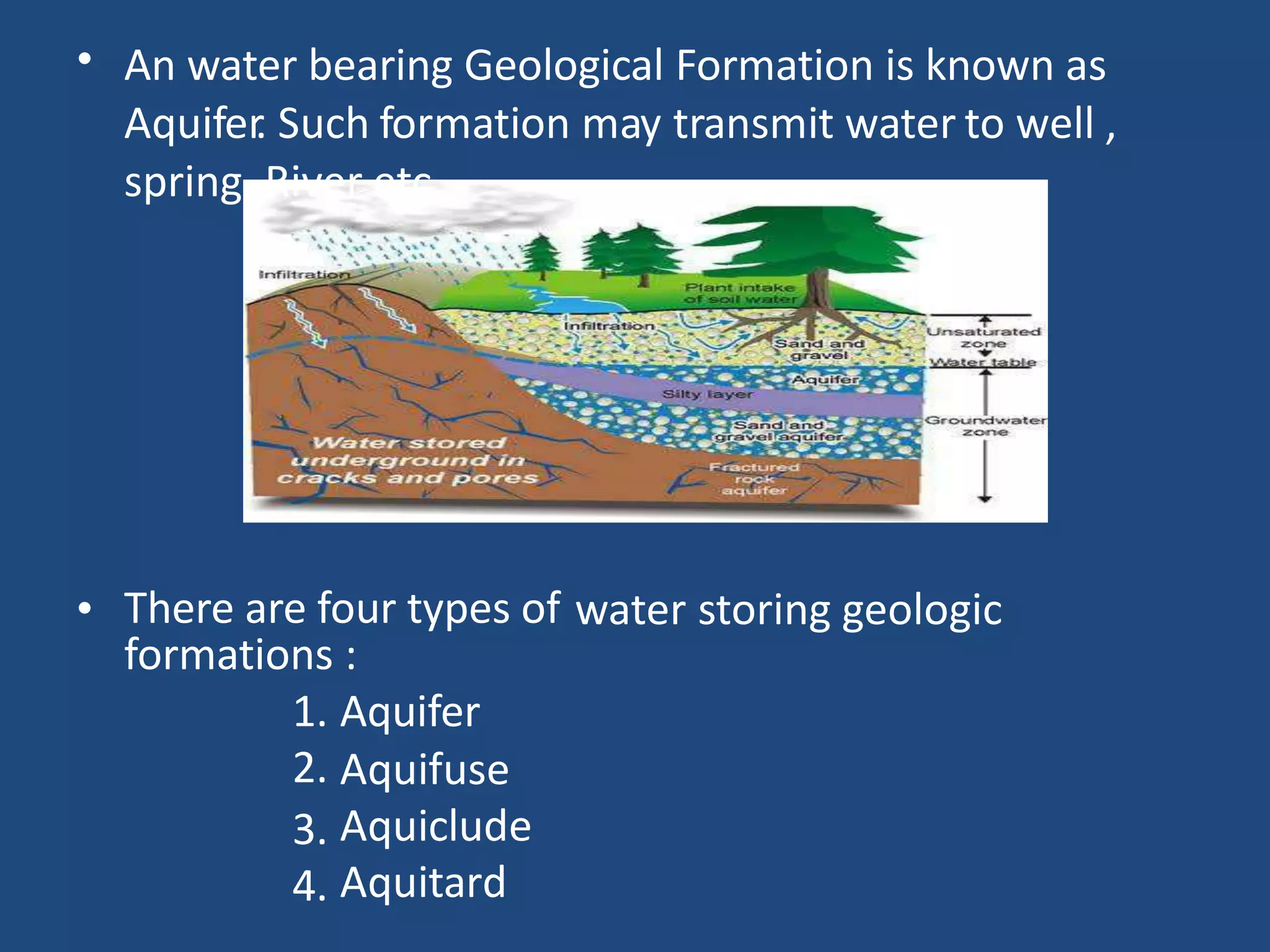
• An water bearing Geological Formation is known as
Aquifer
. Such formation may transmit water to well ,
spring ,River etc.
• There are four types of
formations :
water storing geologic
1.
2.
3.
4.
Aquifer
Aquifuse
Aquiclude
Aquitard
Cont…..
•
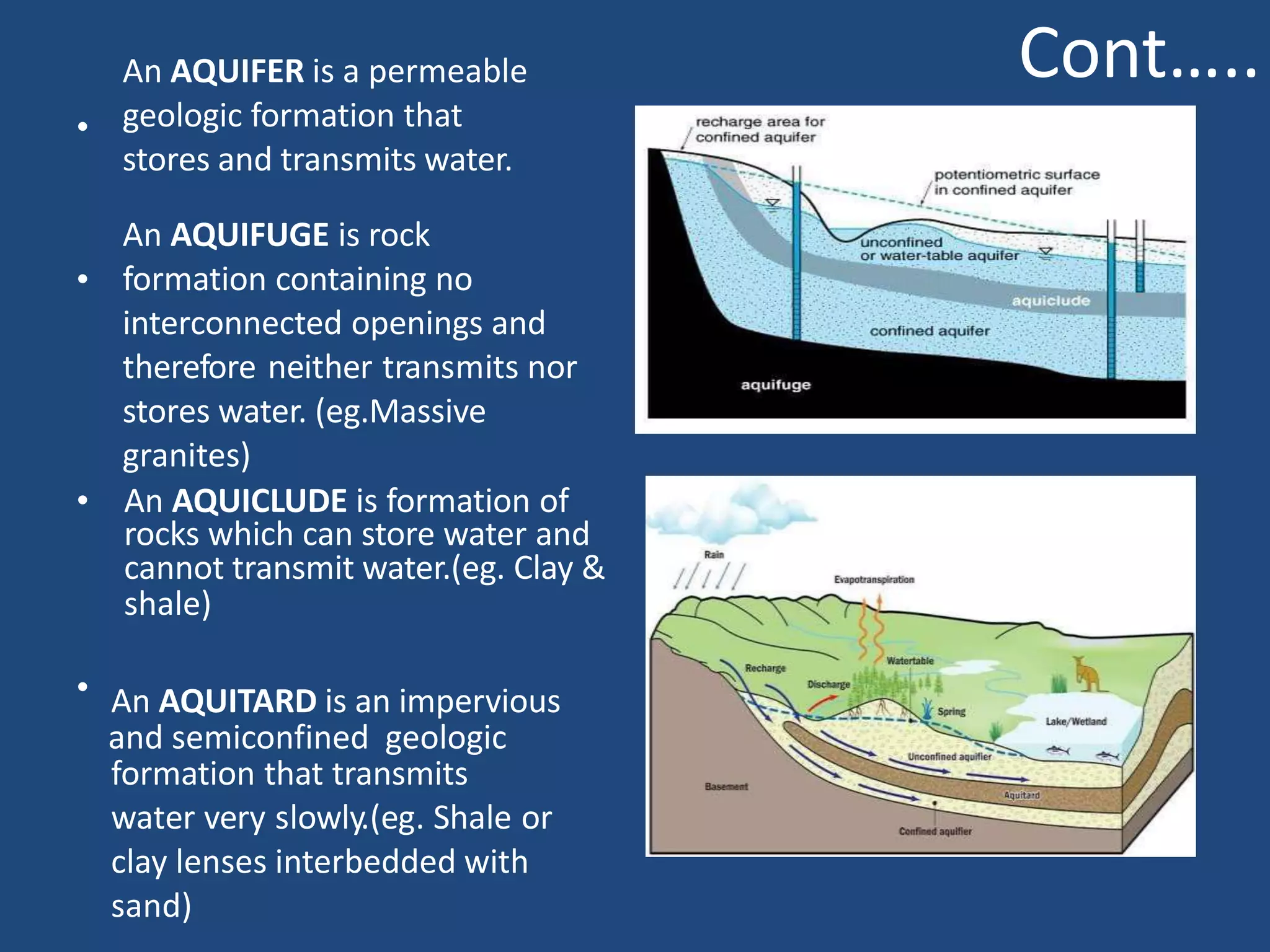
An AQUIFER is a permeable
geologic formation that
stores and transmits water.
•
An AQUIFUGE is rock
formation containing no
interconnected openings and
therefore neither transmits nor
stores water. (eg.Massive
granites)
• An AQUICLUDE is formation of
cannot transmit water.(eg. Clay &
shale)
rocks which can store water and
• An AQUITARD is an impervious
formation that transmits
water very slowly.(eg. Shale or
clay lenses interbedded with
sand)
and semiconfined geologic
Cont…..
• Most geologic strata are
classified as either aquifers
or aquitards ; very few
formations fit the classical
definition of aquitard.
• The ability to store water in
the rock pores is depending
on the porosity of the rock.
• Porosity of the rock
formation may be derived
from intergranular spaces or
from fractures.
Cont…..
Depending on pores and fractures
aquifers are described in the
subsection :
Alluvial Deposits
Limestone
Volcanic rock
Sandstone
following
Igneous & Metamorphicrocks
Cont…..
• Alluvial Deposits :
Probably 90% of all
developed aquifers consist
of unconsolidated rocks.
These consist of alluvial
sediments of river
basins,costal and deltaic
tracts.
These aquifers may be
divided into four categories
based on manner of
occurance. They are water
courses , abandoned or
burried valleys , plains and
intermontane vallyes.
Cont…..
Water Courses –
Water courses consists of
alluvium that forms and underlies stream
channels as well as forming the adjacent
floodplains.
Well located in highly permeable strata
boardering stream produce large quantity of
water as infiltration from the streams adds
groundwater supplies.
Cont…..
Abandoned or Burried Valleys –
Abandoned valleys are valleys
no longer occupied by stream
that form them.
Abandoned valleys are the
ancient river or stream valleys
those have been filled with glacial
or unconsolidated sediments.
These sediments are made up of
predominently gravels and
sands with some silt & clay.
These types of sediments can often
store and transmit large amounts
of groundwater and act as a local
aquifer.
Cont…..
Plains -
Extensive high plains
underlain by
unconsolidated
sediments(some time
gravel
& sand bed) form
important unconfined
aquifers.
The aquifers are recharged
chiefly in areas acessible to
downward percolation of
water from precipitation and
form occasional streams.
Cont……
Intermontane valleys –
Intermontane valleys are
underlain by tremendous
volumes of unconsolidated
rock materials derived by
erosion of bordering
mountains.
Intermontane valleys
contain unconsolidated
alluvial deposits consisting
mainly of sands & gravel
layers that can supply
large amount of water to
the wells.
Cont…..
• Limestone –
Limestone is sedimentary rock composed
mainly of calcium carbonate (CaCO3) formed by
precipitation of CaCO3 from natural waters or by organic
processes involving lime-secreting animals.
Limestone varies widely in density,porosity and
permeability depending on degree of consolidation and
development of permeable zone after deposition.
Limey deposits often have high original porosities,but as
they are changed to sedimentary rock through
compaction,they often become dense,hard rock with
lower porosity.
Cont……
Limestone owe its unique hydrologic properties to the
solubility of its major constituent CaCO3 in water.
Rainwater seeping down into the cracks of
limestones,nearly always carries CO2 (Carbondioxide)
in solution.
This gives the water a slight acidity and causes a certain
amount of CaCO3 to desolve.
Not in a month or even in a year,over a few hundred
years due to the soluble character of CaCO3,cracks and
openings would widen noticeably.
Cont……
The ultimate result
could be a limestone
cavern,but generally it
becomes just a slightly
enlarged solution
opening that allows
water to infitrate and
flow through the rock.
Eventually,even the
densest limestones can
acquire enough
porosity and
permeability to
Cont…..
• Volcanic rocks –
Volcanic
rocks,especially lavas
make good aquifers.
They are important water-
bearing formations
because of their distinctive
systems of fractures and
porous zone.
Simultaneously their
widespread occurance is
also favourable for good
aquifers.
Cont…..
The types of openings contributing to the permeability
basalt aquifers.
of
Basalt lava where it covers extensive areas often
provides with both conduits for groundwater
transmission and reservoirs for water storage.
The vertical fractures in many basalt flows provide
pathways for rainwater to penetrate the otherwise
dense lava rock and seep down to porous zones
between flows.
Porous interflow zones are efficient,long-range conduits
for groundwater.
Cont…..
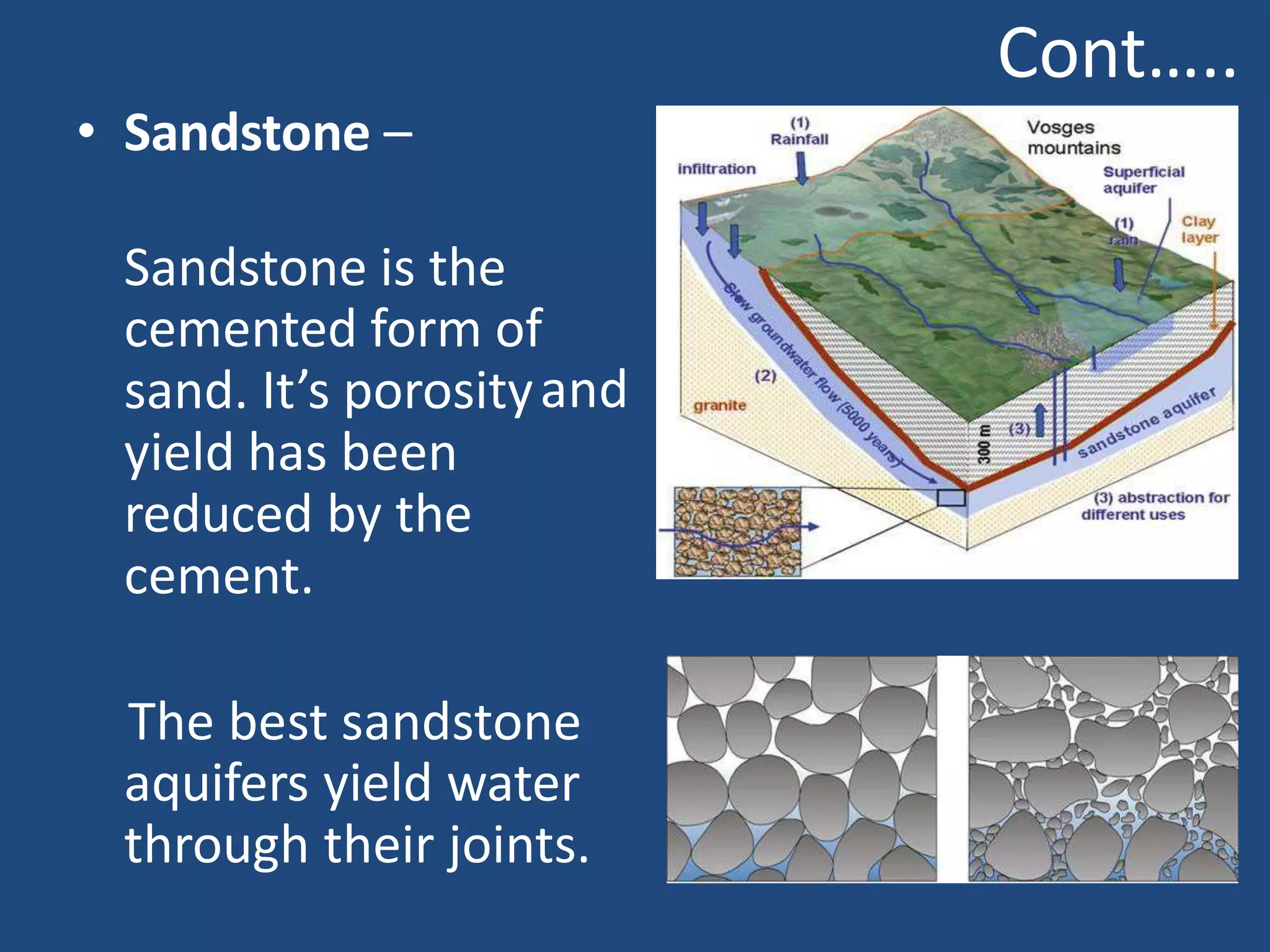
• Sandstone –
Sandstone is the
cemented form of
sand. It’s porosity
yield has been
reduced by the
cement.
and
The best sandstone
aquifers yield water
through their joints.
Cont…..
• Igneous and Metamorphic rocks –
In solid forms igneous and
metamorphic rocks are relatively impermeable
and hence serve as poor aquifers.
Rock names and formations are not important,
except as they influence the rocks’ hydrologic
properties.
Volanic rocks are also igneous rocks but because
they have very different hydrologic properties,
they are considered in a separate category.
Cont…..
Crystalline rocks share two
important attributes:
1. They are almost always uniformly
hard, dense, rocks.
2. They have very low porosities
and
permeabilities.
Since aquifers depend on porosity
for storage and permeability for
water transmission.
Crystalline rocks generally poor aquifers.
Groundwater reserviors in these rocks
appear mainly interconnected three
diamensional fracture systems that
store and transmit water through the
rock’s main body.
THANK YOU

slide-Geologic-Formations-as-Aquidfers.pptx

  • 1.
    Geologic Formations as Aquifer Dr. AnilKumar Professor Department of Geology Patna Science College Patna University , Patna
  • 2.
    • An waterbearing Geological Formation is known as Aquifer . Such formation may transmit water to well , spring ,River etc. • There are four types of formations : water storing geologic 1. 2. 3. 4. Aquifer Aquifuse Aquiclude Aquitard
  • 3.
    Cont….. • An AQUIFER isa permeable geologic formation that stores and transmits water. • An AQUIFUGE is rock formation containing no interconnected openings and therefore neither transmits nor stores water. (eg.Massive granites) • An AQUICLUDE is formation of cannot transmit water.(eg. Clay & shale) rocks which can store water and • An AQUITARD is an impervious formation that transmits water very slowly.(eg. Shale or clay lenses interbedded with sand) and semiconfined geologic
  • 4.
    Cont….. • Most geologicstrata are classified as either aquifers or aquitards ; very few formations fit the classical definition of aquitard. • The ability to store water in the rock pores is depending on the porosity of the rock. • Porosity of the rock formation may be derived from intergranular spaces or from fractures.
  • 5.
    Cont….. Depending on poresand fractures aquifers are described in the subsection : Alluvial Deposits Limestone Volcanic rock Sandstone following Igneous & Metamorphicrocks
  • 6.
    Cont….. • Alluvial Deposits: Probably 90% of all developed aquifers consist of unconsolidated rocks. These consist of alluvial sediments of river basins,costal and deltaic tracts. These aquifers may be divided into four categories based on manner of occurance. They are water courses , abandoned or burried valleys , plains and intermontane vallyes.
  • 7.
    Cont….. Water Courses – Watercourses consists of alluvium that forms and underlies stream channels as well as forming the adjacent floodplains. Well located in highly permeable strata boardering stream produce large quantity of water as infiltration from the streams adds groundwater supplies.
  • 8.
    Cont….. Abandoned or BurriedValleys – Abandoned valleys are valleys no longer occupied by stream that form them. Abandoned valleys are the ancient river or stream valleys those have been filled with glacial or unconsolidated sediments. These sediments are made up of predominently gravels and sands with some silt & clay. These types of sediments can often store and transmit large amounts of groundwater and act as a local aquifer.
  • 9.
    Cont….. Plains - Extensive highplains underlain by unconsolidated sediments(some time gravel & sand bed) form important unconfined aquifers. The aquifers are recharged chiefly in areas acessible to downward percolation of water from precipitation and form occasional streams.
  • 10.
    Cont…… Intermontane valleys – Intermontanevalleys are underlain by tremendous volumes of unconsolidated rock materials derived by erosion of bordering mountains. Intermontane valleys contain unconsolidated alluvial deposits consisting mainly of sands & gravel layers that can supply large amount of water to the wells.
  • 11.
    Cont….. • Limestone – Limestoneis sedimentary rock composed mainly of calcium carbonate (CaCO3) formed by precipitation of CaCO3 from natural waters or by organic processes involving lime-secreting animals. Limestone varies widely in density,porosity and permeability depending on degree of consolidation and development of permeable zone after deposition. Limey deposits often have high original porosities,but as they are changed to sedimentary rock through compaction,they often become dense,hard rock with lower porosity.
  • 12.
    Cont…… Limestone owe itsunique hydrologic properties to the solubility of its major constituent CaCO3 in water. Rainwater seeping down into the cracks of limestones,nearly always carries CO2 (Carbondioxide) in solution. This gives the water a slight acidity and causes a certain amount of CaCO3 to desolve. Not in a month or even in a year,over a few hundred years due to the soluble character of CaCO3,cracks and openings would widen noticeably.
  • 13.
    Cont…… The ultimate result couldbe a limestone cavern,but generally it becomes just a slightly enlarged solution opening that allows water to infitrate and flow through the rock. Eventually,even the densest limestones can acquire enough porosity and permeability to
  • 14.
    Cont….. • Volcanic rocks– Volcanic rocks,especially lavas make good aquifers. They are important water- bearing formations because of their distinctive systems of fractures and porous zone. Simultaneously their widespread occurance is also favourable for good aquifers.
  • 15.
    Cont….. The types ofopenings contributing to the permeability basalt aquifers. of Basalt lava where it covers extensive areas often provides with both conduits for groundwater transmission and reservoirs for water storage. The vertical fractures in many basalt flows provide pathways for rainwater to penetrate the otherwise dense lava rock and seep down to porous zones between flows. Porous interflow zones are efficient,long-range conduits for groundwater.
  • 16.
    Cont….. • Sandstone – Sandstoneis the cemented form of sand. It’s porosity yield has been reduced by the cement. and The best sandstone aquifers yield water through their joints.
  • 17.
    Cont….. • Igneous andMetamorphic rocks – In solid forms igneous and metamorphic rocks are relatively impermeable and hence serve as poor aquifers. Rock names and formations are not important, except as they influence the rocks’ hydrologic properties. Volanic rocks are also igneous rocks but because they have very different hydrologic properties, they are considered in a separate category.
  • 18.
    Cont….. Crystalline rocks sharetwo important attributes: 1. They are almost always uniformly hard, dense, rocks. 2. They have very low porosities and permeabilities. Since aquifers depend on porosity for storage and permeability for water transmission. Crystalline rocks generally poor aquifers. Groundwater reserviors in these rocks appear mainly interconnected three diamensional fracture systems that store and transmit water through the rock’s main body.
  • 19.