Service Level Agreement 
Vs 
Operational Level Agreement 
DEEPTI MISHRA
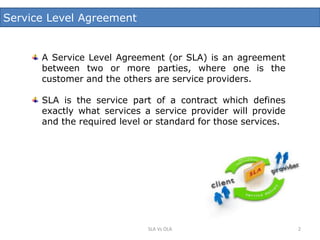
A Service Level Agreement (or SLA) is an agreement 
between two or more parties, where one is the 
customer and the others are service providers. 
SLA is the service part of a contract which defines 
exactly what services a service provider will provide 
and the required level or standard for those services. 
SLA Vs OLA 2 
Service Level Agreement
The SLA is generally part of an outsourcing or managed 
services agreement, or can be used in facilities 
management agreements and other agreements for the 
provision of services. 
The SLA should set out the overall objectives for the 
services to be provided, include a detailed description of 
the services. 
SLA Vs OLA 3 
Service Level Agreement
Operational Level Agreement 
An operational level agreement (OLA) is a contract that 
defines how various groups within a company plan to 
deliver a service or set of services. 
OLA’s are designed to address and solve the problem of 
IT by defining the specific set of IT services that each 
department is responsible for. 
OLA(s) are not a substitute for an SLA. 
SLA Vs OLA 4
Operational Level Agreement 
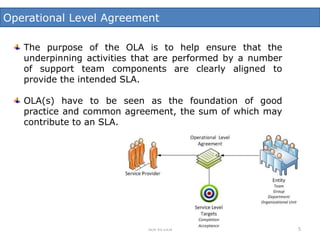
The purpose of the OLA is to help ensure that the 
underpinning activities that are performed by a number 
of support team components are clearly aligned to 
provide the intended SLA. 
OLA(s) have to be seen as the foundation of good 
practice and common agreement, the sum of which may 
contribute to an SLA. 
SLA Vs OLA 5
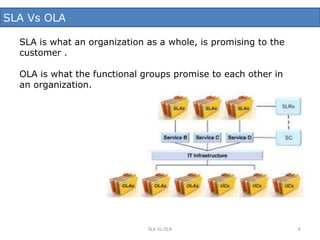
SLA is what an organization as a whole, is promising to the 
customer . 
OLA is what the functional groups promise to each other in 
an organization. 
SLA Vs OLA 6 
SLA Vs OLA
SLA is directly impact to the financial part of an 
organization. 
SLA has to be measureable and completely supported by the 
OLA’s that the SLA is reliant on. 
SLA Vs OLA 7 
SLA Vs OLA
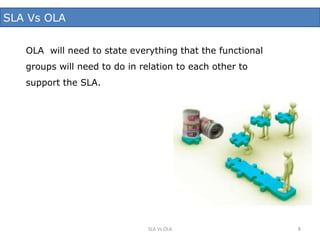
OLA will need to state everything that the functional 
groups will need to do in relation to each other to 
support the SLA. 
SLA Vs OLA 8 
SLA Vs OLA
SLA Vs OLA 9

Sla ola

  • 1.
    Service Level Agreement Vs Operational Level Agreement DEEPTI MISHRA
  • 2.
    A Service LevelAgreement (or SLA) is an agreement between two or more parties, where one is the customer and the others are service providers. SLA is the service part of a contract which defines exactly what services a service provider will provide and the required level or standard for those services. SLA Vs OLA 2 Service Level Agreement
  • 3.
    The SLA isgenerally part of an outsourcing or managed services agreement, or can be used in facilities management agreements and other agreements for the provision of services. The SLA should set out the overall objectives for the services to be provided, include a detailed description of the services. SLA Vs OLA 3 Service Level Agreement
  • 4.
    Operational Level Agreement An operational level agreement (OLA) is a contract that defines how various groups within a company plan to deliver a service or set of services. OLA’s are designed to address and solve the problem of IT by defining the specific set of IT services that each department is responsible for. OLA(s) are not a substitute for an SLA. SLA Vs OLA 4
  • 5.
    Operational Level Agreement The purpose of the OLA is to help ensure that the underpinning activities that are performed by a number of support team components are clearly aligned to provide the intended SLA. OLA(s) have to be seen as the foundation of good practice and common agreement, the sum of which may contribute to an SLA. SLA Vs OLA 5
  • 6.
    SLA is whatan organization as a whole, is promising to the customer . OLA is what the functional groups promise to each other in an organization. SLA Vs OLA 6 SLA Vs OLA
  • 7.
    SLA is directlyimpact to the financial part of an organization. SLA has to be measureable and completely supported by the OLA’s that the SLA is reliant on. SLA Vs OLA 7 SLA Vs OLA
  • 8.
    OLA will needto state everything that the functional groups will need to do in relation to each other to support the SLA. SLA Vs OLA 8 SLA Vs OLA
  • 9.