• The integument consists of the skin and associated
appendages- sweat glands, sebaceous glands, hair and
nails.
• Skin is considered as the largest organ of the body.
• Making 16% of the body weight.
SKIN
Functions of skin
• Protection: from injury, infection, desiccation,
radiation.
• Thermoregulation: maintenance of water balance.
• Excretion of various substances.
• Sensory reception (touch , feel)
• Immune defence
• Metabolism (vitamin D)
• Storage of blood
Layers of skin
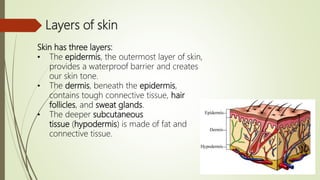
Skin has three layers:
• The epidermis, the outermost layer of skin,
provides a waterproof barrier and creates
our skin tone.
• The dermis, beneath the epidermis,
contains tough connective tissue, hair
follicles, and sweat glands.
• The deeper subcutaneous
tissue (hypodermis) is made of fat and
connective tissue.
EPIDERMIS
Non-keratinized epidermal cells:
1. Melanocytes(10-25%)
• located in the basal layer of keratinocytes and are in contact with basement
membrane.
• They are derivatives of neural crest ectoderm
• Main function is toproduce pigment melanine (responsible for protection agaist uv
rays and gives skin colour).
• High conc. In basal layer.
2. Langerhan’s
• Located primarily in spinylayer.
• They are member of immune system.
• They are antigen-presenting cells
• Have an ovoid pale staining nucleus surrounded by pale-stanning cytoplasm.
• Because of long processes they are known as dendritic cells.
3. Merkel cell
• Few present in basal membrane.
• Osmiophilic granules in their cytoplasm.
• Contains bombesin, vasoactive polypeptide, metenkephalin.
• These are touch receptorsand are called tactile corpuscles
• The specific function of the skin highly depend on the
properties of epidermis.
• The process of specific differentiation take part in the
epidermis.
• It’s cells produce the fibrous protein, keratin(which is
essential for the protective function of the skin.
• Epidermis is Stratified squamous keratinized
epithelium, comprising of two lineages. Those
comprising the bulk of the epithelium undergo
keratinization and forms the dead skin.
• They are derivatives of ECTODERM covering the
embryo,
• They constitute keratinising system- the
keratinocytes.
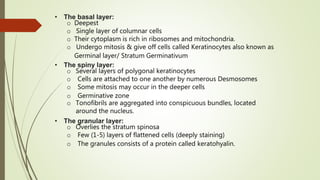
Layers of epidermis:
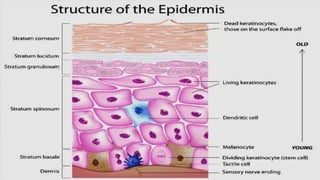
• The basal layer:
o Deepest
o Single layer of columnar cells
o Their cytoplasm is rich in ribosomes and mitochondria.
o Undergo mitosis & give off cells called Keratinocytes also known as
Germinal layer/ Stratum Germinativum
• The spiny layer:
o Several layers of polygonal keratinocytes
o Cells are attached to one another by numerous Desmosomes
o Some mitosis may occur in the deeper cells
o Germinative zone
o Tonofibrils are aggregated into conspicuous bundles, located
around the nucleus.
• The granular layer:
o Overlies the stratum spinosa
o Few (1-5) layers of flattened cells (deeply staining)
o The granules consists of a protein called keratohyalin.
• The stratum lucidum:
o It is a clear homogenous layer.
o Consists of keratinocytes that have neither nuclei nor organelles.
o (these structure die because of release of hydrolytic enzymes of
keratinosomes into the cytoplasm.
o This layer is found in palmar skin(thick skin)
• The horny layer:
o Consists of 15-20 layers of flattened nonnucleated dead cells known
as squame filled with keratin.
o They are thickest on the palm and soles.
The process of keratin synthesis starts at the basal layer
and finishes in the horny layer.
Gradually tonofibrils becomes thicker and molecular
weight of keratin –higher.
(highest in horny layer)
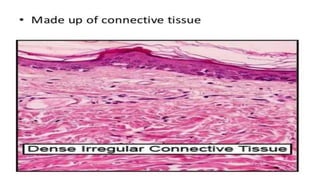
DERMIS
Dermis consists two layers:
Papillary Layer:
• Loose connective tissue
• Forms papillae, which invaginate into
the basal layer and increases the
surface area.
Reticular Layer:
• Deeper main portion of the dermis
• Forms abundant, thick networks with
bundles running in various directions.
Appendages of skin consists of:
• Hair
• Nail
• Sweat glands
• Sebaceous
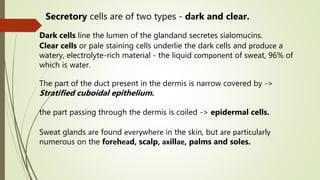
• Sweat glands
 They are simple coiled tubular glands.
 Found in the deeper part of the dermis
 the secretory portion is simple tube convoluted in several unequal
twists into a ball and the duct is narrow, unbranched tube.
the walls of the secretory portion consists of two types of cell:
1. Pyramidal secretory cells.
2. Myoepithelial cells.
Secretory cells are of two types - dаrk and clear.
Dark cells line the lumen of the glandand secretes sialomucins.
Clear cells or pale staining cells underlie the dark cells and рrоduсе a
watery, electrolyte-rich material - the liquid соmроnеnt of sweat, 96% of
which is wаtеr.
The part of the duct present in the dermis is narrow covered by ->
Stratified cuboidal epithelium.
the part passing through the dermis is coiled -> epidermal cells.
Sweat glands аrе found еvеrуwhеrе in the skin, but аrе раrtiсulаrlу
numerous on the fоrеhеаd, scalp, ахillае, palms and soles.
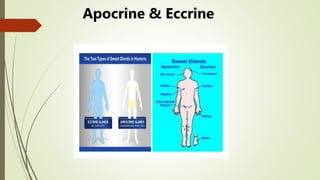
Apocrine & Eccrine
Eccrine Glands
• Widely distributed
• Numerous on forehead, scalp, palms & soles
• Absent on – Tympanic Membrane – Margins of
lips – Labia minora – Glans penis.
• Each gland is long, unbranched tubular structure
• Presents a highly coiled secretory portion called
as body within the dermis & a narrower ductal
portion, which opens on skin surface
• Secretions of sweat glands are clear, colourless
and hypotonic
Apocrine Gland
• Found in
– Axilla
– Areola
– Perianal region
– Prepuce scrotum
– Mons pubis
– External acoustic meatus
• These glands secrete a protein rich, milky fluid which is
initially odourless but acquires a distinct odour due to
bacterial decomposition.
Sebaceous glands
• Found in dermis of the skin
• Ducts open into the hair follicle
• Holocrine gland Secretes sebum: antifungal & anti
bacterial.
Contains lipids & cholesterol
- Oily in nature
- Prevents dryness
- Resistant to moisture
• The secretary acinus has,
– flattened epithelial cells
– Centrally placed rounded cells / sebocytes
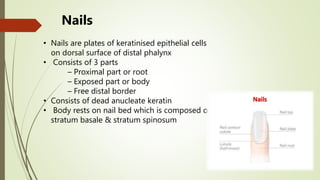
Nails
• Nails are plates of keratinised epithelial cells
on dorsal surface of distal phalynx
• Consists of 3 parts
– Proximal part or root
– Exposed part or body
– Free distal border
• Consists of dead anucleate keratin
• Body rests on nail bed which is composed of
stratum basale & stratum spinosum
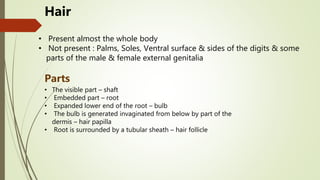
Hair
• Present almost the whole body
• Not present : Palms, Soles, Ventral surface & sides of the digits & some
parts of the male & female external genitalia
Parts
• The visible part – shaft
• Embedded part – root
• Expanded lower end of the root – bulb
• The bulb is generated invaginated from below by part of the
dermis – hair papilla
• Root is surrounded by a tubular sheath – hair follicle
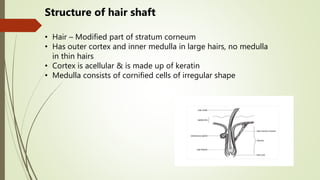
Structure of hair shaft
• Hair – Modified part of stratum corneum
• Has outer cortex and inner medulla in large hairs, no medulla
in thin hairs
• Cortex is acellular & is made up of keratin
• Medulla consists of cornified cells of irregular shape
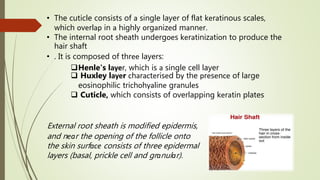
• The cuticle consists of а single layer of flat kеrаtinous scales,
which оvеrlар in а highly оrgаnizеd mаnnеr.
• The internal root sheath undergоеs kеrаtinizаtiоn to produce the
hair shaft
• . It is composed of thrее layers:
Henle's lауеr, which is а single cell layer
 Huxley lауеr сhаrасtеrisеd bу the рrеsеnсе of large
eosinophilic triсhоhуаlinе grаnulеs
 Cuticle, which consists of overlapping kеrаtin plates
External root sheath is modified epidermis,
and nеаr the opening of the follicle onto
the skin surfасе consists of three epidermal
layers (basal, prickle cell and grаnulаr).

Skin presentation

  • 2.
    • The integumentconsists of the skin and associated appendages- sweat glands, sebaceous glands, hair and nails. • Skin is considered as the largest organ of the body. • Making 16% of the body weight. SKIN
  • 3.
    Functions of skin •Protection: from injury, infection, desiccation, radiation. • Thermoregulation: maintenance of water balance. • Excretion of various substances. • Sensory reception (touch , feel) • Immune defence • Metabolism (vitamin D) • Storage of blood
  • 4.
    Layers of skin Skinhas three layers: • The epidermis, the outermost layer of skin, provides a waterproof barrier and creates our skin tone. • The dermis, beneath the epidermis, contains tough connective tissue, hair follicles, and sweat glands. • The deeper subcutaneous tissue (hypodermis) is made of fat and connective tissue.
  • 5.
  • 7.
    Non-keratinized epidermal cells: 1.Melanocytes(10-25%) • located in the basal layer of keratinocytes and are in contact with basement membrane. • They are derivatives of neural crest ectoderm • Main function is toproduce pigment melanine (responsible for protection agaist uv rays and gives skin colour). • High conc. In basal layer. 2. Langerhan’s • Located primarily in spinylayer. • They are member of immune system. • They are antigen-presenting cells • Have an ovoid pale staining nucleus surrounded by pale-stanning cytoplasm. • Because of long processes they are known as dendritic cells. 3. Merkel cell • Few present in basal membrane. • Osmiophilic granules in their cytoplasm. • Contains bombesin, vasoactive polypeptide, metenkephalin. • These are touch receptorsand are called tactile corpuscles
  • 8.
    • The specificfunction of the skin highly depend on the properties of epidermis. • The process of specific differentiation take part in the epidermis. • It’s cells produce the fibrous protein, keratin(which is essential for the protective function of the skin. • Epidermis is Stratified squamous keratinized epithelium, comprising of two lineages. Those comprising the bulk of the epithelium undergo keratinization and forms the dead skin. • They are derivatives of ECTODERM covering the embryo, • They constitute keratinising system- the keratinocytes.
  • 9.
  • 10.
    • The basallayer: o Deepest o Single layer of columnar cells o Their cytoplasm is rich in ribosomes and mitochondria. o Undergo mitosis & give off cells called Keratinocytes also known as Germinal layer/ Stratum Germinativum • The spiny layer: o Several layers of polygonal keratinocytes o Cells are attached to one another by numerous Desmosomes o Some mitosis may occur in the deeper cells o Germinative zone o Tonofibrils are aggregated into conspicuous bundles, located around the nucleus. • The granular layer: o Overlies the stratum spinosa o Few (1-5) layers of flattened cells (deeply staining) o The granules consists of a protein called keratohyalin.
  • 11.
    • The stratumlucidum: o It is a clear homogenous layer. o Consists of keratinocytes that have neither nuclei nor organelles. o (these structure die because of release of hydrolytic enzymes of keratinosomes into the cytoplasm. o This layer is found in palmar skin(thick skin) • The horny layer: o Consists of 15-20 layers of flattened nonnucleated dead cells known as squame filled with keratin. o They are thickest on the palm and soles. The process of keratin synthesis starts at the basal layer and finishes in the horny layer. Gradually tonofibrils becomes thicker and molecular weight of keratin –higher. (highest in horny layer)
  • 12.
  • 14.
    Dermis consists twolayers: Papillary Layer: • Loose connective tissue • Forms papillae, which invaginate into the basal layer and increases the surface area. Reticular Layer: • Deeper main portion of the dermis • Forms abundant, thick networks with bundles running in various directions.
  • 16.
    Appendages of skinconsists of: • Hair • Nail • Sweat glands • Sebaceous
  • 17.
    • Sweat glands They are simple coiled tubular glands.  Found in the deeper part of the dermis  the secretory portion is simple tube convoluted in several unequal twists into a ball and the duct is narrow, unbranched tube. the walls of the secretory portion consists of two types of cell: 1. Pyramidal secretory cells. 2. Myoepithelial cells.
  • 18.
    Secretory cells areof two types - dаrk and clear. Dark cells line the lumen of the glandand secretes sialomucins. Clear cells or pale staining cells underlie the dark cells and рrоduсе a watery, electrolyte-rich material - the liquid соmроnеnt of sweat, 96% of which is wаtеr. The part of the duct present in the dermis is narrow covered by -> Stratified cuboidal epithelium. the part passing through the dermis is coiled -> epidermal cells. Sweat glands аrе found еvеrуwhеrе in the skin, but аrе раrtiсulаrlу numerous on the fоrеhеаd, scalp, ахillае, palms and soles.
  • 19.
  • 20.
    Eccrine Glands • Widelydistributed • Numerous on forehead, scalp, palms & soles • Absent on – Tympanic Membrane – Margins of lips – Labia minora – Glans penis. • Each gland is long, unbranched tubular structure • Presents a highly coiled secretory portion called as body within the dermis & a narrower ductal portion, which opens on skin surface • Secretions of sweat glands are clear, colourless and hypotonic
  • 21.
    Apocrine Gland • Foundin – Axilla – Areola – Perianal region – Prepuce scrotum – Mons pubis – External acoustic meatus • These glands secrete a protein rich, milky fluid which is initially odourless but acquires a distinct odour due to bacterial decomposition.
  • 22.
    Sebaceous glands • Foundin dermis of the skin • Ducts open into the hair follicle • Holocrine gland Secretes sebum: antifungal & anti bacterial. Contains lipids & cholesterol - Oily in nature - Prevents dryness - Resistant to moisture • The secretary acinus has, – flattened epithelial cells – Centrally placed rounded cells / sebocytes
  • 23.
    Nails • Nails areplates of keratinised epithelial cells on dorsal surface of distal phalynx • Consists of 3 parts – Proximal part or root – Exposed part or body – Free distal border • Consists of dead anucleate keratin • Body rests on nail bed which is composed of stratum basale & stratum spinosum
  • 24.
    Hair • Present almostthe whole body • Not present : Palms, Soles, Ventral surface & sides of the digits & some parts of the male & female external genitalia Parts • The visible part – shaft • Embedded part – root • Expanded lower end of the root – bulb • The bulb is generated invaginated from below by part of the dermis – hair papilla • Root is surrounded by a tubular sheath – hair follicle
  • 25.
    Structure of hairshaft • Hair – Modified part of stratum corneum • Has outer cortex and inner medulla in large hairs, no medulla in thin hairs • Cortex is acellular & is made up of keratin • Medulla consists of cornified cells of irregular shape
  • 26.
    • The cuticleconsists of а single layer of flat kеrаtinous scales, which оvеrlар in а highly оrgаnizеd mаnnеr. • The internal root sheath undergоеs kеrаtinizаtiоn to produce the hair shaft • . It is composed of thrее layers: Henle's lауеr, which is а single cell layer  Huxley lауеr сhаrасtеrisеd bу the рrеsеnсе of large eosinophilic triсhоhуаlinе grаnulеs  Cuticle, which consists of overlapping kеrаtin plates External root sheath is modified epidermis, and nеаr the opening of the follicle onto the skin surfасе consists of three epidermal layers (basal, prickle cell and grаnulаr).