International Research Journal of Engineering and Technology (IRJET) e-ISSN: 2395-0056
Volume: 10 Issue: 05 | May 2023 www.irjet.net p-ISSN: 2395-0072
© 2023, IRJET | Impact Factor value: 8.226 | ISO 9001:2008 Certified Journal | Page 1082
Skin disease detection and classification using different segmentation
and classification techniques
Samiksha Prachand1, Nisha Patil2, Neha Badoge3, Vaibhavi Chaudhari4, Bhargavi Kaslikar5
1,2,3,4Student, Final year B. Tech, Electronics Engineering, K.J. Somaiya College of Engineering, Mumbai,
Maharashtra, India
5Professor, Electronics Department, Somaiya College of Engineering, Vidyavihar, Mumbai, Maharashtra, India
---------------------------------------------------------------------***---------------------------------------------------------------------
Abstract - Skin diseases are common and affect a large
population all over the world. Skin disease management
necessitates accurate diagnosis and treatment. The systems
used image processing and machine learning techniques to
automate the process of identifying skin diseases. With the
advancement of machine learning algorithms, automated
systems for skin disease detection and classification are now
possible. This paper presents a study and exploration of
various segmentation techniques used to detect the type of
skin lesions, including Region-based segmentation, Otsu's
Thresholding, Boundary, and spot detection, and Entropy-
based segmentation. Furthermore, support vector machines,
Decision Trees, Random Forests have been usedtoclassifyskin
diseases. Melanotic nevi, Melanoma Benign, Keratosis, Basal
cell Carcinoma, Actinic Keratosis, Vascular Lesions, and
Dermatofibroma are the seven types of skin cancer. The
primary goal of this project is to improve diagnostic system
accuracy by utilizing image segmentation and classification
techniques.
Key Words: Skin Disease Classification, Convolution
Neural Network, Deep Learning, Classification
Algorithms, Image Processing.
1. INTRODUCTION
The early diagnosis and treatment of skin illnesses depend
greatly on the detection and classification of skin diseases,
which is a critical responsibility in dermatology. Skin
conditions are common around the world, and early
diagnosis and classification can preventdeathandlessenthe
financial load on the healthcare system. Recent
advancements in machine learning and computer vision
have led to the development of automated systems for skin
disease detection and classification, which can assist
dermatologists in providing accurate diagnoses and
individualized treatments.
The epidermis, dermis, andsubcutaneoustissuemakeup the
skin, which is the largest organ in the human body. The
epidermis is the skin's outermost layer and a barrier against
environmental hazards. Layers of keratinocytes,
melanocytes, and Langerhans cells make up its structure.
Keratin, which is synthesized by the skin's keratinocytes,
gives the skin its strength and ability to repel water.Melanin
is a pigment made by melanocytes thatgiveskinitscolorand
shield it from the sun's UV rays.
The dermis is the skin's intermediate layer and contains
connective tissue, blood vessels, nerves, and other
structures. It provides structural support to the skin and
contains collagen and elastin fibers, which impart elasticity
and strength to the skin. There are also hair follicles,
perspiration glands, and sebaceous glands.
Fat and connective tissue make up the subcutaneous tissue,
the skin's deepest layer. It Insulates and regulates body
temperature.
Although cancer can manifest itself in any of the skin's
layers, basal cell carcinoma (BCC), the most prevalent form
of skin cancer, is most often found in the epidermis' basal
cells. The epidermis's base is home to a special type of cell
called a basal cell. The epidermis' outermost layers are
frequently the starting point for squamous cell carcinoma
(SCC), another frequently encountered form of skin cancer.
Melanoma, a more aggressive form of skin cancer, develops
in the melanocytes, which are in the epidermis's deeper
layers. Depending on their form and cause, skin lesions can
also affect various layers of skin. For instance, psoriasis
lesions, which are characterized by thick, scaly regions of
skin, affect the epidermis, and can extend into the dermis. In
severe cases, the subcutaneous tissue may be affected by
eczema lesions, which are caused by inflammation and
irritation of the skin.
The purpose of this work is to provide a comprehensive
analysis of existing methods and algorithms for detecting
and classifying skin diseases. The HAM10000dataset,which
contains photos of skin lesions, will be used to test the
effectiveness of various methods and algorithms. We hope
that the work presented here will help move the field of skin
disease identification and categorization forward and
ultimately improve the lives of many people around the
world.
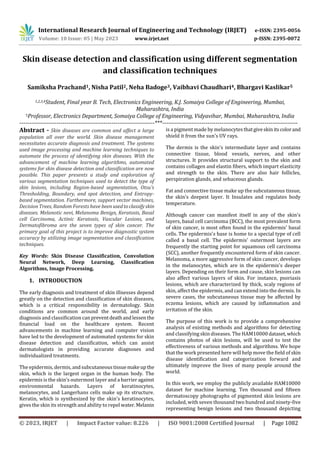
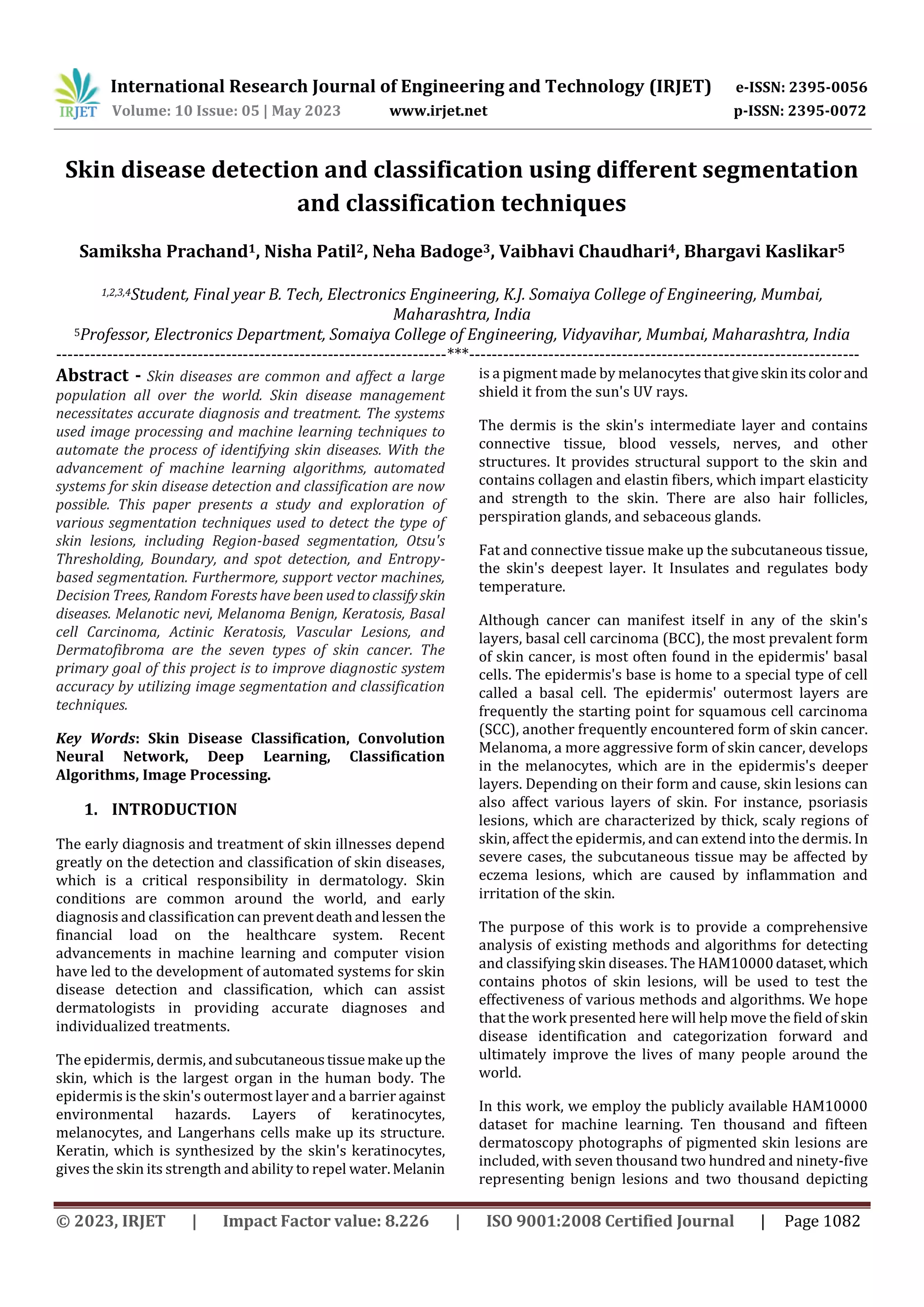
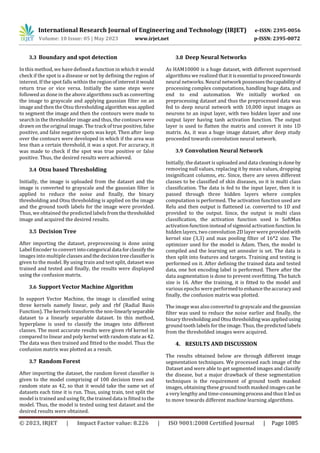
In this work, we employ the publicly available HAM10000
dataset for machine learning. Ten thousand and fifteen
dermatoscopy photographs of pigmented skin lesions are
included, with seven thousand two hundred and ninety-five
representing benign lesions and two thousand depicting
International Research Journal of Engineering and Technology (IRJET) e-ISSN: 2395-0056
Volume: 10 Issue: 05 | May 2023 www.irjet.net p-ISSN: 2395-0072
© 2023, IRJET | Impact Factor value: 8.226 | ISO 9001:2008 Certified Journal | Page 1083
malignant melanomas. Lesions such as seborrheic keratosis
and angiomatosis make up the remaining 715 photos. In
addition to the images themselves, the collection contains
descriptive information aboutthem,suchasthepatient'sage
and gender, the anatomical location of the lesion, and the
diagnosis. In it, you will find examples of both benign and
malignant skin lesions. Below are the seven classes of skin
diseases present in the HAM 10000 dataset.
Moles or melanocytic nevi (nv),arebenignskingrowthsmade
up of melanocytes, which are epidermal cellsresponsiblefor
creating pigment.
Melanoma (mel) is the malignant skin cancer which occurs
because of the melanocytes that is the pigment-producing
cells of the epidermis.
Lesions that mimic seborrheic keratosis or solar lentigines,
which are benign skin growths, are known as keratosis-like
lesions (bkl).
Cancer of the basal cells of the epidermis, also known as
basal cell carcinoma (bcc), manifestsasa firm,pink,orpearly
white nodule on the skin.
Actinic keratoses (akiec) are the premalignant skin lesions
that, if untreated, can develop into squamouscell carcinoma.
They are typically brought on by prolonged sun exposure.
Blood vessel abnormalities such as angiomas,
angiokeratomas, and pyogenic granulomasarereferredto as
Vascular lesions (vas).
A benign skin growth known as a dermatofibroma (df)
typically presents as a tiny, hard bump.
Cancer of the epidermis or other melanocyte-containing
tissues, known as melanoma, begins in these cells. A black,
asymmetrical lesion on the skin is one possible
manifestation. Different layers of skin are affected byeach of
these blemish’s kinds.
Epidermis lesions such as melanocytic nevi and seborrheic
keratosis are more common than those caused by basal cell
and squamous cell carcinomas, which can affect both the
epidermis and the higher dermal layers. Skin's dermis and
subcutaneous tissue are not immune to melanoma's reach.
The affected skin layers might also be affected by the
location and severity of the lesion.
2. LITERATURE SURVEY
[1] Here the authors have used SVM as a machine learning
algorithm to focus on Melanoma and Carcinoma.Theauthors
of this paper aimed to create an automated system that can
assist dermatologists in determining whether a skin lesionis
benign or malignant, which is useful in the early detection of
Melanoma. They trained and tested their SVM-based
classification system on 1,032 skin lesion images in their
study and extracted relevant features from the images using
image processing techniques such as normalization,
segmentation, and featureextraction. The extracted features
were then used to train the SVM classifier, which achievedan
accuracy rate of 95.8%.
[2] In this paper the authors have investigated theefficacyof
different machine-learning algorithms for classifying skin
diseases using color and texture features extracted from
images. The authors gathered a collection of skin disease
images from various sources and preprocessed them to
extract color and texturefeatures.Theimagedatasetconsists
of Chronic Eczema, Lichen, and Plaque psoriasis images
captured with a digital camera and processed to extract Red,
Green, and Blue (RGB) color features and Gray Level Co-
occurrence Matrix (GLCM) texture features. To compare
classifier performance, different combinations of features
with four popular ML algorithms were considered. Linear
Discriminant Analysis (LDA) and Support Vector Machine
(SVM) had the highest classification accuracy of the four
algorithmstested.Thepaperconcludesthatmachinelearning
algorithms can be effective tools for classifying skin diseases
and that the algorithmchosen shouldbebasedonthespecific
features of the disease being diagnosed. The study's results
show that LDA performed better in binary and multi-class
scenarios using color feature-based classification, SVM
performed better for texture features in both binary and
multi-class classifiers, and LDA and SVM classifiers
performed better in binary and multi-class classification for
the combined feature.
[3] In this paper the authors did a literature review to
compare how different image-processing techniques can
detect and classify psoriasis diseases. The goal of theauthors
was to look at the current research in this area and compare
how well different methods work for finding and classifying
psoriasis from images ofskin.Thereviewfoundthatdifferent
image processing methods, such as texture analysis, feature
extraction,and machinelearning algorithms, havebeenused
to find and classify psoriasis. Texture analysis has been used
to look at how the skin of psoriasis lesions feels, and feature
extraction techniques have been used to pull out things like
color, shape, and texture from images of skin. Psoriasis has
been put into groups using machine learning algorithms like
support vector machines (SVMs), artificial neural networks
(ANNs), and random forests (RFs). The machine learning
algorithms have shown promise in correctly classifying
psoriasislesions, with SVMsbeingthemostusedalgorithmin
the literature.
[4] Here they offered an overview of the different techniques
and methods used to findandcategorize skin diseases. Using
Image Processing andclassificationtechniques,themaingoal
of this projectwastomakediagnosticsystemsmoreaccurate.
In the system that is being proposed, an image captured by a
camera is used as input. By using Contrast Enhancement and
International Research Journal of Engineering and Technology (IRJET) e-ISSN: 2395-0056
Volume: 10 Issue: 05 | May 2023 www.irjet.net p-ISSN: 2395-0072
© 2023, IRJET | Impact Factor value: 8.226 | ISO 9001:2008 Certified Journal | Page 1084
Grayscale Conversion, this image will be prepared for
segmentation. The Global Thresholding technique is used to
divide the image that has already been processed into
sections. This is how the real affected area is found. Using
Grey Level Co-occurrence Matrix, texture features like
Energy, Entropy, Contrast, and IDM (Inverse Difference
Moment) are taken from a segmented image. Image Quality
Assessment features are taken out, such as Mean Square
Error (MSE) and Peak Signal to Noise Ratio(PSNR).Usingthe
Decision tree technique,theextractedtexturefeatureswillbe
used to find skin diseases and classify them as melanoma,
leprosy, or eczema if they are found. This system uses
pictures of the skin taken by a camera to figure out if it is
healthy or not. If it isn't healthy, it is categorized as
Melanoma, Eczema, or Leprosy.
[5]Here the authors gaveamethodfordecidingwhetherskin
cancer in two different moles is benign or malignant. At first,
the dataset has images of two different kinds of moles that
are mixed. These images have already been changed so that
they can be used for classification. When the pre-processing
of the dataset is done, these images are sent to CNN models
like VGG16, VGG19, and Inception V3 to pull out the
characteristics. Lastly, these images are sent to different
machine-learning classifiers to figure out if the moles are
harmless or dangerous. The results show that the Inception
V3 model with the neural network classifier has the best
accuracy at 83.2%.
[6] In this work they have used features such as entropy,
variance, and maximum histogram value of Hue-Saturation-
Value (HSV). These characteristics are used to construct a
machine learning algorithm using Decision Tree (DT) and
Support Vector Machine (SVM). Accuracy is used to evaluate
the proposed algorithm's performance. The first phase
includes image processing for skin disease detection,andthe
secondphaseincludesamachine-learningalgorithm.Because
of changes in the skin's characteristic features such as color
and texture, it is difficult to diagnose skin disease in the
primary and other stages. SVM color features produce 8%
better results. As a result, the decision tree produces better
results. The color of various skin diseases is nearly identical.
It makes classification difficult. As a result, texture features
produce better results.
[7] Here they have thoroughly examined how texture-based
feature extraction can be used to find skin diseases and
suggest a system based on what they found. In this paper,
they worked on texture-based features derived from the
GLCM matrix that are used to find skin diseases is discussed
and consolidated. Most of the work is done to find skin
cancer, but some of the works also look at other diseases like
psoriasis, warts, moles, and eczema. Classifiers like neural
networks and SVM decidewhether an image showsadisease
or not. Most of theresearchshowsanoverallaccuracyof90%
or higher. Contrast, Correlation, Energy, Entropy, and
Homogeneity are the top five features used in all this work.
3. METHODOLOGY
In the proposed system we start with the basic image
processing techniques with a smaller dataset andthenas we
move ahead, we work on multiple images and proceed
towards the exploration of segmentation techniques.
Thereafter we have worked on the complete HAM10000
dataset, using different ML techniques. Furthermore, to
increase the efficiency of the model CNN was used and
finalized.
3.1 Basic Thresholding
The first algorithm developed by us is basic thresholding.
This type of thresholding technique is based on pixel
intensities, if the pixel intensity is greater than the specified
threshold it would be considered as one or vice versa. Thus,
converted into binary image. It is one of the basic algorithms
used to detect whether the skin disease is presentornot.For
this thresholding algorithm,weuploadedtheimagefrom our
dataset in the model and a basic classification of the image
(disease detected or disease not detected) was done.
Initially, the image is passed through gaussian filter so that
other insignificant parts would become blur and then the
thresholding algorithm was applied on basis of term
percentage.
3.2 Entropy based thresholding
In Entropy based thresholding algorithm, the optimum
thresholding value is acquired using the maximum entropy
plotted on the histogram and by choosing that respective
pixel intensity and applying the thresholding techniqueonit
and acquiring the results.
In Entropy based thresholding, a histogram is plotted to
obtain the frequency of gray levels in an image and then
cumulative sum of the histogram was obtained and is
normalized. After that, initialization of threshold value and
maximum entropy is done, and the model is made to iterate
through all the possible values where probabilities of two
parts were been calculated. Then, the maximum entropy of
two parts was calculated by applying the equations:
entropy1 = -p1 * np.log2(p1) if p1 > 0 else 0 …3.2.1
entropy2 = -p2 * np.log2(p2) if p2 > 0 else 0 …3.2.2
After taking into consideration,thetotal entropyobtainedby
adding both the results of above equations.
The parameters were updated i.e., threshold value and
maximum entropy based on current entropy. While
implementing it, If the current entropy is higher than the
parameters mentioned, then the entropy would be updated
or vice versa. And finally, thethresholdingwasperformed on
the image and the desired results were obtained.
International Research Journal of Engineering and Technology (IRJET) e-ISSN: 2395-0056
Volume: 10 Issue: 05 | May 2023 www.irjet.net p-ISSN: 2395-0072
© 2023, IRJET | Impact Factor value: 8.226 | ISO 9001:2008 Certified Journal | Page 1085
3.3 Boundary and spot detection
In this method, we have defined a function in which it would
check if the spot is a disease or not by defining the region of
interest. If the spot falls within the regionofinterestitwould
return true or vice versa. Initially the same steps were
followed as done in the above algorithms such as converting
the image to grayscale and applying gaussian filter on an
image and then the Otsu thresholding algorithm wasapplied
to segment the image and then the contours were made to
search in the thresholder image and thus, the contours were
drawn on the original image. The track of true positive, false
positive, and false negative spots was kept. Then after loop
over the contours were developed in which if the area was
less than a certain threshold, it was a spot. For accuracy, it
was made to check if the spot was true positive or false
positive. Thus, the desired results were achieved.
3.4 Otsu based Thresholding
Initially, the image is uploaded from the dataset and the
image is converted to grayscale and the gaussian filter is
applied to reduce the noise and finally, the binary
thresholding and Otsu thresholding is applied on the image
and the ground tooth labels for the image were provided.
Thus, we obtained the predicted labels fromthe thresholded
image and acquired the desired results.
3.5 Decision Tree
After importing the dataset, preprocessing is done using
Label Encoder to convert intocategorical data forclassifythe
images into multiple classesandthedecisiontreeclassifieris
given to the model. By using train and test split, dataset was
trained and tested and finally, the results were displayed
using the confusion matrix.
3.6 Support Vector Machine Algorithm
In support Vector Machine, the image is classified using
three kernels namely linear, poly and rbf (Radial Basis
Function). The kernels transform the non-linearlyseparable
dataset to a linearly separable dataset. In this method,
hyperplane is used to classify the images into different
classes. The most accurate results were given rbf kernel in
compared to linear and poly kernel with random state as42.
The data was then trained and fitted to the model. Thus the
confusion matrix was plotted as a result.
3.7 Random Forest
After importing the dataset, the random forest classifier is
given to the model comprising of 100 decision trees and
random state as 42, so that it would take the same set of
datasets each time it is run. Thus, using train, test split the
model is trained and using fit, the trained data is fitted to the
model. Thus, the model is tested using test dataset and the
desired results were obtained.
3.8 Deep Neural Networks
As HAM10000 is a huge dataset, with different supervised
algorithms we realized that itisessential toproceedtowards
neural networks. Neural network possesses thecapabilityof
processing complex computations, handling huge data, and
end to end automation. We initially worked on
preprocessing dataset and thus the preprocessed data was
fed to deep neural network with 10,000 input images as
neurons to an input layer, with two hidden layer and one
output layer having tanh activation function. The output
layer is used to flatten the matrix and convert it into 1D
matrix. As, it was a huge image dataset, after deep study
proceeded towards convolution neural network.
3.9 Convolution Neural Network
Initially, the dataset is uploaded and data cleaning isdoneby
removing null values, replacing it by mean values, dropping
insignificant columns, etc. Since, there are seven different
classes to be classified of skin diseases, so it is multi class
classification. The data is fed to the input layer, then it is
passed through three hidden layers where complex
computation is performed. The activation function used are
Relu and then output is flattened i.e. converted to 1D and
provided to the output. Since, the output is multi class
classification, the activation function used is SoftMax
activation function instead of sigmoid activation function.In
hidden layers, two convolution 2D layer were providedwith
kernel size (3,3) and max pooling filter of 16*2 size. The
optimizer used for the model is Adam. Then, the model is
compiled and the learning set annealer is set. The data is
then split into features and targets. Training and testing is
performed on it. After defining the trained data and tested
data, one hot encoding label is performed. There after the
data augmentation is done to prevent overfitting. The batch
size is 16. After the training, it is fitted to the model and
various epochs were performedto enhancetheaccuracyand
finally, the confusion matrix was plotted.
The image was also converted to grayscale and the gaussian
filter was used to reduce the noise earlier and finally, the
binary thresholdingand Otsu thresholdingwasappliedusing
ground tooth labels for the image. Thus, the predicted labels
from the thresholded images were acquired.
4. RESULTS AND DISCUSSION
The results obtained below are through different image
segmentation techniques. We processed each image of the
Dataset and were able to get segmented images and classify
the disease, but a major drawback of these segmentation
techniques is the requirement of ground tooth masked
images, obtaining these ground tooth masked images can be
a very lengthy and time-consuming processandthusitled us
to move towards different machine learning algorithms.
International Research Journal of Engineering and Technology (IRJET) e-ISSN: 2395-0056
Volume: 10 Issue: 05 | May 2023 www.irjet.net p-ISSN: 2395-0072
© 2023, IRJET | Impact Factor value: 8.226 | ISO 9001:2008 Certified Journal | Page 1086
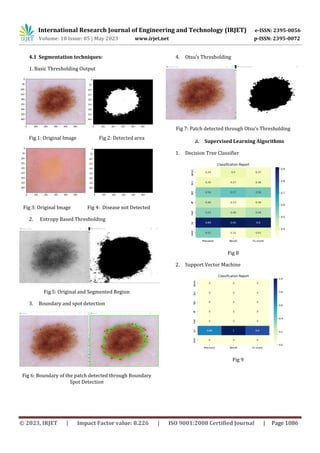
4.1 Segmentation techniques:
1. Basic Thresholding Output
Fig 1: Original Image Fig 2: Detected area
Fig 3: Original Image Fig 4: Disease not Detected
2. Entropy Based Thresholding
Fig 5: Original and Segmented Region
3. Boundary and spot detection
Fig 6: Boundary of the patch detected through Boundary
Spot Detection
4. Otsu’s Thresholding
Fig 7: Patch detected through Otsu’s Thresholding
a. Supervised Learning Algorithms
1. Decision Tree Classifier
Fig 8
2. Support Vector Machine
Fig 9
International Research Journal of Engineering and Technology (IRJET) e-ISSN: 2395-0056
Volume: 10 Issue: 05 | May 2023 www.irjet.net p-ISSN: 2395-0072
© 2023, IRJET | Impact Factor value: 8.226 | ISO 9001:2008 Certified Journal | Page 1087
3. Random Forest Classifier
Fig 10
In Supervised Machine learning algorithms, we classified
using Decision trees, Support Vector Machine, Random
Forest and got maximum accuracies of 77.7%, 67%, 79.3%
respectively. But due to low accuracies, overfitting and due
to high biasness of the model led us to move further to deep
learning.
b. Convolution Neural Network
Fig 11
As per the studies, we found out that the ConvolutionNeural
Network was the best suitable technique for the
classification of diseases. Due to high computation capacity
and the ability to classify a huge dataset, this model proved
to be better than the other classification techniques that
were used above. It also overcame the drawback of
overfitting, and can classify new and unseen data while
maintaining a high accuracy of 82%.
3. CONCLUSIONS
Using the HAM 10000 dataset, a comparison of multiple
algorithms has been carried out in order to detect skin
conditions and for the classificationofskinconditions.When
we began the research with fundamental image processing
methods, we obtained the highest possible accuracy of 75%.
However, when we movedontoclassificationalgorithms,we
obtained the highest possible accuracy of 97% in both the
decision tree and the random forest. On the other hand,
because of the problems associated with overfitting and the
model becoming biased, we decidedtomoveontothe neural
network. Convolutionneural network appearstobethemost
effective algorithm for the classificationofimages,according
to our findings. We found that it was accurate 82% of the
time, and it enabled us to verify that it workedappropriately
with random data as well. Additionally, it assisted us in
attaining a greater degree of precision.
4. REFERENCES
[1].Kumar, N. V., Kumar, P. V., Pramodh, K., & Karuna, Y.
(2019, March). Classification of Skin diseases using Image
processing and SVM. In 2019 International Conference on
Vision Towards Emerging Trends in Communication and
Networking (ViTECoN) (pp. 1-5). IEEE.
[2]. Hegde, P. R., Shenoy, M. M., & Shekar, B. H. (2018,
September). Comparison of machine learningalgorithms for
skin disease classificationusingcolorandtexturefeatures.In
2018 International Conference on Advances in Computing,
Communications, andInformatics(ICACCI)(pp.1825-1828).
IEEE
[3]. Vincent, L., & Jayasingh, J. R. (2022, April). Comparison
of Psoriasis Disease Detection and Classification Through
Various Image ProcessingTechniques-AReview.In2022 6th
International Conference on Devices, Circuits and Systems
(ICDCS) (pp. 122-124). IEEE.
[4]. Pugazhenthi, V., Naik, S. K., Joshi, A. D., Manerkar, S. S.,
Nagvekar, V. U., Naik, K. P., ... & Sagar, K. (2019). Skin disease
detection and classification. International Journal of
Advanced Engineering Research and Science (IJAERS), 6(5),
396-400.
[5]. Gupta, S., Panwar, A., & Mishra, K. (2021, July). Skin
disease classification using dermoscopy images through
deep feature learning models and machine learning
classifiers. In IEEE EUROCON 2021-19th International
Conference on Smart Technologies (pp. 170-174). IEEE.
[6]. Swamy, K. V., & Divya, B. (2021, December).SkinDisease
Classification using Machine Learning Algorithms. In 2021
2ndInternational ConferenceonCommunication,Computing
and Industry 4.0 (C2I4) (pp. 1-5). IEEE.
[7]. Kolkur, S., & Kalbande, D. R. (2016,November).Survey of
texture-based feature extraction for skin disease detection.
In 2016 International Conference on ICT in Business
Industry & Government (ICTBIG) (pp. 1-6). IEEE.

Skin disease detection and classification using different segmentation and classification techniques

  • 1.
    International Research Journalof Engineering and Technology (IRJET) e-ISSN: 2395-0056 Volume: 10 Issue: 05 | May 2023 www.irjet.net p-ISSN: 2395-0072 © 2023, IRJET | Impact Factor value: 8.226 | ISO 9001:2008 Certified Journal | Page 1082 Skin disease detection and classification using different segmentation and classification techniques Samiksha Prachand1, Nisha Patil2, Neha Badoge3, Vaibhavi Chaudhari4, Bhargavi Kaslikar5 1,2,3,4Student, Final year B. Tech, Electronics Engineering, K.J. Somaiya College of Engineering, Mumbai, Maharashtra, India 5Professor, Electronics Department, Somaiya College of Engineering, Vidyavihar, Mumbai, Maharashtra, India ---------------------------------------------------------------------***--------------------------------------------------------------------- Abstract - Skin diseases are common and affect a large population all over the world. Skin disease management necessitates accurate diagnosis and treatment. The systems used image processing and machine learning techniques to automate the process of identifying skin diseases. With the advancement of machine learning algorithms, automated systems for skin disease detection and classification are now possible. This paper presents a study and exploration of various segmentation techniques used to detect the type of skin lesions, including Region-based segmentation, Otsu's Thresholding, Boundary, and spot detection, and Entropy- based segmentation. Furthermore, support vector machines, Decision Trees, Random Forests have been usedtoclassifyskin diseases. Melanotic nevi, Melanoma Benign, Keratosis, Basal cell Carcinoma, Actinic Keratosis, Vascular Lesions, and Dermatofibroma are the seven types of skin cancer. The primary goal of this project is to improve diagnostic system accuracy by utilizing image segmentation and classification techniques. Key Words: Skin Disease Classification, Convolution Neural Network, Deep Learning, Classification Algorithms, Image Processing. 1. INTRODUCTION The early diagnosis and treatment of skin illnesses depend greatly on the detection and classification of skin diseases, which is a critical responsibility in dermatology. Skin conditions are common around the world, and early diagnosis and classification can preventdeathandlessenthe financial load on the healthcare system. Recent advancements in machine learning and computer vision have led to the development of automated systems for skin disease detection and classification, which can assist dermatologists in providing accurate diagnoses and individualized treatments. The epidermis, dermis, andsubcutaneoustissuemakeup the skin, which is the largest organ in the human body. The epidermis is the skin's outermost layer and a barrier against environmental hazards. Layers of keratinocytes, melanocytes, and Langerhans cells make up its structure. Keratin, which is synthesized by the skin's keratinocytes, gives the skin its strength and ability to repel water.Melanin is a pigment made by melanocytes thatgiveskinitscolorand shield it from the sun's UV rays. The dermis is the skin's intermediate layer and contains connective tissue, blood vessels, nerves, and other structures. It provides structural support to the skin and contains collagen and elastin fibers, which impart elasticity and strength to the skin. There are also hair follicles, perspiration glands, and sebaceous glands. Fat and connective tissue make up the subcutaneous tissue, the skin's deepest layer. It Insulates and regulates body temperature. Although cancer can manifest itself in any of the skin's layers, basal cell carcinoma (BCC), the most prevalent form of skin cancer, is most often found in the epidermis' basal cells. The epidermis's base is home to a special type of cell called a basal cell. The epidermis' outermost layers are frequently the starting point for squamous cell carcinoma (SCC), another frequently encountered form of skin cancer. Melanoma, a more aggressive form of skin cancer, develops in the melanocytes, which are in the epidermis's deeper layers. Depending on their form and cause, skin lesions can also affect various layers of skin. For instance, psoriasis lesions, which are characterized by thick, scaly regions of skin, affect the epidermis, and can extend into the dermis. In severe cases, the subcutaneous tissue may be affected by eczema lesions, which are caused by inflammation and irritation of the skin. The purpose of this work is to provide a comprehensive analysis of existing methods and algorithms for detecting and classifying skin diseases. The HAM10000dataset,which contains photos of skin lesions, will be used to test the effectiveness of various methods and algorithms. We hope that the work presented here will help move the field of skin disease identification and categorization forward and ultimately improve the lives of many people around the world. In this work, we employ the publicly available HAM10000 dataset for machine learning. Ten thousand and fifteen dermatoscopy photographs of pigmented skin lesions are included, with seven thousand two hundred and ninety-five representing benign lesions and two thousand depicting
  • 2.
    International Research Journalof Engineering and Technology (IRJET) e-ISSN: 2395-0056 Volume: 10 Issue: 05 | May 2023 www.irjet.net p-ISSN: 2395-0072 © 2023, IRJET | Impact Factor value: 8.226 | ISO 9001:2008 Certified Journal | Page 1083 malignant melanomas. Lesions such as seborrheic keratosis and angiomatosis make up the remaining 715 photos. In addition to the images themselves, the collection contains descriptive information aboutthem,suchasthepatient'sage and gender, the anatomical location of the lesion, and the diagnosis. In it, you will find examples of both benign and malignant skin lesions. Below are the seven classes of skin diseases present in the HAM 10000 dataset. Moles or melanocytic nevi (nv),arebenignskingrowthsmade up of melanocytes, which are epidermal cellsresponsiblefor creating pigment. Melanoma (mel) is the malignant skin cancer which occurs because of the melanocytes that is the pigment-producing cells of the epidermis. Lesions that mimic seborrheic keratosis or solar lentigines, which are benign skin growths, are known as keratosis-like lesions (bkl). Cancer of the basal cells of the epidermis, also known as basal cell carcinoma (bcc), manifestsasa firm,pink,orpearly white nodule on the skin. Actinic keratoses (akiec) are the premalignant skin lesions that, if untreated, can develop into squamouscell carcinoma. They are typically brought on by prolonged sun exposure. Blood vessel abnormalities such as angiomas, angiokeratomas, and pyogenic granulomasarereferredto as Vascular lesions (vas). A benign skin growth known as a dermatofibroma (df) typically presents as a tiny, hard bump. Cancer of the epidermis or other melanocyte-containing tissues, known as melanoma, begins in these cells. A black, asymmetrical lesion on the skin is one possible manifestation. Different layers of skin are affected byeach of these blemish’s kinds. Epidermis lesions such as melanocytic nevi and seborrheic keratosis are more common than those caused by basal cell and squamous cell carcinomas, which can affect both the epidermis and the higher dermal layers. Skin's dermis and subcutaneous tissue are not immune to melanoma's reach. The affected skin layers might also be affected by the location and severity of the lesion. 2. LITERATURE SURVEY [1] Here the authors have used SVM as a machine learning algorithm to focus on Melanoma and Carcinoma.Theauthors of this paper aimed to create an automated system that can assist dermatologists in determining whether a skin lesionis benign or malignant, which is useful in the early detection of Melanoma. They trained and tested their SVM-based classification system on 1,032 skin lesion images in their study and extracted relevant features from the images using image processing techniques such as normalization, segmentation, and featureextraction. The extracted features were then used to train the SVM classifier, which achievedan accuracy rate of 95.8%. [2] In this paper the authors have investigated theefficacyof different machine-learning algorithms for classifying skin diseases using color and texture features extracted from images. The authors gathered a collection of skin disease images from various sources and preprocessed them to extract color and texturefeatures.Theimagedatasetconsists of Chronic Eczema, Lichen, and Plaque psoriasis images captured with a digital camera and processed to extract Red, Green, and Blue (RGB) color features and Gray Level Co- occurrence Matrix (GLCM) texture features. To compare classifier performance, different combinations of features with four popular ML algorithms were considered. Linear Discriminant Analysis (LDA) and Support Vector Machine (SVM) had the highest classification accuracy of the four algorithmstested.Thepaperconcludesthatmachinelearning algorithms can be effective tools for classifying skin diseases and that the algorithmchosen shouldbebasedonthespecific features of the disease being diagnosed. The study's results show that LDA performed better in binary and multi-class scenarios using color feature-based classification, SVM performed better for texture features in both binary and multi-class classifiers, and LDA and SVM classifiers performed better in binary and multi-class classification for the combined feature. [3] In this paper the authors did a literature review to compare how different image-processing techniques can detect and classify psoriasis diseases. The goal of theauthors was to look at the current research in this area and compare how well different methods work for finding and classifying psoriasis from images ofskin.Thereviewfoundthatdifferent image processing methods, such as texture analysis, feature extraction,and machinelearning algorithms, havebeenused to find and classify psoriasis. Texture analysis has been used to look at how the skin of psoriasis lesions feels, and feature extraction techniques have been used to pull out things like color, shape, and texture from images of skin. Psoriasis has been put into groups using machine learning algorithms like support vector machines (SVMs), artificial neural networks (ANNs), and random forests (RFs). The machine learning algorithms have shown promise in correctly classifying psoriasislesions, with SVMsbeingthemostusedalgorithmin the literature. [4] Here they offered an overview of the different techniques and methods used to findandcategorize skin diseases. Using Image Processing andclassificationtechniques,themaingoal of this projectwastomakediagnosticsystemsmoreaccurate. In the system that is being proposed, an image captured by a camera is used as input. By using Contrast Enhancement and
  • 3.
    International Research Journalof Engineering and Technology (IRJET) e-ISSN: 2395-0056 Volume: 10 Issue: 05 | May 2023 www.irjet.net p-ISSN: 2395-0072 © 2023, IRJET | Impact Factor value: 8.226 | ISO 9001:2008 Certified Journal | Page 1084 Grayscale Conversion, this image will be prepared for segmentation. The Global Thresholding technique is used to divide the image that has already been processed into sections. This is how the real affected area is found. Using Grey Level Co-occurrence Matrix, texture features like Energy, Entropy, Contrast, and IDM (Inverse Difference Moment) are taken from a segmented image. Image Quality Assessment features are taken out, such as Mean Square Error (MSE) and Peak Signal to Noise Ratio(PSNR).Usingthe Decision tree technique,theextractedtexturefeatureswillbe used to find skin diseases and classify them as melanoma, leprosy, or eczema if they are found. This system uses pictures of the skin taken by a camera to figure out if it is healthy or not. If it isn't healthy, it is categorized as Melanoma, Eczema, or Leprosy. [5]Here the authors gaveamethodfordecidingwhetherskin cancer in two different moles is benign or malignant. At first, the dataset has images of two different kinds of moles that are mixed. These images have already been changed so that they can be used for classification. When the pre-processing of the dataset is done, these images are sent to CNN models like VGG16, VGG19, and Inception V3 to pull out the characteristics. Lastly, these images are sent to different machine-learning classifiers to figure out if the moles are harmless or dangerous. The results show that the Inception V3 model with the neural network classifier has the best accuracy at 83.2%. [6] In this work they have used features such as entropy, variance, and maximum histogram value of Hue-Saturation- Value (HSV). These characteristics are used to construct a machine learning algorithm using Decision Tree (DT) and Support Vector Machine (SVM). Accuracy is used to evaluate the proposed algorithm's performance. The first phase includes image processing for skin disease detection,andthe secondphaseincludesamachine-learningalgorithm.Because of changes in the skin's characteristic features such as color and texture, it is difficult to diagnose skin disease in the primary and other stages. SVM color features produce 8% better results. As a result, the decision tree produces better results. The color of various skin diseases is nearly identical. It makes classification difficult. As a result, texture features produce better results. [7] Here they have thoroughly examined how texture-based feature extraction can be used to find skin diseases and suggest a system based on what they found. In this paper, they worked on texture-based features derived from the GLCM matrix that are used to find skin diseases is discussed and consolidated. Most of the work is done to find skin cancer, but some of the works also look at other diseases like psoriasis, warts, moles, and eczema. Classifiers like neural networks and SVM decidewhether an image showsadisease or not. Most of theresearchshowsanoverallaccuracyof90% or higher. Contrast, Correlation, Energy, Entropy, and Homogeneity are the top five features used in all this work. 3. METHODOLOGY In the proposed system we start with the basic image processing techniques with a smaller dataset andthenas we move ahead, we work on multiple images and proceed towards the exploration of segmentation techniques. Thereafter we have worked on the complete HAM10000 dataset, using different ML techniques. Furthermore, to increase the efficiency of the model CNN was used and finalized. 3.1 Basic Thresholding The first algorithm developed by us is basic thresholding. This type of thresholding technique is based on pixel intensities, if the pixel intensity is greater than the specified threshold it would be considered as one or vice versa. Thus, converted into binary image. It is one of the basic algorithms used to detect whether the skin disease is presentornot.For this thresholding algorithm,weuploadedtheimagefrom our dataset in the model and a basic classification of the image (disease detected or disease not detected) was done. Initially, the image is passed through gaussian filter so that other insignificant parts would become blur and then the thresholding algorithm was applied on basis of term percentage. 3.2 Entropy based thresholding In Entropy based thresholding algorithm, the optimum thresholding value is acquired using the maximum entropy plotted on the histogram and by choosing that respective pixel intensity and applying the thresholding techniqueonit and acquiring the results. In Entropy based thresholding, a histogram is plotted to obtain the frequency of gray levels in an image and then cumulative sum of the histogram was obtained and is normalized. After that, initialization of threshold value and maximum entropy is done, and the model is made to iterate through all the possible values where probabilities of two parts were been calculated. Then, the maximum entropy of two parts was calculated by applying the equations: entropy1 = -p1 * np.log2(p1) if p1 > 0 else 0 …3.2.1 entropy2 = -p2 * np.log2(p2) if p2 > 0 else 0 …3.2.2 After taking into consideration,thetotal entropyobtainedby adding both the results of above equations. The parameters were updated i.e., threshold value and maximum entropy based on current entropy. While implementing it, If the current entropy is higher than the parameters mentioned, then the entropy would be updated or vice versa. And finally, thethresholdingwasperformed on the image and the desired results were obtained.
  • 4.
    International Research Journalof Engineering and Technology (IRJET) e-ISSN: 2395-0056 Volume: 10 Issue: 05 | May 2023 www.irjet.net p-ISSN: 2395-0072 © 2023, IRJET | Impact Factor value: 8.226 | ISO 9001:2008 Certified Journal | Page 1085 3.3 Boundary and spot detection In this method, we have defined a function in which it would check if the spot is a disease or not by defining the region of interest. If the spot falls within the regionofinterestitwould return true or vice versa. Initially the same steps were followed as done in the above algorithms such as converting the image to grayscale and applying gaussian filter on an image and then the Otsu thresholding algorithm wasapplied to segment the image and then the contours were made to search in the thresholder image and thus, the contours were drawn on the original image. The track of true positive, false positive, and false negative spots was kept. Then after loop over the contours were developed in which if the area was less than a certain threshold, it was a spot. For accuracy, it was made to check if the spot was true positive or false positive. Thus, the desired results were achieved. 3.4 Otsu based Thresholding Initially, the image is uploaded from the dataset and the image is converted to grayscale and the gaussian filter is applied to reduce the noise and finally, the binary thresholding and Otsu thresholding is applied on the image and the ground tooth labels for the image were provided. Thus, we obtained the predicted labels fromthe thresholded image and acquired the desired results. 3.5 Decision Tree After importing the dataset, preprocessing is done using Label Encoder to convert intocategorical data forclassifythe images into multiple classesandthedecisiontreeclassifieris given to the model. By using train and test split, dataset was trained and tested and finally, the results were displayed using the confusion matrix. 3.6 Support Vector Machine Algorithm In support Vector Machine, the image is classified using three kernels namely linear, poly and rbf (Radial Basis Function). The kernels transform the non-linearlyseparable dataset to a linearly separable dataset. In this method, hyperplane is used to classify the images into different classes. The most accurate results were given rbf kernel in compared to linear and poly kernel with random state as42. The data was then trained and fitted to the model. Thus the confusion matrix was plotted as a result. 3.7 Random Forest After importing the dataset, the random forest classifier is given to the model comprising of 100 decision trees and random state as 42, so that it would take the same set of datasets each time it is run. Thus, using train, test split the model is trained and using fit, the trained data is fitted to the model. Thus, the model is tested using test dataset and the desired results were obtained. 3.8 Deep Neural Networks As HAM10000 is a huge dataset, with different supervised algorithms we realized that itisessential toproceedtowards neural networks. Neural network possesses thecapabilityof processing complex computations, handling huge data, and end to end automation. We initially worked on preprocessing dataset and thus the preprocessed data was fed to deep neural network with 10,000 input images as neurons to an input layer, with two hidden layer and one output layer having tanh activation function. The output layer is used to flatten the matrix and convert it into 1D matrix. As, it was a huge image dataset, after deep study proceeded towards convolution neural network. 3.9 Convolution Neural Network Initially, the dataset is uploaded and data cleaning isdoneby removing null values, replacing it by mean values, dropping insignificant columns, etc. Since, there are seven different classes to be classified of skin diseases, so it is multi class classification. The data is fed to the input layer, then it is passed through three hidden layers where complex computation is performed. The activation function used are Relu and then output is flattened i.e. converted to 1D and provided to the output. Since, the output is multi class classification, the activation function used is SoftMax activation function instead of sigmoid activation function.In hidden layers, two convolution 2D layer were providedwith kernel size (3,3) and max pooling filter of 16*2 size. The optimizer used for the model is Adam. Then, the model is compiled and the learning set annealer is set. The data is then split into features and targets. Training and testing is performed on it. After defining the trained data and tested data, one hot encoding label is performed. There after the data augmentation is done to prevent overfitting. The batch size is 16. After the training, it is fitted to the model and various epochs were performedto enhancetheaccuracyand finally, the confusion matrix was plotted. The image was also converted to grayscale and the gaussian filter was used to reduce the noise earlier and finally, the binary thresholdingand Otsu thresholdingwasappliedusing ground tooth labels for the image. Thus, the predicted labels from the thresholded images were acquired. 4. RESULTS AND DISCUSSION The results obtained below are through different image segmentation techniques. We processed each image of the Dataset and were able to get segmented images and classify the disease, but a major drawback of these segmentation techniques is the requirement of ground tooth masked images, obtaining these ground tooth masked images can be a very lengthy and time-consuming processandthusitled us to move towards different machine learning algorithms.
  • 5.
    International Research Journalof Engineering and Technology (IRJET) e-ISSN: 2395-0056 Volume: 10 Issue: 05 | May 2023 www.irjet.net p-ISSN: 2395-0072 © 2023, IRJET | Impact Factor value: 8.226 | ISO 9001:2008 Certified Journal | Page 1086 4.1 Segmentation techniques: 1. Basic Thresholding Output Fig 1: Original Image Fig 2: Detected area Fig 3: Original Image Fig 4: Disease not Detected 2. Entropy Based Thresholding Fig 5: Original and Segmented Region 3. Boundary and spot detection Fig 6: Boundary of the patch detected through Boundary Spot Detection 4. Otsu’s Thresholding Fig 7: Patch detected through Otsu’s Thresholding a. Supervised Learning Algorithms 1. Decision Tree Classifier Fig 8 2. Support Vector Machine Fig 9
  • 6.
    International Research Journalof Engineering and Technology (IRJET) e-ISSN: 2395-0056 Volume: 10 Issue: 05 | May 2023 www.irjet.net p-ISSN: 2395-0072 © 2023, IRJET | Impact Factor value: 8.226 | ISO 9001:2008 Certified Journal | Page 1087 3. Random Forest Classifier Fig 10 In Supervised Machine learning algorithms, we classified using Decision trees, Support Vector Machine, Random Forest and got maximum accuracies of 77.7%, 67%, 79.3% respectively. But due to low accuracies, overfitting and due to high biasness of the model led us to move further to deep learning. b. Convolution Neural Network Fig 11 As per the studies, we found out that the ConvolutionNeural Network was the best suitable technique for the classification of diseases. Due to high computation capacity and the ability to classify a huge dataset, this model proved to be better than the other classification techniques that were used above. It also overcame the drawback of overfitting, and can classify new and unseen data while maintaining a high accuracy of 82%. 3. CONCLUSIONS Using the HAM 10000 dataset, a comparison of multiple algorithms has been carried out in order to detect skin conditions and for the classificationofskinconditions.When we began the research with fundamental image processing methods, we obtained the highest possible accuracy of 75%. However, when we movedontoclassificationalgorithms,we obtained the highest possible accuracy of 97% in both the decision tree and the random forest. On the other hand, because of the problems associated with overfitting and the model becoming biased, we decidedtomoveontothe neural network. Convolutionneural network appearstobethemost effective algorithm for the classificationofimages,according to our findings. We found that it was accurate 82% of the time, and it enabled us to verify that it workedappropriately with random data as well. Additionally, it assisted us in attaining a greater degree of precision. 4. REFERENCES [1].Kumar, N. V., Kumar, P. V., Pramodh, K., & Karuna, Y. (2019, March). Classification of Skin diseases using Image processing and SVM. In 2019 International Conference on Vision Towards Emerging Trends in Communication and Networking (ViTECoN) (pp. 1-5). IEEE. [2]. Hegde, P. R., Shenoy, M. M., & Shekar, B. H. (2018, September). Comparison of machine learningalgorithms for skin disease classificationusingcolorandtexturefeatures.In 2018 International Conference on Advances in Computing, Communications, andInformatics(ICACCI)(pp.1825-1828). IEEE [3]. Vincent, L., & Jayasingh, J. R. (2022, April). Comparison of Psoriasis Disease Detection and Classification Through Various Image ProcessingTechniques-AReview.In2022 6th International Conference on Devices, Circuits and Systems (ICDCS) (pp. 122-124). IEEE. [4]. Pugazhenthi, V., Naik, S. K., Joshi, A. D., Manerkar, S. S., Nagvekar, V. U., Naik, K. P., ... & Sagar, K. (2019). Skin disease detection and classification. International Journal of Advanced Engineering Research and Science (IJAERS), 6(5), 396-400. [5]. Gupta, S., Panwar, A., & Mishra, K. (2021, July). Skin disease classification using dermoscopy images through deep feature learning models and machine learning classifiers. In IEEE EUROCON 2021-19th International Conference on Smart Technologies (pp. 170-174). IEEE. [6]. Swamy, K. V., & Divya, B. (2021, December).SkinDisease Classification using Machine Learning Algorithms. In 2021 2ndInternational ConferenceonCommunication,Computing and Industry 4.0 (C2I4) (pp. 1-5). IEEE. [7]. Kolkur, S., & Kalbande, D. R. (2016,November).Survey of texture-based feature extraction for skin disease detection. In 2016 International Conference on ICT in Business Industry & Government (ICTBIG) (pp. 1-6). IEEE.