International Research Journal of Engineering and Technology (IRJET) e-ISSN: 2395-0056
Volume: 10 Issue: 05 | May 2023 www.irjet.net p-ISSN: 2395-0072
© 2023, IRJET | Impact Factor value: 8.226 | ISO 9001:2008 Certified Journal | Page 448
Detection of Skin Cancer Based on Skin Lesion Images UsingDeep
Learning
Prof. Bharath Bharadwaj B S 1, Saniya Anjum 2, Shaguftha Afreen 3 , Spoorthi T C 4,Keerthana M 5
1 Assistant professor, Dept. of computer Science and Engineering, Maharaja Institute of Technology Thandavapura
2,3,4,5Students , Dept. of Computer Science and Engineering, Maharaja Institute of Technology Thandavapura
---------------------------------------------------------------------***---------------------------------------------------------------------
Abstract - An adding number of inheritable and metabolic
anomalies have been determined to lead to cancer, generally
fatal. Cancerous cells may spread to any bodypart, wherethey
can be life- changing. Skin cancer is one of the most common
types of cancer, and its frequence is adding worldwide. The
main subtypes of skin cancer are scaled and rudimentary cell
lymphomas, and carcinoma, which is clinically aggressive and
responsible for utmost deaths. Thus, skin cancer webbing is
necessary. One of the stylish styles to directly and fleetly
identify skin cancer is using deep literacy (DL). To insure
better prognostic and death rates, early skin cancer
identification is pivotal, yet solid excrescence discovery
generally relies substantially on screening mammography
with shy perceptivity, which is also validated by clinical
samples. Cancer webbing and treatment responseevaluations
are generally not applicable uses for this approach. An adding
number of healthcare providers are using artificial
intelligence (AI) for medical diagnostics to ameliorate and
accelerate the opinion decision- making procedure
1 INTRODUCTION
The willful development of napkins in a specific
body area is known as cancer. The most snappily spreading
complaint in the world looks to be skin cancer.Skincancer is
a complaint in which abnormal skin cells develop out of
control. To determine implicit cancer rapid-fire early
discovery and accurate opinion are essential.Melanoma,the
deadliest form of skin cancer, is responsible for utmost skin
cancer-related deaths in developed countries. The skin
cancer types comprise rudimentary cell melanoma, scaled
cell melanoma, Merkel cell cancer,dermatofibroma,vascular
lesion, and benign keratosis.
1.2 PROBLEM STATEMENT
The GLOBOCAN check also points out that further
than half of the cancer deaths do in Asia about 20 of cancer
deaths are in Europe. Likewise, the areas most affected by
skin cancer are around the globe. North America reckoned
for half of the aggregate. Roughly 9,500 Americans are
diagnosed with skin cancer every day. The good news isthat
the five-time survival rate is 99 if caught and treated
beforehand.
Early discovery of skin cancer can beget by nasty lesions is
pivotal for treatment as it would increase thesurvival rate of
cases. Still, a conventional discovery system similar to
ABCDE criteria possesses colorful limitations such as
subjectivity and trip, due to the different experience
positions of dermatologists and the characteristics of nasty
skin lesions. Either, the current state-of-the-art in detecting
skin lesions using deep neural networks substantially
focuses on the skin lesions. Also, deep literacy model
infrastructures similar to ‘Resent’ used to perform these
tasks are frequently complex, heavy in size, slow, and
delicate to apply.
1.3 OBJECTIVE
The skin cancer detection project is to develop a
framework to analyze and assess the risk ofmelanoma using
dermatological photographs taken with a standard
consumer-grade camera. This step can be performed
because many features used to the risk of melanoma are
derived based on the lesion border. Our approach to finding
the lesion border is texture distinctiveness-based lesion
segmentation.
1.4 SCOPE
Skin cancer indications can be quickly and easily
diagnosed using computer-based techniques. By analyzing
images of lesions on the skin, we developed for quickly and
accurately diagnosing both benign and malignant forms of
cancer.
2 LITRATURE SURVEY
[1] Title:-Detection of Skin Cancer based on skin lesion
images
Authors:-Walaa Gouda, Noor Zaman
Publication Journal & Year:-IRJET, 2022.
Summary:-By assaying images of lesions on the skin,
we developed a fashion for snappily and directly
diagnosing both benign and nasty forms of cancer. The
suggested system uses image improvement approaches
to boost the luminance of the lesion image and reduce
noise. Resnet50, InceptionV3, and Begrudge inception
were all trained on the upper edge of the preprocessed
lesion medical images to help to over fit, as well as
meliorate the overall capabilities of the suggested DL
International Research Journal of Engineering and Technology (IRJET) e-ISSN: 2395-0056
Volume: 10 Issue: 05 | May 2023 www.irjet.net p-ISSN: 2395-0072
© 2023, IRJET | Impact Factor value: 8.226 | ISO 9001:2008 Certified Journal | Page 449
styles. The Inception model had an overall delicacyrateo
f85.7, which is similar to that of educateddermatologists.
[2] Title:-Skin CancerClassificationUsingImageProcessing
and Machine Learning
Authors:-Arslan Javaid,MuhammadSadiq,FarazAkram
Publication Journal & Year:-IJASRT, 2021.
Summary:-In this work, a novel method of skin cancer
classification using machine learning and image
processing is implemented. In the first step, a novel
method of contrast stretching based on the mean and
standard deviation of pixels for Dermoscopy image
enhancement is proposed. Then OTSU thresholding is
performed for segmentation.
[3] Title:-Detection of Skin Cancer Lesions from Digital
Images with Image Processing Techniques
Authors:-Minakshi Waghulde, Shirish Kulkarni, Gargi
Phadke
Publication Journal & Year:-IJCDS, 2020.
Summary:-Our results are harmonious withcurrentart
on DNNs transfer knowledge is a good idea, as is fine-
tuning. We anticipated that transferring knowledge
from a related task (in our case, from Retinopathy,
another medical type task) would lead to better results,
especially in the double transfer scheme.
[4] Title:-Detection and Classification of Skin Cancer by
Using a Parallel CNN Model
Authors:-Noortaz Rezaoana, Mohammad Shahadat
Hossain, Karl Andersson
Publication Journal & Year:-IEEE, 2020.
Summary:-In this work, we propose GAN-based
methods to generate realistic synthetic skin lesion
images. Malignancy markers are present with coherent
placement and sharpness which result in visually-
appealing images.
[5] Title:- Skin Cancer Classification using Deep Learning
and Transfer Learning
Authors:- KhalidM.Hosny, MohamedA.Kassem,
Mohamed M.Foaud
Publication Journal & Year:-IJASRT-2019.
Summary:-we have proposed an improved U-Net which is
named as NABLA-N and the model is evaluated for skin
cancer segmentation tasks. Three different models are
investigated with different feature fusion between encoding
and decoding units which are evaluated on the ISIC2018
dataset. The quantitativeand qualitativeresultsdemonstrate
better performance with the model compared to the model.
3. EXISTING SYSTEM
Sample Skin cancer is on the upswing, this has been
true for the last 10 times. Because the skin is the body’s
central part, it's reasonable to assume that skin cancer isthe
most frequent complaint in humans. The first step for
identifying whether the skin lesion is nasty or benign for a
dermatologist is to do skin vivisection. In skin vivisection,
the dermatologist takes some part of the skin lesion and
examines it under a microscope. The current process takes
nearly a week or further, starting from getting a
dermatologist appointmenttogettinga vivisectionreport. At
present, to check the skin malice of a case, he needs to
witness singular webbing by a dermatologisttofetewhether
they've skin complaint or not.
4. PROPOSED SYSTEM
There is a need for accurate as well as reliable
systems that can help not only clinicians but as well persons
to descry types of lesions at early stages. This proposed skin-
cancer discovery system is developed as a clinical decision
support tool that uses computer vision which can help
croakers to diagnose skin cancer types by simply using
images with good delicacy. This design aims to dock the
current gap to just a couple of days by furnishing the
predictive model using Computer- backed opinion (CAD).
Fig. 1: Sequence Diagram
International Research Journal of Engineering and Technology (IRJET) e-ISSN: 2395-0056
Volume: 10 Issue: 05 | May 2023 www.irjet.net p-ISSN: 2395-0072
© 2023, IRJET | Impact Factor value: 8.226 | ISO 9001:2008 Certified Journal | Page 450
5. METHODOLOGY
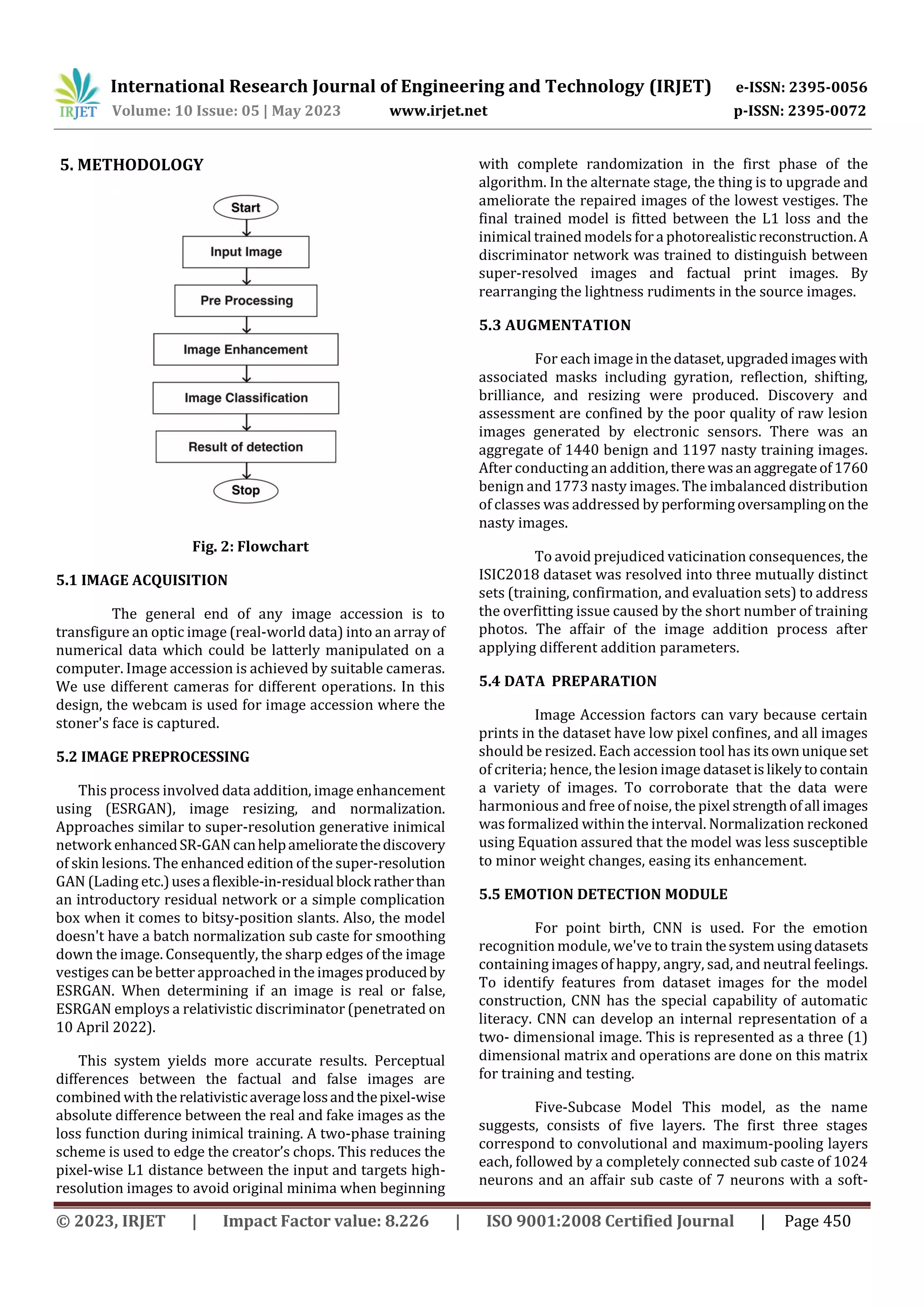
Fig. 2: Flowchart
5.1 IMAGE ACQUISITION
The general end of any image accession is to
transfigure an optic image (real-world data) into an array of
numerical data which could be latterly manipulated on a
computer. Image accession is achieved by suitable cameras.
We use different cameras for different operations. In this
design, the webcam is used for image accession where the
stoner's face is captured.
5.2 IMAGE PREPROCESSING
This process involved data addition, image enhancement
using (ESRGAN), image resizing, and normalization.
Approaches similar to super-resolution generative inimical
network enhancedSR-GANcanhelpamelioratethediscovery
of skin lesions. The enhanced edition of the super-resolution
GAN (Lading etc.)usesaflexible-in-residualblockratherthan
an introductory residual network or a simple complication
box when it comes to bitsy-position slants. Also, the model
doesn't have a batch normalization sub caste for smoothing
down the image. Consequently, the sharp edges of the image
vestiges can be better approached in the imagesproducedby
ESRGAN. When determining if an image is real or false,
ESRGAN employs a relativistic discriminator (penetrated on
10 April 2022).
This system yields more accurate results. Perceptual
differences between the factual and false images are
combined with therelativisticaveragelossandthepixel-wise
absolute difference between the real and fake images as the
loss function during inimical training. A two-phase training
scheme is used to edge the creator’s chops. This reduces the
pixel-wise L1 distance between the input and targets high-
resolution images to avoid original minima when beginning
with complete randomization in the first phase of the
algorithm. In the alternate stage, the thing is to upgrade and
ameliorate the repaired images of the lowest vestiges. The
final trained model is fitted between the L1 loss and the
inimical trained models fora photorealisticreconstruction.A
discriminator network was trained to distinguish between
super-resolved images and factual print images. By
rearranging the lightness rudiments in the source images.
5.3 AUGMENTATION
For each imageinthedataset,upgradedimages with
associated masks including gyration, reflection, shifting,
brilliance, and resizing were produced. Discovery and
assessment are confined by the poor quality of raw lesion
images generated by electronic sensors. There was an
aggregate of 1440 benign and 1197 nasty training images.
After conducting an addition, therewasanaggregateof1760
benign and 1773 nasty images. The imbalanced distribution
of classes was addressed by performingoversamplingon the
nasty images.
To avoid prejudiced vaticination consequences, the
ISIC2018 dataset was resolved into three mutually distinct
sets (training, confirmation, and evaluation sets) to address
the overfitting issue caused by the short number of training
photos. The affair of the image addition process after
applying different addition parameters.
5.4 DATA PREPARATION
Image Accession factors can vary because certain
prints in the dataset have low pixel confines, and all images
should be resized. Each accession tool has itsownuniqueset
of criteria; hence, the lesion image datasetislikelytocontain
a variety of images. To corroborate that the data were
harmonious and free of noise, the pixel strengthofall images
was formalized within the interval. Normalization reckoned
using Equation assured that the model was less susceptible
to minor weight changes, easing its enhancement.
5.5 EMOTION DETECTION MODULE
For point birth, CNN is used. For the emotion
recognition module, we've to train thesystemusingdatasets
containing images of happy, angry, sad, and neutral feelings.
To identify features from dataset images for the model
construction, CNN has the special capability of automatic
literacy. CNN can develop an internal representation of a
two- dimensional image. This is represented as a three (1)
dimensional matrix and operations are done on this matrix
for training and testing.
Five-Subcase Model This model, as the name
suggests, consists of five layers. The first three stages
correspond to convolutional and maximum-pooling layers
each, followed by a completely connected sub caste of 1024
neurons and an affair sub caste of 7 neurons with a soft-
International Research Journal of Engineering and Technology (IRJET) e-ISSN: 2395-0056
Volume: 10 Issue: 05 | May 2023 www.irjet.net p-ISSN: 2395-0072
© 2023, IRJET | Impact Factor value: 8.226 | ISO 9001:2008 Certified Journal | Page 451
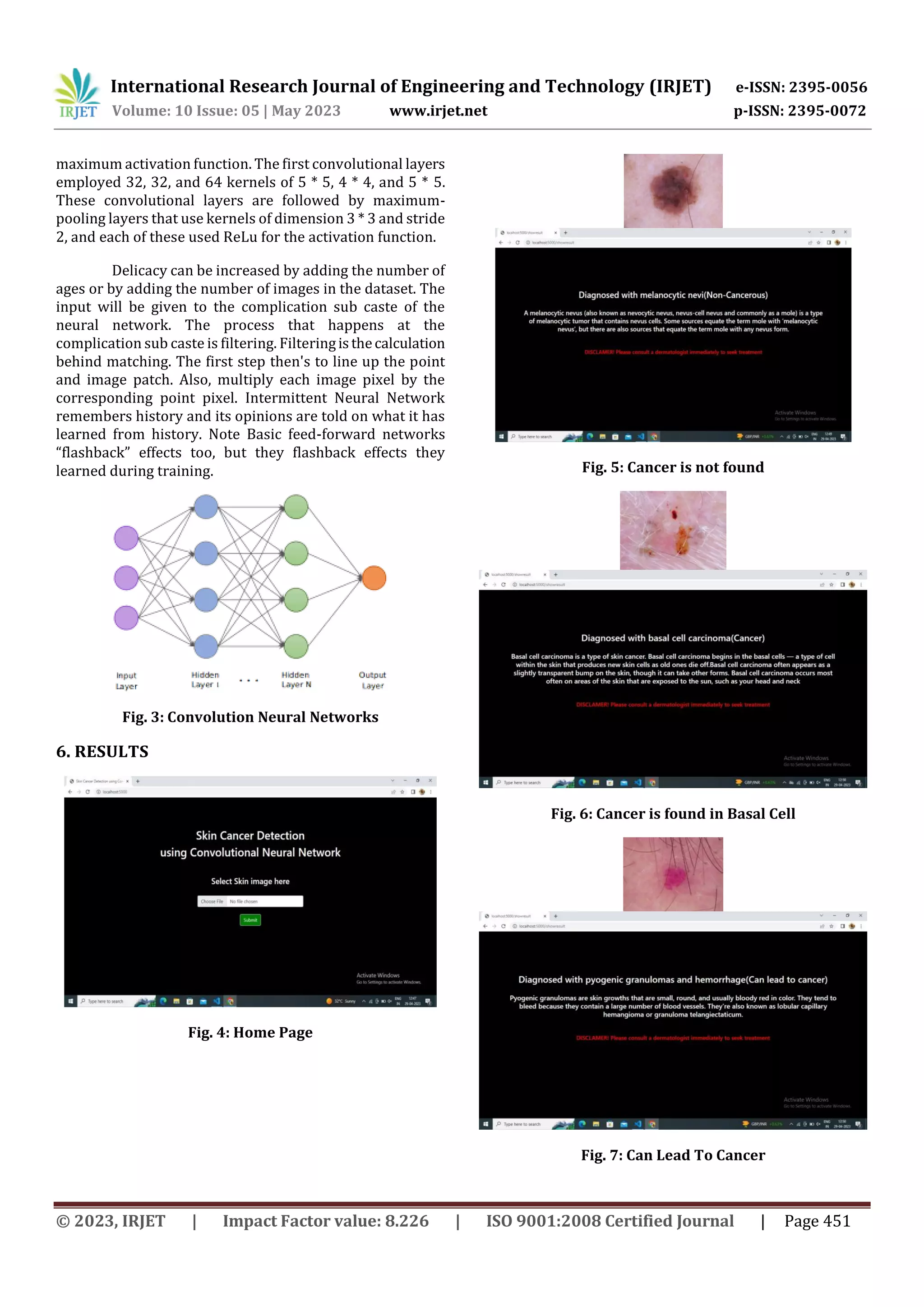
maximum activation function. The first convolutional layers
employed 32, 32, and 64 kernels of 5 * 5, 4 * 4, and 5 * 5.
These convolutional layers are followed by maximum-
pooling layers that use kernels of dimension 3 * 3 and stride
2, and each of these used ReLu for the activation function.
Delicacy can be increased by adding the number of
ages or by adding the number of images in the dataset. The
input will be given to the complication sub caste of the
neural network. The process that happens at the
complication sub caste is filtering. Filteringisthecalculation
behind matching. The first step then's to line up the point
and image patch. Also, multiply each image pixel by the
corresponding point pixel. Intermittent Neural Network
remembers history and its opinions are told on what it has
learned from history. Note Basic feed-forward networks
“flashback” effects too, but they flashback effects they
learned during training.
Fig. 3: Convolution Neural Networks
6. RESULTS
Fig. 4: Home Page
Fig. 5: Cancer is not found
Fig. 6: Cancer is found in Basal Cell
Fig. 7: Can Lead To Cancer
International Research Journal of Engineering and Technology (IRJET) e-ISSN: 2395-0056
Volume: 10 Issue: 05 | May 2023 www.irjet.net p-ISSN: 2395-0072
© 2023, IRJET | Impact Factor value: 8.226 | ISO 9001:2008 Certified Journal | Page 452
Fig.8: Cancer is not found
Fig.9: Cancer is found in Keratosis Cell
Fig. 10: Cancer is not found
7. CONCLUSION
In this project, it is found that most existing skin lesion
diagnoses with deep learning technology stop at deep
learning modeling and without any further deployment or
integration with a readily available device such as a
smartphone. However, the advantage of integrating object
detection deep learning technology and smartphone in the
medical field has been discovered throughout the project.
This technology can provide a low-cost diagnosis without
requiring years of skin lesion diagnosis experience.
Moreover, users can perform diagnosis at home with a
smartphone and therefore can provide a point of care to
users from a remote area. Although the process of
development is challenging due to the immature platform of
object detection development TensorFlow Object Detection
API and requires experience for Android application
development, the success of this project has proven that the
development of this technology is feasible and should be
aware.
REFERENCES
[1] World Health Organization. GlobalHealthObservatory;
World Health Organization: Geneva, Switzerland,
2022.
[2] Han, H.S.; Choi, K.Y. Advances in nanomaterial-
mediated photo thermal cancer therapies: Toward
clinical applications. Biomedicines 2021, 9, 305.
[3] Fuzzell, L.N.; Perkins, R.B.; Christy, S.M.; Lake, P.W.;
Vadaparampil, S.T. Cervical cancer screening in the
United States: Challenges and potential solutions for
under screened groups. Prev. Med. 2021, 144,
106400.
[4] Ting, D.S.; Liu, Y.; Burlina, P.; Xu, X.; Bressler, N.M.;
Wong, T.Y. AI for medical imaging goes deep. Nat.
Med. 2018, 24, 539–540.
[5] Wolf,M.; de Boer,A.; Sharma,K.; Boor,P.; Leiner,T.;
Sunder- Plassmann,G.; Moser,E.; Caroli,A.; Jerome,N.P.
glamorous resonance imaging T1- and T2- mapping to
assess renal structure and functionAmethodical review
and statement paper. Nephron. telephone. Transplant.
2018, 33( Suppl. S2), ii41 – ii50.
BIOGRAPHIES
Bharath Bharadwaj B S
Professor,
Department of Computer
Science & Engineering,
Maharaja Institute of Technology
Thandavapura
International Research Journal of Engineering and Technology (IRJET) e-ISSN: 2395-0056
Volume: 10 Issue: 05 | May 2023 www.irjet.net p-ISSN: 2395-0072
© 2023, IRJET | Impact Factor value: 8.226 | ISO 9001:2008 Certified Journal | Page 453
Saniya Anjum
Student, Department of Computer
Science & Engineering,
Maharaja Institute of Technology
Thandavapura
Shaguftha Afreen
Student, Department of Computer
Science & Engineering,
Maharaja Institute of Technology
Thandavapura
Spoorthi T C
Student, Department of Computer
Science & Engineering,
Maharaja Institute of Technology
Thandavapura
Keerthana M
Student, Department of Computer
Science & Engineering,
Maharaja Institute of Technology
Thandavapura

Detection of Skin Cancer Based on Skin Lesion Images UsingDeep Learning

  • 1.
    International Research Journalof Engineering and Technology (IRJET) e-ISSN: 2395-0056 Volume: 10 Issue: 05 | May 2023 www.irjet.net p-ISSN: 2395-0072 © 2023, IRJET | Impact Factor value: 8.226 | ISO 9001:2008 Certified Journal | Page 448 Detection of Skin Cancer Based on Skin Lesion Images UsingDeep Learning Prof. Bharath Bharadwaj B S 1, Saniya Anjum 2, Shaguftha Afreen 3 , Spoorthi T C 4,Keerthana M 5 1 Assistant professor, Dept. of computer Science and Engineering, Maharaja Institute of Technology Thandavapura 2,3,4,5Students , Dept. of Computer Science and Engineering, Maharaja Institute of Technology Thandavapura ---------------------------------------------------------------------***--------------------------------------------------------------------- Abstract - An adding number of inheritable and metabolic anomalies have been determined to lead to cancer, generally fatal. Cancerous cells may spread to any bodypart, wherethey can be life- changing. Skin cancer is one of the most common types of cancer, and its frequence is adding worldwide. The main subtypes of skin cancer are scaled and rudimentary cell lymphomas, and carcinoma, which is clinically aggressive and responsible for utmost deaths. Thus, skin cancer webbing is necessary. One of the stylish styles to directly and fleetly identify skin cancer is using deep literacy (DL). To insure better prognostic and death rates, early skin cancer identification is pivotal, yet solid excrescence discovery generally relies substantially on screening mammography with shy perceptivity, which is also validated by clinical samples. Cancer webbing and treatment responseevaluations are generally not applicable uses for this approach. An adding number of healthcare providers are using artificial intelligence (AI) for medical diagnostics to ameliorate and accelerate the opinion decision- making procedure 1 INTRODUCTION The willful development of napkins in a specific body area is known as cancer. The most snappily spreading complaint in the world looks to be skin cancer.Skincancer is a complaint in which abnormal skin cells develop out of control. To determine implicit cancer rapid-fire early discovery and accurate opinion are essential.Melanoma,the deadliest form of skin cancer, is responsible for utmost skin cancer-related deaths in developed countries. The skin cancer types comprise rudimentary cell melanoma, scaled cell melanoma, Merkel cell cancer,dermatofibroma,vascular lesion, and benign keratosis. 1.2 PROBLEM STATEMENT The GLOBOCAN check also points out that further than half of the cancer deaths do in Asia about 20 of cancer deaths are in Europe. Likewise, the areas most affected by skin cancer are around the globe. North America reckoned for half of the aggregate. Roughly 9,500 Americans are diagnosed with skin cancer every day. The good news isthat the five-time survival rate is 99 if caught and treated beforehand. Early discovery of skin cancer can beget by nasty lesions is pivotal for treatment as it would increase thesurvival rate of cases. Still, a conventional discovery system similar to ABCDE criteria possesses colorful limitations such as subjectivity and trip, due to the different experience positions of dermatologists and the characteristics of nasty skin lesions. Either, the current state-of-the-art in detecting skin lesions using deep neural networks substantially focuses on the skin lesions. Also, deep literacy model infrastructures similar to ‘Resent’ used to perform these tasks are frequently complex, heavy in size, slow, and delicate to apply. 1.3 OBJECTIVE The skin cancer detection project is to develop a framework to analyze and assess the risk ofmelanoma using dermatological photographs taken with a standard consumer-grade camera. This step can be performed because many features used to the risk of melanoma are derived based on the lesion border. Our approach to finding the lesion border is texture distinctiveness-based lesion segmentation. 1.4 SCOPE Skin cancer indications can be quickly and easily diagnosed using computer-based techniques. By analyzing images of lesions on the skin, we developed for quickly and accurately diagnosing both benign and malignant forms of cancer. 2 LITRATURE SURVEY [1] Title:-Detection of Skin Cancer based on skin lesion images Authors:-Walaa Gouda, Noor Zaman Publication Journal & Year:-IRJET, 2022. Summary:-By assaying images of lesions on the skin, we developed a fashion for snappily and directly diagnosing both benign and nasty forms of cancer. The suggested system uses image improvement approaches to boost the luminance of the lesion image and reduce noise. Resnet50, InceptionV3, and Begrudge inception were all trained on the upper edge of the preprocessed lesion medical images to help to over fit, as well as meliorate the overall capabilities of the suggested DL
  • 2.
    International Research Journalof Engineering and Technology (IRJET) e-ISSN: 2395-0056 Volume: 10 Issue: 05 | May 2023 www.irjet.net p-ISSN: 2395-0072 © 2023, IRJET | Impact Factor value: 8.226 | ISO 9001:2008 Certified Journal | Page 449 styles. The Inception model had an overall delicacyrateo f85.7, which is similar to that of educateddermatologists. [2] Title:-Skin CancerClassificationUsingImageProcessing and Machine Learning Authors:-Arslan Javaid,MuhammadSadiq,FarazAkram Publication Journal & Year:-IJASRT, 2021. Summary:-In this work, a novel method of skin cancer classification using machine learning and image processing is implemented. In the first step, a novel method of contrast stretching based on the mean and standard deviation of pixels for Dermoscopy image enhancement is proposed. Then OTSU thresholding is performed for segmentation. [3] Title:-Detection of Skin Cancer Lesions from Digital Images with Image Processing Techniques Authors:-Minakshi Waghulde, Shirish Kulkarni, Gargi Phadke Publication Journal & Year:-IJCDS, 2020. Summary:-Our results are harmonious withcurrentart on DNNs transfer knowledge is a good idea, as is fine- tuning. We anticipated that transferring knowledge from a related task (in our case, from Retinopathy, another medical type task) would lead to better results, especially in the double transfer scheme. [4] Title:-Detection and Classification of Skin Cancer by Using a Parallel CNN Model Authors:-Noortaz Rezaoana, Mohammad Shahadat Hossain, Karl Andersson Publication Journal & Year:-IEEE, 2020. Summary:-In this work, we propose GAN-based methods to generate realistic synthetic skin lesion images. Malignancy markers are present with coherent placement and sharpness which result in visually- appealing images. [5] Title:- Skin Cancer Classification using Deep Learning and Transfer Learning Authors:- KhalidM.Hosny, MohamedA.Kassem, Mohamed M.Foaud Publication Journal & Year:-IJASRT-2019. Summary:-we have proposed an improved U-Net which is named as NABLA-N and the model is evaluated for skin cancer segmentation tasks. Three different models are investigated with different feature fusion between encoding and decoding units which are evaluated on the ISIC2018 dataset. The quantitativeand qualitativeresultsdemonstrate better performance with the model compared to the model. 3. EXISTING SYSTEM Sample Skin cancer is on the upswing, this has been true for the last 10 times. Because the skin is the body’s central part, it's reasonable to assume that skin cancer isthe most frequent complaint in humans. The first step for identifying whether the skin lesion is nasty or benign for a dermatologist is to do skin vivisection. In skin vivisection, the dermatologist takes some part of the skin lesion and examines it under a microscope. The current process takes nearly a week or further, starting from getting a dermatologist appointmenttogettinga vivisectionreport. At present, to check the skin malice of a case, he needs to witness singular webbing by a dermatologisttofetewhether they've skin complaint or not. 4. PROPOSED SYSTEM There is a need for accurate as well as reliable systems that can help not only clinicians but as well persons to descry types of lesions at early stages. This proposed skin- cancer discovery system is developed as a clinical decision support tool that uses computer vision which can help croakers to diagnose skin cancer types by simply using images with good delicacy. This design aims to dock the current gap to just a couple of days by furnishing the predictive model using Computer- backed opinion (CAD). Fig. 1: Sequence Diagram
  • 3.
    International Research Journalof Engineering and Technology (IRJET) e-ISSN: 2395-0056 Volume: 10 Issue: 05 | May 2023 www.irjet.net p-ISSN: 2395-0072 © 2023, IRJET | Impact Factor value: 8.226 | ISO 9001:2008 Certified Journal | Page 450 5. METHODOLOGY Fig. 2: Flowchart 5.1 IMAGE ACQUISITION The general end of any image accession is to transfigure an optic image (real-world data) into an array of numerical data which could be latterly manipulated on a computer. Image accession is achieved by suitable cameras. We use different cameras for different operations. In this design, the webcam is used for image accession where the stoner's face is captured. 5.2 IMAGE PREPROCESSING This process involved data addition, image enhancement using (ESRGAN), image resizing, and normalization. Approaches similar to super-resolution generative inimical network enhancedSR-GANcanhelpamelioratethediscovery of skin lesions. The enhanced edition of the super-resolution GAN (Lading etc.)usesaflexible-in-residualblockratherthan an introductory residual network or a simple complication box when it comes to bitsy-position slants. Also, the model doesn't have a batch normalization sub caste for smoothing down the image. Consequently, the sharp edges of the image vestiges can be better approached in the imagesproducedby ESRGAN. When determining if an image is real or false, ESRGAN employs a relativistic discriminator (penetrated on 10 April 2022). This system yields more accurate results. Perceptual differences between the factual and false images are combined with therelativisticaveragelossandthepixel-wise absolute difference between the real and fake images as the loss function during inimical training. A two-phase training scheme is used to edge the creator’s chops. This reduces the pixel-wise L1 distance between the input and targets high- resolution images to avoid original minima when beginning with complete randomization in the first phase of the algorithm. In the alternate stage, the thing is to upgrade and ameliorate the repaired images of the lowest vestiges. The final trained model is fitted between the L1 loss and the inimical trained models fora photorealisticreconstruction.A discriminator network was trained to distinguish between super-resolved images and factual print images. By rearranging the lightness rudiments in the source images. 5.3 AUGMENTATION For each imageinthedataset,upgradedimages with associated masks including gyration, reflection, shifting, brilliance, and resizing were produced. Discovery and assessment are confined by the poor quality of raw lesion images generated by electronic sensors. There was an aggregate of 1440 benign and 1197 nasty training images. After conducting an addition, therewasanaggregateof1760 benign and 1773 nasty images. The imbalanced distribution of classes was addressed by performingoversamplingon the nasty images. To avoid prejudiced vaticination consequences, the ISIC2018 dataset was resolved into three mutually distinct sets (training, confirmation, and evaluation sets) to address the overfitting issue caused by the short number of training photos. The affair of the image addition process after applying different addition parameters. 5.4 DATA PREPARATION Image Accession factors can vary because certain prints in the dataset have low pixel confines, and all images should be resized. Each accession tool has itsownuniqueset of criteria; hence, the lesion image datasetislikelytocontain a variety of images. To corroborate that the data were harmonious and free of noise, the pixel strengthofall images was formalized within the interval. Normalization reckoned using Equation assured that the model was less susceptible to minor weight changes, easing its enhancement. 5.5 EMOTION DETECTION MODULE For point birth, CNN is used. For the emotion recognition module, we've to train thesystemusingdatasets containing images of happy, angry, sad, and neutral feelings. To identify features from dataset images for the model construction, CNN has the special capability of automatic literacy. CNN can develop an internal representation of a two- dimensional image. This is represented as a three (1) dimensional matrix and operations are done on this matrix for training and testing. Five-Subcase Model This model, as the name suggests, consists of five layers. The first three stages correspond to convolutional and maximum-pooling layers each, followed by a completely connected sub caste of 1024 neurons and an affair sub caste of 7 neurons with a soft-
  • 4.
    International Research Journalof Engineering and Technology (IRJET) e-ISSN: 2395-0056 Volume: 10 Issue: 05 | May 2023 www.irjet.net p-ISSN: 2395-0072 © 2023, IRJET | Impact Factor value: 8.226 | ISO 9001:2008 Certified Journal | Page 451 maximum activation function. The first convolutional layers employed 32, 32, and 64 kernels of 5 * 5, 4 * 4, and 5 * 5. These convolutional layers are followed by maximum- pooling layers that use kernels of dimension 3 * 3 and stride 2, and each of these used ReLu for the activation function. Delicacy can be increased by adding the number of ages or by adding the number of images in the dataset. The input will be given to the complication sub caste of the neural network. The process that happens at the complication sub caste is filtering. Filteringisthecalculation behind matching. The first step then's to line up the point and image patch. Also, multiply each image pixel by the corresponding point pixel. Intermittent Neural Network remembers history and its opinions are told on what it has learned from history. Note Basic feed-forward networks “flashback” effects too, but they flashback effects they learned during training. Fig. 3: Convolution Neural Networks 6. RESULTS Fig. 4: Home Page Fig. 5: Cancer is not found Fig. 6: Cancer is found in Basal Cell Fig. 7: Can Lead To Cancer
  • 5.
    International Research Journalof Engineering and Technology (IRJET) e-ISSN: 2395-0056 Volume: 10 Issue: 05 | May 2023 www.irjet.net p-ISSN: 2395-0072 © 2023, IRJET | Impact Factor value: 8.226 | ISO 9001:2008 Certified Journal | Page 452 Fig.8: Cancer is not found Fig.9: Cancer is found in Keratosis Cell Fig. 10: Cancer is not found 7. CONCLUSION In this project, it is found that most existing skin lesion diagnoses with deep learning technology stop at deep learning modeling and without any further deployment or integration with a readily available device such as a smartphone. However, the advantage of integrating object detection deep learning technology and smartphone in the medical field has been discovered throughout the project. This technology can provide a low-cost diagnosis without requiring years of skin lesion diagnosis experience. Moreover, users can perform diagnosis at home with a smartphone and therefore can provide a point of care to users from a remote area. Although the process of development is challenging due to the immature platform of object detection development TensorFlow Object Detection API and requires experience for Android application development, the success of this project has proven that the development of this technology is feasible and should be aware. REFERENCES [1] World Health Organization. GlobalHealthObservatory; World Health Organization: Geneva, Switzerland, 2022. [2] Han, H.S.; Choi, K.Y. Advances in nanomaterial- mediated photo thermal cancer therapies: Toward clinical applications. Biomedicines 2021, 9, 305. [3] Fuzzell, L.N.; Perkins, R.B.; Christy, S.M.; Lake, P.W.; Vadaparampil, S.T. Cervical cancer screening in the United States: Challenges and potential solutions for under screened groups. Prev. Med. 2021, 144, 106400. [4] Ting, D.S.; Liu, Y.; Burlina, P.; Xu, X.; Bressler, N.M.; Wong, T.Y. AI for medical imaging goes deep. Nat. Med. 2018, 24, 539–540. [5] Wolf,M.; de Boer,A.; Sharma,K.; Boor,P.; Leiner,T.; Sunder- Plassmann,G.; Moser,E.; Caroli,A.; Jerome,N.P. glamorous resonance imaging T1- and T2- mapping to assess renal structure and functionAmethodical review and statement paper. Nephron. telephone. Transplant. 2018, 33( Suppl. S2), ii41 – ii50. BIOGRAPHIES Bharath Bharadwaj B S Professor, Department of Computer Science & Engineering, Maharaja Institute of Technology Thandavapura
  • 6.
    International Research Journalof Engineering and Technology (IRJET) e-ISSN: 2395-0056 Volume: 10 Issue: 05 | May 2023 www.irjet.net p-ISSN: 2395-0072 © 2023, IRJET | Impact Factor value: 8.226 | ISO 9001:2008 Certified Journal | Page 453 Saniya Anjum Student, Department of Computer Science & Engineering, Maharaja Institute of Technology Thandavapura Shaguftha Afreen Student, Department of Computer Science & Engineering, Maharaja Institute of Technology Thandavapura Spoorthi T C Student, Department of Computer Science & Engineering, Maharaja Institute of Technology Thandavapura Keerthana M Student, Department of Computer Science & Engineering, Maharaja Institute of Technology Thandavapura