Health Assessment-I
Assessment of the Skin, Head & Neck Unit#04
Amjad Ali
Assistant Professor
DIONAM, DUHS
05.04.2021
Objectives
By the end of the unit, learners will be able to
1. Describe the component of health history that should be elicited during the assessment of skin, head & neck.
2. Describe specific assessments to be made during the physical examination of the above systems.
3. Document findings.
4. Describe age related changes in the above systems & differences in assessment findings.
Review of A&P of skin
Functions of the Skin
 Provides a barrier
 Regulates body temperature
 synthesize vitamin D
 Sensory organs for touch, pain, temperature, and pressure allowing sensory perception.
 Provides nonverbal communication, such as posture, facial movements, or vasomotor responses such as
blushing.
 Provides identity
 Allows wound repair
 Allows excretion of metabolic wastes
Review of A&P of skin
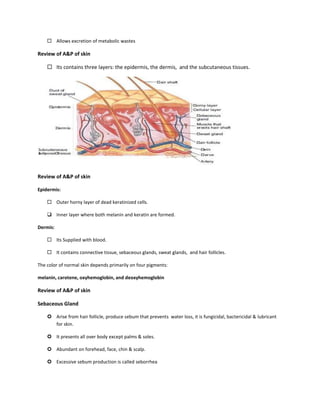
 Its contains three layers: the epidermis, the dermis, and the subcutaneous tissues.
Review of A&P of skin
Epidermis:
 Outer horny layer of dead keratinized cells.
 Inner layer where both melanin and keratin are formed.
Dermis:
 Its Supplied with blood.
 It contains connective tissue, sebaceous glands, sweat glands, and hair follicles.
The color of normal skin depends primarily on four pigments:
melanin, carotene, oxyhemoglobin, and deoxyhemoglobin
Review of A&P of skin
Sebaceous Gland
 Arise from hair follicle, produce sebum that prevents water loss, it is fungicidal, bactericidal & lubricant
for skin.
 It presents all over body except palms & soles.
 Abundant on forehead, face, chin & scalp.
 Excessive sebum production is called seborrhea
Review of A&P of skin
Sweat Glands:
It is responsible to regulate body temperature.
 Eccrine glands
 Apocrine glands
Skin Assessment Subjective data
Positive findings of skin
a. Rashes / lesions
b. Lumps
c. Itching
d. Color change
e. Dryness
f. Hair loss
g. Nail infections
Skin Assessment Subjective data
Obtaining History:
 Any Previous history of skin disease
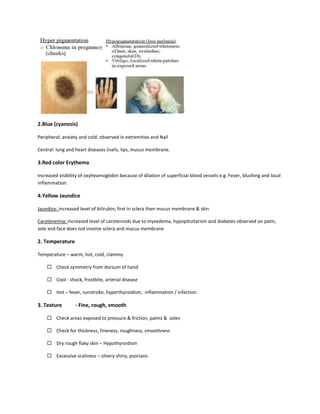
 Pigmentation
 Change in mole
 Excessive dryness or moisture
 Previous or current Medication
 Hair loss or patches on head
 Change in nails
 Environmental hazards.
 Comorbid
General Approach to Skin, Head and Neck Assessment
Greet patient, explain assessment techniques.
Environment
• Quiet
• Warm/Cold
• Private
• Adequate lighting
• Upright sitting position
Compare right and left sides
Systematic approach
HISTORY
 “Do you noticed any changes in your skin? Your hair? Your nails?”
 “Do you feel any rashes or itching, sore or Lumps on your skin?
Physical Assessment of skin
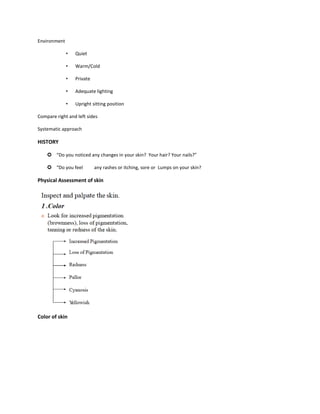
Color of skin
2.Blue (cyanosis)
Peripheral: anxiety and cold: observed in extremities and Nail
Central: lung and heart diseases (nails, lips, mucus membrane.
3.Red color Erythema
Increased visibility of oxyheamoglobin because of dilation of superficial blood vessels e.g. Fever, blushing and local
inflammation.
4.Yellow Jaundice
Jaundice: increased level of bilirubin; first in sclera then mucus membrane & skin
Carotenemia: increased level of carotenoids due to myxedema, hypopituitarism and diabetes observed on palm,
sole and face does not involve sclera and mucus membrane
2. Temperature
Temperature – warm, hot, cold, clammy
 Check symmetry from dorsum of hand
 Cool - shock, frostbite, arterial disease
 Hot – fever, sunstroke, hyperthyroidism, inflammation / infection
3. Texture - Fine, rough, smooth
 Check areas exposed to pressure & friction, palms & soles
 Check for thickness, fineness, roughness, smoothness
 Dry rough flaky skin – Hypothyroidism
 Excessive scaliness – silvery shiny, psoriasis
Calluses
Calluses are thick, hardened layers of skin that develop when your skin tries to protect itself against friction and
pressure
Quick Review
Temperature: Can be assessed with backs of finger.
Texture: Roughness Eczema, Dermatitis.
Mobility: Decreased in case of edema, Obesity.
Turgor: Decreased due to dehydration.
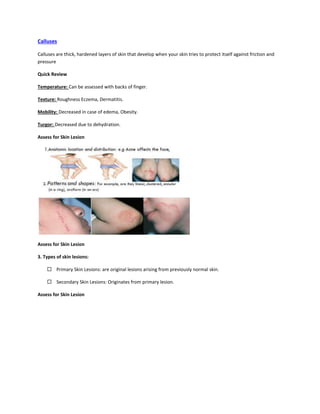
Assess for Skin Lesion
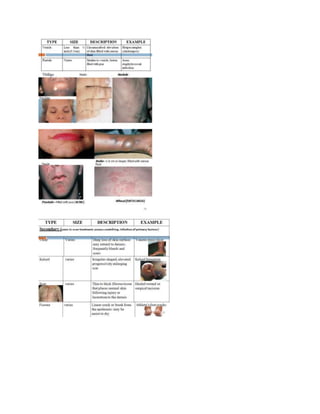
3. Types of skin lesions:
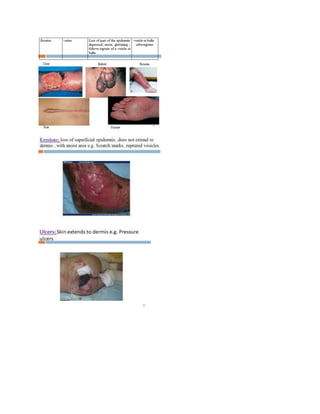
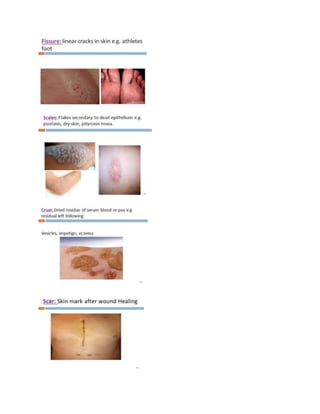
 Primary Skin Lesions: are original lesions arising from previously normal skin.
 Secondary Skin Lesions: Originates from primary lesion.
Assess for Skin Lesion
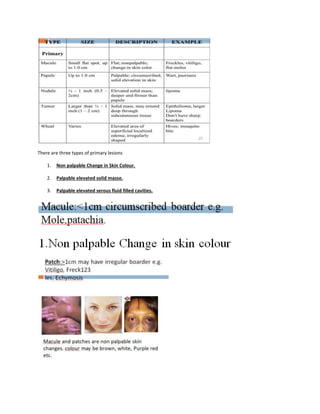
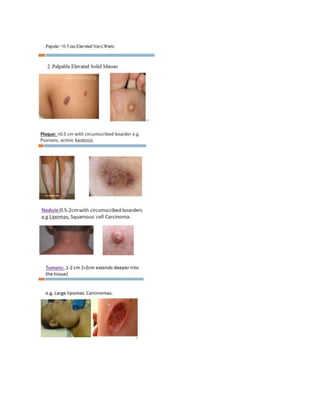
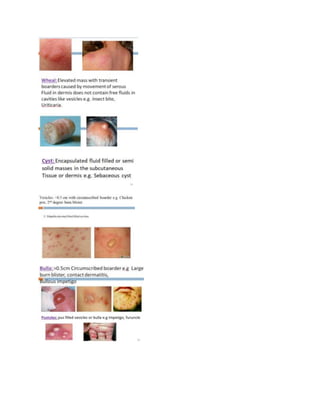
There are three types of primary lesions
1. Non palpable Change in Skin Colour.
2. Palpable elevated solid masse.
3. Palpable elevated serous fluid filled cavities.
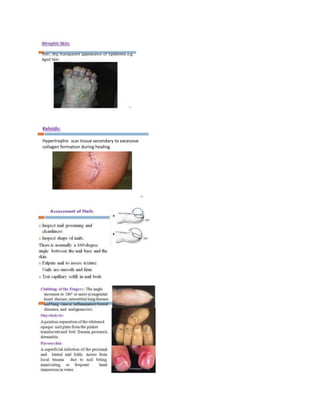
Keloids:
Hypertrophic scar tissue secondary to excessive
collagen formation during healing.
48
Inspection
Shape
Symmetry
Palpation
Contour
Masses
Depression
Tenderness
Inspection and Palpation of the Scalp
Inspect
Lesions or masses
Normal findings
Scalp is shiny, undamaged, without lesions or masses
Abnormal findings
Bleeding, lesions, masses, hematomas
Inspection
• Shape
• Symmetry
• Assessment of the Face
Normal findings
Assessment of face
Symmetrical features
Palpebral fissures equal
Nasolabial folds present bilaterally
Shape can be oval, round, or slightly square
Assessment of the Face
Abnormal findings
Deformed or absent structures
Asymmetry
More or less pronounced facial features
Diseases which may alter facial features:
Bell's palsy is a form of facial paralysis resulting from a dysfunction of the cranial nerve VII
Down syndrome, (trisomy 21) It is typically associated with a delay in cognitive ability (mental retardation
Graves’ disease, producing an excessive amount of thyroid hormones
Myxedema, describes a specific form of dermal edema secondary to increased deposition of connective tissue
components
Cachexia, ( is the loss of body mass that cannot be reversed nutritionally): Cushing’s syndrome a tumor (adenoma)
in the pituitary gland produces large amounts of ACTH.
Inspection Palpation of Neck
Normal findings
Full ROM, pain free, symmetrical muscles, no masses
Abnormal findings
Limited ROM, pain, asymmetrical muscles, masses
Thyroid Gland
Normal findings
Symmetrical movement with swallowing
Adam’s apple more pronounced in males (technically known as the laryngeal prominence)
No masses, tenderness, or enlargement, Absent bruit
Abnormal findings (Thyroid Gland)
Mass
Enlarged gland
Goiter
Asymmetrical enlargement
Presence of a nodule or bruit
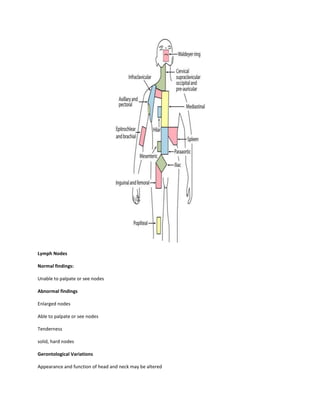
Lymph Nodes
Location:
Preauricular
Postauricular
Occipital
Submental
Submandibular
Anterior and posterior cervical chains
Tonsilar
Supraclavicular
Lymph Nodes
Normal findings:
Unable to palpate or see nodes
Abnormal findings
Enlarged nodes
Able to palpate or see nodes
Tenderness
solid, hard nodes
Gerontological Variations
Appearance and function of head and neck may be altered
Buffalo hump
Kyphosis posture
Limited ROM
Dizziness
Skin
• Observe the skin and related structures during the General Survey and throughout the rest of your
examination.
• The entire skin surface should be inspected in good light, preferably natural light or artificial light that be
similar to it.
• Correlate your findings with observations of the mucous membranes.
• Diseases may manifest themselves in both areas, and both are necessary for assessing skin color.
Color
• Patients may notice a change in their skin color before the clinician does.
• Ask about it.
• Look for increased pigmentation (brownness), loss of pigmentation, redness, pallor, cyanosis, and
yellowing of the skin.
• The red color of oxyheamoglobin and the pallor due to a lack of it
• Central cyanosis is best identified in the lips, oral mucosa, and tongue.
• The lips, however, may turn blue in the cold, and melanin in the lips may replicate cyanosis in darker-
skinned people.
• Cyanosis of the nails, hands, and feet may be central or peripheral in origin.
• Peripheral cyanosis may be caused by anxiety or a cold examining room.
Normal Documentation
 Skin: wheatish, warm, smooth, moist, and intact. No lesions, hypo / hyper pigmented areas, few moles on
face and arms
 Hair: Long, black, smooth, shiny, thin and straight hair, free of dandruff, and any infestations
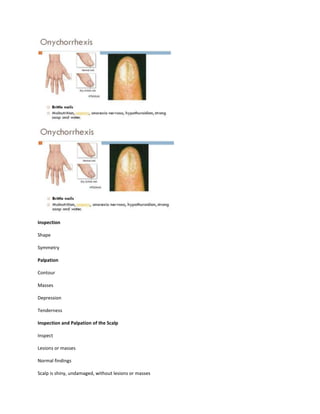
 Nails: Clean, white, trimmed nails, slightly curved, angle 160 degrees, pink nails beds, capillary refill <3
sec, no trauma lesions
Abnormal findings
 Skin: cyanotic / pallor, cold clammy, rough , dry, scaly, a big papule, >2cms, on back, brownish black,
irregular border, with color variation, non tender, multiple petechiae on abdomen, maculo papular
rashes on arms and back.
 Hair: Short, whitish grey, rough, sticky, dull, very thin hair, bald patch on right parietal area, has a clean
dressing in place, hair has nits.
 Nails: long, dirty finger nails, mild clubbing seen, capillary refill slow, toenails yellowish, very curved and
thickened, rt. middle toenail is black, loosened from nail bed, no other lesions.
References
 Bates, B. (2006). A guide to physical examination and history taking. (8th
ed). Lippincott: London
 White, L., & Duncan, G. (2000). Medical Surgical Nursing: An Integrated Approach. Delmar: Tokyo.
 https://youtu.be/CbXLyUdjsdo
 https://youtu.be/OxPlCkTKhzY
 www.google/images.com

Health Assessment 1.docx

  • 1.
    Health Assessment-I Assessment ofthe Skin, Head & Neck Unit#04 Amjad Ali Assistant Professor DIONAM, DUHS 05.04.2021 Objectives By the end of the unit, learners will be able to 1. Describe the component of health history that should be elicited during the assessment of skin, head & neck. 2. Describe specific assessments to be made during the physical examination of the above systems. 3. Document findings. 4. Describe age related changes in the above systems & differences in assessment findings. Review of A&P of skin Functions of the Skin  Provides a barrier  Regulates body temperature  synthesize vitamin D  Sensory organs for touch, pain, temperature, and pressure allowing sensory perception.  Provides nonverbal communication, such as posture, facial movements, or vasomotor responses such as blushing.  Provides identity  Allows wound repair
  • 2.
     Allows excretionof metabolic wastes Review of A&P of skin  Its contains three layers: the epidermis, the dermis, and the subcutaneous tissues. Review of A&P of skin Epidermis:  Outer horny layer of dead keratinized cells.  Inner layer where both melanin and keratin are formed. Dermis:  Its Supplied with blood.  It contains connective tissue, sebaceous glands, sweat glands, and hair follicles. The color of normal skin depends primarily on four pigments: melanin, carotene, oxyhemoglobin, and deoxyhemoglobin Review of A&P of skin Sebaceous Gland  Arise from hair follicle, produce sebum that prevents water loss, it is fungicidal, bactericidal & lubricant for skin.  It presents all over body except palms & soles.  Abundant on forehead, face, chin & scalp.  Excessive sebum production is called seborrhea
  • 3.
    Review of A&Pof skin Sweat Glands: It is responsible to regulate body temperature.  Eccrine glands  Apocrine glands Skin Assessment Subjective data Positive findings of skin a. Rashes / lesions b. Lumps c. Itching d. Color change e. Dryness f. Hair loss g. Nail infections Skin Assessment Subjective data Obtaining History:  Any Previous history of skin disease  Pigmentation  Change in mole  Excessive dryness or moisture  Previous or current Medication  Hair loss or patches on head  Change in nails  Environmental hazards.  Comorbid General Approach to Skin, Head and Neck Assessment Greet patient, explain assessment techniques.
  • 4.
    Environment • Quiet • Warm/Cold •Private • Adequate lighting • Upright sitting position Compare right and left sides Systematic approach HISTORY  “Do you noticed any changes in your skin? Your hair? Your nails?”  “Do you feel any rashes or itching, sore or Lumps on your skin? Physical Assessment of skin Color of skin
  • 5.
    2.Blue (cyanosis) Peripheral: anxietyand cold: observed in extremities and Nail Central: lung and heart diseases (nails, lips, mucus membrane. 3.Red color Erythema Increased visibility of oxyheamoglobin because of dilation of superficial blood vessels e.g. Fever, blushing and local inflammation. 4.Yellow Jaundice Jaundice: increased level of bilirubin; first in sclera then mucus membrane & skin Carotenemia: increased level of carotenoids due to myxedema, hypopituitarism and diabetes observed on palm, sole and face does not involve sclera and mucus membrane 2. Temperature Temperature – warm, hot, cold, clammy  Check symmetry from dorsum of hand  Cool - shock, frostbite, arterial disease  Hot – fever, sunstroke, hyperthyroidism, inflammation / infection 3. Texture - Fine, rough, smooth  Check areas exposed to pressure & friction, palms & soles  Check for thickness, fineness, roughness, smoothness  Dry rough flaky skin – Hypothyroidism  Excessive scaliness – silvery shiny, psoriasis
  • 6.
    Calluses Calluses are thick,hardened layers of skin that develop when your skin tries to protect itself against friction and pressure Quick Review Temperature: Can be assessed with backs of finger. Texture: Roughness Eczema, Dermatitis. Mobility: Decreased in case of edema, Obesity. Turgor: Decreased due to dehydration. Assess for Skin Lesion Assess for Skin Lesion 3. Types of skin lesions:  Primary Skin Lesions: are original lesions arising from previously normal skin.  Secondary Skin Lesions: Originates from primary lesion. Assess for Skin Lesion
  • 7.
    There are threetypes of primary lesions 1. Non palpable Change in Skin Colour. 2. Palpable elevated solid masse. 3. Palpable elevated serous fluid filled cavities.
  • 13.
    Keloids: Hypertrophic scar tissuesecondary to excessive collagen formation during healing. 48
  • 14.
    Inspection Shape Symmetry Palpation Contour Masses Depression Tenderness Inspection and Palpationof the Scalp Inspect Lesions or masses Normal findings Scalp is shiny, undamaged, without lesions or masses
  • 15.
    Abnormal findings Bleeding, lesions,masses, hematomas Inspection • Shape • Symmetry • Assessment of the Face Normal findings Assessment of face Symmetrical features Palpebral fissures equal Nasolabial folds present bilaterally Shape can be oval, round, or slightly square Assessment of the Face Abnormal findings Deformed or absent structures Asymmetry More or less pronounced facial features Diseases which may alter facial features: Bell's palsy is a form of facial paralysis resulting from a dysfunction of the cranial nerve VII Down syndrome, (trisomy 21) It is typically associated with a delay in cognitive ability (mental retardation Graves’ disease, producing an excessive amount of thyroid hormones Myxedema, describes a specific form of dermal edema secondary to increased deposition of connective tissue components Cachexia, ( is the loss of body mass that cannot be reversed nutritionally): Cushing’s syndrome a tumor (adenoma) in the pituitary gland produces large amounts of ACTH. Inspection Palpation of Neck Normal findings Full ROM, pain free, symmetrical muscles, no masses
  • 16.
    Abnormal findings Limited ROM,pain, asymmetrical muscles, masses Thyroid Gland Normal findings Symmetrical movement with swallowing Adam’s apple more pronounced in males (technically known as the laryngeal prominence) No masses, tenderness, or enlargement, Absent bruit Abnormal findings (Thyroid Gland) Mass Enlarged gland Goiter Asymmetrical enlargement Presence of a nodule or bruit Lymph Nodes Location: Preauricular Postauricular Occipital Submental Submandibular Anterior and posterior cervical chains Tonsilar Supraclavicular
  • 17.
    Lymph Nodes Normal findings: Unableto palpate or see nodes Abnormal findings Enlarged nodes Able to palpate or see nodes Tenderness solid, hard nodes Gerontological Variations Appearance and function of head and neck may be altered
  • 18.
    Buffalo hump Kyphosis posture LimitedROM Dizziness Skin • Observe the skin and related structures during the General Survey and throughout the rest of your examination. • The entire skin surface should be inspected in good light, preferably natural light or artificial light that be similar to it. • Correlate your findings with observations of the mucous membranes. • Diseases may manifest themselves in both areas, and both are necessary for assessing skin color. Color • Patients may notice a change in their skin color before the clinician does. • Ask about it. • Look for increased pigmentation (brownness), loss of pigmentation, redness, pallor, cyanosis, and yellowing of the skin. • The red color of oxyheamoglobin and the pallor due to a lack of it • Central cyanosis is best identified in the lips, oral mucosa, and tongue. • The lips, however, may turn blue in the cold, and melanin in the lips may replicate cyanosis in darker- skinned people. • Cyanosis of the nails, hands, and feet may be central or peripheral in origin. • Peripheral cyanosis may be caused by anxiety or a cold examining room. Normal Documentation  Skin: wheatish, warm, smooth, moist, and intact. No lesions, hypo / hyper pigmented areas, few moles on face and arms  Hair: Long, black, smooth, shiny, thin and straight hair, free of dandruff, and any infestations  Nails: Clean, white, trimmed nails, slightly curved, angle 160 degrees, pink nails beds, capillary refill <3 sec, no trauma lesions Abnormal findings
  • 19.
     Skin: cyanotic/ pallor, cold clammy, rough , dry, scaly, a big papule, >2cms, on back, brownish black, irregular border, with color variation, non tender, multiple petechiae on abdomen, maculo papular rashes on arms and back.  Hair: Short, whitish grey, rough, sticky, dull, very thin hair, bald patch on right parietal area, has a clean dressing in place, hair has nits.  Nails: long, dirty finger nails, mild clubbing seen, capillary refill slow, toenails yellowish, very curved and thickened, rt. middle toenail is black, loosened from nail bed, no other lesions. References  Bates, B. (2006). A guide to physical examination and history taking. (8th ed). Lippincott: London  White, L., & Duncan, G. (2000). Medical Surgical Nursing: An Integrated Approach. Delmar: Tokyo.  https://youtu.be/CbXLyUdjsdo  https://youtu.be/OxPlCkTKhzY  www.google/images.com