Paromita Biswas, Metadata Librarian, Western Carolina University, pbiswas@wcu.edu 
Elizabeth Skene, Digital Initiatives Librarian, Western Carolina University, emskene@wcu.edu 
Charleston Conference, November 6, 2014
Project: 
Move 700 legacy finding aids online via ArchivesSpace
•Finding aids overview 
•Past efforts 
•Choosing ArchivesSpace 
•Workflow decisions
•Showcase Appalachian life and natural history, especially of Western North Carolina 
•Notable collections: 
Horace Kephart; George Masa; Nantahala Power & Light Company Records
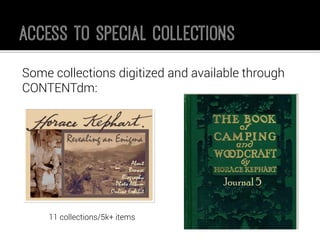
Some collections digitized and available through CONTENTdm: 
11 collections/5k+ items
•Most Special Collections’ materials accessible through finding aids 
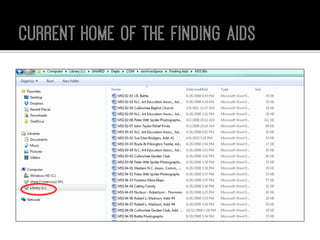
•700 finding aids in MS Word 
The problem: 
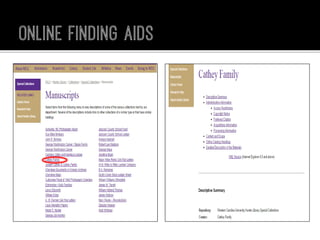
•No online presence of finding aids 
•Findings aids available only to patrons who visit or contact the library 
•Finding aids/Special Collections remain hiddenand inaccessibleto the larger audience
•2010: NC ECHO* provides Hunter Library with templates for creating EAD encoded finding aids 
•Two librarians work in Notepad Pro: time consuming process 
•Lack of technical knowledge to modify generic 
templates or publish the finding aids online 
•35 finding aids published as HTML documents via a widget available online 
*North Carolina Exploring Cultural Heritage Online
•Lack of resources: 
No server space 
No IT support 
Limited staff time 
•ArchivesSpace offered to Hunter Library: 
Option for a hosted server space by LYRASIS 
Technical assistance provided by LYRASIS 
Training and relative ease of use
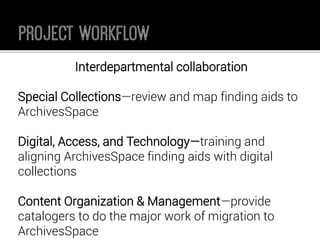
Interdepartmental collaboration 
Special Collections—review and map finding aids to ArchivesSpace 
Digital, Access, and Technology—training and aligning ArchivesSpacefinding aids with digital collections 
Content Organization & Management—provide catalogers to do the major work of migration to ArchivesSpace
Involved: 
•Copying and pasting the Word document finding aids 
•Adding controlled vocabularies—names and subjects to the finding aids
•No training required in adding controlled vocabularies 
•Familiar with content management systems (CONTENTdm) other than traditional ILS 
•Familiarity with the area and local history 
•Summer can provide the opportunity to do majority of the migration work
•The process 
•Challenges 
•The future 
•Take aways
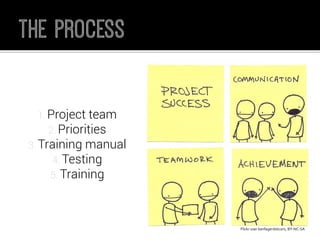
1.Project team 
2.Priorities 
3.Training manual 
4.Testing 
5.Training 
Flickr user kenfagerdotcom, BY-NC-SA
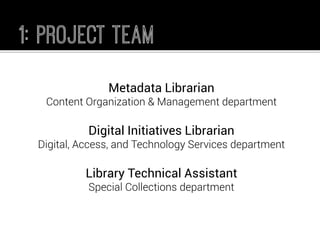
Metadata Librarian 
Content Organization& Management department 
Digital Initiatives Librarian 
Digital, Access, and Technology Services department 
Library Technical Assistant 
Special Collections department
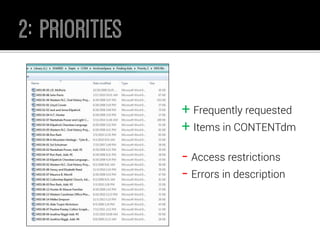
+ Frequently requested 
+ Items in CONTENTdm 
-Access restrictions 
-Errors in description
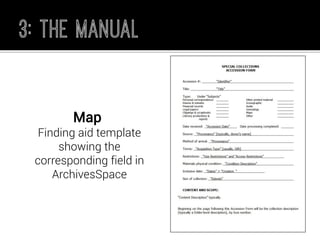
Map 
Finding aid template showing the corresponding field in ArchivesSpace
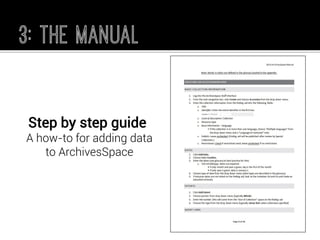
Step by step guide 
A how-to for adding data to ArchivesSpace
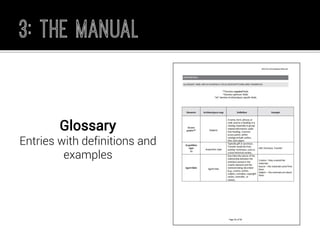
Glossary 
Entries with definitions and examples
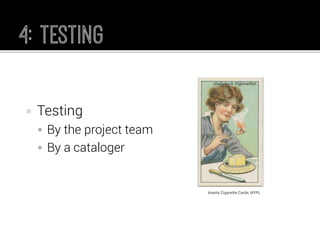
Testing 
By the project team 
By a cataloger 
ArentsCigarette Cards, NYPL
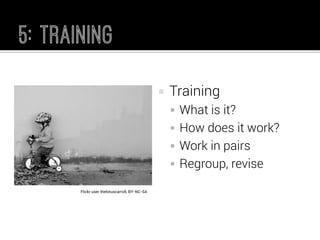
Training 
What is it? 
How does it work? 
Work in pairs 
Regroup, revise 
Flickr user thelotuscarroll, BY-NC-SA
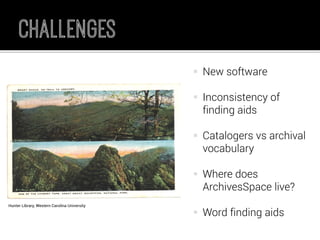
New software 
Inconsistency of finding aids 
Catalogers vs archival vocabulary 
Where does ArchivesSpace live? 
Word finding aids 
Hunter Library, Western Carolina University
Update the manual 
Go live! 
500 finding aids by 2016 
Link to CONTENTdm 
Explore regional consortium 
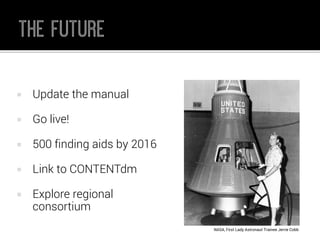
NASA, First Lady Astronaut Trainee JerrieCobb
What is the end goal? 
Who has the knowledge? 
Progress or perfection? 
Boston Public Library, Leslie Jones Collection, BY-NC-ND
Thank you!

From Silos to (Archives)Space: Moving Legacy Finding Aids Online as a Multi-Department Library Collaboration

  • 1.
    Paromita Biswas, MetadataLibrarian, Western Carolina University, pbiswas@wcu.edu Elizabeth Skene, Digital Initiatives Librarian, Western Carolina University, emskene@wcu.edu Charleston Conference, November 6, 2014
  • 2.
    Project: Move 700legacy finding aids online via ArchivesSpace
  • 3.
    •Finding aids overview •Past efforts •Choosing ArchivesSpace •Workflow decisions
  • 4.
    •Showcase Appalachian lifeand natural history, especially of Western North Carolina •Notable collections: Horace Kephart; George Masa; Nantahala Power & Light Company Records
  • 5.
    Some collections digitizedand available through CONTENTdm: 11 collections/5k+ items
  • 6.
    •Most Special Collections’materials accessible through finding aids •700 finding aids in MS Word The problem: •No online presence of finding aids •Findings aids available only to patrons who visit or contact the library •Finding aids/Special Collections remain hiddenand inaccessibleto the larger audience
  • 8.
    •2010: NC ECHO*provides Hunter Library with templates for creating EAD encoded finding aids •Two librarians work in Notepad Pro: time consuming process •Lack of technical knowledge to modify generic templates or publish the finding aids online •35 finding aids published as HTML documents via a widget available online *North Carolina Exploring Cultural Heritage Online
  • 10.
    •Lack of resources: No server space No IT support Limited staff time •ArchivesSpace offered to Hunter Library: Option for a hosted server space by LYRASIS Technical assistance provided by LYRASIS Training and relative ease of use
  • 11.
    Interdepartmental collaboration SpecialCollections—review and map finding aids to ArchivesSpace Digital, Access, and Technology—training and aligning ArchivesSpacefinding aids with digital collections Content Organization & Management—provide catalogers to do the major work of migration to ArchivesSpace
  • 12.
    Involved: •Copying andpasting the Word document finding aids •Adding controlled vocabularies—names and subjects to the finding aids
  • 13.
    •No training requiredin adding controlled vocabularies •Familiar with content management systems (CONTENTdm) other than traditional ILS •Familiarity with the area and local history •Summer can provide the opportunity to do majority of the migration work
  • 14.
    •The process •Challenges •The future •Take aways
  • 15.
    1.Project team 2.Priorities 3.Training manual 4.Testing 5.Training Flickr user kenfagerdotcom, BY-NC-SA
  • 16.
    Metadata Librarian ContentOrganization& Management department Digital Initiatives Librarian Digital, Access, and Technology Services department Library Technical Assistant Special Collections department
  • 17.
    + Frequently requested + Items in CONTENTdm -Access restrictions -Errors in description
  • 19.
    Map Finding aidtemplate showing the corresponding field in ArchivesSpace
  • 20.
    Step by stepguide A how-to for adding data to ArchivesSpace
  • 21.
    Glossary Entries withdefinitions and examples
  • 22.
    Testing By theproject team By a cataloger ArentsCigarette Cards, NYPL
  • 23.
    Training What isit? How does it work? Work in pairs Regroup, revise Flickr user thelotuscarroll, BY-NC-SA
  • 24.
    New software Inconsistencyof finding aids Catalogers vs archival vocabulary Where does ArchivesSpace live? Word finding aids Hunter Library, Western Carolina University
  • 25.
    Update the manual Go live! 500 finding aids by 2016 Link to CONTENTdm Explore regional consortium NASA, First Lady Astronaut Trainee JerrieCobb
  • 26.
    What is theend goal? Who has the knowledge? Progress or perfection? Boston Public Library, Leslie Jones Collection, BY-NC-ND
  • 27.