Presented By:
Arghadeep
Chowdhury
SIX SIGMA
“ DELIVERING TOMORROW'S PERFORMANCE TODAY "
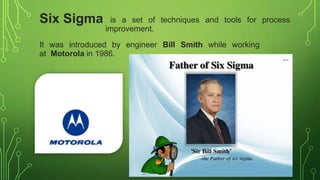
is a set of techniques and tools for process
improvement.
It was introduced by engineer Bill Smith while working
at Motorola in 1986.
Six Sigma
Six Sigma is a quality program that, when all is said in
done, improves your customer’s experience, lowers your
costs, and build better leaders.
It was 1st implemented by Jack Welch in General
Electric in the year 1995.
– Jack Welch
Moto of Six Sigma?
 A highly disciplined process that enables organizations
deliver nearly perfect products and services.
Customer Focused
Project- Focused
Results Driven
Today, it is used in many industrial sectors…….
 Six Sigma emerged as a natural evolution in
business to increase profit by eliminating defects.
 The Current business environment now demands
and rewards innovation more than ever before due
to:
Customer Expectations
Technological Change
Global Competition
Market Fragmentation
WHY SIX SIGMA ?
Sigma Level
[Process
Capability]
Defects per Million
Opportunities % Yield
2 308,537 69.15%
3 66,807 93.32%
4 6,210 99.38%
5 233 99.98%
6 3.4 99.99966%
• Six sigma results in at most 3.4 defects per
million/units opportunities.
Another
application:
Thousands of
“Dabawallas“ in
India apply Six
Sigma methods to
deliver home-
cooked food.
What Six Sigma Does ?
M
Measure
s
A
Analys
e
Six Sigma uses 2 phase models for
improvements:
1. DMAIC
2. DMADV
Better Monitoring Process.
End to End Process improvement.
Develops Employees thinking and leadership skills.
It uses well proven statistical tools.
It focus on the customer.
Advantages of Six Sigma :
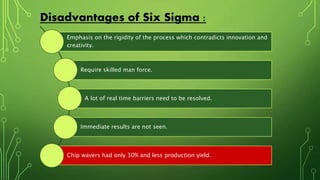
Disadvantages of Six Sigma :
Emphasis on the rigidity of the process which contradicts innovation and
creativity.
Require skilled man force.
A lot of real time barriers need to be resolved.
Immediate results are not seen.
Chip wavers had only 30% and less production yield.
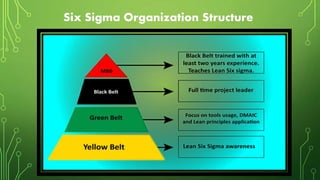
Six Sigma Organization Structure

Six sigma ppt.

  • 1.
  • 2.
    SIX SIGMA “ DELIVERINGTOMORROW'S PERFORMANCE TODAY "
  • 3.
    is a setof techniques and tools for process improvement. It was introduced by engineer Bill Smith while working at Motorola in 1986. Six Sigma
  • 4.
    Six Sigma isa quality program that, when all is said in done, improves your customer’s experience, lowers your costs, and build better leaders. It was 1st implemented by Jack Welch in General Electric in the year 1995. – Jack Welch
  • 5.
    Moto of SixSigma?  A highly disciplined process that enables organizations deliver nearly perfect products and services. Customer Focused Project- Focused Results Driven
  • 6.
    Today, it isused in many industrial sectors…….
  • 7.
     Six Sigmaemerged as a natural evolution in business to increase profit by eliminating defects.  The Current business environment now demands and rewards innovation more than ever before due to: Customer Expectations Technological Change Global Competition Market Fragmentation WHY SIX SIGMA ?
  • 8.
    Sigma Level [Process Capability] Defects perMillion Opportunities % Yield 2 308,537 69.15% 3 66,807 93.32% 4 6,210 99.38% 5 233 99.98% 6 3.4 99.99966% • Six sigma results in at most 3.4 defects per million/units opportunities.
  • 9.
    Another application: Thousands of “Dabawallas“ in Indiaapply Six Sigma methods to deliver home- cooked food.
  • 10.
    What Six SigmaDoes ? M Measure s A Analys e Six Sigma uses 2 phase models for improvements: 1. DMAIC 2. DMADV
  • 11.
    Better Monitoring Process. Endto End Process improvement. Develops Employees thinking and leadership skills. It uses well proven statistical tools. It focus on the customer. Advantages of Six Sigma :
  • 12.
    Disadvantages of SixSigma : Emphasis on the rigidity of the process which contradicts innovation and creativity. Require skilled man force. A lot of real time barriers need to be resolved. Immediate results are not seen. Chip wavers had only 30% and less production yield.
  • 13.