Lecture – 02
Introduction to soft computing
Dr. Ahmed Elngar
Faculty of Computers and Artificial Intellegence
Beni-Suef University
1
Dr. Ahmed Elngar
11/5/2021
Course Syllabus
2
11/5/2021
3
11/5/2021
Evolutionary Computing
4
11/5/2021
Evolutionary Computing
• Evolutionary Computing is the collective name for a range of problem-solving
techniques based on principles of biological evolution, such as natural selection
and genetic inheritance.
• These techniques are being increasingly widely applied to a variety of problems,
ranging from practical applications in industry and commerce to leading-edge
scientific research.
5
11/5/2021
Evolutionary Computing
• In computer science, evolutionary computation is a subfield of artificial
intelligence (more particularly computational intelligence) that involves
combinatorial optimization problems. Evolutionary computation uses iterative
progress, such as growth or development in a population.
• This population is then selected in a guided random search using parallel
processing to achieve the desired end. Such processes are often inspired by
biological mechanisms of evolution.
• As evolution can produce highly optimized processes and networks, it has many
applications in computer science.
6
11/5/2021
Evolutionary Computing
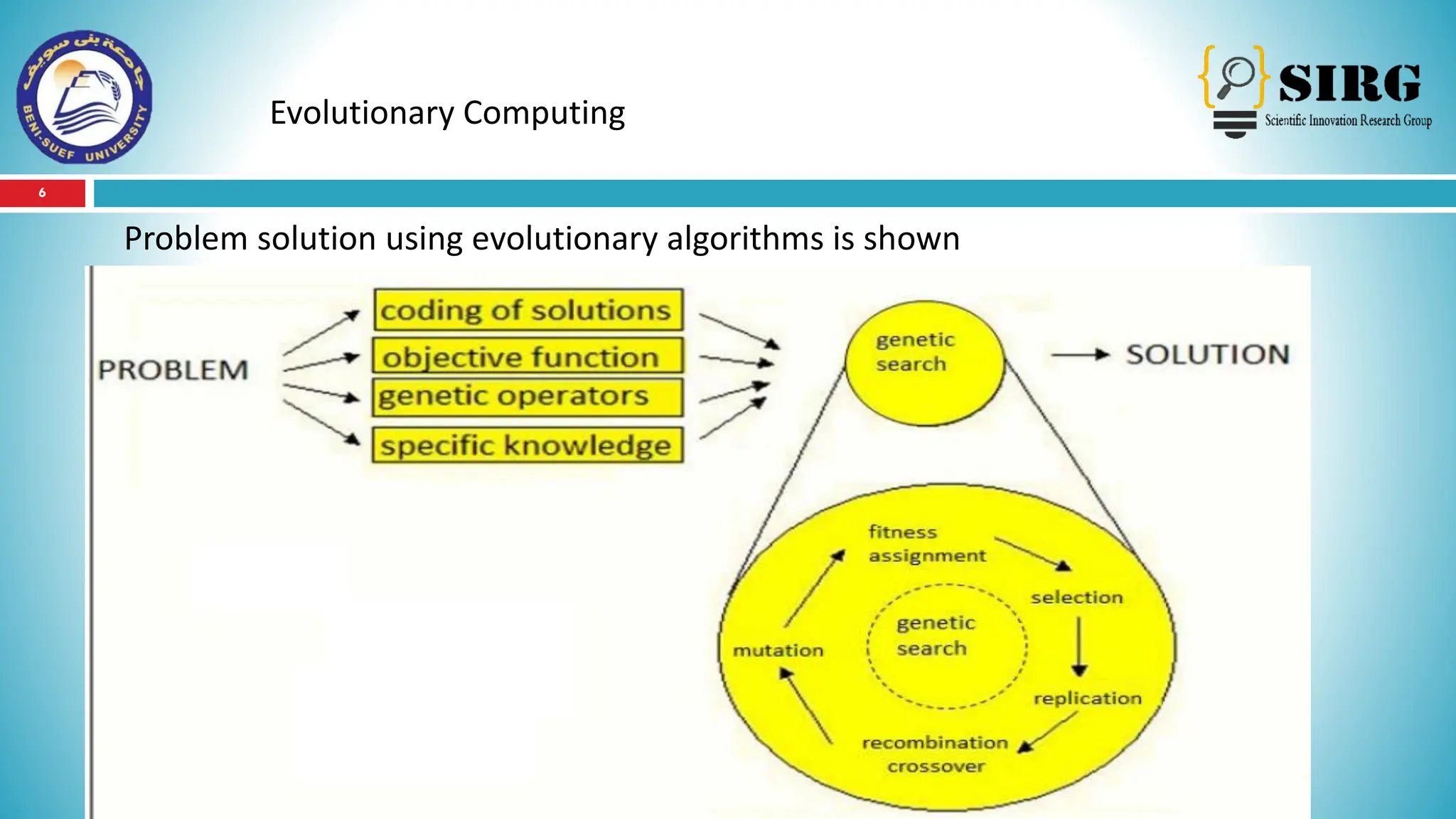
Problem solution using evolutionary algorithms is shown
7
11/5/2021
Evolutionary Computing
• Different main schools of evolutionary algorithms have been evolved during the last 50
years:
• genetic algorithms, mainly developed in the USA by J.H. Holland (Holland 1975),
• evolutionary strategies, developed in Germany by I. Rechenberg (Rechenberg 1973)
and H.-P. Schwefel (Schwefel 1981),
• and evolutionary programming (Fogel, Owens, and Walsh 1966).
• Each of these constitutes represents a different approach, however, they are inspired
by the same principles of natural evolution. A good introductory survey can be found in
(Fogel 1994).
8
11/5/2021
Evolutionary Computing
Evolutionary algorithms are stochastic search methods that mimic the metaphor of
natural biological evolution. Evolutionary algorithms operate on a population of
potential solutions applying the principle of survival of the fittest to produce better
and better approximations to a solution. At each generation, a new set of
approximations is created by the process of selecting individuals according to their
level of fitness in the problem domain and breeding them together using operators
borrowed from natural genetics.
9
11/5/2021
Evolutionary Computing
This process leads to the evolution of populations of individuals that are better suited to
their environment than the individuals that they were created from, just as in natural
adaptation. Evolutionary algorithms model natural processes, such as selection,
recombination, mutation, migration, locality and neighbourhood. Figure 36 shows the
structure of a simple evolutionary algorithm. Evolutionary algorithms work on
populations of individuals instead of single solutions. In this way the search is
performed in a parallel manner.
10
11/5/2021
Evolutionary Computing
From the above discussion, it can be seen that evolutionary algorithms differ
substantially from more traditional search and optimization methods. The most
significant differences are
11
11/5/2021
Evolutionary Computing
• Evolutionary algorithms search a population of points in parallel, not just a single point.
• Evolutionary algorithms do not require derivative information or other auxiliary
knowledge; only the objective function and corresponding fitness levels influence the
directions of search.
• Evolutionary algorithms use probabilistic transition rules, not deterministic ones.
• Evolutionary algorithms are generally more straightforward to apply, because no
restrictions for the definition of the objective function exist.
• Evolutionary algorithms can provide a number of potential solutions to a given problem.
The final choice is left to the user. (Thus, in cases where the particular problem does not
have one individual solution, for example a family of pareto-optimal solutions, as in the case
of multi-objective optimization and scheduling problems, then the evolutionary algorithm is
potentially useful for identifying these alternative solutions simultaneously.)
12
11/5/2021
Evolutionary Computing
Structure of a single population evolutionary algorithm
13
11/5/2021
Evolutionary Computing
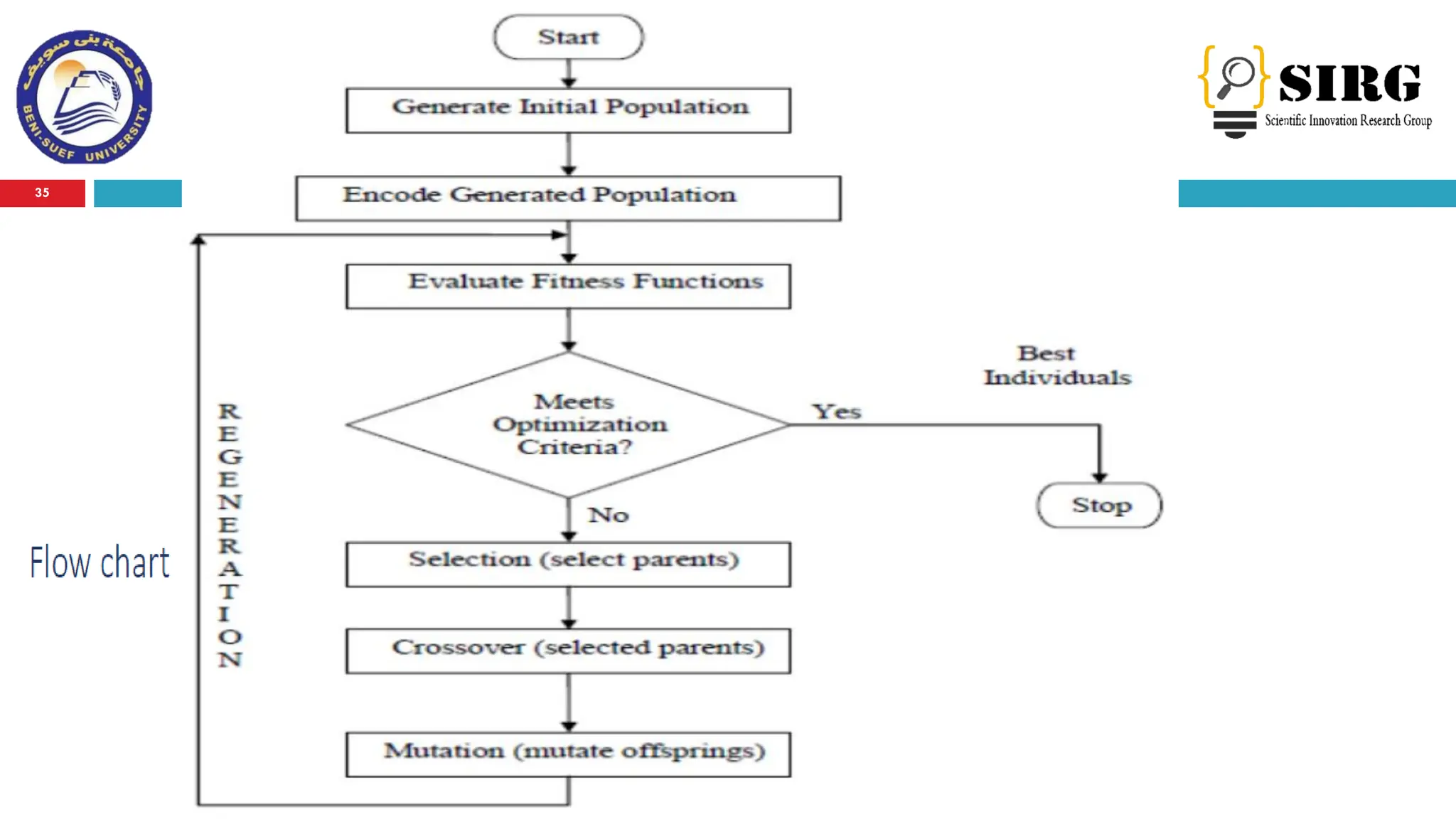
At the beginning of the computation a number of individuals (the population) are randomly
initialized. The objective function is then evaluated for these individuals. The first/initial
generation is produced. If the optimization criteria are not met, the creation of a new
generation starts. Individuals are selected according to their fitness for the production of
offspring. Parents are recombined to produce offspring. All offspring will be mutated with a
certain probability. The fitness of the offspring is then computed. The offspring are inserted
into the population replacing the parents, producing a new generation. This cycle is
performed until the optimization criteria are reached.
14
11/5/2021
15
11/5/2021
16
11/5/2021
Cont..
17
11/5/2021
18
11/5/2021
19
11/5/2021
20
11/5/2021
21
11/5/2021
22
11/5/2021
23
11/5/2021
24
11/5/2021
25
11/5/2021
26
11/5/2021
27
11/5/2021
28
11/5/2021
29
11/5/2021
30
11/5/2021
31
11/5/2021
32
11/5/2021
33
11/5/2021
34
11/5/2021
35
11/5/2021
36
11/5/2021
37
11/5/2021
Next Lecture……
Aim of our Research Group:
38
The aim of our Scientific Innovation research Group
(SIRG) to evaluate the IOT performance by propose a
secure architecture for the IoT security issues for
Education.
11/5/2021
Thanks and Acknowledgement
Thank you
39
11/5/2021

SIRG-BSU_2.pdf

  • 1.
    Lecture – 02 Introductionto soft computing Dr. Ahmed Elngar Faculty of Computers and Artificial Intellegence Beni-Suef University 1 Dr. Ahmed Elngar 11/5/2021
  • 2.
  • 3.
  • 4.
    4 11/5/2021 Evolutionary Computing • EvolutionaryComputing is the collective name for a range of problem-solving techniques based on principles of biological evolution, such as natural selection and genetic inheritance. • These techniques are being increasingly widely applied to a variety of problems, ranging from practical applications in industry and commerce to leading-edge scientific research.
  • 5.
    5 11/5/2021 Evolutionary Computing • Incomputer science, evolutionary computation is a subfield of artificial intelligence (more particularly computational intelligence) that involves combinatorial optimization problems. Evolutionary computation uses iterative progress, such as growth or development in a population. • This population is then selected in a guided random search using parallel processing to achieve the desired end. Such processes are often inspired by biological mechanisms of evolution. • As evolution can produce highly optimized processes and networks, it has many applications in computer science.
  • 6.
    6 11/5/2021 Evolutionary Computing Problem solutionusing evolutionary algorithms is shown
  • 7.
    7 11/5/2021 Evolutionary Computing • Differentmain schools of evolutionary algorithms have been evolved during the last 50 years: • genetic algorithms, mainly developed in the USA by J.H. Holland (Holland 1975), • evolutionary strategies, developed in Germany by I. Rechenberg (Rechenberg 1973) and H.-P. Schwefel (Schwefel 1981), • and evolutionary programming (Fogel, Owens, and Walsh 1966). • Each of these constitutes represents a different approach, however, they are inspired by the same principles of natural evolution. A good introductory survey can be found in (Fogel 1994).
  • 8.
    8 11/5/2021 Evolutionary Computing Evolutionary algorithmsare stochastic search methods that mimic the metaphor of natural biological evolution. Evolutionary algorithms operate on a population of potential solutions applying the principle of survival of the fittest to produce better and better approximations to a solution. At each generation, a new set of approximations is created by the process of selecting individuals according to their level of fitness in the problem domain and breeding them together using operators borrowed from natural genetics.
  • 9.
    9 11/5/2021 Evolutionary Computing This processleads to the evolution of populations of individuals that are better suited to their environment than the individuals that they were created from, just as in natural adaptation. Evolutionary algorithms model natural processes, such as selection, recombination, mutation, migration, locality and neighbourhood. Figure 36 shows the structure of a simple evolutionary algorithm. Evolutionary algorithms work on populations of individuals instead of single solutions. In this way the search is performed in a parallel manner.
  • 10.
    10 11/5/2021 Evolutionary Computing From theabove discussion, it can be seen that evolutionary algorithms differ substantially from more traditional search and optimization methods. The most significant differences are
  • 11.
    11 11/5/2021 Evolutionary Computing • Evolutionaryalgorithms search a population of points in parallel, not just a single point. • Evolutionary algorithms do not require derivative information or other auxiliary knowledge; only the objective function and corresponding fitness levels influence the directions of search. • Evolutionary algorithms use probabilistic transition rules, not deterministic ones. • Evolutionary algorithms are generally more straightforward to apply, because no restrictions for the definition of the objective function exist. • Evolutionary algorithms can provide a number of potential solutions to a given problem. The final choice is left to the user. (Thus, in cases where the particular problem does not have one individual solution, for example a family of pareto-optimal solutions, as in the case of multi-objective optimization and scheduling problems, then the evolutionary algorithm is potentially useful for identifying these alternative solutions simultaneously.)

  • 12.
    12 11/5/2021 Evolutionary Computing Structure ofa single population evolutionary algorithm
  • 13.
    13 11/5/2021 Evolutionary Computing At thebeginning of the computation a number of individuals (the population) are randomly initialized. The objective function is then evaluated for these individuals. The first/initial generation is produced. If the optimization criteria are not met, the creation of a new generation starts. Individuals are selected according to their fitness for the production of offspring. Parents are recombined to produce offspring. All offspring will be mutated with a certain probability. The fitness of the offspring is then computed. The offspring are inserted into the population replacing the parents, producing a new generation. This cycle is performed until the optimization criteria are reached.
  • 14.
  • 15.
  • 16.
  • 17.
  • 18.
  • 19.
  • 20.
  • 21.
  • 22.
  • 23.
  • 24.
  • 25.
  • 26.
  • 27.
  • 28.
  • 29.
  • 30.
  • 31.
  • 32.
  • 33.
  • 34.
  • 35.
  • 36.
  • 37.
  • 38.
    Aim of ourResearch Group: 38 The aim of our Scientific Innovation research Group (SIRG) to evaluate the IOT performance by propose a secure architecture for the IoT security issues for Education. 11/5/2021
  • 39.