Adapted vocational education Belgium
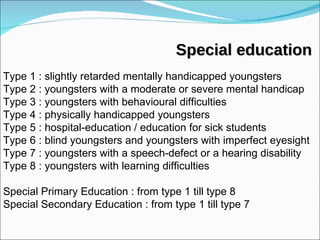
Type 1 : slightly retarded mentally handicapped youngsters Type 2 : youngsters with a moderate or severe mental handicap Type 3 : youngsters with behavioural difficulties Type 4 : physically handicapped youngsters Type 5 : hospital-education / education for sick students Type 6 : blind youngsters and youngsters with imperfect eyesight Type 7 : youngsters with a speech-defect or a hearing disability Type 8 : youngsters with learning difficulties Special Primary Education : from type 1 till type 8 Special Secondary Education : from type 1 till type 7 Special education
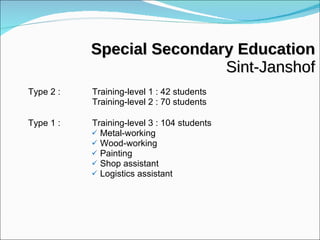
Special Secondary Education Sint-Janshof Type 2 : Training-level 1 : 42 students Training-level 2 : 70 students Type 1 : Training-level 3 : 104 students Metal-working Wood-working Painting Shop assistant Logistics assistant
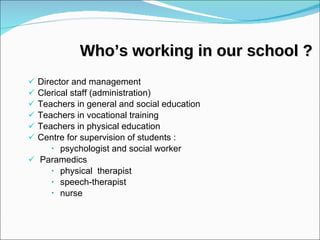
Who’s working in our school ? Director and management  Clerical staff (administration) Teachers in general and social education Teachers in vocational training Teachers in physical education Centre for supervision of students :  psychologist and social worker Paramedics physical  therapist speech-therapist nurse
What’s the meaning of  general and social education ? functional counting reading and writing project-working the use of computers physical education being creative
Vocational educationpreparing for  Level 1 : living in a day-care-centre Level 2 : working in a protected environment Level 3 : working in the labour-market What’s the meaning of vocational training ?
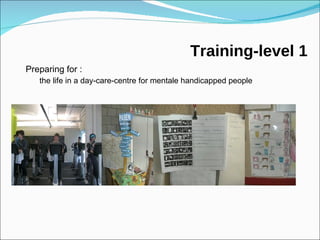
Training-level 1 Preparing  for :  the life in a day-care-centre for mentale  handicapped  people
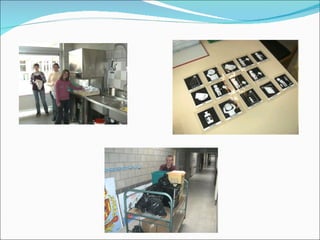
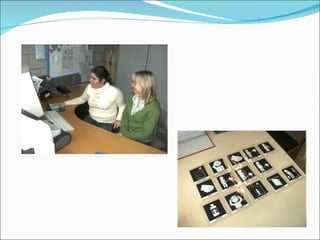
At school : Talking and reading :  SMOG : talking with the support of signs BETA : reading with the support of drawings Functional counting :  the use of money, use of the calendar, the time Cooking Easy labour tasks Maintenance Supporting independence and self-reliance  Socially, physically and daily hygiene Training-level 1
 
 
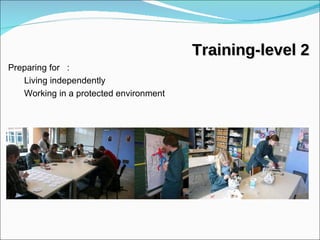
Preparing for  : Living independently Working in a protected environment  Training-level 2
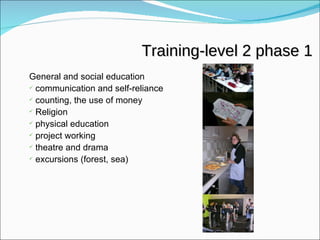
Training-level 2 phase 1 General and social education communication and self-reliance  counting, the use of money Religion physical education project working theatre and drama excursions (forest, sea)
 
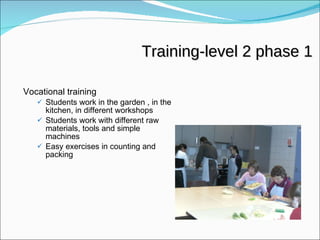
Training-level 2 phase 1 Vocational training Students work in the garden , in the kitchen, in different workshops Students work with different raw materials, tools and simple machines Easy exercises in counting and packing
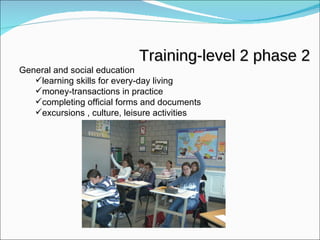
Training-level 2 phase 2 General and social education learning skills for every-day living money-transactions in practice completing official forms and documents excursions , culture, leisure activities
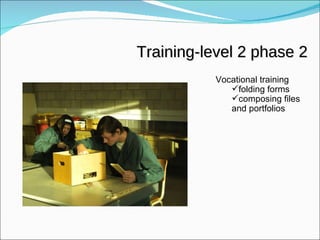
Training-level 2 phase 2 Vocational training folding forms composing files and portfolios
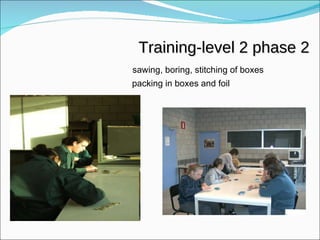
    sawing, boring, stitching of boxes      packing in boxes and foil Training-level 2 phase 2
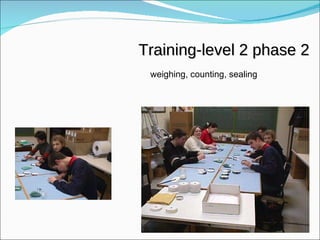
weighing, counting, sealing Training-level 2 phase 2
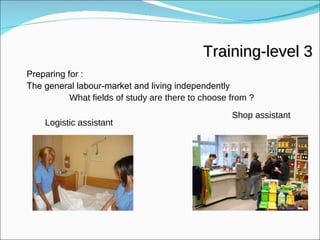
Training-level 3 Logistic assistant Shop assistant   What fields of study are there to choose from ? Preparing for :  The general labour-market and living independently
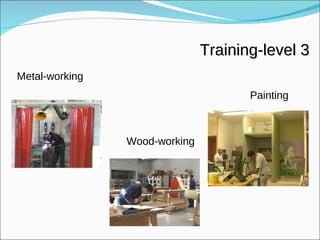
Painting Metal-working Wood-working Training-level 3
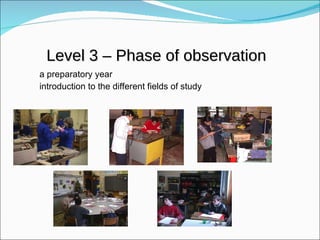
Level 3 – Phase of observation a preparatory year introduction to the different fields of study
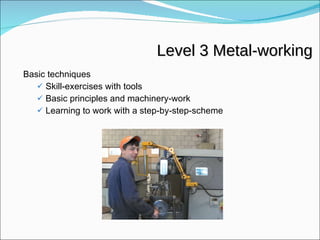
Level 3 Metal-working Basic techniques Skill-exercises with tools Basic principles and machinery-work Learning to work with a step-by-step-scheme
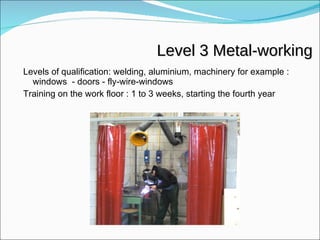
Levels of qualification: welding, aluminium, machinery   for example : windows  - doors - fly-wire-windows Training on the work floor : 1 to 3 weeks, starting the fourth year Level 3 Metal-working
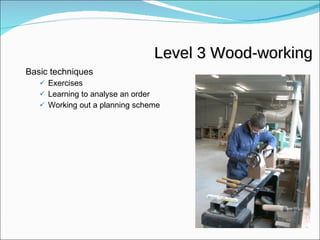
Level 3 Wood-working Basic techniques Exercises Learning to analyse an order Working out a planning scheme
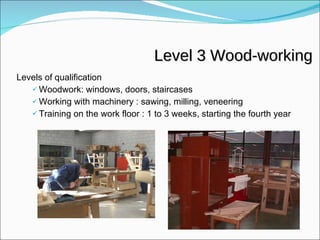
Level 3 Wood-working Levels of qualification Woodwork: windows, doors, staircases Working with machinery : sawing, milling, veneering Training on the work floor : 1 to 3 weeks, starting the fourth year
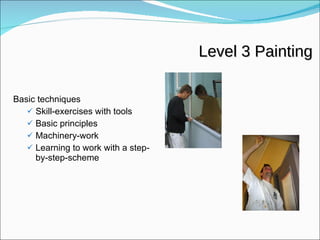
Level 3 Painting Basic techniques Skill-exercises with tools Basic principles  Machinery-work Learning to work with a step-by-step-scheme
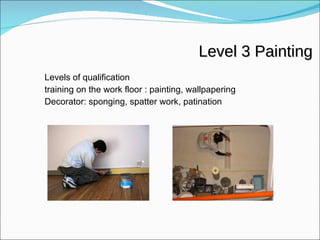
Levels of qualification training on the work floor : painting, wallpapering Decorator: sponging, spatter work, patination Level 3 Painting
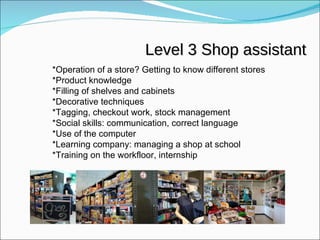
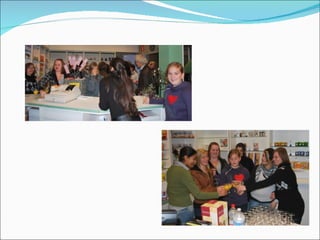
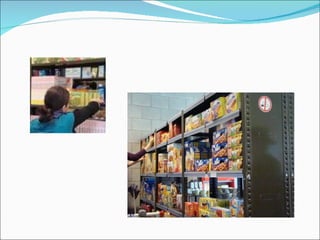
Level 3 Shop assistant *Operation of a store? Getting to know different stores *Product knowledge *Filling of shelves and cabinets *Decorative techniques *Tagging, checkout work, stock management *Social skills: communication, correct language *Use of the computer *Learning company: managing a shop at school *Training on the workfloor, internship
 
 
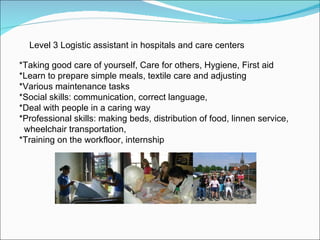
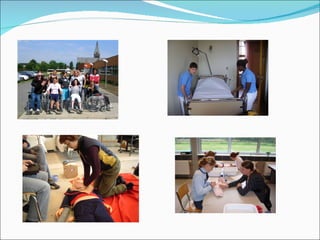
Level 3 Logistic assistant in hospitals and care centers  *Taking good care of yourself, Care for others, Hygiene, First aid  *Learn to prepare simple meals, textile care and adjusting *Various maintenance tasks *Social skills: communication, correct language,  *Deal with people in a caring way *Professional skills: making beds, distribution of food, linnen service,  wheelchair transportation,  *Training on the workfloor, internship
 
ASD SUPPORT Organization  At our school, we choose to integrate students with ASD in the regular classes. It means they have to reach the goals in their teaching level. We provide education for students with a combination of ASD and a mental retardation.  We provide extra support for students with the diagnosis ASD. The staff tries to support the students in their individual needs:
Social skills:  The students exercise in small groups their social skills. The teacher trains daily situations. General and social education:  If necessary the tasks are adapted to the student. It’s possible on the following domains:  Level of difficulty  Individual support during the lessons  Simplify and structure courses  Making step-by-step schemes
Vocational training: If necessary the tasks are adapted to the student. It’s possible on the following domains:  Tracing sensory sensitivities  Making step-by-step schemes  Simplify and structure courses  Subjects following the interests of the student  Individual support during the lessons
Internship and lessons at the workplace  We try to support the students as good as possible  Looking for adapted internship places  Informing the workplace  Preparing the internship  Starting the internship together with the student
We try to search for the best support as possible. Herefor we take part in different projects for students with autism.  During the following two years we have a pedagogical advisor who searches together with the school for a future for our students with autism.  We want to expand the support for students with autism in the future with for example a silent zone, a crisis support area, ...
The end!  Thank you for listening

Sint-Janshof presentation English

  • 1.
  • 2.
    Type 1 : slightlyretarded mentally handicapped youngsters Type 2 : youngsters with a moderate or severe mental handicap Type 3 : youngsters with behavioural difficulties Type 4 : physically handicapped youngsters Type 5 : hospital-education / education for sick students Type 6 : blind youngsters and youngsters with imperfect eyesight Type 7 : youngsters with a speech-defect or a hearing disability Type 8 : youngsters with learning difficulties Special Primary Education : from type 1 till type 8 Special Secondary Education : from type 1 till type 7 Special education
  • 3.
    Special Secondary EducationSint-Janshof Type 2 : Training-level 1 : 42 students Training-level 2 : 70 students Type 1 : Training-level 3 : 104 students Metal-working Wood-working Painting Shop assistant Logistics assistant
  • 4.
    Who’s working inour school ? Director and management Clerical staff (administration) Teachers in general and social education Teachers in vocational training Teachers in physical education Centre for supervision of students : psychologist and social worker Paramedics physical therapist speech-therapist nurse
  • 5.
    What’s the meaningof general and social education ? functional counting reading and writing project-working the use of computers physical education being creative
  • 6.
    Vocational educationpreparing for Level 1 : living in a day-care-centre Level 2 : working in a protected environment Level 3 : working in the labour-market What’s the meaning of vocational training ?
  • 7.
    Training-level 1 Preparing for : the life in a day-care-centre for mentale handicapped people
  • 8.
    At school : Talkingand reading : SMOG : talking with the support of signs BETA : reading with the support of drawings Functional counting : the use of money, use of the calendar, the time Cooking Easy labour tasks Maintenance Supporting independence and self-reliance Socially, physically and daily hygiene Training-level 1
  • 9.
  • 10.
  • 11.
    Preparing for : Living independently Working in a protected environment Training-level 2
  • 12.
    Training-level 2 phase1 General and social education communication and self-reliance counting, the use of money Religion physical education project working theatre and drama excursions (forest, sea)
  • 13.
  • 14.
    Training-level 2 phase1 Vocational training Students work in the garden , in the kitchen, in different workshops Students work with different raw materials, tools and simple machines Easy exercises in counting and packing
  • 15.
    Training-level 2 phase2 General and social education learning skills for every-day living money-transactions in practice completing official forms and documents excursions , culture, leisure activities
  • 16.
    Training-level 2 phase2 Vocational training folding forms composing files and portfolios
  • 17.
       sawing,boring, stitching of boxes     packing in boxes and foil Training-level 2 phase 2
  • 18.
    weighing, counting, sealingTraining-level 2 phase 2
  • 19.
    Training-level 3 Logisticassistant Shop assistant   What fields of study are there to choose from ? Preparing for : The general labour-market and living independently
  • 20.
  • 21.
    Level 3 –Phase of observation a preparatory year introduction to the different fields of study
  • 22.
    Level 3 Metal-workingBasic techniques Skill-exercises with tools Basic principles and machinery-work Learning to work with a step-by-step-scheme
  • 23.
    Levels of qualification:welding, aluminium, machinery for example : windows - doors - fly-wire-windows Training on the work floor : 1 to 3 weeks, starting the fourth year Level 3 Metal-working
  • 24.
    Level 3 Wood-workingBasic techniques Exercises Learning to analyse an order Working out a planning scheme
  • 25.
    Level 3 Wood-workingLevels of qualification Woodwork: windows, doors, staircases Working with machinery : sawing, milling, veneering Training on the work floor : 1 to 3 weeks, starting the fourth year
  • 26.
    Level 3 PaintingBasic techniques Skill-exercises with tools Basic principles Machinery-work Learning to work with a step-by-step-scheme
  • 27.
    Levels of qualificationtraining on the work floor : painting, wallpapering Decorator: sponging, spatter work, patination Level 3 Painting
  • 28.
    Level 3 Shopassistant *Operation of a store? Getting to know different stores *Product knowledge *Filling of shelves and cabinets *Decorative techniques *Tagging, checkout work, stock management *Social skills: communication, correct language *Use of the computer *Learning company: managing a shop at school *Training on the workfloor, internship
  • 29.
  • 30.
  • 31.
    Level 3 Logisticassistant in hospitals and care centers *Taking good care of yourself, Care for others, Hygiene, First aid *Learn to prepare simple meals, textile care and adjusting *Various maintenance tasks *Social skills: communication, correct language, *Deal with people in a caring way *Professional skills: making beds, distribution of food, linnen service, wheelchair transportation, *Training on the workfloor, internship
  • 32.
  • 33.
    ASD SUPPORT Organization At our school, we choose to integrate students with ASD in the regular classes. It means they have to reach the goals in their teaching level. We provide education for students with a combination of ASD and a mental retardation. We provide extra support for students with the diagnosis ASD. The staff tries to support the students in their individual needs:
  • 34.
    Social skills: The students exercise in small groups their social skills. The teacher trains daily situations. General and social education: If necessary the tasks are adapted to the student. It’s possible on the following domains: Level of difficulty Individual support during the lessons Simplify and structure courses Making step-by-step schemes
  • 35.
    Vocational training: Ifnecessary the tasks are adapted to the student. It’s possible on the following domains: Tracing sensory sensitivities Making step-by-step schemes Simplify and structure courses Subjects following the interests of the student Individual support during the lessons
  • 36.
    Internship and lessonsat the workplace We try to support the students as good as possible Looking for adapted internship places Informing the workplace Preparing the internship Starting the internship together with the student
  • 37.
    We try tosearch for the best support as possible. Herefor we take part in different projects for students with autism. During the following two years we have a pedagogical advisor who searches together with the school for a future for our students with autism. We want to expand the support for students with autism in the future with for example a silent zone, a crisis support area, ...
  • 38.
    The end! Thank you for listening