Vocational
                                       training
                                       in France
                                       An Answer to your questions


     Centre INFFO (non-profit society under the aegis of the
                Ministry of Economy, Finance and Employment)
          is the french national centre for the development of
  information on continuing vocational training. Its role is to
       provide information, documentation and studies in this
   field. Its targets are continuing training professionals who
                                                                       n France, people have access to learning throughout

                                                                   I
                  train, inform, advise and guide the end users.
    Centre INFFO has a privileged relationship with the State,         their lives as part of the on-going education system. In
      with employers and trade union organisations and with            2003, one worker out of three took advantage of a trai-
                                    main training professionals.
                                                                   ning offer.

                                                                   On-going education enables individuals to follow a course
                                                                   either in the form of initial schooling, or a university
                                                                   curriculum for school pupils and students, or as vocational
Centre INFFO groups together specialists in law, documentation,    training for any person already in the work force, whatever
data bases, training market and innovative practices, journalism
and professionals of the publishing.
                                                                   their age. The efforts made in the area of lifelong vocational
                                                                   training and apprenticeships represented 1.46% of the
It:                                                                French gross domestic product in 20041.
• co-ordinates information and documentation on continuing
vocational education and training,                                 The vocational training sector in France consists of two
• edits and publishes periodicals, information documents,          areas, each of which is relatively independent of the other:
technical files and other information tools,                       • initial vocational training, which concerns young people in
• contributes to Government information services, awareness        full-time education and apprenticeships;
operations and campaigns,                                          • lifelong vocational training which concerns young people
• provides information on the initiatives and operations of        who have left or completed their initial education and adults
international, national and regional institutions,
                                                                   already in the workplace.
• organises study and information days,                            France is undergoing an extension of schooling at all ages.
• realises inquiries and studies for bodies or for companies.      The vocational training sector is also being given greater
                                                                   credence and the work-based learning system is becoming
                                                                   increasingly common, either as part of the school curriculum
                                                                   or within the framework of a contract of employment.
                                                                   Over the last few years, the co-operation between school and
                                                                   business has increased noticeably and closer bridges have
                                                                   been established. The training/learning sector is enjoying
                                                                   major development, which is also part of EU policy.
                                                                   Besides, the State attributed to Regions, a whole competence
                                                                   of initial and continuing vocational training.


                                                                              1 Source : Budget Plan 2007.


   Centre pour le développement                                                                  This brochure summarises the specific
 de l’information sur la formation                                                               characteristics of initial and lifelong vocational
                      permanente                                                                 training, the means of accessing additional
  4, avenue du Stade-de-France,                                                                  information and the main networks of
93218 Saint-Denis-La Plaine cedex                                                                education, technical teaching and vocational
             ¥ 33 1 55 93 91 91      www.centre-inffo.fr                                         training operators in France.
Initial training to provide a place
                     in the work force


                                                                                                                              Since 2003, all the professionnal diplomas (level II et IV) are orga-
   I  n France, education is organised on a national basis. It is free
      and, in the main, non religious. Private education accounts for
   one pupil in five. In 2005-2006, 87% of young people between the
                                                                                                                              nized in units, you could obtain in a separate way.
                                                                                                                                   Agriculture education
   ages of 2 and 22 were attending an educational establishment1.
                                                                                                                              These courses are overseen by the Ministry of Agriculture. They
         Initial learning                                                                                                     provide varying levels of vocational education ranging from Level
   Education is compulsary between the ages of 6 and 16. It provides                                                          V to Level I.
   young people with teaching in general and professional subjects.                                                                Professionalism for higher education
   The educational system, which is headed by the Ministry of
                                                                                                                              In 2005-2006, 37.5% of students registered in courses with a
   Education, consists of 3 levels divided into “cycles” (cf. table). In
                                                                                                                              technical/ vocational bias3. Higher education offers general cour-
   2004, the cost of education within France amounted to 116.3
                                                                                                                              ses and vocational training courses from technician level (2 years
   billion euros, or 7.1% of the gross domestic product2.
                                                                                                                              after school) to engineer (5 years after school). Such courses are
         Three educational choices                                                                                            open to school leavers holding a school leaving certificate and to
   Threeeducational choices are available to pupils i.e. general                                                              holders of the DAEU (university entrance diploma).
   education, vocational courses and technological curricula. The last                                                        All the curricula now include diploma accreditation procedures
   two result in diplomas ranging from the CAP (Certificate of                                                                enabling adults to enter the university system and students to
   Professional Aptitude, Level V) to an engineering degree (Level I)                                                         be granted examination exemptions. The “grandes écoles”, France’s
   and include the BTS (higher-grade technician’s diploma, 2 years’                                                           leading engineering colleges which have a reputation for excellen-
   study after leaving school). They can be obtained by following a                                                           ce, are controlled by various ministries e.g. Education, Defence,
   school curriculum, taking an apprenticeship, studying on an work-                                                          Industry, Transport, Agriculture and Fisheries.
   based learning system or obtaining an recognition of skills.

   Diplomas are designed and redefined by the relevant public
   authorities in co-operation with trade unions and employers' asso-
                                                                                                                              1. Source: Ministry of Education. Répères et Références Statistiques 2006.
   ciations through Consultative Professional Commissions (know as                                                            2. id.
   "CPC" for "Commissions Professionnelles Consultatives").                                                                   3. id.


                           The education                                                                                                                                          Certifications via
                                                                                                             Main general curricula
                         system in France                                                                                                                                          apprenticeship

C.A.P. (Certificat                                                                                                           Doctorate
                             Higher education


d’aptitude
                                                                aged 18 and over


professionnel) :
Professional                                                                       M2
                                                Engineering                                                                   Master
skills certificate                                                                 M1
                                                 colleges/                                                                                                                     Engineering diploma
                                                                                                                                                                                                           Apprentices’ Training Centre


B.E.P. (Brevet                                  Universities                       L3
d’enseignement
professionnel) :                                                                   L2          Licence                                                                                  BTS-DUT
Professional studies                                                                                                                                BTS-DUT
Certificate                                                                        L1

B.T.S (Brevet                                                                           High school                       High school                    High school                 High school
de technicien                                                                             diploma                        technological                vocational diploma          vocational diploma
                                                                 aged 15 to 18


supérieur) : Higher                                                                                                         diploma
                                                                                                          11th Year                          11th Year
                                                                                                                                                                                Professional certificate
Technician's                                    Senior high                                           technological course                adaptation course
certificate                                                                                                                                                   CAP - BEP
                                                  school
                              undergraduate


                                                                                                                                                                                        CAP-BEP
D.U.T. (Diplôme
universitaire                                                                                                                                                                      Lower grade
technique) : Technical                                                              General course                Technological course                   Vocational course     vocational certificate
university degree
                                                                                                  Lower grade school certificate
                                                                aged 11 to 15


                                                                                                                              9th Year
                                                   Junior
                                                                                                                              8th Year
                                                high school
                                                                                                                              7th Year
                                                                                                                              6th Year                                             General course
                                                               aged 3 to 11
                          and primary
                          pre-primary


                                                Kindergarten
                           graduate


                                                                                                                    Elementary school
                                                and primary                                                                                                                        Technological course
                                                   schools                                                       Pre-elementary school

                                                                                                                                                                                    Vocational course
... and lifelong vocational learning


T      This concerns people already in the work force (staff in
       both the private and the public sectors, non-salaried wor-
kers) and about to enter the work force (job-seekers).
                                                                                                   Accreditation of life experience
                                                                                   n University entrance: the accreditation of life experience
Lifelong vocational training aims to:                                              (system known as "validation des acquis de l’expérience" or
• make it easier to adapt to changes in working techniques and                     "VAE" in France) allows applicants who do not have the necessary diplo-
conditions;                                                                        ma or qualifications but who have a foreign diploma, professional expe-
• maintain or improve their vocational qualification;                              rience or informally acquired knowledge to gain entry to university
• assist in their social or professional promotion.                                courses.
Learning possibilities depend on the status of the beneficiary.                    n Obtaining certification: Anyone who can provide proof of having exer-
                                                                                   cised a professional or voluntary activity relevant to the final aim of the
Central and regional governments are responsible for the imple-                    desired diploma or qualification can have the knowledge and compe-
mentation of lifelong vocational training. Social partners play a                  tencies acquired in the course of that activity accredited in order to
vital role particularly in the choice of learning policies for staff               obtain all or part of the desired certification, i.e. to be exempted from all
in the private sector and the management of funding provided                       or some of the relevant examinations.
by companies.
Vocational training providers may be private, public or part of the
Chambers of Commerce & Industry, Trades or Agriculture (cf. p4).                     • Training Plan
More than 12.8001 have this as their main sector of activity .                       This includes all the training activities for which the employer is respon-
                                                                                     sible. The scheme is submitted to the works committee for discussion. The
In 2004, France spent 24 billion euros on lifelong vocational trai-                  employer have two possibilities to provide training courses to his
ning2. This funding comes mainly from central government                             employees. In one hand the member of staff undergoing training is consi-
(39.6%), companies (39.6%) and regional governments (11.25%).                        dered to be undertaking professional work and is paid by the company. In
The remaining 9.55% result from the other public actors and                          the other hand, the employee attends training courses outside working
from households.                                                                     hours at the employer's request or with an only subsidy.
    An obligation for companies to                                                   • Individual training Leave
                                                                                     This enables any salaried member of staff to follow his/her own
    participate in the funding of
                                                                                     choice of training programme during working hours. Such a program-
    vocational training for their own staff                                          me is different to any included in the training plan. On average, such
This obligation is incumbent upon employers, in both the private                     training leave lasts for one year. During this period, the employee is
and public sectors. Since 2005, it is equal to 1.6% of the wages                     paid (between 80% and 100% of his basic salary). He is also entitled
bill for private companies with 20 employees or more, to 1.05%                       to request that his job be kept open for him in the company. Staff
for privates companies with 10 to 19 employees and to 0.55% of                       covered by a fixed-duration contract of employment can also take
the wages bill for private companies employing fewer than 10                         individual training leave.
employees3.                                                                          • Individual training Right benefit
With the exception of the training plan for companies employing                      Under the Individual Training Right benefit (DIF), every employee acqui-
a minimum of 10 employees, these contributions are managed                           res a training-time credit of 20 hours a year within the limits of 6 years,
jointly and in equal proportions (employers/workers) by collecting                   which allows all employees to pursue a vocational training. Normally, the
bodies operating at national or regional level per professional                      employee attends training courses outside working hours except when a
sector, or operating at an inter-professional level.                                 sector's agreement of the social partners foresees the possibility of being
                                                                                     considered to be undertaking on the professional work.
    Employee training                                                                • Personal and vocational skills analysis
Employees have access to training courses either at the                              This enables staff members to analyse their personal and professional
request of their employers within the framework of a training                        skills in order to define a vocational project or establish a plan for voca-
scheme or at their own request within the leave of absence                           tional training. It can be carried out as part of the training plan or during
system, the longest period of absence being the individual                           leave of absence.
training leave.                                                                      Except the individual training Right, similar arrangements exist for public
                                                                                     sector workers.
Financial contribution of employers
(in % of the firm’s gross annual wage bill)                                               Training for self -employed workers
                                                                                     Self-employed or non-salaried workers (farmers, craftsmen, shopkeepers,
                                                                                     professional people) can also take advantage of training programmes.
                                                                   0.50              They are required to participate in the funding of their training through
                                          0.15
                                                                            0.20
               0.15                                                                  the payment of a contribution to a State-registered collecting body.

    0.40                             0.90                            0.90


 companies                     companies                        companies with
 with less than                with 10 to                       a minimum
 10 employees                  19 employees                     of 20 employees

           Professionalisation and individual training rights                        1. Source: 2007 Budget Plan
           Individual training leave
                                                                                     2. Source: Id.
                                                                                     3. Such funding (or participation) consists of various contributions
           Training plans                                                            (cf. diagram).
Pratical Guide
                Public services
          s Ministère de l’Agriculture et de la Pêche
          78, rue de Varenne - 75349 Paris SP
          ¥ 33 1 49 55 49 55
          http://www.agriculture.gouv.fr

          s Ministère de l’Économie, des Finances et de l’Emploi
          139, rue de Bercy - 75572 Paris cedex 12                         Preparing a vocational stay
          ¥ 33 1 40 04 04 04
          http://www.minefi.gouv.fr                                        in France
          s Délégation générale à l’emploi et à la formation
          professionnelle (DGEFP)                                         Training courses: the main networks in France
          7, square Max-Hymans - 75741 Paris cedex 15
          ¥ 33 1 43 19 38 38                                              • The Association des chambres françaises de commerce et d’industrie
          http://www.travail.gouv.fr                                      (ACFCI) provides information about all the colleges and schools
                                                                          managed by the networks of Chambers of Commerce and Industry.
          s Ministère de l’Éducation nationale                            http://www.acfci.cci.fr
          Direction de l’Enseignement scolaire                            • The Association nationale pour la formation professionnelle des adul-
          110, rue de Grenelle - 75007 Paris                              tes (Afpa) organises vocational diploma courses (400 diplomas).
          ¥ 33 1 49 55 10 10                                              http://www.afpa.fr
          http://www.education.gouv.fr
                                                                          • The Assemblée permanente des chambres des métiers (Apcm)
                                                                          provides information on courses in trades and crafts subjects.
          s Ministère de l’Enseignement supérieur et de la Recherche
                                                                          http://www.apcm.com
          1, rue Descartes - 75231 Paris cedex 05
          ¥ 33 1 55 55 90 90                                              • The Conférence des grandes écoles supplies a list of leading colleges by
          http://www.recherche.gouv.fr                                    specialist subject. It also indicates entrance requirements for foreign students.
                                                                          http://www.cge.asso.fr
                                                                          • The Conservatoire national des arts et métiers (Cnam), a public
                                                                          higher education establishment, offers more than 500 courses in the
Reception and consultancy                                                 industrial and tertiary sectors, each leading to a diploma or certificate.
                                                                          http://www.cnam.fr
• Public service, portal site for French authorities.                     • Educagri, the website dedicated to public sector agricultural
http://www.service-public.fr                                              teaching in France, provides information about schools and colleges,
• National portal on guidance and initial and continuing training         diplomas and sectors within the agricultural teaching system. It also
http://www.orientation-formation.fr                                       indicates intake sizes for halls of residence and details international
                                                                          co-operation programmes.
• EduFrance provides foreign students with a specific                     http://www.educagri.fr
curriculum, in French, to prepare them for higher education.
It also provides a wide range of vocational training courses              • The Groupement d’établissements de l’Éducation nationale (Greta)
for foreign students.                                                     prepares students for the 700 technological and vocational diplomas
http://www.edufrance.fr                                                   offered by the Ministry of Education.
                                                                          http://www.eduscol.education.fr


                                                                                                                                                                              Design and layout: Centre INFFO 01 55 93 91 29
• Egide, a State-commissioned association, provides assistance
for foreign students, researchers, trainees and VIPs making               • The network of lifelong learning departments within French universi-
arrangements for travel, accommodation, sickness insurance and            ties details the courses on offer in each region, by vocational sector.
training before and during their stay.                                    http://www.dep.u-picardie.fr/fcu
http://www.egide.asso.fr                                                  • The Fédération de la formation professionnelle (FFP) groups together
• The Ministry of Foreign Affairs’ site provides a large number of        300 private training providers
recommendations for people wishing to come and study in                   http://www.ffp.org
France. It provides information on the formalities that must be
completed prior to a stay in France.
http://www.diplomatie.gouv.fr
• PLOTEUS is a Portal on Learning Opportunities throughout the
European Space. It aims to help everyone to find out information                           Information on training and employment:
about studying in Europe.                                                                                  the main public agencies
http://europa.eu.int/ploteus
                                                                              Agence nationale pour l’emploi (ANPE) : http://www.anpe.fr

                                                     Centre d’information et de documentation pour la jeunesse (CIDJ) : http://www.cidj.fr
                      Centres régionaux d’animation et de ressources d’information sur la formation (CARIF) : http://www.intercarif.org
                           Centre européen pour le développement de la formation professionnelle (CEDEFOP) : http://www.cedefop.eu.int
                                                                                                                                                              February 2008


                   Centre de développement de l’information sur la formation professionnelle (Centre INFFO) : http://www.centre-inffo.fr
                                    Office national d’information sur les enseignements et les professions (ONISEP) : http://www.onisep.fr


 Centre pour le développement de l’information sur la formation permanente - 4 avenue du Stade-de-France, 93218 Saint-Denis-La Plaine cedex

Vocational Training in France

  • 1.
    Vocational training in France An Answer to your questions Centre INFFO (non-profit society under the aegis of the Ministry of Economy, Finance and Employment) is the french national centre for the development of information on continuing vocational training. Its role is to provide information, documentation and studies in this field. Its targets are continuing training professionals who n France, people have access to learning throughout I train, inform, advise and guide the end users. Centre INFFO has a privileged relationship with the State, their lives as part of the on-going education system. In with employers and trade union organisations and with 2003, one worker out of three took advantage of a trai- main training professionals. ning offer. On-going education enables individuals to follow a course either in the form of initial schooling, or a university curriculum for school pupils and students, or as vocational Centre INFFO groups together specialists in law, documentation, training for any person already in the work force, whatever data bases, training market and innovative practices, journalism and professionals of the publishing. their age. The efforts made in the area of lifelong vocational training and apprenticeships represented 1.46% of the It: French gross domestic product in 20041. • co-ordinates information and documentation on continuing vocational education and training, The vocational training sector in France consists of two • edits and publishes periodicals, information documents, areas, each of which is relatively independent of the other: technical files and other information tools, • initial vocational training, which concerns young people in • contributes to Government information services, awareness full-time education and apprenticeships; operations and campaigns, • lifelong vocational training which concerns young people • provides information on the initiatives and operations of who have left or completed their initial education and adults international, national and regional institutions, already in the workplace. • organises study and information days, France is undergoing an extension of schooling at all ages. • realises inquiries and studies for bodies or for companies. The vocational training sector is also being given greater credence and the work-based learning system is becoming increasingly common, either as part of the school curriculum or within the framework of a contract of employment. Over the last few years, the co-operation between school and business has increased noticeably and closer bridges have been established. The training/learning sector is enjoying major development, which is also part of EU policy. Besides, the State attributed to Regions, a whole competence of initial and continuing vocational training. 1 Source : Budget Plan 2007. Centre pour le développement This brochure summarises the specific de l’information sur la formation characteristics of initial and lifelong vocational permanente training, the means of accessing additional 4, avenue du Stade-de-France, information and the main networks of 93218 Saint-Denis-La Plaine cedex education, technical teaching and vocational ¥ 33 1 55 93 91 91 www.centre-inffo.fr training operators in France.
  • 2.
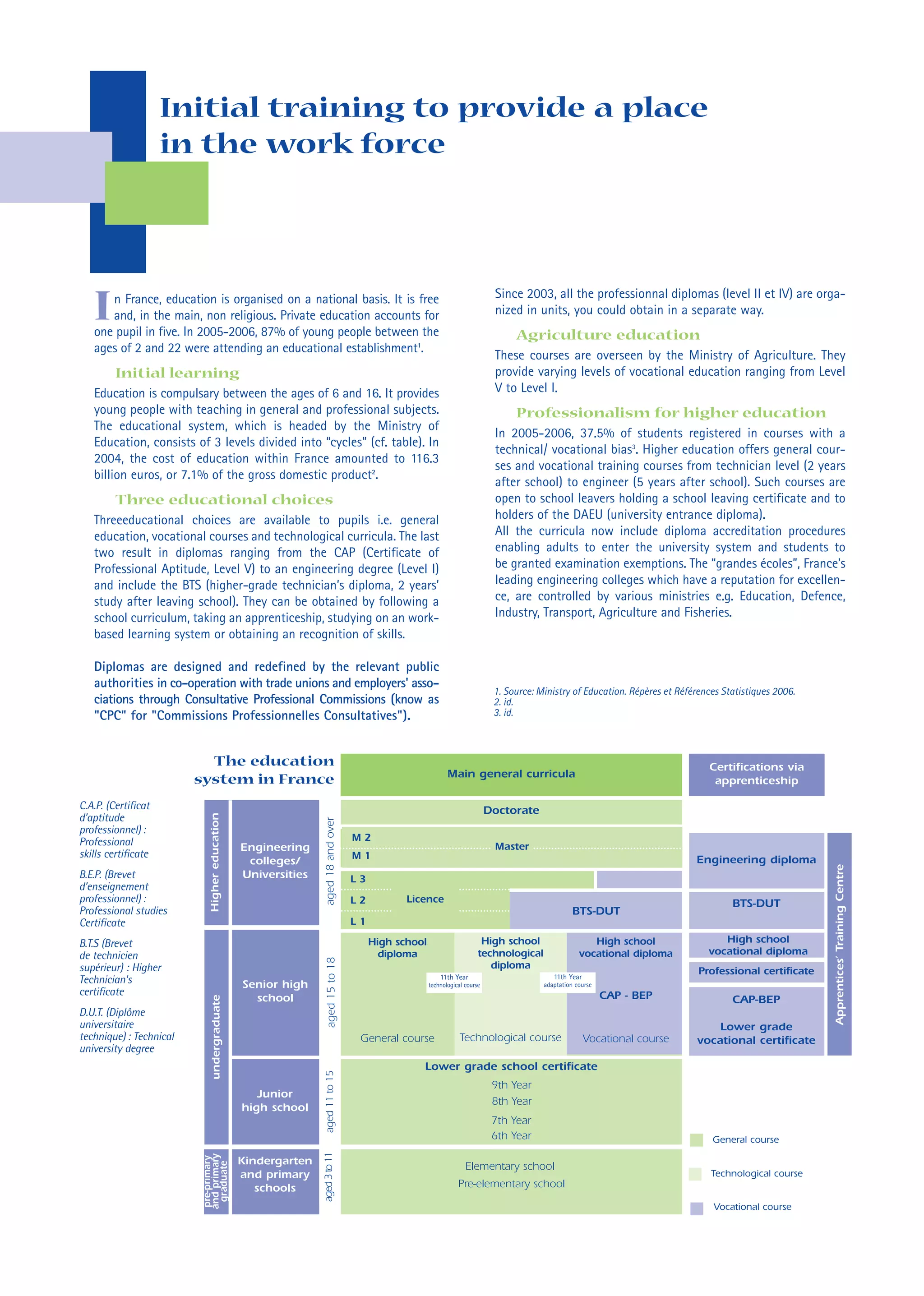
    Initial training toprovide a place in the work force Since 2003, all the professionnal diplomas (level II et IV) are orga- I n France, education is organised on a national basis. It is free and, in the main, non religious. Private education accounts for one pupil in five. In 2005-2006, 87% of young people between the nized in units, you could obtain in a separate way. Agriculture education ages of 2 and 22 were attending an educational establishment1. These courses are overseen by the Ministry of Agriculture. They Initial learning provide varying levels of vocational education ranging from Level Education is compulsary between the ages of 6 and 16. It provides V to Level I. young people with teaching in general and professional subjects. Professionalism for higher education The educational system, which is headed by the Ministry of In 2005-2006, 37.5% of students registered in courses with a Education, consists of 3 levels divided into “cycles” (cf. table). In technical/ vocational bias3. Higher education offers general cour- 2004, the cost of education within France amounted to 116.3 ses and vocational training courses from technician level (2 years billion euros, or 7.1% of the gross domestic product2. after school) to engineer (5 years after school). Such courses are Three educational choices open to school leavers holding a school leaving certificate and to Threeeducational choices are available to pupils i.e. general holders of the DAEU (university entrance diploma). education, vocational courses and technological curricula. The last All the curricula now include diploma accreditation procedures two result in diplomas ranging from the CAP (Certificate of enabling adults to enter the university system and students to Professional Aptitude, Level V) to an engineering degree (Level I) be granted examination exemptions. The “grandes écoles”, France’s and include the BTS (higher-grade technician’s diploma, 2 years’ leading engineering colleges which have a reputation for excellen- study after leaving school). They can be obtained by following a ce, are controlled by various ministries e.g. Education, Defence, school curriculum, taking an apprenticeship, studying on an work- Industry, Transport, Agriculture and Fisheries. based learning system or obtaining an recognition of skills. Diplomas are designed and redefined by the relevant public authorities in co-operation with trade unions and employers' asso- 1. Source: Ministry of Education. Répères et Références Statistiques 2006. ciations through Consultative Professional Commissions (know as 2. id. "CPC" for "Commissions Professionnelles Consultatives"). 3. id. The education Certifications via Main general curricula system in France apprenticeship C.A.P. (Certificat Doctorate Higher education d’aptitude aged 18 and over professionnel) : Professional M2 Engineering Master skills certificate M1 colleges/ Engineering diploma Apprentices’ Training Centre B.E.P. (Brevet Universities L3 d’enseignement professionnel) : L2 Licence BTS-DUT Professional studies BTS-DUT Certificate L1 B.T.S (Brevet High school High school High school High school de technicien diploma technological vocational diploma vocational diploma aged 15 to 18 supérieur) : Higher diploma 11th Year 11th Year Professional certificate Technician's Senior high technological course adaptation course certificate CAP - BEP school undergraduate CAP-BEP D.U.T. (Diplôme universitaire Lower grade technique) : Technical General course Technological course Vocational course vocational certificate university degree Lower grade school certificate aged 11 to 15 9th Year Junior 8th Year high school 7th Year 6th Year General course aged 3 to 11 and primary pre-primary Kindergarten graduate Elementary school and primary Technological course schools Pre-elementary school Vocational course
  • 3.
    ... and lifelongvocational learning T This concerns people already in the work force (staff in both the private and the public sectors, non-salaried wor- kers) and about to enter the work force (job-seekers). Accreditation of life experience n University entrance: the accreditation of life experience Lifelong vocational training aims to: (system known as "validation des acquis de l’expérience" or • make it easier to adapt to changes in working techniques and "VAE" in France) allows applicants who do not have the necessary diplo- conditions; ma or qualifications but who have a foreign diploma, professional expe- • maintain or improve their vocational qualification; rience or informally acquired knowledge to gain entry to university • assist in their social or professional promotion. courses. Learning possibilities depend on the status of the beneficiary. n Obtaining certification: Anyone who can provide proof of having exer- cised a professional or voluntary activity relevant to the final aim of the Central and regional governments are responsible for the imple- desired diploma or qualification can have the knowledge and compe- mentation of lifelong vocational training. Social partners play a tencies acquired in the course of that activity accredited in order to vital role particularly in the choice of learning policies for staff obtain all or part of the desired certification, i.e. to be exempted from all in the private sector and the management of funding provided or some of the relevant examinations. by companies. Vocational training providers may be private, public or part of the Chambers of Commerce & Industry, Trades or Agriculture (cf. p4). • Training Plan More than 12.8001 have this as their main sector of activity . This includes all the training activities for which the employer is respon- sible. The scheme is submitted to the works committee for discussion. The In 2004, France spent 24 billion euros on lifelong vocational trai- employer have two possibilities to provide training courses to his ning2. This funding comes mainly from central government employees. In one hand the member of staff undergoing training is consi- (39.6%), companies (39.6%) and regional governments (11.25%). dered to be undertaking professional work and is paid by the company. In The remaining 9.55% result from the other public actors and the other hand, the employee attends training courses outside working from households. hours at the employer's request or with an only subsidy. An obligation for companies to • Individual training Leave This enables any salaried member of staff to follow his/her own participate in the funding of choice of training programme during working hours. Such a program- vocational training for their own staff me is different to any included in the training plan. On average, such This obligation is incumbent upon employers, in both the private training leave lasts for one year. During this period, the employee is and public sectors. Since 2005, it is equal to 1.6% of the wages paid (between 80% and 100% of his basic salary). He is also entitled bill for private companies with 20 employees or more, to 1.05% to request that his job be kept open for him in the company. Staff for privates companies with 10 to 19 employees and to 0.55% of covered by a fixed-duration contract of employment can also take the wages bill for private companies employing fewer than 10 individual training leave. employees3. • Individual training Right benefit With the exception of the training plan for companies employing Under the Individual Training Right benefit (DIF), every employee acqui- a minimum of 10 employees, these contributions are managed res a training-time credit of 20 hours a year within the limits of 6 years, jointly and in equal proportions (employers/workers) by collecting which allows all employees to pursue a vocational training. Normally, the bodies operating at national or regional level per professional employee attends training courses outside working hours except when a sector, or operating at an inter-professional level. sector's agreement of the social partners foresees the possibility of being considered to be undertaking on the professional work. Employee training • Personal and vocational skills analysis Employees have access to training courses either at the This enables staff members to analyse their personal and professional request of their employers within the framework of a training skills in order to define a vocational project or establish a plan for voca- scheme or at their own request within the leave of absence tional training. It can be carried out as part of the training plan or during system, the longest period of absence being the individual leave of absence. training leave. Except the individual training Right, similar arrangements exist for public sector workers. Financial contribution of employers (in % of the firm’s gross annual wage bill) Training for self -employed workers Self-employed or non-salaried workers (farmers, craftsmen, shopkeepers, professional people) can also take advantage of training programmes. 0.50 They are required to participate in the funding of their training through 0.15 0.20 0.15 the payment of a contribution to a State-registered collecting body. 0.40 0.90 0.90 companies companies companies with with less than with 10 to a minimum 10 employees 19 employees of 20 employees Professionalisation and individual training rights 1. Source: 2007 Budget Plan Individual training leave 2. Source: Id. 3. Such funding (or participation) consists of various contributions Training plans (cf. diagram).
  • 4.
    Pratical Guide Public services s Ministère de l’Agriculture et de la Pêche 78, rue de Varenne - 75349 Paris SP ¥ 33 1 49 55 49 55 http://www.agriculture.gouv.fr s Ministère de l’Économie, des Finances et de l’Emploi 139, rue de Bercy - 75572 Paris cedex 12 Preparing a vocational stay ¥ 33 1 40 04 04 04 http://www.minefi.gouv.fr in France s Délégation générale à l’emploi et à la formation professionnelle (DGEFP) Training courses: the main networks in France 7, square Max-Hymans - 75741 Paris cedex 15 ¥ 33 1 43 19 38 38 • The Association des chambres françaises de commerce et d’industrie http://www.travail.gouv.fr (ACFCI) provides information about all the colleges and schools managed by the networks of Chambers of Commerce and Industry. s Ministère de l’Éducation nationale http://www.acfci.cci.fr Direction de l’Enseignement scolaire • The Association nationale pour la formation professionnelle des adul- 110, rue de Grenelle - 75007 Paris tes (Afpa) organises vocational diploma courses (400 diplomas). ¥ 33 1 49 55 10 10 http://www.afpa.fr http://www.education.gouv.fr • The Assemblée permanente des chambres des métiers (Apcm) provides information on courses in trades and crafts subjects. s Ministère de l’Enseignement supérieur et de la Recherche http://www.apcm.com 1, rue Descartes - 75231 Paris cedex 05 ¥ 33 1 55 55 90 90 • The Conférence des grandes écoles supplies a list of leading colleges by http://www.recherche.gouv.fr specialist subject. It also indicates entrance requirements for foreign students. http://www.cge.asso.fr • The Conservatoire national des arts et métiers (Cnam), a public higher education establishment, offers more than 500 courses in the Reception and consultancy industrial and tertiary sectors, each leading to a diploma or certificate. http://www.cnam.fr • Public service, portal site for French authorities. • Educagri, the website dedicated to public sector agricultural http://www.service-public.fr teaching in France, provides information about schools and colleges, • National portal on guidance and initial and continuing training diplomas and sectors within the agricultural teaching system. It also http://www.orientation-formation.fr indicates intake sizes for halls of residence and details international co-operation programmes. • EduFrance provides foreign students with a specific http://www.educagri.fr curriculum, in French, to prepare them for higher education. It also provides a wide range of vocational training courses • The Groupement d’établissements de l’Éducation nationale (Greta) for foreign students. prepares students for the 700 technological and vocational diplomas http://www.edufrance.fr offered by the Ministry of Education. http://www.eduscol.education.fr Design and layout: Centre INFFO 01 55 93 91 29 • Egide, a State-commissioned association, provides assistance for foreign students, researchers, trainees and VIPs making • The network of lifelong learning departments within French universi- arrangements for travel, accommodation, sickness insurance and ties details the courses on offer in each region, by vocational sector. training before and during their stay. http://www.dep.u-picardie.fr/fcu http://www.egide.asso.fr • The Fédération de la formation professionnelle (FFP) groups together • The Ministry of Foreign Affairs’ site provides a large number of 300 private training providers recommendations for people wishing to come and study in http://www.ffp.org France. It provides information on the formalities that must be completed prior to a stay in France. http://www.diplomatie.gouv.fr • PLOTEUS is a Portal on Learning Opportunities throughout the European Space. It aims to help everyone to find out information Information on training and employment: about studying in Europe. the main public agencies http://europa.eu.int/ploteus Agence nationale pour l’emploi (ANPE) : http://www.anpe.fr Centre d’information et de documentation pour la jeunesse (CIDJ) : http://www.cidj.fr Centres régionaux d’animation et de ressources d’information sur la formation (CARIF) : http://www.intercarif.org Centre européen pour le développement de la formation professionnelle (CEDEFOP) : http://www.cedefop.eu.int February 2008 Centre de développement de l’information sur la formation professionnelle (Centre INFFO) : http://www.centre-inffo.fr Office national d’information sur les enseignements et les professions (ONISEP) : http://www.onisep.fr Centre pour le développement de l’information sur la formation permanente - 4 avenue du Stade-de-France, 93218 Saint-Denis-La Plaine cedex