Sinead Heckett’s 
Professional Inquiry 2014
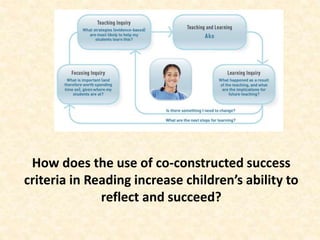
How does the use of co-constructed success 
criteria in Reading increase children’s ability to 
reflect and succeed?
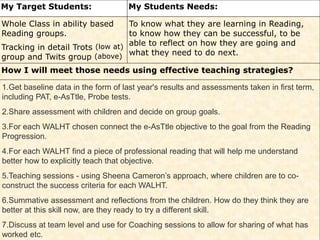
My Target Students: My Students Needs: 
Whole Class in ability based 
Reading groups. 
Tracking in detail Trots (low at) 
group and Twits group (above) 
To know what they are learning in Reading, 
to know how they can be successful, to be 
able to reflect on how they are going and 
what they need to do next. 
How I will meet those needs using effective teaching strategies? 
1.Get baseline data in the form of last year's results and assessments taken in first term, 
including PAT, e-AsTtle, Probe tests. 
2.Share assessment with children and decide on group goals. 
3.For each WALHT chosen connect the e-AsTtle objective to the goal from the Reading 
Progression. 
4.For each WALHT find a piece of professional reading that will help me understand 
better how to explicitly teach that objective. 
5.Teaching sessions - using Sheena Cameron’s approach, where children are to co-construct 
the success criteria for each WALHT. 
6.Summative assessment and reflections from the children. How do they think they are 
better at this skill now, are they ready to try a different skill. 
7.Discuss at team level and use for Coaching sessions to allow for sharing of what has 
worked etc.
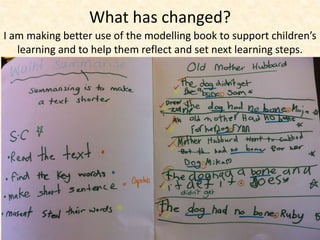
What has changed? 
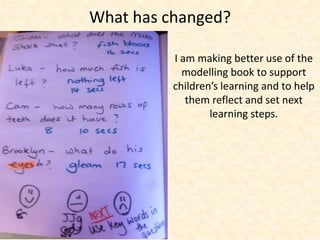
I am making better use of the modelling book to support children’s 
learning and to help them reflect and set next learning steps.
What has changed? 
I am making better use of the 
modelling book to support 
children’s learning and to help 
them reflect and set next 
learning steps.
What has changed? 
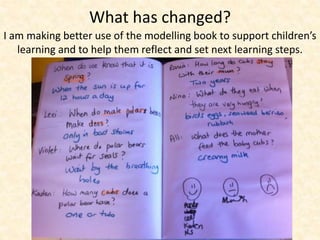
I am making better use of the modelling book to support children’s 
learning and to help them reflect and set next learning steps.
What has changed? 
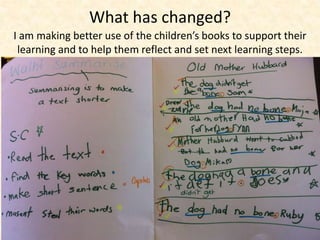
I am making better use of the children’s books to support their 
learning and to help them reflect and set next learning steps.
What has changed? 
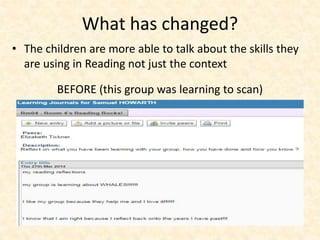
• The children are more able to talk about the skills they 
are using in Reading not just the context 
BEFORE (this group was learning to scan)
What has changed? 
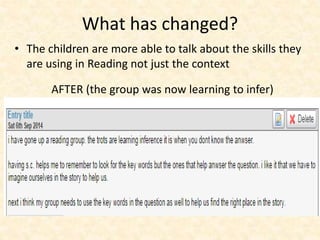
• The children are more able to talk about the skills they 
are using in Reading not just the context 
AFTER (the group was now learning to infer)
What has changed? 
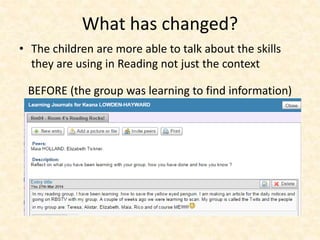
• The children are more able to talk about the skills 
they are using in Reading not just the context 
BEFORE (the group was learning to find information)
What has changed? 
• The children are more able to talk about the skills 
they are using in Reading not just the context 
AFTER (the group was now learning to infer)
What has changed? 
• The children are more able to talk about how success 
criteria can help them with their reading.
What has changed? 
The Year 4 team have learned lots from each 
other in this curriculum area through this 
Inquiry. 
• Team meetings 
https://docs.google.com/a/redbeach.school.nz/document/d/1-uvhjA_mhTHwFPErzROl_xus9xlfvTVaAblVyiOXKAI/edit 
• Coaching 
https://docs.google.com/a/redbeach.school.nz/document/d/1F1wUp2wP_yQzTV9pu1LVdgzQ2zq7MWDjbJk0pWm0PoI/edit 
• Sharing resources 
• Discussing professional readings
What has changed? 
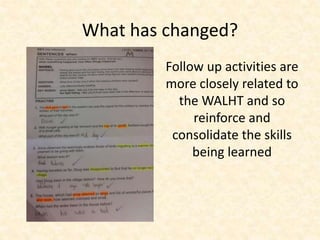
Follow up activities are 
more closely related to 
the WALHT and so 
reinforce and 
consolidate the skills 
being learned
What has changed? 
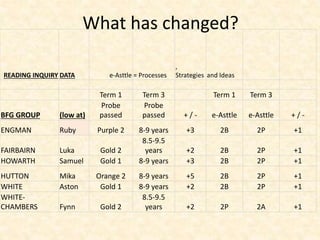
READING INQUIRY DATA e-Asttle = Processes 
, 
Strategies and Ideas 
Term 1 Term 3 Term 1 Term 3 
BFG GROUP (low at) 
Probe 
passed 
Probe 
passed + / - e-Asttle e-Asttle + / - 
ENGMAN Ruby Purple 2 8-9 years +3 2B 2P +1 
FAIRBAIRN Luka Gold 2 
8.5-9.5 
years +2 2B 2P +1 
HOWARTH Samuel Gold 1 8-9 years +3 2B 2P +1 
HUTTON Mika Orange 2 8-9 years +5 2B 2P +1 
WHITE Aston Gold 1 8-9 years +2 2B 2P +1 
WHITE-CHAMBERS 
Fynn Gold 2 
8.5-9.5 
years +2 2P 2A +1
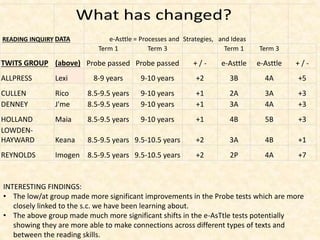
READING INQUIRY DATA e-Asttle = Processes and Strategies, and Ideas 
Term 1 Term 3 Term 1 Term 3 
TWITS GROUP (above) Probe passed Probe passed + / - e-Asttle e-Asttle + / - 
ALLPRESS Lexi 8-9 years 9-10 years +2 3B 4A +5 
CULLEN Rico 8.5-9.5 years 9-10 years +1 2A 3A +3 
DENNEY J'me 8.5-9.5 years 9-10 years +1 3A 4A +3 
HOLLAND Maia 8.5-9.5 years 9-10 years +1 4B 5B +3 
LOWDEN-HAYWARD 
Keana 8.5-9.5 years 9.5-10.5 years +2 3A 4B +1 
REYNOLDS Imogen 8.5-9.5 years 9.5-10.5 years +2 2P 4A +7 
INTERESTING FINDINGS: 
• The low/at group made more significant improvements in the Probe tests which are more 
closely linked to the s.c. we have been learning about. 
• The above group made much more significant shifts in the e-AsTtle tests potentially 
showing they are more able to make connections across different types of texts and 
between the reading skills.
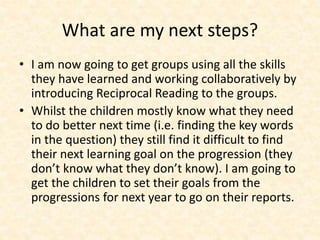
What are my next steps? 
• I am now going to get groups using all the skills 
they have learned and working collaboratively by 
introducing Reciprocal Reading to the groups. 
• Whilst the children mostly know what they need 
to do better next time (i.e. finding the key words 
in the question) they still find it difficult to find 
their next learning goal on the progression (they 
don’t know what they don’t know). I am going to 
get the children to set their goals from the 
progressions for next year to go on their reports.

Sinead heckett’s professional inquiry 2014

  • 1.
  • 2.
    How does theuse of co-constructed success criteria in Reading increase children’s ability to reflect and succeed?
  • 3.
    My Target Students:My Students Needs: Whole Class in ability based Reading groups. Tracking in detail Trots (low at) group and Twits group (above) To know what they are learning in Reading, to know how they can be successful, to be able to reflect on how they are going and what they need to do next. How I will meet those needs using effective teaching strategies? 1.Get baseline data in the form of last year's results and assessments taken in first term, including PAT, e-AsTtle, Probe tests. 2.Share assessment with children and decide on group goals. 3.For each WALHT chosen connect the e-AsTtle objective to the goal from the Reading Progression. 4.For each WALHT find a piece of professional reading that will help me understand better how to explicitly teach that objective. 5.Teaching sessions - using Sheena Cameron’s approach, where children are to co-construct the success criteria for each WALHT. 6.Summative assessment and reflections from the children. How do they think they are better at this skill now, are they ready to try a different skill. 7.Discuss at team level and use for Coaching sessions to allow for sharing of what has worked etc.
  • 4.
    What has changed? I am making better use of the modelling book to support children’s learning and to help them reflect and set next learning steps.
  • 5.
    What has changed? I am making better use of the modelling book to support children’s learning and to help them reflect and set next learning steps.
  • 6.
    What has changed? I am making better use of the modelling book to support children’s learning and to help them reflect and set next learning steps.
  • 7.
    What has changed? I am making better use of the children’s books to support their learning and to help them reflect and set next learning steps.
  • 8.
    What has changed? • The children are more able to talk about the skills they are using in Reading not just the context BEFORE (this group was learning to scan)
  • 9.
    What has changed? • The children are more able to talk about the skills they are using in Reading not just the context AFTER (the group was now learning to infer)
  • 10.
    What has changed? • The children are more able to talk about the skills they are using in Reading not just the context BEFORE (the group was learning to find information)
  • 11.
    What has changed? • The children are more able to talk about the skills they are using in Reading not just the context AFTER (the group was now learning to infer)
  • 12.
    What has changed? • The children are more able to talk about how success criteria can help them with their reading.
  • 13.
    What has changed? The Year 4 team have learned lots from each other in this curriculum area through this Inquiry. • Team meetings https://docs.google.com/a/redbeach.school.nz/document/d/1-uvhjA_mhTHwFPErzROl_xus9xlfvTVaAblVyiOXKAI/edit • Coaching https://docs.google.com/a/redbeach.school.nz/document/d/1F1wUp2wP_yQzTV9pu1LVdgzQ2zq7MWDjbJk0pWm0PoI/edit • Sharing resources • Discussing professional readings
  • 14.
    What has changed? Follow up activities are more closely related to the WALHT and so reinforce and consolidate the skills being learned
  • 15.
    What has changed? READING INQUIRY DATA e-Asttle = Processes , Strategies and Ideas Term 1 Term 3 Term 1 Term 3 BFG GROUP (low at) Probe passed Probe passed + / - e-Asttle e-Asttle + / - ENGMAN Ruby Purple 2 8-9 years +3 2B 2P +1 FAIRBAIRN Luka Gold 2 8.5-9.5 years +2 2B 2P +1 HOWARTH Samuel Gold 1 8-9 years +3 2B 2P +1 HUTTON Mika Orange 2 8-9 years +5 2B 2P +1 WHITE Aston Gold 1 8-9 years +2 2B 2P +1 WHITE-CHAMBERS Fynn Gold 2 8.5-9.5 years +2 2P 2A +1
  • 16.
    READING INQUIRY DATAe-Asttle = Processes and Strategies, and Ideas Term 1 Term 3 Term 1 Term 3 TWITS GROUP (above) Probe passed Probe passed + / - e-Asttle e-Asttle + / - ALLPRESS Lexi 8-9 years 9-10 years +2 3B 4A +5 CULLEN Rico 8.5-9.5 years 9-10 years +1 2A 3A +3 DENNEY J'me 8.5-9.5 years 9-10 years +1 3A 4A +3 HOLLAND Maia 8.5-9.5 years 9-10 years +1 4B 5B +3 LOWDEN-HAYWARD Keana 8.5-9.5 years 9.5-10.5 years +2 3A 4B +1 REYNOLDS Imogen 8.5-9.5 years 9.5-10.5 years +2 2P 4A +7 INTERESTING FINDINGS: • The low/at group made more significant improvements in the Probe tests which are more closely linked to the s.c. we have been learning about. • The above group made much more significant shifts in the e-AsTtle tests potentially showing they are more able to make connections across different types of texts and between the reading skills.
  • 17.
    What are mynext steps? • I am now going to get groups using all the skills they have learned and working collaboratively by introducing Reciprocal Reading to the groups. • Whilst the children mostly know what they need to do better next time (i.e. finding the key words in the question) they still find it difficult to find their next learning goal on the progression (they don’t know what they don’t know). I am going to get the children to set their goals from the progressions for next year to go on their reports.