https://www.youtube.com/watch?v=epJpIKZjgpk
https://www.youtube.com/watch?v=kIx0y_ucWnU
https://www.youtube.com/watch?v=8ockWpx2KKI
http://www.mathguide.com/lessons/Systems.html#substitution
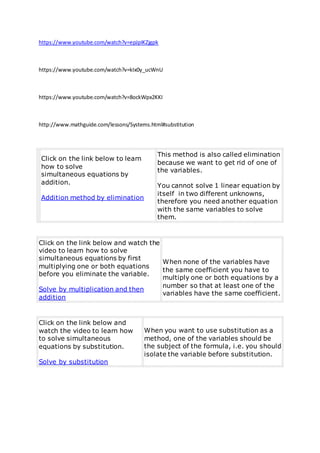
Click on the link below to learn
how to solve
simultaneous equations by
addition.
Addition method by elimination
This method is also called elimination
because we want to get rid of one of
the variables.
You cannot solve 1 linear equation by
itself in two different unknowns,
therefore you need another equation
with the same variables to solve
them.
Click on the link below and watch the
video to learn how to solve
simultaneous equations by first
multiplying one or both equations
before you eliminate the variable.
Solve by multiplication and then
addition
When none of the variables have
the same coefficient you have to
multiply one or both equations by a
number so that at least one of the
variables have the same coefficient.
Click on the link below and
watch the video to learn how
to solve simultaneous
equations by substitution.
Solve by substitution
When you want to use substitution as a
method, one of the variables should be
the subject of the formula, i.e. you should
isolate the variable before substitution.
Click on the link
below and work
through the
examples given
for further
understanding to
solve simultaneous
equations.
Practical examples
to solve
simultaneous
equations
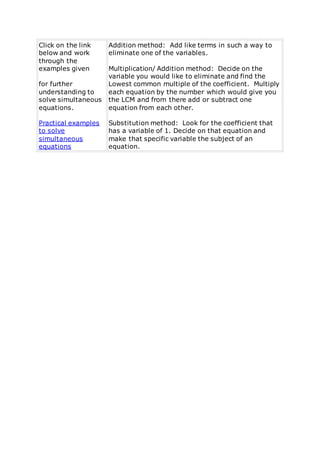
Addition method: Add like terms in such a way to
eliminate one of the variables.
Multiplication/ Addition method: Decide on the
variable you would like to eliminate and find the
Lowest common multiple of the coefficient. Multiply
each equation by the number which would give you
the LCM and from there add or subtract one
equation from each other.
Substitution method: Look for the coefficient that
has a variable of 1. Decide on that equation and
make that specific variable the subject of an
equation.

Simultaneous equations

  • 1.
    https://www.youtube.com/watch?v=epJpIKZjgpk https://www.youtube.com/watch?v=kIx0y_ucWnU https://www.youtube.com/watch?v=8ockWpx2KKI http://www.mathguide.com/lessons/Systems.html#substitution Click on thelink below to learn how to solve simultaneous equations by addition. Addition method by elimination This method is also called elimination because we want to get rid of one of the variables. You cannot solve 1 linear equation by itself in two different unknowns, therefore you need another equation with the same variables to solve them. Click on the link below and watch the video to learn how to solve simultaneous equations by first multiplying one or both equations before you eliminate the variable. Solve by multiplication and then addition When none of the variables have the same coefficient you have to multiply one or both equations by a number so that at least one of the variables have the same coefficient. Click on the link below and watch the video to learn how to solve simultaneous equations by substitution. Solve by substitution When you want to use substitution as a method, one of the variables should be the subject of the formula, i.e. you should isolate the variable before substitution.
  • 2.
    Click on thelink below and work through the examples given for further understanding to solve simultaneous equations. Practical examples to solve simultaneous equations Addition method: Add like terms in such a way to eliminate one of the variables. Multiplication/ Addition method: Decide on the variable you would like to eliminate and find the Lowest common multiple of the coefficient. Multiply each equation by the number which would give you the LCM and from there add or subtract one equation from each other. Substitution method: Look for the coefficient that has a variable of 1. Decide on that equation and make that specific variable the subject of an equation.