




Simulation Hypothesis and The
Matrix Defense
Applications of Simulation Hypothesis in
Psychiatry, Law and Technology
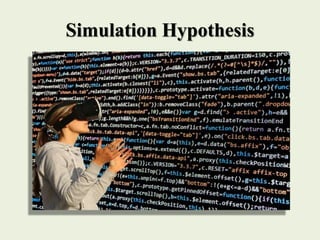
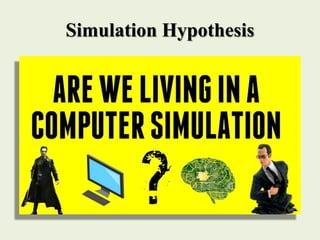
Simulation Hypothesis
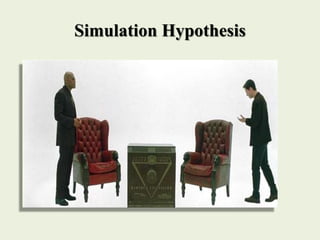
• The simulation hypothesis proposes that all of
reality, including the earth and the universe, is in
fact an artificial simulation, most likely a
computer simulation.
• Some versions rely on the development of a
simulated reality, a proposed technology that
would seem realistic enough to convince its
inhabitants the simulation was real.
• The hypothesis has been a central plot device
of many science fiction stories and films.
Simulation Hypothesis
Origins
• There is a long philosophical and scientific
history to the underlying thesis that reality
is an illusion.
• This skeptical hypothesis can be traced back to
antiquity; for example, to the "Butterfly
Dream" of Zhuangzi, or the Indian
philosophy of Maya.
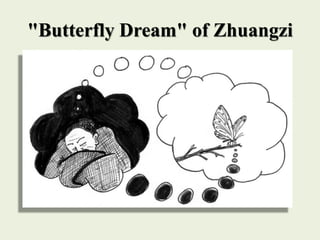
"Butterfly Dream" of Zhuangzi
• Master Zhuang, was a Chinese philosopher,
who is supposed to have lived during the
Warring States Period
• Once Zhuang Zhou dreamed he was a butterfly, a
fluttering butterfly. Once upon a time, I, Chuang
Chou, dreamt I was a butterfly, fluttering hither and
thither, to all intents and purposes a butterfly. I was
conscious only of my happiness as a butterfly, unaware
that I was Chou. Soon I awaked, and there I was,
veritably myself again. Now I do not know whether I was
then a man dreaming I was a butterfly, or whether I am
now a butterfly, dreaming I am a man.
"Butterfly Dream" of Zhuangzi
• Zhuang Zhou said that he once dreamed of being a butterfly,
and while he was in the dream, he felt he could flutter his
wings and everything was real, but that on waking up, he
realized that he was Zhuang Zhou and Zhuang Zhou was
real.
• Then he thought and wondered which was really real,
whether he was really Zhuang Zhou dreaming of being a
butterfly, or really a butterfly dreaming of being Zhuang
Zhou .
• Life, then, is really a dream, and we human beings are
like travelers floating down the eternal river of time,
embarking at a certain point and disembarking again at
another point in order to make room for others waiting
below the river to come aboard.
"Butterfly Dream" of Zhuangzi
Simulation hypothesis
• Many works of science fiction as well as some forecasts
by serious technologists and futurologists predict that
enormous amounts of computing power will be available
in the future.
• Let us suppose for a moment that these predictions are
correct. One thing that later generations might do with their
super-powerful computers is run detailed simulations of
their forebears or of people like their forebears.
• Because their computers would be so powerful, they
could run a great many such simulations. Suppose that
these simulated people are conscious (as they would be if
the simulations were sufficiently fine-grained and if a
certain quite widely accepted position in the philosophy
of mind is correct).
Simulation Hypothesis
• Then it could be the case that the vast majority of minds
like ours do not belong to the original race but rather to
people simulated by the advanced descendants of an
original race.
• It is then possible to argue that, if this were the case, we
would be rational to think that we are likely among the
simulated minds rather than among the original biological
ones.
• Therefore, if we don't think that we are currently living in a
computer simulation, we are not entitled to believe that we
will have descendants who will run lots of such simulations
of their forebears.
• — Nick Bostrom, Are you living in a computer
simulation?, 2003
Simulation Hypothesis
Ancestor Simulation
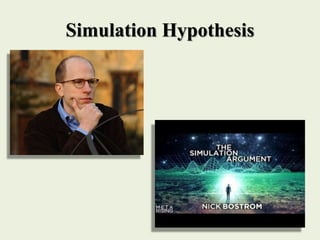
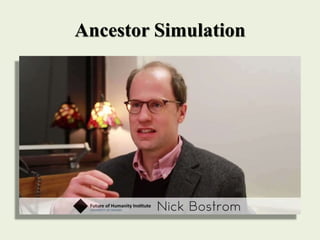
• In 2003, philosopher Nick Bostrom proposed a trilemma that he
called "the simulation argument".
• Despite the name, Bostrom's "simulation argument" does not
directly argue that we live in a simulation; instead, Bostrom's
trilemma argues that one of three unlikely-seeming propositions is
almost certainly true:
• "The fraction of human-level civilizations that reach a post-
human stage (that is, one capable of running high-fidelity
ancestor simulations) is very close to zero", or
• "The fraction of post-human civilizations that are interested in
running ancestor-simulations is very close to zero", or
• "The fraction of all people with our kind of experiences that are
living in a simulation is very close to one"
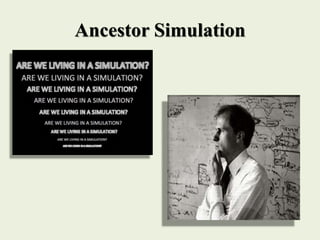
Ancestor Simulation
Ancestor Simulation
• The trilemma points out that a
technologically mature "post human"
civilization would have enormous computing
power; if even a tiny percentage of them were
to run "ancestor simulations“ the total number
of simulated ancestors, or "Sims", in the
universe (or multiverse, if it exists) would
greatly exceed the total number of actual
ancestors.
Ancestor Simulation
Ancestor Simulation
• Bostrom goes on to use a type of anthropic
reasoning to claim that, if the third
proposition is the one of those three that is
true, and almost all people with our kind of
experiences live in simulations, then we are
almost certainly living in a simulation.
Ancestor Simulation
Criticism of Bostrom's anthropic
reasoning
• Bostrom argues that, if "the fraction of all
people with our kind of experiences that are
living in a simulation is very close to one", then
it follows that we probably live in a simulation.
• Some philosophers disagree, proposing that
perhaps "Sims" do not have conscious
experiences the same way that unsimulated
humans do, or that it can otherwise be self-evident
to a human that they are a human rather than a
Sim.
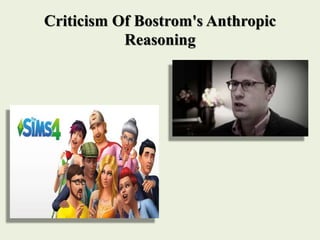
Criticism Of Bostrom's Anthropic
Reasoning
Criticism of Bostrom's anthropic
reasoning
• Philosopher Dainton modifies Bostrom's
trilemma by substituting "neural ancestor
simulations" (ranging from literal brains in a vat,
to far-future humans with induced high-fidelity
hallucinations that they are their own distant
ancestors) for Bostrom's "ancestor simulations",
on the grounds that every philosophical school of
thought can agree that sufficiently high-tech
neural ancestor simulation experiences would be
indistinguishable from non-simulated
experiences. Even if high-fidelity computer Sims
are never conscious.
Criticism of Bostrom's anthropic
reasoning
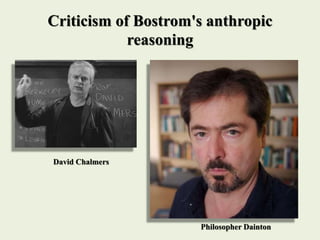
David Chalmers
Philosopher Dainton
Criticism of Bostrom's anthropic
reasoning
• Dainton's reasoning leads to the following
conclusion: either the fraction of human-level
civilizations that reach a post human stage
and are able and willing to run large
numbers of neural ancestor simulations is
close to zero, or we are in some kind of
(possibly neural) ancestor simulation.
Arguments, within the trilemma, against
the simulation hypothesis
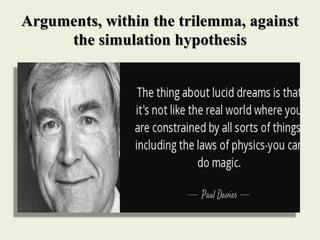
• Physicist Paul Davies deploys Bostrom's
trilemma as part of one possible argument
against a near-infinite multiverse.
Arguments, within the trilemma, against
the simulation hypothesis
Arguments, within the trilemma, against
the simulation hypothesis
• Some point out that there is currently no proof
of technology which would facilitate the
existence of sufficiently high-fidelity ancestor
simulation.
• Additionally, there is no proof that it is physically
possible or feasible for a post human civilization
to create such a simulation, and therefore for the
present, the first proposition must be true.
Additionally there are proofs of limits of
computation.
Consequences of living in a
simutlaion
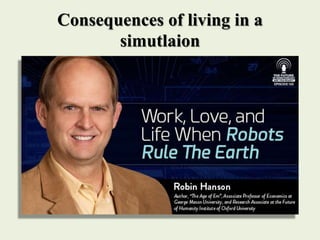
• Economist Robin Hanson argues a self-interested
high-fidelity Sim should strive to be entertaining
and praiseworthy in order to avoid being turned off
or being shunted into a non-conscious low-fidelity
part of the simulation.
• Hanson additionally speculates that someone who is
aware that he might be a Sim might care less about
others and live more for today: "your motivation to
save for retirement, or to help the poor in Ethiopia,
might be muted by realizing that in your simulation,
you will never retire and there is no Ethiopia."
Consequences of living in a
simutlaion
Other uses of the simulation
hypothesis in philosophy
• Besides attempting to assess whether the simulation
hypothesis is true or false, philosophers have also used it
to illustrate other philosophical problems, especially in
metaphysics and epistemology.
• David Chalmers has argued that simulated beings might
wonder whether their mental lives are governed by the
physics of their environment, when in fact these mental
lives are simulated separately (and are thus, in fact, not
governed by the simulated physics).
• They might eventually find that their thoughts fail to be
physically caused. Chalmers argues that this means that
Cartesian dualism is not necessarily as problematic of a
philosophical view as is commonly supposed, though he
does not endorse it.
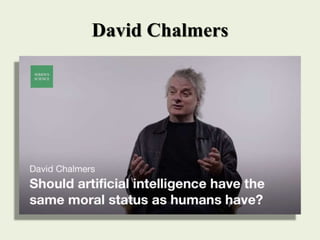
David Chalmers
Other uses of the simulation
hypothesis in philosophy
• Similarly, Vincent Conitzer has used the
following computer simulation scenarios to
illuminate further facts—facts that do not
follow logically from the physical facts—
about qualia (what it is like to have specific
experiences), indexicality (what time it is now
and who I am), and personal identity.
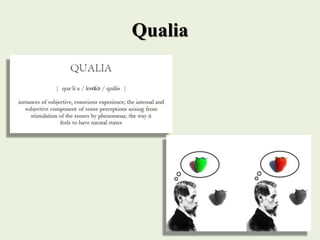
Qualia
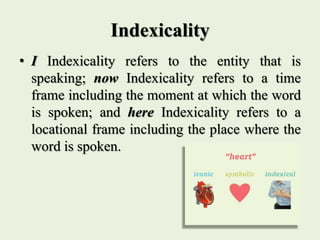
Indexicality
• I Indexicality refers to the entity that is
speaking; now Indexicality refers to a time
frame including the moment at which the word
is spoken; and here Indexicality refers to a
locational frame including the place where the
word is spoken.
Personal Identity
Other uses of the simulation
hypothesis in philosophy
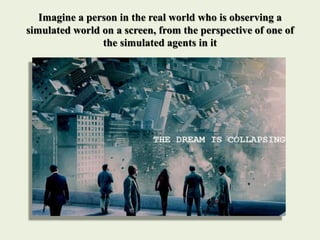
• Imagine a person in the real world who is
observing a simulated world on a screen, from
the perspective of one of the simulated agents
in it.
• The person observing knows that besides the code
responsible for the physics of the simulation,
there must be additional code that determines in
which colors the simulation is displayed on the
screen, and which agent's perspective is
displayed.
Imagine a person in the real world who is observing a
simulated world on a screen, from the perspective of one of
the simulated agents in it
Other uses of the simulation
hypothesis in philosophy
• (These questions are related to the inverted
spectrum scenario and whether there are further
facts about personal identity.)
• That is, the person can conclude that the facts about the
physics of the simulation (which are completely
captured by the code governing the physics) do not
fully determine her experience by themselves. But then,
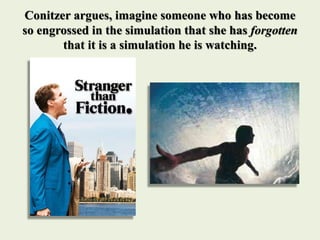
Conitzer argues, imagine someone who has become
so engrossed in the simulation that she has forgotten
that it is a simulation she is watching. Could she not
still reach the same conclusion? And if so, can we not
conclude the same in our own daily lives?
Conitzer argues, imagine someone who has become
so engrossed in the simulation that she has forgotten
that it is a simulation he is watching.
Science Fiction Themes
• Science fiction has highlighted themes such as
virtual reality, artificial intelligence and computer
gaming for more than fifty years.
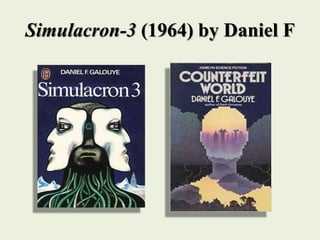
• Simulacron-3 (1964) by Daniel F. Galouye
(alternative title: Counterfeit World) tells the
story of a virtual city developed as a computer
simulation for market research purposes, in which
the simulated inhabitants possess consciousness;
all but one of the inhabitants are unaware of the
true nature of their world.
Simulacron-3 (1964) by Daniel F
Science Fiction Themes
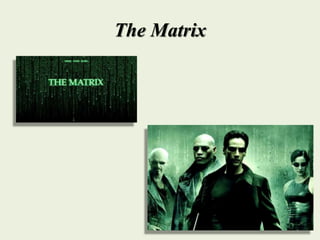
• More recently, the same theme was repeated in the 1999
film The Matrix, which depicted a world in which
artificially intelligent robots enslaved humanity within a
simulation set in the contemporary world.
• The 2012 play World of Wires was partially inspired by the
Bostrom essay on the simulation hypothesis. In the episode
"Extremis" (broadcast on 20 May 2017 on BBC One) of the
science fiction series Doctor Who, aliens called "The
Monks" plan an invasion of Earth by running and studying a
holographic simulation of Earth with conscious inhabitants.
When the virtual Doctor finds out about the simulation he
sends an email about the simulation to his real self so that
the real Doctor can save the world.
The Matrix
Science Fiction Themes
• "M. Night Shaym-Aliens!" Aliens trap the lead
role (Rick) in a simulated reality in order to trick
him into revealing his formula for concentrated
dark matter.
• In the game Xenoblade Chronicles, it is revealed
that the whole world of the gods Bionis and
Mechonis was a simulation run by Alvis, the
administrative computer of a phase transition
experiment facility (heavily implied to be "Ontos"
in Xenoblade Chronicles 2) after Klaus destroyed
the universe in a multi-verse experiment.
Science Fiction Themes
The Simulation Hypothesis
• https://youtu.be/VqULEE7eY8M
Other uses of the simulation
hypothesis in psychology
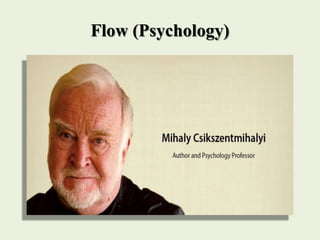
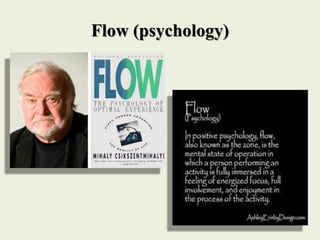
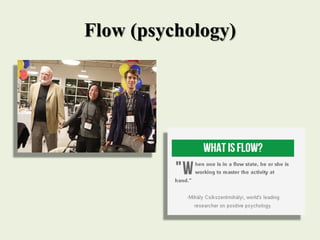
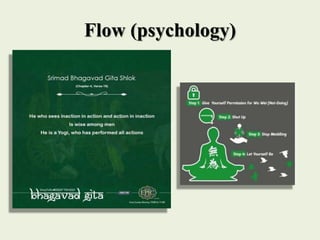
• Flow (Psychology)
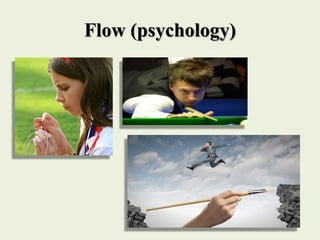
• In positive psychology, flow, also known
colloquially as being in the zone, is the mental
state of operation in which a person performing
an activity is fully immersed in a feeling of
energized focus, full involvement, and
enjoyment in the process of the activity.
• In essence, flow is characterized by complete
absorption in what one does, and a resulting
loss in one's sense of space and time.
Flow (Psychology)
Flow (psychology)
• Flow shares many characteristics with hyper focus.
• However, hyper focus is not always described in a
positive light.
• Some examples include spending "too much" time
playing video games or getting side-tracked and
pleasurably absorbed by one aspect of an
assignment or task to the detriment of the overall
assignment. In some cases, hyper focus can
"capture" a person, perhaps causing them to appear
unfocused or to start several projects, but complete
few.
Flow (psychology)
Flow (psychology)
• Jeanne Nakamura and Csíkszentmihályi identify the
following six factors as encompassing an experience of
flow
• Intense and focused concentration on the present moment
• Merging of action and awareness
• A loss of reflective self-consciousness
• A sense of personal control or agency over the situation or
activity
• A distortion of temporal experience, one's subjective
experience of time is altered
• Experience of the activity as intrinsically rewarding, also
referred to as autotelic experience
Flow (psychology)
Flow (psychology)
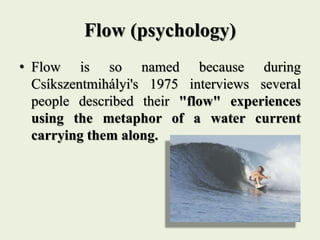
• Flow is so named because during
Csíkszentmihályi's 1975 interviews several
people described their "flow" experiences
using the metaphor of a water current
carrying them along.
Flow (psychology)
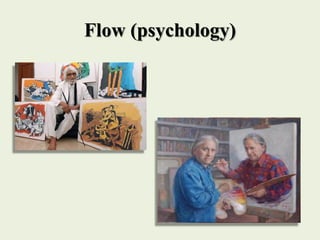
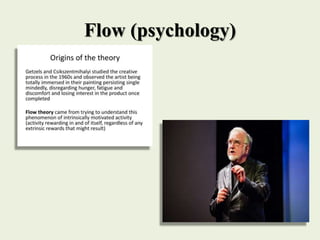
• Mihaly Csikszentmihályi and his fellow
researchers began researching flow after
Csikszentmihályi became fascinated by
artists who would essentially get lost in their
work.
• Artists, especially painters, got so immersed
in their work that they would disregard
their need for food, water and even sleep.
Flow (psychology)
Flow (psychology)
Flow (psychology)
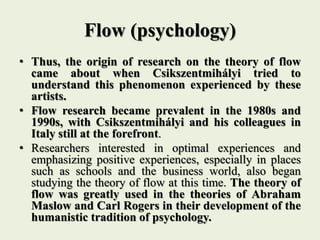
• Thus, the origin of research on the theory of flow
came about when Csikszentmihályi tried to
understand this phenomenon experienced by these
artists.
• Flow research became prevalent in the 1980s and
1990s, with Csikszentmihályi and his colleagues in
Italy still at the forefront.
• Researchers interested in optimal experiences and
emphasizing positive experiences, especially in places
such as schools and the business world, also began
studying the theory of flow at this time. The theory of
flow was greatly used in the theories of Abraham
Maslow and Carl Rogers in their development of the
humanistic tradition of psychology.
Flow (psychology)
Flow (psychology)
• Flow has been recognized throughout history and
across cultures. The teachings of Buddhism and
of Taoism speak of a state of mind known as the
"action of inaction" or "doing without doing"
(wu wei in Taoism) that greatly resembles the idea
of flow.
• Also, Hindu texts on Advaita philosophy such
as Ashtavakra Gita and the Yoga of Knowledge
such as Bhagavad-Gita refer to a similar state.
Flow (psychology)
Mechanism
• In any given moment, there is a great deal of
information made available to each individual.
Psychologists have found that one's mind can attend to
only a certain amount of information at a time.
• According to Csikszentmihályi's 2004 TED talk, that
number is about "110 bits of information per second".
That may seem like a lot of information, but simple
daily tasks take quite a lot of information. Just decoding
speech takes about 60 bits of information per second.
That is why when having a conversation one cannot
focus as much attention on other things.
Mechanism
• For the most part (except for basic bodily feelings
like hunger and pain, which are innate), people are
able to decide what they want to focus their
attention on.
• However, when one is in the flow state, they are
completely engrossed with the one task at hand and,
without making the conscious decision to do so, lose
awareness of all other things: time, people,
distractions, and even basic bodily needs. This occurs
because all of the attention of the person in the flow
state is on the task at hand; there is no more attention to
be allocated
Mechanism
Mechanism
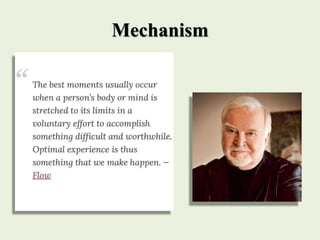
• The flow state has been described by
Csikszentmihályi as the "optimal experience"
in that one gets to a level of high gratification
from the experience.
• Achieving this experience is considered to be
personal and "depends on the ability" of the
individual.
• One's capacity and desire to overcome
challenges in order to achieve their ultimate
goals not only leads to the optimal experience,
but also to a sense of life satisfaction overall.
Simulation Argument And Crime
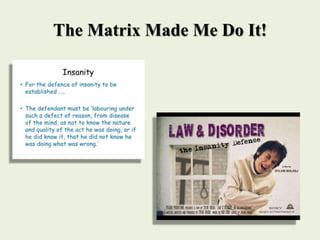
• The Matrix defence
• The Matrix defence is the term applied to several legal
cases of a defence based on the Matrix films where reality is
a computer generation—simulism—and that the real world
is quite different from what reality is perceived to be.
• In using this defence, the defendant claims that they
committed a crime because they believed they were in
the Matrix, and not in the real world. This is a version of
the insanity defence and considered a descendant of the
Taxi Driver defence of John Hinckley, one of the first
defences based on blurring reality with films
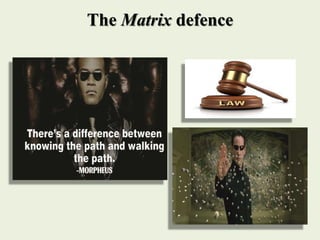
The Matrix defence
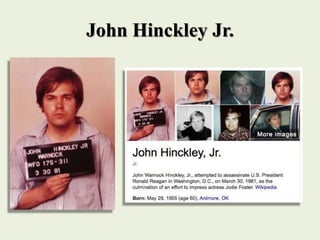
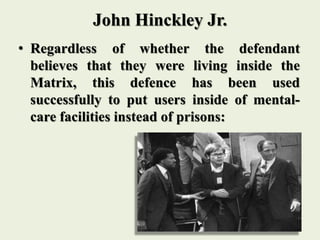
John Hinckley Jr.
• John Warnock Hinckley Jr. is an American man who, on March
30, 1981, attempted to assassinate U.S. President Ronald Reagan
in Washington, D.C. He wounded Reagan with a bullet that
ricocheted and hit him in the chest. He also wounded police
officer Thomas Delahanty and Secret Service agent Tim McCarthy,
and critically wounded Press Secretary James Brady, who died from
complications of his injuries 33 years later.
• Reported to have been driven by an obsessive fixation on Jodie
Foster, Hinckley was found not guilty by reason of insanity and
remained under institutional psychiatric care until September
2016.
• Public outcry over the verdict led to the Insanity Defence Reform
Act of 1984, which altered the rules for consideration of mental
illness of defendants in Federal Criminal Court proceedings in the
United States. He was released from institutional psychiatric care on
September 10, 2016
John Hinckley Jr.
John Hinckley Jr.
• Regardless of whether the defendant
believes that they were living inside the
Matrix, this defence has been used
successfully to put users inside of mental-
care facilities instead of prisons:
Simulation Argument And Crime
• Tonda Lynn Ansley of Hamilton, Ohio, was found not guilty by
reason of insanity using this defence after shooting her landlady in
the head in July 2002.
• Vadim Mieseges of San Francisco offered a "Matrix" explanation
to police after chopping up his landlady, and was declared mentally
incompetent to stand trial.
• Joshua Cooke's lawyers were going to attempt this defence in 2003
in his trial for the murder of his adoptive parents, before he pleaded
guilty.
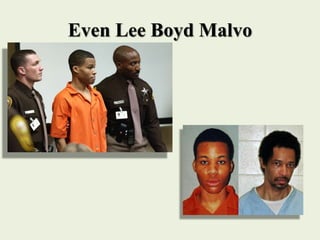
• The case of Lee Malvo also included references to The Matrix,
mentioned in the writings taken from his jail cell; he reportedly
shouted "Free yourself from the Matrix" from his cell after his
arrest, and told FBI agents to watch the film if they wanted to
understand him
Simulation Argument And Crime
The Matrix Made Me Do It!
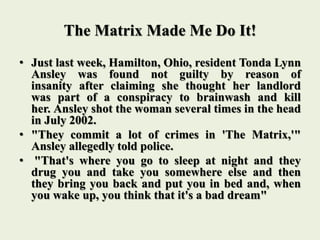
• Just last week, Hamilton, Ohio, resident Tonda Lynn
Ansley was found not guilty by reason of
insanity after claiming she thought her landlord
was part of a conspiracy to brainwash and kill
her. Ansley shot the woman several times in the head
in July 2002.
• "They commit a lot of crimes in 'The Matrix,'"
Ansley allegedly told police.
• "That's where you go to sleep at night and they
drug you and take you somewhere else and then
they bring you back and put you in bed and, when
you wake up, you think that it's a bad dream"
"They commit a lot of crimes in 'The
Matrix,'" Ansley allegedly told police.
The Matrix Made Me Do It!
• A San Francisco man, Vadim Mieseges,
made a successful insanity bid after
claiming he had been "sucked into 'The
Matrix'" when he chopped up his landlady.
The Matrix Made Me Do It!
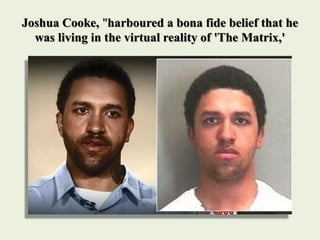
• Joshua Cooke, an Oakton, Virginia, man
charged with murdering his parents this
February, "harboured a bona fide belief that
he was living in the virtual reality of 'The
Matrix,' claimed his defence attorney. Cooke
is scheduled to stand trial at the end of
June.
Joshua Cooke, "harboured a bona fide belief that he
was living in the virtual reality of 'The Matrix,'
The Matrix Made Me Do It!
• Even Lee Boyd Malvo, accused in the series
of deadly sniper shootings in the
Washington, D.C.-area last fall,
reportedly wrote the words, "Free yourself
of the Matrix," in seized jailhouse sketches.
Even Lee Boyd Malvo
The Matrix Made Me Do It!
• Though insanity defences based on "The Matrix"
may grab headlines, experts agreed defence lawyers
shouldn't dash to the Cineplex, legal pads in hand, just
yet: While these excuses may work for a few
defendants, most "copycat" insanity defences will
ultimately fall flat with jurors.
• "It's very hard to prove an insanity defence, even
when you got all kinds of shrinks coming forward,"
said Robert Bloom, a law professor at Boston
College. "Given how hard it is to prove it, the
['Matrix' defence] would seem to me to be a loser."
The Matrix Made Me Do It!
• According to the New England School of Law's
Siegel, "The Matrix" -- which features a "real
world" of sentient computers and their
subverted human slaves, and a "virtual world"
that is spoon-fed via futuristic brain modems
to the cocooned humans -- takes that a step
further.
• "I think any artistic device that includes different
views of reality provides a way to illustrate
someone whose views of reality may be affected
by a mental disorder," he said.
The Matrix Made Me Do It!
• Helfgott agrees.
• "It's taking people a little further into the
future. For people who are already confused
between fantasy and reality, it gives them a
framework to articulate it," she said. "People who
are already on the edge, it can be argued, can be set
off by these types of movies."
• But Siegel and other experts on the insanity defence
insist that, "Matrix"-influenced or not, insanity claims
are simply losers in the courtroom. Fewer than one
percent of cases that are argued in court (many are not
contested by prosecutors) succeed.
The Matrix Made Me Do It!
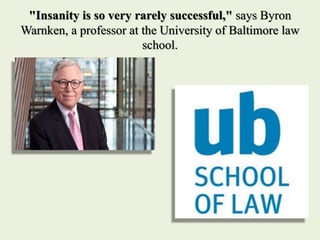
• "Insanity is so very rarely successful," says
Byron Warnken, a professor at the University
of Baltimore law school. "But it fascinates
us all, it's the kind of thing that is
disproportionately reported.
• The correlation between the real world and
the movies tends to be misrepresented. It
doesn't surprise me that more and more of
these are coming up."
"Insanity is so very rarely successful," says Byron
Warnken, a professor at the University of Baltimore law
school.
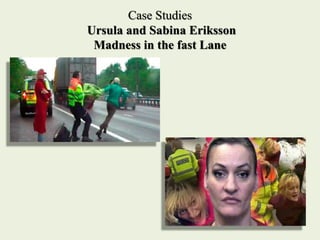
Case Studies
Ursula and Sabina Eriksson
Madness in the fast Lane
• Last month’s BBC documentary ‘Madness in the fast
lane‘ has just come to my attention. It tells the story of
Ursula and Sabina Eriksson, two Swedish twins, who
were captured on camera as they ran into the traffic on
the M6 – apparently without motivation.
• One spent months in hospital, whilst the other was
released from police custody and subsequent events
lead to a murder trial.
• Unfortunate title aside, the twin’s behaviour
appears to have been the result of an episode of folie
à deux so is of interest to students of mental
disorder.
Case Studies
Ursula and Sabina Eriksson
Madness in the fast Lane
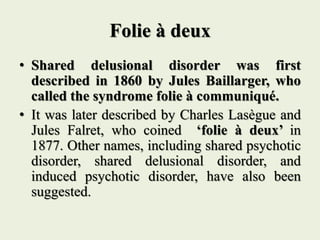
Folie à deux
• Shared delusional disorder was first
described in 1860 by Jules Baillarger, who
called the syndrome folie à communiqué.
• It was later described by Charles Lasègue and
Jules Falret, who coined ‘folie à deux’ in
1877. Other names, including shared psychotic
disorder, shared delusional disorder, and
induced psychotic disorder, have also been
suggested.
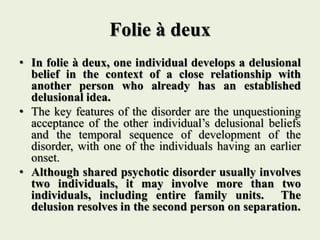
Folie à deux
Folie à deux
• In folie à deux, one individual develops a delusional
belief in the context of a close relationship with
another person who already has an established
delusional idea.
• The key features of the disorder are the unquestioning
acceptance of the other individual’s delusional beliefs
and the temporal sequence of development of the
disorder, with one of the individuals having an earlier
onset.
• Although shared psychotic disorder usually involves
two individuals, it may involve more than two
individuals, including entire family units. The
delusion resolves in the second person on separation.
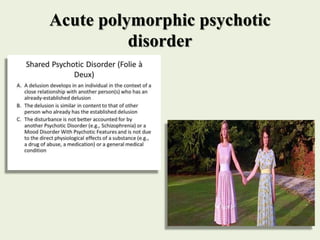
Acute polymorphic psychotic
disorder
• Acute psychotic disorders are characterized
by one or a combination of acute onset of
delusions, hallucinations or
incomprehensible or incoherent speech.
Acute polymorphic psychotic
disorder
The Truman Show Delusion
Psychology
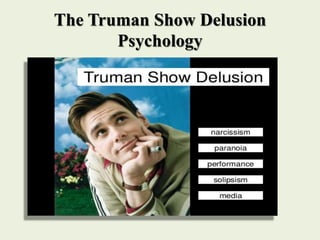
• “…a novel delusion, primarily persecutory in
form, in which the patient believes that he is
being filmed, and that the films are being
broadcast for the entertainment of others. We
describe a series of patients who presented
with a delusional system according to which
they were the subjects of something akin to a
reality television show that was broadcasting
their daily life for the entertainment of others”
The Truman Show Delusion
Psychology
The Truman Show Delusion
Psychology
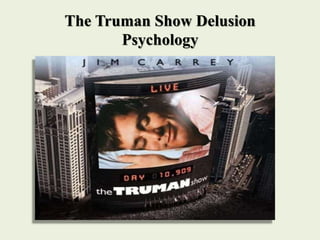
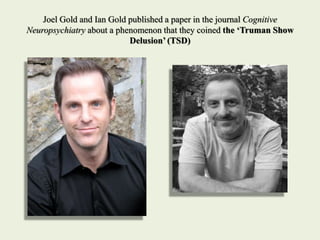
• Reality television shows have now became a staple of
modern life. However, little is known about the effect
they have on day-to-day living. Back in 2012, Joel
Gold and Ian Gold published a paper in the journal
Cognitive Neuropsychiatry about a phenomenon that
they coined the ‘Truman Show Delusion’ (TSD)
based on (director) Peter Weir’s 1998 film that told the
(fictional) story of Truman Burbank (played by Jim
Carrey) whose whole life had been filmed and
broadcast as real life a soap opera around the world
(without his knowledge) from the day he was born.
All the people around Truman were paid actors and
extras.
The Truman Show Delusion
Psychology
The Truman Show Delusion
Psychology
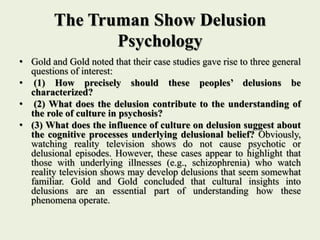
• Gold and Gold noted that their case studies gave rise to three general
questions of interest:
• (1) How precisely should these peoples’ delusions be
characterized?
• (2) What does the delusion contribute to the understanding of
the role of culture in psychosis?
• (3) What does the influence of culture on delusion suggest about
the cognitive processes underlying delusional belief? Obviously,
watching reality television shows do not cause psychotic or
delusional episodes. However, these cases appear to highlight that
those with underlying illnesses (e.g., schizophrenia) who watch
reality television shows may develop delusions that seem somewhat
familiar. Gold and Gold concluded that cultural insights into
delusions are an essential part of understanding how these
phenomena operate.
Joel Gold and Ian Gold published a paper in the journal Cognitive
Neuropsychiatry about a phenomenon that they coined the ‘Truman Show
Delusion’ (TSD)
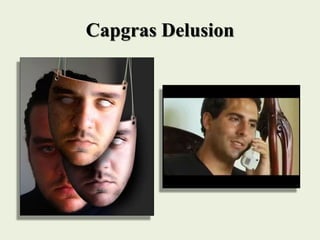
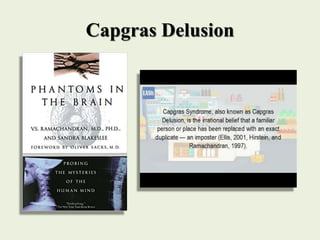
Capgras Delusion
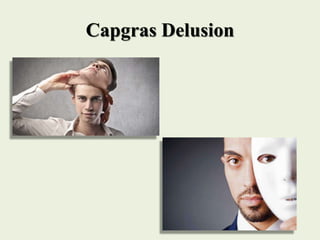
• Capgras delusion is a psychiatric disorder
in which a person holds a delusion that a
friend, spouse, parent, or other close family
member (or pet) has been replaced by an
identical impostor.
• The Capgras delusion is classified as a
delusional misidentification syndrome, a class
of delusional beliefs that involves the
misidentification of people, places, or object.
Capgras Delusion
• Capgras syndrome
• Capgras syndrome was first described by
Capgras and Reboul-Lachaux in 1923. The
main characteristic of the syndrome is the
delusion that a person, usually a close relative,
has been replaced by a double or an imposter
Capgras Delusion
Capgras Delusion
Seeing Impostors: When Loved Ones
Suddenly Aren't
• In the classic 1956 film Invasion of the Body
Snatchers, the residents of a fictional town
in California are beset by the feeling that
their friends and family have been replaced
by impostors. In the movie, this apparent
delusion is not delusional at all: The
townspeople are in fact being replaced -- by
aliens, no less.
Seeing Impostors: When Loved Ones
Suddenly Aren't
Capgras Delusion
• Currently, no one is certain of the underlying
cause of Capgras, and there are different ways
of explaining what is happening to these
people. According to Berman, Capgras might
be caused by psychological dissonance.
Capgras Delusion
Capgras Delusion
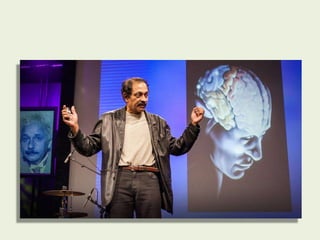
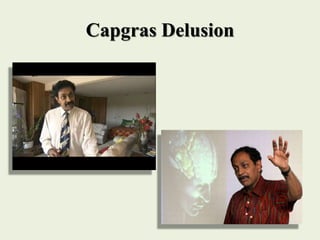
• Ramachandran thinks that Capgras can be better
explained by a structural problem in the brain.
According to Ramachandran, when we see someone we
know, a part of our brain called the fusiform gyrus
identifies the face: "That looks like mom!" That
message is then sent to the amygdala, the part of our
brains that activates the emotions we associate with that
person. In patients experiencing Capgras,
Ramachandran says, the connection between visual
recognition and emotional recognition is severed.
Thus the patient is left with a convincing face --
"That looks like mom!" -- but none of the
accompanying feelings about his mother.
Capgras Delusion
Treating The Illness
• Treating The Illness
• Capgras is very rare, and little is known about how
to treat it. Those who have been afflicted with
Capgras due to physical brain trauma may
eventually re-establish the connection between
perception and emotion. (Ramachandran's patient, for
example, eventually recovered from his delusion.) And
patients who experience Capgras alongside other
mental disorders may be helped by medication. But for
many Capgras patients, there is no treatment, and no
amount of talk or reasoning can cure them.
Treating The Illness
Other uses of the simulation
hypothesis in Technology
• Real-world beaming: The risk of avatar and robot crime
• Beaming, of a kind, is no longer pure science fiction. It is
the name of an international project funded by the European
Commission to investigate how a person can visit a remote
location via the internet and feel fully immersed in the new
environment.
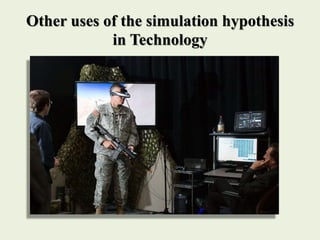
• The visitor may be embodied as an avatar or a robot,
interacting with real people.
• Motion capture technology - such as the Microsoft Kinect
games console - robots, 3D glasses and special haptic suits
with body sensors can all be used to create a rich, realistic
experience, that reproduces that holy grail - "presence".
Other uses of the simulation hypothesis
in Technology
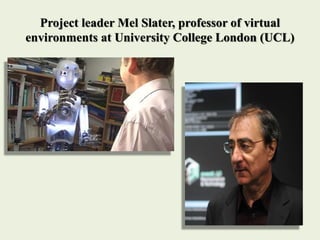
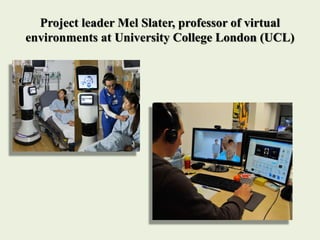
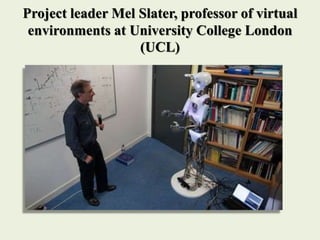
• Project leader Mel Slater, professor of
virtual environments at University College
London (UCL), calls beaming augmented
reality, rather than virtual reality.
• In beaming - unlike the virtual worlds of
computer games and the Second Life website -
the robot or avatar interacts with real people in
a real place.
Project leader Mel Slater, professor of virtual
environments at University College London (UCL)
Other uses of the simulation hypothesis
in Technology
• He and his team have beamed people from
Barcelona to London, embodying them
either as a robot, or as an avatar in a specially
equipped "cave". One avatar was able to
rehearse a play with a real actor, the stage
being represented by the cave's walls - screens
projecting 3D images.
Other uses of the simulation hypothesis
in Technology
Other uses of the simulation hypothesis
in Technology
• The technology is already good enough for
"blocking" a play - working out how the actors
should move around the stage - though
emotion and facial expressions are not yet
captured accurately enough to replace a
traditional rehearsal. This may not be far off,
however.
Project leader Mel Slater, professor of virtual
environments at University College London
(UCL)
Other uses of the simulation hypothesis
in Technology
• Beaming sessions could help military morale by
giving soldiers based overseas a sense of being back
home with their loved ones. The same would apply
to workers or businessmen posted abroad.
• A virtual doctor could visit a patient at home, if that
patient is unable to travel to the surgery.
• Surgeons can already perform operations via
telemedicine and beaming might not only make that
routine but also enable medical students in different
countries to get hands-on training simultaneously.
Project leader Mel Slater, professor of virtual
environments at University College London (UCL)
Other uses of the simulation hypothesis
in Technology
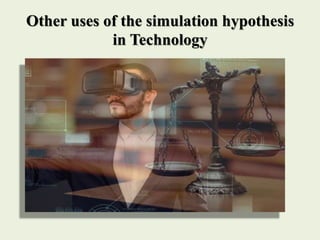
• But this also raises the possibility of new
types of crime.
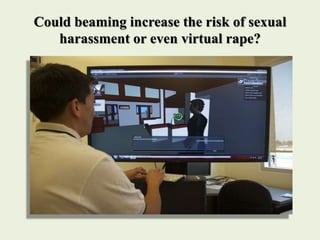
• Could beaming increase the risk of sexual
harassment or even virtual rape? That is one
of many ethical questions that the beaming
project is considering, along with the technical
challenges.
Could beaming increase the risk of sexual
harassment or even virtual rape?
Other uses of the simulation hypothesis
in Technology
• Law researcher Ray Purdy says you might get
a new type of cyber crime, where lovers have
consensual sexual contact via beaming and a
hacker hijacks the man's avatar to have virtual
sex with the woman.
• It raises all sorts of problems that courts and
lawmakers may need to resolve. How could a
court prove that that amounted to molestation or
rape? The human who hacks into an avatar could
easily live in another country, under different
laws.
Law researcher Ray Purdy says you
might get a new type of cyber crime
Other uses of the simulation hypothesis
in Technology
• The electronic evidence might be insufficient
for prosecution. Crimes taking place remotely
might sometimes leave digital trails, but they do
not leave forensic evidence, which is often vital to
secure rape convictions, Purdy says.
• "Clearly, laws might have to adapt to the fact
that certain crimes can be committed at a
distance, via the use of beamed technologies,"
he says
Other uses of the simulation hypothesis
in Technology
• Current law may not go far enough to cover
that, Purdy says. And what if a robot injured
you with an over-zealous handshake? Or if an
avatar made a sexually explicit gesture
amounting to sexual harassment?
Other uses of the simulation hypothesis
in Technology
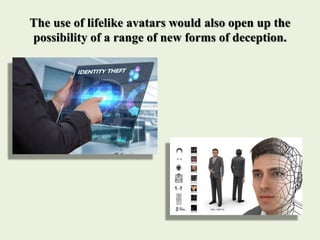
• The use of lifelike avatars would also open
up the possibility of a range of new forms of
deception.
• A related issue is identity theft. You can
copyright a person's creative output, but in
future you might need to copyright the actual
person
The use of lifelike avatars would also open up the
possibility of a range of new forms of deception.
Other uses of the simulation hypothesis
in Technology
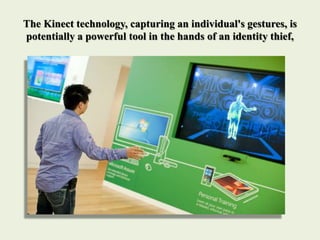
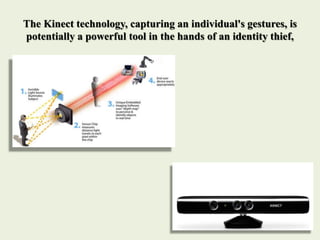
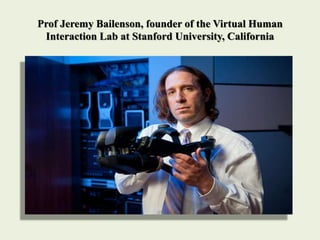
• The Kinect technology, capturing an
individual's gestures, is potentially a powerful
tool in the hands of an identity thief, argues
Prof Jeremy Bailenson, founder of the Virtual
Human Interaction Lab at Stanford
University, California.
• "A hacker can steal my very essence, really
capture all of my nuances, then build a
competing avatar, a copy of me," he told the
BBC. "The courts haven't even begun to think
about that."
The Kinect technology, capturing an individual's gestures, is
potentially a powerful tool in the hands of an identity thief,
The Kinect technology, capturing an individual's gestures, is
potentially a powerful tool in the hands of an identity thief,
Prof Jeremy Bailenson, founder of the Virtual Human
Interaction Lab at Stanford University, California
Other uses of the simulation hypothesis
in Technology
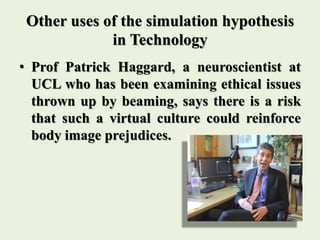
• Prof Patrick Haggard, a neuroscientist at
UCL who has been examining ethical issues
thrown up by beaming, says there is a risk
that such a virtual culture could reinforce
body image prejudices.
Other uses of the simulation hypothesis
in Technology
• As beaming develops, one of the biggest questions
for philosophers may be defining where a person
actually is - just as it is key for lawyers to determine
in which jurisdiction an avatar's crime is
committed.
• Even now people are often physically in one place but
immersed in a virtual world online.
• Avatars challenge the human bond between identity
and a physical body.
• "My body may be here in London but my life may
be in a virtual apartment in New York," says
Haggard. "So where am I really?"
Other uses of the simulation hypothesis
in Technology
References
• Are You Living In A Computer Simulation?
• https://www.simulation-argument.com/simulation.html
• Flow (psychology)
• https://en.wikipedia.org/wiki/Flow_(psychology)
• Living in Flow: What is it and How to Enter the Flow State?
• http://positivepsychology.org.uk/living-in-flow
• 'Matrix' makes its way into courtrooms as defense strategy
• http://edition.cnn.com/2003/LAW/05/21/ctv.matrix.insanity/
• Mel Slater
• http://www0.cs.ucl.ac.uk/staff/m.slater/Mel_Slaters_Home_Page/Home.html
• Ray Purdy is a founder and Director of Air & Space Evidence
• http://www.space-evidence.net/about-us-the-people/
• The Simulation Argument
• https://www.simulation-argument.com/
• The Matrix defense
• https://en.wikipedia.org/wiki/The_Matrix_defense
• The Truman Show Delusion
• https://www.psychologytoday.com/us/blog/in-excess/201608/the-truman-show-delusion
• Ursula and Sabina Eriksson
• https://en.wikipedia.org/wiki/Ursula_and_Sabina_Eriksson
• What Is Capgras Syndrome?
• https://www.healthline.com/health/capgras-syndrome
Thanks…
Simulation Hypothesis and Matrix Defense

Simulation Hypothesis and Matrix Defense

  • 1.
    Simulation Hypothesis andThe Matrix Defense Applications of Simulation Hypothesis in Psychiatry, Law and Technology
  • 2.
    Simulation Hypothesis • Thesimulation hypothesis proposes that all of reality, including the earth and the universe, is in fact an artificial simulation, most likely a computer simulation. • Some versions rely on the development of a simulated reality, a proposed technology that would seem realistic enough to convince its inhabitants the simulation was real. • The hypothesis has been a central plot device of many science fiction stories and films.
  • 3.
  • 4.
  • 5.
    Origins • There isa long philosophical and scientific history to the underlying thesis that reality is an illusion. • This skeptical hypothesis can be traced back to antiquity; for example, to the "Butterfly Dream" of Zhuangzi, or the Indian philosophy of Maya.
  • 6.
  • 7.
    "Butterfly Dream" ofZhuangzi • Master Zhuang, was a Chinese philosopher, who is supposed to have lived during the Warring States Period • Once Zhuang Zhou dreamed he was a butterfly, a fluttering butterfly. Once upon a time, I, Chuang Chou, dreamt I was a butterfly, fluttering hither and thither, to all intents and purposes a butterfly. I was conscious only of my happiness as a butterfly, unaware that I was Chou. Soon I awaked, and there I was, veritably myself again. Now I do not know whether I was then a man dreaming I was a butterfly, or whether I am now a butterfly, dreaming I am a man.
  • 8.
  • 9.
    "Butterfly Dream" ofZhuangzi • Zhuang Zhou said that he once dreamed of being a butterfly, and while he was in the dream, he felt he could flutter his wings and everything was real, but that on waking up, he realized that he was Zhuang Zhou and Zhuang Zhou was real. • Then he thought and wondered which was really real, whether he was really Zhuang Zhou dreaming of being a butterfly, or really a butterfly dreaming of being Zhuang Zhou . • Life, then, is really a dream, and we human beings are like travelers floating down the eternal river of time, embarking at a certain point and disembarking again at another point in order to make room for others waiting below the river to come aboard.
  • 10.
  • 11.
    Simulation hypothesis • Manyworks of science fiction as well as some forecasts by serious technologists and futurologists predict that enormous amounts of computing power will be available in the future. • Let us suppose for a moment that these predictions are correct. One thing that later generations might do with their super-powerful computers is run detailed simulations of their forebears or of people like their forebears. • Because their computers would be so powerful, they could run a great many such simulations. Suppose that these simulated people are conscious (as they would be if the simulations were sufficiently fine-grained and if a certain quite widely accepted position in the philosophy of mind is correct).
  • 12.
  • 13.
    Simulation Hypothesis • Thenit could be the case that the vast majority of minds like ours do not belong to the original race but rather to people simulated by the advanced descendants of an original race. • It is then possible to argue that, if this were the case, we would be rational to think that we are likely among the simulated minds rather than among the original biological ones. • Therefore, if we don't think that we are currently living in a computer simulation, we are not entitled to believe that we will have descendants who will run lots of such simulations of their forebears. • — Nick Bostrom, Are you living in a computer simulation?, 2003
  • 14.
  • 15.
  • 16.
    Ancestor Simulation • In2003, philosopher Nick Bostrom proposed a trilemma that he called "the simulation argument". • Despite the name, Bostrom's "simulation argument" does not directly argue that we live in a simulation; instead, Bostrom's trilemma argues that one of three unlikely-seeming propositions is almost certainly true: • "The fraction of human-level civilizations that reach a post- human stage (that is, one capable of running high-fidelity ancestor simulations) is very close to zero", or • "The fraction of post-human civilizations that are interested in running ancestor-simulations is very close to zero", or • "The fraction of all people with our kind of experiences that are living in a simulation is very close to one"
  • 17.
  • 18.
    Ancestor Simulation • Thetrilemma points out that a technologically mature "post human" civilization would have enormous computing power; if even a tiny percentage of them were to run "ancestor simulations“ the total number of simulated ancestors, or "Sims", in the universe (or multiverse, if it exists) would greatly exceed the total number of actual ancestors.
  • 19.
  • 20.
    Ancestor Simulation • Bostromgoes on to use a type of anthropic reasoning to claim that, if the third proposition is the one of those three that is true, and almost all people with our kind of experiences live in simulations, then we are almost certainly living in a simulation.
  • 21.
  • 22.
    Criticism of Bostrom'santhropic reasoning • Bostrom argues that, if "the fraction of all people with our kind of experiences that are living in a simulation is very close to one", then it follows that we probably live in a simulation. • Some philosophers disagree, proposing that perhaps "Sims" do not have conscious experiences the same way that unsimulated humans do, or that it can otherwise be self-evident to a human that they are a human rather than a Sim.
  • 23.
    Criticism Of Bostrom'sAnthropic Reasoning
  • 24.
    Criticism of Bostrom'santhropic reasoning • Philosopher Dainton modifies Bostrom's trilemma by substituting "neural ancestor simulations" (ranging from literal brains in a vat, to far-future humans with induced high-fidelity hallucinations that they are their own distant ancestors) for Bostrom's "ancestor simulations", on the grounds that every philosophical school of thought can agree that sufficiently high-tech neural ancestor simulation experiences would be indistinguishable from non-simulated experiences. Even if high-fidelity computer Sims are never conscious.
  • 25.
    Criticism of Bostrom'santhropic reasoning David Chalmers Philosopher Dainton
  • 26.
    Criticism of Bostrom'santhropic reasoning • Dainton's reasoning leads to the following conclusion: either the fraction of human-level civilizations that reach a post human stage and are able and willing to run large numbers of neural ancestor simulations is close to zero, or we are in some kind of (possibly neural) ancestor simulation.
  • 27.
    Arguments, within thetrilemma, against the simulation hypothesis • Physicist Paul Davies deploys Bostrom's trilemma as part of one possible argument against a near-infinite multiverse.
  • 28.
    Arguments, within thetrilemma, against the simulation hypothesis
  • 29.
    Arguments, within thetrilemma, against the simulation hypothesis • Some point out that there is currently no proof of technology which would facilitate the existence of sufficiently high-fidelity ancestor simulation. • Additionally, there is no proof that it is physically possible or feasible for a post human civilization to create such a simulation, and therefore for the present, the first proposition must be true. Additionally there are proofs of limits of computation.
  • 30.
    Consequences of livingin a simutlaion • Economist Robin Hanson argues a self-interested high-fidelity Sim should strive to be entertaining and praiseworthy in order to avoid being turned off or being shunted into a non-conscious low-fidelity part of the simulation. • Hanson additionally speculates that someone who is aware that he might be a Sim might care less about others and live more for today: "your motivation to save for retirement, or to help the poor in Ethiopia, might be muted by realizing that in your simulation, you will never retire and there is no Ethiopia."
  • 31.
    Consequences of livingin a simutlaion
  • 32.
    Other uses ofthe simulation hypothesis in philosophy • Besides attempting to assess whether the simulation hypothesis is true or false, philosophers have also used it to illustrate other philosophical problems, especially in metaphysics and epistemology. • David Chalmers has argued that simulated beings might wonder whether their mental lives are governed by the physics of their environment, when in fact these mental lives are simulated separately (and are thus, in fact, not governed by the simulated physics). • They might eventually find that their thoughts fail to be physically caused. Chalmers argues that this means that Cartesian dualism is not necessarily as problematic of a philosophical view as is commonly supposed, though he does not endorse it.
  • 33.
  • 34.
    Other uses ofthe simulation hypothesis in philosophy • Similarly, Vincent Conitzer has used the following computer simulation scenarios to illuminate further facts—facts that do not follow logically from the physical facts— about qualia (what it is like to have specific experiences), indexicality (what time it is now and who I am), and personal identity.
  • 35.
  • 36.
    Indexicality • I Indexicalityrefers to the entity that is speaking; now Indexicality refers to a time frame including the moment at which the word is spoken; and here Indexicality refers to a locational frame including the place where the word is spoken.
  • 37.
  • 38.
    Other uses ofthe simulation hypothesis in philosophy • Imagine a person in the real world who is observing a simulated world on a screen, from the perspective of one of the simulated agents in it. • The person observing knows that besides the code responsible for the physics of the simulation, there must be additional code that determines in which colors the simulation is displayed on the screen, and which agent's perspective is displayed.
  • 39.
    Imagine a personin the real world who is observing a simulated world on a screen, from the perspective of one of the simulated agents in it
  • 40.
    Other uses ofthe simulation hypothesis in philosophy • (These questions are related to the inverted spectrum scenario and whether there are further facts about personal identity.) • That is, the person can conclude that the facts about the physics of the simulation (which are completely captured by the code governing the physics) do not fully determine her experience by themselves. But then, Conitzer argues, imagine someone who has become so engrossed in the simulation that she has forgotten that it is a simulation she is watching. Could she not still reach the same conclusion? And if so, can we not conclude the same in our own daily lives?
  • 41.
    Conitzer argues, imaginesomeone who has become so engrossed in the simulation that she has forgotten that it is a simulation he is watching.
  • 42.
    Science Fiction Themes •Science fiction has highlighted themes such as virtual reality, artificial intelligence and computer gaming for more than fifty years. • Simulacron-3 (1964) by Daniel F. Galouye (alternative title: Counterfeit World) tells the story of a virtual city developed as a computer simulation for market research purposes, in which the simulated inhabitants possess consciousness; all but one of the inhabitants are unaware of the true nature of their world.
  • 43.
  • 44.
    Science Fiction Themes •More recently, the same theme was repeated in the 1999 film The Matrix, which depicted a world in which artificially intelligent robots enslaved humanity within a simulation set in the contemporary world. • The 2012 play World of Wires was partially inspired by the Bostrom essay on the simulation hypothesis. In the episode "Extremis" (broadcast on 20 May 2017 on BBC One) of the science fiction series Doctor Who, aliens called "The Monks" plan an invasion of Earth by running and studying a holographic simulation of Earth with conscious inhabitants. When the virtual Doctor finds out about the simulation he sends an email about the simulation to his real self so that the real Doctor can save the world.
  • 45.
  • 46.
    Science Fiction Themes •"M. Night Shaym-Aliens!" Aliens trap the lead role (Rick) in a simulated reality in order to trick him into revealing his formula for concentrated dark matter. • In the game Xenoblade Chronicles, it is revealed that the whole world of the gods Bionis and Mechonis was a simulation run by Alvis, the administrative computer of a phase transition experiment facility (heavily implied to be "Ontos" in Xenoblade Chronicles 2) after Klaus destroyed the universe in a multi-verse experiment.
  • 47.
  • 48.
    The Simulation Hypothesis •https://youtu.be/VqULEE7eY8M
  • 49.
    Other uses ofthe simulation hypothesis in psychology • Flow (Psychology) • In positive psychology, flow, also known colloquially as being in the zone, is the mental state of operation in which a person performing an activity is fully immersed in a feeling of energized focus, full involvement, and enjoyment in the process of the activity. • In essence, flow is characterized by complete absorption in what one does, and a resulting loss in one's sense of space and time.
  • 50.
  • 51.
    Flow (psychology) • Flowshares many characteristics with hyper focus. • However, hyper focus is not always described in a positive light. • Some examples include spending "too much" time playing video games or getting side-tracked and pleasurably absorbed by one aspect of an assignment or task to the detriment of the overall assignment. In some cases, hyper focus can "capture" a person, perhaps causing them to appear unfocused or to start several projects, but complete few.
  • 52.
  • 53.
    Flow (psychology) • JeanneNakamura and Csíkszentmihályi identify the following six factors as encompassing an experience of flow • Intense and focused concentration on the present moment • Merging of action and awareness • A loss of reflective self-consciousness • A sense of personal control or agency over the situation or activity • A distortion of temporal experience, one's subjective experience of time is altered • Experience of the activity as intrinsically rewarding, also referred to as autotelic experience
  • 54.
  • 55.
    Flow (psychology) • Flowis so named because during Csíkszentmihályi's 1975 interviews several people described their "flow" experiences using the metaphor of a water current carrying them along.
  • 56.
    Flow (psychology) • MihalyCsikszentmihályi and his fellow researchers began researching flow after Csikszentmihályi became fascinated by artists who would essentially get lost in their work. • Artists, especially painters, got so immersed in their work that they would disregard their need for food, water and even sleep.
  • 57.
  • 58.
  • 59.
    Flow (psychology) • Thus,the origin of research on the theory of flow came about when Csikszentmihályi tried to understand this phenomenon experienced by these artists. • Flow research became prevalent in the 1980s and 1990s, with Csikszentmihályi and his colleagues in Italy still at the forefront. • Researchers interested in optimal experiences and emphasizing positive experiences, especially in places such as schools and the business world, also began studying the theory of flow at this time. The theory of flow was greatly used in the theories of Abraham Maslow and Carl Rogers in their development of the humanistic tradition of psychology.
  • 60.
  • 61.
    Flow (psychology) • Flowhas been recognized throughout history and across cultures. The teachings of Buddhism and of Taoism speak of a state of mind known as the "action of inaction" or "doing without doing" (wu wei in Taoism) that greatly resembles the idea of flow. • Also, Hindu texts on Advaita philosophy such as Ashtavakra Gita and the Yoga of Knowledge such as Bhagavad-Gita refer to a similar state.
  • 62.
  • 63.
    Mechanism • In anygiven moment, there is a great deal of information made available to each individual. Psychologists have found that one's mind can attend to only a certain amount of information at a time. • According to Csikszentmihályi's 2004 TED talk, that number is about "110 bits of information per second". That may seem like a lot of information, but simple daily tasks take quite a lot of information. Just decoding speech takes about 60 bits of information per second. That is why when having a conversation one cannot focus as much attention on other things.
  • 64.
    Mechanism • For themost part (except for basic bodily feelings like hunger and pain, which are innate), people are able to decide what they want to focus their attention on. • However, when one is in the flow state, they are completely engrossed with the one task at hand and, without making the conscious decision to do so, lose awareness of all other things: time, people, distractions, and even basic bodily needs. This occurs because all of the attention of the person in the flow state is on the task at hand; there is no more attention to be allocated
  • 65.
  • 66.
    Mechanism • The flowstate has been described by Csikszentmihályi as the "optimal experience" in that one gets to a level of high gratification from the experience. • Achieving this experience is considered to be personal and "depends on the ability" of the individual. • One's capacity and desire to overcome challenges in order to achieve their ultimate goals not only leads to the optimal experience, but also to a sense of life satisfaction overall.
  • 67.
    Simulation Argument AndCrime • The Matrix defence • The Matrix defence is the term applied to several legal cases of a defence based on the Matrix films where reality is a computer generation—simulism—and that the real world is quite different from what reality is perceived to be. • In using this defence, the defendant claims that they committed a crime because they believed they were in the Matrix, and not in the real world. This is a version of the insanity defence and considered a descendant of the Taxi Driver defence of John Hinckley, one of the first defences based on blurring reality with films
  • 68.
  • 69.
    John Hinckley Jr. •John Warnock Hinckley Jr. is an American man who, on March 30, 1981, attempted to assassinate U.S. President Ronald Reagan in Washington, D.C. He wounded Reagan with a bullet that ricocheted and hit him in the chest. He also wounded police officer Thomas Delahanty and Secret Service agent Tim McCarthy, and critically wounded Press Secretary James Brady, who died from complications of his injuries 33 years later. • Reported to have been driven by an obsessive fixation on Jodie Foster, Hinckley was found not guilty by reason of insanity and remained under institutional psychiatric care until September 2016. • Public outcry over the verdict led to the Insanity Defence Reform Act of 1984, which altered the rules for consideration of mental illness of defendants in Federal Criminal Court proceedings in the United States. He was released from institutional psychiatric care on September 10, 2016
  • 70.
  • 71.
    John Hinckley Jr. •Regardless of whether the defendant believes that they were living inside the Matrix, this defence has been used successfully to put users inside of mental- care facilities instead of prisons:
  • 72.
    Simulation Argument AndCrime • Tonda Lynn Ansley of Hamilton, Ohio, was found not guilty by reason of insanity using this defence after shooting her landlady in the head in July 2002. • Vadim Mieseges of San Francisco offered a "Matrix" explanation to police after chopping up his landlady, and was declared mentally incompetent to stand trial. • Joshua Cooke's lawyers were going to attempt this defence in 2003 in his trial for the murder of his adoptive parents, before he pleaded guilty. • The case of Lee Malvo also included references to The Matrix, mentioned in the writings taken from his jail cell; he reportedly shouted "Free yourself from the Matrix" from his cell after his arrest, and told FBI agents to watch the film if they wanted to understand him
  • 73.
  • 74.
    The Matrix MadeMe Do It! • Just last week, Hamilton, Ohio, resident Tonda Lynn Ansley was found not guilty by reason of insanity after claiming she thought her landlord was part of a conspiracy to brainwash and kill her. Ansley shot the woman several times in the head in July 2002. • "They commit a lot of crimes in 'The Matrix,'" Ansley allegedly told police. • "That's where you go to sleep at night and they drug you and take you somewhere else and then they bring you back and put you in bed and, when you wake up, you think that it's a bad dream"
  • 75.
    "They commit alot of crimes in 'The Matrix,'" Ansley allegedly told police.
  • 76.
    The Matrix MadeMe Do It! • A San Francisco man, Vadim Mieseges, made a successful insanity bid after claiming he had been "sucked into 'The Matrix'" when he chopped up his landlady.
  • 77.
    The Matrix MadeMe Do It! • Joshua Cooke, an Oakton, Virginia, man charged with murdering his parents this February, "harboured a bona fide belief that he was living in the virtual reality of 'The Matrix,' claimed his defence attorney. Cooke is scheduled to stand trial at the end of June.
  • 78.
    Joshua Cooke, "harboureda bona fide belief that he was living in the virtual reality of 'The Matrix,'
  • 79.
    The Matrix MadeMe Do It! • Even Lee Boyd Malvo, accused in the series of deadly sniper shootings in the Washington, D.C.-area last fall, reportedly wrote the words, "Free yourself of the Matrix," in seized jailhouse sketches.
  • 80.
  • 81.
    The Matrix MadeMe Do It! • Though insanity defences based on "The Matrix" may grab headlines, experts agreed defence lawyers shouldn't dash to the Cineplex, legal pads in hand, just yet: While these excuses may work for a few defendants, most "copycat" insanity defences will ultimately fall flat with jurors. • "It's very hard to prove an insanity defence, even when you got all kinds of shrinks coming forward," said Robert Bloom, a law professor at Boston College. "Given how hard it is to prove it, the ['Matrix' defence] would seem to me to be a loser."
  • 82.
    The Matrix MadeMe Do It!
  • 83.
    The Matrix MadeMe Do It! • According to the New England School of Law's Siegel, "The Matrix" -- which features a "real world" of sentient computers and their subverted human slaves, and a "virtual world" that is spoon-fed via futuristic brain modems to the cocooned humans -- takes that a step further. • "I think any artistic device that includes different views of reality provides a way to illustrate someone whose views of reality may be affected by a mental disorder," he said.
  • 84.
    The Matrix MadeMe Do It!
  • 85.
    The Matrix MadeMe Do It! • Helfgott agrees. • "It's taking people a little further into the future. For people who are already confused between fantasy and reality, it gives them a framework to articulate it," she said. "People who are already on the edge, it can be argued, can be set off by these types of movies." • But Siegel and other experts on the insanity defence insist that, "Matrix"-influenced or not, insanity claims are simply losers in the courtroom. Fewer than one percent of cases that are argued in court (many are not contested by prosecutors) succeed.
  • 86.
    The Matrix MadeMe Do It! • "Insanity is so very rarely successful," says Byron Warnken, a professor at the University of Baltimore law school. "But it fascinates us all, it's the kind of thing that is disproportionately reported. • The correlation between the real world and the movies tends to be misrepresented. It doesn't surprise me that more and more of these are coming up."
  • 87.
    "Insanity is sovery rarely successful," says Byron Warnken, a professor at the University of Baltimore law school.
  • 88.
    Case Studies Ursula andSabina Eriksson Madness in the fast Lane • Last month’s BBC documentary ‘Madness in the fast lane‘ has just come to my attention. It tells the story of Ursula and Sabina Eriksson, two Swedish twins, who were captured on camera as they ran into the traffic on the M6 – apparently without motivation. • One spent months in hospital, whilst the other was released from police custody and subsequent events lead to a murder trial. • Unfortunate title aside, the twin’s behaviour appears to have been the result of an episode of folie à deux so is of interest to students of mental disorder.
  • 89.
    Case Studies Ursula andSabina Eriksson Madness in the fast Lane
  • 90.
    Folie à deux •Shared delusional disorder was first described in 1860 by Jules Baillarger, who called the syndrome folie à communiqué. • It was later described by Charles Lasègue and Jules Falret, who coined ‘folie à deux’ in 1877. Other names, including shared psychotic disorder, shared delusional disorder, and induced psychotic disorder, have also been suggested.
  • 91.
  • 92.
    Folie à deux •In folie à deux, one individual develops a delusional belief in the context of a close relationship with another person who already has an established delusional idea. • The key features of the disorder are the unquestioning acceptance of the other individual’s delusional beliefs and the temporal sequence of development of the disorder, with one of the individuals having an earlier onset. • Although shared psychotic disorder usually involves two individuals, it may involve more than two individuals, including entire family units. The delusion resolves in the second person on separation.
  • 93.
    Acute polymorphic psychotic disorder •Acute psychotic disorders are characterized by one or a combination of acute onset of delusions, hallucinations or incomprehensible or incoherent speech.
  • 94.
  • 95.
    The Truman ShowDelusion Psychology • “…a novel delusion, primarily persecutory in form, in which the patient believes that he is being filmed, and that the films are being broadcast for the entertainment of others. We describe a series of patients who presented with a delusional system according to which they were the subjects of something akin to a reality television show that was broadcasting their daily life for the entertainment of others”
  • 96.
    The Truman ShowDelusion Psychology
  • 97.
    The Truman ShowDelusion Psychology • Reality television shows have now became a staple of modern life. However, little is known about the effect they have on day-to-day living. Back in 2012, Joel Gold and Ian Gold published a paper in the journal Cognitive Neuropsychiatry about a phenomenon that they coined the ‘Truman Show Delusion’ (TSD) based on (director) Peter Weir’s 1998 film that told the (fictional) story of Truman Burbank (played by Jim Carrey) whose whole life had been filmed and broadcast as real life a soap opera around the world (without his knowledge) from the day he was born. All the people around Truman were paid actors and extras.
  • 98.
    The Truman ShowDelusion Psychology
  • 99.
    The Truman ShowDelusion Psychology • Gold and Gold noted that their case studies gave rise to three general questions of interest: • (1) How precisely should these peoples’ delusions be characterized? • (2) What does the delusion contribute to the understanding of the role of culture in psychosis? • (3) What does the influence of culture on delusion suggest about the cognitive processes underlying delusional belief? Obviously, watching reality television shows do not cause psychotic or delusional episodes. However, these cases appear to highlight that those with underlying illnesses (e.g., schizophrenia) who watch reality television shows may develop delusions that seem somewhat familiar. Gold and Gold concluded that cultural insights into delusions are an essential part of understanding how these phenomena operate.
  • 100.
    Joel Gold andIan Gold published a paper in the journal Cognitive Neuropsychiatry about a phenomenon that they coined the ‘Truman Show Delusion’ (TSD)
  • 101.
    Capgras Delusion • Capgrasdelusion is a psychiatric disorder in which a person holds a delusion that a friend, spouse, parent, or other close family member (or pet) has been replaced by an identical impostor. • The Capgras delusion is classified as a delusional misidentification syndrome, a class of delusional beliefs that involves the misidentification of people, places, or object.
  • 103.
    Capgras Delusion • Capgrassyndrome • Capgras syndrome was first described by Capgras and Reboul-Lachaux in 1923. The main characteristic of the syndrome is the delusion that a person, usually a close relative, has been replaced by a double or an imposter
  • 104.
  • 105.
  • 106.
    Seeing Impostors: WhenLoved Ones Suddenly Aren't • In the classic 1956 film Invasion of the Body Snatchers, the residents of a fictional town in California are beset by the feeling that their friends and family have been replaced by impostors. In the movie, this apparent delusion is not delusional at all: The townspeople are in fact being replaced -- by aliens, no less.
  • 107.
    Seeing Impostors: WhenLoved Ones Suddenly Aren't
  • 108.
    Capgras Delusion • Currently,no one is certain of the underlying cause of Capgras, and there are different ways of explaining what is happening to these people. According to Berman, Capgras might be caused by psychological dissonance.
  • 109.
  • 110.
    Capgras Delusion • Ramachandranthinks that Capgras can be better explained by a structural problem in the brain. According to Ramachandran, when we see someone we know, a part of our brain called the fusiform gyrus identifies the face: "That looks like mom!" That message is then sent to the amygdala, the part of our brains that activates the emotions we associate with that person. In patients experiencing Capgras, Ramachandran says, the connection between visual recognition and emotional recognition is severed. Thus the patient is left with a convincing face -- "That looks like mom!" -- but none of the accompanying feelings about his mother.
  • 111.
  • 112.
    Treating The Illness •Treating The Illness • Capgras is very rare, and little is known about how to treat it. Those who have been afflicted with Capgras due to physical brain trauma may eventually re-establish the connection between perception and emotion. (Ramachandran's patient, for example, eventually recovered from his delusion.) And patients who experience Capgras alongside other mental disorders may be helped by medication. But for many Capgras patients, there is no treatment, and no amount of talk or reasoning can cure them.
  • 113.
  • 114.
    Other uses ofthe simulation hypothesis in Technology • Real-world beaming: The risk of avatar and robot crime • Beaming, of a kind, is no longer pure science fiction. It is the name of an international project funded by the European Commission to investigate how a person can visit a remote location via the internet and feel fully immersed in the new environment. • The visitor may be embodied as an avatar or a robot, interacting with real people. • Motion capture technology - such as the Microsoft Kinect games console - robots, 3D glasses and special haptic suits with body sensors can all be used to create a rich, realistic experience, that reproduces that holy grail - "presence".
  • 115.
    Other uses ofthe simulation hypothesis in Technology • Project leader Mel Slater, professor of virtual environments at University College London (UCL), calls beaming augmented reality, rather than virtual reality. • In beaming - unlike the virtual worlds of computer games and the Second Life website - the robot or avatar interacts with real people in a real place.
  • 116.
    Project leader MelSlater, professor of virtual environments at University College London (UCL)
  • 117.
    Other uses ofthe simulation hypothesis in Technology • He and his team have beamed people from Barcelona to London, embodying them either as a robot, or as an avatar in a specially equipped "cave". One avatar was able to rehearse a play with a real actor, the stage being represented by the cave's walls - screens projecting 3D images.
  • 118.
    Other uses ofthe simulation hypothesis in Technology
  • 119.
    Other uses ofthe simulation hypothesis in Technology • The technology is already good enough for "blocking" a play - working out how the actors should move around the stage - though emotion and facial expressions are not yet captured accurately enough to replace a traditional rehearsal. This may not be far off, however.
  • 120.
    Project leader MelSlater, professor of virtual environments at University College London (UCL)
  • 121.
    Other uses ofthe simulation hypothesis in Technology • Beaming sessions could help military morale by giving soldiers based overseas a sense of being back home with their loved ones. The same would apply to workers or businessmen posted abroad. • A virtual doctor could visit a patient at home, if that patient is unable to travel to the surgery. • Surgeons can already perform operations via telemedicine and beaming might not only make that routine but also enable medical students in different countries to get hands-on training simultaneously.
  • 122.
    Project leader MelSlater, professor of virtual environments at University College London (UCL)
  • 123.
    Other uses ofthe simulation hypothesis in Technology • But this also raises the possibility of new types of crime. • Could beaming increase the risk of sexual harassment or even virtual rape? That is one of many ethical questions that the beaming project is considering, along with the technical challenges.
  • 124.
    Could beaming increasethe risk of sexual harassment or even virtual rape?
  • 125.
    Other uses ofthe simulation hypothesis in Technology • Law researcher Ray Purdy says you might get a new type of cyber crime, where lovers have consensual sexual contact via beaming and a hacker hijacks the man's avatar to have virtual sex with the woman. • It raises all sorts of problems that courts and lawmakers may need to resolve. How could a court prove that that amounted to molestation or rape? The human who hacks into an avatar could easily live in another country, under different laws.
  • 126.
    Law researcher RayPurdy says you might get a new type of cyber crime
  • 127.
    Other uses ofthe simulation hypothesis in Technology • The electronic evidence might be insufficient for prosecution. Crimes taking place remotely might sometimes leave digital trails, but they do not leave forensic evidence, which is often vital to secure rape convictions, Purdy says. • "Clearly, laws might have to adapt to the fact that certain crimes can be committed at a distance, via the use of beamed technologies," he says
  • 128.
    Other uses ofthe simulation hypothesis in Technology • Current law may not go far enough to cover that, Purdy says. And what if a robot injured you with an over-zealous handshake? Or if an avatar made a sexually explicit gesture amounting to sexual harassment?
  • 129.
    Other uses ofthe simulation hypothesis in Technology • The use of lifelike avatars would also open up the possibility of a range of new forms of deception. • A related issue is identity theft. You can copyright a person's creative output, but in future you might need to copyright the actual person
  • 130.
    The use oflifelike avatars would also open up the possibility of a range of new forms of deception.
  • 131.
    Other uses ofthe simulation hypothesis in Technology • The Kinect technology, capturing an individual's gestures, is potentially a powerful tool in the hands of an identity thief, argues Prof Jeremy Bailenson, founder of the Virtual Human Interaction Lab at Stanford University, California. • "A hacker can steal my very essence, really capture all of my nuances, then build a competing avatar, a copy of me," he told the BBC. "The courts haven't even begun to think about that."
  • 132.
    The Kinect technology,capturing an individual's gestures, is potentially a powerful tool in the hands of an identity thief,
  • 133.
    The Kinect technology,capturing an individual's gestures, is potentially a powerful tool in the hands of an identity thief,
  • 134.
    Prof Jeremy Bailenson,founder of the Virtual Human Interaction Lab at Stanford University, California
  • 135.
    Other uses ofthe simulation hypothesis in Technology • Prof Patrick Haggard, a neuroscientist at UCL who has been examining ethical issues thrown up by beaming, says there is a risk that such a virtual culture could reinforce body image prejudices.
  • 136.
    Other uses ofthe simulation hypothesis in Technology • As beaming develops, one of the biggest questions for philosophers may be defining where a person actually is - just as it is key for lawyers to determine in which jurisdiction an avatar's crime is committed. • Even now people are often physically in one place but immersed in a virtual world online. • Avatars challenge the human bond between identity and a physical body. • "My body may be here in London but my life may be in a virtual apartment in New York," says Haggard. "So where am I really?"
  • 137.
    Other uses ofthe simulation hypothesis in Technology
  • 138.
    References • Are YouLiving In A Computer Simulation? • https://www.simulation-argument.com/simulation.html • Flow (psychology) • https://en.wikipedia.org/wiki/Flow_(psychology) • Living in Flow: What is it and How to Enter the Flow State? • http://positivepsychology.org.uk/living-in-flow • 'Matrix' makes its way into courtrooms as defense strategy • http://edition.cnn.com/2003/LAW/05/21/ctv.matrix.insanity/ • Mel Slater • http://www0.cs.ucl.ac.uk/staff/m.slater/Mel_Slaters_Home_Page/Home.html • Ray Purdy is a founder and Director of Air & Space Evidence • http://www.space-evidence.net/about-us-the-people/ • The Simulation Argument • https://www.simulation-argument.com/ • The Matrix defense • https://en.wikipedia.org/wiki/The_Matrix_defense • The Truman Show Delusion • https://www.psychologytoday.com/us/blog/in-excess/201608/the-truman-show-delusion • Ursula and Sabina Eriksson • https://en.wikipedia.org/wiki/Ursula_and_Sabina_Eriksson • What Is Capgras Syndrome? • https://www.healthline.com/health/capgras-syndrome
  • 139.