www.jst.org.in 34 | Page
Journal of Science and Technology (JST)
Volume 2, Issue 3, May - June 2017, PP 34-40
www.jst.org.in ISSN: 2456 - 5660
Simulation and Controlling of Wind Energy System
using ANN Controller
Y.Venkata Lakshmi 1
and Shaik Saidavali 2
1
P.G Student [PSA], Department of Electrical Engineering, Sri Vani School of Engineering, A.P, India
2
Associate Professor, Department of Electrical Engineering, Sri Vani School of Engineering, A.P, India
Abstract: This paper presents a comparative analysis of three control algorithms for a wind turbine generator
using a variable speed permanent magnet synchronous generator (PMSG). The design methodologies of the
conventional PI based controller, the Taylor series expansion linear approximation based (TSLA-based)
controller and the feedback linearization based (FL-based) nonlinear controller are provided. The objective is
to keep the wind turbine operating at its optimum rotor speed (MPPT control), while insuring the power
transfer from the turbine to the generator, regardless of the wind speed. The controller gains of the nonlinear
controller are determined via Linear Quadratic Optimal Control (LQOC) approach. The results show a better
control performance for the nonlinear controller. This performance is characterized by fast and smooth
transient responses as well as a zero steady state error and reference tracking quality.
I. INTRODUCTION
In the present scenario, wind energy system is fast growing power generation system in renewable energy
systems. Wind-turbine systems can work in two modes of operation: grid-connected and stand-alone. However,
the majority of them operating in the field are grid-connected. In this mode, the power generated is directly
uploaded to the grid. When WT are not generating enough energy in low wind time intervals, electricity from
the grid supplies costumer needs. WT in stand-alone mode are usually employed as small power capacity to
power homes, farms, and isolated areas where access to the utility grid is remote or costly. Since the power
generated from the wind is not always available, other energy sources are commonly required in stand-alone
systems. It is common that a stand-alone wind energy system operates with diesel generators or energy storage
systems to form a more reliable distributed generation (DG) system.
Due to their random nature, wind-turbine systems are characterized by an unpredictable output. Hence,
a suitable control system is required to ensure a good system dynamic behavior and an efficient extraction of the
power from a wind turbine. This has been the subject of several recent research investigations. Most of the
proposed control methods for WECS in the literature employed the conventional PI-based control method with
different techniques. Methods of nonlinear control that use input-output feedback linearization method for
WECS have been reported. Feedback linearization control method has the advantage of being able to be used to
both stabilize a nonlinear system, such as WECS, simultaneously tracking many control reference signals. Also,
it allows the user to have a complete decoupled control system where each variable can be controlled
independently.
www.jst.org.in 35 | Page
Journal of Science and Technology
II. ARCHITECTURE OF PROPOSED GRID CONNECTED WIND SYSTEM
A. Grid Integration
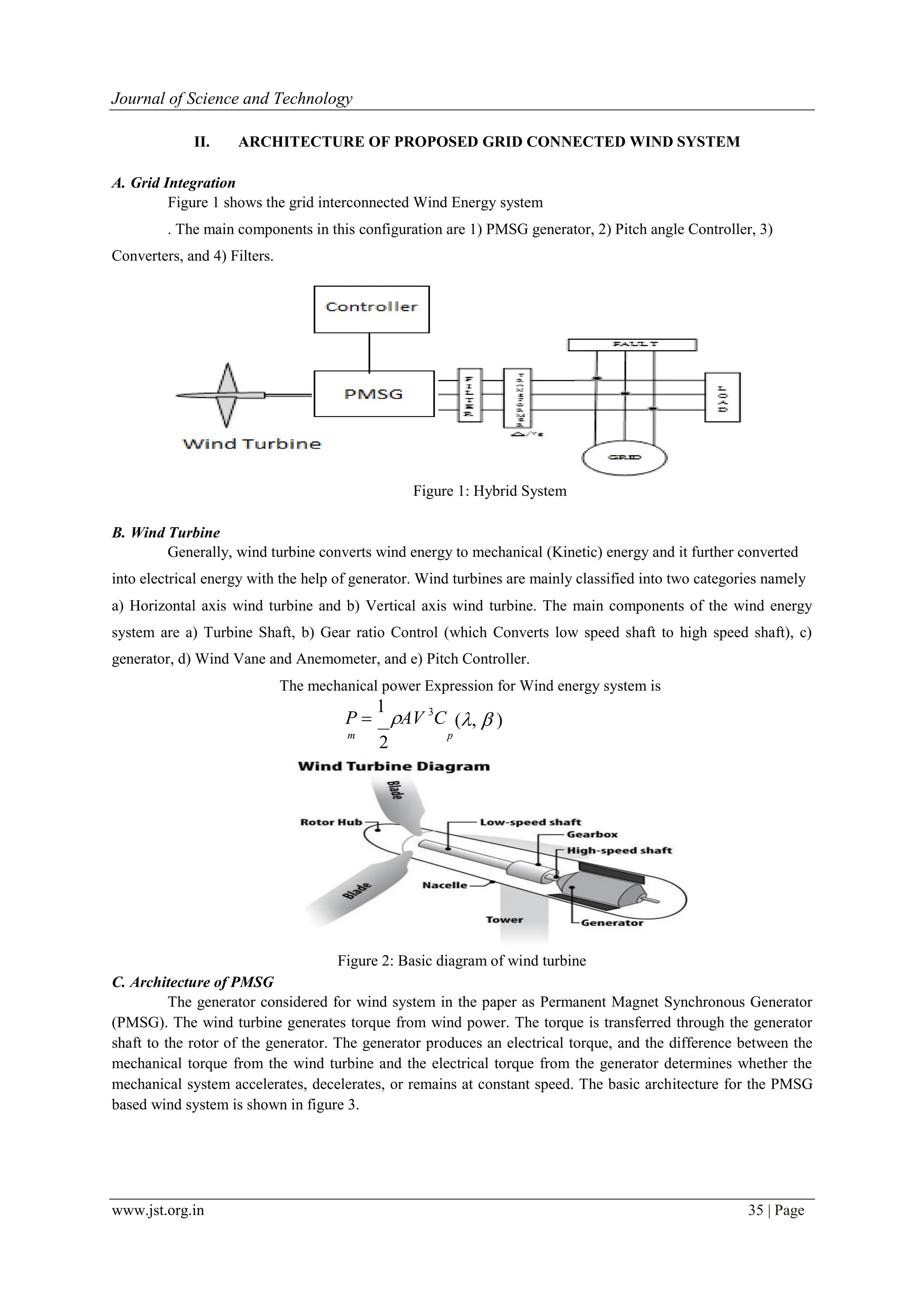
Figure 1 shows the grid interconnected Wind Energy system
. The main components in this configuration are 1) PMSG generator, 2) Pitch angle Controller, 3)
Converters, and 4) Filters.
Figure 1: Hybrid System
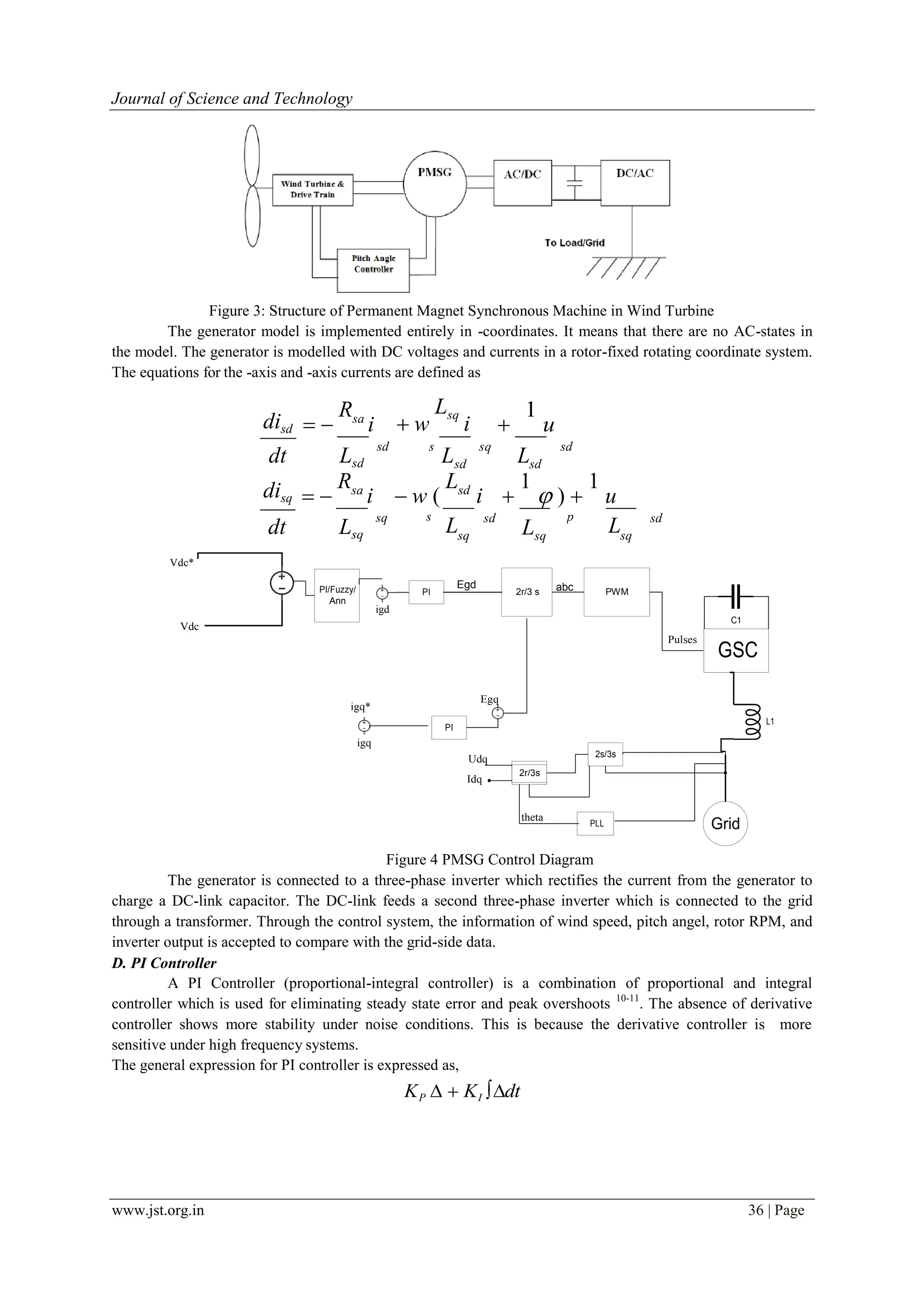
B. Wind Turbine
Generally, wind turbine converts wind energy to mechanical (Kinetic) energy and it further converted
into electrical energy with the help of generator. Wind turbines are mainly classified into two categories namely
a) Horizontal axis wind turbine and b) Vertical axis wind turbine. The main components of the wind energy
system are a) Turbine Shaft, b) Gear ratio Control (which Converts low speed shaft to high speed shaft), c)
generator, d) Wind Vane and Anemometer, and e) Pitch Controller.
The mechanical power Expression for Wind energy system is
P 
1
AV 3
C (,  )
m
2
p
Figure 2: Basic diagram of wind turbine
C. Architecture of PMSG
The generator considered for wind system in the paper as Permanent Magnet Synchronous Generator
(PMSG). The wind turbine generates torque from wind power. The torque is transferred through the generator
shaft to the rotor of the generator. The generator produces an electrical torque, and the difference between the
mechanical torque from the wind turbine and the electrical torque from the generator determines whether the
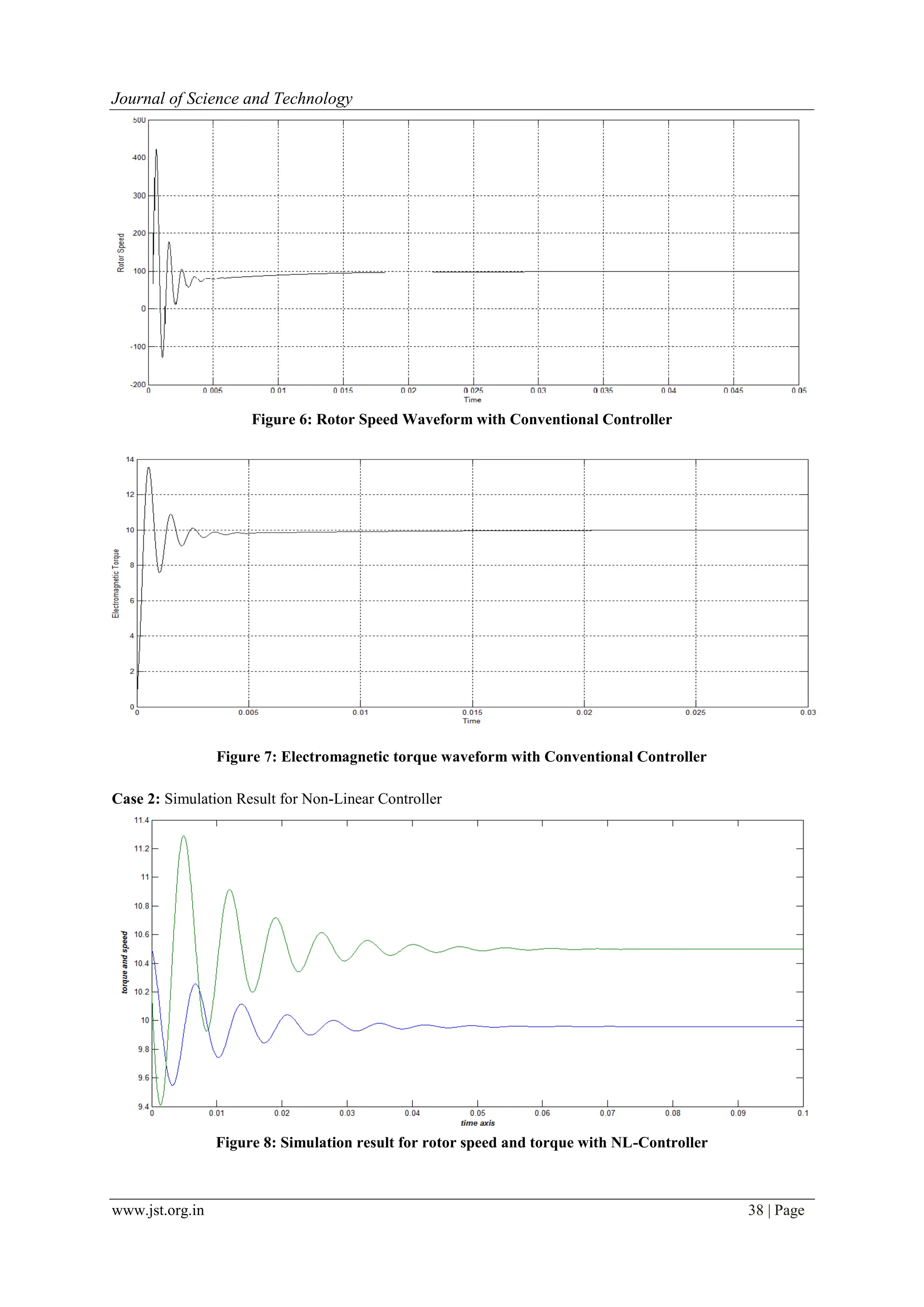
mechanical system accelerates, decelerates, or remains at constant speed. The basic architecture for the PMSG
based wind system is shown in figure 3.
www.jst.org.in 36 | Page
Journal of Science and Technology
PI/Fuzzy/
Ann
PI 2r/3 s
L
Figure 3: Structure of Permanent Magnet Synchronous Machine in Wind Turbine
The generator model is implemented entirely in -coordinates. It means that there are no AC-states in
the model. The generator is modelled with DC voltages and currents in a rotor-fixed rotating coordinate system.
The equations for the -axis and -axis currents are defined as
disd  
Rsa
i  w
Lsq
i 
1
u
dt Lsd
s sq
sd
sd
sd
disq  
Rsa
i  w (
Lsd
i 
1
 ) 
1
u
dt Lsq
sd
sq Lsq
sd
sq
V
igd
Egd abc
igq*
L1
igq
Figure 4 PMSG Control Diagram
The generator is connected to a three-phase inverter which rectifies the current from the generator to
charge a DC-link capacitor. The DC-link feeds a second three-phase inverter which is connected to the grid
through a transformer. Through the control system, the information of wind speed, pitch angel, rotor RPM, and
inverter output is accepted to compare with the grid-side data.
D. PI Controller
A PI Controller (proportional-integral controller) is a combination of proportional and integral
controller which is used for eliminating steady state error and peak overshoots 10-11
. The absence of derivative
controller shows more stability under noise conditions. This is because the derivative controller is more
sensitive under high frequency systems.
The general expression for PI controller is expressed as,
KP   KI dt
dc*
Vdc
C1
Pulses
GSC
PWM
Udq
Idq
2s/3s
theta
Grid
PLL
2r/3s
Egq
PI
sd
L
sq s
L
p
L
www.jst.org.in 37 | Page
Journal of Science and Technology
III. ARTIFICIAL NEURAL NETWORKS
The neuro controller is one of the important controllers in adaptive techniques. This section provides
the information regarding the designing of neuro controller. This neural controller has 2 inputs that are Δe (x)
and Δde (y) and it has 1 output that is f ∈ {x, y}. Each input consists of 5 membership functions. Figure 5 shows
the configuration of ANN controller.
Figure 5: ANN architecture
Neural networks typically consist of multiple layers or a cube design, and the signal path traverses from
front to back. Back propagation is where the forward stimulation is used to reset weights on the "front" neural
units and this is sometimes done in combination with training where the correct result is known.
The goal of the neural network is to solve problems in the same way that the human brain would,
although several neural networks are much more abstract. Modern neural network projects typically work with a
few thousand to a few million neural units and millions of connections, which are still several orders of
magnitude less complex than the human brain and closer to the computing power of a worm.
IV. SIMULATION DIAGRAM AND RESULTS
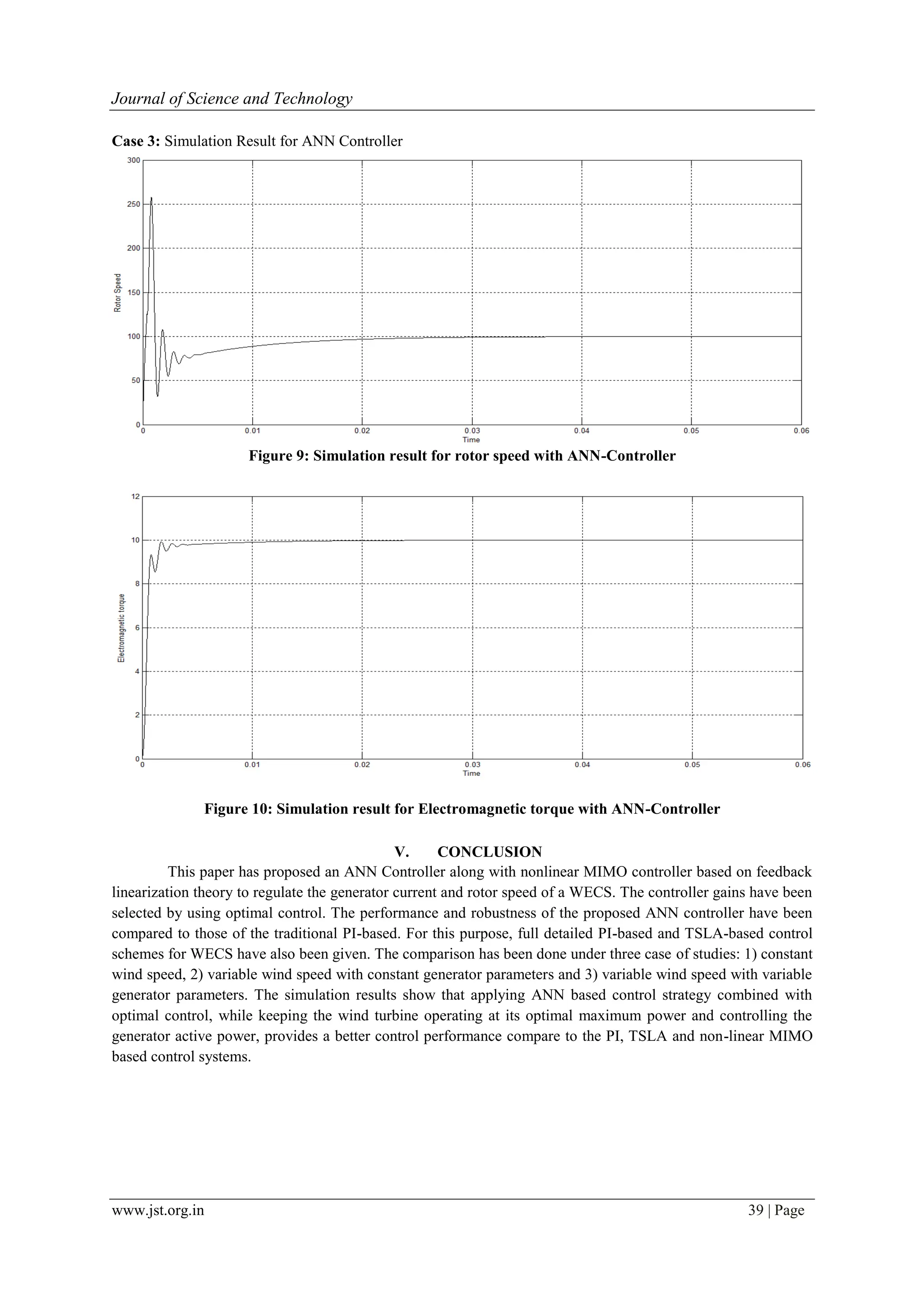
In order to demonstrate the effectiveness of the proposed nonlinear MIMO control feedback
linearization based scheme (FL-based), simulations have been carried out using Matlab/Simulink. The generator
used in the study is a variable speed non-salient-pole PMSG driven by a wind turbine.
Case 1: Simulation Result for PI Controller
www.jst.org.in 38 | Page
Journal of Science and Technology
Figure 6: Rotor Speed Waveform with Conventional Controller
Figure 7: Electromagnetic torque waveform with Conventional Controller
Case 2: Simulation Result for Non-Linear Controller
Figure 8: Simulation result for rotor speed and torque with NL-Controller
www.jst.org.in 39 | Page
Journal of Science and Technology
Case 3: Simulation Result for ANN Controller
Figure 9: Simulation result for rotor speed with ANN-Controller
Figure 10: Simulation result for Electromagnetic torque with ANN-Controller
V. CONCLUSION
This paper has proposed an ANN Controller along with nonlinear MIMO controller based on feedback
linearization theory to regulate the generator current and rotor speed of a WECS. The controller gains have been
selected by using optimal control. The performance and robustness of the proposed ANN controller have been
compared to those of the traditional PI-based. For this purpose, full detailed PI-based and TSLA-based control
schemes for WECS have also been given. The comparison has been done under three case of studies: 1) constant
wind speed, 2) variable wind speed with constant generator parameters and 3) variable wind speed with variable
generator parameters. The simulation results show that applying ANN based control strategy combined with
optimal control, while keeping the wind turbine operating at its optimal maximum power and controlling the
generator active power, provides a better control performance compare to the PI, TSLA and non-linear MIMO
based control systems.
www.jst.org.in 40 | Page
Journal of Science and Technology
REFERENCES:
[I] G. W. E. G. Council, "Global wind report 2015," 2016. [Online]. Available: www.gwec.net
[2] B. Wu, Y. Lang, N. Zargari, and S. Kouro, Power conversion and control of wind energy systems. John
Wiley & Sons, 2011, vol. 77.
[3] J. Thongam, R. Beguenane, A. Okou, M. Tarbouchi, A. Merabet, and P. Bouchard, "A method of tracking
maximum power points in variable speed wind energy conversion systems," in Power Electronics, Electrical
Drives, Automation and Motion (SPEED AM), 2012 International Symposium on. IEEE, 2012, pp. 1095- 1100.
[4] S. Li, T. A. Haskew, R. P. Swatloski, and W. Gathings, "Optimal and direct-current vector control of direct-
driven pmsg wind turbines," IEEE Transactions on power electronics, vol. 27, no. 5, pp. 2325- 2337, 2012.
[5] c. Lumbreras, J. M. Guerrero, P. Garda, F. Briz, and D. D. Reigosa, "Control of a small wind turbine in the
high wind speed region," IEEE Transactions on Power Electronics, vol. 31, no. 10, pp. 6980- 6991, 2016.
[6] N. A. Orlando, M. Liserre, R. A. Mastromauro, and A. Dell' Aquila, "A survey of control issues in pmsg-
based small wind-turbine systems," IEEE Transactions on Industrial Infonnatics, vol. 9, no. 3, pp. 1211- 1221,
2013.
[7] B. Housseini, F. A. Okou, and R. Beguenane, "A unified nonlinear controller design for on-grid/off-grid
wind energy battery storage system," in Industrial Electronics Society, IECON 2015- 41st Annual Conference of
the IEEE. IEEE, 2015, pp. 005273- 005278.
[8] K.-H. Kim, Y.-C. leung, D.-C. Lee, and H.-G. Kim, "Lvrt scheme of pmsg wind power systems based on
feedback linearization," IEEE transactions on power electronics, vol. 27, no. 5, pp. 2376-2384, 2012.
[9] s. Zhou, 1. Liu, L. Zhou, and Y. Zhu, "Improved dc-link voltage control of pmsg wecs based on feedback
linearization under grid faults," in Applied Power Electronics Conference and Exposition (APEC), 2013
Twenty-Eighth Annual IEEE. IEEE, 2013, pp. 2895- 2899.
[10] B. K. Bose, "Power electronics and ac drive," 1986.

Simulation and Controlling of Wind Energy System using ANN Controller

  • 1.
    www.jst.org.in 34 |Page Journal of Science and Technology (JST) Volume 2, Issue 3, May - June 2017, PP 34-40 www.jst.org.in ISSN: 2456 - 5660 Simulation and Controlling of Wind Energy System using ANN Controller Y.Venkata Lakshmi 1 and Shaik Saidavali 2 1 P.G Student [PSA], Department of Electrical Engineering, Sri Vani School of Engineering, A.P, India 2 Associate Professor, Department of Electrical Engineering, Sri Vani School of Engineering, A.P, India Abstract: This paper presents a comparative analysis of three control algorithms for a wind turbine generator using a variable speed permanent magnet synchronous generator (PMSG). The design methodologies of the conventional PI based controller, the Taylor series expansion linear approximation based (TSLA-based) controller and the feedback linearization based (FL-based) nonlinear controller are provided. The objective is to keep the wind turbine operating at its optimum rotor speed (MPPT control), while insuring the power transfer from the turbine to the generator, regardless of the wind speed. The controller gains of the nonlinear controller are determined via Linear Quadratic Optimal Control (LQOC) approach. The results show a better control performance for the nonlinear controller. This performance is characterized by fast and smooth transient responses as well as a zero steady state error and reference tracking quality. I. INTRODUCTION In the present scenario, wind energy system is fast growing power generation system in renewable energy systems. Wind-turbine systems can work in two modes of operation: grid-connected and stand-alone. However, the majority of them operating in the field are grid-connected. In this mode, the power generated is directly uploaded to the grid. When WT are not generating enough energy in low wind time intervals, electricity from the grid supplies costumer needs. WT in stand-alone mode are usually employed as small power capacity to power homes, farms, and isolated areas where access to the utility grid is remote or costly. Since the power generated from the wind is not always available, other energy sources are commonly required in stand-alone systems. It is common that a stand-alone wind energy system operates with diesel generators or energy storage systems to form a more reliable distributed generation (DG) system. Due to their random nature, wind-turbine systems are characterized by an unpredictable output. Hence, a suitable control system is required to ensure a good system dynamic behavior and an efficient extraction of the power from a wind turbine. This has been the subject of several recent research investigations. Most of the proposed control methods for WECS in the literature employed the conventional PI-based control method with different techniques. Methods of nonlinear control that use input-output feedback linearization method for WECS have been reported. Feedback linearization control method has the advantage of being able to be used to both stabilize a nonlinear system, such as WECS, simultaneously tracking many control reference signals. Also, it allows the user to have a complete decoupled control system where each variable can be controlled independently.
  • 2.
    www.jst.org.in 35 |Page Journal of Science and Technology II. ARCHITECTURE OF PROPOSED GRID CONNECTED WIND SYSTEM A. Grid Integration Figure 1 shows the grid interconnected Wind Energy system . The main components in this configuration are 1) PMSG generator, 2) Pitch angle Controller, 3) Converters, and 4) Filters. Figure 1: Hybrid System B. Wind Turbine Generally, wind turbine converts wind energy to mechanical (Kinetic) energy and it further converted into electrical energy with the help of generator. Wind turbines are mainly classified into two categories namely a) Horizontal axis wind turbine and b) Vertical axis wind turbine. The main components of the wind energy system are a) Turbine Shaft, b) Gear ratio Control (which Converts low speed shaft to high speed shaft), c) generator, d) Wind Vane and Anemometer, and e) Pitch Controller. The mechanical power Expression for Wind energy system is P  1 AV 3 C (,  ) m 2 p Figure 2: Basic diagram of wind turbine C. Architecture of PMSG The generator considered for wind system in the paper as Permanent Magnet Synchronous Generator (PMSG). The wind turbine generates torque from wind power. The torque is transferred through the generator shaft to the rotor of the generator. The generator produces an electrical torque, and the difference between the mechanical torque from the wind turbine and the electrical torque from the generator determines whether the mechanical system accelerates, decelerates, or remains at constant speed. The basic architecture for the PMSG based wind system is shown in figure 3.
  • 3.
    www.jst.org.in 36 |Page Journal of Science and Technology PI/Fuzzy/ Ann PI 2r/3 s L Figure 3: Structure of Permanent Magnet Synchronous Machine in Wind Turbine The generator model is implemented entirely in -coordinates. It means that there are no AC-states in the model. The generator is modelled with DC voltages and currents in a rotor-fixed rotating coordinate system. The equations for the -axis and -axis currents are defined as disd   Rsa i  w Lsq i  1 u dt Lsd s sq sd sd sd disq   Rsa i  w ( Lsd i  1  )  1 u dt Lsq sd sq Lsq sd sq V igd Egd abc igq* L1 igq Figure 4 PMSG Control Diagram The generator is connected to a three-phase inverter which rectifies the current from the generator to charge a DC-link capacitor. The DC-link feeds a second three-phase inverter which is connected to the grid through a transformer. Through the control system, the information of wind speed, pitch angel, rotor RPM, and inverter output is accepted to compare with the grid-side data. D. PI Controller A PI Controller (proportional-integral controller) is a combination of proportional and integral controller which is used for eliminating steady state error and peak overshoots 10-11 . The absence of derivative controller shows more stability under noise conditions. This is because the derivative controller is more sensitive under high frequency systems. The general expression for PI controller is expressed as, KP   KI dt dc* Vdc C1 Pulses GSC PWM Udq Idq 2s/3s theta Grid PLL 2r/3s Egq PI sd L sq s L p L
  • 4.
    www.jst.org.in 37 |Page Journal of Science and Technology III. ARTIFICIAL NEURAL NETWORKS The neuro controller is one of the important controllers in adaptive techniques. This section provides the information regarding the designing of neuro controller. This neural controller has 2 inputs that are Δe (x) and Δde (y) and it has 1 output that is f ∈ {x, y}. Each input consists of 5 membership functions. Figure 5 shows the configuration of ANN controller. Figure 5: ANN architecture Neural networks typically consist of multiple layers or a cube design, and the signal path traverses from front to back. Back propagation is where the forward stimulation is used to reset weights on the "front" neural units and this is sometimes done in combination with training where the correct result is known. The goal of the neural network is to solve problems in the same way that the human brain would, although several neural networks are much more abstract. Modern neural network projects typically work with a few thousand to a few million neural units and millions of connections, which are still several orders of magnitude less complex than the human brain and closer to the computing power of a worm. IV. SIMULATION DIAGRAM AND RESULTS In order to demonstrate the effectiveness of the proposed nonlinear MIMO control feedback linearization based scheme (FL-based), simulations have been carried out using Matlab/Simulink. The generator used in the study is a variable speed non-salient-pole PMSG driven by a wind turbine. Case 1: Simulation Result for PI Controller
  • 5.
    www.jst.org.in 38 |Page Journal of Science and Technology Figure 6: Rotor Speed Waveform with Conventional Controller Figure 7: Electromagnetic torque waveform with Conventional Controller Case 2: Simulation Result for Non-Linear Controller Figure 8: Simulation result for rotor speed and torque with NL-Controller
  • 6.
    www.jst.org.in 39 |Page Journal of Science and Technology Case 3: Simulation Result for ANN Controller Figure 9: Simulation result for rotor speed with ANN-Controller Figure 10: Simulation result for Electromagnetic torque with ANN-Controller V. CONCLUSION This paper has proposed an ANN Controller along with nonlinear MIMO controller based on feedback linearization theory to regulate the generator current and rotor speed of a WECS. The controller gains have been selected by using optimal control. The performance and robustness of the proposed ANN controller have been compared to those of the traditional PI-based. For this purpose, full detailed PI-based and TSLA-based control schemes for WECS have also been given. The comparison has been done under three case of studies: 1) constant wind speed, 2) variable wind speed with constant generator parameters and 3) variable wind speed with variable generator parameters. The simulation results show that applying ANN based control strategy combined with optimal control, while keeping the wind turbine operating at its optimal maximum power and controlling the generator active power, provides a better control performance compare to the PI, TSLA and non-linear MIMO based control systems.
  • 7.
    www.jst.org.in 40 |Page Journal of Science and Technology REFERENCES: [I] G. W. E. G. Council, "Global wind report 2015," 2016. [Online]. Available: www.gwec.net [2] B. Wu, Y. Lang, N. Zargari, and S. Kouro, Power conversion and control of wind energy systems. John Wiley & Sons, 2011, vol. 77. [3] J. Thongam, R. Beguenane, A. Okou, M. Tarbouchi, A. Merabet, and P. Bouchard, "A method of tracking maximum power points in variable speed wind energy conversion systems," in Power Electronics, Electrical Drives, Automation and Motion (SPEED AM), 2012 International Symposium on. IEEE, 2012, pp. 1095- 1100. [4] S. Li, T. A. Haskew, R. P. Swatloski, and W. Gathings, "Optimal and direct-current vector control of direct- driven pmsg wind turbines," IEEE Transactions on power electronics, vol. 27, no. 5, pp. 2325- 2337, 2012. [5] c. Lumbreras, J. M. Guerrero, P. Garda, F. Briz, and D. D. Reigosa, "Control of a small wind turbine in the high wind speed region," IEEE Transactions on Power Electronics, vol. 31, no. 10, pp. 6980- 6991, 2016. [6] N. A. Orlando, M. Liserre, R. A. Mastromauro, and A. Dell' Aquila, "A survey of control issues in pmsg- based small wind-turbine systems," IEEE Transactions on Industrial Infonnatics, vol. 9, no. 3, pp. 1211- 1221, 2013. [7] B. Housseini, F. A. Okou, and R. Beguenane, "A unified nonlinear controller design for on-grid/off-grid wind energy battery storage system," in Industrial Electronics Society, IECON 2015- 41st Annual Conference of the IEEE. IEEE, 2015, pp. 005273- 005278. [8] K.-H. Kim, Y.-C. leung, D.-C. Lee, and H.-G. Kim, "Lvrt scheme of pmsg wind power systems based on feedback linearization," IEEE transactions on power electronics, vol. 27, no. 5, pp. 2376-2384, 2012. [9] s. Zhou, 1. Liu, L. Zhou, and Y. Zhu, "Improved dc-link voltage control of pmsg wecs based on feedback linearization under grid faults," in Applied Power Electronics Conference and Exposition (APEC), 2013 Twenty-Eighth Annual IEEE. IEEE, 2013, pp. 2895- 2899. [10] B. K. Bose, "Power electronics and ac drive," 1986.