Journal of Science and Technology
ISSN: 2456-5660 Volume 2, Issue 01 (Jan –Feb 2017)
www.jst.org.in DOI:https://doi.org/10.46243/jst.2017.v2.i01.pp59 - 65
Page | 59
Published by: Longman Publishers www.jst.org.in
Dispersion Analysis in Single Mode and Multimode Fiber
Mahindra Umbarkar
Electronics and Telecommunication
Government Polytechnic
Jalgaon, India
mahindra.umbarkar@gmail.com
To Cite this Article
Mahindra Umbarkar Dispersion Analysis in an Optical Fiber Journal of Science and Technology, Vol. 02, Issue
03,-Jan– Feb 2017, pp59 -65
Article Info
Received: 23-02-2017 Revised: 3-01-2017 Accepted: 12-01-2017 Published: 28-01-2017
Abstract-
A cylindrical-shaped dielectric waveguide is what an optical fibre is. The core cladding interface
confines electromagnetic energy in the form of light within its surface and directs light through a
number of internal reflections if the angle of incidence is larger than the critical angle c. The
dispersion of the transmitted optical signal causes distortion in both digital and analogue
transmission across optical fibres. When optical fibre transmission is widely employed and some
sort of digital modulation is applied, dispersion mechanisms inside the fibre cause the
transmitted light pulses to broaden as they move along the channel.
Keywords- Dispersion; singlemode fiber; multimode fiber; light; optical fiber;
Introduction-
Dispersion is the process through which a light pulse spreads out over time as it moves down the
fibre. Dispersion in optical fibre can take the forms of model dispersion, material dispersion, and
waveguide dispersion. Material dispersion results from the refractive index of fibre optic
materials changing with wavelength. Higher indexes cause light to move more slowly.
Waveguide dispersion results from light being split between the waveguide's core and cladding.
[6]
Similar to attenuation, dispersion shortens the distance a signal must travel through optical
fibres. Dispersion, as opposed to attenuation, distorts the signal rather than making it weaker. For
example, a pulse with duration of one nanosecond at the transmitter will have duration of 10
nanoseconds at the receiver. Signals are not properly received and decoded as a result. [6]
Journal of Science and Technology
ISSN: 2456-5660 Volume 2, Issue 01 (Jan –Feb 2017)
www.jst.org.in DOI:https://doi.org/10.46243/jst.2017.v2.i01.pp59 - 65
Page | 60
Published by: Longman Publishers www.jst.org.in
The waveguide dispersion is calculated using a simple curve fitting method. The dispersion
analysis for single mode fibre is carried out by modifying the wavelength in respect to various
types of dispersion, including material dispersion, waveguide dispersion, and total dispersion.
[8,9]
1. Dispersion in optical Fiber-
The process by which an input signal broadens/spreads out as it propagates/travels down the
fibre is referred to as optical fibre dispersion. Modal, chromatic, and polarisation mode
dispersion are the typical types of dispersion in fibre optic cable.
In multimode fibres and other waveguides, a distortion mechanism known as modal
dispersion causes the signal to be spread out in time as a result of the various modes' varying
rates of propagation. As is common knowledge, light rays entering a fibre at various angles of
incidence will follow various routes or modes. As shown below with a step-index multimode
fibre, some of these light rays will travel directly through the fiber's centre (axial mode), while
others will continually bounce off the cladding/core barrier and zigzag their way through the
waveguide.
As far as we are aware, dispersion is a phenomenon that occurs when light travels from one
medium to another. Light of different wavelengths will bend at various angles and cause
dispersion. One common illustration is how a transparent prism would divide white light into a
spectrum of colours, with red light bent at the lowest angle and blue light bent at the greatest
angle. As a result, red light is at the top of the spectrum while blue light is at the bottom. We just
use our secondary understanding of light dispersion to support our explanation [14]. To fully
comprehend dispersion and how it applies to fibre optics, more research must be done. [10]
Figure 1- Modes of optical Fiber
Combining material and waveguide dispersion in a way that results in zero chromatic
dispersion at a desired operating wavelength is a practical application of both (normally between
1530 and 1620 nm). Since material dispersion is typically unpleasant to change due to desirable
Journal of Science and Technology
ISSN: 2456-5660 Volume 2, Issue 01 (Jan –Feb 2017)
www.jst.org.in DOI:https://doi.org/10.46243/jst.2017.v2.i01.pp59 - 65
Page | 61
Published by: Longman Publishers www.jst.org.in
inherent features of the chosen material for optical fibre, this can be accomplished by altering
waveguide dispersion (most likely silica). The following figure illustrates how nonzero
dispersion-shifted fiber's material, waveguide, and chromatic dispersion fluctuate with
wavelength and exhibits zero chromatic dispersion at 1.5 micrometre wavelength.[1,2,7]
The wavelength dependence of the refractive index on the fibre core material is what
leads to material dispersion. Waveguide dispersion happens as a result of the mode propagation
constant's dependency on the signal wavelength, core radius, and difference in refractive indices
between the fibre core and cladding. These two effects may cancel one another out at a specific
frequency, producing a wavelength with nearly zero chromatic dispersion.
Figure 2- Combine waveguide and material dispersion.
The varying speeds of light rays cause a phenomena known as chromatic dispersion,
which is the spreading of a signal across time. The effects of material and waveguide dispersion
combine to create chromatic dispersion.
Additionally, chromatic dispersion need not always be a negative thing. When travelling
through various materials or wavelengths, light moves at varying rates. It is feasible to tailor the
index of refraction profile to create fibres for various uses by causing pulses to either spread out
or compress as they travel along the fibre. For instance, this is how G.652 fibres are made.
2. Measurement Methodology-
Measurements of dispersion reveal how optical signals are distorted as they travel across
optical fibres. The capacity of the fibre for conveying information is constrained by delay
Journal of Science and Technology
ISSN: 2456-5660 Volume 2, Issue 01 (Jan –Feb 2017)
www.jst.org.in DOI:https://doi.org/10.46243/jst.2017.v2.i01.pp59 - 65
Page | 62
Published by: Longman Publishers www.jst.org.in
distortion, which, for instance, causes the spreading of transmitted light pulses. We implement
the system using MATLAB , the optical fiber toolbox.
Functions for quick, automatic guided mode calculations in basic optical fibres are provided
by the Optical Fibre Toolbox (OFT). Designed with tapered microfibres in mind (also known as
nano-fibres). For both weak and strong guidance scenarios, exact answers are given. Dispersion
of the material is considered.
The main feature is
 To locate the guided modes.
 Determine each mode's effective refractive index for the specified diameter and
wavelength or in the presence of changeable diameter or wavelength (modal dispersion).
 Determine the modes' electric and magnetic fields (only two-layer modes).
 Locate phase-matching fibre spots for harmonic production.
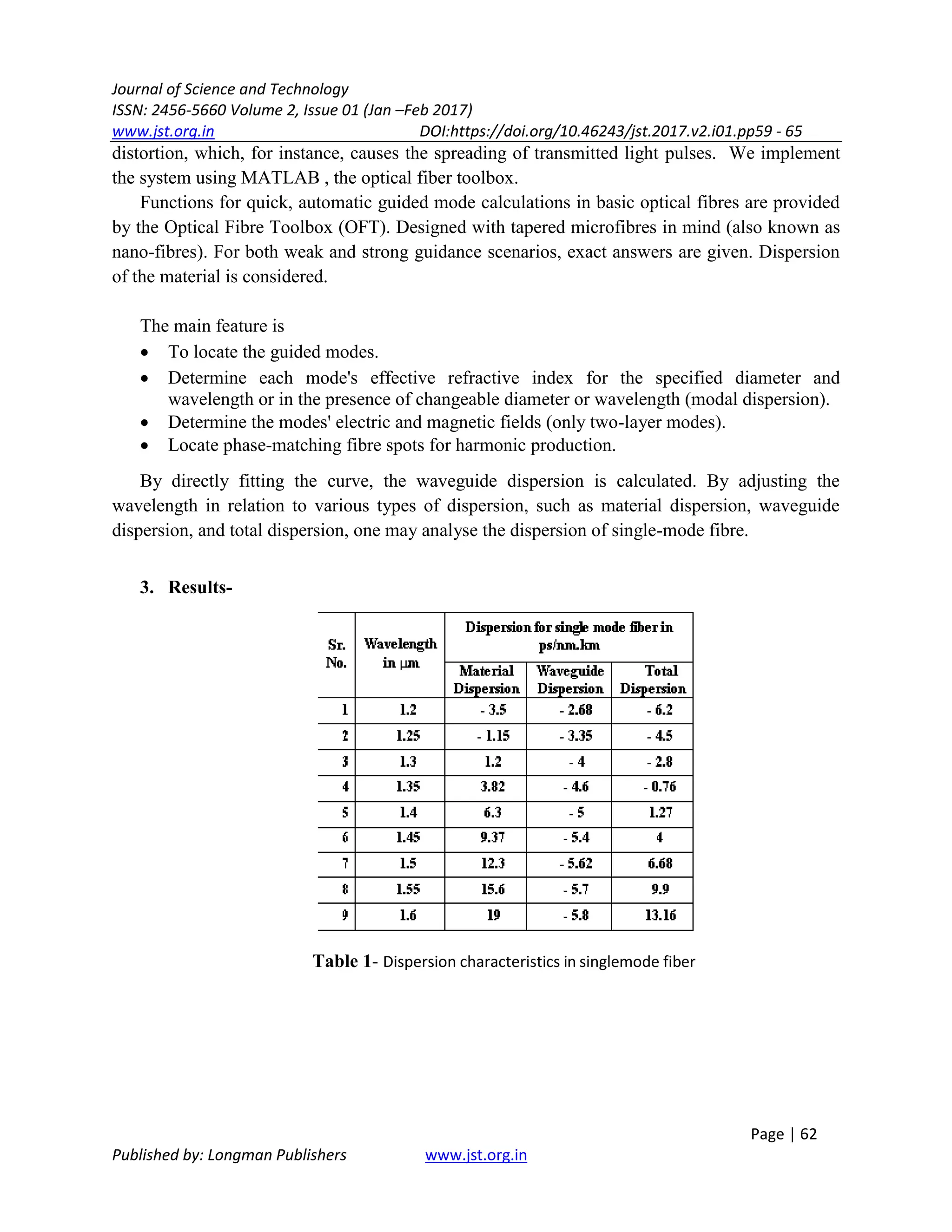
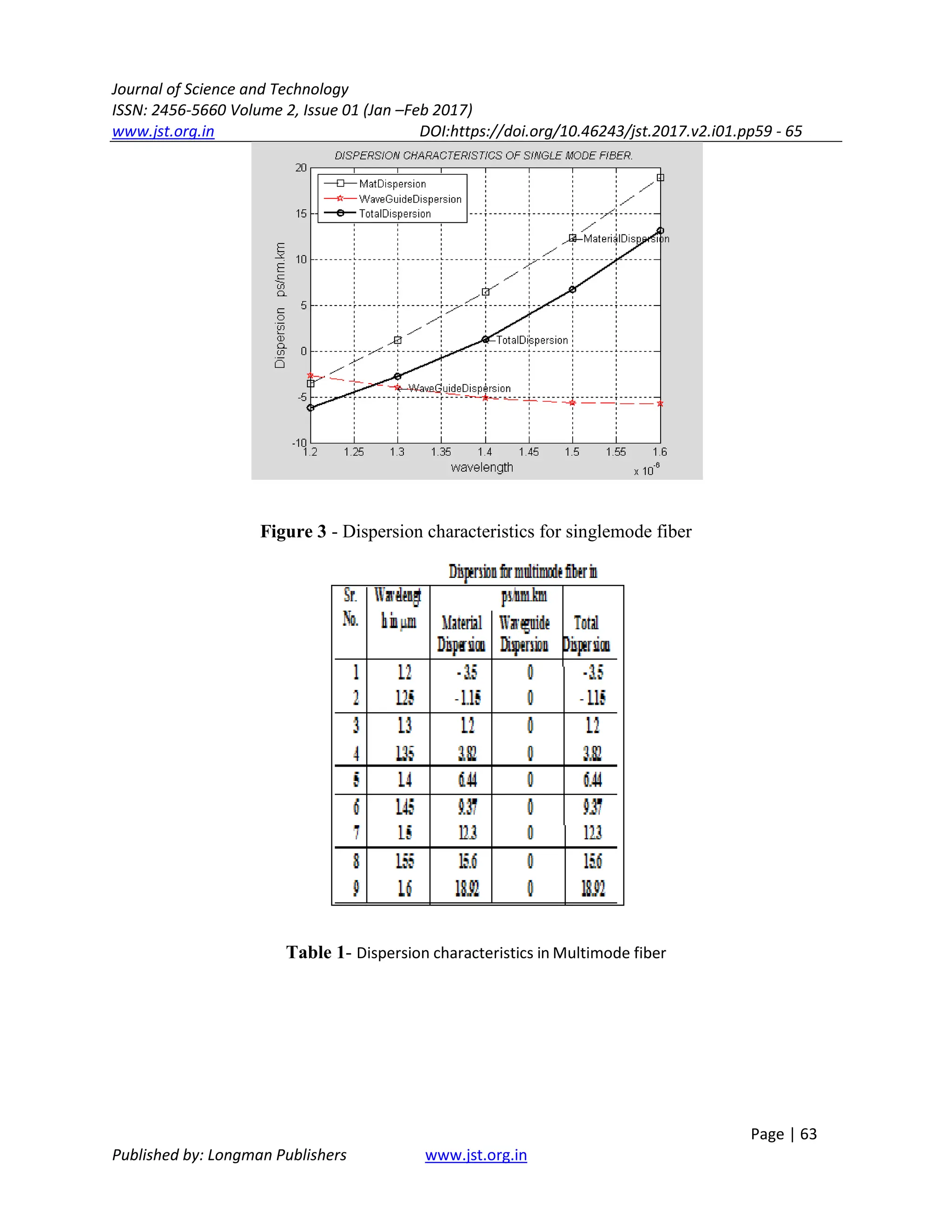
By directly fitting the curve, the waveguide dispersion is calculated. By adjusting the
wavelength in relation to various types of dispersion, such as material dispersion, waveguide
dispersion, and total dispersion, one may analyse the dispersion of single-mode fibre.
3. Results-
Table 1- Dispersion characteristics in singlemode fiber
Journal of Science and Technology
ISSN: 2456-5660 Volume 2, Issue 01 (Jan –Feb 2017)
www.jst.org.in DOI:https://doi.org/10.46243/jst.2017.v2.i01.pp59 - 65
Page | 63
Published by: Longman Publishers www.jst.org.in
Figure 3 - Dispersion characteristics for singlemode fiber
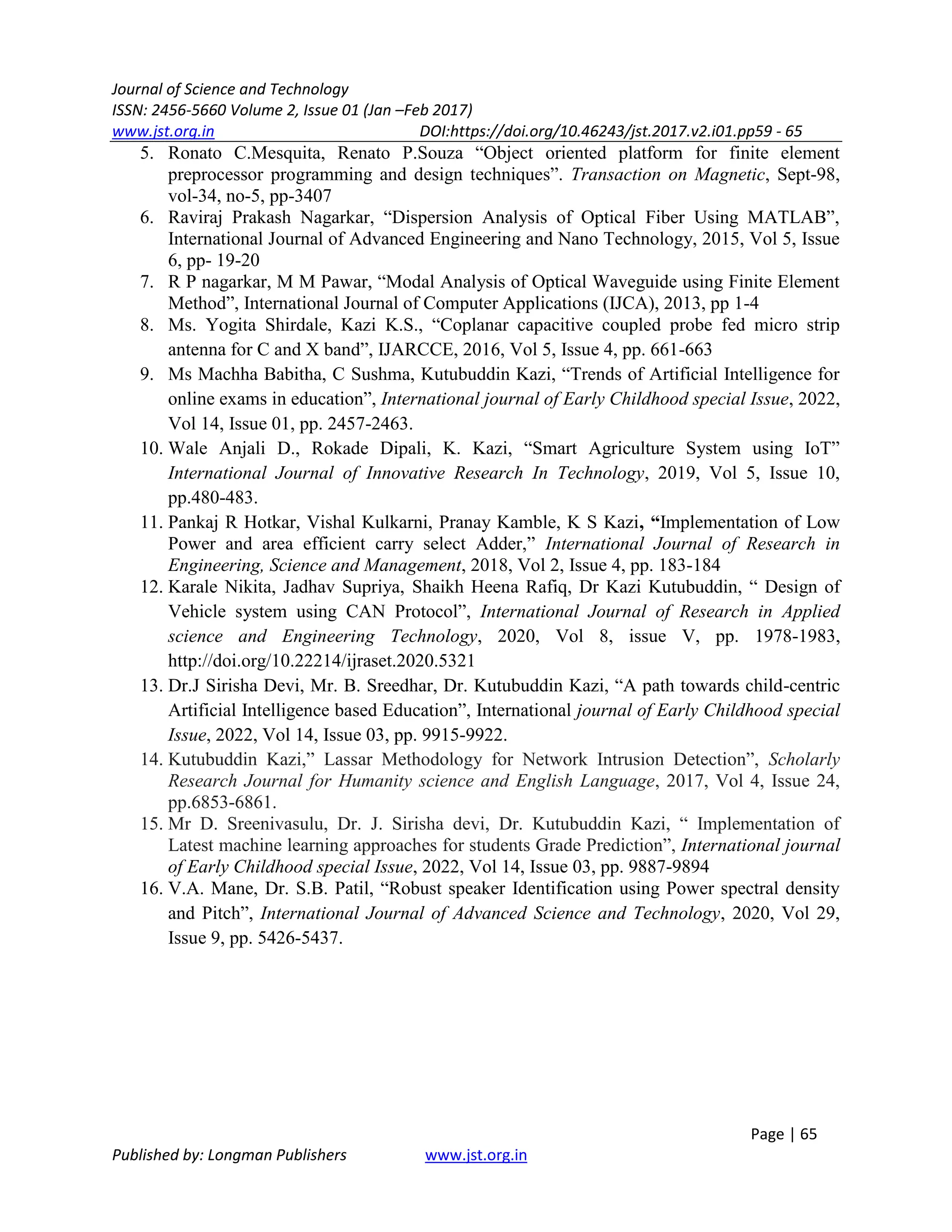
Table 1- Dispersion characteristics in Multimode fiber
Journal of Science and Technology
ISSN: 2456-5660 Volume 2, Issue 01 (Jan –Feb 2017)
www.jst.org.in DOI:https://doi.org/10.46243/jst.2017.v2.i01.pp59 - 65
Page | 64
Published by: Longman Publishers www.jst.org.in
Figure 4- Dispersion characteristics for multimode fiber
Conclusion-
Waveguide dispersion in single mode fibre is not zero, as the aforementioned figures
demonstrate. Waveguide dispersion in multimode fibre, however, is 0 percent. Total dispersion
includes both material dispersion and waveguide dispersion. Furthermore, it can be demonstrated
that there is no material dispersion at 1.27 mm. Between single mode and multimode optical
fibres, there are differences in chromatic dispersion.
References-
1. Yasuhide Tsujii,masanori Koshiba “Curvilinear Hybrid edge/nodal elements with
triangular shape for guided wave problems” J. of Light wave technology, May-2000, vol-
18, no-5, pp-737.
2. Yasuhide Tsujii,masanori Koshiba “Finite element method using port truncation by
perfectly matched layer boundary conditions for optical wave guide discontinuity
problems “J. of Light wave technology, Mar-2002, vol-20, no-2, pp-463.
3. T.Lenahan,”Calculation of modes in single mode fiber using FEM and ESPACK”, Bell
Sys.Tech.J, vol62, pp-2663-2694, 1983.
4. B.M.Azizur, j.Brian Devies “Review of Finite Element Methods for Microwave and
optical Waveguides”, Proceedings of the IEEE., vol-9, no-10, pp-1442-1447, Oct-1991.
Journal of Science and Technology
ISSN: 2456-5660 Volume 2, Issue 01 (Jan –Feb 2017)
www.jst.org.in DOI:https://doi.org/10.46243/jst.2017.v2.i01.pp59 - 65
Page | 65
Published by: Longman Publishers www.jst.org.in
5. Ronato C.Mesquita, Renato P.Souza “Object oriented platform for finite element
preprocessor programming and design techniques”. Transaction on Magnetic, Sept-98,
vol-34, no-5, pp-3407
6. Raviraj Prakash Nagarkar, “Dispersion Analysis of Optical Fiber Using MATLAB”,
International Journal of Advanced Engineering and Nano Technology, 2015, Vol 5, Issue
6, pp- 19-20
7. R P nagarkar, M M Pawar, “Modal Analysis of Optical Waveguide using Finite Element
Method”, International Journal of Computer Applications (IJCA), 2013, pp 1-4
8. Ms. Yogita Shirdale, Kazi K.S., “Coplanar capacitive coupled probe fed micro strip
antenna for C and X band”, IJARCCE, 2016, Vol 5, Issue 4, pp. 661-663
9. Ms Machha Babitha, C Sushma, Kutubuddin Kazi, “Trends of Artificial Intelligence for
online exams in education”, International journal of Early Childhood special Issue, 2022,
Vol 14, Issue 01, pp. 2457-2463.
10. Wale Anjali D., Rokade Dipali, K. Kazi, “Smart Agriculture System using IoT”
International Journal of Innovative Research In Technology, 2019, Vol 5, Issue 10,
pp.480-483.
11. Pankaj R Hotkar, Vishal Kulkarni, Pranay Kamble, K S Kazi, “Implementation of Low
Power and area efficient carry select Adder,” International Journal of Research in
Engineering, Science and Management, 2018, Vol 2, Issue 4, pp. 183-184
12. Karale Nikita, Jadhav Supriya, Shaikh Heena Rafiq, Dr Kazi Kutubuddin, “ Design of
Vehicle system using CAN Protocol”, International Journal of Research in Applied
science and Engineering Technology, 2020, Vol 8, issue V, pp. 1978-1983,
http://doi.org/10.22214/ijraset.2020.5321
13. Dr.J Sirisha Devi, Mr. B. Sreedhar, Dr. Kutubuddin Kazi, “A path towards child-centric
Artificial Intelligence based Education”, International journal of Early Childhood special
Issue, 2022, Vol 14, Issue 03, pp. 9915-9922.
14. Kutubuddin Kazi,” Lassar Methodology for Network Intrusion Detection”, Scholarly
Research Journal for Humanity science and English Language, 2017, Vol 4, Issue 24,
pp.6853-6861.
15. Mr D. Sreenivasulu, Dr. J. Sirisha devi, Dr. Kutubuddin Kazi, “ Implementation of
Latest machine learning approaches for students Grade Prediction”, International journal
of Early Childhood special Issue, 2022, Vol 14, Issue 03, pp. 9887-9894
16. V.A. Mane, Dr. S.B. Patil, “Robust speaker Identification using Power spectral density
and Pitch”, International Journal of Advanced Science and Technology, 2020, Vol 29,
Issue 9, pp. 5426-5437.

Dispersion Analysis in Single Mode and Multimode Fiber

  • 1.
    Journal of Scienceand Technology ISSN: 2456-5660 Volume 2, Issue 01 (Jan –Feb 2017) www.jst.org.in DOI:https://doi.org/10.46243/jst.2017.v2.i01.pp59 - 65 Page | 59 Published by: Longman Publishers www.jst.org.in Dispersion Analysis in Single Mode and Multimode Fiber Mahindra Umbarkar Electronics and Telecommunication Government Polytechnic Jalgaon, India mahindra.umbarkar@gmail.com To Cite this Article Mahindra Umbarkar Dispersion Analysis in an Optical Fiber Journal of Science and Technology, Vol. 02, Issue 03,-Jan– Feb 2017, pp59 -65 Article Info Received: 23-02-2017 Revised: 3-01-2017 Accepted: 12-01-2017 Published: 28-01-2017 Abstract- A cylindrical-shaped dielectric waveguide is what an optical fibre is. The core cladding interface confines electromagnetic energy in the form of light within its surface and directs light through a number of internal reflections if the angle of incidence is larger than the critical angle c. The dispersion of the transmitted optical signal causes distortion in both digital and analogue transmission across optical fibres. When optical fibre transmission is widely employed and some sort of digital modulation is applied, dispersion mechanisms inside the fibre cause the transmitted light pulses to broaden as they move along the channel. Keywords- Dispersion; singlemode fiber; multimode fiber; light; optical fiber; Introduction- Dispersion is the process through which a light pulse spreads out over time as it moves down the fibre. Dispersion in optical fibre can take the forms of model dispersion, material dispersion, and waveguide dispersion. Material dispersion results from the refractive index of fibre optic materials changing with wavelength. Higher indexes cause light to move more slowly. Waveguide dispersion results from light being split between the waveguide's core and cladding. [6] Similar to attenuation, dispersion shortens the distance a signal must travel through optical fibres. Dispersion, as opposed to attenuation, distorts the signal rather than making it weaker. For example, a pulse with duration of one nanosecond at the transmitter will have duration of 10 nanoseconds at the receiver. Signals are not properly received and decoded as a result. [6]
  • 2.
    Journal of Scienceand Technology ISSN: 2456-5660 Volume 2, Issue 01 (Jan –Feb 2017) www.jst.org.in DOI:https://doi.org/10.46243/jst.2017.v2.i01.pp59 - 65 Page | 60 Published by: Longman Publishers www.jst.org.in The waveguide dispersion is calculated using a simple curve fitting method. The dispersion analysis for single mode fibre is carried out by modifying the wavelength in respect to various types of dispersion, including material dispersion, waveguide dispersion, and total dispersion. [8,9] 1. Dispersion in optical Fiber- The process by which an input signal broadens/spreads out as it propagates/travels down the fibre is referred to as optical fibre dispersion. Modal, chromatic, and polarisation mode dispersion are the typical types of dispersion in fibre optic cable. In multimode fibres and other waveguides, a distortion mechanism known as modal dispersion causes the signal to be spread out in time as a result of the various modes' varying rates of propagation. As is common knowledge, light rays entering a fibre at various angles of incidence will follow various routes or modes. As shown below with a step-index multimode fibre, some of these light rays will travel directly through the fiber's centre (axial mode), while others will continually bounce off the cladding/core barrier and zigzag their way through the waveguide. As far as we are aware, dispersion is a phenomenon that occurs when light travels from one medium to another. Light of different wavelengths will bend at various angles and cause dispersion. One common illustration is how a transparent prism would divide white light into a spectrum of colours, with red light bent at the lowest angle and blue light bent at the greatest angle. As a result, red light is at the top of the spectrum while blue light is at the bottom. We just use our secondary understanding of light dispersion to support our explanation [14]. To fully comprehend dispersion and how it applies to fibre optics, more research must be done. [10] Figure 1- Modes of optical Fiber Combining material and waveguide dispersion in a way that results in zero chromatic dispersion at a desired operating wavelength is a practical application of both (normally between 1530 and 1620 nm). Since material dispersion is typically unpleasant to change due to desirable
  • 3.
    Journal of Scienceand Technology ISSN: 2456-5660 Volume 2, Issue 01 (Jan –Feb 2017) www.jst.org.in DOI:https://doi.org/10.46243/jst.2017.v2.i01.pp59 - 65 Page | 61 Published by: Longman Publishers www.jst.org.in inherent features of the chosen material for optical fibre, this can be accomplished by altering waveguide dispersion (most likely silica). The following figure illustrates how nonzero dispersion-shifted fiber's material, waveguide, and chromatic dispersion fluctuate with wavelength and exhibits zero chromatic dispersion at 1.5 micrometre wavelength.[1,2,7] The wavelength dependence of the refractive index on the fibre core material is what leads to material dispersion. Waveguide dispersion happens as a result of the mode propagation constant's dependency on the signal wavelength, core radius, and difference in refractive indices between the fibre core and cladding. These two effects may cancel one another out at a specific frequency, producing a wavelength with nearly zero chromatic dispersion. Figure 2- Combine waveguide and material dispersion. The varying speeds of light rays cause a phenomena known as chromatic dispersion, which is the spreading of a signal across time. The effects of material and waveguide dispersion combine to create chromatic dispersion. Additionally, chromatic dispersion need not always be a negative thing. When travelling through various materials or wavelengths, light moves at varying rates. It is feasible to tailor the index of refraction profile to create fibres for various uses by causing pulses to either spread out or compress as they travel along the fibre. For instance, this is how G.652 fibres are made. 2. Measurement Methodology- Measurements of dispersion reveal how optical signals are distorted as they travel across optical fibres. The capacity of the fibre for conveying information is constrained by delay
  • 4.
    Journal of Scienceand Technology ISSN: 2456-5660 Volume 2, Issue 01 (Jan –Feb 2017) www.jst.org.in DOI:https://doi.org/10.46243/jst.2017.v2.i01.pp59 - 65 Page | 62 Published by: Longman Publishers www.jst.org.in distortion, which, for instance, causes the spreading of transmitted light pulses. We implement the system using MATLAB , the optical fiber toolbox. Functions for quick, automatic guided mode calculations in basic optical fibres are provided by the Optical Fibre Toolbox (OFT). Designed with tapered microfibres in mind (also known as nano-fibres). For both weak and strong guidance scenarios, exact answers are given. Dispersion of the material is considered. The main feature is  To locate the guided modes.  Determine each mode's effective refractive index for the specified diameter and wavelength or in the presence of changeable diameter or wavelength (modal dispersion).  Determine the modes' electric and magnetic fields (only two-layer modes).  Locate phase-matching fibre spots for harmonic production. By directly fitting the curve, the waveguide dispersion is calculated. By adjusting the wavelength in relation to various types of dispersion, such as material dispersion, waveguide dispersion, and total dispersion, one may analyse the dispersion of single-mode fibre. 3. Results- Table 1- Dispersion characteristics in singlemode fiber
  • 5.
    Journal of Scienceand Technology ISSN: 2456-5660 Volume 2, Issue 01 (Jan –Feb 2017) www.jst.org.in DOI:https://doi.org/10.46243/jst.2017.v2.i01.pp59 - 65 Page | 63 Published by: Longman Publishers www.jst.org.in Figure 3 - Dispersion characteristics for singlemode fiber Table 1- Dispersion characteristics in Multimode fiber
  • 6.
    Journal of Scienceand Technology ISSN: 2456-5660 Volume 2, Issue 01 (Jan –Feb 2017) www.jst.org.in DOI:https://doi.org/10.46243/jst.2017.v2.i01.pp59 - 65 Page | 64 Published by: Longman Publishers www.jst.org.in Figure 4- Dispersion characteristics for multimode fiber Conclusion- Waveguide dispersion in single mode fibre is not zero, as the aforementioned figures demonstrate. Waveguide dispersion in multimode fibre, however, is 0 percent. Total dispersion includes both material dispersion and waveguide dispersion. Furthermore, it can be demonstrated that there is no material dispersion at 1.27 mm. Between single mode and multimode optical fibres, there are differences in chromatic dispersion. References- 1. Yasuhide Tsujii,masanori Koshiba “Curvilinear Hybrid edge/nodal elements with triangular shape for guided wave problems” J. of Light wave technology, May-2000, vol- 18, no-5, pp-737. 2. Yasuhide Tsujii,masanori Koshiba “Finite element method using port truncation by perfectly matched layer boundary conditions for optical wave guide discontinuity problems “J. of Light wave technology, Mar-2002, vol-20, no-2, pp-463. 3. T.Lenahan,”Calculation of modes in single mode fiber using FEM and ESPACK”, Bell Sys.Tech.J, vol62, pp-2663-2694, 1983. 4. B.M.Azizur, j.Brian Devies “Review of Finite Element Methods for Microwave and optical Waveguides”, Proceedings of the IEEE., vol-9, no-10, pp-1442-1447, Oct-1991.
  • 7.
    Journal of Scienceand Technology ISSN: 2456-5660 Volume 2, Issue 01 (Jan –Feb 2017) www.jst.org.in DOI:https://doi.org/10.46243/jst.2017.v2.i01.pp59 - 65 Page | 65 Published by: Longman Publishers www.jst.org.in 5. Ronato C.Mesquita, Renato P.Souza “Object oriented platform for finite element preprocessor programming and design techniques”. Transaction on Magnetic, Sept-98, vol-34, no-5, pp-3407 6. Raviraj Prakash Nagarkar, “Dispersion Analysis of Optical Fiber Using MATLAB”, International Journal of Advanced Engineering and Nano Technology, 2015, Vol 5, Issue 6, pp- 19-20 7. R P nagarkar, M M Pawar, “Modal Analysis of Optical Waveguide using Finite Element Method”, International Journal of Computer Applications (IJCA), 2013, pp 1-4 8. Ms. Yogita Shirdale, Kazi K.S., “Coplanar capacitive coupled probe fed micro strip antenna for C and X band”, IJARCCE, 2016, Vol 5, Issue 4, pp. 661-663 9. Ms Machha Babitha, C Sushma, Kutubuddin Kazi, “Trends of Artificial Intelligence for online exams in education”, International journal of Early Childhood special Issue, 2022, Vol 14, Issue 01, pp. 2457-2463. 10. Wale Anjali D., Rokade Dipali, K. Kazi, “Smart Agriculture System using IoT” International Journal of Innovative Research In Technology, 2019, Vol 5, Issue 10, pp.480-483. 11. Pankaj R Hotkar, Vishal Kulkarni, Pranay Kamble, K S Kazi, “Implementation of Low Power and area efficient carry select Adder,” International Journal of Research in Engineering, Science and Management, 2018, Vol 2, Issue 4, pp. 183-184 12. Karale Nikita, Jadhav Supriya, Shaikh Heena Rafiq, Dr Kazi Kutubuddin, “ Design of Vehicle system using CAN Protocol”, International Journal of Research in Applied science and Engineering Technology, 2020, Vol 8, issue V, pp. 1978-1983, http://doi.org/10.22214/ijraset.2020.5321 13. Dr.J Sirisha Devi, Mr. B. Sreedhar, Dr. Kutubuddin Kazi, “A path towards child-centric Artificial Intelligence based Education”, International journal of Early Childhood special Issue, 2022, Vol 14, Issue 03, pp. 9915-9922. 14. Kutubuddin Kazi,” Lassar Methodology for Network Intrusion Detection”, Scholarly Research Journal for Humanity science and English Language, 2017, Vol 4, Issue 24, pp.6853-6861. 15. Mr D. Sreenivasulu, Dr. J. Sirisha devi, Dr. Kutubuddin Kazi, “ Implementation of Latest machine learning approaches for students Grade Prediction”, International journal of Early Childhood special Issue, 2022, Vol 14, Issue 03, pp. 9887-9894 16. V.A. Mane, Dr. S.B. Patil, “Robust speaker Identification using Power spectral density and Pitch”, International Journal of Advanced Science and Technology, 2020, Vol 29, Issue 9, pp. 5426-5437.