Journal of Science and Technology
ISSN: 2456-5660 Volume 5, Issue 1, Jan-February 2020, PP 17-24
www.jst.org.in
www.jst.org.in 17 | Page
Super Cube Root Cube Mean Labeling of Graphs
Radhika V.S.1
Vijayan A.2
1(
Research Scholar, Department of Mathematics, Nesamony Memorial Christian College, Marthandam,
Kanyakumari District, Tamil Nadu, India.)
2 (
Research Scholar, Department of Mathematics, Nesamony Memorial Christian College, Marthandam,
Kanyakumari District, Tamil Nadu, India.)
__________________________________________________________________________________________________________________________________________________
Abstract: A function f is called super cube root cube mean labeling of a graph G = (V,E) with p- vertices
and q- edges if f: V(G) →{ 1, 2, . . ., p + q} is injective and the induced function f*
defined as f*
(uv) =
3 3
3
f(u) + f(v)
2
 
 
 
or
3 3
3
f(u) + f(v)
2
 
 
 
. For all uvE(G) is bijective. Then the resulting edge labels are
distinct. A graph that admits a super cube root cube mean labeling f is called a super cube root cube means
graph. In this paper we introduce super cube root cube mean labeling and investigate super cube root cube
mean labeling of path Pn, Comb graph, ladder graph, pendant vertex attached with comb graph, pendant
vertex attached with the ladder graph, CnK1, PnK3 and Fish graph.
Keywords: cube, root, square, graph
______________________________________________________________________________________________________________
1. INTRODUCTION
By a graph G = (V,E) we mean a finite undirected graph without loops or parallel edges. For all detailed
survey of graph labeling was refer to J.A. Gallian [1]. For all other standard terminology and notations we
follow F.Harray [2]. The concept of Mean Labeling has been introduced by S. Somasundaram and R. Ponraj
[7]. Root square Mean labeling of Graphs has been introduced by S. Sandhya, S. Somasundaram and A.
Anusa[4].Root cube mean labeling of graphs has been introduced by Gowri and Vembarari[6]. Cube root
cube Mean labeling was introduced by S. Kulandhai Therese and K. Romila [5]. Motivated from the above
works, we introduced a new type of labeling called Super Cube root cube Mean Labeling of graphs.
In this paper, we investigate the super cube root cube mean labeling of some graphs such as Path Pn,
Comb graph, ladder graph, pendant vertex attached with comb graph, pendent vertex attached with the
ladder graph, CnK1, Pn  K3 and Fish graph. We now give the following definitions which are useful for
the present investigation.
Definition 1.1. A function f is called a cube root cube mean labeling of a graph G, if f : V(G) → { 1,
2, …, q + 1 } is injective and the induced edge function f*: E(G) → { 1, 2, . . ., q} defined as f*( e= uv) =
3 3
3
f(u) + f(v)
2
 
 
 
 
or
3 3
3
f(u) f(v)
2
+
 
 
 
is bijective. Thus a graph which admits cube root cube mean
labeling is called as cube root cube mean graph.
Definition 1.2. Let f : V(G) → {1,2,. . ., p +q} be an injective function. For a vertex labeling f, the
induced edge labeling f*(e = uv) is defined by f*(e)
3 3
3
f(u) + f(v)
2
 
 
 
 
or
3 3
3
f(u) f(v)
2
+
 
 
 
. Then f is called
a super cube root cube mean labeling if f(V(G)) {f(e) : eE(G)} = { 1,2, . . ., p +q}. A graph which admits
super cube root cube mean labeling is called a super cube root cube mean graph.
Definition 1.3. A walk in which vertices are distinct is called a path. A path on n- vertices is denoted by Pn.
Definition 1.4. The graph obtained by joining a single pendent edge to each vertex of a path is called as
comb graph.
Definition 1.5. The product graph P2 Pn is called as Ladder and is denoted by Ln.
II . MAIN RESULTS
Theorem 2.1.Any path Pn is a super cube root cube mean labeling graph
Proof . Let G = Pn be the path with vertices u1,u2,. . .,un.
Here , p + q = 2n-1.
Journal of Science and Technology
ISSN: 2456-5660 Volume 5, Issue 1, Jan-February 2020, PP 17-24
www.jst.org.in
www.jst.org.in 18 | Page
Define a function f : V(G) → { 1,2, . . .,p + q} by
f(ui) = 2i-1, 1 i  n.
The edges are labeled with
f *(uiui+1) = 2i, 1 i  n−1.
Thus, the edge labels are distinct. Hence, any path Pn is a super cube root cube mean graph.
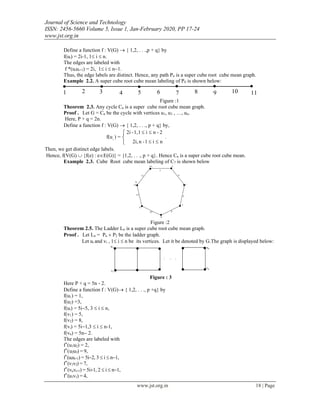
Example 2.2. A super cube root cube mean labeling of P6 is shown below:
Figure :1
Theorem 2.3. Any cycle Cn is a super cube root cube mean graph.
Proof . Let G = Cn be the cycle with vertices u1, u3 , …, un.
Here, P + q = 2n.
Define a function f : V(G) → { 1,2, . . ., p + q} by,
i
2i -1,1 i n - 2
f(u ) =
2i, n -1 i n
 
 



.
Then, we get distinct edge labels.
Hence, f(V(G)  {f(e) : eE(G)} = {1,2, . . ., p + q}. Hence Cn is a super cube root cube mean.
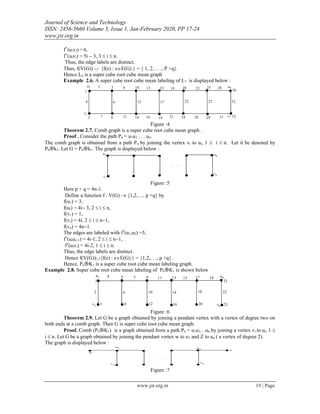
Example 2.3. Cube Root cube mean labeling of C7 is shown below
Figure :2
Theorem 2.5. The Ladder Ln is a super cube root cube mean graph.
Proof . Let Ln = Pn  P2 be the ladder graph.
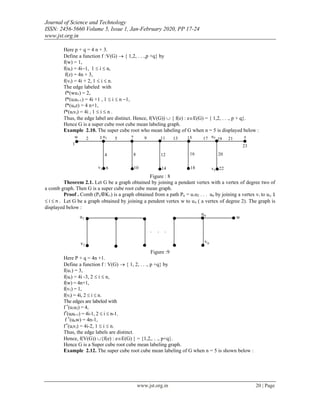
Let ui and vi , 1 i  n be its vertices. Let it be denoted by G.The graph is displayed below:
Figure : 3
Here P + q = 5n - 2.
Define a function f : V(G)→ { 1,2, . . ., p +q} by
f(u1) = 1,
f(u2) =3,
f(ui) = 5i−5, 3  i  n,
f(v1) = 5,
f(v2) = 8,
f(vi) = 5i−1,3  i  n-1,
f(vn) = 5n− 2.
The edges are labeled with
f*
(u1u2) = 2,
f*
(u2u3) = 9,
f*
(uiui+1) = 5i−2, 3  i  n−1,
f*
(v1v2) = 7,
f*
(vi,vi+1) = 5i+, 2  i  n−1,
f*
(u1v1) = 4,
Journal of Science and Technology
ISSN: 2456-5660 Volume 5, Issue 1, Jan-February 2020, PP 17-24
www.jst.org.in
www.jst.org.in 19 | Page
f*
(u1v2) = 6,
f*
(uivi) = 5i − 3, 3  i  n.
Thus, the edge labels are distinct.
Thus, f(V(G))  {f(e) : eE(G) } = { 1, 2, . . ., P +q}.
Hence Ln is a super cube root cube mean graph
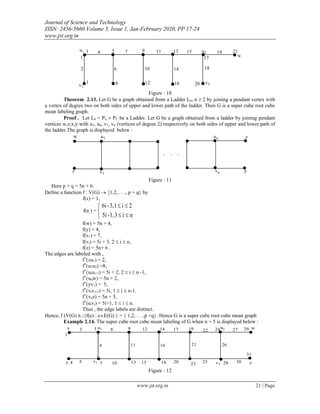
Example 2.6. A super cube root cube mean labeling of L7 is displayed below :
Figure :4
Theorem 2.7. Comb graph is a super cube root cube mean graph .
Proof . Consider the path Pn = u1u2 . . . un.
The comb graph is obtained from a path Pn by joining the vertex vi to ui, 1  i  n. Let it be denoted by
Pnk1. Let G = Pnk1. The graph is displayed below :
Figure :5
Here p + q = 4n-1.
Define a function f : V(G) → {1,2,…, p +q} by
f(u1) = 3,
f(ui) = 4i− 3, 2  i  n,
f(v1) = 1,
f(vi) = 4i, 2  i  n−1,
f(vn) = 4n−1.
The edges are labeled with f*
(u1,u2) =5,
f*
(uiui+1) = 4i-1, 2  i  n−1,
f*
(uivi) = 4i-2, 1  i  n
Thus, the edge labels are distinct.
Hence f(V(G)){f(e) : eE(G) } = {1,2,. . ., p +q} .
Hence, PnK1 is a super cube root cube mean labeling graph.
Example 2.8. Super cube root cube mean labeling of P6K1 is shown below
Figure :6
Theorem 2.9. Let G be a graph obtained by joining a pendant vertex with a vertex of degree two on
both ends at a comb graph. Then G is super cube root cube mean graph.
Proof. Comb (PnK1) is a graph obtained from a path Pn = u1u2…un by joining a vertex vi to ui, 1 
i  n. Let G be a graph obtained by joining the pendant vertex w to u1 and Z to un ( a vertex of degree 2).
The graph is displayed below :
Figure :7
Journal of Science and Technology
ISSN: 2456-5660 Volume 5, Issue 1, Jan-February 2020, PP 17-24
www.jst.org.in
www.jst.org.in 20 | Page
Here p + q = 4 n + 3.
Define a function f :V(G) → { 1,2, . . .,p +q} by
f(w) = 1,
f(ui) = 4i−1, 1  i  n,
f(z) = 4n + 3,
f(vi) = 4i + 2, 1  i  n.
The edge labeled with
f*(wu1) = 2,
f*(uiui+1) = 4i +1 , 1  i  n −1,
f*(unz) = 4 n+1,
f*(uivi) = 4i , 1  i  n .
Thus, the edge label are distinct. Hence, f(V(G))  { f(e) : eE(G) = { 1,2, . . ., p + q}.
Hence G is a super cube root cube mean labeling graph.
Example 2.10. The super cube root who mean labeling of G when n = 5 is displayed below :
Figure : 8
Theorem 2.1. Let G be a graph obtained by joining a pendant vertex with a vertex of degree two of
a comb graph. Then G is a super cube root cube mean graph.
Proof . Comb (PnK1) is a graph obtained from a path Pn = u1u2 . . . un by joining a vertex vi to ui, 1
 i  n . Let G be a graph obtained by joining a pendent vertex w to un ( a vertex of degree 2). The graph is
displayed below :
Figure :9
Here P + q = 4n +1.
Define a function f : V(G) → { 1, 2, . . ., p +q} by
f(u1) = 3,
f(ui) = 4i -3, 2  i  n,
f(w) = 4n+1,
f(v1) = 1,
f(vi) = 4i, 2  i  n.
The edges are labeled with
f *
(u1u2) = 4,
f*
(uiui+1) = 4i-1, 2  i  n-1.
f *
(unw) = 4n-1,
f*
(uivi) = 4i-2, 1  i  n.
Thus, the edge labels are distinct.
Hence, f(V(G)) {f(e) : eE(G) } = {1,2,. . ., p+q}.
Hence G is a Super cube root cube mean labeling graph.
Example 2.12. The super cube root cube mean labeling of G when n = 5 is shown below :
Journal of Science and Technology
ISSN: 2456-5660 Volume 5, Issue 1, Jan-February 2020, PP 17-24
www.jst.org.in
www.jst.org.in 21 | Page
Figure : 10
Theorem 2.13. Let G be a graph obtained from a Ladder Ln, n  2 by joining a pendant vertex with
a vertex of degree two on both sides of upper and lower path of the ladder. Then G is a super cube root cube
mean labeling graph.
Proof . Let Ln = Pn  P2 be a Ladder. Let G be a graph obtained from a ladder by joining pendant
vertices w,z,x,y with u1, un, v1, vn (vertices of degree 2) respectively on both sides of upper and lower path of
the ladder.The graph is displayed below :
Figure : 11
Here p + q = 5n + 6.
Define a function f : V(G) → {1,2, . . ., p + q} by
f(x) = 1,
i
f(u ) =
6i-3,1 i 2
5i-1,3 i n
 


 

f(w) = 5n + 4,
f(y) = 4,
f(v1) = 7,
f(vi) = 5i + 3, 2  i  n,
f(z) = 5n+ 6 .
The edges are labeled with ,
f*
(xu1) = 2,
f*
(u1u2) =8,
f*
(uiui+1) = 5i + 2, 2  i  n -1,
f*
(unw) = 5n + 2,
f*
(yv1) = 5,
f*
(vivi+1) = 5i, 1  i  n-1.
f*
(vnz) = 5n + 5,
f*
(uivi) = 5i+1, 1  i  n.
Thus , the edge labels are distinct.
Hence, f (V(G) ){f(e) : eE(G) } = { 1,2, . . .,p +q}. Hence G is a super cube root cube mean graph
Example 2.14. The super cube root cube mean labeling of G when n = 5 is displayed below :
Figure : 12
Journal of Science and Technology
ISSN: 2456-5660 Volume 5, Issue 1, Jan-February 2020, PP 17-24
www.jst.org.in
www.jst.org.in 22 | Page
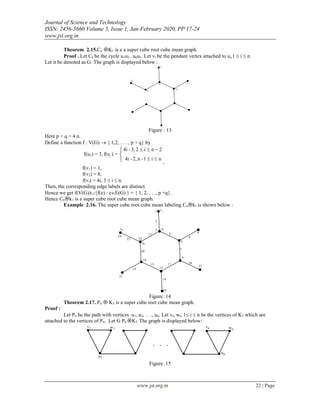
Theorem 2.15.Cn K1 is a a super cube root cube mean graph.
Proof . Let Cn be the cycle u1u2…unu1. Let vi be the pendant vertex attached to ui,1  i  n.
Let it be denoted as G. The graph is displayed below :
Figure : 13
Here p + q = 4 n.
Define a function f : V(G) → { 1,2, . . . , p + q} by
f(u1) = 3, i
4i - 3, 2 i n 2
f(u ) =
4i - 2, n -1 i n
  −
 


 ,
f(v1) = 1,
f(v2) = 8,
f(vi) = 4i, 3  i  n.
Then, the corresponding edge labels are distinct.
Hence we get f(V(G)){f(e) : eE(G) } = { 1, 2, . . ., p +q}.
Hence Cnk1 is a super cube root cube mean graph.
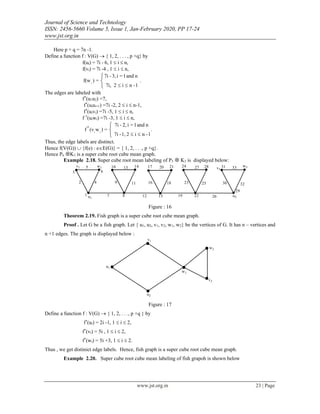
Example 2.16. The super cube root cube mean labeling Cnk1 is shown below :
Figure :14
Theorem 2.17. Pn  K3 is a super cube root cube mean graph.
Proof :
Let Pn be the path with vertices u1, u2, . . ., un. Let vi, wi, 1 i  n be the vertices of K3 which are
attached to the vertices of Pn. Let G Pn K3 .The graph is displayed below:
Figure .15
Journal of Science and Technology
ISSN: 2456-5660 Volume 5, Issue 1, Jan-February 2020, PP 17-24
www.jst.org.in
www.jst.org.in 23 | Page
Here p + q = 7n -1.
Define a function f : V(G) → { 1, 2, . . . , p +q} by
f(ui) = 7i - 6, 1  i  n,
f(vi) = 7i -4 , 1  i  n,
i
7i - 3,i =1and n
f(w ) =
7i, 2 i n -1
 



.
The edges are labeled with
f*
(u1u2) =7,
f*
(uiui+1) =7i -2, 2  i  n-1,
f*
(uivi) =7i -5, 1  i  n,
f *
(uiwi) =7i -3, 1  i  n,
i i
*
7i - 2, i =1and n
f (v w ) =
7i -1, 2 i n -1
 



.
Thus, the edge labels are distinct.
Hence f(V(G))  {f(e) : eE(G)} = { 1, 2, . . ., p +q}.
Hence Pn K3 is a super cube root cube mean graph.
Example 2.18. Super cube root mean labeling of P5  K3 is displayed below:
Figure : 16
Theorem 2.19. Fish graph is a super cube root cube mean graph.
Proof . Let G be a fish graph. Let { u1, u2, v1, v2, w1, w2} be the vertices of G. It has n – vertices and
n +1 edges. The graph is displayed below :
Figure : 17
Define a function f : V(G) → { 1, 2, . . ., p +q } by
f*
(ui) = 2i -1, 1  i  2,
f*
(vi) = 5i , 1  i  2,
f*
(wi) = 5i +3, 1  i  2.
Thus , we get distinict edge labels. Hence, fish graph is a super cube root cube mean graph.
Example 2.20. Super cube root cube mean labeling of fish grapoh is shown below
Journal of Science and Technology
ISSN: 2456-5660 Volume 5, Issue 1, Jan-February 2020, PP 17-24
www.jst.org.in
www.jst.org.in 24 | Page
Figure : 18
References
[1]. J.A Gallian, A dynamic survey of graph labeling , “ The Electronic Journal of Combinatorics 17(2014), # DS6.
[2]. F. Harray, Graph Theory, Narosa publishing House Reading, New Delhi, 1988.
[3]. S.Arokia Raj, A. Durai Baskar and A. Rajesh Kannan F-Root square Mean labeling of Graphs obtained from path, International
journal of mathematics and Combinatorics, Vol. 2 (2017), 92-104.
[4]. S. Sandhya, S. Somasundaram and S. Anusa, Some More Results on Root Square mean Graphs, Journal of Mathamatics
Research.7, No.1; (2015), 72-81.
[5]. S. Kulandhai Therese and K. Romila, Cube root Cube Mean labeling of Graphs, International Journal of Mathematics Trends and
Technology ( IJMTT)-Volume 65, Issue 2 –February 2019.
[6]. R. Gowri and G. Vembarasi, “ Root Cube Mean labeling of graphs”, International Journal of Engineering Science, Advanced
Computing and Bio – Technology Vol 8, No.4, October –December 2017, pp.248-255
[7]. R. Ponraj and S. Somasundaram, Mean labeling of graphs , National Academy of Science Letters 26,(2013), 210-213.

Super Cube Root Cube Mean Labeling of Graphs

  • 1.
    Journal of Scienceand Technology ISSN: 2456-5660 Volume 5, Issue 1, Jan-February 2020, PP 17-24 www.jst.org.in www.jst.org.in 17 | Page Super Cube Root Cube Mean Labeling of Graphs Radhika V.S.1 Vijayan A.2 1( Research Scholar, Department of Mathematics, Nesamony Memorial Christian College, Marthandam, Kanyakumari District, Tamil Nadu, India.) 2 ( Research Scholar, Department of Mathematics, Nesamony Memorial Christian College, Marthandam, Kanyakumari District, Tamil Nadu, India.) __________________________________________________________________________________________________________________________________________________ Abstract: A function f is called super cube root cube mean labeling of a graph G = (V,E) with p- vertices and q- edges if f: V(G) →{ 1, 2, . . ., p + q} is injective and the induced function f* defined as f* (uv) = 3 3 3 f(u) + f(v) 2       or 3 3 3 f(u) + f(v) 2       . For all uvE(G) is bijective. Then the resulting edge labels are distinct. A graph that admits a super cube root cube mean labeling f is called a super cube root cube means graph. In this paper we introduce super cube root cube mean labeling and investigate super cube root cube mean labeling of path Pn, Comb graph, ladder graph, pendant vertex attached with comb graph, pendant vertex attached with the ladder graph, CnK1, PnK3 and Fish graph. Keywords: cube, root, square, graph ______________________________________________________________________________________________________________ 1. INTRODUCTION By a graph G = (V,E) we mean a finite undirected graph without loops or parallel edges. For all detailed survey of graph labeling was refer to J.A. Gallian [1]. For all other standard terminology and notations we follow F.Harray [2]. The concept of Mean Labeling has been introduced by S. Somasundaram and R. Ponraj [7]. Root square Mean labeling of Graphs has been introduced by S. Sandhya, S. Somasundaram and A. Anusa[4].Root cube mean labeling of graphs has been introduced by Gowri and Vembarari[6]. Cube root cube Mean labeling was introduced by S. Kulandhai Therese and K. Romila [5]. Motivated from the above works, we introduced a new type of labeling called Super Cube root cube Mean Labeling of graphs. In this paper, we investigate the super cube root cube mean labeling of some graphs such as Path Pn, Comb graph, ladder graph, pendant vertex attached with comb graph, pendent vertex attached with the ladder graph, CnK1, Pn  K3 and Fish graph. We now give the following definitions which are useful for the present investigation. Definition 1.1. A function f is called a cube root cube mean labeling of a graph G, if f : V(G) → { 1, 2, …, q + 1 } is injective and the induced edge function f*: E(G) → { 1, 2, . . ., q} defined as f*( e= uv) = 3 3 3 f(u) + f(v) 2         or 3 3 3 f(u) f(v) 2 +       is bijective. Thus a graph which admits cube root cube mean labeling is called as cube root cube mean graph. Definition 1.2. Let f : V(G) → {1,2,. . ., p +q} be an injective function. For a vertex labeling f, the induced edge labeling f*(e = uv) is defined by f*(e) 3 3 3 f(u) + f(v) 2         or 3 3 3 f(u) f(v) 2 +       . Then f is called a super cube root cube mean labeling if f(V(G)) {f(e) : eE(G)} = { 1,2, . . ., p +q}. A graph which admits super cube root cube mean labeling is called a super cube root cube mean graph. Definition 1.3. A walk in which vertices are distinct is called a path. A path on n- vertices is denoted by Pn. Definition 1.4. The graph obtained by joining a single pendent edge to each vertex of a path is called as comb graph. Definition 1.5. The product graph P2 Pn is called as Ladder and is denoted by Ln. II . MAIN RESULTS Theorem 2.1.Any path Pn is a super cube root cube mean labeling graph Proof . Let G = Pn be the path with vertices u1,u2,. . .,un. Here , p + q = 2n-1.
  • 2.
    Journal of Scienceand Technology ISSN: 2456-5660 Volume 5, Issue 1, Jan-February 2020, PP 17-24 www.jst.org.in www.jst.org.in 18 | Page Define a function f : V(G) → { 1,2, . . .,p + q} by f(ui) = 2i-1, 1 i  n. The edges are labeled with f *(uiui+1) = 2i, 1 i  n−1. Thus, the edge labels are distinct. Hence, any path Pn is a super cube root cube mean graph. Example 2.2. A super cube root cube mean labeling of P6 is shown below: Figure :1 Theorem 2.3. Any cycle Cn is a super cube root cube mean graph. Proof . Let G = Cn be the cycle with vertices u1, u3 , …, un. Here, P + q = 2n. Define a function f : V(G) → { 1,2, . . ., p + q} by, i 2i -1,1 i n - 2 f(u ) = 2i, n -1 i n        . Then, we get distinct edge labels. Hence, f(V(G)  {f(e) : eE(G)} = {1,2, . . ., p + q}. Hence Cn is a super cube root cube mean. Example 2.3. Cube Root cube mean labeling of C7 is shown below Figure :2 Theorem 2.5. The Ladder Ln is a super cube root cube mean graph. Proof . Let Ln = Pn  P2 be the ladder graph. Let ui and vi , 1 i  n be its vertices. Let it be denoted by G.The graph is displayed below: Figure : 3 Here P + q = 5n - 2. Define a function f : V(G)→ { 1,2, . . ., p +q} by f(u1) = 1, f(u2) =3, f(ui) = 5i−5, 3  i  n, f(v1) = 5, f(v2) = 8, f(vi) = 5i−1,3  i  n-1, f(vn) = 5n− 2. The edges are labeled with f* (u1u2) = 2, f* (u2u3) = 9, f* (uiui+1) = 5i−2, 3  i  n−1, f* (v1v2) = 7, f* (vi,vi+1) = 5i+, 2  i  n−1, f* (u1v1) = 4,
  • 3.
    Journal of Scienceand Technology ISSN: 2456-5660 Volume 5, Issue 1, Jan-February 2020, PP 17-24 www.jst.org.in www.jst.org.in 19 | Page f* (u1v2) = 6, f* (uivi) = 5i − 3, 3  i  n. Thus, the edge labels are distinct. Thus, f(V(G))  {f(e) : eE(G) } = { 1, 2, . . ., P +q}. Hence Ln is a super cube root cube mean graph Example 2.6. A super cube root cube mean labeling of L7 is displayed below : Figure :4 Theorem 2.7. Comb graph is a super cube root cube mean graph . Proof . Consider the path Pn = u1u2 . . . un. The comb graph is obtained from a path Pn by joining the vertex vi to ui, 1  i  n. Let it be denoted by Pnk1. Let G = Pnk1. The graph is displayed below : Figure :5 Here p + q = 4n-1. Define a function f : V(G) → {1,2,…, p +q} by f(u1) = 3, f(ui) = 4i− 3, 2  i  n, f(v1) = 1, f(vi) = 4i, 2  i  n−1, f(vn) = 4n−1. The edges are labeled with f* (u1,u2) =5, f* (uiui+1) = 4i-1, 2  i  n−1, f* (uivi) = 4i-2, 1  i  n Thus, the edge labels are distinct. Hence f(V(G)){f(e) : eE(G) } = {1,2,. . ., p +q} . Hence, PnK1 is a super cube root cube mean labeling graph. Example 2.8. Super cube root cube mean labeling of P6K1 is shown below Figure :6 Theorem 2.9. Let G be a graph obtained by joining a pendant vertex with a vertex of degree two on both ends at a comb graph. Then G is super cube root cube mean graph. Proof. Comb (PnK1) is a graph obtained from a path Pn = u1u2…un by joining a vertex vi to ui, 1  i  n. Let G be a graph obtained by joining the pendant vertex w to u1 and Z to un ( a vertex of degree 2). The graph is displayed below : Figure :7
  • 4.
    Journal of Scienceand Technology ISSN: 2456-5660 Volume 5, Issue 1, Jan-February 2020, PP 17-24 www.jst.org.in www.jst.org.in 20 | Page Here p + q = 4 n + 3. Define a function f :V(G) → { 1,2, . . .,p +q} by f(w) = 1, f(ui) = 4i−1, 1  i  n, f(z) = 4n + 3, f(vi) = 4i + 2, 1  i  n. The edge labeled with f*(wu1) = 2, f*(uiui+1) = 4i +1 , 1  i  n −1, f*(unz) = 4 n+1, f*(uivi) = 4i , 1  i  n . Thus, the edge label are distinct. Hence, f(V(G))  { f(e) : eE(G) = { 1,2, . . ., p + q}. Hence G is a super cube root cube mean labeling graph. Example 2.10. The super cube root who mean labeling of G when n = 5 is displayed below : Figure : 8 Theorem 2.1. Let G be a graph obtained by joining a pendant vertex with a vertex of degree two of a comb graph. Then G is a super cube root cube mean graph. Proof . Comb (PnK1) is a graph obtained from a path Pn = u1u2 . . . un by joining a vertex vi to ui, 1  i  n . Let G be a graph obtained by joining a pendent vertex w to un ( a vertex of degree 2). The graph is displayed below : Figure :9 Here P + q = 4n +1. Define a function f : V(G) → { 1, 2, . . ., p +q} by f(u1) = 3, f(ui) = 4i -3, 2  i  n, f(w) = 4n+1, f(v1) = 1, f(vi) = 4i, 2  i  n. The edges are labeled with f * (u1u2) = 4, f* (uiui+1) = 4i-1, 2  i  n-1. f * (unw) = 4n-1, f* (uivi) = 4i-2, 1  i  n. Thus, the edge labels are distinct. Hence, f(V(G)) {f(e) : eE(G) } = {1,2,. . ., p+q}. Hence G is a Super cube root cube mean labeling graph. Example 2.12. The super cube root cube mean labeling of G when n = 5 is shown below :
  • 5.
    Journal of Scienceand Technology ISSN: 2456-5660 Volume 5, Issue 1, Jan-February 2020, PP 17-24 www.jst.org.in www.jst.org.in 21 | Page Figure : 10 Theorem 2.13. Let G be a graph obtained from a Ladder Ln, n  2 by joining a pendant vertex with a vertex of degree two on both sides of upper and lower path of the ladder. Then G is a super cube root cube mean labeling graph. Proof . Let Ln = Pn  P2 be a Ladder. Let G be a graph obtained from a ladder by joining pendant vertices w,z,x,y with u1, un, v1, vn (vertices of degree 2) respectively on both sides of upper and lower path of the ladder.The graph is displayed below : Figure : 11 Here p + q = 5n + 6. Define a function f : V(G) → {1,2, . . ., p + q} by f(x) = 1, i f(u ) = 6i-3,1 i 2 5i-1,3 i n        f(w) = 5n + 4, f(y) = 4, f(v1) = 7, f(vi) = 5i + 3, 2  i  n, f(z) = 5n+ 6 . The edges are labeled with , f* (xu1) = 2, f* (u1u2) =8, f* (uiui+1) = 5i + 2, 2  i  n -1, f* (unw) = 5n + 2, f* (yv1) = 5, f* (vivi+1) = 5i, 1  i  n-1. f* (vnz) = 5n + 5, f* (uivi) = 5i+1, 1  i  n. Thus , the edge labels are distinct. Hence, f (V(G) ){f(e) : eE(G) } = { 1,2, . . .,p +q}. Hence G is a super cube root cube mean graph Example 2.14. The super cube root cube mean labeling of G when n = 5 is displayed below : Figure : 12
  • 6.
    Journal of Scienceand Technology ISSN: 2456-5660 Volume 5, Issue 1, Jan-February 2020, PP 17-24 www.jst.org.in www.jst.org.in 22 | Page Theorem 2.15.Cn K1 is a a super cube root cube mean graph. Proof . Let Cn be the cycle u1u2…unu1. Let vi be the pendant vertex attached to ui,1  i  n. Let it be denoted as G. The graph is displayed below : Figure : 13 Here p + q = 4 n. Define a function f : V(G) → { 1,2, . . . , p + q} by f(u1) = 3, i 4i - 3, 2 i n 2 f(u ) = 4i - 2, n -1 i n   −      , f(v1) = 1, f(v2) = 8, f(vi) = 4i, 3  i  n. Then, the corresponding edge labels are distinct. Hence we get f(V(G)){f(e) : eE(G) } = { 1, 2, . . ., p +q}. Hence Cnk1 is a super cube root cube mean graph. Example 2.16. The super cube root cube mean labeling Cnk1 is shown below : Figure :14 Theorem 2.17. Pn  K3 is a super cube root cube mean graph. Proof : Let Pn be the path with vertices u1, u2, . . ., un. Let vi, wi, 1 i  n be the vertices of K3 which are attached to the vertices of Pn. Let G Pn K3 .The graph is displayed below: Figure .15
  • 7.
    Journal of Scienceand Technology ISSN: 2456-5660 Volume 5, Issue 1, Jan-February 2020, PP 17-24 www.jst.org.in www.jst.org.in 23 | Page Here p + q = 7n -1. Define a function f : V(G) → { 1, 2, . . . , p +q} by f(ui) = 7i - 6, 1  i  n, f(vi) = 7i -4 , 1  i  n, i 7i - 3,i =1and n f(w ) = 7i, 2 i n -1      . The edges are labeled with f* (u1u2) =7, f* (uiui+1) =7i -2, 2  i  n-1, f* (uivi) =7i -5, 1  i  n, f * (uiwi) =7i -3, 1  i  n, i i * 7i - 2, i =1and n f (v w ) = 7i -1, 2 i n -1      . Thus, the edge labels are distinct. Hence f(V(G))  {f(e) : eE(G)} = { 1, 2, . . ., p +q}. Hence Pn K3 is a super cube root cube mean graph. Example 2.18. Super cube root mean labeling of P5  K3 is displayed below: Figure : 16 Theorem 2.19. Fish graph is a super cube root cube mean graph. Proof . Let G be a fish graph. Let { u1, u2, v1, v2, w1, w2} be the vertices of G. It has n – vertices and n +1 edges. The graph is displayed below : Figure : 17 Define a function f : V(G) → { 1, 2, . . ., p +q } by f* (ui) = 2i -1, 1  i  2, f* (vi) = 5i , 1  i  2, f* (wi) = 5i +3, 1  i  2. Thus , we get distinict edge labels. Hence, fish graph is a super cube root cube mean graph. Example 2.20. Super cube root cube mean labeling of fish grapoh is shown below
  • 8.
    Journal of Scienceand Technology ISSN: 2456-5660 Volume 5, Issue 1, Jan-February 2020, PP 17-24 www.jst.org.in www.jst.org.in 24 | Page Figure : 18 References [1]. J.A Gallian, A dynamic survey of graph labeling , “ The Electronic Journal of Combinatorics 17(2014), # DS6. [2]. F. Harray, Graph Theory, Narosa publishing House Reading, New Delhi, 1988. [3]. S.Arokia Raj, A. Durai Baskar and A. Rajesh Kannan F-Root square Mean labeling of Graphs obtained from path, International journal of mathematics and Combinatorics, Vol. 2 (2017), 92-104. [4]. S. Sandhya, S. Somasundaram and S. Anusa, Some More Results on Root Square mean Graphs, Journal of Mathamatics Research.7, No.1; (2015), 72-81. [5]. S. Kulandhai Therese and K. Romila, Cube root Cube Mean labeling of Graphs, International Journal of Mathematics Trends and Technology ( IJMTT)-Volume 65, Issue 2 –February 2019. [6]. R. Gowri and G. Vembarasi, “ Root Cube Mean labeling of graphs”, International Journal of Engineering Science, Advanced Computing and Bio – Technology Vol 8, No.4, October –December 2017, pp.248-255 [7]. R. Ponraj and S. Somasundaram, Mean labeling of graphs , National Academy of Science Letters 26,(2013), 210-213.