Sponsored by:
Simplified Data Mining for Direct
Mail
Sue and Ron Rescigno
May 28, 2013
Use Twitter Hashtag #npweb
Part
Of:
Sponsored by:
Protecting and Preserving the
Institutional Memories of
Nonprofits Since 1993
www.cjwconsulting.com
(866) 598-0430
info@cjwconsulting.com
Part
Of:
Sponsored by:Part
Of:
Coming this June
Sponsored by:
Today’s Speaker
Ron and Sue Rescigno
President & Vice President
Rescigno's Marketing Connections
Hosting:
Cheri J Weissman, CJW Consulting & Services, Inc.
Assisting with chat questions:
Jamie Maloney, 4Good
Part
Of:
Simplified Data Mining for Direct Mail
Ron and Susan Rescigno
708.974.2600
In this presentation we will answer…
What is data mining?
What data should I be gathering?
How can I use data for my fundraising campaigns?
How can looking at data save me money and
reduce my costs?
How can I maximize my fundraising budget by
making more money with less of a budget?
How can I give this data to a mail house that
understands what I mean?
Data Mining is the search for hidden information:
The locating of previously unknown
patterns and relationships within data
using a database application.
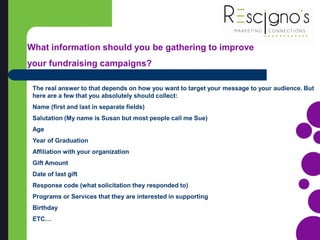
The real answer to that depends on how you want to target your message to your audience. But
here are a few that you absolutely should collect:
Name (first and last in separate fields)
Salutation (My name is Susan but most people call me Sue)
Age
Year of Graduation
Affiliation with your organization
Gift Amount
Date of last gift
Response code (what solicitation they responded to)
Programs or Services that they are interested in supporting
Birthday
ETC…
What information should you be gathering to improve
your fundraising campaigns?
Once you have collected the
information and put it into the system,
it can be used by segmenting your
data into groups and writing
specifically to each group member.
Here are some ideas of different
segments…
Ideas for Segmenting
Donor/Non Donor
Age
Gender
Friends
Current Parents/Parents of Alums
Lybunts/Sybunts/Event Attendees/New Members
Past Patients Community Members
Segment Options
•Major donor – this referenced their largest gift
from the past 5 years
“John, the Brothers always appreciate your
support. Among your gifts over the years was an
especially generous $1,500. Please know that
we are grateful for your support at whatever
level is comfortable for you. We would like to
ask, however, if you could consider renewing
your support at that significant level.”
Segment Options
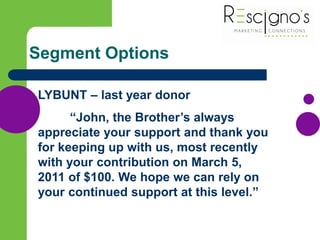
LYBUNT – last year donor
“John, the Brother’s always
appreciate your support and thank you
for keeping up with us, most recently
with your contribution on March 5,
2011 of $100. We hope we can rely on
your continued support at this level.”
Segment Options
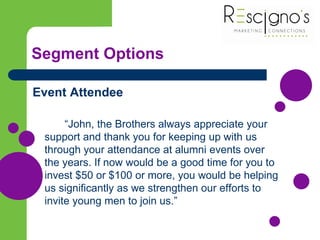
Event Attendee
“John, the Brothers always appreciate your
support and thank you for keeping up with us
through your attendance at alumni events over
the years. If now would be a good time for you to
invest $50 or $100 or more, you would be helping
us significantly as we strengthen our efforts to
invite young men to join us.”
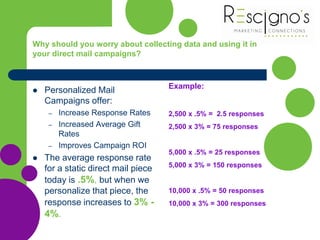
 Personalized Mail
Campaigns offer:
– Increase Response Rates
– Increased Average Gift
Rates
– Improves Campaign ROI
 The average response rate
for a static direct mail piece
today is .5%, but when we
personalize that piece, the
response increases to 3% -
4%.
Why should you worry about collecting data and using it in
your direct mail campaigns?
Example:
2,500 x .5% = 2.5 responses
2,500 x 3% = 75 responses
5,000 x .5% = 25 responses
5,000 x 3% = 150 responses
10,000 x .5% = 50 responses
10,000 x 3% = 300 responses
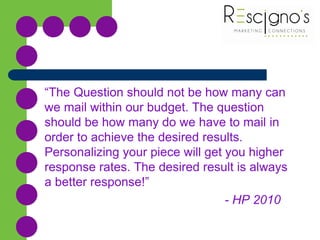
“The Question should not be how many can
we mail within our budget. The question
should be how many do we have to mail in
order to achieve the desired results.
Personalizing your piece will get you higher
response rates. The desired result is always
a better response!”
- HP 2010
So how can we save money by looking at our data?
First look at how many you are mailing to and what your
response rate is
Should you be mailing to all of these people on your list?
When is the last time you heard from these people?
Are you writing to them about something they are interested in?
Are you writing to them just because this is the list you inherited and you
never really looked at it?
Data mining is the most cost
effective way to increase your
ROI for direct mail
$ $
$
$
Staying Cost Effective
If you are mailing to 12,000 people and getting basically
the same 1,300 donors to renew their gift every year,
then you have to ask yourself if that is cost-effective.
By taking a look at your donors, you can find the patterns
or similarities in them and find out what your average
donor looks like. For example:
Gender
Age
Income range
Geographic location
What’s NEXT?
 You can then take that information and find those
that match that group in your non-donors. You could
cut your list in half or even more.
 I am not saying don’t communicate with those other
but in a time when you have to watch your budget so
closely, maybe you shouldn’t be mailing to them as
much as the donors.
 Keep them on newsletter lost and email list.
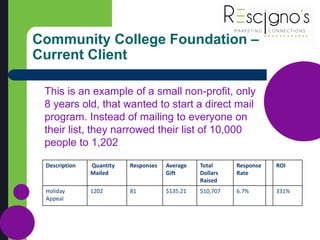
This is an example of a small non-profit, only
8 years old, that wanted to start a direct mail
program. Instead of mailing to everyone on
their list, they narrowed their list of 10,000
people to 1,202
Community College Foundation –
Current Client
Description Quantity
Mailed
Responses Average
Gift
Total
Dollars
Raised
Response
Rate
ROI
Holiday
Appeal
1202 81 $135.21 $10,707 6.7% 331%
Description Quantity
Mailed
Responses Average Gift Total Dollars
Raised
Response
Rate
ROI
Holiday Appeal 1202 81 $135.21 $10,707 6.7% 331%
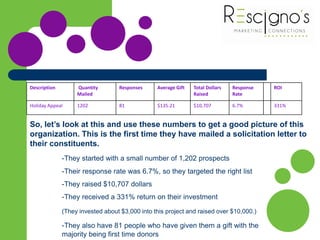
So, let’s look at this and use these numbers to get a good picture of this
organization. This is the first time they have mailed a solicitation letter to
their constituents.
-They started with a small number of 1,202 prospects
-Their response rate was 6.7%, so they targeted the right list
-They raised $10,707 dollars
-They received a 331% return on their investment
(They invested about $3,000 into this project and raised over $10,000.)
-They also have 81 people who have given them a gift with the
majority being first time donors
Now what..?
Now that we’ve discussed what data mining
is, what kinds of information should be
gathered, how are other organizations using
their personalized data and how you can use
it to save money on your direct mail, we need
to talk about how you can collect the data
and present it to the mail house so mistakes
are not made.
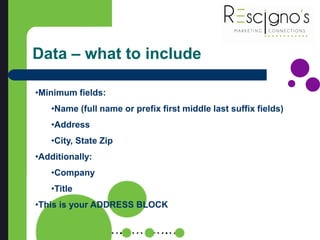
Data – what to include
•Minimum fields:
•Name (full name or prefix first middle last suffix fields)
•Address
•City, State Zip
•Additionally:
•Company
•Title
•This is your ADDRESS BLOCK
Data – what to include
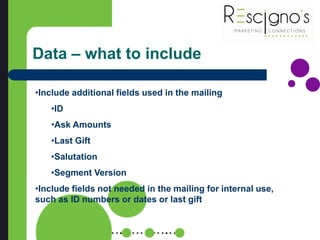
•Include additional fields used in the mailing
•ID
•Ask Amounts
•Last Gift
•Salutation
•Segment Version
•Include fields not needed in the mailing for internal use,
such as ID numbers or dates or last gift
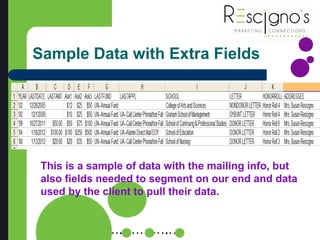
Sample Data with Extra Fields
This is a sample of data with the mailing info, but
also fields needed to segment on our end and data
used by the client to pull their data.
How to add information to your
existing data
•Put reply codes on reply devices to track campaigns
•Personalize your reply cards and ask for updates (incl. ID
#’s to make data entry easier)
•Leave room for Cell #’s, Email, etc.
•Utilize data append services – can add age info, income,
ownership, etc.
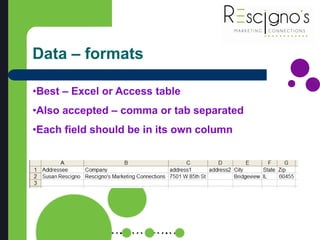
Data – formats
•Best – Excel or Access table
•Also accepted – comma or tab separated
•Each field should be in its own column
Data – what NOT to do
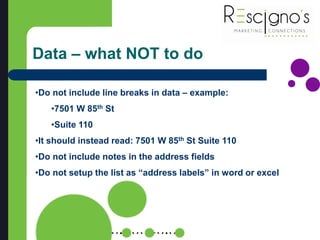
•Do not include line breaks in data – example:
•7501 W 85th St
•Suite 110
•It should instead read: 7501 W 85th St Suite 110
•Do not include notes in the address fields
•Do not setup the list as “address labels” in word or excel
Data – what NOT to do
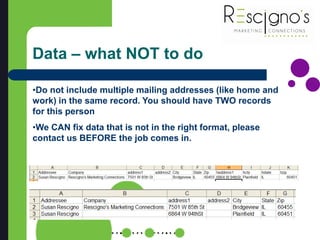
•Do not include multiple mailing addresses (like home and
work) in the same record. You should have TWO records
for this person
•We CAN fix data that is not in the right format, please
contact us BEFORE the job comes in.
Your data and you…
•Your donor database should be your institutional memory.
•it should make it easy for you to look up donors, view
giving histories, understand relationships and analyze
trends.
•It should help your fundraisers work more effectively.
•It should be an aid, NOT a chore!
Rescigno’s Data Consulting
•Rescigno’s Marketing Connections can help you with your
data.
•Available for consultation, database creation and
updates/pulling queries
•We can host your database and give you remote access to
it.
•We can append your data with more information.
Thank You!
Any Questions??
708.974.2600
Sponsored by:
Find listings for our current season
of webinars and register at:
NonprofitWebinars.com
Part
Of:

Simplified Data Mining for Direct Mail

  • 1.
    Sponsored by: Simplified DataMining for Direct Mail Sue and Ron Rescigno May 28, 2013 Use Twitter Hashtag #npweb Part Of:
  • 2.
    Sponsored by: Protecting andPreserving the Institutional Memories of Nonprofits Since 1993 www.cjwconsulting.com (866) 598-0430 info@cjwconsulting.com Part Of:
  • 3.
  • 4.
    Sponsored by: Today’s Speaker Ronand Sue Rescigno President & Vice President Rescigno's Marketing Connections Hosting: Cheri J Weissman, CJW Consulting & Services, Inc. Assisting with chat questions: Jamie Maloney, 4Good Part Of:
  • 5.
    Simplified Data Miningfor Direct Mail Ron and Susan Rescigno 708.974.2600
  • 6.
    In this presentationwe will answer… What is data mining? What data should I be gathering? How can I use data for my fundraising campaigns? How can looking at data save me money and reduce my costs? How can I maximize my fundraising budget by making more money with less of a budget? How can I give this data to a mail house that understands what I mean?
  • 7.
    Data Mining isthe search for hidden information: The locating of previously unknown patterns and relationships within data using a database application.
  • 8.
    The real answerto that depends on how you want to target your message to your audience. But here are a few that you absolutely should collect: Name (first and last in separate fields) Salutation (My name is Susan but most people call me Sue) Age Year of Graduation Affiliation with your organization Gift Amount Date of last gift Response code (what solicitation they responded to) Programs or Services that they are interested in supporting Birthday ETC… What information should you be gathering to improve your fundraising campaigns?
  • 9.
    Once you havecollected the information and put it into the system, it can be used by segmenting your data into groups and writing specifically to each group member. Here are some ideas of different segments…
  • 10.
    Ideas for Segmenting Donor/NonDonor Age Gender Friends Current Parents/Parents of Alums Lybunts/Sybunts/Event Attendees/New Members Past Patients Community Members
  • 11.
    Segment Options •Major donor– this referenced their largest gift from the past 5 years “John, the Brothers always appreciate your support. Among your gifts over the years was an especially generous $1,500. Please know that we are grateful for your support at whatever level is comfortable for you. We would like to ask, however, if you could consider renewing your support at that significant level.”
  • 12.
    Segment Options LYBUNT –last year donor “John, the Brother’s always appreciate your support and thank you for keeping up with us, most recently with your contribution on March 5, 2011 of $100. We hope we can rely on your continued support at this level.”
  • 13.
    Segment Options Event Attendee “John,the Brothers always appreciate your support and thank you for keeping up with us through your attendance at alumni events over the years. If now would be a good time for you to invest $50 or $100 or more, you would be helping us significantly as we strengthen our efforts to invite young men to join us.”
  • 14.
     Personalized Mail Campaignsoffer: – Increase Response Rates – Increased Average Gift Rates – Improves Campaign ROI  The average response rate for a static direct mail piece today is .5%, but when we personalize that piece, the response increases to 3% - 4%. Why should you worry about collecting data and using it in your direct mail campaigns? Example: 2,500 x .5% = 2.5 responses 2,500 x 3% = 75 responses 5,000 x .5% = 25 responses 5,000 x 3% = 150 responses 10,000 x .5% = 50 responses 10,000 x 3% = 300 responses
  • 15.
    “The Question shouldnot be how many can we mail within our budget. The question should be how many do we have to mail in order to achieve the desired results. Personalizing your piece will get you higher response rates. The desired result is always a better response!” - HP 2010
  • 16.
    So how canwe save money by looking at our data? First look at how many you are mailing to and what your response rate is Should you be mailing to all of these people on your list? When is the last time you heard from these people? Are you writing to them about something they are interested in? Are you writing to them just because this is the list you inherited and you never really looked at it?
  • 17.
    Data mining isthe most cost effective way to increase your ROI for direct mail $ $ $ $
  • 18.
    Staying Cost Effective Ifyou are mailing to 12,000 people and getting basically the same 1,300 donors to renew their gift every year, then you have to ask yourself if that is cost-effective. By taking a look at your donors, you can find the patterns or similarities in them and find out what your average donor looks like. For example: Gender Age Income range Geographic location
  • 19.
    What’s NEXT?  Youcan then take that information and find those that match that group in your non-donors. You could cut your list in half or even more.  I am not saying don’t communicate with those other but in a time when you have to watch your budget so closely, maybe you shouldn’t be mailing to them as much as the donors.  Keep them on newsletter lost and email list.
  • 20.
    This is anexample of a small non-profit, only 8 years old, that wanted to start a direct mail program. Instead of mailing to everyone on their list, they narrowed their list of 10,000 people to 1,202 Community College Foundation – Current Client Description Quantity Mailed Responses Average Gift Total Dollars Raised Response Rate ROI Holiday Appeal 1202 81 $135.21 $10,707 6.7% 331%
  • 21.
    Description Quantity Mailed Responses AverageGift Total Dollars Raised Response Rate ROI Holiday Appeal 1202 81 $135.21 $10,707 6.7% 331% So, let’s look at this and use these numbers to get a good picture of this organization. This is the first time they have mailed a solicitation letter to their constituents. -They started with a small number of 1,202 prospects -Their response rate was 6.7%, so they targeted the right list -They raised $10,707 dollars -They received a 331% return on their investment (They invested about $3,000 into this project and raised over $10,000.) -They also have 81 people who have given them a gift with the majority being first time donors
  • 22.
    Now what..? Now thatwe’ve discussed what data mining is, what kinds of information should be gathered, how are other organizations using their personalized data and how you can use it to save money on your direct mail, we need to talk about how you can collect the data and present it to the mail house so mistakes are not made.
  • 23.
    Data – whatto include •Minimum fields: •Name (full name or prefix first middle last suffix fields) •Address •City, State Zip •Additionally: •Company •Title •This is your ADDRESS BLOCK
  • 24.
    Data – whatto include •Include additional fields used in the mailing •ID •Ask Amounts •Last Gift •Salutation •Segment Version •Include fields not needed in the mailing for internal use, such as ID numbers or dates or last gift
  • 25.
    Sample Data withExtra Fields This is a sample of data with the mailing info, but also fields needed to segment on our end and data used by the client to pull their data.
  • 26.
    How to addinformation to your existing data •Put reply codes on reply devices to track campaigns •Personalize your reply cards and ask for updates (incl. ID #’s to make data entry easier) •Leave room for Cell #’s, Email, etc. •Utilize data append services – can add age info, income, ownership, etc.
  • 27.
    Data – formats •Best– Excel or Access table •Also accepted – comma or tab separated •Each field should be in its own column
  • 28.
    Data – whatNOT to do •Do not include line breaks in data – example: •7501 W 85th St •Suite 110 •It should instead read: 7501 W 85th St Suite 110 •Do not include notes in the address fields •Do not setup the list as “address labels” in word or excel
  • 29.
    Data – whatNOT to do •Do not include multiple mailing addresses (like home and work) in the same record. You should have TWO records for this person •We CAN fix data that is not in the right format, please contact us BEFORE the job comes in.
  • 30.
    Your data andyou… •Your donor database should be your institutional memory. •it should make it easy for you to look up donors, view giving histories, understand relationships and analyze trends. •It should help your fundraisers work more effectively. •It should be an aid, NOT a chore!
  • 31.
    Rescigno’s Data Consulting •Rescigno’sMarketing Connections can help you with your data. •Available for consultation, database creation and updates/pulling queries •We can host your database and give you remote access to it. •We can append your data with more information.
  • 32.
  • 33.
    Sponsored by: Find listingsfor our current season of webinars and register at: NonprofitWebinars.com Part Of: