Simple performance appraisal form
In this file, you can ref useful information about simple performance appraisal form such as
simple performance appraisal form methods, simple performance appraisal form tips, simple
performance appraisal form forms, simple performance appraisal form phrases … If you need
more assistant for simple performance appraisal form, please leave your comment at the end of
file.
Other useful material for you:
• performanceappraisal123.com/1125-free-performance-review-phrases
• performanceappraisal123.com/free-28-performance-appraisal-forms
• performanceappraisal123.com/free-ebook-11-methods-for-performance-appraisal
I. Contents of getting simple performance appraisal form
==================
The dreaded performance review—unless it’s "You’re fired!"—is often an unfocused, indirect
thicket of bureaucratic language that is not helpful for either boss or employee. It can be an
exercise that sheds little light but creates a lot of anxiety and resentment for everyone involved.
When we caught up with Paul English, cofounder of Kayak.com, the travel search engine, to ask
him about his five-word reviews we found out that there was a whole lot more to his philosophy
of feedback.
So how did you get this idea of five-word performance reviews?
There was a guy who worked for me back at InterLeaf (a Massachussetts-based software
company). He was given feedback weekly, but nothing changed. So I wanted to be really clear
with him to make sure that he understood the feedback. I didn't want to give him a long list of
details. Five words was a trick I came up with to make myself be blunt. I literally wrote it on a
crinkled phone bill and said, "I want to be really clear that these are the things that we love about
you and these are the things that suck."
But how can you reduce someone’s work life to five words?
If you know someone really well, you can pretty quickly distill their issues. I want to combine
what’s good about someone with what’s not working, so I always do two or three positives and
two or three negatives. It doesn’t take me long to write. I find a crinkled piece of coffee stained
paper on my desk and then I write down the five words.
And then what do you do with the crinkled paper?
It’s important to see people outside the office in a comfortable nonwork space. So we go out to
lunch. I’ll hand the piece of paper to them at the table and get that instant feedback. We’ll spend
an hour talking about it. I’ll give examples and we’ll see if we’re each interpreting them in the
same way.
"No one’s ever thrown anything at me. It’s not a typical managerial technique, so some people
are taken aback by it at first. They’re like, 'What the fuck is this?'"
Sounds intense. How does it usually go?
Even though I might be their boss, I’m just one person, so I’m going to say "Here is my honest
feedback and then you decide what to do with it." Each person is in charge of his or her own
career. They can decide for themselves whether they agree with me. Whether they want to act on
it, that’s up to them.
What’s the usual reaction? Do you ever get blowback? Tears? Plates thrown?
No one’s ever thrown anything at me. It’s not a typical managerial technique, so some people are
taken aback by it at first. They’re like, "What the fuck is this?" But by the end of the lunch, most
can see that this isn’t about me or HR. I’m doing this because I’m trying to help them. After
we’ve met, they go back to work and they have the piece of paper. They can decide to ignore it
or not. I don’t have the paper or even a record of our conversation so I’m not coming back and
saying, "Remember when we talked about how you’re untrusting. . . ."
So most people take the feedback in the spirit it is given?
The feedback I get on my feedback is often, "Wow, no one ever told me that before; that’s so
valuable. I get it." Many times people have told me that this really informal off-cycle review has
been the best review they’ve gotten. There’s one guy I gave this kind of feedback to maybe 15
years ago and recently he told me that he still carries the list around.
What’s your ultimate goal?
I’m giving them advice that helps them at Kayak, and it might also help them outside, too. I want
to improve Kayak, but my primary goal is to help people with their career.
What’s the worst kind of feedback that managers give to employees?
I hate when a weak or lazy manager says, "Well, I talked to five of your peers and they said that
you’re irritable." That makes me crazy. A manager has to interpret. If they’re going to give a
performance review, I want their opinion instead of them saying, "Well I haven’t seen enough of
this, Paul, but everyone else has."
Any other pitfalls?
When a manager tells you too much because then you don’t know what to focus on. Or when
they couch stuff. When they’re afraid to be direct.
Can you give us an example of a five-word performance review?
A month ago I gave one. I said, "1. FAST. 2. ATTENTIVE—People feel you listen to them,
you’re someone people like talking to because you completely focus on them. 3.
UNTRUSTING—Although you try hard to understand people in your group, you don’t
completely trust people outside of your organization that you can’t control. And it creates a
really bad dynamic when a manager likes people who work for him but doesn’t trust people
outside his group. 3. TOO CAUTIOUS [Ed. note: That’s two words!]—I said you’re too
cautious, and it sets the wrong vibe because our vibe is very much about forgiveness not
permission. We want people to just ask. And if somebody feels like you’re judging, it gives them
pause. And 5. TECHNICAL—Because you are in a very strong tech team and you are extremely
technical.
Your feedback is so personal, almost psychological. What’s the advantage of that?
If you ask other executives why they fired the last person they fired, I predict that 10% of the
time they’ll say 'because of incompetence,' and 90% of the time it’ll be because they’re
annoying. There’s a style clash. So I try to prevent the style clash. And when I see it, I want to
fix it. But if I can’t fix it, I separate. Kayak is known as a super efficient company. And one of
the reasons we’re so efficient is that when we split people into teams, we make sure that the
people in those teams are fun. Because if someone around you is annoying or even neutral it’s
going to decrease everyone’s motivation to perform.
What traits would you like to draw out based on your feedback?
I met a woman in New York last week. She’s got to be like 5 foot 2, and she told me she was a
collegiate rower and not a coxswain. And I’m looking at her going, "Really?" She was tiny. And
she said, "Yeah, well we had a good team. It was an eight-person boat. I know I don’t look like a
rower, but I’m really good at reading the other rowers and that contributed to how we work
together." I like that analogy about rowing. That’s what leadership is about. Reading each other
helps people work together. One of the things I do at Kayak is to study dynamics between people
in meetings. It’s also a curse because I can be in a meeting about a really exciting design for a
new product that I’m passionate about, but I can’t help being aware of interactions, body
language, and what makes people uncomfortable. If I see something, I’ll pull someone aside and
give them feedback.
How does someone like you who gives performance reviews, define the word performance?
The most important quality is how someone performs on a team. Do they limit the people they
work with or help them? Are they decisive? Are they transparent? Are they efficient?
Do you ever learn anything yourself from giving feedback to others?
There are times when I’ve just told someone, "This is my evaluation," and they call bullshit on
me. They’ll say, "No, that’s actually not what happened." I might end up saying, "Oh I misread
that." And then I ask myself, "Why did I misread it?"
When you were young, were you given feedback that influenced you?
The bluntest feedback I ever got was painful to hear. But it was transformational. About 10 years
ago I was at Intuit in a meeting with Larry Ellison of Oracle who wanted Intuit to buy some
stupid startup that he had invested in. The chairman of Intuit, Bill Campbell, asked me to lead the
negotiation, which was kind of funny because I was a new person. There were probably 10 of us
in the room. We talked for an hour, and the meeting was over. Afterwards my boss, Craig
Carlson, who is an amazing guy and the coinventor of QuickBooks [now at Tesla], pulled me
aside and said, "Paul, do you have a minute?" And I said, "Sure." And he said, "I want to give
you some feedback." And I said, "Okay." And he said, "Remember in the meeting when Ellison
asked you how long you and Intuit were working on web accounting, and you said, ‘Let’s just
say 10 person years’? Well, I can see how what you said is kind of correct. But I think you said it
with an intent to mislead. And we don’t do that at Intuit. We just tell people exactly what they’re
looking for. And if we misled him just to get the deal, then we shouldn’t get the deal." There
were two things I learned from that feedback. The first: Even though Craig was my boss, it took
balls to call someone on something with real-time feedback. It takes confidence to pull someone
aside and say, "Dude, that made me uncomfortable when you did that." And the second is that he
sharpened my negotiation skills by telling me that you don’t have to mislead to negotiate.
What prepared you to give other people feedback?
I used to be an athlete and I love teams that stick together and work well together. I also think
growing up in a dysfunctional family helped. I’m kidding. But I’m one of seven kids and like a
lot of kids in big, tight families I made a lot of observations about interactions within the family.
You almost sound like a psychologist. Was observation a familial trait?
Two of my siblings are therapists. Yeah there’s something about my family. We’re introspective.
At least some of us.
What’s it like being the guy who gives feedback to others?
Sometimes I say to myself, "Who do I think I am that I can give someone feedback?" So it’s a
little bit stressful. And then I realize that even though they report to me, maybe in a couple years
I’ll be working for them at some other company. So I do have a little bit of humility about the
whole boss thing. But if you connect with the person, you can have fun with it.
Any other words of wisdom for managers struggling to become better at performance reviews?
If you’re a good manager, you never want to put something in writing that’s not been
communicated verbally.
So nothing is in writing?
Ask yourself, "Why am I writing it down? Am I documenting them to HR in case I want to fire
them?" That’s weird. Then HR is involved. And then HR will interpret it their own way. So I’m
like, get rid of all that crap and just tell the person what you actually think.
==================
III. Performance appraisal methods
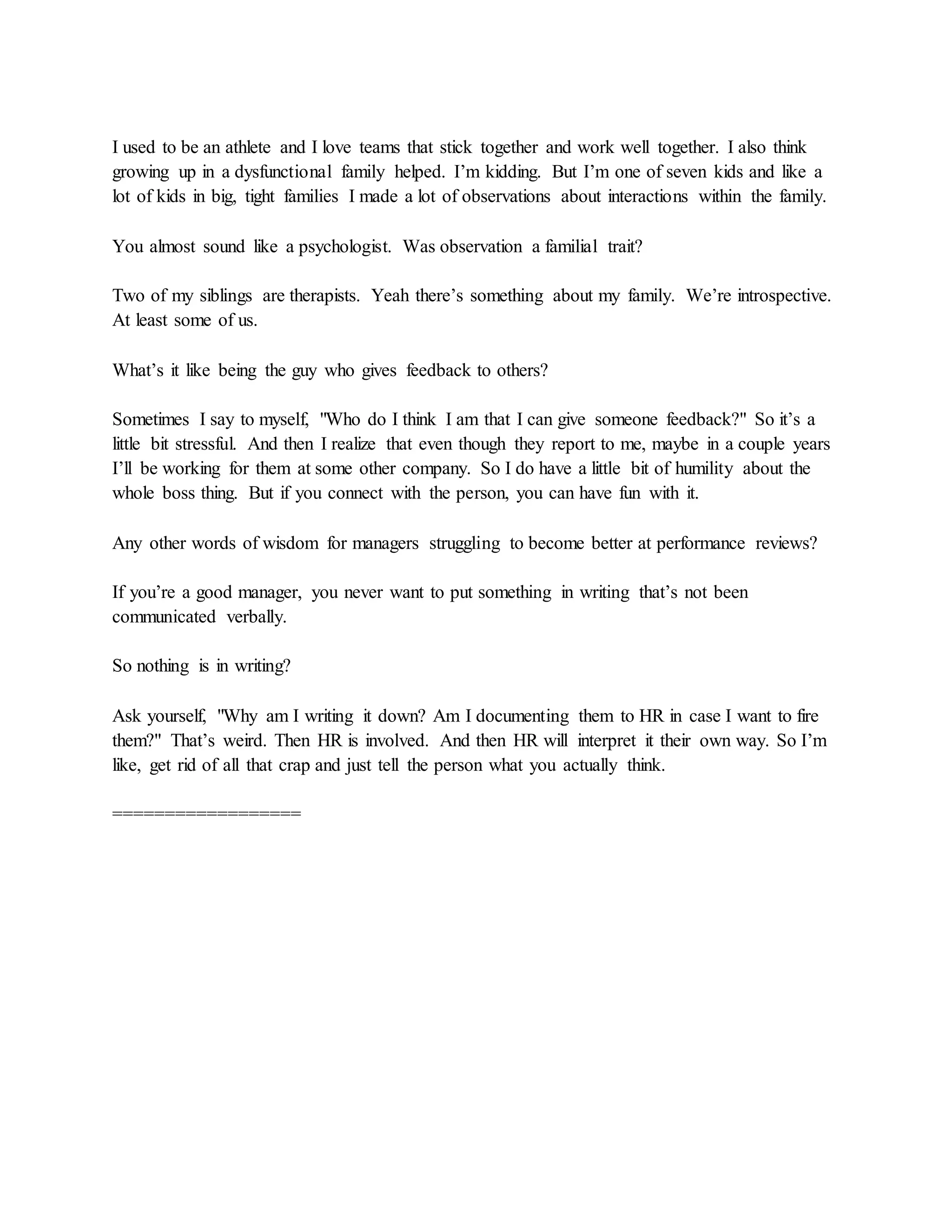
1.Ranking Method
The ranking system requires the rater to rank his
subordinates on overall performance. This consists in
simply putting a man in a rank order. Under this method,
the ranking of an employee in a work group is done
against that of another employee. The relative position of
each employee is tested in terms of his numerical rank. It
may also be done by ranking a person on his job
performance against another member of the competitive
group.
Advantages of Ranking Method
i. Employees are ranked according to their performance
levels.
ii. It is easier to rank the best and the worst employee.
Limitations of Ranking Method
i. The “whole man” is compared with another “whole man”
in this method. In practice, it is very difficult to compare
individuals possessing various individual traits.
ii. This method speaks only of the position where an
employee stands in his group. It does not test anything
about how much better or how much worse an employee
is when compared to another employee.
iii. When a large number of employees are working, ranking
of individuals become a difficult issue.
iv. There is no systematic procedure for ranking individuals
in the organization. The ranking system does not eliminate
the possibility of snap judgements.
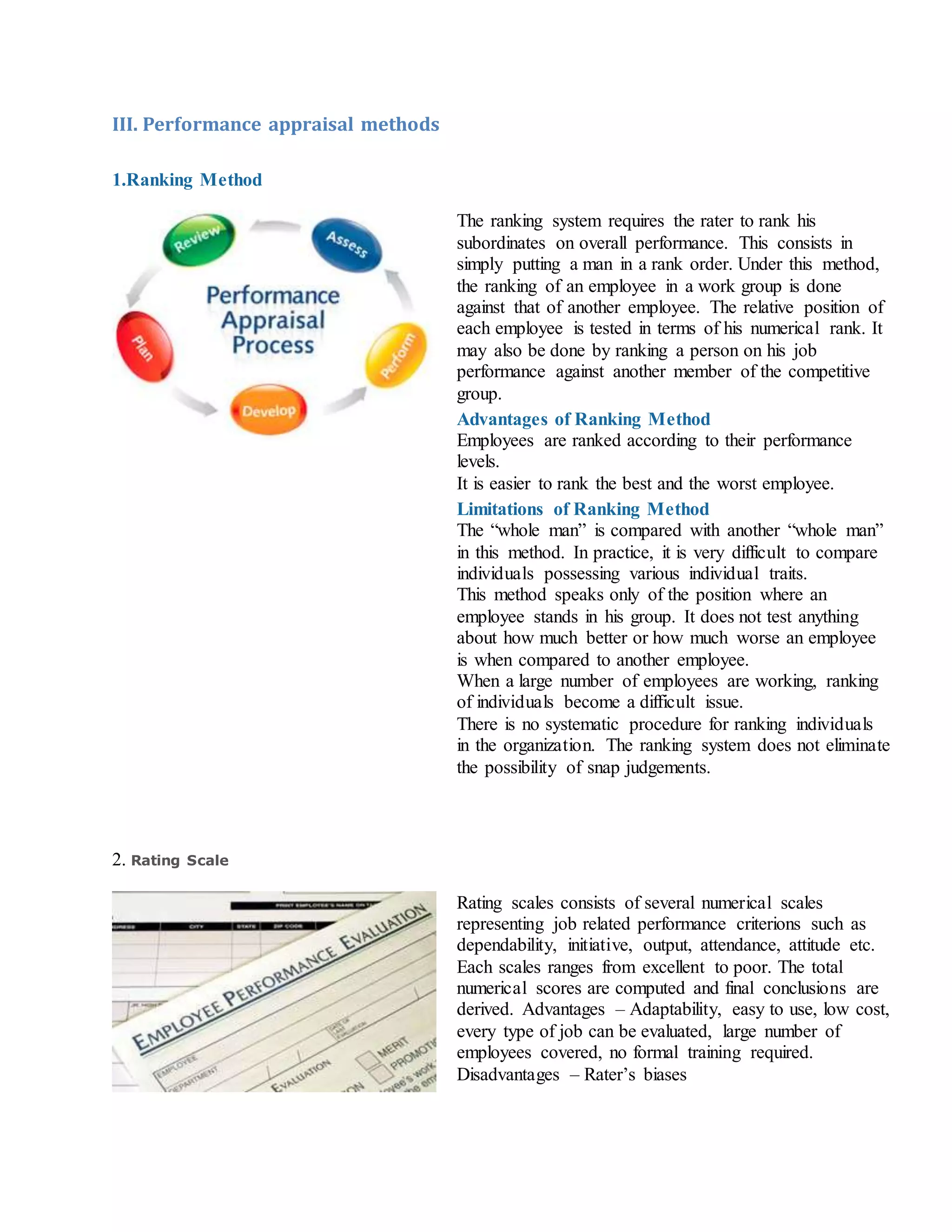
2. Rating Scale
Rating scales consists of several numerical scales
representing job related performance criterions such as
dependability, initiative, output, attendance, attitude etc.
Each scales ranges from excellent to poor. The total
numerical scores are computed and final conclusions are
derived. Advantages – Adaptability, easy to use, low cost,
every type of job can be evaluated, large number of
employees covered, no formal training required.
Disadvantages – Rater’s biases
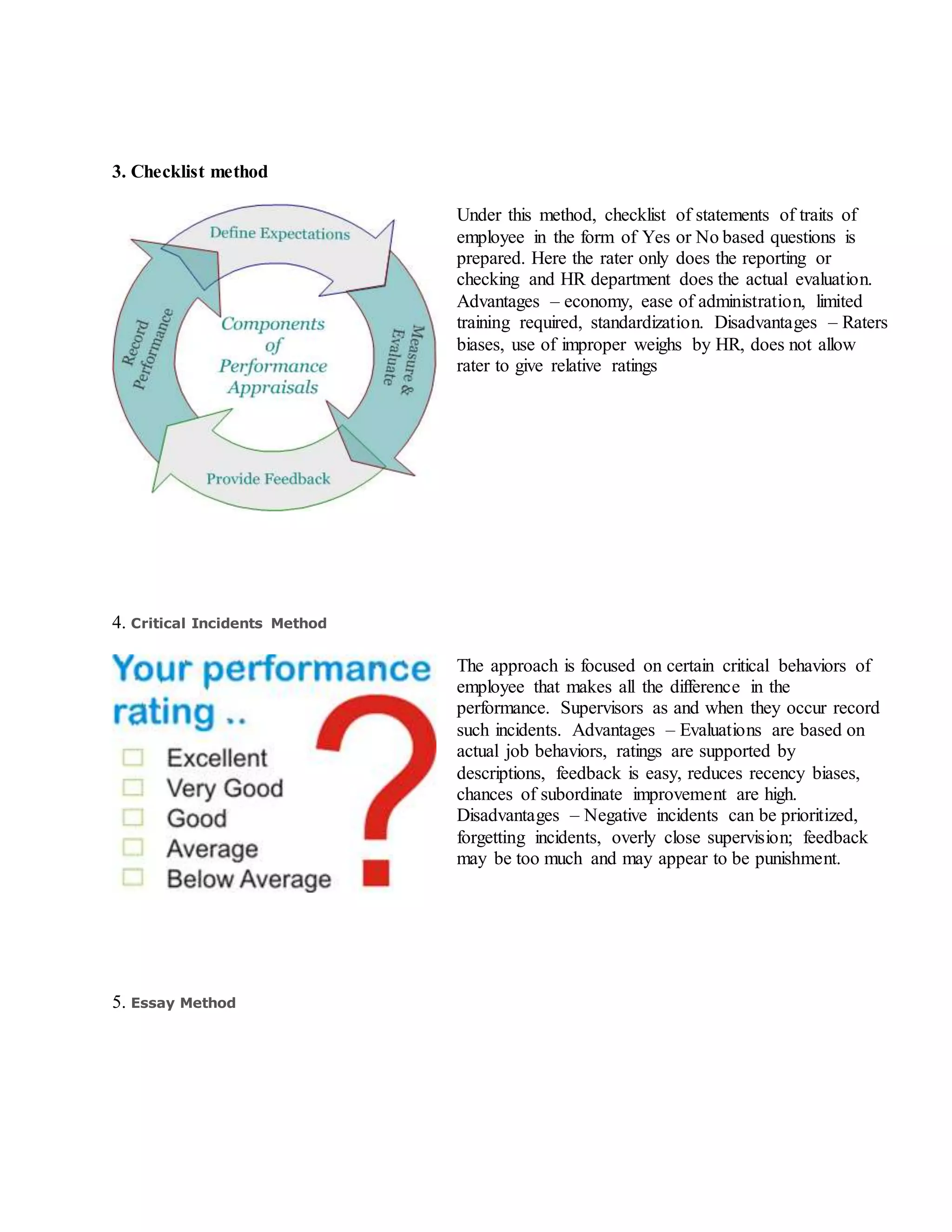
3. Checklist method
Under this method, checklist of statements of traits of
employee in the form of Yes or No based questions is
prepared. Here the rater only does the reporting or
checking and HR department does the actual evaluation.
Advantages – economy, ease of administration, limited
training required, standardization. Disadvantages – Raters
biases, use of improper weighs by HR, does not allow
rater to give relative ratings
4. Critical Incidents Method
The approach is focused on certain critical behaviors of
employee that makes all the difference in the
performance. Supervisors as and when they occur record
such incidents. Advantages – Evaluations are based on
actual job behaviors, ratings are supported by
descriptions, feedback is easy, reduces recency biases,
chances of subordinate improvement are high.
Disadvantages – Negative incidents can be prioritized,
forgetting incidents, overly close supervision; feedback
may be too much and may appear to be punishment.
5. Essay Method
In this method the rater writes down the employee
description in detail within a number of broad categories
like, overall impression of performance, promoteability
of employee, existing capabilities and qualifications of
performing jobs, strengths and weaknesses and training
needs of the employee. Advantage – It is extremely
useful in filing information gaps about the employees
that often occur in a better-structured checklist.
Disadvantages – It its highly dependent upon the writing
skills of rater and most of them are not good writers.
They may get confused success depends on the memory
power of raters.
6. Behaviorally Anchored Rating Scales
statements of effective and ineffective behaviors
determine the points. They are said to be
behaviorally anchored. The rater is supposed to
say, which behavior describes the employee
performance. Advantages – helps overcome rating
errors. Disadvantages – Suffers from distortions
inherent in most rating techniques.
III. Other topics related to Simple performance appraisal form (pdf download)
• Top 28 performance appraisal forms
• performance appraisal comments
• 11 performance appraisal methods
• 25 performance appraisal examples
• performance appraisal phrases
• performance appraisal process
• performance appraisal template
• performance appraisal system
• performance appraisal answers
• performance appraisal questions
• performance appraisal techniques
• performance appraisal format
• performance appraisal templates
• performance appraisal questionnaire
• performance appraisal software
• performance appraisal tools
• performance appraisal interview
• performance appraisal phrases examples
• performance appraisal objectives
• performance appraisal policy
• performance appraisal letter
• performance appraisal types
• performance appraisal quotes
• performance appraisal articles

Simple performance appraisal form

  • 1.
    Simple performance appraisalform In this file, you can ref useful information about simple performance appraisal form such as simple performance appraisal form methods, simple performance appraisal form tips, simple performance appraisal form forms, simple performance appraisal form phrases … If you need more assistant for simple performance appraisal form, please leave your comment at the end of file. Other useful material for you: • performanceappraisal123.com/1125-free-performance-review-phrases • performanceappraisal123.com/free-28-performance-appraisal-forms • performanceappraisal123.com/free-ebook-11-methods-for-performance-appraisal I. Contents of getting simple performance appraisal form ================== The dreaded performance review—unless it’s "You’re fired!"—is often an unfocused, indirect thicket of bureaucratic language that is not helpful for either boss or employee. It can be an exercise that sheds little light but creates a lot of anxiety and resentment for everyone involved. When we caught up with Paul English, cofounder of Kayak.com, the travel search engine, to ask him about his five-word reviews we found out that there was a whole lot more to his philosophy of feedback. So how did you get this idea of five-word performance reviews? There was a guy who worked for me back at InterLeaf (a Massachussetts-based software company). He was given feedback weekly, but nothing changed. So I wanted to be really clear with him to make sure that he understood the feedback. I didn't want to give him a long list of details. Five words was a trick I came up with to make myself be blunt. I literally wrote it on a crinkled phone bill and said, "I want to be really clear that these are the things that we love about you and these are the things that suck." But how can you reduce someone’s work life to five words? If you know someone really well, you can pretty quickly distill their issues. I want to combine what’s good about someone with what’s not working, so I always do two or three positives and
  • 2.
    two or threenegatives. It doesn’t take me long to write. I find a crinkled piece of coffee stained paper on my desk and then I write down the five words. And then what do you do with the crinkled paper? It’s important to see people outside the office in a comfortable nonwork space. So we go out to lunch. I’ll hand the piece of paper to them at the table and get that instant feedback. We’ll spend an hour talking about it. I’ll give examples and we’ll see if we’re each interpreting them in the same way. "No one’s ever thrown anything at me. It’s not a typical managerial technique, so some people are taken aback by it at first. They’re like, 'What the fuck is this?'" Sounds intense. How does it usually go? Even though I might be their boss, I’m just one person, so I’m going to say "Here is my honest feedback and then you decide what to do with it." Each person is in charge of his or her own career. They can decide for themselves whether they agree with me. Whether they want to act on it, that’s up to them. What’s the usual reaction? Do you ever get blowback? Tears? Plates thrown? No one’s ever thrown anything at me. It’s not a typical managerial technique, so some people are taken aback by it at first. They’re like, "What the fuck is this?" But by the end of the lunch, most can see that this isn’t about me or HR. I’m doing this because I’m trying to help them. After we’ve met, they go back to work and they have the piece of paper. They can decide to ignore it or not. I don’t have the paper or even a record of our conversation so I’m not coming back and saying, "Remember when we talked about how you’re untrusting. . . ." So most people take the feedback in the spirit it is given? The feedback I get on my feedback is often, "Wow, no one ever told me that before; that’s so valuable. I get it." Many times people have told me that this really informal off-cycle review has been the best review they’ve gotten. There’s one guy I gave this kind of feedback to maybe 15 years ago and recently he told me that he still carries the list around. What’s your ultimate goal? I’m giving them advice that helps them at Kayak, and it might also help them outside, too. I want to improve Kayak, but my primary goal is to help people with their career.
  • 3.
    What’s the worstkind of feedback that managers give to employees? I hate when a weak or lazy manager says, "Well, I talked to five of your peers and they said that you’re irritable." That makes me crazy. A manager has to interpret. If they’re going to give a performance review, I want their opinion instead of them saying, "Well I haven’t seen enough of this, Paul, but everyone else has." Any other pitfalls? When a manager tells you too much because then you don’t know what to focus on. Or when they couch stuff. When they’re afraid to be direct. Can you give us an example of a five-word performance review? A month ago I gave one. I said, "1. FAST. 2. ATTENTIVE—People feel you listen to them, you’re someone people like talking to because you completely focus on them. 3. UNTRUSTING—Although you try hard to understand people in your group, you don’t completely trust people outside of your organization that you can’t control. And it creates a really bad dynamic when a manager likes people who work for him but doesn’t trust people outside his group. 3. TOO CAUTIOUS [Ed. note: That’s two words!]—I said you’re too cautious, and it sets the wrong vibe because our vibe is very much about forgiveness not permission. We want people to just ask. And if somebody feels like you’re judging, it gives them pause. And 5. TECHNICAL—Because you are in a very strong tech team and you are extremely technical. Your feedback is so personal, almost psychological. What’s the advantage of that? If you ask other executives why they fired the last person they fired, I predict that 10% of the time they’ll say 'because of incompetence,' and 90% of the time it’ll be because they’re annoying. There’s a style clash. So I try to prevent the style clash. And when I see it, I want to fix it. But if I can’t fix it, I separate. Kayak is known as a super efficient company. And one of the reasons we’re so efficient is that when we split people into teams, we make sure that the people in those teams are fun. Because if someone around you is annoying or even neutral it’s going to decrease everyone’s motivation to perform. What traits would you like to draw out based on your feedback? I met a woman in New York last week. She’s got to be like 5 foot 2, and she told me she was a collegiate rower and not a coxswain. And I’m looking at her going, "Really?" She was tiny. And
  • 4.
    she said, "Yeah,well we had a good team. It was an eight-person boat. I know I don’t look like a rower, but I’m really good at reading the other rowers and that contributed to how we work together." I like that analogy about rowing. That’s what leadership is about. Reading each other helps people work together. One of the things I do at Kayak is to study dynamics between people in meetings. It’s also a curse because I can be in a meeting about a really exciting design for a new product that I’m passionate about, but I can’t help being aware of interactions, body language, and what makes people uncomfortable. If I see something, I’ll pull someone aside and give them feedback. How does someone like you who gives performance reviews, define the word performance? The most important quality is how someone performs on a team. Do they limit the people they work with or help them? Are they decisive? Are they transparent? Are they efficient? Do you ever learn anything yourself from giving feedback to others? There are times when I’ve just told someone, "This is my evaluation," and they call bullshit on me. They’ll say, "No, that’s actually not what happened." I might end up saying, "Oh I misread that." And then I ask myself, "Why did I misread it?" When you were young, were you given feedback that influenced you? The bluntest feedback I ever got was painful to hear. But it was transformational. About 10 years ago I was at Intuit in a meeting with Larry Ellison of Oracle who wanted Intuit to buy some stupid startup that he had invested in. The chairman of Intuit, Bill Campbell, asked me to lead the negotiation, which was kind of funny because I was a new person. There were probably 10 of us in the room. We talked for an hour, and the meeting was over. Afterwards my boss, Craig Carlson, who is an amazing guy and the coinventor of QuickBooks [now at Tesla], pulled me aside and said, "Paul, do you have a minute?" And I said, "Sure." And he said, "I want to give you some feedback." And I said, "Okay." And he said, "Remember in the meeting when Ellison asked you how long you and Intuit were working on web accounting, and you said, ‘Let’s just say 10 person years’? Well, I can see how what you said is kind of correct. But I think you said it with an intent to mislead. And we don’t do that at Intuit. We just tell people exactly what they’re looking for. And if we misled him just to get the deal, then we shouldn’t get the deal." There were two things I learned from that feedback. The first: Even though Craig was my boss, it took balls to call someone on something with real-time feedback. It takes confidence to pull someone aside and say, "Dude, that made me uncomfortable when you did that." And the second is that he sharpened my negotiation skills by telling me that you don’t have to mislead to negotiate. What prepared you to give other people feedback?
  • 5.
    I used tobe an athlete and I love teams that stick together and work well together. I also think growing up in a dysfunctional family helped. I’m kidding. But I’m one of seven kids and like a lot of kids in big, tight families I made a lot of observations about interactions within the family. You almost sound like a psychologist. Was observation a familial trait? Two of my siblings are therapists. Yeah there’s something about my family. We’re introspective. At least some of us. What’s it like being the guy who gives feedback to others? Sometimes I say to myself, "Who do I think I am that I can give someone feedback?" So it’s a little bit stressful. And then I realize that even though they report to me, maybe in a couple years I’ll be working for them at some other company. So I do have a little bit of humility about the whole boss thing. But if you connect with the person, you can have fun with it. Any other words of wisdom for managers struggling to become better at performance reviews? If you’re a good manager, you never want to put something in writing that’s not been communicated verbally. So nothing is in writing? Ask yourself, "Why am I writing it down? Am I documenting them to HR in case I want to fire them?" That’s weird. Then HR is involved. And then HR will interpret it their own way. So I’m like, get rid of all that crap and just tell the person what you actually think. ==================
  • 6.
    III. Performance appraisalmethods 1.Ranking Method The ranking system requires the rater to rank his subordinates on overall performance. This consists in simply putting a man in a rank order. Under this method, the ranking of an employee in a work group is done against that of another employee. The relative position of each employee is tested in terms of his numerical rank. It may also be done by ranking a person on his job performance against another member of the competitive group. Advantages of Ranking Method i. Employees are ranked according to their performance levels. ii. It is easier to rank the best and the worst employee. Limitations of Ranking Method i. The “whole man” is compared with another “whole man” in this method. In practice, it is very difficult to compare individuals possessing various individual traits. ii. This method speaks only of the position where an employee stands in his group. It does not test anything about how much better or how much worse an employee is when compared to another employee. iii. When a large number of employees are working, ranking of individuals become a difficult issue. iv. There is no systematic procedure for ranking individuals in the organization. The ranking system does not eliminate the possibility of snap judgements. 2. Rating Scale Rating scales consists of several numerical scales representing job related performance criterions such as dependability, initiative, output, attendance, attitude etc. Each scales ranges from excellent to poor. The total numerical scores are computed and final conclusions are derived. Advantages – Adaptability, easy to use, low cost, every type of job can be evaluated, large number of employees covered, no formal training required. Disadvantages – Rater’s biases
  • 7.
    3. Checklist method Underthis method, checklist of statements of traits of employee in the form of Yes or No based questions is prepared. Here the rater only does the reporting or checking and HR department does the actual evaluation. Advantages – economy, ease of administration, limited training required, standardization. Disadvantages – Raters biases, use of improper weighs by HR, does not allow rater to give relative ratings 4. Critical Incidents Method The approach is focused on certain critical behaviors of employee that makes all the difference in the performance. Supervisors as and when they occur record such incidents. Advantages – Evaluations are based on actual job behaviors, ratings are supported by descriptions, feedback is easy, reduces recency biases, chances of subordinate improvement are high. Disadvantages – Negative incidents can be prioritized, forgetting incidents, overly close supervision; feedback may be too much and may appear to be punishment. 5. Essay Method
  • 8.
    In this methodthe rater writes down the employee description in detail within a number of broad categories like, overall impression of performance, promoteability of employee, existing capabilities and qualifications of performing jobs, strengths and weaknesses and training needs of the employee. Advantage – It is extremely useful in filing information gaps about the employees that often occur in a better-structured checklist. Disadvantages – It its highly dependent upon the writing skills of rater and most of them are not good writers. They may get confused success depends on the memory power of raters. 6. Behaviorally Anchored Rating Scales statements of effective and ineffective behaviors determine the points. They are said to be behaviorally anchored. The rater is supposed to say, which behavior describes the employee performance. Advantages – helps overcome rating errors. Disadvantages – Suffers from distortions inherent in most rating techniques. III. Other topics related to Simple performance appraisal form (pdf download) • Top 28 performance appraisal forms • performance appraisal comments • 11 performance appraisal methods • 25 performance appraisal examples • performance appraisal phrases • performance appraisal process • performance appraisal template • performance appraisal system • performance appraisal answers • performance appraisal questions • performance appraisal techniques • performance appraisal format • performance appraisal templates
  • 9.
    • performance appraisalquestionnaire • performance appraisal software • performance appraisal tools • performance appraisal interview • performance appraisal phrases examples • performance appraisal objectives • performance appraisal policy • performance appraisal letter • performance appraisal types • performance appraisal quotes • performance appraisal articles