Performance appraisal job knowledge
In this file, you can ref useful information about performance appraisal job knowledge such as
performance appraisal job knowledge methods, performance appraisal job knowledge tips,
performance appraisal job knowledge forms, performance appraisal job knowledge phrases … If
you need more assistant for performance appraisal job knowledge, please leave your comment at
the end of file.
Other useful material for you:
• performanceappraisal123.com/1125-free-performance-review-phrases
• performanceappraisal123.com/free-28-performance-appraisal-forms
• performanceappraisal123.com/free-ebook-11-methods-for-performance-appraisal
I. Contents of getting performance appraisal job knowledge
==================
Your employees all (eventually) show up for work, they are as professional as they know how to
be, and they seem to manage their work well. So what are you supposed to write in their
performance appraisal? “Good job doing things, Joe” isn’t exactly the review an employee is
looking for, nor is it one you should give. But, we can work with that. Let’s build on “good job
doing things” and turn it into a more, er, eloquent performance review.
In the Develop Superstars course you learn how to build a team that will be deserving of more
than a pat on the back.
The categories assessed can vary from business to business but generally speaking they include
the following:
Attendance: Is the employee punctual? Or do they call out because their cat ate the car keys too
often?
Customer Service: Does the employee demonstrate diplomatic communication skills when
dealing with custo-monsters? (Check out this course on Customonsters and how to get rid of
them once and for all.) Can they generally meet the needs of the customers?
Quality/Quantity of Work: Are they able to stay busy without managing to do nothing? Are they
producing quality work? If you’re thinking “no, not really” then maybe you should direct them to
the course Hyperperformance, it’ll help increase productivity.
Job Knowledge: Does the employee seem to understand what they are doing at work? Are they
willing and able to learn?
Interpersonal Communication: Can the employee communicate with slow-talking, Southern
drawl bearing Bobette in HR without losing their mind? Are they a good team player? Do they
actively listen and lead the way in conflict resolution?
Safety: Can the employee make it through the day without being a hazard to himself or an
unfortunate co-worker? Are they aware of the safety measures in place to keep everyone alive
and well?
Approach to Work: Do they demonstrate leadership qualities? Are they the go-and-get-‘em type
or the I’ll-wait-to-be-told-what-to-do type? Are they innovative? Problem-solver?
Okay, so some of the scenarios are a bit atypical, but the gist of what I’m saying is still evident.
How does the employee match up the work standards, expectations and code of ethics that the
company upholds? When answering don’t use your tough guy attitude to put an employee in
their place. Exhibit leadership qualities, not boss qualities. Leaders inspire and motivate,
bosses…well, they boss. Learn the difference in the course Transition to Leadership.
A lot of performance appraisals use a rating system to better generalize the ability of an
employee to carry out their duties. The system used will usually model the one demonstrated
below.
Not Applicable: if the employee for some reason is exempt from excelling or doing their job.
Unacceptable or Expectations Not Met: this speaks for itself, chronically late, not exactly easy to
work with, doesn’t perform their job very well in general.
Needs Improvement: isn’t quite as bad off as the Unacceptable Employee, but perhaps some
attention should be brought to their work habits and maybe some training should take place to
help guide them towards the light.
Satisfactory/Meets Expectations: the employee is a solid worker, shows consistent productivity
and fulfills the requirements of the job without their hand being held.
Exceeds Expectations: They work overtime, they show leadership when necessary but don’t
oppose following rules, they are independent workers and this employee deserves a raise.
Goals: Here is where you highlight their weaknesses (nicely) and instill a plan for monitoring
improvement in this area.
==================
III. Performance appraisal methods
1.Ranking Method
The ranking system requires the rater to rank his
subordinates on overall performance. This consists in
simply putting a man in a rank order. Under this method,
the ranking of an employee in a work group is done
against that of another employee. The relative position of
each employee is tested in terms of his numerical rank. It
may also be done by ranking a person on his job
performance against another member of the competitive
group.
Advantages of Ranking Method
i. Employees are ranked according to their performance
levels.
ii. It is easier to rank the best and the worst employee.
Limitations of Ranking Method
i. The “whole man” is compared with another “whole man”
in this method. In practice, it is very difficult to compare
individuals possessing various individual traits.
ii. This method speaks only of the position where an
employee stands in his group. It does not test anything
about how much better or how much worse an employee
is when compared to another employee.
iii. When a large number of employees are working, ranking
of individuals become a difficult issue.
iv. There is no systematic procedure for ranking individuals
in the organization. The ranking system does not eliminate
the possibility of snap judgements.
2. Rating Scale
Rating scales consists of several numerical scales
representing job related performance criterions such as
dependability, initiative, output, attendance, attitude etc.
Each scales ranges from excellent to poor. The total
numerical scores are computed and final conclusions are
derived. Advantages – Adaptability, easy to use, low cost,
every type of job can be evaluated, large number of
employees covered, no formal training required.
Disadvantages – Rater’s biases
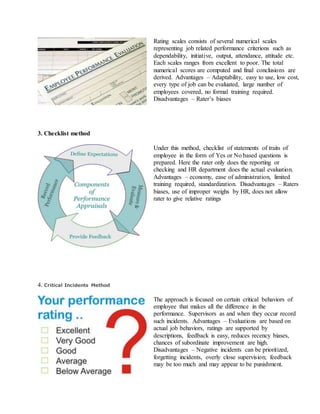
3. Checklist method
Under this method, checklist of statements of traits of
employee in the form of Yes or No based questions is
prepared. Here the rater only does the reporting or
checking and HR department does the actual evaluation.
Advantages – economy, ease of administration, limited
training required, standardization. Disadvantages – Raters
biases, use of improper weighs by HR, does not allow
rater to give relative ratings
4. Critical Incidents Method
The approach is focused on certain critical behaviors of
employee that makes all the difference in the
performance. Supervisors as and when they occur record
such incidents. Advantages – Evaluations are based on
actual job behaviors, ratings are supported by
descriptions, feedback is easy, reduces recency biases,
chances of subordinate improvement are high.
Disadvantages – Negative incidents can be prioritized,
forgetting incidents, overly close supervision; feedback
may be too much and may appear to be punishment.
5. Essay Method
In this method the rater writes down the employee
description in detail within a number of broad categories
like, overall impression of performance, promoteability
of employee, existing capabilities and qualifications of
performing jobs, strengths and weaknesses and training
needs of the employee. Advantage – It is extremely
useful in filing information gaps about the employees
that often occur in a better-structured checklist.
Disadvantages – It its highly dependent upon the writing
skills of rater and most of them are not good writers.
They may get confused success depends on the memory
power of raters.
6. Behaviorally Anchored Rating Scales
statements of effective and ineffective behaviors
determine the points. They are said to be
behaviorally anchored. The rater is supposed to
say, which behavior describes the employee
performance. Advantages – helps overcome rating
errors. Disadvantages – Suffers from distortions
inherent in most rating techniques.
III. Other topics related to Performance appraisal job knowledge (pdf
download)
• Top 28 performance appraisal forms
• performance appraisal comments
• 11 performance appraisal methods
• 25 performance appraisal examples
• performance appraisal phrases
• performance appraisal process
• performance appraisal template
• performance appraisal system
• performance appraisal answers
• performance appraisal questions
• performance appraisal techniques
• performance appraisal format
• performance appraisal templates
• performance appraisal questionnaire
• performance appraisal software
• performance appraisal tools
• performance appraisal interview
• performance appraisal phrases examples
• performance appraisal objectives
• performance appraisal policy
• performance appraisal letter
• performance appraisal types
• performance appraisal quotes
• performance appraisal articles

Performance appraisal job knowledge

  • 1.
    Performance appraisal jobknowledge In this file, you can ref useful information about performance appraisal job knowledge such as performance appraisal job knowledge methods, performance appraisal job knowledge tips, performance appraisal job knowledge forms, performance appraisal job knowledge phrases … If you need more assistant for performance appraisal job knowledge, please leave your comment at the end of file. Other useful material for you: • performanceappraisal123.com/1125-free-performance-review-phrases • performanceappraisal123.com/free-28-performance-appraisal-forms • performanceappraisal123.com/free-ebook-11-methods-for-performance-appraisal I. Contents of getting performance appraisal job knowledge ================== Your employees all (eventually) show up for work, they are as professional as they know how to be, and they seem to manage their work well. So what are you supposed to write in their performance appraisal? “Good job doing things, Joe” isn’t exactly the review an employee is looking for, nor is it one you should give. But, we can work with that. Let’s build on “good job doing things” and turn it into a more, er, eloquent performance review. In the Develop Superstars course you learn how to build a team that will be deserving of more than a pat on the back. The categories assessed can vary from business to business but generally speaking they include the following: Attendance: Is the employee punctual? Or do they call out because their cat ate the car keys too often? Customer Service: Does the employee demonstrate diplomatic communication skills when dealing with custo-monsters? (Check out this course on Customonsters and how to get rid of them once and for all.) Can they generally meet the needs of the customers?
  • 2.
    Quality/Quantity of Work:Are they able to stay busy without managing to do nothing? Are they producing quality work? If you’re thinking “no, not really” then maybe you should direct them to the course Hyperperformance, it’ll help increase productivity. Job Knowledge: Does the employee seem to understand what they are doing at work? Are they willing and able to learn? Interpersonal Communication: Can the employee communicate with slow-talking, Southern drawl bearing Bobette in HR without losing their mind? Are they a good team player? Do they actively listen and lead the way in conflict resolution? Safety: Can the employee make it through the day without being a hazard to himself or an unfortunate co-worker? Are they aware of the safety measures in place to keep everyone alive and well? Approach to Work: Do they demonstrate leadership qualities? Are they the go-and-get-‘em type or the I’ll-wait-to-be-told-what-to-do type? Are they innovative? Problem-solver? Okay, so some of the scenarios are a bit atypical, but the gist of what I’m saying is still evident. How does the employee match up the work standards, expectations and code of ethics that the company upholds? When answering don’t use your tough guy attitude to put an employee in their place. Exhibit leadership qualities, not boss qualities. Leaders inspire and motivate, bosses…well, they boss. Learn the difference in the course Transition to Leadership. A lot of performance appraisals use a rating system to better generalize the ability of an employee to carry out their duties. The system used will usually model the one demonstrated below. Not Applicable: if the employee for some reason is exempt from excelling or doing their job. Unacceptable or Expectations Not Met: this speaks for itself, chronically late, not exactly easy to work with, doesn’t perform their job very well in general. Needs Improvement: isn’t quite as bad off as the Unacceptable Employee, but perhaps some attention should be brought to their work habits and maybe some training should take place to help guide them towards the light. Satisfactory/Meets Expectations: the employee is a solid worker, shows consistent productivity and fulfills the requirements of the job without their hand being held.
  • 3.
    Exceeds Expectations: Theywork overtime, they show leadership when necessary but don’t oppose following rules, they are independent workers and this employee deserves a raise. Goals: Here is where you highlight their weaknesses (nicely) and instill a plan for monitoring improvement in this area. ================== III. Performance appraisal methods 1.Ranking Method The ranking system requires the rater to rank his subordinates on overall performance. This consists in simply putting a man in a rank order. Under this method, the ranking of an employee in a work group is done against that of another employee. The relative position of each employee is tested in terms of his numerical rank. It may also be done by ranking a person on his job performance against another member of the competitive group. Advantages of Ranking Method i. Employees are ranked according to their performance levels. ii. It is easier to rank the best and the worst employee. Limitations of Ranking Method i. The “whole man” is compared with another “whole man” in this method. In practice, it is very difficult to compare individuals possessing various individual traits. ii. This method speaks only of the position where an employee stands in his group. It does not test anything about how much better or how much worse an employee is when compared to another employee. iii. When a large number of employees are working, ranking of individuals become a difficult issue. iv. There is no systematic procedure for ranking individuals in the organization. The ranking system does not eliminate the possibility of snap judgements. 2. Rating Scale
  • 4.
    Rating scales consistsof several numerical scales representing job related performance criterions such as dependability, initiative, output, attendance, attitude etc. Each scales ranges from excellent to poor. The total numerical scores are computed and final conclusions are derived. Advantages – Adaptability, easy to use, low cost, every type of job can be evaluated, large number of employees covered, no formal training required. Disadvantages – Rater’s biases 3. Checklist method Under this method, checklist of statements of traits of employee in the form of Yes or No based questions is prepared. Here the rater only does the reporting or checking and HR department does the actual evaluation. Advantages – economy, ease of administration, limited training required, standardization. Disadvantages – Raters biases, use of improper weighs by HR, does not allow rater to give relative ratings 4. Critical Incidents Method The approach is focused on certain critical behaviors of employee that makes all the difference in the performance. Supervisors as and when they occur record such incidents. Advantages – Evaluations are based on actual job behaviors, ratings are supported by descriptions, feedback is easy, reduces recency biases, chances of subordinate improvement are high. Disadvantages – Negative incidents can be prioritized, forgetting incidents, overly close supervision; feedback may be too much and may appear to be punishment.
  • 5.
    5. Essay Method Inthis method the rater writes down the employee description in detail within a number of broad categories like, overall impression of performance, promoteability of employee, existing capabilities and qualifications of performing jobs, strengths and weaknesses and training needs of the employee. Advantage – It is extremely useful in filing information gaps about the employees that often occur in a better-structured checklist. Disadvantages – It its highly dependent upon the writing skills of rater and most of them are not good writers. They may get confused success depends on the memory power of raters. 6. Behaviorally Anchored Rating Scales statements of effective and ineffective behaviors determine the points. They are said to be behaviorally anchored. The rater is supposed to say, which behavior describes the employee performance. Advantages – helps overcome rating errors. Disadvantages – Suffers from distortions inherent in most rating techniques. III. Other topics related to Performance appraisal job knowledge (pdf download) • Top 28 performance appraisal forms • performance appraisal comments • 11 performance appraisal methods • 25 performance appraisal examples • performance appraisal phrases • performance appraisal process
  • 6.
    • performance appraisaltemplate • performance appraisal system • performance appraisal answers • performance appraisal questions • performance appraisal techniques • performance appraisal format • performance appraisal templates • performance appraisal questionnaire • performance appraisal software • performance appraisal tools • performance appraisal interview • performance appraisal phrases examples • performance appraisal objectives • performance appraisal policy • performance appraisal letter • performance appraisal types • performance appraisal quotes • performance appraisal articles