Andrii Rusakov
Designer at SoftServe
Simple
Card Sorting
Methods
Agenda
– Information we work with
• How to work with it?
– Card Sorting methods
• How to use them?
• When to use them?
• In-Person or Remote?
– Next steps
Have you ever
managed complex
information?
What were
the challenges
you faced?
I know this subject well, and
have good analytical skills.
I am strong enough to manage
it on MY OWN!
Young
Designer
Situation
You can realy know too much.
But your users may not.
User-Centered
Design
I know this subject well, and
have good analytical skills.
I am strong enough to manage
it on MY OWN!
Young
Designer
Situation
... before you come
to any conclusions
try walking in
my shoes
What can help us
to group complex
information right ?
What can help us
to group complex
information right ?
What does
it mean?
Right approach
is to speak your
user’s language
Taxonomy
Classification and labeling
Finding Things
– Familar labeling
– Clear & Consistent navigation
Taxonomy
Content
Organizational
Strategy
Context User
ROI
Return on Investment (ROI) is the
benefit to the investor resulting from
an investment of some resource
Benefits
– Catalog site (increased sales)
• Improved product findability
• Improved product cross-sells and up-sells
• Improved customer loyalty
– Compliance
• Avoiding penalties for breaching regulations
• Following required procedures (e.g. Medical claims)
– Knowledge worker productivity
• Less time searching for things
• Less time recreating existing materials
So...
What will help to
understand our user's
way of thinking?
Sorting
Card Sorting
Card sorting is a great, reliable,
inexpensive method for finding
patterns in how users would expect
to find content or functionality.”
“
Donna Spencer
Methods
Open
Card Sorting
Modified-Delphi
Card Sorting
Closed
Card Sorting
Reversed
Card Sorting
Generative
Generative
Evaluative
Evaluative
Mental models, Organization,
Labeling, Relationship
Mental models, Organization,
Labeling, Relationship
Organization,
Labeling
Organization, Labeling,
Findability
Method Research Type Learn About
When to Use?
– Designing a new App
– Designing a new area of an App
– Redesigning an App
Design Process
Design Process
Two primary methods
Open
Card Sorting
Closed
Card Sorting
USER’S
CATEGORIES
NAMES
PREDETERMINED
CATEGORIES
NAMES
Advantages
& Disadvantages
Advantages
– Simple
– Cheap
– Quick to execute
– Established
– Involves users
– Provides a good foundation
Disadvantages
– Does not consider users’ tasks
– Results may vary
– Analysis can be time consuming
– May capture “surface”
characteristics only
In-Person
Offline
Remote
Online
VS
In-Person (Offline)
Moderated Card Sorting
– Limited scale
– Relatively heavy investment
per participant
– Great for gathering qualitative results
– Expensive to get quantitative results
Remote (Online)
Unmoderated Card Sorting
– Unlimited scale
– “Fire & forget”
– Relatively cheap
– Great for gathering quantitative results
– Difficult to know why things happen
In-Person
Offline Card Sorting
How it Works?
– Planning
– Running
– Analysis
Planning
– Collect the statements for analysis
– Write each statement on a card
– Prepare space for cards placing
– Recruit informants (at least six)
Running
– Shuffle the card deck
– Explain that there may well be
an “unsortable” pile
It looks like this ...
Analysis
You will need Magic + Science
– Look for broad patterns in the data
– Or use cluster analysis approaches
Complex Analysis
– Analysis spreadsheet by Donna Spenser
– Co-occurrence matrix by Mike Rice
– Dendrogram to illustrate the
arrangement of the clusters
How it Works:
1. Entering the card names
2. Cards summary and standardised categories
3. Analysis of categories
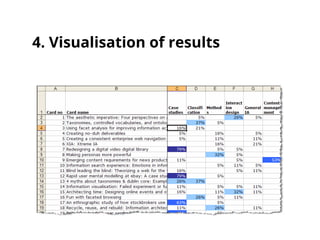
4. Visualisation of results
Analysis Spreadsheet
by Donna Spencer
1. Entering the card names
2. Cards summary and
standardised categories
3. Analysis of categories
4. Visualisation of results
Shows how often each pair
of cards were put together in
conducted card sort
Co-occurrence Matrix
by Mike Rice
Displays the results of cluster
analysis on the similarity matrix
in a tree format
Dendrogram
Tree View
Remote
Online Card Sorting
1. Input your cards
2. Configure your survey
3. Recruit participants
4. Receive results
What we receive?
– Clear vision on projects
information architecture
– Ability to start next design phase
Next Steps
Want to read more?
Card Sorting:
Designing Usable Categories
by Donna Spenser
Links
– Card sort analysis spreadsheet
http://rosenfeldmedia.com/blogs/card-sorting/card-sort-analysis-spreadsheet
– Co-occurrence matrix
http://www.informoire.com/co-occurrence-matrix
– OptimalSort
http://www.optimalworkshop.com/optimalsort.htm
Thank You!

Simple Card Sorting Methods