


How can startups
interact with large
corporations for
success?
June 18, 2017
Simon T. McDougall
Digital VP, McKinsey Digital Labs
2McKinsey & Company
Contents
Digital Labs @ McKinsey
Digital trends and
corporations
Implications for startups
2McKinsey & Company
3McKinsey & Company
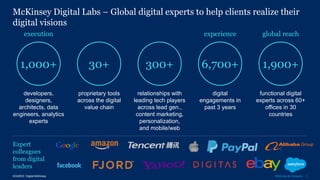
McKinsey Digital Labs – Global digital experts to help clients realize their
digital visions
30+ 300+1,000+ 6,700+ 1,900+
proprietary tools
across the digital
value chain
relationships with
leading tech players
across lead gen.,
content marketing,
personalization,
and mobile/web
developers,
designers,
architects, data
engineers, analytics
experts
digital
engagements in
past 3 years
functional digital
experts across 60+
offices in 30
countries
execution experience global reach
Expert
colleagues
from digital
leaders
SOURCE: Digital McKinsey
4McKinsey & Company
Contents
Digital Labs @ McKinsey
Digital trends and
corporations
Implications for startups
4McKinsey & Company
5McKinsey & Company
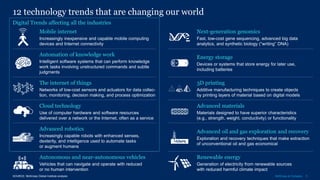
12 technology trends that are changing our world
SOURCE: McKinsey Global Institute analysis
Mobile internet
Increasingly inexpensive and capable mobile computing
devices and Internet connectivity
Next-generation genomics
Fast, low-cost gene sequencing, advanced big data
analytics, and synthetic biology (“writing” DNA)
Digital Trends affecting all the industries
Energy storage
Devices or systems that store energy for later use,
including batteries
Automation of knowledge work
Intelligent software systems that can perform knowledge
work tasks involving unstructured commands and subtle
judgments
3D printing
Additive manufacturing techniques to create objects
by printing layers of material based on digital models
The internet of things
Networks of low-cost sensors and actuators for data collec-
tion, monitoring, decision making, and process optimization
Advanced materials
Materials designed to have superior characteristics
(e.g., strength, weight, conductivity) or functionality
Cloud technology
Use of computer hardware and software resources
delivered over a network or the Internet, often as a service
Advanced oil and gas exploration and recovery
Exploration and recovery techniques that make extraction
of unconventional oil and gas economical
Advanced robotics
Increasingly capable robots with enhanced senses,
dexterity, and intelligence used to automate tasks
or augment humans
Renewable energy
Generation of electricity from renewable sources
with reduced harmful climate impact
Autonomous and near-autonomous vehicles
Vehicles that can navigate and operate with reduced
or no human intervention
6McKinsey & Company
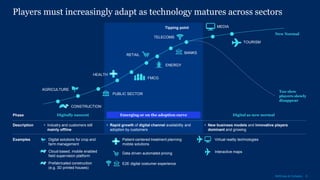
Players must increasingly adapt as technology matures across sectors
TOURISM
MEDIA
HEALTH
PUBLIC SECTOR
BANKS
RETAIL
AGRICULTURE
CONSTRUCTION
FMCG
TELECOMS
Digitally nascent Emerging or on the adoption curve
ENERGY
Digital as new normal
New Normal
Tipping point
Phase
• Rapid growth of digital channel availability and
adoption by customers
• New business models and innovative players
dominant and growing
Too slow
players slowly
disappear
Description • Industry and customers still
mainly offline
Examples Digital solutions for crop and
farm management
Prefabricated construction
(e.g. 3D printed houses)
Cloud-based, mobile enabled
field supervision platform
Patient-centered treatment planning
mobile solutions
Virtual reality technologies
Interactive mapsData driven automated pricing
E2E digital costumer experience
SOURCE: “The State of Startup/Corporate Collaboration 2016”, Imaginatik, MassChallenge; Business Insider; news search
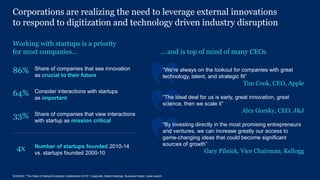
64% Consider interactions with startups
as important
Share of companies that view interactions
with startup as mission critical
33%
4x Number of startups founded 2010-14
vs. startups founded 2000-10
86% Share of companies that see innovation
as crucial to their future
Working with startups is a priority
for most companies…
“The ideal deal for us is early, great innovation, great
science, then we scale it”
Alex Gorsky, CEO, J&J
“By investing directly in the most promising entrepreneurs
and ventures, we can increase greatly our access to
game-changing ideas that could become significant
sources of growth”
Gary Pilnick, Vice Chairman, Kellogg
… and is top of mind of many CEOs
“We're always on the lookout for companies with great
technology, talent, and strategic fit”
Tim Cook, CEO, Apple
Corporations are realizing the need to leverage external innovations
to respond to digitization and technology driven industry disruption
8McKinsey & Company
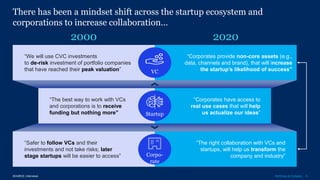
There has been a mindset shift across the startup ecosystem and
corporations to increase collaboration…
SOURCE: Interviews
2000
VC
“The best way to work with VCs
and corporations is to receive
funding but nothing more”
“Corporates have access to
real use cases that will help
us actualize our ideas”Startup
“We will use CVC investments
to de-risk investment of portfolio companies
that have reached their peak valuation”
“Corporates provide non-core assets (e.g.,
data, channels and brand), that will increase
the startup’s likelihood of success”
“Safer to follow VCs and their
investments and not take risks; later
stage startups will be easier to access”
“The right collaboration with VCs and
startups, will help us transform the
company and industry”Corpo-
rate
2020
9McKinsey & Company
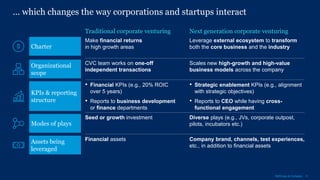
… which changes the way corporations and startups interact
Traditional corporate venturing Next generation corporate venturing
Organizational
scope
CVC team works on one-off
independent transactions
Scales new high-growth and high-value
business models across the company
Charter
Make financial returns
in high growth areas
Leverage external ecosystem to transform
both the core business and the industry
Assets being
leveraged
Financial assets Company brand, channels, test experiences,
etc., in addition to financial assets
Modes of plays
Seed or growth investment Diverse plays (e.g., JVs, corporate outpost,
pilots, incubators etc.)
• Financial KPIs (e.g., 20% ROIC
over 5 years)
• Reports to business development
or finance departments
• Strategic enablement KPIs (e.g., alignment
with strategic objectives)
• Reports to CEO while having cross-
functional engagement
KPIs & reporting
structure
10McKinsey & Company
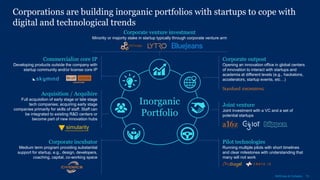
Corporations are building inorganic portfolios with startups to cope with
digital and technological trends
Inorganic
Portfolio
Commercialize core IP
Developing products outside the company with
startup community and/or license core IP
Joint venture
Joint investment with a VC and a set of
potential startups
Pilot technologies
Running multiple pilots with short timelines
and clear milestones with understanding that
many will not work
Corporate outpost
Opening an innovation office in global centers
of innovation to interact with startups and
academia at different levels (e.g., hackatons,
accelerators, startup events, etc…)
Corporate incubator
Medium term program providing substantial
support for startup, e.g., design, developers,
coaching, capital, co-working space
Acquisition / Acquihire
Full acquisition of early stage or late stage
tech companies; acquiring early stage
companies primarily for skills of staff. Staff can
be integrated to existing R&D centers or
become part of new innovation hubs
simularity
Corporate venture investment
Minority or majority stake in startup typically through corporate venture arm
11McKinsey & Company
Contents
Digital Labs @ McKinsey
Digital trends and
corporations
Implications for startups
8McKinsey & Company
12McKinsey & Company
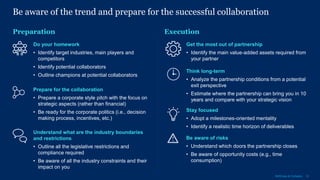
Be aware of the trend and prepare for the successful collaboration
Execution
Do your homework
• Identify target industries, main players and
competitors
• Identify potential collaborators
• Outline champions at potential collaborators
Get the most out of partnership
• Identify the main value-added assets required from
your partner
Prepare for the collaboration
• Prepare a corporate style pitch with the focus on
strategic aspects (rather than financial)
• Be ready for the corporate politics (i.e., decision
making process, incentives, etc.)
Think long-term
• Analyze the partnership conditions from a potential
exit perspective
• Estimate where the partnership can bring you in 10
years and compare with your strategic vision
Understand what are the industry boundaries
and restrictions
• Outline all the legislative restrictions and
compliance required
• Be aware of all the industry constraints and their
impact on you
Stay focused
• Adopt a milestones-oriented mentality
• Identify a realistic time horizon of deliverables
Preparation
Be aware of risks
• Understand which doors the partnership closes
• Be aware of opportunity costs (e.g., time
consumption)
13McKinsey & Company
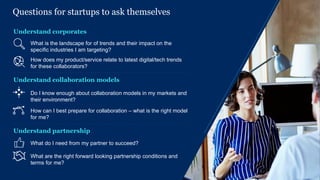
Questions for startups to ask themselves
Understand corporates
How does my product/service relate to latest digital/tech trends
for these collaborators?
What is the landscape for of trends and their impact on the
specific industries I am targeting?
What do I need from my partner to succeed?
What are the right forward looking partnership conditions and
terms for me?
Understand partnership
Understand collaboration models
How can I best prepare for collaboration – what is the right model
for me?
Do I know enough about collaboration models in my markets and
their environment?
15McKinsey & Company
Contents
Digital Labs @ McKinsey
Digital trends and
corporations
Implications for startups
Backup
14McKinsey & Company
16McKinsey & Company
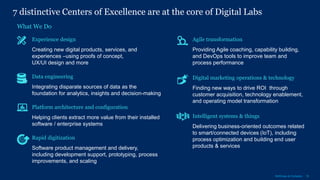
7 distinctive Centers of Excellence are at the core of Digital Labs
What We Do
Agile transformation
Providing Agile coaching, capability building,
and DevOps tools to improve team and
process performance
Data engineering
Integrating disparate sources of data as the
foundation for analytics, insights and decision-making
Intelligent systems & things
Delivering business-oriented outcomes related
to smart/connected devices (IoT), including
process optimization and building end user
products & services
Digital marketing operations & technology
Finding new ways to drive ROI through
customer acquisition, technology enablement,
and operating model transformation
Platform architecture and configuration
Helping clients extract more value from their installed
software / enterprise systems
Experience design
Creating new digital products, services, and
experiences –using proofs of concept,
UX/UI design and more
Rapid digitization
Software product management and delivery,
including development support, prototyping, process
improvements, and scaling
17McKinsey & Company
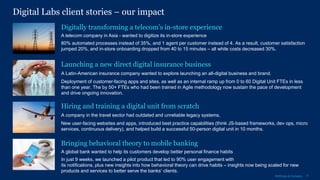
Digital Labs client stories – our impact
Launching a new direct digital insurance business
A Latin-American insurance company wanted to explore launching an all-digital business and brand.
Deployment of customer-facing apps and sites, as well as an internal ramp up from 0 to 60 Digital Unit FTEs in less
than one year. The by 50+ FTEs who had been trained in Agile methodology now sustain the pace of development
and drive ongoing innovation.
Hiring and training a digital unit from scratch
A company in the travel sector had outdated and unreliable legacy systems,
New user-facing websites and apps, introduced best practice capabilities (think JS-based frameworks, dev ops, micro
services, continuous delivery), and helped build a successful 50-person digital unit in 10 months.
Digitally transforming a telecom’s in-store experience
A telecom company in Asia - wanted to digitize its in-store experience
80% automated processes instead of 35%, and 1 agent per customer instead of 4. As a result, customer satisfaction
jumped 20%, and in-store onboarding dropped from 40 to 15 minutes – all while costs decreased 30%.
A global bank wanted to help its customers develop better personal finance habits
In just 9 weeks, we launched a pilot product that led to 90% user engagement with
its notifications, plus new insights into how behavioral theory can drive habits – insights now being scaled for new
products and services to better serve the banks’ clients.
Bringing behavioral theory to mobile banking
18McKinsey & Company
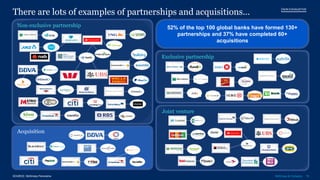
Acquisition
52% of the top 100 global banks have formed 130+
partnerships and 37% have completed 60+
acquisitions
SOURCE: McKinsey Panorama
There are lots of examples of partnerships and acquisitions… NON EXHAUSTIVE
Non-exclusive partnership
Exclusive partnership
Joint venture
19McKinsey & Company
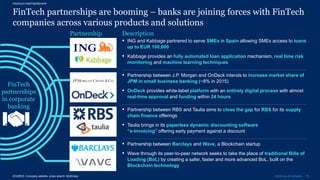
FinTech partnerships are booming – banks are joining forces with FinTech
companies across various products and solutions
SOURCE: Company website, press search, McKinsey
FINTECH PARTNERSHIPS
Description
▪ ING and Kabbage partnered to serve SMEs in Spain allowing SMEs access to loans
up to EUR 100,000
▪ Kabbage provides an fully automated loan application mechanism, real time risk
monitoring and machine learning techniques
▪ Partnership between RBS and Taulia aims to close the gap for RBS for its supply
chain finance offerings
▪ Taulia brings in its paperless dynamic discounting software
“e-Invoicing” offering early payment against a discount
▪ Partnership between Barclays and Wave, a Blockchain startup
▪ Wave through its peer-to-peer network seeks to take the place of traditional Bills of
Loading (BoL) by creating a safer, faster and more advanced BoL, built on the
Blockchain technology
▪ Partnership between J.P. Morgan and OnDeck intends to increase market share of
JPM in small business banking (~8% in 2015)
▪ OnDeck provides white-label platform with an entirely digital process with almost
real-time approval and funding within 24 hours
FinTech
partnerships
in corporate
banking
Partnership
Simon McDougall, Regional Leader EEMA, McKinsey – How Should Startups Engage with Large Corporates Pursuing Digital Transformation

Simon McDougall, Regional Leader EEMA, McKinsey – How Should Startups Engage with Large Corporates Pursuing Digital Transformation

  • 1.
    How can startups interactwith large corporations for success? June 18, 2017 Simon T. McDougall Digital VP, McKinsey Digital Labs
  • 2.
    2McKinsey & Company Contents DigitalLabs @ McKinsey Digital trends and corporations Implications for startups 2McKinsey & Company
  • 3.
    3McKinsey & Company McKinseyDigital Labs – Global digital experts to help clients realize their digital visions 30+ 300+1,000+ 6,700+ 1,900+ proprietary tools across the digital value chain relationships with leading tech players across lead gen., content marketing, personalization, and mobile/web developers, designers, architects, data engineers, analytics experts digital engagements in past 3 years functional digital experts across 60+ offices in 30 countries execution experience global reach Expert colleagues from digital leaders SOURCE: Digital McKinsey
  • 4.
    4McKinsey & Company Contents DigitalLabs @ McKinsey Digital trends and corporations Implications for startups 4McKinsey & Company
  • 5.
    5McKinsey & Company 12technology trends that are changing our world SOURCE: McKinsey Global Institute analysis Mobile internet Increasingly inexpensive and capable mobile computing devices and Internet connectivity Next-generation genomics Fast, low-cost gene sequencing, advanced big data analytics, and synthetic biology (“writing” DNA) Digital Trends affecting all the industries Energy storage Devices or systems that store energy for later use, including batteries Automation of knowledge work Intelligent software systems that can perform knowledge work tasks involving unstructured commands and subtle judgments 3D printing Additive manufacturing techniques to create objects by printing layers of material based on digital models The internet of things Networks of low-cost sensors and actuators for data collec- tion, monitoring, decision making, and process optimization Advanced materials Materials designed to have superior characteristics (e.g., strength, weight, conductivity) or functionality Cloud technology Use of computer hardware and software resources delivered over a network or the Internet, often as a service Advanced oil and gas exploration and recovery Exploration and recovery techniques that make extraction of unconventional oil and gas economical Advanced robotics Increasingly capable robots with enhanced senses, dexterity, and intelligence used to automate tasks or augment humans Renewable energy Generation of electricity from renewable sources with reduced harmful climate impact Autonomous and near-autonomous vehicles Vehicles that can navigate and operate with reduced or no human intervention
  • 6.
    6McKinsey & Company Playersmust increasingly adapt as technology matures across sectors TOURISM MEDIA HEALTH PUBLIC SECTOR BANKS RETAIL AGRICULTURE CONSTRUCTION FMCG TELECOMS Digitally nascent Emerging or on the adoption curve ENERGY Digital as new normal New Normal Tipping point Phase • Rapid growth of digital channel availability and adoption by customers • New business models and innovative players dominant and growing Too slow players slowly disappear Description • Industry and customers still mainly offline Examples Digital solutions for crop and farm management Prefabricated construction (e.g. 3D printed houses) Cloud-based, mobile enabled field supervision platform Patient-centered treatment planning mobile solutions Virtual reality technologies Interactive mapsData driven automated pricing E2E digital costumer experience
  • 7.
    SOURCE: “The Stateof Startup/Corporate Collaboration 2016”, Imaginatik, MassChallenge; Business Insider; news search 64% Consider interactions with startups as important Share of companies that view interactions with startup as mission critical 33% 4x Number of startups founded 2010-14 vs. startups founded 2000-10 86% Share of companies that see innovation as crucial to their future Working with startups is a priority for most companies… “The ideal deal for us is early, great innovation, great science, then we scale it” Alex Gorsky, CEO, J&J “By investing directly in the most promising entrepreneurs and ventures, we can increase greatly our access to game-changing ideas that could become significant sources of growth” Gary Pilnick, Vice Chairman, Kellogg … and is top of mind of many CEOs “We're always on the lookout for companies with great technology, talent, and strategic fit” Tim Cook, CEO, Apple Corporations are realizing the need to leverage external innovations to respond to digitization and technology driven industry disruption
  • 8.
    8McKinsey & Company Therehas been a mindset shift across the startup ecosystem and corporations to increase collaboration… SOURCE: Interviews 2000 VC “The best way to work with VCs and corporations is to receive funding but nothing more” “Corporates have access to real use cases that will help us actualize our ideas”Startup “We will use CVC investments to de-risk investment of portfolio companies that have reached their peak valuation” “Corporates provide non-core assets (e.g., data, channels and brand), that will increase the startup’s likelihood of success” “Safer to follow VCs and their investments and not take risks; later stage startups will be easier to access” “The right collaboration with VCs and startups, will help us transform the company and industry”Corpo- rate 2020
  • 9.
    9McKinsey & Company …which changes the way corporations and startups interact Traditional corporate venturing Next generation corporate venturing Organizational scope CVC team works on one-off independent transactions Scales new high-growth and high-value business models across the company Charter Make financial returns in high growth areas Leverage external ecosystem to transform both the core business and the industry Assets being leveraged Financial assets Company brand, channels, test experiences, etc., in addition to financial assets Modes of plays Seed or growth investment Diverse plays (e.g., JVs, corporate outpost, pilots, incubators etc.) • Financial KPIs (e.g., 20% ROIC over 5 years) • Reports to business development or finance departments • Strategic enablement KPIs (e.g., alignment with strategic objectives) • Reports to CEO while having cross- functional engagement KPIs & reporting structure
  • 10.
    10McKinsey & Company Corporationsare building inorganic portfolios with startups to cope with digital and technological trends Inorganic Portfolio Commercialize core IP Developing products outside the company with startup community and/or license core IP Joint venture Joint investment with a VC and a set of potential startups Pilot technologies Running multiple pilots with short timelines and clear milestones with understanding that many will not work Corporate outpost Opening an innovation office in global centers of innovation to interact with startups and academia at different levels (e.g., hackatons, accelerators, startup events, etc…) Corporate incubator Medium term program providing substantial support for startup, e.g., design, developers, coaching, capital, co-working space Acquisition / Acquihire Full acquisition of early stage or late stage tech companies; acquiring early stage companies primarily for skills of staff. Staff can be integrated to existing R&D centers or become part of new innovation hubs simularity Corporate venture investment Minority or majority stake in startup typically through corporate venture arm
  • 11.
    11McKinsey & Company Contents DigitalLabs @ McKinsey Digital trends and corporations Implications for startups 8McKinsey & Company
  • 12.
    12McKinsey & Company Beaware of the trend and prepare for the successful collaboration Execution Do your homework • Identify target industries, main players and competitors • Identify potential collaborators • Outline champions at potential collaborators Get the most out of partnership • Identify the main value-added assets required from your partner Prepare for the collaboration • Prepare a corporate style pitch with the focus on strategic aspects (rather than financial) • Be ready for the corporate politics (i.e., decision making process, incentives, etc.) Think long-term • Analyze the partnership conditions from a potential exit perspective • Estimate where the partnership can bring you in 10 years and compare with your strategic vision Understand what are the industry boundaries and restrictions • Outline all the legislative restrictions and compliance required • Be aware of all the industry constraints and their impact on you Stay focused • Adopt a milestones-oriented mentality • Identify a realistic time horizon of deliverables Preparation Be aware of risks • Understand which doors the partnership closes • Be aware of opportunity costs (e.g., time consumption)
  • 13.
    13McKinsey & Company Questionsfor startups to ask themselves Understand corporates How does my product/service relate to latest digital/tech trends for these collaborators? What is the landscape for of trends and their impact on the specific industries I am targeting? What do I need from my partner to succeed? What are the right forward looking partnership conditions and terms for me? Understand partnership Understand collaboration models How can I best prepare for collaboration – what is the right model for me? Do I know enough about collaboration models in my markets and their environment?
  • 15.
    15McKinsey & Company Contents DigitalLabs @ McKinsey Digital trends and corporations Implications for startups Backup 14McKinsey & Company
  • 16.
    16McKinsey & Company 7distinctive Centers of Excellence are at the core of Digital Labs What We Do Agile transformation Providing Agile coaching, capability building, and DevOps tools to improve team and process performance Data engineering Integrating disparate sources of data as the foundation for analytics, insights and decision-making Intelligent systems & things Delivering business-oriented outcomes related to smart/connected devices (IoT), including process optimization and building end user products & services Digital marketing operations & technology Finding new ways to drive ROI through customer acquisition, technology enablement, and operating model transformation Platform architecture and configuration Helping clients extract more value from their installed software / enterprise systems Experience design Creating new digital products, services, and experiences –using proofs of concept, UX/UI design and more Rapid digitization Software product management and delivery, including development support, prototyping, process improvements, and scaling
  • 17.
    17McKinsey & Company DigitalLabs client stories – our impact Launching a new direct digital insurance business A Latin-American insurance company wanted to explore launching an all-digital business and brand. Deployment of customer-facing apps and sites, as well as an internal ramp up from 0 to 60 Digital Unit FTEs in less than one year. The by 50+ FTEs who had been trained in Agile methodology now sustain the pace of development and drive ongoing innovation. Hiring and training a digital unit from scratch A company in the travel sector had outdated and unreliable legacy systems, New user-facing websites and apps, introduced best practice capabilities (think JS-based frameworks, dev ops, micro services, continuous delivery), and helped build a successful 50-person digital unit in 10 months. Digitally transforming a telecom’s in-store experience A telecom company in Asia - wanted to digitize its in-store experience 80% automated processes instead of 35%, and 1 agent per customer instead of 4. As a result, customer satisfaction jumped 20%, and in-store onboarding dropped from 40 to 15 minutes – all while costs decreased 30%. A global bank wanted to help its customers develop better personal finance habits In just 9 weeks, we launched a pilot product that led to 90% user engagement with its notifications, plus new insights into how behavioral theory can drive habits – insights now being scaled for new products and services to better serve the banks’ clients. Bringing behavioral theory to mobile banking
  • 18.
    18McKinsey & Company Acquisition 52%of the top 100 global banks have formed 130+ partnerships and 37% have completed 60+ acquisitions SOURCE: McKinsey Panorama There are lots of examples of partnerships and acquisitions… NON EXHAUSTIVE Non-exclusive partnership Exclusive partnership Joint venture
  • 19.
    19McKinsey & Company FinTechpartnerships are booming – banks are joining forces with FinTech companies across various products and solutions SOURCE: Company website, press search, McKinsey FINTECH PARTNERSHIPS Description ▪ ING and Kabbage partnered to serve SMEs in Spain allowing SMEs access to loans up to EUR 100,000 ▪ Kabbage provides an fully automated loan application mechanism, real time risk monitoring and machine learning techniques ▪ Partnership between RBS and Taulia aims to close the gap for RBS for its supply chain finance offerings ▪ Taulia brings in its paperless dynamic discounting software “e-Invoicing” offering early payment against a discount ▪ Partnership between Barclays and Wave, a Blockchain startup ▪ Wave through its peer-to-peer network seeks to take the place of traditional Bills of Loading (BoL) by creating a safer, faster and more advanced BoL, built on the Blockchain technology ▪ Partnership between J.P. Morgan and OnDeck intends to increase market share of JPM in small business banking (~8% in 2015) ▪ OnDeck provides white-label platform with an entirely digital process with almost real-time approval and funding within 24 hours FinTech partnerships in corporate banking Partnership