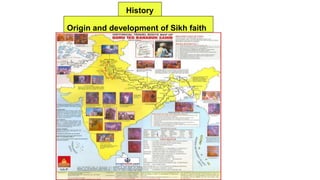
Origin and development of Sikh faith
History
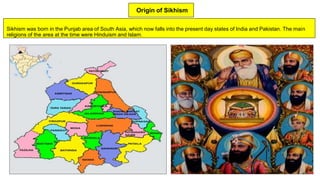
Origin of Sikhism
Sikhism was born in the Punjab area of South Asia, which now falls into the present day states of India and Pakistan. The main
religions of the area at the time were Hinduism and Islam.
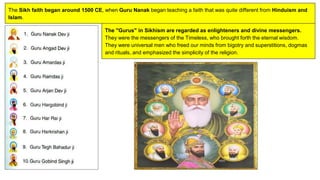
The Sikh faith began around 1500 CE, when Guru Nanak began teaching a faith that was quite different from Hinduism and
Islam.
The "Gurus" in Sikhism are regarded as enlighteners and divine messengers.
They were the messengers of the Timeless, who brought forth the eternal wisdom.
They were universal men who freed our minds from bigotry and superstitions, dogmas
and rituals, and emphasized the simplicity of the religion.
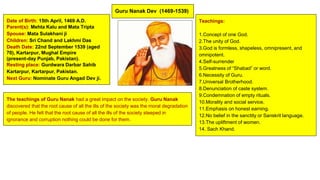
Date of Birth: 15th April, 1469 A.D.
Parent(s): Mehta Kalu and Mata Tripta
Spouse: Mata Sulakhani ji
Children: Sri Chand and Lakhmi Das
Death Date: 22nd September 1539 (aged
70), Kartarpur, Mughal Empire
(present-day Punjab, Pakistan).
Resting place: Gurdwara Darbar Sahib
Kartarpur, Kartarpur, Pakistan.
Next Guru: Nominate Guru Angad Dev ji.
Guru Nanak Dev (1469-1539)
The teachings of Guru Nanak had a great impact on the society. Guru Nanak
discovered that the root cause of all the ills of the society was the moral degradation
of people. He felt that the root cause of all the ills of the society steeped in
ignorance and corruption nothing could be done for them.
Teachings:
1.Concept of one God.
2.The unity of God.
3.God is formless, shapeless, omnipresent, and
omnipotent.
4.Self-surrender
5.Greatness of “Shabad” or word.
6.Necessity of Guru.
7.Universal Brotherhood.
8.Denunciation of caste system.
9.Condemnation of empty rituals.
10.Morality and social service.
11.Emphasis on honest earning.
12.No belief in the sanctity or Sanskrit language.
13.The upliftment of women.
14. Sach Khand.
Date of Birth: 31st March, 1504 A.D.
Parents: Bhai Pheru Mal and Mata Ram Kaur.
Spouse: Mata Khivi ji
Children: Baba Datu and Baba Dasu.
Bibi Amro and Bibi Anokhi.
Death: 1552 A.D., at Khadur Sahib.
Next Guru: Nominate Guru Amar Das ji.
The educational philosophy of Guru Angad Dev occupies the foremost
position.Guru Angad Dev ji started the schools to provide education to those
children who have no right to get an education. Only the children who belong to
the upper class can get the education at that time but the downtrodden or children
belonging to the lower caste have no right to get the education.
"Eliminate your conceit and then perform service to humanity, only then you
will be get honor." – Guru Angad.
Teachings: 1. Equal Opportunity --- In Guru
Angad’s time, the caste system was maintained, in
part, by keeping certain members of the population
uneducated and disenfranchised. Guru Angad
fought this by opening schools and formalizing the
Gurmukhi language. 2. Women’s Empowerment --
- Guru Angad emphasized the importance of
women throughout his teaching. He preached that
men and women were equal and gave women
religious rights and a seat side-by-side with men. 3.
Langar --- Guru Angad and Mata Khivi, both
recognized the importance of feeding everyone and
made langar a formal part of Sikh tradition. They
trained the sevadars (volunteers) to make each
community kitchen a place of refuge where
everyone is treated with respect and dignity. 4.
Physical Fitness --- Guru Angad believed that a
sound mind could only thrive in a sound body. He
encouraged everyone to lead healthy lifestyles that
included avoiding toxic substances and engaging in
physical fitness. He suggested exercising every day
after morning prayers.
Guru Angad (1504-1552)
Guru Amar Das (1479-1574)
Date of Birth: 5th May, 1479 A.D.
Parents: Tej Bhan Bhalla and Mata Bakht Kaur.
Spouse: Mata Mansa Devi ji.
Children: Bhai Mohan ji and Bhai Mohri ji.
Bibi Dani and Bibi Bhani.
Death: 1574 A.D., at Goindwal Sahib.
Next Guru: Nominate Guru Ram Das ji.
Guru Amar Das was an important innovator in The teachings of Guru who
introduced a religious organization called the 'manji system by appointing trained
clergy, a system that expanded and survives into the contemporary era. He wrote
and compiled hymns into a Pothi (book) that ultimately helped create the Adi
Granth.
Teachings: 1. He preached against Sati and
advocated the remarriage of widows. He asked
the women to discard the ‘Purdah’ (veil). He
introduced new birth, marriage, and death
ceremonies. Thus he raised the status of
women and protected the rights of female
infants who were killed without question as they
were deemed to have no status. These
teachings met stiff resistance from the Orthodox
Hindus and Muslim fundamentalists. He fixed
three Gurpurbs for Sikh celebrations: Dewali,
Vaisakhi, and Maghi. Visiting Hindu pilgrimage
centers and paying tributes to Muslim places
were prohibited.
2. A good devotee, taught Amar Das, should
be truthful, keep his mind in control, eat only
when hungry, seek the company of pious men,
worship the Lord, make an honest living, serve
holy men, not covet another's wealth and never
slander others. He recommended holy devotion
with Guru’s image in his follower’s hearts.
Guru Ram Das (1534-1581)
Date of Birth: 5th May, 1479 A.D.
Parents: Bhai Haridas ji and Mata Daya Kaur.
Spouse: Mata Bhani ji
Children: Baba Prithi Chand, Baba Mahadev ji
and Guru Arjan Dev ji.
Death: 1581 A.D., at Goindwal Sahib.
Next Guru: Nominate Guru Arjan Dev ji.
1. Guru Ram Das is credited for the birth of
Amritsar. The city’s bustling markets and the
gentle pool surrounding the Golden Temple all
came together when Guru Ram Das invited
merchants and artisans from other parts of India
to settle in this new town with him.
2. A son-in-law of the third Guru, Amar Das, Ram
Das also strengthened the institution of langar
(community kitchen) and manjis (missionary
centres) in attempts to consolidate the
foundations of a minority Sikh community in the
face of powerful Mughal politics and hegemonic
Brahminical traditions.
Guru Arjan Dev (1563-1606)
Date of Birth: 15th April, 1563, Goindwal,
Mughal Empire.
Parents: Guru Ram Das and Mata Bhani.
Spouse: Mata Ram Dei
Mata Ganga
Children: Guru Hargobind.
Death: 30th May, 1606 (aged 43), Lahore,
Mughal Empire.
Resting Place: Gurdwara Dera Sahib,
Walled City of Lahore.
Next Guru: Nominate Guru Hargobind ji.
Arjan Dev ji is the fifth Guru of Sikhism. He was born in
1563 at Goindwal, Amritsar. He attained Guruship in
1581 from his father Guru Ramdas ji. Guruji compelled
and collated the hymns of the previous Sikh Gurus
as the foundation of the Guru Granth Sahib ji. Guruji
contributed a total of 2218 hymns to the Sahib. Guru
ji authored the Sukhmani Sahib Bani - Prayer of
Peace. Guruji built Harmandir Sahib, also known as
Golden Temple, Amritsar. Guruji installed Adi Granth
(Guru Granth Sahib ji) in Harmandir Sahib, Amritsar
in 1604. Guruji enhanced the structure of the Sikh
Society by introducing the Masund system. Guruji
was the first Sikh Guru to be martyred and so, he is
revered as Shaheedan-De-Sartaaj, or the Crown of
Martyrs.
Teachings: a) Equality of mankind – caste system was abolished by the First Guru. The second Guru started the practice of langar where all people in a
Gurudwara could assemble to meditate, irrespective of the caste, and cook, serve, and eat food together. The soul of every human was considered
respectable and no human being was considered inferior to another. As the caste system was abolished amongst the followers of the Gurus, literacy for all
was advocated. b) Equality between a man and a woman was practiced. Every woman was considered capable of meditation, self-realization and following
all religious practices. A woman could independently follow her religion and was not considered impure on any occasion as well as the man. Therefore,
women were prohibited from wearing a veil. Dowry was prohibited amongst the followers of the Gurus. Sati was prohibited and widow remarriage was
encouraged.c) Equality in work and need to work was prescribed for all followers as well as sharing of their income and wealth. As the dignity of labor was
stressed, all walks of people gained their self-esteem and joined the new religion. The Guru himself would devote substantial time to charity and organize relief
camps in famines and natural calamities. The Guru also abolished the priestly class.d) Equality of and respect for all religions was emphasized. The
emphasis of the Sikh philosophy was on meditation and purity of action, not on the rituals, pilgrimages and dogmas. Therefore, in the compositions that were
accepted in Sri Guru Granth Sahib came from respectable saints that owed allegiance to Islam or to Hinduism. Precisely, that is why, the foundation stone of
the Golden Temple was laid by a Muslim Faqir, in the presence of many established and respected Sikhs.
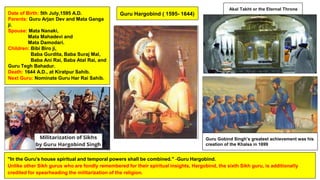
Guru Hargobind ( 1595- 1644)
Date of Birth: 5th July,1595 A.D.
Parents: Guru Arjan Dev and Mata Ganga
ji.
Spouse: Mata Nanaki,
Mata Mahadevi and
Mata Damodari.
Children: Bibi Biro ji,
Baba Gurdita, Baba Suraj Mal,
Baba Ani Rai, Baba Atal Rai, and
Guru Tegh Bahadur.
Death: 1644 A.D., at Kiratpur Sahib.
Next Guru: Nominate Guru Har Rai Sahib.
"In the Guru's house spiritual and temporal powers shall be combined." -Guru Hargobind.
Unlike other Sikh gurus who are fondly remembered for their spiritual insights, Hargobind, the sixth Sikh guru, is additionally
credited for spearheading the militarization of the religion.
Akal Takht or the Eternal Throne
Guru Gobind Singh’s greatest achievement was his
creation of the Khalsa in 1699
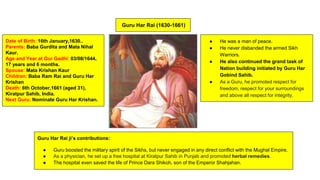
Guru Har Rai (1630-1661)
● He was a man of peace.
● He never disbanded the armed Sikh
Warriors.
● He also continued the grand task of
Nation building initiated by Guru Har
Gobind Sahib.
● As a Guru, he promoted respect for
freedom, respect for your surroundings
and above all respect for integrity.
Date of Birth: 16th January,1630..
Parents: Baba Gurdita and Mata Nihal
Kaur.
Age and Year at Gur Gadhi: 03/08/1644,
17 years and 6 months.
Spouse: Mata Krishan Kaur
Children: Baba Ram Rai and Guru Har
Krishan
Death: 6th October,1661 (aged 31),
Kiratpur Sahib, India.
Next Guru: Nominate Guru Har Krishan.
Guru Har Rai ji’s contributions:
● Guru boosted the military spirit of the Sikhs, but never engaged in any direct conflict with the Mughal Empire.
● As a physician, he set up a free hospital at Kiratpur Sahib in Punjab and promoted herbal remedies.
● The hospital even saved the life of Prince Dara Shikoh, son of the Emperor Shahjahan.
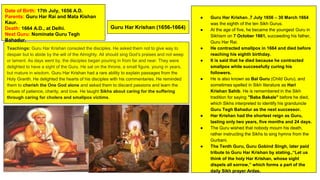
Guru Har Krishan (1656-1664)
Date of Birth: 17th July, 1656 A.D.
Parents: Guru Har Rai and Mata Kishan
Kaur.
Death: 1664 A.D., at Delhi.
Next Guru: Nominate Guru Tegh
Bahadur.
● Guru Har Krishan.,7 July 1656 – 30 March 1664
was the eighth of the ten Sikh Gurus.
● At the age of five, he became the youngest Guru in
Sikhism on 7 October 1661, succeeding his father,
Guru Har Rai.
● He contracted smallpox in 1664 and died before
reaching his eighth birthday.
● It is said that he died because he contracted
smallpox while successfully curing his
followers.
● He is also known as Bal Guru (Child Guru), and
sometimes spelled in Sikh literature as Hari
Krishan Sahib. He is remembered in the Sikh
tradition for saying "Baba Bakale" before he died,
which Sikhs interpreted to identify his granduncle
Guru Tegh Bahadur as the next successor.
● Har Krishan had the shortest reign as Guru,
lasting only two years, five months and 24 days.
● The Guru wished that nobody mourn his death,
rather instructing the Sikhs to sing hymns from the
Gurbani.
● The Tenth Guru, Guru Gobind Singh, later paid
tribute to Guru Har Krishan by stating.,“Let us
think of the holy Har Krishan, whose sight
dispels all sorrow,” which forms a part of the
daily Sikh prayer Ardas.
Teachings: Guru Har Krishan consoled the disciples. He asked them not to give way to
despair but to abide by the will of the Almighty. All should sing God’s praises and not weep
or lament. As days went by, the disciples began pouring in from far and near. They were
delighted to have a sight of the Guru. He sat on the throne, a small figure, young in years,
but mature in wisdom. Guru Har Krishan had a rare ability to explain passages from the
Holy Granth. He delighted the hearts of his disciples with his commentaries. He reminded
them to cherish the One God alone and asked them to discard passions and learn the
virtues of patience, charity, and love. He taught Sikhs about caring for the suffering
through caring for cholera and smallpox victims.
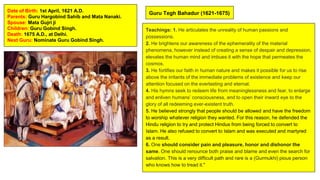
Guru Tegh Bahadur (1621-1675)
Date of Birth: 1st April, 1621 A.D.
Parents: Guru Hargobind Sahib and Mata Nanaki.
Spouse: Mata Gujri ji
Children: Guru Gobind Singh.
Death: 1675 A.D., at Delhi.
Next Guru: Nominate Guru Gobind Singh.
Teachings: 1. He articulates the unreality of human passions and
possessions.
2. He brightens our awareness of the ephemerality of the material
phenomena, however instead of creating a sense of despair and depression,
elevates the human mind and imbues it with the hope that permeates the
cosmos.
3. He fortifies our faith in human nature and makes it possible for us to rise
above the irritants of the immediate problems of existence and keep our
attention focused on the everlasting and eternal.
4. His hymns seek to redeem life from meaninglessness and fear, to enlarge
and enliven humans’ consciousness, and to open their inward eye to the
glory of all redeeming ever-existent truth.
5. He believed strongly that people should be allowed and have the freedom
to worship whatever religion they wanted. For this reason, he defended the
Hindu religion to try and protect Hindus from being forced to convert to
Islam. He also refused to convert to Islam and was executed and martyred
as a result.
6. One should consider pain and pleasure, honor and dishonor the
same. One should renounce both praise and blame and even the search for
salvation. This is a very difficult path and rare is a (Gurmukhi) pious person
who knows how to tread it."
Guru Gobind Singh (1666-1708)
Date of Birth: 22nd December, 1666 A.D.
Parents: Guru Tegh Bahadur and Mata Gujri ji.
Spouse: Mata Jeto ji,
Mata Sahib Kaur ji, and Mata Sundri ji.
Children: Sahibzada Fateh Singh, Sahibzada Ajit Singh,
Sahibzada Jujhar Singh, and Sahibzada Zorawar Singh.
Death: Assassinated on 7th October,1708.
Next Guru: Nominate Guru Granth Sahib.
● Guru Gobind Singh was the last of the human Sikh gurus.
● He introduced the Khalsa, or ‘pure ones’ and the ‘five Ks’.
● Just before he died in 1708, he proclaimed Guru Granth Sahib -
the Sikh scripture - as the future guru.
● This is why the Guru Granth Sahib means so much to people
of the Sikh faith.
● They see it as more than a holy book, but as another guide that
they respect in the same way, and a teacher showing them how
to live their lives fully.
● Guru Granth Sahib is often classed as the 11th Sikh Guru.
Five Ks:1. Kesh – unshorn hair.
This represents the natural appearance of sainthood.
This is the first token of the Sikh faith.
2. Kanga- A comb to clean the hair.
3. Kachha - An underwear to indicate virtuous character.
4. Kara - A Iron bracelet on the wrist, a symbol of dedication
to the Divine Bridegroom.
5. Kirpan - A sword symbolizing dignity, power and
unconquerable spirit.
They must observe the following guidelines:
1. Not to remove hair from the body.
2. Not to use Tobacco or other intoxicants (alcohol).
3. Not to eat or touch Kuttha (Halal or Kosher) meat of an animal
4. Not to commit adultery- 'Par nari ki sej, bhul supne hun na jayo'
(never enjoy, even in dream, the bed of a woman other than your
own wife)
(A supplementary ordinance was issued that any one who did not
observe any of the four directives, must be re- baptized, pay a fine,
and promise not to offend any more; or he must be excommunicated
from the Khalsa).
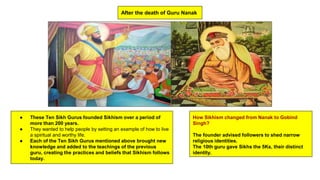
After the death of Guru Nanak
● These Ten Sikh Gurus founded Sikhism over a period of
more than 200 years.
● They wanted to help people by setting an example of how to live
a spiritual and worthy life.
● Each of the Ten Sikh Gurus mentioned above brought new
knowledge and added to the teachings of the previous
guru, creating the practices and beliefs that Sikhism follows
today.
How Sikhism changed from Nanak to Gobind
Singh?
The founder advised followers to shed narrow
religious identities.
The 10th guru gave Sikhs the 5Ks, their distinct
identity.
Origin and Development of Sikh faith.pptx

Origin and Development of Sikh faith.pptx

  • 1.
    Origin and developmentof Sikh faith History
  • 2.
    Origin of Sikhism Sikhismwas born in the Punjab area of South Asia, which now falls into the present day states of India and Pakistan. The main religions of the area at the time were Hinduism and Islam.
  • 3.
    The Sikh faithbegan around 1500 CE, when Guru Nanak began teaching a faith that was quite different from Hinduism and Islam. The "Gurus" in Sikhism are regarded as enlighteners and divine messengers. They were the messengers of the Timeless, who brought forth the eternal wisdom. They were universal men who freed our minds from bigotry and superstitions, dogmas and rituals, and emphasized the simplicity of the religion.
  • 4.
    Date of Birth:15th April, 1469 A.D. Parent(s): Mehta Kalu and Mata Tripta Spouse: Mata Sulakhani ji Children: Sri Chand and Lakhmi Das Death Date: 22nd September 1539 (aged 70), Kartarpur, Mughal Empire (present-day Punjab, Pakistan). Resting place: Gurdwara Darbar Sahib Kartarpur, Kartarpur, Pakistan. Next Guru: Nominate Guru Angad Dev ji. Guru Nanak Dev (1469-1539) The teachings of Guru Nanak had a great impact on the society. Guru Nanak discovered that the root cause of all the ills of the society was the moral degradation of people. He felt that the root cause of all the ills of the society steeped in ignorance and corruption nothing could be done for them. Teachings: 1.Concept of one God. 2.The unity of God. 3.God is formless, shapeless, omnipresent, and omnipotent. 4.Self-surrender 5.Greatness of “Shabad” or word. 6.Necessity of Guru. 7.Universal Brotherhood. 8.Denunciation of caste system. 9.Condemnation of empty rituals. 10.Morality and social service. 11.Emphasis on honest earning. 12.No belief in the sanctity or Sanskrit language. 13.The upliftment of women. 14. Sach Khand.
  • 5.
    Date of Birth:31st March, 1504 A.D. Parents: Bhai Pheru Mal and Mata Ram Kaur. Spouse: Mata Khivi ji Children: Baba Datu and Baba Dasu. Bibi Amro and Bibi Anokhi. Death: 1552 A.D., at Khadur Sahib. Next Guru: Nominate Guru Amar Das ji. The educational philosophy of Guru Angad Dev occupies the foremost position.Guru Angad Dev ji started the schools to provide education to those children who have no right to get an education. Only the children who belong to the upper class can get the education at that time but the downtrodden or children belonging to the lower caste have no right to get the education. "Eliminate your conceit and then perform service to humanity, only then you will be get honor." – Guru Angad. Teachings: 1. Equal Opportunity --- In Guru Angad’s time, the caste system was maintained, in part, by keeping certain members of the population uneducated and disenfranchised. Guru Angad fought this by opening schools and formalizing the Gurmukhi language. 2. Women’s Empowerment -- - Guru Angad emphasized the importance of women throughout his teaching. He preached that men and women were equal and gave women religious rights and a seat side-by-side with men. 3. Langar --- Guru Angad and Mata Khivi, both recognized the importance of feeding everyone and made langar a formal part of Sikh tradition. They trained the sevadars (volunteers) to make each community kitchen a place of refuge where everyone is treated with respect and dignity. 4. Physical Fitness --- Guru Angad believed that a sound mind could only thrive in a sound body. He encouraged everyone to lead healthy lifestyles that included avoiding toxic substances and engaging in physical fitness. He suggested exercising every day after morning prayers. Guru Angad (1504-1552)
  • 6.
    Guru Amar Das(1479-1574) Date of Birth: 5th May, 1479 A.D. Parents: Tej Bhan Bhalla and Mata Bakht Kaur. Spouse: Mata Mansa Devi ji. Children: Bhai Mohan ji and Bhai Mohri ji. Bibi Dani and Bibi Bhani. Death: 1574 A.D., at Goindwal Sahib. Next Guru: Nominate Guru Ram Das ji. Guru Amar Das was an important innovator in The teachings of Guru who introduced a religious organization called the 'manji system by appointing trained clergy, a system that expanded and survives into the contemporary era. He wrote and compiled hymns into a Pothi (book) that ultimately helped create the Adi Granth. Teachings: 1. He preached against Sati and advocated the remarriage of widows. He asked the women to discard the ‘Purdah’ (veil). He introduced new birth, marriage, and death ceremonies. Thus he raised the status of women and protected the rights of female infants who were killed without question as they were deemed to have no status. These teachings met stiff resistance from the Orthodox Hindus and Muslim fundamentalists. He fixed three Gurpurbs for Sikh celebrations: Dewali, Vaisakhi, and Maghi. Visiting Hindu pilgrimage centers and paying tributes to Muslim places were prohibited. 2. A good devotee, taught Amar Das, should be truthful, keep his mind in control, eat only when hungry, seek the company of pious men, worship the Lord, make an honest living, serve holy men, not covet another's wealth and never slander others. He recommended holy devotion with Guru’s image in his follower’s hearts.
  • 7.
    Guru Ram Das(1534-1581) Date of Birth: 5th May, 1479 A.D. Parents: Bhai Haridas ji and Mata Daya Kaur. Spouse: Mata Bhani ji Children: Baba Prithi Chand, Baba Mahadev ji and Guru Arjan Dev ji. Death: 1581 A.D., at Goindwal Sahib. Next Guru: Nominate Guru Arjan Dev ji. 1. Guru Ram Das is credited for the birth of Amritsar. The city’s bustling markets and the gentle pool surrounding the Golden Temple all came together when Guru Ram Das invited merchants and artisans from other parts of India to settle in this new town with him. 2. A son-in-law of the third Guru, Amar Das, Ram Das also strengthened the institution of langar (community kitchen) and manjis (missionary centres) in attempts to consolidate the foundations of a minority Sikh community in the face of powerful Mughal politics and hegemonic Brahminical traditions.
  • 8.
    Guru Arjan Dev(1563-1606) Date of Birth: 15th April, 1563, Goindwal, Mughal Empire. Parents: Guru Ram Das and Mata Bhani. Spouse: Mata Ram Dei Mata Ganga Children: Guru Hargobind. Death: 30th May, 1606 (aged 43), Lahore, Mughal Empire. Resting Place: Gurdwara Dera Sahib, Walled City of Lahore. Next Guru: Nominate Guru Hargobind ji. Arjan Dev ji is the fifth Guru of Sikhism. He was born in 1563 at Goindwal, Amritsar. He attained Guruship in 1581 from his father Guru Ramdas ji. Guruji compelled and collated the hymns of the previous Sikh Gurus as the foundation of the Guru Granth Sahib ji. Guruji contributed a total of 2218 hymns to the Sahib. Guru ji authored the Sukhmani Sahib Bani - Prayer of Peace. Guruji built Harmandir Sahib, also known as Golden Temple, Amritsar. Guruji installed Adi Granth (Guru Granth Sahib ji) in Harmandir Sahib, Amritsar in 1604. Guruji enhanced the structure of the Sikh Society by introducing the Masund system. Guruji was the first Sikh Guru to be martyred and so, he is revered as Shaheedan-De-Sartaaj, or the Crown of Martyrs. Teachings: a) Equality of mankind – caste system was abolished by the First Guru. The second Guru started the practice of langar where all people in a Gurudwara could assemble to meditate, irrespective of the caste, and cook, serve, and eat food together. The soul of every human was considered respectable and no human being was considered inferior to another. As the caste system was abolished amongst the followers of the Gurus, literacy for all was advocated. b) Equality between a man and a woman was practiced. Every woman was considered capable of meditation, self-realization and following all religious practices. A woman could independently follow her religion and was not considered impure on any occasion as well as the man. Therefore, women were prohibited from wearing a veil. Dowry was prohibited amongst the followers of the Gurus. Sati was prohibited and widow remarriage was encouraged.c) Equality in work and need to work was prescribed for all followers as well as sharing of their income and wealth. As the dignity of labor was stressed, all walks of people gained their self-esteem and joined the new religion. The Guru himself would devote substantial time to charity and organize relief camps in famines and natural calamities. The Guru also abolished the priestly class.d) Equality of and respect for all religions was emphasized. The emphasis of the Sikh philosophy was on meditation and purity of action, not on the rituals, pilgrimages and dogmas. Therefore, in the compositions that were accepted in Sri Guru Granth Sahib came from respectable saints that owed allegiance to Islam or to Hinduism. Precisely, that is why, the foundation stone of the Golden Temple was laid by a Muslim Faqir, in the presence of many established and respected Sikhs.
  • 9.
    Guru Hargobind (1595- 1644) Date of Birth: 5th July,1595 A.D. Parents: Guru Arjan Dev and Mata Ganga ji. Spouse: Mata Nanaki, Mata Mahadevi and Mata Damodari. Children: Bibi Biro ji, Baba Gurdita, Baba Suraj Mal, Baba Ani Rai, Baba Atal Rai, and Guru Tegh Bahadur. Death: 1644 A.D., at Kiratpur Sahib. Next Guru: Nominate Guru Har Rai Sahib. "In the Guru's house spiritual and temporal powers shall be combined." -Guru Hargobind. Unlike other Sikh gurus who are fondly remembered for their spiritual insights, Hargobind, the sixth Sikh guru, is additionally credited for spearheading the militarization of the religion. Akal Takht or the Eternal Throne Guru Gobind Singh’s greatest achievement was his creation of the Khalsa in 1699
  • 10.
    Guru Har Rai(1630-1661) ● He was a man of peace. ● He never disbanded the armed Sikh Warriors. ● He also continued the grand task of Nation building initiated by Guru Har Gobind Sahib. ● As a Guru, he promoted respect for freedom, respect for your surroundings and above all respect for integrity. Date of Birth: 16th January,1630.. Parents: Baba Gurdita and Mata Nihal Kaur. Age and Year at Gur Gadhi: 03/08/1644, 17 years and 6 months. Spouse: Mata Krishan Kaur Children: Baba Ram Rai and Guru Har Krishan Death: 6th October,1661 (aged 31), Kiratpur Sahib, India. Next Guru: Nominate Guru Har Krishan. Guru Har Rai ji’s contributions: ● Guru boosted the military spirit of the Sikhs, but never engaged in any direct conflict with the Mughal Empire. ● As a physician, he set up a free hospital at Kiratpur Sahib in Punjab and promoted herbal remedies. ● The hospital even saved the life of Prince Dara Shikoh, son of the Emperor Shahjahan.
  • 11.
    Guru Har Krishan(1656-1664) Date of Birth: 17th July, 1656 A.D. Parents: Guru Har Rai and Mata Kishan Kaur. Death: 1664 A.D., at Delhi. Next Guru: Nominate Guru Tegh Bahadur. ● Guru Har Krishan.,7 July 1656 – 30 March 1664 was the eighth of the ten Sikh Gurus. ● At the age of five, he became the youngest Guru in Sikhism on 7 October 1661, succeeding his father, Guru Har Rai. ● He contracted smallpox in 1664 and died before reaching his eighth birthday. ● It is said that he died because he contracted smallpox while successfully curing his followers. ● He is also known as Bal Guru (Child Guru), and sometimes spelled in Sikh literature as Hari Krishan Sahib. He is remembered in the Sikh tradition for saying "Baba Bakale" before he died, which Sikhs interpreted to identify his granduncle Guru Tegh Bahadur as the next successor. ● Har Krishan had the shortest reign as Guru, lasting only two years, five months and 24 days. ● The Guru wished that nobody mourn his death, rather instructing the Sikhs to sing hymns from the Gurbani. ● The Tenth Guru, Guru Gobind Singh, later paid tribute to Guru Har Krishan by stating.,“Let us think of the holy Har Krishan, whose sight dispels all sorrow,” which forms a part of the daily Sikh prayer Ardas. Teachings: Guru Har Krishan consoled the disciples. He asked them not to give way to despair but to abide by the will of the Almighty. All should sing God’s praises and not weep or lament. As days went by, the disciples began pouring in from far and near. They were delighted to have a sight of the Guru. He sat on the throne, a small figure, young in years, but mature in wisdom. Guru Har Krishan had a rare ability to explain passages from the Holy Granth. He delighted the hearts of his disciples with his commentaries. He reminded them to cherish the One God alone and asked them to discard passions and learn the virtues of patience, charity, and love. He taught Sikhs about caring for the suffering through caring for cholera and smallpox victims.
  • 12.
    Guru Tegh Bahadur(1621-1675) Date of Birth: 1st April, 1621 A.D. Parents: Guru Hargobind Sahib and Mata Nanaki. Spouse: Mata Gujri ji Children: Guru Gobind Singh. Death: 1675 A.D., at Delhi. Next Guru: Nominate Guru Gobind Singh. Teachings: 1. He articulates the unreality of human passions and possessions. 2. He brightens our awareness of the ephemerality of the material phenomena, however instead of creating a sense of despair and depression, elevates the human mind and imbues it with the hope that permeates the cosmos. 3. He fortifies our faith in human nature and makes it possible for us to rise above the irritants of the immediate problems of existence and keep our attention focused on the everlasting and eternal. 4. His hymns seek to redeem life from meaninglessness and fear, to enlarge and enliven humans’ consciousness, and to open their inward eye to the glory of all redeeming ever-existent truth. 5. He believed strongly that people should be allowed and have the freedom to worship whatever religion they wanted. For this reason, he defended the Hindu religion to try and protect Hindus from being forced to convert to Islam. He also refused to convert to Islam and was executed and martyred as a result. 6. One should consider pain and pleasure, honor and dishonor the same. One should renounce both praise and blame and even the search for salvation. This is a very difficult path and rare is a (Gurmukhi) pious person who knows how to tread it."
  • 13.
    Guru Gobind Singh(1666-1708) Date of Birth: 22nd December, 1666 A.D. Parents: Guru Tegh Bahadur and Mata Gujri ji. Spouse: Mata Jeto ji, Mata Sahib Kaur ji, and Mata Sundri ji. Children: Sahibzada Fateh Singh, Sahibzada Ajit Singh, Sahibzada Jujhar Singh, and Sahibzada Zorawar Singh. Death: Assassinated on 7th October,1708. Next Guru: Nominate Guru Granth Sahib. ● Guru Gobind Singh was the last of the human Sikh gurus. ● He introduced the Khalsa, or ‘pure ones’ and the ‘five Ks’. ● Just before he died in 1708, he proclaimed Guru Granth Sahib - the Sikh scripture - as the future guru. ● This is why the Guru Granth Sahib means so much to people of the Sikh faith. ● They see it as more than a holy book, but as another guide that they respect in the same way, and a teacher showing them how to live their lives fully. ● Guru Granth Sahib is often classed as the 11th Sikh Guru. Five Ks:1. Kesh – unshorn hair. This represents the natural appearance of sainthood. This is the first token of the Sikh faith. 2. Kanga- A comb to clean the hair. 3. Kachha - An underwear to indicate virtuous character. 4. Kara - A Iron bracelet on the wrist, a symbol of dedication to the Divine Bridegroom. 5. Kirpan - A sword symbolizing dignity, power and unconquerable spirit. They must observe the following guidelines: 1. Not to remove hair from the body. 2. Not to use Tobacco or other intoxicants (alcohol). 3. Not to eat or touch Kuttha (Halal or Kosher) meat of an animal 4. Not to commit adultery- 'Par nari ki sej, bhul supne hun na jayo' (never enjoy, even in dream, the bed of a woman other than your own wife) (A supplementary ordinance was issued that any one who did not observe any of the four directives, must be re- baptized, pay a fine, and promise not to offend any more; or he must be excommunicated from the Khalsa).
  • 14.
    After the deathof Guru Nanak ● These Ten Sikh Gurus founded Sikhism over a period of more than 200 years. ● They wanted to help people by setting an example of how to live a spiritual and worthy life. ● Each of the Ten Sikh Gurus mentioned above brought new knowledge and added to the teachings of the previous guru, creating the practices and beliefs that Sikhism follows today. How Sikhism changed from Nanak to Gobind Singh? The founder advised followers to shed narrow religious identities. The 10th guru gave Sikhs the 5Ks, their distinct identity.