Significant U.S. Cases
in 2010
Brian R. Dorn, Ph.D.
November 4, 2010
Cases
1. Bilski v. Kappos
2. Ariad v. Eli Lilly & Co.
3. ACLU v. USPTO
(“Myriad”)
4. Daiichi Sankyo Co., Ltd. v.
Matrix Labs., Ltd.
Bilski v. Kappos
561 U.S. ___ (2010)
• Machine or Transformation
(MoT) test is a good test but
not the only test
• A claimed process is patentable
under 35 U.S.C. § 101 if (a)
the process is tied to a
particular machine or
apparatus, or (b) the process
transforms a particular article
into a different state or thing
Bilski
• Not patentable subject matters
– Abstract ideas
– Natural phenomenon
– Laws of Nature
• Involvement of the machine or
transformation must not be
insignificant, extra-solution
activity, such as gathering data
(CAFC)
Bilski
• MoT test may not apply to
“advanced diagnostic
medicine [sic] techniques”
being part of the
“information age”
• To be further elucidated in
Prometheus and Classen
Prometheus
Patentable Transformation (CAFC):
1. A method of optimizing therapeutic efficacy for treatment
of an immune-mediated gastrointestinal disorder, comprising:
(a) administering a drug providing 6-thioguanine to a subject
having said immune-mediated gastrointestinal disorder; and
(b) determining the level of 6-thioguanine in said subject
having said immune-mediated gastrointestinal disorder,
wherein the level of 6-thioguanine less than about 230 pmol per
8x10⁸ red blood cells indicates a need to increase the amount
of said drug subsequently administered to said subject and
wherein the level of 6-thioguanine greater than about 400 pmol
per 8x10⁸ red blood cells indicates a need to decrease the
amount of said drug subsequently administered to said subject.
Classen
Not patentable subject matter (CAFC):
1. A method of determining whether an
immunization schedule affects the incidence or
severity of a chronic immune-mediated disorder in a
treatment group of mammals, relative to a control
group of mammals, which comprises immunizing
mammals in the treatment group of mammals with
one or more doses of one or more immunogens,
according to said immunization schedule, and
comparing the incidence, prevalence, frequency or
severity of said chronic immune-mediated disorder
or the level of a marker of such a disorder, in the
treatment group, with that in the control group.
Assoc. Mol. Pathol. v. USPTO
702 F.Supp.2d 181 (SDNY, 2010)
• The “Myriad Case”
• Potential seismic shift in the biotech
industry
• Decision granting Plaintiffs’ motion
on Summary Judgment that the
claims to isolated DNA sequences
coding for BRCA1/BRCA2
polypeptides are invalid because the
subject matter of the claims is not
patentable subject matter because
the claims cover natural products or
abstract mental processes
The Myriad Case
‘282 & ‘492 patents
• Claim 1:
An isolated DNA molecule
coding for the
[BRCA1/BRCA2] polypeptide,
said DNA molecule comprising
a nucleic acid sequence
encoding the amino acid
sequence set forth in SEQ ID
NO:2
• SEQ ID NO:2 is the
BRCA1/BRCA2 polypeptide
The Myriad Case
• Markedly Different Test—
derived from Chakrabarty
• Does purification/isolation
of a natural product render
the product patentable?
• Is isolated DNA markedly
different than DNA found
in nature?
The Myriad Case
• Judge Sweet characterizes
DNA as “physical embodiment
of information”; ignores
physical/chemical differences
• Finds that “none of the
structural and functional
differences…render the
claimed DNA markedly
different”
Ariad Pharm., Inc. v. Eli Lilly & Co.
(Fed. Cir. 2010) (en banc)
• Reaffirmed that the Written
Description requirement is
separate from the
enablement requirement
• Also reaffirmed the
“possession” standard
Ariad
• Constructive RTP that ID’s
claimed subject matter is
sufficient; Actual RTP is
not necessary
• Sufficient examples
demonstrating common
features to members of the
genus
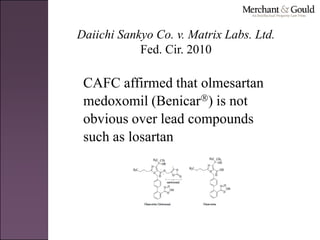
Daiichi Sankyo Co. v. Matrix Labs. Ltd.
Fed. Cir. 2010
CAFC affirmed that olmesartan
medoxomil (Benicar) is not
obvious over lead compounds
such as losartan
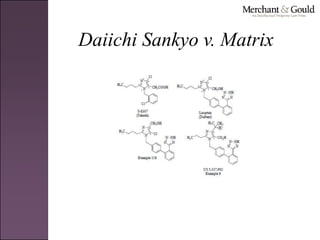
Daiichi Sankyo v. Matrix
Lead Compound
• Known prior art compound
• Closest prior art compound
• Most structurally similar prior
art compound
• Most active prior art
compound
• Most promising prior art
compound to modify
• Most preferred prior art
compound
Daiichi Sankyo v. Matrix
Proof of obviousness based on structural
similarity requires clear and convincing
evidence that a medicinal chemist of
ordinary skill would have been motivated
to select and then to modify a prior art
compound (e.g., a lead compound) to
arrive at a claimed compound would have
similar or improved properties compared
with the old.”
Daiichi Sankyo v. Matrix
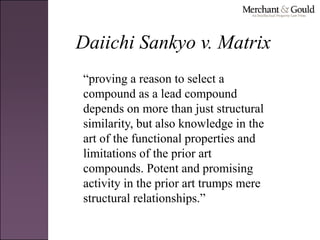
“proving a reason to select a
compound as a lead compound
depends on more than just structural
similarity, but also knowledge in the
art of the functional properties and
limitations of the prior art
compounds. Potent and promising
activity in the prior art trumps mere
structural relationships.”
Daiichi Sankyo v. Matrix
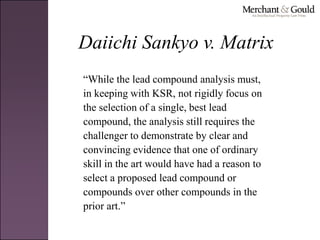
“While the lead compound analysis must,
in keeping with KSR, not rigidly focus on
the selection of a single, best lead
compound, the analysis still requires the
challenger to demonstrate by clear and
convincing evidence that one of ordinary
skill in the art would have had a reason to
select a proposed lead compound or
compounds over other compounds in the
prior art.”
Thank you!
Feel free to contact me at
bdorn@merchantgould.com
www.twitter.com/biotechpatent
www.linkedin.com/in/briandornphd

Significant U.S. cases in 2010

  • 1.
    Significant U.S. Cases in2010 Brian R. Dorn, Ph.D. November 4, 2010
  • 2.
    Cases 1. Bilski v.Kappos 2. Ariad v. Eli Lilly & Co. 3. ACLU v. USPTO (“Myriad”) 4. Daiichi Sankyo Co., Ltd. v. Matrix Labs., Ltd.
  • 3.
    Bilski v. Kappos 561U.S. ___ (2010) • Machine or Transformation (MoT) test is a good test but not the only test • A claimed process is patentable under 35 U.S.C. § 101 if (a) the process is tied to a particular machine or apparatus, or (b) the process transforms a particular article into a different state or thing
  • 4.
    Bilski • Not patentablesubject matters – Abstract ideas – Natural phenomenon – Laws of Nature • Involvement of the machine or transformation must not be insignificant, extra-solution activity, such as gathering data (CAFC)
  • 5.
    Bilski • MoT testmay not apply to “advanced diagnostic medicine [sic] techniques” being part of the “information age” • To be further elucidated in Prometheus and Classen
  • 6.
    Prometheus Patentable Transformation (CAFC): 1.A method of optimizing therapeutic efficacy for treatment of an immune-mediated gastrointestinal disorder, comprising: (a) administering a drug providing 6-thioguanine to a subject having said immune-mediated gastrointestinal disorder; and (b) determining the level of 6-thioguanine in said subject having said immune-mediated gastrointestinal disorder, wherein the level of 6-thioguanine less than about 230 pmol per 8x10⁸ red blood cells indicates a need to increase the amount of said drug subsequently administered to said subject and wherein the level of 6-thioguanine greater than about 400 pmol per 8x10⁸ red blood cells indicates a need to decrease the amount of said drug subsequently administered to said subject.
  • 7.
    Classen Not patentable subjectmatter (CAFC): 1. A method of determining whether an immunization schedule affects the incidence or severity of a chronic immune-mediated disorder in a treatment group of mammals, relative to a control group of mammals, which comprises immunizing mammals in the treatment group of mammals with one or more doses of one or more immunogens, according to said immunization schedule, and comparing the incidence, prevalence, frequency or severity of said chronic immune-mediated disorder or the level of a marker of such a disorder, in the treatment group, with that in the control group.
  • 8.
    Assoc. Mol. Pathol.v. USPTO 702 F.Supp.2d 181 (SDNY, 2010) • The “Myriad Case” • Potential seismic shift in the biotech industry • Decision granting Plaintiffs’ motion on Summary Judgment that the claims to isolated DNA sequences coding for BRCA1/BRCA2 polypeptides are invalid because the subject matter of the claims is not patentable subject matter because the claims cover natural products or abstract mental processes
  • 9.
    The Myriad Case ‘282& ‘492 patents • Claim 1: An isolated DNA molecule coding for the [BRCA1/BRCA2] polypeptide, said DNA molecule comprising a nucleic acid sequence encoding the amino acid sequence set forth in SEQ ID NO:2 • SEQ ID NO:2 is the BRCA1/BRCA2 polypeptide
  • 10.
    The Myriad Case •Markedly Different Test— derived from Chakrabarty • Does purification/isolation of a natural product render the product patentable? • Is isolated DNA markedly different than DNA found in nature?
  • 11.
    The Myriad Case •Judge Sweet characterizes DNA as “physical embodiment of information”; ignores physical/chemical differences • Finds that “none of the structural and functional differences…render the claimed DNA markedly different”
  • 12.
    Ariad Pharm., Inc.v. Eli Lilly & Co. (Fed. Cir. 2010) (en banc) • Reaffirmed that the Written Description requirement is separate from the enablement requirement • Also reaffirmed the “possession” standard
  • 13.
    Ariad • Constructive RTPthat ID’s claimed subject matter is sufficient; Actual RTP is not necessary • Sufficient examples demonstrating common features to members of the genus
  • 14.
    Daiichi Sankyo Co.v. Matrix Labs. Ltd. Fed. Cir. 2010 CAFC affirmed that olmesartan medoxomil (Benicar) is not obvious over lead compounds such as losartan
  • 15.
  • 16.
    Lead Compound • Knownprior art compound • Closest prior art compound • Most structurally similar prior art compound • Most active prior art compound • Most promising prior art compound to modify • Most preferred prior art compound
  • 17.
    Daiichi Sankyo v.Matrix Proof of obviousness based on structural similarity requires clear and convincing evidence that a medicinal chemist of ordinary skill would have been motivated to select and then to modify a prior art compound (e.g., a lead compound) to arrive at a claimed compound would have similar or improved properties compared with the old.”
  • 18.
    Daiichi Sankyo v.Matrix “proving a reason to select a compound as a lead compound depends on more than just structural similarity, but also knowledge in the art of the functional properties and limitations of the prior art compounds. Potent and promising activity in the prior art trumps mere structural relationships.”
  • 19.
    Daiichi Sankyo v.Matrix “While the lead compound analysis must, in keeping with KSR, not rigidly focus on the selection of a single, best lead compound, the analysis still requires the challenger to demonstrate by clear and convincing evidence that one of ordinary skill in the art would have had a reason to select a proposed lead compound or compounds over other compounds in the prior art.”
  • 20.
    Thank you! Feel freeto contact me at bdorn@merchantgould.com www.twitter.com/biotechpatent www.linkedin.com/in/briandornphd