Plaintiffs File Petition for Certiorari
in AMP V. USPTO (Myriad case)
By Kevin E. Noonan


                                 科碩一 易先勇

                         • Basic intro.
                         • Law issue
                         • Conclusion and feedback
Basic Introduction
Paper Review
• Certiorari: from Latin, means to be informed of gaining
 appellate review, ordered and examined by superior court.


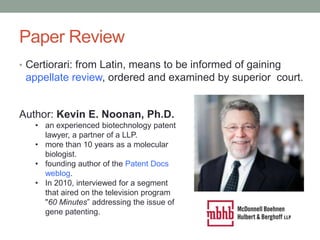
Author: Kevin E. Noonan, Ph.D.
   • an experienced biotechnology patent
     lawyer, a partner of a LLP.
   • more than 10 years as a molecular
     biologist.
   • founding author of the Patent Docs
     weblog.
   • In 2010, interviewed for a segment
     that aired on the television program
     "60 Minutes” addressing the issue of
     gene patenting.
• In AMP. v. USPTO, Public Patent Foundation (PubPat)
 and American Civil Liberties Union (ACLU) argued for
 plaintiffs.
The Public Patent Foundation at Benjamin N.
Cardozo School of Law (“PUBPAT”) is a not-for-
profit legal services organization whose mission is
to protect freedom in the patent system.


                                  The American Civil Liberties Union (ACLU) is
                                  a nonpartisan non-profit organization with
                                  mission "to defend and preserve the
                                  individual rights and liberties guaranteed to
                                  every person in this country by the
                                  Constitution and laws of the United States.
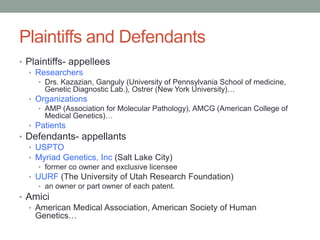
Plaintiffs and Defendants
• Plaintiffs- appellees
  • Researchers
     • Drs. Kazazian, Ganguly (University of Pennsylvania School of medicine,
      Genetic Diagnostic Lab.), Ostrer (New York University)…
  • Organizations
     • AMP (Association for Molecular Pathology), AMCG (American College of
      Medical Genetics)…
  • Patients
• Defendants- appellants
  • USPTO
  • Myriad Genetics, Inc (Salt Lake City)
     • former co owner and exclusive licensee
  • UURF (The University of Utah Research Foundation)
     • an owner or part owner of each patent.
• Amici
  • American Medical Association, American Society of Human
    Genetics…
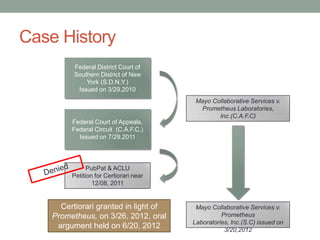
Case History
          Federal District Court of
          Southern District of New
              York (S.D.N.Y.)
           Issued on 3/29.2010
                                         Mayo Collaborative Services v.
                                          Prometheus Laboratories,
                                                Inc.(C.A.F.C)
         Federal Court of Appeals,
         Federal Circuit (C.A.F.C.)
           Issued on 7/29.2011


               PubPat & ACLU
         Petition for Certiorari near
                 12/08, 2011


      Certiorari granted in light of     Mayo Collaborative Services v.
    Prometheus, on 3/26, 2012, oral               Prometheus
                                        Laboratories, Inc.(S.C) issued on
     argument held on 6/20, 2012                   3/20,2012
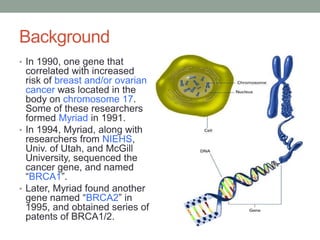
Background
• In 1990, one gene that
  correlated with increased
  risk of breast and/or ovarian
  cancer was located in the
  body on chromosome 17.
  Some of these researchers
  formed Myriad in 1991.
• In 1994, Myriad, along with
  researchers from NIEHS,
  Univ. of Utah, and McGill
  University, sequenced the
  cancer gene, and named
  “BRCA1”.
• Later, Myriad found another
  gene named “BRCA2” in
  1995, and obtained series of
  patents of BRCA1/2.
Background
• In 1998~ 2008, Myriad charges
  about $3000 for BRCA1/2 test.
                 .
• In 2008, revenues are $222 million,
  of which $190 million in profit.
• In contrast, the Ontario regional
  public health plan offering
  BRCA1/2 testing - in disregard of
  the Myriad patents –charges about
  $1000/test.
• Through cease and desist letters,
  communication person in person,
  licensing and litigations…Myriad‟s
  act of enforcing its patent right was
  widely known in the research
  community.
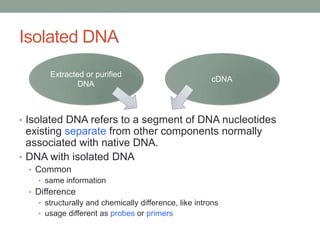
Isolated DNA
      Extracted or purified
                                                      cDNA
              DNA


• Isolated DNA refers to a segment of DNA nucleotides
  existing separate from other components normally
  associated with native DNA.
• DNA with isolated DNA
 • Common
   • same information
 • Difference
   • structurally and chemically difference, like introns
   • usage different as probes or primers
USPTO policy
• Utility Examination Guidelines (2001)
  • 從蛋白質的純化來定序,找到基因序列
  • 生物資訊學的出現:反向轉錄與同源比對,找到蛋白質
  • 美國實務上長期以來的做法均認同基因可專利性,並核准了數以千
    計不同生物體的基因專利,其中約20%為人類基因。
Main Issue
• Patent Eligibility
  • Are human gene patentable?
• Standing Requirement
  • Did the court err in adopting a new and inflexible rule that contradict
    to MedImmune, Inc. imposing a more rigid requirement for
    standing?
Law issue
Category1: Isolated, non- mutated forms,
and fragments of BRCA1/2 gene
• Claim 1 of the „282 patent
  • An isolated DNA coding for a BCRA1 polypeptide, said polypeptide
    having the amino acid sequence set forth in SEQ. ID. NO: 2.
• Claim 2 of the „282 patent
  • The isolated DNA of claim 1 ,wherein said DNA has the nucleotide
    sequence set forth in SEQ ID NO: 1.
• Claim 5 of the „282 patent
  • An isolated DNA having at least 15 nucleotides of the DNA of claim1.
• Claim 6 of the „282 patent
  • An isolated DNA having at least 15 nucleotides of the DNA of claim2.
• Claim 1 of the „492 patent
  • An isolated DNA molecule coding for a BRCA2 polypeptide, said DNA
    molecule comprising a nucleic acid sequence encoding the amino acid
    sequence set forth in SEQ ID NO: 2.
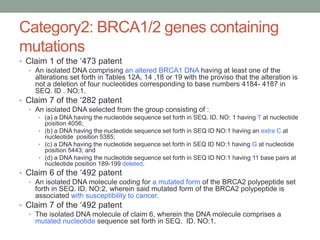
Category2: BRCA1/2 genes containing
mutations
• Claim 1 of the „473 patent
   • An isolated DNA comprising an altered BRCA1 DNA having at least one of the
     alterations set forth in Tables 12A, 14 ,18 or 19 with the proviso that the alteration is
     not a deletion of four nucleotides corresponding to base numbers 4184- 4187 in
     SEQ. ID . NO:1.
• Claim 7 of the „282 patent
   • An isolated DNA selected from the group consisting of :
      • (a) a DNA having the nucleotide sequence set forth in SEQ. ID. NO: 1 having T at nucleotide
        position 4056;
      • (b) a DNA having the nucleotide sequence set forth in SEQ ID NO:1 having an extra C at
        nucleotide position 5385;
      • (c) a DNA having the nucleotide sequence set forth in SEQ ID NO:1 having G at nucleotide
        position 5443; and
      • (d) a DNA having the nucleotide sequence set forth in SEQ ID NO:1 having 11 base pairs at
        nucleotide position 189-199 deleted.
• Claim 6 of the „492 patent
   • An isolated DNA molecule coding for a mutated form of the BRCA2 polypeptide set
     forth in SEQ. ID. NO:2, wherein said mutated form of the BRCA2 polypeptide is
     associated with susceptibility to cancer.
• Claim 7 of the „492 patent
   • The isolated DNA molecule of claim 6, wherein the DNA molecule comprises a
     mutated nucleotide sequence set forth in SEQ. ID. NO:1.
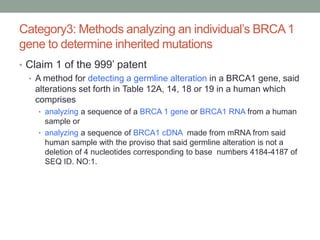
Category3: Methods analyzing an individual‟s BRCA 1
gene to determine inherited mutations
• Claim 1 of the 999‟ patent
  • A method for detecting a germline alteration in a BRCA1 gene, said
    alterations set forth in Table 12A, 14, 18 or 19 in a human which
    comprises
    • analyzing a sequence of a BRCA 1 gene or BRCA1 RNA from a human
      sample or
    • analyzing a sequence of BRCA1 cDNA made from mRNA from said
      human sample with the proviso that said germline alteration is not a
      deletion of 4 nucleotides corresponding to base numbers 4184-4187 of
      SEQ ID. NO:1.
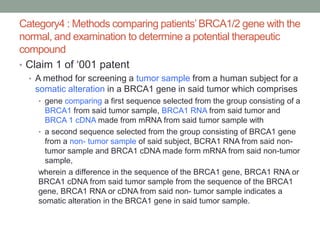
Category4 : Methods comparing patients‟ BRCA1/2 gene with the
normal, and examination to determine a potential therapeutic
compound
• Claim 1 of „001 patent
  • A method for screening a tumor sample from a human subject for a
   somatic alteration in a BRCA1 gene in said tumor which comprises
    • gene comparing a first sequence selected from the group consisting of a
      BRCA1 from said tumor sample, BRCA1 RNA from said tumor and
      BRCA 1 cDNA made from mRNA from said tumor sample with
    • a second sequence selected from the group consisting of BRCA1 gene
      from a non- tumor sample of said subject, BCRA1 RNA from said non-
      tumor sample and BRCA1 cDNA made form mRNA from said non-tumor
      sample,
    wherein a difference in the sequence of the BRCA1 gene, BRCA1 RNA or
    BRCA1 cDNA from said tumor sample from the sequence of the BRCA1
    gene, BRCA1 RNA or cDNA from said non- tumor sample indicates a
    somatic alteration in the BRCA1 gene in said tumor sample.
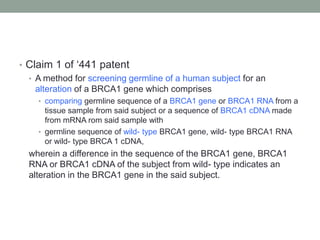
• Claim 1 of „441 patent
  • A method for screening germline of a human subject for an
    alteration of a BRCA1 gene which comprises
    • comparing germline sequence of a BRCA1 gene or BRCA1 RNA from a
      tissue sample from said subject or a sequence of BRCA1 cDNA made
      from mRNA rom said sample with
    • germline sequence of wild- type BRCA1 gene, wild- type BRCA1 RNA
      or wild- type BRCA 1 cDNA,
  wherein a difference in the sequence of the BRCA1 gene, BRCA1
  RNA or BRCA1 cDNA of the subject from wild- type indicates an
  alteration in the BRCA1 gene in the said subject.
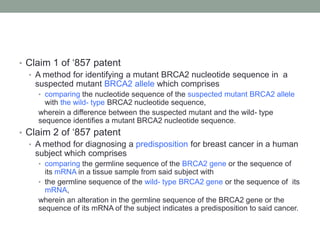
• Claim 1 of „857 patent
  • A method for identifying a mutant BRCA2 nucleotide sequence in a
    suspected mutant BRCA2 allele which comprises
     • comparing the nucleotide sequence of the suspected mutant BRCA2 allele
       with the wild- type BRCA2 nucleotide sequence,
     wherein a difference between the suspected mutant and the wild- type
     sequence identifies a mutant BRCA2 nucleotide sequence.
• Claim 2 of „857 patent
  • A method for diagnosing a predisposition for breast cancer in a human
    subject which comprises
     • comparing the germline sequence of the BRCA2 gene or the sequence of
       its mRNA in a tissue sample from said subject with
     • the germline sequence of the wild- type BRCA2 gene or the sequence of its
       mRNA,
     wherein an alteration in the germline sequence of the BRCA2 gene or the
     sequence of its mRNA of the subject indicates a predisposition to said cancer.
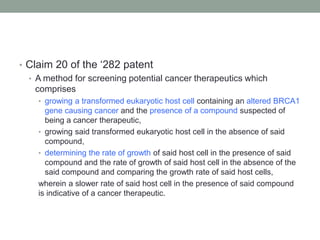
• Claim 20 of the „282 patent
  • A method for screening potential cancer therapeutics which
    comprises
    • growing a transformed eukaryotic host cell containing an altered BRCA1
      gene causing cancer and the presence of a compound suspected of
      being a cancer therapeutic,
    • growing said transformed eukaryotic host cell in the absence of said
      compound,
    • determining the rate of growth of said host cell in the presence of said
      compound and the rate of growth of said host cell in the absence of the
      said compound and comparing the growth rate of said host cells,
    wherein a slower rate of said host cell in the presence of said compound
    is indicative of a cancer therapeutic.
Patents
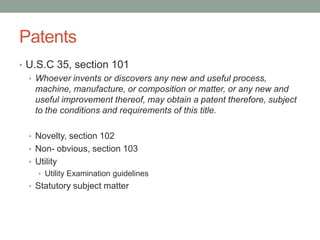
• U.S.C 35, section 101
  • Whoever invents or discovers any new and useful process,
    machine, manufacture, or composition or matter, or any new and
    useful improvement thereof, may obtain a patent therefore, subject
    to the conditions and requirements of this title.

  • Novelty, section 102
  • Non- obvious, section 103
  • Utility
     • Utility Examination guidelines
  • Statutory subject matter
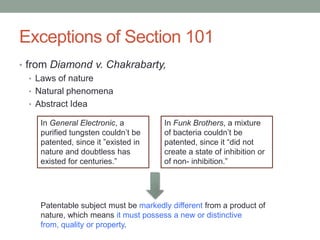
Exceptions of Section 101
• from Diamond v. Chakrabarty,
   • Laws of nature
   • Natural phenomena
   • Abstract Idea

    In General Electronic, a          In Funk Brothers, a mixture
    purified tungsten couldn‟t be     of bacteria couldn‟t be
    patented, since it ”existed in    patented, since it “did not
    nature and doubtless has          create a state of inhibition or
    existed for centuries.”           of non- inhibition.”


    Patentable subject must be markedly different from a product of
    nature, which means it must possess a new or distinctive
    from, quality or property.
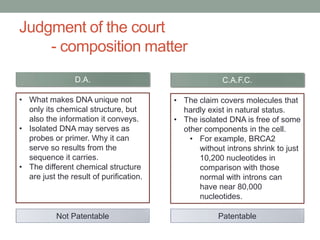
Judgment of the court
    - composition matter
                 D.A.                                 C.A.F.C.

• What makes DNA unique not              • The claim covers molecules that
  only its chemical structure, but         hardly exist in natural status.
  also the information it conveys.       • The isolated DNA is free of some
• Isolated DNA may serves as               other components in the cell.
  probes or primer. Why it can               • For example, BRCA2
  serve so results from the                    without introns shrink to just
  sequence it carries.                         10,200 nucleotides in
• The different chemical structure             comparison with those
  are just the result of purification.         normal with introns can
                                               have near 80,000
                                               nucleotides.

           Not Patentable                            Patentable
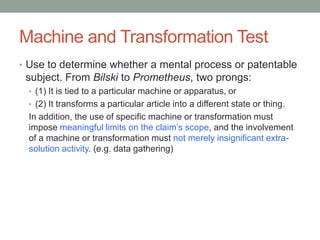
Machine and Transformation Test
• Use to determine whether a mental process or patentable
 subject. From Bilski to Prometheus, two prongs:
 • (1) It is tied to a particular machine or apparatus, or
 • (2) It transforms a particular article into a different state or thing.
 In addition, the use of specific machine or transformation must
 impose meaningful limits on the claim‟s scope, and the involvement
 of a machine or transformation must not merely insignificant extra-
 solution activity. (e.g. data gathering)
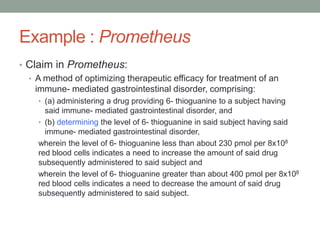
Example : Prometheus
• Claim in Prometheus:
  • A method of optimizing therapeutic efficacy for treatment of an
    immune- mediated gastrointestinal disorder, comprising:
    • (a) administering a drug providing 6- thioguanine to a subject having
      said immune- mediated gastrointestinal disorder, and
    • (b) determining the level of 6- thioguanine in said subject having said
      immune- mediated gastrointestinal disorder,
    wherein the level of 6- thioguanine less than about 230 pmol per 8x10⁸
    red blood cells indicates a need to increase the amount of said drug
    subsequently administered to said subject and
    wherein the level of 6- thioguanine greater than about 400 pmol per 8x10⁸
    red blood cells indicates a need to decrease the amount of said drug
    subsequently administered to said subject.
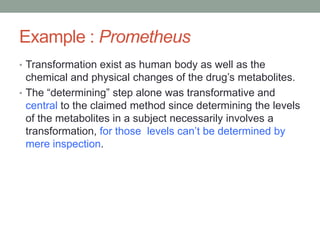
Example : Prometheus
• Transformation exist as human body as well as the
  chemical and physical changes of the drug‟s metabolites.
• The “determining” step alone was transformative and
  central to the claimed method since determining the levels
  of the metabolites in a subject necessarily involves a
  transformation, for those levels can‟t be determined by
  mere inspection.
Example: Grams
• The method consisted of two step:
  • (1) performance of clinical laboratory tests on an individual to
    obtain data for the parameters, and
  • (2) analyzing the data to ascertain the existence and identify of an
    abnormality…

  • No transformative step on human subject.
  • Court held that the essence of what was claimed was the
    mathematical algorithm for analyzing the clinical data, and the sole
    physical process- laboratory testing was merely data- gathering to
    obtain clinical data.
Judgment of the court
    - method
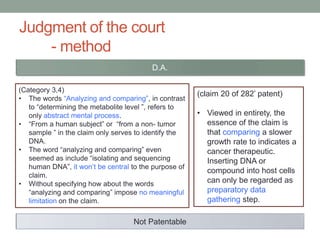
                                         D.A.

(Category 3,4)
                                                       (claim 20 of 282‟ patent)
• The words “Analyzing and comparing”, in contrast
   to “determining the metabolite level ”, refers to
   only abstract mental process.                       • Viewed in entirety, the
• “From a human subject” or “from a non- tumor           essence of the claim is
   sample ” in the claim only serves to identify the     that comparing a slower
   DNA.                                                  growth rate to indicates a
• The word “analyzing and comparing” even                cancer therapeutic.
   seemed as include “isolating and sequencing           Inserting DNA or
   human DNA”, it won‟t be central to the purpose of
                                                         compound into host cells
   claim.
• Without specifying how about the words                 can only be regarded as
   “analyzing and comparing” impose no meaningful        preparatory data
   limitation on the claim.                              gathering step.

                                   Not Patentable
Judgment of the court
    - method
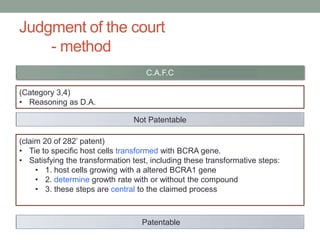
                                    C.A.F.C

(Category 3,4)
• Reasoning as D.A.

                                Not Patentable

(claim 20 of 282‟ patent)
• Tie to specific host cells transformed with BCRA gene.
• Satisfying the transformation test, including these transformative steps:
     • 1. host cells growing with a altered BCRA1 gene
     • 2. determine growth rate with or without the compound
     • 3. these steps are central to the claimed process


                                   Patentable
Standing requirement
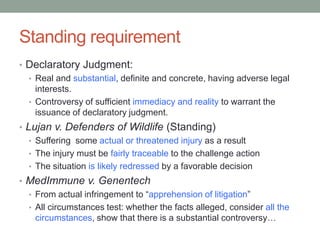
• Declaratory Judgment:
  • Real and substantial, definite and concrete, having adverse legal
    interests.
  • Controversy of sufficient immediacy and reality to warrant the
    issuance of declaratory judgment.
• Lujan v. Defenders of Wildlife (Standing)
   • Suffering some actual or threatened injury as a result
   • The injury must be fairly traceable to the challenge action
   • The situation is likely redressed by a favorable decision
• MedImmune v. Genentech
  • From actual infringement to “apprehension of litigation”
  • All circumstances test: whether the facts alleged, consider all the
    circumstances, show that there is a substantial controversy…
Standing requirement
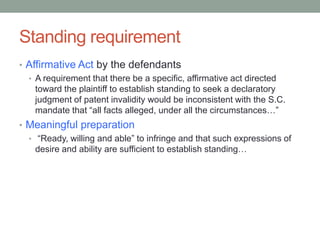
• Affirmative Act by the defendants
  • A requirement that there be a specific, affirmative act directed
    toward the plaintiff to establish standing to seek a declaratory
    judgment of patent invalidity would be inconsistent with the S.C.
    mandate that “all facts alleged, under all the circumstances…”
• Meaningful preparation
  • “Ready, willing and able” to infringe and that such expressions of
    desire and ability are sufficient to establish standing…
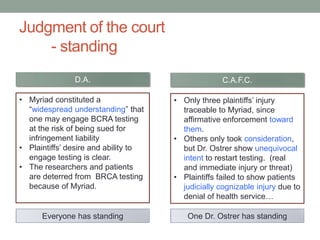
Judgment of the court
    - standing
               D.A.                                 C.A.F.C.

• Myriad constituted a                • Only three plaintiffs‟ injury
  “widespread understanding” that       traceable to Myriad, since
  one may engage BCRA testing           affirmative enforcement toward
  at the risk of being sued for         them.
  infringement liability              • Others only took consideration,
• Plaintiffs‟ desire and ability to     but Dr. Ostrer show unequivocal
  engage testing is clear.              intent to restart testing. (real
• The researchers and patients          and immediate injury or threat)
  are deterred from BRCA testing      • Plaintiffs failed to show patients
  because of Myriad.                    judicially cognizable injury due to
                                        denial of health service…

      Everyone has standing               One Dr. Ostrer has standing
Conclusion and Feedback
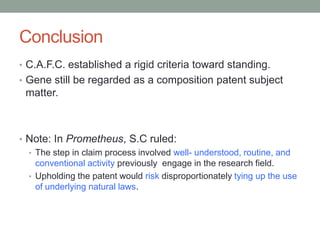
Conclusion
• C.A.F.C. established a rigid criteria toward standing.
• Gene still be regarded as a composition patent subject
 matter.


• Note: In Prometheus, S.C ruled:
  • The step in claim process involved well- understood, routine, and
    conventional activity previously engage in the research field.
  • Upholding the patent would risk disproportionately tying up the use
    of underlying natural laws.
Feedback & Discussion
• The standing requirement?
  • Better rigid
  • 節省訴訟資源
• Should human gene be patentable?
  • Criteria: Vague (markedly different? central?)
  • 考慮分配正義


               Thank you for your listening

AMP vs. USPTO

  • 1.
    Plaintiffs File Petitionfor Certiorari in AMP V. USPTO (Myriad case) By Kevin E. Noonan 科碩一 易先勇 • Basic intro. • Law issue • Conclusion and feedback
  • 2.
  • 3.
    Paper Review • Certiorari:from Latin, means to be informed of gaining appellate review, ordered and examined by superior court. Author: Kevin E. Noonan, Ph.D. • an experienced biotechnology patent lawyer, a partner of a LLP. • more than 10 years as a molecular biologist. • founding author of the Patent Docs weblog. • In 2010, interviewed for a segment that aired on the television program "60 Minutes” addressing the issue of gene patenting.
  • 4.
    • In AMP.v. USPTO, Public Patent Foundation (PubPat) and American Civil Liberties Union (ACLU) argued for plaintiffs. The Public Patent Foundation at Benjamin N. Cardozo School of Law (“PUBPAT”) is a not-for- profit legal services organization whose mission is to protect freedom in the patent system. The American Civil Liberties Union (ACLU) is a nonpartisan non-profit organization with mission "to defend and preserve the individual rights and liberties guaranteed to every person in this country by the Constitution and laws of the United States.
  • 5.
    Plaintiffs and Defendants •Plaintiffs- appellees • Researchers • Drs. Kazazian, Ganguly (University of Pennsylvania School of medicine, Genetic Diagnostic Lab.), Ostrer (New York University)… • Organizations • AMP (Association for Molecular Pathology), AMCG (American College of Medical Genetics)… • Patients • Defendants- appellants • USPTO • Myriad Genetics, Inc (Salt Lake City) • former co owner and exclusive licensee • UURF (The University of Utah Research Foundation) • an owner or part owner of each patent. • Amici • American Medical Association, American Society of Human Genetics…
  • 6.
    Case History Federal District Court of Southern District of New York (S.D.N.Y.) Issued on 3/29.2010 Mayo Collaborative Services v. Prometheus Laboratories, Inc.(C.A.F.C) Federal Court of Appeals, Federal Circuit (C.A.F.C.) Issued on 7/29.2011 PubPat & ACLU Petition for Certiorari near 12/08, 2011 Certiorari granted in light of Mayo Collaborative Services v. Prometheus, on 3/26, 2012, oral Prometheus Laboratories, Inc.(S.C) issued on argument held on 6/20, 2012 3/20,2012
  • 7.
    Background • In 1990,one gene that correlated with increased risk of breast and/or ovarian cancer was located in the body on chromosome 17. Some of these researchers formed Myriad in 1991. • In 1994, Myriad, along with researchers from NIEHS, Univ. of Utah, and McGill University, sequenced the cancer gene, and named “BRCA1”. • Later, Myriad found another gene named “BRCA2” in 1995, and obtained series of patents of BRCA1/2.
  • 8.
    Background • In 1998~2008, Myriad charges about $3000 for BRCA1/2 test. . • In 2008, revenues are $222 million, of which $190 million in profit. • In contrast, the Ontario regional public health plan offering BRCA1/2 testing - in disregard of the Myriad patents –charges about $1000/test. • Through cease and desist letters, communication person in person, licensing and litigations…Myriad‟s act of enforcing its patent right was widely known in the research community.
  • 9.
    Isolated DNA Extracted or purified cDNA DNA • Isolated DNA refers to a segment of DNA nucleotides existing separate from other components normally associated with native DNA. • DNA with isolated DNA • Common • same information • Difference • structurally and chemically difference, like introns • usage different as probes or primers
  • 10.
    USPTO policy • UtilityExamination Guidelines (2001) • 從蛋白質的純化來定序,找到基因序列 • 生物資訊學的出現:反向轉錄與同源比對,找到蛋白質 • 美國實務上長期以來的做法均認同基因可專利性,並核准了數以千 計不同生物體的基因專利,其中約20%為人類基因。
  • 11.
    Main Issue • PatentEligibility • Are human gene patentable? • Standing Requirement • Did the court err in adopting a new and inflexible rule that contradict to MedImmune, Inc. imposing a more rigid requirement for standing?
  • 12.
  • 13.
    Category1: Isolated, non-mutated forms, and fragments of BRCA1/2 gene • Claim 1 of the „282 patent • An isolated DNA coding for a BCRA1 polypeptide, said polypeptide having the amino acid sequence set forth in SEQ. ID. NO: 2. • Claim 2 of the „282 patent • The isolated DNA of claim 1 ,wherein said DNA has the nucleotide sequence set forth in SEQ ID NO: 1. • Claim 5 of the „282 patent • An isolated DNA having at least 15 nucleotides of the DNA of claim1. • Claim 6 of the „282 patent • An isolated DNA having at least 15 nucleotides of the DNA of claim2. • Claim 1 of the „492 patent • An isolated DNA molecule coding for a BRCA2 polypeptide, said DNA molecule comprising a nucleic acid sequence encoding the amino acid sequence set forth in SEQ ID NO: 2.
  • 14.
    Category2: BRCA1/2 genescontaining mutations • Claim 1 of the „473 patent • An isolated DNA comprising an altered BRCA1 DNA having at least one of the alterations set forth in Tables 12A, 14 ,18 or 19 with the proviso that the alteration is not a deletion of four nucleotides corresponding to base numbers 4184- 4187 in SEQ. ID . NO:1. • Claim 7 of the „282 patent • An isolated DNA selected from the group consisting of : • (a) a DNA having the nucleotide sequence set forth in SEQ. ID. NO: 1 having T at nucleotide position 4056; • (b) a DNA having the nucleotide sequence set forth in SEQ ID NO:1 having an extra C at nucleotide position 5385; • (c) a DNA having the nucleotide sequence set forth in SEQ ID NO:1 having G at nucleotide position 5443; and • (d) a DNA having the nucleotide sequence set forth in SEQ ID NO:1 having 11 base pairs at nucleotide position 189-199 deleted. • Claim 6 of the „492 patent • An isolated DNA molecule coding for a mutated form of the BRCA2 polypeptide set forth in SEQ. ID. NO:2, wherein said mutated form of the BRCA2 polypeptide is associated with susceptibility to cancer. • Claim 7 of the „492 patent • The isolated DNA molecule of claim 6, wherein the DNA molecule comprises a mutated nucleotide sequence set forth in SEQ. ID. NO:1.
  • 15.
    Category3: Methods analyzingan individual‟s BRCA 1 gene to determine inherited mutations • Claim 1 of the 999‟ patent • A method for detecting a germline alteration in a BRCA1 gene, said alterations set forth in Table 12A, 14, 18 or 19 in a human which comprises • analyzing a sequence of a BRCA 1 gene or BRCA1 RNA from a human sample or • analyzing a sequence of BRCA1 cDNA made from mRNA from said human sample with the proviso that said germline alteration is not a deletion of 4 nucleotides corresponding to base numbers 4184-4187 of SEQ ID. NO:1.
  • 16.
    Category4 : Methodscomparing patients‟ BRCA1/2 gene with the normal, and examination to determine a potential therapeutic compound • Claim 1 of „001 patent • A method for screening a tumor sample from a human subject for a somatic alteration in a BRCA1 gene in said tumor which comprises • gene comparing a first sequence selected from the group consisting of a BRCA1 from said tumor sample, BRCA1 RNA from said tumor and BRCA 1 cDNA made from mRNA from said tumor sample with • a second sequence selected from the group consisting of BRCA1 gene from a non- tumor sample of said subject, BCRA1 RNA from said non- tumor sample and BRCA1 cDNA made form mRNA from said non-tumor sample, wherein a difference in the sequence of the BRCA1 gene, BRCA1 RNA or BRCA1 cDNA from said tumor sample from the sequence of the BRCA1 gene, BRCA1 RNA or cDNA from said non- tumor sample indicates a somatic alteration in the BRCA1 gene in said tumor sample.
  • 17.
    • Claim 1of „441 patent • A method for screening germline of a human subject for an alteration of a BRCA1 gene which comprises • comparing germline sequence of a BRCA1 gene or BRCA1 RNA from a tissue sample from said subject or a sequence of BRCA1 cDNA made from mRNA rom said sample with • germline sequence of wild- type BRCA1 gene, wild- type BRCA1 RNA or wild- type BRCA 1 cDNA, wherein a difference in the sequence of the BRCA1 gene, BRCA1 RNA or BRCA1 cDNA of the subject from wild- type indicates an alteration in the BRCA1 gene in the said subject.
  • 18.
    • Claim 1of „857 patent • A method for identifying a mutant BRCA2 nucleotide sequence in a suspected mutant BRCA2 allele which comprises • comparing the nucleotide sequence of the suspected mutant BRCA2 allele with the wild- type BRCA2 nucleotide sequence, wherein a difference between the suspected mutant and the wild- type sequence identifies a mutant BRCA2 nucleotide sequence. • Claim 2 of „857 patent • A method for diagnosing a predisposition for breast cancer in a human subject which comprises • comparing the germline sequence of the BRCA2 gene or the sequence of its mRNA in a tissue sample from said subject with • the germline sequence of the wild- type BRCA2 gene or the sequence of its mRNA, wherein an alteration in the germline sequence of the BRCA2 gene or the sequence of its mRNA of the subject indicates a predisposition to said cancer.
  • 19.
    • Claim 20of the „282 patent • A method for screening potential cancer therapeutics which comprises • growing a transformed eukaryotic host cell containing an altered BRCA1 gene causing cancer and the presence of a compound suspected of being a cancer therapeutic, • growing said transformed eukaryotic host cell in the absence of said compound, • determining the rate of growth of said host cell in the presence of said compound and the rate of growth of said host cell in the absence of the said compound and comparing the growth rate of said host cells, wherein a slower rate of said host cell in the presence of said compound is indicative of a cancer therapeutic.
  • 20.
    Patents • U.S.C 35,section 101 • Whoever invents or discovers any new and useful process, machine, manufacture, or composition or matter, or any new and useful improvement thereof, may obtain a patent therefore, subject to the conditions and requirements of this title. • Novelty, section 102 • Non- obvious, section 103 • Utility • Utility Examination guidelines • Statutory subject matter
  • 21.
    Exceptions of Section101 • from Diamond v. Chakrabarty, • Laws of nature • Natural phenomena • Abstract Idea In General Electronic, a In Funk Brothers, a mixture purified tungsten couldn‟t be of bacteria couldn‟t be patented, since it ”existed in patented, since it “did not nature and doubtless has create a state of inhibition or existed for centuries.” of non- inhibition.” Patentable subject must be markedly different from a product of nature, which means it must possess a new or distinctive from, quality or property.
  • 22.
    Judgment of thecourt - composition matter D.A. C.A.F.C. • What makes DNA unique not • The claim covers molecules that only its chemical structure, but hardly exist in natural status. also the information it conveys. • The isolated DNA is free of some • Isolated DNA may serves as other components in the cell. probes or primer. Why it can • For example, BRCA2 serve so results from the without introns shrink to just sequence it carries. 10,200 nucleotides in • The different chemical structure comparison with those are just the result of purification. normal with introns can have near 80,000 nucleotides. Not Patentable Patentable
  • 23.
    Machine and TransformationTest • Use to determine whether a mental process or patentable subject. From Bilski to Prometheus, two prongs: • (1) It is tied to a particular machine or apparatus, or • (2) It transforms a particular article into a different state or thing. In addition, the use of specific machine or transformation must impose meaningful limits on the claim‟s scope, and the involvement of a machine or transformation must not merely insignificant extra- solution activity. (e.g. data gathering)
  • 24.
    Example : Prometheus •Claim in Prometheus: • A method of optimizing therapeutic efficacy for treatment of an immune- mediated gastrointestinal disorder, comprising: • (a) administering a drug providing 6- thioguanine to a subject having said immune- mediated gastrointestinal disorder, and • (b) determining the level of 6- thioguanine in said subject having said immune- mediated gastrointestinal disorder, wherein the level of 6- thioguanine less than about 230 pmol per 8x10⁸ red blood cells indicates a need to increase the amount of said drug subsequently administered to said subject and wherein the level of 6- thioguanine greater than about 400 pmol per 8x10⁸ red blood cells indicates a need to decrease the amount of said drug subsequently administered to said subject.
  • 25.
    Example : Prometheus •Transformation exist as human body as well as the chemical and physical changes of the drug‟s metabolites. • The “determining” step alone was transformative and central to the claimed method since determining the levels of the metabolites in a subject necessarily involves a transformation, for those levels can‟t be determined by mere inspection.
  • 26.
    Example: Grams • Themethod consisted of two step: • (1) performance of clinical laboratory tests on an individual to obtain data for the parameters, and • (2) analyzing the data to ascertain the existence and identify of an abnormality… • No transformative step on human subject. • Court held that the essence of what was claimed was the mathematical algorithm for analyzing the clinical data, and the sole physical process- laboratory testing was merely data- gathering to obtain clinical data.
  • 27.
    Judgment of thecourt - method D.A. (Category 3,4) (claim 20 of 282‟ patent) • The words “Analyzing and comparing”, in contrast to “determining the metabolite level ”, refers to only abstract mental process. • Viewed in entirety, the • “From a human subject” or “from a non- tumor essence of the claim is sample ” in the claim only serves to identify the that comparing a slower DNA. growth rate to indicates a • The word “analyzing and comparing” even cancer therapeutic. seemed as include “isolating and sequencing Inserting DNA or human DNA”, it won‟t be central to the purpose of compound into host cells claim. • Without specifying how about the words can only be regarded as “analyzing and comparing” impose no meaningful preparatory data limitation on the claim. gathering step. Not Patentable
  • 28.
    Judgment of thecourt - method C.A.F.C (Category 3,4) • Reasoning as D.A. Not Patentable (claim 20 of 282‟ patent) • Tie to specific host cells transformed with BCRA gene. • Satisfying the transformation test, including these transformative steps: • 1. host cells growing with a altered BCRA1 gene • 2. determine growth rate with or without the compound • 3. these steps are central to the claimed process Patentable
  • 29.
    Standing requirement • DeclaratoryJudgment: • Real and substantial, definite and concrete, having adverse legal interests. • Controversy of sufficient immediacy and reality to warrant the issuance of declaratory judgment. • Lujan v. Defenders of Wildlife (Standing) • Suffering some actual or threatened injury as a result • The injury must be fairly traceable to the challenge action • The situation is likely redressed by a favorable decision • MedImmune v. Genentech • From actual infringement to “apprehension of litigation” • All circumstances test: whether the facts alleged, consider all the circumstances, show that there is a substantial controversy…
  • 30.
    Standing requirement • AffirmativeAct by the defendants • A requirement that there be a specific, affirmative act directed toward the plaintiff to establish standing to seek a declaratory judgment of patent invalidity would be inconsistent with the S.C. mandate that “all facts alleged, under all the circumstances…” • Meaningful preparation • “Ready, willing and able” to infringe and that such expressions of desire and ability are sufficient to establish standing…
  • 31.
    Judgment of thecourt - standing D.A. C.A.F.C. • Myriad constituted a • Only three plaintiffs‟ injury “widespread understanding” that traceable to Myriad, since one may engage BCRA testing affirmative enforcement toward at the risk of being sued for them. infringement liability • Others only took consideration, • Plaintiffs‟ desire and ability to but Dr. Ostrer show unequivocal engage testing is clear. intent to restart testing. (real • The researchers and patients and immediate injury or threat) are deterred from BRCA testing • Plaintiffs failed to show patients because of Myriad. judicially cognizable injury due to denial of health service… Everyone has standing One Dr. Ostrer has standing
  • 32.
  • 33.
    Conclusion • C.A.F.C. establisheda rigid criteria toward standing. • Gene still be regarded as a composition patent subject matter. • Note: In Prometheus, S.C ruled: • The step in claim process involved well- understood, routine, and conventional activity previously engage in the research field. • Upholding the patent would risk disproportionately tying up the use of underlying natural laws.
  • 34.
    Feedback & Discussion •The standing requirement? • Better rigid • 節省訴訟資源 • Should human gene be patentable? • Criteria: Vague (markedly different? central?) • 考慮分配正義 Thank you for your listening