WHERE BOTH ENDS MEET

A collaborative approach to
developing the digital
research agenda
Sarah Quinton and Ana Isabel Canhoto
Senior Lecturers Marketing
Oxford Brookes University
Impact of digital
• Transformative for social science „as
Galileo’s telescope was for the physical
sciences‟ (Baker, 2009)
• Allows practitioners to „feel the
heartbeat of today’s society‟ (Casteleyn,
Mottart et al., 2009, p. 439)

Quinton and Canhoto (2014)

2
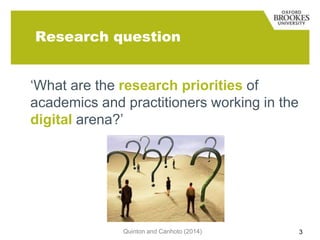
Research question
„What are the research priorities of
academics and practitioners working in the
digital arena?‟

Quinton and Canhoto (2014)

3
A collaborative approach
• Growing gap between marketing
practitioners and academics (Hughes et al.,
2008; Tapp, 2004)

• Increasing pressure for universities and
industry to collaborate
• Government funding (Berman, 2008)
• Commercial organisations may have better
data, technology or techniques
Quinton and Canhoto (2014)

4
Bridging, not closing, the gap
• Very different goals, capabilities and
epistemological stances (Bansal, et al., 2012)
• Exploratory study with practitioners
and academics
• Group discussions to stimulate new ideas
and concepts for further research (Finch and
Lewis, 2003)

Quinton and Canhoto (2014)

5
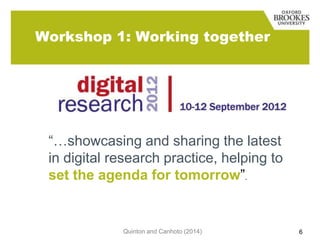
Workshop 1: Working together

“…showcasing and sharing the latest
in digital research practice, helping to
set the agenda for tomorrow”.

Quinton and Canhoto (2014)

6
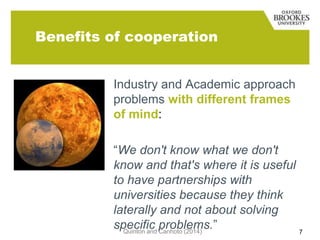
Benefits of cooperation
Industry and Academic approach
problems with different frames
of mind:
“We don't know what we don't
know and that's where it is useful
to have partnerships with
universities because they think
laterally and not about solving
specific problems.”
Quinton and Canhoto (2014)
7
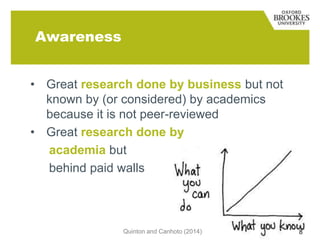
Awareness
• Great research done by business but not
known by (or considered) by academics
because it is not peer-reviewed
• Great research done by
academia but
behind paid walls

Quinton and Canhoto (2014)

8
Role of context
It‟s not (just) about the money:
Collaboration requires right
environment
• Google staff spend time
researching and experimenting

Quinton and Canhoto (2014)

9
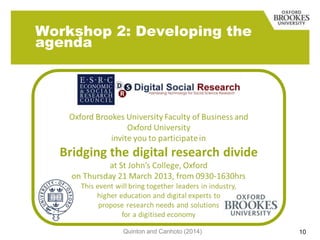
Workshop 2: Developing the
agenda

Quinton and Canhoto (2014)

10
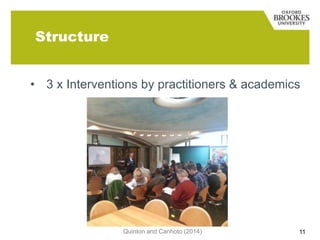
Structure
• 3 x Interventions by practitioners & academics

Quinton and Canhoto (2014)

11
Structure
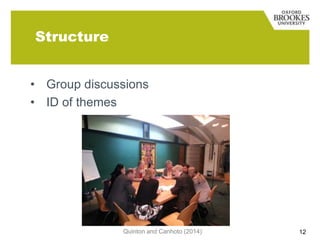
• Group discussions
• ID of themes

Quinton and Canhoto (2014)

12
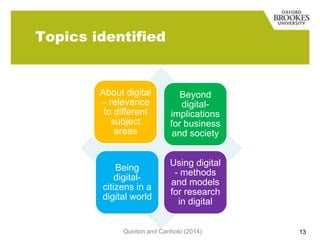
Topics identified

About digital
– relevance
to different
subject
areas

Beyond
digitalimplications
for business
and society

Being
digitalcitizens in a
digital world

Using digital
- methods
and models
for research
in digital

Quinton and Canhoto (2014)

13
Limitations and moving
forward
• Small sample
• „Digital friendly‟ sample
• Application of themes for
marketing practitioners?

• Hub: http://oxforddigitalresearch.com
Quinton and Canhoto (2014)

14
WHERE BOTH ENDS MEET

A collaborative approach to
developing the digital
research agenda
Sarah Quinton and Ana Isabel Canhoto
Senior Lecturers Marketing
Oxford Brookes University

Sig e mark both ends meet sqac jan 2014 final

  • 1.
    WHERE BOTH ENDSMEET A collaborative approach to developing the digital research agenda Sarah Quinton and Ana Isabel Canhoto Senior Lecturers Marketing Oxford Brookes University
  • 2.
    Impact of digital •Transformative for social science „as Galileo’s telescope was for the physical sciences‟ (Baker, 2009) • Allows practitioners to „feel the heartbeat of today’s society‟ (Casteleyn, Mottart et al., 2009, p. 439) Quinton and Canhoto (2014) 2
  • 3.
    Research question „What arethe research priorities of academics and practitioners working in the digital arena?‟ Quinton and Canhoto (2014) 3
  • 4.
    A collaborative approach •Growing gap between marketing practitioners and academics (Hughes et al., 2008; Tapp, 2004) • Increasing pressure for universities and industry to collaborate • Government funding (Berman, 2008) • Commercial organisations may have better data, technology or techniques Quinton and Canhoto (2014) 4
  • 5.
    Bridging, not closing,the gap • Very different goals, capabilities and epistemological stances (Bansal, et al., 2012) • Exploratory study with practitioners and academics • Group discussions to stimulate new ideas and concepts for further research (Finch and Lewis, 2003) Quinton and Canhoto (2014) 5
  • 6.
    Workshop 1: Workingtogether “…showcasing and sharing the latest in digital research practice, helping to set the agenda for tomorrow”. Quinton and Canhoto (2014) 6
  • 7.
    Benefits of cooperation Industryand Academic approach problems with different frames of mind: “We don't know what we don't know and that's where it is useful to have partnerships with universities because they think laterally and not about solving specific problems.” Quinton and Canhoto (2014) 7
  • 8.
    Awareness • Great researchdone by business but not known by (or considered) by academics because it is not peer-reviewed • Great research done by academia but behind paid walls Quinton and Canhoto (2014) 8
  • 9.
    Role of context It‟snot (just) about the money: Collaboration requires right environment • Google staff spend time researching and experimenting Quinton and Canhoto (2014) 9
  • 10.
    Workshop 2: Developingthe agenda Quinton and Canhoto (2014) 10
  • 11.
    Structure • 3 xInterventions by practitioners & academics Quinton and Canhoto (2014) 11
  • 12.
    Structure • Group discussions •ID of themes Quinton and Canhoto (2014) 12
  • 13.
    Topics identified About digital –relevance to different subject areas Beyond digitalimplications for business and society Being digitalcitizens in a digital world Using digital - methods and models for research in digital Quinton and Canhoto (2014) 13
  • 14.
    Limitations and moving forward •Small sample • „Digital friendly‟ sample • Application of themes for marketing practitioners? • Hub: http://oxforddigitalresearch.com Quinton and Canhoto (2014) 14
  • 15.
    WHERE BOTH ENDSMEET A collaborative approach to developing the digital research agenda Sarah Quinton and Ana Isabel Canhoto Senior Lecturers Marketing Oxford Brookes University

Editor's Notes

  • #5 access to data, technology or techniques not accessible to academics.