C A M B R I D G E
H M M M
CD-Ft0
w i t h a n s w
{AAJ; L E V E L 1
Fiona Davis and Wayne Rimmer
Series Editor: Penny Ur
m
active
GRAMMAR
LEVEL 1
With answers
Fiona Davis and Wayne Rimmer
Series editor: Penny Ur
www.cambridge.org© in this web service Cambridge University Press
Cambridge University Press
978-0-521-73251-2 - Active Grammer Level 1 With Answers
Fiona Davis and Wayne Rimmer
Frontmatter
More information
C A M B R I D G E U N I V E R S I T Y P R E S S
Cambridge, New York, Melbourne, Madrid, Cape Town, Singapore,
São Paulo, Delhi, Dubai, Tokyo, Mexico City
Cambridge University Press
The Edinburgh Building, Cambridge CB2 8RU, UK
www.cambridge.org
Information on this title: www.cambridge.org/9780521732512
© Cambridge University Press 2011
This publication is in copyright. Subject to statutory exception
and to the provisions of relevant collective licensing agreements,
no reproduction of any part may take place without the written
permission of Cambridge University Press.
Printed in the United Kingdom at the University Press, Cambridge
A catalogue record for this publication is available from the British Library
ISBN 978-0-521-73251-2 Paperback with answers and CD-ROM
ISBN 978-0-521-17368-1 Paperback without answers and CD-ROM
Cambridge University Press has no responsibility for the persistence or
accuracy of URLs for external or third-party internet websites referred to in
this publication, and does not guarantee that any content on such websites is,
or will remain, accurate or appropriate. Information regarding prices, travel
timetables and other factual information given in this work is correct at
the time of first printing but Cambridge University Press does not guarantee
the accuracy of such information thereafter.
First published 2011
www.cambridge.org© in this web service Cambridge University Press
Cambridge University Press
978-0-521-73251-2 - Active Grammer Level 1 With Answers
Fiona Davis and Wayne Rimmer
Frontmatter
More information
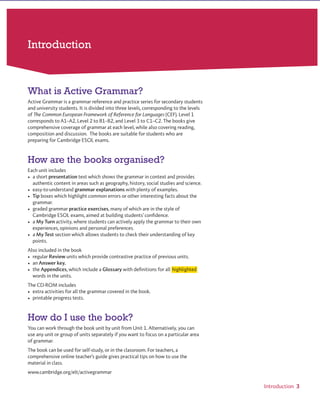
Introduction
What is Active Grammar?
How are the books organised?
How do I use the book?
www.cambridge.org© in this web service Cambridge University Press
Cambridge University Press
978-0-521-73251-2 - Active Grammer Level 1 With Answers
Fiona Davis and Wayne Rimmer
Frontmatter
More information
Contents
Introduction 3
1 Word class and word order 6
Present
2 Be 8
3 Present simple 1: statements 10
4 Present simple 2: negatives and questions 12
5 Present continuous 14
6 Present continuous and present simple 16
7 Imperatives 18
R1 Review: present simple and present continuous 20
Past
8 Past simple 1: was / were 22
9 Past simple 2: regular past forms 24
10 Past simple 3: irregular past forms 26
11 Past continuous 28
R2 Review: past simple and past continuous 30
12 Present perfect 1 32
13 Present perfect 2 34
14 Present perfect 3 36
15 Present perfect or past simple? 38
16 Used to 40
R3 Review: present perfect and used to 42
The future
17 Will, shall, won’t 44
18 Present continuous with future meaning 46
19 Be going to 48
R4 Review: the future 50
Modal verbs
20 Modal verbs: can,could,be able to 52
21 Modals for requests: can,could,may 54
22 Must,have to and can’t 56
23 Should,ought to 58
24 Modals of possibility: may,might 60
R5 Review: modals 62
Questions and answers
25 Yes / no questions and short answers 64
26 Question words: Where?When?Why? 66
How?Whose?
27 Object and subject questions 68
28 Be like and look like 70
29 What? and Which? 72
30 How …? questions 74
31 So and neither 76
32 Question tags 78
R6 Review: questions and answers 80
Verbs
33 Have and have got 82
34 Make,do and get 84
35 Prepositional verbs 86
36 Phrasal verbs 88
www.cambridge.org© in this web service Cambridge University Press
Cambridge University Press
978-0-521-73251-2 - Active Grammer Level 1 With Answers
Fiona Davis and Wayne Rimmer
Frontmatter
More information
37 Verbs with two objects 90
38 Verb + -ing or verb + to-infinitive; like and 92
would like
39 State verbs 94
R7 Review: verb structures 96
Articles, nouns, pronouns, etc.
40 Countable and uncountable nouns 98
41 Plural nouns 100
42 Articles 1 102
43 Articles 2 104
R8 Review: nouns and articles 106
44 This,that,these,those 108
45 Some,any,no,none 110
46 Something,everywhere,nobody,anyone 112
47 Much, many, a lot of, a little, a few 114
48 Subject and object pronouns 116
49 Possessive ’s 118
50 Whose?,my,mine 120
51 There and it 122
R9 Review: pronouns; possessives; quantifiers 124
Adjectives and adverbs
52 Adjectives 126
53 Order of adjectives 128
54 Comparatives 130
55 Superlatives 132
56 Adverbs of manner 134
57 Comparative and superlative adverbs 136
58 -ed and -ing adjectives 138
59 Too and enough 140
60 Adverbs of frequency 142
R10 Review: adjectives and adverbs 144
Prepositions
61 Prepositions of place 146
62 Prepositions of time: at, in, on 148
63 Prepositions of movement 150
R11 Review: prepositions 152
The passive
64 Passive: present and past simple 154
Conditionals
65 Zero and first conditionals 156
66 Second conditional 158
R12 Review: the passive; conditionals 160
Reported speech
67 Reported speech 162
68 Say and tell 164
Relative clauses
69 Defining relative clauses 166
R13 Review: reported speech; say / tell;
relative clauses 168
Linking words and sentences
70 Linking words: and,but,or,so,because 170
71 Time and sequence adverbs:first,then,afterwards 172
72 Both, either, neither 174
73 Word order 176
R14 Review: linking words and word order 178
Appendices
Answer key
www.cambridge.org© in this web service Cambridge University Press
Cambridge University Press
978-0-521-73251-2 - Active Grammer Level 1 With Answers
Fiona Davis and Wayne Rimmer
Frontmatter
More information
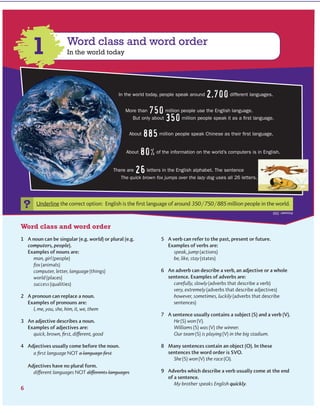
1 Word class and word order
In the world today
Word class and word order
There are 26letters in the English alphabet. The sentence
The quick brown fox jumps over the lazy dog uses all 26 letters.
In the world today, people speak around 2,700different languages.
More than 750million people use the English language.
But only about 350million people speak it as a first language.
About 885million people speak Chinese as their first language.
About 80%of the information on the world’s computers is in English.
?
www.cambridge.org© in this web service Cambridge University Press
Cambridge University Press
978-0-521-73251-2 - Active Grammer Level 1 With Answers
Fiona Davis and Wayne Rimmer
Excerpt
More information
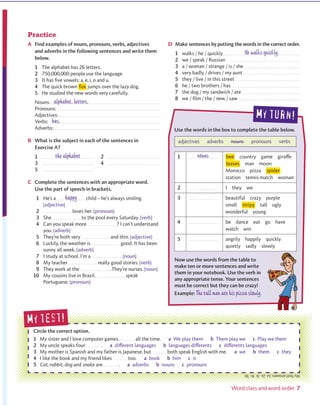
Practice
My test!
My turn!
www.cambridge.org© in this web service Cambridge University Press
Cambridge University Press
978-0-521-73251-2 - Active Grammer Level 1 With Answers
Fiona Davis and Wayne Rimmer
Excerpt
More information
Be
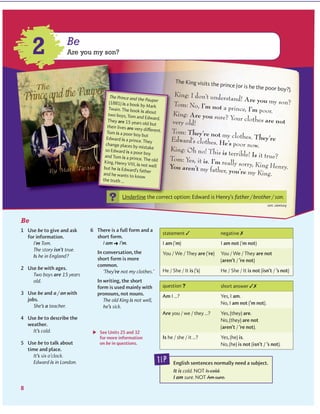
King: I don’t understand! Are you my son?Tom: No, I’m not a prince, I’m poor.King: Are you sure? Your clothes are notvery old!
Tom: They’re not my clothes. They’reEdward’s clothes. He’s poor now.King: Oh no! This is terrible! Is it true?Tom: Yes, it is. I’m really sorry, King Henry.You aren’t my father, you’re my King.
tip
?
?
Be
Are you my son?2
www.cambridge.org© in this web service Cambridge University Press
Cambridge University Press
978-0-521-73251-2 - Active Grammer Level 1 With Answers
Fiona Davis and Wayne Rimmer
Excerpt
More information
Practice
My test!
My turn!
www.cambridge.org© in this web service Cambridge University Press
Cambridge University Press
978-0-521-73251-2 - Active Grammer Level 1 With Answers
Fiona Davis and Wayne Rimmer
Excerpt
More information
Present simple 1: statements
Maybe you know her.3
?
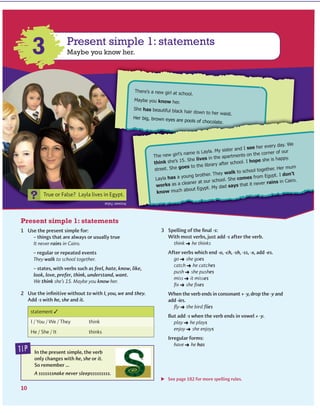
There’s a new girl at school.
Maybe you know her.
She has beautiful black hair down to her waist.
Her big, brown eyes are pools of chocolate.
tip
The new girl’s name is Layla. My sister and I see her every day. We
think she’s 15. She lives in the apartments on the corner of our
street. She goes to the library after school. I hope she is happy.
Layla has a young brother. They walk to school together. Her mum
works as a cleaner at our school. She comes from Egypt. I don’t
know much about Egypt. My dad says that it never rains in Cairo.
www.cambridge.org© in this web service Cambridge University Press
Cambridge University Press
978-0-521-73251-2 - Active Grammer Level 1 With Answers
Fiona Davis and Wayne Rimmer
Excerpt
More information
Practice
A Change the infinitive without to of these verbs into the
correct present simple form with it.
1 play it ptoijS 2 do
4 fix
7 teach
10 wash
5
8
miss
think
3
6
9
enjoy
say
try
B Complete these facts about Egypt. Use the correct
present simple forms ofthe verbs in the box.
buy come have have live show study visit
1 Egypt fi&5 a population of around 80 million.
2 17 million people in Cairo.
3 The name 'Egypt' from the Greek word
Egyptos.
4 Around 6,000,000 tourists Egypt every year.
5 Every tourist presents from a night market.
6 Egypt about 100 pyramids.
7 Tourist guides people the pyramids of Giza.
8 An egyptologist is a person who Egyptian
history from a long time ago.
C Complete Layla's letter using the correct present
simple forms of the verbs in brackets.
Every morning 1 1
Wiki (make)
breakfast for my brother and me.
I 2
(walk) to school with my
brother. We3
(see) the same two
girls. They always4
(say) 'hello'.
1 5
(feel) lonely sometimes, but I
really like my new school. The school
6
(have) a very good library.
My brother ' (go) to primary
school. He always8
(wear) his
old red coat. My mother9
(go) to
work early in the morning. She 1 0
(work) very hard.
Thank you for the card. You1 1
(write) very good letters.
Write again soon!
Love, Layla
about your school morning.
Every morning I (vave breakfast with ituj famitij.
I always
You never
My teacher
The school
My friends sometimes
We
1
2
3
4
5
6
7
| Circle the correct option.
I 1 to the shops. a They walks b She walk c He walks
2 Layla's mum by bus. a go b gos c goes
3 in Cairo. a It never rains b It never rain c It's never rain
4 big brown eyes. a Layla have b Layla haves c Layla has
5 Her mum English. a study b studys c studies
3C 3fc Bf 37 : T :SJBMSUE iisai Aw
Present simple 1 11
4 Present simple 2: negatives and questions
Do you like zoos?
n o n
c v
Do you (ike zoos?
Do you think zoos are a good idea?
Welcome t o A n i m a l W o r l d Park i n C a l i f o r n i a , USA.
The p a r k i s d i f f e r e n t f r o m o t h e r zoos. We h e l p a n i m a l s
i n d a n g e r . When i t i s p o s s i b l e , we r e t u r n young
a n i m a l s t o t h e i r homes.
We have more t h a n 30 g o r i l l a s
i n t h e p a r k . A m o t h e r g o r i l l a
d o e s n ' t have many b a b i e s . A baby-
g o r i l l a s t a y s w i t h i t s m o t h e r f o r
t h r e e y e a r s .
You o f t e n f i n d c o l o b u s monkeys i n
zoos. They a r e i n danger because
t h e y have b e a u t i f u l f u r . Young
c o l o b u s monkeys d o n ' t have b l a c k
and w h i t e f u r - t h e i r f u r i s
w h i t e .
atotot money.
m
Find t h e n a m e s o f t h e animals in t h e p h o t o s .
Xa>|uoui snqo]03 e pile B||uo8 E :J9MSUV
Present simple 2: negatives and
questions
1 To make negative f o r m s in t h e present simple, use don't
and doesn't + t h e infinitive f o r m w i t h o u t to o f t h e verb.
They don't have black and white fur.
A mother gorilla doesn't have many babies.
negative X
1/ You / W e /They do n o t (don't) believe
H e / S h e / I t does n o t (doesn't) believe
2 To make a question, use do or does in f r o n t o f the subject.
Do you like zoos ?
Does the park cost a lot of money?
3 Use do or does in t h e affirmative short answer and don't
or doesn't in t h e negative short answer.
Yes, I do.
No, he doesn't.
There is no -s on t h e main verb after does or doesn't.
She doesn't think... N O T She doesn't thinks...
Does she know? N O T Does she knows ?
question ? short answer / X
D o 1 / you / we / t h e y like...? Yes, (1) do.
No, (1) don't.
Does he / she / i t like...? Yes, (he) does.
No, (he) doesn't.
1 2
PracticeA Underline the correct o p t i o n .
1 I don't know /doesn't know the answer.
2 Most trees don't grow/doesn't grow very quickly.
3 Do/Does Sara understand this?
4 Do/Does you want t o talk about it?
5 The price don't include/doesn't include service.
6 I don't think/doesn't think he's very nice.
7 We don't see/doesn't see our grandparents very often.
8 They don't live/doesn't live very near.
B Complete the t e x t about black rhinos using t h e correct
present simple f o r m s o f t h e verbs in brackets.
W e 1
WW (have) a large number o f rhinos
living here. Black r h i n o s 2
(not live) in
groups. T h e y 3
(prefer) t o live alone.
Black rhinos are in danger because o f their horns. People
4
(use) the
horns as medicine.
A mother black rhino
5
(not have)
many babies. A baby
6
(stay) w i t h
its mother for three t o four
years. The mother rhino
7
(not stay) w i t h the father.
Rhinos 8
(not fight) w i t h other animals in
the park. In fact, they are friendly animals.
C Make present simple questions f r o m t h e words, t h e n
answer the questions in your n o t e b o o k using short
answers.
1 a mechanic / fix cars
Dees a mechanic {i£ cars?
2 y o u / w o r k at the weekend
Oojoa worfc. attkt, wukudL
3 a vet / look after animals
4 zoo keepers/work in shops
5 a young colobus monkey / have white fur
6 w e / g o t o school on Sundays
7 nurses / work in a hospital
8 y o u / d o sport in the evening
D Read part o f an i n t e r v i e w w i t h a gorilla keeper.
C o m p l e t e her answers, using t h e verbs in t h e box.
not eat not fight got up not go home
have not look after love
have
1 Yes, I tyt U.p at 6.30 every morning.
2 Yes, but they bananas all the time. They
like a lot o f other fruit, too.
3 The gorillas in the park are all friends. They
4 Yes, it does. The park more than 50 gorillas.
5 Yes, they do. We a baby gorilla in the park
at the moment.
6 Yes, but sometimes a mother
her baby. Then we help the baby.
7 Yes, I give the baby milk every four hours, day and
night. I in the evening. I sleep at the park.
8 I my j o b ! No day is the same!
mum
J W h a t did t h e i n t e r v i e w e r ask? M a k e present simple
questions using t h e w o r d s in brackets and w r i t e t h e m
in your n o t e b o o k .
1 PojSMfct ap earUjf* (early)
2 ? (bananas)
3 ? (fight)
4 ?(a lot o f gorillas)
5
6
7
8
?(have babies)
? (stay w i t h its mother]
? (drink milk)
'(like)
N o w t h i n k o f at least three more present simple questions
f o r t h e gorilla keeper and w r i t e t h e m in your notebook.
B: No, I don't,
c Do you want
c doesn't visit
Circle t h e correct o p t i o n .
1 A: t o go t o the zoo?
a You wants b W a n t you
2 We zoos very often,
a aren't visit b don't visit
3 M y sister zoos.
a doesn't like b doesn't likes c don't like
4 She says the animals a very happy life,
a not have b doesn't have c don't have
5 A: Do the rhinos fight w i t h other animals?
B:No,
a doesn't they b it doesn't c they don't
' . V S O T W S V V V W W W
DCJ Of E £ (l 0 :SJ9AASUE j;S3J_ A"AJ
Present s i m p l e 2 1 3
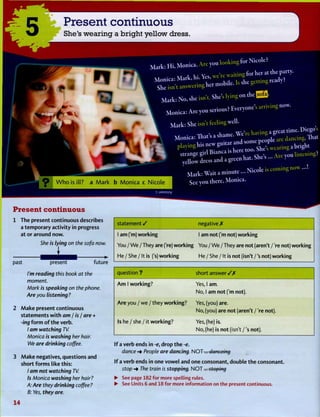
O W h o is ill? a Mark b Monica c Nicole
Mark: Hi, Monica. Are youlookingfor Nicole'
„ i f Y« ,ve'rewairingforherartheparry.
iark: No, she isn't. She's lyingon the »
Monica: Areyou seriousEveryone's arriving now.
Mark: She isn't feeling well.
M o ^ ^ a s ^ e ^ ^ X
plavinghis new gmtar and some peop
'strange g ^ B i a ^ i . ^ ^ ^ ^
yellow dress and a green hat. Shes... a y
Mark: Wait a minute... Nicole is coming now .J
Seeyou there, Monica.
:j3Msuy
Present continuous
1 The present continuous describes
a t e m p o r a r y activity in progress
at o r around now.
She is lying on the sofa now.
present future
I'm reading this book at the
moment.
Mark is speaking on the phone.
Are you listening?
2 M a k e present continuous
statements w i t h am / is / are +
-ing form o f t h e verb.
/ am watching TV.
Monica is washing her hair.
We are drinking coffee.
3 M a k e negatives, questions and
short f o r m s like this:
/ am not watching TV.
Is Monica washing her hair?
A: Are they drinking coffee?
B: Yes, they are.
statement / negative X
1 a m ('m) w o r k i n g 1 am n o t f m not) w o r k i n g
You / W e / They are ('re) w o r k i n g You / W e / They are n o t (aren't / 're not) working
He / She / It is fs) w o r k i n g He / She / It is n o t (isn't /'s not) w o r k i n g
question ? short answer / X
A m 1 working? Yes, 1 am.
No, 1 a m n o t f m not).
A r e you / we / they working? Yes, (you) are.
No, (you) are n o t (aren't / 're not).
Is he / she / it working? Yes, (he) is.
No, (he) is n o t (isn't /'s not).
I f a verb ends in -e, d r o p t h e -e.
dance -* People are dancing. NOT... danccing
I f a verb ends in one v o w e l and one consonant, double t h e consonant.
stop The train is stopping. NOT... stoping
• See page 182 for more spelling rules.
• See Units 6 and 18 for more information on the present continuous.
1 4
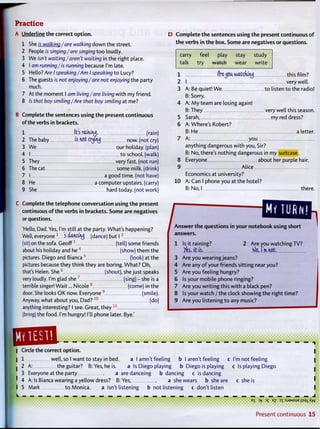
PracticeA Underline t h e correct o p t i o n .
1 She is walking/are walking down t h e street.
2 People is singing/are singing t o o loudly.
3 We isn't waiting/aren't waiting in the right place.
4 I am running/is running because I'm late.
5 Hello? Are I speaking/Am I speaking t o Lucy?
6 The guests is not enjoying /are not enjoying the party
much.
7 At the moment I am living/are living w i t h my friend.
8 /s that boy smiling/Are that boy smiling at me?
B Complete the sentences using t h e present continuous
of the verbs in brackets.
1 It's raining. (rain)
2 The baby is not crijituj now. (not cry)
3 We our holiday, (plan)
4 I t o school, (walk)
5 They very fast, (not run)
6 The cat some milk, (drink)
7 I a good time, (not have)
8 He a computer upstairs, (carry)
9 She hard today, (not work)
C Complete the telephone conversation using t h e present
continuous o f t h e verbs in brackets. Some are negatives
or questions.
'Hello, Dad. Yes, I'm still at the party. What's happening?
Well, everyone 1
i ddhdh^ (dance) but I2
(sit) on the sofa. Geoff (tell) some friends
about his holiday and he4
(show) t h e m the
pictures. Diego and Bianca5
(look) at t h e
pictures because they think they are boring. W h a t ? O h ,
that's Helen. S h e 6
(shout), she just speaks
very loudly. I'm glad she7
(sing) - she is a
terrible singer! Wait... Nicole 8
(come) in t h e
door. She looks O K now. Everyone 9
(smile).
Anyway, what about you, Dad? 1 0
(do)
anything interesting? I see. Great, t h e y 1 1
(bring) the food. I'm hungry! I'll phone later. Bye.'
D C o m p l e t e t h e sentences using t h e present continuous o f
t h e verbs in t h e box. Some are negatives or questions.
carry feel play stay study
talk t r y watch wear write
1
2
3
5
6
flrejjoa watcfvuuj this film?
I very well.
A: Be quiet! W e t o listen t o the radio!
B: Sorry.
A: M y team are losing again!
B: They very well this season.
Sarah, my red dress?
A: Where's Robert?
B: He a letter.
7 A: y o u
anything dangerous w i t h you, Sir?
B: No, there's nothing dangerous in my suitcase.
8 Everyone about her purple hair.
9 Alice
Economics at university?
10 A: Can I phone you at the hotel?
B: No, I there.
/ book using shortA n s w e r t h e questions in y o u r n o t e b o o k using short
answers.
1 Is it raining? 2 Are you watching TV?
Yes, i t is. Klo, I'm. w t .
3 Are you wearing jeans?
4 Are any o f your friends sitting near you?
5 Are you feeling hungry?
6 Is your mobile phone ringing?
7 Are you w r i t i n g this w i t h a black pen?
8 Is your watch / the clock showing the right time?
9 Are you listening t o any music?
| Circle the correct o p t i o n .
1 well, so I want t o stay in bed. a I amn't feeling b I aren't feeling
2 A: the guitar? B:Yes, he is. a Is Diego playing b Diego is playing
3 Everyone at the party a aredanceing b dancing c is dancing
4 A: Is Bianca wearing a yellow dress? B:Yes, a she wears b she are
5 Mark t o Monica. a isn't listening b not listening c don't listen
c I'm not feeling
c Is playing Diego
c she is
eg ~>y ->i E £ ox : s j 9 M 5 u e <&_ X
Present c o n t i n u o u s 1 5
6 Present continuous and present simple
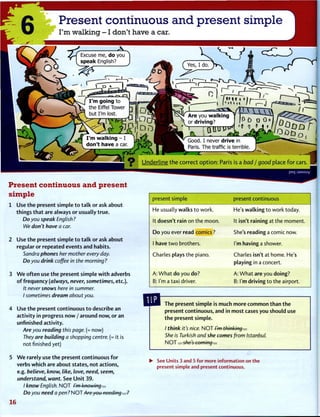
I'm walking -1 don't have a car.
Good. I never d r i v e in " '
Paris. The traffic is terrible.
ine the correct option: Paris is a bad / good place for cars.
pEq IJ9MSUV
Present continuous and present
simple
1 Use t h e present simple t o t a l k or ask a b o u t
things t h a t are always or usually t r u e .
Do you speak English ?
We don't have a car.
2 Use t h e present simple t o t a l k or ask a b o u t
regular or repeated events and habits.
Sandra phones her mother every day.
Do you drink coffee in the morning?
3 W e o f t e n use t h e present simple w i t h adverbs
o f frequency [always, never, sometimes, etc.).
It never snows here in summer.
I sometimes dream about you.
4 Use t h e present continuous t o describe an
activity in progress n o w / around now, or an
unfinished activity.
Are you reading this page. (= now)
They are building a shopping centre. (= it is
not finished yet)
5 W e rarely use t h e present continuous f o r
verbs which are about states, n o t actions,
e.g. believe, know, like, love, need, seem,
understand, want. See U n i t 39.
/ know English. N O T I'm knowing...
Do you need a pen?NOT Are you needing... ?
present simple present continuous
He usually walks t o work. He's w a l k i n g t o work today.
It doesn't rain on the moon. It isn't raining at the moment.
D o you ever read comics? She's reading a comic now.
1 have t w o brothers. I'm having a shower.
Charles plays the piano. Charles isn't at home. He's
playing in a concert.
A: W h a t do you do?
B: I'm a taxi driver.
A: W h a t are you doing?
B: I'm d r i v i n g to the airport.
The present simple is much m o r e c o m m o n t h a n t h e
present continuous, and in most cases you should use
t h e present simple.
/ think it's nice. N O T I'm thinking...
She is Turkish and she comes from Istanbul.
NOT... she's coming...
• See Units 3 and 5 for more information on the
present simple and present continuous.
1 6
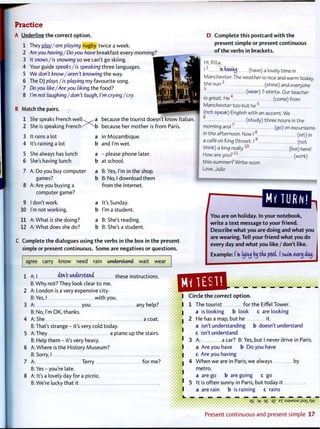
PracticeA Underline the correct o p t i o n .
1 They play/are playing rugby twice a week.
2 Are you having / Do you have breakfast every morning?
3 It snows/is snowing so we can't go skiing.
4 Your guide speaks/is speaking three languages.
5 We don't know/aren't knowing the way.
6 The DJ plays/is playing my favourite song.
7 Do you like /Are you liking the food?
8 'mnot laughing /don't laugh, I'm crying / cry.
D C o m p l e t e this postcard w i t h t h e
present simple or present continuous
o f t h e verbs in brackets.
B Match the pairs.
She speaks French w e l l ^ ^ a
She is speaking F r e n c h - ^ ^ b
It rains a lot a
It's raining a lot b
She always has lunch a
She's having lunch b
because the tourist doesn't know Italian,
because her mother is f r o m Paris.
in Mozambique,
and I'm wet.
- please phone later,
at school.
7 A: Do you buy computer a B: Yes, I'm in the shop.
Hi, Rita,
1 1
fc.M*M$ (have) a lovely time in
Manchester. The weather is nice and warm today,
"the sun (shine) and everyone
(wear) T-shirts. Our teacher
is great. He 4
(come) from
Manchester t o o but he5
(not speak) English with an accent. We
(study) three hours in the
morning and 7
(go) on excursions
in the afternoon. Now 1 8
(sit) in
a cafe on King Street. 1 9
(not
think) a king r e a l l y 1 0
(live) here!
How are y o u ? 1 1
(work)
this summer? Write soon.
Love, Julio
9
10
games?
A: Are you buying a
computer game?
I don't work.
I'm not working.
11 A: What is she doing?
12 A: What does she do?
b B: No, I download them
from the Internet.
a It's Sunday,
b I'm a student.
a B: She's reading,
b B: She's a student.
C Complete the dialogues using t h e verbs in t h e box in t h e present
simple or present continuous. Some are negatives or questions.
agree carry know need rain understand wait wear
/—H3BYou are on holiday. In your notebook,
w r i t e a t e x t message t o your friend.
Describe w h a t you are doing and w h a t you
are wearing. Tell your f r i e n d w h a t you do
every day and w h a t you like / don't like.
Example: I'm tijwuj bij t(ve poet, I swim every ctotj.
1 A: I <font utuierstaiui these instructions.
B: Why not? They look clear t o me.
2 A: London is a very expensive city.
B: Yes, I w i t h you.
3 A: you any help?
B: No, I'm OK, thanks.
4 A: She a coat.
B: That's strange - it's very cold today.
5 A: 1 hey a piano up the stairs.
B: Help them - it's very heavy.
6 A: Where is the History Museum?
B: Sorry, I
7 A: Terry for me?
B: Yes-you're late.
8 A: It's a lovely day for a picnic.
B: We're lucky that it
* 5
Circle t h e correct o p t i o n .
1 The tourist f o r the Eiffel Tower,
a is looking b look c are looking
2 He has a map, but he it.
a isn't understanding b doesn't understand
c isn't understand
3 A: a car? B: Yes, but I never drive in Paris.
a Are you have b Do you have
c Are you having
4 W h e n we are in Paris, we always by
metro.
a are go b are going c go
5 It is often sunny in Paris, but today it
a are rain b is raining c rains
IS t K °Z E
T :sjaMsue jjsai Xyv
Present c o n t i n u o u s and present s i m p l e 1 7
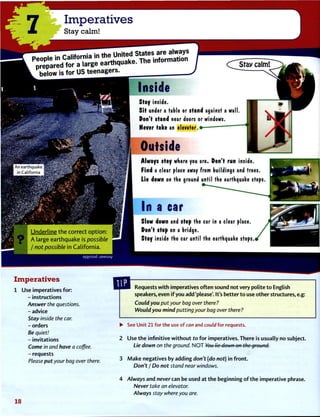
7 Imperatives
Stay calm!
below is for US teenagers.
Inside
C^Stay calm!
V
• An earthquake
1 in California
H
H Underline the correct option:
9 A large earthquake is possible
1 / not possible in California.
aiqissod jaMsuy
Stay inside.
Sit under a table or stand against a wall.
Don't stand near doors or windows.
Never take an elevator.
Outside
Always stay where you are. Don't run inside.
Find a clear place away from buildings and trees
Lie down on the ground until the earthquake stops
In acar
Slow down and stop the car in a clear place.
Don't stop on a bridge.
Stay inside the car until the earthquake stops.
ImperativesUse imperatives for:
- instructions
Answer the questions.
- advice
Stay inside the car.
- orders
Be quiet!
- invitations
Come in and have a coffee.
- requests
Please put your bag over there.
Requests with imperatives often sound not very polite to English
speakers, even if you add 'please'. It's better to use other structures, e.g:
Could you put your bag over there?
Would you mind putting your bag over there ?
• See Unit 21 for the use o f can and could for requests.
2 Use the infinitive without to for imperatives. There is usually no subject.
Lie down on the ground. N O T You lie down on the ground-.
3 Make negatives by adding don't (do not) in front.
Don't I Do not stand near windows.
4 Always and never can be used at the beginning of the imperative phrase.
Never take an elevator.
Always stay where you are.
1 8
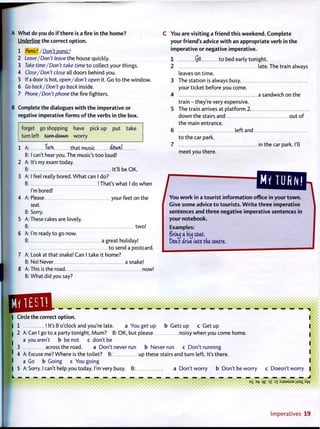
A What do you do i f there is a fire in t h e home?
Underline the correct o p t i o n .
1 Panic! /Don't panic!
2 Leave/Don't leave the house quickly.
3 Take time/Don't take time t o collect your things.
4 Close/Don't close all doors behind you.
5 If a door is hot, open/don't open it. Go t o the window.
6 Go back/Don't go back inside.
7 Phone/Don't phone the fire fighters.
B Complete the dialogues w i t h t h e imperative o r
negative imperative f o r m s o f t h e verbs in t h e box.
forget go shopping have pick up put take
turn left turn down worry
1 A:
B:
2 A:
3 A:
B:
4 A:
5 A:
B:
6 A:
B:
7 A:
B:
8 A
B:
Turn that music &W!
I can't hear you. The music's t o o loud!
It's my exam today.
It'll be OK.
I feel really bored. W h a t can I do?
! That's what I do when
I'm bored!
Please your feet on the
seat.
Sorry.
These cakes are lovely.
t w o !
I'm ready t o go now.
a great holiday!
t o send a postcard.
Look at that snake! Can I take it home?
No! Never a snake!
This is the road now!
What did you say?
You are visiting a friend this weekend. Complete
your friend's advice with an appropriate verb in the
imperative or negative imperative.
1 yO t o bed early tonight.
2 late. The train always
leaves on time.
3 The station is always busy.
your ticket before you come.
4 a sandwich on the
train - they're very expensive.
5 The train arrives at platform 2
down the stairs and out o f
the main entrance.
6 left and
t o the car park.
7 in the car park. I'll
meet you there.
Give some advice to tourists. W r i t e three imperative
sentences and three negative imperative sentences in
your notebook.
Examples:
Srifuj a buj coat,
Dont drive into tfve centre,
mm m • • '
• • • • • |
Circle the correct o p t i o n .
1 ! It's 8 o'clock and you're late. a You get up b Gets up c Get up
2 A: Can I go to a party tonight, M u m ? B: OK, but please noisy when you come home.
a you aren't b be not c don't be
3 across the road. a Don't never run b Never run c Don't running
| 4 A: Excuse me? Where is the toilet? B: up these stairs and turn left. It's there.
a Go b Going c You going
I 5 A: Sorry. I can't help you today. I'm very busy. B: a Don't worry b Don't be worry c Doesn't worry
_ _ _ _ _ _ _ J
E
S B
fr 1£ 3
Z a x : S J 3 M S U B
Usa
l^W
Imperatives 1 9
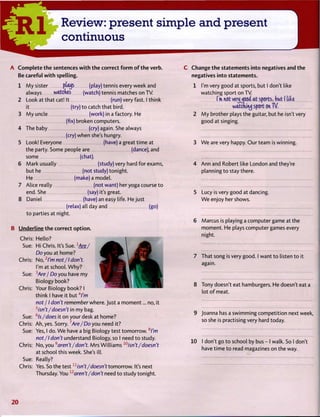
-J^ J Review: present simple and present
continuous
A C o m p l e t e t h e sentences w i t h t h e correct f o r m o f t h e verb.
Be careful w i t h spelling.
1 M y sister ploys (play) tennis every week and
always watckes (watch) tennis matches on TV.
2 Look at that cat! It (run) very fast. I think
it (try) t o catch that bird.
3 M y uncle (work) in a factory. He
(fix) broken computers.
4 The baby (cry) again. She always
(cry) when she's hungry.
5 Look! Everyone (have) a great t i m e at
the party. Some people are (dance), and
some (chat).
6 Mark usually (study) very hard f o r exams,
but he (not study) tonight.
He (make) a model.
7 Alice really (not want) her yoga course t o
end. She (say) it's great.
8 Daniel (have) an easy life. He just
(relax) all day and (go)
t o parties at night.
B Underline t h e correct o p t i o n .
Chris:
Sue:
Chris:
Sue:
Chris:
Sue:
Chris:
Sue:
Chris:
Sue:
Chris:
Hello?
Hi Chris. It's Sue. l
Are/
Do you at home?
No, 2
l'm not/I don't.
I'm at school. W h y ?
3
Are I Do you have my
Biology book?
Your Biology book? I
think I have it but 4
l'm
not 1I don't remember where. Just a moment... no, i t
5
isn't/doesn't in my bag.
6
/s/does it on your desk at home?
Ah, yes. Sorry.7
Are/Do you need it?
Yes, I do. W e have a big Biology test tomorrow. 8
l'm
not/1 don't understand Biology, so I need t o study.
No, you 9
aren't/don't. Mrs Williams 1 0
isn't/doesn't
at school this week. She's ill.
Really?
Yes. So the test ^isn't/doesn't tomorrow. It's next
Thursday. You 12
aren't/don't need t o study tonight.
C Change t h e statements i n t o negatives and t h e
negatives i n t o statements.
1 I'm very good at sports, but I don't like
watching sport on TV.
I'm. not wnjjoo4 at sports, but I tiU
watching sport on TV.
2 M y brother plays the guitar, but he isn't very
good at singing.
3 W e are very happy. O u r team is winning.
4 Ann and Robert like London and they're
planning t o stay there.
5 Lucy is very good at dancing.
We enjoy her shows.
6 Marcus is playing a computer game at the
moment. He plays computer games every
night.
7 That song is very good. I want t o listen t o it
again.
8 Tony doesn't eat hamburgers. He doesn't eat a
lot o f meat.
9 Joanna has a swimming competition next week,
so she is practising very hard today.
10 I don't go t o school by bus - I walk. So I don't
have time t o read magazines on the way.
2 0
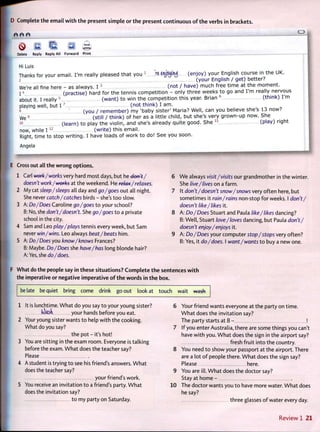
D Complete t h e email w i t h t h e present simple o r t h e present continuous o f t h e verbs in brackets.
e e e
0 s I I a Q
Delete Reply Reply All Forward Print
Hi Luis
Thanks for your email. I'm really pleased that you 1
k « J J « j U $ (enjoy) your English course in the UK.
2 (your English / get) better?
We're all fine here - as always. I 5
(not / have) much free time at the moment.
14 (practise) hard for the tennis competition - only three w e e k s to go and I'm really nervous
about it. I really 5
( w a n t ) to win the competition this year. Brian 6
(think) I'm
playing well, but 1 7
(not think) I a m .
s (you / r e m e m b e r ) my 'baby sister' Maria? Well, can you believe she s 13 now?
We
9
ZIIIIII (still / think) of her as a little child, but she's very grown-up now. S h e
io (learn) to play the violin, and she's already quite good. S h e 1 1
(play) right
now, while 1 1 2
(write) this email.
Right, time to stop writing. I have loads of work to do! S e e you soon.
Angela
E Cross out all t h e w r o n g options.
1 Carl work/works very hard most days, but he don't/
doesn't work/works at the weekend. He relax/relaxes.
2 My cat sleep/sleeps all day and go/goes o u t all night.
She never catch/catches birds - she's t o o slow.
3 A: Do/Does Caroline go/goes t o your school?
B: No, she don't/doesn't. She go /goes t o a private
school in the city.
4 Sam and Leo play/plays tennis every week, but Sam
never win/wins. Leo always beat/beats him.
5 A: Do/Does you know/knows Frances?
B: Maybe. Do/Does she have/has long blonde hair?
A: Yes, she do/does.
We always visit/visits our grandmother in the winter.
She live/lives on a farm.
It don't/doesn't snow/snows very often here, but
sometimes it rain/rains non-stop f o r weeks. I don't/
doesn't like/likes it.
A: Do/Does Stuart and Paula like/likes dancing?
B: Well, Stuart love/loves dancing, but Paula don't/
doesn't enjoy/enjoys it.
A: Do/Does your computer stop/stops very often?
B: Yes, it do/does. I want/wants t o buy a new one.
F What do the people say in these situations? C o m p l e t e t h e sentences w i t h
the imperative or negative imperative o f t h e w o r d s in t h e box.
be late be quiet bring come drink go out look at touch wait wash
1 It is lunchtime. W h a t do you say t o your young sister?
(dash your hands before you eat.
2 Your young sister wants t o help w i t h the cooking.
What do you say?
the pot - it's hot!
3 You are sitting in the exam room. Everyone is talking
before the exam. W h a t does the teacher say?
Please
4 A student is trying t o see his friend's answers. W h a t
does the teacher say?
your friend's work.
5 You receive an invitation t o a friend's party. W h a t
does the invitation say?
t o my party on Saturday.
6 Your friend wants everyone at the party on time.
W h a t does the invitation say?
The party starts at 8 - !
7 If you enter Australia, there are some things you can't
have w i t h you. W h a t does the sign in the airport say?
fresh fruit into the country.
8 You need t o show your passport at the airport. There
are a lot o f people there. W h a t does the sign say?
Please here.
9 You are ill. W h a t does the doctor say?
Stay at home -
10 The doctor wants you t o have more water. W h a t does
he say?
three glasses o f water every day.
R e v i e w 1 2 1
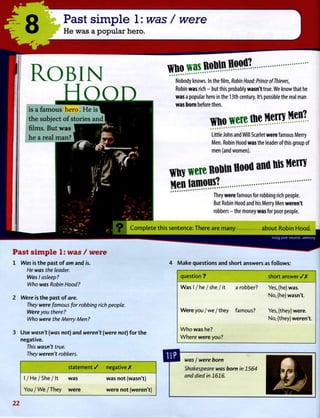
8 Past simple 1:was/ were
He was a popular hero.
Robin
is a famous hero. He is
the subject of stories and I
films. But was
he a real man?
Nobody knows. In the film, Robin Hood: Prince of Thieves,
Robin was rich - but this probably wasn't true. We know that he
was a popular hero in the 13th century. It's possible the real man
was born before then.
^ o w w c t t t c M e m M e n ?
Little John and Will Scarlet were famous Merry
Men. Robin Hood was the leader of this group of
men (and women).
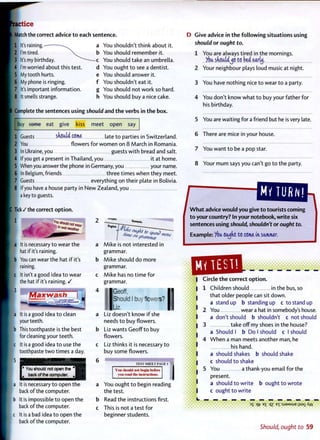
m w e r e R O D i n f l o o f l a n u B i s M e m
M e n i a m o m ? .
They were famous for robbing rich people.
But Robin Hood and his Merry Men weren't
robbers - the money was for poor people.
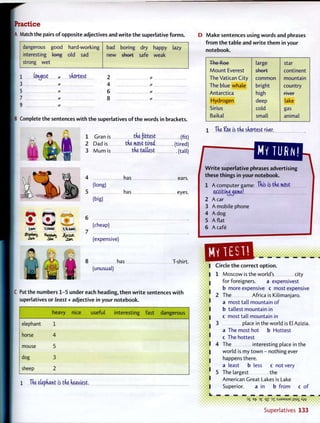
Complete this sentence: There are many about Robin Hood.
mum
Past simple 1: was / were
1 Was is the past of am and is.
He was the leader.
Was I asleep?
Who was Robin Hood?
2 Were is the past o f are.
They were famous for robbing rich people.
Were you there?
Who were the Merry Men ?
3 Use wasn't (was not) and weren't (were not) for the
negative.
This wasn't true.
They weren't robbers.
statement / negative A
1 / H e / S h e / I t was was not (wasn't)
Y o u / W e / T h e y were were not (weren't)
4 Make questions and short answers as follows:
question ? short answer / X
W a s 1 / he / she / it a robber? Yes, (he) was.
No, (he) wasn't.
Were you / we / they famous? Yes, (they) were.
No, (they) weren't.
W h o was he?
W h e r e were you?
was I were born
Shakespeare was born in 1564
and died in 1616.
2 2
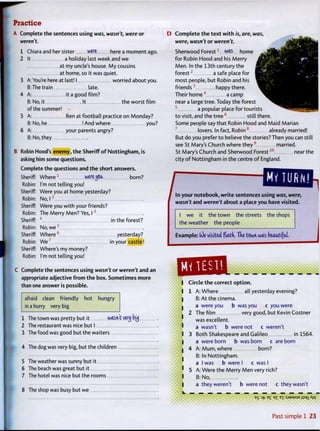
PracticeA Complete the sentences using was, wasn't, were or
weren't.
1 Chiara and her sister were here a m o m e n t ago.
2 It a holiday last week and w e
at my uncle's house. M y cousins
at home, so it was quiet.
3 A: You're here at last! I worried about you.
B:The train late.
4 A: it a good film?
B: No, it It the worst film
of the summer!
5 A: Ben at football practice on Monday?
B: No, he ! And where you?
6 A: your parents angry?
B: No, they
B Robin Hood's enemy, the Sheriff o f Nottingham, is
asking him some questions.
Complete the questions and the short answers.
Sheriff:
Robin:
Sheriff:
Robin:
Sheriff:
Robin:
Sheriff:
Robin:
Sheriff:
Robin:
Sheriff:
Robin:
W h e r e 1
were^OU born?
I'm not telling you!
Were you at home yesterday?
No, 1 2
Were you w i t h your friends?
The Merry Men? Yes, 1 3
4
in the forest?
No, we 5
Where 6
yesterday?
W e ' in your castle!
Where's my money?
I'm not telling you!
C Complete the sentences using wasn't or weren't and an
appropriate adjective from the box. Sometimes more
than one answer is possible.
afraid clean friendly h o t hungry
in a hurry very big
1 The town was pretty but it wasn't venj by
2 The restaurant was nice but I
3 The food was good but the waiters
4 The dog was very big, but the children
5 The weather was sunny but i t
6 The beach was great but it
7 The hotel was nice but the rooms
8 The shop was busy but w e
D Complete the text with is, are, was,
were, wasn't or weren't.
Sherwood Forest1
was home
for Robin Hood and his Merry
Men. In the 13th century the
f o r e s t 2
a safe place for
most people, but Robin and his
f r i e n d s 3
happy there.
Their home4
a camp
near a large tree. Today the forest
5
a popular place for tourists
t o visit, and the tree6
still there.
Some people say that Robin Hood and Maid Marian
7
lovers. In fact, Robin8
already married!
But do you prefer t o believe the stories? Then you can still
see St Mary's Church where they9
married.
St Mary's Church and Sherwood F o r e s t 1 0
near the
city o f Nottingham in the centre o f England.
MV TURN!
In your notebook, write sentences using was, were,
wasn't and weren't about a place you have visited.
I we i t the t o w n the streets the shops
the weather the people
Example: (Oe visited 6at(i. Tfietownwas beautiful
I 3
Circle t h e correct o p t i o n .
1 A: Where all yesterday evening?
B: A t the cinema.
a were you b was you c you were
2 The film very good, but Kevin Costner
was excellent.
a wasn't b were not c weren't
Both Shakespeare and Galileo in 1564.
a were born b was born c are born
A: M u m , where born?
B: In Nottingham,
a I was b were I c was I
A: Were the Merry Men very rich?
B:No,
a they weren't b were not c they wasn't
eg at E£ ez e x : S J 3 M S U E
i l s s
l
Past s i m p l e 1 2 3
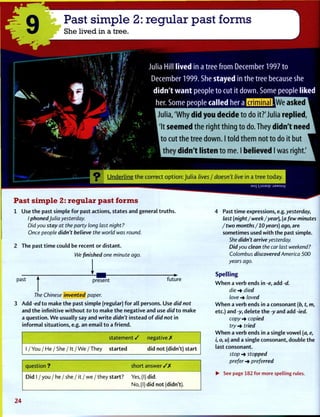
9 Past simple 2: regular past forms
She lived in a tree.
[ a i l
I criminal iWe asked
Julia, 'Why did you decide to do it?'Julia replied,
'It seemed the right thing to do. They didn't need
to cut the tree down. I told them not to do it but
they didn't listen to me. I believed I was right.'
O Underline the correct option: Julia lives / doesn't live in a tree today.
Past simple 2: regular past forms
1 Use t h e past simple f o r past actions, states and general t r u t h s .
/ phoned Julia yesterday.
Did you stay at the party long last night?
Once people didn't believe the world was round.
2 The past t i m e could be recent or distant.
We finished one minute ago.
past present future
The Chinese invented paper.
A d d -ed t o make t h e past simple (regular) f o r all persons. Use did not
and t h e infinitive w i t h o u t to t o make t h e negative and use did t o make
a question. W e usually say and w r i t e didn't instead o f did not in
informal situations, e.g. an email t o a f r i e n d .
statement / negative X
I / Y o u / H e / S h e / I t / W e / T h e y s t a r t e d did n o t (didn't) start
question ? short answer / /
D i d 1 / you / he / she / it / we / they start? Yes, (1) did.
No, (1) did not (didn't).
9A|i ^usaop :J9Msuy
4 Past t i m e expressions, e.g. yesterday,
last (night / week /year), (a few minutes
/two months /10 years) ago, are
sometimes used w i t h the past simple.
She didn't arrive yesterday.
Did you clean the car last weekend?
Colombus discovered America 500
years ago.
S p e l l i n g
W h e n a verb ends in -e, add -d.
die -> died
love -> loved
W h e n a verb ends in a consonant (b, t, m,
etc.) and -y, delete t h e -y and add -led.
copy -» copied
try -* tried
W h e n a verb ends in a single v o w e l (a, e,
i, o, u) and a single consonant, double the
last consonant.
stop -» stopped
prefer -» preferred
• Seepage 182 for more spelling rules.
2 4
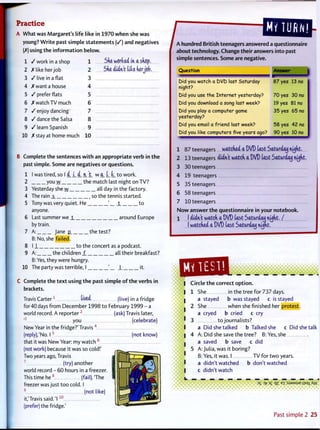
Practice
A What was Margaret's life like in 1970 w h e n she was
young? W r i t e past simple statements (/) and negatives
(X) using the i n f o r m a t i o n below.
1 / w o r k in a shop 1 Ski worked in. a sksp.
2 X like her j o b 2 She didnHike her job,
3 / l i v e in a flat 3
4 X want a house 4
5 / prefer flats 5
6 X watch TV much 6
7 / enjoy dancing 7
8 / dance the Salsa 8
9 / learn Spanish 9
10 X stay at home much 10
MV TURN!
B Complete the sentences w i t h an appropriate verb in t h e
past simple. Some are negatives or questions.
1 I was tired, so I d_i_d_A. t_ w O ^ L L t o work.
2 y o u w the match last night on TV?
3 Yesterday she w all day in the factory.
4 The rain _s , so the tennis started.
5 Tony was very quiet. He '_ X_ t o
anyone.
6 Last summer we _t around Europe
by train.
7 A: Jane g the test?
B:No,she failed.
8 IJ t o the concert as a podcast.
9 A: the children j _ all their breakfast?
B: Yes, they were hungry.
10 The party was terrible, I ' _ J it.
C Complete the t e x t using t h e past simple o f t h e verbs in
brackets.
Travis Carter1
tiv&d (live) in a fridge
for 40 days from December 1998 t o February 1999 - a
world record. A r e p o r t e r ' (ask) Travis later,
'3
you (celebrate)
New Year in the fridge?'Travis4
(reply),'No. 1 5
(not know)
that it was New Year: my watch 6
(not work) because it was so cold!'
Two years ago, Travis
7
(try) another
world record - 60 hours in a freezer.
This time h e 8
(fail). 'The
freezer was just t o o cold. I
9
(not like)
it,'Travis s a i d . ' l 1 0
(prefer) the fridge.'
I A hundred British teenagers answered a questionnaire
about technology. Change t h e i r answers into past
simple sentences. Some are negative.
Question Answer |
Did you watch a DVD last Saturday
night?
Did you use the Internet yesterday?
Did you download a song last week?
Did you play a computer game
yesterday?
Did you email a friend last week?
Did you like computers five years ago?
87 yes 13 no
70 yes 30 no
19 yes 81 no
35 yes 65 no
58 yes 42 no
90 yes 10 no
1 87 teenagers watched a DVD last Saturday nujht.
2 13 teenagers didn't watch a DVD last Saturday nujht.
3 30 teenagers
4 19 teenagers
5 35 teenagers
6 58 teenagers
7 10 teenagers
N o w answer t h e questionnaire in your notebook.
1 (didn't watcd a DVD last Saturday ntjht. /
watched a DVD last Saturday ni^ht.
QB3BL • • • • •
Circle t h e correct o p t i o n .
1 She in the tree for 737 days,
a stayed b was stayed c is stayed
2 She when she finished her protest,
a cryed b cried c cry
3 t o journalists?
a Did she talked b Talked she c Did she talk
4 A: Did she save the tree? B: Yes, she
a saved b save c did
5 A: Julia, was it boring?
B: Yes, it was. I TV for t w o years,
a didn't watched b don't watched
c didn't watch
3
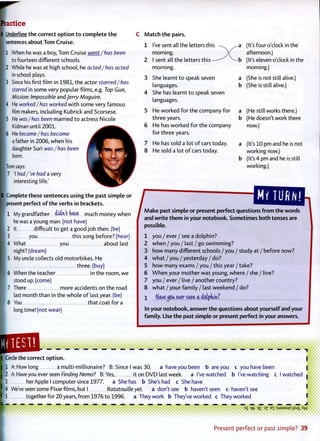
S ^t^E qz E i : S J 3 M S U E iisax^w
Past s i m p l e 2 2 5
r
10 Past simple 3: irregular past forms
They spoke Celtic languages.
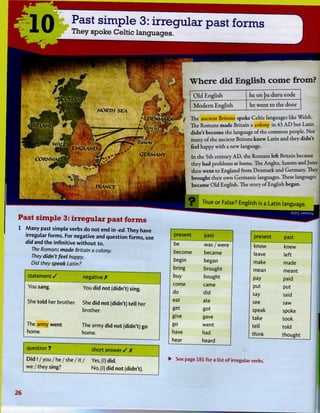
W h e r e d i d E n g l i s h c o m e f r o m ?
Old English he on pa duru eode
Modern English he went to the door
FRANCE
Past simple 3: irregular past forms
1 Many past simple verbs do not end in -ed. They have
irregular forms. For negative and question forms, use
did and the infinitive without to.
The Romans made Britain a colony.
They didn't feel happy.
Did they speak Latin ?
The ancient Britons spoke Celtic languages like Welsh.
The Romans made Britain a colony in 43 AD but Latin
didn't become the language of the common people. Not
many of the ancient Britons knew Latin and they didn't
feel happy with a new language.
In the 5th century AD, the Romans left Britain because
they had problems at home. The Angles, Saxons and Jutes
then went to England from Denmark and Germany. They
brought their own Germanic languages. These languages
became Old English. The story of English began.
True o r False? English is a Latin language. m
3S|E-| MSMSUy
statement / negative X
You sang. You d i d n o t (didn't) sing.
She t o l d her brother. She d i d n o t (didn't) t e l l her
brother.
The army w e n t
home.
The army d i d n o t (didn't) go
home.
question ? short answer / X
D i d 1 / y o u /he /she / i t / Yes, (1) did.
we / t h e y sing? No, (1) d i d n o t (didn't).
present past present past
be was / were know knew
become became leave left
begin began make made
bring brought mean meant
buy bought pay paid
come came put put
do did say said
eat ate see saw
get got speak spoke
give gave take took
go went tell told
have had think thought
hear heard
See page 181 for a list o f irregular verbs.
1
2 6
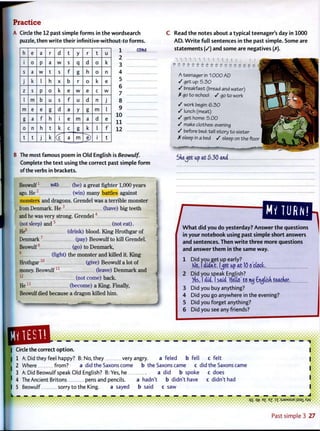
PracticeCircle the 12 past simple forms in the wordsearch
puzzle, then write their infinitive-without-to forms.
1
h e a r d t y r t u
i 0 P a w s q d 0 k
s a w t s f g h 0 n
J k I h X b r 0 k e
z s P 0 k e w e c w
I m b u s f u d n J
m e e g d a y g m I
g a f h i e m a d e
0 n h t k c g k I f
t t J k (c a m ~e) i t
come
2
3
4
5
6
7
8
9
10
1 1
12
B The most famous poem in Old English is Beowulf.
Complete the text using the correct past simple form
of the verbs in brackets.
Beowulf1
was (be) a great fighter 1,000 years
ago. He 2
(win) many battles against
monsters and dragons. Grendel was a terrible monster
from Denmark. He 3
(have) b i g teeth
and he was very strong. G r e n d e l 4
(not sleep) a n d 5
(not eat).
He6
(drink) blood. K i n g Hrothgar of
Denmark7
(pay) Beowulf to kill Grendel.
Beowulf8
(go) to Denmark,
9
(fight) the monster and killed it. K i n g
Hrothgar1 0
(give) Beowulf a lot of
money. B e o w u l f 1 1
(leave) D e n m a r k and
1 2
(not come) back.
H e 1 3
(become) a King. Finally,
Beowulf died because a dragon killed h i m .
Read the notes about a typical teenager's day in 1000
A D . W r i t e full sentences in the past simple. Some are
statements (/) and some are negatives (X).
U U 1 H 1 1 1 I I | | i l
*• ;» ;» *» .» »« .» « «• «. *. «, * „
A teenager in 10OO AD
/ get up: 5.30
/ breakfast {bread and water)
X go t o school / go to work
/ work begin: 6 . 3 0
/ lunch (meat)
/ get home: 5.00
/ make clothes: evening
»/ before bed: tell story t o sister
X sleep in a bed / sleep on the floor
She^ot ap at 5 3 0 and
/ W h a t did you do yesterday? Answer the questions
in your notebook using past simple short answers
and sentences. Then write three more questions
and answer them in the same way.
1 D i d you get up early?
K)& I didn't, l^ct up at 10 o'clock.
2 Did you speak English?
/e&, I did. I said 'tfetta' to iwj €njtisk teacher.
3 Did you buy anything?
4 D i d you go anywhere in the evening?
5 Did you forget anything?
6 Did you see any friends?
.•.M.MAM.MJ
a feled b fell c felt
a did the Saxons come b the Saxons came c did the Saxons came
| Circle the correct o p t i o n
| 1 A: Did they feel happy? B: No, they very angry.
I 2 Where from?
3 A:Did Beowulf speak O l d English? B: Yes, he a did b spoke c does
' 4 The Ancient Britons pens and pencils. a hadn't b didn't have c didn't had
I 5 Beowulf sorry t o the King. a sayed b said c saw
• ••••••• t • • • • # • 1
q g q-t? e £ E Z : 5 J 3 M S U E u s a i Xw
Past s i m p l e 3 2 7
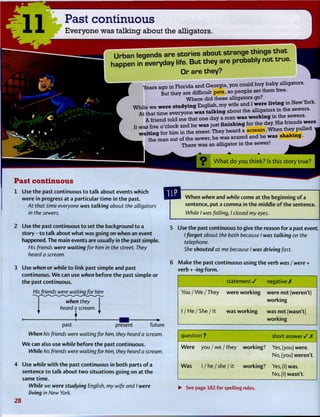
11 Past continuous
Everyone was talking about the alligators.
Urban legends are stories about strange things that
happen in everyday life. But they are probably not true.
Or are they?
Years ago in Florida and Georgia, you could buy baby alligators.
But they are difficult pets, so people set them tree.
Where did these alligators go?
While we were studying English, my wife and I were living in NewYork.
™th^eeverylne was talking about the alligators m the sewers.
A friend told me that one day a man was working in the sewers.
It was five o coC k a n d h e was just finishing for the day. Has fnends were
watUngLhiminthestreet.Theyhearda scream.When they pulled ,
the man out of the sewer, he was scared and he was shakmg.
There was an alligator in the sewer!
W h a t do you think? Is this story true?
Past continuous
1 Use t h e past continuous t o t a l k about events which
w e r e in progress at a particular t i m e in t h e past.
At that time everyone was talking about the alligators
in the sewers.
2 Use t h e past continuous t o set t h e background t o a
story - t o talk about w h a t was going on w h e n an event
happened. The main events are usually in t h e past simple.
His friends were waiting for him in the street. They
heard a scream.
3 Use when or while t o link past simple and past
continuous. W e can use when before t h e past simple or
t h e past continuous.
His friends were waiting for him
when they
heard a scream.
I
1
past present future
When his friends were waiting for him, they heard a scream.
W e can also use while before t h e past continuous.
While his friends were waiting for him, they heard a scream.
Use while w i t h t h e past continuous in b o t h parts o f a
sentence t o talk about t w o situations going on at t h e
same t i m e .
Wh/'/e we were studying English, my wife and I were
living in New York.
W h e n when and while come at t h e beginning o f a
sentence, p u t a c o m m a in t h e middle o f t h e sentence.
While I was falling, I closed my eyes.
5 Use t h e past continuous t o give t h e reason f o r a past event.
/ forgot about the bath because I was talking on the
telephone.
She shouted at me because I was driving fast.
6 M a k e t h e past continuous using t h e verb was / were +
verb + -ing form.
• See page 182 for spelling rules.
statement / negative X
You / W e /They w e r e w o r k i n g w e r e n o t (weren't)
w o r k i n g
1/ He /She / I t was w o r k i n g was n o t (wasn't)
w o r k i n g
question ? short answer / X
W e r e you / we / they working? Yes, (you) were.
No, (you) weren't.
Was 1 / he / she / it working? Yes, (1) was.
No, (1) wasn't.
2 8
P r a c t i c e
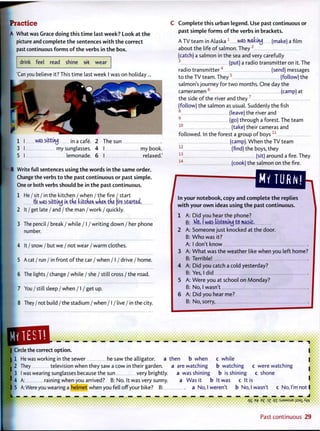
A What was Grace doing this t i m e last week? Look at t h e
picture and complete t h e sentences w i t h t h e correct
past continuous f o r m s o f t h e verbs in t h e box.
drink feel read shine 5+t wear
'Can you believe it? This time last week I was on holiday...
1 I was s i t t i t u j i n a cafe. 2 The sun
3 I my sunglasses. 4 I my book.
5 I lemonade. 6 I relaxed.'
IB Write full sentences using t h e words in t h e same order.
Change the verbs t o t h e past continuous o r past simple.
One or both verbs should be in t h e past continuous.
1 He / sit / in the kitchen / when / the fire / start
He was sittituj in the kitchen when the {ire started.
2 It / get late / and / the man / work / quickly.
3 The pencil / break / while / I / writing down / her phone
number.
4 It / snow / but we / not wear / warm clothes.
5 A cat / run / in front o f the car / when / I / drive / home.
6 The lights / change / while / she / still cross / the road.
7 You/still sleep/when / I / get up.
8 They / not build / the stadium / when /1 / live / in the city.
C o m p l e t e this urban legend. Use past continuous or
past simple f o r m s o f t h e verbs in brackets.
A TV team in Alaska 1
was mkty (make) a film
about the life of salmon. They 2
(catch) a salmon in the sea and very carefully
3
(put) a radio transmitter on it. The
radio t r a n s m i t t e r 4
(send) messages
t o the TV team. T h e y 5
(follow) the
salmon's journey for t w o months. O n e day the
cameramen 6
(camp) at
the side o f the river and they 7
(follow) the salmon as usual. Suddenly the fish
(leave) the river and
(go) through a forest. The team
(take) their cameras and
followed. In the forest a group o f b o y s 1 1
(camp). W h e n the TV team
1 2
(find) the boys, they
1 3
(sit) around a fire. They
1 4
(cook) the salmon on the fire.
9
10
MV TURN!
In your n o t e b o o k , copy and complete t h e replies
w i t h your o w n ideas using t h e past continuous.
1 A: Did you hear the phone?
B: K)o, I was listening to music.
2 A: Someone just knocked at the door.
B: W h o was it?
A: I don't know
3 A: W h a t was the weather like when you left home?
B: Terrible!
4 A: Did you catch a cold yesterday?
B: Yes, I did
5 A: Were you at school on Monday?
B: No, I wasn't
6 A: Did you hear me?
B: No, sorry,
• • •»i « * » * , • « • • i • • _ • a a a
•••••••
| Circle the correct option.
I 1 He was working in the sewer he saw the alligator. a then b when
I 2 They television when they saw a cow in their garden. a a r e w a t c h i n g
[ 3 I was wearing sunglasses because the sun very brightly. a w a s s h i n i n g
? 4 A: raining when you arrived? B: No. It was very sunny. a Was it b
c while
b watching c were watching
b is shining c shone
It was c It is
15 A: Were you wearing a helmet when you fell off your bike? B: a No, I weren't b No, I wasn't c No, I'm not I
••••••••••••••III••••••*•*•< qS *P ?Z qi:sj9MsuEi;saiAw
Past continuous 2 9
Review: past simple and past continuous
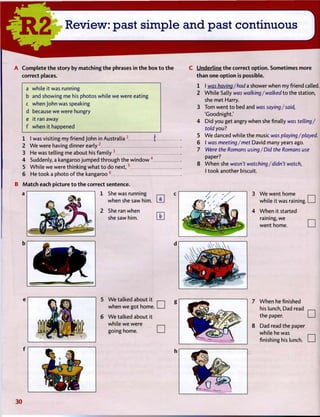
A Complete the story by matching the phrases in the box to the
correct places.
a while it was running
b and showing me his photos while we were eating
c when John was speaking
d because we were hungry
e it ran away
f when it happened
I was visiting my friend John in A u s t r a l i a 1
We were having dinner early 2
He was telling me about his f a m i l y 3
Suddenly, a kangaroo j u m p e d through the w i n d o w 4
W h i l e we were thinking what t o do n e x t , 5
He t o o k a photo o f the kangaroo 6
t
B Match each picture to the correct sentence.
1 She was running
when she saw him.
2 She ran when
she saw him.
C Underline the correct option. Sometimes more
than one option is possible.
1 I was having/had a shower when my friend called.
2 W h i l e Sally was walking/ walked t o the station,
she met Harry.
3 Tom went t o bed and was saying/said,
'Goodnight'
4 Did you get angry when she finally was telling/
told you?
5 We danced while the music was playing/played.
6 I was meeting/met David many years ago.
7 Were the Romans using /Did the Romans use
paper?
8 W h e n she wasn't watching/didn't watch,
I t o o k another biscuit.
3 We went home .—.
while it was raining. I I
4 W h e n it started
We talked about it
when we got home.
We talked about it
while we were
going home.
•
•
raining, we
went home. •
W h e n he finished
his lunch, Dad read .—.
the paper. I I
Dad read the paper
while he was .—.
finishing his lunch. I I
3 0
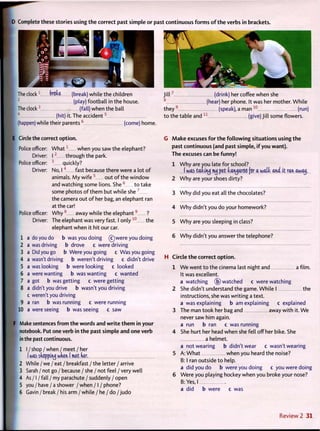
D Complete these stories using t h e correct past simple or past continuous f o r m s o f t h e verbs in brackets.
The clock1
bnh (break) while the children
2
(play) football in the house.
The clock3
(fall) when the ball
4
(hit) it. The accident5
(happen) while their p a r e n t s 6
(come) home.
J i l l 7
(drink) her coffee when she
8
(hear) her phone. It was her mother. While
they 9
(speak), a man 1 0
(run)
t o the table and 1 1
(give) Ji 11 some flowers.
E Circle the correct o p t i o n .
Police officer: W h a t 1
when you saw the elephant?
Driver: 1 2
through the park.
Police officer: 3
quickly?
Driver: No, I4
fast because there were a lot o f
animals. M y w i f e 5
out o f the w i n d o w
and watching some lions. S h e 6
t o take
some photos o f t h e m but while she 7
the camera out o f her bag, an elephant ran
at the car!
Police officer: W h y 8
away while the e l e p h a n t 9
?
Driver: The elephant was very fast. I only 1 0
the
elephant when it hit our car.
1 a do you do b was you doing (c)were you doing
2 a was driving b drove c were driving
3 a Did you go b Were you going c Was you going
4 a wasn't driving b weren't driving c didn't drive
5 a was looking b were looking c looked
6 a were wanting b was wanting c wanted
7 a got b was getting c were getting
8 a didn't you drive b wasn't you driving
c weren't you driving
9 a ran b was running c were running
I 10 a were seeing b was seeing c saw
F Make sentences f r o m t h e words and w r i t e t h e m in your
notebook. Put one verb in t h e past simple and one verb
in the past continuous.
1 I /shop/ when / meet / her
I was shopping wnen I met ker.
I 2 While / we / eat / breakfast / the letter / arrive
3 Sarah / not go / because / she / not feel / very well
1 4 As /1 / fall / my parachute / suddenly / open
5 you / have / a shower / when /1 / phone?
6 Gavin / break / his arm / while / he / do / j u d o
G M a k e excuses f o r t h e f o l l o w i n g situations using t h e
past continuous (and past simple, i f you want).
The excuses can be f u n n y !
1 W h y are you late for school?
(was taking mij pet kangaroo for a watt and it ran. awaij.
2 W h y are your shoes dirty?
3 W h y did you eat all the chocolates?
4 W h y didn't you do your homework?
5 W h y are you sleeping in class?
6 W h y didn't you answer the telephone?
H Circle t h e correct o p t i o n .
1 We went t o the cinema last night and a film.
It was excellent.
a watching (b) watched c were watching
2 She didn't understand the game. W h i l e I the
instructions, she was w r i t i n g a text.
a was explaining b am explaining c explained
3 The man t o o k her bag and away w i t h it. We
never saw him again.
a run b ran c was running
4 She hurt her head when she fell off her bike. She
a helmet.
a not wearing b didn't wear c wasn't wearing
5 A: W h a t when you heard the noise?
B: I ran outside t o help.
a did you do b were you doing c you were doing
6 Were you playing hockey when you broke your nose?
B: Yes, I
a did b were c was
Review 2 31
1 2
Present perfect 1
They've already invented it!
They've a l r e a d y i n v e n t e d it, Dad!
The taxi's j u s t a r r i v e d !
Sorry I'm late. I
h a v e n ' t left y e t !
Find six w o r d s
rCC O from t h e c a r t o o n s
in t h i s w o r d snake:
Present perfect 1
1 Use t h e present perfect f o r a past event
which t h e speaker feels is connected
w i t h t h e present.
The taxi's arrived. (The taxi is here now.)
2 W e o f t e n use t h e present perfect t o t a l k
about a recent event. Use t h e adverb
just t o emphasise t h a t t h e event is
recent.
The taxi's just arrived.
3 W e can use t h e present perfect w i t h
already and yet. Already and yet mean
'before now'. W e use yet in questions
and negatives. Already comes a f t e r has
/have and before t h e main verb. Yet
comes at t h e end o f t h e sentence or
question.
They've already invented it.
I haven't left yet.
Have the boys arrived yet?
4 St/7/ w i t h t h e present perfect negative
stresses t h a t t h e situation is continuing
now.
/ st/7/ haven't left home.
5 M a k e t h e present perfect using t h e verb
have + past participle.
I've just seen her.
I haven't visited the museum yet.
'jsnf'ya] 'Apeaj|e 'paAUje 'pajuaAU! :SJ9MSUV
statement / negative X
1 / Y o u / W e / T h e y have fve) visited have n o t (haven't) visited
H e / S h e / I t has fs) visited has n o t (hasn't) visited
question ? short a n s w e r / /
Have 1 / you / we / they visited...? Yes, (1) have.
No,(l) haven't.
Has he / she / it visited...? Yes, (he) it has.
No, (he) hasn't.
A d d -ed t o f o r m t h e past participle
o f regular verbs, e.g. visited,
arrived, tried. (These are t h e same
as t h e past simple verb forms.)
See page 182 for spelling rules.
's = is and has
he's visited = he has visited
he's cold = he is cold
However, t h e r e are many irregular forms.
be been go + gone
break -> broken give -> given
come -* come steal -> stolen
do -> done
see •# seen
speak •* spoken
wake up •* woken up
Some irregular past participles are t h e same as t h e past
simple f o r m .
find •* found -* found read •* read -> read
have •* had -> had say •* said -> said
leave -* left -* left spend -> spent-* spent
lose -* lost -* lost tell -* told -> told
make -> made -> made win -> won -* won
3 2 • See page 181 for a list of irregular verbs.
Practice
A Match the pairs of sentences.
1 She can't do sports.^ ~x a
2 He's still not feeling well. 1 b
3 She's crying. V-c
4 I'm very happy. d
5 The car won't start. e
6 I have no money. f
7 You're looking worried. g
8 We can go now. h
9 I'm not ready t o go. i
She's lost her bag.
He's just had flu.
She's broken her arm.
I haven't had a shower yet.
I've spent it on CDs.
I haven't left yet.
The taxi has just arrived.
M y football team has just won.
W h a t has happened?
B Complete the sentences using the words in brackets in the
I correct form and position.
I I He can't find his keys. I think MSWKt them, (lose)
[ 2 Haven't you done your homework yet?
I it. (finish / already)
3 It's midnight and she home yet. (not / come)
4 lunch yet? (you / have?)
5 This is terrible. Someone my bike, (steal)
6 We a really cheap car! (just / buy)
7 Take your boots o f f before you come in. I
the carpets, (just / clean)
8 the doctor yet? (you / phone?)
9 They the film, (see /already)
C It's Sunday night and Dad is asking Joe whether he is ready for
f school in the morning. W r i t e Dad's questions and Joe's replies
in your notebook
1 pack school bag [/]
j3 do your science homework [/]
5 wash the dinosaur [X]
7 buy the dinosaur f o o d [X]
1 0: ffavejou packedjour school bayjet f J: /es, I have
2 tidy your cave [X]
4 have a bath [X]
6 make your sandwiches [/]
What four things hasn't Joe done yet? W r i t e sentences.
Example: He hasn't tidied his cavejet.
D W r i t e reasons for each of these situations. Use
the words in brackets and the correct form of
the verb.
1 I don't have my glasses.
I stilt haven't (ound them. (find / still)
2 He's still asleep.
(wake up /yet)
3 The book looks very new.
(I / read / still)
4 She isn't here any more.
(go/just)
5 I don't have my old phone any more.
(give it t o my dad)
6 She doesn't know.
(they / t e l l her /still)
7 I still haven't received the letter.
(postman / come / yet)
8 There's no more milk.
(I / finish/just)
MV TURN!
Imagine it's Sunday evening. In your notebook,
write three things you have done and three
things you haven't done.
Example: I've cleaned RUj bike,
• • * • i
Circle the correct option.
1 The taxi hasn't arrived a already b just c yet
2 He's his new watch. a breaked b broke c broken
3 He left home four hours ago and he t o say he's arrived, a still hasn't phoned b haven't phoned yet
c hasn't just phoned
4 yet? a Have you eaten your vegetables b You have eaten your vegetables c Have you your vegetables eaten '
5 A: Is Alex there? B: O h sorry. He's . a gone already home b just gone home c gone home yet I
Q S v B £ oz 3 1 : S J 3 M S U E N S A J _
Present p e r f e c t 1 3 3
1 3
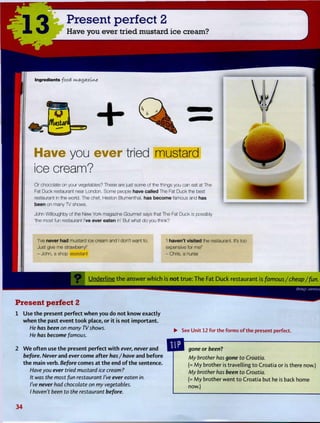
Present perfect 2
Have you ever tried mustard ice cream?
Ingredients food n^aga-zii^t
fm 4 -
H a v e y o u e v e r t r i e d m u s t a r d
i c e c r e a m ?
Or chocolate on your vegetables? These are just some of the things you can eat at The
Fat Duck restaurant near London. Some people have called The Fat Duck the best
restaurant in the world. The chef, Heston Blumenthal, has become famous and has
been on many TV shows.
John Willoughby of the New York magazine Gourmet says that The Fat Duck is possibly
'the most fun restaurant I've ever eaten in' But what do you think?
'I've never had mustard ice cream and I don't want to
Just give me strawberry!'
- John, a shop assistant
Present perfect 2
1 Use t h e present perfect w h e n you do not k n o w exactly
w h e n t h e past event t o o k place, or it is not i m p o r t a n t .
He has been on many TV shows.
He has become famous.
2 W e o f t e n use t h e present perfect w i t h ever, never and
before. Never and ever come a f t e r has / have and before
t h e main verb. Before comes at t h e end o f t h e sentence.
Have you ever tried mustard ice cream?
It was the most fun restaurant I've ever eaten in.
I've never had chocolate on my vegetables.
I haven't been to the restaurant before.
U n d e r l i n e t h e a n s w e r w h i c h is n o t t r u e : T h e Fat D u c k restaurant is famous/cheap/fun
• See Unit 12 for the forms of the present perfect.
gone or been?
My brother has gone to Croatia.
(= M y brother is travelling t o Croatia or is there now.)
My brother has been to Croatia.
(= M y brother w e n t t o Croatia but he is back home
now.)
3 4
ractice
Answer the questions with present perfect short answers.
1 Have vou ever tried raw fish?
frig, I tUMKt.
2 Have you ever used chopsticks?
3 Have you ever seen a banana tree?
4 Have you ever put sugar in a sandwich?
5 Have you ever made ice cream?
6 Have you ever eaten chips w i t h sugar?
7 Have you ever drunk coconut milk?
8 Have you ever cooked a meal f o r your family?
C Complete the sentences using the present perfect of
the verbs in the box.
break ever forget go ever have not meet
not play see not speak never spend write
1 I've broken my nose before.
2 He plays the guitar but he in a band before.
3 They Christmas away f r o m home.
4 W e our new neighbours.
5 M y friends aren't here now, they home.
6 M y sister an article for the local newspaper.
7 I t o my parents about my exam results.
8 your teacher
t o give you homework?
9 W e the new James Bond film.
10 She's the best friend I
Which of these things have you done or not done?
Complete the sentences using the present perfect o f
the verbs in brackets.
1 1 haven't won a competition, (win)
2 t o Cuba, (be)
3 a book in one day. (read)
]4 rugby, (play)
5 an elephant, (see)
6 a famous person, (meet)
7 a leg. (break)
in a restaurant, (work)
9 ten kilometres, (run)
Do you know people who have done these things?
Write true sentences about people you know.
Example: Mij brother has met a famous person,
, .
D Complete the sentences with gone or been.
1 M y grandparents have yone to Australia.
They'll arrive t o m o r r o w - the journey takes 22 hours.
2 They've visited the UK, but they haven't
t o Scotland.
3 M y family loves travelling. We've
t o 10 different countries together.
4 They've out and left the lights on.
5 A: Where have you ?
B: To post a letter.
MY TURN!
^ m ^ o u M i o ^ things you
have done in the past.
Example: I've been to Australia,
Now write three questions to ask a friend using Have
you (ever)...?
Example: ffavejou ever been to Australia?
W r i t e about your friend.
Example: Setty has never been to Australia,
Circle the correct option.
1 My sister sushi three or four times, but she doesn't like it. a tries b has tried c is tried
2 I've tried most things, but an insect. a I've ever eaten b I haven't never eaten c I've never eaten
3 A: on TV? B:Yes, he has. a Has Heston ever been b Has Heston been ever c Heston ever has been
4 It's our favourite restaurant. there many times. a We's been b We've gone c We've been
5 A: Have you ever been t o The Fat Duck? B: a Yes, we've b Yes, w e been c No, we haven't
—
D S 3 f E
£ 3 ? Q I : S J 3 M S U E J ; S 3 X X ^
Present p e r f e c t 2 3 5
1 4
Present perfect 3
They have lived there for centuries.
THE RICH AND
FAMOUS IN LONDON
r p h e rich and famous have l i v e d in Marylebone f o r
T c e n t u n e s . Past residents include Charles * * ™ n L
the Beatles. Ringo Starr rented an
Sauare in Marylebone. Jimi H e n d n x also lived there. There
h a s n ' t been a famous resident at 34 M o n t a g u Square smce
the 1960s, but tourists still go to see the building.
Marylebone has been Madonna's favourite
place in London for a few years now. The
star owns four houses in the same street!
C o m p l e t e t h e sentence: M a r y l e b o n e is a place in
Present perfect 3
Use t h e present perfect f o r a situation w h i c h started
in t h e past and continues now.
Marylebone has been Madonna's favourite
place in London for a few years now.
: I
P a s t
present future
2 W e can use for and since w i t h t h e present perfect.
The rich and famous have lived in Marylebone for
centuries.
There hasn't been a famous resident since the 1960s.
3 Use How long ...?to ask f o r h o w much t i m e a situation
has continued.
How long has she lived in London?
She has lived in London for a few years.
4 W e can use always w i t h t h e present perfect.
I've always wanted to live in the city. (= for all the time
can remember)
uopuo"| :J3MSUV
Use t h e present perfect + for t o emphasise h o w long a
situation has been going on, e.g. for an hour, for a few
days, for a week, for six months, for ages (= for a long
time).
They have lived there for centuries.
Use t h e present perfect + since t o emphasise w h e n a
situation began, e.g. since 12 o'clock, since Monday,
since January, since last year, since the 1960s, since she
got married.
The couple have been married since last year.
There hasn't been a famous resident since the 1960s.
Use t h e present perfect, not t h e present, w i t h since
and for.
She has lived here for a few years.
N O T She lives here for a few years.
•
•
3 6
See Units 12 and 13 for other uses of the present perfect.
See Unit 12 for the forms of the present perfect.
A Complete each t i m e expression w i t h for or since.
Ml for a long time.
1 2 t w o weeks.
1 3 2003.
I 4 last year.
1 5 three years.
1 6 only a day!
• 7 Christmas.
8 I was 12.
| Now answer the question.
I How long have you lived in your house?
I I've lived in my house
B Complete the sentences w i t h t h e present perfect o f t h e
verbs in brackets. Use short f o r m s w h e r e possible.
1 They W always wanted t o visit New York, (always
want)
2 We my cousins since the beginning
of last year. They are always very busy, (not see)
3 It a really good summer. I don't
want it to end. (be)
4 They in the same house all
their lives, (live)
5 My sister and I share a bedroom. We
our own rooms, (never have)
6 How long you
your mountain bike? (have)
7 He his home
town, (always love)
8 How long she ill? (be)
9 He in the
same bank for years, (work)
10 I he was the
best, (always think)
C Ask questions a b o u t t h e celebrities using How long...?
and t h e present perfect.
1 Michael Douglas and Catherine Zeta-Jones are married.
....(few (Gnj have thej been married?
2 Madonna drives a M i n i Cooper car.
3 Sienna Miller lives in Marylebone.
4 Paul McCartney plays the piano.
5 Ringo Starr is a vegetarian.
6 Jennifer Connelly speaks Italian.
MY TURN!
f ^ a k e s e r ^ and a t i m e phrase
which is t r u e f o r you. W r i t e t h e m in your notebook.
1 I / be / hungry
I've been hungry since 16 clock this morniny.
2 I / not see / my cousin
3 I / be / a t t h i s school
4 I / know / my / best friend
5 I / not d o / t h e washing-up
6 M y family / live/here
Circle the correct o p t i o n .
1 t o meet Madonna.
a I always have wanted b I've always wanted c I've wanted always
2 We've lived in Marylebone
a forages b ages ago c since ages
3 They've had their flat in Marylebone since they married.
a get b got c have got
4 A: How long ? B: For about six years.
a are they famous b have they been famous c they've been famous
5 She London since she was a child.
a isn't visit b didn't visit c hasn't visited
3
S QT? <K e
Z Q I : S J 9 M S U E J } S 3 ] _ A Y  /
Present p e r f e c t 3 37
1 5
Present perfect or past simple?
The company has invented the Mac and the iPod.
S t e v e Jobs w a s b o r n in 1 9 5 5 a n d w a s a m u l t i -
m i l l i o n a i r e b e f o r e t h e a g e o f 3 0 . He is d y s l e x i c
a n d o n e o f his t e a c h e r s a t school r e m e m b e r s his
' d i f f e r e n t w a y o f l o o k i n g a t t h i n g s ' .
I n t h e 1 9 7 0 s , c o m p u t e r s w e r e large m a c h i n e s a n d
o n l y l a r g e c o m p a n i e s u s e d t h e m . I n 1 9 7 6 , S t e v e
l o b s a n d S t e v e W o z n i a k c h a n g e d all t h a t . T h e y
s t a r t e d t h e c o m p a n y A p p l e I n c a n d p r o d u c e d t h e
w o r l d ' s f i r s t p e r s o n a l c o m p u t e r , A p p l e I. Since
t h e n , A p p l e I n c h a s also p r o d u c e d M a c i n t o s h
c o m p u t e r s a n d t h e iPod.
S t e v e Jobs also h e l p e d t o s t a r t Pixar A n i m a t i o n
S t u d i o s . S o m e o f t h e b e s t - l o v e d a n i m a t e d f i l m s
h a v e c o m e f r o m Pixar, i n c l u d i n g Toy Story, Finding
Nemo a n d Ratatouille. Pixar h a s w o n m a n y
O s c a r s ™ o v e r t h e last 2 5 y e a r s .
1
V C o m p l e t e t h e s e n t e n c e w i t h t h r e e possible answers: Steve Jobs is f a m o u s f o r
sojpnjs uojiewmv Jexy 'pcy; am'sjsjndwoD Ljscnupeyv '| 9]ddv'3U| 9|ddy :s.iaMSiie aiqjsscy
Present perfect or past simple?
1 Use t h e present perfect t o t a l k a b o u t recent events o r
a past event w h i c h t h e speaker feels is connected w i t h
t h e present.
Certain t i m e expressions are c o m m o n w i t h this use
o f t h e present perfect. These include already, yet,
just, ever, never, before.
I haven't eaten yet. (= I'm hungry now.)
Has he left? (= He isn't here now.)
Use t h e past simple t o t a l k a b o u t a finished action.
Certain t i m e expressions may be used w i t h t h e past
simple. These include yesterday, last week, ago, then,
when, in + year.
In the 1970s, computers were large machines.
When did Apple invent the iPod?
3 Use t h e present perfect t o t a l k about an event or
s i t u a t i o n w h i c h began in t h e past and continues now.
W e o f t e n use t i m e expressions w i t h since and for w i t h
this use o f t h e present perfect, e.g. for a week, since
yesterday, for a long time, since 2004, and ask questions
w i t h How long?
How long have you worked at Pixar?
I've worked here for ten years.
4 The choice o f t h e past simple or present perfect can
sometimes depend on t h e p o i n t o f v i e w o f t h e speaker,
or on t h e c o n t e x t .
/ didn't see George this morning. (The speaker is talking
at the end o f the day and this morning is finished.)
/ haven't seen George this morning. (The speaker is
talking in the morning - this morning is still going on.)
3 8
Practice
A Underline the correct o p t i o n t o complete t h e
sentences about Tom Cruise.
11 When he was a boy, Tom Cruise went /has been
to fourteen different schools.
2 While he was at high school, he acted/has acted
in school plays.
3 Since his first film in 1 9 8 1 , the actor starred/has
starred in some very popular films, e.g. Top Gun,
Mission: Impossible and Jerry Maguire.
4 He worked/has worked w i t h some very famous
film makers, including Kubrick and Scorsese.
[5 He was/has been married t o actress Nicole
Kidman until 2 0 0 1 .
6 He became/has become
a father in 2006, when his
daughter Suri was/has been
born.
Tom says:
7 'I had /'ve had a very
interesting life.'
IB Complete these sentences using t h e past simple or
present perfect o f t h e verbs in brackets.
1 My grandfather didnt have much money when
he was a young man. (not have)
2 It difficult t o get a good j o b then, (be)
3 you this song before? (hear)
4 What you about last
night? (dream)
5 My uncle collects old motorbikes. He
three, (buy)
6 When the teacher in the room, we
stood up. (come)
7 There more accidents on the road
last month than in the whole o f last year, (be)
8 You that coat for a
long time! (not wear)
C Match the pairs.
1 I've sent all the letters this
morning.
2 I sent all the letters this
morning.
3 She learnt t o speak seven
languages.
4 She has learnt t o speak seven
languages.
5 He worked f o r the company for
three years.
6 He has worked for the company
for three years.
7 He has sold a lot o f cars today.
8 He sold a lot o f cars today.
(It's four o'clock in the
afternoon.)
(It's eleven o'clock in the
morning.)
a (She is not still alive.)
b (She is still alive.)
a (He still works there.)
b (He doesn't work there
now.)
a (It's 10 pm and he is not
working now.)
b (It's 4 pm and he is still
working.)
i:niu,ni
/
Make past simple or present perfect questions from the words
and write them in your notebook. Sometimes both tenses are
possible.
1 you / ever / see a dolphin?
2 when / you / last / go swimming?
3 how many different schools / you / study at / before now?
4 what / you / yesterday / do?
5 how many exams / you / this year / take?
6 W h e n your mother was young, where / she / live?
7 you / ever / live / another country?
8 what / your family / last weekend / do?
1 HaveJGU. ever seen a dotpjunf
In your notebook, answer t h e questions about yourself and your
family. Use t h e past simple or present perfect in your answers.
Circle the correct o p t i o n .
1
I 2
>:
I 5
L -
A: How long a multi-millionaire? B: Since I was 30. a have you been b are you c you have been
A: Have you ever seen Finding Nemo? B:Yes, it on D V D last week, a I've watched b I've watching c I watched
her Apple I computer since 1977. a She has b She's had c She have
We've seen some Pixar films, but I Ratatouilteyet. a don't see b haven't seen c haven't see
together for 20 years, f r o m 1976 to 1996. a They work b They've worked c They worked
3
S QT? Q £ ~*Z E X : S J 9 A A S U E J I S A I A W
Present p e r f e c t o r past simple? 39
1 6
Used to
Sick people often used to sleep in temples.
T h e A n c i e n t G r e e k s
u s e d t o t h i n k t h a t
t h e y w e r e i l l b e c a u s e
o f b a d m a g i c o r
b e c a u s e t h e g o d s w e r e
u n h a p p y w i t h t h e m .
So, sick people often
used to sleep in
temples.
, r
The Greeks didn't use to take medicine
and they didn't use to go to the doctor.
The first 'doctors'
used to be witches
or people with magic
powers.
Some people used to eat
flowers and herbs when
they were ill but this d.dnt
use to help everyone.
Hippocrates, born about 460 BC on
the island of Kos, made medicine
into a serious science. He is often
called the father of medicine.
Underline the correct option: The first doctors
were Greek / believed in magic / were women.
Drs I
3I8ELU UJ paA3||aq MSMSUV
Used to
1 Used to is f o r habits and states which finished in t h e
past. Used to o f t e n contrasts t h e past and t h e present.
Jack used to live in Brighton, but now he lives in Liverpool.
Most people used to believe in magic.
2 The past simple can usually replace used to.
The Greeks used to sleep / slept in temples when they
were ill.
They didn't use to go / didn't go to doctors.
3 Use t h e past simple, n o t used to, w h e n t a l k i n g about
single activities, h o w long t h e y t o o k or h o w many
times t h e y happened.
/ went to the doctor yesterday. N O T / used to go...
We didn't eat for two days.
N O T We didn't used to eat...
Jane visited me in hospital twice.
N O T Jane used to visit...
4 0
4 Used to + infinitive w i t h o u t t o . Used to has no present or
continuous f o r m s .
Sick people often used to sleep in temples.
5 M a k e questions w i t h Did + noun / pronoun + use to...?
Did doctors use to study science?
Did you use to eat a lot of sweets when you were young?
6 M a k e t h e negative w i t h did not (didn't) use to or never
used to.
They didn't use to take medicine.
Operations never used to be easy.
In spoken English people o f t e n use did + used
(instead o f use) in questions and negatives.
Did you used to play with dolls ?
I didn't used to like him.
[Practice
A Charlie is now a millionaire but he used t o be poor. In your
notebook, w r i t e sentences about Charlie's life w i t h used to
and didn't use to.
1
Now 10 years ago
1 He gets up at 11.00. 7 £ 0
2 He doesn't work. supermarket
3 He has a very big house. X big house
4 He plays golf. X g o l f
5 He wears expensive clothes. cheap clothes
6 He is unhappy. happy
1 tie used tojet up at 7.00
B Underline the correct o p t i o n . Sometimes b o t h options are
possible.
1 I had/used to have a shower last night.
12 Kurt was I used to be a very good friend.
I 3 It snowed/used to snow a lot in winter.
4 I met/used to meet Janice yesterday.
5 Children didn't watch/use to watch so much TV.
: 6 It wasn't/never used to be very expensive.
i 7 My sister went/used to go to Mexico in 2007.
8 My sister went/used to go t o Mexico every summer.
C Read these sentences about life 2,000 years ago. (Four are
I true, four are false.) I f t h e sentence is t r u e , r e w r i t e it w i t h
I used to. If the sentence is false, r e w r i t e it w i t h didn't use to.
I I Latin was an international language.
Uttn used to be an international lanjuaje.
2 People used to think that the w o r l d was round.
People iiih't use to think, that the world was round,
3 There were bears in England.
4 People ate a lot o f meat.
5 Builders made houses out o f w o o d .
6 Most people lived in towns.
7 Travelling by sea was dangerous.
8 Children learned English.
D C o m p l e t e this advertisement w i t h used to or the
past simple o f t h e verbs in t h e box.
not answer be chan;;e criticise do
get lose not isten sit not worry
M j o u j e t out of bed this morning ond feel terrible?
much filter ond beolfhier once?
jr answer is 'yes', you need powetf l a k e s !
Eva Clark (England):'!3
about my health but
I never4
exercise and my health got
worse and worse. Then I tried Powerflakes! Now I feel like a new woman.'
Andrei Wojdylo (Poland): 'My friends5
me all the time because I was so lazy and unfit but 1 6
to them. I 7
in front of theTV all night and eat chocolates. If the phone rang,
I 8
it! Last
year everything9
because I
1 0
my job and I needed to change
my life. Now, I have Powerflakes and life is perfect!'
In your notebook, w r i t e sentences about changes in
your life w i t h used to, didn't use to or never used to.
Example: I used to dojudo but now I do karate,
. . . . . .
— — — — Hi — — —
] Circle the correct o p t i o n .
| 1 She wants t o be a vet now, but she want t o be a doctor
1 2 He eat healthy food, but now he only eats vegetables.
I 3 go t o the doctor very often when you were young?
I 4 My dad used t o smoke, but he when I was born
I 5 My parents give us medicine when we were sick.
a use t o b used c used t o
a didn't used b didn't use t o
a Did you use t o b You used t o
a used t o stop b stopped c used t o stopped
never didn't use t o b didn't never use to c never used to
c doesn't used t o
c Did you used
L -
°S qVE
£ m ]
T :sJ9Msue i;s9i /(YV
Used to 41
R e v i e w : p r e s e n t p e r f e c t a n d used to
A C o m p l e t e t h e table w i t h t h e missing f o r m s .
infinitive
w i t h o u t to
past simple past participle
eat ate
done
fell
felt
got
had
look
lived
play
walk
made
wrote
B Rewrite these sentences w i t h used to, but only i f it's
possible.
1 I had a red bike when I was little.
I used to have a red biU when I was tittle.
2 Did you play computer games when you were a child?
3 I played tennis three times on holiday.
4 The Romans ate a lot offish.
5 She played the violin at university.
6 He didn't go t o the doctor yesterday.
7 Didn't they work hard at their old school?
8 This morning we made a cake for Grandma's visit.
C M a k e present perfect questions f r o m t h e words.
1 your sister / live in Australia / how long?
ffow tcnj has jour sister lived in Australia7
2 ever / you / make a pizza?
3 s t a r t / y e t / t h e film?
4 you / how many times / ride a horse?
5 all seven Harry Potter books / you / read?
6 be married / how long / Henry and Gloria?
7 ever / you / have a party in your house?
8 Tony / yet / say thank-you for the present?
9 study English / you / before?
10 clean her shoes / Maria / yet?
D W r i t e present perfect or past simple answers t o the
questions in Exercise C, using t h e words given.
1 six months
She's lived in Australia [gr stjc months.
2 never
3 just
4 three times
5 four o f them already / the other three not yet
6 t w o years
7 last year
8 a l r e a d y / f o u r times
9 never
10 yesterday
4 2
I Complete these dialogues using the present perfect, past simple
or used to.
Ml come A: the taxi CCme yet?
B: Yes, it came five minutes ago.
• 2 see A: you ever a UFO?
B: Yes, I one last year.
3 have A: How long you your cat?
B: About a year. We her since Christmas.
1 4 play A: you tennis every week?
B: Yes, I , but I hurt my leg.
I 5 write A: you a thank-you email t o your aunt yet?
B: Yes, I t o her this morning.
6 meet A: Lisa, you my cousin Alan before?
B: Yes, we at your birthday party last year.
• 7 decide A: you about your holiday yet?
B: Well, we to go skiing, but we where yet.
1 8 want A: W h e n you were young, you t o be a
train driver?
B: Yes, when I was 12. Before that, I t o be a circus clown.
; 9 watch A: you Titanic on TV last night?
B: No, I already it four times.
f Underline the correct option.
Lee Gould is in the middle of a tour of Europe
... on a bike. We spoke to him in Portugal.
Interviewer: Hi Lee. Tell us about your tour of Europe.
Lee: Well, I've 1alwavs / ever wanted to visit different
countries, and 21 was always / I've always been good at
cycling. So about two years ago I3
decided / have decided to
cycle around Europe. My plan is to visit every country in the
European Union.
Interviewer: And how many countries 4did / haveyou visited
so far?
Lee: Only 11. I've 5
t e e n /gone to all the countries in the
south of Europe. I 6started/have started in Cyprus last year,
and then I 7took/have taken a boat to Greece. Since then
8/ cycled / I've cycled about 5,000 km.
Interviewer: Have you been to Ireland 9still /yef?
Lee: No, I 10didn't/haven't. I haven't been to any countries
in the north of Europe11
yet/'already, but I'm going to take a
boat from Spain to Ireland next week.
Interviewer: Are you tired after cycling so far?
Lee: Yes, I am. I 1 2
used /ha veto get really tired at the
beginning but it has got easier 13since / from I left Spain.
Interviewer: 14Did / Have you had any problems so far?
Lee: Well, 1 5
/ fell /I've fallen off my bike many times, but
I 16
'don't/haven't really hurt myself. I've also lost my bike
three times, but I've 17always /already found it again. It's a
very special bike for me - 1 8
/ have/I've had it for six years,
and it has been like a good friend for me.
Interviewer: Have you 19
'met/ meet any interesting people?
Lee: 20didn't / haven't had time to talk to people, but in
every country the people have been very good to me. They
have helped me a lot.
Interviewer: One last question. Why are you doing this?
Lee: I'm trying to collect money for a children's hospital.
So f a r 2 1 1 collected / I've collected almost £5,000.
r
Review 3 43
17
Will, shall, won't
I hope you'll enjoy yoga.
W e l c o m e t o
E a s y Y o g a c o u r s e !
U n d e r l i n e t h e correct o p t i o n : This is a business / fitness / music CD.
Will, shall, won't
Will is t h e most usual w a y t o t a l k about t h e f u t u r e in
English.
1 Use will f o r general predictions based on w h a t you t h i n k .
W o r d s like think, hope and sure, w h i c h show your opinion
and a t t i t u d e , are c o m m o n w i t h will.
It won't be easy but it will be healthy and fun.
I think the CD will be very popular.
I hope you'll enjoy yoga.
2 Use w/7/ f o r instant decisions made at t h e t i m e o f speaking.
Right, I'll continue.
I don't know, I'll check.
4 The short f o r m 7/ is used mainly w i t h pronouns and in
speaking.
/7/go.
You'll be happy and your whole body will feel good.
The negative short f o r m won't is c o m m o n in speaking
and w r i t i n g w i t h nouns and pronouns.
You won't want to turn this CD off.
5 Use Shall I / we ...?(NOT will) f o r offers and suggestions.
Shall I open the bottle?
Shall we start?
D o n ' t use will for plans or arrangements.
I'm going to have a yoga lesson tomorrow.
N O T /'// have a yoga lesson tomorrow.
Are we meeting at 6? N O T Will we meet at 6?
Shall is occasionally used w i t h / and we in very
f o r m a l British English.
We shall be very happy to see you.
3 Use will w i t h t h e infinitive w i t h o u t to.
That will be nice.
I hope the lessons will start soon.
• See Units 18 and 19 for more future forms.
statement S negative X
1/ You / H e / S h e / w i l l ('11) w i l l not (won't)
I t / W e / T h e y
question ? short answer / X
W i l l i / y o u / h e / s h e / Yes, (1) will.
it / we / they go? No, (1) w i l l not (won't).
4 4
Practice
|A Write the short f o r m o f each f u l l f o r m . I f no short f o r m
is possible, put X.
1 I will try yoga. (It
2 Shall we sit down? %
3 We will feel better.
4 Will she like it?
5 That will not be easy.
| 6 Shall I play it again?
7 I will not listen again.
18 Will the course be expensive?
9 I will stop the CD.
10 The instructor will not repeat it.
11 I hope it will be fun
B Read the text and make predictions about Victoria's
new life. Complete t h e sentences w i t h will, '11 or won't.
! Victoria is f r o m Russia. She m o v e d t o V a n c o u v e r
Mast week w i t h h e r p a r e n t s . V i c t o r i a is 13 a n d
she is a g o o d s t u d e n t , b u t s h e d o e s n ' t s p e a k
much English. W h a t d o y o u t h i n k V i c t o r i a ' s n e w
Life in C a n a d a w i l l b e l i k e ?
1 She It learn English very quickly.
2 Victoria like Canadian f o o d .
3 Her friends in Russia write t o her.
4 She forget Russian.
5 The climate be a problem.
6 Her parents worry about her.
7 She feel homesick.
18 Victoria get lost in Vancouver.
9 Her grandmother visit her.
llO Her life be very different.
C Use the phrases in the box and will/'ll t o make decisions.
buy some tomorrow do it t o m o r r o w got my coat
give her some milk have a swim talk t o him
i l I'm cold.
litj e t ituj coat.
2 The baby is hungry.
3 I don't have any eggs.
4 I'm tired.
5 The sea is lovely.
6 There's Tom.
Underline t h e correct o p t i o n .
Paul: W h a t do you think,l
shall/will Sunday be all right
for the picnic?
Sunday z
will/won't be fine for me. But, wait...
Sunday is my dad's birthday.
3
Shall/WillNe have the picnic t o m o r r o w then?
4
Shall/ Will we have enough time t o buy the food?
We s
will /won't need much, just some snacks. M y
mum 6
shall/will probably make something nice.
7
Shalt/ Wilt I call everyone or 8
shall/will you do it?
I 9
7//won't do it, it's no problem.
Great. It l0
shall/will be a lovely picnic.
I just hope i t 1 1
7 / / won't rain.
Sue:
Paul:
Sue:
Paul:
Sue:
Paul:
Sue:
Paul:
I In your n o t e b o o k , w r i t e predictions about t h e f u t u r e
w i t h iv/7/ and won't. Begin each sentence w i t h / [don't]
think, I hope or I'm (not) sure.
1 everyone / speak Chinese
I'm not sure everjone witt speak Chinese.
2 we / live / on Mars
I hope we won't tive on Mars.
3
4
5
6
7
8
robots / do / all the housework
children / drive / t o school
everyone / have / a computer
people / live / until they are 120
I / rich
the w o r l d / be / very different
omul• * •»s
• • • • • • • • • • • • • • * * •
i
i
I 3
I Circle t h e correct o p t i o n .
I 1 I hope my sister this yoga CD.
I a w i l l likes b will liking c will like
I'm sure t i m e t o do yoga,
a she won't has b she won't have
c she won't be have
A: t o our new CD now? B: Yes!
a We shall listen b Shall we listened
c Shall we listen
A: W i l l I be good at yoga?
B: Yes,
a you will b you won't c you do
I think this yoga CD. It's t o o difficult,
a I'll stopped b I'll stop c I stop
I 5
i • • • • • • • < • • • • • • I q s *<v 3£ m 3 i : i J S 3 i A w
Will, shall, won't 45
Present continuous with future meaning
She's flying to Glasgow tomorrow.
On Tuesday morning she's flying to
Glasgow. She isn't having lunch because
she's making a video. At 9:00 on
Wednesday she's meeting her manager and
they're talking about a new film. Lucy is
seeing a friend at 11:00 and she's opening
a new theatre in the afternoon. The next
morning she's going back to Southampton.
She isn't working on Thursday, she's
spending time with her family.
Lucy Green is only sixteen but she
is already a famous actress. Today
is Monday and there is a busy week
ahead. Look at her diary.
1 W e d n e s d a y
' T h u r s d a y
True o r False? T h u r s d a y is a f r e e d a y f o r Lucy.
Present continuous with future meaning
1 Use t h e present continuous (be + verb + -ing) f o r plans in
t h e f u t u r e w h e n w e already k n o w t h e t i m e and place.
On Tuesday morning she's flying to Glasgow,
We're meeting at two o'clock.
2 W e o f t e n use t h e present continuous t o t a l k a b o u t a
definite t i m e in t h e f u t u r e , e.g. tomorrow, six o'clock,
on Friday.
I'm staying at home tonight.
She isn't working on Thursday,
4 6
3MI :J9MSUV
W e can o f t e n use going to instead o f t h e
present continuous w i t h f u t u r e meaning.
She's spending time with her family.
= She's going to spend time with her family.
• See Unit 5 for the present continuous and
Units 17 and 19 for more future forms.
Practice
A Look at Lucy's diary for Friday, then complete the
summary using present continuous statements.
p:00 mtet wMager + yign umjrait
iyWdh^i^^f^dkr iKihaM + read wr'upt
MOO -17:30 W Kate- _
U:00 - interview wvtkjcurndi^h _
IVOOtikijrS^M. hwi (Mm wtMivia
K e y 1
Sjettiiuj up earty 0 n Friday morning. A t 9:00
B i e 2
home. Her manager
I her at 11:00 and they
• the contract. Lucy
• lunch w i t h everyone in the
theatre and t h e y 6
the script. In the
afternoon she7
her friend Kate.
I At 18:00 some journalists8
her. At
• 21:00 she9
the train home. Her
mum • her at the station.
Here is part of Lucy's interview. Match the questions
I to the correct answers, then write both in full using the
present continuous.
1 Lucy /you / go / t o the Cannes film festival?
2 you/have/a holiday/there?
3 you/fly/to Zurich?
14 where / you / stay? •
15 your sister /travel / w i t h you?
• No/1/do / a drama course
b N o / w e / n o t g o / t o g e t h e r
|c No /1 / spend / the spring / in Switzerland
Id I/rent/ a flat / in Geneva
e Yes / but / I / not stay / in Zurich
II Question: Ucij, are^jcujeind to tne Cannes film festival7
Lucy: lOo, Im spending tne spring in Switzerland.
2 Question:
I Lucy:
3 Question:
I Lucy:
4 Question:
I Lucy:
5 Question:
I Lucy:
C Complete this telephone dialogue with present
continuous forms of the verbs in the box.
come do not do give go meet play play
not spend not stay take
Angela:
Stacy:
Angela:
Stacy:
Angela:
Stacy:
Angela:
Hi, Stacy.1
Ore you ^Oin^
to the school disco tonight?
No way! 2
I my Friday night at
school. 1 3
my brother at 8.
4
he you w i t h
him t o the hockey game?
Yes, I'm so excited. H e 5
against
a very good team tonight. Steven Stamkos
6
.that guy f r o m the N H L
Steven Stamkos!' he
too?
No, he 8
the prizes. He
9
long. Anyway, what
1 0
you after the
disco?
1 1 1
anything special.
MV TURN!
^^ma$n^ W h a t are you doing
next week? First, write notes in your notebook, then
write at least six present continuous sentences. Some
can be negatives.
Examples:
I'm watcnin^ mtjself on TV.
I'm not jetting up before 12 tomorrow,
Circle the correct option.
1 my manager t o m o r r o w evening.
a I'm meeting b I meeting c I meet
2 the new contract.
a He'll bringing b He's bringing c He's bring
3 coming t o the theatre?
a You're b W i l l you c Are you
4 A: Are you making a video next week?
B: No, I made it last week.
a I don't b I won't c I'm not
5 We staying in a hotel.
a aren't b won't c don't
E
S 3 ^ 3
£ Q Z B
T : S J S M S U B I I S A I
Present c o n t i n u o u s w i t h f u t u r e m e a n i n g 47
Be going to
I'm going to use magic.
The dragon is very angry (and hungry!) now - it's going to
eat you! You don't have a sword — i p o so you aren't
going to fight an angry dragon! Are you going to run away?
I'm not going to fight. I'm going to run away.
^ 9* Turn to page 212.
I'm going to use magic.
»» Turn to page 45.
I'm going to speak nicely to the
dragon. We're going to be friends!
»» Turn to page 170.
W h i c h answer
• w o u l d y o u give?
Be going to
1 Use be going to + infinitive w i t h o u t to (e.g. do, say, have) f o r
predictions about t h e f u t u r e based on w h a t w e see or k n o w
now.
The dragon is very angry - it's going to eat you!
The water is cold. I'm not going to swim.
2 O f t e n be going to + infinitive w i t h o u t to shows t h a t
something is going t o happen i m m e d i a t e l y or very soon.
Be careful, it's going to fall!
Julie is working too hard. She's going to get ill.
3 Use be going to + infinitive w i t h o u t to for plans and decisions.
I'm going to use magic.
Are you going to clean your shoes ?
4 W e can also use t h e present continuous (be + verb + -ing) t o
talk about plans and decisions.
I'm meeting Fiona tonight. = I'm going to meet Fiona tonight.
Be going to ( N O T t h e present continuous) can be used
f o r plans which have not been scheduled.
I'm going to buy a laptop tomorrow. = I'm buying a
laptop tomorrow. (A plan, I know when.)
One day, I'm going to marry a prince. N O T One day, I'm
marrying a prince. (A plan but I don't know when.)
statement / negative X
1 am ('m) going t o see am f m ) not going to
see
H e /
S h e /
It
is ('s) going t o see
is not (isn't / ' s not)
going t o see
Y o u /
W e /
They
are ('re) going t o see
are not (aren't / 're
not) going t o see
question ? short a n s w e r / X
A m 1 going t o see...? Yes, 1 am.
No, 1 a m f m ) not.
Is he / she / it going Yes, (he) is.
t o see...? No, (he) is not (isn't / ' s not).
Are you / we / they
going t o see...?
Yes, (you) are.
No, (you) are not (aren't / 're not).
V
• See Units 17 and 18 for more future forms.
4 8
•
Practice
A What is (or is not) going t o happen next? Look at t h e
pictures and complete t h e sentences w i t h be going to
and a verb from the box.
break buy cry finish have snow
1 She sjeuuj to bcuj a new dress.
E The ball window.
13 It
ft The baby
5 The manager work early.
[6 She a baby.
B C o m p l e t e t h e sentences w i t h be going to. Some are
negatives or questions.
1 I love science. I rn^Otncj to study Physics at university.
2 She feels hungry, so she have dinner.
3 The party is tomorrow. you come?
4 He's broken his leg, so he play tonight.
5 They like fast cars. They buy a Ferrari.
6 A: he win? B: I hope so.
7 We don't have tickets for the concert. We
see it.
C Underline t h e correct o p t i o n . Sometimes b o t h options
are possible.
We're going to do/doing it soon.
John is going to do/doing it tomorrow.
M y son is going to win/winning an Olympic medal in
2020.
Are you going to study/studying hard at college next
year?
M y sister is going to have/having a baby in December.
We're not going to finish/finishing it soon, unfortunately.
Glenda is going to write/writing a book one day.
Is Dad going to take/taking you t o the airport on
Saturday?
J Read t h e sentences, make your o w n predictions w i t h be
going to and w r i t e t h e m in your notebook.
1 The dog is hungry. It sees some meat on the table.
Tke ao^'sjouuj tojump on the table and eat tne meat,
2 Mike sees a nice jacket in the shop window.
3 I don't speak French well but I know the phone
number o f a private French teacher.
4 You like Biology and you are a good student.
5 Sally wants a car but her salary is very small.
6 They live in a t o w n but they don't like the noise and
pollution.
7 You find 100 euros in the street. You see a police officer.
• • • • • i
• •••••••
Circle the correct o p t i o n .
1 Be careful! The dragon up. a be going t o wake b is going t o wake c is going t o waking
• to read this adventure book again. Do you want it? a I don't going b I'm not going c I won't going |
[3 A: Are they going t o be friends? B:Yes, a t h e y a r e b they going c they do
m A: magic? B: No, she isn't. She's going t o run away, a She is going t o use b Is she going use c Is she going t o use '
15 Relax! The dragon you. It's a very friendly dragon, a aren't going t o eat b isn't going t o eat c not going to eat '
L — — — — — — — —
qS E
£ °Z qi : S J 3 M S U G J;S8XA'VV
• •••••••••• • • • • • • • • • • • • • • • • • • • • • • • • • • • • • • • • • • • • •
Be going to 49
R 4 Review: the future
A M a t c h t h e questions t o t h e answers.
1 Shall we go dancing tonight?-
2 W i l l it be cold in Germany?
3 Are you meeting Rachel tonight?
4 Is the train going t o be late?
5 W i l l they arrive on time?
6 Are you both going t o watch t h e tennis match?
7 W i l l your sister want t o come w i t h us?
8 Is Dan cooking dinner tonight?
Yes, they're never late.
No, I'm not. She's on holiday, so I'm going t o stay at home.
Yes, she will. Is that OK?
Yes, w e are. I think it'll be really good.
OK. That's a good idea.
Yes, it is. Sue called t o say she's still waiting at the station.
Yes, he is. He's bought some pizzas.
No, it won't. A t this t i m e o f year it's usually warm.
B Read t h e reasons f o r using different f u t u r e f o r m s below.
Find an example in Exercise A t o match each reason.
1 Will f o r predictions based on what you think: (Oitt i t be cotd in Qermawj?
2 Shall f o r offers and suggestions:
3 Present continuous f o r plans when we already know the t i m e
and place:
4 Be going to f o r predictions about the future based on what we see or
know now:
C Change these sentences i n t o questions (?) or negatives (x).
1 She's arriving at 10 pm tonight. (?) Is s(ve arriving at 10 pm tonyfitf
2 This film will be very exciting. (X) This film won't bi very exscititu).
3 We're going t o be late. (?)
4 I'll need my passport at the hotel. (?)
5 Susan's going t o t h e party, so I'll go. (X)
6 You'll enjoy this book. (X)
7 It's going t o snow tonight. (?)
8 You're going t o be sick. (?)
9 Your parents will be angry. (?)
10 We're going t o w i n the match. (X)
5 0
undejrUne the correct option.
• Jill: l
Willyou go / Are you going t o Joe's Halloween party next week?
Belly: Of course. I'm really excited about it. W h a t about you?
I Jill: Yes,2
I'll I I'm going to go. But I don't know what t o wear. Maybe 3
I'll / I'm
going to be a witch.
Kelly: Oh no, please don't.4
/7//I'm going to be a witch. I've bought a black hat and
5
l'll/l'm going to have a green face.
•Jill: Oh, right. OK, so I6
won't/I'm not going to go as a witch. I know.7
I'll/I'm going
to put a white sheet on my head and be a ghost.
Kelly: Hmmm ... Sue and Chris and Sharon 8
will all/are all going to be ghosts.
Sue told me yesterday.
Jill: OK, OK.9
I'll/I'm going to buy some Dracula teeth. Is that OK?
Kelly: Yes, that's a great idea.
Rob: Hi Jill. Hi Kelly. l0
Willyou go/Are you going t o Joe's party?
Jill: Oh yes. Yes, and ...11
l'll/l'm going to be Dracula.
Rob: Dracula? O h no... please don't. 12
l'll/I'm going to be Dracula too.
Match the pairs.
1 We're going to Korea next month. - ^ N ^ — a I think it's going t o be hot.
2 It's a beautiful morning, w i t h no c l o u d s . ^ — b It'll probably be hot.
3 She's always late. a She probably won't be here on time today.
'4 She phoned to say her bus didn't come. b She isn't going t o be here on time.
5 Ourfootball team is really good. a I'm sure we'll win today's match.
6 It's 6-1, with only 10 minutes t o play. b We're going t o win the match.
7 I've seen this film before. I know the ending. a Maybe she'll marry the doctor.
8 It's a great film. How w i l l it end? b She's going t o marry the doctor.
9 How many children are you going t o have? a I don't know. Ask me again in 10 years'time.
10 How many children w i l l you have? b Two. Next m o n t h .
Make predictions (using will and be going to) and plans (using be going to and
[present continuous) with the words given. Some are negatives.
pi It / be very cold / tonight. (It's 8 o'clock in the evening, and already below zero!)
[ It'sjouuj to be very coui tonight.
;-2 It / be very cold / next week. (You think; you haven't seen the weather forecast.)
3 I/go to the cinema/tonight. (You're going w i t h your sister; it starts at 8 o'clock.)
4 I / go to the cinema / next week. (You don't know when, w h o w i t h or what film.)
5 My favourite football team / play a match / this weekend. (You have a ticket,
the game starts at 3 o'clock.)
6 My favourite football team / win the cup / this year. (You think, but you
don't know.)
7 We / go to a hot country on holiday / next week. (You have the plane tickets.)
8 We / go to a hot country on holiday / this summer. (You don't know which
country or the date.)
20 Modal verbs: can, could, be able to
How can dogs help us?
r ^ H o w c a n d o g s h e l p u s ? j
D o g s c a n h e a r a n d see m u c h b e t t e r
t h a n h u m a n s . T h e y c a n a l s o s m e l l
m a n y t h i n g s t h a t h u m a n s c a n ' t .
D u r i n g W o r l d W a r I, m a n y soldiers
w e n t b l i n d . Dogs w e r e a b l e t o
l o o k after t h e b l i n d soldiers.
I n W o r l d W a r I I ,
dogs w e r e a b l e
t o s m e l l o r hear
s u r v i v o r s that
p e o p l e c o u l d
n o t f i n d .
Sony's A i b o .
W i l l a r o b o t
ever b e a b l e t o
replace a dog?
W h y are dogs v e r y g o o d a t finding people?
suewnq UEL|; jauaq ipnw ]|aws pue sas 'jeaq UBD Aaqx :J3MSU/
Modal verbs: can, could, be able to
1 Use can t o t a l k about ability.
Dogs can hear and see much better than humans.
2 Can does n o t change. It is t h e same w i t h all subjects.
/ can swim. He can swim. They can swim.
3 Can is f o l l o w e d by a second verb. The second verb is t h e
infinitive w i t h o u t to.
Dogs can hear much better than humans.
N O T They can to hear...
4 The negative o f can is cannot. The short f o r m is
can't. The short f o r m is m o r e c o m m o n , especially in
conversation.
Emily can't swim very well.
statement / negative X
1 / Y o u / H e / S h e /
I t / W e / T h e y can swim.
cannot (can't)
swim.
5 M a k e questions and short answers as f o l l o w s :
question ? short answer / X
1 / you / he / Yes, (he) can.
Can s h e / i t / swim? No, (he) can't.
w e / t h e y
H o w can do;*s help us?
Use could (not) or was / were (not) able to for t h e past.
In World Warn, dogs were able to smell or hear
survivors that people could not find.
Use will be able to for t h e f u t u r e . The negative f o r m o f
t h e f u t u r e is will not be able to o r won't be able to.
A robot will / won't be able to replace a dog.
Will a robot ever be able to replace a dog?
See Unit 21 for can (request).
See Unit 22 for can't (forbid).
5 2
actice
Underline the correct option.
1 Dogs can/ could travel a long way t o find food.
2 Most dogs can't/couldn't see the difference between
red and green.
3 Often during World Wars I and II, people were not able
1 to/can'tfind survivors.
4 However, dogs were able to/will be able to find t h e m .
5 They can/could also carry messages.
6 In the future, scientists will be able to/can make better
robot dogs.
Make sentences by putting the words in the correct
order.
si bottle/1/open/can't/this
I cant open th.Cs bottle.
2 couldn't / name / her / remember / I
3 s t a n d / c h i l d / a b l e / T h e / w a s n ' t / t o
4 at/meet/we /Can / 7?
5 question / He / the / answer / couldn't
6 play/can't / I / tennis
7 truck / drive / Can / a / she?
8 able / come / friends / M y / weren't / t o
Circle the correct o p t i o n .
1 I... use my mobile here - it doesn't work.
a can (Tj) can't c couldn't d wasn't able t o
2 In 1 9 9 8 , 2 0 % o f the world's population ... not write,
a can b can't c could d was able t o
3 The box was very heavy - I... carry it.
a will be able t o b won't be able t o
c can't d couldn't
4 When I was younger, I... read a book in one day.
a could b can c will be able t o d can't
5 I... take this to the post office. I haven't got enough time,
a can b can't c could d couldn't
6 I'm not busy. I... go t o the post office for you.
a can't b won't be able t o c can d couldn't
7 Don't stay out late or you won't... get up early,
a could b can c be able t o d can't
8 The window was very small but my daughter... climb in.
a wasn't able t o b weren't able t o
c won't be able t o d was able t o
D C o m p l e t e t h e sentences using can, can't, could,
couldn't, will be able to o r won't be able to and a verb
f r o m t h e box.
come have hear imagine
I t J U U see speak understand
1 It's t o o dark in here. I can't read my book.
2 I want t o learn Spanish. you
another language?
3 W h e n we move t o the country next year, we
a dog.
4 W e don't really know what life was like in the past. We
only
5 Bats
very well but they have excellent hearing.
6 That film was really boring.
you what it was about?
7 I couldn't sleep last night. I a strange noise.
8 If I go to Australia t o study, I
home very often.
I M a k e sentences a b o u t w h a t you can / can't do now,
could I couldn't do w h e n you w e r e younger or will /
won't be able to do in t h e f u t u r e and w r i t e t h e m in your
n o t e b o o k . Use expressions f r o m t h e box o r your o w n
ideas.
drive run 10 kilometres speak English
stand on my head touch my toes w i t h my nose
Example: (dhen I was (our, (couldn't speak €njttsn.
1
Circle t h e correct o p t i o n .
1 M y dog understand about 20 words in
Spanish. a canto b can c is able
2 But he understand one w o r d o f English,
a doesn't can b can't c can not
3 W h e n the people the survivor, their dogs
helped them.
a couldn't find b can't found c couldn't found
4 M y dog very fast.
a doesn't can run b can't run c cannot runs
5 A: W i l l the robot dog be able t o swim?
B: No, it a can't b isn't c won't
3
5 I T 7 E
£ V 3 1 : S J 3 M S U E jlSBX^W
M o d a l verbs: can, could, be able to 53
21 Modals for requests: can, could, may
Could we go on a safari?
e p ]
Write to^lOTand tell him your dreams. For one
lucky winner, your dream will come true!
Dear Jim,
Could we go on a safari in South Africa? We'd really
like to see some real lions. Can our friends come too?
Best wishes, Claudia and Elena (13 years old)
Dear Jim,
May I have a baby sister, please? I have two brothers
but I really want a sister to play with.
Best wishes, Rita (10 years old)
P.S. Please could she have brown hair and brown eyes
like me?
Dear Jim,
Can you send me a model Ferrari? I emailed you last
month but you didn't send it. Could you answer 'yes
or 'no'? (I hope 'yes'.)
Best wishes, Charles (11 years old)
Dear Jim,
Could I work in the circus? I'm still at school but all
my teachers say I am a clown. May I send you a video
clip of myself?
Best wishes, John (123
's years old)
Match each person
t o their request:
1 Claudia
2 Charles
3 John
4 Rita
a a sister
b a holiday
c a car
d ajob
E
17 P£ D
2 I T :J3AASUV
Modals for requests: can, could, may
1 Use can, could and may t o ask f o r s o m e t h i n g politely; can and
could are more c o m m o n t h a n may.
Can you send me a model Ferrari?
Could I have a cake?
May I have a baby sister?
2 Use can and could, but n o t may, t o ask people t o do things.
Could she phone me when she's free?
Can you come here?
W e can use can, could and may w i t h the first
person t o ask for permission. Could is more
polite than can. May is formal. W e usually give
permission w i t h can, or w e can just say Of course
or Sure.
A: Can I leave the room? B: Yes, you can.
A: Could we have some more? B: No, you can't!
A: May I start? B: Of course.
Please + imperative is not very polite.
Please + can / could / may + t h e
infinitive w i t h o u t to is polite.
D o n ' t say Please do it!, say Please can
you do it?
5 4
actice
Match each request to the correct reply.
F1 May I come in?
2 Could you ring back later?
3 Can we meet on Saturday?
4 May I take your number?
5 Can your sister come?
6 Could they buy some bread on
the way home?
7 Can I see your homework?
8 Could we try the cake?
9 Can you translate it?
a I'm not sure. I'll ask her.
b No, the shop is closed,
c Sorry, I don't know Italian,
d Sure, I'll phone again in an hour,
e Yes, take some. It's very good.
f No, I'm busy at the weekend,
g I haven't done it yet.
-h O n e moment, I'll open the door,
i Sure. 7 3 7 - 5 2 - 2 5 .
Write sentences asking for permission.
2
Can Us oat, please?
I want to speak
to Sarah.
V
We want to
come home
late tonight.
I want to
ride your
bike.
your notebook, write a request for each situation using can, could, may
and the words in brackets. Use may when you need to be very polite.
1 You are in a very expensive cafe. You want a coffee. (I / have)rou are in a very exf
Mow I nave a. coffeef
'2 You are lost. You see an old man w i t h a mobile phone. (I / use)
3 Your computer won't work. Your friend is good w i t h computers.
I (you / help)
4 You are late for class. You want t o go into the room. (I / come in)
5 You want t o see your friend after school, (we / meet)
6 You have invited your friend t o a party. You like his CD. (you / bring)
7 It is cold. Your friend is in front o f an open window, (you / close)
8 You are going t o play tennis w i t h a friend. You have the ball, (we / start)
D These emails to Jim are not polite. In
your notebook, write polite versions of
them using can, could, may and please.
1
Give me a Sony PlayStation
CouldJJOU pleasejive me a Soixej PlayStation? /
Canjoujive me a Sonj PlayStation, pleasef
Buy me a new bike
I want to visit London.
Translate this email from my
friend in Mongolia.
Do my Geography homework.
Send my sister a birthday present.
TO
7
want to go into space.
I want to be in the next
Spider-Man film.
MY TURN!
In your notebook, write emails to Jim.
Make them polite with can, could, may
and please.
Examples: Could (meet ftyer federerf
••••••••
• •• • i
| Circle the correct option.
I I Dear Jim. Can you my friend? a be b being c t o be
I 2 A:Excuseme your toilet, please? B: Yes, o f course. a M a y I use b M a y I using c M a y l t o u s e
• for my sixteenth birthday? a May you give me a car b Could give you me a car c Could you give me a car
4 Dear Jim. Please a new mobile phone? a could have my sister b could my sister has c could my sister have
5 A: Mum? Can we have a dog? B:No,we a don't b haven't c can't 8 *
3 5 >T? 3 £ E X : S J 3 M S U E J J S A X A Y V
M o d a l s f o r requests: can, could, may 55
22 Must, have to and can't
I have to stay here.
People tell you all the time,
Poems do not have t o rhyme.
It's often better i f they don't
And I'm determined this one won't.
O h dear.
Wendy Cope
Hove the first bit o f the morning
V o o ™ s , w i p e y o u r f e e t b e f o r e y o u w a i k
Coral Rumble
I have a fairy by my side
Which says I must not sleep,
When once in pain I loudly cried
It said 'You must not weep'.
Lewis Carroll
settles down on my knee,
and he carries a letter
tommy mother to me
Littlebird,taketheg reeting
take a kiss and a tear
fori cannot go with you
as 1 have to stay here.
Which poem is about being far away from someone you love?
Must, have to a n d can't
1 Use must
- t o talk about rules and laws
All passengers must wear a seat belt. (This is the rule.)
- t o talk about something the speaker feels is necessary.
You must phone me. (The speaker feels that this is important.)
2 The negative f o r m is must not. The short f o r m is mustn't.
Use must not or mustn't t o t a l k about things w e are not
allowed t o do.
You mustn't smoke in the restaurant.
3 W e can use can't instead o f mustn't t o t a l k about things
w e are not allowed t o do.
/ can't I cannot go with you.
I couldn't have sweets when I was a girl.
4 Use have to
- t o talk about rules and laws (a similar use t o must)
All passengers have to wear a seat belt. (This is the rule.)
- t o talk about obligation imposed on the speaker by
others or circumstance.
/ have to stay here. (The speaker can't change the situation.)
5 Use don't have to or doesn't have to t o t a l k about
something which is not necessary.
Poems do not have to rhyme. (The speaker doesn't think
this is necessary.)
r uiaoj :J9MSUV
6 The past o f have to is had to.
I had to show my passport at the airport.
The past of don't / doesn't have to is didn't have to.
I didn't have to get up early yesterday.
7 There are no past or f u t u r e f o r m s o f must. Use forms
of have to t o t a l k about obligation in t h e past or
f u t u r e .
/ had to show my passport at the airport.
I will have to leave early.
8 Must does not change. It is t h e same w i t h all subjects.
/ must go. He must go. They must go.
9 Must is a m o d a l verb, and is f o l l o w e d by a second verb
in t h e infinitive w i t h o u t to.
You must not weep.
10 Questions are m o r e c o m m o n w i t h have to t h a n must.
M a k e questions and short answers as follows:
Don't have to is not t h e same as mustn't.
You mustn't walk on the grass.
N O T You don't have to walk on the grass.
question ? short a n s w e r / /
D o 1 / you / we / they have t o stay? Yes, we do.
No, we don't.
Does he / she / it have t o stay? Yes, he does.
No, he doesn't.
• See Units 20,21,23 and 24 for more modal verbs.
5 6
actice
Complete the sentences with have to or don't have
to. Make them true for you.
Ifyou want to be my friend,...
1 you be rich.
2 you be good looking.
3 you be kind.
4 you like the same things as me.
5 you talk about your feelings.
6 you remember my birthday.
Example:
1 j6k aWt have ts be rich..
Complete the sentences using must, mustn't or
can't and a verb from the box.
be drink drive ride your bike step talk
1 Drivers must Stop
2 You on your mobile phone.
3 You here.
• Cars under 60 km per hour.
: 5 You the water.
6 You quiet here.
Follow t h e instructions t o complete t h e poem.
Think o f something you need t o buy. (Write the verb in 1 and
the object in 2.) Think o f someone you need t o t a l k t o . (Write
the verb in 3 and the person in 4.) Think o f something you
want t o eat. (Write the verb in 5 and the food in 6.)
N o w read your poem.
I must
1
3
buy
and
and
2
4
6
I must not buy
or
or
4
6
2
J ^ o u a r ^ g ^ in t h e summer. In
your notebook, w r i t e t w o things you have to do at t h e
campsite, t w o things you mustn't do and t w o things you
don't have to do. Choose f r o m t h e verbs in t h e box.
arrive early bring a tent get up early have parties
keep the campsite clean make a lot o f noise
pay in advance wear a uniform
Example: (don't have tojet up early,
ICircle the correct o p t i o n .
I I remember it's my mum's birthday next week. a must t o
I write poems at school? a Have you b D o you have t o
3 Please don't tell my parents I had a hamburger. They know. a mustn't b have not t o c doesn't must
4 I my poem t o the class yesterday. a had t o read b must read c must t o read
6 t r a v e l a lot when you were a pop singer? a Had you t o b Must you c Did you have t o
b has c must
c D o you must
a mustn't b have not t o
1
35 ET? E £ qz 3 1 : S J 9 M S U E J I S S X
23 Should, ought to
You should take off your shoes.
Here are some things you
should remember if you go
to different countries.
You should not touch somebody on
the head in Thailand. The head is a
special part of the body in Thai culture.
If you go to a restaurant in
South Korea, you should
take off your shoes. This
is polite.
In Russia, you
shouldn't
whistle inside
a house. (No
one knows
why!)
VP-
Guests in Mexico
should always leave a
little bit of food on their
plate. This shows they
are not hungry.
You ought to knock loudly
on doors in Nicaragua -
knocking softly is not polite
J
In Taiwan, you shouldn't
give somebody an umbrella
as a present. An umbrella
will bring people bad luck.
. 9 True or False? It is a bad idea to wear shoes in a restaurant in South Korea.
Should, ought to
1 Should has a similar meaning t o must, but is not so
strong.
You should eat healthy food.
In Taiwan, you shouldn't give somebody an umbrella as
a present.
2 Use should t o ask f o r and give advice.
What should I do now?
A: I don't feel well. B: You should go home.
3 Should is a modal verb so it has no -s in t h e t h i r d person
singular. It is f o l l o w e d by t h e infinitive w i t h o u t to.
Simon should come with us.
N O T Simon should to come with us.
ami uaMsuy
4 W e make questions by p u t t i n g should before t h e
subject.
Should we buy a guidebook ?
What should I do?
5 W e make negatives w i t h not. The short f o r m o f should
not is shouldn't.
You should not touch somebody on the head in
Thailand.
Children shouldn't play here.
6 Ought to = should but it is much less c o m m o n . Ought to
is very rare in questions and negatives.
You ought to be polite.
5 8
actice
Match the correct advice to each sentence.
It's raining.—
I'm tired.
It's my birthday.
I'm worried about this test.
My tooth hurts.
6 My phone is ringing.
7 It's important information.
8 It smells strange.
a You shouldn't think about it.
b You should remember it.
-c You should take an umbrella,
d You ought t o see a dentist,
e You should answer it.
f You shouldn't eat it.
g You should not work so hard,
h You should buy a nice cake.
Complete the sentences using should and the verbs in the box.
buy eeme eat give kiss meet open say
1 Guests should come late t o parties in Switzerland.
2 You flowers for w o m e n on 8 March in Romania.
3 In Ukraine, you guests w i t h bread and salt.
4 If you get a present in Thailand, you it at home.
5 When you answer the phone in Germany, you your name.
6 In Belgium, friends three times when they meet.
7 Guests everything on their plate in Bolivia.
8 If you have a house party in New Zealand, you
a key to guests.
Tick / the correct option.
" t neather
a It is necessary t o wear the
[ hat if it's raining.
b You can wear the hat i f it's
raining.
c It isn't a good idea t o wear
the hat if it's raining. /
3
[a It is a good idea t o clean
your teeth.
b This toothpaste is the best
for cleaning your teeth.
c It is a good idea t o use the
toothpaste t w o times a day.
grammar.
Mike should do more
grammar.
Mike has no time f o r
grammar.
(Geoff,
[Should I buy flowers?
l-«
Liz doesn't know i f she
needs t o buy flowers.
Liz wants Geoff t o buy
flowers.
Liz thinks it is necessary t o
buy some flowers.
5
f* You should not open the ^
back of the computer.
I i s I S H U I PAGE I
You should not begin before
vou read the instructions.
la It is necessary t o open the
back of the computer.
b It is impossible t o open the
back o f the computer.
c It is a bad idea t o open the
back of the computer.
b
c
You ought t o begin reading
the test.
Read the instructions first.
This is not a test f o r
beginner students.
D Give advice in the following situations using
should or ought to.
1 You are always tired in the mornings.
you shouldjo to bed early.
2 Your neighbour plays loud music at night.
3 You have nothing nice t o wear t o a party.
4 You don't know what t o buy your father for
his birthday.
5 You are waiting for a friend but he is very late.
6 There are mice in your house.
7 You want t o be a pop star.
8 Your m u m says you can't go t o the party.
MY TURN!
W h a t advice would you give to tourists coming
to your country? In your notebook, write six
sentences using should, shouldn't or ought to.
Example: Vou ooddt to come in summer,
1
:>3
v 3
•'••3
Circle t h e correct o p t i o n .
1 Children should in the bus, so
that older people can sit down.
a stand up b standing up c t o stand up
2 You wear a hat in somebody's house,
a don't should b shouldn't c not should
3 take o f f my shoes in the house?
a Should I b Do I should c I should
4 W h e n a man meets another man, he
his hand.
a should shakes b should shake
c should t o shake
5 You a thank-you email for the
present.
a should t o write b ought t o wrote
c ought t o write
aa n j n n l n qt- E£ qz EX : S J 9 M S Uqt- E£ qz EX : S J 9 M S U
e
i
Should, ought to 59
-O A Modals of possibility: may might
U J k We may never know ...
I
n 1925 a Greek photographer
saw a strange thing in the
Himalayas. It was like a man but
much bigger. Since then many
more people say tbeyhave seen
it; they call it the Yeti. Is the Yeti
real? It's possible, but we don't
know for sure.
You might see a Yeti if you go
to the Himalayas.There may be
manyYetis or there might not
be any. The Yeti may live very
high in the mountains. It may
be very shy. It might not want
to meet people. It mightn't be
very glad to see you (and you
mightn't be very glad to see it!).
Modals of possibility: may, might
1 Use may or might t o t a l k about t h e chance o f
something being t r u e .
The Yeti may live in the mountains.
It might not want to meet people.
2 Use might instead o f may i f you t h i n k t h e chance is less
certain.
It may snow in the Himalayas next week. (It's cold in the
mountains.)
You might see a Yeti there, (if they exist...)
3 W e can also use could t o t a l k about possibility
(see U n i t 20).
We could go in summer.
Where could the Yeti be?
9 W h a t is t h e Y e t i ? a A m a n b A n a n i m a l c W e d o n ' t know.
4 May, might and could are f o l l o w e d by t h e infinitive
w i t h o u t to.
We may / might / could go by helicopter.
5 The negative o f might is might not, or (sometimes)
mightn't. The negative of may is may not.
It might not / mightn't be very glad to see you.
Many people may not return alive.
Maybe is not t h e same as may be.
Maybe (one word) means 'possibly' and usually
begins a sentence.
Maybe the Yeti is friendly. Maybe it lives in the
mountains.
may be is t w o words: a modal (like can and must)
+ verb.
The Yeti may be friendly. It may be in the mountains.
6 0
actice
Match facts 1-8 t o t h e possible reasons / consequences a-h.
1 The sky is dark. — ^ a
2 She speaks English. ^ » b
3 The tourists are lost. c
4 You don't want to go t o that hotel, d
5 She is beautiful. e
6 You aren't at school. f
7 I can't find my keys. g
8 The baby is crying. h
She might be a model.
It may rain.
He might be hungry.
You may be ill.
She might be American.
They may be in the car.
It might be expensive.
They may not have a good map.
You are going on an expedition t o find t h e Yeti. Use may (not) o r might
(not) and the information in t h e box t o complete t h e sentences.
X
1 JI IUVV 2 not work
3 get lost 4 run away
ft not find the Yeti 6 not have enough f o o d
7 follow 8 not attack
9 write a book 10 not survive
[ l It mjnt snow very hard
2 The camera may / mjnt not work. in the cold
3 We in the mountains
4 The Yeti
5 We
[6 We
ft Animals us.
8 The Yeti us.
B I after the expedition but
10 We
Captain Oakes is on an expedition t o find t h e source o f t h e river
Ganges. Read his email and complete i t w i t h may (not) o r might (not)
and the words f r o m t h e box.
be be find got lost have like need see work write
... I'm taking a good map because we 1
mjhtjet lost
IWe2
a compass too. I'm worried that w e
3
enough f o o d but we can't carry more. I
have my camera but i t 4
in the cold. So, we
5
t h e source o f the river but not get any
pictures. This 6
a good thing because the
people who live t h e r e 7
it i f we take pictures.
Well, w e 8
t h e source o f the river, but i f we do
[ 19
a book about our expedition. W e
1 0
famous one day!
Captain Oakes
MY TURN!
Think o f a possible explanation f o r each
fact o r situation using may o r might.
W r i t e t h e m in your notebook.
1 You feel bad.
/cu. mjht be ill. / /cu may have a coU.
2 Your steak tastes terrible.
3 A dog follows you home.
4 You hear somebody knocking loudly at
your door early in t h e morning.
5 Your phone rings. You answer in
English. The other person doesn't
answer.
6 You see a strange light in the sky.
7 Your father has a free ticket t o the
opera but he doesn't want t o go.
8 A good friend hasn't spoken t o you f o r
t w o weeks.
saSsssSssssm_ _ _ _ _ _
•::S
I Circle t h e correct o p t i o n .
The photographer's story
true.
a may don't be b not may be
c may not be
M y uncle's going t o the Himalayas
next year. He a yeti.
a may see b may sees c mays see
Yetis able t o speak,
a might t o be b might be
c are might
Are you sure you saw a Yeti?
was just a big man.
a Maybe it b M i g h t be it
c M a y be it
You this, but I saw a Yeti
yesterday in your garden,
a might not t o believe
b might not believed
c mightn't believe
3
S E
fr IE E
Z 3
T : S J 3 M S U E jisax ^vl
I
I
I
I
I
M o d a l s o f p o s s i b i l i t y : may, might 61
R 5 Review: modals
A C o m p l e t e t h e sentences using t h e words in t h e box.
Sometimes t w o or t h r e e answers are possible.
can could have may might must mustn't
ought should
1
2
W h e n you travel by bus, you mast have a ticket.
W h e n I was a young man, I run 10
kilometres, but now I'm t o o old.
3 M y m u m says I t o come home before 10
o'clock.
4 I go home early today, please?
You t o read this book - it's very interesting.
I'm going t o take an umbrella because it
rain later.
She speak French and Spanish, but her
English is terrible.
W h a t do you think? I do the exam this year
or next year?
You watch television, but please keep it
quiet.
Don't worry. You don't t o buy me a present.
1 1 you give me some money, please? I've left
my bag at home.
At the zoo, you give food t o the animals. It's
very bad for them.
5
6
8
10
12
B M a t c h t h e sentences in Exercise A t o these reasons f o r
using modal verbs.
a talking about present ability (Unit 20)
b talking about past ability (Unit 20)
c asking people t o do things (Unit 21)
d asking for permission (Unit 21)
e giving permission (Unit 21)
f talking about rules and laws (Unit 22)
g talking about things w e are not
allowed t o do (Unit 22)
h talking about an obligation imposed
by others (Unit 22)
i talking about something which is
not necessary (Unit 22)
j asking for advice (Unit 23)
k giving advice (Unit 23)
I talking about the possibility o f
something being true (Unit 24)
7
C C o m p l e t e t h e sentences using t h e modal verbs f r o m the
boxes.
could will be able t o can
1 Last year I C5U.W run 1500 metres in 5l
A minutes.
2 N o w I run 1500 metres in 5 minutes.
3 Next year I run 1500 metres
in 4y2 minutes.
m u s t / h a v e t o will have t o had t o
4 Yesterday you wash the windows.
5 Today you wash my car.
6 Tomorrow you wash your
clothes - they're very dirty.
will be able to, won't be able t o could, couldn't
can, can't
7 W h e n I was 5 I climb trees but I
ride a bike.
8 N o w I'm 14 I ride a bike but I
drive a car.
9 50 years f r o m now I drive a
car but I climb trees.
didn't have to, had t o have to, don't have t o
won't have to, will have t o
10 W h e n I was small I do homework,
but I go t o bed early.
1 1 N o w I do homework, but I
go to bed early.
12 In 10 years I do homework
and I go t o bed early, but I
get a job.
W r i t e t h r e e more similar sentences about yourself.
6 2
Complete each sentence b so that it means the same as
sentence a. Use two to four words including the correct
form of the word in brackets
1 a It's a good idea t o eat fruit and vegetables every day.
(ought)
b You OUjkt t(5 eat fruit and vegetables
every day.
2 a Maybe Sharon will know the answer. You should ask
her. (might)
i b You should ask Sharon. She
the answer.
3 a She'll be very good at playing the piano next year.
(able)
, b Next year she will
the piano very well.
4 a I want to open the window. Is that OK? (may)
b the window, please?
5 a You must have clean hair before you go in the
swimming pool, (have)
I b Your hair clean before you go in
the swimming pool.
6 a Bob will be ready in five minutes. Please wait in the
garden, (could)
b f o r Bob in the
garden, please? He'll be ready in five minutes.
7 a It's possible that Anna isn't asleep. I'll phone her.
(may)
b I'll phone Anna. She asleep.
8 a Don't worry. It's not necessary t o wear a tie at the
opera, (have)
I b Don't worry. You
a tie at the opera.
Tick / the odd one out.
1 a You mustn't speak in the exam.
b You don't have t o speak in the exam. /
c You can't speak in the exam.
2 a We may go home now.
b We should go home now.
c We ought to go home now.
3 a It might be sunny tomorrow,
b It may be sunny tomorrow.
c It has to be sunny tomorrow.
4 a May I sit here?
b Must I sit here?
c Can I sit here?
a I can't understand her.
b I wasn't able t o understand her.
c I couldn't understand her.
6 a Could you be quiet?
b Can you be quiet?
c Should you be quiet?
F Complete the dialogue with the modals from the box.
Sometimes there is more than one correct answer.
be able t o can/can't could have t o may might
must ought should
Alice
Brad
Alice
Brad
Alice:
Brad:
Alice:
Brad:
Alice:
Brad:
Alice:
Brad:
Alice:
W h e r e are you going on holiday?
To Switzerland. We're going skiing.
Really?1
Can you ski?
Well, 1 2
ski quite well when I was a
child, but that was 10 years ago. I think I
3
have some problems.
No, you'll be fine. Y o u ' l l 4
be careful
on the first day, but after a day or t w o o f lessons
you'll 5
ski quite fast.
Lessons? 6
1 have an instructor?
H m m ... yes, I think y o u 7
t o have
some lessons. You d o n ' t 8
, but it's a
good idea.
I don't know. I t 9
be expensive.
I t 1 0
be. Just a second, my friend is a
ski instructor. He 1 1
know a cheap
instructor in Switzerland. You 1 2
call
him.
G r e a t . 1 3
1 have his number, please?
Er... 1 1 4
remember it. But my m u m
1 5
know it.
G r e a t . 1 6
you ask her?
O f course.
Review 5 63
25 Yes / no questions and short answers
Are beetles important? Yes, they are!
T h i s week Dr S t e p h e n E l l i o t
a n s w e r s y o u r q u e s t i o n s
a b o u t b e e t l e s •
Q
A People often ask me this, and the answer is, yes, they are! Beetles
Q
A
Q
A
c e m a g a z i n e s c i e n c e m a g a z i n e
Are beetles important?
People often ask me this
are important because they feed on dead plants and animals.
Do beetles lay eggs?
Yes, they do. Then the eggs change into larva, pupa and adult
beetle. This is called metamorphosis.
There are 350,000 species of beetle. Is this true?
No, i t isn't - there are probably more! We just haven't
found and named them all yet!
Q Do beetles live everywhere?
^ No, they don't. Beetles don't live in the sea. But beetles
Q
A
were living on Earth before dinosaurs were here - and they
have adapted to almost every habitat.
Have beetles adapted to the Arctic?
You may not believe this - but yes, they have! The Arctic beetle
can live in temperatures of -40°C!
9 True o r False? Beetles o n l y live in w a r m countries.
as|E-| uaMsuy
Yes / no questions and short answers
1 To make a yes / no question, p u t t h e auxiliary verb (e.g.
am, is, are, has, have) before t h e subject.
Is this true? Have beetles adapted to the Arctic?
2 I f t h e r e is no auxiliary verb, use do or does.
Does it have wings ? Do beetles lay eggs ?
auxiliary verb subject ...?
Is he / she / it OK?
A m 1 happy?
Are y o u / w e / t h e y living here?
Has he / she / it arrived?
Have 1 / you / w e / they found it?
auxiliary verb subject ...?
Does he / she / it look good?
D o 1 / you / w e / they have a question?
Yes / no questions in English always have an
auxiliary verb.
Do you come from here? N O T You come from here ?
M a k e a yes / no answer w i t h j u s t t h e subject pronoun
and t h e auxiliary verb.
A: Is it true? B: Yes, it is. / No, it isn't.
A: Are you cold ? B: Yes, I am. / No, I'm not.
A: Has she arrived? B: Yes, she has. / No, she hasn't.
A: Have beetles adapted to the Arctic?
B: Yes, they have. / No, they haven't.
A: Does it look good? B: Yes, it does. / No, it doesn't.
A: Do beetles lay eggs ? B: Yes, they do. / No, they don't. I
64
practice
h Match these questions about ladybirds t o t h e correct
I answers. The verbs w i l l help you.
wings
In 1999, four ladybirds went
into space in a NASA space
shuttle. They came back alive.
1 Are ladybirds beetles? a
2 Are all ladybirds red and black? >^ b
3 Do ladybirds lay eggs?  c
4 Have ladybirds adapted t o all h a b i t a t s ?  d
5 Is the ladybird larva red? V e
6 Does the ladybird larva have black spots? f
7 Has a ladybird been in space? g
Yes, they do.
No, they aren't.
No, it isn't.
No, they haven't.
Yes, they are.
Yes, it has!
No, it doesn't.
B Your aunt and uncle have a holiday house. You are going t o stay
there this summer, but you have some questions. C o m p l e t e
f their answers.
1 Is it close to the beach?
2 Is it big?
3 Does it have a swimming pool?
4 Is my cousin Silvia coming too?
5 Has Silvia been there recently?
6 Are the neighbours friendly?
7 Do the neighbours know we're coming?
8 Have you left the keys w i t h the neighbours?
0 %, it is.
E tOc, it isn't.
e : : : : : :
E
E
0
0
0
C Use the words in t h e table t o make eight or more different
questions and w r i t e t h e m in your notebook.
Have beetles have eggs?
Do a bee ever seen wings?
Does mosquitoes ever picked up spots?
you lay a ladybird larva?
a w o r m ?
Is important?
Are black and yellow?
Examples: Do mosquitoes tau e^sf
f)re mosquitoes important?
/You are coming t o visit your g r a n d m o t h e r in
t h e USA. A t t h e airport, t h e i m m i g r a t i o n offio
asks you some questions. M a k e t h e questions
using t h e words in brackets and w r i t e t h e m in
your notebook.
1 (your name / Marco de Silva)
Is^our name Marco De Sitvaf
2 (over 18)
3 (more than one bag)
4 ( l i v e / i n the USA)
5 (grandmother / living / in the USA)
6 (been / t o the USA /before)
7 ( s t a y i n g / f o r more than a month)
N o w answer t h e questions in your notebook
using t h e i n f o r m a t i o n below.
NAME: Marco De Silva
AGE: 16
LIVES: Capri
REASON FOR VISIT:
Visiting grandmother. First visit.
LENGTH OF STAY: 2 weeks
NUMBER OF BAGS: 2
/es, it is.
Circle t h e correct o p t i o n .
1 Sorry late?
a Do I b Are I c A m I
2 A: ? B: Yes, some beetles eat dead fish,
a Do beetles eat fish
b Are beetles eat fish
c Eat beetles fish
3 A: Are beetles very intelligent?
B: No, . They have very small brains,
a it isn't b they don't c they aren't
4 A: Have you ever eaten a beetle?
B: No, I
a don't b didn't c haven't
5 A: Does your pet beetle have a name?
B: Yes, he His name's Ringo.
a has b does c have
qS yty 0£ DX :SJ9MSUE isa_ <w
Yes / no q u e s t i o n s and s h o r t answers 65
26A
Question words: Where? When? Why?
How? Whose?
How did he die?
I n 1 9 8 4 a f a r m e r f o u n d a
b o d y i n a field i n L i n d o w
M o s s n e a r M a n c h e s t e r .
T h e f a r m e r c a l l e d
t h e p o l i c e . S c i e n t i s t s
f o u n d t h a t t h e p e r s o n
d i e d 2,000 y e a r s ago. I t
w a s a v e r y i m p o r t a n t
a r c h a e o l o g i c a l d i s c o v e r y .
T h e y c a l l e d i t "The
L i n d o w M a n ! T h e r e
w e r e m a n y i n t e r e s t i n g
q u e s t i o n s f o r s c i e n t i s t s
a n d a r c h a e o l o g i s t s t o ask
a n d answer.
• —V
. «•', jJtt
Whose body was it?
It was a man's body. He was about
30 years old.
When did the man die?
He died in about 55 BC (55 years
Before Jesus Christ was born).
How did he die?
The Celts - the people of Britain at
that time - killed him with an axe.
Why did they kill him?
We don't know!
Where is the body now?
It is in the British Museum.
O U n d e r l i n e t h e c o r r e c t o p t i o n : A f a r m e r found/killed t h e L i n d o w Man.
Question words: Where? When? Why?
How? Whose?
Where, When, Why, How and Whose are question words.
1 Use Where ...?to ask about place.
A: Where is Lindow Moss ? B: It's near Manchester.
A: Where are my shoes ? B: Next to the door.
2 Use When ...?to ask about t i m e .
A: When is your birthday? B: 7July.
A: When did you get home ? B: Ten o'clock.
3 Use Why ...?to ask about reason.
A: Why are you wet ? B: It's raining.
A: Why did you become a teacher? B: I tike children.
4 Use How ...?to ask about t h e w a y things are or t h e w a y
people feel.
A: How did you get home ? B: By taxi.
A: How are you ? B: I'm fine, thank you.
66
puno_) J3Msuy
5 Use Whose ...?to ask about w h o has something.
A: Whose is this? B: It's hers.
A: Whose army invaded Russia in 1812? B: Napoleon's ami)
6 The w o r d order is: question w o r d + auxiliary (e.g. is, did,
will, etc.) + subject + main verb.
question w o r d auxiliary subject main verb
When will they understand?
Where are you going?
Why did Jane cry?
7 Whose can come before a singular or plural noun. Whose
can refer t o people, animals or things.
A: Whose bag is it? B: It's Barry's.
Whose streets are cleaner - London's or Manchester's?
• See Unit 50 for more information on whose.
• See Units 27 and 28 for Who...? and What...?questions and
Unit 30 for more How...?questions.
Practice
A Make questions by p u t t i n g t h e words in t h e correct order.
1 did / he/ live / where (dkere did kt tivef
I 2 is / why / he / famous ?
I 3 farmer / t h e / did / body / w h e r e / t h e / f i n d
?
4 i t / w h o s e / f a r m / w a s
I ?
I 5 when / did / invade / the / Britain / Romans
I _ ?
6 d i d / t h e / C e l t s / w h y / h i m / k i l l
I __ ?
7 do / about / know / people / how / this
?
8 h i m / s e e / w e / c a n / w h e r e
B Write Where, When, Why, How or Whose.
• 1 flow was your trip?
2 is the British Museum?
3 do they know he died 2,000 years ago?
I 4 will the museum be open?
5 axe was it?
1 6 is the Lindow M a n so famous?
7 did the farmer feel?
8 can you come with me t o see the Lindow Man?
jC Complete the questions w i t h Where, When, Why, How
or Whose and a f o r m of be or do. Then choose t h e
correct answers f r o m t h e box.
An apple Brazil Egypt eleventh
George Washington Greece horse Microsoft
1 Question: (dkere are the Pyramids?
Answer: They are in €^ijpt
2 Question: the Normans invade England?
Answer: They invaded in the century.
3 Question: picture
on an American $ 1 note?
Answer: It's a picture of
4 Question: the 1896 Olympics?
Answer: They were in
5 Question: N e w t o n discover gravity?
Answer: fell on his head.
6 Question: Bill Gates leave university?
Answer: Because he wanted t o create the
company.
7 Question: national dance
the samba?
Answer: It's the national dance o f
Question: the Greeks enter Troy?
Answer: They hid in a wooden
D W r i t e questions w i t h Where, When, Why, How, and Whose.
1 (Ohose (nrtUaij cake is it?
It's my birthday cake.
2 ... (Often isjjour birtfiiatj?
It's tomorrow.
4
5
6
7
8
9
I usually celebrate it at home.
Because my family is there
Last year? O h , I celebrated it w i t h a big party!
That was my idea.
It started early, about 4 o'clock.
It started then because my gran goes t o bed at 9.
I invited her because she's a great cook!
/ Read t h e first
paragraph o f a
detective story. In
your notebook, w r i t e
questions a b o u t it
using all t h e question
w o r d s Where, When,
Why, How and Whose
at least once.
Chapter 1
The man is alone. It is cold and wet but he
isn't wearing a coat. He has been here a long
time. He wants to leave but he can't. The
police are not here yet. The man is afraid,
very afraid. Suddenly, he hears a voice. He
doesn't recognise the voice but he under-
stands everything. The man runs back to
his car. The car won't start. He sees a face in
the mirror. He screams.
JExamples: (Ofiere is he? OOnx) is he atone?
QBS&. »• • • • • • • • •
Circle t h e correct o p t i o n .
1 body did the farmer find?
a W h y b Whose c Where
2 H o w more about L indow Man?,
a I learn b I can learn c can I learn
3 W h y broken bones?
a did the body have b had the body c the body had
4 we going t o the museum?
a W h e n do b Where do c W h e n are
5 A: I can't find my book. B: I'll help you. Where
looked?
a did you b you have c have you
3S Of E£ iz q-r:sJ3MSUEj;sai/fw
• •••••••
Q u e s t i o n w o r d s : Where? When? Why?How? Whose? 67
27 Object and subject questions
Who studied at Hogwarts?
O D o y o u k n o w t h e answers t o any o f t h e s e questions?
i i u i ; ( M ^ i ^ M i V 0 i r ^ ^ i i : ( M i i ( i i i y i i ( ^
[
What happened on
24 August, 79 AD?
r Wh
i Flemi
What did Sir Alexander
Fleming discover in 1928?
Who did
Romeo love?
Who lives at 1600 Pennsylvania
Avenue, Washington D.C.?
Who studied
at Hogwarts?
I!
What happens in the ninth month
of the Muslim calendar?
Object and subject questions
1 Object questions. In questions beginning w i t h who or
what and using t h e auxiliary verb do, does or did, t h e
question w o r d is t h e object.
A" WhjDiMJohn lemon marry in 1969?
B: He married Yoko Ono.
(WhoI Yoko Ono = object)
A: What does she want?
B: She wants a new car.
(What I a new car = object)
uepewey u; Xep au,i Suunp jes
)ou op swusnyv luepewey 9 asno|-| ajjUAA 3 4 1 Joj ssajppe lepiyo 9i|)
SJ sim sajEis pajjun amJO auapjsajj au,x 5 ujupiusd pa-iaAODsip an 
Jaiicy XJJEH £ J3!|nf 7 nadwod paXcosap smAnsa/:iunoyv I :SJ3MSUV
2 Subject questions. If t h e question w o r d is t h e subject,
w e don't use t h e auxiliary verb do, does or did.
A: Whotdiscovered penicillin ?
B: Alexander Fleming discovered penicillin.
(Who I Alexander Fleming = subject)
A^yVhat happens in November in the USA?
  What I Thanksgiving = subject)
B: Thanksgiving.
In a subject question, t h e verb after t h e question
w o r d is in t h e t h i r d person singular, even when
t h e answer is plural, e.g.
A: Who lives at number 42? B: Elena and Chris.
i ;
i 
i f
practice
|A Make questions by putting t h e words in the correct order.
1 Who /love / d i d / Scarlett O'Hara?
(Oko did ScarUtt 0 ffara Love?
2 What / o n 4 April 1968 /happened?
3 Who / Around the World in 80 Days / wrote?
! 4 landed on M a r s / W h a t / i n 1976?
5 Who / Will Smith / marry / in 1997 / did?
16 i n v e n t / d i d / W h a t / F r a n k W h i t t l e ?
7 in 1969 / What / Neil Armstrong / do / did?
•
•
•
•
•
•
Now match answers a - g t o questions 1-7.
a Jules Verne e Rhett Butler
lb He walked on the moon. f The jet engine
|c Viking 1 g The assassination o f
d JadaPinkett M a r t i n Luther K i n g j r .
Write complete questions using t h e present simple or
the past simple o f t h e verbs in t h e box.
destroy invent live love paint sing about write
1 What / Miguel de Cervantes?
(Okat did Mu^et di Cervantes write? Don Quixote
2 W h o / a t 10 Downing Street?
? The British Prime Minister
3 What / most o f San Francisco in 1906?
? An earthquake
4 Who / Mary Jane Watson?
? Spider M a n
5 Who / Sunflowers?
? Vincent Van Gogh
6 What / Tim Berners-Lee?
? The W o r l d W i d e Web
7 Who / Elton John in his song Candle in the Wind?
? Marilyn M o n r o e
C Read t h e t e x t s and w r i t e a question for each answer.
There was an accident in our road yesterday. A driver was going
down the road too fast. A bird hit the car roof and surprised the
driver. The driver came off the road and hit a tree.
1
2
tOhat did tke car kit
(Okat kit tke car
? A tree.
? A bird.
M a t t l i k e s cats b u t K e l l y l i k e s b i r d s .
3
4
? Birds.
? Matt.
My m u m t o l d my n e i g h b o u r t h a t I d i d n ' t like s c h o o l .
A n d my n e i g h b o u r t o l d m y t e a c h e r !
5
6
? M y mum.
? M y teacher.
The world makes money and money makes the
world go round.
7 ? Money.
8 ? Money.
/
num.irts activity course, You have t h e chance t o go on a sports activity (
b u t you are not sure i f you w a n t t o go. In your
notebook, w r i t e questions t o ask t h e organisers, using
who or what and t h e words in t h e box.
teach happen can come wear bring contact
Example: (dkat oc^ou. teack on tke course?
Circle the correct o p t i o n .
1 A: Who ? B: Tolstoy. a did write War and Peace b did War and Peace write c wrote War and Peace
2 A: What ? B: The Harry Potter books. a write J K Rowling b wrote J K Rowling c did J K Rowling write
3 A: What on 3 1 August 1997? B: Princess Diana died in a car crash. a happened b did happen c happens
4 A: Who on the left side o f the road? B: British and Japanese people. a drive b drives c does drive
5 A: What every February or March? B: The Carnival, a happen in Rio b does happen in Rio c happens in Rio
i
3
S E
£ D
2 Di :SJ9MSUB jisaiXw
O b j e c t and subject q u e s t i o n s 69
WHO are the X-Men?
The X-Men first appeared in comic books published by
Marvel Comics in the 1960s.
wWATQte X-Men like?
X-Men are people who are born with superhuman powers.
wtyATdo X-Men look like?
X-Men are very similar to humans but they are a little different.
They may have strange-coloured skin, for example.
wftATdoes Wolverine look like?
He has dark hair, blue eyes and claws. Wolverine is one of the
most popular X-Men.
WHAT'S he like?
Wolverine is good-looking. He is more than 100 years old, but he is still very strong. He can see and hear very well
^ W h a t s u p e r h u m a n p o w e r s does W o l v e r i n e have?
A.I3A JE3L) pUE 33S UE3 3L| pUE SuOJJS Xj3A S| 3|-| :j3MSliy
Be like and look like
1 Use t h e questions What is... like? and What does ...
look like? to find o u t about a person's looks.
A: What does Wolverine look like ? B: He has dark hair
and blue eyes.
A: What is Wolverine like ? B: He is good-looking.
2 W e can also use t h e question What is... like?to find o u t
about a person's character.
A: What's he like ? B: He is still very strong. He can see
and hear very well.
3 Use t h e question What is / was it like? to ask f o r a
description o f t h e weather, a place or an event.
A: What was the weather like yesterday?
B: It was really hot.
A: What's Mexico City like ? B: It's very big and busy.
A: What was the football match like? B: It was great!
4 The plural f o r m s o f t h e questions are What are... like?
and What do... look like?
W h a t is he / s h e / it like?
W h a t are you / w e / they like?
W h a t does he / s h e / it look like?
W h a t do you / we / they look like?
O t h e r verbs similar t o look like include feel like, smell
like, sound like and taste like.
What does the coat feel like?
What do olives taste like?
What does the flute sound like ?
What does the sea smell like?
What... like? is n o t t h e same as How's...?
A: What's jo like? B: He's really nice.
A: How's Jo? B: He's fine.
Generally, w e don't include t h e w o r d like in t h e
answers t o these questions.
A: What does he look like?
B: He is tall and he has a beard.
70
Practice
A Match the questions t o t h e correct answers.
1 What does Batman look like? — - x a
2 What is Superman like? J b
3 What is Milan like? / c
4 What's the book like? ^ - d
5 What do witches look like? e
6 What are superheroes like? f
It's one o f the largest cities in Italy and it's very fashionable.
They're always strong and they usually have a good heart.
They're usually ugly.
He wears a black suit and a mask.
It's funny, but also a little sad.
He has short, dark hair and he wears a red and blue suit.
B Complete the questions using t h e verbs in t h e box.
feel like look like smell like sound like taste like
1 A: What ^ butterflies toot l i b ?
B: Beautiful.
2 A: What sulphur ?
B: Very bad.
3 A: What honey ?
B: Very sweet.
4 A: What feathers ?
B: Very soft.
5 A: What drums ?
B: Very loud.
C In your notebook, w r i t e eight or m o r e questions using
What... like?, What... look like? and t h e w o r d s in t h e t a b l e .
/
MY TURN!
What do your grandparents like?
does the party look like?
did Harry Potter going t o
is/'s Charlie Chaplin be like?
are the weather
was Superman and Lois
were the first computers
Example: fOkat was Charlie Ckapttn l i t e f
W r i t e appropriate questions f o r these dialogues,
using What... like?, What... look like? and
How...?
1 A: (Ohat are^jow neighbours l i b ?
B: They're kind and friendly.
2 A: ?
B: She's tall and dark.
3 A: ?
B: She's feeling better now, thanks.
4 A: ?
B: It's an Italian island in the Mediterranean.
It's very beautiful.
5 A: ?
B: It was by the sea and very modern. I had a
lovely room.
6 A: ?
B: I'm fine, thanks.
7 A: ?
B: It was great. Everyone was there!
8 A: ?
B: They're quite old n o w but they are still good-
looking!
9 A: ?
B: He's tall and he wears glasses.
[QUEL| Circle the correct o p t i o n .
| 1 A: What like? B: He is very friendly, but he worries a lot. a does Iceman look b is Iceman look c is Iceman
I 2 A: What does Iceman's skin like? B: It's cold and hard. a feel b smell c sound
[ 3 A: like? B: It was really good. I loved it. a H o w was the film b W h a t did the film c W h a t was the film
I 4 A: How is your sister? B: She's a very pretty b friendly c fine, thanks
5 A: What does your brother look like? B: a He likes football b He's tall and thin c He's very nice
q5 3^7 D£ B 7 3X :SJSMSUE iisax Ayv
Be like a n d look like 7 1
29 What? and Which?
Which of them is the queen bee?
W h a t kinds of bees do you know?
There are many different kinds of bees,
but which bees make honey? Honey
bees, of course! Every family of honey
bees has one - and only one - queen bee.
Look at the three pictures of bees.
Which of them is the queen? Look
carefully. Which one has the longest
body? "Yes, the bee in picture 2. This is
the queen bee. Picture 1 is a drone and
picture 3 is a worker.
W h a t work does the queen do? She
doesn't make honey - the workers do
^ that. The queen bee is the mother of all
the drones and workers. The workers
give special food to the queen. What
/ food is this? It is called 'royal jelly'and
S only queen bees eat it.
q C o m p l e t e t h e sentence makes honey.
H | a T h e w o r k e r bee b The d r o n e c The queen bee
What? and Which?
1 Use both What or Which + singular and plural nouns t o
ask questions.
What colour is a honey bee?
Which bees are dangerous ?
What food does a queen bee eat?
2 Use What + noun f o r general questions w h e n t h e r e are
many possibilities, and Which + noun w h e n t h e r e is a
small or l i m i t e d n u m b e r o f possibilities.
What language do they speak in Timbuktu?(many
possibilities)
Which language shall we use -Japanese or English?(two
possibilities)
E M3MSliy
3 W e say What time... ?, What kind(s) of... ? and What size...?
What time is it?
What kinds of bees do you know?
What size are these jeans ?
4 Use Which of... + pronoun or the.
Which of them is the queen?
Which of the answers do you know?
5 W e say Which one(s)...?
Which one would you like?
Which ones are worker bees ?
• See Unit 27 for how to make What...?questions.
72
practice
A Complete the questions using Which and a noun f r o m t h e box. bed car planet team telephone w a y
1 Which team. is winning? 2 is mine? 3 shall I go?
am I on? rarth? 5 is ringing? 6 do you want?
B Complete the questions w i t h What o r Which.
6 A:
.IN)hat colour is it? B: It's blue.
season do you prefer: summer or winter?
Winter.
music do you like? B: I like jazz.
game are you playing? B: We're playing chess.
book is Janet reading?
She's reading Charlie and the Chocolate Factory.
school did you go t o - Sheffield High or
/
MY TURN!
Sheffield Grammar? B: I went t o Sheffield High School.
|C Underline the correct o p t i o n .
10
What I Which time do you go t o bed?
What/ Which one do you want?
What/ Which size are you?
What/Which o f the films have you seen?
What/Which kind o f music do you like?
What/ Which o f her books is the best?
I don't know what/which time it is.
A: Here's your pizza, Sir.
B: What/ Which pizza? I didn't order any!
A: What/ Which university is older, Cambridge or Oxford?
B: Oxford.
A: Good m o r n i n g j a n e Smith calling.
B: I'm sorry, I can't hear you. What/ Which name was that?
W r i t e What or Which questions about bees in
the correct places in t h e dialogue.
Beekeeper: Hello, nice t o meet you.
;
lOhat^oestionsaojca have abcat bees ?
You: I can see a lot o f bees!2
?
Beekeeper: This one w i t h the yellow spot.
You: 3
Beekeeper: Honey bees live in many countries.
You can find them on four continents.
You: 4
Beekeeper:
You:
Beekeeper:
You:
Beekeeper:
Antarctica. It's t o o cold! There are
seven main types o f honey bee but
none o f t h e m live there.
5
I have European honey bees. They
make great honey.
M y honey, o f course!
_ _ _ _ _ _ _ _ _ _ _ • • • • • • • •
Circle the correct o p t i o n .
I 1 I don't know the difference between bees and wasps. Which isdangerous? a f r o m t h e m b o f t h e m c o f t h e y
I 2 A: food do wasps eat? B: Mostly they eat other insects, a Which b Which o f c W h a t
3 the flowers in your garden do the bees like? a Which b W h a t c Which o f
[4 A: What ? B: Orange and black or brown and black, a are honey bees colour b colour are honey bees
c colour honey bees are
I
5 A: homes do wasps live in? B: Paper nests, a W h a t kind o f b H o w kind c W h a t kind i
I -
e
S 3
£ PI :SJ9MSUE i+sai Kyj
What?and Which? 73
Swimming the Channel:
frequently Asked Questio'
How many people have swum the Channel?
Around a thousand people have swum the Channel, the sea
between England and France. The 'Queen of the Channel .
Alison Streeter, has swum it 38 times.
How far is it?
The direct route is 32 kilometres from Shakespeare Beach.
Dover to Cap Gris Nez, France.
How long does it take?
It takes 10-20 hours, depending on how good you
are at swimming and the weather.
E N G L A N D
F R A N C E
How cold is the water?
The water temperature is from 13-17° in summer. The cold
is probably the biggest problem in swimming the Channel.
How much should I practise?
A lot! You will need to swim for one or two hours a day.
Some of this training must be in open water.
How often should I eat during the swim?
Eat every half-hour. Eating in the water is not easy, so
practise.
T h e C h a n n e l goes b e t w e e n E and F
How...? questions
1 Use How + an adjective or an adverb in questions.
How cold is the water?
How hungry are you ?
How late did you get home?
2 Use How far...? t o ask about distance.
A: How far is it from London to Paris ?
B: One hour by plane.
A: How far did you drive ? B: 600 kilometres.
3 Use How long ...?to ask about t i m e or length.
A: How long is the film ? B: It's two hours long.
A: How long is the canal? B: About 200 kilometres.
Use How long does it take? to ask about h o w much
t i m e you need t o go somewhere or do something.
A: There's a plane to Paris.
B: How long does it take?
A: One hour.
9DUBJ-) :puE|Sug :J3MSU
Use How often ...?to ask about frequency.
A: How often do you go swimming?
B: Every day. / Twice a week.
A: How often is Steven here?
B: He only comes on Tuesdays / Not very often.
Use How many...? w i t h plural countable nouns.
How many people have swum the Channel?
How many eggs do we need?
Use H o w / m u d ? . . . ? w i t h singular uncountable nouns.
How much food shall we take?
How much time do you need?
See Unit 40 for more information on countable and
uncountable nouns.
Use How much... ? w i t h o u t a noun t o ask about the price
or q u a n t i t y o f something.
A: How much does it cost? B: Eleven euros.
A: How much did she eat? B:A lot!
See Unit 26 for more information on How in questions.
I
74
P r a c t i c e
A Match the questions t o t h e correct answers.
1 How wide is the Channel? -
2 How important is it?
3 How deep is it?
4 How many types offish live there?
5 How often are there big storms in the Channel?
6 How long does it take t o get through the
Channel tunnel?
7 How much does a ticket through the tunnel cost?
8 How popular is Dover Castle?
a Very. 400 ships cross the Channel every day.
b About 200 euros.
c Between 32 and 240 kilometres
d Rarely, the water is usually calm.
e 300,000 people visit it every year.
f It's about 120 metres in the middle.
g 20 minutes on most trains.
h There are about 1,000 different kinds.
B Complete the questions w i t h t h e w o r d s in
the box.
far fast good long much often eW
mum
1 A: How o(4 js your grandmother?
B: She's 85 tomorrow.
2 A: How is your house f r o m school?
B: It's about a ten-minute walk.
3 A: How is her English?
B: She speaks it almost perfectly.
4 A: How are you staying in Madrid?
B: We're only here for the weekend.
5 A: How does it cost?
B: Seven euros.
6 A: How does it go?
B: About 60 kilometres an hour.
7 A: How do you go to the cinema?
B: Once a month.
C Complete each question b so t h a t it means t h e same as
question a. Use one t o t h r e e words.
1 a Does Alison Streeter train hard?
b How mti does Alison Streeter train?
2 a Do you swim every day or every week?
b How swim?
3 a What is the temperature o f the water in the
Channel?
b How the water in the
Channel?
4 a What is the distance f r o m England t o France?
b How f r o m England t o France?
5 a Did you swim the Channel quickly?
b How take
you to swim the Channel?
6 a Did you eat a lot during the swim?
b How eat
during the swim?
/ z z z : _you'd like t o ask an O l y m p i c athlete.
Example: ffo"w often do^oa train/
I Circle t h e correct o p t i o n .
I 1 A: H o w were you when you first swam
I the Channel? B: I was 15 years old.
a old b many c age
2 A: H o w did it take you t o swim the Channel?
• B: About 18 hours.
I a l o n g t i m e b many time c long
I 3 A: H o w water should I drink?
B: About 5 litres.
a much b many c often
' 4 A: H o w do they go swimming?
I B: Five times a week.
I a long b often c many
I 5 A: H o w t o go swimming in your city?
B: Five euros.
* a many it costs b much it costs
I c much does it cost
1$ It7 E
E 3
Z E"[ :SJ9MSUEjlS9XAA/
How...?questions 75
31 So and neither
Neither do I.
chat M.t&£.aO)t boards. contact us litotes
T H E 1 2 3 C H A T R O O M f o r t e e ^ s o ^ L y
SEND US Y O U R C O M M E N T S .
Tell us things you don't need in your life.
[ e m m a ]
[ n i c k o ]
[suzi a n d a b i ]
[ t o d d ]
[ n i c k o ]
[ t o d d ]
[ e m m a ]
[suzi a n d a b i ]
[ e m m a ]
[ t o d d ]
Easy. My b r o t h e r . M a t h s . W i n t e r . M i l k c h o c o l a t e
N e i t h e r d o I. Dark c h o c o l a t e is t h e b e s t .
H e l l o , E m m a ! Y o u ' r e r i g h t . W i n t e r is so b o r i n g .
H i , e v e r y o n e . I t h i n k w i n t e r is OK.
M e t o o . I l o v e snow. A n d t h e r e ' s f o o t b a l l
I'm a M a n c h e s t e r U n i t e d f a n .
So a m I. ©
I h a t e f o o t b a l l . ©
So d o w e . A n d c a b b a g e .
Does a n y o n e l i k e cabbage?
No.
Yuk!
I d o n ' t l i k e i t
So and neither
1 Use so + auxiliary verb + subject t o mean ' t o o ' or 'also'.
A: I'm a Manchester United fan.
B: So am /.'(= I'm a Manchester United fan, too.)
A: I think winter is OK.
B: So do I. (= I think winter is OK, too.)
A: I hate football.
B: So do we. (= We hate football, too.)
2 The negative is neither + auxiliary verb + subject.
A: I don't like it.
B: Neither do I. (= I don't like it either.)
3 Use t h e same auxiliary verb after so or neither as t h e
auxiliary verb in t h e original statement.
A: I am a football fan.
B: So am I.
I've never been to Spain. Neither has my brother.
4 If t h e r e is no auxiliary verb in t h e original statement,
use a f o r m o f do.
A: Nicko likes white chocolate.
B: So does Todd.
A: I hate football.
B: So do we.
5 A f t e r so and neither t h e auxiliary verb comes before the |
subject.
So am I. N O T So I am.
Neither does she. N O T Neither she docs.
6 Instead o f So am I or So do I w e can say Me too. Instead
o f Neither am I or Neither do I w e can say Me neither.
You can pronounce neitherwlth an / a i / or an / i : /
sound. The first is more c o m m o n in Britain, t h e
second in t h e USA.
76
Practice
A Match each sentence t o an appropriate reply.
1 I'm tired today. — a
2 I'm not working this weekendX b
3 I don't come here often.  c
4 Frank plays tennis really well. d
5 I haven't heard the new CD yet. e
6 Isabel has been to the USA f
lots of times. 
7 She can count to 20 in German. V g
8 My friends were on holiday h
last week.
So can I.
So was I.
Neither do I.
So has her sister.
Neither am I.
So does
his brother.
So am I.
Neither have I.
B Suzi and Abi always agree. W r i t e Abi's replies t o w h a t
Suzi says (two replies each t i m e ) .
<suzi> <abi>
j 1 lam 16. So ami Me too
I 2 I chat on the website
every evening.
• 3 I don't eat chocolate.
4 I am good at English.
j 5 I don't watch horror movies.
6 I hate football.
7 I'm not going out this weekend.
8 I think winter is boring.
C Write sentences about Suzi and Abi using t h e
| information in Exercise B.
I I Sixziib 16 and so is ftbi,
• 2
I 3
I 4
I 5
j 6
I 7
8
D Write replies t o t h e f o l l o w i n g statements using so or
neither and t h e subject in brackets.
1 A: We are ready!
B: (we) So are we!
2 A: Are your parents coming t o the show?
B: No, they're not and (my friends)
3 A: Maria's studying medicine.
B:(her sister)
4 A: I didn't understand what he said!
B:(l)
5 A: My dad hasn't been here before.
B:(my mum)
6 A: I was up late last night.
7 A: I thought the film was great.
B: (we)
8 A: I can't see the board.
B:(l)
9 A: Mrs Jacobs isn't very polite.
B: (her husband)
10 A: They live in the city centre.
B: (my cousins)
11 A: I'm really cold.
B:(l)
12 You weren't listening!
B: (you)
^ ^ W T i p U j t e ^ about yourself.
W h i c h people have the same opinions? W r i t e sentences
in your notebook.
M e Emma Todd Nicko
likes cabbage no no no
likes Maths no yes no
is a Manchester
United fan
no yes yes
thinks winter is
boring
yes no no
Example: Toio' tides Matds a n i so etc 1!
m
u _
qs * °Z n :sj9Msue jisaj. Xw
Circle t h e correct o p t i o n .
1 M y cat is beautiful and so my dog.
a do b does c is
2 A: I've never used a chatroom. B:
a So have I b Neither have I c Neither I have
3 A: You shouldn't say bad things about your brother.
B:
a So shouldn't you b Neither shouldn't you
c Neither should you
4 A: Robert isn't coming t o the party.
B: Neither Paul and Jack,
a are b is c do
5 Emma chatted last night for four hours. So
a Todd did b did Todd c does Todd
>••••••••
So and neither 77
32 Question tags
Chocolate is bad for you, isn't it?
_ W h a t d o y o u k n o w
Chocolate is bad for you, isn't it?
Not really. Chocolate has a lot of calories but this is only a
problem if you eat too much of it.
Coffee stops you sleeping, doesn't it?
Yes, it does. The caffeine in coffee is a stimulant, so it isn't
a good idea to drink coffee before you go to bed.
Vitamin tablets aren't necessary, are they?
No, they aren't. Taking vitamins every day is definitely not
idea.
O U n d e r l i n e t h e c o r r e c t o p t i o n : It is b e t t e r t o d r i n k coffee in t h e morning/evening.
Question tags
1 Use question tags in conversation t o check i n f o r m a t i o n
or t o check t h a t t h e listener agrees w i t h you.
Chocolate is bad for you, isn't it?
You phoned the doctor, didn't you?
It's a lovely day, isn't it?
2 A sentence w i t h a question t a g has a main clause (You
know Simon...) and t h e question t a g (... don't you?).
The question t a g has an auxiliary (e.g. is, do, have) or a
modal (e.g. iv/7/, can) + a subject pronoun.
main clause question t a g
He's coming, isn't he ?
SUJLUOW M3MSUV
3 Usually, i f t h e main clause is affirmative, t h e question ta;|
is negative.
She's a doctor, isn't she?
It could help, couldn't it?
If t h e main clause is negative, the question tag is affirmativj
You don't feel well, do you?
Mike won't be in hospital long, will he?
They won't go, will they?
If there is no auxiliary or modal, use t h e correct f o r m
o f do.
You know DrJones, don't you?
The doctor didn't phone, did she?
The intonation on t h e t a g rises if it is a real question
(i.e. if t h e speaker is not sure o f t h e answer).
Canberra isn't the capital of Australia, is it?
Sydney is bigger.
The intonation on t h e t a g falls i f t h e speaker is
sure o f t h e answer.
You're American, aren't you ? You have an American
accent.
I'm in t h e main clause aren't I in t h e question tag.
I'm right, aren't I?
4 M a k e a short answer w i t h a subject pronoun and an
auxiliary verb.
A: You're OK, aren't you? B: Yes, I am.
A: Did you see the doctor? B: No, I didn't.
78 • See Units 25 and 31 for more information on short answers.
Practice
jA Match the sentence beginnings t o t h e correct tags.
[ 1 You don't like p i z z a , — a isn't it?
2 It's a fact , b aren't I?
3 The children know,  c won't they?
4 I'm not going,  d did it?
5 His mum hasn't phoned,  ^ e do you?
6 They'll remember, f can't he?
7 It didn't rain, g has she?
8 Simon can come, h am I?
| 9 I'm the winner, i don't they?
IB Complete the questions w i t h t h e correct tags.
1 You're Mr Smith, aren'tMoa ?
2 We aren't late, ?
3 I'm next, ?
4 He's having a meeting, ?
5 The dog won't b i t e , ?
6 You had fun at the party, ?
7 Your wife knows, ?
8 The workers made a mistake, ?
9 It hasn't snowed, ?
10 You don't have a brother, ?
C Write affirmative ( / ) or negative (X) short answers.
1 Is it 6 o'clock? ( / ) Vis, it is.
2 Do you know Glenda? (X) K)<5,1 aVt.
3 Are you ready, Simon? ( / )
4 Is this my pen? (X)
5 Did Dave tell you? ( / )
6 Have you two had dinner? (X)
7 Can your cat swim? ( / )
8 Are the children coming? (X)
D Sarah is a runner. She is t a l k i n g t o her doctor. C o m p l e t e
the dialogue w i t h t h e correct question tags.
Doctor: Hello, you're Sarah,1
aren't^OU, ?
Sarah: Yes, I am. I'm not late,-
' ?
Doctor: No, don't worry. Now, your back isn't feeling
I good,3
?
Sarah: No, the pain is terrible. You don't have any
aspirin,' ?
Doctor: Aspirin won't help. You've stopped training,
5 ?
Sarah: Almost. Jogging is all r i g h t , 6
?
Half an hour a day won't do any harm,
7 ?
Doctor: I suppose not.
E Change these statements into affirmative or negative
questions w i t h question tags.
mm
m
1 Its a icy, isn't itf
2
3
4
MYTURN!
tags t o ask a f r i e n d about a party he / she has been t o .
Ask about t h e guests, t h e music, t h e f o o d , t h e t i m e
he / she left, etc.
Example: Tke food, washed, wasn't itf
e the correct o p t i o n .
1 She eats a lot o f chocolate, ? a isn't she b don't she c doesn't she
J 2 The doctor will tell me t o do more exercise, ? a w o n ' t s h e b she won't c d o e s n ' t s h e
I 3 I'm getting very suntanned, ? Maybe I'm sunbathing t o o much. a am not I b aren't I c amn't I
4 You haven't been ill for a l o n g t i m e , you? a do b were c have
5 A:They shouldn't take vitamins every day, should they? B: No,
c they shouldn't
a they should b shouldn't they
35 3fr q£ ez D x : S J S M S U B
i l S 3
l ^ W
Q u e s t i o n tags 79
A M a t c h t h e questions about Rosa t o t h e correct answers.
1 Is Rosa beautiful? H
2 W h e n is her birthday? •
3 Has she been t o India? •
4 W h a t does she like? LJ
5 What's she like? •
6 W h y does she speak English well? •
7 W h o likes her? •
8 W h o does she like? •
9 Where does she live? •
10 How is she? •
a She's very nice,
b In February.
c W e all like her. She's very popular,
d Yes, she has.
e Because her dad is f r o m Scotland,
f She likes Brad Pitt. She thinks he's cool,
g She likes horses and dancing,
h Yes, she is.
i Not very well. She feels sick today,
j In the city centre.
B Make questions by p u t t i n g t h e words in t h e correct order.
1 o f / W h a t / like / do I kind / music / you?
What (ana cfmusic a6.JJ.tt tike, ?
2 book / W h o / favourite / w r o t e / your?
?
3 your / are / H o w / parents / old?
?
4 you / d o / c o m p u t e r / W h o s e / use?
6 visited / H o w / have / many / you / countries?
7 eyes / a r e / W h a t / y o u r / c o l o u r ?
5 a r e / f r i e n d s / y o u r / W h a t / like?
8 games / you / H o w / do / often / computer / play?
9 school / H o w / it / t o / take / does / get / long / to?
N o w answer t h e questions f o r yourself.
C C o m p l e t e t h e dialogues, using question tags, short
answers and so or neither.
1 A You're 15, aren't ^<5U. ?
B No, I'lHWt I'm 14.
A Really? 5oami !
2 A You write poems, 3
B No, I write songs.
A D o you? J
3 A You didn't go t o Phil's party, i
B Yes, But I didn't go t o Helen's party.
A Didn't you? !
4 A You can't speak Chinese, i
B Yes, But I can't speak Korean.
A Can't you? !]
5 A You've lived here for eight years, fl
B No, I've lived here for 11 years.
A Have you? 1
6 A You don't like mushrooms, I
B Yes, . B u t I don't like fish.
A Don't you? 1
7 A Your sister is going on holiday t o Peru, ?j
B No, She's going to Chile.
A Is she? my sister!
8 A Your brother has broken his arm, ?
B No, He's broken his leg.
A Has he? my brother!
80
D Put the dialogue in t h e correct order. W r i t e numbers 2 - 1 3 next t o t h e lines.
1 a A: Are you going t o the concert tonight?
b B: Er... no, 1 don't. Hey, the ticket has a photo o f the band. W h i c h one is your brother?
c A: No, he doesn't. He's a drummer. Have you heard him play?
d A: Because 1 prefer small concerts. 1 don't like it when hundreds o f people are shouting.
e A: He's the one w i t h long black hair and a big black hat. Do you think he looks cool?
f A: So do 1. It's going t o be really good. Did you know my brother is playing?
g A: Oh yes. He's fantastic. H o w many people will be there tonight?
h A: Heavy metal and hard rock. Do you like rock music?
i B: No, 1 haven't. Is he good?
j B: No, 1 didn't. O h , 1 remember. He plays guitar, doesn't he?
k B: Neither do 1. W h a t kind o f music does your brother play?
I B: Yes, 1 am. 1 love concerts.
m B: 1 don't know. Maybe 500. W h y ?
14 n B: Er... maybe.
E Complete each question w i t h one w o r d f r o m Box A and
one word f r o m Box B.
Hew How H o w H o w H o w W h a t W h a t
What Which Whose
B
coffee far kind like long many much often
one time
is it f r o m the Earth t o the M o o n ?1 A: tffiw far
B: 384,403 km.
2 A: does rabbit meat taste ?
B: It's a bit like chicken.
3 A: do you visit your grandparents?
B: About six times a year.
4 A: o f computer games do you like?
B: I love fantasy games.
5 A: hats do you have?
B: Three. Two winter hats and a sun hat.
6 A: is this?
B: It's John's, he drinks about five cups a day.
7 A: were your shoes?
B: I paid 50 euros for them.
8 A: We have four different pizzas. do you
want? B: Can I have that one, please?
9 A: is the journey f r o m London t o N e w
York? B: About 7V2 hours.
10 A: do you usually go t o bed?
B: Between 10 pm and 1 1 pm.
F Read t h e t e x t , t h e n w r i t e a question f o r each answer.
Hi. My name's Tom and I'm 13 years old. I love computers. When I
was 6 years old, I opened my mum's computer to see how it worked.
She was very angry, because I couldn't put it back together. But I
kept all the pieces and learnt about them, and when I was 8,1 made
a new computer for my mum. It was better than the old one, so she
was very happy. Now I write computer games. I put my first game
on my website when I was 10, and my friends all loved it. They said
it was fantastic. I've written about eight games now, and they're all
really good. Last week a man from a big software company wrote to
me. He says he likes my new game, "Ice Jungle', and he wants me
to write games for them. So next week I'm going to London for a
meeting. I'm very excited.
1 ffow M is Tom ? He's 13 years old.
2 ? Computers.
3 ? His mum's.
4 ? Yes, she was. She was very angry.
5 ?
6
7
8
9
10
Because he couldn't put it back together.
O n his website.
About eight.
A man f r o m a big software company.
His new one,'Ice Jungle'.
To London.
Review 6 8 1
33 Have and have got
Have you got a favourite crocodile?
The Samutprakan Crocodile Farm (Thailand) h a s g o t over
60,000 crocodiles. The farm h a s a zoo, it's g o t a research
centre a n d the shops, of course, h a v e lots of crocodile
souvenirs. M r Utai h a d t h e i d e a of opening the m u s e u m in
1950. He h a d s o m e free t i m e yesterday to answer questions
Question: Does the farm h a v e any unusual crocodiles?
M r Utai: W e ' v e g o t the biggest crocodile in the w o r l d .
Come and see it h a v e b r e a k f a s t t o m o r r o w m o r n i n g !
Question: H a v e y o u g o t any plans for the future?
M r Utai: I'm going to h a v e a crocodile T V show. Crocodiles
h a v e n ' t g o t a good i m a g e . H o l l y w o o d films only s h o w
crocodiles t r y i n g to eat people! We need to h a v e more
information about crocodiles.
Have and have got
1 W e can say have or have got. Have is m o r e c o m m o n .
W e can use have got in conversation, especially in
British English.
The farm has a zoo.
It has got over 60,000 crocodiles.
Does the farm have any unusual crocodiles ?
2 In t h e past and f u t u r e , w e can only use have.
I'm going to have a crocodile TV show.
In 1950 the zoo didn't have many crocodiles.
Did the shop have any crocodile T-shirts yesterday?
3 W e can use have + noun f o r many everyday activities.
Have w i t h activities can be in t h e continuous f o r m .
He didn't have much free time yesterday.
The crocodile is having breakfast.
You can have:
an accident / a break / a rest / a sleep / a cold
tea I coffee; breakfast / lunch / dinner; a sandwich
a chat I a discussion / a talk
fun I a good time / a nice day / a holiday
a shower / a bath / a swim / a run / a walk
4 W e do not use have got in t h e f u t u r e or past. W e use
have instead.
/ had a dog but it died. N O T / had got a dog...
5 M a k e questions and negatives w i t h have using t h e
auxiliary verb do.
Do you have a pen? She doesn't have it.
82
U n d e r l i n e t h e correct
O o p t i o n : M r U t a i eats/
likes/sells crocodiles.
sa>)i] :J9MSUV
statement / negative X
1 / You / W e / have do not (don't) have
They
H e / S h e / I t has does not (doesn't) have
question ? short a n s w e r / X
D o 1 / you / we / they have...?
Yes, (1) do.
No, (1) don't.
Does he / she / it have...? Yes, (he) does.
No, (he) doesn't.
M a k e negative f o r m s of have got w i t h not. M a k e |
questions w i t h Have / Has + subject + got...? j
statement / negative X
1 / You / W e / have (Ve) got have not (haven't) got
They
He / She / It has fs) got has not (hasn't) got
question ? short answer / X
Have 1 / you / we / they got...?
Yes, (1) have. j
No, (1) haven't. I
Has he / s h e / it got...? Yes, (he) has. ?
No, (he) hasn't. j
Practice
A What do these people have? Use t h e i n f o r m a t i o n t o make at least eight
sentences w i t h an appropriate pronoun and have, and w r i t e t h e m in
your notebook. Some sentences are negative.
4 44 4Me / X
Me and my brother X
Sarah / X
Brian X
Tom and Lucy X X
Examples: I futve a aq<j. (Oe aWt have a sister.
A crocodile keeper is t a l k i n g about his w o r k . Underline t h e correct
option. Sometimes both options are possible.
I l
have/have got a great j o b but it's very hard! The crocodiles2
have/
have got breakfast at 6 o'clock and some ^have/have got special diets.
After breakfast, we 4
have/have got a walk around the farm. Many
visitors ask me,'5
Do crocodiles have/Have crocodiles got fun in the
farm?' I always answer,'Of course!' They b
have/have got a great t i m e in
the shows and we7
have/have got lots o f nice visitors. Last year I 8
had
/hadgot a holiday in England and I went t o London Zoo. The zoo 9
had
/hadgot a lot o f crocodiles but they w
didn't have/hadn't got a special
crocodile research centre. lx
Doyou have/ Have you got any questions?'
C Complete the sentences w i t h t h e present or past of have or have
got to make t h e m t r u e . Some sentences are negative.
1 Bill Gates tent Uve / rvasft't^Ct a university degree.
2 The Fnglish alphabet 26 letters.
3 Princess Diana a daughter.
4 Penguins wings.
5 Water vitamins.
6 The Romans a big empire.
7 Cats nine lives.
8 A beach volleyball team t w o players.
D W r i t e sentences w i t h have (got) in
t h e present, past or f u t u r e . Some are
negatives or questions.
1 I (vave a dog; it's very nice.
2 W e (vaven't^Ct an uncle but we've
got an auntie.
3 Oii (jfiu. Uve a cold last week?
4 She green hair. It looks
strange!
5 All my friends mobile
phones but I don't.
6 James couldn't run because he
a broken leg.
7 France a King or Queen
now.
8 I want to a holiday in
Thailand.
9 Sharon
your new phone number?
10 W e a chat about it last
night.
1 1 Are you going t o a swim?
12 W e time t o
coffee because we
were late.
13 A: your new house
a garden?
B: Yes, it
In your notebook, w r i t e at least six
questions, using have and have got, t h a t
you w o u l d like t o ask a famous person.
Example: ffavej 5 u ^ 6 t a by dcusef
_ _ _ _ _ _ _ _ _ _ _ _ _ _ _ _ _ _ _
Circle the correct o p t i o n .
1 How many teeth ? a has a crocodile b has a crocodile got c a crocodile has got
2 When he was a child, he a baby crocodile as a pet. a had b has got c had got
3 A: Have crocodiles got cold blood? B: Yes, they a do b have got c have
4 They fish for breakfast. a usually have b usually have got c have usually got
5 a nice time at the farm? a Have you got b Are you having got c Are you having
DS Bf 0£ ?Z m :SJ9MSUB jisai XyV
Have and have got 83
Make, do and get
Do you get angry?
Read our questionnaire and answer the
questions.
a You get a text message from a friend.
Do you reply immediately?
^ T T I j i B 3 _ j ii^fl'^j
Your friend has made a cake, but it
tastes horrible. Do you tell him or her?
( E ! 3 ^ ^ B M t > d^fl^j
c Your best friend has done something
really stupid, and tells you about it. Do
you tell your other friends?
, ft-§j MSBj GEEBj
d You helped your friend do her home-
work, and she gets a good mark. Do
you tell the teacher?
I23_v
e Your friend uses your phone and makes
a lot of calls. Do you get angry?
(K_3_> (EBB^ i B E s b
f Do you always get your friends a
present on their birthdays?
IE©*
(spueuj ou
OADU, M.noA uoos PUD) QH3m ON 3J.noA= 2L-rj
(•oo) 'peau
noA JOUM spueuj JnoA ||9| o) oepi pooB D s,(i
ing) (SJi) SJBL|)O JO ^uim SADMID noA PUD 'pueu|
pooB D 3J,noA'aN3ldd IfldHilVd = E Z - £ l
•noA «ou>| oj A>pri| BJD
spirauj jnoA iaN3ldJ 1V3U9 D aj,noA= QZ-VZ-kM
£ ou '£ eqADLU
'g seA j :g ou '£ sqAoui '£ ssA 9 :g ou 'rj aqAouj o
saA p :g ou 'o eqADiii 'o seA o :g ou '£ eqADW 'o
seA q :Q OU '£ sqADLu 'g saA D JSJOOS jnoA (no puy
W h a t d o y o u t h i n k ? A r e y o u a g o o d friend?
Make, do and get
1 Use make t o t a l k about producing s o m e t h i n g .
make a cup of coffee, make a cake, make a meat
W h e n w e say w h o w e are m a k i n g it for, w e can say:
/ made my dad a cake. O R / made a cake for my dad.
She makes them lunch. O R She makes lunch for them.
• See Unit 37 for more verbs with t w o objects.
2 Use do t o t a l k about w o r k and activities (which o f t e n
end in -ing). Y o u can do:
an exam the shopping
exercise the washing
(your) homework the washing-up
3 Make and do are used in a n u m b e r o f expressions.
You can make:
the bed
a decision
friends
You can do:
your best
a mistake
money
a noise
nothing
a plan sure
a phone call a promise
well j badly
Get can have different meanings. Use get + object to
mean 'receive' or 'obtain'. Y o u can get:
a bad / good mark
a letter
some milk from the shops (= buy)
a present
a text message
Use get + adjective t o mean 'become'.
angry cold late
better dark older
bigger
W e can use get in o t h e r expressions. You can get:
on I off [a bus) ArarraA
up
back(= return)
a bus I train (= travel on) married
dressed
to(= arrive)
lost
W e say get to school b u t get home ( w i t h o u t to).
84
Practice
A Write each w o r d / phrase f r o m t h e box under t h e correct verb.
breakfast a dress an exam exercise homework
a job a paper plane a salad the shopping the washing
/
do make
breakfast
B Match the sentence beginnings t o t h e most appropriate endings.
I How to be a good friend ...
1 Text messages are fun but it's better t o make — a
[ 2 Don't be jealous if a friend makes new ^ - b
[ 3 Be happy when a friend does c
4 And listen to her when she has done d
5 Talk to your friends before you make an important e
6 Say sorry if you make a f
7 Nobody is p e r f e c t - j u s t do g
8 It's more important t o make friends than make h
IC Complete the sentences using a f o r m o f get and w o r d s
I from the box.
friends,
a phone cal
mistake,
your best,
well,
money,
badly,
decision.
angry a really bad mark better dressed
late lost married some milk older
any text messages up
1 I'm going to stay home and study tonight.
I j e t a realty bad mart j n m y Maths exam.
2 My friend has been in hospital but she is
slowly
3 It's OK to if you talk about
it later.
4 It's W e should go home.
5 My mobile phone isn't working. I don't like it
when I don't
6 My brother is in f-ebruary.
Lots of people are coming t o the wedding.
7 You will probably need t o wear glasses when you
8 Could you me
f r o m the shop, please?
9 I didn't take a map and I soon
10 I late this morning. I
and had breakfast in ten
minutes!
M a k e up t h e questions f o r a questionnaire
and w r i t e t h e m in your notebook. Use the
options in brackets and do, make and get.
1 Your m u m is feeling very tired, (a cup o f
coffee or a sandwich?)
OflJBfc mlu ker a cap of coffee or mate der
a saniwickr
2 You're hungry but the fridge is empty, (a
pizza or the shopping?)
3 It's a sunny Sunday in the summer, (up
early or up late?)
4 Your younger brother is really hungry but
your m u m and dad are not at home.
(a snack or some lunch?)
5 You are late for school, (the bus or t o
school late?)
6 It's the summer holidays soon but you
don't have any money.
(a j o b or nothing?)
N o w answer t h e questions.
I Circle the correct option.
I 1
I 4
I
1
It's my best friend's birthday, so I'm going t o
a make a card her b make a card t o her
c make her a card
W h e n you meet new people, is it easy t o
friends with them?
a make b do c get
M y friend doesn't always get good grades, but he
always his best,
a does b makes c gets
I'm sorry I'm late. I lost, and I couldn't find the
cafe.
a made b did c got
Our plane was late, and we at midnight. It was
terrible.
a got t o home b made home c got home
DS D-f E
£ e
Z DT :SJ9MSUE jiss^Xw
Make, do and get 85
Prepositional verbs
Think about it!
L o o k a t a menu in a
restaurant in the United
States and you'll find French
fries. But don't a s k f o r
French fries w h e n you go to
France. The French call them
pommes frites which means
'fried potatoes'.
Do you w o r r y a b o u t too
much salt in your diet?
Then listen to t h i s - y o u
need a little salt. Your
body d e p e n d s o n salt for
healthy blood pressure.
T h i n k a b o u t it! Salmon b e l o n g s t o a
group offish which have Omega-3.
Omega-3 helps you think!
W h y is salt g o o d f o r y o u ?
ajnssajd poo]q Aqi|e3L| Jty ij spaau Apoq mo :j3Msuy
Prepositional verbs
1 Prepositional verbs have t w o words. The t w o words are:
verb + preposition.
Think about it!
Don't ask for French fries.
I'm listening to some music.
O t h e r verbs include:
(dis)agree with depend on learn about suffer from
believe in
belong to
come across
consist of
get off
get on
go with
laugh at
look after
look at
look for
pay for
talk about
wait for
worry about
86
Sometimes t h e meaning o f t h e verb + preposition is
very different f r o m t h e meaning o f t h e verb on its own.
/ didn't get many birthday presents.
Get off the bus at the next stop.
Some verbs can be f o l l o w e d by a different preposition
t o give a different meaning.
Look at the menu.
I'm looking for my glasses - have you seen them?
We looked after my neighbour's dog last weekend.
Questions w h i c h begin w i t h a Wh- w o r d and use
prepositional verbs o f t e n finish w i t h t h e preposition.
What are you looking at?
See Units 26 and 27 for more information on forming
questions.
Practice
[A Complete these f o o d facts w i t h t h e correct
form of the verbs in t h e box.
come across consist o f depend on
go with look after suffer f r o m
1 Rosemary is the perfect herb t o
wltd all kinds o f meat.
2 Pineapples came t o Europe in
1493 when Christopher Columbus
them in the
Caribbean.
3 An apple floats in water because it
I 25% air.
4 your body - eat at
least five portions o f fruit or vegetables
every day.
5 A l o t o f people in my family
high blood pressure.
6 Half of the world's population
rice in their diets.
| B Underline the correct o p t i o n .
1 The politician agreed with/on everything
the journalist said.
I 2 I want to go skiing this weekend, but it
depends on/of the weather.
3 I'll ask for/to some help.
4 My parents are always worrying in/about
something.
5 I was looking for/after my keys when he
came in.
6 I'm not waiting to/for Flavia. She's always
late.
7 I was just thinking about/on you.
8 He suffers from/of a lot o f headaches.
9 That dog belongs to/in the waiter.
10 In this morning's History class we learnt
about/of The Cold War.
C Complete t h e sentences w i t h t h e correct verbs f r o m the box.
believe come depend get get go look look
1 W e don't jet off here. It's the next station.
2 Do you in ghosts?
3 Nurses have t o after some difficult people.
4 on the train! It's leaving!
5 at this photo in the paper.
6 That shirt doesn't w i t h your trousers.
7 I've just across some old photos at the back o f
the cupboard.
8 Julia visits my grandparents every day. They really
on her.
W r i t e appropriate questions f o r these replies. Use t h e verbs
f r o m t h e box in t h e correct tense.
agree w i t h belong t o laugh at listen t o look at pay for
talk about think about
1 A
2 A
3 A
4 A
B:
5 A
6 A
B:
7 A
B:
8 A
N o w
least
lOkat arej c a tdmkuuj about? B: Nothing much. I'm just really tired.
lOkfi agrees w t t U o e f B: M e . W e always like the same films.
B: M y new CD.
Colin just t o l d me a really funny joke.
B: That jacket in the window.
O h , everything - their friends, their families, their jobs.
Me. I forgot t o take it home last night.
B: M y brother. He's got lots o f money!
•Si.:-
Circle the correct o p t i o n .
1 I'm looking the salt, but I can't find it. Have you seen it? a at b a t t e r c for
2 A: What ? B: You. W e didn't want t o start eating w i t h o u t you.
a are you waiting for b you are waiting for c for are you waiting
3 A: Who does this'Food Facts'book ? B: It's Alan's. a depend on b consist o f c belong t o
4 I don't in diets. I think they're a waste o f t i m e and money. a believe b agree c worry
5 Sorry-I've forgotten my money. Could you ? a for me pay b me pay for c pay for me
L _ — _ _ _ _ _ _ _ _ _ _ _ _ _ _ _ _ _ _ _ _ _ _ — — — — — — — J
OS 3 £ <ez O T : S J 3 M S U E J I S 9 1 / < W
» • • • • * • i >••••<
I
P r e p o s i t i o n a l verbs 8 7
Phrasal verbs
A friend to tidy up your room
eed a friend to welcome you home wash ..n a n ^ «,*
never tell you off or need to lie down? ^ " P y
° U r r o o m ? A n c
Sadly for you, that's still just a dream
But things could get better with
Honda's Asimo is the most advanc
robot in the w o r l d . One day Asimo
people or work in places which are dangero
for humans.
But it's not all good...
You need t o charge up Asimo after only one hour!
Each Asimo robot costs nearly $1 million to make.[
Some phrasal verbs which w e o f t e n use w i t h o u t an object are:
break down get up run away wake up
find out hurry up sit down wash up
get back lie down stand up
Some phrasal verbs w h i c h w e c o m m o n l y use w i t h an object are:
charge up put on throw away turn off I on
look up take back tidy up
pick up tell off turn down
There are some verbs w e can use in both ways, e.g. give up, take
off, turn up.
He's given up smoking.
Never give up!
Sometimes t h e verb has a different meaning in each case.
The plane has just taken off. (no object = leave the airport)
Take off your shoes, please, (with object = remove)
They turned up late, (no object = arrive)
Can you turn the music up?(with object = make louder)
If t h e phrasal verb takes an object, it can
usually go before or after the adverb particle.
Asimo can turn lights on.
Asimo can turn on lights.
But t h e object always comes before t h e
adverb particle i f it is a personal pronoun.
Asimo can turn them on.
N O T Asimo can turn on them.
W e o f t e n use prepositional and phrasal
verbs in i n f o r m a l speech and w r i t i n g
and one-word verbs in more f o r m a l
contexts. For example, We returned
in the evening is more f o r m a l than We
got back in the evening.
Some verbs mean t h e same i f they are
used as one-word verbs, but t h e n they
sound more f o r m a l , e.g wake = wake
up, tidy = tidy up, lie = lie down,
sit = sit down.
88
• See Unit 35 for more information on
prepositional verbs.
Practice
A Complete the t e x t using t h e phrasal verbs f r o m t h e box
in the correct tense.
breakdown find out get back lie down
hurry up run away take off wake up
I hadn't seen Jason for six weeks. He 1
ran awaij
after the fight with his brother. I got a postcard f r o m
New York and that was all I knew. Where was he? Was he
OK? I had to 2
O n the last night in
November 1 3
late. I
4
on the sofa and fell asleep right
there. When I f i n a l l y 5
, it was 10
o'clock the next morning. For a moment I couldn't think
what day it was. And then I remembered - it was Sunday
and today I was going t o find Jason.
6
' Jack,' I said t o myself. T h e plane
mustn't7
w i t h o u t you.'
It was icy cold outside. I threw my bags in the car and
started the engine. The car jumped forward and stopped. I
couldn't believe it. This was not a good time for the car t o
B Rewrite each phrasal verb sentence using an
appropriate noun object instead o f t h e p r o n o u n .
Rewrite each sentence in t w o different ways.
1 My mum says I can't go out until I have tidied it up.
Mij mum sous I can't do out until I nave tiiiti nttj room,
up/ until! nave tidied up nw room..
2 Take them off! The sun isn't shining in the house.
3 The beach is really dirty. People should pick it up when
they go home.
4 It's too dark in here. Turn them on!
5 I can't ring Louie. I need t o charge it up first.
6 Let's have a party! Turn it up!
7 They were writing on the wall. The policeman t o l d
them off.
8 When you sit in a car, you need t o put it on.
9 You can't leave. I've locked the door and thrown it away.
C C o m p l e t e t h e dialogues using t h e verbs in t h e box and
appropriate adverb particles. Use t h e structure: verb +
pronoun + adverb particle.
give look put ta+se tell t h r o w turn turn
1 A
B
2 A
B
3 A
B
4 A
D
5
D
A
B
6 A
B
7 A
B
8 A
B
I bought these shoes but they're t o o smal
Tab tnem back!
W h a t do you think o f this hat?
It's great! W h y don't you
I don't know what this word means.
The music is t o o loud.
W h y don't you
The little girl was really rude t o me!
W h y didn't you
We've had these biscuits for weeks.
The TV is boring.
W h y don't you
I don't enjoy learning t o play the piano.
W h y don't you
MV TURN!
W h a t activities w o u l d you like a r o b o t t o do f o r you?
W r i t e at least five sentences in your notebook using
verbs f r o m page 88.
Example: la' lib it to tidxj up nuj bedroom.
QD3HCircle t h e correct o p t i o n .
1 I always leave my dirty clothes on the floor. Asimo
and washes them.
a picks them up b them picks up c picks up them
2 Asimo can clean your shoes, but you have t o
t h e m off first.
a turn b take c tell
3 This robot is broken, so I'm going t o take t o
the shop.
a it back b back it c back
4 Asimo my T-shirt. He thought it was
rubbish!
a ran away b broke down c threw away
5 Asimo always after a meal.
a looks up b picks up c washes up
35 of e£ qz E
T :SJ9MSUB j ; s 9 i Aw
Phrasal verbs 89
37 Verbs with two objects
Tell your friends the truth.
AK£ YOU A$$£KT(Ve?
A n s w e r t h e q u e s t i o n n a i r e t o f i n d o u t .
Y o u lend your f r i e n d € 8 0 ,
b u t s h e d o e s n ' t g i v e i t b a c k .
Do y o u ...
a a s k f o r t h e m o n e y b a c k ?
b n e v e r lend money t o h e r
again?
f o r g e t a b o u t i t ?
Y o u r u n c l e g i v e s you a book
f o r y o u r b i r t h d a y . Y o u
a l r e a d y h a v e i t . 6 0 y o u ...
a t e l l h i m t h e t r u t h ?
b t a k e i t a n d g i v e i t a w a y ?
s a y t h a n k y o u a n d
k e e p i t ?
A c l a s s m a t e s e l l s y o u r y o u n g s i s t e r
h i s b i k e . I t d o e s n ' t w o r k . D o y o u ...
a a s k f o r y o u r m o n e y b a c k ?
b a s k f o r a l i t t l e m o n e y b a c k ?
c b u y y o u r s i s t e r a n e w b i k e ?
4 A f r i e n d s e n d s an e m a i l t o
s o m e c l a s s m a t e s . Y o u s e e i t .
T h e r e is s o m e i n f o r m a t i o n
a b o u t y o u w h i c h is n o t t r u e .
D o y o u ...
a m a k e s u r e y o u r f r i e n d t e l l s
y o u r c l a s s m a t e s t h e t r u t h ?
b s e n d an e m a i l t o y o u r
c l a s s m a t e s ?
c n o t go t o s c h o o l f o r a w e e k ?
M o s t l y a answers:
you're very
assertive. No one
worries you.
M o s t l y b answers:
you're a diplomat,
but is that always
the best thing?
M o s t l y c answers:
life is not easy f o r
you. How can you
change this?
W h a t d o y o u t h i n k ? A r e y o u assertive?
Verbs with two objects
1 Some verbs have t w o objects. Examples include bring,
buy, get, give, lend, make, offer, read, sell, send, show,
tell, throw.
subject verb direct object to indirect object
You lend €80 to your friend.
She sends an email to some classmates.
2 W e can also p u t t h e indirect object first and take o u t to.
verb indirect object + direct object.
You lend your friend
N O T You lend to your friend €80.
€80.
W i t h t h e verb tell, w e prefer t o say:
/ told him the truth. N O T / told the truth to him.
3 Use for not to w i t h buy, get and make.
She bought lunch for me.
She got some milk for him.
We made a cake for our parents.
Again, w e can p u t t h e indirect object first.
She bought me lunch. N O T She bought for me lunch.
She got him some milk.
We made our parents a cake.
90
A Rewrite the questions w i t h o u t to or for.
| 1 Your friend has a new haircut. It doesn't look good. Do you
tell the truth to your friend?
DejCiitettjCW friend tke t r a d ?
i 2 You were playing w i t h your sister's phone and now it's not
working. Do you get a new phone for your sister?
?
3 Your cousin wants t o go out on Saturday night. You don't
want to go. Do you phone or send a text message t o him?
?
4 An old woman gets on the bus. There are no seats. Do you
offer your seat t o the old woman?
?
5 Your mum is not feeling well and doesn't want t o make
lunch. Do you make lunch for your family?
?
; 6 Your Maths teacher talks very fast and you don't
understand the lessons.
Do you tell the problem t o her?
I 7 You want t o learn t o drive, but you have no money. Does
your dad give driving lessons t o you?
What are the people doing? Use t h e words in brackets and
make sentences similar t o t h e example.
1
tie is sk&otM tke
teenager / her tke CDs.
(show the CDs) (lend hisjacket)
(make a cake) (give some flowers)
C In your notebook, w r i t e at least six different
sentences using these words.
Example: Tke womanjave me a cap of tea.
OUJI2Q-.
W h a t can you do f o r these people? In your
notebook, w r i t e suggestions using t h e verbs in
brackets.
1 It's your mum's birthday, (buy)
Saij ker a present, / Sat) a present for ner.
2 Your little cousins are bored, (read)
3 A poor man needs help, (give)
4 Your little brother is hungry, (make)
5 I'm thirsty, (bring)
6 A friend doesn't know the answer t o 12 x 12. (tel
7 A friend needs t o make a phone call, (lend)
Circle t h e correct o p t i o n .
1 Do you remember? I lent last week.
a €80 you b t o you €80 c you €80
2 W h y did you tell ?
a her my secret b t o her my secret
c my secret her
3 I think you've got my phone in your bag. Can you
show .please?
a me t o it b it for me c it t o me
4 I've these earrings for you. Do you like
them?
a made b given c lent
5 W h e n you go t o the shop, you can buy
a t o me a present b for me a present
c me a present
(throw the frisbee) (buy some balloons)
Verbs w i t h t w o objects 9 1
-38 Verb + -ing or verb + to-infinitive;
like and would like
Learn to speak any language in two weeks!
Do you like travelling? Do you enjoy meeting people? Do you want to communicate with
people easily? Would you like to speak other languages? If your answer is 'yes' to any of
these questions then we have the product for you - SUP6I* Lifl£0!
Learn to speak any language in two weeks
with our new Super Lingo! system. Yes, two
weeks! And thanks to your big vocabulary,
you won't need to carry a dictionary around
with you.
If you decide to try Super Lingo! then
telephone 095 973 2593 or send an email to
i.smith@superlingo.net. We promise to give
your money back if you're not happy.
W e h o p e t o h e a r f r o m y o u s o o n !
O U n d e r l i n e t h e c o r r e c t o p t i o n : Super Lingo! is a dictionary / a study programme / a language school.
rb + -ing or verb + to-infinitive;
e and would like
Some verbs, e.g. enjoy, take another verb w i t h -ing.
I enjoy learning English.
I finished talking.
2 Some verbs, e.g. want, take another verb w i t h to-
infinitive.
/ want to learn English.
I decided to try the course.
3 Some can take either -ing or to-infinitive.
/ like helping people.
OR / like to help people.
O n l y -ing
avoid
enjoy
finish
mind
suggest
O n l y to-infinitive
decide plan
hope promise
intend refuse
learn wait
need want
offer
-ing or to-infinitive
begin
continue
hate
like
love
prefer
start
Very much is an adverb, so it cannot go between
t h e verb and t h e object.
/ like playing tennis very much.
N O T / like very much playing tennis.
• See Unit 56 for more information on the word order of adverbs.
W h e n you learn a new verb, learn w h a t comes
after it.
decide /di'said/
• verb 1 © [I OR T] to choose something, especially after thinking
carefully about several possibilities: They have to decide by next
Friday. O / don't mind which one we have-you decide.
O [+ to INFINITIVE] In the end, we decided to go to the theatre.
Would like (short f o r m : 'd like) is one way o f saying want
or might want. The negative is would not (short form:
wouldn't). Use Would you like + to-infinitive for a polite
invitation.
/ would like to learn Greek one day.
You wouldn't like to be in a strange town without any mo/|
Would you like to come to the cinema with me?
92
ractice
Complete t h e sentences using t h e verbs in brackets in
the -ing or to-infinitive f o r m .
1 Do you promise to" tidy your room this weekend
(tidy)?
2 I've always wanted a dog (have).
3 Would you mind the window,
please (open)? It's t o o hot here.
4 Dogs don't enjoy at home all day (be).
5 Philip refused t o my advice (listen).
6 Did the hotel offer your room (change)?
7 Children love t o the circus (go).
8 We don't need an umbrella w i t h us (take).
9 You should avoid t o o many sweet things (eat).
10 The workers finished the house (paint).
Rewrite these sentences using t h e correct f o r m s o f like
and would like.
1 Do you want a banana?
fcfotfUjMt. tike a ba.tuw.aj
2 I enjoy playing tennis.
3 My dream is t o be a chef.
4 Do you want t o see my paintings?
5 Going to the theatre is interesting f o r us.
6 Can I get you a drink?
C Underline the correct o p t i o n .
[ Most teenagers like 1
spend/spending t i m e in front
I of the TV, but is this a good thing? Is TV just a way o f
I avoiding2
to do/doing something more useful? Some
people think that most TV programmes are not right
for teenagers. Teenagers need 3
t o have/having better
programmes,' agrees TV producer Erica Johnson. 'Our
TV company promises 4
r o make/making educational
programmes which teenagers will enjoy 5
to watch/
watching.' Erica suggests 6
to create/creating a special
channel for teenagers. Teenagers w a n t 7
t o be/being
different, so a different channel is a good idea. TV is a
great way o f learning. Teenagers can learn 8
to understand
/understanding the w o r l d through television.' W h a t do
teenagers think? Emily, 13, said,'It's a bad idea. W e have
enough channels already. I wouldn't like 9
to see/seeing
one more.' Erica said,'We are planning w
to show/showing
the first programme on this new channel next spring.'
D C o m p l e t e t h e e m a i l w i t h t h e verbs f r o m t h e box. The
verbs should be -ing or to-infinitive f o r m s .
buy complain get hear learn listen spend
study teach w r i t e
To: i.smith@superlingo.net
I want1
^0 COmpUtn about Super Lingo. My wife and I
decided2
Super Lingo because we needed
3
Arabic very quickly for a business trip. You
promised4
us Arabic in two weeks. We started
5
a month ago and finished
6
to all the CDs last week. And now? We know
nothing! Super Lingo is useless! The course was very difficult and boring.
We certainly didn't enjoy7
hours translating
poems from Arabic into English.
I was very angry, so my wife suggested this
email to you. Please give us back our money immediately; we'd like
it this week. We hope
1 0
from you soon.
Jane & Peter Stevens
^ h i ^ o u M i o t ^ ^ t r u e sentences
about y o u r s e l f using t h e verbs on page 92.
Examples: (want to be a doctor,
My ancle tides skiing very mack.
J^^M^^^^^^^^^^^^^^^^^^^^^^^^^afi^^^^^^^^^^^^^^m^m^^^^^ • • • • • • • • • • • • • • • • I t t M M K I I M I I H I I I I
Circle the correct o p t i o n .
1 If you want t o learn a language, you need for years and years. a study b studying c t o study
2 I've t o learn Russian. a finished b decided c enjoyed
3 I studying every day. a don't mind b don't want c don't need
4 The Super Lingo! system didn't work, but they refused me my money back. a t o give b to gave c giving
5 like t o buy my Super Lingo! system? a Do you would b You would c W o u l d you
• • • • • i • • • • • »
3
S B
1? e
£ °il 3
T :SJ3MSUE ilS9j_AA/
V e r b + -ing o r v e r b + t o - i n f i n i t i v e ; like a n d would like 93
39 State verbs
Imagine a story.
D o y o u k n o w that your b r a i n is actually d i v i d e d i n t o t w o
halves ?
Scientists today believe that the t w o halves o f
your brain have different functions. W h e n y o u
r e m e m b e r things like words, numbers or lists, y o u » LEFT
are exercising the left side o f your brain. W h e n y o u : w o r d s
see colours, hear the r h y t h m i n your favourite 
song or i m a g i n e a story, y o u are using the right
side o f your brain.
W h e n y o u are using o n l y one side o f your b r a i n , it is
similar to w a l k i n g o n o n l y one leg. It seems learning is
easier w h e n y o u use b o t h sides o f your b r a i n .
numbers
lists
RIGHT
colours
rhythm
imagination!
True o r False? T h e l e f t and r i g h t sides o f t h e brain are t h e same.
State verbs
1 State verbs usually describe a state and n o t an action. W e usually
use t h e m in t h e simple f o r m , not t h e continuous.
When you see colours... N O T When you are seeing...
verbs o f
possession
belong
own
O t h e r state verbs include:
verbs o f t h i n k i n g verbs o f verbs o f
and k n o w i n g t h e senses feeling
forget feel believe
imagine hear doubt
know see feel
mean smell hate
realise sound like
recognise taste love
remember prefer
understand want
other
appear agree contain depend
be promise fit need
seem include
as)E-j :JSMSUV
Some c o m m o n state verbs can have a
continuous f o r m w i t h a different meaning.
He has two brothers, (state verb = own /
possess)
He is having a good holiday, (activity)
That cake looks nice, (state verb = seem)
I'm looking at these photos, (activity)
/ think it's a great idea, (state verb = have the |
opinion)
I'm thinking about tomorrow, (activity)
W e o f t e n use t h e verbs o f sense (see,
smell, hear, taste) w i t h can.
I can smell coffee.
He can't hear you.
• See Unit 20 for more information on can.
• See Unit 28 for more information on verbs of
the senses.
94
Practice
A Match the beginnings t o t h e correct endings
[ 1 Humans h a v e — —
I 2 The brain is
! 3 The left and right sides o f the brain have
4 Scientists think
I 5 The brain needs
| 6 With the right side o f the brain, you see
I 7 With the left side o f the brain, you recognise
B Underline t h e correct o p t i o n .
the brain has t w o halves,
colours.
oxygen t o survive.
7 5 % water,
words and numbers,
different ways o f working,
a very complex brain.
1 I promise/am promising I won't tell anyone.
2 I don't know this word. W h a t does it mean/is it meaning?
3 I saw your daughter yesterday. She's growing/grows up fast.
4 I disagree/am disagreeing completely w i t h what you are saying.
I 5 Don't talk t o Dad. He watches/is watching TV!
6 My parents don't understand/are not understanding w h y I
want to stop piano lessons.
I 7 Doyou remember/Areyou remembering that day we spent in Capri?
8 Do computers become/Are computers becoming more difficult
to use?
9 It seems /It's seeming a shame not t o go.
110 I don't doubt/am not doubting that you are right.
I I Are you OK? You don't listen/are not listening t o me.
112 He believes/is believing everything she says.
Do these sentences describe states or activities? C o m p l e t e t h e
sentences w i t h t h e correct f o r m s o f t h e verbs in brackets.
1 We ttont dave very much money, (have)
2 A: Hi, Stan. You look worried!
B: I about tomorrow's meeting - that's all. (think)
3 Where is Carlo? He a shower, (have)
4 That food great, (look)
5 They a baby. He is six months old. (have)
6 My dad the party is a good idea, (not think)
7 What you at? (look)
/Use your imagination t o answer t h e questions
w i t h f u l l sentences in your notebook. Use
your o w n ideas or words f r o m t h e box.
alone birds bitter dry sand excited
flowers frightened hard the horizon
insects nothing smooth soft
sweet the wind
You are in the PffffH.
J-_-H-__N
1 H o w do you feel?
2 W h a t can you smell?
3 W h a t can you hear?
[ (eel ejcctted.
You pick an exotic fruit.
4 W h a t does it feel like?
5 H o w does it taste?
You are in the
6 W h a t can you smell?
7 W h a t can you hear?
8 W h a t can you see?
9 H o w do you feel?
_ _ _ _ _ _ _ _ _ _ _ _ — . _ _ _ _ _ _ _ _ _ _ _ _ _
Circle the correct o p t i o n .
1 This song really beautiful. W h o is the singer? a is sounding b sounding c sounds
2 A: You're using the wrong side o f your brain. B: Sorry.
a I don't understand b I'm not understand c I'm not understanding
3 A: You're very quiet, Tom. B:Yes,sorry. about my holiday. a I think b I'mthinking c I'mthink
4 It's very noisy here, and you. a I'm not hearing b I don't hear c I can't hear
5 You're very good with colours and stories. you're probably using the right side o f your brain,
a That's mean b That means c That's meaning
• • • •
IS J
V K e
Z J
T :SJ3MSUE iisax Ayv
State verbs 95
A M a t c h t h e sentence beginnings t o t h e correct endings.
1 He used t o play the violin but he had t o give
2 Please turn the music
3 Please pick
4 1 asked my mum
5 M y teacher t o l d me
6 She never stops talking
7 M y phone was broken,
8 1 wake
9 The plane took
10 1 lent him
11 1 phoned the theatre t o find
12 1 have t o tidy up
1 1 2 3 4 5 6
B M a k e f u l l sentences f r o m t h e words.
1 I / love / listen / music.
I love listening to music.
2 Yesterday / David / suggest / go bowling tonight.
3 M y mum / decide / t h r o w away / my old trainers /
yesterday.
4 W e / want / make / a birthday card / Sharon.
5 Last night / I /finish / study / 10 pm.
6 I / not m i n d / w a i t / y o u .
7 She / p r o m i s e / t a k e / m e / c i n e m a
8 Last week / Duncan / offer / buy / me / a ticket.
9 I / n e e d / s p e a k / J o / now.
a my pen, but he didn't give it back.
b off because I didn't do my homework.
c off at 7 pm, three hours late.
d up at 6 every morning, I hate it!
e so I took it back.
f out what time the show starts.
g my room before I go out.
h down, I'm trying t o concentrate.
i up your clothes f r o m the floor.
j about her daughter.
k for some money, but she said'No'.
I it up when he broke his arm.
8 9 10 11 12
C M a k e questions f r o m t h e sentences using the words in
brackets.
1 Your sister w o u l d like ? for her birthday. (What... ?)
(Okat wouU^our sister UU (or der birtkaayf
2 Steven has ? brothers. (How many... ?)
3 I'm worried about ? (What... ?)
4 This guitar belongs t o ? (Who ... ?)
5 We've got a ? house. (What kind of... ?)
6 The plane took off at ? (What time ... ?)
7 This w o r d means ? (What... ?)
8 Pauline w o u l d like t o go ? (Where... ?)
9 This sandwich tastes ? (What... like?)
10 They were waiting f o r ? (Who... ?)
10 A l i s o n / r e f u s e / p a y / h e r dinner.
96
D Complete t h e t e x t using t h e words in t h e box.
bought getting getting g o t got had laughed looked made
make offered planned prefer sat turned wait wanted
Yesterday 1 1
JSfe really angry w i t h Wendy. W e •
to meet at 3 pm at the shopping centre. 1 3
t o buy some new shoes, and Wendy
4
t o help me choose. I a l w a y s 5
shopping w i t h a friend,
because I can n e v e r 6
a decision. Last time I went shopping alone I
7
a mistake and bought a very ugly hat, and all my f r i e n d s 8
at me.
I started9
worried about her when she still wasn't there at 5 pm. It w a s 1 0
dark, but I couldn't phone her because her phone was broken. W h e n s h e 1 1
up she
1 2
terrible. She1 3
d o w n and explained.'Sorry I'm late. I
on the wrong bus. Then the b u s 1 5
an accident and I had
for the police. It was terrible.'So 1 1 7
her a coffee and
16
to
she told me the whole story.
E Complete t h e advert. Use one w o r d in each gap.
Do you love dancing? Do you want to
get some exercise? Would you like to
learn something new? Do you want to
make friends? Do you enjoy listening
1
to. Latin American music?
Then c o m e 2
our Salsa
Club!
Do you think you can't dance? Do you
think people will laugh 3
you? Don't worry 4
that! You
don't have to be a good dancer - just
come and have fun. W e can help you
to be a great dancer, but it depends
5
Y O U ! Just do your best
and you'll do well. The course consists
6
20 lessons, so you have
lots of time to get better and better.
So what are you waiting 7
?
P u t 8
your dancing shoes
and come to Salsa Club!
Cross o u t all t h e w r o n g options.
1 She bed-/is having/is-get a good time at the
moment.
2 W e had got/is having/had an accident on the
way home last night.
3 W h a t t i m e did you get by/from/to work?
4 He's looking up/after/like his baby brother
while his parents are at work.
5 W e looked after/up/at the long word in a
dictionary.
6 She is look/is looking/looks like her
grandmother.
7 Did you look at/ for/after your keys in the
kitchen?
8 Yd like/liking/liked t o go out f o r dinner tonight.
9 They like to /are liking/like swimming in the
lake.
10 Think of/Think about/Think coming w i t h us
tomorrow.
11 W h e n did your visitors finally turn over/up/
down last night?
12 The music was t o o quiet so I turned it down/
turned up it / turned it up.
Review 7 97
40 Countable and uncountable nouns
Where does sand come from?
G
rains of sand are really very small
pieces of rock. It takes a long time to
change rock into sand. On beaches, waves
hit the rock and break it up. The salt in
the sea water also attacks the rocks.
Rain, ice and wind are important too.
The sand on the beach can be many
different colours. Tropical white sand
usually comes from white limestone ^
rock. Red sand means there is iron
in the rocks. Sand from volcanic •
rock can be black or even green.
m
™™
waves
sand
N a m e t h r e e t h i n g s t h a t break u p rock and m a k e sand.
PU|M '9D| 'UjEJ 'B9S Uj }|BS 'S8ABM :SJ9MSUV
Countable and uncountable nouns
1 Countable nouns are nouns w e can count. They have singular and
plural forms. Use t h e articles a or an before a singular noun.
a beach, an apple, a wave
Use words like some, many, twenty or nothing before a plural noun.
some beaches, many rocks, two apples, waves
2 Uncountable nouns o f t e n refer t o liquids, materials, general
concepts and abstract qualities. Uncountable nouns are s i n g u l a r -
they don't usually have plural f o r m s .
The homework is easy. N O T The homcworks arc easy.
Don't use a or an before uncountable nouns; use words like some,
any, no or no article.
some sand, no rain, furniture, time
• See Unit 45 for more information on some, any and no.
• See Unit 47 for more information on many.
3 Some nouns can be b o t h countable and
uncountable w i t h a difference in meaning.
rock (uncountable = the material)
a rock (countable = a piece o f rock)
coffee (uncountable = the substance)
a coffee (countable = a cup o f coffee)
ff^ hair (uncountable)
a hair (countable = one hair)
Some nouns which are uncountable in English may be countable
in your o w n language. In English, these nouns are uncountable:
accommodation furniture knowledge music traffic
advice homework, luggage news transport
fruit information money pasta
Can I have some information ? N O T Can I have some informations ?
4 Uncountable nouns can be countable i f we
use expressions such as:
a piece of advice / fruit / information / news
a slice of bread / toast / cheese
a bar of chocolate
a cup of coffee / tea
a grain of sand
a glass of water
98
Practice
A Which of these words can be used in t h e plural?
accommodation bag beach bread car cotton
cup furniture happiness job luggage melon
piece room table traffic wave work
can be used in t h e plural: bad,
can't be used in t h e plural: accommodation,
| Complete the t e x t by w r i t i n g a, an o r - (= no article).
Where d o e s 1
— chocolate come from?
Next time you buy 2
bar o f chocolate, think about
where it came from. Did you know that it is made f r o m
I cocoa butter? This butter comes f r o m the beans
of4
cacao trees. They grow mainly in South
America and Africa.
Amazing Chocolate Facts
• The Aztecs t h o u g h t 5
cocoa beans were very
important. They believed that the beans brought
6
wisdom.
• The Aztecs and the Maya used the beans t o make
7
hot drink.
* The word 'chocolate' comes f r o m 8
w o r d in the
Aztec language, xocoatl.
* The Spanish b r o u g h t 9
cocoa t o Europe in the
16t h
century. They mixed the beans w i t h 1 0
sugar.
• There i s 1 1
iron in cocoa.
* There are 5 mg o f caffeine in 25 g o f milk chocolate.
I n 1 2
cup o f coffee, there are about 100 mg o f
caffeine.
C Underline t h e correct o p t i o n .
1 Did you show your homework/homeworks t o Miss
Elliot?
2 The woman gave me some useful information/
informations.
3 Let's make some cheese sandwich/sandwiches.
4 Black sand come/comes f r o m volcanic rock.
5 Can you give me some advice/advices?
6 He has long hair/hairs and dark eye/eyes.
7 Spaghetti is/are my favourite food.
8 There are a lot o f bus/buses in the city centre.
9 Good luck/lucks in your new job.
10 The news is /are not very good.
[HZZ
Use t h e countable nouns in either t h e singular or plural
f o r m .
car f o o d friend good looks knowledge
love money music weekend work
Examples:
(Oorlc is important to me.
f) car isn't important to me,
friends are important to me,
1 important t o me.
2 I cannot live w i t h o u t
3 the best!
4 not essential in life.
5 all you need.
6 last forever.
7 Everyone needs
8 beautiful.
Circle the correct o p t i o n .
1 When I came home f r o m the beach, my socks were full o f
a red grain o f sand b red grains o f sand c a red grain o f sand
2 I found on the beach, so I picked it up and took it home.
a beautiful rock b a beautiful rock c some beautiful rocks
3 I didn't eat my bar o f because it fell on the sand, a bread b chocolate c pasta
4 I always listen t o Paul when I need some good a informations b advice c knowledges
5 Could I have , please? a t w o coffees b t w o cup o f coffees c t w o coffee
• • e • • • * • <
ES qfr q£ qz q i :SJ3MSUE jjsaiAw
C o u n t a b l e and u n c o u n t a b l e nouns 99
41
Plural nouns
He ate 47 sandwiches in ten minutes.
Amazing people
R o n H i l l ( E n g l a n d ) h a s r u n
115 m a r a t h o n s . H e h a s r u n
m o r e t h a n 2 9 0 , 0 0 0 k i l o m e t r e s
- f i v e t i m e s a r o u n d t h e w o r l d .
S u s a n B a k e r ( A u s t r a l i a )
l o v e s t h e c o l o u r o r a n g e .
H e r h o u s e i s f u l l o f o r a n g e
t h i n g s , e v e r y t h i n g f r o m c u p s
a n d k n i v e s t o d r e s s e s a n d
p y j a m a s .
J o e y C h e s t n u t ( U S A ) c a n e a t
47 c h e e s e s a n d w i c h e s i n t e n
m i n u t e s .
M u l a i I s m a i l ( E m p e r o r o f
M o r o c c o ) h a d a l o t o f c h i l d r e n .
R e c o r d s f o r 1703 s h o w h e h a d
3 4 2 d a u g h t e r s a n d 5 2 5 s o n s .
E n i d B l y t o n ( E n g l a n d ) w r o t e
m o r e t h a n 8 0 0 b o o k s a n d s h o r t
s t o r i e s f o r y o u n g p e o p l e . Y o u
c a n r e a d t r a n s l a t i o n s o f h e r
b o o k s i n a l m o s t 9 0 d i f f e r e n t
l a n g u a g e s .
M a t c h t h e n u m b e r s t o the
plural nouns:
1 4 7 a marathons
2 9 0 b sons
3 1 1 5 c languages
4 5 2 5 d sandwiches
E
£ ?Z PI :sJ3AASuy
Plural nouns
1 There are countable and uncountable nouns.
Countable nouns (e.g. chair, apple) can be in t h e
plural (e.g. chairs, apples). Uncountable nouns (e.g.
advice, information) cannot usually be in t h e plural
(advices, informations).
• See Unit 40 for more information on countable and
uncountable nouns.
In t h e plural w e usually add -s.
banana -> bananas, cat -> cats, garden -* gardens
If t h e w o r d ends in -s, -ch, -sh, -x, w e add -es.
dress dresses
sandwich •+ sandwiches
wish •+ wishes
box -> boxes
M a n y words ending-f(e) end in -ves in t h e plural.
knife -> knives, loaf-* loaves, wife -> wives
If the w o r d ends in consonant + -y, w e change t h e
-y t o -ie.
story -> stories, city -> cities
But i f t h e w o r d ends in v o w e l + -y, w e j u s t add -s.
day days, monkey -> monkeys
Some words ending in -o take -s, b u t some take -es.
piano -» pianos, photo -> photos,
potato -> potatoes, tomato -> tomatoes
• See page 183 for more spelling rules.
100
Some c o m m o n nouns have special plurals.
child -* children person •+ people
fish -> fish sheep -» sheep
foot -> feet tooth -» teeth
man -* men woman -> women
mouse -> mice
Some nouns only have a plural f o r m , e.g. glassesjeans, pyjamas
scissors, trousers. W e can use a pair of before these nouns to
mean one i t e m , t h e n w e t r e a t it as a singular.
Susan wears orange pyjamas.
Can I have the scissors, please?
There are some I K i ^ j * There is a pair of
glasses on the table. f B B K glasses on the tabid
W h e n t a l k i n g about things in general, use a plural noun
and no article.
Enid loved children.
Ron doesn't run marathons now.
• See Units 42 and 43 for more information on articles.
4 Some nouns, e.g. s t a f f and police, look singular b u t w e use
t h e m like plural nouns.
How many staff work in this school?
The police are here.
5 Some nouns which refer t o groups o f people, e.g. team, family,
company, can be singular or plural.
Her family lives / live in Verona.
P r a c t i c e
A Write the plurals.
I I a dog - <%> 2
[3 a table - 4
15 a leg - 6
[7 a tomato - 8
9 a country 10
I I I a fox - 12
• 3 a family - 14
a girl
a person
a beach
a bike
a sheep
a photo
a wish
Complete the sentences using t h e plurals o f t h e w o r d s
in the box.
bag bus child piano runnor sandwich t o o t h
wife wolf woman
1 There are four runners in a 4 x 100 m team.
2 You'll need some t o carry the shopping.
She has t w o : a boy and a girl.
King Henry VI11 o f England had six
Humans usually have 32
We need t w o for the concert.
There are bears and in the forest.
No or trains go t o t o w n on Sundays.
The decathlon is for men, the heptathlon is for
I 10 They had cheese for lunch.
|C Underline the correct o p t i o n .
1 I think snakes is/are very nice pets.
2 My house has/have mice.
3 Sheep eat/eats grass.
4 Your pyjamas is/are in the cupboard.
5 One of the students come/comes f r o m Venezuela.
6 There is/are a pair o f scissors on the desk.
7 Do/Does children learn Italian in England?
8 Not many people understands /understand my jokes.
9 Jack and Jill's best friend live/lives next t o me.
10 Is/Are your jeans dirty?
D C o m p l e t e t h e t e x t w i t h t h e plural f o r m s o f t h e nouns in
brackets.
Peter Olsen f r o m Aarhus in Denmark is an amazing
collector. He collects everything! Peter started his
collection w i t h t o y 1
cars (car) and he now
has 870 d i f f e r e n t 2
(model). They fill
t w o 3
(room) o f his house. Then Peter
began t o c o l l e c t 4
(clock) and
5
(watch). He is never late for
6
(meeting)! Peter has many
collections but his favourite is probably his smallest: he
owns 2 1 plastic C h r i s t m a s 7
(tree).
Peter's t w o 8
(child) think their dad is
great. Tomas, 9 years old, says,'Not many
9
(person) understand Dad but we do.
OK, the house is full o f 1 0
(box) and
(shelf) but we don't mind.'l i
/D o you like these things? W h y (not)? W r i t e your
answers in your notebook, t h e n w r i t e f o u r sentences
about o t h e r things you like / don't like.
1 mouse I don't likt mice. I'm afraid of them.
2 Monday
3 blackjeans
4 cheese sandwich
5 butterfly
6 hip-hop music
7 orange furniture
• • • • • i • • • • i • • • • • • • * • • • • • •
V Circle the correct o p t i o n .
I 1 Mulai Ismail didn't know the names o f all his a wifes and baby b wifes and babys c wives and babies
2 I'm hungry. Can you make me some ? Just 4 0 or 50, please.
a sandwiches with cheese and tomatoes b sandwichs with cheese and tomatoes c sandwiches with cheese and tomatos
3 I need t o cut this paper. Do you have ? a a pair o f scissor b a scissors c a pair o f scissors
I 4 very small teeth. a Mouse have b Mouses have c Mice have
5 While he was stealing the car, the f i l m i n g h i m . a policeswere b policewas c policewere
I
3
S 3
fc 3
£ E
Z 3
T :SJ3MSUE jjsax fi.y*i
Plural nouns 101
r
42 Articles 1
Do you know the answer?
What happened?
R o m e o and J u l i e t a r e in a room. T h e y a r e
in t h e middle o f t h e r o o m , on t h e floor.
T h e y a r e d e a d . N e x t t o t h e m t h e r e is
s o m e g l a s s . T h e g l a s s is b r o k e n . In t h e
r o o m you can also s e e an open w i n d o w . It
isn't a h o t d a y b u t t h e w i n d o w is still o p e n .
H o w did R o m e o a n d J u l i e t d i e ?
O Is t h e r e an a n s w e r t o t h e puzzle?
•AEME UBJ IBD a q i wocu a q i ui auiED puE asiou aqi pjesii
UEW v ]Moq a m a>|Ojq JED ai|j. MopujM a q j LjSnojqi u| BWED JED XjSunij
V IMoq qsq ua>(Ojq B W 0 4 SJ SSE|S 3 i | i qsy ajE laqnf puE oawoy :J3MSUV
Articles 1
1 Articles (a, an or the) go before nouns. Sometimes,
t h e r e is no article before a noun.
/ saw a cat outside.
I gave some fish to the cat.
I like cats.
2 Names o f people and places usually have no article.
Romeo and Juliet lived in Verona.
3 W e don't use articles w h e n w e are t a l k i n g about things
in general w i t h plural or uncountable nouns (e.g. houses,
information).
I like puzzles.
Cats drink milk.
4 W e use a or an w i t h singular countable nouns w h e n w e
are t a l k i n g about only one person or one t h i n g .
Juliet had a brother.
Do you want an apple?
5 Use a or an t o t a l k about w h i c h j o b somebody has.
My mum is an engineer.
Shakespeare was a writer.
6 Use a before a consonant sound (/b/, /t/, /s/, etc.) and an
before a v o w e l sound (/e/, / o / , / u / , etc.).
There is a room.
You can see an open window.
102
h is a consonant, so use a w i t h words which begin
w i t h h in sound and spelling.
It isn't a hot day.
A hungry cat.
You say an hour and an honour because hour /'aus/
and honour /'ona/ start w i t h v o w e l sounds.
Use the before singular and plural countable nouns and
uncountable nouns.
The window is open.
What's the news?
Use the w h e n t h e speaker and listener both know what
is being t a l k e d about.
The glass is broken. (= the glass was mentioned in the
previous sentence)
/ saw the cat. (= the cat we both know)
The bank is closed. (= our bank)
N o t e t h e difference:
/ have an idea. (= but I haven't told
you what it is yet, so you don't know)
/ like the idea. (= we both know which
idea we're talking about)
See Unit 40
for article
use with
countable a
uncountable
nouns.
ractice
K Underline the correct o p t i o n .
10
11
I get a same bus/the same bus/same bus every morning.
John is a nurse/ the nurse/nurse at Hope Hospital.
I'm busy. I'll feed a cat/the cat/cat later.
There are a lot o f students in a Manchester/ the Manchester/
Manchester.
What is a tomato/the tomato/ tomato? Fruit or vegetable?
Please give me a scissors /the scissors /scissors.
My dog loves a chocolate/the chocolate/chocolate.
Frankenstein is a horror story / the horror story /horror story by
Mary Shelley.
Did you see a game/the game/game last night?
It was great.
A sport /The sport/Sport is important.
I have an older brother/ the older brother/older brother.
12 Where is a Post Office/the Post Office/Post Office? I can't find it.
Complete t h e puzzle w i t h a, an, the or - (= no article).
This puzzle is a b o u t 1
a t o w n called 2
Darkville. It i s 3
old t o w n w i t h 4
university a n d 5
history m u s e u m . 6
tourists often visit it. N o w 7
dog is walking down
8
main road o f 9
t o w n . It is
1 0
black dog. There is no moon a n d 1 1
weather is bad. No lights are on i n 1 2
streets. All
shops i n 1 4
t o w n are closed. N o w
man is driving quickly f r o m 1 6
airport.
headlights o f his car are not on. He almost hits
dog. There is n e a r l y 1 9
accident but he
stops
20
car. Luckily, dog survives. It
doesn't die. It i s 2 2
miracle - how d i d 2 3
man see2 4
dog? You k n o w , 2 5
life is
sometimes very strange...
(See2 6
b o t t o m o f the page for
2 7
answer t o 2 8
puzzle.)
C M a k e f u l l sentences f r o m t h e words, adding
articles i f necessary. Then mark t h e m True or
False.
1 Shakespeare / was / actor
Skafcespcare was a * actor. True.
2 colours / o f / English / flag / are / red / and / blue
3 cats / have / nine / lives
4 there / is / t o w n / called / Moscow / in / America
5 'musicals'/ are / plays / or / films / w i t h / singers /
and / dancers
6 mile / is / longer / than / kilometre
7 Elvis / Presley / played / concert / in / London
8 original / name / o f / N e w York / was / New Rome
In your notebook, w r i t e six sentences about
w h a t you can see around you now.
Example: I can see a cat, Tke cat is ctimbirwj a tree.
Circle the correct o p t i o n .
A man and his son loved c l i m b i n g 1
mountains. One day, they were c l i m b i n g 2
mountain w h e n 3
son
fell and cut his head. The boy looked terrible - he had 4
blood on his face, his hair and his clothes - but he felt OK.
The man phoned for help, and after a b o u t 5
hour, a helicopter came and took the boy t o hospital. The man had t o
stay on the mountain. At the hospital, a doctor started t o clean 6
blood f r o m the boy's face. Suddenly the doctor
said,'Oh no! This is my son!'
How is this possible?
1 a the b an c a d -
3 a the b an c a d -
5 a the b an c a d -
2 a the b an c a d
4 a the b an c a d
6 a the b an c a d
L _
qgju iou 'Xep S| i| :g aspjaxg 0 } jaMSuy J3L|JOLU s / o q aqj SBM j o p o p aqx eg qg pt> e£ 3 3 pi :SJ3MSUE jjsaj. /
Articles 1 103
'43 Articles 2
Play music and watch the birds.
c | | +
r
Blogj/pot
The most famous guitar in the world is the
Fender Stratocaster (Strat).
An American Standard Stratocaster is a
classic guitar. The colour is beautiful. The
sound is perfect.
People play guitars for many reasons: fun,
money, interest. There is one reason why I
play the Stratocaster: love.
What is happiness? Take a Strat, put it in
a rucksack, go to the train station, buy a
ticket to the seaside and stay there for
a month. Play music on the beach, swim
and watch the birds every day. This is
happiness.
W h y d o p e o p l e play guitars?
a f u n b m o n e y c i n t e r e s t d all o f these things
Articles 2
1 Use the before things in t h e w o r l d t h a t w e all k n o w
about. Examples are: the desert, the mountains, the
river, the sea and the town.
Swim in the river.
The country is quieter than the town.
2 Use the before things t h a t are t h e only ones around us,
or t h a t are unique.
Look at the moon. (There is only one moon we can see.)
She's the best singer in the world. (There is only one
world.)
3 Use the w i t h streets and hotels.
Walk across the road carefully.
4 Use the before superlatives (smallest, most
interesting, etc.).
The most famous guitar in the world.
It is the best.
• See Unit 42 for the basic rules for articles.
• See Unit 40 for countable and uncountable nouns.
O n l y use the w i t h uncountable nouns (music, air,
furniture, etc.) i f t h e y are specific things w e know
about. N o t e t h e difference:
Money does not bring happiness. (= money in general)
Where is the money?(= physical money you can touch
Coffee is bad for you. (= all coffee)
Put the coffee on the table. (= this cup o f coffee)
W e can t a l k about specific types and examples of
things w i t h the and a singular countable noun.
The guitar is very popular today, (the guitar = a type
o f musical instrument)
Marconi invented the radio, (the radio = an example
o f technology)
Use a or an w i t h nouns t o t a l k about something that
t h e listener doesn't k n o w about yet.
There is a concert tonight.
Listen to this, it's a true story.
104
Practice
| Complete the sentences w i t h a, an or the.
1 Do you play tke guitar?
2 It's second house on the left.
3 Esperanto is language.
4 longest river is in Brazil.
5 When I was young I had dog.
6 Wear dress you bought last week.
7 I love sea.
8 That is interesting idea.
Match the pairs.
1 1 can see — ^ a money.
2 Everyone n e e d s — b the money.
3 Turn on a the light.
4 Plants die w i t h o u t b light.
5 The bread a is easy t o make.
6 Bread b is in the kitchen
7 1 want t o study a music.
8 Listen to b the music.
9 Football a is in the car.
10 The football b is a sport.
Make sentences by p u t t i n g t h e words in t h e correct
order. Add a, an or the i f necessary.
1 i n / I / mountains / live
I im in tke mountains.
2 w h e r e / t o m o r r o w / i s / party / ?
3 night / was / it / exciting
4 most / is / beautiful / who / ?
5 animal / is / horse
6 hot / nice / is / m i l k / o n / cold / day
7 c a r / f u l l / i s / p a r k / a g a i n .
8 m u s i c / n e e d / p e o p l e .
D Cross o u t t h e pictures in this story and w r i t e t h e correct
words w i t h a, an, the or - (= no article).
tke^uitar «*]
Billy wanted t o play r
~V*ji^ — because he loved 2
J 4 .
But there was a problem. He had no money t o buy one.
He lived near a big forest and every day he walked in
3
and dreamed about a guitar. One day Billy sat
u n d e r 4
a n d listened to .They sang
beautifully. B | was shining. Billy was thinking.
'Guitars are made o f ' . I can make 8
}JJ~' "!' He
walked back t o 9
^0^, went home and g o t 1 0
,-ff^^ and
some string. He went back to !
. Billy made his
guitar. The birds sang and Billy played. He was happy now.
^ m ^ o u n T o t ^ ^ w i t h a, an,
the or - (= no article) and t h e noun.
1 W h a t is a carrot? r) vegetable.
2 W h a t musical instrument would you like t o play?
3 W h e r e can you swim in salt water?
4 W h a t do you put in coffee?
5 W h a t was the Titanic?
6 W h a t object can you see in the sky at night?
7 W h a t plastic thing can you use in a shop?
8 M o n e y cannot buy...?
Circle the correct o p t i o n .
1 I'm sorry. I've broken your Stratocaster. I was playing music on the beach and it fell in sea.
2 most expensive Stratocaster costs about $12,000. a A b An c The
3 I usually play , but sometimes I play it for money.
a guitar for the fun b the guitar for a fun c the guitar for fun
4 My friend has just bought old guitar. It's 4 0 years old and it sounds fantastic. a an b the c
5 Who invented electric guitar? a an b the c -
— — — — — 1
I
a a b the c - |
qS e-fc. D£ JZ q i :SJ9MSUE iJsaj. ^W
A r t i c l e s 2 105
A W r i t e t h e plurals o f these nouns.
1 b o y - 2 c h i l d - ckiUm 3 d o g - 4 m a n -
5 s h o e - 6 t o m a t o - 7 b o x - 8 table -
9 c o m p u t e r - 10 m o u s e - 1 1 t o o t h - 12 banana -
13 knife - 14 house - 15 d i c t i o n a r y -
B Change t h e sentences into t h e plural. Be careful w i t h w o r d s like a, the, some and this.
1 This boy has found a key. These boijs have found some keijs. / These beijs have (oanci tetjs.
2 That lady has a pretty baby.
3 The man is going t o buy a new watch.
4 The woman found a mouse under the piano.
5 That girl stole a glass.
6 This bus has a broken window.
7 The child is eating a potato.
8 That farmer is buying a sheep and a fish.
C Put t h e nouns f r o m t h e box in t h e correct places in t h e table.
advice air chair city family feeling
fun furniture game garden help
icecream information luggage
music problem soap soup tree
trip water work
a / a n some
chair water
D Underline t h e correct o p t i o n .
1 Jill jumped into a/some water.
2 I have just read any/a book about it.
3 He did a/some good work.
4 He did a/some good job.
5 A/Some people like it.
6 M r and Mrs Brown don't have any/some children.
7 Have you lost any/a money?
8 The police now have some/an information.
9 W o u l d you like t o come on some/a trip?
10 Please give me some/an advice.
106
I Match the pairs.
1 We need to talk about your plans for the future. Do you have a time?
2 I've forgotten my watch. Do you have b the time?
3 Do you often eat a a pizza?
4 Do you want t o eat b pizzas?
5 1 want to be a teacher because 1 love a children.
6 Dinner's ready. Please go and tell b the children.
7 Her house is in the middle o f a a forest.
8 1 love walking in b the forest.
9 Marconi invented a a radio.
10 My mobile phone doesn't have b the radio.
11 My sister never drinks a milk.
12 Ugh... this coffee's disgusting. There's something wrong w i t h b the milk.
f Write a, an, the or - (= no article) in each space.
Last year we went t o Wales f o r 1
ft holiday and we stayed in 2
old house.
3
family o f 4
mice was living i n 5
house too. W e never saw
6
mice, but we knew they were there, because they used t o eat our bread.
O n 7
last day o f 8
holiday we decided we wanted t o see 9
mice, so we b o u g h t 1 0
smelly cheese. That night, we p u t 1 1
cheese in
1 2
bowl and p u t 1 3
bowl on 1 4
floor o f 1 5
living
room. We sat in 1 6
dark and waited f o r 1 7
mice t o come. After
1 8
t w o hours o f waiting, I was feeling hungry, so I went t o 1 9
kitchen t o
make myself some 2 0
tea and 2 1
sandwich. I remembered there was some
bread o n 2 2
table. W h e n I turned o n 2 3
light I s a w 2 4
mouse.
It was sitting on 2 5
kitchen table and eating 2 6
bread.
Complete each sentence b so t h a t it means t h e same as sentence a. Use t w o t o f o u r w o r d s
including the w o r d in brackets.
1 a She teaches English at our school, (teacher)
b She's an £n<jusn teacher at our school.
2 a He's a violinist in an orchestra, (violin)
b He in an orchestra.
3 a I want a relaxing beach holiday this year, (beach)
b This holiday, I want to relax
4 a We had some cheese in the fridge this morning, but now it's gone. Who's eaten it? (all)
b Who's eaten f r o m the fridge? It was here this morning.
5 a Kenny is Tom's only brother, (of)
b Kenny is Tom.
6 a I'm going out now. I'll be about 60 minutes, (hour)
b I'm going out now. I'll be back in
7 a Sorry I'm late. I had a meeting w i t h my bank manager, (bank)
b Sorry I'm late. I went t o meeting w i t h the manager.
8 a She needs t o travel t o Italy on business, (trip)
b She needs to go to Italy.
44 This, that, these, those
This is me.
tftllo - I'kvt A.v^usVou.vu> av^d I live i-kv
£}haiA,a.
These children are studying at school
we leam, Kas.ev^a^a^[zaM, ov^e of
the languages of Cyhav^a, avuX also
e^ujllsh at school.
This is kvte fit home. Whet^ I grow up,
I wai/vtto be a photographer. I'd lltee to
take photos of the people av^d children
Lwv w.y country. TViat's ncy dream.
I live lev the kvorth of
cjmav^a where It's very
dry. But yvot all of the
country Is dry. This
photo Is of the port of
Accra, av^d those are
fishing boats.
True
This, that, these, those
1 Use this or that w i t h a singular noun.
th/'s photo, that girl
2 Use these or those w i t h a plural noun.
these friends, those hills
3 W e usually use this or these f o r people and things
which are near.
This photo is of the port of Accra.
Are these your children?
4 W e usually use that or those for people and things
which are not near:
Who's that girl over there?
Those are fishing boats.
5 Use this for things which are happening n o w or w i l l
soon happen.
This TV programme is really interesting. (= the TV
programme I am watching now)
You'll laugh when you hear this story. (= the story I am
about to tell you)
O n t h e phone, w e usually use this is t o say w h o
is speaking.
Hello. This is Fatima.
o r False? A n u s i b u n o speaks English as her first language.
•]Ooips b L|S!]8ug sujea| ai|s '!ue>|ueueuase>| steads aqs as|ej
6 Use that for things which happened in t h e past or have
j u s t finished.
That was a great holiday.
What was that noise?
7 Use that t o say more about something t h a t someone
has j u s t said.
/ want to be a photographer. That's my dream.
A: She wants to be a photographer.
B: Really? I didn't know that.
8 W e can also use this, that, these and those on their own.
This is me. (= This person in the photo is me.)
These are my friends. (= These people in the photo are
my friends.)
Who's that?(= Who's that person in the photo?)
The short f o r m o f that is = that's. This is, these
are and those are do not have short forms.
108
Practice
A Complete this letter w i t h this, that, these or those.
1
Tilts Is. m.e at
hofvte with m.y fakully.
2
Is our luyvch.
We are eatli/vg yakvts.
3
are our
animals you. cai/v see
outside.
you'll lltee4
photo.5
Is m.e
ngalkv ai/vd6
flre kvty -friends. The -photo
shows the first day of
school. 7
was
a special day. we are
wearing our school
u t u f o r m . 8
buildln-g behind us Is the school.
C C o m p l e t e t h e speech bubbles using this, that, these or
those.
B Underline t h e correct o p t i o n .
1 Can you give me this /that book on the top shelf,
please?
2 Can you hold this/that for me? I need t o put my hat on.
3 Come and look at these/ those photos.
4 A: David failed his exam.
B: Really? I didn't know this/that.
5 Hello, this/that is Alice. Can I speak t o Abe?
6 Look what I found! Do you remember this/that
photo?
7 This/That film was amazing. Did you see it last night?
8 I love the painting over there in the corner. Just look at
these/those flowers! I can't believe they're not real.
HV TURN!
j Find a p h o t o w h i c h includes you or someone you k n o w
and w r i t e a description o f w h a t you can see, using this,
that, these, those, in your notebook.
Example: Tdis is me omul nuj cousin, Pavel.
Circle the correct o p t i o n .
1 A: Did you know they speak Kasenanankani in Ghana? B: No, I didn't. interesting.
a It's b This is c That's
2 Look at mountains! They're so far away, but they look really beautiful. a that b those c these
3 A: I lived in Ghana for eight months when I was a student. B: Really? I'm sure was an amazing experience,
a this b that c those
4 M m m , f o o d is delicious. Do you want t o try some? a this b that c those
5 Can you help me w i t h bags, please? They're really heavy. a this b those c these
— — — — — — — — — — — — — — — — — — — — — — — — — — — — — — — _ _ J
3
S ^ 9£ qZ 'SJ9MSUP j}S9J_ Aw
45
Some, any, no, none
There are no trains or buses.
Do you have any plans for
your vacation? None?
Good, then ...
V i s i t K n o y d a r t !
Knoydart is a beautiful place in Scotland. It's
perfect for a holiday. You won't find any pollution
in Knoydart and there are no cars. There are some
boats to Knoydart but none of them carry cars. Don't
worry, there are some roads but you'll have plenty
of exercise because there are no trains or buses!
Knoydart has a post office, a school and some small
hotels. The hotels are very nice but none of them are
very big and some are only open in summer. Do you
have any questions? The website at the bottom of the
page has some useful information.
U n d e r l i n e t h e c o r r e c t o p t i o n : K n o y d a r t is a g o o d place for
p e o p l e w h o like: quiet holidays/driving/big luxury hotels.
Some, any, no, none
1 Use some and any t o t a l k
about a l i m i t e d q u a n t i t y
o f something. Use not...
any, no and none w h e n
there is nothing t h e r e .
You can see some birds.
The beach doesn't have any cafes.
There are no tourists.
Are there any people swimming? No, none.
Use some and any w i t h countable plural nouns and
uncountable nouns.
Some people like quiet holidays, (people = plural noun)
Do you have any news?(news = uncountable)
/ need some information, (information = uncountable)
See Unit 40 for countable and uncountable nouns.
W e o f t e n use some in statements.
Knoydart has some roads.
W e usually use any in negative sentences. W e also use
any in questions instead o f some.
There isn't any pollution.
Do you want any milk with your coffee ? 10
sAep!]oi| iamb :J3MSUV
W e can use some in questions when we expect the answeij
'yes', especially for offers, requests and suggestions.
Do you have some good ideas? I'm sure you do!
Would you like some help? (offer)
Can I have some sugar?(request)
Shall I take some photos?(suggestion)
W e can use any in statements t o mean 'it doesn't matter|
w h i c h one'.
Use any colour.
W e can use some and any w i t h o u t a f o l l o w i n g noun whej
it is clear w h a t some and any are referring t o .
There are hotels but some are only open in summer.
We have time for some questions. Do you have any?
Use no w i t h countable plural nouns and uncountable
nouns. No is o f t e n more emphatic than not any.
There are no trains.
None = not any.
/ wanted some water but there was none.
W e can use o f after some, any and none, before the or a |
pronoun.
/ read some of the website.
Do any of you speak English?
... none of them are very big.
110
A Make sentences about Susie's shopping bag using some,
2 r 
5 r 
3 r 
1 M
6 4 f 
1 Sde das some cdocctate.
2 Sde doesn't dave wyj (isd./Sdedasnofisd.
3
D C o m p l e t e t h e sentences using t h e words in t h e box and
some, any and no.
Some people like Knoydart f o r these reasons:
beautiful walks delicious seafood noisy factories
friendly people money traffic
1 The roads are very quiet. There is
2
in the area.
3 There aren't
no traffic
live
4 The hotel restaurants serve
5 There are
through the country.
6 You don't need
t o enjoy the fresh air.
Underline t h e correct o p t i o n .
1 I'm lucky, I have some/any good friends.
2 It's a small room and there aren't some/any windows.
3 Sundays are quiet; there is no/none traffic on the
streets.
4 I'd love some/any chocolate cake, please.
5 Bring some water because there is no/none here.
6 I'm afraid there's no/none beach.
7 Sheila doesn't need no/any help.
8 We need help because some/none of us understand.
9 There aren't some/any questions.
I 10 Some/None tourists prefer t o travel by train.
C In your notebook, r e w r i t e these dialogues w i t h some,
any or none t o make t h e m more natural. Sometimes
more than one answer is possible.
1 A: Can I have six or seven potatoes?
B: Sorry, we don't have them.
A: Can I dave some potatoes7
"
B: Scrrtj, we dont dave anj.
2 A: Have you got a small amount o f American dollars
with you?
B: Yes, I've got a small amount.
3 A: Would you like a little bit o f help?
B: I don't need help, thanks.
4 A: I need three or four biscuits.
B: I'm sorry, we don't have three or four biscuits. W e
don't even have one biscuit!
5 A: Do you understand one or more o f the questions?
B: No, not one.
6 A: Yes, we've got three or four. Which do you want?
B: It doesn't matter.
MY TURN!
^nyo^^ reasons t o visit your
t o w n or village, using some, any and no.
Examples:
1 It das some interesting museums,
2 Tdere aren't aiuj expensive dotek,
i
Circle t h e correct o p t i o n .
You'll have t o walk because the island doesn't have
taxis. a some b no c any
I invited all my friends t o come with me
t o Knoydart, but them wanted t o
come. a none o f b no c any o f
A: Does Knoydart have casinos? B: No, I
don't think so. a any o f b some o f c any
Could I have more information about the
hotel, please?
a no b none c some
A: H o w many people live on Knoydart? B: I have
idea. a none b no c any
q 3f »7 IT ^JSM^IJP 11931 KM•*
c
Some, any, no, none 111
46 Something, everywhere, nobody, anyone
Say nothing.
W h e n y o u h a v e n o t h i n g
t o s a y , s a y n o t h i n g .
( C h a r l e s C a l e b C o l t o n )
He knows nothing and he
thinks he knows everything.
That clearly points to a political
career. (George Bernard Shaw)
Anyone can catch
your eye, but it takes
someone special to
catch your heart. (Anon)
Learning is a treasure
that will follow its owner
everywhere.
(Chinese proverb)
c
?-- W h i c h o f t h e s e q u o t e s d o y o u like best?
Something, everywhere, nobody, anyone
1 Use t h e pronouns anything o r something t o t a l k about a
t h i n g o r an idea.
Use t h e pronouns anybody, somebody, anyone o r someone
t o t a l k about a person. (The words ending in -body o r -one
are t h e same in meaning.)
Anyone can catch your eye.
Use t h e pronouns anywhere o r somewhere t o t a l k about a
place.
2 Everywhere (= all places), everybody or everyone (= all
people), everything (= all things)
Nowhere (= no place), nobody or no one (= no person),
nothing (= no t h i n g o r not anything)
He knows nothing and he thinks he knows everything.
3 W e usually use something, somewhere, somebody and
someone in statements.
It takes someone special to catch your heart.
W e o f t e n use anything, anywhere, anybody and anyone
in negative sentences and questions.
/ can't see anything.
Is anybody at home?
112
W e can also use pronouns beginning w i t h any- in
statements t o mean 'all' w h e n it doesn't m a t t e r who, I
w h a t o r w h e r e .
Anyone can catch your eye. (= all people; it doesn't
matter who they are)
He can go anywhere he wants. (= He can go t o all places;
it doesn't matter where.)
Use nothing, nowhere, nobody and no one in statements |
and questions.
He knows nothing. Why is no one here ? He has nowhere |
to live.
W e don't have t w o negative words in one sentence.
/ didn't hear anything. OR / heard nothing.
N O T / didn't hear nothing.
W e usually use everything, everywhere, everybody and
everyone in statements.
Everybody says it's true. I met everyone.
everyone j everybody / everything + singular verb
Everybody was there. N O T Everybody were there.
1
Practice
A Match t h e sentence beginnings t o t h e correct endings. D W r i t e sentences which mean t h e opposite.
1 Anything that can go wrong,
2 Worrying
3 Try something
4 Nothing
5 If you have hope,
6 Nobody's
7 Everyone needs
B Underline t h e correct o p t i o n .
a someone t o talk to.
b lasts forever,
c perfect,
^ d will go wrong,
e won't help anyone,
f new today,
g you have everything
1 Let's go somewhere /everywhere special.
2 She doesn't have anything/nothing nice t o wear.
3 I think there's something/anything strange about him.
4 I have nothing/anything new t o read.
5 Look in the fridge i f you're hungry. You can have
anything/something you want.
6 This music is boring - I want t o listen t o something/
everything different.
7 I've met someone/anyone special.
8 Everybody/Everything loves a good story.
C Complete t h e sentences w i t h an appropriate p r o n o u n .
Sometimes t h e r e is m o r e t h a n one right answer.
1 A: Have you seen the dog?
B: No, I've looked everywhere
2 I've got in my eye.
3 You must come t o the party - is
going t o be there.
4 There's at the door.
5 Has seen my watch?
6 My cousin is very shy - she never says
I
7 I need t o buy f o r dinner.
8 Can come t o the party or do you
need a ticket?
9 She lives in France.
1 She doesn't have anywhere t o live.
Sde das somewhere to live,
2 I could see no one.
3 I told the police officer everything.
4 The woman t o l d me something interesting.
5 Everyone is happy.
6 Nobody knows.
7 There was nothing unusual about her.
8 He hasn't been anywhere.
1 K)o One knows the answer.
2 There's in the garden.
3 says it's true.
4 I can't see him
5 D o and will happen.
6 loves a happy ending.
7 is always right.
pUffl. _ _ _ _ _ _ _ _ _ _ _ _ _ _
Circle the correct o p t i o n . |
1 Please tell me about your family. a something b anywhere c everyone
2 A: What do you want f o r your birthday? B: I don't mind. I'll be happy w i t h something small.
a Everything b Anything c Something
3 I didn't know at the party, so I went home again. a nobody b anybody c no one
4 mistakes. a Everyone makes b Anybody make c Everybody make
5 A: I can't find my keys B: Where have you looked? A: Everywhere. a somewhere b anything c anywhere I
]
S E
t? <K m E
T :sJ3Msue u s a i X w
Something, everywhere, nobody, anyone 113
r
47 Much, many, a lot of, a little, a few
A lot of fun!
- o.-
D o t o u r i s t s at Port Stephens
• usually see d o l p h i n s ?
•u!i)d]op e aas },uop
not, ajai^M sduj Aueiu JOU aje ajam sax IJBMSU v
The Eco-Blog
Read what our eco-tourists say about travelling in Australia.
A lot of fun! by Kelly, 24t h
October
I ve been on dolphin-watching trips before and often you only get a little time with the dolphins
... but this was different. Port Stephens on the coast of New South Wales is the perfect place to
watch dolphins. I saw lots of dolphins jumping over the waves ... fantastic!
There are not many trips where you don't see a dolphin. But if you are unlucky and only see a
dolphin for a few moments, the captain will give you a free ticket for another trip.
And the best thing is - it doesn't cost much. What are you waiting for? Buy your ticket today!
Much, many, a lot of, a little, a few
many, a lot of,
lots o f
some not many, a f e w
m > ^ J 8 p
much, a lot of, some not much, a little
lots o f
Use much w i t h singular uncountable nouns and many
w i t h plural countable nouns.
We do not have much time.
There are not many trips.
Use a lot of or lots o f w i t h b o t h singular uncountable
nouns and plural countable nouns.
It was a lot of I lots of fun.
I saw a lot of I lots of dolphins.
W e use a lot of or lots of in statements and negative
sentences and in questions.
There is a lot of marine life in the Port Stephens bay area.
Not a lot of tourists know this place.
Are there a lot of different types of dolphin?
4 W e usually use much and many in negative sentences
and questions.
We do not have much time.
Are there many dolphins in the Port Stephens bay area?
5 W e don't usually use much in statements - w e prefer a
lot of or lots of
It was a lot of fun! N O T It was much fun!
6 W e sometimes use many in f o r m a l statements.
Scientists have discovered that many female dolphins
live in groups of six or eight animals.
7 A lot of or lots of are more c o m m o n in informal
statements.
/ saw lots of dolphins jumping over the waves.
8 Use a little w i t h singular uncountable nouns and a few
w i t h plural nouns.
You only get a little time with the dolphins.
You only see a dolphin for a few moments.
You can leave o u t t h e noun after much, many, a
little, a few, a lot of and lots of.
It doesn't cost much. (= It doesn't cost much money.)
How much time do we have? Only a little. (= Only a
little time.)
It doesn't cost a lot. (= It doesn't cost a lot o f money.)
How much money do we have?Lots!
114
Practice
A Complete the sentences w i t h much or many.
1 There aren't Mty days before the exam.
2 Not snow has fallen in the Alps this
winter.
3 people are surprised when they first
seethe dolphins.
4 Do the boys have homework tonight?
5 Did children come t o the party?
6 There won't be hotel rooms at this
time of year.
7 Do you eat meat?
8 Did you get presents for your
birthday?
9 Maria didn't give me good advice.
I 10 There are different plants, animals and
insects in the rainforest.
B Complete each o f these sentences in t w o different
ways, using phrases f r o m t h e box and appropriate
forms of the verb.
C C o m p l e t e t h e blog using a lot of, lots of, much, many, a
little or a few.
love
knowledge
arguments
a little bad marks
a few salt in your f o o d
sweets
rain
days off
1 f) tittle rain is
f] few <%» off are }a good thing.
j n o t bad for you.
j b e t t e r t h a n none.
|nothing t o worry about.
Kuranda Train and Skyrail, Australia
by Ido, 4 t h
July
This is a great day trip. Take the
train through the mountains
and come back by Skyrail.
The train trip was beautiful - we
went p a s t 1
a tot of waterfalls and through
2
tunnels! We wanted to see the traditional
markets at Kuranda, but there weren't
good shops - just shops selling tourist souvenirs - so you
won't need'' money.
hours in town should be enough for
most people. You can visit the Butterfly Sanctuary - if you
want to - but there are 6
butterflies
flying around you for free!
You don't need 7
time to get to the
Skyrail. Skyrail is a cable car that travels only
metres above the top of the
rainforest. Unfortunately we only had 9
time. I wanted to stay all day!
MY TURK!
^ ^ n s v v e ^ t h ^ ^ using a lot, not
much, some, only a little, not many or only a few.
1 H o w much time do you spend on your homework
every evenmgr AM
2 H o w much time do you spend watching TV every
week?
3 H o w many plants do you know the names of?
4 H o w many different butterflies do you know?
5 H o w much money do you have in your pocket?
6 H o w many hours' sleep did you have last night?
7 H o w much snow was there last winter?
8 H o w many times have you been on a plane?
1
Circle the correct o p t i o n .
1 We travelled around Australia w i t h friends. There were about six o f us. a a little b a few c much
2 We didn't have time in Port Stephens - only a f e w days. a many b a lot c much
3 W e h a d a free time at the end o f our trip, so we did some shopping. a few b lot c little
4 A: Did you see other animals? B: Yes, lots. a many b much c a lot
5 A: How much did it cost t o fly t o Australia? B: It was very expensive. a Much b A lot o f c A l o t
— — — — — — — — — — — — — — — — _ _ J
D£ Bf7 3£ 1Z q i :SJBMSUE jjsaj_Xw
Much, many, a lot of, a little, a few 115
48 Subject and object pronouns
I don't know them and they don't know me.
I'm Susan. Simon is my husband. We live in Green Street. I t is a big street and our house is in the middle of it.
John lives next to me. He's a doctor and I like him a lot. His wife Jane is noisy. She sings in the shower very
loudly. Sometimes we tell her to be quiet but she doesn't listen to us. My other neighbours are Mr and Mrs
Strange. They are very quiet. I don't know them very well. We have two sons. They know a story about Mr
and Mrs Strange. We don't believe them but you will read about it in Exercise E.
Susan and
Simon
mmiri
True or False? T h e r e are f o u r p e o p l e in Susan's family.
Subject and object pronouns
1 W e can replace nouns w i t h pronouns.
/ have two neighbours. They are nice, (they = t w o
neighbours)
This isJane. She's my wife. (She = Jane)
2 There are different f o r m s f o r subject pronouns and
object pronouns, but you and it stay t h e same.
subject verb object
1 like h i m
She likes me
I'm Susan.
She sings in the shower.
Sometimes we tell her.
subject pronoun object pronoun
1 me
you you
he him
she her
it it
we us
they them
3 Use object pronouns after prepositions (e.g. to, in, at,
around).
John lives next to them.
Look at me!
The story is about her.
In English, a f u l l sentence needs a subject.
The subject can be a noun or a pronoun.
/ want an apple. N O T Want an apple.
It's eight o'clock. N O T Is eight o'clock.
• See Unit 51 for more information on it as a pronoun.
116
Iractice
j Underline t h e subject pronouns and circle t h e object
pronouns.
1 i know(jijrri} 2
3 She likes them. 4
5 Can you see me? 6
7 You don't understand her. 8
It is my birthday.
W h e r e is he?
Give it t o us.
We're w i t h you.
Complete t h e sentences w i t h t h e correct pronouns.
am the winner!
can't sing very well,
smell very nice.
2 likes chocolate.
4 go first, please.
6 costs a lot o f
money.
|C Complete t h e sentences w i t h t h e correct pronouns.
She's our new neighbour. Do you know her1
2
3
4
5
6
7
8
9
10
are going t o visit John. W i l l you come w i t h us?
Your bags are heavy. I'll carry
Listen, boys, can be quiet, please?
Mrjones isn't ill. I saw this morning.
Where are my glasses? I can't find
Dolphins are very intelligent. have their own language.
Susan needs the book. Give t o now, please.
I don't understand the instructions. Please explain
t o
Hello? It's , we're back.
Complete t h e t e x t w i t h t h e correct
pronouns.
Neighbours is an Australian soap opera.
1
ft is now famous around the world.
Kylie Minogue started her career in Neighbours.
2
married Jason Donovan in the show and
3
both became pop stars. W h e n Kylie left
Neighbours, thousands o f people wrote t o 4
. 5
wanted Kylie to stay in the show.'6
all love 7
Kylie, please don't leave 8
!' wrote many sad Neighbours
fans. Kylie left, but Neighbours continued. Today you can watch
9
in many countries including Uganda, Ukraine and Laos.
Of course, the actors and characters c h a n g e . 1 0
are not
the same today, but fans still love 1 1
all.
Replace t h e nouns in t h e t e x t w i t h pronouns t o
make t h e story m o r e natural.
M r and Mrs Strange are my neighbours.
Tkeij
M r and Mrs Strange live in a very old house. The
very old house has a big garden but most people
don't know that the big garden is a magic garden!
M r and Mrs Strange have a daughter, Mary Strange.
Last summer, my brother and I saw Mary Strange
outside. Mary Strange had a golden key. Mary
Strange took the golden key, went t o the gate o f the
garden and opened the gate o f the garden. Quietly,
my brother and I followed Mary Strange inside. M y
brother and I saw M r and Mrs Strange. M r and Mrs
Strange were sitting in a tree. Mary flew t o M r and
Mrs Strange. A bird in the tree spoke t o Mary and
Mary answered the bird. M y brother and I ran away.
D o you like these things / people? Use pronouns
in your answers and w r i t e t h e m in your notebook.
1 English I l i b it.
3 Red shoes
5 Your doctor
7 Jennifer Lopez
9 Your neighbours
2 Swimming I &6Kt tiki it.
4 Jazz
6 Basketball
8 Brad Pitt
Circle t h e correct o p t i o n .
1 He is my neighbour. I like likes me.
a him and he b them and they
c he and him
2 Please visit soon,
a us b we c they
3 I spend a lot o f time with
a it b them c they
4 That's me in the picture an old
picture.
a Is b He's c It's
5 Can I give a message?
a her b he c she
e
S 3
fr q£ E
7 E l :SJ9MSUE jisai Aw
Subject and o b j e c t p r o n o u n s 117
M y name is Joe. I live in Philadelphia
in t h e U n i t e d S t a t e s . I work in m y
f a t h e r ' s
M y g r e a t - g r a n d f a t h e r , Emilio, came
here f r o m Italy in 1 9 0 2 . Emilio's b r o t h e r
arrived two y e a r s later. A t f i r s t , my great-
g r a n d m o t h e r , Rosa, did n o t w a n t t o leave
her p a r e n t s ' h o m e in Italy. B u t she loved
g e t t i n g m y g r e a t - g r a n d f a t h e r ' s l e t t e r s ,
a n d finally she decided t o come. She came
in 1 9 0 5 w i t h their young children. The
f a m i l y w a s happy to be together again.
The family had little money. Emilio's first
j o b s were selling f r u i t a n d building roads.
They worked very hard to save money, and
in 1 9 1 5 t h e y bought their first little home.
They were happy t h a t t h e i r children's
f u t u r e w a s more certain.
49
Possessive's
My great-grandfather's letters
I f
Possessive's
1 A d d ' s t o a singular noun t o mean 'belongs to'.
my father's bakery
Emilio's brother
2 A f t e r a plural noun which ends in -s, j u s t a d d ' .
her parents' home
3 Add's t o irregular plural nouns (which do not end
in -s).
their children's future
4 W e can use's w i t h o u t a f o l l o w i n g noun, f o r
example w h e n w e answer questions w i t h Whose?
A: Whose bakery is it ? B: It's my father's.
• See Units 26 and 50 for Whose?
•X]EJ| LUO4 3WED SJU3JEdpUEj8-}B3J§
s|q )nq 'sajEis paijun aq; woy S| aof :ja/wsuv
W e o f t e n use's w i t h o u t a noun t o talk about
shops, businesses or someone's house
My aunt stayed at Rosa's. (= Rosa's house)
We had a great pizza at Mario's. (= Mario's restaurant)
5 W h e n t h e r e are t w o nouns, w e usually add's t o the
second noun.
It's my mother and father's bakery. (The bakery belongs
t o both my mother and father.)
s can mean:
1 possessive: Emilio's letters
2 is: he's poor
3 has: he's worked (he has worked)
6 W h e n a name ends in's w e still add's.
Lois's house.
118
Practice
A Look at Joe's f a m i l y t r e e and complete t h e sentences.
Mario Emilio -
I f
Rosa
f
Lucio
I
-Anna Fabio
f I
Catherine Pietro
'.If
Stefano
I
Joe
I
Carla
•
1 €m.aUS is Joe's great-grandfather.
2 is Emilio's wife.
3 is Mario's brother.
4 Emilio and Rosa have t w o children. The children's
names are
5 are Lucio and Anna's sons.
6 is Emilio's great-grandson.
7 Fabio is Stefano and" Pietro s ancle,
8 Lucio
9 Catherine
10 Stefano
11 Carla
12 Joe and Carla
B C o m p l e t e t h e sentences using t h e correct names.
This is
Rosa's
hat.
This is
stick.
These are
shoes.
These are
boots.
This is
baby.
This is
house.
C Add ' or's in t h e correct places.
1 The presidents son is coming this
afternoon .
2 Jack daughter is taking her exams
this summer
3 Could you get this man coat for him,
please ?
4 W o m e n football is becoming more
popular .
5 There was a managers meeting last
week .
6 Young people diets are not always very
healthy
7 W h a t does your country flag look like ?
8 M y parents apartment is in San Francisco
9 A: Is this your card?
B: No, it's my husband
W r i t e sentences about your f a m i l y in your notebook
Use t h e w o r d s in t h e box.
birthday hobby home j o b name room school
favourite sport
Example: fygmdfetku's name is Cnulto.
H1US1!
de the correct o p t i o n .
| 1 stayed in Italy. a Rosa parents b Rosa's parents c Rosa's parent's
I 2 children came t o Philadelphia in 1905. a Emilio's and Rosa b Emilio and Rosa's c Emilio and Rosa
3 In the 1900s, many hats were very beautiful. a womans' b women's c womens'
4 lived in Philadelphia all his life. His name's Pietro. a Joe's father's b Joes fathers' c Joe's fathers
I 5 We always buy our bread at He has the best bakery in t o w n . a Pietro's b Pietros c Pietros'
E
S E
t> m °Z IT :SJ3MSUB jlS3j_ Ayv
Possessive s 119
Whose?, my, mine
1 Use Whose?to ask w h o s o m e t h i n g belongs t o .
A: Whose bag is this ? B: It's Julie's.
• See Unit 26 for questions with Whose?
2 Use my, your, his, her, our, their w i t h a noun.
My bag is black.
Do you have your number?
The boy doesn't have his bag.
The woman has lost her number.
Can we have our bags, please?
That's their little girl.
Use mine, yours, his, hers, ours, theirs w i t h o u t a noun.
That's not mine.
Do you have yours ?
The boy doesn't have his.
The woman has lost hers.
Can we have ours ?
That's theirs.
W e don't use a, an or the before my, your,
his, her, our or their.
I went to the cinema with my new friend, Luke.
NOT... with a my new friend, Luke.
His first day at school was good.
N O T The his first day...
1 m y bag It's mine.
You your book It's yours.
He his skateboard It's his.
She her number It's hers.
It its name -
W e our house It's ours.
They t h e i r car It's theirs.
It's is different f r o m its.
It's a dog. (= it is)
What's its name?[= What's the dog's name?)
120
Practice
A Complete the l e t t e r w i t h my, your, his, her, our
or their.
^ 7
Dear Jez,
This is a photo o f 1
Hijj family. We are just
finishing the run. This is 2
dad. He was
really pleased with 3
time. He ran 10 km in
55 minutes. This is mum. She's wearing
5
race number. This is
dog. The dog's wearing 7
medals. Do you
and8
family do any sports together?
Love, Stacey x
PS In the photo you can also see friends,
Hari and Jay. They always do the race on
skateboards.10
B Underline t h e correct o p t i o n .
She lives at the end o f our/ours street.
3 A
Is that Claudia's bike?
No, that's her/hers over there.
My/Mine new computer is really fast.
Lucky you! My/Mine is really slow!
4 My grandparents live in this village. That's their/theirs
flat on the top floor.
5 A: Is Stella OK?
B: No, I think she has hurt her/hers arm.
6 My/mine eyes are blue and your/yours are brown.
7 I went t o San Gimignano on holiday. It's/Its a very
beautiful t o w n .
8 The Black Pharaohs ruled Egypt for 75 years. Until
recently, we did not know much about their/theirs
history.
9 Welcome t o the museum, everybody. Please leave your
/yours bags at the desk.
C o m p l e t e t h e sentences using an appropriate
possessive f o r m .
1 Do these sunglasses belong t o you?
No, they're not IfvlM
2 I've just seen Teresa. She was w i t h husband.
3 A: H o w is Luke getting home?
B: parents are coming t o collect him.
4 W e w o u l d like t o have the Olympic games in
country.
5 A: Are your parents in?
B: No, they've gone t o visit a friend o f
6 I had a phone call f r o m my brother yesterday. It was
great to hear news.
7 The company is having a meeting for all
members on Friday.
8 That's Mrs Stanley, my doctor. And that's
big house.
9 A: Does that blue car belong t o your friends?
B: No, is red.
10 A: We're staying in this hotel
room is on the ground floor.
B: So are we! But is on the top floor.
11 That's Michael's bag, but those boots aren't
12 A: M u m , me and Jack have had an idea....
B: I'm just going t o finish my lunch and then you can
tell me about that idea of
your notebook. If 1A n s w e r t h e questions t r u t h f u l l y i n ;
t h e answer is no, use an appropriate possessive f o r m
in t h e answer.
1 Do you have black jeans?
/es, I do. / K)e, mine are Mae. / Kle, iwjjearvs are blue.
2 Do you have a pink mobile phone?
3 Does your teacher have a sports car?
4 Does your friend have a white bag?
5 Is your family home very large?
6 Do your parents have a fast computer?
7 Do you have a tidy bedroom?
• • • • • • • • • i
• • • • • • i
Circle the correct o p t i o n .
I 1 bag is black and red. That's it under your table. a M y the b The my c M y
I 2 This little girl can't find running shoes. a she's b her c hers
3 A: Whose medals are these? B: They're I saw those boys winning them. a theirs b their c their's
I 4 My dog has lost bone. Is it here? a it's b its' c its
I 5 My sister and I love running w i t h parents. a our b ours c our's
E
S D
17E
£ °Z 3
T :sjaMSue jisai Aw
Whose?, my, mine 1 2 1
' 5 1
There and it
It's a very unusual book.
There's a very unusual book in Cincinnati
UnWerity liSary. It's
n u * Q real book- there are 30 pages
the librarian Mark Palkovic some questions
about the book:
'Is it an interesting book?'
'Yes, it is. It's a story by the Russian author
Chekhov.'
'Is it in Russian?'
There a n d it
1 Use there + be t o show t h a t s o m e t h i n g is present or exists.
There is an unusual book in the library.
2 Use there is w i t h singular subjects and there are w i t h plural
subjects. W e o f t e n use there + be w i t h a, some and any.
There isn't a Post Office but there are three shops.
A: Are there any flowers ? B: Yes, there are some here.
• See Unit 45 for some and any.
3 Use there is w i t h uncountable nouns and w i t h a series o f
singular and uncountable nouns.
There is milk in your coffee.
There's an apple, some bread and a bottle of milk.
4 W e can use there in different tenses.
There was a problem but there won't be tomorrow.
5 In conversation, t h e short f o r m there's is used. D o n ' t use
there's in questions or short answers.
A: Is there a computer I can use? B: Yes, there is.
statement / negative X
singular There is... There is not...
(There's...) (There isn't... / There's not...)
plural There are... There are not...
(There aren't...)
question ? short answer / / •
Is there...? Yes, there is. / No, there isn't.
Are there...? Yes, there are. / No, there aren't.
'No, it isn't. It's a translation into English.'
'Are there any other copies?'
'Yes there are 99 other copies. They're in
J S r e n r m u s e u m s and libraries.
very good condition. For example, there aren
any missing pages. It's beautiful.
'Can I see it, please?'
'No, it's too small!'
I"rue o r False? The b o o k has
pictures b u t no w o r d s .
9S|Bj :jSMSuy
6 Use it + be w i t h a singular or uncountable noun (e.g.
Monday, information) or adjective (e.g. big, red) to
identify or describe s o m e t h i n g or someone.
It's a library, not a museum.
It is quiet in Cincinnati.
Look Lisa, it's David!
7 Use it + be t o describe days, dates, times and weather.
It's Monday.
It's two o'clock.
It isn't cold.
8 Use it + be f o r nouns w h i c h have already been
m e n t i o n e d or which are already k n o w n t o exist.
A: Is there a cafe here ? B: Yes, but it's not open.
A: What's that? B: It's a mouse!
statement / negative X
It is ...(It's...) It is not ...(It isn't .../It's not...)
question ? short a n s w e r / X
Is it...? Yes, it is. / No, it isn't.
Use It's t o introduce yourself on t h e phone.
Hi Jane. It's Simon here.
• See Unit 2 for more information on be.
122
Practice
A Look at t h e picture f o r one m i n u t e , t h e n cover it. I f t h e
things in t h e box were in t h e picture, w r i t e sentences in
your notebook beginning There's... / There are some....
If the things were not in t h e picture, w r i t e sentences
beginning There isn't... / There aren't any....
books boxes clock computer doer lamp
people pictures telephone windows
Examples: There aren't atuj windows. Tnere's a dW.
B Underline t h e correct o p t i o n .
1 I'm happy. There's /It's Friday and I love Fridays.
2 There isn't/It isn't a lesson today.
3 There is/It is white bread if you don't like brown bread.
4 Is there/it five o'clock already?
5 I like Norwich. There's/It's a great city.
6 There/It is next t o the bank.
7 Listen, there is/it is something I need t o tell you.
8 Here's a letter. There's/It's for you.
9 There isn't/It isn't my book.
10 Oh no! Is there/it closed?
11 Is there/it any more news?
C Put the words in t h e correct order and add there or it
and was or were.
1 you / t o / a / next / pen
Tnere was a pen neict tojoa.
2 birthday / my / yesterday
3 y o u / t o / s e e / lovely / again
4 o f / a / p e o p l e / l o t
5 i n / o n c e / b e a r s / E n g l a n d
6 time / b e d / f o r / a l m o s t
7 b o t t l e / t h e / i n / w a t e r / s o m e
8 l o n g / t h r e e / k i l o m e t r e s
D C o m p l e t e t h e t e x t w i t h t h e correct f o r m s o f there + be
and it + be. (Some are negatives.)
The Three Sisters is a famous play by Anton Chekhov.
1
It isnt a small book b u t 2
very famous.
3
three sisters. They live in a boring t o w n
at the beginning o f the 20th century.4
nothing t o do in this t o w n . They want t o live in Moscow
because5
the capital.6
more opportunities in Moscow. However,
7
a long way t o Moscow and 8
many t r a i n s . 9
easy t o move f r o m a small t o w n
t o the capital. So, the sisters never go t o Moscow. The
Three Sisters is a classic play and 1 0
translations into many languages.
^ m ^ o ^ J M i o ^ about each
i t e m in t h e left-hand column using words in t h e right-
hand column. O n e sentence should begin There's... and
one sentence should begin It's....
a bus on the website
a good programme really interesting
a door on television
some information for you
a text message open
at the bus stop
in the wall
f r o m Susie
very late!
really funny!
Example: Tnere's a door in tke wait. It's open,
Circle t h e correct o p t i o n .I
I 1
I 3
I
L
a lot o f information on the website.
a There are b There's c It's
I like our library. very good and there are a
lot o f useful books, a Its b There's c It's
very cold in our library.
a There's b It's c Is
There any colour pictures in the book.
a isn't b hasn't c aren't
A: Is there a copy in the library? B: Yes,
a there is b there's c it is
E
S >fr q£ ~>Z qi :SJ9MSUB jjsai Xvv
There and it 123
R 9 Review: pronouns; possessives; quantifiers
A Replace the underlined w o r d s w i t h pronouns t o make this story
more natural.
r
touj
Hi. M y name's Will. I live in a house w i t h -L
Witl*s parents and brother, Tom.
, Our
Will's family's house has a nice big garden where my brother and I like
playing football.
One day, 3
W i l l kicked the ball over the garden wall and into 4
Will's
family's neighbours' garden. The neighbours are called M r and Mrs Stark
and 5
t h e neighbours are not very nice people. 6
The neighbours don't like
7
Will's family and 8
Will's family don't like 9
t h e neighbours.
1 0
W i l l and Tom asked n
t h e neighbours for 1 2
W i l l and Tom's ball back,
but Mrs Stark didn't give 1 3
t h e ball t o us. Mrs Stark said ' 1 4
T h e ball is in
1 5
M r and Mrs Stark's garden so 1 6
t h e ball is 1 7
M r and Mrs Stark's.'
Later that day, Mrs Stark came t o 1 8
WiU's family's house. 1 9
M r s Stark
had 2 0
W i l l and Tom's ball. 'Sorry. Here's the ball,' 2 1
M r s Stark said t o
me. 'I need 2 2
W i l l ' s help. Today a bird took 2 3
M r s Stark's gold watch and
dropped 2 4
t h e watch in 2 5
W i l l ' s family's garden. Can 2 6
W i l l give 2 7
M r s
Stark the watch back, please?'
W h a t do you think 2 8
W i l l said?
B Answer t h e questions w i t h sentences beginning there or it.
1 H o w many people are in your class?
Tdere are 26.
W h a t is the time?
W h a t colour is your country's flag?
W h a t can you see outside the window?
Does your t o w n have a lot o f tourists?
W h o is your best friend?
W h a t wild animals live in your country?
W h a t day was your birthday on last year?
W h a t was on TV last night?
W h a t was the weather like yesterday?
C Put apostrophes (') in t h e correct places in
these sentences.
1 Robert's got some new trousers, but
they're not very nice.
2 M y brothers friend is very kind but hes
not very clever.
3 Samanthas baby brother sleeps in her
parents bedroom.
4 Its good that she isnt angry.
5 M y friends computer doesnt work.
6 III do my work and you can do yours.
7 M y sister likes my brothers friends but
he doesnt like hers.
8 The childrens rooms are very dirty.
9 Marias horses names are Daisy and Rosy.l
10 Terrys parents took his keys and he took f
theirs.
D C o m p l e t e each sentence b so t h a t it means|
t h e same as sentence a. Use t w o t o four
w o r d s including t h e w o r d in brackets.
1 a W h o does this phone belong to? (is)
b (*)(i6se pkone is this? |
2 a Barry and Gary have a house by the
sea. W e stayed there last summer, (in)
b W e stayed
house by the sea last summer.
3 a M y dad owns these skis, (are)
b These skis
4 a You can use my dictionary. Have you
lost yours? (lend)
b Have you lost your dictionary? I'll
5 a Al and Paula live near a lake. They're
very lucky, (house)
b Al and Paula are very lucky.
near a lake.
6 a She talks but he never listens, (to)
b He never
when she talks.
7 a Can I have a new bike, please? (give)
b Can a new bike,
please?
124
E Complete this report. W r i t e one w o r d f r o m the box in each space.
a any anything everybody f e w little lot o f lots
many many many much much nobody o f
Number of visits to
cinema every month
A 1
few d a y s a g o I i n t e r v i e w e d 25 s t u d e n t s a b o u t t h e i r
c i n e m a h a b i t s . H e r e a r e t h e r e s u l t s o f m y s u r v e y .
Q u e s t i o n 1 : H o w 2
times do you go to the cinema
every month?
in the class goes to the cinema sometimes.
people go to the cinema once or twice a month.
few people go three, four or five times.
goes more than five times a month.
Q u e s t i o n 2: H o w 7
cola do you usually drink at the cinema?
8
of people buy cola at the cinema, and s o m e 9
them say they
drink a 1 0
cola (1 litre or more) while they are watching a film. Seventeen people
say they drink a 1 1
cola (less than 1 litre). A few people never drink
1 2
cola.
Q u e s t i o n 3: H o w 1 3
food do you usually buy at the cinema?
People in my class don't buy 1 4
snacks (sandwiches, hot dogs, etc.) at the
cinema. Four people in the group never b u y 1 5
at the cinema because it is
very expensive.
F Underli
Alison:
Sally:
Alison:
Sally:
Alison:
Sally:
Alison:
Sally:
Alison:
Sally:
Alison:
Sally:
Alison
Sally
ne t h e correct o p t i o n .
Hello. x
That /This /Here is Alison. Is2
that/you/there, Sally?
Yes, it is. Hi, Alison. W h e r e are you?
I'm camping3
anywhere/nowhere/somewhere in the forest. I'm here w i t h 4
some/any
/a little o f the girls f r o m my class.
^That/This/Those sounds nice.
Yeah, it's great. It's so b i g - w e can walk a long way in ^any/this/no direction and we
never s e e 7
any/an/no other people. But we've seen %
that / an / lots of animals.
Really? Have you seen 9
a/much/any bears?
No, none. We've heard 10
a few/ few of/a few of, but we haven't seen 1 1
any of/any/
none. W e have seen 1 2
some/lots/a few of rabbits. We've even seen 13
any/a little/a
few snakes.
That's fantastic. What's 14
the/a/- weather like?
Well, we've had ^some/a/a few nice weather, but we've also had 1 6
a few/ a few of'/
a lot of rain. Last night we all got w e t while we were coming h o m e . 1 7
A little of/ Much
of/A few of the girls got sick.
That doesn't sound like 1 8
m a n y / m u c h / a fun. Are you going1 9
nowhere/anywhere/
everywhere today?
No,2 0
somewhere/nowhere/anywhere. We're going t o stay at the campsite and wait
for the doctor.
O h no.
Listen, I have t o go. I'll see you soon.
OK, bye. H a v e 1 1
any/a/-fun!
Review 9 125
52 Adjectives
It's a wonderful place.
isaTVprcscnteiofUavelandhistofYPiogramiiies.
Hctra¥elsalot.Weaskedhimsomequestions.
You've been to Ethiopia. What was
it like there?
I was very happy to visit Ethiopia.
It's a wonderful place. The north
of the country is not dry - it's very
t has an interesting
Do you have a favourite city!
I have two favourite cities:
Damascus and Calcutta.
They are both ancient cities.
Calcutta has some great
palaces and it seems very safe
What about
lat are
The
are be;
Ethiopian
:autiful
BjdOimg pUE E)}nD|E^ 'SrOSEWEQ : J 3 M S U V
Adjectives
1 A n adjective describes a noun or a pronoun.
It's a wonderful country. They are beautiful.
2 Put t h e adjective before t h e noun.
It has an interesting history.
N O T It has a history interesting.
There are a f e w adjectives w h i c h w e only use after
t h e noun or pronoun. For example: afraid, alive,
alone, asleep, awake, glad. W e prefer t o use ill and
well (= healthy) after t h e noun, t o o .
The baby is awake. NOT... the awake baby...
The man is ill. NOT... the ill man...
3 W e use adjectives after t h e verbs be, feel, look, seem,
smell, sound, taste.
It is safe. They seem beautiful and charming.
4 A number o f adjectives end in -y.
ugly, funny, happy
-ful at t h e end o f an adjective o f t e n has a meaning
similar t o 'full o f .
careful, useful
-less o f t e n means 'without'.
careless, useless
Adjectives don't change in t h e plural.
ancient cities N O T ancients cities
5 W e can use words like very, quite, a bit and a little with
adjectives. Use quite, a bit and a little after t h e noun or
pronoun.
He's quite tall. (= not tall, but not short)
N O T He's quite tall man.
The weather's a bit cold. The weather's a little cold.
N O T It's a bit cold weather.
Very can be used before or after t h e noun or pronoun.
She's a very kind person. OR She's very kind.
W e don't use words like a bit or really in f r o n t o f all
adjectives. For example, w e say He is married, but NOT
He is quite married. W e say It is delicious, but N O T Ws-
very delicious. O t h e r examples are: dead, enormous,
exhausted, impossible, perfect.
6 Sometimes w e use another noun instead o f an
adjective.
shoe + shop = a shoe shop
dog + food = dog food
126
Practice
A Find at least t e n pairs o f adjectives and nouns t h a t
go together and w r i t e t h e m in your notebook. (Some
adjectives may go w i t h more t h a n one noun.)
ancient careless city cold day empty face
glass great information man terrible
time weather worker ugly useful young
Example:^jcun<j man
B Put a noun f r o m box A w i t h a noun f r o m box B t o make
words which match t h e definitions.
A bed book CD credit
post taxi t o o t h train
B brush card driver man
player room shop station
1 You buy books here a book snop
2 You can use this i f you don't have any money.
3 You can use this t o listen t o music.
4 You clean your teeth w i t h this
5 You sleep here
6 You go here t o travel t o a different place.
7 This person brings your letters
8 This person takes people t o other places.
C Make sentences by p u t t i n g t h e words in order, t h e n
suggest w h o or w h a t each sentence is about.
1 stories / writes / wonderful / he / think / I
(tdtnt ne writes wonderful stories. (Pasts Coelfvo)
2 from / far / it / not / is / here
3 was / busy / very / it / place / a
4 w e l l / v e r y / doesn't / she / look
5 these / lovely / smell / flowers
6 friendly / very / not / she / does / seem
7 it / idea / not / is / good / a
8 actor / my / he / favourite / is
9 do / nice/taste/they / not
10 always / is / he / asleep!
D C o m p l e t e t h e sentences using a bit, a little, quite or
very w h e r e possible.
1 MjJ dad is quite tall.
2 impossible.
3 nice.
4 enormous
5 tired
6 s h o r t
7 small.
8 perfect.
9 happy.
10 cold.
J^n^erth^^^ city in your
notebook. Use an adjective in each answer.
1 D o you have a favourite city?
2 W h e n you first arrived in this city, how did you feel?
3 Think o f one place every visitor must see. W h a t is it?
Tell us something interesting about it.
4 Imagine you are flying over the city in an aeroplane.
W h a t does t h e city look like?
5 W h a t are the people like there?
6 W h a t is the city like at night?
7 W h a t do you miss about this city?
1 Mij favourite city is Prague. It's a beautiful city.
a beautifuls cities b beautiful cities c cities beautifuls
| Circle t h e correct o p t i o n .
| 1 Istanbul and Barcelona are both
I 2 He has met many people. a afraid b awake c interesting
3 l a m I often lose things. a quite careless man b quite careless c quite careful
' 4 The king's palace is very a old b enormous c perfect
I 5 I spend a lot o f time in . a airport's restaurants b airport restaurants c restaurant airports I
qs et> q£ 3 Z qi :SJ9MSUB jisai Aw
' • • • • i • • • • • • • • • • (
• ••••••••• A d j e c t i v e s 127
53 Order of adjectives
... wonderful golden shoes ...
The International
Olympic Museum in
Lausanne, Switzerland
has many unique
exhibits. Here are
some examples:
S
I
The original wooden torch
from Montreal (1976).
The wonderful golden shoes of the
brilliant 100 m sprinter, Carl Lewis.
A fascinating short film
clip of the first modern
Olympics (1896).
An ancient Greek vase
from Olympia (450 BC).
An interesting small
stamp from London (1948).
O r d e r o f a d j e c t i v e s
1 W h e n there is more t h a n one adjective before a noun, t h e adjectives
usually go in a specific order.
an interesting old museum N O T an old interesting museum
a popular British sport N O T a British popular sport
2 O p i n i o n adjectives (e.g. nice, terrible, strange, etc.) go before factual
adjectives (e.g. old, green, plastic, etc.).
the wonderful golden shoes
a brilliant educational experience
3 The usual order o f adjectives is:
W h i c h c o u n t r y w e r e t h e 1 9 7 6 O l y m p i c s in?
If t h e r e is an adjective phrase with
numbers before a noun, w e often use
hyphens (-) t o separate t h e words.
We stayed in a five-star hotel.
A horse is a four-legged animal.
opinion size quality age shape colour origin material
lovely big clever old round red Italian paper
strange long happy recent square black African stone
an ancient Greek vase (age + origin)
a small square stamp (size + shape)
a big strong wooden box (size + quality + material)
my lovely warm new green jumper (opinion + quality + age + colour)
128
Practice
A Write these adjectives in t h e correct column.
amazing Asian b i g brown cheese dirty enormous
famous glass golden handsome happy modern new
quiet Roman short Swiss white
opinion size quality age colour origin material
B Describe t h e pictures using one w o r d f r o m each column.
amazing enormous
heavy long
tall tired
golden Kenyan
new slim silver
70-metre
basketball discus
g o l f marathon
Olympic 100-metre
1 an MOTlWlSj c f a f a f t t f cup
2 a medal
3 a runner
4 a really record
5 a player
6 a really throw
C o m p l e t e each sentence w i t h t h e correct
adjective.
1 It's a red tyliik teapot.
(English / small)
2 I got a new poster f o r my
birthday, (football / beautiful)
3 Paint a square house,
(big / brown)
4 It's a Japanese boat,
(real / fishing)
5 The police are looking f o r a
blonde girl, (tall / French)
6 It was a round ball,
(plastic / hard)
7 D o you really need silver
shoes? (expensive / golf)
8 I bought a red car. (fast / family)
/
MY TURN!
In your notebook, w r i t e six phrases
describing t h e nouns in t h e box using t h r e e
adjectives. D o n ' t use any adjective more
t h a n once.
armchair bear dress footballer friend
sandwich shoes watch window
Example: a buj brown Kassian bear
• • • • <
Circle t h e correct o p t i o n .
1 Lausanne is a a beautiful Swiss-town b beautiful Swiss t o w n c Swiss beautiful t o w n
2 We saw medal at the museum.
a an ancient gold incredible b a gold ancient incredible c an incredible ancient gold
3 The winner o f the race was a young girl. a amazing b small c Chinese
4 They are building stadium in the city.
a an enormous new Olympic b a new Olympic enormous c an Olympic new enormous
5 The ancient Romans loved a horses race b horseraces c horses races
IS e
v D
£ D
Z q i :SJ3MSUE jisaiXyv
O r d e r o f adjectives 129
-54 Comparatives
It's nearer than you think.
Are you looking for a really different skiing holiday?
Try Sochi, Russia, location of the 2014 winter Olympics. Now
it's easier than ever to travel to Sochi and it's nearer than
you think. The new airport terminal is nicer and much more
convenient than the old one. Things are a bit more expens.ve
than in Switzerland but Russians say the snow is whiter and
faster. After all that skiing you will go home slimmer and
fitter than when you arrived! If you get tired of skiing, Sochi
beach is close and the entertainment is even better there.
Some tourists think the nightlife is more interesting than
the skiing!
Try Sochi - it really is as good as we say!
Comparatives
O Is Sochi near t h e sea?
Use t h e comparative f o r m o f adjectives t o
compare people, things, actions and events.
The airport is smaller but more convenient.
The Sochi Olympics will be better than the
Vancouver Olympics.
To make t h e comparative o f one-syllable
adjectives, add -erto t h e adjective.
slow slower, long longer
Some two-syllable adjectives f o r m
comparatives w i t h -er, or more before t h e
adjective.
clever -> cleverer, narrow -> narrower,
simple -> simpler
To make t h e comparative o f long adjectives
(at least t w o syllables) put more before t h e
adjective.
intelligent -> more intelligent
hard-working more hard-working
further or farther
W h e n w e talk about distance, t h e meaning is the same.
It is 10 km further / farther.
U s e further, not farther, t o m e a n 'extra'.
There is further information about Sochi on the website.
Two-syllable adjectives ending in -y have
-er endings.
The journey was easier last year.
I feel happier now.
5 A f e w comparative adjectives have irregular
forms.
good better, bad -» worse, far -> further /
farther
130
6 To compare different people, things, actions and events in the
same sentence, use comparative adjective + than.
Winter is colder than summer.
7 U s e as + adjective + as t o say t h a t people or things are equal.
I'm as tall as you.
• See Unit 57 for more information on as... as.
8 T h e opposite o f more is less. W e usually use less before adjectives
o f t w o syllables and more.
Are people less happy today?
Travelling is less difficult now.
W e often use not as... (as) instead o f less in speaking and informal
language.
Travelling is not as difficult now.
• See Unit 57 for less before adverbs (less quickly).
9 Don't use very on its o w n before a comparative adjective. Use
much, far or a lot. A lot is more informal. I f you w a n t t o say that
t h e difference compared is small, use a little or a bit. A bit is more
informal.
Sochi is much hotter than Moscow. N O T . . . very hotter...
Our hotel is a little more expensive.
Practice
A Complete the quiz questions using comparative f o r m s o f
the adjectives in brackets. T h e n underline t h e answers.
1 Which are higher : the Carpathians or the
Rocky Mountains? (high)
2 Which month is : February or March? (long)
1 3 Which is :
driving or flying? (dangerous)
4 Which is : 'I want the bread.' or
'Can you give me the bread?'(polite)
5 Which is : gold or silver? (rare)
6 Which is : one mile or one kilometre? (far)
7 Which city is :
Tokyo or Seoul? (expensive)
8 Which town is : Moscow or Madrid? (old)
9 Who was when he died: Mozart
or Shakespeare? (young)
10 Which is : a kilogram o f water or a
kilogram o f ice? (heavy)
Now check your answers a t t h e bottom o f t h e page.
B Use the information f r o m Exercise A t o complete t h e s e
sentences using less than or not as... as.
1 February is net as toruj as March
I 2 Flying
I 3 Silver
4 One kilometre
I 5 Seoul
I 6 Moscow
C Complete t h e sentences about t h e t w o hotels, using t h e
information in t h e table and t h e adjectives in t h e box.
Seaview Pushkin
1 Atmosphere © © © © ©
2 Management ©@© ©@©
3 Price per day 100 euros 70 euros
4 Size 6 7 rooms 6 7 rooms
5 Distance from the
beach
4 0 0 m 15 minute walk
6 Service ©© ©@©
7 Food © @ © © © © ©
8 Check-out time 11.00 12.00
bad big expensive far good
good interesting late n k e
1 The atmosphere at Pushkin is wcer
2 The management at Seaview is as^OCa" as
the management at Pushkin.
3 Seaview is 3 0 euros
4 Pushkin is Seaview.
5 Pushkin is from the beach.
6 T h e service at Pushkin is than at Seaview.
7 The food at Seaview is than at Pushkin.
8 T h e check-out time at Pushkin is
/ comparing t h e 1
If n r n hit and
In y o u r notebook, w r i t e sentences
animals. U s e much, far, a lot, a little or a bit and
comparative adjectives.
E x a m p l e : The^iraf(e is mu-ch tatter than the zebra,
Circle t h e correct option.
1 The beach in Sochi was the beach in my town,
a nicer than b nicer then c more nice than
2 T h e mountains in Sochi are a little than the
mountains in my country.
a bigger b biger c more big
3 This hotel used t o be very bad, but now it's
a very better b much better c much more good
4 D o you think the winter Olympics are as the
summer Olympics?
a more interesting b as interesting
c as much interesting
5 I'm much than I was a f e w years ago.
a less healthier b not as healthy c less healthy
3
S qt" q£ E
? E
I : S J 3 M S U B j i s a i A y v
j3wi?s aqi 9JE mog 01 JJezoyv 6 PMPE
W 8 3||wauo9
p]0§ 5 ^peajq am aA|3 noX uB3 ^ SujAupf Lpjew Z
isja/wsue v asp-iaxg
C o m p a r a t i v e s 131
Superlatives
The lowest point on Earth
is the Mariana Trench. It
is the deepest part of the
Pacific Ocean at 11 k m
down.
Antarctica has the most extreme climate.
The temperature can be -50" C and wind
speeds 200 k m / hour. The penguins there
live in probably the world's most difficult
conditions.
The biggest tree is the Giant Sequoia,
which grows in California, U S A . General
Sherman is the world's largest living tree
and the most famous Sequoia. (William
Sherman was one of the most important
generals in American
history.)
The shortest river is the Roe River in
Montana, U S A . It is only 61 metres
long but it is one of the most popular
tourist attractions in Montana.
W h i c h is a g o o d place f o r t o u r i s t s ? a T h e M a r i a n a T r e n c h b A n t a r c t i c a c Montana
Superlatives
1 U s e superlatives t o compare people, things,
actions and events.
The biggest tree is the Giant Sequoia.
William Sherman was one of the most
important generals.
It's the best thing I've ever seen.
2 To make t h e superlative o f one-syllable
adjectives, add -est.
quick quickest, low •+ lowest
3 To make t h e superlative o f long adjectives
(at least t w o syllables), put most before t h e
adjective, e.g. most popular, most famous.
4 W e can use -est w i t h some two-syllable
adjectives, and some adjectives ending in -y,
e.g. simplest, happiest.
Which is the simplest?
That was the happiest day of my life.
5 Some superlatives have irregular f o r m s .
good-> best, bad-> worst, far-* furthest / farthest
6 T h e opposite o f most is least.
I bought it because it was the least expensive.
7 W e usually use the before superlatives.
The oldest rock in the world is in Australia.
8 W e can use superlatives w i t h o u t a noun.
My essay is not the longest, but it's the most interesting.
U s e in + t h e name o f a group or place [class, team, Italy,
world, etc.) a f t e r a superlative.
He is the most important player in the team.
N O T . . . of the team.
U s e of + plurals a f t e r a superlative.
This is the hardest question of them all.
132
Practice
A Match the pairs o f opposite adjectives and w r i t e t h e superlative forms.
dangerous
interesting
strong w e t
good
t w t
5
hard-working
old sad
bad
new
boring
short
dry happy lazy
safe weak
1 fondest shortest 2
3 * .... 4
5 * 6
7 * 8 *
B Complete t h e sentences w i t h t h e superlatives o f the words in brackets.
1 Gran is the fittest (fit)
2 Dad is the most tired, (tired)
3 M u m is the tallest (tall)
I}6u<c6
Jim dan
4
5
6
7
(long)
(big)
has
has
ears.
eyes.
(cheap)
(expensive)
, r ^ c
-
T-shirt.8 has
(unusual)
C Put the numbers 1-5 under each heading, then w r i t e sentences w i t h
superlatives or least + adjective in your notebook.
D M a k e sentences using words and phrases
f r o m t h e table and w r i t e t h e m in your
notebook.
The Roe large star
Mount Everest short continent
The Vatican City common mountain
The blue whale bright country
Antarctica high 1 1 VCI
Hydrogen deep lake
Sirius cold gas
Baikal small animal
The Koe is the shortest river,
W r i t e superlative phrases advertising
these things in your notebook.
1 A computer game: This is the most
ex^ttiruj^ame!
2 A car
3 A mobile phone
4 A dog
5 A f l a t
6 A cafe
heavy nice useful interesting fast dangerous
elephant 1 3
horse 4 1
mouse 5
1 4
dog 3
sheep 2 1
5
1 The elephant is the heaviest,
' -
Circle t h e correct option.
1 Moscow is the world's city
for foreigners. a expensivest
b more expensive c most expensive
2 T h e Africa is Kilimanjaro,
a most tall mountain o f
b tallest mountain in
c most tall mountain in
place in the world is El Azizia.
a The most hot b Hottest
c The hottest
The interesting place in the
world is my town - nothing ever
happens there.
a least b less c not very
The largest the
American Great Lakes is Lake
Superior. a in b from c o f
DS efc :>£ 31 : S J 3 M S U E jjsax Ayy
S u p e r l a t i v e s 133
56 Adverbs of manner
Eat healthily.
^ e * 4 ^ tee. K e * JW * e f w e l l ; t K e « e a r e f o , r ^ a ^ M
W h i c h f o o d is n o t a c a r b o h y d r a t e ? a p a s t a b m e a t c rice d bananas
q :JSMSUV
Adverbs of manner
Use adverbs o f manner to describe how something
happens.
He eats very healthily. They give us energy quickly.
W e usually f o r m adverbs o f manner by adding -ly to t h e
adjective.
bad -> badly, careful carefully
I f the adjective ends in -e, t a k e off t h e -e.
gentle gently
I f t h e adjective ends in -y, w e usually change t h e -y t o /'.
angry -* angrily healthy -> healthily
easy -> easily heavy -* heavily
(un)happy -> (un)happily noisy -• noisily
B U T shy -* shyly
Some adjectives end in -ly, e.g. friendly, lonely, lovely,
silly, ugly. W e don't add -ly t o m a k e t h e adverb. W e say,
for example:
He spoke to them in a friendly way.
4 Some adverbs are t h e same as t h e adjectives, e.g. early,
far, fast, hard, high, late, low.
a fast car{= adjective), eating fast (= adverb)
5 Well is t h e adverb f r o m good.
Sleep well.
Well can also be an adjective. It means 'healthy'.
My teacher was not at school today. He is not well.
6 A d v e r b s o f manner often come at t h e end o f a sentence.
Simple carbohydrates provide energy quickly.
A n adverb does not usually come between a verb
and t h e object.
She plays tennis well. N O T She plays well tennis.
Complex carbohydrates provide energy slowly.
N O T Complex carbohydrates provide slowly energy.
• See page 183 for more spelling rules.
134
Practice
|A Read each sentence a, t h e n complete sentence b w i t h a
suitable adverb.
a They have a healthy diet.
b They eat nealtniltj
I had a bad diet when I was a student.
I ate when I was a student.
I like eating fish because it is quick to cook.
I like eating fish because you can cook it
My little sister is noisy when she eats.
My little sister eats
It was easy to find the restaurant.
b We found the restaurant
a My friend prepared the meal but he was very slow.
b My friend prepared the meal
a When he put the food on the plates, he was very
careful.
b He put the food on the plates very
Complete the sentences using adverbs made f r o m t h e
adjectives in the box.
careful early far fast good happy hard
immediate late sudden
1 My class has studied very hard for our exam.
2 Where is the hotel? Do we have to go ?
3 My dog loves water, he will swim for
hours.
4 I never go on motorways - I don't like driving
5 My aunt lives in Japan. She speaks Japanese
now.
6 Please drive through the village.
7 It's only six o'clock. W h y did you get up so
8 My friend invited me to stay and I said 'yes'
9 We were walking in the park when a man
shouted at us.
10 He left home and had to run to work.
TEST!
C C o m p l e t e t h e sentences about t h e famous people using
t h e w o r d s in t h e table. Choose a verb and make an
adverb f r o m an appropriate adjective.
could dance beautiful
hit brilliant
paint very good
play football hard
play chess quick
run
sing
Rudolf Nureyev could dance beautifully
Leonardo da Vinci
Rocky Marciano
Carl Lewis
The Beatles
Pele
Garry Kasparov
M a k e sentences about famous people today and w r i t e
t h e m in your notebook.
E x a m p l e : Cristia.noftstutUocan plau football brilliantly.
/
MY TURMJ
In your notebook, w r i t e sentences about w h a t the
people are doing and how.
h
1 Sne is rm,i^ ouidcly / fast.
£»>>>>>>>>>>>>>>>>>>>>Iv
I Circle the correct option.
| 1 She always eats a her food quick b her food quickly c quickly her food
• 2 Wash your hands before cooking. a carefuly b careful c carefully
3 She cooks really a good b goodly c well
' 4 They worked very in the kitchen. a hard b harder c hardly
I 5 He speaks when he's excited. a sillily b sillyly c in a silly way
' • • • • • •••• • ••• • * • ••••••••i • • • • i
35 B-^ 3£ jz q i :sjaMSueiiS9iXw
A d v e r b s o f m a n n e r 135
5 7
Comparative and superlative adverbs
Which will fall faster?
Which w i l l fall f a s t e r : a ball
' of paper or a ball of wood?
Many people think that light objects always fall
m o r e s l o w l y . But - remember Galileo - if t h e balls
are t h e same size they w i l l hit t h e ground a t t h e
same t i m e .
iQ In a storm w e see t h e lightning before
w e hear t h e t h u n d e r . Why?
Because light travels
m o r e q u i c k l y than sound.
Which runs most q u i c k l y : an ostrich,
an e m u or a 100-metre runner?
An ostrich runs most q u i c k l y a t
around 56 km an hour. An e m u runs a t
about 48 km an hour and a 100-metre
runner at about 32 km an hour.
Which jumps f u r t h e s t : a kangaroo,
a frog or a flea?
A kangaroo jumps f u r t h e s t - aboutfl
metres. But t h e flea jumps best. It J
jumps 200 times its own body length]
Kangaroo
Runner
V U n d e r l i n e t h e correct o p t i o n . A k a n g a r o o can j u m p 9 metres / 32 metres / 200 metres.
Comparative and superlative adverbs
1 A d d more or less t o m a k e t h e comparative f o r m o f most
adverbs.
Light travels more quickly than sound.
Light objects do not fall less quickly.
2 A d d most or least t o m a k e t h e superlative f o r m o f most
adverbs.
Which runs most quickly?
Which runs least quickly?
3 M a n y short adverbs, such as early, fast, hard, high, late, long
and soon have comparative f o r m s w i t h -er and superlative
forms w i t h -est.
early -> earlier -» earliest, fast -> faster -> fastest
early -> less early -» least early, fast •+ less fast least fast
4 Some c o m m o n adverbs have irregular comparative
and superlative f o r m s .
well-> better-* best
badly -> worse -> worst
far •+ farther / further -> farthest / furthest
5 U s e as + adverb + as w h e n t w o or more people or
things are equal.
/ work as hard as you.
• See Units 54 and 55 for comparative and superlative
forms of adjectives.
• See Unit 56 for more information on forming adverbs.
136
Practice
A Complete the table.
adverb comparative superlative
1 badly w 5 r 5 e w 5 r 5 t
2 early
3 more easily
4 far
5 better
6 most happily
7 more slowly
8 safely
B Underline the correct option.
1 Can you explain your ideas more simply/
most simply?
2 The storm arrived soon/sooner than we
expected.
3 There are many different types of plane, but
rocket planes like the X-15 fly higher/highest.
4 Special cycle roads mean people can cycle
more safely/most safely.
5 I don't know who plays the guitar badly/
worse - y o u or me!
6 Why aren't you studying? You need to take
your exams more seriously/most seriously.
7 Robots can do many jobs as accurately/
more accurately as humans.
8 O f all the boys, he did the work more
carefully/most carefully.
C Complete the sentences using t h e adjectives
in brackets to make comparative adverbs.
Circle True or False.
1 A man runs mere stowlij
than a cheetah, (slow) (fru|)/ False
2 A frog jumps
than a kangaroo, (far) True / False
3 Dolphins swim
than most fish, (quick) True / False
4 Light travels
than sound, (fast) True / False
5 A balloon can fly
than a plane, (high) True / False
6 Most plants grow
in the sun. (good) True /False
7 A knife cuts
when it's not sharp, (easy) True / False
8 Most people sleep
in the winter, (deep) True / False
D C o m p l e t e t h e sentences using the adjectives in brackets to make
superlative adverbs.
O f all the people I know ...
1 MtjOad drives most stowhj (slow)
2 draws (good)
3 works (hard)
4 writes (clear)
5 lives from here, (far)
6 sings (bad)
7 sleeps (long)
^^ri^miMTO^^ comparing w h a t
T i m , J i m and K i m are doing or have done. U s e more, most, less,
least, -er, -est and adverbs made f r o m the adjectives in t h e box.
fast happy high hungry quick slow tidy
Example: Tim is eatiruj m-OSt cyxickty.
•mm| Circle t h e c o r r e c
1 1
1
2
1
1 3
1
1
4
1 5
1
L
Circle t h e correct option.
M y cat is great: she plays much than my big, noisy dog.
a quieter b most quietly c more quietly
Elephants can live much than people.
a more longly b longer c more long
The bird that flies is the peregrine falcon,
a mostfastly b most fast c fastest
Many birds fly a long way, but Arctic terns fly
a most far b farest c furthest
Sorry, can you please speak ? I can't understand you.
a more slowly b slowlier c more slow
B S Vf 3 £ qz D X : S J 9 M S U E j I S 3 _
C o m p a r a t i v e a n d s u p e r l a t i v e adverbs 137
5 8
-ed and -ing adjectives
Is it exciting?
4*
enters really think about
.a S News, technology, the
the world today, rw problems
Here are their answers.
Do this questionnaire
i n y 0 «r class. What do the
students in your class think.
-ed and -ing adjectives
1 M a n y adjectives end in -ing or -ed.
an exciting day
The United manager was pleased with the result of
the game.
2 Adjectives w i t h -ed endings describe h o w w e f e e l .
T h e y show our reaction t o something or somebody.
No one is interested in my opinion.
I felt less worried after listening to Bill.
3 Adjectives w i t h -ing endings describe w h a t or
w h o causes t h e feeling. T h e y s h o w t h e effect t h a t
something or somebody has on us.
Politics is boring.
Sam is amazing - he speaks six languages.
Agree (%) Disagree (%) Not sure (%)
Climate change is worrying. 30 17 53
The price of food today is shocking. 90 0 10
No one is interested in my opinion. 69 12 19
Politics is boring. 84 7
OA 9
—
i 1 am very worried about crime.
TV advertisements are annoying.
15
65
30
20
55
15
1 It is exciting to live in the 21st century. 42 25 33
4 Some adjectives have both -ed and -ing endings but there
is a difference in meaning.
She is tired. Tennis is a tiring sport.
I am shocked. The news is shocking.
5 Some examples o f adjectives which end in -ing and -edare:
amazing - amazed
annoying - annoyed
boring - bored
confusing - confused
depressing - depressed
disappointing - disappointed
exciting - excited
frightening - frightened
interesting - interested
pleased - pleasing
surprising - surprised
shocking - shocked
terrifying - terrified
tiring - tired
worrying - worried
138
Practice
A Underline t h e correct option.
1 It was a long and very tiring / tired day for her.
2 I'm disappointing/disappointed that you can't
come.
3 It's not a very interesting/interested idea.
4 Something really exciting/excited happened
at the weekend.
5 Bears are terrifying / terrified when they get
angry.
6 When you're nice and relaxing/relaxed, w e
can begin.
7 That's not surprising/surprised news.
8 Jack always looks very worrying/worried
before a test.
9 Shopping is so boring/bored.
10 Is the boss annoying/annoyed because you
were late?
B Add an -ing or -ed ending t o t h e
adjectives in t h e t e x t .
Time travel is an -interest i i j
concept. It is not2
surpris that
people are so i n t e r e s t in
time travel because the idea is very
romantic. In the 19th century, H. G.
Wells wrote a very 4
excit book
called The Time Machine. It's a great novel and
you won't be5
disappoint if you read it. The
book also shows the dangers o f time travel. The
hero is "shock and confus when he
visits the past and future. At the end o f the book
he is lost in time and cannot come back to the
present. This is a8
frighten finish to the book
and readers w h o are9
b o r with living in the
present must read it carefully. W e cannot change
the past or know the future so w e must live in the
present. The world around us is full o f 1 0
a m a z
things. W e don't need to visit the past or future to
have ann
i n t e r e s t life.
2
C D o y o u care about t h e w o r l d ? C o m p l e t e t h e questions w i t h t h e
correct adjectives, t h e n tick / your answers a, b or c.
You are walking down the street 4 Will robots do all the work in the
and see somebody drop a can on future?
the ground. What do you think? a ) l h o p e s 0 V m o f
a) I'm nut surprised work, (tiring / tired)
(surprising / surprised) S b) It's an thought but
b) That's sftoctouj  (shocking / it won't happen soon, (amazing
shocked) / amazed)
c) That's OK. c) Perhaps.
There is an election. What do you 5 Does technology make life better?
think? a ) yes, of course.
a) Elections are very b) Yes, but too much change can
(boring / bored) be (frightening /
b) How ! (exciting / frightened)
excited) c) I play computer games six hours
c) What's an election? a day, which is very
Do you think one day there will (relaxing / relaxed)
be too many people in the world
to feed? What do your results mean?
. y, Mostly a: You don't care about the
a) I m not sure. .. * . ,. . .
' ,T , world and rind many things bonng.
b) Yes and I in very
(worrying / worried) Mostly b: You care about the world
c) I don't care. I'm not a r o u n d
y°u
-
in the future. Mostly c: You don't know much about
(interesting / interested) the world around you.
/Imagine y o u are in these situations. In your
w h a t y o u f e e l using -ing and -ed adjectives.
1 Y o u are riding an elephant.
It's e^ctttruj fat I'm a bit scared!
2 Y o u see a snake in your garden.
3 It snows in July.
4 Julia Roberts phones you.
5 Y o u come first in the English test.
6 Y o u hear a strange noise in the middle o f the night.
7 A police officer stops you in the street.
8 Y o u are waiting for your best friend. He / She is late.
• notebook, w r i t e I
Circle the correct option.
1 I'm not about the future. I'm sure everything's going to be fine. a worried b pleasing c pleased
| 2 She's so when she talks about politics all the time. She thinks it's really interesting, but it isn't,
a exciting b boring c bored
3 People today are o f giving their real opinions. a depressing b annoyed c frightened
' 4 I think all those numbers are very - I don't understand them at all. a confusing b shocked c confused I
I 5 The results from the questionnaire weren't a surprising b tiring c surprised I
E
S
B
fr 3
£ 33 B X :sJ3Msue jissiXyv
1
-ed a n d -ing adjectives 139
59 Too and enough
This chair is too soft.
O The lines below are from a famous children's story. W h a t is the story?
an e e u p o n
c i t i m e . . .
There's too much sugar in this porridge!
There's not enough sugar in this porridge!
This porridge is just right!
Too and enough
1 U s e too before an adjective or an adverb.
It's too big.
N O T It's too
much big.
^ He's driving too fast!
N O T He's driving too
much fast!
Note the difference b e t w e e n very and too:
f It's very I
It's too loud!)
This chair is too soft.
This chair is too hard.
This chair is just right!
This bed doesn't have enough pillows.
This bed has too many pillows.
This bed is just right ...
... She's still there!
sjEsg asjLjx puE s>|30|ip|03 :JSMSUV
2 U s e too much before a singular (uncountable) noun.
U s e too many before a plural (countable) noun.
There's too much sugar.
This bed has too many pillows.
3 W e can also use too much as an adverb.
She eats too much.
4 U s e enough before a noun.
There isn't enough salt.
5 U s e enough after an adjective or adverb.
It is good enough.
She doesn't study hard enough.
6 W e can s o m e t i m e s o m i t t h e noun after enough, too
much or too many.
There isn't enough.
A: How many pillows are there?
B: Too many.
140
Practice
A Make sentences by putting t h e w o r d s in the correct
order. W h i c h stories are t h e sentences f r o m ?
1 t o o / l i e s / H e / m a n y / t o l d
He tM t<55 MMMjtteS. Piti6Cckc6
2 The / small / shoe / too / was
D C o m p l e t e t h e sentences using too, too much, too many
or enough and the w o r d s in the box.
3 were / mattresses /enough /
There / not
4 city / in / many / r a t s / w e r e /
There / too / the
5 t o o / w a s / ugly / He
6 H e / t o o / m u c h / s l e p t
B Complete the sentences using too, too much or too many.
1 I don't like this weather - it's tCC hot.
2 Why don't you sit down? You work hard!
3 A: Did you buy the shirt? B: No, it was expensive.
4 There are people here.
5 A: Can you come out tonight? B: No, I'm busy.
6 It costs
7 It's late now.
8 Don't ask questions!
9 I can't watch television - I have homework.
C Add enough in the correct places in these sentences.
1 There's not'Salt. Can you buy some more?
2 There are not women police officers.
3 He doesn't work fast.
4 I can't reach it - I'm not tall.
5 Do you have money?
6 There's never time for everything.
7 This camera is small to fit in your pocket.
butter hard money people rain
sweet sweete traffic
1 I don't feel very well.
I've eaten t06 rrvaKX) Sweets
2 You need 100 g to make the cake. I only have 50 g.
I don't have
3 The young boy pushed his brother and he fell over.
He pushed him
4 It hasn't rained much this summer. The river is dry.
There hasn't been
5 There's sugar in my coffee. I don't like sugar in my coffee.
The coffee
6 The tickets are 10 euros. I have 11 euros.
I have
7 I like driving on empty roads. I don't like driving in the
city.
In the city, there's
8 This class is very full.
There are
C o m p l e t e t h e questions w i t h How much or How many.
T h e n a n s w e r using too much, too many, not enough or
enough.
1 ffow mack coffee do you drink? K)(5t eftulwjM
2 money have you saved?
3 football is there on T V ?
4 exams do you have every month?
5 text messages do you receive?
6 sleep do you get?
7 weekends are there in a year?
8 music do you listen to?
Circle the correct option.
1 My dad prefers his porridge to be hot. a too b very c enough
2 He sat on his son's chair, but it wasn't and it broke. a strong enough b too much strong c enough strong
3 She ate her porridge , and now she feels sick. a too quick b quick enough c too quickly
4 Ididn'thave for breakfast, so I just hadtea. a t o o m a n y t i m e b t o o m u c h t i m e c e n o u g h t i m e
5 A: How much porridge do you eat? B: . W e have it every day and I hate it! a Much b Too much c Not enough
qs 5f 3£ •ez qi : S J 9 M S U E i i s a i
Too and enough 141
60 Adverbs of frequency
We always have dreams.
Most adults spend 30% of their lives in bed - but how much
do you know about sleep? Here are six interesting facts.
« " Elephants often sleep standing up.
* • A n i m a l s u s u a l l y sleep less than humans (maybe one reason why
we n o r m a l l y live longer),
ra? Parents of a new baby n o r m a l l y lose a lot of sleep. N e w babies
need a lot of sleep but they h a r d l y ever sleep more than three hours
at a time.
Sleep is sometimes possible with your eyes open. T r y it!
rar Teenagers don't u s u a l l y sleep enough. T h e y need about ten hours
but they r a r e l y have this.
W h e n w e are in deep sleep, w e a l w a y s have dreams, though we
r a r e l y remember them. Scientists have never understood the real
reason for dreams and they are still a mystery.
W h o sleeps more, a horse or a man?
Adverbs of frequency
1 Adverbs of frequency show how often w e do things.
hardly ever sometimes usually
never rarely often normally always
UEUI E :J3MSUV
In negative sentences, adverbs of frequency usually
go after not. However, sometimes goes before be,
auxiliaries and modals in negative sentences.
We don't always dream.
We sometimes don't dream.
• See Unit 62 for time phrases.
Adverbs o f frequency usually go before the main verb o f the
sentence.
A new baby normally sleeps badly.
Teenagers don't usually sleep enough.
Do you often remember your dreams?
The adverb of frequency usually goes after the verb be.
Sleep is sometimes possible with your eyes open.
The class is usually in room 7.
Never and hardly ever are negative in
meaning, so w e don't use negative verbs in
sentences containing them.
/ never read in bed. N O T . . . never don't read...
When have is a main verb, the adverb goes before have.
New babies normally have strange sleeping habits.
W h e n have is an auxiliary, the adverb goes after have.
I have often visited them.
5 How often...? questions usually need an answer
with an adverb of frequency.
A: How often do you sleep late?
B: I rarely get up late.
• See Unit 30 for How often...? questions.
Usually, normally, often and sometimes
can also go at the beginning or at the end
of a sentence, especially when the adverb
provides the most important information in
the sentence.
Usually I get up late but yesterday was different.
142
Practice
A Put the adverbs in the correct places in the sentences.
1 I usuultij have eggs for
breakfast, (usually)
2 It snows here in
winter, (rarely)
3 Computers don't
save time, (always)
4 Dad is wrong.
(hardly ever)
5 Do you take the bus
to school? (often)
6 They go shopping
together, (normally)
7 We have barbecues in
the garden, (often)
8 The boss is on time so
don't be late, (always)
9 My mum doesn't
understand me. (sometimes)
10 Ivan has had a mobile
phone, (never)
B How often does Sally do these things? W r i t e
sentences using never, rarely, sometimes, often,
usually and always. ( 0 % = 0 t i m e s ; 1 0 0 % = every time)
drive to work 5 0 %
wear jeans in the office 1 5 %
remember her boss's birthday 1 0 0 %
be late 7 0 %
work at the weekend 0 %
have lunch in a cafe 8 5 %
1 Ski sometimes drives to work,
2
3
4
5
6
C R e w r i t e t h e sentences so t h a t t h e y have a similar meaning,
using t h e adverbs in brackets.
1 Simon does the washing-up after every meal, (always)
Simon atwotjs does tde wasainqruj-ap.
2 Most o f the time I wear jeans, (usually)
3 M y sister is not late very much, (hardly ever)
4 Sandra phones me a lot. (often)
5 M y boss has very little time to go on holiday, (rarely)
6 The book is useful about 5 0 % o f the time, (sometimes)
7 Guests must lock their rooms every time they go out.
(always)
8 I have been to every European country except Portugal,
(never)
/ MY TURN!
In your notebook, a n s w e r t h e questions w i t h f u l l
sentences using adverbs o f frequency.
1 H o w often do you remember your dreams?
I usiiolttj remember mij dreams.
2 Do you always go to bed at the same time?
3 H o w often do you see animals in your dreams?
4 Has your dream ever come true?
5 Have you ever seen anyone you know in a dream?
6 H o w often do you wake up because o f a bad dream?
7 Do you tell friends about your dreams?
MlESi!
Circle the correct option.
| 1 I on planes. a sleep never b don't sleep never c never sleep
I 2 Teenagers don't like going to bed. a usually b sometimes c never
3 My little sister awake all night. a rarely is b sometimes is c is often
' 4 Our baby slept more than four hours. a hardty ever hasn't b has hardly ever
I 5 bad dreams. a I have sometimes b Rarely I have c Sometimes I have
L _ — — — — — — — — — —
c hasn't hardly ever
3
S Pfr E
3 3
T : S J 3 M S U E i l s s i ^ W
A d v e r b s o f f r e q u e n c y 143
A C o m p l e t e t h e table w i t h t h e correct f o r m s .
adjective comparative
adjective
superlative
adjective
adverb comparative
adverb
superlative
adverb
1 quick pucker the quickest qtucktij more quicttij most qiucktu
2 nice
3 easy
4 quiet
5 fast
6 sad
7 good
8 expensive
9 bad
10 far
11 interesting
12 friendly
B C o m p l e t e t h e e m a i l by w r i t i n g one w o r d in each space.
eee o
® E IS; a £Delete Reply Reply All Forward Print
Hi Philip
I'm having a great time here in Warsaw. It's a1
(^t
nicer than I expected. The weather's been really warm - about 28°C
most days. Yesterday it was too hot to go outside, so we went to a
shopping centre to stay cool.
Warsaw's 2
biggest city in Poland - nearly 2 million
people live here. It's not as big 3
London, but it's
4
much bigger any other cities in Poland.
On Monday we went to the Palace of Culture. It's5
tallest building in Poland. We went to the top, and we could see the
whole city - it was fantastic. But little Danny didn't see much - he
wasn't tall enough to see over the walls!
The Old Town is amazing - it looks really old, but in fact almost no
buildings are6
than about 60 years old. We wanted
to eat in a restaurant in the Old Town, but it was7
expensive than restaurants back home! Can you believe it? So we
bought some sandwiches in the city centre - they were much
o _
expensive than the food in the Old Town.
OK, so now it's your turn to write. You hardly ever write to me ©.
Best wishes
Louise
d
C C o m p l e t e each sentence b so t h a t it means t h e same as
sentence a. U s e t w o t o four w o r d s including t h e word in
brackets.
1 a She has a beautiful singing voice, (sings)
b She strips beaatifatuj
2 a Nobody in my town drives as badly as Harry, (driver)
b Harry is in my town.
3 a Their house is nearer the sea than ours, (from)
b O u r house is than theirs.
4 a You are speaking too quietly. I can't hear you. (enough)
b I can't hear you. You aren't speaking
5 a Her new sports shoes were very expensive. She
bought them in America. (American, expensive,
sports, new)
She has _ J
shoes. I
She is slower than me at learning English, (more)
She is learning English I
am.
He did a silly dance, (way)
He danced _ J
This book isn't as interesting as her earlier one. (less)
This book her earlier one.
Today is far colder than yesterday, (warm)
Today is a than yesterday.
D W r i t e complete sentences, putting t h e adjectives and
adverbs in t h e best places. Y o u m a y need t o change a t o an
(or an t o a).
1 W e have a meal in a restaurant on Sundays, (big,
expensive, usually)
We asaat-Uj nave a bi$ meat in an expensive restaurant on
Sundays.
2 I study before an exam, (always, hard, important)
3 Please speak. T h e baby is. (asleep, more, quietly)
4 I get up when I'm on holiday, (early, hardly ever)
5 You wear your coat, (blue, never, old)
6 I don't answer my emails, (important, quickly, sometimes)
7 He's a man, but he's, (a bit, boring, nice, very)
8 My car is than my one. (a lot, better, new, old)
9 She laughs and she doesn't smile, (never, often)
10 You eat and you don't eat vegetables, (enough, fresh, quickly,
too)
E Match t h e pairs.
1 He's very careful, ^ ^ x - — a He always makes mistakes.
2 He's very c a r e l e s s . ^ — - b He never makes mistakes.
3 It's a bit a windy weather.
4 It's very b windy.
5 I bought an old a big painting.
6 I bought a lovely b Chinese vase.
7 He is an eleven-year-old a today. It's his birthday.
8 He is eleven years old b boy.
9 Bob is as clever a as Mike.
10 Bob is cleverer b than Mike.
11 She's the tallest in a my class.
12 She's the tallest o f b my friends.
1 3 Alan is boring.
1 4 Alan is bored.
15 They don't
16 They
a He has nothing to
do.
b He always talks
about football.
a often go dancing,
b never go dancing.
F M a k e this story more interesting by adding
adjectives and adverbs. Y o u m a y need t o change a
to an (or an t o a). U s e t h e words in t h e table and/or
your o w n ideas.
adjectives adverbs
angry beautiful
big black broken
colourful dirty fat
golden good happy
horrible hungry
magic old open
poor sad silly small
strange stupid thin
young
angrily carefully
enough happily
in a friendly w a y
kindly quickly
quietly slowly
sometimes strangely
suddenly very
usually
sitt^oiouj
Once upon a time, there was al)oy called Jack. He lived
qutettt)
A
wrui his mother. They were. They didn't have money.
They had clothes. They had just one cow.
O n e day J ack's mother told Jack to take the cow to
the market in the city. Jack and the cow walked to the
market. Jack heard somebody calling his name. He turned
round and saw a man. The man was wearing clothes.
'Give me some gold and I'll give you some beans,'the
man said.
Jack thought about it.'I don't have any gold,' he said.'I
only have this cow.'
The man took the cow and Jack took the beans home to
his mother.
W h e n Jack got home, his mother was. 'You boy!' she
said.'You sold our cow for these beans! You arel'Jack's
mother threw the beans through the window and into
the garden.
R e v i e w 1 0 145
61 Prepositions of place
I've left my keys at home.
Hi Chris! I'm at work, but I've left my keys at home. Could you
bring them?
O f course. Where are they?
I think they're in my room. They're probably in front of you - on
the table. I usually put them next to the photos.
No, they're not there.
Can you see the flowers in the corner?
Yes...
Maybe they're behind them ... or under some books?
Just a minute... there's somebody at the door... Hello, Jess?
The postman found your keys. You left them in the door!
u i a m spuLj ueuj^sod s^a>( jaij jso| seq ssaf :sj3Msuy
Prepositions of place
1 W e use prepositions o f place in front o f a noun or a pronoun to say where
something or someone is.
on the table, under some books, in front of you, next to that, at home
2 Some prepositions of place are in, at and on.
JjJ^^ m t
^ie
b°x
at the door on the table
Use in to say something is inside a
larger space.
in the box, in the city, in my study
Use at with a place or a point.
at the station, at work, at the door
3 Note the following uses of the prepositions at, in and on:
The shop is at 42 Culver Road,
(at = point)
The shop is in Culver Road, (in
= inside a larger space)
at
in
on
+ place: A: Where's Jo ? B: He's at the doctor's.
the top/the bottom (of): Look at the exercise at the top of the page.
the end (of): The post office is at the end of the street.
+ city / country: They live in Paris.
a taxi/the car: Let's go to the station in a taxi/in the car.
the north/the south/the east/the west: They live in the west of the country.
the corner: Let's sit in the corner.
the centre: There are a lot of shops in the centre of the town.
the top / bottom shelf: The present's on the top shelf of the cupboard.
the bus/plane/train: The passengers are on the train.
the ground/ first/second/top floor: His apartment is on the first floor.
the left/the right: It's the second door on the left.
TV: There's a good programme on TV tonight.
4 W e don't use the after the
preposition in some expressions.
at home, at school, at college,
in bed
5 Some more prepositions of
place are: under, above, below,
opposite, in front of, behind, next
to, between, outside, near, by
and inside.
under the books
above the clouds
below the clouds
opposite the house
in front of him
behind him
next to the photos
between the houses,
in I inside the house]
146
"-near / by tne house
outside the house-
Practice
A Where's Edward? M a t c h t h e prepositions f r o m t h e box t o
each picture.
above at in in front of near next to on opposite
B W h a t ' s t h e opposite o f . . . ?
1 on the table under tfie table
2 in the north o f the island
3 at the top o f the page
4 below the line
5 in the shop
6 far from me
7 in front o f the building
8 outside the city
9 at the beginning of the film
C Underline t h e correct option.
1 M y cousin lives at/in Sydney now.
2 Be careful! There's some water in/on the floor.
3 There was a clock at/in the corner o f the room.
4 Look out! There's a car behind/between you.
5 I'm going to a party at/in my uncle's tonight.
6 The castle is between/in front of the mountains and
the sea.
7 Are you staying at/by home tonight?
8 W e drove very slowly. There was a tractor opposite/in
front of us.
9 They live by/outside the sea.
1 0 I've left my bag at/in the car.
1 n e j c t t O t h e man 2 the bus stop
3 his sister 4 the old man
5 his brother 6 the window
7 the cupboard 8 T V
QB3B. • • • • i
MV TURN!
preposition f r o m t h e list on page 1 4 6 .
1 W h e r e do you keep your keys? On tne sdetf
2 W h e r e do you keep your mobile phone?
3 You've lost something. W h e r e do you look for it first?
4 W h e r e did you meet your best friend?
5 W h e r e does your best friend live?
6 W h e r e were you born?
7 W h e r e do your parents park their car?
8 W h e r e are you now?
• • • • i
Circle the correct option.
1 I think I left my bag the bedroom. Can you check? a on b at c in
2 I was Lucy's flat yesterday. Maybe I left my glasses there. a at b on c next
3 I think I've found your phone. It's the sofa, but I can't reach it and the sofa's too heavy to move.
a outside b between c behind
4 I was bed this morning when I found my watch. It was under the pillow. a in b at c in the
5 Her house is at the end o f this street. It's the last house the left. a at b by c o n
. . . . . . . 3S E-j? 3£ ez 3
T : S J 9 M S U E jjsax A w
P r e p o s i t i o n s o f place 147
$2 Prepositions of time: at, in, on
It happened at night.
T h e H i n d e n b u r g w a s a G e r m a n airship.
It exploded o n 6 M a y 1937 a n d k i l l e d 36
people. T h e airship first flew o n M o n d a y , 4
M a r c h 1936 a n d it m a d e m a n y trips between
G e r m a n y a n d A m e r i c a . I n s u m m e r 1936 the
airship w a s part o f the o p e n i n g o f the B e r l i n
O l y m p i c s . T h e trip i n M a y 1937 w a s its first
transatlantic trip o f the year. T h e H i n d e n b u r g
left G e r m a n y at night o n 3 M a y a n d reached
A m e r i c a i n the afternoon o n 6 M a y . T h e
H i n d e n b u r g started to c o m e d o w n but at 7.25
there w a s a p r o b l e m . A fire started a n d i n less
than a minute the airship ( § 2 5 f f i S 3 - N o one
k n o w s w h y it happened.
Match the dates to the events:
1 4 March 1936 a The Hindenburg goes to America.
O 2 Summer 1936 b The Hindenburg flies for the first time.
3 3 May 1 9 3 7 c 36 people die.
4 6 May 1 9 3 7 d At the Berlin Olympics.
3fr E
£ PZ q i :SJ3MSUV
Prepositions of time: at, in, on
1 Use at, in and on before time expressions.
The tragedy happened in 1937.
The story was in all the newspapers on 7 May.
2 Use at for a point in time such as a clock time, meal
time and short holidays.
At 7.25 there was a problem.
I'll see you at breakfast.
There are flights at New Year.
3 Use at w i t h t i m e ' a n d m o m e n t ' .
There is a meeting at lunchtime.
I always get up at the same time.
She's busy at the moment.
4 Use in with parts of the day (morning, afternoon,
evening).
It reached America in the afternoon.
It's much cooler in the evening.
5 Use in for longer time periods like months, seasons,
years and centuries.
it happened in the spring.
President Hindenburg died in 2934.
148
A common expression is in...'s time.
What will air transport be like in 100years' time?
In can also mean
'after' a future time
interval.
I'll speak to you in
an hour.
in the day, on Friday
afternoon B U T at night,
at the weekend
Use on with days and dates.
The Hindenburg Museum is closed on Mondays.
The Olympics began on 15July.
On weekdays, I get up at 7.
W e do not normally use at, in or on before this / that /
some I each / every / last / next.
The airship landed the next evening. N O T . . . in the next
evening.
We go home every New Year. N O T . . . at every New Year.
It will finish next Friday. N O T . . . on next Friday.
W e do not usually use at, in or on before the adverb
phrases later / today / tonight / tomorrow / the day
after tomorrow / yesterday / the day before yesterday.
We're going to Berlin tomorrow. N O T . . . on tomorrow.
He arrived the day before yesterday. N O T . . . on the day
before yesterday.
Practice
A Write the t i m e expressions f r o m the box under t h e
correct prepositions.
2i00 1999 breakfast 22 June midnight
Monday your birthday 13 September
the afternoon the moment the rainy season
the weekend Thursday t w o years'time winter
on in at
2:00
D C o m p l e t e t h e t e x t w i t h on, in, at or - (= no preposition).
Airship Tours (www.airshiptours.net) offers airship trips
1
ON, weekdays and 2
the weekends. You
can t r a v e l 3
any s e a s o n , 4
the morning,
afternoon or even 5
night. It's a wonderful trip.
R e m e m b e r , 6
this month we have a special flight
across San Francisco. The trip starts 7
9:00 so you
will have plenty o f time to enjoy the views. For romantic
travellers, it's not too late to book a place for the trip
8
Valentine's Day. The perfect present for the
person you love! This trip leaves early so we hope to see
you a l l 9
b r e a k f a s t 1 0
next February.
B Match the pairs.
1 1 was born on • ^ a March.
2 It's my birthday in — - b 10 March.
3 I'll see you in a Wednesday.
4 I'll see you on b three weeks.
5 Come at a lunchtime.
6 Come on b 15 August.
7 We left school in a 2010.
8 We left school at b 5:00.
9 The film starts in a ten past three.
10 The film starts at b half an hour.
C Write on, in, at or - (= no preposition).
1 I play golf On Sundays.
2 Is the play — next Tuesday?
3 She'll be fifteen 26 May.
4 My family goes to Greece every summer.
5 It's 11 o'clock night.
6 Phoneme t w o days.
7 Are you free this weekend?
8 It was a mistake to go November.
MY TURN!
1 W h a t are your plans? C o m p l e t e these sentences w i t h
t i m e expressions.
1 I'm going to watch T V at 7 o'clock, tonujnt
2 I want to go to the cinema at
3 I will leave school in
4 I'd like to see my friends on
5 I will probably go to bed tonight at
6 M y parents hope we will go on holiday in
time.
think I'll buy some new shoes in7 I
8 I'll have a really good time on
| Circle the correct option.
| 1 The fire started at a the day before yesterday b the morning c midnight
I 2 I read a book about the Hindenburg on a yesterday b July c Tuesday
3 He first flew the airship in a the 1930s b his birthday c last month
' 4 A: W h e n will you arrive in America? B: three weeks. a O n b In c At
I 5 Two airships flew across the Atlantic same time. a the b in the c at the
Hrs t • • • • • • • • • • * • • • • • • • • • • • • • • • • • • • • • • • • • • • • • • • • • • • • • • • • • • • • • • •
3
S qt7 E
£ 3
Z 3X : S J 9 A A S U E jT.saxXw
P r e p o s i t i o n s o f t i m e : at, in, on 149
$3 Prepositions of movement
Get off the boat and swim to the island.
'ake .he road b e . w e T „ T „ ° " ' ° f t h e
^ ™ >
oyer t h e - J r C X T W a
" < ' " ,
" * ™ d
-
Vou w i „ come . 0 a b £ ^ G T ' W
° S m a 1
' h
° U S
« -
and got r i r 0 1 1 g l l l h e » tree. Open t h e d o o r
* n e . There is theI r e a s u r e T a k e i M L
° ° k
" n d e
" big
^ . 8 e , o „ , b e b o a , a n ; g o T
t n : : ^ * *
Underline the correct option: O n the island you will n o t see a forest / mountains / houses / pirates.
Prepositions of movement
1 /nto, through, etc. are prepositions o f movement.
They show where somebody or something is going.
Walk into the forest
Go through the door.
More prepositions o f movement:
across Walk across the bridge.
along She's driving along the road.
between The mouse ran between two chairs.
by You will pass by some shops.
down Jill fell down the hill.
from Has Max come back from London ?
in Jump in the water!
off Get off the horse carefully.
on Spider-Man climbed on the wall.
onto We got onto the ship.
out of 1 walked out of the disco.
over They ran over a big hill.
past You will go past Jim's house.
round (= around] The plane flew round the town twice.
towards The dog came towards me.
to Throw the ball to Simon.
under Go under the apple trees.
up Walk up Oxford Street for 10 minutes.
2 Some of these prepositions can also show position, not
movement.
Walk under the bridge.
She's under the bridge.
• See Unit 61 for prepositions of place.
Don't use to after arrive. Use arrive before at (places)
or in (very big places, e.g. cities, countries).
When you arrive at the hotel,... N O T . . . to the hotel...
I arrived in Paris. N O T . . . to Paris.
Use to after verbs o f movement like go, walk, come, fly
and travel.
Don't go to the island.
Don't use to after visit.
I visited my brother. N O T / visited to my brother.
Don't use to before home.
Run home! N O T Run to home!
Don't use go + to + an -ing word.
Use by to show how you travel.
Go by train.
It is faster by plane.
Use get on / onto and off with trains, buses, planes,
bikes, boats and animals.
Get on your bike.
Get off the boat.
Use get in / into and out ofwith cars (and small boats
and small planes).
/ got into my Mercedes.
Get out of my taxi!
150
Practice
A Rewrite these sentences using different prepositions to
make them mean the opposite.
1 I'm flying to Nice.
I'm. fujiri^ from. K)ice.
2 Get in the car.
3 Walk over it.
4 Jack went up the hill.
5 We got off the train.
6 She is coming from Palermo.
7 I walked from the park.
8 We got onto the plane.
9 Walk slowly away from the lion.
B Where is the mouse going? Answer using the prepositions
on page 150.
1 Past tde cfieese. 2
3 4
5 6
7 8
C Circle the correct option.
e e e c
Max,
Here are the directions to get1
my house. If you
come '' train you will arrive 3
Central Station. Go4
the station and walk
5
the road. You are then on North Street. Go
6
this street. You will walk 7
a
supermarket and a bookshop. My house is number 61. Go
o
the garden - the back door will be open. If you
Q
get lost, you can always go back the station
and get a taxi.
See you soon, Amelia.
1 a in b on © t o d at
2 a by b in c on d with
3 a in b on c to d at
4 a from b out o f c into d between
5 a on b back c through d across
6 a over b to c along d across
7 a over b past c up d at
8 a between b on c at d through
9 a off b by c to d at
10 a in b on c at d to
amEHamMark X on the map to show where your treasure
is. Then draw the route to the treasure using
In your notebook, write instructions for
finding the treasure.
1
HI TEST.
a off b across c towards
| Circle the correct option.
1 The pirate ship went the ocean, from the Caribbean to Africa.
2 The pirates walked us. a through b past c along
3 We came to the island ship, but we had to swim home, a on b in c by
4 I was hiding the treasure on the beach when two pirates came the forest behind me
5 When I arrived the treasure tree, the treasure had gone. a at b to c in
a under b off c out of
P r e p o s i t i o n s o f m o v e m e n t 151
• •••••• <
A C o m p l e t e each sentence b so t h a t it means t h e same as sentence a.
Use t w o t o four w o r d s , including t h e w o r d in brackets.
1 a It's 10 o'clock n o w - w e ' r e going to leave at 11 o'clock, (hour)
b We're going to leave J A M kour , at 11 o'clock.
2 a There's a red house on one side o f our house and another red house on the other side, (two)
b O u r house is red houses.
3 a Walter stood behind us while we were waiting to buy tickets, (front)
b W e stood Walter while we were waiting to buy tickets.
4 a The best time to phone is 3 pm. (at)
b You should phone the afternoon.
5 a W e met her t w o days ago. (yesterday)
b W e met her
6 a They left the shop and went home, (out)
b They came the shop and went home.
7 a I went to see my grandmother in N e w York 12 months ago. (visited)
b M y grandmother lives in New York. I year.
8 a Sorry - I can't help you right now. (moment)
b Sorry - I can't help you
B C o m p l e t e the sentences w i t h in, on or at.
1 There's someone the door.
2 He got his bike and went home.
3 They got up lunchtime.
4 She's asleep bed.
5 The cup is the shelf.
6 W h a t happens the end o f the story?
7 I'll see you Sunday.
8 She was born 1998.
9 I go to ballet classes Fridays.
10 He's still work.
11 We'll be there about an hour.
12 There's a spider the wall.
13 It was cold the evening.
14 O u r house is the third the left.
15 She arrived the hotel very late.
16 They jumped the water.
17 W h a t are you doing the weekend?
18 Put the box the corner.
C M a t c h t h e sentence beginnings t o the correct endings.
1 M y parents got married
2 She has a house
3 A tall man was sitting
4 W e travelled to Spain
5 The Queen is standing
6 I'll see you EH
7 Please put those C D s
8 Rabbits live
9 I do my homework
10 W e put the photograph
a on the wall above the television,
b by plane.
c next to the President,
d into their boxes,
e in five minutes,
f by the sea.
g in 1992.
h at night.
i in front o f us in the cinema,
j under the ground.
152
at in off
e n out o f
D Complete the story using the prepositions in the boxes.
Scarface s a t 1
O H t h e bed in his small
r o o m 2
the p r i s o n . 3
midnight he g o t 4
the bed, took
the k n i f e 5
his pocket and started
cutting the metal bar in the window.
Ten minutes later, the bar was cut and
he climbed 6
the hole in the
window.
He then climbed carefully 7
the
wall.
When he w a s 8
the ground, he
ran9
the corner and 1 0
the prison kitchen. It was very dark. He
waited 1 1
the door and listened
carefully.
down
through
behind into
round on 3?
There was another w a l l 1 2
the door o f the kitchen.
When he was sure no one was there, he ran 1 3
the kitchen 1 4
the wall. W h e n
he arrived 1 5
the wall, he stopped again and listened. He heard a noise - a guard was
coming1 6
him.
There was a c a r 1 7
the wall, so he lay down 1 8
it and waited. He heard the
guard w a l k 1 9
him and 2 0
the kitchen. He went back 2 1
the wall
and started to climb 2 2
it.
2 3
the top o f the wall he could see a c a r 2 4
him on the other side. It was his
wife's car - she was waiting to take him home. He started walking 2 5
the top o f the
wall... when suddenly he f e l l 2 6
the wall. He landed 2 7
the ground
two guards.
at opposite out of
towards towards
into near past
to under up
28
along at below
between off on
E Make sentences by putting t h e w o r d s in t h e correct order. T h e first and last w o r d s
are already in t h e right places.
1 We / the / 3 / arrived / the / at / o'clock / i n / at / airport / morning.
We arrived at the airport at 3 o'clock in. tne morning.
2 I'll / half / in / meet / in / you / o f / t h e / an / front / hour/ cinema.
I'll cinema.
3 He / box / out / the / took / into / o f / the / and / put / the / it / pizza / oven.
He oven.
4 I'm / after/ day / t o / t h e / her / in / going /visit / hospital / tomorrow.
I'm tomorrow.
5 They / on / eighth / an / live / apartment / in / the /floor.
They floor.
6 I / best / my / next / friend / sit / at / always / to / school.
I school.
7 We / on / t o / usually / by / went / b y / w o r k /train / but /Tuesday / go / we / t a x i .
We taxi.
8 The / over / the / along / the / road / dog /jumped / ran / and / wall.
The wall.
Review 11 153
'64 Passive: present and past simple
A lot of rubbish is produced.
It w a s c l e a n e d yesterday (it is c l e a n e d
every m o r n i n g by hotel workers) but it
is dirty again now. T h e beach is c o v e r e d
w i t h rubbish. Why?
S o m e cans w e r e left by people having
a picnic.
T h e bags w e r e n ' t t a k e n to the bin.
A bottle w a s b r o k e n .
T h o s e sweets w e r e b r o u g h t by some
children but t h e y w e r e n ' t e a t e n .
This is a small part of a big problem.
Every year 1.3 billion tons of rubbish are
p r o d u c e d in Europe. A r e y o u s h o c k e d
by this?
L o o k a t t h i s b e a c h .
O Underline the correct option: The best place for rubbish is in the bin / on the beach / in the sea.
Passive: present and past simple
1 W e usually use the passive when w e want to focus on the
process or result rather than who or what does or did it.
The beach is cleaned every day.
I am not surprised.
2 Make the passive with be and the past participle
(cleaned, seen, driven, etc.).
Bottles are sometimes used again.
It is made of glass.
• See Unit 2 for forms of be.
3 The negative and questions are formed like this:
Most rubbish isn't recycled.
The food wasn't eaten.
Are you shocked by this?
Were the hotels built in the 1980s?
4 In the past, use was or were. In the future, use will
be.
In the 1970s, less rubbish was produced.
Tomorrow the beach will be cleaned again.
5 If you want to say who or what causes the action,
add by + noun.
A lot of money is made by the recycling business.
Were the dinosaurs killed by a meteorite?
be born is only used in the passive.
/ was born in 1998.
154
Practice
Match t h e sentence beginnings t o t h e correct endings. I f you don't k n o w
the answers, look on t h e Internet.
1 Tea was invented
2 The euro is used
3 Hydrogen (H2 ) was discovered
4 The women's football world cup is held
5 The Fiat car company was started
6 Dracula was written
7 Most coffee beans are grown
8 President Lincoln was killed
9 The original hamburgers were cooked
10 In 2002 water was found J
by Henry Cavendish,
on Mars.
in the nineteenth century,
by over 3 0 0 million people,
in a theatre,
every four years,
in N e w York,
in China.
by Giovanni Agnelli,
in Africa.
D Gerald is talking about his j o b as a
d u s t m a n . C o m p l e t e t h e t e x t w i t h
passive f o r m s o f t h e verbs in t h e box.
ask break empty give leave
put sell shock take wake
B Complete t h e sentences w i t h passive f o r m s (present and past
simple) o f t h e verbs in brackets.
1 The Olympics are watered by billions o f people today, (watch)
2 Nowadays the work by computer, (do)
3 Now, prizes every week, (give)
4 The course t w o years ago. (start)
5 In Europe, most food in supermarkets, (buy)
6 Latin still in schools? (learn)
7 Gold in California in the 19th century, (discover)
8 Cars all over the world nowadays, (produce)
9 you any information about it? (send)
Radio by Marconi, (invent)
A
I 1
was asked to tell you
about my job, so I'll begin.
I •• up by
my wife at 5 o'clock and I
am at work at 5.45. We go
round and take rubbish from
people's bins. In my area,
6,000 rubbish bins a day
3
Often I
4
by what people
don't need! Yesterday a new T V
5
next to a bin! That
6
very quickly, I can tell you!
I t 7
for 700 euros the same
day. T h e job can be dangerous. Once a big
bin 8
on the van. It fell off
and my friend's leg9
She
didn't work for a month but she
1 0
some money to help her.
10
Complete each sentence b so t h a t it means t h e same as
sentence a. U s e no more t h a n t h r e e w o r d s .
1 a John took Cindy to the cinema.
b Cindy was t a b u to the cinema.
2 a The cat ate the cheese.
b The cheese the cat.
3 a The shop was opened by the Queen.
b the shop.
4 a Somebody called the police.
b The police
5 a W a s it written by him?
b it?
6 a This computer does not accept my password,
b M y password
W h a t is done in these places? In your notebook, w r i t e
at least t w o sentences f o r each place using t h e passive
and t h e w o r d s in brackets.
1 Your neighbourhood, (people, rubbish, streets)
Cubbish is collected. Streets are cleaned.
2 A supermarket, (customers, food, money)
3 A school, (children, friends, lessons).
4 A cinema, (films, popcorn, tickets)
5 A n office, (computers, emails, work)
6 A hotel, (beds, food, rooms)
7 A train station, (coffee, tickets, trains)
8 T h e Internet, (information, websites, emails)
Circle t h e correct option.
1 The rubbish to the bin. a is take b is took c is taken
2 The workers are paid hotels to pick up the rubbish. a by b through c from
3 A lot o f this rubbish fish or birds. a eat b is eaten by c is ate by
4 These birds when they ate these plastic bags. a was kill b were killed c was killed
5 How often ? a is the beach cleaned b is cleaned the beach c the beach is cleaned I
Qfr <1£ E
? :sjaMSUE A'VV
Passive: p r e s e n t a n d past s i m p l e 155
65 Zero and first conditionals
If you study chemistry, you'll never stop learning.
Thinking About Your Future - Why Study Chemistry?
Chemistry is a good
subject to study if you
are thinking about
your future. You'll
be able to choose
from a lot of different
jobs if you have
a qualification in
chemistry. Maybe you
want to find some new
medicine, or solutions
to pollution . . .
If you study chemistry, you will understand how
many everyday things work. For example, if you cut
an onion, it makes you cry. But did you know this is
a chemical reaction? There is sulphur in onions which
turns to sulphuric acid in your eyes. If you cut the
onion under water, the sulphur reacts with the water
and not your eyes.
If you study chemistry, you'll never stop learning.
Find one reason w h y it is a good idea to study chemistry.
•Smuiea] dois . 1 8 A 8 U ll.nox >|JOM sSujqj XepAjaAa Xuew
Moq p u E } S j a p u n | ] | M ro sqofiua.ia.mp_jo } 0 | e ja§ oj ajqe aq ]no M S M S U V
Zero and first conditionals
1 Use the zero conditional to talk about things that are generally true.
If you cut an onion, it makes you cry.
2 In zero conditional sentences, use if + present tense... present tense.
If you cut the onion under water, the sulphur reacts with the water.
3 Use the first conditional to talk about something that we think is
possible in the future, and its result.
If I see Jack tomorrow, I'll talk to him about the problem.
4 The basic pattern for first conditional sentences is: if + present tense
... will + infinitive without to.
If you study chemistry, you'll never stop learning.
Both parts of a first conditional sentence talk about the future,
even though a present tense is used after if. W e do not usually
use iv/7/ after if.
If you study chemistry next year, you will learn how lots of things
work. N O T If you will study chemistry next year,...
5 Use might or could in the main part of the
sentence to indicate that something is
possible and not certain.
If you have a qualification in chemistry,
you might get a good job.
You could work with antibiotics if you are
interested in this.
• See Units 20,21 and 24 for more information
on could and might.
6 W h e n if comes at the beginning of the
sentence, we need a comma in the middle.
If you cut an onion, it makes you cry.
Chemistry is a good subject to study if you
are thinking about your future.
7 W e can use unless to mean if... not.
I run every morning if it isn't cold.
O R / run every morning unless it's cold.
That plant will die if you don't water it.
O R That plant wilt die unless you water it.
156
Practice
A Complete t h e sentences w i t h t h e correct f o r m s o f t h e
verbs in t h e box.
eat keep kill make melt not mix
1 Ice cream melts unless you keep it in the fridge.
2 If you put sulphur in water, it sulphuric acid.
3 Ice quickly if you put salt on it.
4 Chillies burn your mouth if you them.
5 If you put chlorine in water, it bacteria.
6 If you put water and oil together, they
B Match t h e t w o parts o f each sentence and m a k e t h e m into
one whole sentence using if. Decide w h e t h e r t o put / f a t t h e
beginning or in t h e middle.
I see Alice
you'll get cold
we study hard
the men do not leave
What will you do
I don't work very well
I might go to school tomorrow^
I give you some money
If I see Cilia, I'll till ker to rirujjoa.
the army will attack
the shop is closed?
I feel better
we will do well in our exams
you don't put your coat on
the T V is on
will you pay for the tickets?
I'll tell her to ring you
C o m p l e t e t h e sentences using t h e correct
f o r m s o f t h e verbs in brackets.
1 If you ptoti this button, water
CCItUJS out. (push / come)
2 If the weather bad this
year, food prices (be / go up)
3 I phone my mum every evening. If I
her, she
worried, (not phone / get)
4 If I to the airport, I
there on time, (drive / get)
5 You can to bed if you
tired, (go / feel)
6 If he he
in the team, (not practise / not be)
7 W h y don't you leave now? If you
there early, you
more relaxed, (get / be)
8 You very tired tomorrow unless
you working now. (be / stop)
/
MY TURN!
Y o u are planning t o go t o t h e beach for t h e
day w i t h your cousin. Copy and complete t h e
sentences in your notebook.
1 If I arrive late, kt'U be aigrtj
2 If the sun's shining,
3 We'll stay at home
4 If my cousin's ill,
5 We'll walk
6 If we're tired,
1ES1! V . V . ! . V
Circle t h e correct option.
1 If you put lemon juice on a go black. a banana it doesn't b banana, it doesn't c banana, it don't
2 Water boils faster if you salt in it. a doesn't put b won't put c don't put
3 If I pass my exams, I chemistry at university. a might study b might be study c might to study
4 The chemicals in cola will be bad for your teeth unless them carefully,
a you don't clean b you won't clean c you clean
5 Be careful! If those sweets in your cola, the bottle might explode. a you put b you might put c you'll put |
eg E £ oz qx:sjaMSUBj}S3iXw
Z e r o a n d first c o n d i t i o n a l s 157
Second conditional
I'd throw a cake at him if he didn't stop.
Tim wants a job in a restaurant.
The chef interviews him.
Chef: N o w T i m , some more difficult questions. Don't worry,
these are not everyday situations. What would you doifl
there was a fire in the kitchen?
T i m : I would run away if I saw a fire.
Chef: I see. If a waiter shouted at you, would you do
anything?
T i m : Yes, I'd throw a cake at him if he didn't stop.
Chef: H m m . If the shops were closed and you needed some
eggs, where would you get some?
T i m : If I wanted some eggs, I'd look for a chicken.
Second conditional
1 Use the second conditional for events and situations
which are unlikely, imaginary or impossible in the
present and future.
If I didn't like anything on the menu, I would go home.
(Unlikely: there is usually something you like.)
/ would run away if I saw a fire. (Imaginary: Tim is
imagining a fire that might happen in the future.)
If I were the chef, I wouldn't give Tim the job. (Impossible:
you are not the chef.)
2 In second conditional sentences, use if + past tense
... would + infinitive without to. W e can use the short
forms'd for would and wouldn't for would not.
If the customer complained, I'd tell the manager.
If Tim worked here, he wouldn't do a good job.
3 The short form answer is Yes, 11 you / etc. would or No, I
I you I etc. would not / wouldn't.
If you were the chef, would Tim get the job?
No, he wouldn't.
Would you run outside if there was a pre in the kitchen?
Yes, I would.
W h e n the if comes at the beginning of the sentence, we
need a comma in the middle.
If the food was bad, there wouldn't be many customers.
There wouldn't be many customers if the food was bad.
Use might or could in the main clause to indicate that
something is possible and not certain.
If you ate Tim's cooking, you might get sick.
You could complain if you didn't like the food.
I could be a chef if I wanted.
See Units 20,21 and 24 for more information on could and
might.
W e often use if + were instead of was after the
pronouns /, she, he, it and singular nouns. This is more
common in formal language and American English.
If it were cheaper, I'd go to restaurants more often.
W e often use If I were you... I would (not)... for advice
and suggestions.
If I were you, I'd find another job.
I wouldn't eat here if I were you.
1 5 8
Practice
A Complete t h e second conditional sentences using t h e correct
forms o f the verbs in brackets.
1 If I k&t my phone, I would botj a new one. (lose / buy)
2 If you the race, you famous, (win / be)
3 If I really bad, I a doctor, (feel / see)
4 My sister to me if I it.
(not speak / break)
5 We to Mars if too many people
on this planet, (move / live)
6 If you more time, you
another language? (have / learn)
7 If I my name, I it.
(not like / change)
8 you away if you a wolf? (run / see)
B Circle t h e correct option.
Interviewer: You're a famous British chef but if you 1
„ . a chef, what
would you do?
I would play football if 12
... because I love it. But, I
love cooking too. 13
... all day if my wife let me.
W h e r e 4
... to open a restaurant next?
If 15
... a restaurant in Paris, that would be fantastic. It
would be great if 16
... shop in the markets there.
If that restaurant w a s successful, 17
... more in France.
People think British food is not very good. W h y ?
I really don't know. If I8
... why, I would tell you. If you
9
... my cooking, you would never say English food is
bad. If 11 0
... you, I'd buy my new book.
a were ® weren't c would be d wouldn't be
a could b can c will d would
a cooked b would cook c didn't cook d wouldn't cook
a do you like b did you like
c are you liking d would you like
a had b did have c would have d might have
a would b might c could d did
a opened b might open c might opened d might to open
a know b knew c would know d would knew
a might taste b wouldn't taste c didn't taste d tasted
a am b be c were d would
M a t c h t h e pairs, t h e n make t h e m into second
conditional sentences using could and might
(not) and w r i t e t h e m in your notebook.
Chef:
Interviewer:
Chef:
Interviewer:
Chef:
1
2
3
4
5
6
7
8
9
10
1 watch too much T V - ^ a become a pop
2 see a strange light in star
the sky b make my
3 have no friends family very angry
4 learn 7 0 0 new - c my eyes get
words today tired
5 find a book o f magic d not want to read
6 travel back in time it
7 write a pop song e visit Cleopatra
8 spend three hours f think it was a
in the bathroom spaceship
every morning g join a sports club
h not remember
them all
1 ((I watcked too miicfi W, ituj etjes mujdtjet
tired,
/In your notebook, copy and complete at least
f o u r o f these sentences w i t h If..., using a
c o m m a i f necessary.
1 If I found some moneij on trie street,
I'd give it to a police officer.
2 I'd fly to Peru.
3 1 might jump out o f the window.
4 The world would be a happier place
5 she wouldn't be very pleased.
6 I would be really worried
7 I'd invite all my friends to a big party.
8 1 couldn't get home.
• • • • • • • • • • • • • • •
! the correct option.
1 If I found an insect in my salad, I wouldn't it. a eat b ate c eating
2 I'd be a chef if I better at cooking. a would be b were c am
3 A: This soup tastes terrible. B: If" I speak to the waiter, a were you, I'd b would be you, I'd c would be you I'd
4 If the food in this restaurant were better, I eat here more often. a may b will c might
5 A: If a waiter threw a cake at you, would you eat it? B: No, a I don't b he didn't c I wouldn't
35 > f B £ qz ex :SJ9MSU6 isai AA/
S e c o n d c o n d i t i o n a l 159
A M a t c h t h e sentence beginnings t o t h e correct endings.
1 Stonehenge was built-
2 Mickey Mouse was created
3 Some people think the dinosaurs were killed
4 Champagne is made
5 Honey is made
6 Chinese is spoken
7 Paper is made
8 Bananas are grown
9 Mice are eaten i
B Change t h e active sentences into passive sentences. Y o u don't
always need t o include by.
1 Somebody stole my phone last night.
My pdcne was stcUn, Last nidtit
2 They sell mobile phones in that shop.
Mobile phones
3 M y sister gave me this sweater.
I
4 M y aunt cuts my hair.
M y
by a meteor from space,
from trees.
by over 1 billion people.
by snakes.
by Walt Disney.
in France.
about 4,500 years ago.
in Central America,
by bees.
5 A famous opera singer taught me to sing.
I
6 M r Hill teaches us to swim.
W e
7 Uncle Brian will cook tomorrow's dinner.
Tomorrow's
8 I told you to stay in your room.
You
C Complete these newspaper stories using t h e correct f o r m o f t h e verbs in brackets.
Some verbs should be active and some should be passive.
More bikes stolen from city centre
Last weekend four bicycles 1
were Stolen (steal) i n the city centre. T h i s
brings the total of bikes stolen this month to fourteen. Police 2
(think)
there is a gang of bike thieves. ' T h e thieves always 3
(use) the same
methods. E v e r y time, the chains 4
(cut) using metal cutters
and the bikes 5
(put) into a big white truck. W e know it's a
white van because i t 6
(film) last night by cameras.'
-mm i 11 — M M — — — 1
^ ^ m 9 m m $ m m
m m m m m ^ m m
New element number 112 has a name
Yesterday, one o f the newest and heaviest elements 7
(give)
a name, Copernicium. T h e e l e m e n t 8
(discover) in 1996, but
i t 9
(add) to the periodic table only last month, because other
scientists 1 0
(need) to check that there really is such an element. T h e
name 'Copernicium' 1 1
(choose) b y Professor H o f m a n n , the
man w h o1 2
(discover) the element.
£1 million
damage caused by
Wednesday's wild
weather
T h e strong winds last Wednesday
n i g h t 1 3
(cause) over £1
million worth o f damage in the
city. M o r e than 4 0 shop windows
1 4
(break). Several
trees 1 5
(blow
down). Eleven cars
1 6
(damage) when
tree branches 1 7
(fall)
on them. S i x houses 1 8
(lose) their roofs. Fortunately,
nobody 1 9
(hurt).
160
D Complete t h e conditional sentences using t h e w o r d s in
brackets. A d d commas i f necessary.
1 If you (not understand), I (help) you.
If ^oa dent understand, lit kelp you.
2 If Mick (be) taller, he (be) a great basketball player.
If
player.
3 This computer (not work) unless you (turn) it on.
This
on.
4 If I (know) the answer, I (tell) you.
If
you.
5 If I (be) you, I (not wear) that hat.
If
hat.
6 You can't come in unless you (have) a ticket.
You
ticket.
7 Where (go) if you could fly?
Where
fly?
8 I might win the competition i f I (be) lucky.
I
lucky.
E Complete t h e sentences using t h e correct verb f o r m s .
1 If I met a Hollywood star,
I'd take a pkoto.
2 If I go to the cinema this week,
3 I'd buy a new M P 3 player
4 I'll take an umbrella if
5 If my grandparents phoned me,
6 If I got a car for my birthday,
7 I'd phone the police if
8 If I were invited onto a T V show,
F C o m p l e t e t h e conversation using t h e correct forms o f
t h e verbs in brackets. S o m e t i m e s t h e r e is more than
one right answer.
A: So what shall w e get for Maggie's birthday?
B: I don't know. W h a t does she want?
A: W e l l , if 1 1
knew (know) that, I
2
(not / ask) you, would I?
B: O K . . . but what does she like?
C: W e l l , she loves tennis, o f course. W e could buy her a
new racket.
A: Are you joking? They're really expensive. If w e
3
(have) more money, it might be a
good idea.
C: Yes, but if w e4
(buy) her a cheap one
on the Internet, it might not be too bad...
B: H m m ... I think she's already got a racket.
C: But if s h e 5
(have) t w o , she
6
(be able to) play with her sister.
B: N o . . . w e shouldn't buy her a racket. W e don't know
anything about rackets. W h a t if w e
7
(buy) her the wrong one...?
... like a children's racket...
... or a squash racket.
Yeah. I t 8
(be)terrible.
So what do you think? H o w about tennis balls?
Maybe ... but it's a bit boring. H o w9
(you / feel) if s o m e b o d y 1 0
(give) you
a tennis ball for your birthday?
A: W e l l , if 1 1 1
(be) a tennis player, I
1 2
(be) happy, I think.
B: Hang on ... I've just remembered something. You can
buy night-time tennis balls. They're made o f some
special plastic. If you 1 3
(hit) them,
t h e y 1 4
(light up).
C: Er... w h y 1 5
(she / want) a night-time
tennis ball?
B: W e l l , if she 1 6
(want) to play tennis
outside at night, for example, and she
(lose) the ball, she
(be able to) find it again.
A: It sounds really useful. I think w e should get it.
B: O K , so unless anyone 1 9
(have) any
better ideas, I2 0
(try) to buy one on
the Internet. If I2 1
(not can) find one,
or if they 2 2
(be) really expensive, I
2 3
(phone) you and we
2 4
1 7
1 8
(have to) think o f
something else.
R e v i e w 1 2 161
$7 Reported speech
She said she would never have a party again.
Sophie Brown's 18th birthday party was really bad. A radio station told listeners that
there was going to be a party the next day, so many teenagers thought the party
was open to everyone. The teenagers caused 30,000 euros of damage to the Browns'
expensive house. One teenager said he didn't know Sophie but he liked parties.
Sophie said that she felt terrible and that she would never have another party
again. Her father told reporters that he was thinking of getting the radio station
to pay for the damage. Sophie's mother said she couldn't understand why the
teenagers wanted to damage their lovely house. We tried to talk to Sophie again today
but her father says she is not talking to reporters any more.
Reported speech
1 We can talk about what people said or thought by using reported speech.
Sophie said that she wanted a party.
2 If the verb of saying or thinking is in the present, there is no change of
tense for the words reported.
Her father says that she is ill.
3 When the verb of saying or thinking is in the past,
the verb in the reported speech usually moves
into the past.
Sophie told her mum she was sorry.
direct speech reported speech
present simple ]• past simple
'It seems strange.' He thought that it seemed strange.
present continuous ]• past continuous
'1 am staying for a few days.' She said that she was staying for a few days.
can 1• could
'We can swim very well.' They said that they could swim very well.
will i• would
'It will be great!' She thought that it would be great.
Used to and would do not change in reported speech.
/ used to be Sophie's friend. -*
She said she used to be Sophie's friend.
How old was Sophie? •
9X jaMSuy
The verb in the reported speech does
not need to change if the information
is still true or relevant now.
Sophie told me that she is 18.
That often links the verb of saying or
thinking to the reported speech. That
can be left out, especially in speaking
and informal language.
She said that she wanted a big party. /
She said she wanted a big party.
Pronouns and time and place
expressions may change in reported
speech.
we -* they
now -* then
next week -* the week after
this morning -* that morning
tomorrow -* the next day
here -* there
John: 7 love parties.'-*
John said he loved parties.
'There will be a party tomorrow.'-*
A radio station told listeners that
there would be a party the next day.
See Unit 68 for more information on say
and tell.
162
P r a c t i c e
A Change these sentences from reported speech into direct speech.
1 Jim said he was tired.
Jim: I nvtired.'
2 Cathy said she wanted to go to Sophie's party.
Cathy:
3 Jim said he didn't know Sophie.
Jim:
4 Cathy told Jim that Sophie was having a party the next day.
Cathy:
5 Cathy also said that everyone was invited to the party.
Cathy:
6 Jim said that he was surprised that everyone was going.
Jim:
7 Cathy said that it would be great if they went together.
Cathy:
8 Jim told Cathy that he would think about it.
Jim:
B Report what the people are saying or thinking. Begin each
sentence with He / She / They said / thought.
i f^> ^T^i 7 7. f l have a lot of
1 'Its my ball!] 2 ^ 3 J w o r k t o d o
I need
"<gj> ^ f?fM
<
I'm not answering
your question!
1 f(e said it was (vis bait.
2
3
4
5
6
C Complete each sentence b so that it means the
same as sentence a in reported speech. Use no
more than three words.
1 a John: 'I come from a small town in New
Zealand.'
b John said that de came
from a small town in New Zealand.
2 a Felicity:'I need it this morning.'
b Felicity said she morning.
3 a John: 'We have a lot to do.'
b John told her a lot to do.
4 a Alice:'! am busy now.'
b Alice said that she
5 a Olive: 'Gary, I'll go next week.'
b Olive told Gary that she would
after.
6 a Mike:'I'll phone tomorrow.'
b Mike said he would phone
MV T U R N !
It was the morning after Sophie's party. Mr and
Mrs Brown came home and found the house in
a mess. What did they think and say? Write six
sentences in reported speech in your notebook.
Example: Mr Srswrv thought de was fiaviruj
a bad dream..
• • • • • * • • • • • •
" ""-•-fiMMfr"'"
• •••••••••••
Circle the correct option.
1 'I like big parties': Sophie says she big parties. a likes b would like c liked
2 'Sophie will be 18 tomorrow': The radio station said that Sophie 18 the next day. a was b would be
3 'You can't have a party next year': Mr Brown told Sophie that she have a party the next year.
a won't b can't c couldn't
4 'Sophie's helping to clean our house': Mrs Brown said that Sophie to clean their house.
a is helping b helped c was helping
5 'I'll come to your party tomorrow': Sophie's friend said she'd go to her party
a tomorrow b this day c the next day
c will be
og a^- D£ qz EX : S J S M S U E
i l S 3
l ^ W
Reported speech 163
68 Say and tell
She told me to meet her.
HI JO! WHY
ARE YOU
SITTING HERE?
I ITS NEARLY 8. WHY
DON'T YOU COME AND
SEE A FILM WITH
I ME? PLEASE SAY YES!
I'M WAITING FOR BETH
- SHE TOLD ME TO
MEET HER HERE AT 7.
NO, I'LL WAIT. ^ k i
SHE SAID V 
SHE WOULD
BE HERE. BETH WAS TELLING
LIES ...
Say and tell
1 Say and tell have similar meanings.
What did he say?
What did she tell you?
2 Use say when it is not necessary to specify who is being
spoken to.
What did she say?
She said (that) she would be here.
3 Use tell or say when you want to mention the person
who is being spoken to.
Tell her your name. NOT Tell to heryour name.
She said to me that she was happy.
NOT She said me..., She told to me...
4 We usually use say (not tell) to introduce direct speech.
You must be home by midnight,'she said.
O What do you think happens next?
5 We can also use tell + object + to-infinitive to report
instructions or commands.
'Phone me!'-* She told me to phone.
The negative form is tell + object + not + to-infinitive.
'Don't phone!'She told me not to phone.
NOT She told me don't phone-.
6 There are also a number of expressions using tell +
noun. For example:
tell ajoke tell a secret tell the time
tell a lie tell a story tell the truth
My mum likes telling stories. He told me a good joke.
7 Common expressions with say are:
say goodbye say something / anything
say hello c
<™tnm/
say nothing
say sorry
sayyes / no
I hate saying goodbye.
Please say yes.
164
Practice
A Complete these sentences using an appropriate form
of say or tell.
1 She looks really unhappy. What did you SftjJ
to her?
2 He didn't that he would be late.
3 I'm not sure if he was me the truth.
4 He her to wait.
5 They goodbye at the station.
6 She's going to us everything tomorrow.
7 She didn't anyone she was
going to the park.
8 She she doesn't like cheese.
B Make sentences by putting the words in the correct order.
1 please / phone / number / tell / Can / me / your / you?
Canjoa tdl me^car pftone namber pteasef
2 police officer / did / tell / you / What / the / do / to?
3 were / happy / not / said / customers / The / they
4 Have / problems / anyone / you / about / your / told?
5 She / she / get / up / would / said / early
6 later / will / you / about / I / the / tell / match
7 Passengers / platform 3 / told / go / were / to / to
8 very / well / said / not / My / dad /was /feeling / he
9 go / in/told / not / She / everyone/to
10 told / come / them / We / not / could / we
C Rewrite the sentences in reported speech using the pattern
tell + object + (not) to-infinitive and the words in brackets.
1 'Come back in four weeks.'(The dentist / him)
Tke dentist tdd dim to come back in (oar weeb.
2 'Call back later!' (He /me)
3 'Don't leave without us.' (We / the others)
4 'Wait outside.'(I will/her)
5 'Don't park in front of the house!'(Tell / the driver)
6 'Don't be late!'(I / Simon)
7 'Don't say anything!'(The girl / her friend)
8 'Don't worry!' (He / always / me)
/ W h a t do you think was happening? Write sentences
using phrases with say and tell in your notebook.
1 The girl didn't believe the boy.
Sde tdoa^dt de was teltiruj a tie.
2 Everyone in the class was laughing.
3 The boy went red in the face.
4 The children were listening very carefully to the man.
5 The girl was speaking very quietly to her friend.
6 It was difficult for the boy to speak to his mother.
But afterwards he felt better.
i • • • • • ( *••••••**•••• •_• • • • • • • • • •»• *
Circle the correct option.
1 Jo me she was waiting for Beth. a told b told to
2 'There's a great film on at the cinema,'I a told b
3 I told Jo for Beth, but to come to the cinema with me.
4 When Beth arrived, she didn't even say for being late.
5 A: Hi. Are you angry with me? I thought it was still five o'clock,
a say the b tell the c tell a
c said
said her c said
a to wait not b to don't wait
a a lie b sorry c a joke
B: Can't you time?
c not to wait
i
ft
»•••••<
• • • • • • • • • ••• • • • • • • • • • • • • * • • • • • * • • • • • *•••••* •% • •*»% qt7 3
£ 3
Z E
T " S J 9 M S U E jisai Aw
Say and te// 165
Defining relative clauses
A ball game that is played in many countries
... is a team ball game
t h a t is played in many
countries. A team has eight
players w h o t a k e t u r n s t o
t h r o w t h e ball against a
wall. The players throw the ball
from a cesta (a basket a player
t i e s t o his a r m ) . The game is
played in a fronton (a court t h a t
has t h r e e walls).
The sport has been popular with
famous people in the USA. Paul
Newman was one famous person
w h o played t h e s p o r t .
It is an exciting ball game w h i c h
many people t h i n k is t h e f a s t e s t
in t h e w o r l d .
Defining relative clauses
1 A relative clause gives us more information about a
noun.
A team has eight players who take turns to throw the
ball against the wall, (gives more information about
the players)
A fronton is a court that has three walls, (gives more
information about the court)
2 Many relative clauses begin with the relative pronouns
who, which or that.
Use who to refer to a person.
Paul Newman was one famous person who played the
sport.
Use which to refer to a thing, an animal or an idea.
It is an exciting sport which many people think is the
fastest ball game in the world.
Use that instead of who or which in informal English.
Jai-alai is a team ball game that is played in many
countries.
When the relative pronoun is the object of the relative
clause we do not need to repeat the object pronoun.
Handball is a game. People have played it for centuries.
Handball is a game which people have played for
centuries. NOT Handball is a game which people have
played it for centuries.
We can leave out the relative pronoun when it is the
object of the relative clause.
Handball is a game which people have played for
centuries. OR Handball is a game people have played
for centuries.
166
Practice
A Underline the relative
clauses in this text about
the game of squash.
Squash is a racket sport which
bovs in a London school
invented in the 19th century.
It is played by two players in
a court that has four walls.
Players hit the ball around
the walls of the court. The
ball travels very quickly.
Squash is a healthy sport
but it is not good for people who are not very strong! It
has become an internationally popular sport which many
people think should be in the Olympics. But there is a
problem with this. People who come to watch the matches
do not always enjoy them. They find it difficult to see the
ball!
B Complete the sentences with the relative pronoun who
or which.
1 That's the woman who | saw.
2 The school she goes to is outside town.
3 People arrive late have to go to
Reception.
4 The train he's catching leaves in half an
hour.
5 The man lives there is an actor.
6 I've just seen the woman stole your bag!
7 Is that the book your teacher told you
about?
8 Who Wants to be a Millionaire?'is a TV show
is very popular.
C Join each pair of sentences to make one sentence. Use
relative clauses with who, which, that (or nothing).
1 A spade is a thing. You use it to dig the garden.
f) spade is a tdiiuj wrack / tUt^jcu. ase to di<j tfie^arden.
. f) spade is a tkiry ^cu. ase to duj tke^arden.
2 Matkot is a beach game. It is played all over the world.
3 An ecologist is a scientist. An ecologist studies the
environment.
4 Is that the girl? The girl you saw at the party?
QB9B-
5 A penguin is a bird. It can't fly.
6 I don't know the doctor. He is coming to see you.
7 The actress was in Superman. She is on TV tonight.
8 We're going to the hotel. It's near the beach.
[BIB,id thines in vourWrite definitions for the people and things in your
notebook.
1 a sunflower is a flower whick^rows very tail.
2 Neighbours 3 A musician
4 A chef 5 A telescope
6 An astronaut 7 Friends
8 A dinosaur 9 A ring
10 A knife
> • • •
Circle the correct option. I
1 There are often eight players in ajai-alai game. a what play b that plays c who play |
2 The most important things are very strong arms and good eyes. I
a that you need them b you need c which you need them
3 The first player seven points is the winner. a what gets b gets c who gets
4 The balls are made of rubber. a that they use b they use them c which they use them I
5 Avery high ball down near the back wall is called a chula. a it comes b which comes c which it comes |
qg e-fc D £ qz ?l : S J 8 M S U E jjsax Aw
Defining relative clauses 167
13 Review: reported speech; say / tell;
relative clauses
A Change the direct speech to reported speech in the past.
1 'I have to go now, Steve. The baby's crying.'
Vicky tout Steve ske fiad to^o then because the baby was cryiiuj.
2 'You can't go out tomorrow, Frank. Your aunt is coming to stay with us.'
Frank's mum told
3 'Come to my house later, Zoe. I'll show you my photos.'
Sue told She said
4 'I can't play the guitar but I'm quite good at singing.'
John said
5 'We used to have a dog but now we have a cat.'
Tina said
6 'Please put your coats here, children. You can collect them later.'
The teacher told the and that
7 'I'd like to speak English as well as you, Paula.'
Greg told
8 'If you don't stop talking, I'll phone your mother.'
Their grandmother said that
B Read this police officer's report and change the reported speech (underlined)
to direct speech.
POLICE REPORT
I was walteing through the parte yesterday afternoon when I saw
a young m a n . He was. speateing very loudly on a mobile phone.
I told h i m . 1
to stop t a l k i n g . The m a n said t h a t 2
he couldn't
because he was t a l k i n g to his friend, He told me t h a t 3
his friend
was, am^ry with him,. He said 4
he would be very very angry i f he
turned the phone off.
I told him t h a t 5
I would be very very very avu^ri^ If he didn't t u r n
the phone off. He told his friend that fe
he couldn't talte ric^ht then
because a policeman wanted to talte to him. He tunned the phone off.
I told h i m . T
I was lootei-ng for a criminal. I said that s
I wanted
to loote i n his bacy He told me-9
I couldn't because it was full of
stolen money from the bante. I laughed because I t h o u g h t ± 0
he was
jotelng. "&ut then he r a n away ...
1 'Please stop tatlatuj,
2
3
4
5
6
7
8
9
10
168
C Match the pairs.
1 He thinks a she is very nice.
2 He thought b she was very nice.
3 She told a a truth
4 She told the b lie
5 He said a her that he loved her.
6 He told b to her that he loved her
7 She said a 'I'm sorry.'
8 She told him b she was sorry.
9 He said a a story.
10 He told b nothing.
D Complete each sentence b so that it means the same as
sentence a. Use two to four words, including the word
in brackets.
1 a 'Don't be late,'Charles said to Pamela, (not)
b Charles told Pamela not to be late.
2 a The children listened to Bill's story, (told)
b Bill story.
3 a Tm sorry I broke your pen, Rob,'said Adam, (said)
b for breaking Rob's pen.
4 a Barry told Sylvia that he didn't like her. (I)
b Barry said,' , Sylvia.'
5 a He said he'd study the next day. (I'll)
b He said' .'
6 a I'll say something to you, but you mustn't tell
anybody, (you)
b I'll secret.
7 a 'I used to live here,'he said, (that)
b He said live there.
8 a She lied to me about her age. (told)
b When I asked her about her age, she
E Combine the pairs of sentences into one sentence,
using which or who.
1 The shop closes at 7.00. We want to visit it.
The shop which we want to visit closes at 7.00.
2 The photo is terrible! You took the photo of me.
3 The student is from China. I'm teaching her.
4 Where did I put that book? I was reading it.
5 I met someone. He went to primary school with you.
6 Was the doctor nice? You saw her.
7 The bus doesn't stop here. It goes to the town centre.
8 The people live next door. They have eight cats.
9 Was the present expensive? You gave the present to me.
10 People are usually healthy. They run every day.
Match the sentence beginnings to the correct endings,
then write them below. Add the relative pronouns who or
which only if they are necessary.
1
2
3
4
5
6
7
8
9
1
6
Atie is something
A shopaholic is a person
An insect is an animal
A pet is an animal
Mercury is a planet
Oxygen is a gas
A pilot is someone
A poet is someone
Yoga is a type of exercise
many people enjoy.
has six legs.
flies a plane.
writes poems.
you wear with a shirt.
we need to live.
you look after at home.
loves shopping!
is very close to the sun.
2
7
3
8
4
9
1 f) tie is something^joa wear with a shirt.
2
3
4
5
6
7
8
9
Review 13 169
0 Linking words: and, but, or, so, because
What is 6,700 km long and made of stone?
The Great Wall of China is 6,700 k m long a n d it goes from
the east to the west of China. The Wall was started more
than 2,500 years ago, b u t the biggest part was built m the
Ming dynasty ( 1 3 6 8 - 1 6 4 4 ) .
The Mings needed the Wall because enemies were coming
from the north. MiUions of people - free people a n d slaves
- built the Wall o r guarded it. They worked day a n d night.
They guarded the Wall during the day a n d built it at night.
They didn't build i n the morning o r afternoon because it
was often very hot a n d uncomfortable i n the day.
The Wall is very old, so some of it is broken, b u t there are
still many beautiful sections.
i i >
lirii i i '
" i n .
M r
1
Underline the correct option: The Mings were builders/emperors/slaves.
Linking words: and, but, or, so, because
1 Use and, but, or, so and because to link two or more
words, sentences, or parts of sentences.
day and night
the morning or afternoon
It was hot, so people worked at night.
2 Use and to add information.
/ left my hotel and walked to the Wall,
a warm and beautiful night
In a long list, separate the items with commas (,),
but remember to put and before the last item.
Chinese,Japanese, Thai and Korean
170
3 Use but to contrast information.
/ love China but I don't like the food much,
nice but expensive
4 Use orto show alternatives.
Do you want to see the old town or go to the beach?
Don't shout or scream.
5 Use so to show the result of something.
The Wall is very old, so some of it is broken.
They worked all night, so they were tired in the morning.
6 Use because to show the reason for something. Because
usually goes in the middle of the sentence.
The Chinese needed the Wall because they had enemies.
If you put because at the beginning of the sentence, you
need to use a comma.
Because you speak Chinese, you can buy the tickets.
Practice
A Match the pairs.
1 I sat down
2 I ran five km,-
3 I want to go out
4 It's Monday
5 Did you finish the test
6 Did you fail the test
7 Sarah looks older
8 I know Sarah
9 We can go for a meal
10 I don't have much time
a so I was tired,
b because I was tired.
a and it's raining again,
b but it's raining again.
a and did you pass?
b or did you pass?
a but she is in the same
class as me.
b because she is in the
same class as me.
a but we can have a coffee,
b or we can have a coffee.
B Complete the sentences using and, so, but, or, because.
1 It's very late, S O g o to bed.
2 Please come visit us in the summer.
3 Do you want to stay here do you need to
get home?
4 It's a big house my bedroom is small.
5 We're ready, let's go.
6 John finished university got a job.
7 Lucy was happy she got a present.
8 We can watch it at the cinema buy the
DVD You choose.
C Join each pair of sentences using linking words and write
them in your notebook.
1 Sally went to bed. She felt tired.
Salty went to bid because she felt tired.
Felix is friendly. His sister is really nice.
My dictionary is very small. The word isn't in it.
The party was OK. I felt a bit bored.
Have you been to Italy before? Is this your first time here?
I opened the bag. I saw the money.
Trevor can't sleep. He drank a lot of coffee.
We heard a strange noise. I phoned the police.
D Join some of the sentences in this story using
linking words.
so^joa
This is an interesting storyPVeu will like it. Shen-Nung
was an Emperor. He lived in China. One day he went
into the garden. He sat under a tree. It was a beautiful
day. It was too hot. It was too dry. Shen-Nung was
thirsty. He asked for a drink. Shen-Nung could drink
something cold. He could have a cup of hot water. The
Emperor chose hot water. It was his usual afternoon
drink. He waited. The servant brought the hot water.
Shen-Nung closed his eyes. He felt tired. He felt
sleepy. Some leaves fell from the tree. They went into
his cup of water. Shen-Nung woke up. He took his
cup. He drank the tea. He didn't notice the leaves. The
new drink was unusual. The new drink was very tasty.
He made another cup of hot water with leaves. Shen-
Nung is now famous. He invented tea.
Copy these sentences into your notebook and
complete them using and, or, so, but and because.
At the weekends I JO sdoppiruj or see nuj friends
This morning I got up
I like the place where I live
4 is difficult for me
5 When I leave school I might or
1
2
3
6 made me angry
7 I want or
my birthday.
English is important for me
Pollution is a problem
for
8
9
10 Two things I need for happiness are
1ES1!
I Circle the correct option.
| 1 Some people say you can easily see the Great Wall from the moon, it's not true. but
2 You can't see the Wall from the moon it's only 9 metres wide. a and b so
3 Some people use the Wall's stones for building, parts of the Wall are broken.
4 I want to goto China to visit Beijing visit the Great Wall. a because b and
5 Nobody wanted to destroy the Wall build a road. a or b but c so
a or b
c because
a and b but
c so
c so
c so
_ _ _ _ _ _ J
B
S W 3
£ J
Z q i : S J S M S U E j } S 3 ] _ Aw
• » • • • I • • • • • I
Linking words: and, but, or, so, because 171
1 Time and sequence adverbs:
first, then, afterwards
After lunch we visit the Peguche waterfall.
E c u a d o r i a n A n d e s T o u r
The two-day tour of the
Ecuadorian Andes starts from
a five-star hotel in Quito. First,
we'll take you on a beautiful
drive, then for lunch at a local
restaurant on the San Pablo
lake. Next, we'll take you to the
volcanic lake of Cuicocha. At
night we will stay at a 17th-
century hotel.
The next morning you are free
to visit the market in Otavalo.
Afterwards, we'll visit the
Peguche waterfall, and finally,
we'll have a lovely drive back to
the five-star hotel in Quito.
Put the events in the correct order:
a Visit the market,
b See the waterfall,
c Drive back to the hotel,
d Have lunch at the restaurant.
3 'q 'E 'p J9MSUV
Time and sequence adverbs: first, then,
afterwards
1 Use these words to describe the order of events:
first, next / then, afterwards, finally
2 Other phrases similar to afterwards include after that
and after + noun.
The next morning, you are free to visit the market in
Otavalo.
Afterwards / After that / After lunch, we visit the
Peguche waterfall.
We don't usually use after as an adverb.
After the class we are going to the museum.
NOT After we arc going to the museum.
When we describe a process, we can also use ordinal
numbers to describe each stage, e.g. first, second, third,
fourth, fifth, sixth. We can use finally for the last part of
the process. We usually use commas after these words.
First, turn the machine on. Second, take a cup. Third,
choose water orjuice. Finally, press the green button.
172
Practice
A Complete this
postcard using the
words in the box.
afterwards finally
first - next then
Xs*i having ajteat H/yte. in Sici/y! &Oe attlved at
the ait pott this ^rotnina and ^ then had
2
f< tout of Pcjet/yio. Tin Pa/et/yjo^ , toe
3
Visited the cathedtaj', t/?e Church
4
of Mattotana and toe ttave//ed to
Montea/e. 6<Je ate staying in a /note/ tonight.
To/nottoto /yjotnincj toe ate visiting the theatte
m '/aot/yfina. ^ toe ate cjoincj to the
PaJazzo Cotvaja. Oat /ast visit is to the top
of Mount Etna in a Coach- See you Soon!
B Describe the process of taking money out of a cash machine.
Use time and sequence adverbs and the words in the box.
bank card pin code amount of money wallet
1 . first, pat^cur bank card in the machine.
2
3
4
5
6
Complete the sentences using first, second,
then, after that or finally. Sometimes more
than one answer is possible.
1 Do your homework. Then you can
go out.
2 , listen to all the instructions.
Then write your answers.
3 We're not ready to leave yet. ,
we need to check the bikes. ,
we need to repair the tent and
we need to buy some food.
4 Put the sugar in a bowl and
add the eggs.
5 We had breakfast early. we
went to the beach.
6 It was a good class we learnt
about rivers. we saw a film
and we talked about river
pollution.
7 The best advice I can give you about money
is to save first and spend.
Think of a food or drink you know how to
make, e.g. a cake, a cup of coffee. Write
sentences describing how to make it in your
notebook. Use time and sequence adverbs in
your description.
Example: first, cat tw6 slices cf bread.
Circle the correct option.
1 When you arrive at the airport, first, collect your bags , go through Passport
Control. Third, go to the Arrivals hall and look for a man with 'Super Peru Tours' on a sign, a Two
2 breakfast in Cuzco, we'll drive you to Pisac. a Afterwards b After that c After
3 After .we'll take you to your hotel in Yucay. a then b that c this
4 The next morning we'll take the early train to Machu Picchu for a tour.
We'll have a two-hour tour, and you will have some free time.
5 .we'll return to the hotel in Cuzco. That's the end of the holiday.
a then b second c
a Finally b After
b Second c After
after
c Second
— —
B
S B
1 7 ~>Z q i : S J 3 M S U E |iS9iAw
Time and sequence adverbs: first, then, afterwards 173
2 Both, either, neither
They both live in a fantasy world.
The Golden Compass is a story of both magic
and adventure.
Lyra and Roger are friends. Both children enjoy
playing and having fun but neither Lyra nor Roger
is an ordinary child. Both of them live i n a fantasy
world. Neither child understands how dangerous this
world is.
The strangeness of their world doesn't worry either
of the children. But then other children around them
start to disappear. Neither of them knows w h y and
both are frightened.
One day even Roger disappears. There are two things
Lyra can do. She can either stay at home or travel to
the terrible North to find her friend. Both options are
dangerous. What will Lyra do?
Underline the correct option: Lyra is Roger's daughter/friend/wife.
puauj : J 3 M S U V
Both, either, neither
1 Both = A and B. Neither = not A and not B. Either = A or B.
Both compasses show north.
Neither is working.
Don't use either.
2 Use both either before or after nouns, but only after
pronouns.
Lyra and Roger both feel afraid.
OR Both Lyra and Roger feel afraid.
We both like fantasy books.
3 Use both of before plural personal pronouns: both of us /
you/them.
Both of us read it.
They will find both of them.
4 Use either and neither before singular nouns.
Either day at the weekend is fine.
Neither child understands.
5 Use either of and neither of before plural nouns and
pronouns.
Do either of you understand?
Neither of them knows why.
6 We can use both... and, either... or, neither... nor to
join nouns, other kinds of words, phrases and even
sentences.
... a story of both magic and adventure.
The children neither know nor care.
... either take the train or the bus.
7 We can use both, either and neither on their own as
pronouns.
A: Do you want a sandwich or a pizza?
B: Both! I'm hungry!
C: Either! One of them - it doesn't matter which.
D: Neither! I don't like sandwiches or pizzas! I want
a hot dog.
174
Practice
A Underline the correct word.
1 There are two nice cakes. Both /Neither are delicious.
2 Either/Both Russia and Korea are next to China.
3 A: Do you want an apple or a banana?
B: Both/Neither. I'm not hungry.
4 We saw both/both of them at the station.
5 I'm not busy on Monday and Tuesday. Either/Neither day is
good to meet.
6 We didn't pass the exam, so either of/neither of us is happy.
7 I have a sister. We both/neither like football.
8 My computer is slow. It's either/neither broken or it's very old.
B In your notebook, compare Lyra and Roger using Both/Neither
of them... and Both/Neither Lyra and/nor Roger....
Lyra Roger
1 Where do you come from? Oxford Oxford
2 Do you like Oxford? No No
3 Can you use a compass? No No
4 Do you feel afraid? Yes Yes
5 Have you been to the North? No No
6 Would you like a map? Yes Yes
7 Do you know where the children
are?
No No
1 SofcK. of them come from Oxford. / Soth Lyra and ftyer come from Oxford.
C These symbols are used in computer logic. Make sentences using
both... and, either... or and neither... nor.
= both... and = either... or J ] } " = n e
' t n e r
- n o r
1 A computer is J^)-on/off.
f) computer is either on or off.
2 Programming is J3" a science / an art.
3 Computer logic is difficult / boring.
4 The symbols are clear / useful.
5 The software is ~^)" free/very cheap.
6 You need lJ3" a monitor / keyboard.
Complete the dialogue using both (of), neither
(of) or either (of).
Andrew: Hi, Clare. Have you see seen those two
DVDs I bought? I can't find:
either of
them.
They are2
on the coffee table.
You should take them back to the shop.
3
them will play.
Really? I watched4
on
Tuesday and they were OK.
Well, they don't work now. Take them
back to the shop. You can5
exchange them or get your money back.
I didn't like6
, anyway.
Andrew: I thought7
films were good.
8
you like those kinds of films
or you don't.
Clare:
Andrew:
Clare:
/In your notebook, write sentences about you and
your best friend using both (of) and neither (of).
(Think about your favourite things; what you do
every day; your family and friends; what you can /
can't do and have / don't have.)
Example: (Oe were both born in, 2000,
i ••••
i
1
Circle the correct option.
1 I love The Golden Compass. I
enjoyed the film and the
book. a neither b both of c both
2 Lyra travels between her world and ours, but
she doesn't feel comfortable in
a neither of b either c either of
3 Neither Lyra's mother her father
understands her.
a or b nor c neither
4 Both Lyra and Roger leave Oxford, but will
ever come home again?
a either them b they either
c either of them
5 A: Who wrote the book? Was itJK Rowling
or Lemony Snicket? B: It was
Philip Pullman.
I a Nor b Neither c Either
qS 3fr q£ m 3T:sJ9Msuejjs3iAy/
• • • •
Both, either, neither 175
Word order
Outside the port today
E v e n i n g T i m e s , 2 5 J u l y
N e w s i n B r i e f
Police are looking for the driver of a car which hit
a tree by the side of the M79 motorway. The car
was found earlier today.
Last night Fogmouth port was closed because
of strong winds.There were long lines of trucks
outside the port today. I have been here for
ten hours,' one driver told us angrily.
The Fire Service was called to afirein
Rexbrook town centre yesterday Thefirestarted
in some rubbish in Kelly Road at about 9.10 p m
Word order
1 Common expressions of time:
in the winter
in the afternoon
on Sunday
on Mondays
at the moment
at 9 o'clock
at lunchtime
for ten years
today
tomorrow morning
next week
last month
yesterday
daily
every year
early
again
now
then
recently
these days
at this time
Answer the questions.
1 When was the car found?
• 2 When was Fogmouth port closed?
3 Where did the fire start?
UMOj >|oojqxay u peoy A]|a>| u qsiqqru
aujos uj £ j q § ! U jse| z Aepo} jsjijea  : S J 3 M S U V
If there is more than one of these at the end of a
sentence, the order is usually: manner, place, time.
There were long queues of trucks outside
Fogmouth port today, (place + time)
She brushed her teeth carefully at bedtime.
(manner + time)
He ran quickly to school in the morning.
(manner + place + time)
• See Unit 56 for more adverbs of manner.
2 Common expressions of place:
here
there
upstairs
in Italy
in Milan
in Ford Street
in the town centre
at the bank
at the end of the street
near the church
outside the fire station
An adverb does not usually come between a
verb and the object.
They closed the port yesterday.
NOT They closed yesterday the port.
• See Unit 1 for more information on word order.
We usually put expressions of time and place and adverbs of
manner at the end of a sentence. Sometimes we put them at
the beginning.
The Fire Service was called to a fire in Rexbrook town centre.
The police came immediately.
Last night Fogmouth port was closed because of strong winds.
176
A Underline the expressions of time and place in these short
news stories and mark them either t (time) or p (place).
1 Police are looking for three men who stole money from a restaurant
in^Market Place. The robbery happened at Tony's Diner at 8 pnA>n
Monday.
2 There are plans for new buildings at the Barton Hospital.
Work will start on the old people's buildings in the summer.
3 Rory Wright could play for Barton Football Club again. The
club hopes the 23-year-old player will return next month.
4 The headteacher of Stoke Fields Primary School has retired at the
age of 65. Ian Fletcher has worked at the city centre school for 18
years. Mr Fletcher owns a house in Florida. He plans to move there.
C Add more information to the news stories by
putting the expressions in the right places.
1
last week on Sunday evening
outside the port
B Complete the dialogues by putting the words in the correct order.
Sometimes more than one answer is possible.
1 A: What time do we leave in the morning?
B: (Oe need to leave eartij. (we / early / leave / to / need)
2 A: Have you been to the holiday apartment recently?
B: Yes, (last / week / there / was / I)
3 A: Do you know this town?
B: Oh yes, (years / lived / have / for / here /1)
4 A: When do you go to the gym?
B: (Tuesdays/ I / on/go/there)
5 A: Do you know where the town hall is?
B: (now / am / I / there / going)
6 A: Have you read the information?
B: No, but
(I / it / at / look/ tonight / carefully / will)
7 A: Have you seen my bag?
B: (was / upstairs / it / morning/this)
8 A: Where are we meeting?
B:
(are / outside / at / we / school / the / meeting / 9.15)
QQSfl.
Three young men were r.escued from a boat
last weet
near Fogmouth por^The boat hit large rocks.
No one was hurt.
at home from St Francis Zoo
recently yesterday
A bear escaped. Police told people to stay.
A number of animals have escaped from
the zoo, including a rare white tiger.
Copy and complete the sentences in your
notebook using appropriate expressions
of time and / or place.
1 The baby was born at the hospital last nyfit
2 Buses go
3 I was
4 Shall we have the party ?
5 I'm going to meet her
6 Could you give him the present ?
7 I love going
— — — — — — — — — — — — — — — — — — — — — — — — — — — — i
Circle the correct option.
1 Police stopped a woman driving
a dangerously in the city last night b in the city dangerously last night c in the city last night dangerously
2 the new airport. a Tomorrow the president is going to open
b The president tomorrow is going to open c The president is going to tomorrow open
3 Most teenagers don't do
a outside enough sport these days b these days enough sport outside c enough sport outside these days
4 Lynn Green played a chess well last Tuesday b chess last Tuesday well c well chess last Tuesday
5 13-year-old Harry White has made over £1 million buying and selling on the Internet. 'I spend ,' he said. I
a at the moment all my free time there b all my free time there at the moment c there all my free time at the moment I
q5 Ef 3£ ?z B
T :sJ3/wsue jisai Ayv
Word order 177
A Complete the sentences using the expressions in brackets.
Remember the usual order is: manner, place, time.
1 She climbed sfowty Upstairs
(slowly / upstairs)
2 I have an appointment
(in the park / at 11.00)
3 Can you meet me
(at the hospital / next Monday)
4 I always eat
(at lunchtime / quickly)
5 You don't see young people
(in this cafe / these days)
6 People must drive
(carefully / on Saturdays / in the town centre)
7 He's staying
(in Barcelona / on holiday)
8 I saw him
(here / last week)
9 Can you swim
(now / well)
10 I'm not studying
(at the moment / at school / hard)
B Underline the correct options.
1 It's hard work or/but I enjoy it.
2 I walk everywhere. I don't have a car and/or a bike.
3 I stayed at home on Saturday so/because I thought Andy would
visit.
4 I thought Andy would visit, so/because I stayed at home on
Saturday.
5 Amy got up too late, so/because she missed the bus.
6 Amy missed the bus so/because she had got up too late.
7 I'd like to buy this shirt for Charlie, and/but do you think it will be
big enough?
8 I went back to the village and/or saw all the places I used to play
in.
9 My sister and I both/either like rock climbing.
10 I haven't been there either/neither.
C Make sentences by putting the words in the
correct order.
1 arrived / both / late / us / of
Both of us arrived late.
2 neither / nor / see / hear / I / him / could
I
3 stay / I / go / I / do / or / do?
Do
4 after/ spoke / he /game /the/the /
players / to
After
5 wasn't / the / either / joke / clever / funny /
or
The
6 were / because / late / angry / they / was /1
Because
7 playing /team /was /neither /well
Neither
8 colds / my mum / my dad / have / and /
both
My
178
Make one sentence from each pair using the linking words: and,
because, but, or, so.
1 They sat down. She asked their names.
Tketj sat down and she asked tneir names.
2 My computer is very slow now. I'm getting a new one.
3 Would you like a sandwich? Have you had something to eat?
4 I need some new shoes. These are really old.
5 I've joined the club. I'll get tickets half-price.
6 He loves music. He can't sing very well.
7 Laura agreed to help them. They had been kind to her in the
past.
8 Just knock on the door! Go in!
9 I'll give you the book at school tomorrow. I'll bring it to your
house later.
10 I'm going to the party. I have to leave early.
F Complete the text using the words and
expressions from the box.
and at midnight at the school because
both but but finally in 1989
in New England so
The film Dead Poets Society was made
1
in M i It is still a very
popular teen movie2
its message is that a man should think for himself.
The film takes place3
in the 1950s. The main characters in the film are
new schoolboys Neil and Todd
4
a new English
teacher, Mr Keating. The two boys
5
have difficult
fathers who want them to do well
6
.They soon
become friends. The school and the parents are
very traditional,7
Mr
Keating is a young free-thinking teacher. Mr
Keating helps the boys to be different. They form
a poetry club which meets to read poems
8
The headteacher
becomes worried about Mr Keating's classes,
9
he tells the new
teacher to leave.
1 0
Mr Keating has
to agree,1:
he has
changed the boys' lives forever.
Put the sentences in the correct order and complete them with
the time and sequence adverbs from the box.
after five or ten minutes finally first second then
The perfect lunch.
, cut into pieces and enjoy!
, put the bread and cheese back in the oven at 180° C.
first , warm some broad in the oven.
, put some cheese on top.
, take the toast out of the oven and put some tomato on top.
1 first, warm some bread in the oven.
2
3
4
5
Review 14 179
statement negative questions
Present simple
l/you/we/they
he/she/it
work
works
do not work
(1 don't work)
does not work
(he doesn't work)
Do 1 work?
Does he work?
Present continuous
1
you/we/they
he/she/it
am working
(I'm working)
are working
(you're working)
is working
(it's working)
am not working
(I'm not working)
are not working
(you're not / you aren't
working)
is not working
(it's not /it isn't working)
Am 1 working?
Are you working?
Is it working?
Past simple
l/you/he/she/it/we/they worked did not work
(you didn't work)
Did you work?
Present perfect
l/you/we/they
he/she/it
have worked
(they've worked)
has worked
(she's worked)
have not worked
(they haven't worked)
has not worked
(she hasn't worked)
Have they worked?
Has she worked?
180
infinitive past simple past participle infinitive past simple past participle
let let let
lie lay lain
light lit lit
lose lost lost
make made made
mean meant meant
meet met met
pay paid paid
put put put
read read read
ride rode ridden
ring rang rung
rise rose risen
run ran run
say said said
see saw seen
sell sold sold
send sent sent
shine shone shone
shoot shot shot
show showed shown
shut shut shut
sing sang sung
sit sat sat
sleep slept slept
speak spoke spoken
spend spent spent
stand stood stood
steal stole stolen
swim swam swum
take took taken
teach taught taught
tear tore torn
tell told told
think thought thought
throw threw thrown
understand understood understood
wake woke woken
wear wore worn
win won won
write wrote written
Appendices 181
be was/were been
seat beat beaten
Decome became become
jegin began begun
bite bit bitten
Dlow blew blown
break broke broken
bring brought brought
build caught caught
buy bought bought
catch caught caught
choose chose chosen
come came come
cost cost cost
cut cut cut
do did done
draw drew drawn
drink drank drunk
drive drove driven
eat ate eaten
fall fell fallen
feel felt felt
fight fought fought
find found found
fly flew flown
forget forgot forgotten
get got got
give gave given
go went gone
grow grew grown
hang hung hung
have had had
hear heard heard
hide hid hidden
hit hit hit
hold held held
hurt hurt hurt
keep kept kept
know knew known
leave left left
lend lent lent
Spelling: verbs
Present simple verbs he/she/it
most verbs + -s work - works
verbs ending -s, -ss, -sh, -ch, -x,-z + -es watch - watches
verbs ending -o + -es go - goes
verbs ending consonant + y y->}+ -es study - studies
verbs ending vowel +y + -s play - plays
! Have and be are irregular.
/, you, we, they have he, she, it has
I am you, we, they are he, she, it is
-ing form
most verbs + -ing work - working
verbs ending -e remove e + -ing come - coming
! except be is irregular be - being
verbs ending -ee + -ing see - seeing
verbs ending vowel + b, g, m, n, p, t double consonant + -ing get - getting
! except if final syllable is not stressed visit - visiting
verbs ending-/ double / + -ing travel - travelling
! North American English has one / traveling
verbs ending in -ie ie + y + -ing lie - lying
Past simple
most verbs + -ed work - worked
verbs ending -e + -d like - liked
verbs ending consonant +y y-+i + -ed try - tried
verbs ending in vowel +y + -ed play - played
! except pay, lay, say y-+ i + -d paid, laid, said
verb ends vowel + consonant double consonant + -ed chat - chatted
! except if final syllable is not stressed visit - visited
verb ends -/ double /+ -ed travel - travelled
! North American English has one / traveled
182
Adjectives and adverbs
Comparative and superlative adjectives and adverbs
most words + -er/-est fast-faster -
fastest
words ending -e + -r/-st nice - nicer -
nicest
words ending consonant + y y-¥i + -er/-est early - earlier -
earliest
words ending vowel + consonant double consonant +
-er/-est
big - bigger -
biggest
Adverbs ending in -ly
most adjectives + -ly bad - badly
adjectives ending -le e+y simple - simply
adjectives ending consonant + y y-*i + -ly busy - busily
Nouns
Regular noun plurals (countablenouns only)
most nouns + -s car- cars
noun ends -s, -ss, -sh, -ch, -x, -z + -es [adds a syllable] watch - watches
noun ends vowel + -o + -s radio - radios
noun ends consonant + o + -es tomato - tomatoes
noun ends consonant + y y-*i + -es diary - diaries
noun ends vowel + y + -s day-days
noun ends -f/fe
! except roof - roofs
f/fe -» ves knife - knives
Irregular noun plurals
man men
woman women
child children
person people
tooth teeth
foot feet
Appendices 183
bee a yellow and black insect that makes honey 1
amazed very surprised 58
amazing very surprising 58
ancient from a long time ago 10
army a large group of soldiers that fight wars 10
assertive behaving or speaking in a strong, confident way 37
assistant someone whose job is to help a person who has a
more important job 13
atmosphere the feeling which exists in a place or situation 54
attraction somewhere you can visit that is interesting or
enjoyable 55
axe a tool with a sharp piece of metal at one end, used for
cutting trees or wood 26
bacteria very small living things that can cause disease 65
bakery a shop where you can buy bread, cakes, etc. 49
bat a small animal like a mouse with wings that flies at
night 20
battle a fight between two armies in a war 10
bite to cut something using teeth 32
blood pressure the force with which blood flows around your
body 35
bone one of the hard, white pieces inside the body of a
person or animal 26
Briton someone who comes from Great Britain 10
butterfly an insect with large, coloured wings 47
cabbage a large, round vegetable with a lot of green or whitecabbage
leaves 3 1
calm If the weather or the sea is calm, it is quiet and
peaceful. 30
captain the person in control of a ship or aeroplane 47
castle a large, strong building that was built in the past to
protect the people inside from being attacked 8
cave a large hole in the ground or in the side of a
mountain 12
chain a line of metal rings connected together R 1 2
charge up put electricity into 36
chlorine a gas with a strong smell, used to make water safe to
drink and swim in (symbol CI) 65
chopsticks thin sticks used for eating food in East Asia 13
cocoa bean the seed of the cacao tree. Chocolate is made
from this. 40
colony a country or area controlled by a more powerful
country 10
comic a magazine with stories told in pictures 6
compass a piece of equipment which shows you which direction
you are going in 24
complain to say that something is wrong or that you are angry
about something 38
contract a legal agreement between two people or
organisations 18
convenient near or easy to get to 54
country the areas that are away from towns and cities 45
criminal someone who has done a crime 9
depressed very sad, often for a longtime 58
depressing making you feel sad and without any hope for the
future 58
desert a large, hot, dry area of land with very few plants 39
determined wanting so much to do something that you keep
trying very hard 22
diet the type of food that someone usually eats 35
diplomat someone who is good at dealing with people in a
sensitive way 37
dyslexic Someone who is dyslexic has difficulty with reading
and writing. 15
elevator (AmE) a machine that carries people up and down in
tall buildings (BrE lift) 7
empire a group of countries that is ruled by one person or
government 33
enemy a person or country that you are arguing or fighting
with 8
expedition an organised journey, especially a long one for a
particular purpose 24
explode If a bomb explodes, it bursts (= breaks suddenly from
inside) with noise and force. 62
fail to not be successful 9
faithful always liking and supporting someone or
something 34
fan someone who likes a person or thing very much 31
fascinating very interesting 53
feather one of the soft, light things that cover a bird's skin 28
fishing boat a boat used to catch fish 44
flight a journey in an aircraft 62
float to stay on the surface of a liquid and not go under 35
forever for all time in the future 46
fox a wild animal like a dog with brown fur and a long
thick tail 1
fur the thick hair that covers bodies of some animals like
cats and rabbits 4
gravity the force that makes objects fall to the ground 26
guard to protect someone or something so that no one
attacks or steals them. 70
guidebook a book that gives visitors information about a
particular place 23
habitat the natural environment of an animal or plant 25
helmet a hard hat that protects your head 11
hero a very brave man that a lot of people admire 8
honey a sweet, sticky food that is made by bees 28
horizon the line in the distance where the sky and the land or
sea seem to meet 39
hydrogen a gas that combines with oxygen to form water 55
image the way that other people think someone or
something is 33
in danger when it is possible that something bad will happen 4
intend to want and plan to do something 38
invent to design or make something new 9
jealous upset and angry because someone you like likes
another person 34
jogging the activity of running at a slow regular speed,
especially as a form of exercise 32
184
jungle an area of land in a hot country where trees and plants slim Someone who is slim is thin in an attractive way. 54
grow close together 39 soap opera a series of television or radio programmes that
keyboard a set of keys on a computer, which you press to make continues over a long period and is about the lives of a
it work 72 group of characters 48
kiss to put your lips against another person's lips or skin sofa a large, comfortable seat for more than one person 5
because you love or like them 23 software programs that you use to make a computer do
lake a large area of water which has land all around it 55 different things 72
leaf (leaves) a flat, green part of a plant that grows from a stem or species a group of plants or animals which are the same in
branch 1 some way 25
lend to give something to someone for a period of time 37 spider a creature with eight long legs which catches insects in
lightning sudden bright light in the sky during a storm 57 a web 1
lonely sad because you are not with other people 3 sprinter someone who runs short distances in competitions 53
mechanic someone who repairs vehicles and machines 4 stripy with a pattern of stripes 1
medicine something that you drink or eat when you are ill, to suitcase a rectangular case with a handle that you use for
stop you being ill 16 carrying clothes when you are travelling 5
monitor a screen that shows information or pictures, usually sulphur a yellow chemical element that has an unpleasant
connected to a computer 72 smell (symbol S) 28
monster an imaginary creature that is large, ugly, and survivor someone who continues to live after almost dying
frightening 10 because of an accident, illness, etc. 20
mosquito a small flying insect that drinks your blood, sometimes temple a building where people in some religions go to
causing a disease 25 pray 16
mustard a spicy yellow or brown sauce often eaten in small tent a structure for sleeping in, made of cloth fixed to
amounts with meat 13 metal poles 22
nest a home built by birds or insects for their eggs 29 terrified very frightened 58
oven a piece of kitchen equipment which is used for terrifying very frightening 58
cooking food R14 thunder the loud noise in the sky that you hear during a
panic to suddenly feel very afraid so that you stop thinking storm 57
clearly and do silly things 7 tragedy something very sad which happens, usually involving
pet an animal that someone keeps in their home 11 death 62
pineapple a large fruit with leaves sticking out of the top which treasure something valuable; gold, silver and jewellery 46
is sweet and yellow inside 35 tunnel a long passage under the ground or through a
pirate someone who attacks ships and steals from them 63 mountain 30
programming when someone writes computer programs 72 uniform a special set of clothes that are worn by people who
protest when people show that they disagree with something do a particular job or by children at school 22protest
by standing somewhere, shouting, carrying signs, etc 9 vegetarian someone who does not eat meat or fish 14
qualification what you get when you pass an exam or a course 65 vet a doctor for animals 4
raw not cooked 13 volcanic volcanic rocks come from a volcano (a mountain that
react If a chemical substance reacts with another substance, sends gas and hot rocks out of a hole in the top) 40
it changes. 65 wasp a flying insect with a thin, black and yellow body 29
recycle to use paper, glass, plastic, etc. again and not throw it waterfall a stream of water that falls from a high place, often torecycle
away 64 a pool below 71
rent to pay money to live in a building that someone else wave to put your hand up and move it from side to side
owns 14 in order to attract someone's attention or to say
resident someone who lives in a particular place 14 goodbye 36
rhyme If a word rhymes with another word, the end part of weep to cry, usually because you are sad 22rhyme
the words sound the same. 22 whale a very large animal that looks like a large fish and lives
rhythm a regular, repeating pattern of sound 39
wind
in the sea 55
rugby a sport played by two teams with an oval ball and wind a natural, fast movement of air 39rugby
H-shaped goals 6 wipe your feet clean dirt from your shoes on a mat before entering a
scream when someone makes a high, loud cry because they room or house 22
are afraid or upset 11 witch a woman who has magical powers 16
shake to make quick, short movements from side to side or wonderful very good 53
up and down 11 worm a small creature with a long, thin, soft body and no
shy not confident, especially about meeting new people 24 legs 25
slave someone who is owned by someone else and has to
work for them 70
Appendices 185
a/an 102,104 may 54,60 there is/are 122
a few 114 might 60,156,158 these 108
a little 114 mucn 114,140 this 108
a lot of / lots of 114 must 56 those 108
able to 52 neither 76,174 to infinitive 92
adjectives 126,128,130,132,138 never 34 too 140
adverbs 134,136,142,172 no 110 uncountable nouns 98
after 172 none 110 unless 156
afterwards 172 or 170 used to 40
and 170 ought to 58 was/were 22
any 110 passive 154 will 44,156
anybody 112 past continuous 28 word order 6,176
anyone 112 past simple 22,24,26,38 would 158
anything 112 phrasal verbs 88 would like 92
anywhere 112 plural nouns 100 zero conditional 156
articles 102,104 possessive apostrophe fs) 118
fee 8 possessive adjectives 120
because 170 prepositional verbs 86
both 174 prepositions 86,88,146,148,150
but 170 present continuous 14,16,46
can, can't 52,54,56 present perfect 32,34,36,38
comparatives 130,136 present simple 10,12,16
conditionals 156,158 pronouns 116,120
could 52,54,60,156,158 quantifiers 114
countable nouns 98 question tags 78
either 174 questions 64,66,68,72,74
enough 140 relative clauses 166
ever 34 reported speech 162
everybody 112 say 164
everyone 112 second conditional 158
everything 112 shall 44
everywhere 112 should 58
/irst 172 so 76,170
first conditional 156 some 110
going to 48 somebody 112
nave (got) 82 someone 112
have to 56 something 112
if 156,158 somewhere 112
infinitive 92 state verbs 94
imperative 18 superlatives 132,136
-ing form 14,92 tell 164
it is 122 that 108
like 70,92 the 102,104
linking words 170,172 then 172
many 114,140
186
Answer key
1 Word class and word order
A Nouns: people, language, vowels, fox, dog, words
Pronouns: it, he
Adjectives: quick, brown, lazy, new
Verbs: use, hasjumps, studied
Adverbs: very carefully
B 2 750,000,000 people 3 It
4 The quick brown fox 5 He
C Possible answers
2 He 3 goes/comes 4 slowly
5 tall 6 very 7 student 8 tells
9 hospital 10 They
D 2 We speak Russian.
3 She is fs) a strange woman.
4 My aunt drives very badly.
5 They live in this street.
6 He has two brothers.
7 The dog ate my sandwich.
8 We saw the new film.
My Turn!
2 pronouns 3 adjectives 4 verbs 5 adverbs
Possible answers
The ugly giraffe danced happily.
The beautiful woman watched the purple moon sadly.
The stripy spider went to Morocco slowly.
We won a crazy tennis match quickly.
2 Be
A 2 are 3 is 4 are 5 am 6 is 7 is
8 am 9 are 10 is
B 2 are('re) 3 is('s) 4 are('re) 5 is not (isn't)
6 Am 7 are not (aren't) 8 Is
C 2 am ('m) 3 am not ('m not) 4 is
5 is not (isn't /'s not) 6 are 7 is not (isn't)
8 is('s) 9 is 10 are ('re) 11 is not (isn't)
12 is('s) 13 are 14 are ('re)
15 are not (aren't / 're not)
D 2 Is King Henry your father? Yes, he is.
3 Is your mother the Queen? Yes, she is.
4 Are we brothers? No, we are not / we aren't /
we're not.
5 Are your sisters here? No, they are not / they
aren't/they're not.
6 Are you very rich? Yes, I am.
7 Is it cold in your house? No, it is not / isn't.
8 Am I your friend? Yes, you are.
My Turn!
Possible answers
2 isn't 3 is 4 am 5 are 6 's 7 are
8 'm 9 are not 10 's not
3 Present simple 1
A 2 it does 3 it enjoys 4 it fixes 5 it misses
6 it says 7 it teaches 8 it thinks 9 it tries
10 it washes
B 2 live 3 comes 4 visit 5 buys 6 has
7 show 8 studies
C 2 walk 3 see 4 say 5 feel 6 has
7 goes 8 wears 9 goes 10 works
11 write
My Turn!
Possible answers
2 I always eat toast.
3 You never have breakfast.
4 My teacher comes to school early.
5 The school opens at 8.30.
6 My friends sometimes walk with me.
7 We like school.
4 Present simple 2
A 2 don't grow 3 Does 4 Do
5 doesn't include 6 don't think
7 don't see 8 don't live
B 2 don't live 3 prefer 4 use
5 does not (doesn't) have 6 stays
7 does not (doesn't) stay 8 do not (don't) fight
C 3 Does a vet look after animals?
4 Do zoo keepers work in shops?
5 Does a young colobus monkey have white fur?
6 Do we go to school on Sundays?
7 Do nurses work in a hospital?
8 Do you do sport in the evening?
3 Yes, he / she does.
4 No, they don't.
5 Yes, it does.
6 No, we don't!
7 Yes, they do.
8 Yes, I do. / No, I don't.
D 2 don't eat 3 don't fight 4 has 5 have
6 doesn't look after 7 don't go home 8 love
My Turn!
2 Do (the) gorillas eat bananas?
3 Do (the) gorillas fight?
4 Does the park have a lot of gorillas?
5 Do (the) gorillas have babies?
6 Does a / the baby gori lla stay with its mother?
7 Does a/the baby gorilla drink milk?
8 Do you like your job?
Possible answers
Do you have a favourite gorilla?
Do you give the gorillas names?
Do you play with the baby gorillas?
Do the baby gorillas have toys?
Do most of the gorillas look after their babies?
5 Present continuous
A 2 are singing 3 aren't waiting 4 am running
5 Am I speaking 6 are not enjoying
7 am living 8 Is that boy smiling
B 3 are (Ye) planning 4 am fm) walking
5 are not (aren't /'re not) running
6 is ('s) drinking 7 am not f m not) having
8 is fs) carrying 9 is not (isn't /'s not) working
C 2 am fm) sitting 3 is fs) telling
4 is fs) showing 5 are not (aren't) looking
6 is not (isn't/'s not) shouting
7 is not (isn't /'s not) singing 8 is fs) coming
9 's / is smiling 10 Are you doing
11 are f re) bringing
D 2 am not fm not) feeling 3 are fre) trying
4 are not (aren't/'re not) playing
5 are you wearing 6 is fs) writing
7 Are... carrying 8 is fs) talking
9 Is... studying 10 am not fm not) staying
My Turn!
Possible answers
3 Yes, I am. 4 No, they aren't. 5 No, I'm not.
6 No, it isn't. 7 No, I'm not. 8 Yes, it is.
9 Yes, I am.
6 Present continuous and present simple
A 2 Do you have 3 is snowing
4 speaks 5 don't know 6 is playing
7 Do you like 8 'm not laughing; 'm crying
B 3a 4b 5b 6a 7b 8a 9b 10a l l a 12b
C 2 agree 3 Do... need
4 is not (isn't /'s not) wearing 5 are f re) carrying
6 do not (don't) know 7 Is ...waiting
8 is not (isn't) raining
D 2 is shining 3 is fs) wearing 4 comes
5 does not (doesn't) speak 6 study
7 (we) go 8 am fm) sitting
9 do not (don't) think 10 lives
11 Are you working
My Turn!
Possible answers
I'm sitting on a ski lift. I'm wearing skis. I ski every day.
I don't like the cold weather!
7 Imperatives
A 2 Leave 3 Don't take time 4 Close
5 don't open 6 Don't go back 7 Phone
B 2 Don't worry 3 Go shopping 4 don't put
5 Take / Have 6 Have; Don't forget
7 pick up 8 Turn left
C 2 Don't be / Don't arrive 3 Buy/Get
4 Don't buy / Don't get 5 Go; go / come
6 Turn; go / walk 7 Wait
My Turn!
Possible answers
1 Visit the art museum.
2 Have lunch in the market place.
3 Climb to the top of the hill.
4 Don't go to the parks at night.
5 Don't forget your camera.
6 Don't come on Saturday.
Rl Review: present simple and present
continuous
A 2 is fs) running; is fs) trying 3 works; fixes
4 is fs) crying; cries
5 is having; are dancing; are chatting
6 studies; isn't studying; is fs) making
7 doesn't want; says 8 has; relaxes; goes
B 2 I'm not 3 Do 4 I don't 5 isn't 6 Is
7 Do 8 I don't 9 don't 10 isn't 11 isn't
12 don't
C 2 My brother doesn't play the guitar, but he is fs)
very good at singing.
3 We aren't f re not) very happy. Our team isn't fs
not) winning.
Answer key 187
4 Ann and Robert don't like London, and they
aren't ('re not) planning to stay here.
5 Lucy isn't fs not) very good at dancing. We
don't enjoy her shows.
6 Marcus isn't playing a computer game at the
moment. He doesn't play computer games
every night.
7 That song isn't very good. I don't want to
listen to it again.
8 Tony eats hamburgers. He eats a lot of meat.
9 Joanna doesn't have a swimming competition
next week, so she isn't fs not) practising very
hard today.
10 I go to school by bus - I don't walk. So I have
time to read magazines on the way.
D 2 Is your English getting 3 don't have
4 am fm) practising 5 want 6 thinks
7 don't think 8 Do you remember
9 still think 10 is fs) learning
11 is fs) playing 12 am fm) writing
E 2 sleeps; goes; catches 3 Does; go; doesn't; goes
4 play; wins; beats 5 Do; know; Does; have; does
6 visit; lives 7 doesn't; snow; rains; don't; like
8 Do; like; loves; doesn't; enjoy
9 Does; stop; does; want
F 2 Don't touch 3 be quiet 4 Don't look at
5 Come 6 don't be late 7 Don't bring
8 wait 9 don't go out 10 Drink
8 Past simple 1
A 2 was; were; weren't 3 was; was
4 Was; wasn't; was 5 Was; wasn't; were
6 Were; weren't
B 2 wasn't 3 was 4 Were you 5 weren't
6 were you 7 were
C Possible answers
2 wasn't hungry 3 weren't friendly
4 weren't afraid 5 wasn't hot
6 wasn't clean / wasn't hot / wasn't very big
7 weren't clean/weren't very big
8 weren't in a hurry
D 2 wasn't 3 were 4 was 5 is 6 is
7 weren't 8 was 9 were 10 are
My Turn!
Possible answers
The people were very friendly and the shops were
excellent. The streets weren't very crowded. It was a
great day!
9 Past simple 2
A 3 She lived in a flat.
4 She did not (didn't) want a house.
5 She preferred flats.
6 She did not (didn't) watch TV much.
7 She enjoyed dancing.
8 She danced the Salsa.
9 She learned Spanish.
10 She did not (didn't) stay at home much.
B 2 Did... watch 3 worked 4 stopped
5 didn't talk 6 travelled 7 Did... pass
8 listened 9 Did... finish 10 didn't like
C 2 asked 3 Did... celebrate 4 replied
5 didn't know 6 didn't work 7 tried
8 failed 9 didn't like 10 preferred
My Turn!
3 30 teenagers didn't use the Internet yesterday.
4 19 teenagers downloaded a song last week.
5 35 teenagers played a computer game yesterday.
6 58 teenagers emailed a friend last week.
7 10 teenagers didn't like computers five years ago.
Possible answers
2 I used the Internet yesterday.
3 I didn't download a song last week.
4 I played a computer game yesterday.
5 I didn't email a friend last week.
6 I didn't like computers five years ago.
10 Past simple 3
A break, get, hear, know, leave , make, mean, see,
speak, take, think
B 2 won 3 had 4 did not (didn't) sleep
5 did not (didn't) eat 6 drank 7 paid
8 went 9 fought 10 gave 11 left
12 did not (didn't) come 13 became
C ... ate / had bread and (drank) water for breakfast.
She didn't go to school, she went to work. Her
work began at 6.30. She ate / had meat for lunch.
She got home at 5.00. She made clothes in the
evening. Before she went to bed, she told a story
to her sister. She didn't sleep in a bed, she slept
on the floor.
My Turn!
Possible answers
3 Yes, I did. I bought some chocolate.
4 No, I didn't. I went to bed early.
5 Yes, I did. I forgot my Geography homework.
6 Yes, I did. I saw Lucy.
7 Did you get any messages? Yes, I did. Lucy sent
me a text.
8 Did you drink coffee? No, I didn't. I drank two
cans of cola.
9 Did you feel happy? Yes, I did. I was very happy.
11 Past continuous
A 2 was shining 3 was wearing 4 was reading
5 was drinking 6 was feeling
B 2 It was getting late and the man was working
quickly.
3 The pencil broke while I was writing down her
phone number.
4 It was snowing but we were not (weren't)
wearing warm clothes.
5 A cat ran in front of the car when I was driving
home.
6 The lights changed while she was still crossing
the road.
7 You were still sleeping when 1 got up.
8 They were not (weren't) building the stadium
when I was living / lived in the city.
C 2 caught 3 put 4 sent 5 followed
6 were camping 7 were following 8 left
9 went 10 took 11 were camping
12 found 13 were sitting 14 were cooking
My Turn!
Possible answers
2 I was having a shower. 3 Terrible! It was raining.
4 Yes, I did. I wasn't wearing a coat.
5 No, I wasn't. I wasn't feeling well.
6 No, sorry, I wasn't listening.
R2 Review: past simple and past
continuous
A 2d 3b 4c 5e 6a
B 3d 4c 5f 6e 7h 8g
C 2 was walking 3 said 4 told
5 was playing / played 6 met
7 Did the Romans use 8 wasn't watching
D 2 were playing 3 fell 4 hit 5 happened
6 were coming 7 was drinking 8 heard
9 were speaking 10 ran 11 gave
E 2a 3b 4a 5a 6c 7b 8a 9b 10c
F 2 While we were eating breakfast, the letter arrived.
3 Sarah didn't go because she wasn't feeling very
well.
4 As I was falling, my parachute suddenly opened.
5 Were you having a shower when I phoned?
6 Gavin broke his arm while he was doing judo.
G Possible answers
2 I walked through the park on the way here and it
was raining.
3 I didn't want my sister to eat them.
4 I was doing it but my dog ate it.
5 I didn't sleep last night because I was worrying
about the exam.
6 I was playing tennis in the garden.
H 2a 3b 4c 5a 6c
12 Present perfect 1
A 2b 3a 4h 5f 6e 7i 8g 9d
B 2 have fve) already finished
3 has not (hasn't) come 4 Have you had
5 has stolen 6 have fve) just bought
7 have fve) just cleaned 8 Have you phoned
9 have fve) already seen
C 2 Have you tidied your cave yet? No, I haven't.
3 Have you done your science homework yet? Yes,
I have.
4 Have you had a bath yet? No, I haven't.
5 Have you washed the dinosaur yet? No, I
haven't.
6 Have you made your sandwiches yet? Yes, I have,
7 Have you bought the dinosaur food yet? No, I
haven't.
2 He has not (hasn't) had a bath yet.
3 He has not (hasn't) washed the dinosaur yet.
4 He has not (hasn't) bought the dinosaur food yet.
D 2 He has not (hasn't) woken up yet.
3 I still have not (haven't) read it.
4 She has fs) just gone.
5 I have fve) given it to my dad.
6 They still have not (haven't) told her.
7 The postman has not (hasn't) come yet.
8 I have fve) just finished it.
My Turn!
Possible answers
2 I have fve) read my book.
3 I have fve) phoned Julie.
4 I have not (haven't) washed my school uniform.
5 I have not (haven't) done my Maths homework.
6 I have not (haven't) found my tie.
13 Present perfect 2
A Yes, I have. / No, I haven't.
B 2 I have fve) been / I haven't been
3 I have fve) read /1 haven't read
4 I have fve) played / I haven't played
5 I have fve) seen /1 haven't seen
6 I have fve) met / I haven't met
7 I have fve) broken / I haven't broken
8 I have fve) worked / I haven't worked
9 I have fve) run / I haven't run
Possible answers
My parents have been to Cuba.
My teacher has fs) read a book in one day.
My dad has fs) played rugby.
My sister has fs) seen an elephant (too).
My friend has fs) met a famous person.
My cousin has fs) broken his leg.
My neighbour has fs) worked in a restaurant.
My aunt has fs) run ten kilometres.
188
C 2 has not (hasn't /'s not) played
3 have(Ve)never spent
4 have not (haven't) met 5 have (Ve) gone
6 has fs) written 7 have not (haven't) spoken
,8 Has... ever forgotten 9 have fve) seen
10 have fve)ever had
D 2 been 3 been 4 gone 5 been
My Turn!
Possible answers
1 I have fve) held a snake in my hands.
2 I have fve) eaten Mexican food before.
3 I have fve) visited the Taj Mahal.
4 Have you ever held a snake in your hands?
5 Have you ever eaten Mexican food?
6 Have you ever visited the Taj Mahal?
7 Betty has fs) held a snake in her hands.
8 Betty has fs) never eaten Mexican food.
9 Betty has not fs not / hasn't) visited the Taj Mahal
before.
14 Present perfect 3
A 2 for 3 since 4 since 5 for 6 for
7 since 8 since
B 2 haven't seen 3 's been 4 've lived
5 've never had 6 have ... had
7 's always loved 8 has... been
9 's worked 10 've always thought
C 2 How long has she driven a Mini Cooper?
3 How long has she lived there / in Marylebone?
4 How long has he played the piano?
5 How long has he been a vegetarian?
6 How long has she spoken Italian?
My Turn!
Possible answers
2 I haven't seen my cousin for ages.
3 I've been at this school since September.
4 I've known my best friend for one year.
5 I haven't done the washing-up for weeks.
6 My family has / have always lived here.
15 Present perfect or past simple?
A 2 acted 3 has starred 4 has worked
5 was 6 became; was 7 've had
B 2 was 3 Have ... heard 4 did ... dream
5 has fs) bought 6 came 7 were
8 haven't worn
C 3a 4b 5b 6a 7b 8a
My Turn!
2 When did you last go swimming?
3 How many different schools have you studied at
before now?
4 What did you do yesterday?
5 How many exams have you taken / did you take
this year?
6 When your mother was young, where did she live?
7 Have you ever lived in another country?
8 What did your family do last weekend?
Possible answers
2 I went swimming last week.
3 I've studied at three different schools (so far).
4 I went shopping.
5 Up to now, I've taken ten exams. / I took ten
exams this year.
6 She lived in a village in the mountains.
7 Yes, I have. I've lived in Switzerland.
8 We ate in a restaurant.
16 Used to
A 2 He used to work in a supermarket.
3 He didn't use to have a big house.
4 He didn't use to play golf.
5 He used to wear cheap clothes.
6 He used to be happy.
B 3 snowed / used to snow 4 met
5 watch / use to watch
6 wasn't / never used to be
7 went 8 went / used to go
C 3 There used to be bears in England.
4 People didn't use to eat a lot of meat.
5 Builders used to make houses out of wood.
6 Most people didn't use to live in towns.
7 Travelling by sea used to be dangerous.
8 Children didn't use to learn English.
D 2 Were you / Did you use to be
3 didn't worry / didn't use to worry
4 did/used to do 5 criticised / used to criticise
6 didn't listen / didn't use to listen
7 sat / used to sit
8 didn't answer / didn't use to answer
9 changed 10 lost
My Turn!
Possible answers
2 I didn't use to have a cat.
3 I used to want to be an astronaut.
4 I never used to go to discos.
5 I didn't use to like swimming.
6 I used to be afraid of the dark.
R3 Review: present perfect and used to
A eaten; do, did; fall, fallen; feel, felt; get, got; have,
had; looked, looked; live, lived; make, made;
played, played; walked, walked; write, written
B 2 Did you use to play computer games when
you were a child?
3 -
4 The Romans used to eat a lot of fish.
5 She used to play the violin at university.
6 -
7 Didn't they use to work hard at their old school?
8 -
C 2 Have you ever made a pizza?
3 Has the film started yet?
4 How many times have you ridden a horse?
5 Have you read all seven Harry Potter books?
6 How long have Henry and Gloria been
married?
7 Have you ever had a party in your house?
8 Has Tony said thank-you for the present yet?
9 Have you studied English before?
10 Has Maria cleaned her shoes yet?
D 2 No, I've never made a pizza.
3 Yes, it'sjust started.
4 I've ridden a horse three times.
5 I've read four of them already, but I haven't
read the other three yet.
6 They've been married for two years.
7 Yes, I have. I had a party in my house last year.
8 Yes, he's already said thank-you four times.
9 No, I've never studied English before.
10 Yes, she has. She cleaned them yesterday.
E 2 Have ... seen; saw
3 have... had; have fve) had
4 Did / Didn't... (use to) play; did / used to
5 Have ... written; wrote
6 Have ... met; met
7 Have... decided; have fve) decided;
haven't decided
8 did ... (use to) want; used to want / wanted
9 Did ... watch; have fve )... watched
F 2 I've always been 3 decided 4 have
5 been 6 started 7 took 8 I've cycled
9 yet 10 haven't 11 yet 12 used
13 since 14 Have 15 I've fallen
16 haven't 17 always 18 I've had
19 met 20 haven't 21 I've collected
17 Will, shall, won't
A 3 We'll 4 x
5 won't 6 x
7 won't 8 x
9 I'll
10 won't
11 it'll
B Possible answers
2 will 3 won't 4 'II 5 won't 6 won't
7 'II 8 won't 9 will 10 won't
C 2 I will (Tl) give her some milk.
3 I will (Tl) buy some tomorrow.
4 I will (Tl) do it tomorrow.
5 I will (Tl) have a swim.
6 I will (Tl) talk to him.
D 2 will 3 Shall 4 Will 5 won't 6 will
7 Shall 8 will 9 Tl 10 will 11 won't
My Turn!
Possible answers
3 I think robots will do all the housework.
4 I don't think children will drive to school.
5 I'm sure everyone will have a computer.
6 I hope people won't live until they are 120.
7 I think I won't be rich.
8 I'm not sure the world will be very different.
18 Present continuous with future
meaning
A 2 is fs) leaving 3 is meeting 4 are fre) signing
5 is fs) having 6 are fre) reading
7 is fs) seeing 8 are interviewing
9 is fs) taking 10 is fs) meeting
B 2a 3e 4d 5b
2 Are you having a holiday there?
No, I am fm) doing a drama course.
3 Are you flying to Zurich?
Yes, but I am fm) not staying in Zurich.
4 Where are you staying?
I am fm) renting a flat in Geneva.
5 Is your sister travelling with you?
No, we are fre) not going together.
C 2 am fm) not spending
3 am fm) meeting
4 Is... taking 5 is fs) playing 6 is fs) coming
7 Is... playing 8 is fs) giving
9 is not (isn't /'s not) staying
10 are... doing
11 am not fm not) doing
My Turn!
Possible answers
I'm meeting the Queen of England on Saturday.
We're having a party on my yacht.
I'm not working next week.
I'm meeting my fans.
I'm buying a new castle.
I'm not speaking to the reporters.
19 Be going to
A 2 is fs) going to break the
3 is not (isn't /'s not) going to snow
4 is fs) going to cry 5 is not (isn't) going to finish
6 is fs) going to have
B 2 is fs) going to 3 Are ... going to
4 is not fs not / isn't) going to
5 are fre) going to 6 Is... going to
7 are not fre not / aren't) going to
Answer key 189
C 3 going to win 4 going to study
5 going to have / having 6 going to finish
7 going to write 8 going to take/taking
My Turn!
Possible answers
2 He is fs) going to buy it.
3 I am ('m) going to arrange private lessons.
4 You are (Ve) going to be a doctor.
5 Sally is fs) going to get a better job.
6 They are fre) going to move to the country.
7 You are fre) going to give (him) the money (to him).
R4 Review: the future
A 2h 3b 4f 5a 6d 7c 8g
B 1 Will your sister want to come... ?; Will they
arrive on time?; Yes, she will.; I think it'll be
really good.; No, it won't.
2 Shall we go dancing tonight?
3 Are you meeting Rachel tonight?; Is Dan
cooking dinner tonight?
4 Is the train going to be late?; Are you both
going to watch the tennis match?; I'm going to
stay at home.
C 3 Are we going to be late?
4 Will I need my passport at the hotel?
5 Susan isn't going to the party, so I won't go.
6 You won't enjoy this book.
7 Is it going to snow tonight?
8 Are you going to be sick?
9 Will your parents be angry?
10 We aren't going to win the match.
D 2 I'm going to 3 I'll 4 I'm going to
5 I'm going to 6 won't 7 I'll
8 are all going to 9 I'll 10 Are you going
11 I'm going to 12 I'm going to
E 3a 4b 5a 6b 7b 8a 9b 10a
F Possible answers
2 It will not (won't) be very cold next week.
3 I am fm) going to the cinema tonight.
4 I am fm) not going to go to the cinema next
week.
5 My favourite football team is playing a match
this weekend.
6 My favourite football team is not (isn't) going to
win the cup this year.
7 We are fre) going to a hot country on holiday
next week.
8 We are fre) going to go to a hot country on
holiday this summer.
20 Modal verbs: can, could, be able to
A 2 can't 3 were not able to
4 were able to 5 could 6 will be able to
B 2 I couldn't remember her name.
3 The child wasn't able to stand.
4 Can we meet at 7?
5 He couldn't answer the question.
6 I can't play tennis.
7 Can she drive a truck?
8 My friends weren't able to come.
C 2c 3d 4a 5b 6c 7c 8d
D 2 Can ... speak 3 will be able to have
4 can ... imagine 5 can't see
6 Could ... understand 7 could hear
8 won't be able to come
My Turn!
Possible answers
When I was four,
I couldn't stand on my head.
I could touch my toes with my nose.
Now,
I can speak English.
I can stand on my head.
I can't drive.
In the future,
I will be able to run 10 kilometres.
I won't be able to touch my toes with my nose.
I will be able to drive.
21 Modals for requests: can, could, may
A 2d 3f 4i 5a 6b 7g 8e 9c
B 2 (Please) Can / Could / May I speak to Sarah
(please)?
3 (Please) Can / Could / May we come home late
tonight (please)?
4 (Please) Can / Could / May I ride your bike
(please)?
C 2 May I use your mobile (phone)?
3 Could / Can you help me?
4 May I come in?
5 Could / Can we meet after school?
6 Could/Can you bring your CD?
7 Could / Can you close the window?
8 Could / Can we start?
D 2 Could / Can you (please) buy me a new bike
(please)?
3 Could / Can / May I (please) visit London
(please)?
4 Could / Can you (please) translate this email
from my friend in Mongolia (please)?
5 Could / Can you (please) do my Geography
homework (please)?
6 Could / Can you (please) send my sister a
birthday present (please)?
7 Could / Can / May I (please) go into space
(please)?
8 Could / Can / May I (please) be in the next
Spider-Man film (please)?
My Turn!
Possible answers
Could I be President for a day, please?
Please could you lend me 200 euros?
Can I have my own room, please?
22 Must, have to and can't
A All answers: have to / don't have to
B 2 You mustn't/can't talk on your mobile phone.
3 You mustn't / can't ride your bike here.
4 Cars must drive under 60 km per hour.
5 You mustn't / can't drink the water.
6 You must be quiet here.
C Possible answer
I must...
buy a new bag
and talk to my dad
and eat chips.
I must not...
buy my dad
or talk to chips
or eat a new bag.
My Turn!
Possible answers
I have to pay in advance.
I have to bring a tent.
I mustn't make a lot of noise.
I mustn't have parties.
I don't have to arrive early.
23 Should, ought to
A 2g 3h 4a 5d 6e 7b 8f
B 2 should buy 3 should meet 4 should open
5 should say 6 should kiss 7 should eat
8 should give
C 2b 3c 4a 5c 6b
D Possible answers
You should play loud music too!
You should borrow a dress from your sister.
You should ask him what he wants.
You should go home.
You shouldn't worry about it.
You should find a good manager.
You ought to do what she says.
My Turn!
Possible answers
Tourists shouldn't stay in expensive hotels.
People should always say'Please'and'Thank you'.
You ought to travel on our beautiful trams.
You shouldn't go out after 22.00.
Tourists shouldn't forget to bring sun cream.
24 Modals of possibility: may, might
A 2e 3h 4g 5a 6d 7f 8c
B 3 might / may get lost
4 may / might run away.
5 might not / may not / mightn't find the Yeti.
6 might not / may not / mightn't have enough
food.
7 might / may follow
8 might not / may not / mightn't attack
9 may / might write a book
10 might not / may not / mightn't survive!
C 2 might / may need 3 might not / may not have
4 might not / may not work
5 might / may see/find 6 might/may be
7 might not / may not like
8 might not / may not see/find
9 might / may write 10 might/may be
My Turn!
Possible answers
2 It might be burnt. 3 The dog may be lost.
4 Your neighbour might have an important
message for you.
5 The other person may not speak English.
6 It might be your imagination.
7 He may not like opera.
8 She might be on holiday.
R5 Review: modals
A 2 could 3 have 4 May /Can / Could
5 ought/have 6 might / may/could
7 can 8 Should 9 can / may 10 have
11 Could / Can 12 mustn't
B b 2 e l l d 4 e9 f l g l 2 h3 ilO
j 8 k5 16
C 2 can 3 will be able to 4 had to
5 must / have to 6 will have to
7 could / couldn't; couldn't/could
8 can; can't 9 will be able to; won't be able to
10 didn't have to; had to
11 have to; don't have to
12 won't have to; won't have to; will have to
D 2 might know 3 be able to play
4 May I open 5 has to be 6 Could you wait
7 may not be 8 don't have to wear
E 2a 3c 4b 5a 6c
190
F 2 could 3 may/might/could 4 have to
5 be able to 6 Should / Must 7 ought
8 have to 9 may / might / could
10 may/could/might 11 may/might
12 should/could/might 13 May/Can /Could
14 can't 15 may / might 16 Can / Could
25 Yes / no questions and short answers
A 2b 3a 4d 5c 6g 7f
B 3 No, it doesn't. 4 No, he / she isn't.
5 No, he / she hasn't. 6 Yes, they are.
7 Yes, they do. 8 Yes, we have.
C Possible answers
Is a bee black and yellow?
Have you ever seen a ladybird larva?
Do beetles have wings?
Do mosquitoes have spots?
Does a bee lay eggs?
Have you ever picked up a worm?
My Turn!
2 Are you over 18? No, I'm not.
3 Do you have more than one bag? Yes, I do.
4 Do you live in the USA? No, I don't.
5 Is your grandmother living in the USA? Yes, she is.
6 Have you been to the USA before? No, I haven't.
7 Are you staying for more than a month? No, I'm
not.
26 Question words: Where? When? Why?
How? Whose?
A 2 Why is he famous?
3 Where did the farmer find the body?
4 Whose farm was it?
5 When did the Romans invade Britain?
6 Why did the Celts kill him?
7 How do people know about this?
8 Where can we see him?
B 2 Where 3 How 4 When 5 Whose
6 Why 7 How 8 When
C 2 When did; eleventh
3 Whose... is; George Washington
4 Where were; Greece 5 How did; An apple
6 Why did; Microsoft 7 Whose ... is; Brazil
8 How did; horse
D 3 Where do you (usually) celebrate (it)?
4 Why do you celebrate (it) at home?
5 How did you celebrate (it) last year?
6 Whose idea was that? 7 When did it start?
8 Why did it start then/early?
9 Why did you invite your gran?
My Turn!
Possible answers
Who is the man?
Why is he afraid?
When did he arrive?
Where are the police?
Whose voice is it?
Why won't his car start?
Whose face is it?
How can I find out the end of this story?
27 Object and subject questions
A 2 What happened on 4 April 1968? g
3 Who wrote Around the World in 80 Days'? a
4 What landed on Mars in 1976? c
5 Who did Will Smith marry in 1997? d
6 What did Frank Whittle invent? f
8 What did Neil Armstrong do in 1969? b
B 2 Who lives at 10 Downing Street?
3 What destroyed most of San Francisco in 1906?
4 Who does Mary Jane Watson love? Who loves
Mary jane Watson?
5 Who painted Sunflowers?
6 What did Tim Berners-Lee invent?
7 Who did Elton John sing about in his song
Candle in the Wind?
C 3 What does Kelly like? 4 Who likes cats?
5 Who told my neighbour that I didn't like school.
6 Who did my neighbour tell?
7 & 8 What makes the world go round? / What
does the world make?
My Turn!
Possible answers
2 Who teaches the sports/classes / us?
3 What happens (on a sports activity course)?
4 Who can come on the course?
5 What do I (need to / have to) wear?
6 What do I (need to / have to) bring?
7 Who do I contact?
28 Be like and look like
A 2f 3a 4e 5c 6b
B 2 What does sulphur smell like?
3 What does honey taste like?
4 What do feathers feel like?
5 What do drums sound like?
C Possible answers
What do Superman and Lois look like?
What does Harry Potter look like?
What did Charlie Chaplin look like?
What is ('s) the weather like?
What is fs) the weather going to be like?
What is ('sj Harry Potter like?
What are Superman and Lois like?
What was the weather like?
What was the party like?
What were the first computers like?
What are your grandparents like?
My Turn!
Possible answers
2 What does your sister / she look like?
3 How's your mother?
4 What is fs) Sicily / Sardinia like?
5 What was the hotel like?
6 How are you?
7 What was the party / it like?
8 What are your grandparents like? What do your
grandparents look like?
9 What is your teacher like? / What does your
teacher look like?
29 What? and Which?
A 2 Which car 3 Which way 4 Which planet
5 Which telephone / phone 6 Which bed
B 2 Which 3 What /Which 4 What/Which
5 What/Which 6 Which
C 2 Which 3 What 4 Which 5 What
6 Which 7 what 8 What 9 Which
10 What
My Turn!
Possible answers
2 Which one is the queen?
3 What / Which countries do honey bees live in?
4 Which continent doesn't have bees?
5 What / Which kind(s) of bees do you have?
6 What/Which is the best honey?
30 How...? questions
A 2a 3f 4h 5d 6g 7b 8e
B 2 far 3 good 4 long 5 much 6 fast
7 often
C 2 often do you
3 cold / warm is (NOT / low hot is.. ? because
water in the sea doesn't get hot.)
4 far is it 5 long did it 6 much did you
My Turn!
2 How fast / quickly do / can you swim?
3 How tall are you?
4 How fast can you run?
5 How early do you have to get up?
31 So and neither
A 2e 3c 4f 5h 6d 7a 8b
B 2 So do I. Me too. 3 Neither do I. Me neither.
4 So am I. Me too. 5 Neither do I. Me neither.
6 So do I. Me too. 7 Neither am I. Me neither.
8 So do I. Me too.
C 2 Suzi chats on the website every evening and
so does Abi.
3 Suzi doesn't eat chocolate and neither does Abi.
4 Suzi is good at English and so is Abi.
5 Suzi doesn't watch horror movies and neither
does Abi.
6 Suzi hates football and so does Abi.
7 Suzi isn't going out this weekend and neither
is Abi.
8 Suzi thinks winter is boring and so does Abi.
D 2 neither are my friends. 3 So is her sister.
4 Neither did I! 5 Neither has my mum.
6 So was I. 7 So did we. 8 Neither can I.
9 Neither is her husband.
10 So do my cousins. 11 So am I.
12 Neither were you!
My Turn!
Possible answers
Todd, Nicko and Emma don't like cabbage and
neither do I.
Nicko doesn't like Maths and neither does Emma,
Nicko and Emma don't like Maths and neither do I.
Todd is a Manchester United fan and so is Nicko.
Emma is not / isn't a Manchester United fan and
neither am I.
Emma thinks winter is boring and so do I.
32 Question tags
A 2a 3i 4h 5g 6c 7d 8f 9b
B 2 are we? 3 aren't I? 4 isn't he?
5 will it / he / she? 6 didn't you?
7 doesn't she? 8 didn't they?
9 has it? 10 do you?
C 3 Yes, I am. 4 No, it isn't / it's not.
5 Yes, he did. 6 No, we haven't.
7 Yes, it / he / she can. 8 No, they're not / aren't.
D 2 am I 3 is it 4 do you 5 haven't you
6 isn't it 7 will it
E 2 You broke it, didn't you?
3 You will go, won't you?
4 You're very tired, aren't you?
My Turn!
Possible answers
The music wasn't loud, was it?
Fred was there, wasn't he?
Jake's parents were there, weren't they?
You didn't leave early, did you?
Answer key 191
R6 Review: questions and answers
A 2b 3d 4g 5a 6e 7c 8f 9j lOi
B (Possible answers in brackets)
1 What kind of music do you like? (I love hip hop.)
2 Who wrote your favourite book? (J. K. Rowling)
3 How old are your parents? (40 and 42)
4 Whose computer do you use? (I use my computer
or my mum's.)
5 What are your friends like? (They are (Ve) very nice.)
6 How many countries have you visited? (I have /
've visited / been to five countries.)
7 What colour are your eyes? (They are (Ve) blue.)
8 How often do you play computer games? (Every
day)
9 How long does it take to get to school? (20
minutes)
C 2 don't you; I don't; So do I
3 did you; I did; Neither did I
4 can you; I can; Neither can I
5 haven't you; I haven't; So have I
6 do you; I do; Neither do I
7 isn't she; she isn't; So is
8 hasn't he; he hasn't; So has
D 21 3f 4j 5c 6i 7g 8m 9d 10k
l l h 12b 13e
E 2 What... like 3 How often 4 What kind
5 How many 6 Whose coffee 7 How much
8 Which one 9 How long 10 What time
F 2 What does he love?
3 Whose computer did he open?
4 Was she angry? 5 Why was she angry?
6 Where did he put his first game?
7 How many games has he written?
8 Who wrote to him last week?
9 Which game did the man like?
10 Where is he going (to go) next week?
33 Have and have got
A 3 I do not (don't) have blue eyes.
4 We have a piano. 5 She has blue eyes.
6 She does not (doesn't) have a cold.
7 He does not (doesn't) have a sister.
8 He has a piano.
9 They do not (don't) have a dog.
10 They do not (don't) have a cold.
B 3 have / have got 4 have
5 Do crocodiles have 6 have
7 have / have got 8 had 9 had
10 didn't have 11 Do you have / Have you got
C 2 has/has got 3 did not (didn't) have
4 have / have got
5 does not (doesn't) have / has not (hasn't) got
6 had
7 do not (don't) have / have not (haven't) got
8 has / has got
D 4 has / has fs) got 5 have / have got 6 had
7 does not (doesn't) have / has not (hasn't) got
8 have 9 Does ... have / Has ... got
10 had 11 have
12 did not (didn't) have; have
13 Does... have / Has... got; does / has
My Turn!
Possible answers
2 Do you have a favourite crocodile?
3 Has your farm got any unusual crocodiles?
4 Will your TV show have any famous stars?
5 Can I have your autograph?
34 Make, do and get
A do: an exam, exercise, homework, a job, the
shopping, the washing
make: a dress, a paper plane, a salad
B 2a 3e 4g 5h 6c 7d 8f
C 2 getting better 3 get angry 4 getting late
5 get any text messages 6 getting married
7 get older 8 get; some milk 9 got lost
10 got up; got dressed
My Turn!
2 Do you get / make a pizza or do the shopping?
3 Do you get up early or get up late?
4 Do you make him a snack or make him some
lunch? / Do you make a snack for him or make
some lunch for him? / Do you make a snack or
make some lunch?
5 Do you get the bus or get to school late?
6 Do you get a job or do nothing?
35 Prepositional verbs
A 2 came across 3 consists of 4 Look after
5 suffer from 6 depend on
B 2 on 3 for 4 about 5 for 6 for
7 about 8 from 9 to 10 about
C 2 believe 3 look 4 Get 5 Look 6 go
7 come 8 depend
My Turn!
Possible answers
3 What are/were you listening to?
4 What are/were you laughing at?
5 What are you looking at?
6 What do they talk about? / What are / were they
talking about?
7 Who does (this coat) belong to?
8 Who paid /'s paying for the meal?
36 Phrasal verbs
A 2 find out 3 got back 4 lay down
5 woke up 6 Hurry up 7 takeoff
8 break down.
B Possible answers
2 Take off your sunglasses. / Take your sunglasses
off.
3 People should pick up their rubbish / pick their
rubbish up when they go home.
4 Turn on the lights! / Turn the lights on!
5 I need to charge up my phone / charge my phone
up first.
6 Turn up the music / the volume! / Turn the music /
the volume up!
7 The policeman told off the children. / The
policeman told the children off.
8 When you sit in a car, you need to put on your
seat belt / put your seat belt on.
9 I've locked the door and thrown away the key /
thrown the key away.
C 2 put it on 3 Look it up! 4 turn it down
5 tell her off 6 Throw them away
7 turn it off 8 give it up
My Turn!
Possible answers
2 I'd like it to wake me up.
3 I'd like it to turn on the TV.
4 I'd like it to take off my shoes.
5 I'd like it to find out the answers to my homework.
37 Verbs with two objects
A 2 Do you get your sister a new phone?
3 Do you phone or send him a text message?
4 Do you offer the old woman your seat?
5 Do you make your family lunch?
6 Do you tell her the problem?
7 Does your dad give you driving lessons?
B Possible answers
2 He is lending the woman his jacket. / He is
lending her hisjacket.
3 He is making his children a cake. / He is
making them a cake.
4 She is giving her husband some flowers. / She
is giving him some flowers.
5 She is throwing the boy the frisbee. / She is
throwing him the frisbee.
6 He is buying his children some balloons. / He
is buying them some balloons.
C Possible answers
The woman made me / her / the boy a cup of tea
/ a present.
The woman made a cup of tea / a present for me
/ him / the boy.
I made her / the boy / the woman a cup of tea /
a present.
I made a cup of tea / a present for her/the boy /
the woman
The boy sold me / her / the woman a cup of tea /
a new bike.
The boy sold a cup of tea /a new bike to me / her
/ the woman.
I sold her / the boy / the woman a cup of tea / a
new bike.
I sold a cup of tea /a new bike to her / the boy /
the woman.
The woman gave me / her / the boy a cup of tea /
a new bike / a present / a message.
The woman gave a cup of tea / a new bike / a
present / a message to me / her / the boy.
I gave her / the boy / the woman a cup of tea / a
new bike / a present / a message.
I gave a cup of tea / a new bike / a present / a
message to her / the boy / the woman.
The boy sent me / her / the woman a message.
The boy sent a message to me / her / the woman.
I sent her / the boy / the woman a message.
I sent a message to her / the boy / the woman.
My Turn!
Possible answers
2 Read them a story. / Read a story to them.
3 Give him some money. / Give some money to
him.
4 Make him a sandwich. / Make a sandwich for him.
5 Bring me a drink. / Bring a drink to me.
6 Tell him / her / your friend the answer. (This is the
most usual form with tell.)
7 Lend him / her / your friend your mobile phone. /
Lend your mobile phone to him / her / your friend.
38 Verb + -ing or verb + to-infinitive; like
and would like
A 2 to have 3 opening 4 being 5 to listen
6 to change 7 to go / going 8 to take
9 eating 10 painting
B 2 I like playing tennis.
3 I would fd) like to be a chef.
4 Would you like to see my paintings?
5 We like going / to go to the theatre.
6 Would you like a drink?
C 2 doing 3 to have 4 to make 5 watching
6 creating 7 to be 8 to understand
9 to see 10 to show
D 2 to buy 3 to learn 4 to teach
5 to study/studying 6 listening 7 spending
8 writing 9 to get 10 to hear
192
My Turn!
Possible answers
3 I enjoy learning English.
4 I intend to do the PET exam.
5 One day my gran hopes to visit my auntie in
America.
6 My dog hates going for a walk.
7 I need to exercise more.
8 My mum promised to buy me a new bike.
39 State verbs
A 2d 3f 4a 5c 6b 7e
B 2 does it mean 3 's growing 4 disagree
5 is watching 6 don't understand
7 Do you remember
8 Are computers becoming 9 It seems
10 don't doubt 11 are not listening
12 believes
C 2 am ('mj thinking 3 is having 4 looks
5 have 6 does not (doesn't) think
7 are... looking
My Turn!
Possible answers
2 I can smell flowers.
3 I can hear birds / insects.
4 It feels smooth / soft.
5 It tastes bitter / sweet.
6 I can smell dry sand.
7 I can hear nothing/the wind.
8 I can see dry sand/the horizon.
9 I feel alone/frightened / excited.
R7 Review: verb structures
A 2h 3i 4k 5b 6j 7e 8d 9c 10a
l l f 12g
B 2 Yesterday David suggested going bowling
tonight,
3 My mum decided to throw away my old
trainers yesterday.
4 We want to make a birthday card for Sharon.
5 Last night, I finished studying at 10 pm.
6 I don't mind waiting for you.
7 She promised to take me to the cinema.
8 Last week, Duncan offered to buy me a ticket.
9 I need to speak to Jo now.
10 Alison refused to pay for her dinner.
C 2 How many brothers does Steven have?
3 What are you worried about?
4 Who does this guitar belong to?
5 What kind of house have you got?
6 What time did the plane take off?
7 What does this word mean?
8 Where would Pauline like to go?
9 What does this sandwich taste like?
10 Who were they waiting for?
D 2 planned 3 wanted 4 offered 5 prefer
6 make 7 made 8 laughed 9 getting
10 getting 11 turned 12 looked 13 sat
14 got 15 had 16 wait 17 bought
E 2 to 3 at 4 about 5 on 6 of
7 for 8 on
F 2 had 3 to 4 after 5 up 6 looks
7 for 8 'd like 9 like 10 Think about
11 up 12 turned it up
40 Countable and uncountable nouns
A can be used in the plural: beach, car, cup, job,
melon, piece, room, table, wave
can't be used in the plural: bread, cotton,
furniture, happiness, luggage, traffic, work
B 2 a 3 - 4 - 5 - 6 - 7 a 8 a
9 - 10 - 1 1 - 12 a
C 2 information 3 sandwiches 4 comes
5 advice 6 hair; eyes 7 is 8 buses
9 luck 10 is
My Turn!
Possible answers
2 I cannot live without a car / food / friends.
3 A car is / Food is / Weekends are the best!
4 A car is / Money is / Good looks are not essential
in life.
5 A friend is / Love is / Good looks are all you need.
(The original line 'Love is all you need' comes
from a Beatles song.)
6 A weekend doesn't / Love doesn't / Good looks
don't last forever.
7 Everyone needs a friend / work / music.
8 Music / A friend / Knowledge is beautiful.
41 Plural nouns
A 2 girls 3 tables 4 people 5 legs
6 beaches 7 tomatoes 8 bikes
9 countries 10 sheep 11 foxes
12 photos 13 families 14 wishes
B 2 bags 3 children 4 wives 5 teeth
6 pianos 7 wolves 8 buses
9 women 10 sandwiches
C 2 has 3 eat 4 are 5 comes 6 is
7 Do 8 understand 9 lives 10 Are
D 2 models 3 rooms 4 clocks 5 watches
6 meetings 7 trees 8 children 9 people
10 boxes 11 shelves
My Turn!
Possible answers
2 I like Mondays but I don't know why!
3 I like black jeans. They are (Ve) cool.
4 I don't like cheese sandwiches because they're
not tasty.
5 I like butterflies. They're beautiful.
6 I like hip-hop music because my friend likes it.
7 I don't like orange furniture. It's strange.
I don't like rats because they are dirty.
I like French food. It's delicious.
I don't like tests because I get nervous.
42 Articles 1
A 2 a nurse 3 the cat 4 Manchester
5 a tomato 6 the scissors 7 chocolate
8 a horror story 9 the game 10 Sport
11 an older brother 12 the Post Office
B 2 - 3 a n 4 a 5 a 6 - 7 a 8 t h e
9 the 10 a 11 the 12 the 13 the
14 the 15 a 16 the 17 The 18 the
19 an 20 the 21 the 22 a 23 the
24 the 25 - 26 the 27 the 28 the
C 2 The colours of the English flag are red and
blue. False. (They're red and white.)
3 Cats have nine lives. False.
4 There is a town called Moscow in America.
True.
5 'Musicals' are plays or films with singers and
dancers. True.
6 A mile is longer than a kilometre. True.
7 Elvis Presley played a concert in London.
False. (Elvis never visited England.)
8 The original name of New York was New
Rome. False. (It was New Amsterdam.)
My Turn!
Possible answers
There are birds in the tree. The leaves on the tree are
brown. I don't like cats, but I like birds.
43 Articles 2
A 2 the 3 a 4 The 5 a 6 the 7 the
8 an
B 3a 4b 5b 6a 7a 8b 9b 10a
C 2 Where is the party tomorrow?
3 It was an exciting night.
4 Who is the most beautiful?
5 A horse is an animal.
6 Hot milk is nice on a cold day. / Cold milk is
nice on a hot day.
7 The car park is full again.
8 People need music.
D 2 -music 3 the forest 4 a tree
5 the birds 6 The sun 7 -wood
8 a guitar 9 the road 10 a knife
11 the tree
My Turn!
Some of the answers are possible ones.
2 The viola/The piano 3 The sea.
4 - M i l k /-Sugar 5 A ship. 6 The moon.
7 A credit card. 8 - Happiness./-Love.
R8 Review: nouns and articles
A 3 dogs 4 men 5 shoes 6 tomatoes
7 boxes 8 tables 9 computers 10 mice
11 teeth 12 bananas 13 knives
14 houses 15 dictionaries
B 2 Those ladies have pretty babies.
3 The men are going to buy (some) new watches.
4 The women found (some) mice under the
pianos.
5 Those girls stole (some) glasses.
6 These buses have (some) broken windows.
7 The children are eating (some) potatoes.
8 Those farmers are buying (some) sheep and fish.
C a/an some
city, family, advice, air, fun, furniture,
feeling, game, help, information,
garden, ice cream, luggage, music, soap,
problem, tree, soup, work
trip
D 2 a 3 some 4 a 5 Some 6 any
7 any 8 some 9 a 10 some
E 3b 4a 5a 6b 7a 8b 9b 10a l l a 12b
F 2 an 3 A 4 - 5 the 6 the 7 the
8 the 9 the 10 - 11 the 12 a
13 the 14 the 15 the 16 the 17 the
18 - 19 the 20 - 21 a 22 the
23 the/a 24 a 25 the 26 the
G 2 plays the violin 3 on / at the/a beach
4 all the cheese 5 the only brother of
6 an hour 7 the bank for a
8 on a business trip
44 This, that, these, those
A 2 This 3 Those 4 this 5 This 6 these
7 That 8 That
B 2 this 3 these 4 that 5 this
6 this 7 That 8 those
C Possible answers
2 How much are these?
3 Who's that?
4 That's
5 Look at those flowers! / Aren't those flowers
lovely!
6 are these your glasses
7 is this your phone
Answer key 193
My Turn!
Possible answers
These are my brothers, Tim and Tom. This buliding
is my aunt's house. That tree behind the house is a
cherry tree.
45 Some, any, no, none
A 3 She has some bananas.
4 She doesn't have any tomatoes. / She has no
tomatoes.
5 She doesn't have any coffee. / She has no coffee.
6 She has some soap.
B 2 any 3 no 4 some 5 none 6 no
7 any 8 none 9 any 10 Some
C 2 A: Have you got some / any American dollars
with you?
B: Yes, I've got some.
3 A: Would you like some / any help?
B: I don't need any, thanks.
4 A: I need some biscuits.
B: I'm sorry, we don't have any (biscuits). / I'm
sorry, there are none / there aren't any.
5 A: Do you understand any of the questions?
B: No, none.
6 A: Yes, we've got some. Which do you want?
B: Any.
D 2 Some friendly people 3 any noisy factories
4 some delicious seafood
5 some beautiful walks
6 any money
My Turn!
Possible answers
3 The art gallery has some great paintings.
4 There are no sharks in the sea.
5 There isn't any problem with pollution.
6 Some people speak English.
7 We don't get any snow in winter.
46 Something, everywhere, nobody, anyone
A 2e 3f 4b 5g 6c 7a
B 2 anything 3 something 4 nothing
5 anything 6 something 7 someone
8 Everybody
C 2 something 3 everyone / everybody
4 someone / somebody / no one / nobody
5 anyone / anybody 6 anything
7 something 8 anyone / anybody
9 somewhere
D 2 I could see someone / somebody / everyone /
everybody.
3 I didn't tell the police officer anything. / I told
the police officer nothing.
4 The woman didn't tell me anything interesting.
/The woman told me nothing interesting/The
woman told me something boring.
5 Nobody / No one is happy / Everyone is sad.
6 Everybody / Everyone knows.
7 There was something unusual about her.
8 He's (He has) been everywhere / somewhere.
My Turn!
Possible answers
2 someone 3 Everybody 4 anywhere
5 nothing; nothing 6 Everyone 7 Nobody
47 Much, many, a lot of, a little, a few
A 2 much 3 Many 4 much 5 many
6 many 7 much 8 many 9 much
10 many
B Possible answers
2 A few sweets are not bad for you. / A little salt in
your food is not bad for you.
3 A little love is better than none. / A few days off
are better than none.
4 A few arguments are nothing to worry about. / A
little rain is nothing to worry about.
C 2 a lot of / lots of [many wouldn't be used here
as this text is written in an informal style)
3 many / a lot of / lots of
4 much / a lot of
5 A few
6 a lot of / lots of [many wouldn't be used here
as this text is written in an informal style)
7 much/a lot of 8 a few 9 a little
My Turn!
Possible answers
1 A lot / Not much / Only a little.
2 A lot / Not much / Only a little.
3 A lot / Not many / Only a few.
4 A lot / Not many / Only a few.
5 A lot/Not much/Only a little.
6 A lot / Not many / Only a few.
7 A lot / Not much / Only a little.
8 A lot / Not many / Only a few.
48 Subject and object pronouns
A 2 It 3 She:(fhem> 4 he 5 vou:(me)
6 ( f t © 7 Youihl^ 8 W e ; ®
B 2 She 3 He 4 You 5 They 6 It
C 2 We 3 them 4 you 5 him 6 them
7 They 8 it; her 9 them; me 10 us
D 2 She 3 they 4 her 5 They 6 We
7 you 8 us/it 9 it 10 They 11 them
E It has a big garden but most people don't know
that it is a magic garden! Mr and Mrs Strange have
a daughter, Mary Strange. Last summer, my brother
and I saw her outside. She had a golden key. She
took it, went to the gate of the garden and opened
it. Quietly, we followed her inside. We saw Mr and
Mrs Strange. They were sitting in a tree. Mary flew
to them. A bird in the tree spoke to her and she
answered it. We ran away.
My Turn!
3 I like / don't like them. 4 I like / don't like it.
5 I like / don't like him / her.
6 I like / don't like it. 7 I like / don't like her.
8 I like / don't like him. 9 I like / don't like them.
49 Possessive's
A 2 Rosa 3 Emilio 4 Anna and Fabio
5 Pietro and Stefano 6 Joe
Possible answers
8 is Anna's husband / Pietro and Stefano's father
9 is Pietro's wife / Joe and Carla's mother
10 is Pietro's brother / Joe's (Carla's) uncle
11 is Joe's sister / Pietro and Catherine's daughter /
Anna and Lucio's granddaughter
12 are Pietro and Catherine's children / Anna and
Lucio's grandchildren / Emilio and Rosa's great-
grandchildren
B 2 Emilio's 3 Emilio's
4 Rosa and Emilio's / Emilio and Rosa's
5 Rosa's 6 Rosa and Emilio's / Emilio and Rosa's
C 2 Jack's 3 man's 4 Women's 5 managers'
6 Young people's 7 country's 8 parents'
9 husband's
My Turn!
Possible answers
My dad's favourite sport is motor racing.
My mum's birthday is in July.
My sister's hobby is surfing.
My grandparents' home is in the country.
My cousin's job is easy.
My brother's room is very untidy.
My sister's school is at the end of the road.
50 Whose?, my, mine
A 2 my 3 his 4 my 5 her 6 my/our
7 our 8 your 9 my/our 10 their
B 2 hers 3 My; Mine 4 their 5 her
6 My; yours 7 It's 8 their 9 your
C 2 her 3 His 4 our 5 theirs 6 his
7 its/their 8 her 9 theirs 10 Our; ours
11 his 12 yours
My Turn!
Possible answers
2 Yes, I do. / No, mine is silver. / No, my phone is
silver.
3 Yes, he / she does. / No, his / hers is a VW. / No,
his / her car is a VW.
4 Yes, he / she does. / No, his / hers is black. / No,
his / her bag is black.
5 Yes, it is. / No, ours is small. / No, our (family)
home is small.
6 Yes, they do. / No, theirs is old. / No, their
computer is old.
7 Yes, I do. / No, mine is untidy. / No, my bedroom
is untidy.
51 There and it
A Any order possible:
3 There are some books.
4 There are some boxes.
5 There isn't a clock.
6 There's a computer.
7 There isn't a lamp.
8 There aren't any people.
9 There aren't any pictures.
10 There's a telephone.
B 2 There isn't 3 There is 4 it
5 It's 6 It 7 there is 8 It's 9 It isn't
10 it 11 there
C 2 It was my birthday yesterday.
3 It was lovely to see you again.
4 There were a lot of people.
5 (Once) there were (once) bears in England
(once).
6 It was almost time for bed.
7 There was some water in the bottle.
8 It was three kilometres long.
D 2 it is (it's) 3 There are 4 There is (There's)
5 it is (it's) 6 There are 7 it is (it's)
8 there are not (aren't) 9 It is not (isn't/'s not)
10 there are
My Turn!
Possible answers
2 There's some information on the website. It's
really interesting.
3 There's a text message from Susie. It's for you.
4 There's a bus at the bus stop. It's very late!
5 There's a good programme on television. It's
really funny!
R9 Review: pronouns; possessives;
quantifiers
A 3 1 4 our 5 they 6 They 7 us
8 we 9 them 10 We 11 them
12 our 13 it 14 It 15 our 16 it
17 ours 18 my/our 19 She 20 our
21 she 22 your 23 my 24 it
25 your 26 you 27 me 28 I
194
B Possible answers
2 It's 11.30. 3 It's red, blue and white.
4 There's a man on a bicycle.
5 There aren't many. 6 It's Maria.
7 There are foxes and wolves.
8 It was on Monday.
9 There was a fi Im about dragons.
10 It was sunny.
C 2 brother's... he's 3 Samantha's ... parents'
4 It's ... isn't 5 friend's... doesn't
6 I'll 7 brother's... doesn't 8 children's
9 Maria's... horses' 10 Terry's
D 2 in Barry and Gary's / their
3 are my dad's 4 lend you mine
5 Their house is 6 listens to her
7 you give me
E 2 many 3 Everybody 4 Many 5 A
6 Nobody 7 much 8 Lots 9 of
10 lot of 11 little 12 any 13 much
14 many 15 anything
F 2 that 3 somewhere 4 some 5 That
6 any 7 any 8 lots of 9 any 10 a few
11 any 12 some 13 a few 14 the
15 some 16 a lot of 17 A few of 18 much
19 anywhere 20 nowhere 21 -
52 Adjectives
A ancient city
careless man /worker
cold weather / city / day
empty glass / city
great city / day / time / weather / worker
terrible day / time / weather / worker
ugly face / man / city
useful information / glass
young face / worker
B 2 a credit card 3 a CD player
4 a toothbrush 5 a bedroom
6 a train station 7 a postman
8 a taxi driver
C Possible answers
2 It is (It's) not far from here, (the cinema)
3 It was a very busy place, (the airport)
4 She doesn't look very well, (my friend)
5 These flowers smell lovely, (roses)
6 She does not (doesn't) seem very friendly, (my
neighbour)
7 It is not (It's not / It isn't) a good idea, (smoking)
8 He is (He's) my favourite actor. (Johnny Depp)
9 They do not (don't) taste nice, (olives)
10 He is fs) always asleep! (my brother)
D
Possible answers
2 The homework was
3 My lunch was quite
4 Atyrannosaurus rex was
5 I feel a bit
6 I am quite
7 My bedroom is a little
8 I am
9 I am very
10 The house is very
My Turn!
Possible answers
2 I felt nervous, but also excited.
3 Every visitor must go to the Charles Bridge. It's
a famous bridge across the Vltava river. It is very
busy in the day but at night it is quiet.
4 From an aeroplane the city looks very big. All the
houses have red roofs.
5 The people are very friendly.
6 The city seems safe at night.
7 I miss the culture. In Prague there are a lot of
interesting galleries and festivals.
53 Order of adjectives
opinion size quality age
amazing [big] dirty modern
famous enormous happy new
handsome short quiet
colour origin material
brown Asian cheese
golden Roman glass
white Swiss
B 2 heavy silver Olympic
3 tired Kenyan marathon
4 amazing new 100-metre
5 tall slim basketball
6 long 70-metre discus
C 2 football 3 brown 4 real 5 tall
6 hard 7 golf 8 family
My Turn!
Possible answers
2 my expensive new brown shoes
3 an enormous white plastic watch
4 a dirty old glass window
5 a famous young Asian footballer
6 an amazing big cheese sandwich
54 Comparatives
A 2 longer 3 more dangerous
4 politer / more polite 5 rarer
6 farther / further 7 more expensive
8 older 9 younger 10 heavier
B 2 Flying is less dangerous than / not as
dangerous as driving.
3 Silver is less rare than / not as rare as gold.
4 One kilometre is less far than / not as far as
one mile.
5 Seoul is less expensive than / not as expensive
as Tokyo.
6 Moscow is less old than / not as old as Madrid.
C 3 more expensive 4 as big as
5 further / farther 6 better
7 worse 8 later / better
My Turn!
Possible answers
2 The giraffe is a bit taller than the elephant.
3 The elephant is far heavier than the monkey.
4 The lion is a bit shorter than the zebra.
5 The snake is a lot more dangerous than the
monkey.
6 The zebra is a little slower than the lion.
55 Superlatives
A 2 most dangerous * safest
3 best* worst 4 most hard-working ? laziest
5 most interesting * most boring
6 oldest * newest 7 saddest * happiest
8 strongest * weakest 9 wettest * driest
B 4 The rabbit... the longest
5 The dog ... the biggest
6 The strawberry jam is the cheapest.
7 The raspberry jam is the most expensive.
8 Tom ... the most unusual
C Possible answers
2 The dog is the nicest.
3 The sheep is the most useful.
4 The mouse is the least useful.
5 The elephant is the least interesting.
6 The horse is the most interesting.
7 The horse is the fastest.
8 The elephant is the most dangerous.
9 The sheep is the least dangerous.
D 2 Mount Everest is the highest mountain.
3 The Vatican City is the smallest country.
4 The blue whale is the largest animal.
5 Antarctica is the coldest continent.
6 Hydrogen is the most common gas.
7 Sirius is the brightest star.
8 Baikal is the deepest lake.
My Turn!
Possible answers
2 This is the fastest car!
3 This is the lightest mobile!
4 This is the friendliest dog!
5 This is the most comfortable flat!
6 Our coffee is the best!
56 Adverbs of manner
A 2 badly 3 quickly 4 noisily 5 easily
6 slowly 7 carefully
B 2 far 3 happily 4 fast 5 well 6 carefully
7 early 8 immediately 9 suddenly 10 late
C Possible answers
2 Leonardo da Vinci could paint very well.
3 Rocky Marciano could hit hard.
4 Carl Lewis could run very quickly.
5 The Beatles could sing very well.
6 Pele could play football beautifully.
7 Garry Kasparov could play chess brilliantly.
My Turn!
Possible answers
2 She is fs) smiling happily.
3 They are fre) talking angrily.
4 He is fs) walking slowly.
5 He is fs) eating unhealthily / badly.
6 She is fs) leaving the house quietly.
57 Comparative and superlative adverbs
A 2 [early]-earlier-earliest
3 easily - [more easily] - most easily
4 [far] - farther / further - farthest / furthest
5 well - [better] - best
6 happily - more happily - [most happily]
7 slowly - [more slowly] - most slowly
8 [safely] - more safely - most safely
B 2 sooner 3 highest 4 more safely
5 worse 6 more seriously 7 accurately
8 most carefully
C 2 farther / further; False 3 more quickly; True
4 faster; True 5 higher; False
6 better; True 7 more easily; False
8 more deeply; True
D
Possible answers
2 My sister draws best.
3 My mum works hardest.
4 Stefan writes most clearly.
5 Marco lives farthest / furthest from here.
6 My dad sings worst.
7 My brother sleeps longest.
8 My cousin eats his lunch most quickly.
My Turn!
Possible answers
2 Tim has eaten his meal fastest.
3 Kim is eating most tidily and most slowly.
4 Kim is eating least quickly.
5 Kim has climbed higher.
6 Tim has climbed less high.
7 Kim is smiling more happily.
8 Tim is smiling less happily.
Answer key 195
58 -ed and -ing adjectives
A 2 disappointed 3 interesting 4 exciting
5 terrifying 6 relaxed 7 surprising
8 worried 9 boring 10 annoyed
B 2 surprising 3 interested 4 exciting
5 disappointed 6 shocked 7 confused
8 frightening 9 bored 10 amazing
11 interesting
C 2 a) boring b) exciting
3 b) worried c) interested
4 a) tired b) amazing
5 b) frightening c) relaxing
My Turn!
Possible answers
2 I'm shocked and frightened.
3 I'm pleased and excited.
4 It's very surprising but I'm very pleased.
5 I'm amazed. It's amazing!
6 This is terrifying. I'm frightened.
7 I'm not worried but it's annoying.
8 I'm annoyed but this isn't very surprising.
59 Too and enough
A 2 The shoe was too small. Cinderella
3 There were not enough mattresses. The
Princess and the Pea
4 There were too many rats in the city. The Pied
Piper ofHamelin
5 He was too ugly. The Ugly Duckling
6 He slept too much. Rip Van Winkle
B 2 too 3 too 4 too many 5 too
6 too much 7 too 8 too many 9 too much
C 2 There are not enough women police officers.
3 He doesn't work fast enough.
4 I can't reach it - I'm not tall enough.
5 Do you have enough money?
6 There's never enough time for everything.
7 This camera is small enough to fit in your pocket.
D 2 enough butter
3 too hard
4 enough rain
5 is fs) too sweet
6 enough money
7 too much traffic
8 too many people
My Turn!
Possible answers
2 How much money have you saved? Enough / Not
enough!
3 How much football is there on TV? Enough / Not
enough!/Too much!
4 How many exams do you have every month?
Enough / Not enough! / Too many!
5 How many text messages do you receive? Enough
/ Not enough! / Too many!
6 How much sleep do you get? Enough / Not
enough!/Too much!
7 How many weekends are there in a year? Enough
/ Not enough! / Too many!
8 How much music do you listen to? Enough / Not
enough / Too much!
60 Adverbs of frequency
A 2 It rarely snows 3 don't always save
4 is hardly ever wrong 5 Do you often take
6 They normally go 7 We often have
8 is always on time
9 My mum sometimes doesn't
10 has never had
B 2 She rarely wears jeans in the office.
3 She always remembers her boss's birthday.
4 She is often late
5 She never works at the weekend.
6 She usually has lunch in a cafe.
C 2 I usually wear jeans.
3 My sister is hardly ever late.
4 Sandra often phones (me).
5 My boss rarely goes on holiday.
6 The book is sometimes useful.
7 Guests must always lock their rooms.
8 I have never been to Portugal.
My Turn!
Possible answers
2 I usually go to bed at the same time.
3 I hardly ever dream about animals.
4 My dreams never come true.
5 I have often seen my friends in dreams.
6 Sometimes I wake up because of a bad dream.
7 I usually tell my friends about my dreams.
8 I have never dreamed in English.
RIO Review: adjectives and adverbs
A 2 nicer, the nicest, nicely, more nicely, most
nicely
3 easier, the easiest, easily, more easily, most
easily
4 quieter, the quietest, quietly, more quietly,
most quietly
5 faster, the fastest, fast, faster, fastest
6 sadder, the saddest, sadly, more sadly, most
sadly
7 better, the best, well, better, the best
8 more expensive, the most expensive,
expensively, more expensively, most
expensively
9 worse, the worst, badly, worse, worst
10 further / farther, the furthest / farthest, far,
further / farther, furthest / farthest
11 more interesting, the most interesting,
interestingly, more interestingly, most
interestingly
12 friendlier, the friendliest, in a friendly way, in
a friendlier way, in the friendliest way
B 2 the 3 as 4 than 5 the 6 more
7 more 8 less
C 2 the worst driver 3 further from the sea
4 loudly enough
5 expensive new American sports
6 more slowly than I
7 in a silly way 8 is less interesting than
9 lot less warm
D Possible answers
2 I always study hard before an important exam.
3 Please speak more quietly. The baby is asleep.
4 I hardly ever get up early when I'm on holiday.
5 You never wear your old blue coat.
6 (Sometimes) I (sometimes) don't answer my
important emails quickly.
7 He's a very nice man, but he's a bit boring.
8 My new car is a lot better than my old one.
9 She never laughs and she doesn't often smile.
10 You eat too quickly and you don't eat enough
fresh vegetables.
E 3b 4a 5b 6a 7b 8a 9a 10b l l a
12b 13b 14a 15a 16b
F Possible answer
Once upon a time, there was a silly,young boy
called Jack. He lived quietly with his old mother.
They were very poor. They didn't have enough
money. They had dirty old clothes. They had just
one thin cow.
One sad day Jack's mother told sillyJack
to take the thin cow to the colourful market in
the big city. Jack and the sad cow walked to the
market slowly. Suddenly, Jack heard somebody
calling his name in a friendly way. He turned
round quickly and saw a strange man. The strange
man was wearing colourful clothes ...
61 Prepositions of place
A 2 at 3 opposite 4 in front of 5 above
6 near 7 in 8 on
B 2 in the south of the island
3 at the bottom of the page
4 above the line 5 outside the shop
6 near me 7 behind the building
8 in the city / inside the city / in the centre of
the city 9 at the end of the film
C 2 on 3 in 4 behind 5 at 6 between
7 at 8 in front of 9 by 10 in
My Turn!
Possible answers
2 in my pocket
3 under the bed / behind the sofa
4 at a party / at school
5 in Ruskin Street / at 19 Ruskin Street
6 in Milan
7 outside the house / in the garage / next to the
house
8 at school / at home
62 Prepositions of time: at, in, on
A
on in at
22 June 1999 breakfast
Monday the afternoon midnight
your birthday the rainy season the moment
13 September two years'time the weekend
Thursday winter
B 3b 4a 5a 6b 7a 8b 9b 10a
C 3 on 4 - 5 at 6 in 7 - 8 in
D 2 at 3 in 4 in 5 at 6 - 7 at
8 on 9 at 10 -
My Turn!
Possible answers
2 the weekend 3 four years 4 Friday night
5 ten o'clock 6 a few months'
7 the spring 8 Saturday
63 Prepositions of movement
A 2 Get out of the car. 3 Walk under it.
4 Jack went down the hill.
5 We got on / onto the train.
6 She is coming / going to Palermo.
7 I walked to the park. 8 We got off the plane.
9 Walk slowly towards the lion.
B 2 Up the cheese. 3 Over the cheese.
4 To (towards) the cheese. 5 From the cheese.
6 Into (in) the cheese. 7 Out of the cheese.
8 (A)round the cheese.
C 2a 3d 4b 5d 6c 7b 8d 9c 10a
My Turn!
Possible answers
Go round the mountains and walk round the lake. Go
along the river and over the bridge to the old house.
Go into the house. The treasure is behind the door.
R l 1 Review: prepositions
A 2 between two 3 in front of 4 at 3 in
5 the day before yesterday 6 out of
7 visited her last 8 at the moment
196
B 2 on 3 at 4 in 5 on 6 at 7 on
8 in 9 on 10 at 11 in 12 on
13 in 14 on 15 at 16 in 17 at 18 in
C 2f 3i 4b 5c 6e 7d 8j 9h 10a
D 2 in 3 At 4 off 5 out of 6 through
7 down 8 on 9 round 10 into
11 behind 12 opposite 13 out of
14 towards 15 at 16 towards 17 near
18 under 19 past 20 into 21 to
22 up 23 At 24 below 25 along
26 off 27 on 28 between
E 2 I'll meet you in half an hour in front of the
cinema.
3 He took the pizza out of the box and put it
into the oven.
4 I'm going to visit her in hospital the day after
tomorrow.
5 They live in an apartment on the eighth floor.
6 I always sit next to my best friend at school.
7 We usually go to work by train but on Tuesday
we went by taxi.
8 The dog ran along the road and jumped over
the wall.
64 Passive: present and past simple
A 2d 3a 4f 5i 6c 7j 8e 9g 10b
B 2 is done 3 are given 4 was started
5 is bought 6 Is ... learned / learnt
7 was discovered 8 are produced
9 Were ... sent 10 was invented
C 2 was eaten by 3 The Queen opened
4 were called 5 Did he write
6 is not (isn't) accepted
D 2 am ('m) woken 3 are emptied
4 am ('m) shocked 5 was left 6 was taken
7 was sold 8 was put 9 was broken
10 was given
My Turn!
Possible answers
2 Food is bought. Money is paid.
3 Children are taught. Friends are made.
4 Films are watched. Popcorn is eaten.
5 Computers are used. Emails are sent.
6 Rooms are cleaned. Food is prepared.
7 Tickets are sold. Trains are caught.
8 Information is found. Websites are used.
65 Zero and first conditionals
A 2 makes 3 melts 4 eat 5 kills
6 do not (don't mix)
B 2e 3d 4a 5b 6f 7c 8g
2 You'll get cold if you don't put your coat on.
3 If we study hard, we will do well in our exams.
4 If the men do not leave, the army will attack.
5 What will you do if the shop is closed?
6 I don't work very well if the TV is on.
7 I might go to school tomorrow if I feel better.
8 If I give you some money, will you pay for the
tickets?
C 2 is; will go up 3 do not (don't) phone; gets
4 drive; will (Tl) get 5 go; feel / are feeling
6 does not (doesn't) practise; will not (won't) be
7 get; will (Tl) be 8 will (Tl) be; stop
My Turn!
Possible answers
2 we'll go early.
3 if it's raining / if it rains.
4 I'll go on my own.
5 if we don't have enough money for the bus.
6 we'll come back in the afternoon.
66 Second conditional
A 2 won; would ('d) be 3 felt; would fd) see
4 would not (wouldn't) speak; broke
5 would ('d) move; lived 6 had; would ... learn
7 did not (didn't) like; would fd) change
8 Would ... run; saw
B 2a 3b 4d 5a 6c 7b 8b 9d 10c
C 2f 3g 4h 5d 6e 7a 8b
2 If I saw a strange light in the sky, I might
think it was a spaceship.
3 If I had no friends, I could / might join a
sports club.
4 If I learned 700 new words today, I could not
(couldn't) might not remember them all.
5 If I found a book of magic, I might not want
to read it.
6 If I travelled back in time, I could / might visit
Cleopatra.
7 If I wrote a pop song, I could / might become
a pop star.
8 If I spent three hours in the bathroom every
morning, I could / might make my family very
angry.
My Turn!
Possible answers
2 If I won a free plane ticket, ...
3 If the house was on fire,...
4 ... if everyone smiled more.
5 If I forgot Lucy's birthday,...
6 ... if I had a History test tomorrow.
7 If I moved house,...
8 If there were no buses,...
R12 Review: the passive; conditionals
A 2e 3a 4f 5i 6c 7b 8h 9d
B 2 are sold in that shop
3 was given this sweater by my sister
4 hair is cut by my aunt
5 was taught to sing by a famous opera singer
6 are taught to swim by Mr Hill
7 dinner will be cooked by Uncle Brian
8 were told to stay in your room
C 2 think 3 use 4 are cut 5 are put
6 was filmed 7 was given
8 was discovered 9 was added
10 needed 11 was chosen 12 discovered
13 caused 14 were broken / broke
15 were blown down 16 were damaged
17 fell 18 lost 19 was hurt
D 2 If Mick was/were taller, he would fd) be a
great basketball player.
3 This computer will not (won't) work unless you
turn it on.
4 If I knew the answer, I would fd) tell you.
5 If I were / was you, I would not (wouldn't)
wear that hat.
6 You can't come in unless you have a ticket.
7 Where would you go if you could fly?
8 I might win the competition if I am f m) lucky.
E Possible answers
2 I'll take my sister. 3 if I needed it.
4 the weather is bad.
5 I'd ask them to come round.
6 I'd be surprised. 7 I saw an accident.
8 I would love it.
F 2 wouldn't ask 3 had 4 buy/bought
5 has /had 6 will/would be able to
7 buy/bought 8 would
9 would you feel 10 gave 11 was
12 would be 13 hit 14 light up
15 does / would she want 16 wants /wanted
17 loses/lost 18 will / would be able to
19 has 20 will try 21 can't 22 are
23 will phone 24 will have to
67 Reported speech
A 2 T want to go to Sophie's party.'
3 T don't know Sophie.'
4 'Sophie is having a party tomorrow.'
5 'Everyone is invited to the party'
6 'I'm surprised that everyone is going.'
7 'It will be great if we go together.'
8 'I'll think about i f
B 2 He thought (that) he needed a towel.
3 She said (that) she had a lot of work to do.
4 He thought (that) the map / it wasn't clear.
5 They thought (that) they were winning.
6 She said (that) she wasn't answering his
question.
C 2 needed it that 3 they had
4 was busy then 5 go the week
6 the next / following day
My Turn!
Possible answers
2 Mr Brown knew it was Sophie's fault.
3 Mrs Brown said she wanted to stay in a hotel.
4 She thought she needed a holiday.
5 The Browns thought that they needed the police.
6 They told the police they wanted to move house.
7 They said Sophie would never have another
birthday party.
68 Say and tell
A 2 say 3 telling 4 told 5 said 6 tell
7 tell 8 says /said
B 2 What did you tell the police officer to do? /
What did the police officer tell you to do?
3 The customers said they were not happy.
4 Have you told anyone about your problems?
5 She said she would get up early.
6 I will tell you about the match later.
7 Passengers were told to go to platform 3.
8 My dad said he was not feeling very well.
9 She told everyone not to go in.
10 We told them we could not come.
C 2 He told me to call back later.
3 We told the others not to leave without us.
4 I will tell her to wait outside.
5 Tell the driver not to park in front of the house.
6 I told Simon not to be late.
7 The girl told her friend not to say anything.
8 He always tells me not to worry.
My Turn!
Possible answers
2 The teacher was telling a good joke.
3 He wasn't telling the truth.
4 He was telling a story.
5 She was telling (her / her friend) a secret.
6 He said sorry.
69 Defining relative clauses
A Squash is a racket sport which bovs in a London
school invented in the 19th century. It is played
by two players in a court that has four walls.
Players hit the ball around the walls of the court.
The ball travels very quickly.
Answer key 197
Squash is a healthy sport but it is not good for
people who are not very strong! It has become an
internationally popular sport which many people
think should be in the Olympics. But there is a
problem with this. People who come to watch the
matches do not always enjoy them. They find it
difficult to see the ball!
B 2 which 3 who 4 which 5 who
6 who 7 which 8 which
C 2 Matkot is a beach game which /that is played
all over the world.
3 An ecologist is a scientist who / that studies
the environment.
4 Is that the girl who / that you saw at the
party? / Is that the girl you saw at the party?
5 A penguin is a bird which / that can't fly.
6 I don't know the doctor who / that is coming
to see you.
7 The actress who / that was in Superman is on
TV tonight. / The actress who / that is on TV
tonight was in Superman.
8 We're going to the hotel which / that is near
the beach. / The hotel which / that we're going
to is near the beach. / The hotel we're going to
is near the beach. /
My Turn!
Possible answers
2 Neighbours are people who live next to you.
3 A musician is a person who plays an
instrument.
4 A chef is someone who cooks food.
5 A telescope is a thing you use to look at the
stars.
6 An astronaut is a person who travels into
space.
7 Friends are people who understand you.
8 A dinosaur was an animal that lived on Earth
millions of years ago.
9 A ring is a thing you wear on your finger.
10 A knife is a thing you use to cut food.
R13 Review: reported speech; say / tell;
relative clauses
A 2 him he couldn't go out the next day because
his aunt was coming / going to stay with them.
3 Zoe to come / go to her house later. She said
she would show her her photos.
4 he couldn't play the guitar but he was quite
good at singing.
5 they used to have a dog but now they have /
had a cat.
6 children to put their coats there and that they
could collect them later.
7 Paula he'd like to speak English as well as her.
8 if they didn't stop talking, she would phone
their mother.
B 2 'I can't. I'm talking to my friend.'
3 'My friend is angry with me.'
4 'He will (Tl) be very very angry if I turn the
phone off'
5 T will (Tl) be very very very angry if you don't
turn the phone off.'
6 'I can't talk right now. A policeman wants to
talk to me.'
7 'I'm looking for a criminal.'
8 'I want to look in your bag.'
9 'You can't. It's full of stolen money from the
bank.'
10 'You'rejoking.'
C 3b 4a 5b 6a 7a 8b 9b 10a
D 2 told the children a 3 Adam said sorry
4 I don't like you 5 I'll study tomorrow
6 tell you a 7 that he used to 8 told me a lie
E 2 The photo which you took of me is terrible!
3 The student who I'm teaching is from China.
4 Where did I put that book which I was
reading?
5 I met someone who went to primary school
with you.
6 Was the doctor who you saw nice?
7 The bus which goes to the town centre
doesn't stop here.
8 The people who live next door have eight cats.
9 Was the present which you gave me
expensive?
10 People who run every day are usually healthy.
F 2h 3b 4g 5i 6f 7c 8d 9a
2 A shopaholic is a person who loves shopping!
3 An insect is an animal which has six legs.
4 A pet is an animal you look after at home.
5 Mercury is a planet which is very close to the
sun.
6 Oxygen is a gas we need to live.
7 A pilot is someone who flies a plane.
8 A poet is someone who writes poems.
9 Yoga is a type of exercise many people enjoy.
70 Linking words: and, but, or, so, because
A 3b 4a 5a 6b 7a 8b 9b 10a
B 2 and 3 or 4 but 5 so 6 and
7 because 8 or
C 2 Felix is friendly and his sister is really nice.
3 My dictionary is very small, so the word isn't
in it.
4 The party was OK but I felt a bit bored.
5 Have you been to Italy before or is this your
first time here?
6 I opened the bag and I saw the money.
7 Trevor can't sleep because he drank a lot of
coffee.
8 We heard a strange noise, so I phoned the
police.
D Shen-Nung was an Emperor r-He and he lived
in China. One day he went into the garden rHe
and (he) sat under a tree. It was a beautiful day r
Ft, but it was too hot. It was too and dry. Shen-
Nung was thirsty r-He, so he asked for a drink.
Shen-Nung could drink something cold rHe or he
could have a cup of hot water. The Emperor chose
hot water 7+t because it was his usual afternoon
drink. He waited . The and the servant brought
the hot water. Shen-Nung closed his eyes
r-He because he felt tired . He felt and sleepy.
Some leaves fell from the treerfliey and they
went into his cup of water. Shen-Nung woke up
r-He and he took his cup. He drank the tea r-He
, but he didn't notice the leaves. The new drink
was unusual. The new drink was but very tasty
r-He, so he made another cup of hot water with
leaves. Shen-Nung is now famous r-He because he
invented tea.
My Turn!
Possible answers
2 and made breakfast.
3 because there are a lot of parks.
4 Getting up early ... so I am often late.
5 ... get a job ... travel around Asia.
6 My sister... because she took my make-up.
7 ... a mobile phone ... a poster of Juventus
8 ... because I have some friends from Canada.
9 ... so people should use public transport.
10 ... my family and friends.
71 Time and sequence adverbs: Srst,
then, afterwards
A 2 first 3 next 4 finally 5 Afterwards
B Possible answers
2 Second, put in / enter your pin code.
3 Third, choose an amount of money.
4 Fourth, take your card (out of the machine).
5 Next, take your money.
6 Finally, put the money in your wallet.
C 2 First 3 First; Second; then/finally
4 then/after that 5 After that /Then
6 First; Next; after that / then / finally
7 then
My Turn!
Possible answer
Then put butter or mayonnaise on the bread. Next,
cut some cheese or ham. Put the cheese on one piece
of bread. Finally, put the other piece of bread on top
and eat it. Afterwards, have a drink.
72 Both, either, neither
A 2 Both 3 Neither 4 both of 5 Either
6 neither of 7 both 8 either
B 2 Neither of them like / likes Oxford. / Neither
Lyra nor Roger like / likes Oxford.
3 Neither of them can use a compass. / Neither
Lyra nor Roger can use a compass.
4 Both of them feel afraid. / Both Lyra and
Roger feel afraid.
5 Neither of them have / has been to the North.
/ Neither Lyra nor Roger have / has been to
the North.
6 Both of them would like a map. / Both Lyra
and Roger would like a map.
7 Neither of them know / knows where the
children are. / Neither Lyra nor Roger know /
knows where the children are.
C 2 Programming is both a science and an art.
3 Computer logic is neither difficult nor boring.
4 The symbols are both clear and useful.
5 The software is either free or very cheap.
6 You need both a monitor and a keyboard.
D 2 both 3 Neither of 4 both 5 either
6 either 7 both 8 Either
My Turn!
Possible answers
We both have a pet cat.
Both of us speak a bit of French.
Neither of us likes shopping.
Both of us are in the basketball team.
We both read in bed.
73 Word order
A 1 at Tony's Diner p on Monday t
2 at the Barton hospital p in the summer t
3 again t next month t
4 at the age of 65 t for 18 years t
at the city centre school p in Florida p
there p
B 2 I was there last week.
3 I have lived here for years.
4 I go there on Tuesdays.
5 I am going there now.
6 I will look at it carefully tonight.
7 It was upstairs this morning.
8 We are meeting outside the school at 9.15.
C 1 The boat hit large rocks outside the port on
Sunday evening. No one was hurt.
2 A bear escaped from St Francis Zoo yesterday.
Police told people to stay at home. A number
of animals have escaped from the zoo
recently, including a rare white tiger.
198
My Turn!
Possible answers
2 daily / every morning / on Wednesdays / from the
bus station
3 at home / at work/in bed / here/there
4 here / at my house / on Saturday
5 on Friday / next week / at lunchtime / here /
there / outside the bank
6 tomorrow / at breakfast
7 to the beach in the summer
R14 Review: linking words and word order
A 2 I have an appointment in the park at 11.00.
3 Can you meet me at the hospital next
Monday?
4 I always eat quickly at lunchtime.
5 You don't see young people in this cafe these
days.
6 People must drive carefully in the town
centre on Saturdays.
7 He's staying in Barcelona on holiday.
8 I saw him here last week.
9 Can you swim well now?
10 I'm not studying hard at school at the
moment.
B 2 or 3 because 4 so 5 so 6 because
7 but 8 and 9 both 10 either
C 2 I could neither see nor hear him.
3 Do I stay or do I go? / Do I go or do I stay?
4 After the game, he spoke to the players.
5 The joke wasn't either funny or clever / clever
or funny.
6 Because I was late, they were angry.
7 Neither team was playing well.
8 My mum and my dad both have colds.
D 2 My computer is very slow now, so I'm getting
a new one.
3 Would you like a sandwich or have you had
something to eat?
4 I need some new shoes because these are
really old.
5 I've joined the club, so I'll get tickets half-price.
6 He loves music, but he can't sing very well.
7 Laura agreed to help them because they had
been kind to her in the past.
8 Just knock on the door and go in!
9 I'll give you the book at school tomorrow or
I'll bring it to your house later.
10 I'm going to the party but / so I have to leave
early.
E 2 Second, put some cheese on top.
3 Then, put the bread and cheese back in the
oven at 180° C.
4 After five or ten minutes, take the toast out of
the oven and put some tomato on top.
5 Finally, cut into pieces and enjoy!
F 2 because 3 in New England 4 and
5 both 6 at the school 7 but
8 at midnight 9 so 10 Finally 11 but
Active G r a m m a r is a three-level grammar
reference and practice series specially
designed to appeal to teenage and young
adult learners. Active G r a m m a r Level 1
covers A1-A2 (CEF) level grammar points.
On the C D - R O M
• Extra practice material for each unit
• Printable tests for all grammar areas
• Presentation of grammar points in
interesting and realistic contexts
• Appealing, educational content drawn
from areas such as geography, science
and history
• Clear, easy-to-understand grammar
explanations
• Exercises designed to help students
prepare for the Cambridge KET and
PET exams
• Regular TIP boxes highlight common
mistakes
• MY TEST! and Review units monitor
progress
Suitable for classroom use or self-study
On the website
• A FREE online Teacher's Guide provides
an abundance of practical ideas on how
to use the material in class, and tips on
teaching mixed-ability and mixed-age
classes.
www. Cambridge, org/elt/activegrammar
•~ i
W
a c t i v e
G R A M M A R
L E V E L 2
Intermediate
L E V E L 3
C1-C2* Advanced
'* + * CAE/CPE
CAMBRIDGE LEARNER CORPUS
6)The Cambridge Learner Corpus (CLC)
is a unique collection of over
35 million words taken from student 
exam papers from Cambridge E50L.
It shows real mistakes students make and highlights
the parts of English which cause problems for
learners. The CLC has been developed by Cambridge
University Press with University of Cambridge ESOL
Examinations to help in writing materials for
learners of English.
www.cambridge.org/corpus
U N I V E R S I T Y PRESS
www.cambridge.org
English
I Vocabulary in
npTip Use
Michael McCarthy
Felicity 0 Dell
Cambridge
Essential
English
Dictionary

Active grammar 1

  • 1.
    C A MB R I D G E H M M M CD-Ft0 w i t h a n s w {AAJ; L E V E L 1 Fiona Davis and Wayne Rimmer Series Editor: Penny Ur m
  • 2.
    active GRAMMAR LEVEL 1 With answers FionaDavis and Wayne Rimmer Series editor: Penny Ur www.cambridge.org© in this web service Cambridge University Press Cambridge University Press 978-0-521-73251-2 - Active Grammer Level 1 With Answers Fiona Davis and Wayne Rimmer Frontmatter More information
  • 3.
    C A MB R I D G E U N I V E R S I T Y P R E S S Cambridge, New York, Melbourne, Madrid, Cape Town, Singapore, São Paulo, Delhi, Dubai, Tokyo, Mexico City Cambridge University Press The Edinburgh Building, Cambridge CB2 8RU, UK www.cambridge.org Information on this title: www.cambridge.org/9780521732512 © Cambridge University Press 2011 This publication is in copyright. Subject to statutory exception and to the provisions of relevant collective licensing agreements, no reproduction of any part may take place without the written permission of Cambridge University Press. Printed in the United Kingdom at the University Press, Cambridge A catalogue record for this publication is available from the British Library ISBN 978-0-521-73251-2 Paperback with answers and CD-ROM ISBN 978-0-521-17368-1 Paperback without answers and CD-ROM Cambridge University Press has no responsibility for the persistence or accuracy of URLs for external or third-party internet websites referred to in this publication, and does not guarantee that any content on such websites is, or will remain, accurate or appropriate. Information regarding prices, travel timetables and other factual information given in this work is correct at the time of first printing but Cambridge University Press does not guarantee the accuracy of such information thereafter. First published 2011 www.cambridge.org© in this web service Cambridge University Press Cambridge University Press 978-0-521-73251-2 - Active Grammer Level 1 With Answers Fiona Davis and Wayne Rimmer Frontmatter More information
  • 4.
    Introduction What is ActiveGrammar? How are the books organised? How do I use the book? www.cambridge.org© in this web service Cambridge University Press Cambridge University Press 978-0-521-73251-2 - Active Grammer Level 1 With Answers Fiona Davis and Wayne Rimmer Frontmatter More information
  • 5.
    Contents Introduction 3 1 Wordclass and word order 6 Present 2 Be 8 3 Present simple 1: statements 10 4 Present simple 2: negatives and questions 12 5 Present continuous 14 6 Present continuous and present simple 16 7 Imperatives 18 R1 Review: present simple and present continuous 20 Past 8 Past simple 1: was / were 22 9 Past simple 2: regular past forms 24 10 Past simple 3: irregular past forms 26 11 Past continuous 28 R2 Review: past simple and past continuous 30 12 Present perfect 1 32 13 Present perfect 2 34 14 Present perfect 3 36 15 Present perfect or past simple? 38 16 Used to 40 R3 Review: present perfect and used to 42 The future 17 Will, shall, won’t 44 18 Present continuous with future meaning 46 19 Be going to 48 R4 Review: the future 50 Modal verbs 20 Modal verbs: can,could,be able to 52 21 Modals for requests: can,could,may 54 22 Must,have to and can’t 56 23 Should,ought to 58 24 Modals of possibility: may,might 60 R5 Review: modals 62 Questions and answers 25 Yes / no questions and short answers 64 26 Question words: Where?When?Why? 66 How?Whose? 27 Object and subject questions 68 28 Be like and look like 70 29 What? and Which? 72 30 How …? questions 74 31 So and neither 76 32 Question tags 78 R6 Review: questions and answers 80 Verbs 33 Have and have got 82 34 Make,do and get 84 35 Prepositional verbs 86 36 Phrasal verbs 88 www.cambridge.org© in this web service Cambridge University Press Cambridge University Press 978-0-521-73251-2 - Active Grammer Level 1 With Answers Fiona Davis and Wayne Rimmer Frontmatter More information
  • 6.
    37 Verbs withtwo objects 90 38 Verb + -ing or verb + to-infinitive; like and 92 would like 39 State verbs 94 R7 Review: verb structures 96 Articles, nouns, pronouns, etc. 40 Countable and uncountable nouns 98 41 Plural nouns 100 42 Articles 1 102 43 Articles 2 104 R8 Review: nouns and articles 106 44 This,that,these,those 108 45 Some,any,no,none 110 46 Something,everywhere,nobody,anyone 112 47 Much, many, a lot of, a little, a few 114 48 Subject and object pronouns 116 49 Possessive ’s 118 50 Whose?,my,mine 120 51 There and it 122 R9 Review: pronouns; possessives; quantifiers 124 Adjectives and adverbs 52 Adjectives 126 53 Order of adjectives 128 54 Comparatives 130 55 Superlatives 132 56 Adverbs of manner 134 57 Comparative and superlative adverbs 136 58 -ed and -ing adjectives 138 59 Too and enough 140 60 Adverbs of frequency 142 R10 Review: adjectives and adverbs 144 Prepositions 61 Prepositions of place 146 62 Prepositions of time: at, in, on 148 63 Prepositions of movement 150 R11 Review: prepositions 152 The passive 64 Passive: present and past simple 154 Conditionals 65 Zero and first conditionals 156 66 Second conditional 158 R12 Review: the passive; conditionals 160 Reported speech 67 Reported speech 162 68 Say and tell 164 Relative clauses 69 Defining relative clauses 166 R13 Review: reported speech; say / tell; relative clauses 168 Linking words and sentences 70 Linking words: and,but,or,so,because 170 71 Time and sequence adverbs:first,then,afterwards 172 72 Both, either, neither 174 73 Word order 176 R14 Review: linking words and word order 178 Appendices Answer key www.cambridge.org© in this web service Cambridge University Press Cambridge University Press 978-0-521-73251-2 - Active Grammer Level 1 With Answers Fiona Davis and Wayne Rimmer Frontmatter More information
  • 7.
    1 Word classand word order In the world today Word class and word order There are 26letters in the English alphabet. The sentence The quick brown fox jumps over the lazy dog uses all 26 letters. In the world today, people speak around 2,700different languages. More than 750million people use the English language. But only about 350million people speak it as a first language. About 885million people speak Chinese as their first language. About 80%of the information on the world’s computers is in English. ? www.cambridge.org© in this web service Cambridge University Press Cambridge University Press 978-0-521-73251-2 - Active Grammer Level 1 With Answers Fiona Davis and Wayne Rimmer Excerpt More information
  • 8.
    Practice My test! My turn! www.cambridge.org©in this web service Cambridge University Press Cambridge University Press 978-0-521-73251-2 - Active Grammer Level 1 With Answers Fiona Davis and Wayne Rimmer Excerpt More information
  • 9.
    Be King: I don’tunderstand! Are you my son?Tom: No, I’m not a prince, I’m poor.King: Are you sure? Your clothes are notvery old! Tom: They’re not my clothes. They’reEdward’s clothes. He’s poor now.King: Oh no! This is terrible! Is it true?Tom: Yes, it is. I’m really sorry, King Henry.You aren’t my father, you’re my King. tip ? ? Be Are you my son?2 www.cambridge.org© in this web service Cambridge University Press Cambridge University Press 978-0-521-73251-2 - Active Grammer Level 1 With Answers Fiona Davis and Wayne Rimmer Excerpt More information
  • 10.
    Practice My test! My turn! www.cambridge.org©in this web service Cambridge University Press Cambridge University Press 978-0-521-73251-2 - Active Grammer Level 1 With Answers Fiona Davis and Wayne Rimmer Excerpt More information
  • 11.
    Present simple 1:statements Present simple 1: statements Maybe you know her.3 ? There’s a new girl at school. Maybe you know her. She has beautiful black hair down to her waist. Her big, brown eyes are pools of chocolate. tip The new girl’s name is Layla. My sister and I see her every day. We think she’s 15. She lives in the apartments on the corner of our street. She goes to the library after school. I hope she is happy. Layla has a young brother. They walk to school together. Her mum works as a cleaner at our school. She comes from Egypt. I don’t know much about Egypt. My dad says that it never rains in Cairo. www.cambridge.org© in this web service Cambridge University Press Cambridge University Press 978-0-521-73251-2 - Active Grammer Level 1 With Answers Fiona Davis and Wayne Rimmer Excerpt More information
  • 12.
    Practice A Change theinfinitive without to of these verbs into the correct present simple form with it. 1 play it ptoijS 2 do 4 fix 7 teach 10 wash 5 8 miss think 3 6 9 enjoy say try B Complete these facts about Egypt. Use the correct present simple forms ofthe verbs in the box. buy come have have live show study visit 1 Egypt fi&5 a population of around 80 million. 2 17 million people in Cairo. 3 The name 'Egypt' from the Greek word Egyptos. 4 Around 6,000,000 tourists Egypt every year. 5 Every tourist presents from a night market. 6 Egypt about 100 pyramids. 7 Tourist guides people the pyramids of Giza. 8 An egyptologist is a person who Egyptian history from a long time ago. C Complete Layla's letter using the correct present simple forms of the verbs in brackets. Every morning 1 1 Wiki (make) breakfast for my brother and me. I 2 (walk) to school with my brother. We3 (see) the same two girls. They always4 (say) 'hello'. 1 5 (feel) lonely sometimes, but I really like my new school. The school 6 (have) a very good library. My brother ' (go) to primary school. He always8 (wear) his old red coat. My mother9 (go) to work early in the morning. She 1 0 (work) very hard. Thank you for the card. You1 1 (write) very good letters. Write again soon! Love, Layla about your school morning. Every morning I (vave breakfast with ituj famitij. I always You never My teacher The school My friends sometimes We 1 2 3 4 5 6 7 | Circle the correct option. I 1 to the shops. a They walks b She walk c He walks 2 Layla's mum by bus. a go b gos c goes 3 in Cairo. a It never rains b It never rain c It's never rain 4 big brown eyes. a Layla have b Layla haves c Layla has 5 Her mum English. a study b studys c studies 3C 3fc Bf 37 : T :SJBMSUE iisai Aw Present simple 1 11
  • 13.
    4 Present simple2: negatives and questions Do you like zoos? n o n c v Do you (ike zoos? Do you think zoos are a good idea? Welcome t o A n i m a l W o r l d Park i n C a l i f o r n i a , USA. The p a r k i s d i f f e r e n t f r o m o t h e r zoos. We h e l p a n i m a l s i n d a n g e r . When i t i s p o s s i b l e , we r e t u r n young a n i m a l s t o t h e i r homes. We have more t h a n 30 g o r i l l a s i n t h e p a r k . A m o t h e r g o r i l l a d o e s n ' t have many b a b i e s . A baby- g o r i l l a s t a y s w i t h i t s m o t h e r f o r t h r e e y e a r s . You o f t e n f i n d c o l o b u s monkeys i n zoos. They a r e i n danger because t h e y have b e a u t i f u l f u r . Young c o l o b u s monkeys d o n ' t have b l a c k and w h i t e f u r - t h e i r f u r i s w h i t e . atotot money. m Find t h e n a m e s o f t h e animals in t h e p h o t o s . Xa>|uoui snqo]03 e pile B||uo8 E :J9MSUV Present simple 2: negatives and questions 1 To make negative f o r m s in t h e present simple, use don't and doesn't + t h e infinitive f o r m w i t h o u t to o f t h e verb. They don't have black and white fur. A mother gorilla doesn't have many babies. negative X 1/ You / W e /They do n o t (don't) believe H e / S h e / I t does n o t (doesn't) believe 2 To make a question, use do or does in f r o n t o f the subject. Do you like zoos ? Does the park cost a lot of money? 3 Use do or does in t h e affirmative short answer and don't or doesn't in t h e negative short answer. Yes, I do. No, he doesn't. There is no -s on t h e main verb after does or doesn't. She doesn't think... N O T She doesn't thinks... Does she know? N O T Does she knows ? question ? short answer / X D o 1 / you / we / t h e y like...? Yes, (1) do. No, (1) don't. Does he / she / i t like...? Yes, (he) does. No, (he) doesn't. 1 2
  • 14.
    PracticeA Underline thecorrect o p t i o n . 1 I don't know /doesn't know the answer. 2 Most trees don't grow/doesn't grow very quickly. 3 Do/Does Sara understand this? 4 Do/Does you want t o talk about it? 5 The price don't include/doesn't include service. 6 I don't think/doesn't think he's very nice. 7 We don't see/doesn't see our grandparents very often. 8 They don't live/doesn't live very near. B Complete the t e x t about black rhinos using t h e correct present simple f o r m s o f t h e verbs in brackets. W e 1 WW (have) a large number o f rhinos living here. Black r h i n o s 2 (not live) in groups. T h e y 3 (prefer) t o live alone. Black rhinos are in danger because o f their horns. People 4 (use) the horns as medicine. A mother black rhino 5 (not have) many babies. A baby 6 (stay) w i t h its mother for three t o four years. The mother rhino 7 (not stay) w i t h the father. Rhinos 8 (not fight) w i t h other animals in the park. In fact, they are friendly animals. C Make present simple questions f r o m t h e words, t h e n answer the questions in your n o t e b o o k using short answers. 1 a mechanic / fix cars Dees a mechanic {i£ cars? 2 y o u / w o r k at the weekend Oojoa worfc. attkt, wukudL 3 a vet / look after animals 4 zoo keepers/work in shops 5 a young colobus monkey / have white fur 6 w e / g o t o school on Sundays 7 nurses / work in a hospital 8 y o u / d o sport in the evening D Read part o f an i n t e r v i e w w i t h a gorilla keeper. C o m p l e t e her answers, using t h e verbs in t h e box. not eat not fight got up not go home have not look after love have 1 Yes, I tyt U.p at 6.30 every morning. 2 Yes, but they bananas all the time. They like a lot o f other fruit, too. 3 The gorillas in the park are all friends. They 4 Yes, it does. The park more than 50 gorillas. 5 Yes, they do. We a baby gorilla in the park at the moment. 6 Yes, but sometimes a mother her baby. Then we help the baby. 7 Yes, I give the baby milk every four hours, day and night. I in the evening. I sleep at the park. 8 I my j o b ! No day is the same! mum J W h a t did t h e i n t e r v i e w e r ask? M a k e present simple questions using t h e w o r d s in brackets and w r i t e t h e m in your n o t e b o o k . 1 PojSMfct ap earUjf* (early) 2 ? (bananas) 3 ? (fight) 4 ?(a lot o f gorillas) 5 6 7 8 ?(have babies) ? (stay w i t h its mother] ? (drink milk) '(like) N o w t h i n k o f at least three more present simple questions f o r t h e gorilla keeper and w r i t e t h e m in your notebook. B: No, I don't, c Do you want c doesn't visit Circle t h e correct o p t i o n . 1 A: t o go t o the zoo? a You wants b W a n t you 2 We zoos very often, a aren't visit b don't visit 3 M y sister zoos. a doesn't like b doesn't likes c don't like 4 She says the animals a very happy life, a not have b doesn't have c don't have 5 A: Do the rhinos fight w i t h other animals? B:No, a doesn't they b it doesn't c they don't ' . V S O T W S V V V W W W DCJ Of E £ (l 0 :SJ9AASUE j;S3J_ A"AJ Present s i m p l e 2 1 3
  • 15.
    O W ho is ill? a Mark b Monica c Nicole Mark: Hi, Monica. Are youlookingfor Nicole' „ i f Y« ,ve'rewairingforherartheparry. iark: No, she isn't. She's lyingon the » Monica: Areyou seriousEveryone's arriving now. Mark: She isn't feeling well. M o ^ ^ a s ^ e ^ ^ X plavinghis new gmtar and some peop 'strange g ^ B i a ^ i . ^ ^ ^ ^ yellow dress and a green hat. Shes... a y Mark: Wait a minute... Nicole is coming now .J Seeyou there, Monica. :j3Msuy Present continuous 1 The present continuous describes a t e m p o r a r y activity in progress at o r around now. She is lying on the sofa now. present future I'm reading this book at the moment. Mark is speaking on the phone. Are you listening? 2 M a k e present continuous statements w i t h am / is / are + -ing form o f t h e verb. / am watching TV. Monica is washing her hair. We are drinking coffee. 3 M a k e negatives, questions and short f o r m s like this: / am not watching TV. Is Monica washing her hair? A: Are they drinking coffee? B: Yes, they are. statement / negative X 1 a m ('m) w o r k i n g 1 am n o t f m not) w o r k i n g You / W e / They are ('re) w o r k i n g You / W e / They are n o t (aren't / 're not) working He / She / It is fs) w o r k i n g He / She / It is n o t (isn't /'s not) w o r k i n g question ? short answer / X A m 1 working? Yes, 1 am. No, 1 a m n o t f m not). A r e you / we / they working? Yes, (you) are. No, (you) are n o t (aren't / 're not). Is he / she / it working? Yes, (he) is. No, (he) is n o t (isn't /'s not). I f a verb ends in -e, d r o p t h e -e. dance -* People are dancing. NOT... danccing I f a verb ends in one v o w e l and one consonant, double t h e consonant. stop The train is stopping. NOT... stoping • See page 182 for more spelling rules. • See Units 6 and 18 for more information on the present continuous. 1 4
  • 16.
    PracticeA Underline th e correct o p t i o n . 1 She is walking/are walking down t h e street. 2 People is singing/are singing t o o loudly. 3 We isn't waiting/aren't waiting in the right place. 4 I am running/is running because I'm late. 5 Hello? Are I speaking/Am I speaking t o Lucy? 6 The guests is not enjoying /are not enjoying the party much. 7 At the moment I am living/are living w i t h my friend. 8 /s that boy smiling/Are that boy smiling at me? B Complete the sentences using t h e present continuous of the verbs in brackets. 1 It's raining. (rain) 2 The baby is not crijituj now. (not cry) 3 We our holiday, (plan) 4 I t o school, (walk) 5 They very fast, (not run) 6 The cat some milk, (drink) 7 I a good time, (not have) 8 He a computer upstairs, (carry) 9 She hard today, (not work) C Complete the telephone conversation using t h e present continuous o f t h e verbs in brackets. Some are negatives or questions. 'Hello, Dad. Yes, I'm still at the party. What's happening? Well, everyone 1 i ddhdh^ (dance) but I2 (sit) on the sofa. Geoff (tell) some friends about his holiday and he4 (show) t h e m the pictures. Diego and Bianca5 (look) at t h e pictures because they think they are boring. W h a t ? O h , that's Helen. S h e 6 (shout), she just speaks very loudly. I'm glad she7 (sing) - she is a terrible singer! Wait... Nicole 8 (come) in t h e door. She looks O K now. Everyone 9 (smile). Anyway, what about you, Dad? 1 0 (do) anything interesting? I see. Great, t h e y 1 1 (bring) the food. I'm hungry! I'll phone later. Bye.' D C o m p l e t e t h e sentences using t h e present continuous o f t h e verbs in t h e box. Some are negatives or questions. carry feel play stay study talk t r y watch wear write 1 2 3 5 6 flrejjoa watcfvuuj this film? I very well. A: Be quiet! W e t o listen t o the radio! B: Sorry. A: M y team are losing again! B: They very well this season. Sarah, my red dress? A: Where's Robert? B: He a letter. 7 A: y o u anything dangerous w i t h you, Sir? B: No, there's nothing dangerous in my suitcase. 8 Everyone about her purple hair. 9 Alice Economics at university? 10 A: Can I phone you at the hotel? B: No, I there. / book using shortA n s w e r t h e questions in y o u r n o t e b o o k using short answers. 1 Is it raining? 2 Are you watching TV? Yes, i t is. Klo, I'm. w t . 3 Are you wearing jeans? 4 Are any o f your friends sitting near you? 5 Are you feeling hungry? 6 Is your mobile phone ringing? 7 Are you w r i t i n g this w i t h a black pen? 8 Is your watch / the clock showing the right time? 9 Are you listening t o any music? | Circle the correct o p t i o n . 1 well, so I want t o stay in bed. a I amn't feeling b I aren't feeling 2 A: the guitar? B:Yes, he is. a Is Diego playing b Diego is playing 3 Everyone at the party a aredanceing b dancing c is dancing 4 A: Is Bianca wearing a yellow dress? B:Yes, a she wears b she are 5 Mark t o Monica. a isn't listening b not listening c don't listen c I'm not feeling c Is playing Diego c she is eg ~>y ->i E £ ox : s j 9 M 5 u e <&_ X Present c o n t i n u o u s 1 5
  • 17.
    6 Present continuousand present simple I'm walking -1 don't have a car. Good. I never d r i v e in " ' Paris. The traffic is terrible. ine the correct option: Paris is a bad / good place for cars. pEq IJ9MSUV Present continuous and present simple 1 Use t h e present simple t o t a l k or ask a b o u t things t h a t are always or usually t r u e . Do you speak English ? We don't have a car. 2 Use t h e present simple t o t a l k or ask a b o u t regular or repeated events and habits. Sandra phones her mother every day. Do you drink coffee in the morning? 3 W e o f t e n use t h e present simple w i t h adverbs o f frequency [always, never, sometimes, etc.). It never snows here in summer. I sometimes dream about you. 4 Use t h e present continuous t o describe an activity in progress n o w / around now, or an unfinished activity. Are you reading this page. (= now) They are building a shopping centre. (= it is not finished yet) 5 W e rarely use t h e present continuous f o r verbs which are about states, n o t actions, e.g. believe, know, like, love, need, seem, understand, want. See U n i t 39. / know English. N O T I'm knowing... Do you need a pen?NOT Are you needing... ? present simple present continuous He usually walks t o work. He's w a l k i n g t o work today. It doesn't rain on the moon. It isn't raining at the moment. D o you ever read comics? She's reading a comic now. 1 have t w o brothers. I'm having a shower. Charles plays the piano. Charles isn't at home. He's playing in a concert. A: W h a t do you do? B: I'm a taxi driver. A: W h a t are you doing? B: I'm d r i v i n g to the airport. The present simple is much m o r e c o m m o n t h a n t h e present continuous, and in most cases you should use t h e present simple. / think it's nice. N O T I'm thinking... She is Turkish and she comes from Istanbul. NOT... she's coming... • See Units 3 and 5 for more information on the present simple and present continuous. 1 6
  • 18.
    PracticeA Underline thecorrect o p t i o n . 1 They play/are playing rugby twice a week. 2 Are you having / Do you have breakfast every morning? 3 It snows/is snowing so we can't go skiing. 4 Your guide speaks/is speaking three languages. 5 We don't know/aren't knowing the way. 6 The DJ plays/is playing my favourite song. 7 Do you like /Are you liking the food? 8 'mnot laughing /don't laugh, I'm crying / cry. D C o m p l e t e this postcard w i t h t h e present simple or present continuous o f t h e verbs in brackets. B Match the pairs. She speaks French w e l l ^ ^ a She is speaking F r e n c h - ^ ^ b It rains a lot a It's raining a lot b She always has lunch a She's having lunch b because the tourist doesn't know Italian, because her mother is f r o m Paris. in Mozambique, and I'm wet. - please phone later, at school. 7 A: Do you buy computer a B: Yes, I'm in the shop. Hi, Rita, 1 1 fc.M*M$ (have) a lovely time in Manchester. The weather is nice and warm today, "the sun (shine) and everyone (wear) T-shirts. Our teacher is great. He 4 (come) from Manchester t o o but he5 (not speak) English with an accent. We (study) three hours in the morning and 7 (go) on excursions in the afternoon. Now 1 8 (sit) in a cafe on King Street. 1 9 (not think) a king r e a l l y 1 0 (live) here! How are y o u ? 1 1 (work) this summer? Write soon. Love, Julio 9 10 games? A: Are you buying a computer game? I don't work. I'm not working. 11 A: What is she doing? 12 A: What does she do? b B: No, I download them from the Internet. a It's Sunday, b I'm a student. a B: She's reading, b B: She's a student. C Complete the dialogues using t h e verbs in t h e box in t h e present simple or present continuous. Some are negatives or questions. agree carry know need rain understand wait wear /—H3BYou are on holiday. In your notebook, w r i t e a t e x t message t o your friend. Describe w h a t you are doing and w h a t you are wearing. Tell your f r i e n d w h a t you do every day and w h a t you like / don't like. Example: I'm tijwuj bij t(ve poet, I swim every ctotj. 1 A: I <font utuierstaiui these instructions. B: Why not? They look clear t o me. 2 A: London is a very expensive city. B: Yes, I w i t h you. 3 A: you any help? B: No, I'm OK, thanks. 4 A: She a coat. B: That's strange - it's very cold today. 5 A: 1 hey a piano up the stairs. B: Help them - it's very heavy. 6 A: Where is the History Museum? B: Sorry, I 7 A: Terry for me? B: Yes-you're late. 8 A: It's a lovely day for a picnic. B: We're lucky that it * 5 Circle t h e correct o p t i o n . 1 The tourist f o r the Eiffel Tower, a is looking b look c are looking 2 He has a map, but he it. a isn't understanding b doesn't understand c isn't understand 3 A: a car? B: Yes, but I never drive in Paris. a Are you have b Do you have c Are you having 4 W h e n we are in Paris, we always by metro. a are go b are going c go 5 It is often sunny in Paris, but today it a are rain b is raining c rains IS t K °Z E T :sjaMsue jjsai Xyv Present c o n t i n u o u s and present s i m p l e 1 7
  • 19.
    7 Imperatives Stay calm! belowis for US teenagers. Inside C^Stay calm! V • An earthquake 1 in California H H Underline the correct option: 9 A large earthquake is possible 1 / not possible in California. aiqissod jaMsuy Stay inside. Sit under a table or stand against a wall. Don't stand near doors or windows. Never take an elevator. Outside Always stay where you are. Don't run inside. Find a clear place away from buildings and trees Lie down on the ground until the earthquake stops In acar Slow down and stop the car in a clear place. Don't stop on a bridge. Stay inside the car until the earthquake stops. ImperativesUse imperatives for: - instructions Answer the questions. - advice Stay inside the car. - orders Be quiet! - invitations Come in and have a coffee. - requests Please put your bag over there. Requests with imperatives often sound not very polite to English speakers, even if you add 'please'. It's better to use other structures, e.g: Could you put your bag over there? Would you mind putting your bag over there ? • See Unit 21 for the use o f can and could for requests. 2 Use the infinitive without to for imperatives. There is usually no subject. Lie down on the ground. N O T You lie down on the ground-. 3 Make negatives by adding don't (do not) in front. Don't I Do not stand near windows. 4 Always and never can be used at the beginning of the imperative phrase. Never take an elevator. Always stay where you are. 1 8
  • 20.
    A What doyou do i f there is a fire in t h e home? Underline the correct o p t i o n . 1 Panic! /Don't panic! 2 Leave/Don't leave the house quickly. 3 Take time/Don't take time t o collect your things. 4 Close/Don't close all doors behind you. 5 If a door is hot, open/don't open it. Go t o the window. 6 Go back/Don't go back inside. 7 Phone/Don't phone the fire fighters. B Complete the dialogues w i t h t h e imperative o r negative imperative f o r m s o f t h e verbs in t h e box. forget go shopping have pick up put take turn left turn down worry 1 A: B: 2 A: 3 A: B: 4 A: 5 A: B: 6 A: B: 7 A: B: 8 A B: Turn that music &W! I can't hear you. The music's t o o loud! It's my exam today. It'll be OK. I feel really bored. W h a t can I do? ! That's what I do when I'm bored! Please your feet on the seat. Sorry. These cakes are lovely. t w o ! I'm ready t o go now. a great holiday! t o send a postcard. Look at that snake! Can I take it home? No! Never a snake! This is the road now! What did you say? You are visiting a friend this weekend. Complete your friend's advice with an appropriate verb in the imperative or negative imperative. 1 yO t o bed early tonight. 2 late. The train always leaves on time. 3 The station is always busy. your ticket before you come. 4 a sandwich on the train - they're very expensive. 5 The train arrives at platform 2 down the stairs and out o f the main entrance. 6 left and t o the car park. 7 in the car park. I'll meet you there. Give some advice to tourists. W r i t e three imperative sentences and three negative imperative sentences in your notebook. Examples: Srifuj a buj coat, Dont drive into tfve centre, mm m • • ' • • • • • | Circle the correct o p t i o n . 1 ! It's 8 o'clock and you're late. a You get up b Gets up c Get up 2 A: Can I go to a party tonight, M u m ? B: OK, but please noisy when you come home. a you aren't b be not c don't be 3 across the road. a Don't never run b Never run c Don't running | 4 A: Excuse me? Where is the toilet? B: up these stairs and turn left. It's there. a Go b Going c You going I 5 A: Sorry. I can't help you today. I'm very busy. B: a Don't worry b Don't be worry c Doesn't worry _ _ _ _ _ _ _ J E S B fr 1£ 3 Z a x : S J 3 M S U B Usa l^W Imperatives 1 9
  • 21.
    -J^ J Review:present simple and present continuous A C o m p l e t e t h e sentences w i t h t h e correct f o r m o f t h e verb. Be careful w i t h spelling. 1 M y sister ploys (play) tennis every week and always watckes (watch) tennis matches on TV. 2 Look at that cat! It (run) very fast. I think it (try) t o catch that bird. 3 M y uncle (work) in a factory. He (fix) broken computers. 4 The baby (cry) again. She always (cry) when she's hungry. 5 Look! Everyone (have) a great t i m e at the party. Some people are (dance), and some (chat). 6 Mark usually (study) very hard f o r exams, but he (not study) tonight. He (make) a model. 7 Alice really (not want) her yoga course t o end. She (say) it's great. 8 Daniel (have) an easy life. He just (relax) all day and (go) t o parties at night. B Underline t h e correct o p t i o n . Chris: Sue: Chris: Sue: Chris: Sue: Chris: Sue: Chris: Sue: Chris: Hello? Hi Chris. It's Sue. l Are/ Do you at home? No, 2 l'm not/I don't. I'm at school. W h y ? 3 Are I Do you have my Biology book? Your Biology book? I think I have it but 4 l'm not 1I don't remember where. Just a moment... no, i t 5 isn't/doesn't in my bag. 6 /s/does it on your desk at home? Ah, yes. Sorry.7 Are/Do you need it? Yes, I do. W e have a big Biology test tomorrow. 8 l'm not/1 don't understand Biology, so I need t o study. No, you 9 aren't/don't. Mrs Williams 1 0 isn't/doesn't at school this week. She's ill. Really? Yes. So the test ^isn't/doesn't tomorrow. It's next Thursday. You 12 aren't/don't need t o study tonight. C Change t h e statements i n t o negatives and t h e negatives i n t o statements. 1 I'm very good at sports, but I don't like watching sport on TV. I'm. not wnjjoo4 at sports, but I tiU watching sport on TV. 2 M y brother plays the guitar, but he isn't very good at singing. 3 W e are very happy. O u r team is winning. 4 Ann and Robert like London and they're planning t o stay there. 5 Lucy is very good at dancing. We enjoy her shows. 6 Marcus is playing a computer game at the moment. He plays computer games every night. 7 That song is very good. I want t o listen t o it again. 8 Tony doesn't eat hamburgers. He doesn't eat a lot o f meat. 9 Joanna has a swimming competition next week, so she is practising very hard today. 10 I don't go t o school by bus - I walk. So I don't have time t o read magazines on the way. 2 0
  • 22.
    D Complete th e email w i t h t h e present simple o r t h e present continuous o f t h e verbs in brackets. e e e 0 s I I a Q Delete Reply Reply All Forward Print Hi Luis Thanks for your email. I'm really pleased that you 1 k « J J « j U $ (enjoy) your English course in the UK. 2 (your English / get) better? We're all fine here - as always. I 5 (not / have) much free time at the moment. 14 (practise) hard for the tennis competition - only three w e e k s to go and I'm really nervous about it. I really 5 ( w a n t ) to win the competition this year. Brian 6 (think) I'm playing well, but 1 7 (not think) I a m . s (you / r e m e m b e r ) my 'baby sister' Maria? Well, can you believe she s 13 now? We 9 ZIIIIII (still / think) of her as a little child, but she's very grown-up now. S h e io (learn) to play the violin, and she's already quite good. S h e 1 1 (play) right now, while 1 1 2 (write) this email. Right, time to stop writing. I have loads of work to do! S e e you soon. Angela E Cross out all t h e w r o n g options. 1 Carl work/works very hard most days, but he don't/ doesn't work/works at the weekend. He relax/relaxes. 2 My cat sleep/sleeps all day and go/goes o u t all night. She never catch/catches birds - she's t o o slow. 3 A: Do/Does Caroline go/goes t o your school? B: No, she don't/doesn't. She go /goes t o a private school in the city. 4 Sam and Leo play/plays tennis every week, but Sam never win/wins. Leo always beat/beats him. 5 A: Do/Does you know/knows Frances? B: Maybe. Do/Does she have/has long blonde hair? A: Yes, she do/does. We always visit/visits our grandmother in the winter. She live/lives on a farm. It don't/doesn't snow/snows very often here, but sometimes it rain/rains non-stop f o r weeks. I don't/ doesn't like/likes it. A: Do/Does Stuart and Paula like/likes dancing? B: Well, Stuart love/loves dancing, but Paula don't/ doesn't enjoy/enjoys it. A: Do/Does your computer stop/stops very often? B: Yes, it do/does. I want/wants t o buy a new one. F What do the people say in these situations? C o m p l e t e t h e sentences w i t h the imperative or negative imperative o f t h e w o r d s in t h e box. be late be quiet bring come drink go out look at touch wait wash 1 It is lunchtime. W h a t do you say t o your young sister? (dash your hands before you eat. 2 Your young sister wants t o help w i t h the cooking. What do you say? the pot - it's hot! 3 You are sitting in the exam room. Everyone is talking before the exam. W h a t does the teacher say? Please 4 A student is trying t o see his friend's answers. W h a t does the teacher say? your friend's work. 5 You receive an invitation t o a friend's party. W h a t does the invitation say? t o my party on Saturday. 6 Your friend wants everyone at the party on time. W h a t does the invitation say? The party starts at 8 - ! 7 If you enter Australia, there are some things you can't have w i t h you. W h a t does the sign in the airport say? fresh fruit into the country. 8 You need t o show your passport at the airport. There are a lot o f people there. W h a t does the sign say? Please here. 9 You are ill. W h a t does the doctor say? Stay at home - 10 The doctor wants you t o have more water. W h a t does he say? three glasses o f water every day. R e v i e w 1 2 1
  • 23.
    8 Past simple1:was/ were He was a popular hero. Robin is a famous hero. He is the subject of stories and I films. But was he a real man? Nobody knows. In the film, Robin Hood: Prince of Thieves, Robin was rich - but this probably wasn't true. We know that he was a popular hero in the 13th century. It's possible the real man was born before then. ^ o w w c t t t c M e m M e n ? Little John and Will Scarlet were famous Merry Men. Robin Hood was the leader of this group of men (and women). m w e r e R O D i n f l o o f l a n u B i s M e m M e n i a m o m ? . They were famous for robbing rich people. But Robin Hood and his Merry Men weren't robbers - the money was for poor people. Complete this sentence: There are many about Robin Hood. mum Past simple 1: was / were 1 Was is the past of am and is. He was the leader. Was I asleep? Who was Robin Hood? 2 Were is the past o f are. They were famous for robbing rich people. Were you there? Who were the Merry Men ? 3 Use wasn't (was not) and weren't (were not) for the negative. This wasn't true. They weren't robbers. statement / negative A 1 / H e / S h e / I t was was not (wasn't) Y o u / W e / T h e y were were not (weren't) 4 Make questions and short answers as follows: question ? short answer / X W a s 1 / he / she / it a robber? Yes, (he) was. No, (he) wasn't. Were you / we / they famous? Yes, (they) were. No, (they) weren't. W h o was he? W h e r e were you? was I were born Shakespeare was born in 1564 and died in 1616. 2 2
  • 24.
    PracticeA Complete thesentences using was, wasn't, were or weren't. 1 Chiara and her sister were here a m o m e n t ago. 2 It a holiday last week and w e at my uncle's house. M y cousins at home, so it was quiet. 3 A: You're here at last! I worried about you. B:The train late. 4 A: it a good film? B: No, it It the worst film of the summer! 5 A: Ben at football practice on Monday? B: No, he ! And where you? 6 A: your parents angry? B: No, they B Robin Hood's enemy, the Sheriff o f Nottingham, is asking him some questions. Complete the questions and the short answers. Sheriff: Robin: Sheriff: Robin: Sheriff: Robin: Sheriff: Robin: Sheriff: Robin: Sheriff: Robin: W h e r e 1 were^OU born? I'm not telling you! Were you at home yesterday? No, 1 2 Were you w i t h your friends? The Merry Men? Yes, 1 3 4 in the forest? No, we 5 Where 6 yesterday? W e ' in your castle! Where's my money? I'm not telling you! C Complete the sentences using wasn't or weren't and an appropriate adjective from the box. Sometimes more than one answer is possible. afraid clean friendly h o t hungry in a hurry very big 1 The town was pretty but it wasn't venj by 2 The restaurant was nice but I 3 The food was good but the waiters 4 The dog was very big, but the children 5 The weather was sunny but i t 6 The beach was great but it 7 The hotel was nice but the rooms 8 The shop was busy but w e D Complete the text with is, are, was, were, wasn't or weren't. Sherwood Forest1 was home for Robin Hood and his Merry Men. In the 13th century the f o r e s t 2 a safe place for most people, but Robin and his f r i e n d s 3 happy there. Their home4 a camp near a large tree. Today the forest 5 a popular place for tourists t o visit, and the tree6 still there. Some people say that Robin Hood and Maid Marian 7 lovers. In fact, Robin8 already married! But do you prefer t o believe the stories? Then you can still see St Mary's Church where they9 married. St Mary's Church and Sherwood F o r e s t 1 0 near the city o f Nottingham in the centre o f England. MV TURN! In your notebook, write sentences using was, were, wasn't and weren't about a place you have visited. I we i t the t o w n the streets the shops the weather the people Example: (Oe visited 6at(i. Tfietownwas beautiful I 3 Circle t h e correct o p t i o n . 1 A: Where all yesterday evening? B: A t the cinema. a were you b was you c you were 2 The film very good, but Kevin Costner was excellent. a wasn't b were not c weren't Both Shakespeare and Galileo in 1564. a were born b was born c are born A: M u m , where born? B: In Nottingham, a I was b were I c was I A: Were the Merry Men very rich? B:No, a they weren't b were not c they wasn't eg at E£ ez e x : S J 3 M S U E i l s s l Past s i m p l e 1 2 3
  • 25.
    9 Past simple2: regular past forms She lived in a tree. [ a i l I criminal iWe asked Julia, 'Why did you decide to do it?'Julia replied, 'It seemed the right thing to do. They didn't need to cut the tree down. I told them not to do it but they didn't listen to me. I believed I was right.' O Underline the correct option: Julia lives / doesn't live in a tree today. Past simple 2: regular past forms 1 Use t h e past simple f o r past actions, states and general t r u t h s . / phoned Julia yesterday. Did you stay at the party long last night? Once people didn't believe the world was round. 2 The past t i m e could be recent or distant. We finished one minute ago. past present future The Chinese invented paper. A d d -ed t o make t h e past simple (regular) f o r all persons. Use did not and t h e infinitive w i t h o u t to t o make t h e negative and use did t o make a question. W e usually say and w r i t e didn't instead o f did not in informal situations, e.g. an email t o a f r i e n d . statement / negative X I / Y o u / H e / S h e / I t / W e / T h e y s t a r t e d did n o t (didn't) start question ? short answer / / D i d 1 / you / he / she / it / we / they start? Yes, (1) did. No, (1) did not (didn't). 9A|i ^usaop :J9Msuy 4 Past t i m e expressions, e.g. yesterday, last (night / week /year), (a few minutes /two months /10 years) ago, are sometimes used w i t h the past simple. She didn't arrive yesterday. Did you clean the car last weekend? Colombus discovered America 500 years ago. S p e l l i n g W h e n a verb ends in -e, add -d. die -> died love -> loved W h e n a verb ends in a consonant (b, t, m, etc.) and -y, delete t h e -y and add -led. copy -» copied try -* tried W h e n a verb ends in a single v o w e l (a, e, i, o, u) and a single consonant, double the last consonant. stop -» stopped prefer -» preferred • Seepage 182 for more spelling rules. 2 4
  • 26.
    Practice A What wasMargaret's life like in 1970 w h e n she was young? W r i t e past simple statements (/) and negatives (X) using the i n f o r m a t i o n below. 1 / w o r k in a shop 1 Ski worked in. a sksp. 2 X like her j o b 2 She didnHike her job, 3 / l i v e in a flat 3 4 X want a house 4 5 / prefer flats 5 6 X watch TV much 6 7 / enjoy dancing 7 8 / dance the Salsa 8 9 / learn Spanish 9 10 X stay at home much 10 MV TURN! B Complete the sentences w i t h an appropriate verb in t h e past simple. Some are negatives or questions. 1 I was tired, so I d_i_d_A. t_ w O ^ L L t o work. 2 y o u w the match last night on TV? 3 Yesterday she w all day in the factory. 4 The rain _s , so the tennis started. 5 Tony was very quiet. He '_ X_ t o anyone. 6 Last summer we _t around Europe by train. 7 A: Jane g the test? B:No,she failed. 8 IJ t o the concert as a podcast. 9 A: the children j _ all their breakfast? B: Yes, they were hungry. 10 The party was terrible, I ' _ J it. C Complete the t e x t using t h e past simple o f t h e verbs in brackets. Travis Carter1 tiv&d (live) in a fridge for 40 days from December 1998 t o February 1999 - a world record. A r e p o r t e r ' (ask) Travis later, '3 you (celebrate) New Year in the fridge?'Travis4 (reply),'No. 1 5 (not know) that it was New Year: my watch 6 (not work) because it was so cold!' Two years ago, Travis 7 (try) another world record - 60 hours in a freezer. This time h e 8 (fail). 'The freezer was just t o o cold. I 9 (not like) it,'Travis s a i d . ' l 1 0 (prefer) the fridge.' I A hundred British teenagers answered a questionnaire about technology. Change t h e i r answers into past simple sentences. Some are negative. Question Answer | Did you watch a DVD last Saturday night? Did you use the Internet yesterday? Did you download a song last week? Did you play a computer game yesterday? Did you email a friend last week? Did you like computers five years ago? 87 yes 13 no 70 yes 30 no 19 yes 81 no 35 yes 65 no 58 yes 42 no 90 yes 10 no 1 87 teenagers watched a DVD last Saturday nujht. 2 13 teenagers didn't watch a DVD last Saturday nujht. 3 30 teenagers 4 19 teenagers 5 35 teenagers 6 58 teenagers 7 10 teenagers N o w answer t h e questionnaire in your notebook. 1 (didn't watcd a DVD last Saturday ntjht. / watched a DVD last Saturday ni^ht. QB3BL • • • • • Circle t h e correct o p t i o n . 1 She in the tree for 737 days, a stayed b was stayed c is stayed 2 She when she finished her protest, a cryed b cried c cry 3 t o journalists? a Did she talked b Talked she c Did she talk 4 A: Did she save the tree? B: Yes, she a saved b save c did 5 A: Julia, was it boring? B: Yes, it was. I TV for t w o years, a didn't watched b don't watched c didn't watch 3 S ^t^E qz E i : S J 3 M S U E iisax^w Past s i m p l e 2 2 5
  • 27.
    r 10 Past simple3: irregular past forms They spoke Celtic languages. W h e r e d i d E n g l i s h c o m e f r o m ? Old English he on pa duru eode Modern English he went to the door FRANCE Past simple 3: irregular past forms 1 Many past simple verbs do not end in -ed. They have irregular forms. For negative and question forms, use did and the infinitive without to. The Romans made Britain a colony. They didn't feel happy. Did they speak Latin ? The ancient Britons spoke Celtic languages like Welsh. The Romans made Britain a colony in 43 AD but Latin didn't become the language of the common people. Not many of the ancient Britons knew Latin and they didn't feel happy with a new language. In the 5th century AD, the Romans left Britain because they had problems at home. The Angles, Saxons and Jutes then went to England from Denmark and Germany. They brought their own Germanic languages. These languages became Old English. The story of English began. True o r False? English is a Latin language. m 3S|E-| MSMSUy statement / negative X You sang. You d i d n o t (didn't) sing. She t o l d her brother. She d i d n o t (didn't) t e l l her brother. The army w e n t home. The army d i d n o t (didn't) go home. question ? short answer / X D i d 1 / y o u /he /she / i t / Yes, (1) did. we / t h e y sing? No, (1) d i d n o t (didn't). present past present past be was / were know knew become became leave left begin began make made bring brought mean meant buy bought pay paid come came put put do did say said eat ate see saw get got speak spoke give gave take took go went tell told have had think thought hear heard See page 181 for a list o f irregular verbs. 1 2 6
  • 28.
    PracticeCircle the 12past simple forms in the wordsearch puzzle, then write their infinitive-without-to forms. 1 h e a r d t y r t u i 0 P a w s q d 0 k s a w t s f g h 0 n J k I h X b r 0 k e z s P 0 k e w e c w I m b u s f u d n J m e e g d a y g m I g a f h i e m a d e 0 n h t k c g k I f t t J k (c a m ~e) i t come 2 3 4 5 6 7 8 9 10 1 1 12 B The most famous poem in Old English is Beowulf. Complete the text using the correct past simple form of the verbs in brackets. Beowulf1 was (be) a great fighter 1,000 years ago. He 2 (win) many battles against monsters and dragons. Grendel was a terrible monster from Denmark. He 3 (have) b i g teeth and he was very strong. G r e n d e l 4 (not sleep) a n d 5 (not eat). He6 (drink) blood. K i n g Hrothgar of Denmark7 (pay) Beowulf to kill Grendel. Beowulf8 (go) to Denmark, 9 (fight) the monster and killed it. K i n g Hrothgar1 0 (give) Beowulf a lot of money. B e o w u l f 1 1 (leave) D e n m a r k and 1 2 (not come) back. H e 1 3 (become) a King. Finally, Beowulf died because a dragon killed h i m . Read the notes about a typical teenager's day in 1000 A D . W r i t e full sentences in the past simple. Some are statements (/) and some are negatives (X). U U 1 H 1 1 1 I I | | i l *• ;» ;» *» .» »« .» « «• «. *. «, * „ A teenager in 10OO AD / get up: 5.30 / breakfast {bread and water) X go t o school / go to work / work begin: 6 . 3 0 / lunch (meat) / get home: 5.00 / make clothes: evening »/ before bed: tell story t o sister X sleep in a bed / sleep on the floor She^ot ap at 5 3 0 and / W h a t did you do yesterday? Answer the questions in your notebook using past simple short answers and sentences. Then write three more questions and answer them in the same way. 1 D i d you get up early? K)& I didn't, l^ct up at 10 o'clock. 2 Did you speak English? /e&, I did. I said 'tfetta' to iwj €njtisk teacher. 3 Did you buy anything? 4 D i d you go anywhere in the evening? 5 Did you forget anything? 6 Did you see any friends? .•.M.MAM.MJ a feled b fell c felt a did the Saxons come b the Saxons came c did the Saxons came | Circle the correct o p t i o n | 1 A: Did they feel happy? B: No, they very angry. I 2 Where from? 3 A:Did Beowulf speak O l d English? B: Yes, he a did b spoke c does ' 4 The Ancient Britons pens and pencils. a hadn't b didn't have c didn't had I 5 Beowulf sorry t o the King. a sayed b said c saw • ••••••• t • • • • # • 1 q g q-t? e £ E Z : 5 J 3 M S U E u s a i Xw Past s i m p l e 3 2 7
  • 29.
    11 Past continuous Everyonewas talking about the alligators. Urban legends are stories about strange things that happen in everyday life. But they are probably not true. Or are they? Years ago in Florida and Georgia, you could buy baby alligators. But they are difficult pets, so people set them tree. Where did these alligators go? While we were studying English, my wife and I were living in NewYork. ™th^eeverylne was talking about the alligators m the sewers. A friend told me that one day a man was working in the sewers. It was five o coC k a n d h e was just finishing for the day. Has fnends were watUngLhiminthestreet.Theyhearda scream.When they pulled , the man out of the sewer, he was scared and he was shakmg. There was an alligator in the sewer! W h a t do you think? Is this story true? Past continuous 1 Use t h e past continuous t o t a l k about events which w e r e in progress at a particular t i m e in t h e past. At that time everyone was talking about the alligators in the sewers. 2 Use t h e past continuous t o set t h e background t o a story - t o talk about w h a t was going on w h e n an event happened. The main events are usually in t h e past simple. His friends were waiting for him in the street. They heard a scream. 3 Use when or while t o link past simple and past continuous. W e can use when before t h e past simple or t h e past continuous. His friends were waiting for him when they heard a scream. I 1 past present future When his friends were waiting for him, they heard a scream. W e can also use while before t h e past continuous. While his friends were waiting for him, they heard a scream. Use while w i t h t h e past continuous in b o t h parts o f a sentence t o talk about t w o situations going on at t h e same t i m e . Wh/'/e we were studying English, my wife and I were living in New York. W h e n when and while come at t h e beginning o f a sentence, p u t a c o m m a in t h e middle o f t h e sentence. While I was falling, I closed my eyes. 5 Use t h e past continuous t o give t h e reason f o r a past event. / forgot about the bath because I was talking on the telephone. She shouted at me because I was driving fast. 6 M a k e t h e past continuous using t h e verb was / were + verb + -ing form. • See page 182 for spelling rules. statement / negative X You / W e /They w e r e w o r k i n g w e r e n o t (weren't) w o r k i n g 1/ He /She / I t was w o r k i n g was n o t (wasn't) w o r k i n g question ? short answer / X W e r e you / we / they working? Yes, (you) were. No, (you) weren't. Was 1 / he / she / it working? Yes, (1) was. No, (1) wasn't. 2 8
  • 30.
    P r ac t i c e A What was Grace doing this t i m e last week? Look at t h e picture and complete t h e sentences w i t h t h e correct past continuous f o r m s o f t h e verbs in t h e box. drink feel read shine 5+t wear 'Can you believe it? This time last week I was on holiday... 1 I was s i t t i t u j i n a cafe. 2 The sun 3 I my sunglasses. 4 I my book. 5 I lemonade. 6 I relaxed.' IB Write full sentences using t h e words in t h e same order. Change the verbs t o t h e past continuous o r past simple. One or both verbs should be in t h e past continuous. 1 He / sit / in the kitchen / when / the fire / start He was sittituj in the kitchen when the {ire started. 2 It / get late / and / the man / work / quickly. 3 The pencil / break / while / I / writing down / her phone number. 4 It / snow / but we / not wear / warm clothes. 5 A cat / run / in front o f the car / when / I / drive / home. 6 The lights / change / while / she / still cross / the road. 7 You/still sleep/when / I / get up. 8 They / not build / the stadium / when /1 / live / in the city. C o m p l e t e this urban legend. Use past continuous or past simple f o r m s o f t h e verbs in brackets. A TV team in Alaska 1 was mkty (make) a film about the life of salmon. They 2 (catch) a salmon in the sea and very carefully 3 (put) a radio transmitter on it. The radio t r a n s m i t t e r 4 (send) messages t o the TV team. T h e y 5 (follow) the salmon's journey for t w o months. O n e day the cameramen 6 (camp) at the side o f the river and they 7 (follow) the salmon as usual. Suddenly the fish (leave) the river and (go) through a forest. The team (take) their cameras and followed. In the forest a group o f b o y s 1 1 (camp). W h e n the TV team 1 2 (find) the boys, they 1 3 (sit) around a fire. They 1 4 (cook) the salmon on the fire. 9 10 MV TURN! In your n o t e b o o k , copy and complete t h e replies w i t h your o w n ideas using t h e past continuous. 1 A: Did you hear the phone? B: K)o, I was listening to music. 2 A: Someone just knocked at the door. B: W h o was it? A: I don't know 3 A: W h a t was the weather like when you left home? B: Terrible! 4 A: Did you catch a cold yesterday? B: Yes, I did 5 A: Were you at school on Monday? B: No, I wasn't 6 A: Did you hear me? B: No, sorry, • • •»i « * » * , • « • • i • • _ • a a a ••••••• | Circle the correct option. I 1 He was working in the sewer he saw the alligator. a then b when I 2 They television when they saw a cow in their garden. a a r e w a t c h i n g [ 3 I was wearing sunglasses because the sun very brightly. a w a s s h i n i n g ? 4 A: raining when you arrived? B: No. It was very sunny. a Was it b c while b watching c were watching b is shining c shone It was c It is 15 A: Were you wearing a helmet when you fell off your bike? B: a No, I weren't b No, I wasn't c No, I'm not I ••••••••••••••III••••••*•*•< qS *P ?Z qi:sj9MsuEi;saiAw Past continuous 2 9
  • 31.
    Review: past simpleand past continuous A Complete the story by matching the phrases in the box to the correct places. a while it was running b and showing me his photos while we were eating c when John was speaking d because we were hungry e it ran away f when it happened I was visiting my friend John in A u s t r a l i a 1 We were having dinner early 2 He was telling me about his f a m i l y 3 Suddenly, a kangaroo j u m p e d through the w i n d o w 4 W h i l e we were thinking what t o do n e x t , 5 He t o o k a photo o f the kangaroo 6 t B Match each picture to the correct sentence. 1 She was running when she saw him. 2 She ran when she saw him. C Underline the correct option. Sometimes more than one option is possible. 1 I was having/had a shower when my friend called. 2 W h i l e Sally was walking/ walked t o the station, she met Harry. 3 Tom went t o bed and was saying/said, 'Goodnight' 4 Did you get angry when she finally was telling/ told you? 5 We danced while the music was playing/played. 6 I was meeting/met David many years ago. 7 Were the Romans using /Did the Romans use paper? 8 W h e n she wasn't watching/didn't watch, I t o o k another biscuit. 3 We went home .—. while it was raining. I I 4 W h e n it started We talked about it when we got home. We talked about it while we were going home. • • raining, we went home. • W h e n he finished his lunch, Dad read .—. the paper. I I Dad read the paper while he was .—. finishing his lunch. I I 3 0
  • 32.
    D Complete thesestories using t h e correct past simple or past continuous f o r m s o f t h e verbs in brackets. The clock1 bnh (break) while the children 2 (play) football in the house. The clock3 (fall) when the ball 4 (hit) it. The accident5 (happen) while their p a r e n t s 6 (come) home. J i l l 7 (drink) her coffee when she 8 (hear) her phone. It was her mother. While they 9 (speak), a man 1 0 (run) t o the table and 1 1 (give) Ji 11 some flowers. E Circle the correct o p t i o n . Police officer: W h a t 1 when you saw the elephant? Driver: 1 2 through the park. Police officer: 3 quickly? Driver: No, I4 fast because there were a lot o f animals. M y w i f e 5 out o f the w i n d o w and watching some lions. S h e 6 t o take some photos o f t h e m but while she 7 the camera out o f her bag, an elephant ran at the car! Police officer: W h y 8 away while the e l e p h a n t 9 ? Driver: The elephant was very fast. I only 1 0 the elephant when it hit our car. 1 a do you do b was you doing (c)were you doing 2 a was driving b drove c were driving 3 a Did you go b Were you going c Was you going 4 a wasn't driving b weren't driving c didn't drive 5 a was looking b were looking c looked 6 a were wanting b was wanting c wanted 7 a got b was getting c were getting 8 a didn't you drive b wasn't you driving c weren't you driving 9 a ran b was running c were running I 10 a were seeing b was seeing c saw F Make sentences f r o m t h e words and w r i t e t h e m in your notebook. Put one verb in t h e past simple and one verb in the past continuous. 1 I /shop/ when / meet / her I was shopping wnen I met ker. I 2 While / we / eat / breakfast / the letter / arrive 3 Sarah / not go / because / she / not feel / very well 1 4 As /1 / fall / my parachute / suddenly / open 5 you / have / a shower / when /1 / phone? 6 Gavin / break / his arm / while / he / do / j u d o G M a k e excuses f o r t h e f o l l o w i n g situations using t h e past continuous (and past simple, i f you want). The excuses can be f u n n y ! 1 W h y are you late for school? (was taking mij pet kangaroo for a watt and it ran. awaij. 2 W h y are your shoes dirty? 3 W h y did you eat all the chocolates? 4 W h y didn't you do your homework? 5 W h y are you sleeping in class? 6 W h y didn't you answer the telephone? H Circle t h e correct o p t i o n . 1 We went t o the cinema last night and a film. It was excellent. a watching (b) watched c were watching 2 She didn't understand the game. W h i l e I the instructions, she was w r i t i n g a text. a was explaining b am explaining c explained 3 The man t o o k her bag and away w i t h it. We never saw him again. a run b ran c was running 4 She hurt her head when she fell off her bike. She a helmet. a not wearing b didn't wear c wasn't wearing 5 A: W h a t when you heard the noise? B: I ran outside t o help. a did you do b were you doing c you were doing 6 Were you playing hockey when you broke your nose? B: Yes, I a did b were c was Review 2 31
  • 33.
    1 2 Present perfect1 They've already invented it! They've a l r e a d y i n v e n t e d it, Dad! The taxi's j u s t a r r i v e d ! Sorry I'm late. I h a v e n ' t left y e t ! Find six w o r d s rCC O from t h e c a r t o o n s in t h i s w o r d snake: Present perfect 1 1 Use t h e present perfect f o r a past event which t h e speaker feels is connected w i t h t h e present. The taxi's arrived. (The taxi is here now.) 2 W e o f t e n use t h e present perfect t o t a l k about a recent event. Use t h e adverb just t o emphasise t h a t t h e event is recent. The taxi's just arrived. 3 W e can use t h e present perfect w i t h already and yet. Already and yet mean 'before now'. W e use yet in questions and negatives. Already comes a f t e r has /have and before t h e main verb. Yet comes at t h e end o f t h e sentence or question. They've already invented it. I haven't left yet. Have the boys arrived yet? 4 St/7/ w i t h t h e present perfect negative stresses t h a t t h e situation is continuing now. / st/7/ haven't left home. 5 M a k e t h e present perfect using t h e verb have + past participle. I've just seen her. I haven't visited the museum yet. 'jsnf'ya] 'Apeaj|e 'paAUje 'pajuaAU! :SJ9MSUV statement / negative X 1 / Y o u / W e / T h e y have fve) visited have n o t (haven't) visited H e / S h e / I t has fs) visited has n o t (hasn't) visited question ? short a n s w e r / / Have 1 / you / we / they visited...? Yes, (1) have. No,(l) haven't. Has he / she / it visited...? Yes, (he) it has. No, (he) hasn't. A d d -ed t o f o r m t h e past participle o f regular verbs, e.g. visited, arrived, tried. (These are t h e same as t h e past simple verb forms.) See page 182 for spelling rules. 's = is and has he's visited = he has visited he's cold = he is cold However, t h e r e are many irregular forms. be been go + gone break -> broken give -> given come -* come steal -> stolen do -> done see •# seen speak •* spoken wake up •* woken up Some irregular past participles are t h e same as t h e past simple f o r m . find •* found -* found read •* read -> read have •* had -> had say •* said -> said leave -* left -* left spend -> spent-* spent lose -* lost -* lost tell -* told -> told make -> made -> made win -> won -* won 3 2 • See page 181 for a list of irregular verbs.
  • 34.
    Practice A Match thepairs of sentences. 1 She can't do sports.^ ~x a 2 He's still not feeling well. 1 b 3 She's crying. V-c 4 I'm very happy. d 5 The car won't start. e 6 I have no money. f 7 You're looking worried. g 8 We can go now. h 9 I'm not ready t o go. i She's lost her bag. He's just had flu. She's broken her arm. I haven't had a shower yet. I've spent it on CDs. I haven't left yet. The taxi has just arrived. M y football team has just won. W h a t has happened? B Complete the sentences using the words in brackets in the I correct form and position. I I He can't find his keys. I think MSWKt them, (lose) [ 2 Haven't you done your homework yet? I it. (finish / already) 3 It's midnight and she home yet. (not / come) 4 lunch yet? (you / have?) 5 This is terrible. Someone my bike, (steal) 6 We a really cheap car! (just / buy) 7 Take your boots o f f before you come in. I the carpets, (just / clean) 8 the doctor yet? (you / phone?) 9 They the film, (see /already) C It's Sunday night and Dad is asking Joe whether he is ready for f school in the morning. W r i t e Dad's questions and Joe's replies in your notebook 1 pack school bag [/] j3 do your science homework [/] 5 wash the dinosaur [X] 7 buy the dinosaur f o o d [X] 1 0: ffavejou packedjour school bayjet f J: /es, I have 2 tidy your cave [X] 4 have a bath [X] 6 make your sandwiches [/] What four things hasn't Joe done yet? W r i t e sentences. Example: He hasn't tidied his cavejet. D W r i t e reasons for each of these situations. Use the words in brackets and the correct form of the verb. 1 I don't have my glasses. I stilt haven't (ound them. (find / still) 2 He's still asleep. (wake up /yet) 3 The book looks very new. (I / read / still) 4 She isn't here any more. (go/just) 5 I don't have my old phone any more. (give it t o my dad) 6 She doesn't know. (they / t e l l her /still) 7 I still haven't received the letter. (postman / come / yet) 8 There's no more milk. (I / finish/just) MV TURN! Imagine it's Sunday evening. In your notebook, write three things you have done and three things you haven't done. Example: I've cleaned RUj bike, • • * • i Circle the correct option. 1 The taxi hasn't arrived a already b just c yet 2 He's his new watch. a breaked b broke c broken 3 He left home four hours ago and he t o say he's arrived, a still hasn't phoned b haven't phoned yet c hasn't just phoned 4 yet? a Have you eaten your vegetables b You have eaten your vegetables c Have you your vegetables eaten ' 5 A: Is Alex there? B: O h sorry. He's . a gone already home b just gone home c gone home yet I Q S v B £ oz 3 1 : S J 3 M S U E N S A J _ Present p e r f e c t 1 3 3
  • 35.
    1 3 Present perfect2 Have you ever tried mustard ice cream? Ingredients food n^aga-zii^t fm 4 - H a v e y o u e v e r t r i e d m u s t a r d i c e c r e a m ? Or chocolate on your vegetables? These are just some of the things you can eat at The Fat Duck restaurant near London. Some people have called The Fat Duck the best restaurant in the world. The chef, Heston Blumenthal, has become famous and has been on many TV shows. John Willoughby of the New York magazine Gourmet says that The Fat Duck is possibly 'the most fun restaurant I've ever eaten in' But what do you think? 'I've never had mustard ice cream and I don't want to Just give me strawberry!' - John, a shop assistant Present perfect 2 1 Use t h e present perfect w h e n you do not k n o w exactly w h e n t h e past event t o o k place, or it is not i m p o r t a n t . He has been on many TV shows. He has become famous. 2 W e o f t e n use t h e present perfect w i t h ever, never and before. Never and ever come a f t e r has / have and before t h e main verb. Before comes at t h e end o f t h e sentence. Have you ever tried mustard ice cream? It was the most fun restaurant I've ever eaten in. I've never had chocolate on my vegetables. I haven't been to the restaurant before. U n d e r l i n e t h e a n s w e r w h i c h is n o t t r u e : T h e Fat D u c k restaurant is famous/cheap/fun • See Unit 12 for the forms of the present perfect. gone or been? My brother has gone to Croatia. (= M y brother is travelling t o Croatia or is there now.) My brother has been to Croatia. (= M y brother w e n t t o Croatia but he is back home now.) 3 4
  • 36.
    ractice Answer the questionswith present perfect short answers. 1 Have vou ever tried raw fish? frig, I tUMKt. 2 Have you ever used chopsticks? 3 Have you ever seen a banana tree? 4 Have you ever put sugar in a sandwich? 5 Have you ever made ice cream? 6 Have you ever eaten chips w i t h sugar? 7 Have you ever drunk coconut milk? 8 Have you ever cooked a meal f o r your family? C Complete the sentences using the present perfect of the verbs in the box. break ever forget go ever have not meet not play see not speak never spend write 1 I've broken my nose before. 2 He plays the guitar but he in a band before. 3 They Christmas away f r o m home. 4 W e our new neighbours. 5 M y friends aren't here now, they home. 6 M y sister an article for the local newspaper. 7 I t o my parents about my exam results. 8 your teacher t o give you homework? 9 W e the new James Bond film. 10 She's the best friend I Which of these things have you done or not done? Complete the sentences using the present perfect o f the verbs in brackets. 1 1 haven't won a competition, (win) 2 t o Cuba, (be) 3 a book in one day. (read) ]4 rugby, (play) 5 an elephant, (see) 6 a famous person, (meet) 7 a leg. (break) in a restaurant, (work) 9 ten kilometres, (run) Do you know people who have done these things? Write true sentences about people you know. Example: Mij brother has met a famous person, , . D Complete the sentences with gone or been. 1 M y grandparents have yone to Australia. They'll arrive t o m o r r o w - the journey takes 22 hours. 2 They've visited the UK, but they haven't t o Scotland. 3 M y family loves travelling. We've t o 10 different countries together. 4 They've out and left the lights on. 5 A: Where have you ? B: To post a letter. MY TURN! ^ m ^ o u M i o ^ things you have done in the past. Example: I've been to Australia, Now write three questions to ask a friend using Have you (ever)...? Example: ffavejou ever been to Australia? W r i t e about your friend. Example: Setty has never been to Australia, Circle the correct option. 1 My sister sushi three or four times, but she doesn't like it. a tries b has tried c is tried 2 I've tried most things, but an insect. a I've ever eaten b I haven't never eaten c I've never eaten 3 A: on TV? B:Yes, he has. a Has Heston ever been b Has Heston been ever c Heston ever has been 4 It's our favourite restaurant. there many times. a We's been b We've gone c We've been 5 A: Have you ever been t o The Fat Duck? B: a Yes, we've b Yes, w e been c No, we haven't — D S 3 f E £ 3 ? Q I : S J 3 M S U E J ; S 3 X X ^ Present p e r f e c t 2 3 5
  • 37.
    1 4 Present perfect3 They have lived there for centuries. THE RICH AND FAMOUS IN LONDON r p h e rich and famous have l i v e d in Marylebone f o r T c e n t u n e s . Past residents include Charles * * ™ n L the Beatles. Ringo Starr rented an Sauare in Marylebone. Jimi H e n d n x also lived there. There h a s n ' t been a famous resident at 34 M o n t a g u Square smce the 1960s, but tourists still go to see the building. Marylebone has been Madonna's favourite place in London for a few years now. The star owns four houses in the same street! C o m p l e t e t h e sentence: M a r y l e b o n e is a place in Present perfect 3 Use t h e present perfect f o r a situation w h i c h started in t h e past and continues now. Marylebone has been Madonna's favourite place in London for a few years now. : I P a s t present future 2 W e can use for and since w i t h t h e present perfect. The rich and famous have lived in Marylebone for centuries. There hasn't been a famous resident since the 1960s. 3 Use How long ...?to ask f o r h o w much t i m e a situation has continued. How long has she lived in London? She has lived in London for a few years. 4 W e can use always w i t h t h e present perfect. I've always wanted to live in the city. (= for all the time can remember) uopuo"| :J3MSUV Use t h e present perfect + for t o emphasise h o w long a situation has been going on, e.g. for an hour, for a few days, for a week, for six months, for ages (= for a long time). They have lived there for centuries. Use t h e present perfect + since t o emphasise w h e n a situation began, e.g. since 12 o'clock, since Monday, since January, since last year, since the 1960s, since she got married. The couple have been married since last year. There hasn't been a famous resident since the 1960s. Use t h e present perfect, not t h e present, w i t h since and for. She has lived here for a few years. N O T She lives here for a few years. • • 3 6 See Units 12 and 13 for other uses of the present perfect. See Unit 12 for the forms of the present perfect.
  • 38.
    A Complete eacht i m e expression w i t h for or since. Ml for a long time. 1 2 t w o weeks. 1 3 2003. I 4 last year. 1 5 three years. 1 6 only a day! • 7 Christmas. 8 I was 12. | Now answer the question. I How long have you lived in your house? I I've lived in my house B Complete the sentences w i t h t h e present perfect o f t h e verbs in brackets. Use short f o r m s w h e r e possible. 1 They W always wanted t o visit New York, (always want) 2 We my cousins since the beginning of last year. They are always very busy, (not see) 3 It a really good summer. I don't want it to end. (be) 4 They in the same house all their lives, (live) 5 My sister and I share a bedroom. We our own rooms, (never have) 6 How long you your mountain bike? (have) 7 He his home town, (always love) 8 How long she ill? (be) 9 He in the same bank for years, (work) 10 I he was the best, (always think) C Ask questions a b o u t t h e celebrities using How long...? and t h e present perfect. 1 Michael Douglas and Catherine Zeta-Jones are married. ....(few (Gnj have thej been married? 2 Madonna drives a M i n i Cooper car. 3 Sienna Miller lives in Marylebone. 4 Paul McCartney plays the piano. 5 Ringo Starr is a vegetarian. 6 Jennifer Connelly speaks Italian. MY TURN! f ^ a k e s e r ^ and a t i m e phrase which is t r u e f o r you. W r i t e t h e m in your notebook. 1 I / be / hungry I've been hungry since 16 clock this morniny. 2 I / not see / my cousin 3 I / be / a t t h i s school 4 I / know / my / best friend 5 I / not d o / t h e washing-up 6 M y family / live/here Circle the correct o p t i o n . 1 t o meet Madonna. a I always have wanted b I've always wanted c I've wanted always 2 We've lived in Marylebone a forages b ages ago c since ages 3 They've had their flat in Marylebone since they married. a get b got c have got 4 A: How long ? B: For about six years. a are they famous b have they been famous c they've been famous 5 She London since she was a child. a isn't visit b didn't visit c hasn't visited 3 S QT? <K e Z Q I : S J 9 M S U E J } S 3 ] _ A Y / Present p e r f e c t 3 37
  • 39.
    1 5 Present perfector past simple? The company has invented the Mac and the iPod. S t e v e Jobs w a s b o r n in 1 9 5 5 a n d w a s a m u l t i - m i l l i o n a i r e b e f o r e t h e a g e o f 3 0 . He is d y s l e x i c a n d o n e o f his t e a c h e r s a t school r e m e m b e r s his ' d i f f e r e n t w a y o f l o o k i n g a t t h i n g s ' . I n t h e 1 9 7 0 s , c o m p u t e r s w e r e large m a c h i n e s a n d o n l y l a r g e c o m p a n i e s u s e d t h e m . I n 1 9 7 6 , S t e v e l o b s a n d S t e v e W o z n i a k c h a n g e d all t h a t . T h e y s t a r t e d t h e c o m p a n y A p p l e I n c a n d p r o d u c e d t h e w o r l d ' s f i r s t p e r s o n a l c o m p u t e r , A p p l e I. Since t h e n , A p p l e I n c h a s also p r o d u c e d M a c i n t o s h c o m p u t e r s a n d t h e iPod. S t e v e Jobs also h e l p e d t o s t a r t Pixar A n i m a t i o n S t u d i o s . S o m e o f t h e b e s t - l o v e d a n i m a t e d f i l m s h a v e c o m e f r o m Pixar, i n c l u d i n g Toy Story, Finding Nemo a n d Ratatouille. Pixar h a s w o n m a n y O s c a r s ™ o v e r t h e last 2 5 y e a r s . 1 V C o m p l e t e t h e s e n t e n c e w i t h t h r e e possible answers: Steve Jobs is f a m o u s f o r sojpnjs uojiewmv Jexy 'pcy; am'sjsjndwoD Ljscnupeyv '| 9]ddv'3U| 9|ddy :s.iaMSiie aiqjsscy Present perfect or past simple? 1 Use t h e present perfect t o t a l k a b o u t recent events o r a past event w h i c h t h e speaker feels is connected w i t h t h e present. Certain t i m e expressions are c o m m o n w i t h this use o f t h e present perfect. These include already, yet, just, ever, never, before. I haven't eaten yet. (= I'm hungry now.) Has he left? (= He isn't here now.) Use t h e past simple t o t a l k a b o u t a finished action. Certain t i m e expressions may be used w i t h t h e past simple. These include yesterday, last week, ago, then, when, in + year. In the 1970s, computers were large machines. When did Apple invent the iPod? 3 Use t h e present perfect t o t a l k about an event or s i t u a t i o n w h i c h began in t h e past and continues now. W e o f t e n use t i m e expressions w i t h since and for w i t h this use o f t h e present perfect, e.g. for a week, since yesterday, for a long time, since 2004, and ask questions w i t h How long? How long have you worked at Pixar? I've worked here for ten years. 4 The choice o f t h e past simple or present perfect can sometimes depend on t h e p o i n t o f v i e w o f t h e speaker, or on t h e c o n t e x t . / didn't see George this morning. (The speaker is talking at the end o f the day and this morning is finished.) / haven't seen George this morning. (The speaker is talking in the morning - this morning is still going on.) 3 8
  • 40.
    Practice A Underline thecorrect o p t i o n t o complete t h e sentences about Tom Cruise. 11 When he was a boy, Tom Cruise went /has been to fourteen different schools. 2 While he was at high school, he acted/has acted in school plays. 3 Since his first film in 1 9 8 1 , the actor starred/has starred in some very popular films, e.g. Top Gun, Mission: Impossible and Jerry Maguire. 4 He worked/has worked w i t h some very famous film makers, including Kubrick and Scorsese. [5 He was/has been married t o actress Nicole Kidman until 2 0 0 1 . 6 He became/has become a father in 2006, when his daughter Suri was/has been born. Tom says: 7 'I had /'ve had a very interesting life.' IB Complete these sentences using t h e past simple or present perfect o f t h e verbs in brackets. 1 My grandfather didnt have much money when he was a young man. (not have) 2 It difficult t o get a good j o b then, (be) 3 you this song before? (hear) 4 What you about last night? (dream) 5 My uncle collects old motorbikes. He three, (buy) 6 When the teacher in the room, we stood up. (come) 7 There more accidents on the road last month than in the whole o f last year, (be) 8 You that coat for a long time! (not wear) C Match the pairs. 1 I've sent all the letters this morning. 2 I sent all the letters this morning. 3 She learnt t o speak seven languages. 4 She has learnt t o speak seven languages. 5 He worked f o r the company for three years. 6 He has worked for the company for three years. 7 He has sold a lot o f cars today. 8 He sold a lot o f cars today. (It's four o'clock in the afternoon.) (It's eleven o'clock in the morning.) a (She is not still alive.) b (She is still alive.) a (He still works there.) b (He doesn't work there now.) a (It's 10 pm and he is not working now.) b (It's 4 pm and he is still working.) i:niu,ni / Make past simple or present perfect questions from the words and write them in your notebook. Sometimes both tenses are possible. 1 you / ever / see a dolphin? 2 when / you / last / go swimming? 3 how many different schools / you / study at / before now? 4 what / you / yesterday / do? 5 how many exams / you / this year / take? 6 W h e n your mother was young, where / she / live? 7 you / ever / live / another country? 8 what / your family / last weekend / do? 1 HaveJGU. ever seen a dotpjunf In your notebook, answer t h e questions about yourself and your family. Use t h e past simple or present perfect in your answers. Circle the correct o p t i o n . 1 I 2 >: I 5 L - A: How long a multi-millionaire? B: Since I was 30. a have you been b are you c you have been A: Have you ever seen Finding Nemo? B:Yes, it on D V D last week, a I've watched b I've watching c I watched her Apple I computer since 1977. a She has b She's had c She have We've seen some Pixar films, but I Ratatouilteyet. a don't see b haven't seen c haven't see together for 20 years, f r o m 1976 to 1996. a They work b They've worked c They worked 3 S QT? Q £ ~*Z E X : S J 9 A A S U E J I S A I A W Present p e r f e c t o r past simple? 39
  • 41.
    1 6 Used to Sickpeople often used to sleep in temples. T h e A n c i e n t G r e e k s u s e d t o t h i n k t h a t t h e y w e r e i l l b e c a u s e o f b a d m a g i c o r b e c a u s e t h e g o d s w e r e u n h a p p y w i t h t h e m . So, sick people often used to sleep in temples. , r The Greeks didn't use to take medicine and they didn't use to go to the doctor. The first 'doctors' used to be witches or people with magic powers. Some people used to eat flowers and herbs when they were ill but this d.dnt use to help everyone. Hippocrates, born about 460 BC on the island of Kos, made medicine into a serious science. He is often called the father of medicine. Underline the correct option: The first doctors were Greek / believed in magic / were women. Drs I 3I8ELU UJ paA3||aq MSMSUV Used to 1 Used to is f o r habits and states which finished in t h e past. Used to o f t e n contrasts t h e past and t h e present. Jack used to live in Brighton, but now he lives in Liverpool. Most people used to believe in magic. 2 The past simple can usually replace used to. The Greeks used to sleep / slept in temples when they were ill. They didn't use to go / didn't go to doctors. 3 Use t h e past simple, n o t used to, w h e n t a l k i n g about single activities, h o w long t h e y t o o k or h o w many times t h e y happened. / went to the doctor yesterday. N O T / used to go... We didn't eat for two days. N O T We didn't used to eat... Jane visited me in hospital twice. N O T Jane used to visit... 4 0 4 Used to + infinitive w i t h o u t t o . Used to has no present or continuous f o r m s . Sick people often used to sleep in temples. 5 M a k e questions w i t h Did + noun / pronoun + use to...? Did doctors use to study science? Did you use to eat a lot of sweets when you were young? 6 M a k e t h e negative w i t h did not (didn't) use to or never used to. They didn't use to take medicine. Operations never used to be easy. In spoken English people o f t e n use did + used (instead o f use) in questions and negatives. Did you used to play with dolls ? I didn't used to like him.
  • 42.
    [Practice A Charlie isnow a millionaire but he used t o be poor. In your notebook, w r i t e sentences about Charlie's life w i t h used to and didn't use to. 1 Now 10 years ago 1 He gets up at 11.00. 7 £ 0 2 He doesn't work. supermarket 3 He has a very big house. X big house 4 He plays golf. X g o l f 5 He wears expensive clothes. cheap clothes 6 He is unhappy. happy 1 tie used tojet up at 7.00 B Underline the correct o p t i o n . Sometimes b o t h options are possible. 1 I had/used to have a shower last night. 12 Kurt was I used to be a very good friend. I 3 It snowed/used to snow a lot in winter. 4 I met/used to meet Janice yesterday. 5 Children didn't watch/use to watch so much TV. : 6 It wasn't/never used to be very expensive. i 7 My sister went/used to go to Mexico in 2007. 8 My sister went/used to go t o Mexico every summer. C Read these sentences about life 2,000 years ago. (Four are I true, four are false.) I f t h e sentence is t r u e , r e w r i t e it w i t h I used to. If the sentence is false, r e w r i t e it w i t h didn't use to. I I Latin was an international language. Uttn used to be an international lanjuaje. 2 People used to think that the w o r l d was round. People iiih't use to think, that the world was round, 3 There were bears in England. 4 People ate a lot o f meat. 5 Builders made houses out o f w o o d . 6 Most people lived in towns. 7 Travelling by sea was dangerous. 8 Children learned English. D C o m p l e t e this advertisement w i t h used to or the past simple o f t h e verbs in t h e box. not answer be chan;;e criticise do get lose not isten sit not worry M j o u j e t out of bed this morning ond feel terrible? much filter ond beolfhier once? jr answer is 'yes', you need powetf l a k e s ! Eva Clark (England):'!3 about my health but I never4 exercise and my health got worse and worse. Then I tried Powerflakes! Now I feel like a new woman.' Andrei Wojdylo (Poland): 'My friends5 me all the time because I was so lazy and unfit but 1 6 to them. I 7 in front of theTV all night and eat chocolates. If the phone rang, I 8 it! Last year everything9 because I 1 0 my job and I needed to change my life. Now, I have Powerflakes and life is perfect!' In your notebook, w r i t e sentences about changes in your life w i t h used to, didn't use to or never used to. Example: I used to dojudo but now I do karate, . . . . . . — — — — Hi — — — ] Circle the correct o p t i o n . | 1 She wants t o be a vet now, but she want t o be a doctor 1 2 He eat healthy food, but now he only eats vegetables. I 3 go t o the doctor very often when you were young? I 4 My dad used t o smoke, but he when I was born I 5 My parents give us medicine when we were sick. a use t o b used c used t o a didn't used b didn't use t o a Did you use t o b You used t o a used t o stop b stopped c used t o stopped never didn't use t o b didn't never use to c never used to c doesn't used t o c Did you used L - °S qVE £ m ] T :sJ9Msue i;s9i /(YV Used to 41
  • 43.
    R e vi e w : p r e s e n t p e r f e c t a n d used to A C o m p l e t e t h e table w i t h t h e missing f o r m s . infinitive w i t h o u t to past simple past participle eat ate done fell felt got had look lived play walk made wrote B Rewrite these sentences w i t h used to, but only i f it's possible. 1 I had a red bike when I was little. I used to have a red biU when I was tittle. 2 Did you play computer games when you were a child? 3 I played tennis three times on holiday. 4 The Romans ate a lot offish. 5 She played the violin at university. 6 He didn't go t o the doctor yesterday. 7 Didn't they work hard at their old school? 8 This morning we made a cake for Grandma's visit. C M a k e present perfect questions f r o m t h e words. 1 your sister / live in Australia / how long? ffow tcnj has jour sister lived in Australia7 2 ever / you / make a pizza? 3 s t a r t / y e t / t h e film? 4 you / how many times / ride a horse? 5 all seven Harry Potter books / you / read? 6 be married / how long / Henry and Gloria? 7 ever / you / have a party in your house? 8 Tony / yet / say thank-you for the present? 9 study English / you / before? 10 clean her shoes / Maria / yet? D W r i t e present perfect or past simple answers t o the questions in Exercise C, using t h e words given. 1 six months She's lived in Australia [gr stjc months. 2 never 3 just 4 three times 5 four o f them already / the other three not yet 6 t w o years 7 last year 8 a l r e a d y / f o u r times 9 never 10 yesterday 4 2
  • 44.
    I Complete thesedialogues using the present perfect, past simple or used to. Ml come A: the taxi CCme yet? B: Yes, it came five minutes ago. • 2 see A: you ever a UFO? B: Yes, I one last year. 3 have A: How long you your cat? B: About a year. We her since Christmas. 1 4 play A: you tennis every week? B: Yes, I , but I hurt my leg. I 5 write A: you a thank-you email t o your aunt yet? B: Yes, I t o her this morning. 6 meet A: Lisa, you my cousin Alan before? B: Yes, we at your birthday party last year. • 7 decide A: you about your holiday yet? B: Well, we to go skiing, but we where yet. 1 8 want A: W h e n you were young, you t o be a train driver? B: Yes, when I was 12. Before that, I t o be a circus clown. ; 9 watch A: you Titanic on TV last night? B: No, I already it four times. f Underline the correct option. Lee Gould is in the middle of a tour of Europe ... on a bike. We spoke to him in Portugal. Interviewer: Hi Lee. Tell us about your tour of Europe. Lee: Well, I've 1alwavs / ever wanted to visit different countries, and 21 was always / I've always been good at cycling. So about two years ago I3 decided / have decided to cycle around Europe. My plan is to visit every country in the European Union. Interviewer: And how many countries 4did / haveyou visited so far? Lee: Only 11. I've 5 t e e n /gone to all the countries in the south of Europe. I 6started/have started in Cyprus last year, and then I 7took/have taken a boat to Greece. Since then 8/ cycled / I've cycled about 5,000 km. Interviewer: Have you been to Ireland 9still /yef? Lee: No, I 10didn't/haven't. I haven't been to any countries in the north of Europe11 yet/'already, but I'm going to take a boat from Spain to Ireland next week. Interviewer: Are you tired after cycling so far? Lee: Yes, I am. I 1 2 used /ha veto get really tired at the beginning but it has got easier 13since / from I left Spain. Interviewer: 14Did / Have you had any problems so far? Lee: Well, 1 5 / fell /I've fallen off my bike many times, but I 16 'don't/haven't really hurt myself. I've also lost my bike three times, but I've 17always /already found it again. It's a very special bike for me - 1 8 / have/I've had it for six years, and it has been like a good friend for me. Interviewer: Have you 19 'met/ meet any interesting people? Lee: 20didn't / haven't had time to talk to people, but in every country the people have been very good to me. They have helped me a lot. Interviewer: One last question. Why are you doing this? Lee: I'm trying to collect money for a children's hospital. So f a r 2 1 1 collected / I've collected almost £5,000. r Review 3 43
  • 45.
    17 Will, shall, won't Ihope you'll enjoy yoga. W e l c o m e t o E a s y Y o g a c o u r s e ! U n d e r l i n e t h e correct o p t i o n : This is a business / fitness / music CD. Will, shall, won't Will is t h e most usual w a y t o t a l k about t h e f u t u r e in English. 1 Use will f o r general predictions based on w h a t you t h i n k . W o r d s like think, hope and sure, w h i c h show your opinion and a t t i t u d e , are c o m m o n w i t h will. It won't be easy but it will be healthy and fun. I think the CD will be very popular. I hope you'll enjoy yoga. 2 Use w/7/ f o r instant decisions made at t h e t i m e o f speaking. Right, I'll continue. I don't know, I'll check. 4 The short f o r m 7/ is used mainly w i t h pronouns and in speaking. /7/go. You'll be happy and your whole body will feel good. The negative short f o r m won't is c o m m o n in speaking and w r i t i n g w i t h nouns and pronouns. You won't want to turn this CD off. 5 Use Shall I / we ...?(NOT will) f o r offers and suggestions. Shall I open the bottle? Shall we start? D o n ' t use will for plans or arrangements. I'm going to have a yoga lesson tomorrow. N O T /'// have a yoga lesson tomorrow. Are we meeting at 6? N O T Will we meet at 6? Shall is occasionally used w i t h / and we in very f o r m a l British English. We shall be very happy to see you. 3 Use will w i t h t h e infinitive w i t h o u t to. That will be nice. I hope the lessons will start soon. • See Units 18 and 19 for more future forms. statement S negative X 1/ You / H e / S h e / w i l l ('11) w i l l not (won't) I t / W e / T h e y question ? short answer / X W i l l i / y o u / h e / s h e / Yes, (1) will. it / we / they go? No, (1) w i l l not (won't). 4 4
  • 46.
    Practice |A Write theshort f o r m o f each f u l l f o r m . I f no short f o r m is possible, put X. 1 I will try yoga. (It 2 Shall we sit down? % 3 We will feel better. 4 Will she like it? 5 That will not be easy. | 6 Shall I play it again? 7 I will not listen again. 18 Will the course be expensive? 9 I will stop the CD. 10 The instructor will not repeat it. 11 I hope it will be fun B Read the text and make predictions about Victoria's new life. Complete t h e sentences w i t h will, '11 or won't. ! Victoria is f r o m Russia. She m o v e d t o V a n c o u v e r Mast week w i t h h e r p a r e n t s . V i c t o r i a is 13 a n d she is a g o o d s t u d e n t , b u t s h e d o e s n ' t s p e a k much English. W h a t d o y o u t h i n k V i c t o r i a ' s n e w Life in C a n a d a w i l l b e l i k e ? 1 She It learn English very quickly. 2 Victoria like Canadian f o o d . 3 Her friends in Russia write t o her. 4 She forget Russian. 5 The climate be a problem. 6 Her parents worry about her. 7 She feel homesick. 18 Victoria get lost in Vancouver. 9 Her grandmother visit her. llO Her life be very different. C Use the phrases in the box and will/'ll t o make decisions. buy some tomorrow do it t o m o r r o w got my coat give her some milk have a swim talk t o him i l I'm cold. litj e t ituj coat. 2 The baby is hungry. 3 I don't have any eggs. 4 I'm tired. 5 The sea is lovely. 6 There's Tom. Underline t h e correct o p t i o n . Paul: W h a t do you think,l shall/will Sunday be all right for the picnic? Sunday z will/won't be fine for me. But, wait... Sunday is my dad's birthday. 3 Shall/WillNe have the picnic t o m o r r o w then? 4 Shall/ Will we have enough time t o buy the food? We s will /won't need much, just some snacks. M y mum 6 shall/will probably make something nice. 7 Shalt/ Wilt I call everyone or 8 shall/will you do it? I 9 7//won't do it, it's no problem. Great. It l0 shall/will be a lovely picnic. I just hope i t 1 1 7 / / won't rain. Sue: Paul: Sue: Paul: Sue: Paul: Sue: Paul: I In your n o t e b o o k , w r i t e predictions about t h e f u t u r e w i t h iv/7/ and won't. Begin each sentence w i t h / [don't] think, I hope or I'm (not) sure. 1 everyone / speak Chinese I'm not sure everjone witt speak Chinese. 2 we / live / on Mars I hope we won't tive on Mars. 3 4 5 6 7 8 robots / do / all the housework children / drive / t o school everyone / have / a computer people / live / until they are 120 I / rich the w o r l d / be / very different omul• * •»s • • • • • • • • • • • • • • * * • i i I 3 I Circle t h e correct o p t i o n . I 1 I hope my sister this yoga CD. I a w i l l likes b will liking c will like I'm sure t i m e t o do yoga, a she won't has b she won't have c she won't be have A: t o our new CD now? B: Yes! a We shall listen b Shall we listened c Shall we listen A: W i l l I be good at yoga? B: Yes, a you will b you won't c you do I think this yoga CD. It's t o o difficult, a I'll stopped b I'll stop c I stop I 5 i • • • • • • • < • • • • • • I q s *<v 3£ m 3 i : i J S 3 i A w Will, shall, won't 45
  • 47.
    Present continuous withfuture meaning She's flying to Glasgow tomorrow. On Tuesday morning she's flying to Glasgow. She isn't having lunch because she's making a video. At 9:00 on Wednesday she's meeting her manager and they're talking about a new film. Lucy is seeing a friend at 11:00 and she's opening a new theatre in the afternoon. The next morning she's going back to Southampton. She isn't working on Thursday, she's spending time with her family. Lucy Green is only sixteen but she is already a famous actress. Today is Monday and there is a busy week ahead. Look at her diary. 1 W e d n e s d a y ' T h u r s d a y True o r False? T h u r s d a y is a f r e e d a y f o r Lucy. Present continuous with future meaning 1 Use t h e present continuous (be + verb + -ing) f o r plans in t h e f u t u r e w h e n w e already k n o w t h e t i m e and place. On Tuesday morning she's flying to Glasgow, We're meeting at two o'clock. 2 W e o f t e n use t h e present continuous t o t a l k a b o u t a definite t i m e in t h e f u t u r e , e.g. tomorrow, six o'clock, on Friday. I'm staying at home tonight. She isn't working on Thursday, 4 6 3MI :J9MSUV W e can o f t e n use going to instead o f t h e present continuous w i t h f u t u r e meaning. She's spending time with her family. = She's going to spend time with her family. • See Unit 5 for the present continuous and Units 17 and 19 for more future forms.
  • 48.
    Practice A Look atLucy's diary for Friday, then complete the summary using present continuous statements. p:00 mtet wMager + yign umjrait iyWdh^i^^f^dkr iKihaM + read wr'upt MOO -17:30 W Kate- _ U:00 - interview wvtkjcurndi^h _ IVOOtikijrS^M. hwi (Mm wtMivia K e y 1 Sjettiiuj up earty 0 n Friday morning. A t 9:00 B i e 2 home. Her manager I her at 11:00 and they • the contract. Lucy • lunch w i t h everyone in the theatre and t h e y 6 the script. In the afternoon she7 her friend Kate. I At 18:00 some journalists8 her. At • 21:00 she9 the train home. Her mum • her at the station. Here is part of Lucy's interview. Match the questions I to the correct answers, then write both in full using the present continuous. 1 Lucy /you / go / t o the Cannes film festival? 2 you/have/a holiday/there? 3 you/fly/to Zurich? 14 where / you / stay? • 15 your sister /travel / w i t h you? • No/1/do / a drama course b N o / w e / n o t g o / t o g e t h e r |c No /1 / spend / the spring / in Switzerland Id I/rent/ a flat / in Geneva e Yes / but / I / not stay / in Zurich II Question: Ucij, are^jcujeind to tne Cannes film festival7 Lucy: lOo, Im spending tne spring in Switzerland. 2 Question: I Lucy: 3 Question: I Lucy: 4 Question: I Lucy: 5 Question: I Lucy: C Complete this telephone dialogue with present continuous forms of the verbs in the box. come do not do give go meet play play not spend not stay take Angela: Stacy: Angela: Stacy: Angela: Stacy: Angela: Hi, Stacy.1 Ore you ^Oin^ to the school disco tonight? No way! 2 I my Friday night at school. 1 3 my brother at 8. 4 he you w i t h him t o the hockey game? Yes, I'm so excited. H e 5 against a very good team tonight. Steven Stamkos 6 .that guy f r o m the N H L Steven Stamkos!' he too? No, he 8 the prizes. He 9 long. Anyway, what 1 0 you after the disco? 1 1 1 anything special. MV TURN! ^^ma$n^ W h a t are you doing next week? First, write notes in your notebook, then write at least six present continuous sentences. Some can be negatives. Examples: I'm watcnin^ mtjself on TV. I'm not jetting up before 12 tomorrow, Circle the correct option. 1 my manager t o m o r r o w evening. a I'm meeting b I meeting c I meet 2 the new contract. a He'll bringing b He's bringing c He's bring 3 coming t o the theatre? a You're b W i l l you c Are you 4 A: Are you making a video next week? B: No, I made it last week. a I don't b I won't c I'm not 5 We staying in a hotel. a aren't b won't c don't E S 3 ^ 3 £ Q Z B T : S J S M S U B I I S A I Present c o n t i n u o u s w i t h f u t u r e m e a n i n g 47
  • 49.
    Be going to I'mgoing to use magic. The dragon is very angry (and hungry!) now - it's going to eat you! You don't have a sword — i p o so you aren't going to fight an angry dragon! Are you going to run away? I'm not going to fight. I'm going to run away. ^ 9* Turn to page 212. I'm going to use magic. »» Turn to page 45. I'm going to speak nicely to the dragon. We're going to be friends! »» Turn to page 170. W h i c h answer • w o u l d y o u give? Be going to 1 Use be going to + infinitive w i t h o u t to (e.g. do, say, have) f o r predictions about t h e f u t u r e based on w h a t w e see or k n o w now. The dragon is very angry - it's going to eat you! The water is cold. I'm not going to swim. 2 O f t e n be going to + infinitive w i t h o u t to shows t h a t something is going t o happen i m m e d i a t e l y or very soon. Be careful, it's going to fall! Julie is working too hard. She's going to get ill. 3 Use be going to + infinitive w i t h o u t to for plans and decisions. I'm going to use magic. Are you going to clean your shoes ? 4 W e can also use t h e present continuous (be + verb + -ing) t o talk about plans and decisions. I'm meeting Fiona tonight. = I'm going to meet Fiona tonight. Be going to ( N O T t h e present continuous) can be used f o r plans which have not been scheduled. I'm going to buy a laptop tomorrow. = I'm buying a laptop tomorrow. (A plan, I know when.) One day, I'm going to marry a prince. N O T One day, I'm marrying a prince. (A plan but I don't know when.) statement / negative X 1 am ('m) going t o see am f m ) not going to see H e / S h e / It is ('s) going t o see is not (isn't / ' s not) going t o see Y o u / W e / They are ('re) going t o see are not (aren't / 're not) going t o see question ? short a n s w e r / X A m 1 going t o see...? Yes, 1 am. No, 1 a m f m ) not. Is he / she / it going Yes, (he) is. t o see...? No, (he) is not (isn't / ' s not). Are you / we / they going t o see...? Yes, (you) are. No, (you) are not (aren't / 're not). V • See Units 17 and 18 for more future forms. 4 8 •
  • 50.
    Practice A What is(or is not) going t o happen next? Look at t h e pictures and complete t h e sentences w i t h be going to and a verb from the box. break buy cry finish have snow 1 She sjeuuj to bcuj a new dress. E The ball window. 13 It ft The baby 5 The manager work early. [6 She a baby. B C o m p l e t e t h e sentences w i t h be going to. Some are negatives or questions. 1 I love science. I rn^Otncj to study Physics at university. 2 She feels hungry, so she have dinner. 3 The party is tomorrow. you come? 4 He's broken his leg, so he play tonight. 5 They like fast cars. They buy a Ferrari. 6 A: he win? B: I hope so. 7 We don't have tickets for the concert. We see it. C Underline t h e correct o p t i o n . Sometimes b o t h options are possible. We're going to do/doing it soon. John is going to do/doing it tomorrow. M y son is going to win/winning an Olympic medal in 2020. Are you going to study/studying hard at college next year? M y sister is going to have/having a baby in December. We're not going to finish/finishing it soon, unfortunately. Glenda is going to write/writing a book one day. Is Dad going to take/taking you t o the airport on Saturday? J Read t h e sentences, make your o w n predictions w i t h be going to and w r i t e t h e m in your notebook. 1 The dog is hungry. It sees some meat on the table. Tke ao^'sjouuj tojump on the table and eat tne meat, 2 Mike sees a nice jacket in the shop window. 3 I don't speak French well but I know the phone number o f a private French teacher. 4 You like Biology and you are a good student. 5 Sally wants a car but her salary is very small. 6 They live in a t o w n but they don't like the noise and pollution. 7 You find 100 euros in the street. You see a police officer. • • • • • i • ••••••• Circle the correct o p t i o n . 1 Be careful! The dragon up. a be going t o wake b is going t o wake c is going t o waking • to read this adventure book again. Do you want it? a I don't going b I'm not going c I won't going | [3 A: Are they going t o be friends? B:Yes, a t h e y a r e b they going c they do m A: magic? B: No, she isn't. She's going t o run away, a She is going t o use b Is she going use c Is she going t o use ' 15 Relax! The dragon you. It's a very friendly dragon, a aren't going t o eat b isn't going t o eat c not going to eat ' L — — — — — — — — qS E £ °Z qi : S J 3 M S U G J;S8XA'VV • •••••••••• • • • • • • • • • • • • • • • • • • • • • • • • • • • • • • • • • • • • • Be going to 49
  • 51.
    R 4 Review:the future A M a t c h t h e questions t o t h e answers. 1 Shall we go dancing tonight?- 2 W i l l it be cold in Germany? 3 Are you meeting Rachel tonight? 4 Is the train going t o be late? 5 W i l l they arrive on time? 6 Are you both going t o watch t h e tennis match? 7 W i l l your sister want t o come w i t h us? 8 Is Dan cooking dinner tonight? Yes, they're never late. No, I'm not. She's on holiday, so I'm going t o stay at home. Yes, she will. Is that OK? Yes, w e are. I think it'll be really good. OK. That's a good idea. Yes, it is. Sue called t o say she's still waiting at the station. Yes, he is. He's bought some pizzas. No, it won't. A t this t i m e o f year it's usually warm. B Read t h e reasons f o r using different f u t u r e f o r m s below. Find an example in Exercise A t o match each reason. 1 Will f o r predictions based on what you think: (Oitt i t be cotd in Qermawj? 2 Shall f o r offers and suggestions: 3 Present continuous f o r plans when we already know the t i m e and place: 4 Be going to f o r predictions about the future based on what we see or know now: C Change these sentences i n t o questions (?) or negatives (x). 1 She's arriving at 10 pm tonight. (?) Is s(ve arriving at 10 pm tonyfitf 2 This film will be very exciting. (X) This film won't bi very exscititu). 3 We're going t o be late. (?) 4 I'll need my passport at the hotel. (?) 5 Susan's going t o t h e party, so I'll go. (X) 6 You'll enjoy this book. (X) 7 It's going t o snow tonight. (?) 8 You're going t o be sick. (?) 9 Your parents will be angry. (?) 10 We're going t o w i n the match. (X) 5 0
  • 52.
    undejrUne the correctoption. • Jill: l Willyou go / Are you going t o Joe's Halloween party next week? Belly: Of course. I'm really excited about it. W h a t about you? I Jill: Yes,2 I'll I I'm going to go. But I don't know what t o wear. Maybe 3 I'll / I'm going to be a witch. Kelly: Oh no, please don't.4 /7//I'm going to be a witch. I've bought a black hat and 5 l'll/l'm going to have a green face. •Jill: Oh, right. OK, so I6 won't/I'm not going to go as a witch. I know.7 I'll/I'm going to put a white sheet on my head and be a ghost. Kelly: Hmmm ... Sue and Chris and Sharon 8 will all/are all going to be ghosts. Sue told me yesterday. Jill: OK, OK.9 I'll/I'm going to buy some Dracula teeth. Is that OK? Kelly: Yes, that's a great idea. Rob: Hi Jill. Hi Kelly. l0 Willyou go/Are you going t o Joe's party? Jill: Oh yes. Yes, and ...11 l'll/l'm going to be Dracula. Rob: Dracula? O h no... please don't. 12 l'll/I'm going to be Dracula too. Match the pairs. 1 We're going to Korea next month. - ^ N ^ — a I think it's going t o be hot. 2 It's a beautiful morning, w i t h no c l o u d s . ^ — b It'll probably be hot. 3 She's always late. a She probably won't be here on time today. '4 She phoned to say her bus didn't come. b She isn't going t o be here on time. 5 Ourfootball team is really good. a I'm sure we'll win today's match. 6 It's 6-1, with only 10 minutes t o play. b We're going t o win the match. 7 I've seen this film before. I know the ending. a Maybe she'll marry the doctor. 8 It's a great film. How w i l l it end? b She's going t o marry the doctor. 9 How many children are you going t o have? a I don't know. Ask me again in 10 years'time. 10 How many children w i l l you have? b Two. Next m o n t h . Make predictions (using will and be going to) and plans (using be going to and [present continuous) with the words given. Some are negatives. pi It / be very cold / tonight. (It's 8 o'clock in the evening, and already below zero!) [ It'sjouuj to be very coui tonight. ;-2 It / be very cold / next week. (You think; you haven't seen the weather forecast.) 3 I/go to the cinema/tonight. (You're going w i t h your sister; it starts at 8 o'clock.) 4 I / go to the cinema / next week. (You don't know when, w h o w i t h or what film.) 5 My favourite football team / play a match / this weekend. (You have a ticket, the game starts at 3 o'clock.) 6 My favourite football team / win the cup / this year. (You think, but you don't know.) 7 We / go to a hot country on holiday / next week. (You have the plane tickets.) 8 We / go to a hot country on holiday / this summer. (You don't know which country or the date.)
  • 53.
    20 Modal verbs:can, could, be able to How can dogs help us? r ^ H o w c a n d o g s h e l p u s ? j D o g s c a n h e a r a n d see m u c h b e t t e r t h a n h u m a n s . T h e y c a n a l s o s m e l l m a n y t h i n g s t h a t h u m a n s c a n ' t . D u r i n g W o r l d W a r I, m a n y soldiers w e n t b l i n d . Dogs w e r e a b l e t o l o o k after t h e b l i n d soldiers. I n W o r l d W a r I I , dogs w e r e a b l e t o s m e l l o r hear s u r v i v o r s that p e o p l e c o u l d n o t f i n d . Sony's A i b o . W i l l a r o b o t ever b e a b l e t o replace a dog? W h y are dogs v e r y g o o d a t finding people? suewnq UEL|; jauaq ipnw ]|aws pue sas 'jeaq UBD Aaqx :J3MSU/ Modal verbs: can, could, be able to 1 Use can t o t a l k about ability. Dogs can hear and see much better than humans. 2 Can does n o t change. It is t h e same w i t h all subjects. / can swim. He can swim. They can swim. 3 Can is f o l l o w e d by a second verb. The second verb is t h e infinitive w i t h o u t to. Dogs can hear much better than humans. N O T They can to hear... 4 The negative o f can is cannot. The short f o r m is can't. The short f o r m is m o r e c o m m o n , especially in conversation. Emily can't swim very well. statement / negative X 1 / Y o u / H e / S h e / I t / W e / T h e y can swim. cannot (can't) swim. 5 M a k e questions and short answers as f o l l o w s : question ? short answer / X 1 / you / he / Yes, (he) can. Can s h e / i t / swim? No, (he) can't. w e / t h e y H o w can do;*s help us? Use could (not) or was / were (not) able to for t h e past. In World Warn, dogs were able to smell or hear survivors that people could not find. Use will be able to for t h e f u t u r e . The negative f o r m o f t h e f u t u r e is will not be able to o r won't be able to. A robot will / won't be able to replace a dog. Will a robot ever be able to replace a dog? See Unit 21 for can (request). See Unit 22 for can't (forbid). 5 2
  • 54.
    actice Underline the correctoption. 1 Dogs can/ could travel a long way t o find food. 2 Most dogs can't/couldn't see the difference between red and green. 3 Often during World Wars I and II, people were not able 1 to/can'tfind survivors. 4 However, dogs were able to/will be able to find t h e m . 5 They can/could also carry messages. 6 In the future, scientists will be able to/can make better robot dogs. Make sentences by putting the words in the correct order. si bottle/1/open/can't/this I cant open th.Cs bottle. 2 couldn't / name / her / remember / I 3 s t a n d / c h i l d / a b l e / T h e / w a s n ' t / t o 4 at/meet/we /Can / 7? 5 question / He / the / answer / couldn't 6 play/can't / I / tennis 7 truck / drive / Can / a / she? 8 able / come / friends / M y / weren't / t o Circle the correct o p t i o n . 1 I... use my mobile here - it doesn't work. a can (Tj) can't c couldn't d wasn't able t o 2 In 1 9 9 8 , 2 0 % o f the world's population ... not write, a can b can't c could d was able t o 3 The box was very heavy - I... carry it. a will be able t o b won't be able t o c can't d couldn't 4 When I was younger, I... read a book in one day. a could b can c will be able t o d can't 5 I... take this to the post office. I haven't got enough time, a can b can't c could d couldn't 6 I'm not busy. I... go t o the post office for you. a can't b won't be able t o c can d couldn't 7 Don't stay out late or you won't... get up early, a could b can c be able t o d can't 8 The window was very small but my daughter... climb in. a wasn't able t o b weren't able t o c won't be able t o d was able t o D C o m p l e t e t h e sentences using can, can't, could, couldn't, will be able to o r won't be able to and a verb f r o m t h e box. come have hear imagine I t J U U see speak understand 1 It's t o o dark in here. I can't read my book. 2 I want t o learn Spanish. you another language? 3 W h e n we move t o the country next year, we a dog. 4 W e don't really know what life was like in the past. We only 5 Bats very well but they have excellent hearing. 6 That film was really boring. you what it was about? 7 I couldn't sleep last night. I a strange noise. 8 If I go to Australia t o study, I home very often. I M a k e sentences a b o u t w h a t you can / can't do now, could I couldn't do w h e n you w e r e younger or will / won't be able to do in t h e f u t u r e and w r i t e t h e m in your n o t e b o o k . Use expressions f r o m t h e box o r your o w n ideas. drive run 10 kilometres speak English stand on my head touch my toes w i t h my nose Example: (dhen I was (our, (couldn't speak €njttsn. 1 Circle t h e correct o p t i o n . 1 M y dog understand about 20 words in Spanish. a canto b can c is able 2 But he understand one w o r d o f English, a doesn't can b can't c can not 3 W h e n the people the survivor, their dogs helped them. a couldn't find b can't found c couldn't found 4 M y dog very fast. a doesn't can run b can't run c cannot runs 5 A: W i l l the robot dog be able t o swim? B: No, it a can't b isn't c won't 3 5 I T 7 E £ V 3 1 : S J 3 M S U E jlSBX^W M o d a l verbs: can, could, be able to 53
  • 55.
    21 Modals forrequests: can, could, may Could we go on a safari? e p ] Write to^lOTand tell him your dreams. For one lucky winner, your dream will come true! Dear Jim, Could we go on a safari in South Africa? We'd really like to see some real lions. Can our friends come too? Best wishes, Claudia and Elena (13 years old) Dear Jim, May I have a baby sister, please? I have two brothers but I really want a sister to play with. Best wishes, Rita (10 years old) P.S. Please could she have brown hair and brown eyes like me? Dear Jim, Can you send me a model Ferrari? I emailed you last month but you didn't send it. Could you answer 'yes or 'no'? (I hope 'yes'.) Best wishes, Charles (11 years old) Dear Jim, Could I work in the circus? I'm still at school but all my teachers say I am a clown. May I send you a video clip of myself? Best wishes, John (123 's years old) Match each person t o their request: 1 Claudia 2 Charles 3 John 4 Rita a a sister b a holiday c a car d ajob E 17 P£ D 2 I T :J3AASUV Modals for requests: can, could, may 1 Use can, could and may t o ask f o r s o m e t h i n g politely; can and could are more c o m m o n t h a n may. Can you send me a model Ferrari? Could I have a cake? May I have a baby sister? 2 Use can and could, but n o t may, t o ask people t o do things. Could she phone me when she's free? Can you come here? W e can use can, could and may w i t h the first person t o ask for permission. Could is more polite than can. May is formal. W e usually give permission w i t h can, or w e can just say Of course or Sure. A: Can I leave the room? B: Yes, you can. A: Could we have some more? B: No, you can't! A: May I start? B: Of course. Please + imperative is not very polite. Please + can / could / may + t h e infinitive w i t h o u t to is polite. D o n ' t say Please do it!, say Please can you do it? 5 4
  • 56.
    actice Match each requestto the correct reply. F1 May I come in? 2 Could you ring back later? 3 Can we meet on Saturday? 4 May I take your number? 5 Can your sister come? 6 Could they buy some bread on the way home? 7 Can I see your homework? 8 Could we try the cake? 9 Can you translate it? a I'm not sure. I'll ask her. b No, the shop is closed, c Sorry, I don't know Italian, d Sure, I'll phone again in an hour, e Yes, take some. It's very good. f No, I'm busy at the weekend, g I haven't done it yet. -h O n e moment, I'll open the door, i Sure. 7 3 7 - 5 2 - 2 5 . Write sentences asking for permission. 2 Can Us oat, please? I want to speak to Sarah. V We want to come home late tonight. I want to ride your bike. your notebook, write a request for each situation using can, could, may and the words in brackets. Use may when you need to be very polite. 1 You are in a very expensive cafe. You want a coffee. (I / have)rou are in a very exf Mow I nave a. coffeef '2 You are lost. You see an old man w i t h a mobile phone. (I / use) 3 Your computer won't work. Your friend is good w i t h computers. I (you / help) 4 You are late for class. You want t o go into the room. (I / come in) 5 You want t o see your friend after school, (we / meet) 6 You have invited your friend t o a party. You like his CD. (you / bring) 7 It is cold. Your friend is in front o f an open window, (you / close) 8 You are going t o play tennis w i t h a friend. You have the ball, (we / start) D These emails to Jim are not polite. In your notebook, write polite versions of them using can, could, may and please. 1 Give me a Sony PlayStation CouldJJOU pleasejive me a Soixej PlayStation? / Canjoujive me a Sonj PlayStation, pleasef Buy me a new bike I want to visit London. Translate this email from my friend in Mongolia. Do my Geography homework. Send my sister a birthday present. TO 7 want to go into space. I want to be in the next Spider-Man film. MY TURN! In your notebook, write emails to Jim. Make them polite with can, could, may and please. Examples: Could (meet ftyer federerf •••••••• • •• • i | Circle the correct option. I I Dear Jim. Can you my friend? a be b being c t o be I 2 A:Excuseme your toilet, please? B: Yes, o f course. a M a y I use b M a y I using c M a y l t o u s e • for my sixteenth birthday? a May you give me a car b Could give you me a car c Could you give me a car 4 Dear Jim. Please a new mobile phone? a could have my sister b could my sister has c could my sister have 5 A: Mum? Can we have a dog? B:No,we a don't b haven't c can't 8 * 3 5 >T? 3 £ E X : S J 3 M S U E J J S A X A Y V M o d a l s f o r requests: can, could, may 55
  • 57.
    22 Must, haveto and can't I have to stay here. People tell you all the time, Poems do not have t o rhyme. It's often better i f they don't And I'm determined this one won't. O h dear. Wendy Cope Hove the first bit o f the morning V o o ™ s , w i p e y o u r f e e t b e f o r e y o u w a i k Coral Rumble I have a fairy by my side Which says I must not sleep, When once in pain I loudly cried It said 'You must not weep'. Lewis Carroll settles down on my knee, and he carries a letter tommy mother to me Littlebird,taketheg reeting take a kiss and a tear fori cannot go with you as 1 have to stay here. Which poem is about being far away from someone you love? Must, have to a n d can't 1 Use must - t o talk about rules and laws All passengers must wear a seat belt. (This is the rule.) - t o talk about something the speaker feels is necessary. You must phone me. (The speaker feels that this is important.) 2 The negative f o r m is must not. The short f o r m is mustn't. Use must not or mustn't t o t a l k about things w e are not allowed t o do. You mustn't smoke in the restaurant. 3 W e can use can't instead o f mustn't t o t a l k about things w e are not allowed t o do. / can't I cannot go with you. I couldn't have sweets when I was a girl. 4 Use have to - t o talk about rules and laws (a similar use t o must) All passengers have to wear a seat belt. (This is the rule.) - t o talk about obligation imposed on the speaker by others or circumstance. / have to stay here. (The speaker can't change the situation.) 5 Use don't have to or doesn't have to t o t a l k about something which is not necessary. Poems do not have to rhyme. (The speaker doesn't think this is necessary.) r uiaoj :J9MSUV 6 The past o f have to is had to. I had to show my passport at the airport. The past of don't / doesn't have to is didn't have to. I didn't have to get up early yesterday. 7 There are no past or f u t u r e f o r m s o f must. Use forms of have to t o t a l k about obligation in t h e past or f u t u r e . / had to show my passport at the airport. I will have to leave early. 8 Must does not change. It is t h e same w i t h all subjects. / must go. He must go. They must go. 9 Must is a m o d a l verb, and is f o l l o w e d by a second verb in t h e infinitive w i t h o u t to. You must not weep. 10 Questions are m o r e c o m m o n w i t h have to t h a n must. M a k e questions and short answers as follows: Don't have to is not t h e same as mustn't. You mustn't walk on the grass. N O T You don't have to walk on the grass. question ? short a n s w e r / / D o 1 / you / we / they have t o stay? Yes, we do. No, we don't. Does he / she / it have t o stay? Yes, he does. No, he doesn't. • See Units 20,21,23 and 24 for more modal verbs. 5 6
  • 58.
    actice Complete the sentenceswith have to or don't have to. Make them true for you. Ifyou want to be my friend,... 1 you be rich. 2 you be good looking. 3 you be kind. 4 you like the same things as me. 5 you talk about your feelings. 6 you remember my birthday. Example: 1 j6k aWt have ts be rich.. Complete the sentences using must, mustn't or can't and a verb from the box. be drink drive ride your bike step talk 1 Drivers must Stop 2 You on your mobile phone. 3 You here. • Cars under 60 km per hour. : 5 You the water. 6 You quiet here. Follow t h e instructions t o complete t h e poem. Think o f something you need t o buy. (Write the verb in 1 and the object in 2.) Think o f someone you need t o t a l k t o . (Write the verb in 3 and the person in 4.) Think o f something you want t o eat. (Write the verb in 5 and the food in 6.) N o w read your poem. I must 1 3 buy and and 2 4 6 I must not buy or or 4 6 2 J ^ o u a r ^ g ^ in t h e summer. In your notebook, w r i t e t w o things you have to do at t h e campsite, t w o things you mustn't do and t w o things you don't have to do. Choose f r o m t h e verbs in t h e box. arrive early bring a tent get up early have parties keep the campsite clean make a lot o f noise pay in advance wear a uniform Example: (don't have tojet up early, ICircle the correct o p t i o n . I I remember it's my mum's birthday next week. a must t o I write poems at school? a Have you b D o you have t o 3 Please don't tell my parents I had a hamburger. They know. a mustn't b have not t o c doesn't must 4 I my poem t o the class yesterday. a had t o read b must read c must t o read 6 t r a v e l a lot when you were a pop singer? a Had you t o b Must you c Did you have t o b has c must c D o you must a mustn't b have not t o 1 35 ET? E £ qz 3 1 : S J 9 M S U E J I S S X
  • 59.
    23 Should, oughtto You should take off your shoes. Here are some things you should remember if you go to different countries. You should not touch somebody on the head in Thailand. The head is a special part of the body in Thai culture. If you go to a restaurant in South Korea, you should take off your shoes. This is polite. In Russia, you shouldn't whistle inside a house. (No one knows why!) VP- Guests in Mexico should always leave a little bit of food on their plate. This shows they are not hungry. You ought to knock loudly on doors in Nicaragua - knocking softly is not polite J In Taiwan, you shouldn't give somebody an umbrella as a present. An umbrella will bring people bad luck. . 9 True or False? It is a bad idea to wear shoes in a restaurant in South Korea. Should, ought to 1 Should has a similar meaning t o must, but is not so strong. You should eat healthy food. In Taiwan, you shouldn't give somebody an umbrella as a present. 2 Use should t o ask f o r and give advice. What should I do now? A: I don't feel well. B: You should go home. 3 Should is a modal verb so it has no -s in t h e t h i r d person singular. It is f o l l o w e d by t h e infinitive w i t h o u t to. Simon should come with us. N O T Simon should to come with us. ami uaMsuy 4 W e make questions by p u t t i n g should before t h e subject. Should we buy a guidebook ? What should I do? 5 W e make negatives w i t h not. The short f o r m o f should not is shouldn't. You should not touch somebody on the head in Thailand. Children shouldn't play here. 6 Ought to = should but it is much less c o m m o n . Ought to is very rare in questions and negatives. You ought to be polite. 5 8
  • 60.
    actice Match the correctadvice to each sentence. It's raining.— I'm tired. It's my birthday. I'm worried about this test. My tooth hurts. 6 My phone is ringing. 7 It's important information. 8 It smells strange. a You shouldn't think about it. b You should remember it. -c You should take an umbrella, d You ought t o see a dentist, e You should answer it. f You shouldn't eat it. g You should not work so hard, h You should buy a nice cake. Complete the sentences using should and the verbs in the box. buy eeme eat give kiss meet open say 1 Guests should come late t o parties in Switzerland. 2 You flowers for w o m e n on 8 March in Romania. 3 In Ukraine, you guests w i t h bread and salt. 4 If you get a present in Thailand, you it at home. 5 When you answer the phone in Germany, you your name. 6 In Belgium, friends three times when they meet. 7 Guests everything on their plate in Bolivia. 8 If you have a house party in New Zealand, you a key to guests. Tick / the correct option. " t neather a It is necessary t o wear the [ hat if it's raining. b You can wear the hat i f it's raining. c It isn't a good idea t o wear the hat if it's raining. / 3 [a It is a good idea t o clean your teeth. b This toothpaste is the best for cleaning your teeth. c It is a good idea t o use the toothpaste t w o times a day. grammar. Mike should do more grammar. Mike has no time f o r grammar. (Geoff, [Should I buy flowers? l-« Liz doesn't know i f she needs t o buy flowers. Liz wants Geoff t o buy flowers. Liz thinks it is necessary t o buy some flowers. 5 f* You should not open the ^ back of the computer. I i s I S H U I PAGE I You should not begin before vou read the instructions. la It is necessary t o open the back of the computer. b It is impossible t o open the back o f the computer. c It is a bad idea t o open the back of the computer. b c You ought t o begin reading the test. Read the instructions first. This is not a test f o r beginner students. D Give advice in the following situations using should or ought to. 1 You are always tired in the mornings. you shouldjo to bed early. 2 Your neighbour plays loud music at night. 3 You have nothing nice t o wear t o a party. 4 You don't know what t o buy your father for his birthday. 5 You are waiting for a friend but he is very late. 6 There are mice in your house. 7 You want t o be a pop star. 8 Your m u m says you can't go t o the party. MY TURN! W h a t advice would you give to tourists coming to your country? In your notebook, write six sentences using should, shouldn't or ought to. Example: Vou ooddt to come in summer, 1 :>3 v 3 •'••3 Circle t h e correct o p t i o n . 1 Children should in the bus, so that older people can sit down. a stand up b standing up c t o stand up 2 You wear a hat in somebody's house, a don't should b shouldn't c not should 3 take o f f my shoes in the house? a Should I b Do I should c I should 4 W h e n a man meets another man, he his hand. a should shakes b should shake c should t o shake 5 You a thank-you email for the present. a should t o write b ought t o wrote c ought t o write aa n j n n l n qt- E£ qz EX : S J 9 M S Uqt- E£ qz EX : S J 9 M S U e i Should, ought to 59
  • 61.
    -O A Modalsof possibility: may might U J k We may never know ... I n 1925 a Greek photographer saw a strange thing in the Himalayas. It was like a man but much bigger. Since then many more people say tbeyhave seen it; they call it the Yeti. Is the Yeti real? It's possible, but we don't know for sure. You might see a Yeti if you go to the Himalayas.There may be manyYetis or there might not be any. The Yeti may live very high in the mountains. It may be very shy. It might not want to meet people. It mightn't be very glad to see you (and you mightn't be very glad to see it!). Modals of possibility: may, might 1 Use may or might t o t a l k about t h e chance o f something being t r u e . The Yeti may live in the mountains. It might not want to meet people. 2 Use might instead o f may i f you t h i n k t h e chance is less certain. It may snow in the Himalayas next week. (It's cold in the mountains.) You might see a Yeti there, (if they exist...) 3 W e can also use could t o t a l k about possibility (see U n i t 20). We could go in summer. Where could the Yeti be? 9 W h a t is t h e Y e t i ? a A m a n b A n a n i m a l c W e d o n ' t know. 4 May, might and could are f o l l o w e d by t h e infinitive w i t h o u t to. We may / might / could go by helicopter. 5 The negative o f might is might not, or (sometimes) mightn't. The negative of may is may not. It might not / mightn't be very glad to see you. Many people may not return alive. Maybe is not t h e same as may be. Maybe (one word) means 'possibly' and usually begins a sentence. Maybe the Yeti is friendly. Maybe it lives in the mountains. may be is t w o words: a modal (like can and must) + verb. The Yeti may be friendly. It may be in the mountains. 6 0
  • 62.
    actice Match facts 1-8t o t h e possible reasons / consequences a-h. 1 The sky is dark. — ^ a 2 She speaks English. ^ » b 3 The tourists are lost. c 4 You don't want to go t o that hotel, d 5 She is beautiful. e 6 You aren't at school. f 7 I can't find my keys. g 8 The baby is crying. h She might be a model. It may rain. He might be hungry. You may be ill. She might be American. They may be in the car. It might be expensive. They may not have a good map. You are going on an expedition t o find t h e Yeti. Use may (not) o r might (not) and the information in t h e box t o complete t h e sentences. X 1 JI IUVV 2 not work 3 get lost 4 run away ft not find the Yeti 6 not have enough f o o d 7 follow 8 not attack 9 write a book 10 not survive [ l It mjnt snow very hard 2 The camera may / mjnt not work. in the cold 3 We in the mountains 4 The Yeti 5 We [6 We ft Animals us. 8 The Yeti us. B I after the expedition but 10 We Captain Oakes is on an expedition t o find t h e source o f t h e river Ganges. Read his email and complete i t w i t h may (not) o r might (not) and the words f r o m t h e box. be be find got lost have like need see work write ... I'm taking a good map because we 1 mjhtjet lost IWe2 a compass too. I'm worried that w e 3 enough f o o d but we can't carry more. I have my camera but i t 4 in the cold. So, we 5 t h e source o f the river but not get any pictures. This 6 a good thing because the people who live t h e r e 7 it i f we take pictures. Well, w e 8 t h e source o f the river, but i f we do [ 19 a book about our expedition. W e 1 0 famous one day! Captain Oakes MY TURN! Think o f a possible explanation f o r each fact o r situation using may o r might. W r i t e t h e m in your notebook. 1 You feel bad. /cu. mjht be ill. / /cu may have a coU. 2 Your steak tastes terrible. 3 A dog follows you home. 4 You hear somebody knocking loudly at your door early in t h e morning. 5 Your phone rings. You answer in English. The other person doesn't answer. 6 You see a strange light in the sky. 7 Your father has a free ticket t o the opera but he doesn't want t o go. 8 A good friend hasn't spoken t o you f o r t w o weeks. saSsssSssssm_ _ _ _ _ _ •::S I Circle t h e correct o p t i o n . The photographer's story true. a may don't be b not may be c may not be M y uncle's going t o the Himalayas next year. He a yeti. a may see b may sees c mays see Yetis able t o speak, a might t o be b might be c are might Are you sure you saw a Yeti? was just a big man. a Maybe it b M i g h t be it c M a y be it You this, but I saw a Yeti yesterday in your garden, a might not t o believe b might not believed c mightn't believe 3 S E fr IE E Z 3 T : S J 3 M S U E jisax ^vl I I I I I M o d a l s o f p o s s i b i l i t y : may, might 61
  • 63.
    R 5 Review:modals A C o m p l e t e t h e sentences using t h e words in t h e box. Sometimes t w o or t h r e e answers are possible. can could have may might must mustn't ought should 1 2 W h e n you travel by bus, you mast have a ticket. W h e n I was a young man, I run 10 kilometres, but now I'm t o o old. 3 M y m u m says I t o come home before 10 o'clock. 4 I go home early today, please? You t o read this book - it's very interesting. I'm going t o take an umbrella because it rain later. She speak French and Spanish, but her English is terrible. W h a t do you think? I do the exam this year or next year? You watch television, but please keep it quiet. Don't worry. You don't t o buy me a present. 1 1 you give me some money, please? I've left my bag at home. At the zoo, you give food t o the animals. It's very bad for them. 5 6 8 10 12 B M a t c h t h e sentences in Exercise A t o these reasons f o r using modal verbs. a talking about present ability (Unit 20) b talking about past ability (Unit 20) c asking people t o do things (Unit 21) d asking for permission (Unit 21) e giving permission (Unit 21) f talking about rules and laws (Unit 22) g talking about things w e are not allowed t o do (Unit 22) h talking about an obligation imposed by others (Unit 22) i talking about something which is not necessary (Unit 22) j asking for advice (Unit 23) k giving advice (Unit 23) I talking about the possibility o f something being true (Unit 24) 7 C C o m p l e t e t h e sentences using t h e modal verbs f r o m the boxes. could will be able t o can 1 Last year I C5U.W run 1500 metres in 5l A minutes. 2 N o w I run 1500 metres in 5 minutes. 3 Next year I run 1500 metres in 4y2 minutes. m u s t / h a v e t o will have t o had t o 4 Yesterday you wash the windows. 5 Today you wash my car. 6 Tomorrow you wash your clothes - they're very dirty. will be able to, won't be able t o could, couldn't can, can't 7 W h e n I was 5 I climb trees but I ride a bike. 8 N o w I'm 14 I ride a bike but I drive a car. 9 50 years f r o m now I drive a car but I climb trees. didn't have to, had t o have to, don't have t o won't have to, will have t o 10 W h e n I was small I do homework, but I go t o bed early. 1 1 N o w I do homework, but I go to bed early. 12 In 10 years I do homework and I go t o bed early, but I get a job. W r i t e t h r e e more similar sentences about yourself. 6 2
  • 64.
    Complete each sentenceb so that it means the same as sentence a. Use two to four words including the correct form of the word in brackets 1 a It's a good idea t o eat fruit and vegetables every day. (ought) b You OUjkt t(5 eat fruit and vegetables every day. 2 a Maybe Sharon will know the answer. You should ask her. (might) i b You should ask Sharon. She the answer. 3 a She'll be very good at playing the piano next year. (able) , b Next year she will the piano very well. 4 a I want to open the window. Is that OK? (may) b the window, please? 5 a You must have clean hair before you go in the swimming pool, (have) I b Your hair clean before you go in the swimming pool. 6 a Bob will be ready in five minutes. Please wait in the garden, (could) b f o r Bob in the garden, please? He'll be ready in five minutes. 7 a It's possible that Anna isn't asleep. I'll phone her. (may) b I'll phone Anna. She asleep. 8 a Don't worry. It's not necessary t o wear a tie at the opera, (have) I b Don't worry. You a tie at the opera. Tick / the odd one out. 1 a You mustn't speak in the exam. b You don't have t o speak in the exam. / c You can't speak in the exam. 2 a We may go home now. b We should go home now. c We ought to go home now. 3 a It might be sunny tomorrow, b It may be sunny tomorrow. c It has to be sunny tomorrow. 4 a May I sit here? b Must I sit here? c Can I sit here? a I can't understand her. b I wasn't able t o understand her. c I couldn't understand her. 6 a Could you be quiet? b Can you be quiet? c Should you be quiet? F Complete the dialogue with the modals from the box. Sometimes there is more than one correct answer. be able t o can/can't could have t o may might must ought should Alice Brad Alice Brad Alice: Brad: Alice: Brad: Alice: Brad: Alice: Brad: Alice: W h e r e are you going on holiday? To Switzerland. We're going skiing. Really?1 Can you ski? Well, 1 2 ski quite well when I was a child, but that was 10 years ago. I think I 3 have some problems. No, you'll be fine. Y o u ' l l 4 be careful on the first day, but after a day or t w o o f lessons you'll 5 ski quite fast. Lessons? 6 1 have an instructor? H m m ... yes, I think y o u 7 t o have some lessons. You d o n ' t 8 , but it's a good idea. I don't know. I t 9 be expensive. I t 1 0 be. Just a second, my friend is a ski instructor. He 1 1 know a cheap instructor in Switzerland. You 1 2 call him. G r e a t . 1 3 1 have his number, please? Er... 1 1 4 remember it. But my m u m 1 5 know it. G r e a t . 1 6 you ask her? O f course. Review 5 63
  • 65.
    25 Yes /no questions and short answers Are beetles important? Yes, they are! T h i s week Dr S t e p h e n E l l i o t a n s w e r s y o u r q u e s t i o n s a b o u t b e e t l e s • Q A People often ask me this, and the answer is, yes, they are! Beetles Q A Q A c e m a g a z i n e s c i e n c e m a g a z i n e Are beetles important? People often ask me this are important because they feed on dead plants and animals. Do beetles lay eggs? Yes, they do. Then the eggs change into larva, pupa and adult beetle. This is called metamorphosis. There are 350,000 species of beetle. Is this true? No, i t isn't - there are probably more! We just haven't found and named them all yet! Q Do beetles live everywhere? ^ No, they don't. Beetles don't live in the sea. But beetles Q A were living on Earth before dinosaurs were here - and they have adapted to almost every habitat. Have beetles adapted to the Arctic? You may not believe this - but yes, they have! The Arctic beetle can live in temperatures of -40°C! 9 True o r False? Beetles o n l y live in w a r m countries. as|E-| uaMsuy Yes / no questions and short answers 1 To make a yes / no question, p u t t h e auxiliary verb (e.g. am, is, are, has, have) before t h e subject. Is this true? Have beetles adapted to the Arctic? 2 I f t h e r e is no auxiliary verb, use do or does. Does it have wings ? Do beetles lay eggs ? auxiliary verb subject ...? Is he / she / it OK? A m 1 happy? Are y o u / w e / t h e y living here? Has he / she / it arrived? Have 1 / you / w e / they found it? auxiliary verb subject ...? Does he / she / it look good? D o 1 / you / w e / they have a question? Yes / no questions in English always have an auxiliary verb. Do you come from here? N O T You come from here ? M a k e a yes / no answer w i t h j u s t t h e subject pronoun and t h e auxiliary verb. A: Is it true? B: Yes, it is. / No, it isn't. A: Are you cold ? B: Yes, I am. / No, I'm not. A: Has she arrived? B: Yes, she has. / No, she hasn't. A: Have beetles adapted to the Arctic? B: Yes, they have. / No, they haven't. A: Does it look good? B: Yes, it does. / No, it doesn't. A: Do beetles lay eggs ? B: Yes, they do. / No, they don't. I 64
  • 66.
    practice h Match thesequestions about ladybirds t o t h e correct I answers. The verbs w i l l help you. wings In 1999, four ladybirds went into space in a NASA space shuttle. They came back alive. 1 Are ladybirds beetles? a 2 Are all ladybirds red and black? >^ b 3 Do ladybirds lay eggs? c 4 Have ladybirds adapted t o all h a b i t a t s ? d 5 Is the ladybird larva red? V e 6 Does the ladybird larva have black spots? f 7 Has a ladybird been in space? g Yes, they do. No, they aren't. No, it isn't. No, they haven't. Yes, they are. Yes, it has! No, it doesn't. B Your aunt and uncle have a holiday house. You are going t o stay there this summer, but you have some questions. C o m p l e t e f their answers. 1 Is it close to the beach? 2 Is it big? 3 Does it have a swimming pool? 4 Is my cousin Silvia coming too? 5 Has Silvia been there recently? 6 Are the neighbours friendly? 7 Do the neighbours know we're coming? 8 Have you left the keys w i t h the neighbours? 0 %, it is. E tOc, it isn't. e : : : : : : E E 0 0 0 C Use the words in t h e table t o make eight or more different questions and w r i t e t h e m in your notebook. Have beetles have eggs? Do a bee ever seen wings? Does mosquitoes ever picked up spots? you lay a ladybird larva? a w o r m ? Is important? Are black and yellow? Examples: Do mosquitoes tau e^sf f)re mosquitoes important? /You are coming t o visit your g r a n d m o t h e r in t h e USA. A t t h e airport, t h e i m m i g r a t i o n offio asks you some questions. M a k e t h e questions using t h e words in brackets and w r i t e t h e m in your notebook. 1 (your name / Marco de Silva) Is^our name Marco De Sitvaf 2 (over 18) 3 (more than one bag) 4 ( l i v e / i n the USA) 5 (grandmother / living / in the USA) 6 (been / t o the USA /before) 7 ( s t a y i n g / f o r more than a month) N o w answer t h e questions in your notebook using t h e i n f o r m a t i o n below. NAME: Marco De Silva AGE: 16 LIVES: Capri REASON FOR VISIT: Visiting grandmother. First visit. LENGTH OF STAY: 2 weeks NUMBER OF BAGS: 2 /es, it is. Circle t h e correct o p t i o n . 1 Sorry late? a Do I b Are I c A m I 2 A: ? B: Yes, some beetles eat dead fish, a Do beetles eat fish b Are beetles eat fish c Eat beetles fish 3 A: Are beetles very intelligent? B: No, . They have very small brains, a it isn't b they don't c they aren't 4 A: Have you ever eaten a beetle? B: No, I a don't b didn't c haven't 5 A: Does your pet beetle have a name? B: Yes, he His name's Ringo. a has b does c have qS yty 0£ DX :SJ9MSUE isa_ <w Yes / no q u e s t i o n s and s h o r t answers 65
  • 67.
    26A Question words: Where?When? Why? How? Whose? How did he die? I n 1 9 8 4 a f a r m e r f o u n d a b o d y i n a field i n L i n d o w M o s s n e a r M a n c h e s t e r . T h e f a r m e r c a l l e d t h e p o l i c e . S c i e n t i s t s f o u n d t h a t t h e p e r s o n d i e d 2,000 y e a r s ago. I t w a s a v e r y i m p o r t a n t a r c h a e o l o g i c a l d i s c o v e r y . T h e y c a l l e d i t "The L i n d o w M a n ! T h e r e w e r e m a n y i n t e r e s t i n g q u e s t i o n s f o r s c i e n t i s t s a n d a r c h a e o l o g i s t s t o ask a n d answer. • —V . «•', jJtt Whose body was it? It was a man's body. He was about 30 years old. When did the man die? He died in about 55 BC (55 years Before Jesus Christ was born). How did he die? The Celts - the people of Britain at that time - killed him with an axe. Why did they kill him? We don't know! Where is the body now? It is in the British Museum. O U n d e r l i n e t h e c o r r e c t o p t i o n : A f a r m e r found/killed t h e L i n d o w Man. Question words: Where? When? Why? How? Whose? Where, When, Why, How and Whose are question words. 1 Use Where ...?to ask about place. A: Where is Lindow Moss ? B: It's near Manchester. A: Where are my shoes ? B: Next to the door. 2 Use When ...?to ask about t i m e . A: When is your birthday? B: 7July. A: When did you get home ? B: Ten o'clock. 3 Use Why ...?to ask about reason. A: Why are you wet ? B: It's raining. A: Why did you become a teacher? B: I tike children. 4 Use How ...?to ask about t h e w a y things are or t h e w a y people feel. A: How did you get home ? B: By taxi. A: How are you ? B: I'm fine, thank you. 66 puno_) J3Msuy 5 Use Whose ...?to ask about w h o has something. A: Whose is this? B: It's hers. A: Whose army invaded Russia in 1812? B: Napoleon's ami) 6 The w o r d order is: question w o r d + auxiliary (e.g. is, did, will, etc.) + subject + main verb. question w o r d auxiliary subject main verb When will they understand? Where are you going? Why did Jane cry? 7 Whose can come before a singular or plural noun. Whose can refer t o people, animals or things. A: Whose bag is it? B: It's Barry's. Whose streets are cleaner - London's or Manchester's? • See Unit 50 for more information on whose. • See Units 27 and 28 for Who...? and What...?questions and Unit 30 for more How...?questions.
  • 68.
    Practice A Make questionsby p u t t i n g t h e words in t h e correct order. 1 did / he/ live / where (dkere did kt tivef I 2 is / why / he / famous ? I 3 farmer / t h e / did / body / w h e r e / t h e / f i n d ? 4 i t / w h o s e / f a r m / w a s I ? I 5 when / did / invade / the / Britain / Romans I _ ? 6 d i d / t h e / C e l t s / w h y / h i m / k i l l I __ ? 7 do / about / know / people / how / this ? 8 h i m / s e e / w e / c a n / w h e r e B Write Where, When, Why, How or Whose. • 1 flow was your trip? 2 is the British Museum? 3 do they know he died 2,000 years ago? I 4 will the museum be open? 5 axe was it? 1 6 is the Lindow M a n so famous? 7 did the farmer feel? 8 can you come with me t o see the Lindow Man? jC Complete the questions w i t h Where, When, Why, How or Whose and a f o r m of be or do. Then choose t h e correct answers f r o m t h e box. An apple Brazil Egypt eleventh George Washington Greece horse Microsoft 1 Question: (dkere are the Pyramids? Answer: They are in €^ijpt 2 Question: the Normans invade England? Answer: They invaded in the century. 3 Question: picture on an American $ 1 note? Answer: It's a picture of 4 Question: the 1896 Olympics? Answer: They were in 5 Question: N e w t o n discover gravity? Answer: fell on his head. 6 Question: Bill Gates leave university? Answer: Because he wanted t o create the company. 7 Question: national dance the samba? Answer: It's the national dance o f Question: the Greeks enter Troy? Answer: They hid in a wooden D W r i t e questions w i t h Where, When, Why, How, and Whose. 1 (Ohose (nrtUaij cake is it? It's my birthday cake. 2 ... (Often isjjour birtfiiatj? It's tomorrow. 4 5 6 7 8 9 I usually celebrate it at home. Because my family is there Last year? O h , I celebrated it w i t h a big party! That was my idea. It started early, about 4 o'clock. It started then because my gran goes t o bed at 9. I invited her because she's a great cook! / Read t h e first paragraph o f a detective story. In your notebook, w r i t e questions a b o u t it using all t h e question w o r d s Where, When, Why, How and Whose at least once. Chapter 1 The man is alone. It is cold and wet but he isn't wearing a coat. He has been here a long time. He wants to leave but he can't. The police are not here yet. The man is afraid, very afraid. Suddenly, he hears a voice. He doesn't recognise the voice but he under- stands everything. The man runs back to his car. The car won't start. He sees a face in the mirror. He screams. JExamples: (Ofiere is he? OOnx) is he atone? QBS&. »• • • • • • • • • Circle t h e correct o p t i o n . 1 body did the farmer find? a W h y b Whose c Where 2 H o w more about L indow Man?, a I learn b I can learn c can I learn 3 W h y broken bones? a did the body have b had the body c the body had 4 we going t o the museum? a W h e n do b Where do c W h e n are 5 A: I can't find my book. B: I'll help you. Where looked? a did you b you have c have you 3S Of E£ iz q-r:sJ3MSUEj;sai/fw • ••••••• Q u e s t i o n w o r d s : Where? When? Why?How? Whose? 67
  • 69.
    27 Object andsubject questions Who studied at Hogwarts? O D o y o u k n o w t h e answers t o any o f t h e s e questions? i i u i ; ( M ^ i ^ M i V 0 i r ^ ^ i i : ( M i i ( i i i y i i ( ^ [ What happened on 24 August, 79 AD? r Wh i Flemi What did Sir Alexander Fleming discover in 1928? Who did Romeo love? Who lives at 1600 Pennsylvania Avenue, Washington D.C.? Who studied at Hogwarts? I! What happens in the ninth month of the Muslim calendar? Object and subject questions 1 Object questions. In questions beginning w i t h who or what and using t h e auxiliary verb do, does or did, t h e question w o r d is t h e object. A" WhjDiMJohn lemon marry in 1969? B: He married Yoko Ono. (WhoI Yoko Ono = object) A: What does she want? B: She wants a new car. (What I a new car = object) uepewey u; Xep au,i Suunp jes )ou op swusnyv luepewey 9 asno|-| ajjUAA 3 4 1 Joj ssajppe lepiyo 9i|) SJ sim sajEis pajjun amJO auapjsajj au,x 5 ujupiusd pa-iaAODsip an Jaiicy XJJEH £ J3!|nf 7 nadwod paXcosap smAnsa/:iunoyv I :SJ3MSUV 2 Subject questions. If t h e question w o r d is t h e subject, w e don't use t h e auxiliary verb do, does or did. A: Whotdiscovered penicillin ? B: Alexander Fleming discovered penicillin. (Who I Alexander Fleming = subject) A^yVhat happens in November in the USA? What I Thanksgiving = subject) B: Thanksgiving. In a subject question, t h e verb after t h e question w o r d is in t h e t h i r d person singular, even when t h e answer is plural, e.g. A: Who lives at number 42? B: Elena and Chris. i ; i i f
  • 70.
    practice |A Make questionsby putting t h e words in the correct order. 1 Who /love / d i d / Scarlett O'Hara? (Oko did ScarUtt 0 ffara Love? 2 What / o n 4 April 1968 /happened? 3 Who / Around the World in 80 Days / wrote? ! 4 landed on M a r s / W h a t / i n 1976? 5 Who / Will Smith / marry / in 1997 / did? 16 i n v e n t / d i d / W h a t / F r a n k W h i t t l e ? 7 in 1969 / What / Neil Armstrong / do / did? • • • • • • Now match answers a - g t o questions 1-7. a Jules Verne e Rhett Butler lb He walked on the moon. f The jet engine |c Viking 1 g The assassination o f d JadaPinkett M a r t i n Luther K i n g j r . Write complete questions using t h e present simple or the past simple o f t h e verbs in t h e box. destroy invent live love paint sing about write 1 What / Miguel de Cervantes? (Okat did Mu^et di Cervantes write? Don Quixote 2 W h o / a t 10 Downing Street? ? The British Prime Minister 3 What / most o f San Francisco in 1906? ? An earthquake 4 Who / Mary Jane Watson? ? Spider M a n 5 Who / Sunflowers? ? Vincent Van Gogh 6 What / Tim Berners-Lee? ? The W o r l d W i d e Web 7 Who / Elton John in his song Candle in the Wind? ? Marilyn M o n r o e C Read t h e t e x t s and w r i t e a question for each answer. There was an accident in our road yesterday. A driver was going down the road too fast. A bird hit the car roof and surprised the driver. The driver came off the road and hit a tree. 1 2 tOhat did tke car kit (Okat kit tke car ? A tree. ? A bird. M a t t l i k e s cats b u t K e l l y l i k e s b i r d s . 3 4 ? Birds. ? Matt. My m u m t o l d my n e i g h b o u r t h a t I d i d n ' t like s c h o o l . A n d my n e i g h b o u r t o l d m y t e a c h e r ! 5 6 ? M y mum. ? M y teacher. The world makes money and money makes the world go round. 7 ? Money. 8 ? Money. / num.irts activity course, You have t h e chance t o go on a sports activity ( b u t you are not sure i f you w a n t t o go. In your notebook, w r i t e questions t o ask t h e organisers, using who or what and t h e words in t h e box. teach happen can come wear bring contact Example: (dkat oc^ou. teack on tke course? Circle the correct o p t i o n . 1 A: Who ? B: Tolstoy. a did write War and Peace b did War and Peace write c wrote War and Peace 2 A: What ? B: The Harry Potter books. a write J K Rowling b wrote J K Rowling c did J K Rowling write 3 A: What on 3 1 August 1997? B: Princess Diana died in a car crash. a happened b did happen c happens 4 A: Who on the left side o f the road? B: British and Japanese people. a drive b drives c does drive 5 A: What every February or March? B: The Carnival, a happen in Rio b does happen in Rio c happens in Rio i 3 S E £ D 2 Di :SJ9MSUB jisaiXw O b j e c t and subject q u e s t i o n s 69
  • 71.
    WHO are theX-Men? The X-Men first appeared in comic books published by Marvel Comics in the 1960s. wWATQte X-Men like? X-Men are people who are born with superhuman powers. wtyATdo X-Men look like? X-Men are very similar to humans but they are a little different. They may have strange-coloured skin, for example. wftATdoes Wolverine look like? He has dark hair, blue eyes and claws. Wolverine is one of the most popular X-Men. WHAT'S he like? Wolverine is good-looking. He is more than 100 years old, but he is still very strong. He can see and hear very well ^ W h a t s u p e r h u m a n p o w e r s does W o l v e r i n e have? A.I3A JE3L) pUE 33S UE3 3L| pUE SuOJJS Xj3A S| 3|-| :j3MSliy Be like and look like 1 Use t h e questions What is... like? and What does ... look like? to find o u t about a person's looks. A: What does Wolverine look like ? B: He has dark hair and blue eyes. A: What is Wolverine like ? B: He is good-looking. 2 W e can also use t h e question What is... like?to find o u t about a person's character. A: What's he like ? B: He is still very strong. He can see and hear very well. 3 Use t h e question What is / was it like? to ask f o r a description o f t h e weather, a place or an event. A: What was the weather like yesterday? B: It was really hot. A: What's Mexico City like ? B: It's very big and busy. A: What was the football match like? B: It was great! 4 The plural f o r m s o f t h e questions are What are... like? and What do... look like? W h a t is he / s h e / it like? W h a t are you / w e / they like? W h a t does he / s h e / it look like? W h a t do you / we / they look like? O t h e r verbs similar t o look like include feel like, smell like, sound like and taste like. What does the coat feel like? What do olives taste like? What does the flute sound like ? What does the sea smell like? What... like? is n o t t h e same as How's...? A: What's jo like? B: He's really nice. A: How's Jo? B: He's fine. Generally, w e don't include t h e w o r d like in t h e answers t o these questions. A: What does he look like? B: He is tall and he has a beard. 70
  • 72.
    Practice A Match thequestions t o t h e correct answers. 1 What does Batman look like? — - x a 2 What is Superman like? J b 3 What is Milan like? / c 4 What's the book like? ^ - d 5 What do witches look like? e 6 What are superheroes like? f It's one o f the largest cities in Italy and it's very fashionable. They're always strong and they usually have a good heart. They're usually ugly. He wears a black suit and a mask. It's funny, but also a little sad. He has short, dark hair and he wears a red and blue suit. B Complete the questions using t h e verbs in t h e box. feel like look like smell like sound like taste like 1 A: What ^ butterflies toot l i b ? B: Beautiful. 2 A: What sulphur ? B: Very bad. 3 A: What honey ? B: Very sweet. 4 A: What feathers ? B: Very soft. 5 A: What drums ? B: Very loud. C In your notebook, w r i t e eight or m o r e questions using What... like?, What... look like? and t h e w o r d s in t h e t a b l e . / MY TURN! What do your grandparents like? does the party look like? did Harry Potter going t o is/'s Charlie Chaplin be like? are the weather was Superman and Lois were the first computers Example: fOkat was Charlie Ckapttn l i t e f W r i t e appropriate questions f o r these dialogues, using What... like?, What... look like? and How...? 1 A: (Ohat are^jow neighbours l i b ? B: They're kind and friendly. 2 A: ? B: She's tall and dark. 3 A: ? B: She's feeling better now, thanks. 4 A: ? B: It's an Italian island in the Mediterranean. It's very beautiful. 5 A: ? B: It was by the sea and very modern. I had a lovely room. 6 A: ? B: I'm fine, thanks. 7 A: ? B: It was great. Everyone was there! 8 A: ? B: They're quite old n o w but they are still good- looking! 9 A: ? B: He's tall and he wears glasses. [QUEL| Circle the correct o p t i o n . | 1 A: What like? B: He is very friendly, but he worries a lot. a does Iceman look b is Iceman look c is Iceman I 2 A: What does Iceman's skin like? B: It's cold and hard. a feel b smell c sound [ 3 A: like? B: It was really good. I loved it. a H o w was the film b W h a t did the film c W h a t was the film I 4 A: How is your sister? B: She's a very pretty b friendly c fine, thanks 5 A: What does your brother look like? B: a He likes football b He's tall and thin c He's very nice q5 3^7 D£ B 7 3X :SJSMSUE iisax Ayv Be like a n d look like 7 1
  • 73.
    29 What? andWhich? Which of them is the queen bee? W h a t kinds of bees do you know? There are many different kinds of bees, but which bees make honey? Honey bees, of course! Every family of honey bees has one - and only one - queen bee. Look at the three pictures of bees. Which of them is the queen? Look carefully. Which one has the longest body? "Yes, the bee in picture 2. This is the queen bee. Picture 1 is a drone and picture 3 is a worker. W h a t work does the queen do? She doesn't make honey - the workers do ^ that. The queen bee is the mother of all the drones and workers. The workers give special food to the queen. What / food is this? It is called 'royal jelly'and S only queen bees eat it. q C o m p l e t e t h e sentence makes honey. H | a T h e w o r k e r bee b The d r o n e c The queen bee What? and Which? 1 Use both What or Which + singular and plural nouns t o ask questions. What colour is a honey bee? Which bees are dangerous ? What food does a queen bee eat? 2 Use What + noun f o r general questions w h e n t h e r e are many possibilities, and Which + noun w h e n t h e r e is a small or l i m i t e d n u m b e r o f possibilities. What language do they speak in Timbuktu?(many possibilities) Which language shall we use -Japanese or English?(two possibilities) E M3MSliy 3 W e say What time... ?, What kind(s) of... ? and What size...? What time is it? What kinds of bees do you know? What size are these jeans ? 4 Use Which of... + pronoun or the. Which of them is the queen? Which of the answers do you know? 5 W e say Which one(s)...? Which one would you like? Which ones are worker bees ? • See Unit 27 for how to make What...?questions. 72
  • 74.
    practice A Complete thequestions using Which and a noun f r o m t h e box. bed car planet team telephone w a y 1 Which team. is winning? 2 is mine? 3 shall I go? am I on? rarth? 5 is ringing? 6 do you want? B Complete the questions w i t h What o r Which. 6 A: .IN)hat colour is it? B: It's blue. season do you prefer: summer or winter? Winter. music do you like? B: I like jazz. game are you playing? B: We're playing chess. book is Janet reading? She's reading Charlie and the Chocolate Factory. school did you go t o - Sheffield High or / MY TURN! Sheffield Grammar? B: I went t o Sheffield High School. |C Underline the correct o p t i o n . 10 What I Which time do you go t o bed? What/ Which one do you want? What/ Which size are you? What/Which o f the films have you seen? What/Which kind o f music do you like? What/ Which o f her books is the best? I don't know what/which time it is. A: Here's your pizza, Sir. B: What/ Which pizza? I didn't order any! A: What/ Which university is older, Cambridge or Oxford? B: Oxford. A: Good m o r n i n g j a n e Smith calling. B: I'm sorry, I can't hear you. What/ Which name was that? W r i t e What or Which questions about bees in the correct places in t h e dialogue. Beekeeper: Hello, nice t o meet you. ; lOhat^oestionsaojca have abcat bees ? You: I can see a lot o f bees!2 ? Beekeeper: This one w i t h the yellow spot. You: 3 Beekeeper: Honey bees live in many countries. You can find them on four continents. You: 4 Beekeeper: You: Beekeeper: You: Beekeeper: Antarctica. It's t o o cold! There are seven main types o f honey bee but none o f t h e m live there. 5 I have European honey bees. They make great honey. M y honey, o f course! _ _ _ _ _ _ _ _ _ _ _ • • • • • • • • Circle the correct o p t i o n . I 1 I don't know the difference between bees and wasps. Which isdangerous? a f r o m t h e m b o f t h e m c o f t h e y I 2 A: food do wasps eat? B: Mostly they eat other insects, a Which b Which o f c W h a t 3 the flowers in your garden do the bees like? a Which b W h a t c Which o f [4 A: What ? B: Orange and black or brown and black, a are honey bees colour b colour are honey bees c colour honey bees are I 5 A: homes do wasps live in? B: Paper nests, a W h a t kind o f b H o w kind c W h a t kind i I - e S 3 £ PI :SJ9MSUE i+sai Kyj What?and Which? 73
  • 75.
    Swimming the Channel: frequentlyAsked Questio' How many people have swum the Channel? Around a thousand people have swum the Channel, the sea between England and France. The 'Queen of the Channel . Alison Streeter, has swum it 38 times. How far is it? The direct route is 32 kilometres from Shakespeare Beach. Dover to Cap Gris Nez, France. How long does it take? It takes 10-20 hours, depending on how good you are at swimming and the weather. E N G L A N D F R A N C E How cold is the water? The water temperature is from 13-17° in summer. The cold is probably the biggest problem in swimming the Channel. How much should I practise? A lot! You will need to swim for one or two hours a day. Some of this training must be in open water. How often should I eat during the swim? Eat every half-hour. Eating in the water is not easy, so practise. T h e C h a n n e l goes b e t w e e n E and F How...? questions 1 Use How + an adjective or an adverb in questions. How cold is the water? How hungry are you ? How late did you get home? 2 Use How far...? t o ask about distance. A: How far is it from London to Paris ? B: One hour by plane. A: How far did you drive ? B: 600 kilometres. 3 Use How long ...?to ask about t i m e or length. A: How long is the film ? B: It's two hours long. A: How long is the canal? B: About 200 kilometres. Use How long does it take? to ask about h o w much t i m e you need t o go somewhere or do something. A: There's a plane to Paris. B: How long does it take? A: One hour. 9DUBJ-) :puE|Sug :J3MSU Use How often ...?to ask about frequency. A: How often do you go swimming? B: Every day. / Twice a week. A: How often is Steven here? B: He only comes on Tuesdays / Not very often. Use How many...? w i t h plural countable nouns. How many people have swum the Channel? How many eggs do we need? Use H o w / m u d ? . . . ? w i t h singular uncountable nouns. How much food shall we take? How much time do you need? See Unit 40 for more information on countable and uncountable nouns. Use How much... ? w i t h o u t a noun t o ask about the price or q u a n t i t y o f something. A: How much does it cost? B: Eleven euros. A: How much did she eat? B:A lot! See Unit 26 for more information on How in questions. I 74
  • 76.
    P r ac t i c e A Match the questions t o t h e correct answers. 1 How wide is the Channel? - 2 How important is it? 3 How deep is it? 4 How many types offish live there? 5 How often are there big storms in the Channel? 6 How long does it take t o get through the Channel tunnel? 7 How much does a ticket through the tunnel cost? 8 How popular is Dover Castle? a Very. 400 ships cross the Channel every day. b About 200 euros. c Between 32 and 240 kilometres d Rarely, the water is usually calm. e 300,000 people visit it every year. f It's about 120 metres in the middle. g 20 minutes on most trains. h There are about 1,000 different kinds. B Complete the questions w i t h t h e w o r d s in the box. far fast good long much often eW mum 1 A: How o(4 js your grandmother? B: She's 85 tomorrow. 2 A: How is your house f r o m school? B: It's about a ten-minute walk. 3 A: How is her English? B: She speaks it almost perfectly. 4 A: How are you staying in Madrid? B: We're only here for the weekend. 5 A: How does it cost? B: Seven euros. 6 A: How does it go? B: About 60 kilometres an hour. 7 A: How do you go to the cinema? B: Once a month. C Complete each question b so t h a t it means t h e same as question a. Use one t o t h r e e words. 1 a Does Alison Streeter train hard? b How mti does Alison Streeter train? 2 a Do you swim every day or every week? b How swim? 3 a What is the temperature o f the water in the Channel? b How the water in the Channel? 4 a What is the distance f r o m England t o France? b How f r o m England t o France? 5 a Did you swim the Channel quickly? b How take you to swim the Channel? 6 a Did you eat a lot during the swim? b How eat during the swim? / z z z : _you'd like t o ask an O l y m p i c athlete. Example: ffo"w often do^oa train/ I Circle t h e correct o p t i o n . I 1 A: H o w were you when you first swam I the Channel? B: I was 15 years old. a old b many c age 2 A: H o w did it take you t o swim the Channel? • B: About 18 hours. I a l o n g t i m e b many time c long I 3 A: H o w water should I drink? B: About 5 litres. a much b many c often ' 4 A: H o w do they go swimming? I B: Five times a week. I a long b often c many I 5 A: H o w t o go swimming in your city? B: Five euros. * a many it costs b much it costs I c much does it cost 1$ It7 E E 3 Z E"[ :SJ9MSUEjlS9XAA/ How...?questions 75
  • 77.
    31 So andneither Neither do I. chat M.t&£.aO)t boards. contact us litotes T H E 1 2 3 C H A T R O O M f o r t e e ^ s o ^ L y SEND US Y O U R C O M M E N T S . Tell us things you don't need in your life. [ e m m a ] [ n i c k o ] [suzi a n d a b i ] [ t o d d ] [ n i c k o ] [ t o d d ] [ e m m a ] [suzi a n d a b i ] [ e m m a ] [ t o d d ] Easy. My b r o t h e r . M a t h s . W i n t e r . M i l k c h o c o l a t e N e i t h e r d o I. Dark c h o c o l a t e is t h e b e s t . H e l l o , E m m a ! Y o u ' r e r i g h t . W i n t e r is so b o r i n g . H i , e v e r y o n e . I t h i n k w i n t e r is OK. M e t o o . I l o v e snow. A n d t h e r e ' s f o o t b a l l I'm a M a n c h e s t e r U n i t e d f a n . So a m I. © I h a t e f o o t b a l l . © So d o w e . A n d c a b b a g e . Does a n y o n e l i k e cabbage? No. Yuk! I d o n ' t l i k e i t So and neither 1 Use so + auxiliary verb + subject t o mean ' t o o ' or 'also'. A: I'm a Manchester United fan. B: So am /.'(= I'm a Manchester United fan, too.) A: I think winter is OK. B: So do I. (= I think winter is OK, too.) A: I hate football. B: So do we. (= We hate football, too.) 2 The negative is neither + auxiliary verb + subject. A: I don't like it. B: Neither do I. (= I don't like it either.) 3 Use t h e same auxiliary verb after so or neither as t h e auxiliary verb in t h e original statement. A: I am a football fan. B: So am I. I've never been to Spain. Neither has my brother. 4 If t h e r e is no auxiliary verb in t h e original statement, use a f o r m o f do. A: Nicko likes white chocolate. B: So does Todd. A: I hate football. B: So do we. 5 A f t e r so and neither t h e auxiliary verb comes before the | subject. So am I. N O T So I am. Neither does she. N O T Neither she docs. 6 Instead o f So am I or So do I w e can say Me too. Instead o f Neither am I or Neither do I w e can say Me neither. You can pronounce neitherwlth an / a i / or an / i : / sound. The first is more c o m m o n in Britain, t h e second in t h e USA. 76
  • 78.
    Practice A Match eachsentence t o an appropriate reply. 1 I'm tired today. — a 2 I'm not working this weekendX b 3 I don't come here often. c 4 Frank plays tennis really well. d 5 I haven't heard the new CD yet. e 6 Isabel has been to the USA f lots of times. 7 She can count to 20 in German. V g 8 My friends were on holiday h last week. So can I. So was I. Neither do I. So has her sister. Neither am I. So does his brother. So am I. Neither have I. B Suzi and Abi always agree. W r i t e Abi's replies t o w h a t Suzi says (two replies each t i m e ) . <suzi> <abi> j 1 lam 16. So ami Me too I 2 I chat on the website every evening. • 3 I don't eat chocolate. 4 I am good at English. j 5 I don't watch horror movies. 6 I hate football. 7 I'm not going out this weekend. 8 I think winter is boring. C Write sentences about Suzi and Abi using t h e | information in Exercise B. I I Sixziib 16 and so is ftbi, • 2 I 3 I 4 I 5 j 6 I 7 8 D Write replies t o t h e f o l l o w i n g statements using so or neither and t h e subject in brackets. 1 A: We are ready! B: (we) So are we! 2 A: Are your parents coming t o the show? B: No, they're not and (my friends) 3 A: Maria's studying medicine. B:(her sister) 4 A: I didn't understand what he said! B:(l) 5 A: My dad hasn't been here before. B:(my mum) 6 A: I was up late last night. 7 A: I thought the film was great. B: (we) 8 A: I can't see the board. B:(l) 9 A: Mrs Jacobs isn't very polite. B: (her husband) 10 A: They live in the city centre. B: (my cousins) 11 A: I'm really cold. B:(l) 12 You weren't listening! B: (you) ^ ^ W T i p U j t e ^ about yourself. W h i c h people have the same opinions? W r i t e sentences in your notebook. M e Emma Todd Nicko likes cabbage no no no likes Maths no yes no is a Manchester United fan no yes yes thinks winter is boring yes no no Example: Toio' tides Matds a n i so etc 1! m u _ qs * °Z n :sj9Msue jisaj. Xw Circle t h e correct o p t i o n . 1 M y cat is beautiful and so my dog. a do b does c is 2 A: I've never used a chatroom. B: a So have I b Neither have I c Neither I have 3 A: You shouldn't say bad things about your brother. B: a So shouldn't you b Neither shouldn't you c Neither should you 4 A: Robert isn't coming t o the party. B: Neither Paul and Jack, a are b is c do 5 Emma chatted last night for four hours. So a Todd did b did Todd c does Todd >•••••••• So and neither 77
  • 79.
    32 Question tags Chocolateis bad for you, isn't it? _ W h a t d o y o u k n o w Chocolate is bad for you, isn't it? Not really. Chocolate has a lot of calories but this is only a problem if you eat too much of it. Coffee stops you sleeping, doesn't it? Yes, it does. The caffeine in coffee is a stimulant, so it isn't a good idea to drink coffee before you go to bed. Vitamin tablets aren't necessary, are they? No, they aren't. Taking vitamins every day is definitely not idea. O U n d e r l i n e t h e c o r r e c t o p t i o n : It is b e t t e r t o d r i n k coffee in t h e morning/evening. Question tags 1 Use question tags in conversation t o check i n f o r m a t i o n or t o check t h a t t h e listener agrees w i t h you. Chocolate is bad for you, isn't it? You phoned the doctor, didn't you? It's a lovely day, isn't it? 2 A sentence w i t h a question t a g has a main clause (You know Simon...) and t h e question t a g (... don't you?). The question t a g has an auxiliary (e.g. is, do, have) or a modal (e.g. iv/7/, can) + a subject pronoun. main clause question t a g He's coming, isn't he ? SUJLUOW M3MSUV 3 Usually, i f t h e main clause is affirmative, t h e question ta;| is negative. She's a doctor, isn't she? It could help, couldn't it? If t h e main clause is negative, the question tag is affirmativj You don't feel well, do you? Mike won't be in hospital long, will he? They won't go, will they? If there is no auxiliary or modal, use t h e correct f o r m o f do. You know DrJones, don't you? The doctor didn't phone, did she? The intonation on t h e t a g rises if it is a real question (i.e. if t h e speaker is not sure o f t h e answer). Canberra isn't the capital of Australia, is it? Sydney is bigger. The intonation on t h e t a g falls i f t h e speaker is sure o f t h e answer. You're American, aren't you ? You have an American accent. I'm in t h e main clause aren't I in t h e question tag. I'm right, aren't I? 4 M a k e a short answer w i t h a subject pronoun and an auxiliary verb. A: You're OK, aren't you? B: Yes, I am. A: Did you see the doctor? B: No, I didn't. 78 • See Units 25 and 31 for more information on short answers.
  • 80.
    Practice jA Match thesentence beginnings t o t h e correct tags. [ 1 You don't like p i z z a , — a isn't it? 2 It's a fact , b aren't I? 3 The children know, c won't they? 4 I'm not going, d did it? 5 His mum hasn't phoned, ^ e do you? 6 They'll remember, f can't he? 7 It didn't rain, g has she? 8 Simon can come, h am I? | 9 I'm the winner, i don't they? IB Complete the questions w i t h t h e correct tags. 1 You're Mr Smith, aren'tMoa ? 2 We aren't late, ? 3 I'm next, ? 4 He's having a meeting, ? 5 The dog won't b i t e , ? 6 You had fun at the party, ? 7 Your wife knows, ? 8 The workers made a mistake, ? 9 It hasn't snowed, ? 10 You don't have a brother, ? C Write affirmative ( / ) or negative (X) short answers. 1 Is it 6 o'clock? ( / ) Vis, it is. 2 Do you know Glenda? (X) K)<5,1 aVt. 3 Are you ready, Simon? ( / ) 4 Is this my pen? (X) 5 Did Dave tell you? ( / ) 6 Have you two had dinner? (X) 7 Can your cat swim? ( / ) 8 Are the children coming? (X) D Sarah is a runner. She is t a l k i n g t o her doctor. C o m p l e t e the dialogue w i t h t h e correct question tags. Doctor: Hello, you're Sarah,1 aren't^OU, ? Sarah: Yes, I am. I'm not late,- ' ? Doctor: No, don't worry. Now, your back isn't feeling I good,3 ? Sarah: No, the pain is terrible. You don't have any aspirin,' ? Doctor: Aspirin won't help. You've stopped training, 5 ? Sarah: Almost. Jogging is all r i g h t , 6 ? Half an hour a day won't do any harm, 7 ? Doctor: I suppose not. E Change these statements into affirmative or negative questions w i t h question tags. mm m 1 Its a icy, isn't itf 2 3 4 MYTURN! tags t o ask a f r i e n d about a party he / she has been t o . Ask about t h e guests, t h e music, t h e f o o d , t h e t i m e he / she left, etc. Example: Tke food, washed, wasn't itf e the correct o p t i o n . 1 She eats a lot o f chocolate, ? a isn't she b don't she c doesn't she J 2 The doctor will tell me t o do more exercise, ? a w o n ' t s h e b she won't c d o e s n ' t s h e I 3 I'm getting very suntanned, ? Maybe I'm sunbathing t o o much. a am not I b aren't I c amn't I 4 You haven't been ill for a l o n g t i m e , you? a do b were c have 5 A:They shouldn't take vitamins every day, should they? B: No, c they shouldn't a they should b shouldn't they 35 3fr q£ ez D x : S J S M S U B i l S 3 l ^ W Q u e s t i o n tags 79
  • 81.
    A M at c h t h e questions about Rosa t o t h e correct answers. 1 Is Rosa beautiful? H 2 W h e n is her birthday? • 3 Has she been t o India? • 4 W h a t does she like? LJ 5 What's she like? • 6 W h y does she speak English well? • 7 W h o likes her? • 8 W h o does she like? • 9 Where does she live? • 10 How is she? • a She's very nice, b In February. c W e all like her. She's very popular, d Yes, she has. e Because her dad is f r o m Scotland, f She likes Brad Pitt. She thinks he's cool, g She likes horses and dancing, h Yes, she is. i Not very well. She feels sick today, j In the city centre. B Make questions by p u t t i n g t h e words in t h e correct order. 1 o f / W h a t / like / do I kind / music / you? What (ana cfmusic a6.JJ.tt tike, ? 2 book / W h o / favourite / w r o t e / your? ? 3 your / are / H o w / parents / old? ? 4 you / d o / c o m p u t e r / W h o s e / use? 6 visited / H o w / have / many / you / countries? 7 eyes / a r e / W h a t / y o u r / c o l o u r ? 5 a r e / f r i e n d s / y o u r / W h a t / like? 8 games / you / H o w / do / often / computer / play? 9 school / H o w / it / t o / take / does / get / long / to? N o w answer t h e questions f o r yourself. C C o m p l e t e t h e dialogues, using question tags, short answers and so or neither. 1 A You're 15, aren't ^<5U. ? B No, I'lHWt I'm 14. A Really? 5oami ! 2 A You write poems, 3 B No, I write songs. A D o you? J 3 A You didn't go t o Phil's party, i B Yes, But I didn't go t o Helen's party. A Didn't you? ! 4 A You can't speak Chinese, i B Yes, But I can't speak Korean. A Can't you? !] 5 A You've lived here for eight years, fl B No, I've lived here for 11 years. A Have you? 1 6 A You don't like mushrooms, I B Yes, . B u t I don't like fish. A Don't you? 1 7 A Your sister is going on holiday t o Peru, ?j B No, She's going to Chile. A Is she? my sister! 8 A Your brother has broken his arm, ? B No, He's broken his leg. A Has he? my brother! 80
  • 82.
    D Put thedialogue in t h e correct order. W r i t e numbers 2 - 1 3 next t o t h e lines. 1 a A: Are you going t o the concert tonight? b B: Er... no, 1 don't. Hey, the ticket has a photo o f the band. W h i c h one is your brother? c A: No, he doesn't. He's a drummer. Have you heard him play? d A: Because 1 prefer small concerts. 1 don't like it when hundreds o f people are shouting. e A: He's the one w i t h long black hair and a big black hat. Do you think he looks cool? f A: So do 1. It's going t o be really good. Did you know my brother is playing? g A: Oh yes. He's fantastic. H o w many people will be there tonight? h A: Heavy metal and hard rock. Do you like rock music? i B: No, 1 haven't. Is he good? j B: No, 1 didn't. O h , 1 remember. He plays guitar, doesn't he? k B: Neither do 1. W h a t kind o f music does your brother play? I B: Yes, 1 am. 1 love concerts. m B: 1 don't know. Maybe 500. W h y ? 14 n B: Er... maybe. E Complete each question w i t h one w o r d f r o m Box A and one word f r o m Box B. Hew How H o w H o w H o w W h a t W h a t What Which Whose B coffee far kind like long many much often one time is it f r o m the Earth t o the M o o n ?1 A: tffiw far B: 384,403 km. 2 A: does rabbit meat taste ? B: It's a bit like chicken. 3 A: do you visit your grandparents? B: About six times a year. 4 A: o f computer games do you like? B: I love fantasy games. 5 A: hats do you have? B: Three. Two winter hats and a sun hat. 6 A: is this? B: It's John's, he drinks about five cups a day. 7 A: were your shoes? B: I paid 50 euros for them. 8 A: We have four different pizzas. do you want? B: Can I have that one, please? 9 A: is the journey f r o m London t o N e w York? B: About 7V2 hours. 10 A: do you usually go t o bed? B: Between 10 pm and 1 1 pm. F Read t h e t e x t , t h e n w r i t e a question f o r each answer. Hi. My name's Tom and I'm 13 years old. I love computers. When I was 6 years old, I opened my mum's computer to see how it worked. She was very angry, because I couldn't put it back together. But I kept all the pieces and learnt about them, and when I was 8,1 made a new computer for my mum. It was better than the old one, so she was very happy. Now I write computer games. I put my first game on my website when I was 10, and my friends all loved it. They said it was fantastic. I've written about eight games now, and they're all really good. Last week a man from a big software company wrote to me. He says he likes my new game, "Ice Jungle', and he wants me to write games for them. So next week I'm going to London for a meeting. I'm very excited. 1 ffow M is Tom ? He's 13 years old. 2 ? Computers. 3 ? His mum's. 4 ? Yes, she was. She was very angry. 5 ? 6 7 8 9 10 Because he couldn't put it back together. O n his website. About eight. A man f r o m a big software company. His new one,'Ice Jungle'. To London. Review 6 8 1
  • 83.
    33 Have andhave got Have you got a favourite crocodile? The Samutprakan Crocodile Farm (Thailand) h a s g o t over 60,000 crocodiles. The farm h a s a zoo, it's g o t a research centre a n d the shops, of course, h a v e lots of crocodile souvenirs. M r Utai h a d t h e i d e a of opening the m u s e u m in 1950. He h a d s o m e free t i m e yesterday to answer questions Question: Does the farm h a v e any unusual crocodiles? M r Utai: W e ' v e g o t the biggest crocodile in the w o r l d . Come and see it h a v e b r e a k f a s t t o m o r r o w m o r n i n g ! Question: H a v e y o u g o t any plans for the future? M r Utai: I'm going to h a v e a crocodile T V show. Crocodiles h a v e n ' t g o t a good i m a g e . H o l l y w o o d films only s h o w crocodiles t r y i n g to eat people! We need to h a v e more information about crocodiles. Have and have got 1 W e can say have or have got. Have is m o r e c o m m o n . W e can use have got in conversation, especially in British English. The farm has a zoo. It has got over 60,000 crocodiles. Does the farm have any unusual crocodiles ? 2 In t h e past and f u t u r e , w e can only use have. I'm going to have a crocodile TV show. In 1950 the zoo didn't have many crocodiles. Did the shop have any crocodile T-shirts yesterday? 3 W e can use have + noun f o r many everyday activities. Have w i t h activities can be in t h e continuous f o r m . He didn't have much free time yesterday. The crocodile is having breakfast. You can have: an accident / a break / a rest / a sleep / a cold tea I coffee; breakfast / lunch / dinner; a sandwich a chat I a discussion / a talk fun I a good time / a nice day / a holiday a shower / a bath / a swim / a run / a walk 4 W e do not use have got in t h e f u t u r e or past. W e use have instead. / had a dog but it died. N O T / had got a dog... 5 M a k e questions and negatives w i t h have using t h e auxiliary verb do. Do you have a pen? She doesn't have it. 82 U n d e r l i n e t h e correct O o p t i o n : M r U t a i eats/ likes/sells crocodiles. sa>)i] :J9MSUV statement / negative X 1 / You / W e / have do not (don't) have They H e / S h e / I t has does not (doesn't) have question ? short a n s w e r / X D o 1 / you / we / they have...? Yes, (1) do. No, (1) don't. Does he / she / it have...? Yes, (he) does. No, (he) doesn't. M a k e negative f o r m s of have got w i t h not. M a k e | questions w i t h Have / Has + subject + got...? j statement / negative X 1 / You / W e / have (Ve) got have not (haven't) got They He / She / It has fs) got has not (hasn't) got question ? short answer / X Have 1 / you / we / they got...? Yes, (1) have. j No, (1) haven't. I Has he / s h e / it got...? Yes, (he) has. ? No, (he) hasn't. j
  • 84.
    Practice A What dothese people have? Use t h e i n f o r m a t i o n t o make at least eight sentences w i t h an appropriate pronoun and have, and w r i t e t h e m in your notebook. Some sentences are negative. 4 44 4Me / X Me and my brother X Sarah / X Brian X Tom and Lucy X X Examples: I futve a aq<j. (Oe aWt have a sister. A crocodile keeper is t a l k i n g about his w o r k . Underline t h e correct option. Sometimes both options are possible. I l have/have got a great j o b but it's very hard! The crocodiles2 have/ have got breakfast at 6 o'clock and some ^have/have got special diets. After breakfast, we 4 have/have got a walk around the farm. Many visitors ask me,'5 Do crocodiles have/Have crocodiles got fun in the farm?' I always answer,'Of course!' They b have/have got a great t i m e in the shows and we7 have/have got lots o f nice visitors. Last year I 8 had /hadgot a holiday in England and I went t o London Zoo. The zoo 9 had /hadgot a lot o f crocodiles but they w didn't have/hadn't got a special crocodile research centre. lx Doyou have/ Have you got any questions?' C Complete the sentences w i t h t h e present or past of have or have got to make t h e m t r u e . Some sentences are negative. 1 Bill Gates tent Uve / rvasft't^Ct a university degree. 2 The Fnglish alphabet 26 letters. 3 Princess Diana a daughter. 4 Penguins wings. 5 Water vitamins. 6 The Romans a big empire. 7 Cats nine lives. 8 A beach volleyball team t w o players. D W r i t e sentences w i t h have (got) in t h e present, past or f u t u r e . Some are negatives or questions. 1 I (vave a dog; it's very nice. 2 W e (vaven't^Ct an uncle but we've got an auntie. 3 Oii (jfiu. Uve a cold last week? 4 She green hair. It looks strange! 5 All my friends mobile phones but I don't. 6 James couldn't run because he a broken leg. 7 France a King or Queen now. 8 I want to a holiday in Thailand. 9 Sharon your new phone number? 10 W e a chat about it last night. 1 1 Are you going t o a swim? 12 W e time t o coffee because we were late. 13 A: your new house a garden? B: Yes, it In your notebook, w r i t e at least six questions, using have and have got, t h a t you w o u l d like t o ask a famous person. Example: ffavej 5 u ^ 6 t a by dcusef _ _ _ _ _ _ _ _ _ _ _ _ _ _ _ _ _ _ _ Circle the correct o p t i o n . 1 How many teeth ? a has a crocodile b has a crocodile got c a crocodile has got 2 When he was a child, he a baby crocodile as a pet. a had b has got c had got 3 A: Have crocodiles got cold blood? B: Yes, they a do b have got c have 4 They fish for breakfast. a usually have b usually have got c have usually got 5 a nice time at the farm? a Have you got b Are you having got c Are you having DS Bf 0£ ?Z m :SJ9MSUB jisai XyV Have and have got 83
  • 85.
    Make, do andget Do you get angry? Read our questionnaire and answer the questions. a You get a text message from a friend. Do you reply immediately? ^ T T I j i B 3 _ j ii^fl'^j Your friend has made a cake, but it tastes horrible. Do you tell him or her? ( E ! 3 ^ ^ B M t > d^fl^j c Your best friend has done something really stupid, and tells you about it. Do you tell your other friends? , ft-§j MSBj GEEBj d You helped your friend do her home- work, and she gets a good mark. Do you tell the teacher? I23_v e Your friend uses your phone and makes a lot of calls. Do you get angry? (K_3_> (EBB^ i B E s b f Do you always get your friends a present on their birthdays? IE©* (spueuj ou OADU, M.noA uoos PUD) QH3m ON 3J.noA= 2L-rj (•oo) 'peau noA JOUM spueuj JnoA ||9| o) oepi pooB D s,(i ing) (SJi) SJBL|)O JO ^uim SADMID noA PUD 'pueu| pooB D 3J,noA'aN3ldd IfldHilVd = E Z - £ l •noA «ou>| oj A>pri| BJD spirauj jnoA iaN3ldJ 1V3U9 D aj,noA= QZ-VZ-kM £ ou '£ eqADLU 'g seA j :g ou '£ sqAoui '£ ssA 9 :g ou 'rj aqAouj o saA p :g ou 'o eqADiii 'o seA o :g ou '£ eqADW 'o seA q :Q OU '£ sqADLu 'g saA D JSJOOS jnoA (no puy W h a t d o y o u t h i n k ? A r e y o u a g o o d friend? Make, do and get 1 Use make t o t a l k about producing s o m e t h i n g . make a cup of coffee, make a cake, make a meat W h e n w e say w h o w e are m a k i n g it for, w e can say: / made my dad a cake. O R / made a cake for my dad. She makes them lunch. O R She makes lunch for them. • See Unit 37 for more verbs with t w o objects. 2 Use do t o t a l k about w o r k and activities (which o f t e n end in -ing). Y o u can do: an exam the shopping exercise the washing (your) homework the washing-up 3 Make and do are used in a n u m b e r o f expressions. You can make: the bed a decision friends You can do: your best a mistake money a noise nothing a plan sure a phone call a promise well j badly Get can have different meanings. Use get + object to mean 'receive' or 'obtain'. Y o u can get: a bad / good mark a letter some milk from the shops (= buy) a present a text message Use get + adjective t o mean 'become'. angry cold late better dark older bigger W e can use get in o t h e r expressions. You can get: on I off [a bus) ArarraA up back(= return) a bus I train (= travel on) married dressed to(= arrive) lost W e say get to school b u t get home ( w i t h o u t to). 84
  • 86.
    Practice A Write eachw o r d / phrase f r o m t h e box under t h e correct verb. breakfast a dress an exam exercise homework a job a paper plane a salad the shopping the washing / do make breakfast B Match the sentence beginnings t o t h e most appropriate endings. I How to be a good friend ... 1 Text messages are fun but it's better t o make — a [ 2 Don't be jealous if a friend makes new ^ - b [ 3 Be happy when a friend does c 4 And listen to her when she has done d 5 Talk to your friends before you make an important e 6 Say sorry if you make a f 7 Nobody is p e r f e c t - j u s t do g 8 It's more important t o make friends than make h IC Complete the sentences using a f o r m o f get and w o r d s I from the box. friends, a phone cal mistake, your best, well, money, badly, decision. angry a really bad mark better dressed late lost married some milk older any text messages up 1 I'm going to stay home and study tonight. I j e t a realty bad mart j n m y Maths exam. 2 My friend has been in hospital but she is slowly 3 It's OK to if you talk about it later. 4 It's W e should go home. 5 My mobile phone isn't working. I don't like it when I don't 6 My brother is in f-ebruary. Lots of people are coming t o the wedding. 7 You will probably need t o wear glasses when you 8 Could you me f r o m the shop, please? 9 I didn't take a map and I soon 10 I late this morning. I and had breakfast in ten minutes! M a k e up t h e questions f o r a questionnaire and w r i t e t h e m in your notebook. Use the options in brackets and do, make and get. 1 Your m u m is feeling very tired, (a cup o f coffee or a sandwich?) OflJBfc mlu ker a cap of coffee or mate der a saniwickr 2 You're hungry but the fridge is empty, (a pizza or the shopping?) 3 It's a sunny Sunday in the summer, (up early or up late?) 4 Your younger brother is really hungry but your m u m and dad are not at home. (a snack or some lunch?) 5 You are late for school, (the bus or t o school late?) 6 It's the summer holidays soon but you don't have any money. (a j o b or nothing?) N o w answer t h e questions. I Circle the correct option. I 1 I 4 I 1 It's my best friend's birthday, so I'm going t o a make a card her b make a card t o her c make her a card W h e n you meet new people, is it easy t o friends with them? a make b do c get M y friend doesn't always get good grades, but he always his best, a does b makes c gets I'm sorry I'm late. I lost, and I couldn't find the cafe. a made b did c got Our plane was late, and we at midnight. It was terrible. a got t o home b made home c got home DS D-f E £ e Z DT :SJ9MSUE jiss^Xw Make, do and get 85
  • 87.
    Prepositional verbs Think aboutit! L o o k a t a menu in a restaurant in the United States and you'll find French fries. But don't a s k f o r French fries w h e n you go to France. The French call them pommes frites which means 'fried potatoes'. Do you w o r r y a b o u t too much salt in your diet? Then listen to t h i s - y o u need a little salt. Your body d e p e n d s o n salt for healthy blood pressure. T h i n k a b o u t it! Salmon b e l o n g s t o a group offish which have Omega-3. Omega-3 helps you think! W h y is salt g o o d f o r y o u ? ajnssajd poo]q Aqi|e3L| Jty ij spaau Apoq mo :j3Msuy Prepositional verbs 1 Prepositional verbs have t w o words. The t w o words are: verb + preposition. Think about it! Don't ask for French fries. I'm listening to some music. O t h e r verbs include: (dis)agree with depend on learn about suffer from believe in belong to come across consist of get off get on go with laugh at look after look at look for pay for talk about wait for worry about 86 Sometimes t h e meaning o f t h e verb + preposition is very different f r o m t h e meaning o f t h e verb on its own. / didn't get many birthday presents. Get off the bus at the next stop. Some verbs can be f o l l o w e d by a different preposition t o give a different meaning. Look at the menu. I'm looking for my glasses - have you seen them? We looked after my neighbour's dog last weekend. Questions w h i c h begin w i t h a Wh- w o r d and use prepositional verbs o f t e n finish w i t h t h e preposition. What are you looking at? See Units 26 and 27 for more information on forming questions.
  • 88.
    Practice [A Complete thesef o o d facts w i t h t h e correct form of the verbs in t h e box. come across consist o f depend on go with look after suffer f r o m 1 Rosemary is the perfect herb t o wltd all kinds o f meat. 2 Pineapples came t o Europe in 1493 when Christopher Columbus them in the Caribbean. 3 An apple floats in water because it I 25% air. 4 your body - eat at least five portions o f fruit or vegetables every day. 5 A l o t o f people in my family high blood pressure. 6 Half of the world's population rice in their diets. | B Underline the correct o p t i o n . 1 The politician agreed with/on everything the journalist said. I 2 I want to go skiing this weekend, but it depends on/of the weather. 3 I'll ask for/to some help. 4 My parents are always worrying in/about something. 5 I was looking for/after my keys when he came in. 6 I'm not waiting to/for Flavia. She's always late. 7 I was just thinking about/on you. 8 He suffers from/of a lot o f headaches. 9 That dog belongs to/in the waiter. 10 In this morning's History class we learnt about/of The Cold War. C Complete t h e sentences w i t h t h e correct verbs f r o m the box. believe come depend get get go look look 1 W e don't jet off here. It's the next station. 2 Do you in ghosts? 3 Nurses have t o after some difficult people. 4 on the train! It's leaving! 5 at this photo in the paper. 6 That shirt doesn't w i t h your trousers. 7 I've just across some old photos at the back o f the cupboard. 8 Julia visits my grandparents every day. They really on her. W r i t e appropriate questions f o r these replies. Use t h e verbs f r o m t h e box in t h e correct tense. agree w i t h belong t o laugh at listen t o look at pay for talk about think about 1 A 2 A 3 A 4 A B: 5 A 6 A B: 7 A B: 8 A N o w least lOkat arej c a tdmkuuj about? B: Nothing much. I'm just really tired. lOkfi agrees w t t U o e f B: M e . W e always like the same films. B: M y new CD. Colin just t o l d me a really funny joke. B: That jacket in the window. O h , everything - their friends, their families, their jobs. Me. I forgot t o take it home last night. B: M y brother. He's got lots o f money! •Si.:- Circle the correct o p t i o n . 1 I'm looking the salt, but I can't find it. Have you seen it? a at b a t t e r c for 2 A: What ? B: You. W e didn't want t o start eating w i t h o u t you. a are you waiting for b you are waiting for c for are you waiting 3 A: Who does this'Food Facts'book ? B: It's Alan's. a depend on b consist o f c belong t o 4 I don't in diets. I think they're a waste o f t i m e and money. a believe b agree c worry 5 Sorry-I've forgotten my money. Could you ? a for me pay b me pay for c pay for me L _ — _ _ _ _ _ _ _ _ _ _ _ _ _ _ _ _ _ _ _ _ _ _ — — — — — — — J OS 3 £ <ez O T : S J 3 M S U E J I S 9 1 / < W » • • • • * • i >••••< I P r e p o s i t i o n a l verbs 8 7
  • 89.
    Phrasal verbs A friendto tidy up your room eed a friend to welcome you home wash ..n a n ^ «,* never tell you off or need to lie down? ^ " P y ° U r r o o m ? A n c Sadly for you, that's still just a dream But things could get better with Honda's Asimo is the most advanc robot in the w o r l d . One day Asimo people or work in places which are dangero for humans. But it's not all good... You need t o charge up Asimo after only one hour! Each Asimo robot costs nearly $1 million to make.[ Some phrasal verbs which w e o f t e n use w i t h o u t an object are: break down get up run away wake up find out hurry up sit down wash up get back lie down stand up Some phrasal verbs w h i c h w e c o m m o n l y use w i t h an object are: charge up put on throw away turn off I on look up take back tidy up pick up tell off turn down There are some verbs w e can use in both ways, e.g. give up, take off, turn up. He's given up smoking. Never give up! Sometimes t h e verb has a different meaning in each case. The plane has just taken off. (no object = leave the airport) Take off your shoes, please, (with object = remove) They turned up late, (no object = arrive) Can you turn the music up?(with object = make louder) If t h e phrasal verb takes an object, it can usually go before or after the adverb particle. Asimo can turn lights on. Asimo can turn on lights. But t h e object always comes before t h e adverb particle i f it is a personal pronoun. Asimo can turn them on. N O T Asimo can turn on them. W e o f t e n use prepositional and phrasal verbs in i n f o r m a l speech and w r i t i n g and one-word verbs in more f o r m a l contexts. For example, We returned in the evening is more f o r m a l than We got back in the evening. Some verbs mean t h e same i f they are used as one-word verbs, but t h e n they sound more f o r m a l , e.g wake = wake up, tidy = tidy up, lie = lie down, sit = sit down. 88 • See Unit 35 for more information on prepositional verbs.
  • 90.
    Practice A Complete thet e x t using t h e phrasal verbs f r o m t h e box in the correct tense. breakdown find out get back lie down hurry up run away take off wake up I hadn't seen Jason for six weeks. He 1 ran awaij after the fight with his brother. I got a postcard f r o m New York and that was all I knew. Where was he? Was he OK? I had to 2 O n the last night in November 1 3 late. I 4 on the sofa and fell asleep right there. When I f i n a l l y 5 , it was 10 o'clock the next morning. For a moment I couldn't think what day it was. And then I remembered - it was Sunday and today I was going t o find Jason. 6 ' Jack,' I said t o myself. T h e plane mustn't7 w i t h o u t you.' It was icy cold outside. I threw my bags in the car and started the engine. The car jumped forward and stopped. I couldn't believe it. This was not a good time for the car t o B Rewrite each phrasal verb sentence using an appropriate noun object instead o f t h e p r o n o u n . Rewrite each sentence in t w o different ways. 1 My mum says I can't go out until I have tidied it up. Mij mum sous I can't do out until I nave tiiiti nttj room, up/ until! nave tidied up nw room.. 2 Take them off! The sun isn't shining in the house. 3 The beach is really dirty. People should pick it up when they go home. 4 It's too dark in here. Turn them on! 5 I can't ring Louie. I need t o charge it up first. 6 Let's have a party! Turn it up! 7 They were writing on the wall. The policeman t o l d them off. 8 When you sit in a car, you need t o put it on. 9 You can't leave. I've locked the door and thrown it away. C C o m p l e t e t h e dialogues using t h e verbs in t h e box and appropriate adverb particles. Use t h e structure: verb + pronoun + adverb particle. give look put ta+se tell t h r o w turn turn 1 A B 2 A B 3 A B 4 A D 5 D A B 6 A B 7 A B 8 A B I bought these shoes but they're t o o smal Tab tnem back! W h a t do you think o f this hat? It's great! W h y don't you I don't know what this word means. The music is t o o loud. W h y don't you The little girl was really rude t o me! W h y didn't you We've had these biscuits for weeks. The TV is boring. W h y don't you I don't enjoy learning t o play the piano. W h y don't you MV TURN! W h a t activities w o u l d you like a r o b o t t o do f o r you? W r i t e at least five sentences in your notebook using verbs f r o m page 88. Example: la' lib it to tidxj up nuj bedroom. QD3HCircle t h e correct o p t i o n . 1 I always leave my dirty clothes on the floor. Asimo and washes them. a picks them up b them picks up c picks up them 2 Asimo can clean your shoes, but you have t o t h e m off first. a turn b take c tell 3 This robot is broken, so I'm going t o take t o the shop. a it back b back it c back 4 Asimo my T-shirt. He thought it was rubbish! a ran away b broke down c threw away 5 Asimo always after a meal. a looks up b picks up c washes up 35 of e£ qz E T :SJ9MSUB j ; s 9 i Aw Phrasal verbs 89
  • 91.
    37 Verbs withtwo objects Tell your friends the truth. AK£ YOU A$$£KT(Ve? A n s w e r t h e q u e s t i o n n a i r e t o f i n d o u t . Y o u lend your f r i e n d € 8 0 , b u t s h e d o e s n ' t g i v e i t b a c k . Do y o u ... a a s k f o r t h e m o n e y b a c k ? b n e v e r lend money t o h e r again? f o r g e t a b o u t i t ? Y o u r u n c l e g i v e s you a book f o r y o u r b i r t h d a y . Y o u a l r e a d y h a v e i t . 6 0 y o u ... a t e l l h i m t h e t r u t h ? b t a k e i t a n d g i v e i t a w a y ? s a y t h a n k y o u a n d k e e p i t ? A c l a s s m a t e s e l l s y o u r y o u n g s i s t e r h i s b i k e . I t d o e s n ' t w o r k . D o y o u ... a a s k f o r y o u r m o n e y b a c k ? b a s k f o r a l i t t l e m o n e y b a c k ? c b u y y o u r s i s t e r a n e w b i k e ? 4 A f r i e n d s e n d s an e m a i l t o s o m e c l a s s m a t e s . Y o u s e e i t . T h e r e is s o m e i n f o r m a t i o n a b o u t y o u w h i c h is n o t t r u e . D o y o u ... a m a k e s u r e y o u r f r i e n d t e l l s y o u r c l a s s m a t e s t h e t r u t h ? b s e n d an e m a i l t o y o u r c l a s s m a t e s ? c n o t go t o s c h o o l f o r a w e e k ? M o s t l y a answers: you're very assertive. No one worries you. M o s t l y b answers: you're a diplomat, but is that always the best thing? M o s t l y c answers: life is not easy f o r you. How can you change this? W h a t d o y o u t h i n k ? A r e y o u assertive? Verbs with two objects 1 Some verbs have t w o objects. Examples include bring, buy, get, give, lend, make, offer, read, sell, send, show, tell, throw. subject verb direct object to indirect object You lend €80 to your friend. She sends an email to some classmates. 2 W e can also p u t t h e indirect object first and take o u t to. verb indirect object + direct object. You lend your friend N O T You lend to your friend €80. €80. W i t h t h e verb tell, w e prefer t o say: / told him the truth. N O T / told the truth to him. 3 Use for not to w i t h buy, get and make. She bought lunch for me. She got some milk for him. We made a cake for our parents. Again, w e can p u t t h e indirect object first. She bought me lunch. N O T She bought for me lunch. She got him some milk. We made our parents a cake. 90
  • 92.
    A Rewrite thequestions w i t h o u t to or for. | 1 Your friend has a new haircut. It doesn't look good. Do you tell the truth to your friend? DejCiitettjCW friend tke t r a d ? i 2 You were playing w i t h your sister's phone and now it's not working. Do you get a new phone for your sister? ? 3 Your cousin wants t o go out on Saturday night. You don't want to go. Do you phone or send a text message t o him? ? 4 An old woman gets on the bus. There are no seats. Do you offer your seat t o the old woman? ? 5 Your mum is not feeling well and doesn't want t o make lunch. Do you make lunch for your family? ? ; 6 Your Maths teacher talks very fast and you don't understand the lessons. Do you tell the problem t o her? I 7 You want t o learn t o drive, but you have no money. Does your dad give driving lessons t o you? What are the people doing? Use t h e words in brackets and make sentences similar t o t h e example. 1 tie is sk&otM tke teenager / her tke CDs. (show the CDs) (lend hisjacket) (make a cake) (give some flowers) C In your notebook, w r i t e at least six different sentences using these words. Example: Tke womanjave me a cap of tea. OUJI2Q-. W h a t can you do f o r these people? In your notebook, w r i t e suggestions using t h e verbs in brackets. 1 It's your mum's birthday, (buy) Saij ker a present, / Sat) a present for ner. 2 Your little cousins are bored, (read) 3 A poor man needs help, (give) 4 Your little brother is hungry, (make) 5 I'm thirsty, (bring) 6 A friend doesn't know the answer t o 12 x 12. (tel 7 A friend needs t o make a phone call, (lend) Circle t h e correct o p t i o n . 1 Do you remember? I lent last week. a €80 you b t o you €80 c you €80 2 W h y did you tell ? a her my secret b t o her my secret c my secret her 3 I think you've got my phone in your bag. Can you show .please? a me t o it b it for me c it t o me 4 I've these earrings for you. Do you like them? a made b given c lent 5 W h e n you go t o the shop, you can buy a t o me a present b for me a present c me a present (throw the frisbee) (buy some balloons) Verbs w i t h t w o objects 9 1
  • 93.
    -38 Verb +-ing or verb + to-infinitive; like and would like Learn to speak any language in two weeks! Do you like travelling? Do you enjoy meeting people? Do you want to communicate with people easily? Would you like to speak other languages? If your answer is 'yes' to any of these questions then we have the product for you - SUP6I* Lifl£0! Learn to speak any language in two weeks with our new Super Lingo! system. Yes, two weeks! And thanks to your big vocabulary, you won't need to carry a dictionary around with you. If you decide to try Super Lingo! then telephone 095 973 2593 or send an email to i.smith@superlingo.net. We promise to give your money back if you're not happy. W e h o p e t o h e a r f r o m y o u s o o n ! O U n d e r l i n e t h e c o r r e c t o p t i o n : Super Lingo! is a dictionary / a study programme / a language school. rb + -ing or verb + to-infinitive; e and would like Some verbs, e.g. enjoy, take another verb w i t h -ing. I enjoy learning English. I finished talking. 2 Some verbs, e.g. want, take another verb w i t h to- infinitive. / want to learn English. I decided to try the course. 3 Some can take either -ing or to-infinitive. / like helping people. OR / like to help people. O n l y -ing avoid enjoy finish mind suggest O n l y to-infinitive decide plan hope promise intend refuse learn wait need want offer -ing or to-infinitive begin continue hate like love prefer start Very much is an adverb, so it cannot go between t h e verb and t h e object. / like playing tennis very much. N O T / like very much playing tennis. • See Unit 56 for more information on the word order of adverbs. W h e n you learn a new verb, learn w h a t comes after it. decide /di'said/ • verb 1 © [I OR T] to choose something, especially after thinking carefully about several possibilities: They have to decide by next Friday. O / don't mind which one we have-you decide. O [+ to INFINITIVE] In the end, we decided to go to the theatre. Would like (short f o r m : 'd like) is one way o f saying want or might want. The negative is would not (short form: wouldn't). Use Would you like + to-infinitive for a polite invitation. / would like to learn Greek one day. You wouldn't like to be in a strange town without any mo/| Would you like to come to the cinema with me? 92
  • 94.
    ractice Complete t he sentences using t h e verbs in brackets in the -ing or to-infinitive f o r m . 1 Do you promise to" tidy your room this weekend (tidy)? 2 I've always wanted a dog (have). 3 Would you mind the window, please (open)? It's t o o hot here. 4 Dogs don't enjoy at home all day (be). 5 Philip refused t o my advice (listen). 6 Did the hotel offer your room (change)? 7 Children love t o the circus (go). 8 We don't need an umbrella w i t h us (take). 9 You should avoid t o o many sweet things (eat). 10 The workers finished the house (paint). Rewrite these sentences using t h e correct f o r m s o f like and would like. 1 Do you want a banana? fcfotfUjMt. tike a ba.tuw.aj 2 I enjoy playing tennis. 3 My dream is t o be a chef. 4 Do you want t o see my paintings? 5 Going to the theatre is interesting f o r us. 6 Can I get you a drink? C Underline the correct o p t i o n . [ Most teenagers like 1 spend/spending t i m e in front I of the TV, but is this a good thing? Is TV just a way o f I avoiding2 to do/doing something more useful? Some people think that most TV programmes are not right for teenagers. Teenagers need 3 t o have/having better programmes,' agrees TV producer Erica Johnson. 'Our TV company promises 4 r o make/making educational programmes which teenagers will enjoy 5 to watch/ watching.' Erica suggests 6 to create/creating a special channel for teenagers. Teenagers w a n t 7 t o be/being different, so a different channel is a good idea. TV is a great way o f learning. Teenagers can learn 8 to understand /understanding the w o r l d through television.' W h a t do teenagers think? Emily, 13, said,'It's a bad idea. W e have enough channels already. I wouldn't like 9 to see/seeing one more.' Erica said,'We are planning w to show/showing the first programme on this new channel next spring.' D C o m p l e t e t h e e m a i l w i t h t h e verbs f r o m t h e box. The verbs should be -ing or to-infinitive f o r m s . buy complain get hear learn listen spend study teach w r i t e To: i.smith@superlingo.net I want1 ^0 COmpUtn about Super Lingo. My wife and I decided2 Super Lingo because we needed 3 Arabic very quickly for a business trip. You promised4 us Arabic in two weeks. We started 5 a month ago and finished 6 to all the CDs last week. And now? We know nothing! Super Lingo is useless! The course was very difficult and boring. We certainly didn't enjoy7 hours translating poems from Arabic into English. I was very angry, so my wife suggested this email to you. Please give us back our money immediately; we'd like it this week. We hope 1 0 from you soon. Jane & Peter Stevens ^ h i ^ o u M i o t ^ ^ t r u e sentences about y o u r s e l f using t h e verbs on page 92. Examples: (want to be a doctor, My ancle tides skiing very mack. J^^M^^^^^^^^^^^^^^^^^^^^^^^^^afi^^^^^^^^^^^^^^m^m^^^^^ • • • • • • • • • • • • • • • • I t t M M K I I M I I H I I I I Circle the correct o p t i o n . 1 If you want t o learn a language, you need for years and years. a study b studying c t o study 2 I've t o learn Russian. a finished b decided c enjoyed 3 I studying every day. a don't mind b don't want c don't need 4 The Super Lingo! system didn't work, but they refused me my money back. a t o give b to gave c giving 5 like t o buy my Super Lingo! system? a Do you would b You would c W o u l d you • • • • • i • • • • • » 3 S B 1? e £ °il 3 T :SJ3MSUE ilS9j_AA/ V e r b + -ing o r v e r b + t o - i n f i n i t i v e ; like a n d would like 93
  • 95.
    39 State verbs Imaginea story. D o y o u k n o w that your b r a i n is actually d i v i d e d i n t o t w o halves ? Scientists today believe that the t w o halves o f your brain have different functions. W h e n y o u r e m e m b e r things like words, numbers or lists, y o u » LEFT are exercising the left side o f your brain. W h e n y o u : w o r d s see colours, hear the r h y t h m i n your favourite song or i m a g i n e a story, y o u are using the right side o f your brain. W h e n y o u are using o n l y one side o f your b r a i n , it is similar to w a l k i n g o n o n l y one leg. It seems learning is easier w h e n y o u use b o t h sides o f your b r a i n . numbers lists RIGHT colours rhythm imagination! True o r False? T h e l e f t and r i g h t sides o f t h e brain are t h e same. State verbs 1 State verbs usually describe a state and n o t an action. W e usually use t h e m in t h e simple f o r m , not t h e continuous. When you see colours... N O T When you are seeing... verbs o f possession belong own O t h e r state verbs include: verbs o f t h i n k i n g verbs o f verbs o f and k n o w i n g t h e senses feeling forget feel believe imagine hear doubt know see feel mean smell hate realise sound like recognise taste love remember prefer understand want other appear agree contain depend be promise fit need seem include as)E-j :JSMSUV Some c o m m o n state verbs can have a continuous f o r m w i t h a different meaning. He has two brothers, (state verb = own / possess) He is having a good holiday, (activity) That cake looks nice, (state verb = seem) I'm looking at these photos, (activity) / think it's a great idea, (state verb = have the | opinion) I'm thinking about tomorrow, (activity) W e o f t e n use t h e verbs o f sense (see, smell, hear, taste) w i t h can. I can smell coffee. He can't hear you. • See Unit 20 for more information on can. • See Unit 28 for more information on verbs of the senses. 94
  • 96.
    Practice A Match thebeginnings t o t h e correct endings [ 1 Humans h a v e — — I 2 The brain is ! 3 The left and right sides o f the brain have 4 Scientists think I 5 The brain needs | 6 With the right side o f the brain, you see I 7 With the left side o f the brain, you recognise B Underline t h e correct o p t i o n . the brain has t w o halves, colours. oxygen t o survive. 7 5 % water, words and numbers, different ways o f working, a very complex brain. 1 I promise/am promising I won't tell anyone. 2 I don't know this word. W h a t does it mean/is it meaning? 3 I saw your daughter yesterday. She's growing/grows up fast. 4 I disagree/am disagreeing completely w i t h what you are saying. I 5 Don't talk t o Dad. He watches/is watching TV! 6 My parents don't understand/are not understanding w h y I want to stop piano lessons. I 7 Doyou remember/Areyou remembering that day we spent in Capri? 8 Do computers become/Are computers becoming more difficult to use? 9 It seems /It's seeming a shame not t o go. 110 I don't doubt/am not doubting that you are right. I I Are you OK? You don't listen/are not listening t o me. 112 He believes/is believing everything she says. Do these sentences describe states or activities? C o m p l e t e t h e sentences w i t h t h e correct f o r m s o f t h e verbs in brackets. 1 We ttont dave very much money, (have) 2 A: Hi, Stan. You look worried! B: I about tomorrow's meeting - that's all. (think) 3 Where is Carlo? He a shower, (have) 4 That food great, (look) 5 They a baby. He is six months old. (have) 6 My dad the party is a good idea, (not think) 7 What you at? (look) /Use your imagination t o answer t h e questions w i t h f u l l sentences in your notebook. Use your o w n ideas or words f r o m t h e box. alone birds bitter dry sand excited flowers frightened hard the horizon insects nothing smooth soft sweet the wind You are in the PffffH. J-_-H-__N 1 H o w do you feel? 2 W h a t can you smell? 3 W h a t can you hear? [ (eel ejcctted. You pick an exotic fruit. 4 W h a t does it feel like? 5 H o w does it taste? You are in the 6 W h a t can you smell? 7 W h a t can you hear? 8 W h a t can you see? 9 H o w do you feel? _ _ _ _ _ _ _ _ _ _ _ _ — . _ _ _ _ _ _ _ _ _ _ _ _ _ Circle the correct o p t i o n . 1 This song really beautiful. W h o is the singer? a is sounding b sounding c sounds 2 A: You're using the wrong side o f your brain. B: Sorry. a I don't understand b I'm not understand c I'm not understanding 3 A: You're very quiet, Tom. B:Yes,sorry. about my holiday. a I think b I'mthinking c I'mthink 4 It's very noisy here, and you. a I'm not hearing b I don't hear c I can't hear 5 You're very good with colours and stories. you're probably using the right side o f your brain, a That's mean b That means c That's meaning • • • • IS J V K e Z J T :SJ3MSUE iisax Ayv State verbs 95
  • 97.
    A M at c h t h e sentence beginnings t o t h e correct endings. 1 He used t o play the violin but he had t o give 2 Please turn the music 3 Please pick 4 1 asked my mum 5 M y teacher t o l d me 6 She never stops talking 7 M y phone was broken, 8 1 wake 9 The plane took 10 1 lent him 11 1 phoned the theatre t o find 12 1 have t o tidy up 1 1 2 3 4 5 6 B M a k e f u l l sentences f r o m t h e words. 1 I / love / listen / music. I love listening to music. 2 Yesterday / David / suggest / go bowling tonight. 3 M y mum / decide / t h r o w away / my old trainers / yesterday. 4 W e / want / make / a birthday card / Sharon. 5 Last night / I /finish / study / 10 pm. 6 I / not m i n d / w a i t / y o u . 7 She / p r o m i s e / t a k e / m e / c i n e m a 8 Last week / Duncan / offer / buy / me / a ticket. 9 I / n e e d / s p e a k / J o / now. a my pen, but he didn't give it back. b off because I didn't do my homework. c off at 7 pm, three hours late. d up at 6 every morning, I hate it! e so I took it back. f out what time the show starts. g my room before I go out. h down, I'm trying t o concentrate. i up your clothes f r o m the floor. j about her daughter. k for some money, but she said'No'. I it up when he broke his arm. 8 9 10 11 12 C M a k e questions f r o m t h e sentences using the words in brackets. 1 Your sister w o u l d like ? for her birthday. (What... ?) (Okat wouU^our sister UU (or der birtkaayf 2 Steven has ? brothers. (How many... ?) 3 I'm worried about ? (What... ?) 4 This guitar belongs t o ? (Who ... ?) 5 We've got a ? house. (What kind of... ?) 6 The plane took off at ? (What time ... ?) 7 This w o r d means ? (What... ?) 8 Pauline w o u l d like t o go ? (Where... ?) 9 This sandwich tastes ? (What... like?) 10 They were waiting f o r ? (Who... ?) 10 A l i s o n / r e f u s e / p a y / h e r dinner. 96
  • 98.
    D Complete th e t e x t using t h e words in t h e box. bought getting getting g o t got had laughed looked made make offered planned prefer sat turned wait wanted Yesterday 1 1 JSfe really angry w i t h Wendy. W e • to meet at 3 pm at the shopping centre. 1 3 t o buy some new shoes, and Wendy 4 t o help me choose. I a l w a y s 5 shopping w i t h a friend, because I can n e v e r 6 a decision. Last time I went shopping alone I 7 a mistake and bought a very ugly hat, and all my f r i e n d s 8 at me. I started9 worried about her when she still wasn't there at 5 pm. It w a s 1 0 dark, but I couldn't phone her because her phone was broken. W h e n s h e 1 1 up she 1 2 terrible. She1 3 d o w n and explained.'Sorry I'm late. I on the wrong bus. Then the b u s 1 5 an accident and I had for the police. It was terrible.'So 1 1 7 her a coffee and 16 to she told me the whole story. E Complete t h e advert. Use one w o r d in each gap. Do you love dancing? Do you want to get some exercise? Would you like to learn something new? Do you want to make friends? Do you enjoy listening 1 to. Latin American music? Then c o m e 2 our Salsa Club! Do you think you can't dance? Do you think people will laugh 3 you? Don't worry 4 that! You don't have to be a good dancer - just come and have fun. W e can help you to be a great dancer, but it depends 5 Y O U ! Just do your best and you'll do well. The course consists 6 20 lessons, so you have lots of time to get better and better. So what are you waiting 7 ? P u t 8 your dancing shoes and come to Salsa Club! Cross o u t all t h e w r o n g options. 1 She bed-/is having/is-get a good time at the moment. 2 W e had got/is having/had an accident on the way home last night. 3 W h a t t i m e did you get by/from/to work? 4 He's looking up/after/like his baby brother while his parents are at work. 5 W e looked after/up/at the long word in a dictionary. 6 She is look/is looking/looks like her grandmother. 7 Did you look at/ for/after your keys in the kitchen? 8 Yd like/liking/liked t o go out f o r dinner tonight. 9 They like to /are liking/like swimming in the lake. 10 Think of/Think about/Think coming w i t h us tomorrow. 11 W h e n did your visitors finally turn over/up/ down last night? 12 The music was t o o quiet so I turned it down/ turned up it / turned it up. Review 7 97
  • 99.
    40 Countable anduncountable nouns Where does sand come from? G rains of sand are really very small pieces of rock. It takes a long time to change rock into sand. On beaches, waves hit the rock and break it up. The salt in the sea water also attacks the rocks. Rain, ice and wind are important too. The sand on the beach can be many different colours. Tropical white sand usually comes from white limestone ^ rock. Red sand means there is iron in the rocks. Sand from volcanic • rock can be black or even green. m ™™ waves sand N a m e t h r e e t h i n g s t h a t break u p rock and m a k e sand. PU|M '9D| 'UjEJ 'B9S Uj }|BS 'S8ABM :SJ9MSUV Countable and uncountable nouns 1 Countable nouns are nouns w e can count. They have singular and plural forms. Use t h e articles a or an before a singular noun. a beach, an apple, a wave Use words like some, many, twenty or nothing before a plural noun. some beaches, many rocks, two apples, waves 2 Uncountable nouns o f t e n refer t o liquids, materials, general concepts and abstract qualities. Uncountable nouns are s i n g u l a r - they don't usually have plural f o r m s . The homework is easy. N O T The homcworks arc easy. Don't use a or an before uncountable nouns; use words like some, any, no or no article. some sand, no rain, furniture, time • See Unit 45 for more information on some, any and no. • See Unit 47 for more information on many. 3 Some nouns can be b o t h countable and uncountable w i t h a difference in meaning. rock (uncountable = the material) a rock (countable = a piece o f rock) coffee (uncountable = the substance) a coffee (countable = a cup o f coffee) ff^ hair (uncountable) a hair (countable = one hair) Some nouns which are uncountable in English may be countable in your o w n language. In English, these nouns are uncountable: accommodation furniture knowledge music traffic advice homework, luggage news transport fruit information money pasta Can I have some information ? N O T Can I have some informations ? 4 Uncountable nouns can be countable i f we use expressions such as: a piece of advice / fruit / information / news a slice of bread / toast / cheese a bar of chocolate a cup of coffee / tea a grain of sand a glass of water 98
  • 100.
    Practice A Which ofthese words can be used in t h e plural? accommodation bag beach bread car cotton cup furniture happiness job luggage melon piece room table traffic wave work can be used in t h e plural: bad, can't be used in t h e plural: accommodation, | Complete the t e x t by w r i t i n g a, an o r - (= no article). Where d o e s 1 — chocolate come from? Next time you buy 2 bar o f chocolate, think about where it came from. Did you know that it is made f r o m I cocoa butter? This butter comes f r o m the beans of4 cacao trees. They grow mainly in South America and Africa. Amazing Chocolate Facts • The Aztecs t h o u g h t 5 cocoa beans were very important. They believed that the beans brought 6 wisdom. • The Aztecs and the Maya used the beans t o make 7 hot drink. * The word 'chocolate' comes f r o m 8 w o r d in the Aztec language, xocoatl. * The Spanish b r o u g h t 9 cocoa t o Europe in the 16t h century. They mixed the beans w i t h 1 0 sugar. • There i s 1 1 iron in cocoa. * There are 5 mg o f caffeine in 25 g o f milk chocolate. I n 1 2 cup o f coffee, there are about 100 mg o f caffeine. C Underline t h e correct o p t i o n . 1 Did you show your homework/homeworks t o Miss Elliot? 2 The woman gave me some useful information/ informations. 3 Let's make some cheese sandwich/sandwiches. 4 Black sand come/comes f r o m volcanic rock. 5 Can you give me some advice/advices? 6 He has long hair/hairs and dark eye/eyes. 7 Spaghetti is/are my favourite food. 8 There are a lot o f bus/buses in the city centre. 9 Good luck/lucks in your new job. 10 The news is /are not very good. [HZZ Use t h e countable nouns in either t h e singular or plural f o r m . car f o o d friend good looks knowledge love money music weekend work Examples: (Oorlc is important to me. f) car isn't important to me, friends are important to me, 1 important t o me. 2 I cannot live w i t h o u t 3 the best! 4 not essential in life. 5 all you need. 6 last forever. 7 Everyone needs 8 beautiful. Circle the correct o p t i o n . 1 When I came home f r o m the beach, my socks were full o f a red grain o f sand b red grains o f sand c a red grain o f sand 2 I found on the beach, so I picked it up and took it home. a beautiful rock b a beautiful rock c some beautiful rocks 3 I didn't eat my bar o f because it fell on the sand, a bread b chocolate c pasta 4 I always listen t o Paul when I need some good a informations b advice c knowledges 5 Could I have , please? a t w o coffees b t w o cup o f coffees c t w o coffee • • e • • • * • < ES qfr q£ qz q i :SJ3MSUE jjsaiAw C o u n t a b l e and u n c o u n t a b l e nouns 99
  • 101.
    41 Plural nouns He ate47 sandwiches in ten minutes. Amazing people R o n H i l l ( E n g l a n d ) h a s r u n 115 m a r a t h o n s . H e h a s r u n m o r e t h a n 2 9 0 , 0 0 0 k i l o m e t r e s - f i v e t i m e s a r o u n d t h e w o r l d . S u s a n B a k e r ( A u s t r a l i a ) l o v e s t h e c o l o u r o r a n g e . H e r h o u s e i s f u l l o f o r a n g e t h i n g s , e v e r y t h i n g f r o m c u p s a n d k n i v e s t o d r e s s e s a n d p y j a m a s . J o e y C h e s t n u t ( U S A ) c a n e a t 47 c h e e s e s a n d w i c h e s i n t e n m i n u t e s . M u l a i I s m a i l ( E m p e r o r o f M o r o c c o ) h a d a l o t o f c h i l d r e n . R e c o r d s f o r 1703 s h o w h e h a d 3 4 2 d a u g h t e r s a n d 5 2 5 s o n s . E n i d B l y t o n ( E n g l a n d ) w r o t e m o r e t h a n 8 0 0 b o o k s a n d s h o r t s t o r i e s f o r y o u n g p e o p l e . Y o u c a n r e a d t r a n s l a t i o n s o f h e r b o o k s i n a l m o s t 9 0 d i f f e r e n t l a n g u a g e s . M a t c h t h e n u m b e r s t o the plural nouns: 1 4 7 a marathons 2 9 0 b sons 3 1 1 5 c languages 4 5 2 5 d sandwiches E £ ?Z PI :sJ3AASuy Plural nouns 1 There are countable and uncountable nouns. Countable nouns (e.g. chair, apple) can be in t h e plural (e.g. chairs, apples). Uncountable nouns (e.g. advice, information) cannot usually be in t h e plural (advices, informations). • See Unit 40 for more information on countable and uncountable nouns. In t h e plural w e usually add -s. banana -> bananas, cat -> cats, garden -* gardens If t h e w o r d ends in -s, -ch, -sh, -x, w e add -es. dress dresses sandwich •+ sandwiches wish •+ wishes box -> boxes M a n y words ending-f(e) end in -ves in t h e plural. knife -> knives, loaf-* loaves, wife -> wives If the w o r d ends in consonant + -y, w e change t h e -y t o -ie. story -> stories, city -> cities But i f t h e w o r d ends in v o w e l + -y, w e j u s t add -s. day days, monkey -> monkeys Some words ending in -o take -s, b u t some take -es. piano -» pianos, photo -> photos, potato -> potatoes, tomato -> tomatoes • See page 183 for more spelling rules. 100 Some c o m m o n nouns have special plurals. child -* children person •+ people fish -> fish sheep -» sheep foot -> feet tooth -» teeth man -* men woman -> women mouse -> mice Some nouns only have a plural f o r m , e.g. glassesjeans, pyjamas scissors, trousers. W e can use a pair of before these nouns to mean one i t e m , t h e n w e t r e a t it as a singular. Susan wears orange pyjamas. Can I have the scissors, please? There are some I K i ^ j * There is a pair of glasses on the table. f B B K glasses on the tabid W h e n t a l k i n g about things in general, use a plural noun and no article. Enid loved children. Ron doesn't run marathons now. • See Units 42 and 43 for more information on articles. 4 Some nouns, e.g. s t a f f and police, look singular b u t w e use t h e m like plural nouns. How many staff work in this school? The police are here. 5 Some nouns which refer t o groups o f people, e.g. team, family, company, can be singular or plural. Her family lives / live in Verona.
  • 102.
    P r ac t i c e A Write the plurals. I I a dog - <%> 2 [3 a table - 4 15 a leg - 6 [7 a tomato - 8 9 a country 10 I I I a fox - 12 • 3 a family - 14 a girl a person a beach a bike a sheep a photo a wish Complete the sentences using t h e plurals o f t h e w o r d s in the box. bag bus child piano runnor sandwich t o o t h wife wolf woman 1 There are four runners in a 4 x 100 m team. 2 You'll need some t o carry the shopping. She has t w o : a boy and a girl. King Henry VI11 o f England had six Humans usually have 32 We need t w o for the concert. There are bears and in the forest. No or trains go t o t o w n on Sundays. The decathlon is for men, the heptathlon is for I 10 They had cheese for lunch. |C Underline the correct o p t i o n . 1 I think snakes is/are very nice pets. 2 My house has/have mice. 3 Sheep eat/eats grass. 4 Your pyjamas is/are in the cupboard. 5 One of the students come/comes f r o m Venezuela. 6 There is/are a pair o f scissors on the desk. 7 Do/Does children learn Italian in England? 8 Not many people understands /understand my jokes. 9 Jack and Jill's best friend live/lives next t o me. 10 Is/Are your jeans dirty? D C o m p l e t e t h e t e x t w i t h t h e plural f o r m s o f t h e nouns in brackets. Peter Olsen f r o m Aarhus in Denmark is an amazing collector. He collects everything! Peter started his collection w i t h t o y 1 cars (car) and he now has 870 d i f f e r e n t 2 (model). They fill t w o 3 (room) o f his house. Then Peter began t o c o l l e c t 4 (clock) and 5 (watch). He is never late for 6 (meeting)! Peter has many collections but his favourite is probably his smallest: he owns 2 1 plastic C h r i s t m a s 7 (tree). Peter's t w o 8 (child) think their dad is great. Tomas, 9 years old, says,'Not many 9 (person) understand Dad but we do. OK, the house is full o f 1 0 (box) and (shelf) but we don't mind.'l i /D o you like these things? W h y (not)? W r i t e your answers in your notebook, t h e n w r i t e f o u r sentences about o t h e r things you like / don't like. 1 mouse I don't likt mice. I'm afraid of them. 2 Monday 3 blackjeans 4 cheese sandwich 5 butterfly 6 hip-hop music 7 orange furniture • • • • • i • • • • i • • • • • • • * • • • • • • V Circle the correct o p t i o n . I 1 Mulai Ismail didn't know the names o f all his a wifes and baby b wifes and babys c wives and babies 2 I'm hungry. Can you make me some ? Just 4 0 or 50, please. a sandwiches with cheese and tomatoes b sandwichs with cheese and tomatoes c sandwiches with cheese and tomatos 3 I need t o cut this paper. Do you have ? a a pair o f scissor b a scissors c a pair o f scissors I 4 very small teeth. a Mouse have b Mouses have c Mice have 5 While he was stealing the car, the f i l m i n g h i m . a policeswere b policewas c policewere I 3 S 3 fc 3 £ E Z 3 T :SJ3MSUE jjsax fi.y*i Plural nouns 101
  • 103.
    r 42 Articles 1 Doyou know the answer? What happened? R o m e o and J u l i e t a r e in a room. T h e y a r e in t h e middle o f t h e r o o m , on t h e floor. T h e y a r e d e a d . N e x t t o t h e m t h e r e is s o m e g l a s s . T h e g l a s s is b r o k e n . In t h e r o o m you can also s e e an open w i n d o w . It isn't a h o t d a y b u t t h e w i n d o w is still o p e n . H o w did R o m e o a n d J u l i e t d i e ? O Is t h e r e an a n s w e r t o t h e puzzle? •AEME UBJ IBD a q i wocu a q i ui auiED puE asiou aqi pjesii UEW v ]Moq a m a>|Ojq JED ai|j. MopujM a q j LjSnojqi u| BWED JED XjSunij V IMoq qsq ua>(Ojq B W 0 4 SJ SSE|S 3 i | i qsy ajE laqnf puE oawoy :J3MSUV Articles 1 1 Articles (a, an or the) go before nouns. Sometimes, t h e r e is no article before a noun. / saw a cat outside. I gave some fish to the cat. I like cats. 2 Names o f people and places usually have no article. Romeo and Juliet lived in Verona. 3 W e don't use articles w h e n w e are t a l k i n g about things in general w i t h plural or uncountable nouns (e.g. houses, information). I like puzzles. Cats drink milk. 4 W e use a or an w i t h singular countable nouns w h e n w e are t a l k i n g about only one person or one t h i n g . Juliet had a brother. Do you want an apple? 5 Use a or an t o t a l k about w h i c h j o b somebody has. My mum is an engineer. Shakespeare was a writer. 6 Use a before a consonant sound (/b/, /t/, /s/, etc.) and an before a v o w e l sound (/e/, / o / , / u / , etc.). There is a room. You can see an open window. 102 h is a consonant, so use a w i t h words which begin w i t h h in sound and spelling. It isn't a hot day. A hungry cat. You say an hour and an honour because hour /'aus/ and honour /'ona/ start w i t h v o w e l sounds. Use the before singular and plural countable nouns and uncountable nouns. The window is open. What's the news? Use the w h e n t h e speaker and listener both know what is being t a l k e d about. The glass is broken. (= the glass was mentioned in the previous sentence) / saw the cat. (= the cat we both know) The bank is closed. (= our bank) N o t e t h e difference: / have an idea. (= but I haven't told you what it is yet, so you don't know) / like the idea. (= we both know which idea we're talking about) See Unit 40 for article use with countable a uncountable nouns.
  • 104.
    ractice K Underline thecorrect o p t i o n . 10 11 I get a same bus/the same bus/same bus every morning. John is a nurse/ the nurse/nurse at Hope Hospital. I'm busy. I'll feed a cat/the cat/cat later. There are a lot o f students in a Manchester/ the Manchester/ Manchester. What is a tomato/the tomato/ tomato? Fruit or vegetable? Please give me a scissors /the scissors /scissors. My dog loves a chocolate/the chocolate/chocolate. Frankenstein is a horror story / the horror story /horror story by Mary Shelley. Did you see a game/the game/game last night? It was great. A sport /The sport/Sport is important. I have an older brother/ the older brother/older brother. 12 Where is a Post Office/the Post Office/Post Office? I can't find it. Complete t h e puzzle w i t h a, an, the or - (= no article). This puzzle is a b o u t 1 a t o w n called 2 Darkville. It i s 3 old t o w n w i t h 4 university a n d 5 history m u s e u m . 6 tourists often visit it. N o w 7 dog is walking down 8 main road o f 9 t o w n . It is 1 0 black dog. There is no moon a n d 1 1 weather is bad. No lights are on i n 1 2 streets. All shops i n 1 4 t o w n are closed. N o w man is driving quickly f r o m 1 6 airport. headlights o f his car are not on. He almost hits dog. There is n e a r l y 1 9 accident but he stops 20 car. Luckily, dog survives. It doesn't die. It i s 2 2 miracle - how d i d 2 3 man see2 4 dog? You k n o w , 2 5 life is sometimes very strange... (See2 6 b o t t o m o f the page for 2 7 answer t o 2 8 puzzle.) C M a k e f u l l sentences f r o m t h e words, adding articles i f necessary. Then mark t h e m True or False. 1 Shakespeare / was / actor Skafcespcare was a * actor. True. 2 colours / o f / English / flag / are / red / and / blue 3 cats / have / nine / lives 4 there / is / t o w n / called / Moscow / in / America 5 'musicals'/ are / plays / or / films / w i t h / singers / and / dancers 6 mile / is / longer / than / kilometre 7 Elvis / Presley / played / concert / in / London 8 original / name / o f / N e w York / was / New Rome In your notebook, w r i t e six sentences about w h a t you can see around you now. Example: I can see a cat, Tke cat is ctimbirwj a tree. Circle the correct o p t i o n . A man and his son loved c l i m b i n g 1 mountains. One day, they were c l i m b i n g 2 mountain w h e n 3 son fell and cut his head. The boy looked terrible - he had 4 blood on his face, his hair and his clothes - but he felt OK. The man phoned for help, and after a b o u t 5 hour, a helicopter came and took the boy t o hospital. The man had t o stay on the mountain. At the hospital, a doctor started t o clean 6 blood f r o m the boy's face. Suddenly the doctor said,'Oh no! This is my son!' How is this possible? 1 a the b an c a d - 3 a the b an c a d - 5 a the b an c a d - 2 a the b an c a d 4 a the b an c a d 6 a the b an c a d L _ qgju iou 'Xep S| i| :g aspjaxg 0 } jaMSuy J3L|JOLU s / o q aqj SBM j o p o p aqx eg qg pt> e£ 3 3 pi :SJ3MSUE jjsaj. / Articles 1 103
  • 105.
    '43 Articles 2 Playmusic and watch the birds. c | | + r Blogj/pot The most famous guitar in the world is the Fender Stratocaster (Strat). An American Standard Stratocaster is a classic guitar. The colour is beautiful. The sound is perfect. People play guitars for many reasons: fun, money, interest. There is one reason why I play the Stratocaster: love. What is happiness? Take a Strat, put it in a rucksack, go to the train station, buy a ticket to the seaside and stay there for a month. Play music on the beach, swim and watch the birds every day. This is happiness. W h y d o p e o p l e play guitars? a f u n b m o n e y c i n t e r e s t d all o f these things Articles 2 1 Use the before things in t h e w o r l d t h a t w e all k n o w about. Examples are: the desert, the mountains, the river, the sea and the town. Swim in the river. The country is quieter than the town. 2 Use the before things t h a t are t h e only ones around us, or t h a t are unique. Look at the moon. (There is only one moon we can see.) She's the best singer in the world. (There is only one world.) 3 Use the w i t h streets and hotels. Walk across the road carefully. 4 Use the before superlatives (smallest, most interesting, etc.). The most famous guitar in the world. It is the best. • See Unit 42 for the basic rules for articles. • See Unit 40 for countable and uncountable nouns. O n l y use the w i t h uncountable nouns (music, air, furniture, etc.) i f t h e y are specific things w e know about. N o t e t h e difference: Money does not bring happiness. (= money in general) Where is the money?(= physical money you can touch Coffee is bad for you. (= all coffee) Put the coffee on the table. (= this cup o f coffee) W e can t a l k about specific types and examples of things w i t h the and a singular countable noun. The guitar is very popular today, (the guitar = a type o f musical instrument) Marconi invented the radio, (the radio = an example o f technology) Use a or an w i t h nouns t o t a l k about something that t h e listener doesn't k n o w about yet. There is a concert tonight. Listen to this, it's a true story. 104
  • 106.
    Practice | Complete thesentences w i t h a, an or the. 1 Do you play tke guitar? 2 It's second house on the left. 3 Esperanto is language. 4 longest river is in Brazil. 5 When I was young I had dog. 6 Wear dress you bought last week. 7 I love sea. 8 That is interesting idea. Match the pairs. 1 1 can see — ^ a money. 2 Everyone n e e d s — b the money. 3 Turn on a the light. 4 Plants die w i t h o u t b light. 5 The bread a is easy t o make. 6 Bread b is in the kitchen 7 1 want t o study a music. 8 Listen to b the music. 9 Football a is in the car. 10 The football b is a sport. Make sentences by p u t t i n g t h e words in t h e correct order. Add a, an or the i f necessary. 1 i n / I / mountains / live I im in tke mountains. 2 w h e r e / t o m o r r o w / i s / party / ? 3 night / was / it / exciting 4 most / is / beautiful / who / ? 5 animal / is / horse 6 hot / nice / is / m i l k / o n / cold / day 7 c a r / f u l l / i s / p a r k / a g a i n . 8 m u s i c / n e e d / p e o p l e . D Cross o u t t h e pictures in this story and w r i t e t h e correct words w i t h a, an, the or - (= no article). tke^uitar «*] Billy wanted t o play r ~V*ji^ — because he loved 2 J 4 . But there was a problem. He had no money t o buy one. He lived near a big forest and every day he walked in 3 and dreamed about a guitar. One day Billy sat u n d e r 4 a n d listened to .They sang beautifully. B | was shining. Billy was thinking. 'Guitars are made o f ' . I can make 8 }JJ~' "!' He walked back t o 9 ^0^, went home and g o t 1 0 ,-ff^^ and some string. He went back to ! . Billy made his guitar. The birds sang and Billy played. He was happy now. ^ m ^ o u n T o t ^ ^ w i t h a, an, the or - (= no article) and t h e noun. 1 W h a t is a carrot? r) vegetable. 2 W h a t musical instrument would you like t o play? 3 W h e r e can you swim in salt water? 4 W h a t do you put in coffee? 5 W h a t was the Titanic? 6 W h a t object can you see in the sky at night? 7 W h a t plastic thing can you use in a shop? 8 M o n e y cannot buy...? Circle the correct o p t i o n . 1 I'm sorry. I've broken your Stratocaster. I was playing music on the beach and it fell in sea. 2 most expensive Stratocaster costs about $12,000. a A b An c The 3 I usually play , but sometimes I play it for money. a guitar for the fun b the guitar for a fun c the guitar for fun 4 My friend has just bought old guitar. It's 4 0 years old and it sounds fantastic. a an b the c 5 Who invented electric guitar? a an b the c - — — — — — 1 I a a b the c - | qS e-fc. D£ JZ q i :SJ9MSUE iJsaj. ^W A r t i c l e s 2 105
  • 107.
    A W ri t e t h e plurals o f these nouns. 1 b o y - 2 c h i l d - ckiUm 3 d o g - 4 m a n - 5 s h o e - 6 t o m a t o - 7 b o x - 8 table - 9 c o m p u t e r - 10 m o u s e - 1 1 t o o t h - 12 banana - 13 knife - 14 house - 15 d i c t i o n a r y - B Change t h e sentences into t h e plural. Be careful w i t h w o r d s like a, the, some and this. 1 This boy has found a key. These boijs have found some keijs. / These beijs have (oanci tetjs. 2 That lady has a pretty baby. 3 The man is going t o buy a new watch. 4 The woman found a mouse under the piano. 5 That girl stole a glass. 6 This bus has a broken window. 7 The child is eating a potato. 8 That farmer is buying a sheep and a fish. C Put t h e nouns f r o m t h e box in t h e correct places in t h e table. advice air chair city family feeling fun furniture game garden help icecream information luggage music problem soap soup tree trip water work a / a n some chair water D Underline t h e correct o p t i o n . 1 Jill jumped into a/some water. 2 I have just read any/a book about it. 3 He did a/some good work. 4 He did a/some good job. 5 A/Some people like it. 6 M r and Mrs Brown don't have any/some children. 7 Have you lost any/a money? 8 The police now have some/an information. 9 W o u l d you like t o come on some/a trip? 10 Please give me some/an advice. 106
  • 108.
    I Match thepairs. 1 We need to talk about your plans for the future. Do you have a time? 2 I've forgotten my watch. Do you have b the time? 3 Do you often eat a a pizza? 4 Do you want t o eat b pizzas? 5 1 want to be a teacher because 1 love a children. 6 Dinner's ready. Please go and tell b the children. 7 Her house is in the middle o f a a forest. 8 1 love walking in b the forest. 9 Marconi invented a a radio. 10 My mobile phone doesn't have b the radio. 11 My sister never drinks a milk. 12 Ugh... this coffee's disgusting. There's something wrong w i t h b the milk. f Write a, an, the or - (= no article) in each space. Last year we went t o Wales f o r 1 ft holiday and we stayed in 2 old house. 3 family o f 4 mice was living i n 5 house too. W e never saw 6 mice, but we knew they were there, because they used t o eat our bread. O n 7 last day o f 8 holiday we decided we wanted t o see 9 mice, so we b o u g h t 1 0 smelly cheese. That night, we p u t 1 1 cheese in 1 2 bowl and p u t 1 3 bowl on 1 4 floor o f 1 5 living room. We sat in 1 6 dark and waited f o r 1 7 mice t o come. After 1 8 t w o hours o f waiting, I was feeling hungry, so I went t o 1 9 kitchen t o make myself some 2 0 tea and 2 1 sandwich. I remembered there was some bread o n 2 2 table. W h e n I turned o n 2 3 light I s a w 2 4 mouse. It was sitting on 2 5 kitchen table and eating 2 6 bread. Complete each sentence b so t h a t it means t h e same as sentence a. Use t w o t o f o u r w o r d s including the w o r d in brackets. 1 a She teaches English at our school, (teacher) b She's an £n<jusn teacher at our school. 2 a He's a violinist in an orchestra, (violin) b He in an orchestra. 3 a I want a relaxing beach holiday this year, (beach) b This holiday, I want to relax 4 a We had some cheese in the fridge this morning, but now it's gone. Who's eaten it? (all) b Who's eaten f r o m the fridge? It was here this morning. 5 a Kenny is Tom's only brother, (of) b Kenny is Tom. 6 a I'm going out now. I'll be about 60 minutes, (hour) b I'm going out now. I'll be back in 7 a Sorry I'm late. I had a meeting w i t h my bank manager, (bank) b Sorry I'm late. I went t o meeting w i t h the manager. 8 a She needs t o travel t o Italy on business, (trip) b She needs to go to Italy.
  • 109.
    44 This, that,these, those This is me. tftllo - I'kvt A.v^usVou.vu> av^d I live i-kv £}haiA,a. These children are studying at school we leam, Kas.ev^a^a^[zaM, ov^e of the languages of Cyhav^a, avuX also e^ujllsh at school. This is kvte fit home. Whet^ I grow up, I wai/vtto be a photographer. I'd lltee to take photos of the people av^d children Lwv w.y country. TViat's ncy dream. I live lev the kvorth of cjmav^a where It's very dry. But yvot all of the country Is dry. This photo Is of the port of Accra, av^d those are fishing boats. True This, that, these, those 1 Use this or that w i t h a singular noun. th/'s photo, that girl 2 Use these or those w i t h a plural noun. these friends, those hills 3 W e usually use this or these f o r people and things which are near. This photo is of the port of Accra. Are these your children? 4 W e usually use that or those for people and things which are not near: Who's that girl over there? Those are fishing boats. 5 Use this for things which are happening n o w or w i l l soon happen. This TV programme is really interesting. (= the TV programme I am watching now) You'll laugh when you hear this story. (= the story I am about to tell you) O n t h e phone, w e usually use this is t o say w h o is speaking. Hello. This is Fatima. o r False? A n u s i b u n o speaks English as her first language. •]Ooips b L|S!]8ug sujea| ai|s '!ue>|ueueuase>| steads aqs as|ej 6 Use that for things which happened in t h e past or have j u s t finished. That was a great holiday. What was that noise? 7 Use that t o say more about something t h a t someone has j u s t said. / want to be a photographer. That's my dream. A: She wants to be a photographer. B: Really? I didn't know that. 8 W e can also use this, that, these and those on their own. This is me. (= This person in the photo is me.) These are my friends. (= These people in the photo are my friends.) Who's that?(= Who's that person in the photo?) The short f o r m o f that is = that's. This is, these are and those are do not have short forms. 108
  • 110.
    Practice A Complete thisletter w i t h this, that, these or those. 1 Tilts Is. m.e at hofvte with m.y fakully. 2 Is our luyvch. We are eatli/vg yakvts. 3 are our animals you. cai/v see outside. you'll lltee4 photo.5 Is m.e ngalkv ai/vd6 flre kvty -friends. The -photo shows the first day of school. 7 was a special day. we are wearing our school u t u f o r m . 8 buildln-g behind us Is the school. C C o m p l e t e t h e speech bubbles using this, that, these or those. B Underline t h e correct o p t i o n . 1 Can you give me this /that book on the top shelf, please? 2 Can you hold this/that for me? I need t o put my hat on. 3 Come and look at these/ those photos. 4 A: David failed his exam. B: Really? I didn't know this/that. 5 Hello, this/that is Alice. Can I speak t o Abe? 6 Look what I found! Do you remember this/that photo? 7 This/That film was amazing. Did you see it last night? 8 I love the painting over there in the corner. Just look at these/those flowers! I can't believe they're not real. HV TURN! j Find a p h o t o w h i c h includes you or someone you k n o w and w r i t e a description o f w h a t you can see, using this, that, these, those, in your notebook. Example: Tdis is me omul nuj cousin, Pavel. Circle the correct o p t i o n . 1 A: Did you know they speak Kasenanankani in Ghana? B: No, I didn't. interesting. a It's b This is c That's 2 Look at mountains! They're so far away, but they look really beautiful. a that b those c these 3 A: I lived in Ghana for eight months when I was a student. B: Really? I'm sure was an amazing experience, a this b that c those 4 M m m , f o o d is delicious. Do you want t o try some? a this b that c those 5 Can you help me w i t h bags, please? They're really heavy. a this b those c these — — — — — — — — — — — — — — — — — — — — — — — — — — — — — — — _ _ J 3 S ^ 9£ qZ 'SJ9MSUP j}S9J_ Aw
  • 111.
    45 Some, any, no,none There are no trains or buses. Do you have any plans for your vacation? None? Good, then ... V i s i t K n o y d a r t ! Knoydart is a beautiful place in Scotland. It's perfect for a holiday. You won't find any pollution in Knoydart and there are no cars. There are some boats to Knoydart but none of them carry cars. Don't worry, there are some roads but you'll have plenty of exercise because there are no trains or buses! Knoydart has a post office, a school and some small hotels. The hotels are very nice but none of them are very big and some are only open in summer. Do you have any questions? The website at the bottom of the page has some useful information. U n d e r l i n e t h e c o r r e c t o p t i o n : K n o y d a r t is a g o o d place for p e o p l e w h o like: quiet holidays/driving/big luxury hotels. Some, any, no, none 1 Use some and any t o t a l k about a l i m i t e d q u a n t i t y o f something. Use not... any, no and none w h e n there is nothing t h e r e . You can see some birds. The beach doesn't have any cafes. There are no tourists. Are there any people swimming? No, none. Use some and any w i t h countable plural nouns and uncountable nouns. Some people like quiet holidays, (people = plural noun) Do you have any news?(news = uncountable) / need some information, (information = uncountable) See Unit 40 for countable and uncountable nouns. W e o f t e n use some in statements. Knoydart has some roads. W e usually use any in negative sentences. W e also use any in questions instead o f some. There isn't any pollution. Do you want any milk with your coffee ? 10 sAep!]oi| iamb :J3MSUV W e can use some in questions when we expect the answeij 'yes', especially for offers, requests and suggestions. Do you have some good ideas? I'm sure you do! Would you like some help? (offer) Can I have some sugar?(request) Shall I take some photos?(suggestion) W e can use any in statements t o mean 'it doesn't matter| w h i c h one'. Use any colour. W e can use some and any w i t h o u t a f o l l o w i n g noun whej it is clear w h a t some and any are referring t o . There are hotels but some are only open in summer. We have time for some questions. Do you have any? Use no w i t h countable plural nouns and uncountable nouns. No is o f t e n more emphatic than not any. There are no trains. None = not any. / wanted some water but there was none. W e can use o f after some, any and none, before the or a | pronoun. / read some of the website. Do any of you speak English? ... none of them are very big. 110
  • 112.
    A Make sentencesabout Susie's shopping bag using some, 2 r 5 r 3 r 1 M 6 4 f 1 Sde das some cdocctate. 2 Sde doesn't dave wyj (isd./Sdedasnofisd. 3 D C o m p l e t e t h e sentences using t h e words in t h e box and some, any and no. Some people like Knoydart f o r these reasons: beautiful walks delicious seafood noisy factories friendly people money traffic 1 The roads are very quiet. There is 2 in the area. 3 There aren't no traffic live 4 The hotel restaurants serve 5 There are through the country. 6 You don't need t o enjoy the fresh air. Underline t h e correct o p t i o n . 1 I'm lucky, I have some/any good friends. 2 It's a small room and there aren't some/any windows. 3 Sundays are quiet; there is no/none traffic on the streets. 4 I'd love some/any chocolate cake, please. 5 Bring some water because there is no/none here. 6 I'm afraid there's no/none beach. 7 Sheila doesn't need no/any help. 8 We need help because some/none of us understand. 9 There aren't some/any questions. I 10 Some/None tourists prefer t o travel by train. C In your notebook, r e w r i t e these dialogues w i t h some, any or none t o make t h e m more natural. Sometimes more than one answer is possible. 1 A: Can I have six or seven potatoes? B: Sorry, we don't have them. A: Can I dave some potatoes7 " B: Scrrtj, we dont dave anj. 2 A: Have you got a small amount o f American dollars with you? B: Yes, I've got a small amount. 3 A: Would you like a little bit o f help? B: I don't need help, thanks. 4 A: I need three or four biscuits. B: I'm sorry, we don't have three or four biscuits. W e don't even have one biscuit! 5 A: Do you understand one or more o f the questions? B: No, not one. 6 A: Yes, we've got three or four. Which do you want? B: It doesn't matter. MY TURN! ^nyo^^ reasons t o visit your t o w n or village, using some, any and no. Examples: 1 It das some interesting museums, 2 Tdere aren't aiuj expensive dotek, i Circle t h e correct o p t i o n . You'll have t o walk because the island doesn't have taxis. a some b no c any I invited all my friends t o come with me t o Knoydart, but them wanted t o come. a none o f b no c any o f A: Does Knoydart have casinos? B: No, I don't think so. a any o f b some o f c any Could I have more information about the hotel, please? a no b none c some A: H o w many people live on Knoydart? B: I have idea. a none b no c any q 3f »7 IT ^JSM^IJP 11931 KM•* c Some, any, no, none 111
  • 113.
    46 Something, everywhere,nobody, anyone Say nothing. W h e n y o u h a v e n o t h i n g t o s a y , s a y n o t h i n g . ( C h a r l e s C a l e b C o l t o n ) He knows nothing and he thinks he knows everything. That clearly points to a political career. (George Bernard Shaw) Anyone can catch your eye, but it takes someone special to catch your heart. (Anon) Learning is a treasure that will follow its owner everywhere. (Chinese proverb) c ?-- W h i c h o f t h e s e q u o t e s d o y o u like best? Something, everywhere, nobody, anyone 1 Use t h e pronouns anything o r something t o t a l k about a t h i n g o r an idea. Use t h e pronouns anybody, somebody, anyone o r someone t o t a l k about a person. (The words ending in -body o r -one are t h e same in meaning.) Anyone can catch your eye. Use t h e pronouns anywhere o r somewhere t o t a l k about a place. 2 Everywhere (= all places), everybody or everyone (= all people), everything (= all things) Nowhere (= no place), nobody or no one (= no person), nothing (= no t h i n g o r not anything) He knows nothing and he thinks he knows everything. 3 W e usually use something, somewhere, somebody and someone in statements. It takes someone special to catch your heart. W e o f t e n use anything, anywhere, anybody and anyone in negative sentences and questions. / can't see anything. Is anybody at home? 112 W e can also use pronouns beginning w i t h any- in statements t o mean 'all' w h e n it doesn't m a t t e r who, I w h a t o r w h e r e . Anyone can catch your eye. (= all people; it doesn't matter who they are) He can go anywhere he wants. (= He can go t o all places; it doesn't matter where.) Use nothing, nowhere, nobody and no one in statements | and questions. He knows nothing. Why is no one here ? He has nowhere | to live. W e don't have t w o negative words in one sentence. / didn't hear anything. OR / heard nothing. N O T / didn't hear nothing. W e usually use everything, everywhere, everybody and everyone in statements. Everybody says it's true. I met everyone. everyone j everybody / everything + singular verb Everybody was there. N O T Everybody were there. 1
  • 114.
    Practice A Match th e sentence beginnings t o t h e correct endings. D W r i t e sentences which mean t h e opposite. 1 Anything that can go wrong, 2 Worrying 3 Try something 4 Nothing 5 If you have hope, 6 Nobody's 7 Everyone needs B Underline t h e correct o p t i o n . a someone t o talk to. b lasts forever, c perfect, ^ d will go wrong, e won't help anyone, f new today, g you have everything 1 Let's go somewhere /everywhere special. 2 She doesn't have anything/nothing nice t o wear. 3 I think there's something/anything strange about him. 4 I have nothing/anything new t o read. 5 Look in the fridge i f you're hungry. You can have anything/something you want. 6 This music is boring - I want t o listen t o something/ everything different. 7 I've met someone/anyone special. 8 Everybody/Everything loves a good story. C Complete t h e sentences w i t h an appropriate p r o n o u n . Sometimes t h e r e is m o r e t h a n one right answer. 1 A: Have you seen the dog? B: No, I've looked everywhere 2 I've got in my eye. 3 You must come t o the party - is going t o be there. 4 There's at the door. 5 Has seen my watch? 6 My cousin is very shy - she never says I 7 I need t o buy f o r dinner. 8 Can come t o the party or do you need a ticket? 9 She lives in France. 1 She doesn't have anywhere t o live. Sde das somewhere to live, 2 I could see no one. 3 I told the police officer everything. 4 The woman t o l d me something interesting. 5 Everyone is happy. 6 Nobody knows. 7 There was nothing unusual about her. 8 He hasn't been anywhere. 1 K)o One knows the answer. 2 There's in the garden. 3 says it's true. 4 I can't see him 5 D o and will happen. 6 loves a happy ending. 7 is always right. pUffl. _ _ _ _ _ _ _ _ _ _ _ _ _ _ Circle the correct o p t i o n . | 1 Please tell me about your family. a something b anywhere c everyone 2 A: What do you want f o r your birthday? B: I don't mind. I'll be happy w i t h something small. a Everything b Anything c Something 3 I didn't know at the party, so I went home again. a nobody b anybody c no one 4 mistakes. a Everyone makes b Anybody make c Everybody make 5 A: I can't find my keys B: Where have you looked? A: Everywhere. a somewhere b anything c anywhere I ] S E t? <K m E T :sJ3Msue u s a i X w Something, everywhere, nobody, anyone 113
  • 115.
    r 47 Much, many,a lot of, a little, a few A lot of fun! - o.- D o t o u r i s t s at Port Stephens • usually see d o l p h i n s ? •u!i)d]op e aas },uop not, ajai^M sduj Aueiu JOU aje ajam sax IJBMSU v The Eco-Blog Read what our eco-tourists say about travelling in Australia. A lot of fun! by Kelly, 24t h October I ve been on dolphin-watching trips before and often you only get a little time with the dolphins ... but this was different. Port Stephens on the coast of New South Wales is the perfect place to watch dolphins. I saw lots of dolphins jumping over the waves ... fantastic! There are not many trips where you don't see a dolphin. But if you are unlucky and only see a dolphin for a few moments, the captain will give you a free ticket for another trip. And the best thing is - it doesn't cost much. What are you waiting for? Buy your ticket today! Much, many, a lot of, a little, a few many, a lot of, lots o f some not many, a f e w m > ^ J 8 p much, a lot of, some not much, a little lots o f Use much w i t h singular uncountable nouns and many w i t h plural countable nouns. We do not have much time. There are not many trips. Use a lot of or lots o f w i t h b o t h singular uncountable nouns and plural countable nouns. It was a lot of I lots of fun. I saw a lot of I lots of dolphins. W e use a lot of or lots of in statements and negative sentences and in questions. There is a lot of marine life in the Port Stephens bay area. Not a lot of tourists know this place. Are there a lot of different types of dolphin? 4 W e usually use much and many in negative sentences and questions. We do not have much time. Are there many dolphins in the Port Stephens bay area? 5 W e don't usually use much in statements - w e prefer a lot of or lots of It was a lot of fun! N O T It was much fun! 6 W e sometimes use many in f o r m a l statements. Scientists have discovered that many female dolphins live in groups of six or eight animals. 7 A lot of or lots of are more c o m m o n in informal statements. / saw lots of dolphins jumping over the waves. 8 Use a little w i t h singular uncountable nouns and a few w i t h plural nouns. You only get a little time with the dolphins. You only see a dolphin for a few moments. You can leave o u t t h e noun after much, many, a little, a few, a lot of and lots of. It doesn't cost much. (= It doesn't cost much money.) How much time do we have? Only a little. (= Only a little time.) It doesn't cost a lot. (= It doesn't cost a lot o f money.) How much money do we have?Lots! 114
  • 116.
    Practice A Complete thesentences w i t h much or many. 1 There aren't Mty days before the exam. 2 Not snow has fallen in the Alps this winter. 3 people are surprised when they first seethe dolphins. 4 Do the boys have homework tonight? 5 Did children come t o the party? 6 There won't be hotel rooms at this time of year. 7 Do you eat meat? 8 Did you get presents for your birthday? 9 Maria didn't give me good advice. I 10 There are different plants, animals and insects in the rainforest. B Complete each o f these sentences in t w o different ways, using phrases f r o m t h e box and appropriate forms of the verb. C C o m p l e t e t h e blog using a lot of, lots of, much, many, a little or a few. love knowledge arguments a little bad marks a few salt in your f o o d sweets rain days off 1 f) tittle rain is f] few <%» off are }a good thing. j n o t bad for you. j b e t t e r t h a n none. |nothing t o worry about. Kuranda Train and Skyrail, Australia by Ido, 4 t h July This is a great day trip. Take the train through the mountains and come back by Skyrail. The train trip was beautiful - we went p a s t 1 a tot of waterfalls and through 2 tunnels! We wanted to see the traditional markets at Kuranda, but there weren't good shops - just shops selling tourist souvenirs - so you won't need'' money. hours in town should be enough for most people. You can visit the Butterfly Sanctuary - if you want to - but there are 6 butterflies flying around you for free! You don't need 7 time to get to the Skyrail. Skyrail is a cable car that travels only metres above the top of the rainforest. Unfortunately we only had 9 time. I wanted to stay all day! MY TURK! ^ ^ n s v v e ^ t h ^ ^ using a lot, not much, some, only a little, not many or only a few. 1 H o w much time do you spend on your homework every evenmgr AM 2 H o w much time do you spend watching TV every week? 3 H o w many plants do you know the names of? 4 H o w many different butterflies do you know? 5 H o w much money do you have in your pocket? 6 H o w many hours' sleep did you have last night? 7 H o w much snow was there last winter? 8 H o w many times have you been on a plane? 1 Circle the correct o p t i o n . 1 We travelled around Australia w i t h friends. There were about six o f us. a a little b a few c much 2 We didn't have time in Port Stephens - only a f e w days. a many b a lot c much 3 W e h a d a free time at the end o f our trip, so we did some shopping. a few b lot c little 4 A: Did you see other animals? B: Yes, lots. a many b much c a lot 5 A: How much did it cost t o fly t o Australia? B: It was very expensive. a Much b A lot o f c A l o t — — — — — — — — — — — — — — — — _ _ J D£ Bf7 3£ 1Z q i :SJBMSUE jjsaj_Xw Much, many, a lot of, a little, a few 115
  • 117.
    48 Subject andobject pronouns I don't know them and they don't know me. I'm Susan. Simon is my husband. We live in Green Street. I t is a big street and our house is in the middle of it. John lives next to me. He's a doctor and I like him a lot. His wife Jane is noisy. She sings in the shower very loudly. Sometimes we tell her to be quiet but she doesn't listen to us. My other neighbours are Mr and Mrs Strange. They are very quiet. I don't know them very well. We have two sons. They know a story about Mr and Mrs Strange. We don't believe them but you will read about it in Exercise E. Susan and Simon mmiri True or False? T h e r e are f o u r p e o p l e in Susan's family. Subject and object pronouns 1 W e can replace nouns w i t h pronouns. / have two neighbours. They are nice, (they = t w o neighbours) This isJane. She's my wife. (She = Jane) 2 There are different f o r m s f o r subject pronouns and object pronouns, but you and it stay t h e same. subject verb object 1 like h i m She likes me I'm Susan. She sings in the shower. Sometimes we tell her. subject pronoun object pronoun 1 me you you he him she her it it we us they them 3 Use object pronouns after prepositions (e.g. to, in, at, around). John lives next to them. Look at me! The story is about her. In English, a f u l l sentence needs a subject. The subject can be a noun or a pronoun. / want an apple. N O T Want an apple. It's eight o'clock. N O T Is eight o'clock. • See Unit 51 for more information on it as a pronoun. 116
  • 118.
    Iractice j Underline th e subject pronouns and circle t h e object pronouns. 1 i know(jijrri} 2 3 She likes them. 4 5 Can you see me? 6 7 You don't understand her. 8 It is my birthday. W h e r e is he? Give it t o us. We're w i t h you. Complete t h e sentences w i t h t h e correct pronouns. am the winner! can't sing very well, smell very nice. 2 likes chocolate. 4 go first, please. 6 costs a lot o f money. |C Complete t h e sentences w i t h t h e correct pronouns. She's our new neighbour. Do you know her1 2 3 4 5 6 7 8 9 10 are going t o visit John. W i l l you come w i t h us? Your bags are heavy. I'll carry Listen, boys, can be quiet, please? Mrjones isn't ill. I saw this morning. Where are my glasses? I can't find Dolphins are very intelligent. have their own language. Susan needs the book. Give t o now, please. I don't understand the instructions. Please explain t o Hello? It's , we're back. Complete t h e t e x t w i t h t h e correct pronouns. Neighbours is an Australian soap opera. 1 ft is now famous around the world. Kylie Minogue started her career in Neighbours. 2 married Jason Donovan in the show and 3 both became pop stars. W h e n Kylie left Neighbours, thousands o f people wrote t o 4 . 5 wanted Kylie to stay in the show.'6 all love 7 Kylie, please don't leave 8 !' wrote many sad Neighbours fans. Kylie left, but Neighbours continued. Today you can watch 9 in many countries including Uganda, Ukraine and Laos. Of course, the actors and characters c h a n g e . 1 0 are not the same today, but fans still love 1 1 all. Replace t h e nouns in t h e t e x t w i t h pronouns t o make t h e story m o r e natural. M r and Mrs Strange are my neighbours. Tkeij M r and Mrs Strange live in a very old house. The very old house has a big garden but most people don't know that the big garden is a magic garden! M r and Mrs Strange have a daughter, Mary Strange. Last summer, my brother and I saw Mary Strange outside. Mary Strange had a golden key. Mary Strange took the golden key, went t o the gate o f the garden and opened the gate o f the garden. Quietly, my brother and I followed Mary Strange inside. M y brother and I saw M r and Mrs Strange. M r and Mrs Strange were sitting in a tree. Mary flew t o M r and Mrs Strange. A bird in the tree spoke t o Mary and Mary answered the bird. M y brother and I ran away. D o you like these things / people? Use pronouns in your answers and w r i t e t h e m in your notebook. 1 English I l i b it. 3 Red shoes 5 Your doctor 7 Jennifer Lopez 9 Your neighbours 2 Swimming I &6Kt tiki it. 4 Jazz 6 Basketball 8 Brad Pitt Circle t h e correct o p t i o n . 1 He is my neighbour. I like likes me. a him and he b them and they c he and him 2 Please visit soon, a us b we c they 3 I spend a lot o f time with a it b them c they 4 That's me in the picture an old picture. a Is b He's c It's 5 Can I give a message? a her b he c she e S 3 fr q£ E 7 E l :SJ9MSUE jisai Aw Subject and o b j e c t p r o n o u n s 117
  • 119.
    M y nameis Joe. I live in Philadelphia in t h e U n i t e d S t a t e s . I work in m y f a t h e r ' s M y g r e a t - g r a n d f a t h e r , Emilio, came here f r o m Italy in 1 9 0 2 . Emilio's b r o t h e r arrived two y e a r s later. A t f i r s t , my great- g r a n d m o t h e r , Rosa, did n o t w a n t t o leave her p a r e n t s ' h o m e in Italy. B u t she loved g e t t i n g m y g r e a t - g r a n d f a t h e r ' s l e t t e r s , a n d finally she decided t o come. She came in 1 9 0 5 w i t h their young children. The f a m i l y w a s happy to be together again. The family had little money. Emilio's first j o b s were selling f r u i t a n d building roads. They worked very hard to save money, and in 1 9 1 5 t h e y bought their first little home. They were happy t h a t t h e i r children's f u t u r e w a s more certain. 49 Possessive's My great-grandfather's letters I f Possessive's 1 A d d ' s t o a singular noun t o mean 'belongs to'. my father's bakery Emilio's brother 2 A f t e r a plural noun which ends in -s, j u s t a d d ' . her parents' home 3 Add's t o irregular plural nouns (which do not end in -s). their children's future 4 W e can use's w i t h o u t a f o l l o w i n g noun, f o r example w h e n w e answer questions w i t h Whose? A: Whose bakery is it ? B: It's my father's. • See Units 26 and 50 for Whose? •X]EJ| LUO4 3WED SJU3JEdpUEj8-}B3J§ s|q )nq 'sajEis paijun aq; woy S| aof :ja/wsuv W e o f t e n use's w i t h o u t a noun t o talk about shops, businesses or someone's house My aunt stayed at Rosa's. (= Rosa's house) We had a great pizza at Mario's. (= Mario's restaurant) 5 W h e n t h e r e are t w o nouns, w e usually add's t o the second noun. It's my mother and father's bakery. (The bakery belongs t o both my mother and father.) s can mean: 1 possessive: Emilio's letters 2 is: he's poor 3 has: he's worked (he has worked) 6 W h e n a name ends in's w e still add's. Lois's house. 118
  • 120.
    Practice A Look atJoe's f a m i l y t r e e and complete t h e sentences. Mario Emilio - I f Rosa f Lucio I -Anna Fabio f I Catherine Pietro '.If Stefano I Joe I Carla • 1 €m.aUS is Joe's great-grandfather. 2 is Emilio's wife. 3 is Mario's brother. 4 Emilio and Rosa have t w o children. The children's names are 5 are Lucio and Anna's sons. 6 is Emilio's great-grandson. 7 Fabio is Stefano and" Pietro s ancle, 8 Lucio 9 Catherine 10 Stefano 11 Carla 12 Joe and Carla B C o m p l e t e t h e sentences using t h e correct names. This is Rosa's hat. This is stick. These are shoes. These are boots. This is baby. This is house. C Add ' or's in t h e correct places. 1 The presidents son is coming this afternoon . 2 Jack daughter is taking her exams this summer 3 Could you get this man coat for him, please ? 4 W o m e n football is becoming more popular . 5 There was a managers meeting last week . 6 Young people diets are not always very healthy 7 W h a t does your country flag look like ? 8 M y parents apartment is in San Francisco 9 A: Is this your card? B: No, it's my husband W r i t e sentences about your f a m i l y in your notebook Use t h e w o r d s in t h e box. birthday hobby home j o b name room school favourite sport Example: fygmdfetku's name is Cnulto. H1US1! de the correct o p t i o n . | 1 stayed in Italy. a Rosa parents b Rosa's parents c Rosa's parent's I 2 children came t o Philadelphia in 1905. a Emilio's and Rosa b Emilio and Rosa's c Emilio and Rosa 3 In the 1900s, many hats were very beautiful. a womans' b women's c womens' 4 lived in Philadelphia all his life. His name's Pietro. a Joe's father's b Joes fathers' c Joe's fathers I 5 We always buy our bread at He has the best bakery in t o w n . a Pietro's b Pietros c Pietros' E S E t> m °Z IT :SJ3MSUB jlS3j_ Ayv Possessive s 119
  • 121.
    Whose?, my, mine 1Use Whose?to ask w h o s o m e t h i n g belongs t o . A: Whose bag is this ? B: It's Julie's. • See Unit 26 for questions with Whose? 2 Use my, your, his, her, our, their w i t h a noun. My bag is black. Do you have your number? The boy doesn't have his bag. The woman has lost her number. Can we have our bags, please? That's their little girl. Use mine, yours, his, hers, ours, theirs w i t h o u t a noun. That's not mine. Do you have yours ? The boy doesn't have his. The woman has lost hers. Can we have ours ? That's theirs. W e don't use a, an or the before my, your, his, her, our or their. I went to the cinema with my new friend, Luke. NOT... with a my new friend, Luke. His first day at school was good. N O T The his first day... 1 m y bag It's mine. You your book It's yours. He his skateboard It's his. She her number It's hers. It its name - W e our house It's ours. They t h e i r car It's theirs. It's is different f r o m its. It's a dog. (= it is) What's its name?[= What's the dog's name?) 120
  • 122.
    Practice A Complete thel e t t e r w i t h my, your, his, her, our or their. ^ 7 Dear Jez, This is a photo o f 1 Hijj family. We are just finishing the run. This is 2 dad. He was really pleased with 3 time. He ran 10 km in 55 minutes. This is mum. She's wearing 5 race number. This is dog. The dog's wearing 7 medals. Do you and8 family do any sports together? Love, Stacey x PS In the photo you can also see friends, Hari and Jay. They always do the race on skateboards.10 B Underline t h e correct o p t i o n . She lives at the end o f our/ours street. 3 A Is that Claudia's bike? No, that's her/hers over there. My/Mine new computer is really fast. Lucky you! My/Mine is really slow! 4 My grandparents live in this village. That's their/theirs flat on the top floor. 5 A: Is Stella OK? B: No, I think she has hurt her/hers arm. 6 My/mine eyes are blue and your/yours are brown. 7 I went t o San Gimignano on holiday. It's/Its a very beautiful t o w n . 8 The Black Pharaohs ruled Egypt for 75 years. Until recently, we did not know much about their/theirs history. 9 Welcome t o the museum, everybody. Please leave your /yours bags at the desk. C o m p l e t e t h e sentences using an appropriate possessive f o r m . 1 Do these sunglasses belong t o you? No, they're not IfvlM 2 I've just seen Teresa. She was w i t h husband. 3 A: H o w is Luke getting home? B: parents are coming t o collect him. 4 W e w o u l d like t o have the Olympic games in country. 5 A: Are your parents in? B: No, they've gone t o visit a friend o f 6 I had a phone call f r o m my brother yesterday. It was great to hear news. 7 The company is having a meeting for all members on Friday. 8 That's Mrs Stanley, my doctor. And that's big house. 9 A: Does that blue car belong t o your friends? B: No, is red. 10 A: We're staying in this hotel room is on the ground floor. B: So are we! But is on the top floor. 11 That's Michael's bag, but those boots aren't 12 A: M u m , me and Jack have had an idea.... B: I'm just going t o finish my lunch and then you can tell me about that idea of your notebook. If 1A n s w e r t h e questions t r u t h f u l l y i n ; t h e answer is no, use an appropriate possessive f o r m in t h e answer. 1 Do you have black jeans? /es, I do. / K)e, mine are Mae. / Kle, iwjjearvs are blue. 2 Do you have a pink mobile phone? 3 Does your teacher have a sports car? 4 Does your friend have a white bag? 5 Is your family home very large? 6 Do your parents have a fast computer? 7 Do you have a tidy bedroom? • • • • • • • • • i • • • • • • i Circle the correct o p t i o n . I 1 bag is black and red. That's it under your table. a M y the b The my c M y I 2 This little girl can't find running shoes. a she's b her c hers 3 A: Whose medals are these? B: They're I saw those boys winning them. a theirs b their c their's I 4 My dog has lost bone. Is it here? a it's b its' c its I 5 My sister and I love running w i t h parents. a our b ours c our's E S D 17E £ °Z 3 T :sjaMSue jisai Aw Whose?, my, mine 1 2 1
  • 123.
    ' 5 1 Thereand it It's a very unusual book. There's a very unusual book in Cincinnati UnWerity liSary. It's n u * Q real book- there are 30 pages the librarian Mark Palkovic some questions about the book: 'Is it an interesting book?' 'Yes, it is. It's a story by the Russian author Chekhov.' 'Is it in Russian?' There a n d it 1 Use there + be t o show t h a t s o m e t h i n g is present or exists. There is an unusual book in the library. 2 Use there is w i t h singular subjects and there are w i t h plural subjects. W e o f t e n use there + be w i t h a, some and any. There isn't a Post Office but there are three shops. A: Are there any flowers ? B: Yes, there are some here. • See Unit 45 for some and any. 3 Use there is w i t h uncountable nouns and w i t h a series o f singular and uncountable nouns. There is milk in your coffee. There's an apple, some bread and a bottle of milk. 4 W e can use there in different tenses. There was a problem but there won't be tomorrow. 5 In conversation, t h e short f o r m there's is used. D o n ' t use there's in questions or short answers. A: Is there a computer I can use? B: Yes, there is. statement / negative X singular There is... There is not... (There's...) (There isn't... / There's not...) plural There are... There are not... (There aren't...) question ? short answer / / • Is there...? Yes, there is. / No, there isn't. Are there...? Yes, there are. / No, there aren't. 'No, it isn't. It's a translation into English.' 'Are there any other copies?' 'Yes there are 99 other copies. They're in J S r e n r m u s e u m s and libraries. very good condition. For example, there aren any missing pages. It's beautiful. 'Can I see it, please?' 'No, it's too small!' I"rue o r False? The b o o k has pictures b u t no w o r d s . 9S|Bj :jSMSuy 6 Use it + be w i t h a singular or uncountable noun (e.g. Monday, information) or adjective (e.g. big, red) to identify or describe s o m e t h i n g or someone. It's a library, not a museum. It is quiet in Cincinnati. Look Lisa, it's David! 7 Use it + be t o describe days, dates, times and weather. It's Monday. It's two o'clock. It isn't cold. 8 Use it + be f o r nouns w h i c h have already been m e n t i o n e d or which are already k n o w n t o exist. A: Is there a cafe here ? B: Yes, but it's not open. A: What's that? B: It's a mouse! statement / negative X It is ...(It's...) It is not ...(It isn't .../It's not...) question ? short a n s w e r / X Is it...? Yes, it is. / No, it isn't. Use It's t o introduce yourself on t h e phone. Hi Jane. It's Simon here. • See Unit 2 for more information on be. 122
  • 124.
    Practice A Look att h e picture f o r one m i n u t e , t h e n cover it. I f t h e things in t h e box were in t h e picture, w r i t e sentences in your notebook beginning There's... / There are some.... If the things were not in t h e picture, w r i t e sentences beginning There isn't... / There aren't any.... books boxes clock computer doer lamp people pictures telephone windows Examples: There aren't atuj windows. Tnere's a dW. B Underline t h e correct o p t i o n . 1 I'm happy. There's /It's Friday and I love Fridays. 2 There isn't/It isn't a lesson today. 3 There is/It is white bread if you don't like brown bread. 4 Is there/it five o'clock already? 5 I like Norwich. There's/It's a great city. 6 There/It is next t o the bank. 7 Listen, there is/it is something I need t o tell you. 8 Here's a letter. There's/It's for you. 9 There isn't/It isn't my book. 10 Oh no! Is there/it closed? 11 Is there/it any more news? C Put the words in t h e correct order and add there or it and was or were. 1 you / t o / a / next / pen Tnere was a pen neict tojoa. 2 birthday / my / yesterday 3 y o u / t o / s e e / lovely / again 4 o f / a / p e o p l e / l o t 5 i n / o n c e / b e a r s / E n g l a n d 6 time / b e d / f o r / a l m o s t 7 b o t t l e / t h e / i n / w a t e r / s o m e 8 l o n g / t h r e e / k i l o m e t r e s D C o m p l e t e t h e t e x t w i t h t h e correct f o r m s o f there + be and it + be. (Some are negatives.) The Three Sisters is a famous play by Anton Chekhov. 1 It isnt a small book b u t 2 very famous. 3 three sisters. They live in a boring t o w n at the beginning o f the 20th century.4 nothing t o do in this t o w n . They want t o live in Moscow because5 the capital.6 more opportunities in Moscow. However, 7 a long way t o Moscow and 8 many t r a i n s . 9 easy t o move f r o m a small t o w n t o the capital. So, the sisters never go t o Moscow. The Three Sisters is a classic play and 1 0 translations into many languages. ^ m ^ o ^ J M i o ^ about each i t e m in t h e left-hand column using words in t h e right- hand column. O n e sentence should begin There's... and one sentence should begin It's.... a bus on the website a good programme really interesting a door on television some information for you a text message open at the bus stop in the wall f r o m Susie very late! really funny! Example: Tnere's a door in tke wait. It's open, Circle t h e correct o p t i o n .I I 1 I 3 I L a lot o f information on the website. a There are b There's c It's I like our library. very good and there are a lot o f useful books, a Its b There's c It's very cold in our library. a There's b It's c Is There any colour pictures in the book. a isn't b hasn't c aren't A: Is there a copy in the library? B: Yes, a there is b there's c it is E S >fr q£ ~>Z qi :SJ9MSUB jjsai Xvv There and it 123
  • 125.
    R 9 Review:pronouns; possessives; quantifiers A Replace the underlined w o r d s w i t h pronouns t o make this story more natural. r touj Hi. M y name's Will. I live in a house w i t h -L Witl*s parents and brother, Tom. , Our Will's family's house has a nice big garden where my brother and I like playing football. One day, 3 W i l l kicked the ball over the garden wall and into 4 Will's family's neighbours' garden. The neighbours are called M r and Mrs Stark and 5 t h e neighbours are not very nice people. 6 The neighbours don't like 7 Will's family and 8 Will's family don't like 9 t h e neighbours. 1 0 W i l l and Tom asked n t h e neighbours for 1 2 W i l l and Tom's ball back, but Mrs Stark didn't give 1 3 t h e ball t o us. Mrs Stark said ' 1 4 T h e ball is in 1 5 M r and Mrs Stark's garden so 1 6 t h e ball is 1 7 M r and Mrs Stark's.' Later that day, Mrs Stark came t o 1 8 WiU's family's house. 1 9 M r s Stark had 2 0 W i l l and Tom's ball. 'Sorry. Here's the ball,' 2 1 M r s Stark said t o me. 'I need 2 2 W i l l ' s help. Today a bird took 2 3 M r s Stark's gold watch and dropped 2 4 t h e watch in 2 5 W i l l ' s family's garden. Can 2 6 W i l l give 2 7 M r s Stark the watch back, please?' W h a t do you think 2 8 W i l l said? B Answer t h e questions w i t h sentences beginning there or it. 1 H o w many people are in your class? Tdere are 26. W h a t is the time? W h a t colour is your country's flag? W h a t can you see outside the window? Does your t o w n have a lot o f tourists? W h o is your best friend? W h a t wild animals live in your country? W h a t day was your birthday on last year? W h a t was on TV last night? W h a t was the weather like yesterday? C Put apostrophes (') in t h e correct places in these sentences. 1 Robert's got some new trousers, but they're not very nice. 2 M y brothers friend is very kind but hes not very clever. 3 Samanthas baby brother sleeps in her parents bedroom. 4 Its good that she isnt angry. 5 M y friends computer doesnt work. 6 III do my work and you can do yours. 7 M y sister likes my brothers friends but he doesnt like hers. 8 The childrens rooms are very dirty. 9 Marias horses names are Daisy and Rosy.l 10 Terrys parents took his keys and he took f theirs. D C o m p l e t e each sentence b so t h a t it means| t h e same as sentence a. Use t w o t o four w o r d s including t h e w o r d in brackets. 1 a W h o does this phone belong to? (is) b (*)(i6se pkone is this? | 2 a Barry and Gary have a house by the sea. W e stayed there last summer, (in) b W e stayed house by the sea last summer. 3 a M y dad owns these skis, (are) b These skis 4 a You can use my dictionary. Have you lost yours? (lend) b Have you lost your dictionary? I'll 5 a Al and Paula live near a lake. They're very lucky, (house) b Al and Paula are very lucky. near a lake. 6 a She talks but he never listens, (to) b He never when she talks. 7 a Can I have a new bike, please? (give) b Can a new bike, please? 124
  • 126.
    E Complete thisreport. W r i t e one w o r d f r o m the box in each space. a any anything everybody f e w little lot o f lots many many many much much nobody o f Number of visits to cinema every month A 1 few d a y s a g o I i n t e r v i e w e d 25 s t u d e n t s a b o u t t h e i r c i n e m a h a b i t s . H e r e a r e t h e r e s u l t s o f m y s u r v e y . Q u e s t i o n 1 : H o w 2 times do you go to the cinema every month? in the class goes to the cinema sometimes. people go to the cinema once or twice a month. few people go three, four or five times. goes more than five times a month. Q u e s t i o n 2: H o w 7 cola do you usually drink at the cinema? 8 of people buy cola at the cinema, and s o m e 9 them say they drink a 1 0 cola (1 litre or more) while they are watching a film. Seventeen people say they drink a 1 1 cola (less than 1 litre). A few people never drink 1 2 cola. Q u e s t i o n 3: H o w 1 3 food do you usually buy at the cinema? People in my class don't buy 1 4 snacks (sandwiches, hot dogs, etc.) at the cinema. Four people in the group never b u y 1 5 at the cinema because it is very expensive. F Underli Alison: Sally: Alison: Sally: Alison: Sally: Alison: Sally: Alison: Sally: Alison: Sally: Alison Sally ne t h e correct o p t i o n . Hello. x That /This /Here is Alison. Is2 that/you/there, Sally? Yes, it is. Hi, Alison. W h e r e are you? I'm camping3 anywhere/nowhere/somewhere in the forest. I'm here w i t h 4 some/any /a little o f the girls f r o m my class. ^That/This/Those sounds nice. Yeah, it's great. It's so b i g - w e can walk a long way in ^any/this/no direction and we never s e e 7 any/an/no other people. But we've seen % that / an / lots of animals. Really? Have you seen 9 a/much/any bears? No, none. We've heard 10 a few/ few of/a few of, but we haven't seen 1 1 any of/any/ none. W e have seen 1 2 some/lots/a few of rabbits. We've even seen 13 any/a little/a few snakes. That's fantastic. What's 14 the/a/- weather like? Well, we've had ^some/a/a few nice weather, but we've also had 1 6 a few/ a few of'/ a lot of rain. Last night we all got w e t while we were coming h o m e . 1 7 A little of/ Much of/A few of the girls got sick. That doesn't sound like 1 8 m a n y / m u c h / a fun. Are you going1 9 nowhere/anywhere/ everywhere today? No,2 0 somewhere/nowhere/anywhere. We're going t o stay at the campsite and wait for the doctor. O h no. Listen, I have t o go. I'll see you soon. OK, bye. H a v e 1 1 any/a/-fun! Review 9 125
  • 127.
    52 Adjectives It's awonderful place. isaTVprcscnteiofUavelandhistofYPiogramiiies. Hctra¥elsalot.Weaskedhimsomequestions. You've been to Ethiopia. What was it like there? I was very happy to visit Ethiopia. It's a wonderful place. The north of the country is not dry - it's very t has an interesting Do you have a favourite city! I have two favourite cities: Damascus and Calcutta. They are both ancient cities. Calcutta has some great palaces and it seems very safe What about lat are The are be; Ethiopian :autiful BjdOimg pUE E)}nD|E^ 'SrOSEWEQ : J 3 M S U V Adjectives 1 A n adjective describes a noun or a pronoun. It's a wonderful country. They are beautiful. 2 Put t h e adjective before t h e noun. It has an interesting history. N O T It has a history interesting. There are a f e w adjectives w h i c h w e only use after t h e noun or pronoun. For example: afraid, alive, alone, asleep, awake, glad. W e prefer t o use ill and well (= healthy) after t h e noun, t o o . The baby is awake. NOT... the awake baby... The man is ill. NOT... the ill man... 3 W e use adjectives after t h e verbs be, feel, look, seem, smell, sound, taste. It is safe. They seem beautiful and charming. 4 A number o f adjectives end in -y. ugly, funny, happy -ful at t h e end o f an adjective o f t e n has a meaning similar t o 'full o f . careful, useful -less o f t e n means 'without'. careless, useless Adjectives don't change in t h e plural. ancient cities N O T ancients cities 5 W e can use words like very, quite, a bit and a little with adjectives. Use quite, a bit and a little after t h e noun or pronoun. He's quite tall. (= not tall, but not short) N O T He's quite tall man. The weather's a bit cold. The weather's a little cold. N O T It's a bit cold weather. Very can be used before or after t h e noun or pronoun. She's a very kind person. OR She's very kind. W e don't use words like a bit or really in f r o n t o f all adjectives. For example, w e say He is married, but NOT He is quite married. W e say It is delicious, but N O T Ws- very delicious. O t h e r examples are: dead, enormous, exhausted, impossible, perfect. 6 Sometimes w e use another noun instead o f an adjective. shoe + shop = a shoe shop dog + food = dog food 126
  • 128.
    Practice A Find atleast t e n pairs o f adjectives and nouns t h a t go together and w r i t e t h e m in your notebook. (Some adjectives may go w i t h more t h a n one noun.) ancient careless city cold day empty face glass great information man terrible time weather worker ugly useful young Example:^jcun<j man B Put a noun f r o m box A w i t h a noun f r o m box B t o make words which match t h e definitions. A bed book CD credit post taxi t o o t h train B brush card driver man player room shop station 1 You buy books here a book snop 2 You can use this i f you don't have any money. 3 You can use this t o listen t o music. 4 You clean your teeth w i t h this 5 You sleep here 6 You go here t o travel t o a different place. 7 This person brings your letters 8 This person takes people t o other places. C Make sentences by p u t t i n g t h e words in order, t h e n suggest w h o or w h a t each sentence is about. 1 stories / writes / wonderful / he / think / I (tdtnt ne writes wonderful stories. (Pasts Coelfvo) 2 from / far / it / not / is / here 3 was / busy / very / it / place / a 4 w e l l / v e r y / doesn't / she / look 5 these / lovely / smell / flowers 6 friendly / very / not / she / does / seem 7 it / idea / not / is / good / a 8 actor / my / he / favourite / is 9 do / nice/taste/they / not 10 always / is / he / asleep! D C o m p l e t e t h e sentences using a bit, a little, quite or very w h e r e possible. 1 MjJ dad is quite tall. 2 impossible. 3 nice. 4 enormous 5 tired 6 s h o r t 7 small. 8 perfect. 9 happy. 10 cold. J^n^erth^^^ city in your notebook. Use an adjective in each answer. 1 D o you have a favourite city? 2 W h e n you first arrived in this city, how did you feel? 3 Think o f one place every visitor must see. W h a t is it? Tell us something interesting about it. 4 Imagine you are flying over the city in an aeroplane. W h a t does t h e city look like? 5 W h a t are the people like there? 6 W h a t is the city like at night? 7 W h a t do you miss about this city? 1 Mij favourite city is Prague. It's a beautiful city. a beautifuls cities b beautiful cities c cities beautifuls | Circle t h e correct o p t i o n . | 1 Istanbul and Barcelona are both I 2 He has met many people. a afraid b awake c interesting 3 l a m I often lose things. a quite careless man b quite careless c quite careful ' 4 The king's palace is very a old b enormous c perfect I 5 I spend a lot o f time in . a airport's restaurants b airport restaurants c restaurant airports I qs et> q£ 3 Z qi :SJ9MSUB jisai Aw ' • • • • i • • • • • • • • • • ( • ••••••••• A d j e c t i v e s 127
  • 129.
    53 Order ofadjectives ... wonderful golden shoes ... The International Olympic Museum in Lausanne, Switzerland has many unique exhibits. Here are some examples: S I The original wooden torch from Montreal (1976). The wonderful golden shoes of the brilliant 100 m sprinter, Carl Lewis. A fascinating short film clip of the first modern Olympics (1896). An ancient Greek vase from Olympia (450 BC). An interesting small stamp from London (1948). O r d e r o f a d j e c t i v e s 1 W h e n there is more t h a n one adjective before a noun, t h e adjectives usually go in a specific order. an interesting old museum N O T an old interesting museum a popular British sport N O T a British popular sport 2 O p i n i o n adjectives (e.g. nice, terrible, strange, etc.) go before factual adjectives (e.g. old, green, plastic, etc.). the wonderful golden shoes a brilliant educational experience 3 The usual order o f adjectives is: W h i c h c o u n t r y w e r e t h e 1 9 7 6 O l y m p i c s in? If t h e r e is an adjective phrase with numbers before a noun, w e often use hyphens (-) t o separate t h e words. We stayed in a five-star hotel. A horse is a four-legged animal. opinion size quality age shape colour origin material lovely big clever old round red Italian paper strange long happy recent square black African stone an ancient Greek vase (age + origin) a small square stamp (size + shape) a big strong wooden box (size + quality + material) my lovely warm new green jumper (opinion + quality + age + colour) 128
  • 130.
    Practice A Write theseadjectives in t h e correct column. amazing Asian b i g brown cheese dirty enormous famous glass golden handsome happy modern new quiet Roman short Swiss white opinion size quality age colour origin material B Describe t h e pictures using one w o r d f r o m each column. amazing enormous heavy long tall tired golden Kenyan new slim silver 70-metre basketball discus g o l f marathon Olympic 100-metre 1 an MOTlWlSj c f a f a f t t f cup 2 a medal 3 a runner 4 a really record 5 a player 6 a really throw C o m p l e t e each sentence w i t h t h e correct adjective. 1 It's a red tyliik teapot. (English / small) 2 I got a new poster f o r my birthday, (football / beautiful) 3 Paint a square house, (big / brown) 4 It's a Japanese boat, (real / fishing) 5 The police are looking f o r a blonde girl, (tall / French) 6 It was a round ball, (plastic / hard) 7 D o you really need silver shoes? (expensive / golf) 8 I bought a red car. (fast / family) / MY TURN! In your notebook, w r i t e six phrases describing t h e nouns in t h e box using t h r e e adjectives. D o n ' t use any adjective more t h a n once. armchair bear dress footballer friend sandwich shoes watch window Example: a buj brown Kassian bear • • • • < Circle t h e correct o p t i o n . 1 Lausanne is a a beautiful Swiss-town b beautiful Swiss t o w n c Swiss beautiful t o w n 2 We saw medal at the museum. a an ancient gold incredible b a gold ancient incredible c an incredible ancient gold 3 The winner o f the race was a young girl. a amazing b small c Chinese 4 They are building stadium in the city. a an enormous new Olympic b a new Olympic enormous c an Olympic new enormous 5 The ancient Romans loved a horses race b horseraces c horses races IS e v D £ D Z q i :SJ3MSUE jisaiXyv O r d e r o f adjectives 129
  • 131.
    -54 Comparatives It's nearerthan you think. Are you looking for a really different skiing holiday? Try Sochi, Russia, location of the 2014 winter Olympics. Now it's easier than ever to travel to Sochi and it's nearer than you think. The new airport terminal is nicer and much more convenient than the old one. Things are a bit more expens.ve than in Switzerland but Russians say the snow is whiter and faster. After all that skiing you will go home slimmer and fitter than when you arrived! If you get tired of skiing, Sochi beach is close and the entertainment is even better there. Some tourists think the nightlife is more interesting than the skiing! Try Sochi - it really is as good as we say! Comparatives O Is Sochi near t h e sea? Use t h e comparative f o r m o f adjectives t o compare people, things, actions and events. The airport is smaller but more convenient. The Sochi Olympics will be better than the Vancouver Olympics. To make t h e comparative o f one-syllable adjectives, add -erto t h e adjective. slow slower, long longer Some two-syllable adjectives f o r m comparatives w i t h -er, or more before t h e adjective. clever -> cleverer, narrow -> narrower, simple -> simpler To make t h e comparative o f long adjectives (at least t w o syllables) put more before t h e adjective. intelligent -> more intelligent hard-working more hard-working further or farther W h e n w e talk about distance, t h e meaning is the same. It is 10 km further / farther. U s e further, not farther, t o m e a n 'extra'. There is further information about Sochi on the website. Two-syllable adjectives ending in -y have -er endings. The journey was easier last year. I feel happier now. 5 A f e w comparative adjectives have irregular forms. good better, bad -» worse, far -> further / farther 130 6 To compare different people, things, actions and events in the same sentence, use comparative adjective + than. Winter is colder than summer. 7 U s e as + adjective + as t o say t h a t people or things are equal. I'm as tall as you. • See Unit 57 for more information on as... as. 8 T h e opposite o f more is less. W e usually use less before adjectives o f t w o syllables and more. Are people less happy today? Travelling is less difficult now. W e often use not as... (as) instead o f less in speaking and informal language. Travelling is not as difficult now. • See Unit 57 for less before adverbs (less quickly). 9 Don't use very on its o w n before a comparative adjective. Use much, far or a lot. A lot is more informal. I f you w a n t t o say that t h e difference compared is small, use a little or a bit. A bit is more informal. Sochi is much hotter than Moscow. N O T . . . very hotter... Our hotel is a little more expensive.
  • 132.
    Practice A Complete thequiz questions using comparative f o r m s o f the adjectives in brackets. T h e n underline t h e answers. 1 Which are higher : the Carpathians or the Rocky Mountains? (high) 2 Which month is : February or March? (long) 1 3 Which is : driving or flying? (dangerous) 4 Which is : 'I want the bread.' or 'Can you give me the bread?'(polite) 5 Which is : gold or silver? (rare) 6 Which is : one mile or one kilometre? (far) 7 Which city is : Tokyo or Seoul? (expensive) 8 Which town is : Moscow or Madrid? (old) 9 Who was when he died: Mozart or Shakespeare? (young) 10 Which is : a kilogram o f water or a kilogram o f ice? (heavy) Now check your answers a t t h e bottom o f t h e page. B Use the information f r o m Exercise A t o complete t h e s e sentences using less than or not as... as. 1 February is net as toruj as March I 2 Flying I 3 Silver 4 One kilometre I 5 Seoul I 6 Moscow C Complete t h e sentences about t h e t w o hotels, using t h e information in t h e table and t h e adjectives in t h e box. Seaview Pushkin 1 Atmosphere © © © © © 2 Management ©@© ©@© 3 Price per day 100 euros 70 euros 4 Size 6 7 rooms 6 7 rooms 5 Distance from the beach 4 0 0 m 15 minute walk 6 Service ©© ©@© 7 Food © @ © © © © © 8 Check-out time 11.00 12.00 bad big expensive far good good interesting late n k e 1 The atmosphere at Pushkin is wcer 2 The management at Seaview is as^OCa" as the management at Pushkin. 3 Seaview is 3 0 euros 4 Pushkin is Seaview. 5 Pushkin is from the beach. 6 T h e service at Pushkin is than at Seaview. 7 The food at Seaview is than at Pushkin. 8 T h e check-out time at Pushkin is / comparing t h e 1 If n r n hit and In y o u r notebook, w r i t e sentences animals. U s e much, far, a lot, a little or a bit and comparative adjectives. E x a m p l e : The^iraf(e is mu-ch tatter than the zebra, Circle t h e correct option. 1 The beach in Sochi was the beach in my town, a nicer than b nicer then c more nice than 2 T h e mountains in Sochi are a little than the mountains in my country. a bigger b biger c more big 3 This hotel used t o be very bad, but now it's a very better b much better c much more good 4 D o you think the winter Olympics are as the summer Olympics? a more interesting b as interesting c as much interesting 5 I'm much than I was a f e w years ago. a less healthier b not as healthy c less healthy 3 S qt" q£ E ? E I : S J 3 M S U B j i s a i A y v j3wi?s aqi 9JE mog 01 JJezoyv 6 PMPE W 8 3||wauo9 p]0§ 5 ^peajq am aA|3 noX uB3 ^ SujAupf Lpjew Z isja/wsue v asp-iaxg C o m p a r a t i v e s 131
  • 133.
    Superlatives The lowest pointon Earth The lowest point on Earth is the Mariana Trench. It is the deepest part of the Pacific Ocean at 11 k m down. Antarctica has the most extreme climate. The temperature can be -50" C and wind speeds 200 k m / hour. The penguins there live in probably the world's most difficult conditions. The biggest tree is the Giant Sequoia, which grows in California, U S A . General Sherman is the world's largest living tree and the most famous Sequoia. (William Sherman was one of the most important generals in American history.) The shortest river is the Roe River in Montana, U S A . It is only 61 metres long but it is one of the most popular tourist attractions in Montana. W h i c h is a g o o d place f o r t o u r i s t s ? a T h e M a r i a n a T r e n c h b A n t a r c t i c a c Montana Superlatives 1 U s e superlatives t o compare people, things, actions and events. The biggest tree is the Giant Sequoia. William Sherman was one of the most important generals. It's the best thing I've ever seen. 2 To make t h e superlative o f one-syllable adjectives, add -est. quick quickest, low •+ lowest 3 To make t h e superlative o f long adjectives (at least t w o syllables), put most before t h e adjective, e.g. most popular, most famous. 4 W e can use -est w i t h some two-syllable adjectives, and some adjectives ending in -y, e.g. simplest, happiest. Which is the simplest? That was the happiest day of my life. 5 Some superlatives have irregular f o r m s . good-> best, bad-> worst, far-* furthest / farthest 6 T h e opposite o f most is least. I bought it because it was the least expensive. 7 W e usually use the before superlatives. The oldest rock in the world is in Australia. 8 W e can use superlatives w i t h o u t a noun. My essay is not the longest, but it's the most interesting. U s e in + t h e name o f a group or place [class, team, Italy, world, etc.) a f t e r a superlative. He is the most important player in the team. N O T . . . of the team. U s e of + plurals a f t e r a superlative. This is the hardest question of them all. 132
  • 134.
    Practice A Match thepairs o f opposite adjectives and w r i t e t h e superlative forms. dangerous interesting strong w e t good t w t 5 hard-working old sad bad new boring short dry happy lazy safe weak 1 fondest shortest 2 3 * .... 4 5 * 6 7 * 8 * B Complete t h e sentences w i t h t h e superlatives o f the words in brackets. 1 Gran is the fittest (fit) 2 Dad is the most tired, (tired) 3 M u m is the tallest (tall) I}6u<c6 Jim dan 4 5 6 7 (long) (big) has has ears. eyes. (cheap) (expensive) , r ^ c - T-shirt.8 has (unusual) C Put the numbers 1-5 under each heading, then w r i t e sentences w i t h superlatives or least + adjective in your notebook. D M a k e sentences using words and phrases f r o m t h e table and w r i t e t h e m in your notebook. The Roe large star Mount Everest short continent The Vatican City common mountain The blue whale bright country Antarctica high 1 1 VCI Hydrogen deep lake Sirius cold gas Baikal small animal The Koe is the shortest river, W r i t e superlative phrases advertising these things in your notebook. 1 A computer game: This is the most ex^ttiruj^ame! 2 A car 3 A mobile phone 4 A dog 5 A f l a t 6 A cafe heavy nice useful interesting fast dangerous elephant 1 3 horse 4 1 mouse 5 1 4 dog 3 sheep 2 1 5 1 The elephant is the heaviest, ' - Circle t h e correct option. 1 Moscow is the world's city for foreigners. a expensivest b more expensive c most expensive 2 T h e Africa is Kilimanjaro, a most tall mountain o f b tallest mountain in c most tall mountain in place in the world is El Azizia. a The most hot b Hottest c The hottest The interesting place in the world is my town - nothing ever happens there. a least b less c not very The largest the American Great Lakes is Lake Superior. a in b from c o f DS efc :>£ 31 : S J 3 M S U E jjsax Ayy S u p e r l a t i v e s 133
  • 135.
    56 Adverbs ofmanner Eat healthily. ^ e * 4 ^ tee. K e * JW * e f w e l l ; t K e « e a r e f o , r ^ a ^ M W h i c h f o o d is n o t a c a r b o h y d r a t e ? a p a s t a b m e a t c rice d bananas q :JSMSUV Adverbs of manner Use adverbs o f manner to describe how something happens. He eats very healthily. They give us energy quickly. W e usually f o r m adverbs o f manner by adding -ly to t h e adjective. bad -> badly, careful carefully I f the adjective ends in -e, t a k e off t h e -e. gentle gently I f t h e adjective ends in -y, w e usually change t h e -y t o /'. angry -* angrily healthy -> healthily easy -> easily heavy -* heavily (un)happy -> (un)happily noisy -• noisily B U T shy -* shyly Some adjectives end in -ly, e.g. friendly, lonely, lovely, silly, ugly. W e don't add -ly t o m a k e t h e adverb. W e say, for example: He spoke to them in a friendly way. 4 Some adverbs are t h e same as t h e adjectives, e.g. early, far, fast, hard, high, late, low. a fast car{= adjective), eating fast (= adverb) 5 Well is t h e adverb f r o m good. Sleep well. Well can also be an adjective. It means 'healthy'. My teacher was not at school today. He is not well. 6 A d v e r b s o f manner often come at t h e end o f a sentence. Simple carbohydrates provide energy quickly. A n adverb does not usually come between a verb and t h e object. She plays tennis well. N O T She plays well tennis. Complex carbohydrates provide energy slowly. N O T Complex carbohydrates provide slowly energy. • See page 183 for more spelling rules. 134
  • 136.
    Practice |A Read eachsentence a, t h e n complete sentence b w i t h a suitable adverb. a They have a healthy diet. b They eat nealtniltj I had a bad diet when I was a student. I ate when I was a student. I like eating fish because it is quick to cook. I like eating fish because you can cook it My little sister is noisy when she eats. My little sister eats It was easy to find the restaurant. b We found the restaurant a My friend prepared the meal but he was very slow. b My friend prepared the meal a When he put the food on the plates, he was very careful. b He put the food on the plates very Complete the sentences using adverbs made f r o m t h e adjectives in the box. careful early far fast good happy hard immediate late sudden 1 My class has studied very hard for our exam. 2 Where is the hotel? Do we have to go ? 3 My dog loves water, he will swim for hours. 4 I never go on motorways - I don't like driving 5 My aunt lives in Japan. She speaks Japanese now. 6 Please drive through the village. 7 It's only six o'clock. W h y did you get up so 8 My friend invited me to stay and I said 'yes' 9 We were walking in the park when a man shouted at us. 10 He left home and had to run to work. TEST! C C o m p l e t e t h e sentences about t h e famous people using t h e w o r d s in t h e table. Choose a verb and make an adverb f r o m an appropriate adjective. could dance beautiful hit brilliant paint very good play football hard play chess quick run sing Rudolf Nureyev could dance beautifully Leonardo da Vinci Rocky Marciano Carl Lewis The Beatles Pele Garry Kasparov M a k e sentences about famous people today and w r i t e t h e m in your notebook. E x a m p l e : Cristia.noftstutUocan plau football brilliantly. / MY TURMJ In your notebook, w r i t e sentences about w h a t the people are doing and how. h 1 Sne is rm,i^ ouidcly / fast. £»>>>>>>>>>>>>>>>>>>>>Iv I Circle the correct option. | 1 She always eats a her food quick b her food quickly c quickly her food • 2 Wash your hands before cooking. a carefuly b careful c carefully 3 She cooks really a good b goodly c well ' 4 They worked very in the kitchen. a hard b harder c hardly I 5 He speaks when he's excited. a sillily b sillyly c in a silly way ' • • • • • •••• • ••• • * • ••••••••i • • • • i 35 B-^ 3£ jz q i :sjaMSueiiS9iXw A d v e r b s o f m a n n e r 135
  • 137.
    5 7 Comparative andsuperlative adverbs Which will fall faster? Which w i l l fall f a s t e r : a ball ' of paper or a ball of wood? Many people think that light objects always fall m o r e s l o w l y . But - remember Galileo - if t h e balls are t h e same size they w i l l hit t h e ground a t t h e same t i m e . iQ In a storm w e see t h e lightning before w e hear t h e t h u n d e r . Why? Because light travels m o r e q u i c k l y than sound. Which runs most q u i c k l y : an ostrich, an e m u or a 100-metre runner? An ostrich runs most q u i c k l y a t around 56 km an hour. An e m u runs a t about 48 km an hour and a 100-metre runner at about 32 km an hour. Which jumps f u r t h e s t : a kangaroo, a frog or a flea? A kangaroo jumps f u r t h e s t - aboutfl metres. But t h e flea jumps best. It J jumps 200 times its own body length] Kangaroo Runner V U n d e r l i n e t h e correct o p t i o n . A k a n g a r o o can j u m p 9 metres / 32 metres / 200 metres. Comparative and superlative adverbs 1 A d d more or less t o m a k e t h e comparative f o r m o f most adverbs. Light travels more quickly than sound. Light objects do not fall less quickly. 2 A d d most or least t o m a k e t h e superlative f o r m o f most adverbs. Which runs most quickly? Which runs least quickly? 3 M a n y short adverbs, such as early, fast, hard, high, late, long and soon have comparative f o r m s w i t h -er and superlative forms w i t h -est. early -> earlier -» earliest, fast -> faster -> fastest early -> less early -» least early, fast •+ less fast least fast 4 Some c o m m o n adverbs have irregular comparative and superlative f o r m s . well-> better-* best badly -> worse -> worst far •+ farther / further -> farthest / furthest 5 U s e as + adverb + as w h e n t w o or more people or things are equal. / work as hard as you. • See Units 54 and 55 for comparative and superlative forms of adjectives. • See Unit 56 for more information on forming adverbs. 136
  • 138.
    Practice A Complete thetable. adverb comparative superlative 1 badly w 5 r 5 e w 5 r 5 t 2 early 3 more easily 4 far 5 better 6 most happily 7 more slowly 8 safely B Underline the correct option. 1 Can you explain your ideas more simply/ most simply? 2 The storm arrived soon/sooner than we expected. 3 There are many different types of plane, but rocket planes like the X-15 fly higher/highest. 4 Special cycle roads mean people can cycle more safely/most safely. 5 I don't know who plays the guitar badly/ worse - y o u or me! 6 Why aren't you studying? You need to take your exams more seriously/most seriously. 7 Robots can do many jobs as accurately/ more accurately as humans. 8 O f all the boys, he did the work more carefully/most carefully. C Complete the sentences using t h e adjectives in brackets to make comparative adverbs. Circle True or False. 1 A man runs mere stowlij than a cheetah, (slow) (fru|)/ False 2 A frog jumps than a kangaroo, (far) True / False 3 Dolphins swim than most fish, (quick) True / False 4 Light travels than sound, (fast) True / False 5 A balloon can fly than a plane, (high) True / False 6 Most plants grow in the sun. (good) True /False 7 A knife cuts when it's not sharp, (easy) True / False 8 Most people sleep in the winter, (deep) True / False D C o m p l e t e t h e sentences using the adjectives in brackets to make superlative adverbs. O f all the people I know ... 1 MtjOad drives most stowhj (slow) 2 draws (good) 3 works (hard) 4 writes (clear) 5 lives from here, (far) 6 sings (bad) 7 sleeps (long) ^^ri^miMTO^^ comparing w h a t T i m , J i m and K i m are doing or have done. U s e more, most, less, least, -er, -est and adverbs made f r o m the adjectives in t h e box. fast happy high hungry quick slow tidy Example: Tim is eatiruj m-OSt cyxickty. •mm| Circle t h e c o r r e c 1 1 1 2 1 1 3 1 1 4 1 5 1 L Circle t h e correct option. M y cat is great: she plays much than my big, noisy dog. a quieter b most quietly c more quietly Elephants can live much than people. a more longly b longer c more long The bird that flies is the peregrine falcon, a mostfastly b most fast c fastest Many birds fly a long way, but Arctic terns fly a most far b farest c furthest Sorry, can you please speak ? I can't understand you. a more slowly b slowlier c more slow B S Vf 3 £ qz D X : S J 9 M S U E j I S 3 _ C o m p a r a t i v e a n d s u p e r l a t i v e adverbs 137
  • 139.
    5 8 -ed and-ing adjectives Is it exciting? 4* enters really think about .a S News, technology, the the world today, rw problems Here are their answers. Do this questionnaire i n y 0 «r class. What do the students in your class think. -ed and -ing adjectives 1 M a n y adjectives end in -ing or -ed. an exciting day The United manager was pleased with the result of the game. 2 Adjectives w i t h -ed endings describe h o w w e f e e l . T h e y show our reaction t o something or somebody. No one is interested in my opinion. I felt less worried after listening to Bill. 3 Adjectives w i t h -ing endings describe w h a t or w h o causes t h e feeling. T h e y s h o w t h e effect t h a t something or somebody has on us. Politics is boring. Sam is amazing - he speaks six languages. Agree (%) Disagree (%) Not sure (%) Climate change is worrying. 30 17 53 The price of food today is shocking. 90 0 10 No one is interested in my opinion. 69 12 19 Politics is boring. 84 7 OA 9 — i 1 am very worried about crime. TV advertisements are annoying. 15 65 30 20 55 15 1 It is exciting to live in the 21st century. 42 25 33 4 Some adjectives have both -ed and -ing endings but there is a difference in meaning. She is tired. Tennis is a tiring sport. I am shocked. The news is shocking. 5 Some examples o f adjectives which end in -ing and -edare: amazing - amazed annoying - annoyed boring - bored confusing - confused depressing - depressed disappointing - disappointed exciting - excited frightening - frightened interesting - interested pleased - pleasing surprising - surprised shocking - shocked terrifying - terrified tiring - tired worrying - worried 138
  • 140.
    Practice A Underline th e correct option. 1 It was a long and very tiring / tired day for her. 2 I'm disappointing/disappointed that you can't come. 3 It's not a very interesting/interested idea. 4 Something really exciting/excited happened at the weekend. 5 Bears are terrifying / terrified when they get angry. 6 When you're nice and relaxing/relaxed, w e can begin. 7 That's not surprising/surprised news. 8 Jack always looks very worrying/worried before a test. 9 Shopping is so boring/bored. 10 Is the boss annoying/annoyed because you were late? B Add an -ing or -ed ending t o t h e adjectives in t h e t e x t . Time travel is an -interest i i j concept. It is not2 surpris that people are so i n t e r e s t in time travel because the idea is very romantic. In the 19th century, H. G. Wells wrote a very 4 excit book called The Time Machine. It's a great novel and you won't be5 disappoint if you read it. The book also shows the dangers o f time travel. The hero is "shock and confus when he visits the past and future. At the end o f the book he is lost in time and cannot come back to the present. This is a8 frighten finish to the book and readers w h o are9 b o r with living in the present must read it carefully. W e cannot change the past or know the future so w e must live in the present. The world around us is full o f 1 0 a m a z things. W e don't need to visit the past or future to have ann i n t e r e s t life. 2 C D o y o u care about t h e w o r l d ? C o m p l e t e t h e questions w i t h t h e correct adjectives, t h e n tick / your answers a, b or c. You are walking down the street 4 Will robots do all the work in the and see somebody drop a can on future? the ground. What do you think? a ) l h o p e s 0 V m o f a) I'm nut surprised work, (tiring / tired) (surprising / surprised) S b) It's an thought but b) That's sftoctouj (shocking / it won't happen soon, (amazing shocked) / amazed) c) That's OK. c) Perhaps. There is an election. What do you 5 Does technology make life better? think? a ) yes, of course. a) Elections are very b) Yes, but too much change can (boring / bored) be (frightening / b) How ! (exciting / frightened) excited) c) I play computer games six hours c) What's an election? a day, which is very Do you think one day there will (relaxing / relaxed) be too many people in the world to feed? What do your results mean? . y, Mostly a: You don't care about the a) I m not sure. .. * . ,. . . ' ,T , world and rind many things bonng. b) Yes and I in very (worrying / worried) Mostly b: You care about the world c) I don't care. I'm not a r o u n d y°u - in the future. Mostly c: You don't know much about (interesting / interested) the world around you. /Imagine y o u are in these situations. In your w h a t y o u f e e l using -ing and -ed adjectives. 1 Y o u are riding an elephant. It's e^ctttruj fat I'm a bit scared! 2 Y o u see a snake in your garden. 3 It snows in July. 4 Julia Roberts phones you. 5 Y o u come first in the English test. 6 Y o u hear a strange noise in the middle o f the night. 7 A police officer stops you in the street. 8 Y o u are waiting for your best friend. He / She is late. • notebook, w r i t e I Circle the correct option. 1 I'm not about the future. I'm sure everything's going to be fine. a worried b pleasing c pleased | 2 She's so when she talks about politics all the time. She thinks it's really interesting, but it isn't, a exciting b boring c bored 3 People today are o f giving their real opinions. a depressing b annoyed c frightened ' 4 I think all those numbers are very - I don't understand them at all. a confusing b shocked c confused I I 5 The results from the questionnaire weren't a surprising b tiring c surprised I E S B fr 3 £ 33 B X :sJ3Msue jissiXyv 1 -ed a n d -ing adjectives 139
  • 141.
    59 Too andenough This chair is too soft. O The lines below are from a famous children's story. W h a t is the story? an e e u p o n c i t i m e . . . There's too much sugar in this porridge! There's not enough sugar in this porridge! This porridge is just right! Too and enough 1 U s e too before an adjective or an adverb. It's too big. N O T It's too much big. ^ He's driving too fast! N O T He's driving too much fast! Note the difference b e t w e e n very and too: f It's very I It's too loud!) This chair is too soft. This chair is too hard. This chair is just right! This bed doesn't have enough pillows. This bed has too many pillows. This bed is just right ... ... She's still there! sjEsg asjLjx puE s>|30|ip|03 :JSMSUV 2 U s e too much before a singular (uncountable) noun. U s e too many before a plural (countable) noun. There's too much sugar. This bed has too many pillows. 3 W e can also use too much as an adverb. She eats too much. 4 U s e enough before a noun. There isn't enough salt. 5 U s e enough after an adjective or adverb. It is good enough. She doesn't study hard enough. 6 W e can s o m e t i m e s o m i t t h e noun after enough, too much or too many. There isn't enough. A: How many pillows are there? B: Too many. 140
  • 142.
    Practice A Make sentencesby putting t h e w o r d s in the correct order. W h i c h stories are t h e sentences f r o m ? 1 t o o / l i e s / H e / m a n y / t o l d He tM t<55 MMMjtteS. Piti6Cckc6 2 The / small / shoe / too / was D C o m p l e t e t h e sentences using too, too much, too many or enough and the w o r d s in the box. 3 were / mattresses /enough / There / not 4 city / in / many / r a t s / w e r e / There / too / the 5 t o o / w a s / ugly / He 6 H e / t o o / m u c h / s l e p t B Complete the sentences using too, too much or too many. 1 I don't like this weather - it's tCC hot. 2 Why don't you sit down? You work hard! 3 A: Did you buy the shirt? B: No, it was expensive. 4 There are people here. 5 A: Can you come out tonight? B: No, I'm busy. 6 It costs 7 It's late now. 8 Don't ask questions! 9 I can't watch television - I have homework. C Add enough in the correct places in these sentences. 1 There's not'Salt. Can you buy some more? 2 There are not women police officers. 3 He doesn't work fast. 4 I can't reach it - I'm not tall. 5 Do you have money? 6 There's never time for everything. 7 This camera is small to fit in your pocket. butter hard money people rain sweet sweete traffic 1 I don't feel very well. I've eaten t06 rrvaKX) Sweets 2 You need 100 g to make the cake. I only have 50 g. I don't have 3 The young boy pushed his brother and he fell over. He pushed him 4 It hasn't rained much this summer. The river is dry. There hasn't been 5 There's sugar in my coffee. I don't like sugar in my coffee. The coffee 6 The tickets are 10 euros. I have 11 euros. I have 7 I like driving on empty roads. I don't like driving in the city. In the city, there's 8 This class is very full. There are C o m p l e t e t h e questions w i t h How much or How many. T h e n a n s w e r using too much, too many, not enough or enough. 1 ffow mack coffee do you drink? K)(5t eftulwjM 2 money have you saved? 3 football is there on T V ? 4 exams do you have every month? 5 text messages do you receive? 6 sleep do you get? 7 weekends are there in a year? 8 music do you listen to? Circle the correct option. 1 My dad prefers his porridge to be hot. a too b very c enough 2 He sat on his son's chair, but it wasn't and it broke. a strong enough b too much strong c enough strong 3 She ate her porridge , and now she feels sick. a too quick b quick enough c too quickly 4 Ididn'thave for breakfast, so I just hadtea. a t o o m a n y t i m e b t o o m u c h t i m e c e n o u g h t i m e 5 A: How much porridge do you eat? B: . W e have it every day and I hate it! a Much b Too much c Not enough qs 5f 3£ •ez qi : S J 9 M S U E i i s a i Too and enough 141
  • 143.
    60 Adverbs offrequency We always have dreams. Most adults spend 30% of their lives in bed - but how much do you know about sleep? Here are six interesting facts. « " Elephants often sleep standing up. * • A n i m a l s u s u a l l y sleep less than humans (maybe one reason why we n o r m a l l y live longer), ra? Parents of a new baby n o r m a l l y lose a lot of sleep. N e w babies need a lot of sleep but they h a r d l y ever sleep more than three hours at a time. Sleep is sometimes possible with your eyes open. T r y it! rar Teenagers don't u s u a l l y sleep enough. T h e y need about ten hours but they r a r e l y have this. W h e n w e are in deep sleep, w e a l w a y s have dreams, though we r a r e l y remember them. Scientists have never understood the real reason for dreams and they are still a mystery. W h o sleeps more, a horse or a man? Adverbs of frequency 1 Adverbs of frequency show how often w e do things. hardly ever sometimes usually never rarely often normally always UEUI E :J3MSUV In negative sentences, adverbs of frequency usually go after not. However, sometimes goes before be, auxiliaries and modals in negative sentences. We don't always dream. We sometimes don't dream. • See Unit 62 for time phrases. Adverbs o f frequency usually go before the main verb o f the sentence. A new baby normally sleeps badly. Teenagers don't usually sleep enough. Do you often remember your dreams? The adverb of frequency usually goes after the verb be. Sleep is sometimes possible with your eyes open. The class is usually in room 7. Never and hardly ever are negative in meaning, so w e don't use negative verbs in sentences containing them. / never read in bed. N O T . . . never don't read... When have is a main verb, the adverb goes before have. New babies normally have strange sleeping habits. W h e n have is an auxiliary, the adverb goes after have. I have often visited them. 5 How often...? questions usually need an answer with an adverb of frequency. A: How often do you sleep late? B: I rarely get up late. • See Unit 30 for How often...? questions. Usually, normally, often and sometimes can also go at the beginning or at the end of a sentence, especially when the adverb provides the most important information in the sentence. Usually I get up late but yesterday was different. 142
  • 144.
    Practice A Put theadverbs in the correct places in the sentences. 1 I usuultij have eggs for breakfast, (usually) 2 It snows here in winter, (rarely) 3 Computers don't save time, (always) 4 Dad is wrong. (hardly ever) 5 Do you take the bus to school? (often) 6 They go shopping together, (normally) 7 We have barbecues in the garden, (often) 8 The boss is on time so don't be late, (always) 9 My mum doesn't understand me. (sometimes) 10 Ivan has had a mobile phone, (never) B How often does Sally do these things? W r i t e sentences using never, rarely, sometimes, often, usually and always. ( 0 % = 0 t i m e s ; 1 0 0 % = every time) drive to work 5 0 % wear jeans in the office 1 5 % remember her boss's birthday 1 0 0 % be late 7 0 % work at the weekend 0 % have lunch in a cafe 8 5 % 1 Ski sometimes drives to work, 2 3 4 5 6 C R e w r i t e t h e sentences so t h a t t h e y have a similar meaning, using t h e adverbs in brackets. 1 Simon does the washing-up after every meal, (always) Simon atwotjs does tde wasainqruj-ap. 2 Most o f the time I wear jeans, (usually) 3 M y sister is not late very much, (hardly ever) 4 Sandra phones me a lot. (often) 5 M y boss has very little time to go on holiday, (rarely) 6 The book is useful about 5 0 % o f the time, (sometimes) 7 Guests must lock their rooms every time they go out. (always) 8 I have been to every European country except Portugal, (never) / MY TURN! In your notebook, a n s w e r t h e questions w i t h f u l l sentences using adverbs o f frequency. 1 H o w often do you remember your dreams? I usiiolttj remember mij dreams. 2 Do you always go to bed at the same time? 3 H o w often do you see animals in your dreams? 4 Has your dream ever come true? 5 Have you ever seen anyone you know in a dream? 6 H o w often do you wake up because o f a bad dream? 7 Do you tell friends about your dreams? MlESi! Circle the correct option. | 1 I on planes. a sleep never b don't sleep never c never sleep I 2 Teenagers don't like going to bed. a usually b sometimes c never 3 My little sister awake all night. a rarely is b sometimes is c is often ' 4 Our baby slept more than four hours. a hardty ever hasn't b has hardly ever I 5 bad dreams. a I have sometimes b Rarely I have c Sometimes I have L _ — — — — — — — — — — c hasn't hardly ever 3 S Pfr E 3 3 T : S J 3 M S U E i l s s i ^ W A d v e r b s o f f r e q u e n c y 143
  • 145.
    A C om p l e t e t h e table w i t h t h e correct f o r m s . adjective comparative adjective superlative adjective adverb comparative adverb superlative adverb 1 quick pucker the quickest qtucktij more quicttij most qiucktu 2 nice 3 easy 4 quiet 5 fast 6 sad 7 good 8 expensive 9 bad 10 far 11 interesting 12 friendly B C o m p l e t e t h e e m a i l by w r i t i n g one w o r d in each space. eee o ® E IS; a £Delete Reply Reply All Forward Print Hi Philip I'm having a great time here in Warsaw. It's a1 (^t nicer than I expected. The weather's been really warm - about 28°C most days. Yesterday it was too hot to go outside, so we went to a shopping centre to stay cool. Warsaw's 2 biggest city in Poland - nearly 2 million people live here. It's not as big 3 London, but it's 4 much bigger any other cities in Poland. On Monday we went to the Palace of Culture. It's5 tallest building in Poland. We went to the top, and we could see the whole city - it was fantastic. But little Danny didn't see much - he wasn't tall enough to see over the walls! The Old Town is amazing - it looks really old, but in fact almost no buildings are6 than about 60 years old. We wanted to eat in a restaurant in the Old Town, but it was7 expensive than restaurants back home! Can you believe it? So we bought some sandwiches in the city centre - they were much o _ expensive than the food in the Old Town. OK, so now it's your turn to write. You hardly ever write to me ©. Best wishes Louise d C C o m p l e t e each sentence b so t h a t it means t h e same as sentence a. U s e t w o t o four w o r d s including t h e word in brackets. 1 a She has a beautiful singing voice, (sings) b She strips beaatifatuj 2 a Nobody in my town drives as badly as Harry, (driver) b Harry is in my town. 3 a Their house is nearer the sea than ours, (from) b O u r house is than theirs. 4 a You are speaking too quietly. I can't hear you. (enough) b I can't hear you. You aren't speaking 5 a Her new sports shoes were very expensive. She bought them in America. (American, expensive, sports, new) She has _ J shoes. I She is slower than me at learning English, (more) She is learning English I am. He did a silly dance, (way) He danced _ J This book isn't as interesting as her earlier one. (less) This book her earlier one. Today is far colder than yesterday, (warm) Today is a than yesterday.
  • 146.
    D W ri t e complete sentences, putting t h e adjectives and adverbs in t h e best places. Y o u m a y need t o change a t o an (or an t o a). 1 W e have a meal in a restaurant on Sundays, (big, expensive, usually) We asaat-Uj nave a bi$ meat in an expensive restaurant on Sundays. 2 I study before an exam, (always, hard, important) 3 Please speak. T h e baby is. (asleep, more, quietly) 4 I get up when I'm on holiday, (early, hardly ever) 5 You wear your coat, (blue, never, old) 6 I don't answer my emails, (important, quickly, sometimes) 7 He's a man, but he's, (a bit, boring, nice, very) 8 My car is than my one. (a lot, better, new, old) 9 She laughs and she doesn't smile, (never, often) 10 You eat and you don't eat vegetables, (enough, fresh, quickly, too) E Match t h e pairs. 1 He's very careful, ^ ^ x - — a He always makes mistakes. 2 He's very c a r e l e s s . ^ — - b He never makes mistakes. 3 It's a bit a windy weather. 4 It's very b windy. 5 I bought an old a big painting. 6 I bought a lovely b Chinese vase. 7 He is an eleven-year-old a today. It's his birthday. 8 He is eleven years old b boy. 9 Bob is as clever a as Mike. 10 Bob is cleverer b than Mike. 11 She's the tallest in a my class. 12 She's the tallest o f b my friends. 1 3 Alan is boring. 1 4 Alan is bored. 15 They don't 16 They a He has nothing to do. b He always talks about football. a often go dancing, b never go dancing. F M a k e this story more interesting by adding adjectives and adverbs. Y o u m a y need t o change a to an (or an t o a). U s e t h e words in t h e table and/or your o w n ideas. adjectives adverbs angry beautiful big black broken colourful dirty fat golden good happy horrible hungry magic old open poor sad silly small strange stupid thin young angrily carefully enough happily in a friendly w a y kindly quickly quietly slowly sometimes strangely suddenly very usually sitt^oiouj Once upon a time, there was al)oy called Jack. He lived qutettt) A wrui his mother. They were. They didn't have money. They had clothes. They had just one cow. O n e day J ack's mother told Jack to take the cow to the market in the city. Jack and the cow walked to the market. Jack heard somebody calling his name. He turned round and saw a man. The man was wearing clothes. 'Give me some gold and I'll give you some beans,'the man said. Jack thought about it.'I don't have any gold,' he said.'I only have this cow.' The man took the cow and Jack took the beans home to his mother. W h e n Jack got home, his mother was. 'You boy!' she said.'You sold our cow for these beans! You arel'Jack's mother threw the beans through the window and into the garden. R e v i e w 1 0 145
  • 147.
    61 Prepositions ofplace I've left my keys at home. Hi Chris! I'm at work, but I've left my keys at home. Could you bring them? O f course. Where are they? I think they're in my room. They're probably in front of you - on the table. I usually put them next to the photos. No, they're not there. Can you see the flowers in the corner? Yes... Maybe they're behind them ... or under some books? Just a minute... there's somebody at the door... Hello, Jess? The postman found your keys. You left them in the door! u i a m spuLj ueuj^sod s^a>( jaij jso| seq ssaf :sj3Msuy Prepositions of place 1 W e use prepositions o f place in front o f a noun or a pronoun to say where something or someone is. on the table, under some books, in front of you, next to that, at home 2 Some prepositions of place are in, at and on. JjJ^^ m t ^ie b°x at the door on the table Use in to say something is inside a larger space. in the box, in the city, in my study Use at with a place or a point. at the station, at work, at the door 3 Note the following uses of the prepositions at, in and on: The shop is at 42 Culver Road, (at = point) The shop is in Culver Road, (in = inside a larger space) at in on + place: A: Where's Jo ? B: He's at the doctor's. the top/the bottom (of): Look at the exercise at the top of the page. the end (of): The post office is at the end of the street. + city / country: They live in Paris. a taxi/the car: Let's go to the station in a taxi/in the car. the north/the south/the east/the west: They live in the west of the country. the corner: Let's sit in the corner. the centre: There are a lot of shops in the centre of the town. the top / bottom shelf: The present's on the top shelf of the cupboard. the bus/plane/train: The passengers are on the train. the ground/ first/second/top floor: His apartment is on the first floor. the left/the right: It's the second door on the left. TV: There's a good programme on TV tonight. 4 W e don't use the after the preposition in some expressions. at home, at school, at college, in bed 5 Some more prepositions of place are: under, above, below, opposite, in front of, behind, next to, between, outside, near, by and inside. under the books above the clouds below the clouds opposite the house in front of him behind him next to the photos between the houses, in I inside the house] 146 "-near / by tne house outside the house-
  • 148.
    Practice A Where's Edward?M a t c h t h e prepositions f r o m t h e box t o each picture. above at in in front of near next to on opposite B W h a t ' s t h e opposite o f . . . ? 1 on the table under tfie table 2 in the north o f the island 3 at the top o f the page 4 below the line 5 in the shop 6 far from me 7 in front o f the building 8 outside the city 9 at the beginning of the film C Underline t h e correct option. 1 M y cousin lives at/in Sydney now. 2 Be careful! There's some water in/on the floor. 3 There was a clock at/in the corner o f the room. 4 Look out! There's a car behind/between you. 5 I'm going to a party at/in my uncle's tonight. 6 The castle is between/in front of the mountains and the sea. 7 Are you staying at/by home tonight? 8 W e drove very slowly. There was a tractor opposite/in front of us. 9 They live by/outside the sea. 1 0 I've left my bag at/in the car. 1 n e j c t t O t h e man 2 the bus stop 3 his sister 4 the old man 5 his brother 6 the window 7 the cupboard 8 T V QB3B. • • • • i MV TURN! preposition f r o m t h e list on page 1 4 6 . 1 W h e r e do you keep your keys? On tne sdetf 2 W h e r e do you keep your mobile phone? 3 You've lost something. W h e r e do you look for it first? 4 W h e r e did you meet your best friend? 5 W h e r e does your best friend live? 6 W h e r e were you born? 7 W h e r e do your parents park their car? 8 W h e r e are you now? • • • • i Circle the correct option. 1 I think I left my bag the bedroom. Can you check? a on b at c in 2 I was Lucy's flat yesterday. Maybe I left my glasses there. a at b on c next 3 I think I've found your phone. It's the sofa, but I can't reach it and the sofa's too heavy to move. a outside b between c behind 4 I was bed this morning when I found my watch. It was under the pillow. a in b at c in the 5 Her house is at the end o f this street. It's the last house the left. a at b by c o n . . . . . . . 3S E-j? 3£ ez 3 T : S J 9 M S U E jjsax A w P r e p o s i t i o n s o f place 147
  • 149.
    $2 Prepositions oftime: at, in, on It happened at night. T h e H i n d e n b u r g w a s a G e r m a n airship. It exploded o n 6 M a y 1937 a n d k i l l e d 36 people. T h e airship first flew o n M o n d a y , 4 M a r c h 1936 a n d it m a d e m a n y trips between G e r m a n y a n d A m e r i c a . I n s u m m e r 1936 the airship w a s part o f the o p e n i n g o f the B e r l i n O l y m p i c s . T h e trip i n M a y 1937 w a s its first transatlantic trip o f the year. T h e H i n d e n b u r g left G e r m a n y at night o n 3 M a y a n d reached A m e r i c a i n the afternoon o n 6 M a y . T h e H i n d e n b u r g started to c o m e d o w n but at 7.25 there w a s a p r o b l e m . A fire started a n d i n less than a minute the airship ( § 2 5 f f i S 3 - N o one k n o w s w h y it happened. Match the dates to the events: 1 4 March 1936 a The Hindenburg goes to America. O 2 Summer 1936 b The Hindenburg flies for the first time. 3 3 May 1 9 3 7 c 36 people die. 4 6 May 1 9 3 7 d At the Berlin Olympics. 3fr E £ PZ q i :SJ3MSUV Prepositions of time: at, in, on 1 Use at, in and on before time expressions. The tragedy happened in 1937. The story was in all the newspapers on 7 May. 2 Use at for a point in time such as a clock time, meal time and short holidays. At 7.25 there was a problem. I'll see you at breakfast. There are flights at New Year. 3 Use at w i t h t i m e ' a n d m o m e n t ' . There is a meeting at lunchtime. I always get up at the same time. She's busy at the moment. 4 Use in with parts of the day (morning, afternoon, evening). It reached America in the afternoon. It's much cooler in the evening. 5 Use in for longer time periods like months, seasons, years and centuries. it happened in the spring. President Hindenburg died in 2934. 148 A common expression is in...'s time. What will air transport be like in 100years' time? In can also mean 'after' a future time interval. I'll speak to you in an hour. in the day, on Friday afternoon B U T at night, at the weekend Use on with days and dates. The Hindenburg Museum is closed on Mondays. The Olympics began on 15July. On weekdays, I get up at 7. W e do not normally use at, in or on before this / that / some I each / every / last / next. The airship landed the next evening. N O T . . . in the next evening. We go home every New Year. N O T . . . at every New Year. It will finish next Friday. N O T . . . on next Friday. W e do not usually use at, in or on before the adverb phrases later / today / tonight / tomorrow / the day after tomorrow / yesterday / the day before yesterday. We're going to Berlin tomorrow. N O T . . . on tomorrow. He arrived the day before yesterday. N O T . . . on the day before yesterday.
  • 150.
    Practice A Write thet i m e expressions f r o m the box under t h e correct prepositions. 2i00 1999 breakfast 22 June midnight Monday your birthday 13 September the afternoon the moment the rainy season the weekend Thursday t w o years'time winter on in at 2:00 D C o m p l e t e t h e t e x t w i t h on, in, at or - (= no preposition). Airship Tours (www.airshiptours.net) offers airship trips 1 ON, weekdays and 2 the weekends. You can t r a v e l 3 any s e a s o n , 4 the morning, afternoon or even 5 night. It's a wonderful trip. R e m e m b e r , 6 this month we have a special flight across San Francisco. The trip starts 7 9:00 so you will have plenty o f time to enjoy the views. For romantic travellers, it's not too late to book a place for the trip 8 Valentine's Day. The perfect present for the person you love! This trip leaves early so we hope to see you a l l 9 b r e a k f a s t 1 0 next February. B Match the pairs. 1 1 was born on • ^ a March. 2 It's my birthday in — - b 10 March. 3 I'll see you in a Wednesday. 4 I'll see you on b three weeks. 5 Come at a lunchtime. 6 Come on b 15 August. 7 We left school in a 2010. 8 We left school at b 5:00. 9 The film starts in a ten past three. 10 The film starts at b half an hour. C Write on, in, at or - (= no preposition). 1 I play golf On Sundays. 2 Is the play — next Tuesday? 3 She'll be fifteen 26 May. 4 My family goes to Greece every summer. 5 It's 11 o'clock night. 6 Phoneme t w o days. 7 Are you free this weekend? 8 It was a mistake to go November. MY TURN! 1 W h a t are your plans? C o m p l e t e these sentences w i t h t i m e expressions. 1 I'm going to watch T V at 7 o'clock, tonujnt 2 I want to go to the cinema at 3 I will leave school in 4 I'd like to see my friends on 5 I will probably go to bed tonight at 6 M y parents hope we will go on holiday in time. think I'll buy some new shoes in7 I 8 I'll have a really good time on | Circle the correct option. | 1 The fire started at a the day before yesterday b the morning c midnight I 2 I read a book about the Hindenburg on a yesterday b July c Tuesday 3 He first flew the airship in a the 1930s b his birthday c last month ' 4 A: W h e n will you arrive in America? B: three weeks. a O n b In c At I 5 Two airships flew across the Atlantic same time. a the b in the c at the Hrs t • • • • • • • • • • * • • • • • • • • • • • • • • • • • • • • • • • • • • • • • • • • • • • • • • • • • • • • • • • 3 S qt7 E £ 3 Z 3X : S J 9 A A S U E jT.saxXw P r e p o s i t i o n s o f t i m e : at, in, on 149
  • 151.
    $3 Prepositions ofmovement Get off the boat and swim to the island. 'ake .he road b e . w e T „ T „ ° " ' ° f t h e ^ ™ > oyer t h e - J r C X T W a " < ' " , " * ™ d - Vou w i „ come . 0 a b £ ^ G T ' W ° S m a 1 ' h ° U S « - and got r i r 0 1 1 g l l l h e » tree. Open t h e d o o r * n e . There is theI r e a s u r e T a k e i M L ° ° k " n d e " big ^ . 8 e , o „ , b e b o a , a n ; g o T t n : : ^ * * Underline the correct option: O n the island you will n o t see a forest / mountains / houses / pirates. Prepositions of movement 1 /nto, through, etc. are prepositions o f movement. They show where somebody or something is going. Walk into the forest Go through the door. More prepositions o f movement: across Walk across the bridge. along She's driving along the road. between The mouse ran between two chairs. by You will pass by some shops. down Jill fell down the hill. from Has Max come back from London ? in Jump in the water! off Get off the horse carefully. on Spider-Man climbed on the wall. onto We got onto the ship. out of 1 walked out of the disco. over They ran over a big hill. past You will go past Jim's house. round (= around] The plane flew round the town twice. towards The dog came towards me. to Throw the ball to Simon. under Go under the apple trees. up Walk up Oxford Street for 10 minutes. 2 Some of these prepositions can also show position, not movement. Walk under the bridge. She's under the bridge. • See Unit 61 for prepositions of place. Don't use to after arrive. Use arrive before at (places) or in (very big places, e.g. cities, countries). When you arrive at the hotel,... N O T . . . to the hotel... I arrived in Paris. N O T . . . to Paris. Use to after verbs o f movement like go, walk, come, fly and travel. Don't go to the island. Don't use to after visit. I visited my brother. N O T / visited to my brother. Don't use to before home. Run home! N O T Run to home! Don't use go + to + an -ing word. Use by to show how you travel. Go by train. It is faster by plane. Use get on / onto and off with trains, buses, planes, bikes, boats and animals. Get on your bike. Get off the boat. Use get in / into and out ofwith cars (and small boats and small planes). / got into my Mercedes. Get out of my taxi! 150
  • 152.
    Practice A Rewrite thesesentences using different prepositions to make them mean the opposite. 1 I'm flying to Nice. I'm. fujiri^ from. K)ice. 2 Get in the car. 3 Walk over it. 4 Jack went up the hill. 5 We got off the train. 6 She is coming from Palermo. 7 I walked from the park. 8 We got onto the plane. 9 Walk slowly away from the lion. B Where is the mouse going? Answer using the prepositions on page 150. 1 Past tde cfieese. 2 3 4 5 6 7 8 C Circle the correct option. e e e c Max, Here are the directions to get1 my house. If you come '' train you will arrive 3 Central Station. Go4 the station and walk 5 the road. You are then on North Street. Go 6 this street. You will walk 7 a supermarket and a bookshop. My house is number 61. Go o the garden - the back door will be open. If you Q get lost, you can always go back the station and get a taxi. See you soon, Amelia. 1 a in b on © t o d at 2 a by b in c on d with 3 a in b on c to d at 4 a from b out o f c into d between 5 a on b back c through d across 6 a over b to c along d across 7 a over b past c up d at 8 a between b on c at d through 9 a off b by c to d at 10 a in b on c at d to amEHamMark X on the map to show where your treasure is. Then draw the route to the treasure using In your notebook, write instructions for finding the treasure. 1 HI TEST. a off b across c towards | Circle the correct option. 1 The pirate ship went the ocean, from the Caribbean to Africa. 2 The pirates walked us. a through b past c along 3 We came to the island ship, but we had to swim home, a on b in c by 4 I was hiding the treasure on the beach when two pirates came the forest behind me 5 When I arrived the treasure tree, the treasure had gone. a at b to c in a under b off c out of P r e p o s i t i o n s o f m o v e m e n t 151 • •••••• <
  • 153.
    A C om p l e t e each sentence b so t h a t it means t h e same as sentence a. Use t w o t o four w o r d s , including t h e w o r d in brackets. 1 a It's 10 o'clock n o w - w e ' r e going to leave at 11 o'clock, (hour) b We're going to leave J A M kour , at 11 o'clock. 2 a There's a red house on one side o f our house and another red house on the other side, (two) b O u r house is red houses. 3 a Walter stood behind us while we were waiting to buy tickets, (front) b W e stood Walter while we were waiting to buy tickets. 4 a The best time to phone is 3 pm. (at) b You should phone the afternoon. 5 a W e met her t w o days ago. (yesterday) b W e met her 6 a They left the shop and went home, (out) b They came the shop and went home. 7 a I went to see my grandmother in N e w York 12 months ago. (visited) b M y grandmother lives in New York. I year. 8 a Sorry - I can't help you right now. (moment) b Sorry - I can't help you B C o m p l e t e the sentences w i t h in, on or at. 1 There's someone the door. 2 He got his bike and went home. 3 They got up lunchtime. 4 She's asleep bed. 5 The cup is the shelf. 6 W h a t happens the end o f the story? 7 I'll see you Sunday. 8 She was born 1998. 9 I go to ballet classes Fridays. 10 He's still work. 11 We'll be there about an hour. 12 There's a spider the wall. 13 It was cold the evening. 14 O u r house is the third the left. 15 She arrived the hotel very late. 16 They jumped the water. 17 W h a t are you doing the weekend? 18 Put the box the corner. C M a t c h t h e sentence beginnings t o the correct endings. 1 M y parents got married 2 She has a house 3 A tall man was sitting 4 W e travelled to Spain 5 The Queen is standing 6 I'll see you EH 7 Please put those C D s 8 Rabbits live 9 I do my homework 10 W e put the photograph a on the wall above the television, b by plane. c next to the President, d into their boxes, e in five minutes, f by the sea. g in 1992. h at night. i in front o f us in the cinema, j under the ground. 152
  • 154.
    at in off en out o f D Complete the story using the prepositions in the boxes. Scarface s a t 1 O H t h e bed in his small r o o m 2 the p r i s o n . 3 midnight he g o t 4 the bed, took the k n i f e 5 his pocket and started cutting the metal bar in the window. Ten minutes later, the bar was cut and he climbed 6 the hole in the window. He then climbed carefully 7 the wall. When he w a s 8 the ground, he ran9 the corner and 1 0 the prison kitchen. It was very dark. He waited 1 1 the door and listened carefully. down through behind into round on 3? There was another w a l l 1 2 the door o f the kitchen. When he was sure no one was there, he ran 1 3 the kitchen 1 4 the wall. W h e n he arrived 1 5 the wall, he stopped again and listened. He heard a noise - a guard was coming1 6 him. There was a c a r 1 7 the wall, so he lay down 1 8 it and waited. He heard the guard w a l k 1 9 him and 2 0 the kitchen. He went back 2 1 the wall and started to climb 2 2 it. 2 3 the top o f the wall he could see a c a r 2 4 him on the other side. It was his wife's car - she was waiting to take him home. He started walking 2 5 the top o f the wall... when suddenly he f e l l 2 6 the wall. He landed 2 7 the ground two guards. at opposite out of towards towards into near past to under up 28 along at below between off on E Make sentences by putting t h e w o r d s in t h e correct order. T h e first and last w o r d s are already in t h e right places. 1 We / the / 3 / arrived / the / at / o'clock / i n / at / airport / morning. We arrived at the airport at 3 o'clock in. tne morning. 2 I'll / half / in / meet / in / you / o f / t h e / an / front / hour/ cinema. I'll cinema. 3 He / box / out / the / took / into / o f / the / and / put / the / it / pizza / oven. He oven. 4 I'm / after/ day / t o / t h e / her / in / going /visit / hospital / tomorrow. I'm tomorrow. 5 They / on / eighth / an / live / apartment / in / the /floor. They floor. 6 I / best / my / next / friend / sit / at / always / to / school. I school. 7 We / on / t o / usually / by / went / b y / w o r k /train / but /Tuesday / go / we / t a x i . We taxi. 8 The / over / the / along / the / road / dog /jumped / ran / and / wall. The wall. Review 11 153
  • 155.
    '64 Passive: presentand past simple A lot of rubbish is produced. It w a s c l e a n e d yesterday (it is c l e a n e d every m o r n i n g by hotel workers) but it is dirty again now. T h e beach is c o v e r e d w i t h rubbish. Why? S o m e cans w e r e left by people having a picnic. T h e bags w e r e n ' t t a k e n to the bin. A bottle w a s b r o k e n . T h o s e sweets w e r e b r o u g h t by some children but t h e y w e r e n ' t e a t e n . This is a small part of a big problem. Every year 1.3 billion tons of rubbish are p r o d u c e d in Europe. A r e y o u s h o c k e d by this? L o o k a t t h i s b e a c h . O Underline the correct option: The best place for rubbish is in the bin / on the beach / in the sea. Passive: present and past simple 1 W e usually use the passive when w e want to focus on the process or result rather than who or what does or did it. The beach is cleaned every day. I am not surprised. 2 Make the passive with be and the past participle (cleaned, seen, driven, etc.). Bottles are sometimes used again. It is made of glass. • See Unit 2 for forms of be. 3 The negative and questions are formed like this: Most rubbish isn't recycled. The food wasn't eaten. Are you shocked by this? Were the hotels built in the 1980s? 4 In the past, use was or were. In the future, use will be. In the 1970s, less rubbish was produced. Tomorrow the beach will be cleaned again. 5 If you want to say who or what causes the action, add by + noun. A lot of money is made by the recycling business. Were the dinosaurs killed by a meteorite? be born is only used in the passive. / was born in 1998. 154
  • 156.
    Practice Match t he sentence beginnings t o t h e correct endings. I f you don't k n o w the answers, look on t h e Internet. 1 Tea was invented 2 The euro is used 3 Hydrogen (H2 ) was discovered 4 The women's football world cup is held 5 The Fiat car company was started 6 Dracula was written 7 Most coffee beans are grown 8 President Lincoln was killed 9 The original hamburgers were cooked 10 In 2002 water was found J by Henry Cavendish, on Mars. in the nineteenth century, by over 3 0 0 million people, in a theatre, every four years, in N e w York, in China. by Giovanni Agnelli, in Africa. D Gerald is talking about his j o b as a d u s t m a n . C o m p l e t e t h e t e x t w i t h passive f o r m s o f t h e verbs in t h e box. ask break empty give leave put sell shock take wake B Complete t h e sentences w i t h passive f o r m s (present and past simple) o f t h e verbs in brackets. 1 The Olympics are watered by billions o f people today, (watch) 2 Nowadays the work by computer, (do) 3 Now, prizes every week, (give) 4 The course t w o years ago. (start) 5 In Europe, most food in supermarkets, (buy) 6 Latin still in schools? (learn) 7 Gold in California in the 19th century, (discover) 8 Cars all over the world nowadays, (produce) 9 you any information about it? (send) Radio by Marconi, (invent) A I 1 was asked to tell you about my job, so I'll begin. I •• up by my wife at 5 o'clock and I am at work at 5.45. We go round and take rubbish from people's bins. In my area, 6,000 rubbish bins a day 3 Often I 4 by what people don't need! Yesterday a new T V 5 next to a bin! That 6 very quickly, I can tell you! I t 7 for 700 euros the same day. T h e job can be dangerous. Once a big bin 8 on the van. It fell off and my friend's leg9 She didn't work for a month but she 1 0 some money to help her. 10 Complete each sentence b so t h a t it means t h e same as sentence a. U s e no more t h a n t h r e e w o r d s . 1 a John took Cindy to the cinema. b Cindy was t a b u to the cinema. 2 a The cat ate the cheese. b The cheese the cat. 3 a The shop was opened by the Queen. b the shop. 4 a Somebody called the police. b The police 5 a W a s it written by him? b it? 6 a This computer does not accept my password, b M y password W h a t is done in these places? In your notebook, w r i t e at least t w o sentences f o r each place using t h e passive and t h e w o r d s in brackets. 1 Your neighbourhood, (people, rubbish, streets) Cubbish is collected. Streets are cleaned. 2 A supermarket, (customers, food, money) 3 A school, (children, friends, lessons). 4 A cinema, (films, popcorn, tickets) 5 A n office, (computers, emails, work) 6 A hotel, (beds, food, rooms) 7 A train station, (coffee, tickets, trains) 8 T h e Internet, (information, websites, emails) Circle t h e correct option. 1 The rubbish to the bin. a is take b is took c is taken 2 The workers are paid hotels to pick up the rubbish. a by b through c from 3 A lot o f this rubbish fish or birds. a eat b is eaten by c is ate by 4 These birds when they ate these plastic bags. a was kill b were killed c was killed 5 How often ? a is the beach cleaned b is cleaned the beach c the beach is cleaned I Qfr <1£ E ? :sjaMSUE A'VV Passive: p r e s e n t a n d past s i m p l e 155
  • 157.
    65 Zero andfirst conditionals If you study chemistry, you'll never stop learning. Thinking About Your Future - Why Study Chemistry? Chemistry is a good subject to study if you are thinking about your future. You'll be able to choose from a lot of different jobs if you have a qualification in chemistry. Maybe you want to find some new medicine, or solutions to pollution . . . If you study chemistry, you will understand how many everyday things work. For example, if you cut an onion, it makes you cry. But did you know this is a chemical reaction? There is sulphur in onions which turns to sulphuric acid in your eyes. If you cut the onion under water, the sulphur reacts with the water and not your eyes. If you study chemistry, you'll never stop learning. Find one reason w h y it is a good idea to study chemistry. •Smuiea] dois . 1 8 A 8 U ll.nox >|JOM sSujqj XepAjaAa Xuew Moq p u E } S j a p u n | ] | M ro sqofiua.ia.mp_jo } 0 | e ja§ oj ajqe aq ]no M S M S U V Zero and first conditionals 1 Use the zero conditional to talk about things that are generally true. If you cut an onion, it makes you cry. 2 In zero conditional sentences, use if + present tense... present tense. If you cut the onion under water, the sulphur reacts with the water. 3 Use the first conditional to talk about something that we think is possible in the future, and its result. If I see Jack tomorrow, I'll talk to him about the problem. 4 The basic pattern for first conditional sentences is: if + present tense ... will + infinitive without to. If you study chemistry, you'll never stop learning. Both parts of a first conditional sentence talk about the future, even though a present tense is used after if. W e do not usually use iv/7/ after if. If you study chemistry next year, you will learn how lots of things work. N O T If you will study chemistry next year,... 5 Use might or could in the main part of the sentence to indicate that something is possible and not certain. If you have a qualification in chemistry, you might get a good job. You could work with antibiotics if you are interested in this. • See Units 20,21 and 24 for more information on could and might. 6 W h e n if comes at the beginning of the sentence, we need a comma in the middle. If you cut an onion, it makes you cry. Chemistry is a good subject to study if you are thinking about your future. 7 W e can use unless to mean if... not. I run every morning if it isn't cold. O R / run every morning unless it's cold. That plant will die if you don't water it. O R That plant wilt die unless you water it. 156
  • 158.
    Practice A Complete th e sentences w i t h t h e correct f o r m s o f t h e verbs in t h e box. eat keep kill make melt not mix 1 Ice cream melts unless you keep it in the fridge. 2 If you put sulphur in water, it sulphuric acid. 3 Ice quickly if you put salt on it. 4 Chillies burn your mouth if you them. 5 If you put chlorine in water, it bacteria. 6 If you put water and oil together, they B Match t h e t w o parts o f each sentence and m a k e t h e m into one whole sentence using if. Decide w h e t h e r t o put / f a t t h e beginning or in t h e middle. I see Alice you'll get cold we study hard the men do not leave What will you do I don't work very well I might go to school tomorrow^ I give you some money If I see Cilia, I'll till ker to rirujjoa. the army will attack the shop is closed? I feel better we will do well in our exams you don't put your coat on the T V is on will you pay for the tickets? I'll tell her to ring you C o m p l e t e t h e sentences using t h e correct f o r m s o f t h e verbs in brackets. 1 If you ptoti this button, water CCItUJS out. (push / come) 2 If the weather bad this year, food prices (be / go up) 3 I phone my mum every evening. If I her, she worried, (not phone / get) 4 If I to the airport, I there on time, (drive / get) 5 You can to bed if you tired, (go / feel) 6 If he he in the team, (not practise / not be) 7 W h y don't you leave now? If you there early, you more relaxed, (get / be) 8 You very tired tomorrow unless you working now. (be / stop) / MY TURN! Y o u are planning t o go t o t h e beach for t h e day w i t h your cousin. Copy and complete t h e sentences in your notebook. 1 If I arrive late, kt'U be aigrtj 2 If the sun's shining, 3 We'll stay at home 4 If my cousin's ill, 5 We'll walk 6 If we're tired, 1ES1! V . V . ! . V Circle t h e correct option. 1 If you put lemon juice on a go black. a banana it doesn't b banana, it doesn't c banana, it don't 2 Water boils faster if you salt in it. a doesn't put b won't put c don't put 3 If I pass my exams, I chemistry at university. a might study b might be study c might to study 4 The chemicals in cola will be bad for your teeth unless them carefully, a you don't clean b you won't clean c you clean 5 Be careful! If those sweets in your cola, the bottle might explode. a you put b you might put c you'll put | eg E £ oz qx:sjaMSUBj}S3iXw Z e r o a n d first c o n d i t i o n a l s 157
  • 159.
    Second conditional I'd throwa cake at him if he didn't stop. Tim wants a job in a restaurant. The chef interviews him. Chef: N o w T i m , some more difficult questions. Don't worry, these are not everyday situations. What would you doifl there was a fire in the kitchen? T i m : I would run away if I saw a fire. Chef: I see. If a waiter shouted at you, would you do anything? T i m : Yes, I'd throw a cake at him if he didn't stop. Chef: H m m . If the shops were closed and you needed some eggs, where would you get some? T i m : If I wanted some eggs, I'd look for a chicken. Second conditional 1 Use the second conditional for events and situations which are unlikely, imaginary or impossible in the present and future. If I didn't like anything on the menu, I would go home. (Unlikely: there is usually something you like.) / would run away if I saw a fire. (Imaginary: Tim is imagining a fire that might happen in the future.) If I were the chef, I wouldn't give Tim the job. (Impossible: you are not the chef.) 2 In second conditional sentences, use if + past tense ... would + infinitive without to. W e can use the short forms'd for would and wouldn't for would not. If the customer complained, I'd tell the manager. If Tim worked here, he wouldn't do a good job. 3 The short form answer is Yes, 11 you / etc. would or No, I I you I etc. would not / wouldn't. If you were the chef, would Tim get the job? No, he wouldn't. Would you run outside if there was a pre in the kitchen? Yes, I would. W h e n the if comes at the beginning of the sentence, we need a comma in the middle. If the food was bad, there wouldn't be many customers. There wouldn't be many customers if the food was bad. Use might or could in the main clause to indicate that something is possible and not certain. If you ate Tim's cooking, you might get sick. You could complain if you didn't like the food. I could be a chef if I wanted. See Units 20,21 and 24 for more information on could and might. W e often use if + were instead of was after the pronouns /, she, he, it and singular nouns. This is more common in formal language and American English. If it were cheaper, I'd go to restaurants more often. W e often use If I were you... I would (not)... for advice and suggestions. If I were you, I'd find another job. I wouldn't eat here if I were you. 1 5 8
  • 160.
    Practice A Complete th e second conditional sentences using t h e correct forms o f the verbs in brackets. 1 If I k&t my phone, I would botj a new one. (lose / buy) 2 If you the race, you famous, (win / be) 3 If I really bad, I a doctor, (feel / see) 4 My sister to me if I it. (not speak / break) 5 We to Mars if too many people on this planet, (move / live) 6 If you more time, you another language? (have / learn) 7 If I my name, I it. (not like / change) 8 you away if you a wolf? (run / see) B Circle t h e correct option. Interviewer: You're a famous British chef but if you 1 „ . a chef, what would you do? I would play football if 12 ... because I love it. But, I love cooking too. 13 ... all day if my wife let me. W h e r e 4 ... to open a restaurant next? If 15 ... a restaurant in Paris, that would be fantastic. It would be great if 16 ... shop in the markets there. If that restaurant w a s successful, 17 ... more in France. People think British food is not very good. W h y ? I really don't know. If I8 ... why, I would tell you. If you 9 ... my cooking, you would never say English food is bad. If 11 0 ... you, I'd buy my new book. a were ® weren't c would be d wouldn't be a could b can c will d would a cooked b would cook c didn't cook d wouldn't cook a do you like b did you like c are you liking d would you like a had b did have c would have d might have a would b might c could d did a opened b might open c might opened d might to open a know b knew c would know d would knew a might taste b wouldn't taste c didn't taste d tasted a am b be c were d would M a t c h t h e pairs, t h e n make t h e m into second conditional sentences using could and might (not) and w r i t e t h e m in your notebook. Chef: Interviewer: Chef: Interviewer: Chef: 1 2 3 4 5 6 7 8 9 10 1 watch too much T V - ^ a become a pop 2 see a strange light in star the sky b make my 3 have no friends family very angry 4 learn 7 0 0 new - c my eyes get words today tired 5 find a book o f magic d not want to read 6 travel back in time it 7 write a pop song e visit Cleopatra 8 spend three hours f think it was a in the bathroom spaceship every morning g join a sports club h not remember them all 1 ((I watcked too miicfi W, ituj etjes mujdtjet tired, /In your notebook, copy and complete at least f o u r o f these sentences w i t h If..., using a c o m m a i f necessary. 1 If I found some moneij on trie street, I'd give it to a police officer. 2 I'd fly to Peru. 3 1 might jump out o f the window. 4 The world would be a happier place 5 she wouldn't be very pleased. 6 I would be really worried 7 I'd invite all my friends to a big party. 8 1 couldn't get home. • • • • • • • • • • • • • • • ! the correct option. 1 If I found an insect in my salad, I wouldn't it. a eat b ate c eating 2 I'd be a chef if I better at cooking. a would be b were c am 3 A: This soup tastes terrible. B: If" I speak to the waiter, a were you, I'd b would be you, I'd c would be you I'd 4 If the food in this restaurant were better, I eat here more often. a may b will c might 5 A: If a waiter threw a cake at you, would you eat it? B: No, a I don't b he didn't c I wouldn't 35 > f B £ qz ex :SJ9MSU6 isai AA/ S e c o n d c o n d i t i o n a l 159
  • 161.
    A M at c h t h e sentence beginnings t o t h e correct endings. 1 Stonehenge was built- 2 Mickey Mouse was created 3 Some people think the dinosaurs were killed 4 Champagne is made 5 Honey is made 6 Chinese is spoken 7 Paper is made 8 Bananas are grown 9 Mice are eaten i B Change t h e active sentences into passive sentences. Y o u don't always need t o include by. 1 Somebody stole my phone last night. My pdcne was stcUn, Last nidtit 2 They sell mobile phones in that shop. Mobile phones 3 M y sister gave me this sweater. I 4 M y aunt cuts my hair. M y by a meteor from space, from trees. by over 1 billion people. by snakes. by Walt Disney. in France. about 4,500 years ago. in Central America, by bees. 5 A famous opera singer taught me to sing. I 6 M r Hill teaches us to swim. W e 7 Uncle Brian will cook tomorrow's dinner. Tomorrow's 8 I told you to stay in your room. You C Complete these newspaper stories using t h e correct f o r m o f t h e verbs in brackets. Some verbs should be active and some should be passive. More bikes stolen from city centre Last weekend four bicycles 1 were Stolen (steal) i n the city centre. T h i s brings the total of bikes stolen this month to fourteen. Police 2 (think) there is a gang of bike thieves. ' T h e thieves always 3 (use) the same methods. E v e r y time, the chains 4 (cut) using metal cutters and the bikes 5 (put) into a big white truck. W e know it's a white van because i t 6 (film) last night by cameras.' -mm i 11 — M M — — — 1 ^ ^ m 9 m m $ m m m m m m m ^ m m New element number 112 has a name Yesterday, one o f the newest and heaviest elements 7 (give) a name, Copernicium. T h e e l e m e n t 8 (discover) in 1996, but i t 9 (add) to the periodic table only last month, because other scientists 1 0 (need) to check that there really is such an element. T h e name 'Copernicium' 1 1 (choose) b y Professor H o f m a n n , the man w h o1 2 (discover) the element. £1 million damage caused by Wednesday's wild weather T h e strong winds last Wednesday n i g h t 1 3 (cause) over £1 million worth o f damage in the city. M o r e than 4 0 shop windows 1 4 (break). Several trees 1 5 (blow down). Eleven cars 1 6 (damage) when tree branches 1 7 (fall) on them. S i x houses 1 8 (lose) their roofs. Fortunately, nobody 1 9 (hurt). 160
  • 162.
    D Complete th e conditional sentences using t h e w o r d s in brackets. A d d commas i f necessary. 1 If you (not understand), I (help) you. If ^oa dent understand, lit kelp you. 2 If Mick (be) taller, he (be) a great basketball player. If player. 3 This computer (not work) unless you (turn) it on. This on. 4 If I (know) the answer, I (tell) you. If you. 5 If I (be) you, I (not wear) that hat. If hat. 6 You can't come in unless you (have) a ticket. You ticket. 7 Where (go) if you could fly? Where fly? 8 I might win the competition i f I (be) lucky. I lucky. E Complete t h e sentences using t h e correct verb f o r m s . 1 If I met a Hollywood star, I'd take a pkoto. 2 If I go to the cinema this week, 3 I'd buy a new M P 3 player 4 I'll take an umbrella if 5 If my grandparents phoned me, 6 If I got a car for my birthday, 7 I'd phone the police if 8 If I were invited onto a T V show, F C o m p l e t e t h e conversation using t h e correct forms o f t h e verbs in brackets. S o m e t i m e s t h e r e is more than one right answer. A: So what shall w e get for Maggie's birthday? B: I don't know. W h a t does she want? A: W e l l , if 1 1 knew (know) that, I 2 (not / ask) you, would I? B: O K . . . but what does she like? C: W e l l , she loves tennis, o f course. W e could buy her a new racket. A: Are you joking? They're really expensive. If w e 3 (have) more money, it might be a good idea. C: Yes, but if w e4 (buy) her a cheap one on the Internet, it might not be too bad... B: H m m ... I think she's already got a racket. C: But if s h e 5 (have) t w o , she 6 (be able to) play with her sister. B: N o . . . w e shouldn't buy her a racket. W e don't know anything about rackets. W h a t if w e 7 (buy) her the wrong one...? ... like a children's racket... ... or a squash racket. Yeah. I t 8 (be)terrible. So what do you think? H o w about tennis balls? Maybe ... but it's a bit boring. H o w9 (you / feel) if s o m e b o d y 1 0 (give) you a tennis ball for your birthday? A: W e l l , if 1 1 1 (be) a tennis player, I 1 2 (be) happy, I think. B: Hang on ... I've just remembered something. You can buy night-time tennis balls. They're made o f some special plastic. If you 1 3 (hit) them, t h e y 1 4 (light up). C: Er... w h y 1 5 (she / want) a night-time tennis ball? B: W e l l , if she 1 6 (want) to play tennis outside at night, for example, and she (lose) the ball, she (be able to) find it again. A: It sounds really useful. I think w e should get it. B: O K , so unless anyone 1 9 (have) any better ideas, I2 0 (try) to buy one on the Internet. If I2 1 (not can) find one, or if they 2 2 (be) really expensive, I 2 3 (phone) you and we 2 4 1 7 1 8 (have to) think o f something else. R e v i e w 1 2 161
  • 163.
    $7 Reported speech Shesaid she would never have a party again. Sophie Brown's 18th birthday party was really bad. A radio station told listeners that there was going to be a party the next day, so many teenagers thought the party was open to everyone. The teenagers caused 30,000 euros of damage to the Browns' expensive house. One teenager said he didn't know Sophie but he liked parties. Sophie said that she felt terrible and that she would never have another party again. Her father told reporters that he was thinking of getting the radio station to pay for the damage. Sophie's mother said she couldn't understand why the teenagers wanted to damage their lovely house. We tried to talk to Sophie again today but her father says she is not talking to reporters any more. Reported speech 1 We can talk about what people said or thought by using reported speech. Sophie said that she wanted a party. 2 If the verb of saying or thinking is in the present, there is no change of tense for the words reported. Her father says that she is ill. 3 When the verb of saying or thinking is in the past, the verb in the reported speech usually moves into the past. Sophie told her mum she was sorry. direct speech reported speech present simple ]• past simple 'It seems strange.' He thought that it seemed strange. present continuous ]• past continuous '1 am staying for a few days.' She said that she was staying for a few days. can 1• could 'We can swim very well.' They said that they could swim very well. will i• would 'It will be great!' She thought that it would be great. Used to and would do not change in reported speech. / used to be Sophie's friend. -* She said she used to be Sophie's friend. How old was Sophie? • 9X jaMSuy The verb in the reported speech does not need to change if the information is still true or relevant now. Sophie told me that she is 18. That often links the verb of saying or thinking to the reported speech. That can be left out, especially in speaking and informal language. She said that she wanted a big party. / She said she wanted a big party. Pronouns and time and place expressions may change in reported speech. we -* they now -* then next week -* the week after this morning -* that morning tomorrow -* the next day here -* there John: 7 love parties.'-* John said he loved parties. 'There will be a party tomorrow.'-* A radio station told listeners that there would be a party the next day. See Unit 68 for more information on say and tell. 162
  • 164.
    P r ac t i c e A Change these sentences from reported speech into direct speech. 1 Jim said he was tired. Jim: I nvtired.' 2 Cathy said she wanted to go to Sophie's party. Cathy: 3 Jim said he didn't know Sophie. Jim: 4 Cathy told Jim that Sophie was having a party the next day. Cathy: 5 Cathy also said that everyone was invited to the party. Cathy: 6 Jim said that he was surprised that everyone was going. Jim: 7 Cathy said that it would be great if they went together. Cathy: 8 Jim told Cathy that he would think about it. Jim: B Report what the people are saying or thinking. Begin each sentence with He / She / They said / thought. i f^> ^T^i 7 7. f l have a lot of 1 'Its my ball!] 2 ^ 3 J w o r k t o d o I need "<gj> ^ f?fM < I'm not answering your question! 1 f(e said it was (vis bait. 2 3 4 5 6 C Complete each sentence b so that it means the same as sentence a in reported speech. Use no more than three words. 1 a John: 'I come from a small town in New Zealand.' b John said that de came from a small town in New Zealand. 2 a Felicity:'I need it this morning.' b Felicity said she morning. 3 a John: 'We have a lot to do.' b John told her a lot to do. 4 a Alice:'! am busy now.' b Alice said that she 5 a Olive: 'Gary, I'll go next week.' b Olive told Gary that she would after. 6 a Mike:'I'll phone tomorrow.' b Mike said he would phone MV T U R N ! It was the morning after Sophie's party. Mr and Mrs Brown came home and found the house in a mess. What did they think and say? Write six sentences in reported speech in your notebook. Example: Mr Srswrv thought de was fiaviruj a bad dream.. • • • • • * • • • • • • " ""-•-fiMMfr"'" • ••••••••••• Circle the correct option. 1 'I like big parties': Sophie says she big parties. a likes b would like c liked 2 'Sophie will be 18 tomorrow': The radio station said that Sophie 18 the next day. a was b would be 3 'You can't have a party next year': Mr Brown told Sophie that she have a party the next year. a won't b can't c couldn't 4 'Sophie's helping to clean our house': Mrs Brown said that Sophie to clean their house. a is helping b helped c was helping 5 'I'll come to your party tomorrow': Sophie's friend said she'd go to her party a tomorrow b this day c the next day c will be og a^- D£ qz EX : S J S M S U E i l S 3 l ^ W Reported speech 163
  • 165.
    68 Say andtell She told me to meet her. HI JO! WHY ARE YOU SITTING HERE? I ITS NEARLY 8. WHY DON'T YOU COME AND SEE A FILM WITH I ME? PLEASE SAY YES! I'M WAITING FOR BETH - SHE TOLD ME TO MEET HER HERE AT 7. NO, I'LL WAIT. ^ k i SHE SAID V SHE WOULD BE HERE. BETH WAS TELLING LIES ... Say and tell 1 Say and tell have similar meanings. What did he say? What did she tell you? 2 Use say when it is not necessary to specify who is being spoken to. What did she say? She said (that) she would be here. 3 Use tell or say when you want to mention the person who is being spoken to. Tell her your name. NOT Tell to heryour name. She said to me that she was happy. NOT She said me..., She told to me... 4 We usually use say (not tell) to introduce direct speech. You must be home by midnight,'she said. O What do you think happens next? 5 We can also use tell + object + to-infinitive to report instructions or commands. 'Phone me!'-* She told me to phone. The negative form is tell + object + not + to-infinitive. 'Don't phone!'She told me not to phone. NOT She told me don't phone-. 6 There are also a number of expressions using tell + noun. For example: tell ajoke tell a secret tell the time tell a lie tell a story tell the truth My mum likes telling stories. He told me a good joke. 7 Common expressions with say are: say goodbye say something / anything say hello c <™tnm/ say nothing say sorry sayyes / no I hate saying goodbye. Please say yes. 164
  • 166.
    Practice A Complete thesesentences using an appropriate form of say or tell. 1 She looks really unhappy. What did you SftjJ to her? 2 He didn't that he would be late. 3 I'm not sure if he was me the truth. 4 He her to wait. 5 They goodbye at the station. 6 She's going to us everything tomorrow. 7 She didn't anyone she was going to the park. 8 She she doesn't like cheese. B Make sentences by putting the words in the correct order. 1 please / phone / number / tell / Can / me / your / you? Canjoa tdl me^car pftone namber pteasef 2 police officer / did / tell / you / What / the / do / to? 3 were / happy / not / said / customers / The / they 4 Have / problems / anyone / you / about / your / told? 5 She / she / get / up / would / said / early 6 later / will / you / about / I / the / tell / match 7 Passengers / platform 3 / told / go / were / to / to 8 very / well / said / not / My / dad /was /feeling / he 9 go / in/told / not / She / everyone/to 10 told / come / them / We / not / could / we C Rewrite the sentences in reported speech using the pattern tell + object + (not) to-infinitive and the words in brackets. 1 'Come back in four weeks.'(The dentist / him) Tke dentist tdd dim to come back in (oar weeb. 2 'Call back later!' (He /me) 3 'Don't leave without us.' (We / the others) 4 'Wait outside.'(I will/her) 5 'Don't park in front of the house!'(Tell / the driver) 6 'Don't be late!'(I / Simon) 7 'Don't say anything!'(The girl / her friend) 8 'Don't worry!' (He / always / me) / W h a t do you think was happening? Write sentences using phrases with say and tell in your notebook. 1 The girl didn't believe the boy. Sde tdoa^dt de was teltiruj a tie. 2 Everyone in the class was laughing. 3 The boy went red in the face. 4 The children were listening very carefully to the man. 5 The girl was speaking very quietly to her friend. 6 It was difficult for the boy to speak to his mother. But afterwards he felt better. i • • • • • ( *••••••**•••• •_• • • • • • • • • •»• * Circle the correct option. 1 Jo me she was waiting for Beth. a told b told to 2 'There's a great film on at the cinema,'I a told b 3 I told Jo for Beth, but to come to the cinema with me. 4 When Beth arrived, she didn't even say for being late. 5 A: Hi. Are you angry with me? I thought it was still five o'clock, a say the b tell the c tell a c said said her c said a to wait not b to don't wait a a lie b sorry c a joke B: Can't you time? c not to wait i ft »•••••< • • • • • • • • • ••• • • • • • • • • • • • • * • • • • • * • • • • • *•••••* •% • •*»% qt7 3 £ 3 Z E T " S J 9 M S U E jisai Aw Say and te// 165
  • 167.
    Defining relative clauses Aball game that is played in many countries ... is a team ball game t h a t is played in many countries. A team has eight players w h o t a k e t u r n s t o t h r o w t h e ball against a wall. The players throw the ball from a cesta (a basket a player t i e s t o his a r m ) . The game is played in a fronton (a court t h a t has t h r e e walls). The sport has been popular with famous people in the USA. Paul Newman was one famous person w h o played t h e s p o r t . It is an exciting ball game w h i c h many people t h i n k is t h e f a s t e s t in t h e w o r l d . Defining relative clauses 1 A relative clause gives us more information about a noun. A team has eight players who take turns to throw the ball against the wall, (gives more information about the players) A fronton is a court that has three walls, (gives more information about the court) 2 Many relative clauses begin with the relative pronouns who, which or that. Use who to refer to a person. Paul Newman was one famous person who played the sport. Use which to refer to a thing, an animal or an idea. It is an exciting sport which many people think is the fastest ball game in the world. Use that instead of who or which in informal English. Jai-alai is a team ball game that is played in many countries. When the relative pronoun is the object of the relative clause we do not need to repeat the object pronoun. Handball is a game. People have played it for centuries. Handball is a game which people have played for centuries. NOT Handball is a game which people have played it for centuries. We can leave out the relative pronoun when it is the object of the relative clause. Handball is a game which people have played for centuries. OR Handball is a game people have played for centuries. 166
  • 168.
    Practice A Underline therelative clauses in this text about the game of squash. Squash is a racket sport which bovs in a London school invented in the 19th century. It is played by two players in a court that has four walls. Players hit the ball around the walls of the court. The ball travels very quickly. Squash is a healthy sport but it is not good for people who are not very strong! It has become an internationally popular sport which many people think should be in the Olympics. But there is a problem with this. People who come to watch the matches do not always enjoy them. They find it difficult to see the ball! B Complete the sentences with the relative pronoun who or which. 1 That's the woman who | saw. 2 The school she goes to is outside town. 3 People arrive late have to go to Reception. 4 The train he's catching leaves in half an hour. 5 The man lives there is an actor. 6 I've just seen the woman stole your bag! 7 Is that the book your teacher told you about? 8 Who Wants to be a Millionaire?'is a TV show is very popular. C Join each pair of sentences to make one sentence. Use relative clauses with who, which, that (or nothing). 1 A spade is a thing. You use it to dig the garden. f) spade is a tdiiuj wrack / tUt^jcu. ase to di<j tfie^arden. . f) spade is a tkiry ^cu. ase to duj tke^arden. 2 Matkot is a beach game. It is played all over the world. 3 An ecologist is a scientist. An ecologist studies the environment. 4 Is that the girl? The girl you saw at the party? QB9B- 5 A penguin is a bird. It can't fly. 6 I don't know the doctor. He is coming to see you. 7 The actress was in Superman. She is on TV tonight. 8 We're going to the hotel. It's near the beach. [BIB,id thines in vourWrite definitions for the people and things in your notebook. 1 a sunflower is a flower whick^rows very tail. 2 Neighbours 3 A musician 4 A chef 5 A telescope 6 An astronaut 7 Friends 8 A dinosaur 9 A ring 10 A knife > • • • Circle the correct option. I 1 There are often eight players in ajai-alai game. a what play b that plays c who play | 2 The most important things are very strong arms and good eyes. I a that you need them b you need c which you need them 3 The first player seven points is the winner. a what gets b gets c who gets 4 The balls are made of rubber. a that they use b they use them c which they use them I 5 Avery high ball down near the back wall is called a chula. a it comes b which comes c which it comes | qg e-fc D £ qz ?l : S J 8 M S U E jjsax Aw Defining relative clauses 167
  • 169.
    13 Review: reportedspeech; say / tell; relative clauses A Change the direct speech to reported speech in the past. 1 'I have to go now, Steve. The baby's crying.' Vicky tout Steve ske fiad to^o then because the baby was cryiiuj. 2 'You can't go out tomorrow, Frank. Your aunt is coming to stay with us.' Frank's mum told 3 'Come to my house later, Zoe. I'll show you my photos.' Sue told She said 4 'I can't play the guitar but I'm quite good at singing.' John said 5 'We used to have a dog but now we have a cat.' Tina said 6 'Please put your coats here, children. You can collect them later.' The teacher told the and that 7 'I'd like to speak English as well as you, Paula.' Greg told 8 'If you don't stop talking, I'll phone your mother.' Their grandmother said that B Read this police officer's report and change the reported speech (underlined) to direct speech. POLICE REPORT I was walteing through the parte yesterday afternoon when I saw a young m a n . He was. speateing very loudly on a mobile phone. I told h i m . 1 to stop t a l k i n g . The m a n said t h a t 2 he couldn't because he was t a l k i n g to his friend, He told me t h a t 3 his friend was, am^ry with him,. He said 4 he would be very very angry i f he turned the phone off. I told him t h a t 5 I would be very very very avu^ri^ If he didn't t u r n the phone off. He told his friend that fe he couldn't talte ric^ht then because a policeman wanted to talte to him. He tunned the phone off. I told h i m . T I was lootei-ng for a criminal. I said that s I wanted to loote i n his bacy He told me-9 I couldn't because it was full of stolen money from the bante. I laughed because I t h o u g h t ± 0 he was jotelng. "&ut then he r a n away ... 1 'Please stop tatlatuj, 2 3 4 5 6 7 8 9 10 168
  • 170.
    C Match thepairs. 1 He thinks a she is very nice. 2 He thought b she was very nice. 3 She told a a truth 4 She told the b lie 5 He said a her that he loved her. 6 He told b to her that he loved her 7 She said a 'I'm sorry.' 8 She told him b she was sorry. 9 He said a a story. 10 He told b nothing. D Complete each sentence b so that it means the same as sentence a. Use two to four words, including the word in brackets. 1 a 'Don't be late,'Charles said to Pamela, (not) b Charles told Pamela not to be late. 2 a The children listened to Bill's story, (told) b Bill story. 3 a Tm sorry I broke your pen, Rob,'said Adam, (said) b for breaking Rob's pen. 4 a Barry told Sylvia that he didn't like her. (I) b Barry said,' , Sylvia.' 5 a He said he'd study the next day. (I'll) b He said' .' 6 a I'll say something to you, but you mustn't tell anybody, (you) b I'll secret. 7 a 'I used to live here,'he said, (that) b He said live there. 8 a She lied to me about her age. (told) b When I asked her about her age, she E Combine the pairs of sentences into one sentence, using which or who. 1 The shop closes at 7.00. We want to visit it. The shop which we want to visit closes at 7.00. 2 The photo is terrible! You took the photo of me. 3 The student is from China. I'm teaching her. 4 Where did I put that book? I was reading it. 5 I met someone. He went to primary school with you. 6 Was the doctor nice? You saw her. 7 The bus doesn't stop here. It goes to the town centre. 8 The people live next door. They have eight cats. 9 Was the present expensive? You gave the present to me. 10 People are usually healthy. They run every day. Match the sentence beginnings to the correct endings, then write them below. Add the relative pronouns who or which only if they are necessary. 1 2 3 4 5 6 7 8 9 1 6 Atie is something A shopaholic is a person An insect is an animal A pet is an animal Mercury is a planet Oxygen is a gas A pilot is someone A poet is someone Yoga is a type of exercise many people enjoy. has six legs. flies a plane. writes poems. you wear with a shirt. we need to live. you look after at home. loves shopping! is very close to the sun. 2 7 3 8 4 9 1 f) tie is something^joa wear with a shirt. 2 3 4 5 6 7 8 9 Review 13 169
  • 171.
    0 Linking words:and, but, or, so, because What is 6,700 km long and made of stone? The Great Wall of China is 6,700 k m long a n d it goes from the east to the west of China. The Wall was started more than 2,500 years ago, b u t the biggest part was built m the Ming dynasty ( 1 3 6 8 - 1 6 4 4 ) . The Mings needed the Wall because enemies were coming from the north. MiUions of people - free people a n d slaves - built the Wall o r guarded it. They worked day a n d night. They guarded the Wall during the day a n d built it at night. They didn't build i n the morning o r afternoon because it was often very hot a n d uncomfortable i n the day. The Wall is very old, so some of it is broken, b u t there are still many beautiful sections. i i > lirii i i ' " i n . M r 1 Underline the correct option: The Mings were builders/emperors/slaves. Linking words: and, but, or, so, because 1 Use and, but, or, so and because to link two or more words, sentences, or parts of sentences. day and night the morning or afternoon It was hot, so people worked at night. 2 Use and to add information. / left my hotel and walked to the Wall, a warm and beautiful night In a long list, separate the items with commas (,), but remember to put and before the last item. Chinese,Japanese, Thai and Korean 170 3 Use but to contrast information. / love China but I don't like the food much, nice but expensive 4 Use orto show alternatives. Do you want to see the old town or go to the beach? Don't shout or scream. 5 Use so to show the result of something. The Wall is very old, so some of it is broken. They worked all night, so they were tired in the morning. 6 Use because to show the reason for something. Because usually goes in the middle of the sentence. The Chinese needed the Wall because they had enemies. If you put because at the beginning of the sentence, you need to use a comma. Because you speak Chinese, you can buy the tickets.
  • 172.
    Practice A Match thepairs. 1 I sat down 2 I ran five km,- 3 I want to go out 4 It's Monday 5 Did you finish the test 6 Did you fail the test 7 Sarah looks older 8 I know Sarah 9 We can go for a meal 10 I don't have much time a so I was tired, b because I was tired. a and it's raining again, b but it's raining again. a and did you pass? b or did you pass? a but she is in the same class as me. b because she is in the same class as me. a but we can have a coffee, b or we can have a coffee. B Complete the sentences using and, so, but, or, because. 1 It's very late, S O g o to bed. 2 Please come visit us in the summer. 3 Do you want to stay here do you need to get home? 4 It's a big house my bedroom is small. 5 We're ready, let's go. 6 John finished university got a job. 7 Lucy was happy she got a present. 8 We can watch it at the cinema buy the DVD You choose. C Join each pair of sentences using linking words and write them in your notebook. 1 Sally went to bed. She felt tired. Salty went to bid because she felt tired. Felix is friendly. His sister is really nice. My dictionary is very small. The word isn't in it. The party was OK. I felt a bit bored. Have you been to Italy before? Is this your first time here? I opened the bag. I saw the money. Trevor can't sleep. He drank a lot of coffee. We heard a strange noise. I phoned the police. D Join some of the sentences in this story using linking words. so^joa This is an interesting storyPVeu will like it. Shen-Nung was an Emperor. He lived in China. One day he went into the garden. He sat under a tree. It was a beautiful day. It was too hot. It was too dry. Shen-Nung was thirsty. He asked for a drink. Shen-Nung could drink something cold. He could have a cup of hot water. The Emperor chose hot water. It was his usual afternoon drink. He waited. The servant brought the hot water. Shen-Nung closed his eyes. He felt tired. He felt sleepy. Some leaves fell from the tree. They went into his cup of water. Shen-Nung woke up. He took his cup. He drank the tea. He didn't notice the leaves. The new drink was unusual. The new drink was very tasty. He made another cup of hot water with leaves. Shen- Nung is now famous. He invented tea. Copy these sentences into your notebook and complete them using and, or, so, but and because. At the weekends I JO sdoppiruj or see nuj friends This morning I got up I like the place where I live 4 is difficult for me 5 When I leave school I might or 1 2 3 6 made me angry 7 I want or my birthday. English is important for me Pollution is a problem for 8 9 10 Two things I need for happiness are 1ES1! I Circle the correct option. | 1 Some people say you can easily see the Great Wall from the moon, it's not true. but 2 You can't see the Wall from the moon it's only 9 metres wide. a and b so 3 Some people use the Wall's stones for building, parts of the Wall are broken. 4 I want to goto China to visit Beijing visit the Great Wall. a because b and 5 Nobody wanted to destroy the Wall build a road. a or b but c so a or b c because a and b but c so c so c so _ _ _ _ _ _ J B S W 3 £ J Z q i : S J S M S U E j } S 3 ] _ Aw • » • • • I • • • • • I Linking words: and, but, or, so, because 171
  • 173.
    1 Time andsequence adverbs: first, then, afterwards After lunch we visit the Peguche waterfall. E c u a d o r i a n A n d e s T o u r The two-day tour of the Ecuadorian Andes starts from a five-star hotel in Quito. First, we'll take you on a beautiful drive, then for lunch at a local restaurant on the San Pablo lake. Next, we'll take you to the volcanic lake of Cuicocha. At night we will stay at a 17th- century hotel. The next morning you are free to visit the market in Otavalo. Afterwards, we'll visit the Peguche waterfall, and finally, we'll have a lovely drive back to the five-star hotel in Quito. Put the events in the correct order: a Visit the market, b See the waterfall, c Drive back to the hotel, d Have lunch at the restaurant. 3 'q 'E 'p J9MSUV Time and sequence adverbs: first, then, afterwards 1 Use these words to describe the order of events: first, next / then, afterwards, finally 2 Other phrases similar to afterwards include after that and after + noun. The next morning, you are free to visit the market in Otavalo. Afterwards / After that / After lunch, we visit the Peguche waterfall. We don't usually use after as an adverb. After the class we are going to the museum. NOT After we arc going to the museum. When we describe a process, we can also use ordinal numbers to describe each stage, e.g. first, second, third, fourth, fifth, sixth. We can use finally for the last part of the process. We usually use commas after these words. First, turn the machine on. Second, take a cup. Third, choose water orjuice. Finally, press the green button. 172
  • 174.
    Practice A Complete this postcardusing the words in the box. afterwards finally first - next then Xs*i having ajteat H/yte. in Sici/y! &Oe attlved at the ait pott this ^rotnina and ^ then had 2 f< tout of Pcjet/yio. Tin Pa/et/yjo^ , toe 3 Visited the cathedtaj', t/?e Church 4 of Mattotana and toe ttave//ed to Montea/e. 6<Je ate staying in a /note/ tonight. To/nottoto /yjotnincj toe ate visiting the theatte m '/aot/yfina. ^ toe ate cjoincj to the PaJazzo Cotvaja. Oat /ast visit is to the top of Mount Etna in a Coach- See you Soon! B Describe the process of taking money out of a cash machine. Use time and sequence adverbs and the words in the box. bank card pin code amount of money wallet 1 . first, pat^cur bank card in the machine. 2 3 4 5 6 Complete the sentences using first, second, then, after that or finally. Sometimes more than one answer is possible. 1 Do your homework. Then you can go out. 2 , listen to all the instructions. Then write your answers. 3 We're not ready to leave yet. , we need to check the bikes. , we need to repair the tent and we need to buy some food. 4 Put the sugar in a bowl and add the eggs. 5 We had breakfast early. we went to the beach. 6 It was a good class we learnt about rivers. we saw a film and we talked about river pollution. 7 The best advice I can give you about money is to save first and spend. Think of a food or drink you know how to make, e.g. a cake, a cup of coffee. Write sentences describing how to make it in your notebook. Use time and sequence adverbs in your description. Example: first, cat tw6 slices cf bread. Circle the correct option. 1 When you arrive at the airport, first, collect your bags , go through Passport Control. Third, go to the Arrivals hall and look for a man with 'Super Peru Tours' on a sign, a Two 2 breakfast in Cuzco, we'll drive you to Pisac. a Afterwards b After that c After 3 After .we'll take you to your hotel in Yucay. a then b that c this 4 The next morning we'll take the early train to Machu Picchu for a tour. We'll have a two-hour tour, and you will have some free time. 5 .we'll return to the hotel in Cuzco. That's the end of the holiday. a then b second c a Finally b After b Second c After after c Second — — B S B 1 7 ~>Z q i : S J 3 M S U E |iS9iAw Time and sequence adverbs: first, then, afterwards 173
  • 175.
    2 Both, either,neither They both live in a fantasy world. The Golden Compass is a story of both magic and adventure. Lyra and Roger are friends. Both children enjoy playing and having fun but neither Lyra nor Roger is an ordinary child. Both of them live i n a fantasy world. Neither child understands how dangerous this world is. The strangeness of their world doesn't worry either of the children. But then other children around them start to disappear. Neither of them knows w h y and both are frightened. One day even Roger disappears. There are two things Lyra can do. She can either stay at home or travel to the terrible North to find her friend. Both options are dangerous. What will Lyra do? Underline the correct option: Lyra is Roger's daughter/friend/wife. puauj : J 3 M S U V Both, either, neither 1 Both = A and B. Neither = not A and not B. Either = A or B. Both compasses show north. Neither is working. Don't use either. 2 Use both either before or after nouns, but only after pronouns. Lyra and Roger both feel afraid. OR Both Lyra and Roger feel afraid. We both like fantasy books. 3 Use both of before plural personal pronouns: both of us / you/them. Both of us read it. They will find both of them. 4 Use either and neither before singular nouns. Either day at the weekend is fine. Neither child understands. 5 Use either of and neither of before plural nouns and pronouns. Do either of you understand? Neither of them knows why. 6 We can use both... and, either... or, neither... nor to join nouns, other kinds of words, phrases and even sentences. ... a story of both magic and adventure. The children neither know nor care. ... either take the train or the bus. 7 We can use both, either and neither on their own as pronouns. A: Do you want a sandwich or a pizza? B: Both! I'm hungry! C: Either! One of them - it doesn't matter which. D: Neither! I don't like sandwiches or pizzas! I want a hot dog. 174
  • 176.
    Practice A Underline thecorrect word. 1 There are two nice cakes. Both /Neither are delicious. 2 Either/Both Russia and Korea are next to China. 3 A: Do you want an apple or a banana? B: Both/Neither. I'm not hungry. 4 We saw both/both of them at the station. 5 I'm not busy on Monday and Tuesday. Either/Neither day is good to meet. 6 We didn't pass the exam, so either of/neither of us is happy. 7 I have a sister. We both/neither like football. 8 My computer is slow. It's either/neither broken or it's very old. B In your notebook, compare Lyra and Roger using Both/Neither of them... and Both/Neither Lyra and/nor Roger.... Lyra Roger 1 Where do you come from? Oxford Oxford 2 Do you like Oxford? No No 3 Can you use a compass? No No 4 Do you feel afraid? Yes Yes 5 Have you been to the North? No No 6 Would you like a map? Yes Yes 7 Do you know where the children are? No No 1 SofcK. of them come from Oxford. / Soth Lyra and ftyer come from Oxford. C These symbols are used in computer logic. Make sentences using both... and, either... or and neither... nor. = both... and = either... or J ] } " = n e ' t n e r - n o r 1 A computer is J^)-on/off. f) computer is either on or off. 2 Programming is J3" a science / an art. 3 Computer logic is difficult / boring. 4 The symbols are clear / useful. 5 The software is ~^)" free/very cheap. 6 You need lJ3" a monitor / keyboard. Complete the dialogue using both (of), neither (of) or either (of). Andrew: Hi, Clare. Have you see seen those two DVDs I bought? I can't find: either of them. They are2 on the coffee table. You should take them back to the shop. 3 them will play. Really? I watched4 on Tuesday and they were OK. Well, they don't work now. Take them back to the shop. You can5 exchange them or get your money back. I didn't like6 , anyway. Andrew: I thought7 films were good. 8 you like those kinds of films or you don't. Clare: Andrew: Clare: /In your notebook, write sentences about you and your best friend using both (of) and neither (of). (Think about your favourite things; what you do every day; your family and friends; what you can / can't do and have / don't have.) Example: (Oe were both born in, 2000, i •••• i 1 Circle the correct option. 1 I love The Golden Compass. I enjoyed the film and the book. a neither b both of c both 2 Lyra travels between her world and ours, but she doesn't feel comfortable in a neither of b either c either of 3 Neither Lyra's mother her father understands her. a or b nor c neither 4 Both Lyra and Roger leave Oxford, but will ever come home again? a either them b they either c either of them 5 A: Who wrote the book? Was itJK Rowling or Lemony Snicket? B: It was Philip Pullman. I a Nor b Neither c Either qS 3fr q£ m 3T:sJ9Msuejjs3iAy/ • • • • Both, either, neither 175
  • 177.
    Word order Outside theport today E v e n i n g T i m e s , 2 5 J u l y N e w s i n B r i e f Police are looking for the driver of a car which hit a tree by the side of the M79 motorway. The car was found earlier today. Last night Fogmouth port was closed because of strong winds.There were long lines of trucks outside the port today. I have been here for ten hours,' one driver told us angrily. The Fire Service was called to afirein Rexbrook town centre yesterday Thefirestarted in some rubbish in Kelly Road at about 9.10 p m Word order 1 Common expressions of time: in the winter in the afternoon on Sunday on Mondays at the moment at 9 o'clock at lunchtime for ten years today tomorrow morning next week last month yesterday daily every year early again now then recently these days at this time Answer the questions. 1 When was the car found? • 2 When was Fogmouth port closed? 3 Where did the fire start? UMOj >|oojqxay u peoy A]|a>| u qsiqqru aujos uj £ j q § ! U jse| z Aepo} jsjijea : S J 3 M S U V If there is more than one of these at the end of a sentence, the order is usually: manner, place, time. There were long queues of trucks outside Fogmouth port today, (place + time) She brushed her teeth carefully at bedtime. (manner + time) He ran quickly to school in the morning. (manner + place + time) • See Unit 56 for more adverbs of manner. 2 Common expressions of place: here there upstairs in Italy in Milan in Ford Street in the town centre at the bank at the end of the street near the church outside the fire station An adverb does not usually come between a verb and the object. They closed the port yesterday. NOT They closed yesterday the port. • See Unit 1 for more information on word order. We usually put expressions of time and place and adverbs of manner at the end of a sentence. Sometimes we put them at the beginning. The Fire Service was called to a fire in Rexbrook town centre. The police came immediately. Last night Fogmouth port was closed because of strong winds. 176
  • 178.
    A Underline theexpressions of time and place in these short news stories and mark them either t (time) or p (place). 1 Police are looking for three men who stole money from a restaurant in^Market Place. The robbery happened at Tony's Diner at 8 pnA>n Monday. 2 There are plans for new buildings at the Barton Hospital. Work will start on the old people's buildings in the summer. 3 Rory Wright could play for Barton Football Club again. The club hopes the 23-year-old player will return next month. 4 The headteacher of Stoke Fields Primary School has retired at the age of 65. Ian Fletcher has worked at the city centre school for 18 years. Mr Fletcher owns a house in Florida. He plans to move there. C Add more information to the news stories by putting the expressions in the right places. 1 last week on Sunday evening outside the port B Complete the dialogues by putting the words in the correct order. Sometimes more than one answer is possible. 1 A: What time do we leave in the morning? B: (Oe need to leave eartij. (we / early / leave / to / need) 2 A: Have you been to the holiday apartment recently? B: Yes, (last / week / there / was / I) 3 A: Do you know this town? B: Oh yes, (years / lived / have / for / here /1) 4 A: When do you go to the gym? B: (Tuesdays/ I / on/go/there) 5 A: Do you know where the town hall is? B: (now / am / I / there / going) 6 A: Have you read the information? B: No, but (I / it / at / look/ tonight / carefully / will) 7 A: Have you seen my bag? B: (was / upstairs / it / morning/this) 8 A: Where are we meeting? B: (are / outside / at / we / school / the / meeting / 9.15) QQSfl. Three young men were r.escued from a boat last weet near Fogmouth por^The boat hit large rocks. No one was hurt. at home from St Francis Zoo recently yesterday A bear escaped. Police told people to stay. A number of animals have escaped from the zoo, including a rare white tiger. Copy and complete the sentences in your notebook using appropriate expressions of time and / or place. 1 The baby was born at the hospital last nyfit 2 Buses go 3 I was 4 Shall we have the party ? 5 I'm going to meet her 6 Could you give him the present ? 7 I love going — — — — — — — — — — — — — — — — — — — — — — — — — — — — i Circle the correct option. 1 Police stopped a woman driving a dangerously in the city last night b in the city dangerously last night c in the city last night dangerously 2 the new airport. a Tomorrow the president is going to open b The president tomorrow is going to open c The president is going to tomorrow open 3 Most teenagers don't do a outside enough sport these days b these days enough sport outside c enough sport outside these days 4 Lynn Green played a chess well last Tuesday b chess last Tuesday well c well chess last Tuesday 5 13-year-old Harry White has made over £1 million buying and selling on the Internet. 'I spend ,' he said. I a at the moment all my free time there b all my free time there at the moment c there all my free time at the moment I q5 Ef 3£ ?z B T :sJ3/wsue jisai Ayv Word order 177
  • 179.
    A Complete thesentences using the expressions in brackets. Remember the usual order is: manner, place, time. 1 She climbed sfowty Upstairs (slowly / upstairs) 2 I have an appointment (in the park / at 11.00) 3 Can you meet me (at the hospital / next Monday) 4 I always eat (at lunchtime / quickly) 5 You don't see young people (in this cafe / these days) 6 People must drive (carefully / on Saturdays / in the town centre) 7 He's staying (in Barcelona / on holiday) 8 I saw him (here / last week) 9 Can you swim (now / well) 10 I'm not studying (at the moment / at school / hard) B Underline the correct options. 1 It's hard work or/but I enjoy it. 2 I walk everywhere. I don't have a car and/or a bike. 3 I stayed at home on Saturday so/because I thought Andy would visit. 4 I thought Andy would visit, so/because I stayed at home on Saturday. 5 Amy got up too late, so/because she missed the bus. 6 Amy missed the bus so/because she had got up too late. 7 I'd like to buy this shirt for Charlie, and/but do you think it will be big enough? 8 I went back to the village and/or saw all the places I used to play in. 9 My sister and I both/either like rock climbing. 10 I haven't been there either/neither. C Make sentences by putting the words in the correct order. 1 arrived / both / late / us / of Both of us arrived late. 2 neither / nor / see / hear / I / him / could I 3 stay / I / go / I / do / or / do? Do 4 after/ spoke / he /game /the/the / players / to After 5 wasn't / the / either / joke / clever / funny / or The 6 were / because / late / angry / they / was /1 Because 7 playing /team /was /neither /well Neither 8 colds / my mum / my dad / have / and / both My 178
  • 180.
    Make one sentencefrom each pair using the linking words: and, because, but, or, so. 1 They sat down. She asked their names. Tketj sat down and she asked tneir names. 2 My computer is very slow now. I'm getting a new one. 3 Would you like a sandwich? Have you had something to eat? 4 I need some new shoes. These are really old. 5 I've joined the club. I'll get tickets half-price. 6 He loves music. He can't sing very well. 7 Laura agreed to help them. They had been kind to her in the past. 8 Just knock on the door! Go in! 9 I'll give you the book at school tomorrow. I'll bring it to your house later. 10 I'm going to the party. I have to leave early. F Complete the text using the words and expressions from the box. and at midnight at the school because both but but finally in 1989 in New England so The film Dead Poets Society was made 1 in M i It is still a very popular teen movie2 its message is that a man should think for himself. The film takes place3 in the 1950s. The main characters in the film are new schoolboys Neil and Todd 4 a new English teacher, Mr Keating. The two boys 5 have difficult fathers who want them to do well 6 .They soon become friends. The school and the parents are very traditional,7 Mr Keating is a young free-thinking teacher. Mr Keating helps the boys to be different. They form a poetry club which meets to read poems 8 The headteacher becomes worried about Mr Keating's classes, 9 he tells the new teacher to leave. 1 0 Mr Keating has to agree,1: he has changed the boys' lives forever. Put the sentences in the correct order and complete them with the time and sequence adverbs from the box. after five or ten minutes finally first second then The perfect lunch. , cut into pieces and enjoy! , put the bread and cheese back in the oven at 180° C. first , warm some broad in the oven. , put some cheese on top. , take the toast out of the oven and put some tomato on top. 1 first, warm some bread in the oven. 2 3 4 5 Review 14 179
  • 181.
    statement negative questions Presentsimple l/you/we/they he/she/it work works do not work (1 don't work) does not work (he doesn't work) Do 1 work? Does he work? Present continuous 1 you/we/they he/she/it am working (I'm working) are working (you're working) is working (it's working) am not working (I'm not working) are not working (you're not / you aren't working) is not working (it's not /it isn't working) Am 1 working? Are you working? Is it working? Past simple l/you/he/she/it/we/they worked did not work (you didn't work) Did you work? Present perfect l/you/we/they he/she/it have worked (they've worked) has worked (she's worked) have not worked (they haven't worked) has not worked (she hasn't worked) Have they worked? Has she worked? 180
  • 182.
    infinitive past simplepast participle infinitive past simple past participle let let let lie lay lain light lit lit lose lost lost make made made mean meant meant meet met met pay paid paid put put put read read read ride rode ridden ring rang rung rise rose risen run ran run say said said see saw seen sell sold sold send sent sent shine shone shone shoot shot shot show showed shown shut shut shut sing sang sung sit sat sat sleep slept slept speak spoke spoken spend spent spent stand stood stood steal stole stolen swim swam swum take took taken teach taught taught tear tore torn tell told told think thought thought throw threw thrown understand understood understood wake woke woken wear wore worn win won won write wrote written Appendices 181 be was/were been seat beat beaten Decome became become jegin began begun bite bit bitten Dlow blew blown break broke broken bring brought brought build caught caught buy bought bought catch caught caught choose chose chosen come came come cost cost cost cut cut cut do did done draw drew drawn drink drank drunk drive drove driven eat ate eaten fall fell fallen feel felt felt fight fought fought find found found fly flew flown forget forgot forgotten get got got give gave given go went gone grow grew grown hang hung hung have had had hear heard heard hide hid hidden hit hit hit hold held held hurt hurt hurt keep kept kept know knew known leave left left lend lent lent
  • 183.
    Spelling: verbs Present simpleverbs he/she/it most verbs + -s work - works verbs ending -s, -ss, -sh, -ch, -x,-z + -es watch - watches verbs ending -o + -es go - goes verbs ending consonant + y y->}+ -es study - studies verbs ending vowel +y + -s play - plays ! Have and be are irregular. /, you, we, they have he, she, it has I am you, we, they are he, she, it is -ing form most verbs + -ing work - working verbs ending -e remove e + -ing come - coming ! except be is irregular be - being verbs ending -ee + -ing see - seeing verbs ending vowel + b, g, m, n, p, t double consonant + -ing get - getting ! except if final syllable is not stressed visit - visiting verbs ending-/ double / + -ing travel - travelling ! North American English has one / traveling verbs ending in -ie ie + y + -ing lie - lying Past simple most verbs + -ed work - worked verbs ending -e + -d like - liked verbs ending consonant +y y-+i + -ed try - tried verbs ending in vowel +y + -ed play - played ! except pay, lay, say y-+ i + -d paid, laid, said verb ends vowel + consonant double consonant + -ed chat - chatted ! except if final syllable is not stressed visit - visited verb ends -/ double /+ -ed travel - travelled ! North American English has one / traveled 182
  • 184.
    Adjectives and adverbs Comparativeand superlative adjectives and adverbs most words + -er/-est fast-faster - fastest words ending -e + -r/-st nice - nicer - nicest words ending consonant + y y-¥i + -er/-est early - earlier - earliest words ending vowel + consonant double consonant + -er/-est big - bigger - biggest Adverbs ending in -ly most adjectives + -ly bad - badly adjectives ending -le e+y simple - simply adjectives ending consonant + y y-*i + -ly busy - busily Nouns Regular noun plurals (countablenouns only) most nouns + -s car- cars noun ends -s, -ss, -sh, -ch, -x, -z + -es [adds a syllable] watch - watches noun ends vowel + -o + -s radio - radios noun ends consonant + o + -es tomato - tomatoes noun ends consonant + y y-*i + -es diary - diaries noun ends vowel + y + -s day-days noun ends -f/fe ! except roof - roofs f/fe -» ves knife - knives Irregular noun plurals man men woman women child children person people tooth teeth foot feet Appendices 183
  • 185.
    bee a yellowand black insect that makes honey 1 amazed very surprised 58 amazing very surprising 58 ancient from a long time ago 10 army a large group of soldiers that fight wars 10 assertive behaving or speaking in a strong, confident way 37 assistant someone whose job is to help a person who has a more important job 13 atmosphere the feeling which exists in a place or situation 54 attraction somewhere you can visit that is interesting or enjoyable 55 axe a tool with a sharp piece of metal at one end, used for cutting trees or wood 26 bacteria very small living things that can cause disease 65 bakery a shop where you can buy bread, cakes, etc. 49 bat a small animal like a mouse with wings that flies at night 20 battle a fight between two armies in a war 10 bite to cut something using teeth 32 blood pressure the force with which blood flows around your body 35 bone one of the hard, white pieces inside the body of a person or animal 26 Briton someone who comes from Great Britain 10 butterfly an insect with large, coloured wings 47 cabbage a large, round vegetable with a lot of green or whitecabbage leaves 3 1 calm If the weather or the sea is calm, it is quiet and peaceful. 30 captain the person in control of a ship or aeroplane 47 castle a large, strong building that was built in the past to protect the people inside from being attacked 8 cave a large hole in the ground or in the side of a mountain 12 chain a line of metal rings connected together R 1 2 charge up put electricity into 36 chlorine a gas with a strong smell, used to make water safe to drink and swim in (symbol CI) 65 chopsticks thin sticks used for eating food in East Asia 13 cocoa bean the seed of the cacao tree. Chocolate is made from this. 40 colony a country or area controlled by a more powerful country 10 comic a magazine with stories told in pictures 6 compass a piece of equipment which shows you which direction you are going in 24 complain to say that something is wrong or that you are angry about something 38 contract a legal agreement between two people or organisations 18 convenient near or easy to get to 54 country the areas that are away from towns and cities 45 criminal someone who has done a crime 9 depressed very sad, often for a longtime 58 depressing making you feel sad and without any hope for the future 58 desert a large, hot, dry area of land with very few plants 39 determined wanting so much to do something that you keep trying very hard 22 diet the type of food that someone usually eats 35 diplomat someone who is good at dealing with people in a sensitive way 37 dyslexic Someone who is dyslexic has difficulty with reading and writing. 15 elevator (AmE) a machine that carries people up and down in tall buildings (BrE lift) 7 empire a group of countries that is ruled by one person or government 33 enemy a person or country that you are arguing or fighting with 8 expedition an organised journey, especially a long one for a particular purpose 24 explode If a bomb explodes, it bursts (= breaks suddenly from inside) with noise and force. 62 fail to not be successful 9 faithful always liking and supporting someone or something 34 fan someone who likes a person or thing very much 31 fascinating very interesting 53 feather one of the soft, light things that cover a bird's skin 28 fishing boat a boat used to catch fish 44 flight a journey in an aircraft 62 float to stay on the surface of a liquid and not go under 35 forever for all time in the future 46 fox a wild animal like a dog with brown fur and a long thick tail 1 fur the thick hair that covers bodies of some animals like cats and rabbits 4 gravity the force that makes objects fall to the ground 26 guard to protect someone or something so that no one attacks or steals them. 70 guidebook a book that gives visitors information about a particular place 23 habitat the natural environment of an animal or plant 25 helmet a hard hat that protects your head 11 hero a very brave man that a lot of people admire 8 honey a sweet, sticky food that is made by bees 28 horizon the line in the distance where the sky and the land or sea seem to meet 39 hydrogen a gas that combines with oxygen to form water 55 image the way that other people think someone or something is 33 in danger when it is possible that something bad will happen 4 intend to want and plan to do something 38 invent to design or make something new 9 jealous upset and angry because someone you like likes another person 34 jogging the activity of running at a slow regular speed, especially as a form of exercise 32 184
  • 186.
    jungle an areaof land in a hot country where trees and plants slim Someone who is slim is thin in an attractive way. 54 grow close together 39 soap opera a series of television or radio programmes that keyboard a set of keys on a computer, which you press to make continues over a long period and is about the lives of a it work 72 group of characters 48 kiss to put your lips against another person's lips or skin sofa a large, comfortable seat for more than one person 5 because you love or like them 23 software programs that you use to make a computer do lake a large area of water which has land all around it 55 different things 72 leaf (leaves) a flat, green part of a plant that grows from a stem or species a group of plants or animals which are the same in branch 1 some way 25 lend to give something to someone for a period of time 37 spider a creature with eight long legs which catches insects in lightning sudden bright light in the sky during a storm 57 a web 1 lonely sad because you are not with other people 3 sprinter someone who runs short distances in competitions 53 mechanic someone who repairs vehicles and machines 4 stripy with a pattern of stripes 1 medicine something that you drink or eat when you are ill, to suitcase a rectangular case with a handle that you use for stop you being ill 16 carrying clothes when you are travelling 5 monitor a screen that shows information or pictures, usually sulphur a yellow chemical element that has an unpleasant connected to a computer 72 smell (symbol S) 28 monster an imaginary creature that is large, ugly, and survivor someone who continues to live after almost dying frightening 10 because of an accident, illness, etc. 20 mosquito a small flying insect that drinks your blood, sometimes temple a building where people in some religions go to causing a disease 25 pray 16 mustard a spicy yellow or brown sauce often eaten in small tent a structure for sleeping in, made of cloth fixed to amounts with meat 13 metal poles 22 nest a home built by birds or insects for their eggs 29 terrified very frightened 58 oven a piece of kitchen equipment which is used for terrifying very frightening 58 cooking food R14 thunder the loud noise in the sky that you hear during a panic to suddenly feel very afraid so that you stop thinking storm 57 clearly and do silly things 7 tragedy something very sad which happens, usually involving pet an animal that someone keeps in their home 11 death 62 pineapple a large fruit with leaves sticking out of the top which treasure something valuable; gold, silver and jewellery 46 is sweet and yellow inside 35 tunnel a long passage under the ground or through a pirate someone who attacks ships and steals from them 63 mountain 30 programming when someone writes computer programs 72 uniform a special set of clothes that are worn by people who protest when people show that they disagree with something do a particular job or by children at school 22protest by standing somewhere, shouting, carrying signs, etc 9 vegetarian someone who does not eat meat or fish 14 qualification what you get when you pass an exam or a course 65 vet a doctor for animals 4 raw not cooked 13 volcanic volcanic rocks come from a volcano (a mountain that react If a chemical substance reacts with another substance, sends gas and hot rocks out of a hole in the top) 40 it changes. 65 wasp a flying insect with a thin, black and yellow body 29 recycle to use paper, glass, plastic, etc. again and not throw it waterfall a stream of water that falls from a high place, often torecycle away 64 a pool below 71 rent to pay money to live in a building that someone else wave to put your hand up and move it from side to side owns 14 in order to attract someone's attention or to say resident someone who lives in a particular place 14 goodbye 36 rhyme If a word rhymes with another word, the end part of weep to cry, usually because you are sad 22rhyme the words sound the same. 22 whale a very large animal that looks like a large fish and lives rhythm a regular, repeating pattern of sound 39 wind in the sea 55 rugby a sport played by two teams with an oval ball and wind a natural, fast movement of air 39rugby H-shaped goals 6 wipe your feet clean dirt from your shoes on a mat before entering a scream when someone makes a high, loud cry because they room or house 22 are afraid or upset 11 witch a woman who has magical powers 16 shake to make quick, short movements from side to side or wonderful very good 53 up and down 11 worm a small creature with a long, thin, soft body and no shy not confident, especially about meeting new people 24 legs 25 slave someone who is owned by someone else and has to work for them 70 Appendices 185
  • 187.
    a/an 102,104 may54,60 there is/are 122 a few 114 might 60,156,158 these 108 a little 114 mucn 114,140 this 108 a lot of / lots of 114 must 56 those 108 able to 52 neither 76,174 to infinitive 92 adjectives 126,128,130,132,138 never 34 too 140 adverbs 134,136,142,172 no 110 uncountable nouns 98 after 172 none 110 unless 156 afterwards 172 or 170 used to 40 and 170 ought to 58 was/were 22 any 110 passive 154 will 44,156 anybody 112 past continuous 28 word order 6,176 anyone 112 past simple 22,24,26,38 would 158 anything 112 phrasal verbs 88 would like 92 anywhere 112 plural nouns 100 zero conditional 156 articles 102,104 possessive apostrophe fs) 118 fee 8 possessive adjectives 120 because 170 prepositional verbs 86 both 174 prepositions 86,88,146,148,150 but 170 present continuous 14,16,46 can, can't 52,54,56 present perfect 32,34,36,38 comparatives 130,136 present simple 10,12,16 conditionals 156,158 pronouns 116,120 could 52,54,60,156,158 quantifiers 114 countable nouns 98 question tags 78 either 174 questions 64,66,68,72,74 enough 140 relative clauses 166 ever 34 reported speech 162 everybody 112 say 164 everyone 112 second conditional 158 everything 112 shall 44 everywhere 112 should 58 /irst 172 so 76,170 first conditional 156 some 110 going to 48 somebody 112 nave (got) 82 someone 112 have to 56 something 112 if 156,158 somewhere 112 infinitive 92 state verbs 94 imperative 18 superlatives 132,136 -ing form 14,92 tell 164 it is 122 that 108 like 70,92 the 102,104 linking words 170,172 then 172 many 114,140 186
  • 188.
    Answer key 1 Wordclass and word order A Nouns: people, language, vowels, fox, dog, words Pronouns: it, he Adjectives: quick, brown, lazy, new Verbs: use, hasjumps, studied Adverbs: very carefully B 2 750,000,000 people 3 It 4 The quick brown fox 5 He C Possible answers 2 He 3 goes/comes 4 slowly 5 tall 6 very 7 student 8 tells 9 hospital 10 They D 2 We speak Russian. 3 She is fs) a strange woman. 4 My aunt drives very badly. 5 They live in this street. 6 He has two brothers. 7 The dog ate my sandwich. 8 We saw the new film. My Turn! 2 pronouns 3 adjectives 4 verbs 5 adverbs Possible answers The ugly giraffe danced happily. The beautiful woman watched the purple moon sadly. The stripy spider went to Morocco slowly. We won a crazy tennis match quickly. 2 Be A 2 are 3 is 4 are 5 am 6 is 7 is 8 am 9 are 10 is B 2 are('re) 3 is('s) 4 are('re) 5 is not (isn't) 6 Am 7 are not (aren't) 8 Is C 2 am ('m) 3 am not ('m not) 4 is 5 is not (isn't /'s not) 6 are 7 is not (isn't) 8 is('s) 9 is 10 are ('re) 11 is not (isn't) 12 is('s) 13 are 14 are ('re) 15 are not (aren't / 're not) D 2 Is King Henry your father? Yes, he is. 3 Is your mother the Queen? Yes, she is. 4 Are we brothers? No, we are not / we aren't / we're not. 5 Are your sisters here? No, they are not / they aren't/they're not. 6 Are you very rich? Yes, I am. 7 Is it cold in your house? No, it is not / isn't. 8 Am I your friend? Yes, you are. My Turn! Possible answers 2 isn't 3 is 4 am 5 are 6 's 7 are 8 'm 9 are not 10 's not 3 Present simple 1 A 2 it does 3 it enjoys 4 it fixes 5 it misses 6 it says 7 it teaches 8 it thinks 9 it tries 10 it washes B 2 live 3 comes 4 visit 5 buys 6 has 7 show 8 studies C 2 walk 3 see 4 say 5 feel 6 has 7 goes 8 wears 9 goes 10 works 11 write My Turn! Possible answers 2 I always eat toast. 3 You never have breakfast. 4 My teacher comes to school early. 5 The school opens at 8.30. 6 My friends sometimes walk with me. 7 We like school. 4 Present simple 2 A 2 don't grow 3 Does 4 Do 5 doesn't include 6 don't think 7 don't see 8 don't live B 2 don't live 3 prefer 4 use 5 does not (doesn't) have 6 stays 7 does not (doesn't) stay 8 do not (don't) fight C 3 Does a vet look after animals? 4 Do zoo keepers work in shops? 5 Does a young colobus monkey have white fur? 6 Do we go to school on Sundays? 7 Do nurses work in a hospital? 8 Do you do sport in the evening? 3 Yes, he / she does. 4 No, they don't. 5 Yes, it does. 6 No, we don't! 7 Yes, they do. 8 Yes, I do. / No, I don't. D 2 don't eat 3 don't fight 4 has 5 have 6 doesn't look after 7 don't go home 8 love My Turn! 2 Do (the) gorillas eat bananas? 3 Do (the) gorillas fight? 4 Does the park have a lot of gorillas? 5 Do (the) gorillas have babies? 6 Does a / the baby gori lla stay with its mother? 7 Does a/the baby gorilla drink milk? 8 Do you like your job? Possible answers Do you have a favourite gorilla? Do you give the gorillas names? Do you play with the baby gorillas? Do the baby gorillas have toys? Do most of the gorillas look after their babies? 5 Present continuous A 2 are singing 3 aren't waiting 4 am running 5 Am I speaking 6 are not enjoying 7 am living 8 Is that boy smiling B 3 are (Ye) planning 4 am fm) walking 5 are not (aren't /'re not) running 6 is ('s) drinking 7 am not f m not) having 8 is fs) carrying 9 is not (isn't /'s not) working C 2 am fm) sitting 3 is fs) telling 4 is fs) showing 5 are not (aren't) looking 6 is not (isn't/'s not) shouting 7 is not (isn't /'s not) singing 8 is fs) coming 9 's / is smiling 10 Are you doing 11 are f re) bringing D 2 am not fm not) feeling 3 are fre) trying 4 are not (aren't/'re not) playing 5 are you wearing 6 is fs) writing 7 Are... carrying 8 is fs) talking 9 Is... studying 10 am not fm not) staying My Turn! Possible answers 3 Yes, I am. 4 No, they aren't. 5 No, I'm not. 6 No, it isn't. 7 No, I'm not. 8 Yes, it is. 9 Yes, I am. 6 Present continuous and present simple A 2 Do you have 3 is snowing 4 speaks 5 don't know 6 is playing 7 Do you like 8 'm not laughing; 'm crying B 3a 4b 5b 6a 7b 8a 9b 10a l l a 12b C 2 agree 3 Do... need 4 is not (isn't /'s not) wearing 5 are f re) carrying 6 do not (don't) know 7 Is ...waiting 8 is not (isn't) raining D 2 is shining 3 is fs) wearing 4 comes 5 does not (doesn't) speak 6 study 7 (we) go 8 am fm) sitting 9 do not (don't) think 10 lives 11 Are you working My Turn! Possible answers I'm sitting on a ski lift. I'm wearing skis. I ski every day. I don't like the cold weather! 7 Imperatives A 2 Leave 3 Don't take time 4 Close 5 don't open 6 Don't go back 7 Phone B 2 Don't worry 3 Go shopping 4 don't put 5 Take / Have 6 Have; Don't forget 7 pick up 8 Turn left C 2 Don't be / Don't arrive 3 Buy/Get 4 Don't buy / Don't get 5 Go; go / come 6 Turn; go / walk 7 Wait My Turn! Possible answers 1 Visit the art museum. 2 Have lunch in the market place. 3 Climb to the top of the hill. 4 Don't go to the parks at night. 5 Don't forget your camera. 6 Don't come on Saturday. Rl Review: present simple and present continuous A 2 is fs) running; is fs) trying 3 works; fixes 4 is fs) crying; cries 5 is having; are dancing; are chatting 6 studies; isn't studying; is fs) making 7 doesn't want; says 8 has; relaxes; goes B 2 I'm not 3 Do 4 I don't 5 isn't 6 Is 7 Do 8 I don't 9 don't 10 isn't 11 isn't 12 don't C 2 My brother doesn't play the guitar, but he is fs) very good at singing. 3 We aren't f re not) very happy. Our team isn't fs not) winning. Answer key 187
  • 189.
    4 Ann andRobert don't like London, and they aren't ('re not) planning to stay here. 5 Lucy isn't fs not) very good at dancing. We don't enjoy her shows. 6 Marcus isn't playing a computer game at the moment. He doesn't play computer games every night. 7 That song isn't very good. I don't want to listen to it again. 8 Tony eats hamburgers. He eats a lot of meat. 9 Joanna doesn't have a swimming competition next week, so she isn't fs not) practising very hard today. 10 I go to school by bus - I don't walk. So I have time to read magazines on the way. D 2 Is your English getting 3 don't have 4 am fm) practising 5 want 6 thinks 7 don't think 8 Do you remember 9 still think 10 is fs) learning 11 is fs) playing 12 am fm) writing E 2 sleeps; goes; catches 3 Does; go; doesn't; goes 4 play; wins; beats 5 Do; know; Does; have; does 6 visit; lives 7 doesn't; snow; rains; don't; like 8 Do; like; loves; doesn't; enjoy 9 Does; stop; does; want F 2 Don't touch 3 be quiet 4 Don't look at 5 Come 6 don't be late 7 Don't bring 8 wait 9 don't go out 10 Drink 8 Past simple 1 A 2 was; were; weren't 3 was; was 4 Was; wasn't; was 5 Was; wasn't; were 6 Were; weren't B 2 wasn't 3 was 4 Were you 5 weren't 6 were you 7 were C Possible answers 2 wasn't hungry 3 weren't friendly 4 weren't afraid 5 wasn't hot 6 wasn't clean / wasn't hot / wasn't very big 7 weren't clean/weren't very big 8 weren't in a hurry D 2 wasn't 3 were 4 was 5 is 6 is 7 weren't 8 was 9 were 10 are My Turn! Possible answers The people were very friendly and the shops were excellent. The streets weren't very crowded. It was a great day! 9 Past simple 2 A 3 She lived in a flat. 4 She did not (didn't) want a house. 5 She preferred flats. 6 She did not (didn't) watch TV much. 7 She enjoyed dancing. 8 She danced the Salsa. 9 She learned Spanish. 10 She did not (didn't) stay at home much. B 2 Did... watch 3 worked 4 stopped 5 didn't talk 6 travelled 7 Did... pass 8 listened 9 Did... finish 10 didn't like C 2 asked 3 Did... celebrate 4 replied 5 didn't know 6 didn't work 7 tried 8 failed 9 didn't like 10 preferred My Turn! 3 30 teenagers didn't use the Internet yesterday. 4 19 teenagers downloaded a song last week. 5 35 teenagers played a computer game yesterday. 6 58 teenagers emailed a friend last week. 7 10 teenagers didn't like computers five years ago. Possible answers 2 I used the Internet yesterday. 3 I didn't download a song last week. 4 I played a computer game yesterday. 5 I didn't email a friend last week. 6 I didn't like computers five years ago. 10 Past simple 3 A break, get, hear, know, leave , make, mean, see, speak, take, think B 2 won 3 had 4 did not (didn't) sleep 5 did not (didn't) eat 6 drank 7 paid 8 went 9 fought 10 gave 11 left 12 did not (didn't) come 13 became C ... ate / had bread and (drank) water for breakfast. She didn't go to school, she went to work. Her work began at 6.30. She ate / had meat for lunch. She got home at 5.00. She made clothes in the evening. Before she went to bed, she told a story to her sister. She didn't sleep in a bed, she slept on the floor. My Turn! Possible answers 3 Yes, I did. I bought some chocolate. 4 No, I didn't. I went to bed early. 5 Yes, I did. I forgot my Geography homework. 6 Yes, I did. I saw Lucy. 7 Did you get any messages? Yes, I did. Lucy sent me a text. 8 Did you drink coffee? No, I didn't. I drank two cans of cola. 9 Did you feel happy? Yes, I did. I was very happy. 11 Past continuous A 2 was shining 3 was wearing 4 was reading 5 was drinking 6 was feeling B 2 It was getting late and the man was working quickly. 3 The pencil broke while I was writing down her phone number. 4 It was snowing but we were not (weren't) wearing warm clothes. 5 A cat ran in front of the car when I was driving home. 6 The lights changed while she was still crossing the road. 7 You were still sleeping when 1 got up. 8 They were not (weren't) building the stadium when I was living / lived in the city. C 2 caught 3 put 4 sent 5 followed 6 were camping 7 were following 8 left 9 went 10 took 11 were camping 12 found 13 were sitting 14 were cooking My Turn! Possible answers 2 I was having a shower. 3 Terrible! It was raining. 4 Yes, I did. I wasn't wearing a coat. 5 No, I wasn't. I wasn't feeling well. 6 No, sorry, I wasn't listening. R2 Review: past simple and past continuous A 2d 3b 4c 5e 6a B 3d 4c 5f 6e 7h 8g C 2 was walking 3 said 4 told 5 was playing / played 6 met 7 Did the Romans use 8 wasn't watching D 2 were playing 3 fell 4 hit 5 happened 6 were coming 7 was drinking 8 heard 9 were speaking 10 ran 11 gave E 2a 3b 4a 5a 6c 7b 8a 9b 10c F 2 While we were eating breakfast, the letter arrived. 3 Sarah didn't go because she wasn't feeling very well. 4 As I was falling, my parachute suddenly opened. 5 Were you having a shower when I phoned? 6 Gavin broke his arm while he was doing judo. G Possible answers 2 I walked through the park on the way here and it was raining. 3 I didn't want my sister to eat them. 4 I was doing it but my dog ate it. 5 I didn't sleep last night because I was worrying about the exam. 6 I was playing tennis in the garden. H 2a 3b 4c 5a 6c 12 Present perfect 1 A 2b 3a 4h 5f 6e 7i 8g 9d B 2 have fve) already finished 3 has not (hasn't) come 4 Have you had 5 has stolen 6 have fve) just bought 7 have fve) just cleaned 8 Have you phoned 9 have fve) already seen C 2 Have you tidied your cave yet? No, I haven't. 3 Have you done your science homework yet? Yes, I have. 4 Have you had a bath yet? No, I haven't. 5 Have you washed the dinosaur yet? No, I haven't. 6 Have you made your sandwiches yet? Yes, I have, 7 Have you bought the dinosaur food yet? No, I haven't. 2 He has not (hasn't) had a bath yet. 3 He has not (hasn't) washed the dinosaur yet. 4 He has not (hasn't) bought the dinosaur food yet. D 2 He has not (hasn't) woken up yet. 3 I still have not (haven't) read it. 4 She has fs) just gone. 5 I have fve) given it to my dad. 6 They still have not (haven't) told her. 7 The postman has not (hasn't) come yet. 8 I have fve) just finished it. My Turn! Possible answers 2 I have fve) read my book. 3 I have fve) phoned Julie. 4 I have not (haven't) washed my school uniform. 5 I have not (haven't) done my Maths homework. 6 I have not (haven't) found my tie. 13 Present perfect 2 A Yes, I have. / No, I haven't. B 2 I have fve) been / I haven't been 3 I have fve) read /1 haven't read 4 I have fve) played / I haven't played 5 I have fve) seen /1 haven't seen 6 I have fve) met / I haven't met 7 I have fve) broken / I haven't broken 8 I have fve) worked / I haven't worked 9 I have fve) run / I haven't run Possible answers My parents have been to Cuba. My teacher has fs) read a book in one day. My dad has fs) played rugby. My sister has fs) seen an elephant (too). My friend has fs) met a famous person. My cousin has fs) broken his leg. My neighbour has fs) worked in a restaurant. My aunt has fs) run ten kilometres. 188
  • 190.
    C 2 hasnot (hasn't /'s not) played 3 have(Ve)never spent 4 have not (haven't) met 5 have (Ve) gone 6 has fs) written 7 have not (haven't) spoken ,8 Has... ever forgotten 9 have fve) seen 10 have fve)ever had D 2 been 3 been 4 gone 5 been My Turn! Possible answers 1 I have fve) held a snake in my hands. 2 I have fve) eaten Mexican food before. 3 I have fve) visited the Taj Mahal. 4 Have you ever held a snake in your hands? 5 Have you ever eaten Mexican food? 6 Have you ever visited the Taj Mahal? 7 Betty has fs) held a snake in her hands. 8 Betty has fs) never eaten Mexican food. 9 Betty has not fs not / hasn't) visited the Taj Mahal before. 14 Present perfect 3 A 2 for 3 since 4 since 5 for 6 for 7 since 8 since B 2 haven't seen 3 's been 4 've lived 5 've never had 6 have ... had 7 's always loved 8 has... been 9 's worked 10 've always thought C 2 How long has she driven a Mini Cooper? 3 How long has she lived there / in Marylebone? 4 How long has he played the piano? 5 How long has he been a vegetarian? 6 How long has she spoken Italian? My Turn! Possible answers 2 I haven't seen my cousin for ages. 3 I've been at this school since September. 4 I've known my best friend for one year. 5 I haven't done the washing-up for weeks. 6 My family has / have always lived here. 15 Present perfect or past simple? A 2 acted 3 has starred 4 has worked 5 was 6 became; was 7 've had B 2 was 3 Have ... heard 4 did ... dream 5 has fs) bought 6 came 7 were 8 haven't worn C 3a 4b 5b 6a 7b 8a My Turn! 2 When did you last go swimming? 3 How many different schools have you studied at before now? 4 What did you do yesterday? 5 How many exams have you taken / did you take this year? 6 When your mother was young, where did she live? 7 Have you ever lived in another country? 8 What did your family do last weekend? Possible answers 2 I went swimming last week. 3 I've studied at three different schools (so far). 4 I went shopping. 5 Up to now, I've taken ten exams. / I took ten exams this year. 6 She lived in a village in the mountains. 7 Yes, I have. I've lived in Switzerland. 8 We ate in a restaurant. 16 Used to A 2 He used to work in a supermarket. 3 He didn't use to have a big house. 4 He didn't use to play golf. 5 He used to wear cheap clothes. 6 He used to be happy. B 3 snowed / used to snow 4 met 5 watch / use to watch 6 wasn't / never used to be 7 went 8 went / used to go C 3 There used to be bears in England. 4 People didn't use to eat a lot of meat. 5 Builders used to make houses out of wood. 6 Most people didn't use to live in towns. 7 Travelling by sea used to be dangerous. 8 Children didn't use to learn English. D 2 Were you / Did you use to be 3 didn't worry / didn't use to worry 4 did/used to do 5 criticised / used to criticise 6 didn't listen / didn't use to listen 7 sat / used to sit 8 didn't answer / didn't use to answer 9 changed 10 lost My Turn! Possible answers 2 I didn't use to have a cat. 3 I used to want to be an astronaut. 4 I never used to go to discos. 5 I didn't use to like swimming. 6 I used to be afraid of the dark. R3 Review: present perfect and used to A eaten; do, did; fall, fallen; feel, felt; get, got; have, had; looked, looked; live, lived; make, made; played, played; walked, walked; write, written B 2 Did you use to play computer games when you were a child? 3 - 4 The Romans used to eat a lot of fish. 5 She used to play the violin at university. 6 - 7 Didn't they use to work hard at their old school? 8 - C 2 Have you ever made a pizza? 3 Has the film started yet? 4 How many times have you ridden a horse? 5 Have you read all seven Harry Potter books? 6 How long have Henry and Gloria been married? 7 Have you ever had a party in your house? 8 Has Tony said thank-you for the present yet? 9 Have you studied English before? 10 Has Maria cleaned her shoes yet? D 2 No, I've never made a pizza. 3 Yes, it'sjust started. 4 I've ridden a horse three times. 5 I've read four of them already, but I haven't read the other three yet. 6 They've been married for two years. 7 Yes, I have. I had a party in my house last year. 8 Yes, he's already said thank-you four times. 9 No, I've never studied English before. 10 Yes, she has. She cleaned them yesterday. E 2 Have ... seen; saw 3 have... had; have fve) had 4 Did / Didn't... (use to) play; did / used to 5 Have ... written; wrote 6 Have ... met; met 7 Have... decided; have fve) decided; haven't decided 8 did ... (use to) want; used to want / wanted 9 Did ... watch; have fve )... watched F 2 I've always been 3 decided 4 have 5 been 6 started 7 took 8 I've cycled 9 yet 10 haven't 11 yet 12 used 13 since 14 Have 15 I've fallen 16 haven't 17 always 18 I've had 19 met 20 haven't 21 I've collected 17 Will, shall, won't A 3 We'll 4 x 5 won't 6 x 7 won't 8 x 9 I'll 10 won't 11 it'll B Possible answers 2 will 3 won't 4 'II 5 won't 6 won't 7 'II 8 won't 9 will 10 won't C 2 I will (Tl) give her some milk. 3 I will (Tl) buy some tomorrow. 4 I will (Tl) do it tomorrow. 5 I will (Tl) have a swim. 6 I will (Tl) talk to him. D 2 will 3 Shall 4 Will 5 won't 6 will 7 Shall 8 will 9 Tl 10 will 11 won't My Turn! Possible answers 3 I think robots will do all the housework. 4 I don't think children will drive to school. 5 I'm sure everyone will have a computer. 6 I hope people won't live until they are 120. 7 I think I won't be rich. 8 I'm not sure the world will be very different. 18 Present continuous with future meaning A 2 is fs) leaving 3 is meeting 4 are fre) signing 5 is fs) having 6 are fre) reading 7 is fs) seeing 8 are interviewing 9 is fs) taking 10 is fs) meeting B 2a 3e 4d 5b 2 Are you having a holiday there? No, I am fm) doing a drama course. 3 Are you flying to Zurich? Yes, but I am fm) not staying in Zurich. 4 Where are you staying? I am fm) renting a flat in Geneva. 5 Is your sister travelling with you? No, we are fre) not going together. C 2 am fm) not spending 3 am fm) meeting 4 Is... taking 5 is fs) playing 6 is fs) coming 7 Is... playing 8 is fs) giving 9 is not (isn't /'s not) staying 10 are... doing 11 am not fm not) doing My Turn! Possible answers I'm meeting the Queen of England on Saturday. We're having a party on my yacht. I'm not working next week. I'm meeting my fans. I'm buying a new castle. I'm not speaking to the reporters. 19 Be going to A 2 is fs) going to break the 3 is not (isn't /'s not) going to snow 4 is fs) going to cry 5 is not (isn't) going to finish 6 is fs) going to have B 2 is fs) going to 3 Are ... going to 4 is not fs not / isn't) going to 5 are fre) going to 6 Is... going to 7 are not fre not / aren't) going to Answer key 189
  • 191.
    C 3 goingto win 4 going to study 5 going to have / having 6 going to finish 7 going to write 8 going to take/taking My Turn! Possible answers 2 He is fs) going to buy it. 3 I am ('m) going to arrange private lessons. 4 You are (Ve) going to be a doctor. 5 Sally is fs) going to get a better job. 6 They are fre) going to move to the country. 7 You are fre) going to give (him) the money (to him). R4 Review: the future A 2h 3b 4f 5a 6d 7c 8g B 1 Will your sister want to come... ?; Will they arrive on time?; Yes, she will.; I think it'll be really good.; No, it won't. 2 Shall we go dancing tonight? 3 Are you meeting Rachel tonight?; Is Dan cooking dinner tonight? 4 Is the train going to be late?; Are you both going to watch the tennis match?; I'm going to stay at home. C 3 Are we going to be late? 4 Will I need my passport at the hotel? 5 Susan isn't going to the party, so I won't go. 6 You won't enjoy this book. 7 Is it going to snow tonight? 8 Are you going to be sick? 9 Will your parents be angry? 10 We aren't going to win the match. D 2 I'm going to 3 I'll 4 I'm going to 5 I'm going to 6 won't 7 I'll 8 are all going to 9 I'll 10 Are you going 11 I'm going to 12 I'm going to E 3a 4b 5a 6b 7b 8a 9b 10a F Possible answers 2 It will not (won't) be very cold next week. 3 I am fm) going to the cinema tonight. 4 I am fm) not going to go to the cinema next week. 5 My favourite football team is playing a match this weekend. 6 My favourite football team is not (isn't) going to win the cup this year. 7 We are fre) going to a hot country on holiday next week. 8 We are fre) going to go to a hot country on holiday this summer. 20 Modal verbs: can, could, be able to A 2 can't 3 were not able to 4 were able to 5 could 6 will be able to B 2 I couldn't remember her name. 3 The child wasn't able to stand. 4 Can we meet at 7? 5 He couldn't answer the question. 6 I can't play tennis. 7 Can she drive a truck? 8 My friends weren't able to come. C 2c 3d 4a 5b 6c 7c 8d D 2 Can ... speak 3 will be able to have 4 can ... imagine 5 can't see 6 Could ... understand 7 could hear 8 won't be able to come My Turn! Possible answers When I was four, I couldn't stand on my head. I could touch my toes with my nose. Now, I can speak English. I can stand on my head. I can't drive. In the future, I will be able to run 10 kilometres. I won't be able to touch my toes with my nose. I will be able to drive. 21 Modals for requests: can, could, may A 2d 3f 4i 5a 6b 7g 8e 9c B 2 (Please) Can / Could / May I speak to Sarah (please)? 3 (Please) Can / Could / May we come home late tonight (please)? 4 (Please) Can / Could / May I ride your bike (please)? C 2 May I use your mobile (phone)? 3 Could / Can you help me? 4 May I come in? 5 Could / Can we meet after school? 6 Could/Can you bring your CD? 7 Could / Can you close the window? 8 Could / Can we start? D 2 Could / Can you (please) buy me a new bike (please)? 3 Could / Can / May I (please) visit London (please)? 4 Could / Can you (please) translate this email from my friend in Mongolia (please)? 5 Could / Can you (please) do my Geography homework (please)? 6 Could / Can you (please) send my sister a birthday present (please)? 7 Could / Can / May I (please) go into space (please)? 8 Could / Can / May I (please) be in the next Spider-Man film (please)? My Turn! Possible answers Could I be President for a day, please? Please could you lend me 200 euros? Can I have my own room, please? 22 Must, have to and can't A All answers: have to / don't have to B 2 You mustn't/can't talk on your mobile phone. 3 You mustn't / can't ride your bike here. 4 Cars must drive under 60 km per hour. 5 You mustn't / can't drink the water. 6 You must be quiet here. C Possible answer I must... buy a new bag and talk to my dad and eat chips. I must not... buy my dad or talk to chips or eat a new bag. My Turn! Possible answers I have to pay in advance. I have to bring a tent. I mustn't make a lot of noise. I mustn't have parties. I don't have to arrive early. 23 Should, ought to A 2g 3h 4a 5d 6e 7b 8f B 2 should buy 3 should meet 4 should open 5 should say 6 should kiss 7 should eat 8 should give C 2b 3c 4a 5c 6b D Possible answers You should play loud music too! You should borrow a dress from your sister. You should ask him what he wants. You should go home. You shouldn't worry about it. You should find a good manager. You ought to do what she says. My Turn! Possible answers Tourists shouldn't stay in expensive hotels. People should always say'Please'and'Thank you'. You ought to travel on our beautiful trams. You shouldn't go out after 22.00. Tourists shouldn't forget to bring sun cream. 24 Modals of possibility: may, might A 2e 3h 4g 5a 6d 7f 8c B 3 might / may get lost 4 may / might run away. 5 might not / may not / mightn't find the Yeti. 6 might not / may not / mightn't have enough food. 7 might / may follow 8 might not / may not / mightn't attack 9 may / might write a book 10 might not / may not / mightn't survive! C 2 might / may need 3 might not / may not have 4 might not / may not work 5 might / may see/find 6 might/may be 7 might not / may not like 8 might not / may not see/find 9 might / may write 10 might/may be My Turn! Possible answers 2 It might be burnt. 3 The dog may be lost. 4 Your neighbour might have an important message for you. 5 The other person may not speak English. 6 It might be your imagination. 7 He may not like opera. 8 She might be on holiday. R5 Review: modals A 2 could 3 have 4 May /Can / Could 5 ought/have 6 might / may/could 7 can 8 Should 9 can / may 10 have 11 Could / Can 12 mustn't B b 2 e l l d 4 e9 f l g l 2 h3 ilO j 8 k5 16 C 2 can 3 will be able to 4 had to 5 must / have to 6 will have to 7 could / couldn't; couldn't/could 8 can; can't 9 will be able to; won't be able to 10 didn't have to; had to 11 have to; don't have to 12 won't have to; won't have to; will have to D 2 might know 3 be able to play 4 May I open 5 has to be 6 Could you wait 7 may not be 8 don't have to wear E 2a 3c 4b 5a 6c 190
  • 192.
    F 2 could3 may/might/could 4 have to 5 be able to 6 Should / Must 7 ought 8 have to 9 may / might / could 10 may/could/might 11 may/might 12 should/could/might 13 May/Can /Could 14 can't 15 may / might 16 Can / Could 25 Yes / no questions and short answers A 2b 3a 4d 5c 6g 7f B 3 No, it doesn't. 4 No, he / she isn't. 5 No, he / she hasn't. 6 Yes, they are. 7 Yes, they do. 8 Yes, we have. C Possible answers Is a bee black and yellow? Have you ever seen a ladybird larva? Do beetles have wings? Do mosquitoes have spots? Does a bee lay eggs? Have you ever picked up a worm? My Turn! 2 Are you over 18? No, I'm not. 3 Do you have more than one bag? Yes, I do. 4 Do you live in the USA? No, I don't. 5 Is your grandmother living in the USA? Yes, she is. 6 Have you been to the USA before? No, I haven't. 7 Are you staying for more than a month? No, I'm not. 26 Question words: Where? When? Why? How? Whose? A 2 Why is he famous? 3 Where did the farmer find the body? 4 Whose farm was it? 5 When did the Romans invade Britain? 6 Why did the Celts kill him? 7 How do people know about this? 8 Where can we see him? B 2 Where 3 How 4 When 5 Whose 6 Why 7 How 8 When C 2 When did; eleventh 3 Whose... is; George Washington 4 Where were; Greece 5 How did; An apple 6 Why did; Microsoft 7 Whose ... is; Brazil 8 How did; horse D 3 Where do you (usually) celebrate (it)? 4 Why do you celebrate (it) at home? 5 How did you celebrate (it) last year? 6 Whose idea was that? 7 When did it start? 8 Why did it start then/early? 9 Why did you invite your gran? My Turn! Possible answers Who is the man? Why is he afraid? When did he arrive? Where are the police? Whose voice is it? Why won't his car start? Whose face is it? How can I find out the end of this story? 27 Object and subject questions A 2 What happened on 4 April 1968? g 3 Who wrote Around the World in 80 Days'? a 4 What landed on Mars in 1976? c 5 Who did Will Smith marry in 1997? d 6 What did Frank Whittle invent? f 8 What did Neil Armstrong do in 1969? b B 2 Who lives at 10 Downing Street? 3 What destroyed most of San Francisco in 1906? 4 Who does Mary Jane Watson love? Who loves Mary jane Watson? 5 Who painted Sunflowers? 6 What did Tim Berners-Lee invent? 7 Who did Elton John sing about in his song Candle in the Wind? C 3 What does Kelly like? 4 Who likes cats? 5 Who told my neighbour that I didn't like school. 6 Who did my neighbour tell? 7 & 8 What makes the world go round? / What does the world make? My Turn! Possible answers 2 Who teaches the sports/classes / us? 3 What happens (on a sports activity course)? 4 Who can come on the course? 5 What do I (need to / have to) wear? 6 What do I (need to / have to) bring? 7 Who do I contact? 28 Be like and look like A 2f 3a 4e 5c 6b B 2 What does sulphur smell like? 3 What does honey taste like? 4 What do feathers feel like? 5 What do drums sound like? C Possible answers What do Superman and Lois look like? What does Harry Potter look like? What did Charlie Chaplin look like? What is ('s) the weather like? What is fs) the weather going to be like? What is ('sj Harry Potter like? What are Superman and Lois like? What was the weather like? What was the party like? What were the first computers like? What are your grandparents like? My Turn! Possible answers 2 What does your sister / she look like? 3 How's your mother? 4 What is fs) Sicily / Sardinia like? 5 What was the hotel like? 6 How are you? 7 What was the party / it like? 8 What are your grandparents like? What do your grandparents look like? 9 What is your teacher like? / What does your teacher look like? 29 What? and Which? A 2 Which car 3 Which way 4 Which planet 5 Which telephone / phone 6 Which bed B 2 Which 3 What /Which 4 What/Which 5 What/Which 6 Which C 2 Which 3 What 4 Which 5 What 6 Which 7 what 8 What 9 Which 10 What My Turn! Possible answers 2 Which one is the queen? 3 What / Which countries do honey bees live in? 4 Which continent doesn't have bees? 5 What / Which kind(s) of bees do you have? 6 What/Which is the best honey? 30 How...? questions A 2a 3f 4h 5d 6g 7b 8e B 2 far 3 good 4 long 5 much 6 fast 7 often C 2 often do you 3 cold / warm is (NOT / low hot is.. ? because water in the sea doesn't get hot.) 4 far is it 5 long did it 6 much did you My Turn! 2 How fast / quickly do / can you swim? 3 How tall are you? 4 How fast can you run? 5 How early do you have to get up? 31 So and neither A 2e 3c 4f 5h 6d 7a 8b B 2 So do I. Me too. 3 Neither do I. Me neither. 4 So am I. Me too. 5 Neither do I. Me neither. 6 So do I. Me too. 7 Neither am I. Me neither. 8 So do I. Me too. C 2 Suzi chats on the website every evening and so does Abi. 3 Suzi doesn't eat chocolate and neither does Abi. 4 Suzi is good at English and so is Abi. 5 Suzi doesn't watch horror movies and neither does Abi. 6 Suzi hates football and so does Abi. 7 Suzi isn't going out this weekend and neither is Abi. 8 Suzi thinks winter is boring and so does Abi. D 2 neither are my friends. 3 So is her sister. 4 Neither did I! 5 Neither has my mum. 6 So was I. 7 So did we. 8 Neither can I. 9 Neither is her husband. 10 So do my cousins. 11 So am I. 12 Neither were you! My Turn! Possible answers Todd, Nicko and Emma don't like cabbage and neither do I. Nicko doesn't like Maths and neither does Emma, Nicko and Emma don't like Maths and neither do I. Todd is a Manchester United fan and so is Nicko. Emma is not / isn't a Manchester United fan and neither am I. Emma thinks winter is boring and so do I. 32 Question tags A 2a 3i 4h 5g 6c 7d 8f 9b B 2 are we? 3 aren't I? 4 isn't he? 5 will it / he / she? 6 didn't you? 7 doesn't she? 8 didn't they? 9 has it? 10 do you? C 3 Yes, I am. 4 No, it isn't / it's not. 5 Yes, he did. 6 No, we haven't. 7 Yes, it / he / she can. 8 No, they're not / aren't. D 2 am I 3 is it 4 do you 5 haven't you 6 isn't it 7 will it E 2 You broke it, didn't you? 3 You will go, won't you? 4 You're very tired, aren't you? My Turn! Possible answers The music wasn't loud, was it? Fred was there, wasn't he? Jake's parents were there, weren't they? You didn't leave early, did you? Answer key 191
  • 193.
    R6 Review: questionsand answers A 2b 3d 4g 5a 6e 7c 8f 9j lOi B (Possible answers in brackets) 1 What kind of music do you like? (I love hip hop.) 2 Who wrote your favourite book? (J. K. Rowling) 3 How old are your parents? (40 and 42) 4 Whose computer do you use? (I use my computer or my mum's.) 5 What are your friends like? (They are (Ve) very nice.) 6 How many countries have you visited? (I have / 've visited / been to five countries.) 7 What colour are your eyes? (They are (Ve) blue.) 8 How often do you play computer games? (Every day) 9 How long does it take to get to school? (20 minutes) C 2 don't you; I don't; So do I 3 did you; I did; Neither did I 4 can you; I can; Neither can I 5 haven't you; I haven't; So have I 6 do you; I do; Neither do I 7 isn't she; she isn't; So is 8 hasn't he; he hasn't; So has D 21 3f 4j 5c 6i 7g 8m 9d 10k l l h 12b 13e E 2 What... like 3 How often 4 What kind 5 How many 6 Whose coffee 7 How much 8 Which one 9 How long 10 What time F 2 What does he love? 3 Whose computer did he open? 4 Was she angry? 5 Why was she angry? 6 Where did he put his first game? 7 How many games has he written? 8 Who wrote to him last week? 9 Which game did the man like? 10 Where is he going (to go) next week? 33 Have and have got A 3 I do not (don't) have blue eyes. 4 We have a piano. 5 She has blue eyes. 6 She does not (doesn't) have a cold. 7 He does not (doesn't) have a sister. 8 He has a piano. 9 They do not (don't) have a dog. 10 They do not (don't) have a cold. B 3 have / have got 4 have 5 Do crocodiles have 6 have 7 have / have got 8 had 9 had 10 didn't have 11 Do you have / Have you got C 2 has/has got 3 did not (didn't) have 4 have / have got 5 does not (doesn't) have / has not (hasn't) got 6 had 7 do not (don't) have / have not (haven't) got 8 has / has got D 4 has / has fs) got 5 have / have got 6 had 7 does not (doesn't) have / has not (hasn't) got 8 have 9 Does ... have / Has ... got 10 had 11 have 12 did not (didn't) have; have 13 Does... have / Has... got; does / has My Turn! Possible answers 2 Do you have a favourite crocodile? 3 Has your farm got any unusual crocodiles? 4 Will your TV show have any famous stars? 5 Can I have your autograph? 34 Make, do and get A do: an exam, exercise, homework, a job, the shopping, the washing make: a dress, a paper plane, a salad B 2a 3e 4g 5h 6c 7d 8f C 2 getting better 3 get angry 4 getting late 5 get any text messages 6 getting married 7 get older 8 get; some milk 9 got lost 10 got up; got dressed My Turn! 2 Do you get / make a pizza or do the shopping? 3 Do you get up early or get up late? 4 Do you make him a snack or make him some lunch? / Do you make a snack for him or make some lunch for him? / Do you make a snack or make some lunch? 5 Do you get the bus or get to school late? 6 Do you get a job or do nothing? 35 Prepositional verbs A 2 came across 3 consists of 4 Look after 5 suffer from 6 depend on B 2 on 3 for 4 about 5 for 6 for 7 about 8 from 9 to 10 about C 2 believe 3 look 4 Get 5 Look 6 go 7 come 8 depend My Turn! Possible answers 3 What are/were you listening to? 4 What are/were you laughing at? 5 What are you looking at? 6 What do they talk about? / What are / were they talking about? 7 Who does (this coat) belong to? 8 Who paid /'s paying for the meal? 36 Phrasal verbs A 2 find out 3 got back 4 lay down 5 woke up 6 Hurry up 7 takeoff 8 break down. B Possible answers 2 Take off your sunglasses. / Take your sunglasses off. 3 People should pick up their rubbish / pick their rubbish up when they go home. 4 Turn on the lights! / Turn the lights on! 5 I need to charge up my phone / charge my phone up first. 6 Turn up the music / the volume! / Turn the music / the volume up! 7 The policeman told off the children. / The policeman told the children off. 8 When you sit in a car, you need to put on your seat belt / put your seat belt on. 9 I've locked the door and thrown away the key / thrown the key away. C 2 put it on 3 Look it up! 4 turn it down 5 tell her off 6 Throw them away 7 turn it off 8 give it up My Turn! Possible answers 2 I'd like it to wake me up. 3 I'd like it to turn on the TV. 4 I'd like it to take off my shoes. 5 I'd like it to find out the answers to my homework. 37 Verbs with two objects A 2 Do you get your sister a new phone? 3 Do you phone or send him a text message? 4 Do you offer the old woman your seat? 5 Do you make your family lunch? 6 Do you tell her the problem? 7 Does your dad give you driving lessons? B Possible answers 2 He is lending the woman his jacket. / He is lending her hisjacket. 3 He is making his children a cake. / He is making them a cake. 4 She is giving her husband some flowers. / She is giving him some flowers. 5 She is throwing the boy the frisbee. / She is throwing him the frisbee. 6 He is buying his children some balloons. / He is buying them some balloons. C Possible answers The woman made me / her / the boy a cup of tea / a present. The woman made a cup of tea / a present for me / him / the boy. I made her / the boy / the woman a cup of tea / a present. I made a cup of tea / a present for her/the boy / the woman The boy sold me / her / the woman a cup of tea / a new bike. The boy sold a cup of tea /a new bike to me / her / the woman. I sold her / the boy / the woman a cup of tea / a new bike. I sold a cup of tea /a new bike to her / the boy / the woman. The woman gave me / her / the boy a cup of tea / a new bike / a present / a message. The woman gave a cup of tea / a new bike / a present / a message to me / her / the boy. I gave her / the boy / the woman a cup of tea / a new bike / a present / a message. I gave a cup of tea / a new bike / a present / a message to her / the boy / the woman. The boy sent me / her / the woman a message. The boy sent a message to me / her / the woman. I sent her / the boy / the woman a message. I sent a message to her / the boy / the woman. My Turn! Possible answers 2 Read them a story. / Read a story to them. 3 Give him some money. / Give some money to him. 4 Make him a sandwich. / Make a sandwich for him. 5 Bring me a drink. / Bring a drink to me. 6 Tell him / her / your friend the answer. (This is the most usual form with tell.) 7 Lend him / her / your friend your mobile phone. / Lend your mobile phone to him / her / your friend. 38 Verb + -ing or verb + to-infinitive; like and would like A 2 to have 3 opening 4 being 5 to listen 6 to change 7 to go / going 8 to take 9 eating 10 painting B 2 I like playing tennis. 3 I would fd) like to be a chef. 4 Would you like to see my paintings? 5 We like going / to go to the theatre. 6 Would you like a drink? C 2 doing 3 to have 4 to make 5 watching 6 creating 7 to be 8 to understand 9 to see 10 to show D 2 to buy 3 to learn 4 to teach 5 to study/studying 6 listening 7 spending 8 writing 9 to get 10 to hear 192
  • 194.
    My Turn! Possible answers 3I enjoy learning English. 4 I intend to do the PET exam. 5 One day my gran hopes to visit my auntie in America. 6 My dog hates going for a walk. 7 I need to exercise more. 8 My mum promised to buy me a new bike. 39 State verbs A 2d 3f 4a 5c 6b 7e B 2 does it mean 3 's growing 4 disagree 5 is watching 6 don't understand 7 Do you remember 8 Are computers becoming 9 It seems 10 don't doubt 11 are not listening 12 believes C 2 am ('mj thinking 3 is having 4 looks 5 have 6 does not (doesn't) think 7 are... looking My Turn! Possible answers 2 I can smell flowers. 3 I can hear birds / insects. 4 It feels smooth / soft. 5 It tastes bitter / sweet. 6 I can smell dry sand. 7 I can hear nothing/the wind. 8 I can see dry sand/the horizon. 9 I feel alone/frightened / excited. R7 Review: verb structures A 2h 3i 4k 5b 6j 7e 8d 9c 10a l l f 12g B 2 Yesterday David suggested going bowling tonight, 3 My mum decided to throw away my old trainers yesterday. 4 We want to make a birthday card for Sharon. 5 Last night, I finished studying at 10 pm. 6 I don't mind waiting for you. 7 She promised to take me to the cinema. 8 Last week, Duncan offered to buy me a ticket. 9 I need to speak to Jo now. 10 Alison refused to pay for her dinner. C 2 How many brothers does Steven have? 3 What are you worried about? 4 Who does this guitar belong to? 5 What kind of house have you got? 6 What time did the plane take off? 7 What does this word mean? 8 Where would Pauline like to go? 9 What does this sandwich taste like? 10 Who were they waiting for? D 2 planned 3 wanted 4 offered 5 prefer 6 make 7 made 8 laughed 9 getting 10 getting 11 turned 12 looked 13 sat 14 got 15 had 16 wait 17 bought E 2 to 3 at 4 about 5 on 6 of 7 for 8 on F 2 had 3 to 4 after 5 up 6 looks 7 for 8 'd like 9 like 10 Think about 11 up 12 turned it up 40 Countable and uncountable nouns A can be used in the plural: beach, car, cup, job, melon, piece, room, table, wave can't be used in the plural: bread, cotton, furniture, happiness, luggage, traffic, work B 2 a 3 - 4 - 5 - 6 - 7 a 8 a 9 - 10 - 1 1 - 12 a C 2 information 3 sandwiches 4 comes 5 advice 6 hair; eyes 7 is 8 buses 9 luck 10 is My Turn! Possible answers 2 I cannot live without a car / food / friends. 3 A car is / Food is / Weekends are the best! 4 A car is / Money is / Good looks are not essential in life. 5 A friend is / Love is / Good looks are all you need. (The original line 'Love is all you need' comes from a Beatles song.) 6 A weekend doesn't / Love doesn't / Good looks don't last forever. 7 Everyone needs a friend / work / music. 8 Music / A friend / Knowledge is beautiful. 41 Plural nouns A 2 girls 3 tables 4 people 5 legs 6 beaches 7 tomatoes 8 bikes 9 countries 10 sheep 11 foxes 12 photos 13 families 14 wishes B 2 bags 3 children 4 wives 5 teeth 6 pianos 7 wolves 8 buses 9 women 10 sandwiches C 2 has 3 eat 4 are 5 comes 6 is 7 Do 8 understand 9 lives 10 Are D 2 models 3 rooms 4 clocks 5 watches 6 meetings 7 trees 8 children 9 people 10 boxes 11 shelves My Turn! Possible answers 2 I like Mondays but I don't know why! 3 I like black jeans. They are (Ve) cool. 4 I don't like cheese sandwiches because they're not tasty. 5 I like butterflies. They're beautiful. 6 I like hip-hop music because my friend likes it. 7 I don't like orange furniture. It's strange. I don't like rats because they are dirty. I like French food. It's delicious. I don't like tests because I get nervous. 42 Articles 1 A 2 a nurse 3 the cat 4 Manchester 5 a tomato 6 the scissors 7 chocolate 8 a horror story 9 the game 10 Sport 11 an older brother 12 the Post Office B 2 - 3 a n 4 a 5 a 6 - 7 a 8 t h e 9 the 10 a 11 the 12 the 13 the 14 the 15 a 16 the 17 The 18 the 19 an 20 the 21 the 22 a 23 the 24 the 25 - 26 the 27 the 28 the C 2 The colours of the English flag are red and blue. False. (They're red and white.) 3 Cats have nine lives. False. 4 There is a town called Moscow in America. True. 5 'Musicals' are plays or films with singers and dancers. True. 6 A mile is longer than a kilometre. True. 7 Elvis Presley played a concert in London. False. (Elvis never visited England.) 8 The original name of New York was New Rome. False. (It was New Amsterdam.) My Turn! Possible answers There are birds in the tree. The leaves on the tree are brown. I don't like cats, but I like birds. 43 Articles 2 A 2 the 3 a 4 The 5 a 6 the 7 the 8 an B 3a 4b 5b 6a 7a 8b 9b 10a C 2 Where is the party tomorrow? 3 It was an exciting night. 4 Who is the most beautiful? 5 A horse is an animal. 6 Hot milk is nice on a cold day. / Cold milk is nice on a hot day. 7 The car park is full again. 8 People need music. D 2 -music 3 the forest 4 a tree 5 the birds 6 The sun 7 -wood 8 a guitar 9 the road 10 a knife 11 the tree My Turn! Some of the answers are possible ones. 2 The viola/The piano 3 The sea. 4 - M i l k /-Sugar 5 A ship. 6 The moon. 7 A credit card. 8 - Happiness./-Love. R8 Review: nouns and articles A 3 dogs 4 men 5 shoes 6 tomatoes 7 boxes 8 tables 9 computers 10 mice 11 teeth 12 bananas 13 knives 14 houses 15 dictionaries B 2 Those ladies have pretty babies. 3 The men are going to buy (some) new watches. 4 The women found (some) mice under the pianos. 5 Those girls stole (some) glasses. 6 These buses have (some) broken windows. 7 The children are eating (some) potatoes. 8 Those farmers are buying (some) sheep and fish. C a/an some city, family, advice, air, fun, furniture, feeling, game, help, information, garden, ice cream, luggage, music, soap, problem, tree, soup, work trip D 2 a 3 some 4 a 5 Some 6 any 7 any 8 some 9 a 10 some E 3b 4a 5a 6b 7a 8b 9b 10a l l a 12b F 2 an 3 A 4 - 5 the 6 the 7 the 8 the 9 the 10 - 11 the 12 a 13 the 14 the 15 the 16 the 17 the 18 - 19 the 20 - 21 a 22 the 23 the/a 24 a 25 the 26 the G 2 plays the violin 3 on / at the/a beach 4 all the cheese 5 the only brother of 6 an hour 7 the bank for a 8 on a business trip 44 This, that, these, those A 2 This 3 Those 4 this 5 This 6 these 7 That 8 That B 2 this 3 these 4 that 5 this 6 this 7 That 8 those C Possible answers 2 How much are these? 3 Who's that? 4 That's 5 Look at those flowers! / Aren't those flowers lovely! 6 are these your glasses 7 is this your phone Answer key 193
  • 195.
    My Turn! Possible answers Theseare my brothers, Tim and Tom. This buliding is my aunt's house. That tree behind the house is a cherry tree. 45 Some, any, no, none A 3 She has some bananas. 4 She doesn't have any tomatoes. / She has no tomatoes. 5 She doesn't have any coffee. / She has no coffee. 6 She has some soap. B 2 any 3 no 4 some 5 none 6 no 7 any 8 none 9 any 10 Some C 2 A: Have you got some / any American dollars with you? B: Yes, I've got some. 3 A: Would you like some / any help? B: I don't need any, thanks. 4 A: I need some biscuits. B: I'm sorry, we don't have any (biscuits). / I'm sorry, there are none / there aren't any. 5 A: Do you understand any of the questions? B: No, none. 6 A: Yes, we've got some. Which do you want? B: Any. D 2 Some friendly people 3 any noisy factories 4 some delicious seafood 5 some beautiful walks 6 any money My Turn! Possible answers 3 The art gallery has some great paintings. 4 There are no sharks in the sea. 5 There isn't any problem with pollution. 6 Some people speak English. 7 We don't get any snow in winter. 46 Something, everywhere, nobody, anyone A 2e 3f 4b 5g 6c 7a B 2 anything 3 something 4 nothing 5 anything 6 something 7 someone 8 Everybody C 2 something 3 everyone / everybody 4 someone / somebody / no one / nobody 5 anyone / anybody 6 anything 7 something 8 anyone / anybody 9 somewhere D 2 I could see someone / somebody / everyone / everybody. 3 I didn't tell the police officer anything. / I told the police officer nothing. 4 The woman didn't tell me anything interesting. /The woman told me nothing interesting/The woman told me something boring. 5 Nobody / No one is happy / Everyone is sad. 6 Everybody / Everyone knows. 7 There was something unusual about her. 8 He's (He has) been everywhere / somewhere. My Turn! Possible answers 2 someone 3 Everybody 4 anywhere 5 nothing; nothing 6 Everyone 7 Nobody 47 Much, many, a lot of, a little, a few A 2 much 3 Many 4 much 5 many 6 many 7 much 8 many 9 much 10 many B Possible answers 2 A few sweets are not bad for you. / A little salt in your food is not bad for you. 3 A little love is better than none. / A few days off are better than none. 4 A few arguments are nothing to worry about. / A little rain is nothing to worry about. C 2 a lot of / lots of [many wouldn't be used here as this text is written in an informal style) 3 many / a lot of / lots of 4 much / a lot of 5 A few 6 a lot of / lots of [many wouldn't be used here as this text is written in an informal style) 7 much/a lot of 8 a few 9 a little My Turn! Possible answers 1 A lot / Not much / Only a little. 2 A lot / Not much / Only a little. 3 A lot / Not many / Only a few. 4 A lot / Not many / Only a few. 5 A lot/Not much/Only a little. 6 A lot / Not many / Only a few. 7 A lot / Not much / Only a little. 8 A lot / Not many / Only a few. 48 Subject and object pronouns A 2 It 3 She:(fhem> 4 he 5 vou:(me) 6 ( f t © 7 Youihl^ 8 W e ; ® B 2 She 3 He 4 You 5 They 6 It C 2 We 3 them 4 you 5 him 6 them 7 They 8 it; her 9 them; me 10 us D 2 She 3 they 4 her 5 They 6 We 7 you 8 us/it 9 it 10 They 11 them E It has a big garden but most people don't know that it is a magic garden! Mr and Mrs Strange have a daughter, Mary Strange. Last summer, my brother and I saw her outside. She had a golden key. She took it, went to the gate of the garden and opened it. Quietly, we followed her inside. We saw Mr and Mrs Strange. They were sitting in a tree. Mary flew to them. A bird in the tree spoke to her and she answered it. We ran away. My Turn! 3 I like / don't like them. 4 I like / don't like it. 5 I like / don't like him / her. 6 I like / don't like it. 7 I like / don't like her. 8 I like / don't like him. 9 I like / don't like them. 49 Possessive's A 2 Rosa 3 Emilio 4 Anna and Fabio 5 Pietro and Stefano 6 Joe Possible answers 8 is Anna's husband / Pietro and Stefano's father 9 is Pietro's wife / Joe and Carla's mother 10 is Pietro's brother / Joe's (Carla's) uncle 11 is Joe's sister / Pietro and Catherine's daughter / Anna and Lucio's granddaughter 12 are Pietro and Catherine's children / Anna and Lucio's grandchildren / Emilio and Rosa's great- grandchildren B 2 Emilio's 3 Emilio's 4 Rosa and Emilio's / Emilio and Rosa's 5 Rosa's 6 Rosa and Emilio's / Emilio and Rosa's C 2 Jack's 3 man's 4 Women's 5 managers' 6 Young people's 7 country's 8 parents' 9 husband's My Turn! Possible answers My dad's favourite sport is motor racing. My mum's birthday is in July. My sister's hobby is surfing. My grandparents' home is in the country. My cousin's job is easy. My brother's room is very untidy. My sister's school is at the end of the road. 50 Whose?, my, mine A 2 my 3 his 4 my 5 her 6 my/our 7 our 8 your 9 my/our 10 their B 2 hers 3 My; Mine 4 their 5 her 6 My; yours 7 It's 8 their 9 your C 2 her 3 His 4 our 5 theirs 6 his 7 its/their 8 her 9 theirs 10 Our; ours 11 his 12 yours My Turn! Possible answers 2 Yes, I do. / No, mine is silver. / No, my phone is silver. 3 Yes, he / she does. / No, his / hers is a VW. / No, his / her car is a VW. 4 Yes, he / she does. / No, his / hers is black. / No, his / her bag is black. 5 Yes, it is. / No, ours is small. / No, our (family) home is small. 6 Yes, they do. / No, theirs is old. / No, their computer is old. 7 Yes, I do. / No, mine is untidy. / No, my bedroom is untidy. 51 There and it A Any order possible: 3 There are some books. 4 There are some boxes. 5 There isn't a clock. 6 There's a computer. 7 There isn't a lamp. 8 There aren't any people. 9 There aren't any pictures. 10 There's a telephone. B 2 There isn't 3 There is 4 it 5 It's 6 It 7 there is 8 It's 9 It isn't 10 it 11 there C 2 It was my birthday yesterday. 3 It was lovely to see you again. 4 There were a lot of people. 5 (Once) there were (once) bears in England (once). 6 It was almost time for bed. 7 There was some water in the bottle. 8 It was three kilometres long. D 2 it is (it's) 3 There are 4 There is (There's) 5 it is (it's) 6 There are 7 it is (it's) 8 there are not (aren't) 9 It is not (isn't/'s not) 10 there are My Turn! Possible answers 2 There's some information on the website. It's really interesting. 3 There's a text message from Susie. It's for you. 4 There's a bus at the bus stop. It's very late! 5 There's a good programme on television. It's really funny! R9 Review: pronouns; possessives; quantifiers A 3 1 4 our 5 they 6 They 7 us 8 we 9 them 10 We 11 them 12 our 13 it 14 It 15 our 16 it 17 ours 18 my/our 19 She 20 our 21 she 22 your 23 my 24 it 25 your 26 you 27 me 28 I 194
  • 196.
    B Possible answers 2It's 11.30. 3 It's red, blue and white. 4 There's a man on a bicycle. 5 There aren't many. 6 It's Maria. 7 There are foxes and wolves. 8 It was on Monday. 9 There was a fi Im about dragons. 10 It was sunny. C 2 brother's... he's 3 Samantha's ... parents' 4 It's ... isn't 5 friend's... doesn't 6 I'll 7 brother's... doesn't 8 children's 9 Maria's... horses' 10 Terry's D 2 in Barry and Gary's / their 3 are my dad's 4 lend you mine 5 Their house is 6 listens to her 7 you give me E 2 many 3 Everybody 4 Many 5 A 6 Nobody 7 much 8 Lots 9 of 10 lot of 11 little 12 any 13 much 14 many 15 anything F 2 that 3 somewhere 4 some 5 That 6 any 7 any 8 lots of 9 any 10 a few 11 any 12 some 13 a few 14 the 15 some 16 a lot of 17 A few of 18 much 19 anywhere 20 nowhere 21 - 52 Adjectives A ancient city careless man /worker cold weather / city / day empty glass / city great city / day / time / weather / worker terrible day / time / weather / worker ugly face / man / city useful information / glass young face / worker B 2 a credit card 3 a CD player 4 a toothbrush 5 a bedroom 6 a train station 7 a postman 8 a taxi driver C Possible answers 2 It is (It's) not far from here, (the cinema) 3 It was a very busy place, (the airport) 4 She doesn't look very well, (my friend) 5 These flowers smell lovely, (roses) 6 She does not (doesn't) seem very friendly, (my neighbour) 7 It is not (It's not / It isn't) a good idea, (smoking) 8 He is (He's) my favourite actor. (Johnny Depp) 9 They do not (don't) taste nice, (olives) 10 He is fs) always asleep! (my brother) D Possible answers 2 The homework was 3 My lunch was quite 4 Atyrannosaurus rex was 5 I feel a bit 6 I am quite 7 My bedroom is a little 8 I am 9 I am very 10 The house is very My Turn! Possible answers 2 I felt nervous, but also excited. 3 Every visitor must go to the Charles Bridge. It's a famous bridge across the Vltava river. It is very busy in the day but at night it is quiet. 4 From an aeroplane the city looks very big. All the houses have red roofs. 5 The people are very friendly. 6 The city seems safe at night. 7 I miss the culture. In Prague there are a lot of interesting galleries and festivals. 53 Order of adjectives opinion size quality age amazing [big] dirty modern famous enormous happy new handsome short quiet colour origin material brown Asian cheese golden Roman glass white Swiss B 2 heavy silver Olympic 3 tired Kenyan marathon 4 amazing new 100-metre 5 tall slim basketball 6 long 70-metre discus C 2 football 3 brown 4 real 5 tall 6 hard 7 golf 8 family My Turn! Possible answers 2 my expensive new brown shoes 3 an enormous white plastic watch 4 a dirty old glass window 5 a famous young Asian footballer 6 an amazing big cheese sandwich 54 Comparatives A 2 longer 3 more dangerous 4 politer / more polite 5 rarer 6 farther / further 7 more expensive 8 older 9 younger 10 heavier B 2 Flying is less dangerous than / not as dangerous as driving. 3 Silver is less rare than / not as rare as gold. 4 One kilometre is less far than / not as far as one mile. 5 Seoul is less expensive than / not as expensive as Tokyo. 6 Moscow is less old than / not as old as Madrid. C 3 more expensive 4 as big as 5 further / farther 6 better 7 worse 8 later / better My Turn! Possible answers 2 The giraffe is a bit taller than the elephant. 3 The elephant is far heavier than the monkey. 4 The lion is a bit shorter than the zebra. 5 The snake is a lot more dangerous than the monkey. 6 The zebra is a little slower than the lion. 55 Superlatives A 2 most dangerous * safest 3 best* worst 4 most hard-working ? laziest 5 most interesting * most boring 6 oldest * newest 7 saddest * happiest 8 strongest * weakest 9 wettest * driest B 4 The rabbit... the longest 5 The dog ... the biggest 6 The strawberry jam is the cheapest. 7 The raspberry jam is the most expensive. 8 Tom ... the most unusual C Possible answers 2 The dog is the nicest. 3 The sheep is the most useful. 4 The mouse is the least useful. 5 The elephant is the least interesting. 6 The horse is the most interesting. 7 The horse is the fastest. 8 The elephant is the most dangerous. 9 The sheep is the least dangerous. D 2 Mount Everest is the highest mountain. 3 The Vatican City is the smallest country. 4 The blue whale is the largest animal. 5 Antarctica is the coldest continent. 6 Hydrogen is the most common gas. 7 Sirius is the brightest star. 8 Baikal is the deepest lake. My Turn! Possible answers 2 This is the fastest car! 3 This is the lightest mobile! 4 This is the friendliest dog! 5 This is the most comfortable flat! 6 Our coffee is the best! 56 Adverbs of manner A 2 badly 3 quickly 4 noisily 5 easily 6 slowly 7 carefully B 2 far 3 happily 4 fast 5 well 6 carefully 7 early 8 immediately 9 suddenly 10 late C Possible answers 2 Leonardo da Vinci could paint very well. 3 Rocky Marciano could hit hard. 4 Carl Lewis could run very quickly. 5 The Beatles could sing very well. 6 Pele could play football beautifully. 7 Garry Kasparov could play chess brilliantly. My Turn! Possible answers 2 She is fs) smiling happily. 3 They are fre) talking angrily. 4 He is fs) walking slowly. 5 He is fs) eating unhealthily / badly. 6 She is fs) leaving the house quietly. 57 Comparative and superlative adverbs A 2 [early]-earlier-earliest 3 easily - [more easily] - most easily 4 [far] - farther / further - farthest / furthest 5 well - [better] - best 6 happily - more happily - [most happily] 7 slowly - [more slowly] - most slowly 8 [safely] - more safely - most safely B 2 sooner 3 highest 4 more safely 5 worse 6 more seriously 7 accurately 8 most carefully C 2 farther / further; False 3 more quickly; True 4 faster; True 5 higher; False 6 better; True 7 more easily; False 8 more deeply; True D Possible answers 2 My sister draws best. 3 My mum works hardest. 4 Stefan writes most clearly. 5 Marco lives farthest / furthest from here. 6 My dad sings worst. 7 My brother sleeps longest. 8 My cousin eats his lunch most quickly. My Turn! Possible answers 2 Tim has eaten his meal fastest. 3 Kim is eating most tidily and most slowly. 4 Kim is eating least quickly. 5 Kim has climbed higher. 6 Tim has climbed less high. 7 Kim is smiling more happily. 8 Tim is smiling less happily. Answer key 195
  • 197.
    58 -ed and-ing adjectives A 2 disappointed 3 interesting 4 exciting 5 terrifying 6 relaxed 7 surprising 8 worried 9 boring 10 annoyed B 2 surprising 3 interested 4 exciting 5 disappointed 6 shocked 7 confused 8 frightening 9 bored 10 amazing 11 interesting C 2 a) boring b) exciting 3 b) worried c) interested 4 a) tired b) amazing 5 b) frightening c) relaxing My Turn! Possible answers 2 I'm shocked and frightened. 3 I'm pleased and excited. 4 It's very surprising but I'm very pleased. 5 I'm amazed. It's amazing! 6 This is terrifying. I'm frightened. 7 I'm not worried but it's annoying. 8 I'm annoyed but this isn't very surprising. 59 Too and enough A 2 The shoe was too small. Cinderella 3 There were not enough mattresses. The Princess and the Pea 4 There were too many rats in the city. The Pied Piper ofHamelin 5 He was too ugly. The Ugly Duckling 6 He slept too much. Rip Van Winkle B 2 too 3 too 4 too many 5 too 6 too much 7 too 8 too many 9 too much C 2 There are not enough women police officers. 3 He doesn't work fast enough. 4 I can't reach it - I'm not tall enough. 5 Do you have enough money? 6 There's never enough time for everything. 7 This camera is small enough to fit in your pocket. D 2 enough butter 3 too hard 4 enough rain 5 is fs) too sweet 6 enough money 7 too much traffic 8 too many people My Turn! Possible answers 2 How much money have you saved? Enough / Not enough! 3 How much football is there on TV? Enough / Not enough!/Too much! 4 How many exams do you have every month? Enough / Not enough! / Too many! 5 How many text messages do you receive? Enough / Not enough! / Too many! 6 How much sleep do you get? Enough / Not enough!/Too much! 7 How many weekends are there in a year? Enough / Not enough! / Too many! 8 How much music do you listen to? Enough / Not enough / Too much! 60 Adverbs of frequency A 2 It rarely snows 3 don't always save 4 is hardly ever wrong 5 Do you often take 6 They normally go 7 We often have 8 is always on time 9 My mum sometimes doesn't 10 has never had B 2 She rarely wears jeans in the office. 3 She always remembers her boss's birthday. 4 She is often late 5 She never works at the weekend. 6 She usually has lunch in a cafe. C 2 I usually wear jeans. 3 My sister is hardly ever late. 4 Sandra often phones (me). 5 My boss rarely goes on holiday. 6 The book is sometimes useful. 7 Guests must always lock their rooms. 8 I have never been to Portugal. My Turn! Possible answers 2 I usually go to bed at the same time. 3 I hardly ever dream about animals. 4 My dreams never come true. 5 I have often seen my friends in dreams. 6 Sometimes I wake up because of a bad dream. 7 I usually tell my friends about my dreams. 8 I have never dreamed in English. RIO Review: adjectives and adverbs A 2 nicer, the nicest, nicely, more nicely, most nicely 3 easier, the easiest, easily, more easily, most easily 4 quieter, the quietest, quietly, more quietly, most quietly 5 faster, the fastest, fast, faster, fastest 6 sadder, the saddest, sadly, more sadly, most sadly 7 better, the best, well, better, the best 8 more expensive, the most expensive, expensively, more expensively, most expensively 9 worse, the worst, badly, worse, worst 10 further / farther, the furthest / farthest, far, further / farther, furthest / farthest 11 more interesting, the most interesting, interestingly, more interestingly, most interestingly 12 friendlier, the friendliest, in a friendly way, in a friendlier way, in the friendliest way B 2 the 3 as 4 than 5 the 6 more 7 more 8 less C 2 the worst driver 3 further from the sea 4 loudly enough 5 expensive new American sports 6 more slowly than I 7 in a silly way 8 is less interesting than 9 lot less warm D Possible answers 2 I always study hard before an important exam. 3 Please speak more quietly. The baby is asleep. 4 I hardly ever get up early when I'm on holiday. 5 You never wear your old blue coat. 6 (Sometimes) I (sometimes) don't answer my important emails quickly. 7 He's a very nice man, but he's a bit boring. 8 My new car is a lot better than my old one. 9 She never laughs and she doesn't often smile. 10 You eat too quickly and you don't eat enough fresh vegetables. E 3b 4a 5b 6a 7b 8a 9a 10b l l a 12b 13b 14a 15a 16b F Possible answer Once upon a time, there was a silly,young boy called Jack. He lived quietly with his old mother. They were very poor. They didn't have enough money. They had dirty old clothes. They had just one thin cow. One sad day Jack's mother told sillyJack to take the thin cow to the colourful market in the big city. Jack and the sad cow walked to the market slowly. Suddenly, Jack heard somebody calling his name in a friendly way. He turned round quickly and saw a strange man. The strange man was wearing colourful clothes ... 61 Prepositions of place A 2 at 3 opposite 4 in front of 5 above 6 near 7 in 8 on B 2 in the south of the island 3 at the bottom of the page 4 above the line 5 outside the shop 6 near me 7 behind the building 8 in the city / inside the city / in the centre of the city 9 at the end of the film C 2 on 3 in 4 behind 5 at 6 between 7 at 8 in front of 9 by 10 in My Turn! Possible answers 2 in my pocket 3 under the bed / behind the sofa 4 at a party / at school 5 in Ruskin Street / at 19 Ruskin Street 6 in Milan 7 outside the house / in the garage / next to the house 8 at school / at home 62 Prepositions of time: at, in, on A on in at 22 June 1999 breakfast Monday the afternoon midnight your birthday the rainy season the moment 13 September two years'time the weekend Thursday winter B 3b 4a 5a 6b 7a 8b 9b 10a C 3 on 4 - 5 at 6 in 7 - 8 in D 2 at 3 in 4 in 5 at 6 - 7 at 8 on 9 at 10 - My Turn! Possible answers 2 the weekend 3 four years 4 Friday night 5 ten o'clock 6 a few months' 7 the spring 8 Saturday 63 Prepositions of movement A 2 Get out of the car. 3 Walk under it. 4 Jack went down the hill. 5 We got on / onto the train. 6 She is coming / going to Palermo. 7 I walked to the park. 8 We got off the plane. 9 Walk slowly towards the lion. B 2 Up the cheese. 3 Over the cheese. 4 To (towards) the cheese. 5 From the cheese. 6 Into (in) the cheese. 7 Out of the cheese. 8 (A)round the cheese. C 2a 3d 4b 5d 6c 7b 8d 9c 10a My Turn! Possible answers Go round the mountains and walk round the lake. Go along the river and over the bridge to the old house. Go into the house. The treasure is behind the door. R l 1 Review: prepositions A 2 between two 3 in front of 4 at 3 in 5 the day before yesterday 6 out of 7 visited her last 8 at the moment 196
  • 198.
    B 2 on3 at 4 in 5 on 6 at 7 on 8 in 9 on 10 at 11 in 12 on 13 in 14 on 15 at 16 in 17 at 18 in C 2f 3i 4b 5c 6e 7d 8j 9h 10a D 2 in 3 At 4 off 5 out of 6 through 7 down 8 on 9 round 10 into 11 behind 12 opposite 13 out of 14 towards 15 at 16 towards 17 near 18 under 19 past 20 into 21 to 22 up 23 At 24 below 25 along 26 off 27 on 28 between E 2 I'll meet you in half an hour in front of the cinema. 3 He took the pizza out of the box and put it into the oven. 4 I'm going to visit her in hospital the day after tomorrow. 5 They live in an apartment on the eighth floor. 6 I always sit next to my best friend at school. 7 We usually go to work by train but on Tuesday we went by taxi. 8 The dog ran along the road and jumped over the wall. 64 Passive: present and past simple A 2d 3a 4f 5i 6c 7j 8e 9g 10b B 2 is done 3 are given 4 was started 5 is bought 6 Is ... learned / learnt 7 was discovered 8 are produced 9 Were ... sent 10 was invented C 2 was eaten by 3 The Queen opened 4 were called 5 Did he write 6 is not (isn't) accepted D 2 am ('m) woken 3 are emptied 4 am ('m) shocked 5 was left 6 was taken 7 was sold 8 was put 9 was broken 10 was given My Turn! Possible answers 2 Food is bought. Money is paid. 3 Children are taught. Friends are made. 4 Films are watched. Popcorn is eaten. 5 Computers are used. Emails are sent. 6 Rooms are cleaned. Food is prepared. 7 Tickets are sold. Trains are caught. 8 Information is found. Websites are used. 65 Zero and first conditionals A 2 makes 3 melts 4 eat 5 kills 6 do not (don't mix) B 2e 3d 4a 5b 6f 7c 8g 2 You'll get cold if you don't put your coat on. 3 If we study hard, we will do well in our exams. 4 If the men do not leave, the army will attack. 5 What will you do if the shop is closed? 6 I don't work very well if the TV is on. 7 I might go to school tomorrow if I feel better. 8 If I give you some money, will you pay for the tickets? C 2 is; will go up 3 do not (don't) phone; gets 4 drive; will (Tl) get 5 go; feel / are feeling 6 does not (doesn't) practise; will not (won't) be 7 get; will (Tl) be 8 will (Tl) be; stop My Turn! Possible answers 2 we'll go early. 3 if it's raining / if it rains. 4 I'll go on my own. 5 if we don't have enough money for the bus. 6 we'll come back in the afternoon. 66 Second conditional A 2 won; would ('d) be 3 felt; would fd) see 4 would not (wouldn't) speak; broke 5 would ('d) move; lived 6 had; would ... learn 7 did not (didn't) like; would fd) change 8 Would ... run; saw B 2a 3b 4d 5a 6c 7b 8b 9d 10c C 2f 3g 4h 5d 6e 7a 8b 2 If I saw a strange light in the sky, I might think it was a spaceship. 3 If I had no friends, I could / might join a sports club. 4 If I learned 700 new words today, I could not (couldn't) might not remember them all. 5 If I found a book of magic, I might not want to read it. 6 If I travelled back in time, I could / might visit Cleopatra. 7 If I wrote a pop song, I could / might become a pop star. 8 If I spent three hours in the bathroom every morning, I could / might make my family very angry. My Turn! Possible answers 2 If I won a free plane ticket, ... 3 If the house was on fire,... 4 ... if everyone smiled more. 5 If I forgot Lucy's birthday,... 6 ... if I had a History test tomorrow. 7 If I moved house,... 8 If there were no buses,... R12 Review: the passive; conditionals A 2e 3a 4f 5i 6c 7b 8h 9d B 2 are sold in that shop 3 was given this sweater by my sister 4 hair is cut by my aunt 5 was taught to sing by a famous opera singer 6 are taught to swim by Mr Hill 7 dinner will be cooked by Uncle Brian 8 were told to stay in your room C 2 think 3 use 4 are cut 5 are put 6 was filmed 7 was given 8 was discovered 9 was added 10 needed 11 was chosen 12 discovered 13 caused 14 were broken / broke 15 were blown down 16 were damaged 17 fell 18 lost 19 was hurt D 2 If Mick was/were taller, he would fd) be a great basketball player. 3 This computer will not (won't) work unless you turn it on. 4 If I knew the answer, I would fd) tell you. 5 If I were / was you, I would not (wouldn't) wear that hat. 6 You can't come in unless you have a ticket. 7 Where would you go if you could fly? 8 I might win the competition if I am f m) lucky. E Possible answers 2 I'll take my sister. 3 if I needed it. 4 the weather is bad. 5 I'd ask them to come round. 6 I'd be surprised. 7 I saw an accident. 8 I would love it. F 2 wouldn't ask 3 had 4 buy/bought 5 has /had 6 will/would be able to 7 buy/bought 8 would 9 would you feel 10 gave 11 was 12 would be 13 hit 14 light up 15 does / would she want 16 wants /wanted 17 loses/lost 18 will / would be able to 19 has 20 will try 21 can't 22 are 23 will phone 24 will have to 67 Reported speech A 2 T want to go to Sophie's party.' 3 T don't know Sophie.' 4 'Sophie is having a party tomorrow.' 5 'Everyone is invited to the party' 6 'I'm surprised that everyone is going.' 7 'It will be great if we go together.' 8 'I'll think about i f B 2 He thought (that) he needed a towel. 3 She said (that) she had a lot of work to do. 4 He thought (that) the map / it wasn't clear. 5 They thought (that) they were winning. 6 She said (that) she wasn't answering his question. C 2 needed it that 3 they had 4 was busy then 5 go the week 6 the next / following day My Turn! Possible answers 2 Mr Brown knew it was Sophie's fault. 3 Mrs Brown said she wanted to stay in a hotel. 4 She thought she needed a holiday. 5 The Browns thought that they needed the police. 6 They told the police they wanted to move house. 7 They said Sophie would never have another birthday party. 68 Say and tell A 2 say 3 telling 4 told 5 said 6 tell 7 tell 8 says /said B 2 What did you tell the police officer to do? / What did the police officer tell you to do? 3 The customers said they were not happy. 4 Have you told anyone about your problems? 5 She said she would get up early. 6 I will tell you about the match later. 7 Passengers were told to go to platform 3. 8 My dad said he was not feeling very well. 9 She told everyone not to go in. 10 We told them we could not come. C 2 He told me to call back later. 3 We told the others not to leave without us. 4 I will tell her to wait outside. 5 Tell the driver not to park in front of the house. 6 I told Simon not to be late. 7 The girl told her friend not to say anything. 8 He always tells me not to worry. My Turn! Possible answers 2 The teacher was telling a good joke. 3 He wasn't telling the truth. 4 He was telling a story. 5 She was telling (her / her friend) a secret. 6 He said sorry. 69 Defining relative clauses A Squash is a racket sport which bovs in a London school invented in the 19th century. It is played by two players in a court that has four walls. Players hit the ball around the walls of the court. The ball travels very quickly. Answer key 197
  • 199.
    Squash is ahealthy sport but it is not good for people who are not very strong! It has become an internationally popular sport which many people think should be in the Olympics. But there is a problem with this. People who come to watch the matches do not always enjoy them. They find it difficult to see the ball! B 2 which 3 who 4 which 5 who 6 who 7 which 8 which C 2 Matkot is a beach game which /that is played all over the world. 3 An ecologist is a scientist who / that studies the environment. 4 Is that the girl who / that you saw at the party? / Is that the girl you saw at the party? 5 A penguin is a bird which / that can't fly. 6 I don't know the doctor who / that is coming to see you. 7 The actress who / that was in Superman is on TV tonight. / The actress who / that is on TV tonight was in Superman. 8 We're going to the hotel which / that is near the beach. / The hotel which / that we're going to is near the beach. / The hotel we're going to is near the beach. / My Turn! Possible answers 2 Neighbours are people who live next to you. 3 A musician is a person who plays an instrument. 4 A chef is someone who cooks food. 5 A telescope is a thing you use to look at the stars. 6 An astronaut is a person who travels into space. 7 Friends are people who understand you. 8 A dinosaur was an animal that lived on Earth millions of years ago. 9 A ring is a thing you wear on your finger. 10 A knife is a thing you use to cut food. R13 Review: reported speech; say / tell; relative clauses A 2 him he couldn't go out the next day because his aunt was coming / going to stay with them. 3 Zoe to come / go to her house later. She said she would show her her photos. 4 he couldn't play the guitar but he was quite good at singing. 5 they used to have a dog but now they have / had a cat. 6 children to put their coats there and that they could collect them later. 7 Paula he'd like to speak English as well as her. 8 if they didn't stop talking, she would phone their mother. B 2 'I can't. I'm talking to my friend.' 3 'My friend is angry with me.' 4 'He will (Tl) be very very angry if I turn the phone off' 5 T will (Tl) be very very very angry if you don't turn the phone off.' 6 'I can't talk right now. A policeman wants to talk to me.' 7 'I'm looking for a criminal.' 8 'I want to look in your bag.' 9 'You can't. It's full of stolen money from the bank.' 10 'You'rejoking.' C 3b 4a 5b 6a 7a 8b 9b 10a D 2 told the children a 3 Adam said sorry 4 I don't like you 5 I'll study tomorrow 6 tell you a 7 that he used to 8 told me a lie E 2 The photo which you took of me is terrible! 3 The student who I'm teaching is from China. 4 Where did I put that book which I was reading? 5 I met someone who went to primary school with you. 6 Was the doctor who you saw nice? 7 The bus which goes to the town centre doesn't stop here. 8 The people who live next door have eight cats. 9 Was the present which you gave me expensive? 10 People who run every day are usually healthy. F 2h 3b 4g 5i 6f 7c 8d 9a 2 A shopaholic is a person who loves shopping! 3 An insect is an animal which has six legs. 4 A pet is an animal you look after at home. 5 Mercury is a planet which is very close to the sun. 6 Oxygen is a gas we need to live. 7 A pilot is someone who flies a plane. 8 A poet is someone who writes poems. 9 Yoga is a type of exercise many people enjoy. 70 Linking words: and, but, or, so, because A 3b 4a 5a 6b 7a 8b 9b 10a B 2 and 3 or 4 but 5 so 6 and 7 because 8 or C 2 Felix is friendly and his sister is really nice. 3 My dictionary is very small, so the word isn't in it. 4 The party was OK but I felt a bit bored. 5 Have you been to Italy before or is this your first time here? 6 I opened the bag and I saw the money. 7 Trevor can't sleep because he drank a lot of coffee. 8 We heard a strange noise, so I phoned the police. D Shen-Nung was an Emperor r-He and he lived in China. One day he went into the garden rHe and (he) sat under a tree. It was a beautiful day r Ft, but it was too hot. It was too and dry. Shen- Nung was thirsty r-He, so he asked for a drink. Shen-Nung could drink something cold rHe or he could have a cup of hot water. The Emperor chose hot water 7+t because it was his usual afternoon drink. He waited . The and the servant brought the hot water. Shen-Nung closed his eyes r-He because he felt tired . He felt and sleepy. Some leaves fell from the treerfliey and they went into his cup of water. Shen-Nung woke up r-He and he took his cup. He drank the tea r-He , but he didn't notice the leaves. The new drink was unusual. The new drink was but very tasty r-He, so he made another cup of hot water with leaves. Shen-Nung is now famous r-He because he invented tea. My Turn! Possible answers 2 and made breakfast. 3 because there are a lot of parks. 4 Getting up early ... so I am often late. 5 ... get a job ... travel around Asia. 6 My sister... because she took my make-up. 7 ... a mobile phone ... a poster of Juventus 8 ... because I have some friends from Canada. 9 ... so people should use public transport. 10 ... my family and friends. 71 Time and sequence adverbs: Srst, then, afterwards A 2 first 3 next 4 finally 5 Afterwards B Possible answers 2 Second, put in / enter your pin code. 3 Third, choose an amount of money. 4 Fourth, take your card (out of the machine). 5 Next, take your money. 6 Finally, put the money in your wallet. C 2 First 3 First; Second; then/finally 4 then/after that 5 After that /Then 6 First; Next; after that / then / finally 7 then My Turn! Possible answer Then put butter or mayonnaise on the bread. Next, cut some cheese or ham. Put the cheese on one piece of bread. Finally, put the other piece of bread on top and eat it. Afterwards, have a drink. 72 Both, either, neither A 2 Both 3 Neither 4 both of 5 Either 6 neither of 7 both 8 either B 2 Neither of them like / likes Oxford. / Neither Lyra nor Roger like / likes Oxford. 3 Neither of them can use a compass. / Neither Lyra nor Roger can use a compass. 4 Both of them feel afraid. / Both Lyra and Roger feel afraid. 5 Neither of them have / has been to the North. / Neither Lyra nor Roger have / has been to the North. 6 Both of them would like a map. / Both Lyra and Roger would like a map. 7 Neither of them know / knows where the children are. / Neither Lyra nor Roger know / knows where the children are. C 2 Programming is both a science and an art. 3 Computer logic is neither difficult nor boring. 4 The symbols are both clear and useful. 5 The software is either free or very cheap. 6 You need both a monitor and a keyboard. D 2 both 3 Neither of 4 both 5 either 6 either 7 both 8 Either My Turn! Possible answers We both have a pet cat. Both of us speak a bit of French. Neither of us likes shopping. Both of us are in the basketball team. We both read in bed. 73 Word order A 1 at Tony's Diner p on Monday t 2 at the Barton hospital p in the summer t 3 again t next month t 4 at the age of 65 t for 18 years t at the city centre school p in Florida p there p B 2 I was there last week. 3 I have lived here for years. 4 I go there on Tuesdays. 5 I am going there now. 6 I will look at it carefully tonight. 7 It was upstairs this morning. 8 We are meeting outside the school at 9.15. C 1 The boat hit large rocks outside the port on Sunday evening. No one was hurt. 2 A bear escaped from St Francis Zoo yesterday. Police told people to stay at home. A number of animals have escaped from the zoo recently, including a rare white tiger. 198
  • 200.
    My Turn! Possible answers 2daily / every morning / on Wednesdays / from the bus station 3 at home / at work/in bed / here/there 4 here / at my house / on Saturday 5 on Friday / next week / at lunchtime / here / there / outside the bank 6 tomorrow / at breakfast 7 to the beach in the summer R14 Review: linking words and word order A 2 I have an appointment in the park at 11.00. 3 Can you meet me at the hospital next Monday? 4 I always eat quickly at lunchtime. 5 You don't see young people in this cafe these days. 6 People must drive carefully in the town centre on Saturdays. 7 He's staying in Barcelona on holiday. 8 I saw him here last week. 9 Can you swim well now? 10 I'm not studying hard at school at the moment. B 2 or 3 because 4 so 5 so 6 because 7 but 8 and 9 both 10 either C 2 I could neither see nor hear him. 3 Do I stay or do I go? / Do I go or do I stay? 4 After the game, he spoke to the players. 5 The joke wasn't either funny or clever / clever or funny. 6 Because I was late, they were angry. 7 Neither team was playing well. 8 My mum and my dad both have colds. D 2 My computer is very slow now, so I'm getting a new one. 3 Would you like a sandwich or have you had something to eat? 4 I need some new shoes because these are really old. 5 I've joined the club, so I'll get tickets half-price. 6 He loves music, but he can't sing very well. 7 Laura agreed to help them because they had been kind to her in the past. 8 Just knock on the door and go in! 9 I'll give you the book at school tomorrow or I'll bring it to your house later. 10 I'm going to the party but / so I have to leave early. E 2 Second, put some cheese on top. 3 Then, put the bread and cheese back in the oven at 180° C. 4 After five or ten minutes, take the toast out of the oven and put some tomato on top. 5 Finally, cut into pieces and enjoy! F 2 because 3 in New England 4 and 5 both 6 at the school 7 but 8 at midnight 9 so 10 Finally 11 but
  • 201.
    Active G ra m m a r is a three-level grammar reference and practice series specially designed to appeal to teenage and young adult learners. Active G r a m m a r Level 1 covers A1-A2 (CEF) level grammar points. On the C D - R O M • Extra practice material for each unit • Printable tests for all grammar areas • Presentation of grammar points in interesting and realistic contexts • Appealing, educational content drawn from areas such as geography, science and history • Clear, easy-to-understand grammar explanations • Exercises designed to help students prepare for the Cambridge KET and PET exams • Regular TIP boxes highlight common mistakes • MY TEST! and Review units monitor progress Suitable for classroom use or self-study On the website • A FREE online Teacher's Guide provides an abundance of practical ideas on how to use the material in class, and tips on teaching mixed-ability and mixed-age classes. www. Cambridge, org/elt/activegrammar •~ i W a c t i v e G R A M M A R L E V E L 2 Intermediate L E V E L 3 C1-C2* Advanced '* + * CAE/CPE CAMBRIDGE LEARNER CORPUS 6)The Cambridge Learner Corpus (CLC) is a unique collection of over 35 million words taken from student exam papers from Cambridge E50L. It shows real mistakes students make and highlights the parts of English which cause problems for learners. The CLC has been developed by Cambridge University Press with University of Cambridge ESOL Examinations to help in writing materials for learners of English. www.cambridge.org/corpus U N I V E R S I T Y PRESS www.cambridge.org English I Vocabulary in npTip Use Michael McCarthy Felicity 0 Dell Cambridge Essential English Dictionary