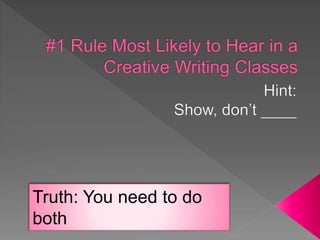
Truth: You need to do
both
 Fiction tries to create the emotional impact of
actual experience.
 Unlike other forms of art, it does so by using
words to create: feelings, ideas and images.
 Various writing techniques help accomplish
this.
 Writing is more effective when it’s specific.
 Specific means using concrete details.
 Concrete details are sensory and concrete
versus general and abstract:
 Sensory means simply that: appealing to one of
the senses: sight, sound, smell, taste, touch
 Details should appeal—evoke—the senses,
but also matter to the story.
 Susie wore a pair of shoes.
 Susie wore a pair of blue Oxford loafers.
 Susie wore a pair of blue Oxford loafers, one
size too large so that she constantly stepped
out of them. The heals were scuffed, and a
piece of duct tape kept the bows on the left
shoe attached.
 Susie wore a pair of blue Oxford loafers, one
size too large so that she constantly stepped
out of them. The heals were scuffed, and a
piece of duct tape kept the bows on the left
shoe attached.
 Susie wore clothing that showed she was poor.
 Susie wore clothing that showed she didn’t care
about clothing
 Susie was slovenly
 Just as characteristics should be rendered
with detail, so should emotion.
 Avoid labeling emotions in writing; rather, try
to describe them with sensory details.
 Susie was sad (telling)
 Write a quick sentence or two that shows
poor Susie’s sorrow.
 Concrete details also play a role in
foreshadowing the plot and underlining the
theme of a story.
 Chekov’s famous statement that a pistol
shown in the first act should be fired in the
third. Use concrete physical objects as plot
devices.
 Details also can be used to reinforce the
theme of a story. Imagery and metaphor
evokes larger ideas.
 Take one minute: Write down the emotions
and themes at play in this story.
 Take another few minutes and scan the story
for language that reinforces those emotions
or themes you wrote down. These can just
even be words: “hot pink.”
 Both metaphor and simile—poetic devices—
are ways language can be used to create
emotion in fiction.
 Simile compares; metaphor is used literally.
 She was like a tree.
 She was a tree.
Clichés:
 Hot as hell
 Cold as ice
 She was sweet, like sugar and spice.
Overstretched:
 Her eyes were like a prehistoric dragon
breathing fire on a village (what?)
 One of the greatest challenges most writers
face is remembering to keep prose in active
voice. This can be dealt with on revision, but
it’s key to strong writing.
 In active voice, the subject performs the
action:
 Julia operated the computer (active)
 The computer was operated by Julia
(passive)
 Active voice keeps the prose lively—passive
voice is monotonous, and should only be used
purposefully:
 The guard beat the prisoner (active)
 The prisoner was beaten by the guard (passive,
but with purpose)
 Active verbs have the same impact in prose as
concrete details: they show rather than tell.
 She ate a cookie vs. She wolfed down a cookie.
 Pick any story
 Quickly scan a paragraph and mark the
active verbs.
 How do these verbs contribute to the
feeling/emotions of the writing?
 A good rule of thumb is to vary the length of
your sentences to create energy and texture
in prose.
 But rhythm can also be used to reinforce the
emotion by creating a tempo that works with
what is happening in the story.
 Long sentences can slow down time, for
example.
 15 minutes:
 Describe a beautiful setting (mountain vista,
pristine lake etc) from the point of view of
someone who has just undergone a terrible
loss. Do not tell the story of this loss or refer to
it; just use the description to show the
perception of this place through the viewpoint of
someone in this situation.
 Quick note on in-class writing: Use the time.
 Like art students copying the masters,
“seeing” (writing) through the eyes of a writer
you admire can be instructive.
 Take the writing you have brought to class.
Rewrite two of the paragraphs, keep the
sentence structure, but use your own nouns,
verbs and other parts of speech.
 David Bowie was one of the most widely
revered musicians in the world. Once, before
he was to deliver a small concert at a rock n’
roll ceremony, the guitarist who introduced
him described him as an example for young
musicians of the world to imitate. He was
almost 40; his style was studied and
mesmerizing, and he wore a meticulously
trimmed goatee.
 These are in the syllabus:
 January 30
 Reading assignment: “Lobster Night” by
Russell Banks (CASF), page 15; “My Writing
Method” by Kate Chopin (GWAF), page 43
 Bring to class observations, questions and
ideas about the stories, with particular
attention paid to sensory detail. Also note
use of active voice and rhythm of sentences.

Show Don't Tell

  • 1.
    Truth: You needto do both
  • 2.
     Fiction triesto create the emotional impact of actual experience.  Unlike other forms of art, it does so by using words to create: feelings, ideas and images.  Various writing techniques help accomplish this.
  • 3.
     Writing ismore effective when it’s specific.  Specific means using concrete details.  Concrete details are sensory and concrete versus general and abstract:  Sensory means simply that: appealing to one of the senses: sight, sound, smell, taste, touch
  • 4.
     Details shouldappeal—evoke—the senses, but also matter to the story.  Susie wore a pair of shoes.  Susie wore a pair of blue Oxford loafers.  Susie wore a pair of blue Oxford loafers, one size too large so that she constantly stepped out of them. The heals were scuffed, and a piece of duct tape kept the bows on the left shoe attached.
  • 5.
     Susie worea pair of blue Oxford loafers, one size too large so that she constantly stepped out of them. The heals were scuffed, and a piece of duct tape kept the bows on the left shoe attached.  Susie wore clothing that showed she was poor.  Susie wore clothing that showed she didn’t care about clothing  Susie was slovenly
  • 6.
     Just ascharacteristics should be rendered with detail, so should emotion.  Avoid labeling emotions in writing; rather, try to describe them with sensory details.  Susie was sad (telling)  Write a quick sentence or two that shows poor Susie’s sorrow.
  • 7.
     Concrete detailsalso play a role in foreshadowing the plot and underlining the theme of a story.  Chekov’s famous statement that a pistol shown in the first act should be fired in the third. Use concrete physical objects as plot devices.  Details also can be used to reinforce the theme of a story. Imagery and metaphor evokes larger ideas.
  • 8.
     Take oneminute: Write down the emotions and themes at play in this story.  Take another few minutes and scan the story for language that reinforces those emotions or themes you wrote down. These can just even be words: “hot pink.”
  • 9.
     Both metaphorand simile—poetic devices— are ways language can be used to create emotion in fiction.  Simile compares; metaphor is used literally.  She was like a tree.  She was a tree.
  • 10.
    Clichés:  Hot ashell  Cold as ice  She was sweet, like sugar and spice. Overstretched:  Her eyes were like a prehistoric dragon breathing fire on a village (what?)
  • 11.
     One ofthe greatest challenges most writers face is remembering to keep prose in active voice. This can be dealt with on revision, but it’s key to strong writing.  In active voice, the subject performs the action:  Julia operated the computer (active)  The computer was operated by Julia (passive)
  • 12.
     Active voicekeeps the prose lively—passive voice is monotonous, and should only be used purposefully:  The guard beat the prisoner (active)  The prisoner was beaten by the guard (passive, but with purpose)  Active verbs have the same impact in prose as concrete details: they show rather than tell.  She ate a cookie vs. She wolfed down a cookie.
  • 13.
     Pick anystory  Quickly scan a paragraph and mark the active verbs.  How do these verbs contribute to the feeling/emotions of the writing?
  • 14.
     A goodrule of thumb is to vary the length of your sentences to create energy and texture in prose.  But rhythm can also be used to reinforce the emotion by creating a tempo that works with what is happening in the story.  Long sentences can slow down time, for example.
  • 15.
     15 minutes: Describe a beautiful setting (mountain vista, pristine lake etc) from the point of view of someone who has just undergone a terrible loss. Do not tell the story of this loss or refer to it; just use the description to show the perception of this place through the viewpoint of someone in this situation.  Quick note on in-class writing: Use the time.
  • 16.
     Like artstudents copying the masters, “seeing” (writing) through the eyes of a writer you admire can be instructive.  Take the writing you have brought to class. Rewrite two of the paragraphs, keep the sentence structure, but use your own nouns, verbs and other parts of speech.
  • 17.
     David Bowiewas one of the most widely revered musicians in the world. Once, before he was to deliver a small concert at a rock n’ roll ceremony, the guitarist who introduced him described him as an example for young musicians of the world to imitate. He was almost 40; his style was studied and mesmerizing, and he wore a meticulously trimmed goatee.
  • 18.
     These arein the syllabus:  January 30  Reading assignment: “Lobster Night” by Russell Banks (CASF), page 15; “My Writing Method” by Kate Chopin (GWAF), page 43  Bring to class observations, questions and ideas about the stories, with particular attention paid to sensory detail. Also note use of active voice and rhythm of sentences.

Editor's Notes

  • #2 Talk about the different aspects of showing: character, scene setting but digging down into word choice & language
  • #15 Slow down time with long sentences; make time brisk with shorter ones.
  • #16 Can you make any guesses about the loss. What language stood out for you?
  • #17 Pastiche, imitation