
STORIES ANALYSIS
Let´s see if you are ready for the test
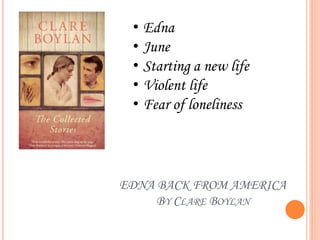
EDNA BACK FROM AMERICA
BY CLARE BOYLAN
• Edna
• June
• Starting a new life
• Violent life
• Fear of loneliness
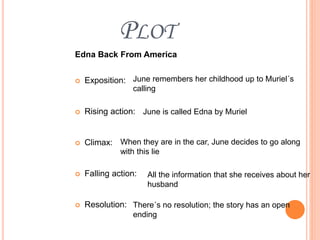
PLOT
Edna Back From America
 Exposition:
 Rising action:
 Climax:
 Falling action:
 Resolution:
June remembers her childhood up to Muriel´s
calling
June is called Edna by Muriel
When they are in the car, June decides to go along
with this lie
All the information that she receives about her
husband
There´s no resolution; the story has an open
ending
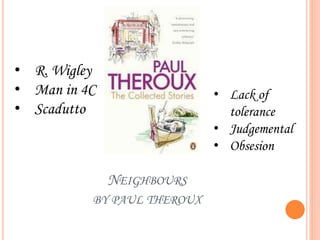
NEIGHBOURS
BY PAUL THEROUX
• R. Wigley
• Man in 4C
• Scadutto
• Lack of
tolerance
• Judgemental
• Obsesion
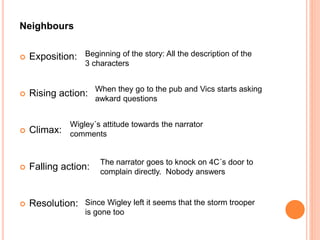
Neighbours
 Exposition:
 Rising action:
 Climax:
 Falling action:
 Resolution:
Beginning of the story: All the description of the
3 characters
When they go to the pub and Vics starts asking
awkard questions
Wigley´s attitude towards the narrator
comments
The narrator goes to knock on 4C´s door to
complain directly. Nobody answers
Since Wigley left it seems that the storm trooper
is gone too
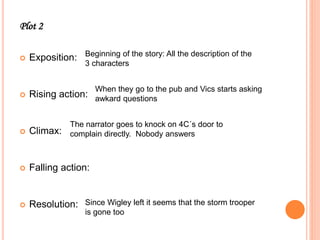
Plot 2
 Exposition:
 Rising action:
 Climax:
 Falling action:
 Resolution:
Beginning of the story: All the description of the
3 characters
When they go to the pub and Vics starts asking
awkard questions
The narrator goes to knock on 4C´s door to
complain directly. Nobody answers
Since Wigley left it seems that the storm trooper
is gone too
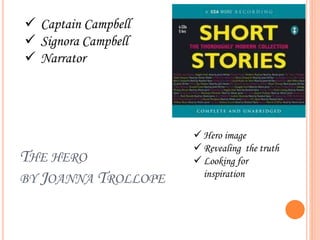
THE HERO
BY JOANNA TROLLOPE
 Captain Campbell
 Signora Campbell
 Narrator
 Hero image
 Revealing the truth
 Looking for
inspiration
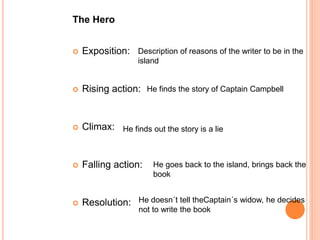
The Hero
 Exposition:
 Rising action:
 Climax:
 Falling action:
 Resolution:
Description of reasons of the writer to be in the
island
He finds the story of Captain Campbell
He finds out the story is a lie
He goes back to the island, brings back the
book
He doesn´t tell theCaptain´s widow, he decides
not to write the book
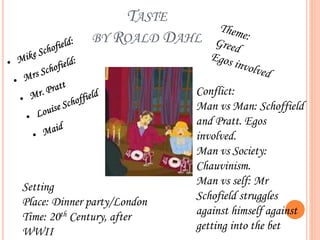
TASTE
BY ROALD DAHL
Conflict:
Man vs Man: Schoffield
and Pratt. Egos
involved.
Man vs Society:
Chauvinism.
Man vs self: Mr
Schofield struggles
against himself against
getting into the bet
Setting
Place: Dinner party/London
Time: 20th Century, after
WWII
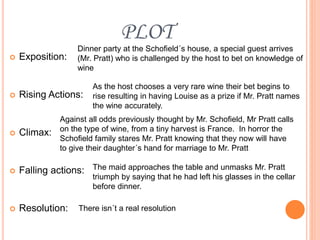
PLOT
 Exposition:
 Rising Actions:
 Climax:
 Falling actions:
 Resolution:
Dinner party at the Schofield´s house, a special guest arrives
(Mr. Pratt) who is challenged by the host to bet on knowledge of
wine
As the host chooses a very rare wine their bet begins to
rise resulting in having Louise as a prize if Mr. Pratt names
the wine accurately.
Against all odds previously thought by Mr. Schofield, Mr Pratt calls
on the type of wine, from a tiny harvest is France. In horror the
Schofield family stares Mr. Pratt knowing that they now will have
to give their daughter´s hand for marriage to Mr. Pratt
The maid approaches the table and unmasks Mr. Pratt
triumph by saying that he had left his glasses in the cellar
before dinner.
There isn´t a real resolution
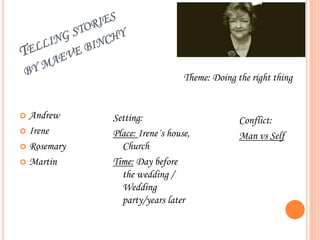
 Andrew
 Irene
 Rosemary
 Martin
Theme: Doing the right thing
Conflict:
Man vs Self
Setting:
Place: Irene´s house,
Church
Time: Day before
the wedding /
Wedding
party/years later
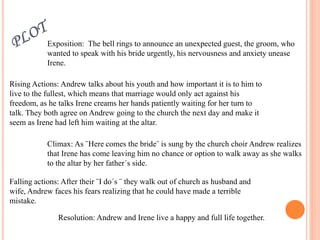
Exposition: The bell rings to announce an unexpected guest, the groom, who
wanted to speak with his bride urgently, his nervousness and anxiety unease
Irene.
Rising Actions: Andrew talks about his youth and how important it is to him to
live to the fullest, which means that marriage would only act against his
freedom, as he talks Irene creams her hands patiently waiting for her turn to
talk. They both agree on Andrew going to the church the next day and make it
seem as Irene had left him waiting at the altar.
Climax: As ¨Here comes the bride¨ is sung by the church choir Andrew realizes
that Irene has come leaving him no chance or option to walk away as she walks
to the altar by her father´s side.
Falling actions: After their ¨I do´s ¨ they walk out of church as husband and
wife, Andrew faces his fears realizing that he could have made a terrible
mistake.
Resolution: Andrew and Irene live a happy and full life together.
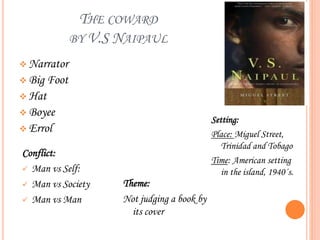
THE COWARD
BY V.S NAIPAUL
 Narrator
 Big Foot
 Hat
 Boyee
 Errol
Setting:
Place: Miguel Street,
Trinidad and Tobago
Time: American setting
in the island, 1940´s.
Conflict:
 Man vs Self:
 Man vs Society
 Man vs Man
Theme:
Not judging a book by
its cover
 Exposition: All Miguel Street was afraid of Big Foot
but as time passes the myth on his violent ways began to
merge.
 Rising Actions: when the narrator gets to know his
more sensible side on a glass accident and his laughable
reaction towards a dog. During his first fights Big Foot
defeats all of his contenders as expected
 Climax: When the boxer comes to the town and
fights Big Foot, who is defeated at the end.
 Falling actions: Big Foots cries loudly and the crowd
laughs at him
 Resolution: Big Foot leaves Miguel Street,
the fighter wasn´t really a boxer
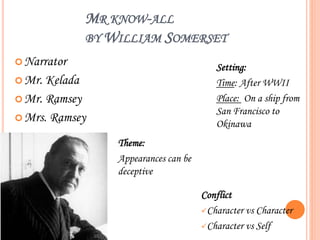
MR KNOW-ALL
BY WILLIAM SOMERSET
Narrator
Mr. Kelada
Mr. Ramsey
Mrs. Ramsey
Setting:
Time: After WWII
Place: On a ship from
San Francisco to
Okinawa
Conflict
Character vs Character
Character vs Self
Theme:
Appearances can be
deceptive
 Exposition: A very outgoing Mr. Kelada interrupts a rather quiet
passenger´s life when they share a cabin in a ship, Mr. Kelada speaks about his
exclusiveness on all kinds of good difficult to obtain or prohibited during this time
in history.
 Rising Actions: Mr. Kelada talks about his keen eye on pearls and business in
general; as he keeps talking about it Mr. Ramsey dares him to guess the amount he
paid for his wife´s pearls. Always trying to keep his appearance he flatters Mrs.
Ramsey´s pearls for a while.
 Climax: Mr Kelada sets the price of the pearls on around 20, 000 US
dollars. Mr. Ramsey feels very pleased once he tells Kelada that he had only
paid 18 dollars for the pearls at a department store in NYC.
 Falling actions: Mr. Kelada write the 100.00 US dollars to Mr.
Ramsey for not guessing if the pearls were real, ashamed he leaves the
room.
 Resolution: Mr Kelada realizes that it wasn´t about the money
when Mr. Ramseys returns it to him on an envelope.
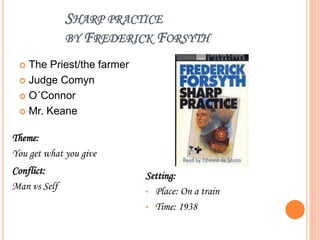
SHARP PRACTICE
BY FREDERICK FORSYTH
 The Priest/the farmer
 Judge Comyn
 O´Connor
 Mr. Keane
Theme:
You get what you give
Conflict:
Man vs Self
Setting:
• Place: On a train
• Time: 1938
 Exposition: Three men are absorbed during a train trip into a game of
cards, along the journey they change strategies and raised their bets until they
arrived to destination and one of them is set to pay the highest bid.
 Rising Actions: As the game progressed all three men decided to raise the bar
and put more excitement into the game resulting in one big winner, The Priest,
who mentioned a good donation place for the money.
 Climax: Judge Comyn realizes that the person in court under his
jurisdiction was O´Connor who was being charged of misleading the game and
earnings of the card game.
 Falling actions: Judge Comyn listens to a statement made by Mr. Keane who
had been cheated in the same manner as Judge Comyn
 Resolution: Judge Comyn sees the Priest in the car/they are working
together…he was tricked!
THE MODEL MILLIONAIRE
BY OSCAR WILDE
 Hughie Erskie
 Alan Trevor
 Laura Merton
 Colonel Merton
 The Beggar (Baron Hausberg)
 Gustave Naudin
Conflict:
Man vs Society
Man vs Self
Theme:
Solidarity and reciprocity keeps
the world turning
Setting:
Place: Holland park
Time: Morning
 Exposition: Hughie feels sad for not having his girlfriend´s family
blessing for being poor, he goes to talk about it over his painter friend
Alan looking for a word of advice.
 Rising Actions: As he arrives to Alan´s studio he realizes that his friend is
working on a portrait of a beggar. He realizes that the beggar is in more need
of money than he is therefore he gives them all the money he has
 Climax: The beggar asks Alan who was the man who had just given him money
and what was his story he feels deeply touched.
 Falling actions: Hughie receives the money he needed to marry his love Laura,
Trevor tell Hughie where the money comes from
 Resolution: Hughie and Laura live happily ever after, keeping the
condition the Baron had set.

Short Stories

  • 1.
    STORIES ANALYSIS Let´s seeif you are ready for the test
  • 2.
    EDNA BACK FROMAMERICA BY CLARE BOYLAN • Edna • June • Starting a new life • Violent life • Fear of loneliness
  • 3.
    PLOT Edna Back FromAmerica  Exposition:  Rising action:  Climax:  Falling action:  Resolution: June remembers her childhood up to Muriel´s calling June is called Edna by Muriel When they are in the car, June decides to go along with this lie All the information that she receives about her husband There´s no resolution; the story has an open ending
  • 4.
    NEIGHBOURS BY PAUL THEROUX •R. Wigley • Man in 4C • Scadutto • Lack of tolerance • Judgemental • Obsesion
  • 5.
    Neighbours  Exposition:  Risingaction:  Climax:  Falling action:  Resolution: Beginning of the story: All the description of the 3 characters When they go to the pub and Vics starts asking awkard questions Wigley´s attitude towards the narrator comments The narrator goes to knock on 4C´s door to complain directly. Nobody answers Since Wigley left it seems that the storm trooper is gone too
  • 6.
    Plot 2  Exposition: Rising action:  Climax:  Falling action:  Resolution: Beginning of the story: All the description of the 3 characters When they go to the pub and Vics starts asking awkard questions The narrator goes to knock on 4C´s door to complain directly. Nobody answers Since Wigley left it seems that the storm trooper is gone too
  • 7.
    THE HERO BY JOANNATROLLOPE  Captain Campbell  Signora Campbell  Narrator  Hero image  Revealing the truth  Looking for inspiration
  • 8.
    The Hero  Exposition: Rising action:  Climax:  Falling action:  Resolution: Description of reasons of the writer to be in the island He finds the story of Captain Campbell He finds out the story is a lie He goes back to the island, brings back the book He doesn´t tell theCaptain´s widow, he decides not to write the book
  • 9.
    TASTE BY ROALD DAHL Conflict: Manvs Man: Schoffield and Pratt. Egos involved. Man vs Society: Chauvinism. Man vs self: Mr Schofield struggles against himself against getting into the bet Setting Place: Dinner party/London Time: 20th Century, after WWII
  • 10.
    PLOT  Exposition:  RisingActions:  Climax:  Falling actions:  Resolution: Dinner party at the Schofield´s house, a special guest arrives (Mr. Pratt) who is challenged by the host to bet on knowledge of wine As the host chooses a very rare wine their bet begins to rise resulting in having Louise as a prize if Mr. Pratt names the wine accurately. Against all odds previously thought by Mr. Schofield, Mr Pratt calls on the type of wine, from a tiny harvest is France. In horror the Schofield family stares Mr. Pratt knowing that they now will have to give their daughter´s hand for marriage to Mr. Pratt The maid approaches the table and unmasks Mr. Pratt triumph by saying that he had left his glasses in the cellar before dinner. There isn´t a real resolution
  • 11.
     Andrew  Irene Rosemary  Martin Theme: Doing the right thing Conflict: Man vs Self Setting: Place: Irene´s house, Church Time: Day before the wedding / Wedding party/years later
  • 12.
    Exposition: The bellrings to announce an unexpected guest, the groom, who wanted to speak with his bride urgently, his nervousness and anxiety unease Irene. Rising Actions: Andrew talks about his youth and how important it is to him to live to the fullest, which means that marriage would only act against his freedom, as he talks Irene creams her hands patiently waiting for her turn to talk. They both agree on Andrew going to the church the next day and make it seem as Irene had left him waiting at the altar. Climax: As ¨Here comes the bride¨ is sung by the church choir Andrew realizes that Irene has come leaving him no chance or option to walk away as she walks to the altar by her father´s side. Falling actions: After their ¨I do´s ¨ they walk out of church as husband and wife, Andrew faces his fears realizing that he could have made a terrible mistake. Resolution: Andrew and Irene live a happy and full life together.
  • 13.
    THE COWARD BY V.SNAIPAUL  Narrator  Big Foot  Hat  Boyee  Errol Setting: Place: Miguel Street, Trinidad and Tobago Time: American setting in the island, 1940´s. Conflict:  Man vs Self:  Man vs Society  Man vs Man Theme: Not judging a book by its cover
  • 14.
     Exposition: AllMiguel Street was afraid of Big Foot but as time passes the myth on his violent ways began to merge.  Rising Actions: when the narrator gets to know his more sensible side on a glass accident and his laughable reaction towards a dog. During his first fights Big Foot defeats all of his contenders as expected  Climax: When the boxer comes to the town and fights Big Foot, who is defeated at the end.  Falling actions: Big Foots cries loudly and the crowd laughs at him  Resolution: Big Foot leaves Miguel Street, the fighter wasn´t really a boxer
  • 15.
    MR KNOW-ALL BY WILLIAMSOMERSET Narrator Mr. Kelada Mr. Ramsey Mrs. Ramsey Setting: Time: After WWII Place: On a ship from San Francisco to Okinawa Conflict Character vs Character Character vs Self Theme: Appearances can be deceptive
  • 16.
     Exposition: Avery outgoing Mr. Kelada interrupts a rather quiet passenger´s life when they share a cabin in a ship, Mr. Kelada speaks about his exclusiveness on all kinds of good difficult to obtain or prohibited during this time in history.  Rising Actions: Mr. Kelada talks about his keen eye on pearls and business in general; as he keeps talking about it Mr. Ramsey dares him to guess the amount he paid for his wife´s pearls. Always trying to keep his appearance he flatters Mrs. Ramsey´s pearls for a while.  Climax: Mr Kelada sets the price of the pearls on around 20, 000 US dollars. Mr. Ramsey feels very pleased once he tells Kelada that he had only paid 18 dollars for the pearls at a department store in NYC.  Falling actions: Mr. Kelada write the 100.00 US dollars to Mr. Ramsey for not guessing if the pearls were real, ashamed he leaves the room.  Resolution: Mr Kelada realizes that it wasn´t about the money when Mr. Ramseys returns it to him on an envelope.
  • 17.
    SHARP PRACTICE BY FREDERICKFORSYTH  The Priest/the farmer  Judge Comyn  O´Connor  Mr. Keane Theme: You get what you give Conflict: Man vs Self Setting: • Place: On a train • Time: 1938
  • 18.
     Exposition: Threemen are absorbed during a train trip into a game of cards, along the journey they change strategies and raised their bets until they arrived to destination and one of them is set to pay the highest bid.  Rising Actions: As the game progressed all three men decided to raise the bar and put more excitement into the game resulting in one big winner, The Priest, who mentioned a good donation place for the money.  Climax: Judge Comyn realizes that the person in court under his jurisdiction was O´Connor who was being charged of misleading the game and earnings of the card game.  Falling actions: Judge Comyn listens to a statement made by Mr. Keane who had been cheated in the same manner as Judge Comyn  Resolution: Judge Comyn sees the Priest in the car/they are working together…he was tricked!
  • 19.
    THE MODEL MILLIONAIRE BYOSCAR WILDE  Hughie Erskie  Alan Trevor  Laura Merton  Colonel Merton  The Beggar (Baron Hausberg)  Gustave Naudin Conflict: Man vs Society Man vs Self Theme: Solidarity and reciprocity keeps the world turning Setting: Place: Holland park Time: Morning
  • 20.
     Exposition: Hughiefeels sad for not having his girlfriend´s family blessing for being poor, he goes to talk about it over his painter friend Alan looking for a word of advice.  Rising Actions: As he arrives to Alan´s studio he realizes that his friend is working on a portrait of a beggar. He realizes that the beggar is in more need of money than he is therefore he gives them all the money he has  Climax: The beggar asks Alan who was the man who had just given him money and what was his story he feels deeply touched.  Falling actions: Hughie receives the money he needed to marry his love Laura, Trevor tell Hughie where the money comes from  Resolution: Hughie and Laura live happily ever after, keeping the condition the Baron had set.