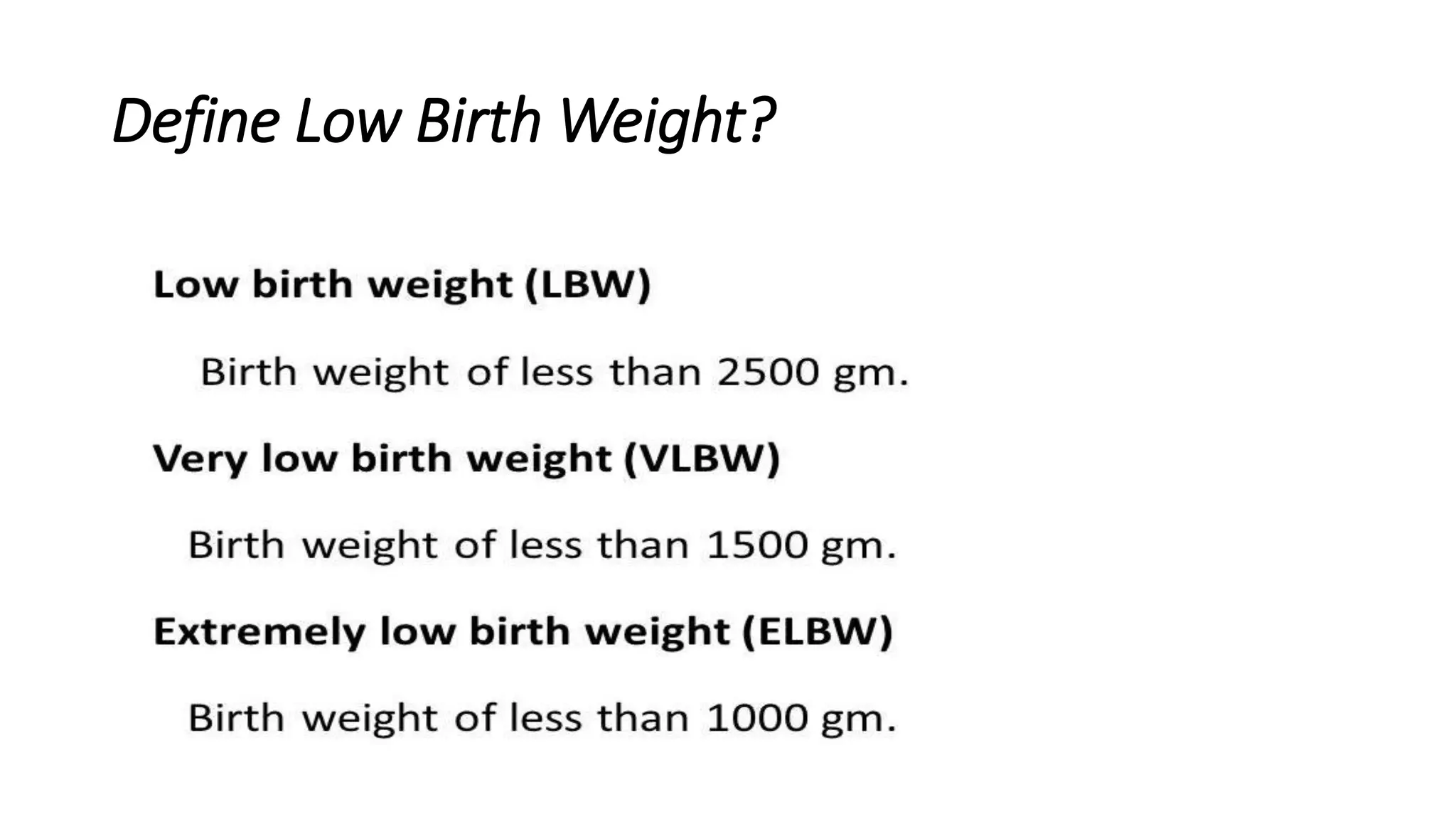
Define Low Birth Weight?
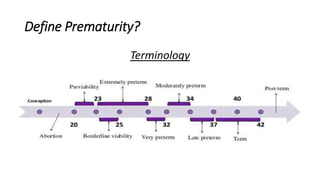
Define Prematurity?
Define Prematurity?
Terminology
Simple weight calculation
2-12 years = [Age (years)+3]x5 /2
7-12 years = Age(years)x3
 2
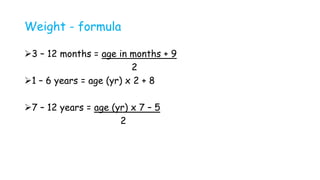
Weight - formula
3 – 12 months = age in months + 9
2
1 – 6 years = age (yr) x 2 + 8
7 – 12 years = age (yr) x 7 – 5
2
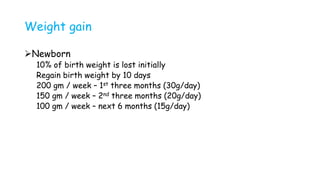
Weight gain
Newborn
10% of birth weight is lost initially
Regain birth weight by 10 days
200 gm / week – 1st three months (30g/day)
150 gm / week – 2nd three months (20g/day)
100 gm / week – next 6 months (15g/day)
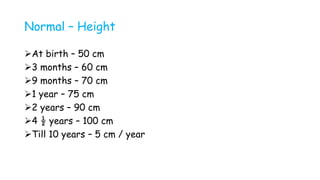
Normal – Height
At birth – 50 cm
3 months – 60 cm
9 months – 70 cm
1 year – 75 cm
2 years – 90 cm
4 ½ years – 100 cm
Till 10 years – 5 cm / year
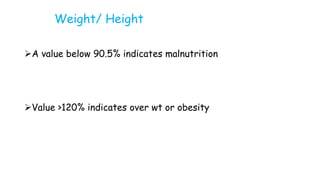
Weight/ Height
A value below 90.5% indicates malnutrition
Value >120% indicates over wt or obesity
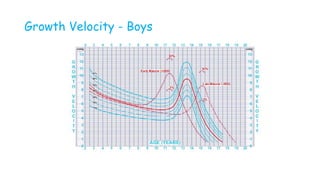
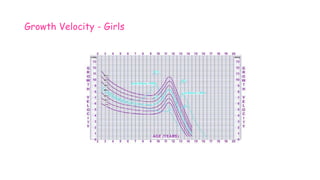
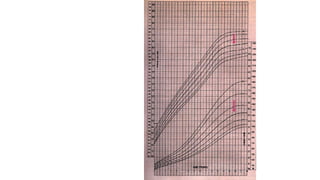
GROWTH VELOCITY
Rate at which the child grows over a period
of time
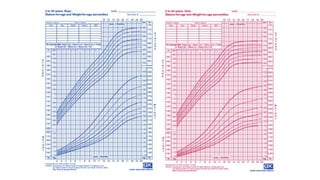
Growth Velocity - Boys
Growth Velocity - Girls
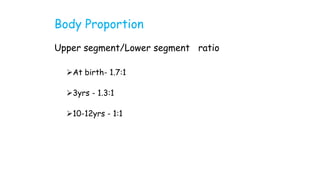
Body Proportion
Upper segment/Lower segment ratio
At birth- 1.7:1
3yrs - 1.3:1
10-12yrs - 1:1
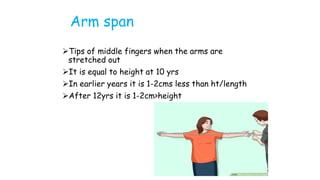
Arm span
Tips of middle fingers when the arms are
stretched out
It is equal to height at 10 yrs
In earlier years it is 1-2cms less than ht/length
After 12yrs it is 1-2cm>height
Arm span
Abnormally large span-
Klinefelter’s syndrome
Coarctation of aorta
Marfan’s syndrome
Head Circumference
• Brain growth is rapid during infancy and it is unaffected by
mild to moderate degree of malnutrition
• Should not be measured with in 24 hrs after birth
• Boney land marks – superior orbital ridge (ant), occipital
protuberance (post)
Normal head circumference
Birth – 35 cm
3 months – 40 cm
12 months – 45 cm
2 years – 48 cm
12 years – 52 cm
2 cm / month in 1st 3 months
1 cm / month in next 3 months
0.5 cm / month in 6 months
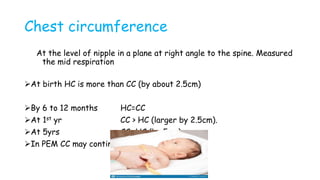
Chest circumference
At the level of nipple in a plane at right angle to the spine. Measured
the mid respiration
At birth HC is more than CC (by about 2.5cm)
By 6 to 12 months HC=CC
At 1st yr CC > HC (larger by 2.5cm).
At 5yrs CC >HC (by 5cm)
In PEM CC may continue to be less than HC
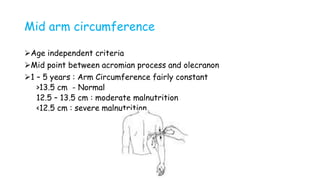
Mid arm circumference
Age independent criteria
Mid point between acromian process and olecranon
1 – 5 years : Arm Circumference fairly constant
>13.5 cm - Normal
12.5 – 13.5 cm : moderate malnutrition
<12.5 cm : severe malnutrition
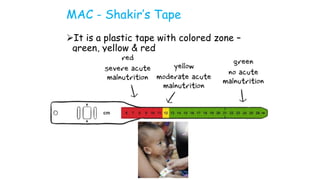
MAC - Shakir’s Tape
It is a plastic tape with colored zone –
green, yellow & red
eindicateseverema12.5cm
Yellow indicates moderate malnutrition
(12.5-13.5cm)
reendica13.5cm
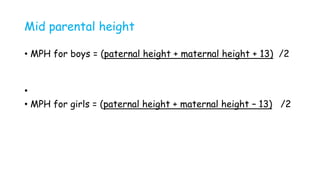
Mid parental height
• MPH for boys = (paternal height + maternal height + 13) /2
•
• MPH for girls = (paternal height + maternal height – 13) /2
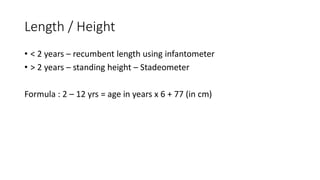
Length / Height
• < 2 years – recumbent length using infantometer
• > 2 years – standing height – Stadeometer
Formula : 2 – 12 yrs = age in years x 6 + 77 (in cm)
• In girls at 2yrs - half of adult height is attained.
• In boys at 2 ½ yrs - half of adult height is attained
• What are the common causes of growth retardation in a child
Dept of Pediatrics, AFMC
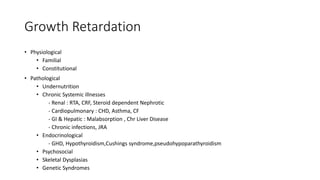
Growth Retardation
• Physiological
• Familial
• Constitutional
• Pathological
• Undernutrition
• Chronic Systemic illnesses
- Renal : RTA, CRF, Steroid dependent Nephrotic
- Cardiopulmonary : CHD, Asthma, CF
- GI & Hepatic : Malabsorption , Chr Liver Disease
- Chronic infections, JRA
• Endocrinological
- GHD, Hypothyroidism,Cushings syndrome,pseudohypoparathyroidism
• Psychosocial
• Skeletal Dysplasias
• Genetic Syndromes
Dept of Pediatrics, AFMC
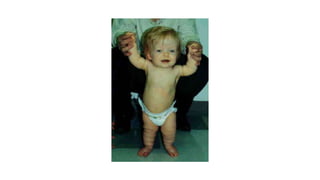
• Can you apply the term Failure to thrive for this patient
• Descriptive term for < 5 yr
• Organic or Non organic(80%)
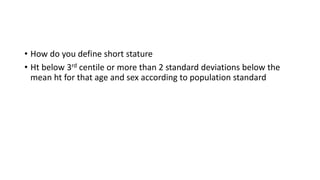
• How do you define short stature
• Ht below 3rd centile or more than 2 standard deviations below the
mean ht for that age and sex according to population standard
Salient Points in History
• Well till 5 - 6 yrs of age
• Behavior changes
• Constipation
• Puffiness of face and swelling hands and feet
• Dry skin
• 2 yrs younger sister is taller than her
• History of delayed dentition
Dept of Pediatrics, AFMC
• What are the common dentition problems in children
• Delayed eruption
- Hypothyroidism
- Hypoparathyroidism
- familial
- Idiopathic
• Early Exfoliation
- Histiocytosis
- Leukemia
- cyclic neutropenia
Differential Diagnosis
• Familial
• Constitutional
• Nutritional
• Endocrinological
• Chromosomal
• Renal
Dept of Pediatrics, AFMC
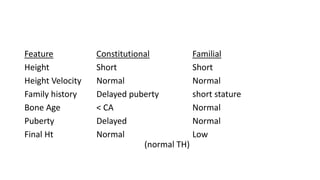
• How do we differentiate between Familial and Constitutional delay in
growth?
Dept of Pediatrics, AFMC
Feature Constitutional Familial
Height Short Short
Height Velocity Normal Normal
Family history Delayed puberty short stature
Bone Age < CA Normal
Puberty Delayed Normal
Final Ht Normal Low
(normal TH)
Dept of Pediatrics, AFMC
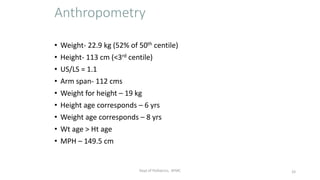
Anthropometry
• Weight- 22.9 kg (52% of 50th centile)
• Height- 113 cm (<3rd centile)
• US/LS = 1.1
• Arm span- 112 cms
• Weight for height – 19 kg
• Height age corresponds – 6 yrs
• Weight age corresponds – 8 yrs
• Wt age > Ht age
• MPH – 149.5 cm
33
Dept of Pediatrics, AFMC
34
Dept of Pediatrics, AFMC
• What are the latest recommendations on growth charts
• < 5 yrs – WHO
• > 5 yrs – modified Agarwal charts / IAP
• What is Growth velocity
• What are the conclusions derived from US LS ratio
• Decreased US LS ratio
- spondyloepiphyseal dysplasias
- vertebral anomalies
• Increased US LS ratio
- rickets
- Congenital hypothyroidism
- achondroplasia
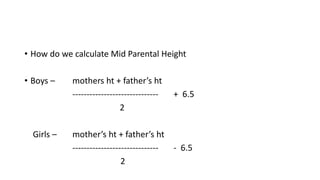
• How do we calculate Mid Parental Height
• Boys – mothers ht + father’s ht
------------------------------ + 6.5
2
Girls – mother’s ht + father’s ht
------------------------------ - 6.5
2
• What is the interpretation of wt for ht in children with short stature
• Decreased wt for ht
- malnutrition, chronic illnesses
• Increased wt for ht with short stature
- Endocrinopathies
- Syndromes
- Skeletal dysplasias
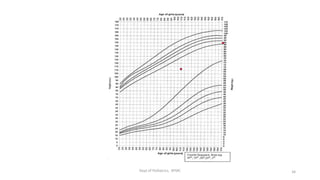
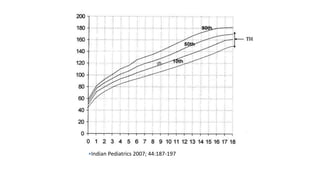
• How do we plot target ht on the growth chart
Indian Pediatrics 2007; 44:187-197
Investigations
• How do you investigate a child with short stature
• Level 1 inv
- CBC
- Bone Age
- Urinalysis (ME,pH,osmolality)
- Blood – urea,creat,ABG,Ca,PO4,ALP, Proteins,LFT,BSL
• Level 2 inv
- Thyroid Function
- Karyotype
• Level 3
- Celiac serology
- IGF 1 , GH stimulation tests
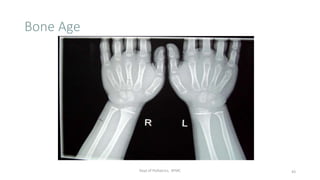
Bone Age
Dept of Pediatrics, AFMC 43
• What are the radiographs that you will prefer to assess bone age at
- < 1 yr
- 1 – 12 yrs
- > 12 yrs
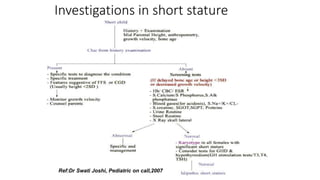
Investigations in short stature
Ref:Dr Swati Joshi, Pediatric on call,2007
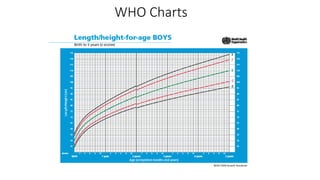
• Interpretation of anthropometry?
WHO Charts
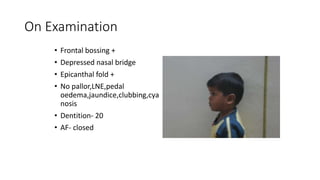
On Examination
• Frontal bossing +
• Depressed nasal bridge
• Epicanthal fold +
• No pallor,LNE,pedal
oedema,jaundice,clubbing,cya
nosis
• Dentition- 20
• AF- closed
• Summary?
D/D
• Short stature
• Renal cause
• CKD
• Primary tubulopathy
• Malabsorption
• Celiac disease
• Hypothyroidism
Question?
• Causes of short stature in renal disease?
Causes of short stature in renal disease
• Poor nutrition
• Metabolic acidosis
• Osteodystrophy (rickets)
• Anemia
• Decreased IGF level
• Hypothyroidism
• Proteinuria
Who is Short?
• If child is below 3rd percentile
• But target height is also below 3rd percentile
• HEREDITORY SHORT STATURE
• REASSURANCE
Who is Short ?
• If child above 3rd percentile with target height
percentile above it
• Observe after initial screening
• Quarterly height measurement for height velocity
• It should be > 4 cm/year
Who is Short ?
• If child below 3rd percentile with target height
percentile above it
• height velocity < 4 cm/year
• Then he/she is short
What Next ?
Look at the child
• Whether upper body and lower body is proportionate or
disproportionate
• Disproportionate
• Skeletal Causes
• Proportionate
• Systemic or Endocrinal causes
Upper/Lower Ratio
• Normal
• 1.7 at Birth ,1.3 by 4 year, 1.0 by 7 years
• Increased Ratio
• Skeletal Dysplasia
• Turner’s Syndrome
• Cretinism
• X-Linked Hypophosphatemic Rickets
• Decreased Ratio
• Mucopolysaccharidosis
• Spondylo-epiphyseal dysplasia
What Next ?
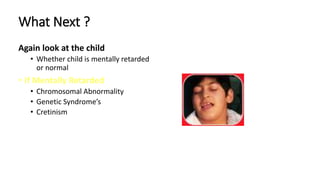
Again look at the child
• Whether child is mentally retarded
or normal
• If Mentally Retarded
• Chromosomal Abnormality
• Genetic Syndrome’s
• Cretinism
Then ?
Calculate BMI
• If Low : Systemic Illness
: Anorexia Nervosa
• If Normal : Endocrinal
DICTIM: All obese children are taller than counterparts,
and if Short indicate endocrinal disease
Then What ?
Measure
• Chronological Age
• Height Age
• Weight Age
• Bone Age
Height Age
Weight Age
Bone Age Estimation
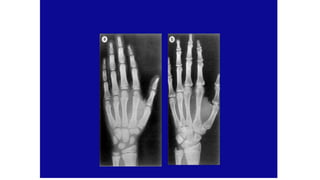
• X-Ray left hand with wrist
• Scoring system of each of 20 individual hand bones
(Tanner-Whitehouse Method, TW2), a technique that has
been adapted for computerized assessment
• BA is a better predictor pubertal milestones than CA
Possibilities
• BA = HA = CA
• Normally growing child
• BA = HA < CA
• Delayed Growth (Constitutional)
• BA = CA < HA
• Hereditory Short Stature
• Intrinsic Short Stature (Genetic)
• BA < HA < CA
• Delayed/Attenuated Growth (Pathological)
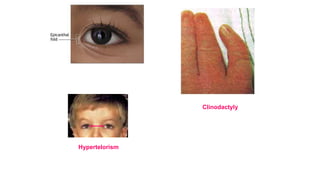
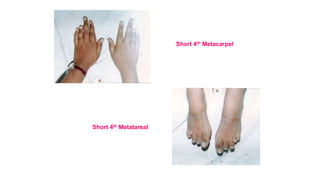
Dysmorphic Features
• Epicanthal fold
• Hypertelorism
• Auricular Malformation
• Facial Asymmetry
• Teeth Dysplasia
• Webbing of Neck
• Polydactyly
• Abnormal Crease of Palm
• Nail abnormality
Hypertelorism
Clinodactyly
Short 4th Metacarpel
Short 4th Metatarsal
Intrinsic Short Stature
• Single Gene Defects
• Down’s Syndrome
• Turner’s Syndrome
• Mucopolysaccharidosis
• Polygenetic or Unknown
• Prader Willi Syndrome
• Noonan’s Syndrome
• Progeria
• Silver Russell Syndrome
Idiopathic Short Stature
• Short Stature otherwise Healthy child
• Exclusion of Other causes
• Bone age within 2 SD of CA
• Normal GH Response to test
• For Treatment
• HA < 2.25 SD for age and sex
• Open Epiphyses
• Unable to achieve normal height with current Height
velocity
Further Evaluation
• Referral to Endocrinologist
• T3, T4, TSH
• IGF-1, IGF-BP3
• GH Stimulation
• Cortisol Evaluation
if Cushing’s syndrome is suspected
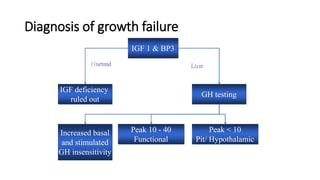
Diagnosis of growth failure
IGF 1 & BP3
IGF deficiency
ruled out
Normal
GH testing
Low
Increased basal
and stimulated
GH insensitivity
Peak < 10
Pit/ Hypothalamic
Peak 10 - 40
Functional
TREATMENT
• Growth Hormone Therapy
• GHD
• Adult Growth Hormone Deficiency
• Chronic Renal Failure
• Turner’s Syndrome
• Prader Willi Syndrome
• Idiopathic Short Stature
• IUGR
Follow Up
• 6-12 monthly
• Clinical evaluation
• Assessment of side effects
• IGF-1 levels
• Lipid Profile
• Fasting B Glucose
• BMD if initial was abnormal
SIDE EFFECTS
• Malignancy
• Benign Intracranial Hypertension
• Slipped Epiphysial Disc
• Fluid Retention
• Increase in naevi
• Gynaecomastia
• IGT & DM (Aggravation of Retinopathy)
• Predisposition of hypothyroidism & ACTH
deficiency
Confirmation of GHD: IGF-I
• Polypeptide, synthesized by liver and also locally in peripheral tissue
• Locally synthesized IGF-I – 20% of serum level
• Mediates growth promoting actions of GH
• Single sample for estimation
• Assay – difficult as extraction step is required
Williams text book of Endocrinology, 10th Ed
Factors affecting IGF-I levels
• Age
• Nutrition
• Genetic factors, ethnicity
• GH
• Insulin, cortisol, thyroxine, estrogen, androgen
• Catabolic state
• IGFBP
Williams text book of Endocrinology, 10th Ed
Indications and Goals of GHD Rx
• Patients with proven GHD - treated with GH as soon as possible
• Primary objectives of the therapy of GHD are:
- Normalization of height during childhood
- Attainment of normal adult height and genetic potential!!
GH Dosing
• O.025-0.035mg/kg daily subcutaneously in the evening
• 0.17 – 0.35 mg/kg/week (Summary statement, GH Research
Society 2000)
• Few studies – 0.3 mg/kg/wk better result than 0.17 mg/kg/wk (GH-IGF Res
1998)
Duration of GH therapy
• Improvements in linear growth have been almost the sole indication for the
use of GH in pediatric practice.
• Treatment is initiated as soon as possible once
• GH should be continued until the attainment of final height.
• Final Ht - slowing of growth to an annualized HV of <1 cm/yr or fusion of the
long bone epiphyses.
• Ideally – life long
Short staure.Paeds  2.pptx

Short staure.Paeds 2.pptx

  • 1.
  • 2.
  • 3.
  • 4.
    Simple weight calculation 2-12years = [Age (years)+3]x5 /2 7-12 years = Age(years)x3  2
  • 5.
    Weight - formula 3– 12 months = age in months + 9 2 1 – 6 years = age (yr) x 2 + 8 7 – 12 years = age (yr) x 7 – 5 2
  • 6.
    Weight gain Newborn 10% ofbirth weight is lost initially Regain birth weight by 10 days 200 gm / week – 1st three months (30g/day) 150 gm / week – 2nd three months (20g/day) 100 gm / week – next 6 months (15g/day)
  • 8.
    Normal – Height Atbirth – 50 cm 3 months – 60 cm 9 months – 70 cm 1 year – 75 cm 2 years – 90 cm 4 ½ years – 100 cm Till 10 years – 5 cm / year
  • 10.
    Weight/ Height A valuebelow 90.5% indicates malnutrition Value >120% indicates over wt or obesity
  • 11.
    GROWTH VELOCITY Rate atwhich the child grows over a period of time
  • 12.
  • 13.
  • 14.
    Body Proportion Upper segment/Lowersegment ratio At birth- 1.7:1 3yrs - 1.3:1 10-12yrs - 1:1
  • 15.
    Arm span Tips ofmiddle fingers when the arms are stretched out It is equal to height at 10 yrs In earlier years it is 1-2cms less than ht/length After 12yrs it is 1-2cm>height
  • 16.
    Arm span Abnormally largespan- Klinefelter’s syndrome Coarctation of aorta Marfan’s syndrome
  • 17.
    Head Circumference • Braingrowth is rapid during infancy and it is unaffected by mild to moderate degree of malnutrition • Should not be measured with in 24 hrs after birth • Boney land marks – superior orbital ridge (ant), occipital protuberance (post)
  • 18.
    Normal head circumference Birth– 35 cm 3 months – 40 cm 12 months – 45 cm 2 years – 48 cm 12 years – 52 cm 2 cm / month in 1st 3 months 1 cm / month in next 3 months 0.5 cm / month in 6 months
  • 19.
    Chest circumference At thelevel of nipple in a plane at right angle to the spine. Measured the mid respiration At birth HC is more than CC (by about 2.5cm) By 6 to 12 months HC=CC At 1st yr CC > HC (larger by 2.5cm). At 5yrs CC >HC (by 5cm) In PEM CC may continue to be less than HC
  • 20.
    Mid arm circumference Ageindependent criteria Mid point between acromian process and olecranon 1 – 5 years : Arm Circumference fairly constant >13.5 cm - Normal 12.5 – 13.5 cm : moderate malnutrition <12.5 cm : severe malnutrition
  • 21.
    MAC - Shakir’sTape It is a plastic tape with colored zone – green, yellow & red eindicateseverema12.5cm Yellow indicates moderate malnutrition (12.5-13.5cm) reendica13.5cm
  • 22.
    Mid parental height •MPH for boys = (paternal height + maternal height + 13) /2 • • MPH for girls = (paternal height + maternal height – 13) /2
  • 23.
    Length / Height •< 2 years – recumbent length using infantometer • > 2 years – standing height – Stadeometer Formula : 2 – 12 yrs = age in years x 6 + 77 (in cm) • In girls at 2yrs - half of adult height is attained. • In boys at 2 ½ yrs - half of adult height is attained
  • 24.
    • What arethe common causes of growth retardation in a child Dept of Pediatrics, AFMC
  • 25.
    Growth Retardation • Physiological •Familial • Constitutional • Pathological • Undernutrition • Chronic Systemic illnesses - Renal : RTA, CRF, Steroid dependent Nephrotic - Cardiopulmonary : CHD, Asthma, CF - GI & Hepatic : Malabsorption , Chr Liver Disease - Chronic infections, JRA • Endocrinological - GHD, Hypothyroidism,Cushings syndrome,pseudohypoparathyroidism • Psychosocial • Skeletal Dysplasias • Genetic Syndromes Dept of Pediatrics, AFMC
  • 26.
    • Can youapply the term Failure to thrive for this patient • Descriptive term for < 5 yr • Organic or Non organic(80%)
  • 27.
    • How doyou define short stature • Ht below 3rd centile or more than 2 standard deviations below the mean ht for that age and sex according to population standard
  • 28.
    Salient Points inHistory • Well till 5 - 6 yrs of age • Behavior changes • Constipation • Puffiness of face and swelling hands and feet • Dry skin • 2 yrs younger sister is taller than her • History of delayed dentition Dept of Pediatrics, AFMC
  • 29.
    • What arethe common dentition problems in children • Delayed eruption - Hypothyroidism - Hypoparathyroidism - familial - Idiopathic • Early Exfoliation - Histiocytosis - Leukemia - cyclic neutropenia
  • 30.
    Differential Diagnosis • Familial •Constitutional • Nutritional • Endocrinological • Chromosomal • Renal Dept of Pediatrics, AFMC
  • 31.
    • How dowe differentiate between Familial and Constitutional delay in growth? Dept of Pediatrics, AFMC
  • 32.
    Feature Constitutional Familial HeightShort Short Height Velocity Normal Normal Family history Delayed puberty short stature Bone Age < CA Normal Puberty Delayed Normal Final Ht Normal Low (normal TH) Dept of Pediatrics, AFMC
  • 33.
    Anthropometry • Weight- 22.9kg (52% of 50th centile) • Height- 113 cm (<3rd centile) • US/LS = 1.1 • Arm span- 112 cms • Weight for height – 19 kg • Height age corresponds – 6 yrs • Weight age corresponds – 8 yrs • Wt age > Ht age • MPH – 149.5 cm 33 Dept of Pediatrics, AFMC
  • 34.
  • 35.
    • What arethe latest recommendations on growth charts • < 5 yrs – WHO • > 5 yrs – modified Agarwal charts / IAP
  • 36.
    • What isGrowth velocity
  • 37.
    • What arethe conclusions derived from US LS ratio • Decreased US LS ratio - spondyloepiphyseal dysplasias - vertebral anomalies • Increased US LS ratio - rickets - Congenital hypothyroidism - achondroplasia
  • 38.
    • How dowe calculate Mid Parental Height • Boys – mothers ht + father’s ht ------------------------------ + 6.5 2 Girls – mother’s ht + father’s ht ------------------------------ - 6.5 2
  • 39.
    • What isthe interpretation of wt for ht in children with short stature • Decreased wt for ht - malnutrition, chronic illnesses • Increased wt for ht with short stature - Endocrinopathies - Syndromes - Skeletal dysplasias
  • 40.
    • How dowe plot target ht on the growth chart
  • 41.
  • 42.
    Investigations • How doyou investigate a child with short stature • Level 1 inv - CBC - Bone Age - Urinalysis (ME,pH,osmolality) - Blood – urea,creat,ABG,Ca,PO4,ALP, Proteins,LFT,BSL • Level 2 inv - Thyroid Function - Karyotype • Level 3 - Celiac serology - IGF 1 , GH stimulation tests
  • 43.
    Bone Age Dept ofPediatrics, AFMC 43
  • 44.
    • What arethe radiographs that you will prefer to assess bone age at - < 1 yr - 1 – 12 yrs - > 12 yrs
  • 45.
    Investigations in shortstature Ref:Dr Swati Joshi, Pediatric on call,2007
  • 46.
    • Interpretation ofanthropometry?
  • 47.
  • 48.
    On Examination • Frontalbossing + • Depressed nasal bridge • Epicanthal fold + • No pallor,LNE,pedal oedema,jaundice,clubbing,cya nosis • Dentition- 20 • AF- closed
  • 49.
  • 50.
    D/D • Short stature •Renal cause • CKD • Primary tubulopathy • Malabsorption • Celiac disease • Hypothyroidism
  • 51.
    Question? • Causes ofshort stature in renal disease?
  • 52.
    Causes of shortstature in renal disease • Poor nutrition • Metabolic acidosis • Osteodystrophy (rickets) • Anemia • Decreased IGF level • Hypothyroidism • Proteinuria
  • 53.
    Who is Short? •If child is below 3rd percentile • But target height is also below 3rd percentile • HEREDITORY SHORT STATURE • REASSURANCE
  • 54.
    Who is Short? • If child above 3rd percentile with target height percentile above it • Observe after initial screening • Quarterly height measurement for height velocity • It should be > 4 cm/year
  • 55.
    Who is Short? • If child below 3rd percentile with target height percentile above it • height velocity < 4 cm/year • Then he/she is short
  • 56.
    What Next ? Lookat the child • Whether upper body and lower body is proportionate or disproportionate • Disproportionate • Skeletal Causes • Proportionate • Systemic or Endocrinal causes
  • 57.
    Upper/Lower Ratio • Normal •1.7 at Birth ,1.3 by 4 year, 1.0 by 7 years • Increased Ratio • Skeletal Dysplasia • Turner’s Syndrome • Cretinism • X-Linked Hypophosphatemic Rickets • Decreased Ratio • Mucopolysaccharidosis • Spondylo-epiphyseal dysplasia
  • 60.
    What Next ? Againlook at the child • Whether child is mentally retarded or normal • If Mentally Retarded • Chromosomal Abnormality • Genetic Syndrome’s • Cretinism
  • 61.
    Then ? Calculate BMI •If Low : Systemic Illness : Anorexia Nervosa • If Normal : Endocrinal DICTIM: All obese children are taller than counterparts, and if Short indicate endocrinal disease
  • 62.
    Then What ? Measure •Chronological Age • Height Age • Weight Age • Bone Age
  • 63.
  • 64.
    Bone Age Estimation •X-Ray left hand with wrist • Scoring system of each of 20 individual hand bones (Tanner-Whitehouse Method, TW2), a technique that has been adapted for computerized assessment • BA is a better predictor pubertal milestones than CA
  • 66.
    Possibilities • BA =HA = CA • Normally growing child • BA = HA < CA • Delayed Growth (Constitutional) • BA = CA < HA • Hereditory Short Stature • Intrinsic Short Stature (Genetic) • BA < HA < CA • Delayed/Attenuated Growth (Pathological)
  • 67.
    Dysmorphic Features • Epicanthalfold • Hypertelorism • Auricular Malformation • Facial Asymmetry • Teeth Dysplasia • Webbing of Neck • Polydactyly • Abnormal Crease of Palm • Nail abnormality
  • 68.
  • 69.
  • 70.
    Intrinsic Short Stature •Single Gene Defects • Down’s Syndrome • Turner’s Syndrome • Mucopolysaccharidosis • Polygenetic or Unknown • Prader Willi Syndrome • Noonan’s Syndrome • Progeria • Silver Russell Syndrome
  • 71.
    Idiopathic Short Stature •Short Stature otherwise Healthy child • Exclusion of Other causes • Bone age within 2 SD of CA • Normal GH Response to test • For Treatment • HA < 2.25 SD for age and sex • Open Epiphyses • Unable to achieve normal height with current Height velocity
  • 72.
    Further Evaluation • Referralto Endocrinologist • T3, T4, TSH • IGF-1, IGF-BP3 • GH Stimulation • Cortisol Evaluation if Cushing’s syndrome is suspected
  • 73.
    Diagnosis of growthfailure IGF 1 & BP3 IGF deficiency ruled out Normal GH testing Low Increased basal and stimulated GH insensitivity Peak < 10 Pit/ Hypothalamic Peak 10 - 40 Functional
  • 74.
    TREATMENT • Growth HormoneTherapy • GHD • Adult Growth Hormone Deficiency • Chronic Renal Failure • Turner’s Syndrome • Prader Willi Syndrome • Idiopathic Short Stature • IUGR
  • 75.
    Follow Up • 6-12monthly • Clinical evaluation • Assessment of side effects • IGF-1 levels • Lipid Profile • Fasting B Glucose • BMD if initial was abnormal
  • 76.
    SIDE EFFECTS • Malignancy •Benign Intracranial Hypertension • Slipped Epiphysial Disc • Fluid Retention • Increase in naevi • Gynaecomastia • IGT & DM (Aggravation of Retinopathy) • Predisposition of hypothyroidism & ACTH deficiency
  • 77.
    Confirmation of GHD:IGF-I • Polypeptide, synthesized by liver and also locally in peripheral tissue • Locally synthesized IGF-I – 20% of serum level • Mediates growth promoting actions of GH • Single sample for estimation • Assay – difficult as extraction step is required Williams text book of Endocrinology, 10th Ed
  • 78.
    Factors affecting IGF-Ilevels • Age • Nutrition • Genetic factors, ethnicity • GH • Insulin, cortisol, thyroxine, estrogen, androgen • Catabolic state • IGFBP Williams text book of Endocrinology, 10th Ed
  • 79.
    Indications and Goalsof GHD Rx • Patients with proven GHD - treated with GH as soon as possible • Primary objectives of the therapy of GHD are: - Normalization of height during childhood - Attainment of normal adult height and genetic potential!!
  • 80.
    GH Dosing • O.025-0.035mg/kgdaily subcutaneously in the evening • 0.17 – 0.35 mg/kg/week (Summary statement, GH Research Society 2000) • Few studies – 0.3 mg/kg/wk better result than 0.17 mg/kg/wk (GH-IGF Res 1998)
  • 81.
    Duration of GHtherapy • Improvements in linear growth have been almost the sole indication for the use of GH in pediatric practice. • Treatment is initiated as soon as possible once • GH should be continued until the attainment of final height. • Final Ht - slowing of growth to an annualized HV of <1 cm/yr or fusion of the long bone epiphyses. • Ideally – life long