Short Sales in 2013
  …. and Beyond!
  How to profit from one of the BIGGEST
      trends in Real Estate History
Why Short Sales?
  • Experts are predicting that 2013 will be the “Year of
    the Short Sale”
  • Past Due Mortgages = 6,298,000
  • Home Prices are slowly increasing nationwide
  • Close to 30% of ALL homes are “underwater”
  • Most agents still run the other way
  • Become your “local area expert” and Cash In
Common Agent Objections
 • It’s hard to find a buyer for a short sale
 • They take too long
 • By the time we get the approval, the buyer walks
 • The bank wants too much money
 • I don’t have the time to become a negotiator and sit on-
   hold all day with the bank
 • They cut my commission anyway
Common Agent Objections
• I don’t know how to negotiate a short sale properly
  • What is the difference when negotiating an FHA loan vs.
    conventional?
  • What about a Jumbo loan, or a VA loan?
  • How do I handle 2nd mortgages, lines of credit, etc.?
  • What do I do about other judgments and liens that come
    up such as mechanic liens, HOA liens, child support
    judgments, alimony judgments, credit card or other debt
    instrument judgments?
Common Agent Objections
• What do I do when:
  • They want a cash contribution from the seller and they
    don’t have it?
  • They want the seller to sign a promissory note?
  • They won’t give a full-satisfaction and will only “release
    the lien”?
  • How do I handle the tax ramification/1099-C issue should
    it arise?
Investor Based Solution
 • The GOOD NEWS is that you NEVER have to worry about
   any of those things ever again!
 • You don’t need to learn every possible thing there is to
   know and every way to negotiate the hundreds of
   different scenarios out there when dealing with short
   sales!
 • Your investor team will handle all of this
   for you….at NO CHARGE ever to either
   the agent or the homeowner!
Investor Based Solution
 • Investor puts in “cash” offer as soon as you get the listing so
   that negotiations with the bank can begin immediately….a great
   selling point for your prospects to bring a buyer upfront!
 • Investor’s experienced negotiating team will handle all bank
   negotiations….NEVER have to talk to the banks again!
 • Average short sale closing average for agents nationwide is
   around 30%.
 • Our team closes 90%+ of every deal we work on
Investor-Based Solution
         • Property is actively marketed only after
           the bank counter-offers
         • Property can now be marketed as a
           “bank approved short sale”
         • Buyers that are identified later in the
           process are much less likely to “walk”
           as their wait time is normally less than
           30 days.
         • When negotiated properly,
           commissions are almost always a full
           6%
Resale Process
 • Homeowner (Owner of Record) = Party A
 • Investor Buyer = Party B
 • End Buyer = Party C
 • Initial contract is the A > B. The homeowner grants the
   investor an “equitable interest” in the property allowing
   them to negotiate with their bank, lien-holders, etc.
 • In addition, they are granted the right to list, market for
   sale, and sell the property while negotiating and prior to
   purchasing from owner of record.
Resale Process
 • Entire process and each possible scenario is fully
   disclosed in writing to ALL parties…including the banks
 • Any offers that come in are presented to the
   investor/buyer as they are now the ones legally selling
   the property (B > C).
 • Once the approval letter is in-hand the decision is made
   whether to purchase (A > B) and re-sell (B > C) or to use
   one of the following exit strategies
Exit Strategies…
and Realtor Compensation
• A > B, B > C … Immediate buy/sell (Realtor is paid on both
  transactions on same day….earning double commission)
• A > B, B > C … Buy/Hold/Rehab (Realtor is paid on 2nd
  transaction no matter how much time goes by during the
  waiting and/or rehab period)
Process (A > C)
 • More and more bank short sale approval letters are
   including language that prohibits the re-sale of the
   property for 30, 60, or even 90 days
 • If there is already a “C” buyer lined up and ready to go, it
   normally makes more sense for the investor to “release”
   their interest and consequent contract with the owner of
   record so that the “C” buyer can purchase direct from the
   owner of record
Process (A > C)
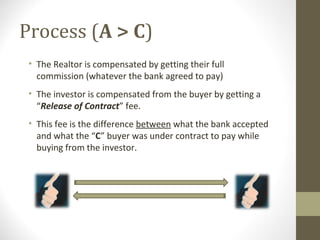
 • The Realtor is compensated by getting their full
   commission (whatever the bank agreed to pay)
 • The investor is compensated from the buyer by getting a
   “Release of Contract” fee.
 • This fee is the difference between what the bank accepted
   and what the “C” buyer was under contract to pay while
   buying from the investor.
Process (A > C) Example
 For example:
 •If the B > C contract was for $160k
 •And the bank approval was for $150k
 •The amount of the release would be $10k
 •The owner of record (A) would then contract in place of
 the investor (B) for the bank- approved $150k
 •The total price to Buyer (C) therefore would not change at
 $160k
Process (A > C)
 • The possibility of the transaction going A > C is fully
   disclosed to the bank as well as to the buyer once the
   offer comes in.
 • They know upfront that this could go A > B, B > C or
   simply A > C, but regardless their end price will not
   change or be increased 1 penny due to the investor
   involvement
Process (A > C)
 • The release fee is a separate transaction and has nothing
   legally to do with the new contract between the owner of
   record and the buyer
 • Therefore is does not appear on the HUD-1 and complies
   with RESPA terms and ALL bank approval letters
 • If in the event the buyer needs to “mortgage” that amount
   as they do not have the cash on hand, it can be added on
   the HUD-1 as a buyer side closing cost (debit) as long as it
   is OK with their lender
Conclusion
Realtors working side-by-side with
investors in this model will:
•Increase their amount of listings as they
can attract more sellers; bringing not only
a buyer but a proven team of negotiators
to help them
•Close more deals and focus on the things
that make them money…which is buying
and selling homes
•NEVER have to talk to or deal with the
banks again
Conclusion
• Stop worrying about the buyers “walking”
• Stop worrying about the bank BPO/Appraisal coming in
  too high
• Start making more $$$ than ever before and take
  advantage of what truly is a once-in-a-lifetime opportunity
  for those smart enough to “see it”!!!!!

                      Contact James N. Graham
                      Sunburst Redevelopment LLC
                      (800) 450-2595 or
                      Email: james@sunburstbuyshouses.com

                      We will work in any state…
                      Take Action Now!! Call Us!

Short Sales in 2013

  • 1.
    Short Sales in2013 …. and Beyond! How to profit from one of the BIGGEST trends in Real Estate History
  • 2.
    Why Short Sales? • Experts are predicting that 2013 will be the “Year of the Short Sale” • Past Due Mortgages = 6,298,000 • Home Prices are slowly increasing nationwide • Close to 30% of ALL homes are “underwater” • Most agents still run the other way • Become your “local area expert” and Cash In
  • 3.
    Common Agent Objections • It’s hard to find a buyer for a short sale • They take too long • By the time we get the approval, the buyer walks • The bank wants too much money • I don’t have the time to become a negotiator and sit on- hold all day with the bank • They cut my commission anyway
  • 4.
    Common Agent Objections •I don’t know how to negotiate a short sale properly • What is the difference when negotiating an FHA loan vs. conventional? • What about a Jumbo loan, or a VA loan? • How do I handle 2nd mortgages, lines of credit, etc.? • What do I do about other judgments and liens that come up such as mechanic liens, HOA liens, child support judgments, alimony judgments, credit card or other debt instrument judgments?
  • 5.
    Common Agent Objections •What do I do when: • They want a cash contribution from the seller and they don’t have it? • They want the seller to sign a promissory note? • They won’t give a full-satisfaction and will only “release the lien”? • How do I handle the tax ramification/1099-C issue should it arise?
  • 6.
    Investor Based Solution • The GOOD NEWS is that you NEVER have to worry about any of those things ever again! • You don’t need to learn every possible thing there is to know and every way to negotiate the hundreds of different scenarios out there when dealing with short sales! • Your investor team will handle all of this for you….at NO CHARGE ever to either the agent or the homeowner!
  • 7.
    Investor Based Solution • Investor puts in “cash” offer as soon as you get the listing so that negotiations with the bank can begin immediately….a great selling point for your prospects to bring a buyer upfront! • Investor’s experienced negotiating team will handle all bank negotiations….NEVER have to talk to the banks again! • Average short sale closing average for agents nationwide is around 30%. • Our team closes 90%+ of every deal we work on
  • 8.
    Investor-Based Solution • Property is actively marketed only after the bank counter-offers • Property can now be marketed as a “bank approved short sale” • Buyers that are identified later in the process are much less likely to “walk” as their wait time is normally less than 30 days. • When negotiated properly, commissions are almost always a full 6%
  • 9.
    Resale Process •Homeowner (Owner of Record) = Party A • Investor Buyer = Party B • End Buyer = Party C • Initial contract is the A > B. The homeowner grants the investor an “equitable interest” in the property allowing them to negotiate with their bank, lien-holders, etc. • In addition, they are granted the right to list, market for sale, and sell the property while negotiating and prior to purchasing from owner of record.
  • 10.
    Resale Process •Entire process and each possible scenario is fully disclosed in writing to ALL parties…including the banks • Any offers that come in are presented to the investor/buyer as they are now the ones legally selling the property (B > C). • Once the approval letter is in-hand the decision is made whether to purchase (A > B) and re-sell (B > C) or to use one of the following exit strategies
  • 11.
    Exit Strategies… and RealtorCompensation • A > B, B > C … Immediate buy/sell (Realtor is paid on both transactions on same day….earning double commission) • A > B, B > C … Buy/Hold/Rehab (Realtor is paid on 2nd transaction no matter how much time goes by during the waiting and/or rehab period)
  • 12.
    Process (A >C) • More and more bank short sale approval letters are including language that prohibits the re-sale of the property for 30, 60, or even 90 days • If there is already a “C” buyer lined up and ready to go, it normally makes more sense for the investor to “release” their interest and consequent contract with the owner of record so that the “C” buyer can purchase direct from the owner of record
  • 13.
    Process (A >C) • The Realtor is compensated by getting their full commission (whatever the bank agreed to pay) • The investor is compensated from the buyer by getting a “Release of Contract” fee. • This fee is the difference between what the bank accepted and what the “C” buyer was under contract to pay while buying from the investor.
  • 14.
    Process (A >C) Example For example: •If the B > C contract was for $160k •And the bank approval was for $150k •The amount of the release would be $10k •The owner of record (A) would then contract in place of the investor (B) for the bank- approved $150k •The total price to Buyer (C) therefore would not change at $160k
  • 15.
    Process (A >C) • The possibility of the transaction going A > C is fully disclosed to the bank as well as to the buyer once the offer comes in. • They know upfront that this could go A > B, B > C or simply A > C, but regardless their end price will not change or be increased 1 penny due to the investor involvement
  • 16.
    Process (A >C) • The release fee is a separate transaction and has nothing legally to do with the new contract between the owner of record and the buyer • Therefore is does not appear on the HUD-1 and complies with RESPA terms and ALL bank approval letters • If in the event the buyer needs to “mortgage” that amount as they do not have the cash on hand, it can be added on the HUD-1 as a buyer side closing cost (debit) as long as it is OK with their lender
  • 17.
    Conclusion Realtors working side-by-sidewith investors in this model will: •Increase their amount of listings as they can attract more sellers; bringing not only a buyer but a proven team of negotiators to help them •Close more deals and focus on the things that make them money…which is buying and selling homes •NEVER have to talk to or deal with the banks again
  • 18.
    Conclusion • Stop worryingabout the buyers “walking” • Stop worrying about the bank BPO/Appraisal coming in too high • Start making more $$$ than ever before and take advantage of what truly is a once-in-a-lifetime opportunity for those smart enough to “see it”!!!!! Contact James N. Graham Sunburst Redevelopment LLC (800) 450-2595 or Email: james@sunburstbuyshouses.com We will work in any state… Take Action Now!! Call Us!