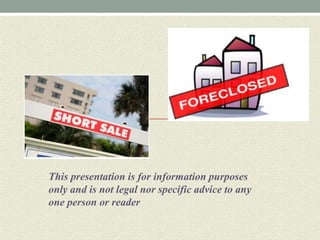
This presentation is for information purposes
only and is not legal nor specific advice to any
one person or reader
What happens when you default?
• The note involved in a foreclosure or repossession is a
  contract. It is an "I Owe You": a promise and an obligation
  for you to pay the debt owed to the lender that financed
  your property.
• The mortgage on the property, is the security for that debt.
  It is a lien.
Default Consequences

• Default - Failure to pay a debt when it is due.
• Acceleration - Allows a lender to demand payment of the
  total outstanding balance upon default.
• Foreclosure - Lawsuit calling the entire note due and
  requesting a court ordered sale of the property to satisfy
  the note.
Mortgage Foreclosure
       Four Step Process

1. Complaint
2. Final Judgment
3. Foreclosure
4. Deficiency Judgment
Step 1 Complaint - Lender sues on non-payment of Note.

  • Complaint Includes 3 Documents.
       1.   Summons - directs you to answer the Complaint.
       2.   Complaint - describes why the bank is entitled to
            payment on the Promissory Note.
       3.   Lis Pendens – (means "pending litigation”) filed in
            the public records of county where property is located
            to give notice to anyone dealing with the property that
            a claim has been made against the property.
Step 2
Final Judgment – (not a money judgment)
1. Orders clerk of court to sell to highest bidder within 30
   days if borrower does not redeem, (pay the full amount
   the bank proved is due).
2. If the highest bidder bids less than the amount due to
   the bank, the bank can come back to court and request
   a Deficiency Judgment (a money judgment).
Step 3
Foreclosure Sale
• May occur "on the courthouse steps", in a courtroom, in a
  meeting hall, in a large hallway and more recently, on the
  Web.
• Bidding starts at $100 and goes up from there.
• Lender has a credit up to amount owed on mortgage.
• Bank bids for the property to "protect" the collateral up to
  the amount (and usually beyond) the bank has
  determined the property is worth.
• Usually gets sold to the bank for a mere $100 if no other
  bidders at the foreclosure sale.
• Buyer pays DOC stamps based upon sales amount.
Step 4
• Deficiency Judgment –
• demands that, if the lender does not receive all
 amounts due from foreclosure sale, the remaining
 balance be paid by the borrower.

  • “appraisal value” - “judgment amount” + (costs, penalties, late
   fees) = DJ


• FMV on the date of the sale is LESS than the total
  indebtedness of the mortgage = deficiency.
• FMV on the date of the sale is MORE than the total
  indebtedness of the mortgage = NO DEFICIENCY.
How Acquired (not automatic)
• File motion in foreclosure action for DJ – must
  have evidentiary hearing to prove sales
  amount was less than judgment amount.
• Must be done within one year from date of
  foreclosure sale.
• May also be obtained in separate breach of
  contract action on promissory note (5 years to
  bring such action).
When Does Lender Seek a DJ?
• Is this Primary Residence or Investment property?
• What are the lender’s assets?
• Strategic Default?
• Is there Private Mortgage Insurance?
What is PMI
A down payment of less than 20% of the purchase price means
your lender may require you to buy private mortgage insurance
(PMI), which partially protects the lender against the risk of
default.

protects lender for an amount equal to that 20 % difference
between loan amount and value.

Example:            Value = $100,000
                 Financed = $100,000

PMI covers 20 % of amount financed = $20,000

Acts like a $20,000 lien on the property.
RESULT OF PMI
Once the Lender approves the Short Sale, it gets sent to PMI for their
approval.

Adds 2-3 weeks to the process.

From buyer’s or seller’s perspective, PMI does nothing to improve the Short
Sale process.
HOW IS A DEFICIENCY JUDGMENT TREATED FOR TAX PURPOSES?


If the lender gets a deficiency judgment, the lender is not forgiving the loan.

The homeowner incurs income tax liability for debt forgiveness if:

    • the lender does not seek a deficiency judgment or

    • the lender pursues the judgment but is unsuccessful
What is Cancellation of Debt?

If you borrow money from a commercial lender
that later cancels or forgives the debt, you may
have to treat the cancelled amount as income for
tax purposes.
WHY?
loan proceeds are not treated as income because of the obligation to repay.

When obligation is forgiven, the amount discharged is normally reportable
as income because you no longer have an obligation to repay.

The lender is usually required to report the amount of the canceled debt to
you and the IRS on a Form 1099-C, Cancellation of Debt.
Very simplified example.


You borrow $10,000 and default on the loan after paying back $2,000.

If the lender is unable to collect the remaining debt from you, there is a
CANCELLATION OF DEBT of $8,000, which generally is taxable income to you.
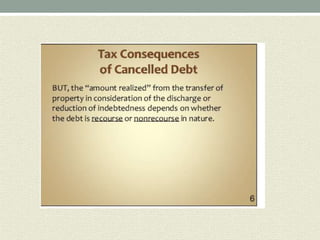
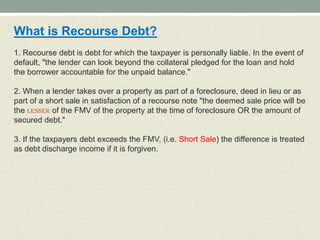
What is Recourse Debt?
1. Recourse debt is debt for which the taxpayer is personally liable. In the event of
default, "the lender can look beyond the collateral pledged for the loan and hold
the borrower accountable for the unpaid balance."

2. When a lender takes over a property as part of a foreclosure, deed in lieu or as
part of a short sale in satisfaction of a recourse note "the deemed sale price will be
the LESSER of the FMV of the property at the time of foreclosure OR the amount of
secured debt."

3. If the taxpayers debt exceeds the FMV, (i.e. Short Sale) the difference is treated
as debt discharge income if it is forgiven.
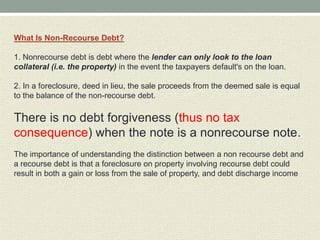
What Is Non-Recourse Debt?

1. Nonrecourse debt is debt where the lender can only look to the loan
collateral (i.e. the property) in the event the taxpayers default's on the loan.

2. In a foreclosure, deed in lieu, the sale proceeds from the deemed sale is equal
to the balance of the non-recourse debt.

There is no debt forgiveness (thus no tax
consequence) when the note is a nonrecourse note.
The importance of understanding the distinction between a non recourse debt and
a recourse debt is that a foreclosure on property involving recourse debt could
result in both a gain or loss from the sale of property, and debt discharge income
Is there a second mortgage?


Another name for a second mortgage -- Gift


Second mortgage lenders and private lenders are more likely than first
mortgage holders to go after the borrowers by suing for default on the
underlying promissory note.
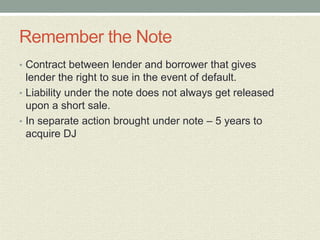
Remember the Note
• Contract between lender and borrower that gives
  lender the right to sue in the event of default.
• Liability under the note does not always get released
  upon a short sale.
• In separate action brought under note – 5 years to
  acquire DJ
What Does the Future Hold?
• As of January 2012 an estimated 368,000 foreclosure
  cases are pending in Florida courts.
• The backlog of cases is expected to grow by another
  380,000 cases by 2016.
Short Sale -Property sold for less than what’s owed
• Seller lists the property with a Realtor.
• Buyer must be found and contract executed.
• Sale and purchase agreement along with the seller's financial
    information is sent to the lender for review (this is called the
    short sale package.)
•   Lender orders a Broker's Price Opinion on the property.
•   Once conducted, received, and reviewed, the file is assigned to
    a
    Loss Mitigation Specialist. (LMS)
•   LMS accepts, rejects, or counters the Buyer's offer on the
    property.
•   Negotiation continues until deal approved or its falls apart.
•   Upon agreement, closing date is set for about three weeks
    away.
BEST CASES FOR SHORT SALE
• Start the process as soon as payments are stopped.

• Nice homes in nice neighborhoods are more likely to stick – Buyers seem
  more willing to negotiate

• Homes with only one mortgage easiest to get approved

• 2 loans with only one lender still have a chance of getting approved.

•   2 loans with different lenders very challenging to get approved.

• Easier if pay-off is not too short, less than 70% payoff are hard to get
  approved.
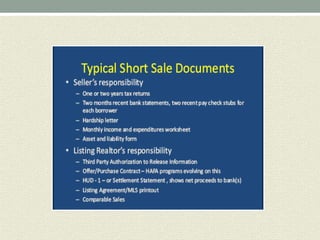
Documentation to get out of a loan is similar to what’s need for
getting a loan.

• Hardship letter

• Financials -NEVER ENGAGE IN MISSTATING INCOME AND
  ASSETS – THIS IS BANK FRAUD – FBI WILL PROSECUTE
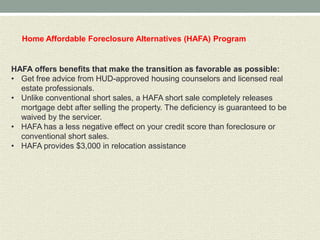
Home Affordable Foreclosure Alternatives (HAFA) Program


HAFA offers benefits that make the transition as favorable as possible:
• Get free advice from HUD-approved housing counselors and licensed real
  estate professionals.
• Unlike conventional short sales, a HAFA short sale completely releases
  mortgage debt after selling the property. The deficiency is guaranteed to be
  waived by the servicer.
• HAFA has a less negative effect on your credit score than foreclosure or
  conventional short sales.
• HAFA provides $3,000 in relocation assistance
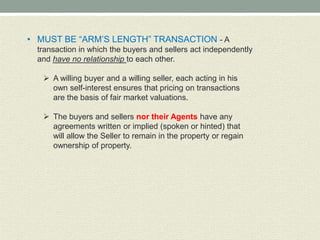
• MUST BE “ARM’S LENGTH” TRANSACTION - A
 transaction in which the buyers and sellers act independently
 and have no relationship to each other.

    A willing buyer and a willing seller, each acting in his
     own self-interest ensures that pricing on transactions
     are the basis of fair market valuations.

    The buyers and sellers nor their Agents have any
     agreements written or implied (spoken or hinted) that
     will allow the Seller to remain in the property or regain
     ownership of property.
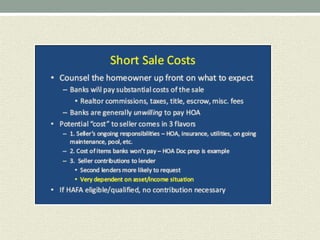
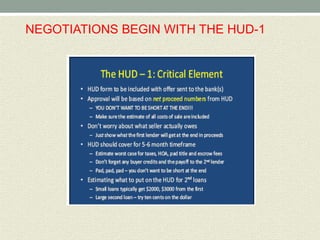
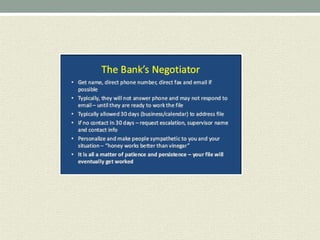
NEGOTIATIONS BEGIN WITH THE HUD-1
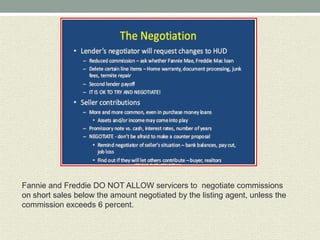
Fannie and Freddie DO NOT ALLOW servicers to negotiate commissions
on short sales below the amount negotiated by the listing agent, unless the
commission exceeds 6 percent.
AS IS PURCHASE AGREEMENT
• 5 days to inspect

      Starts when bank approves sale to buyer at agreed upon price.

•   Seller is obligated to provide utilities during the inspection period.

      Listing agent needs to ensure owner turns on power.
      If power is turned off and buyer chooses not to inspect, get
       waiver of that contingency in writing.

     AS IS CONTRACT DOES NOT ELIMINATE JOHNSON V. DAVIS
     DISCLOSURE REQUIREMENTS.
Closing the Transaction

• Track buyer’s loan to ensure timely closing – 30 days very challenging
     Buyers need to get pre-approved for loan amount.

• Track all typical inspections, disclosures for timeliness.

• If loan appraisal comes in low – must renegotiate – can cause
  problems if there are extension limits.

• Final HUD 1 approval – REQUIRED 24-48 hours prior to close – NO
  MAJOR CHANGES ALLOWED.
In Short Sales…Need 2 Releases to
Avoid DJs
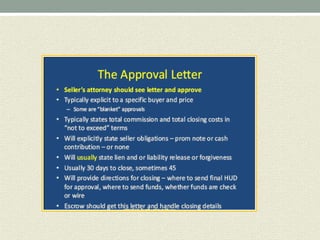
• What does the Approval Letter say?
  • Does it say both the Mortgage AND the Note are being released?
• Does the approval letter say the mortgage is being
  SATISFIED or simply released.
• If mortgage is being satisfied, it should contain language
  that the underlying obligation under the note is paid in full.
• Look for language in Approval Letter that “mortgage and
  note are being satisfied.”
Deed-In-Lieu


• “a transaction in which a borrower, after
 default, conveys to its lender by absolute
 deed, title to real property pledged as
 security for the indebtedness.
Banks Prefer Short Sales

•Don’t want to manage
another property
DIL Prerequisites

• Can’t sell the property
• Clean title
  • No second mortgages or liens against property
  • No judgments against borrower
   REMEMBER THE NOTE – Seller wants to be
   RELEASED from the note as part of
   consideration for the DIL.
Title Insurance Issues
• Lenders and title companies share the same concerns
  about deeds-in-lieu: They are subject to judicial attack by:
1. re-characterization as an equitable mortgage:
       •   Deed must be an absolute conveyance
       •   Grantors cannot remain in possession
2.   violation of the “clogging the equity” doctrine (i.e., use
     of DIL to prevent borrower from exercising its rights to
     redeem the property from a foreclosure sale):
     • Deed must be given freely without duress or coercion


3.   setting aside of the DIL as a fraudulent conveyance or
     preferential transfer under federal bankruptcy or state
     fraudulent transfer laws.
MERGER
When a mortgage on lands and the equity of redemption in the
same lands become united in the same person, ordinarily the
mortgage is merged,-in other words, ceases to be an incumbrance.


Should it be determined subsequent to the acceptance of a deed in
lieu of foreclosure that inferior lienholders are claiming an interest in
the subject property, a merger of the mortgage estate into the fee
estate could arguably eliminate the lender's ability to foreclose such
claims.

The mortgage released by the DIL may lose its superiority.
This Warranty Deed is given as an absolute conveyance of title,
in consideration of the full cancellation by Grantee of Grantor’s
liability for all debts, obligations, costs, and charges secured by
that certain Mortgage encumbering the above described property
recorded on November 7, 2007, in Official Records Book 6156,
pages 2181-2190, of the public records of Volusia County,
Florida, securing $40,000.00, including, without limitation, the
indebtedness secured by said Mortgage; provided however, it is
the intent of the Grantee by acceptance of this Warranty Deed,
that the lien of said Mortgage shall not merge with fee simple title
to the above described property, but rather shall continue in full
force and effect notwithstanding that the Grantee shall be both
the holder of said Mortgage and owner of fee simple title.
Tips for Realtors
Things you can do to help minimize this lengthy process time:
• Advise clients to contact their servicer as early as possible.
• Ensure all customer financials are in PDF format.
• Help clients complete all documentation accurately and as soon as possible.
• Make sure the purchase offer is a legitimate offer and fully executed.
• Submit the best possible purchase offer at fair market value.
• Provide listing information and comparables to support the price.

Frequent causes of delay to be aware of:
• A change of buyer or agent at any time may require process to revert to an earlier
  step; notify client’s servicer immediately if there is any change.
• Investor/mortgage insurance approval is needed if the servicer is not fully
  delegated to approve the short sale.
• Release on a second lien must be received prior to issuing an approval letter.
• If customer has filed bankruptcy, the trustee must provide a court document that
  approves the sale of the property.

Short sales

  • 1.
    This presentation isfor information purposes only and is not legal nor specific advice to any one person or reader
  • 2.
    What happens whenyou default? • The note involved in a foreclosure or repossession is a contract. It is an "I Owe You": a promise and an obligation for you to pay the debt owed to the lender that financed your property. • The mortgage on the property, is the security for that debt. It is a lien.
  • 3.
    Default Consequences • Default- Failure to pay a debt when it is due. • Acceleration - Allows a lender to demand payment of the total outstanding balance upon default. • Foreclosure - Lawsuit calling the entire note due and requesting a court ordered sale of the property to satisfy the note.
  • 4.
    Mortgage Foreclosure Four Step Process 1. Complaint 2. Final Judgment 3. Foreclosure 4. Deficiency Judgment
  • 5.
    Step 1 Complaint- Lender sues on non-payment of Note. • Complaint Includes 3 Documents. 1. Summons - directs you to answer the Complaint. 2. Complaint - describes why the bank is entitled to payment on the Promissory Note. 3. Lis Pendens – (means "pending litigation”) filed in the public records of county where property is located to give notice to anyone dealing with the property that a claim has been made against the property.
  • 6.
    Step 2 Final Judgment– (not a money judgment) 1. Orders clerk of court to sell to highest bidder within 30 days if borrower does not redeem, (pay the full amount the bank proved is due). 2. If the highest bidder bids less than the amount due to the bank, the bank can come back to court and request a Deficiency Judgment (a money judgment).
  • 7.
    Step 3 Foreclosure Sale •May occur "on the courthouse steps", in a courtroom, in a meeting hall, in a large hallway and more recently, on the Web. • Bidding starts at $100 and goes up from there. • Lender has a credit up to amount owed on mortgage. • Bank bids for the property to "protect" the collateral up to the amount (and usually beyond) the bank has determined the property is worth. • Usually gets sold to the bank for a mere $100 if no other bidders at the foreclosure sale. • Buyer pays DOC stamps based upon sales amount.
  • 8.
    Step 4 • DeficiencyJudgment – • demands that, if the lender does not receive all amounts due from foreclosure sale, the remaining balance be paid by the borrower. • “appraisal value” - “judgment amount” + (costs, penalties, late fees) = DJ • FMV on the date of the sale is LESS than the total indebtedness of the mortgage = deficiency. • FMV on the date of the sale is MORE than the total indebtedness of the mortgage = NO DEFICIENCY.
  • 9.
    How Acquired (notautomatic) • File motion in foreclosure action for DJ – must have evidentiary hearing to prove sales amount was less than judgment amount. • Must be done within one year from date of foreclosure sale. • May also be obtained in separate breach of contract action on promissory note (5 years to bring such action).
  • 10.
    When Does LenderSeek a DJ? • Is this Primary Residence or Investment property? • What are the lender’s assets? • Strategic Default? • Is there Private Mortgage Insurance?
  • 11.
    What is PMI Adown payment of less than 20% of the purchase price means your lender may require you to buy private mortgage insurance (PMI), which partially protects the lender against the risk of default. protects lender for an amount equal to that 20 % difference between loan amount and value. Example: Value = $100,000 Financed = $100,000 PMI covers 20 % of amount financed = $20,000 Acts like a $20,000 lien on the property.
  • 12.
    RESULT OF PMI Oncethe Lender approves the Short Sale, it gets sent to PMI for their approval. Adds 2-3 weeks to the process. From buyer’s or seller’s perspective, PMI does nothing to improve the Short Sale process.
  • 13.
    HOW IS ADEFICIENCY JUDGMENT TREATED FOR TAX PURPOSES? If the lender gets a deficiency judgment, the lender is not forgiving the loan. The homeowner incurs income tax liability for debt forgiveness if: • the lender does not seek a deficiency judgment or • the lender pursues the judgment but is unsuccessful
  • 15.
    What is Cancellationof Debt? If you borrow money from a commercial lender that later cancels or forgives the debt, you may have to treat the cancelled amount as income for tax purposes.
  • 16.
    WHY? loan proceeds arenot treated as income because of the obligation to repay. When obligation is forgiven, the amount discharged is normally reportable as income because you no longer have an obligation to repay. The lender is usually required to report the amount of the canceled debt to you and the IRS on a Form 1099-C, Cancellation of Debt.
  • 17.
    Very simplified example. Youborrow $10,000 and default on the loan after paying back $2,000. If the lender is unable to collect the remaining debt from you, there is a CANCELLATION OF DEBT of $8,000, which generally is taxable income to you.
  • 19.
    What is RecourseDebt? 1. Recourse debt is debt for which the taxpayer is personally liable. In the event of default, "the lender can look beyond the collateral pledged for the loan and hold the borrower accountable for the unpaid balance." 2. When a lender takes over a property as part of a foreclosure, deed in lieu or as part of a short sale in satisfaction of a recourse note "the deemed sale price will be the LESSER of the FMV of the property at the time of foreclosure OR the amount of secured debt." 3. If the taxpayers debt exceeds the FMV, (i.e. Short Sale) the difference is treated as debt discharge income if it is forgiven.
  • 20.
    What Is Non-RecourseDebt? 1. Nonrecourse debt is debt where the lender can only look to the loan collateral (i.e. the property) in the event the taxpayers default's on the loan. 2. In a foreclosure, deed in lieu, the sale proceeds from the deemed sale is equal to the balance of the non-recourse debt. There is no debt forgiveness (thus no tax consequence) when the note is a nonrecourse note. The importance of understanding the distinction between a non recourse debt and a recourse debt is that a foreclosure on property involving recourse debt could result in both a gain or loss from the sale of property, and debt discharge income
  • 21.
    Is there asecond mortgage? Another name for a second mortgage -- Gift Second mortgage lenders and private lenders are more likely than first mortgage holders to go after the borrowers by suing for default on the underlying promissory note.
  • 22.
    Remember the Note •Contract between lender and borrower that gives lender the right to sue in the event of default. • Liability under the note does not always get released upon a short sale. • In separate action brought under note – 5 years to acquire DJ
  • 23.
    What Does theFuture Hold? • As of January 2012 an estimated 368,000 foreclosure cases are pending in Florida courts. • The backlog of cases is expected to grow by another 380,000 cases by 2016.
  • 24.
    Short Sale -Propertysold for less than what’s owed • Seller lists the property with a Realtor. • Buyer must be found and contract executed. • Sale and purchase agreement along with the seller's financial information is sent to the lender for review (this is called the short sale package.) • Lender orders a Broker's Price Opinion on the property. • Once conducted, received, and reviewed, the file is assigned to a Loss Mitigation Specialist. (LMS) • LMS accepts, rejects, or counters the Buyer's offer on the property. • Negotiation continues until deal approved or its falls apart. • Upon agreement, closing date is set for about three weeks away.
  • 25.
    BEST CASES FORSHORT SALE • Start the process as soon as payments are stopped. • Nice homes in nice neighborhoods are more likely to stick – Buyers seem more willing to negotiate • Homes with only one mortgage easiest to get approved • 2 loans with only one lender still have a chance of getting approved. • 2 loans with different lenders very challenging to get approved. • Easier if pay-off is not too short, less than 70% payoff are hard to get approved.
  • 26.
    Documentation to getout of a loan is similar to what’s need for getting a loan. • Hardship letter • Financials -NEVER ENGAGE IN MISSTATING INCOME AND ASSETS – THIS IS BANK FRAUD – FBI WILL PROSECUTE
  • 28.
    Home Affordable ForeclosureAlternatives (HAFA) Program HAFA offers benefits that make the transition as favorable as possible: • Get free advice from HUD-approved housing counselors and licensed real estate professionals. • Unlike conventional short sales, a HAFA short sale completely releases mortgage debt after selling the property. The deficiency is guaranteed to be waived by the servicer. • HAFA has a less negative effect on your credit score than foreclosure or conventional short sales. • HAFA provides $3,000 in relocation assistance
  • 30.
    • MUST BE“ARM’S LENGTH” TRANSACTION - A transaction in which the buyers and sellers act independently and have no relationship to each other.  A willing buyer and a willing seller, each acting in his own self-interest ensures that pricing on transactions are the basis of fair market valuations.  The buyers and sellers nor their Agents have any agreements written or implied (spoken or hinted) that will allow the Seller to remain in the property or regain ownership of property.
  • 31.
  • 33.
    Fannie and FreddieDO NOT ALLOW servicers to negotiate commissions on short sales below the amount negotiated by the listing agent, unless the commission exceeds 6 percent.
  • 35.
    AS IS PURCHASEAGREEMENT • 5 days to inspect  Starts when bank approves sale to buyer at agreed upon price. • Seller is obligated to provide utilities during the inspection period.  Listing agent needs to ensure owner turns on power.  If power is turned off and buyer chooses not to inspect, get waiver of that contingency in writing. AS IS CONTRACT DOES NOT ELIMINATE JOHNSON V. DAVIS DISCLOSURE REQUIREMENTS.
  • 36.
    Closing the Transaction •Track buyer’s loan to ensure timely closing – 30 days very challenging  Buyers need to get pre-approved for loan amount. • Track all typical inspections, disclosures for timeliness. • If loan appraisal comes in low – must renegotiate – can cause problems if there are extension limits. • Final HUD 1 approval – REQUIRED 24-48 hours prior to close – NO MAJOR CHANGES ALLOWED.
  • 37.
    In Short Sales…Need2 Releases to Avoid DJs • What does the Approval Letter say? • Does it say both the Mortgage AND the Note are being released? • Does the approval letter say the mortgage is being SATISFIED or simply released. • If mortgage is being satisfied, it should contain language that the underlying obligation under the note is paid in full. • Look for language in Approval Letter that “mortgage and note are being satisfied.”
  • 38.
    Deed-In-Lieu • “a transactionin which a borrower, after default, conveys to its lender by absolute deed, title to real property pledged as security for the indebtedness.
  • 39.
    Banks Prefer ShortSales •Don’t want to manage another property
  • 40.
    DIL Prerequisites • Can’tsell the property • Clean title • No second mortgages or liens against property • No judgments against borrower REMEMBER THE NOTE – Seller wants to be RELEASED from the note as part of consideration for the DIL.
  • 41.
    Title Insurance Issues •Lenders and title companies share the same concerns about deeds-in-lieu: They are subject to judicial attack by: 1. re-characterization as an equitable mortgage: • Deed must be an absolute conveyance • Grantors cannot remain in possession 2. violation of the “clogging the equity” doctrine (i.e., use of DIL to prevent borrower from exercising its rights to redeem the property from a foreclosure sale): • Deed must be given freely without duress or coercion 3. setting aside of the DIL as a fraudulent conveyance or preferential transfer under federal bankruptcy or state fraudulent transfer laws.
  • 42.
    MERGER When a mortgageon lands and the equity of redemption in the same lands become united in the same person, ordinarily the mortgage is merged,-in other words, ceases to be an incumbrance. Should it be determined subsequent to the acceptance of a deed in lieu of foreclosure that inferior lienholders are claiming an interest in the subject property, a merger of the mortgage estate into the fee estate could arguably eliminate the lender's ability to foreclose such claims. The mortgage released by the DIL may lose its superiority.
  • 43.
    This Warranty Deedis given as an absolute conveyance of title, in consideration of the full cancellation by Grantee of Grantor’s liability for all debts, obligations, costs, and charges secured by that certain Mortgage encumbering the above described property recorded on November 7, 2007, in Official Records Book 6156, pages 2181-2190, of the public records of Volusia County, Florida, securing $40,000.00, including, without limitation, the indebtedness secured by said Mortgage; provided however, it is the intent of the Grantee by acceptance of this Warranty Deed, that the lien of said Mortgage shall not merge with fee simple title to the above described property, but rather shall continue in full force and effect notwithstanding that the Grantee shall be both the holder of said Mortgage and owner of fee simple title.
  • 44.
    Tips for Realtors Thingsyou can do to help minimize this lengthy process time: • Advise clients to contact their servicer as early as possible. • Ensure all customer financials are in PDF format. • Help clients complete all documentation accurately and as soon as possible. • Make sure the purchase offer is a legitimate offer and fully executed. • Submit the best possible purchase offer at fair market value. • Provide listing information and comparables to support the price. Frequent causes of delay to be aware of: • A change of buyer or agent at any time may require process to revert to an earlier step; notify client’s servicer immediately if there is any change. • Investor/mortgage insurance approval is needed if the servicer is not fully delegated to approve the short sale. • Release on a second lien must be received prior to issuing an approval letter. • If customer has filed bankruptcy, the trustee must provide a court document that approves the sale of the property.