Codes and Conventions
of
Short Film
By Adam Kalabiska
A Level Media Studies
Character(s)
Philosophical conflict is indescribably important as it is what
makes us, as the audience, create a meaningful emotional
connection with the character and understand the motives that
drive their actions. It is generally understood to be the
foundation of not only great character, but most importantly, a
great story. Once again, due to the limited time, the
development of a character’s backstory is usually put aside and
the focus is instead put on his or her current situation. Wants
and needs, alongside philosophical beliefs should be
established in order for the character’s journey to feel
meaningful and the engagement of the audience should also be
achieved as now there is something at stake for the character to
lose.
Storyline
Story is key.
Storylines are generally kept simple and one should always stick to a singular
idea/theme, due to the short length of the film. “Show over tell” is a long time
rule in cinema which has been slowly getting lost over the years. Its importance is
extra relevant when it comes to short films, as there isn’t enough time for
important information to be conveyed to the audience through dialogue (more
specifically known as exposition). Instead, visual storytelling is essential in telling
an emotionally resonant story.
Additionally, the story requires a proper set up, otherwise the audience may
quickly become disengaged.
Nimic
2019
Narrative Structure
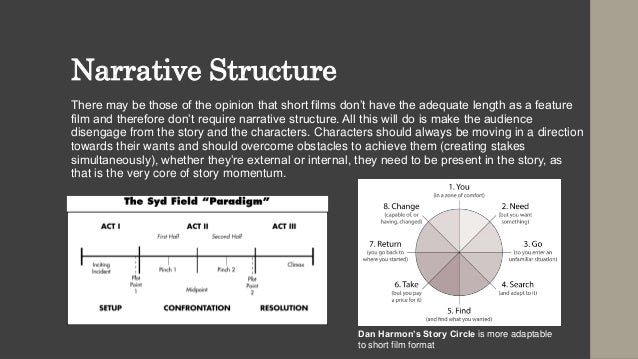
There may be those of the opinion that short films don’t have the adequate length as a feature
film and therefore don’t require narrative structure. All this will do is make the audience
disengage from the story and the characters. Characters should always be moving in a direction
towards their wants and should overcome obstacles to achieve them (creating stakes
simultaneously), whether they’re external or internal, they need to be present in the story, as
that is the very core of story momentum.
Dan Harmon’s Story Circle is more adaptable
to short film format
Budget
Sometimes, the very lack of a budget is the reason why a filmmaker
decides to pursue the creation of a short film, as he/she may actually be
hoping to find the necessary budget, along side the recourses in order
to make the full feature version of their idea and the short film is their
ticket. The previously established lack of budget or only very little
funding may result in the short film having certain limitations. Mainly
visually and performance wise.
Nevertheless, with certain technology available in modern day society, it
helps to achieve much closer to ones original vision. Not to mention that
especially when it comes to the post-production stage, there is truly an
unbelievably wide range of free options to choose from. For example,
the Davinci Resolve editing software is freely accessible to anyone and
remains to be on board with what top of the industry professionals use
whilst editing big budget films that are being released in cinemas.
At the end of the day, the idea is all that matters and limitations in the
form of budget or equipment should, in my opinion atleast, be seen as a
positive factor. This is because they push your creativity to its absolute
limits and commonly helps to open up newer and better possibilities.
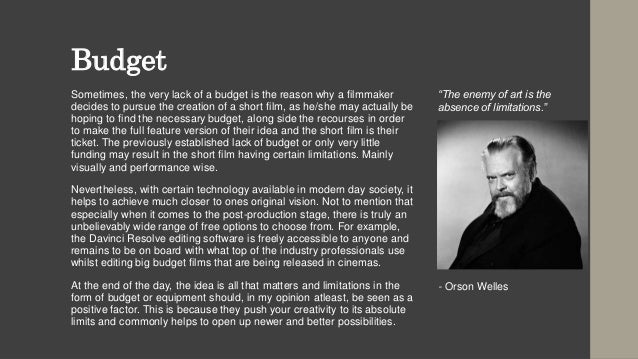
“The enemy of art is the
absence of limitations.”
- Orson Welles
Distribution
Contrary to mainstream films, short films are for the large part accessible for free via the internet. There
are many large websites who distribute short films online, ranging from independent to professional, such
as Argo and Mubi. As the purpose of most short films is often experimental or artistic expression, rather
than financial profit, it is of significantly higher importance for the filmmaker to reach a wide audience and
in todays, increasingly online, world this has never been easier. This can also be achieved by the
submission of short films to short film festivals. Usually done in the hopes of finding a positive critical
reception and that consequently helping the short film to find an even larger audience than before.
Some notable film festivals include:
• Sundance Film Festival
• Cannes Film Festival
• Berlin International Film Festival
• TIFF (Toronto International Film Festival)
• Karlovy Vary International Film Festival

Short film - codes & conventions

  • 1.
    Codes and Conventions of ShortFilm By Adam Kalabiska A Level Media Studies
  • 2.
    Character(s) Philosophical conflict isindescribably important as it is what makes us, as the audience, create a meaningful emotional connection with the character and understand the motives that drive their actions. It is generally understood to be the foundation of not only great character, but most importantly, a great story. Once again, due to the limited time, the development of a character’s backstory is usually put aside and the focus is instead put on his or her current situation. Wants and needs, alongside philosophical beliefs should be established in order for the character’s journey to feel meaningful and the engagement of the audience should also be achieved as now there is something at stake for the character to lose.
  • 3.
    Storyline Story is key. Storylinesare generally kept simple and one should always stick to a singular idea/theme, due to the short length of the film. “Show over tell” is a long time rule in cinema which has been slowly getting lost over the years. Its importance is extra relevant when it comes to short films, as there isn’t enough time for important information to be conveyed to the audience through dialogue (more specifically known as exposition). Instead, visual storytelling is essential in telling an emotionally resonant story. Additionally, the story requires a proper set up, otherwise the audience may quickly become disengaged. Nimic 2019
  • 4.
    Narrative Structure There maybe those of the opinion that short films don’t have the adequate length as a feature film and therefore don’t require narrative structure. All this will do is make the audience disengage from the story and the characters. Characters should always be moving in a direction towards their wants and should overcome obstacles to achieve them (creating stakes simultaneously), whether they’re external or internal, they need to be present in the story, as that is the very core of story momentum. Dan Harmon’s Story Circle is more adaptable to short film format
  • 5.
    Budget Sometimes, the verylack of a budget is the reason why a filmmaker decides to pursue the creation of a short film, as he/she may actually be hoping to find the necessary budget, along side the recourses in order to make the full feature version of their idea and the short film is their ticket. The previously established lack of budget or only very little funding may result in the short film having certain limitations. Mainly visually and performance wise. Nevertheless, with certain technology available in modern day society, it helps to achieve much closer to ones original vision. Not to mention that especially when it comes to the post-production stage, there is truly an unbelievably wide range of free options to choose from. For example, the Davinci Resolve editing software is freely accessible to anyone and remains to be on board with what top of the industry professionals use whilst editing big budget films that are being released in cinemas. At the end of the day, the idea is all that matters and limitations in the form of budget or equipment should, in my opinion atleast, be seen as a positive factor. This is because they push your creativity to its absolute limits and commonly helps to open up newer and better possibilities. “The enemy of art is the absence of limitations.” - Orson Welles
  • 6.
    Distribution Contrary to mainstreamfilms, short films are for the large part accessible for free via the internet. There are many large websites who distribute short films online, ranging from independent to professional, such as Argo and Mubi. As the purpose of most short films is often experimental or artistic expression, rather than financial profit, it is of significantly higher importance for the filmmaker to reach a wide audience and in todays, increasingly online, world this has never been easier. This can also be achieved by the submission of short films to short film festivals. Usually done in the hopes of finding a positive critical reception and that consequently helping the short film to find an even larger audience than before. Some notable film festivals include: • Sundance Film Festival • Cannes Film Festival • Berlin International Film Festival • TIFF (Toronto International Film Festival) • Karlovy Vary International Film Festival