WELCOME
To
THE PRESENTATION ON
SHIPBREAKING/SCRAPPING
For
DY PATIL UNIVERSITY SCHOOL OF
MANAGEMENT
PRESENT BY
RAHUL RASKARMBALS015006
AMIR KHAN MBALS015013
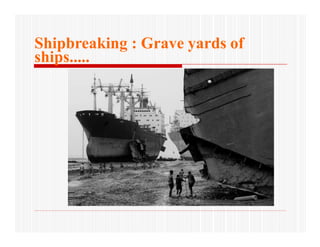
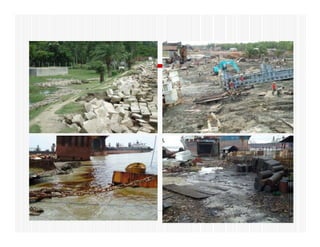
Shipbreaking : Grave yards of
ships.....
i b ki d li i d t i
yment opportunity
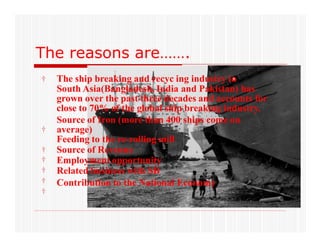
The reasons are…….
The ship breaking and recyc ing industry in
South Asia(Bangladesh, India and Pakistan) has
grown over the past three decades and accounts for
close to 70% of the global ship breaking industry.
Source of Iron (more than 400 ships come on
average)
Feeding to the re-rolling mill
Source of Revenue
Employment opportunity
Related business with SB
Contribution to the National Economy
†
†
†
†
†
†
†
f l i l i
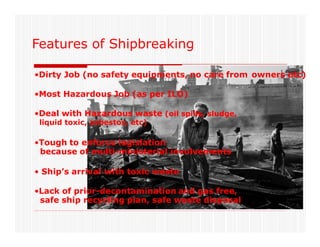
Features of Shipbreaking
•Dirty Job (no safety equipments, no care from owners etc)
•Most Hazardous Job (as per ILO)
•Deal with Hazardous waste (oil spills, sludge,
liquid toxic, asbestos, etc)
•Tough to enforce legislation
because of multi-ministerial involvements
• Ship’s arrival with toxic waste
•Lack of prior-decontamination and gas free,
safe ship recycling plan, safe waste disposal
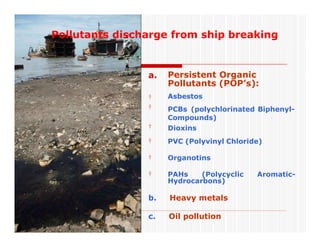
Pollutants discharge from ship breaking
a. Persistent Organic
Pollutants (POP’s):
Asbestos
PCBs (polychlorinated Biphenyl-
Compounds)
Dioxins
†
†
†
† PVC (Polyvinyl Chloride)
† Organotins
† PAHs (Polycyclic Aromatic-
Hydrocarbons)
b. Heavy metals
c. Oil pollution
urial
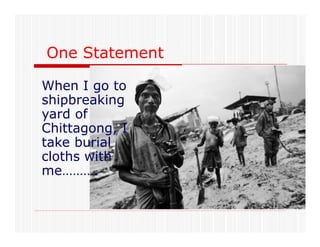
One Statement
When I go to
shipbreaking
yard of
Chittagong, I
take burial
cloths with
me……….
Recent Victims of Shipbreaking
More than 200 workers died in last 7 years 9 months,
more than one worker died on an average per month,
according to the available information.
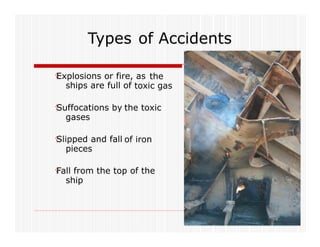
Types of Accidents
†Explosions or fire, as the
ships are full of toxic gas
†Suffocations by
gases
the toxic
†Slipped and fall
pieces
of iron
†Fall from the top of the
ship
Ok,Lets talk basedon
documentation.....(WORLD BANK)
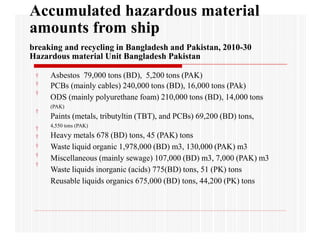
Accumulated hazardous material
amounts from ship
breaking and recycling in Bangladesh and Pakistan, 2010-30
Hazardous material Unit Bangladesh Pakistan
†
†
†
Asbestos 79,000 tons (BD), 5,200 tons (PAK)
PCBs (mainly cables) 240,000 tons (BD), 16,000 tons (PAk)
ODS (mainly polyurethane foam) 210,000 tons (BD), 14,000 tons
(PAK)
Paints (metals, tributyltin (TBT), and PCBs) 69,200 (BD) tons,
4,550 tons (PAK)
Heavy metals 678 (BD) tons, 45 (PAK) tons
Waste liquid organic 1,978,000 (BD) m3, 130,000 (PAK) m3
Miscellaneous (mainly sewage) 107,000 (BD) m3, 7,000 (PAK) m3
Waste liquids inorganic (acids) 775(BD) tons, 51 (PK) tons
Reusable liquids organics 675,000 (BD) tons, 44,200 (PK) tons
†
†
†
†
†
†
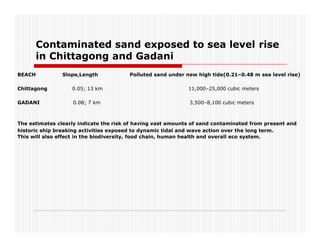
Contaminated sand exposed to sea level rise
in Chittagong and Gadani
BEACH Slope,Length Polluted sand under new high tide(0.21–0.48 m sea level rise)
Chittagong 0.05; 13 km 11,000–25,000 cubic meters
GADANI 0.08; 7 km 3,500–8,100 cubic meters
The estimates clearly indicate the risk of having vast amounts of sand contaminated from present and
historic ship breaking activities exposed to dynamic tidal and wave action over the long term.
This will also effect in the biodiversity, food chain, human health and overall eco system.
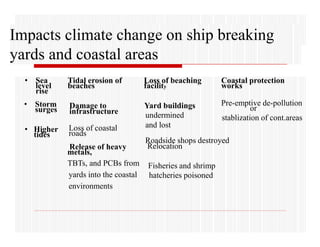
Impacts climate change on ship breaking
yards and coastal areas
• Sea
level
rise
Tidal erosion of
beaches
Loss of beaching
facility
Coastal protection
works
• Storm
surges Damage to
infrastructure
Yard buildings
undermined
and lostLoss of coastal
roads
Roadside shops destroyed
Relocation
• Higher
tides
Release of heavy
metals,
TBTs, and PCBs from
yards into the coastal
environments
Fisheries and shrimp
hatcheries poisoned
Pre-emptive de-pollution
or
stablization of cont.areas
Why its in South Asia….
South Asian countries are compromising their environment for certain
industries such as shipbreaking and that the methods used would
never be allowed in other parts of the world because of the harm done
to the environment and workers. South Asian countries should stop
being the dumping grounds for the industrialized countries and not
compromise health and environment for some tax income or to
protect the business model that benefits few people only.
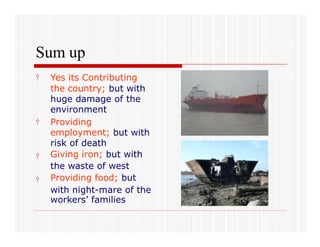
Sum up
Yes its Contributing
the country; but with
huge damage of the
environment
Providing
employment; but with
risk of death
Giving iron; but with
the waste of west
Providing food; but
with night-mare of the
workers’ families
†
†
†
†
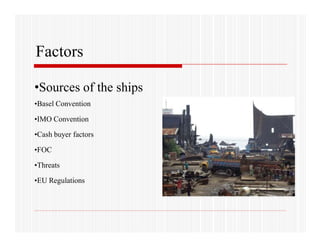
Factors
•Sources of the ships
•Basel Convention
•IMO Convention
•Cash buyer factors
•FOC
•Threats
•EU Regulations
QUESTION AND ANSWER
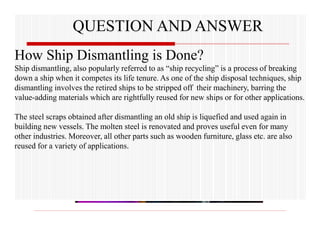
How Ship Dismantling is Done?
Ship dismantling, also popularly referred to as “ship recycling” is a process of breaking
down a ship when it competes its life tenure. As one of the ship disposal techniques, ship
dismantling involves the retired ships to be stripped off their machinery, barring the
value-adding materials which are rightfully reused for new ships or for other applications.
The steel scraps obtained after dismantling an old ship is liquefied and used again in
building new vessels. The molten steel is renovated and proves useful even for many
other industries. Moreover, all other parts such as wooden furniture, glass etc. are also
reused for a variety of applications.
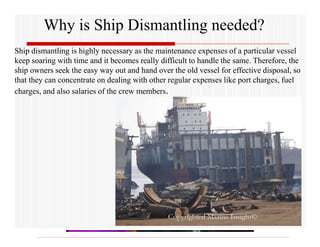
Why is Ship Dismantling needed?
Ship dismantling is highly necessary as the maintenance expenses of a particular vessel
keep soaring with time and it becomes really difficult to handle the same. Therefore, the
ship owners seek the easy way out and hand over the old vessel for effective disposal, so
that they can concentrate on dealing with other regular expenses like port charges, fuel
charges, and also salaries of the crew members.
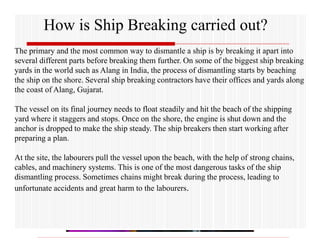
How is Ship Breaking carried out?
The primary and the most common way to dismantle a ship is by breaking it apart into
several different parts before breaking them further. On some of the biggest ship breaking
yards in the world such as Alang in India, the process of dismantling starts by beaching
the ship on the shore. Several ship breaking contractors have their offices and yards along
the coast of Alang, Gujarat.
The vessel on its final journey needs to float steadily and hit the beach of the shipping
yard where it staggers and stops. Once on the shore, the engine is shut down and the
anchor is dropped to make the ship steady. The ship breakers then start working after
preparing a plan.
At the site, the labourers pull the vessel upon the beach, with the help of strong chains,
cables, and machinery systems. This is one of the most dangerous tasks of the ship
dismantling process. Sometimes chains might break during the process, leading to
unfortunate accidents and great harm to the labourers.
Is Ship Dismantling dangerous?
Ship dismantling is regarded to be one of the most dangerous professions in the world as
it involves a great amount of risks and hazards. Several guidelines and programs have
been formed be tackled the consequences and control the oddities of this profession. It is
definitely a Herculean task to break apart a sturdy ship as it had been built to be
impregnable so as to withstand the harsh weather conditions and ocean storms and
support countless tones of cargo.
Many toxic ships contain dangerous substances such as asbestos, petrochemicals by
products, lead, mercury, Polychlorinated Biphenyls, radium, poisons and heavy metal
machinery, which are extremely harmful to humans and environment. Moreover, the
workers work with the least personal protective equipment and in really rough weather
and temperature conditions.
The labourers are also extremely poor and desperate to earn some quick money. They are
subjected to mortal perils every single day and the death toll in such ship breaking yards
are rising in spite of all the precautionary measures.
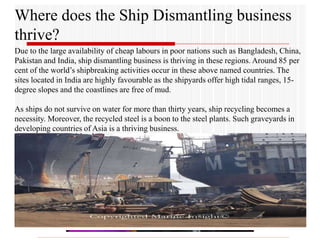
Where does the Ship Dismantling business
thrive?
Due to the large availability of cheap labours in poor nations such as Bangladesh, China,
Pakistan and India, ship dismantling business is thriving in these regions. Around 85 per
cent of the world’s shipbreaking activities occur in these above named countries. The
sites located in India are highly favourable as the shipyards offer high tidal ranges, 15-
degree slopes and the coastlines are free of mud.
As ships do not survive on water for more than thirty years, ship recycling becomes a
necessity. Moreover, the recycled steel is a boon to the steel plants. Such graveyards in
developing countries of Asia is a thriving business.
How does it affect our environment?
Disassembling of vessels comes at a huge price for it causes various environmental
hazards. The non-eco friendly dismantling techniques are a serious international concern
and stringent regulations are implemented to prevent the disastrous consequences.
Especially, the companies that engage in the beaching dismantling method, face stern
opposition as beaching affects the ecosystem a lot. Interestingly, the ship disposal
companies flourish in the third-world or developing nations, mainly because of the easy
availability of cheap labour.
Other favourable conditions may include the slackened laws when it comes to
environmental protection or labour health, and the ever-increasing demand for steel. This
tragic lack of definite government rules leads to an inevitable bout of pollution in such
countries and the rate at which the workers are injured just keeps on increasing
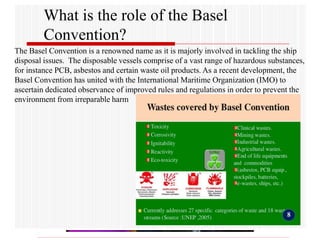
What is the role of the Basel
Convention?
The Basel Convention is a renowned name as it is majorly involved in tackling the ship
disposal issues. The disposable vessels comprise of a vast range of hazardous substances,
for instance PCB, asbestos and certain waste oil products. As a recent development, the
Basel Convention has united with the International Maritime Organization (IMO) to
ascertain dedicated observance of improved rules and regulations in order to prevent the
environment from irreparable harm
t i hi i SA b h
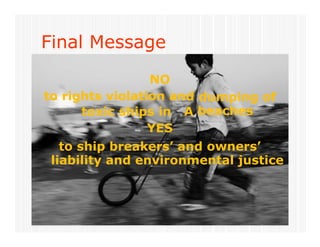
Final Message
NO
to rights violation and dumping of
beachestoxic ships in
YES
A
to ship breakers’ and owners’
liability and environmental justice
Thank you very much

Shipbreaking powerpoint

  • 1.
    WELCOME To THE PRESENTATION ON SHIPBREAKING/SCRAPPING For DYPATIL UNIVERSITY SCHOOL OF MANAGEMENT PRESENT BY RAHUL RASKARMBALS015006 AMIR KHAN MBALS015013
  • 2.
    Shipbreaking : Graveyards of ships.....
  • 3.
    i b kid li i d t i yment opportunity The reasons are……. The ship breaking and recyc ing industry in South Asia(Bangladesh, India and Pakistan) has grown over the past three decades and accounts for close to 70% of the global ship breaking industry. Source of Iron (more than 400 ships come on average) Feeding to the re-rolling mill Source of Revenue Employment opportunity Related business with SB Contribution to the National Economy † † † † † † †
  • 4.
    f l il i Features of Shipbreaking •Dirty Job (no safety equipments, no care from owners etc) •Most Hazardous Job (as per ILO) •Deal with Hazardous waste (oil spills, sludge, liquid toxic, asbestos, etc) •Tough to enforce legislation because of multi-ministerial involvements • Ship’s arrival with toxic waste •Lack of prior-decontamination and gas free, safe ship recycling plan, safe waste disposal
  • 5.
    Pollutants discharge fromship breaking a. Persistent Organic Pollutants (POP’s): Asbestos PCBs (polychlorinated Biphenyl- Compounds) Dioxins † † † † PVC (Polyvinyl Chloride) † Organotins † PAHs (Polycyclic Aromatic- Hydrocarbons) b. Heavy metals c. Oil pollution
  • 6.
    urial One Statement When Igo to shipbreaking yard of Chittagong, I take burial cloths with me……….
  • 7.
    Recent Victims ofShipbreaking More than 200 workers died in last 7 years 9 months, more than one worker died on an average per month, according to the available information.
  • 8.
    Types of Accidents †Explosionsor fire, as the ships are full of toxic gas †Suffocations by gases the toxic †Slipped and fall pieces of iron †Fall from the top of the ship
  • 9.
  • 10.
    Accumulated hazardous material amountsfrom ship breaking and recycling in Bangladesh and Pakistan, 2010-30 Hazardous material Unit Bangladesh Pakistan † † † Asbestos 79,000 tons (BD), 5,200 tons (PAK) PCBs (mainly cables) 240,000 tons (BD), 16,000 tons (PAk) ODS (mainly polyurethane foam) 210,000 tons (BD), 14,000 tons (PAK) Paints (metals, tributyltin (TBT), and PCBs) 69,200 (BD) tons, 4,550 tons (PAK) Heavy metals 678 (BD) tons, 45 (PAK) tons Waste liquid organic 1,978,000 (BD) m3, 130,000 (PAK) m3 Miscellaneous (mainly sewage) 107,000 (BD) m3, 7,000 (PAK) m3 Waste liquids inorganic (acids) 775(BD) tons, 51 (PK) tons Reusable liquids organics 675,000 (BD) tons, 44,200 (PK) tons † † † † † †
  • 11.
    Contaminated sand exposedto sea level rise in Chittagong and Gadani BEACH Slope,Length Polluted sand under new high tide(0.21–0.48 m sea level rise) Chittagong 0.05; 13 km 11,000–25,000 cubic meters GADANI 0.08; 7 km 3,500–8,100 cubic meters The estimates clearly indicate the risk of having vast amounts of sand contaminated from present and historic ship breaking activities exposed to dynamic tidal and wave action over the long term. This will also effect in the biodiversity, food chain, human health and overall eco system.
  • 12.
    Impacts climate changeon ship breaking yards and coastal areas • Sea level rise Tidal erosion of beaches Loss of beaching facility Coastal protection works • Storm surges Damage to infrastructure Yard buildings undermined and lostLoss of coastal roads Roadside shops destroyed Relocation • Higher tides Release of heavy metals, TBTs, and PCBs from yards into the coastal environments Fisheries and shrimp hatcheries poisoned Pre-emptive de-pollution or stablization of cont.areas
  • 14.
    Why its inSouth Asia…. South Asian countries are compromising their environment for certain industries such as shipbreaking and that the methods used would never be allowed in other parts of the world because of the harm done to the environment and workers. South Asian countries should stop being the dumping grounds for the industrialized countries and not compromise health and environment for some tax income or to protect the business model that benefits few people only.
  • 15.
    Sum up Yes itsContributing the country; but with huge damage of the environment Providing employment; but with risk of death Giving iron; but with the waste of west Providing food; but with night-mare of the workers’ families † † † †
  • 16.
    Factors •Sources of theships •Basel Convention •IMO Convention •Cash buyer factors •FOC •Threats •EU Regulations
  • 17.
    QUESTION AND ANSWER HowShip Dismantling is Done? Ship dismantling, also popularly referred to as “ship recycling” is a process of breaking down a ship when it competes its life tenure. As one of the ship disposal techniques, ship dismantling involves the retired ships to be stripped off their machinery, barring the value-adding materials which are rightfully reused for new ships or for other applications. The steel scraps obtained after dismantling an old ship is liquefied and used again in building new vessels. The molten steel is renovated and proves useful even for many other industries. Moreover, all other parts such as wooden furniture, glass etc. are also reused for a variety of applications.
  • 18.
    Why is ShipDismantling needed? Ship dismantling is highly necessary as the maintenance expenses of a particular vessel keep soaring with time and it becomes really difficult to handle the same. Therefore, the ship owners seek the easy way out and hand over the old vessel for effective disposal, so that they can concentrate on dealing with other regular expenses like port charges, fuel charges, and also salaries of the crew members.
  • 19.
    How is ShipBreaking carried out? The primary and the most common way to dismantle a ship is by breaking it apart into several different parts before breaking them further. On some of the biggest ship breaking yards in the world such as Alang in India, the process of dismantling starts by beaching the ship on the shore. Several ship breaking contractors have their offices and yards along the coast of Alang, Gujarat. The vessel on its final journey needs to float steadily and hit the beach of the shipping yard where it staggers and stops. Once on the shore, the engine is shut down and the anchor is dropped to make the ship steady. The ship breakers then start working after preparing a plan. At the site, the labourers pull the vessel upon the beach, with the help of strong chains, cables, and machinery systems. This is one of the most dangerous tasks of the ship dismantling process. Sometimes chains might break during the process, leading to unfortunate accidents and great harm to the labourers.
  • 20.
    Is Ship Dismantlingdangerous? Ship dismantling is regarded to be one of the most dangerous professions in the world as it involves a great amount of risks and hazards. Several guidelines and programs have been formed be tackled the consequences and control the oddities of this profession. It is definitely a Herculean task to break apart a sturdy ship as it had been built to be impregnable so as to withstand the harsh weather conditions and ocean storms and support countless tones of cargo. Many toxic ships contain dangerous substances such as asbestos, petrochemicals by products, lead, mercury, Polychlorinated Biphenyls, radium, poisons and heavy metal machinery, which are extremely harmful to humans and environment. Moreover, the workers work with the least personal protective equipment and in really rough weather and temperature conditions. The labourers are also extremely poor and desperate to earn some quick money. They are subjected to mortal perils every single day and the death toll in such ship breaking yards are rising in spite of all the precautionary measures.
  • 21.
    Where does theShip Dismantling business thrive? Due to the large availability of cheap labours in poor nations such as Bangladesh, China, Pakistan and India, ship dismantling business is thriving in these regions. Around 85 per cent of the world’s shipbreaking activities occur in these above named countries. The sites located in India are highly favourable as the shipyards offer high tidal ranges, 15- degree slopes and the coastlines are free of mud. As ships do not survive on water for more than thirty years, ship recycling becomes a necessity. Moreover, the recycled steel is a boon to the steel plants. Such graveyards in developing countries of Asia is a thriving business.
  • 22.
    How does itaffect our environment? Disassembling of vessels comes at a huge price for it causes various environmental hazards. The non-eco friendly dismantling techniques are a serious international concern and stringent regulations are implemented to prevent the disastrous consequences. Especially, the companies that engage in the beaching dismantling method, face stern opposition as beaching affects the ecosystem a lot. Interestingly, the ship disposal companies flourish in the third-world or developing nations, mainly because of the easy availability of cheap labour. Other favourable conditions may include the slackened laws when it comes to environmental protection or labour health, and the ever-increasing demand for steel. This tragic lack of definite government rules leads to an inevitable bout of pollution in such countries and the rate at which the workers are injured just keeps on increasing
  • 23.
    What is therole of the Basel Convention? The Basel Convention is a renowned name as it is majorly involved in tackling the ship disposal issues. The disposable vessels comprise of a vast range of hazardous substances, for instance PCB, asbestos and certain waste oil products. As a recent development, the Basel Convention has united with the International Maritime Organization (IMO) to ascertain dedicated observance of improved rules and regulations in order to prevent the environment from irreparable harm
  • 24.
    t i hii SA b h Final Message NO to rights violation and dumping of beachestoxic ships in YES A to ship breakers’ and owners’ liability and environmental justice
  • 25.