NPPF Policy Workshop: Infrastructure
17 September 2024 – Online 10:00 am
Please login to Slido to ask questions
and respond to polls
Slido link:
https://app.sli.do/event/gbvHxP1SbVNqU6d3E
ERZwq
Welcome
• Meet the team
• This is the fourth of our policy workshops
• Help you to frame a response
• And understand the wider context
• Been to a PAS event before?
• Frank, friendly
• Honest – we won’t have all the answers
• Interactive – please ask questions / share thoughts in the
comments – log into Slido
Adobe Stock
Agenda
• Welcome and Introduction
oSlido Polls – Your role and projects
• MHCLG Presentation – Delivering community needs
oQ and A and discussion on key consultation questions
• MHCLG presentation – Nationally Significant Infrastructure
oQ and A and discussion on key consultation questions
• Bringing it all together - Group Feedback
• Summary and Close
PAS
who are we / what do we do?
• Grant funded – MHCLG (Ministry of Housing, Communities and
Local Government)
• Part of the local government association (LGA)
• Our grant £ = supporting Local Planning Authorities (LPAs) to:
• Interpret national planning system & respond to change
• Improve and innovate plan making and decision taking
• Share ideas and examples of what works best
Housekeeping
• Opportunity to provide constructive feedback in
collaborative way
• There will be some interactive polls
• It is impossible to cover everything today - remember
this is a consultation
• We will capture, share and reflect on all of your
questions and encourage you to respond using Citizen
Space on MHCLG’s website
• We will also send you an evaluation form afterwards –
please complete this
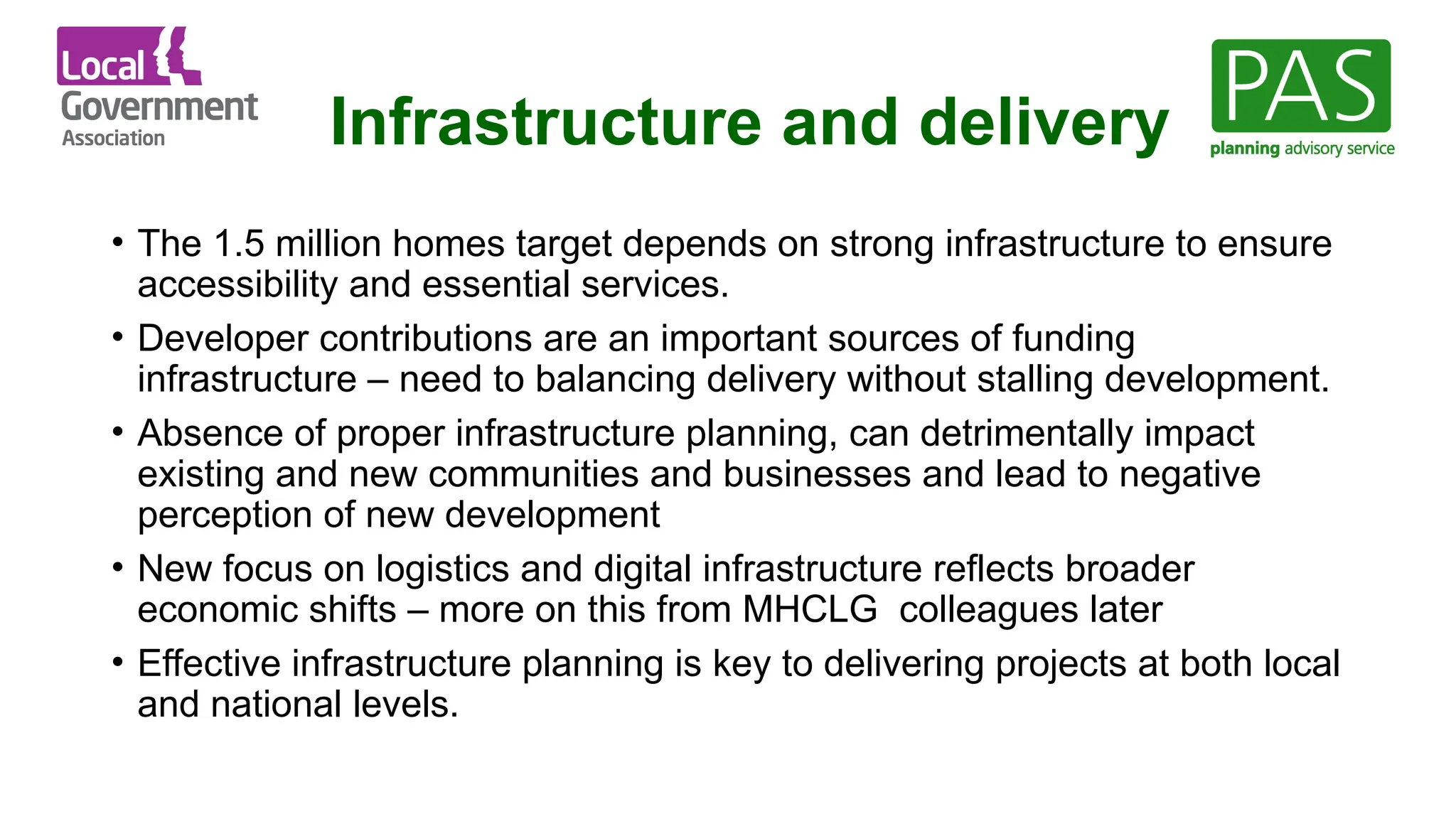
Context
• Pre-election: Labour Manifesto
• Labour Government – Five
Missions
• Planning Reform – Written
Ministerial Statement July 2024
• Housing delivery – 1.5 million
homes
Shutterstock
Infrastructure and delivery
• The 1.5 million homes target depends on strong infrastructure to ensure
accessibility and essential services.
• Developer contributions are an important sources of funding
infrastructure – need to balancing delivery without stalling development.
• Absence of proper infrastructure planning, can detrimentally impact
existing and new communities and businesses and lead to negative
perception of new development
• New focus on logistics and digital infrastructure reflects broader
economic shifts – more on this from MHCLG colleagues later
• Effective infrastructure planning is key to delivering projects at both local
and national levels.
National Infrastructure
Planning
Nationally Significant Infrastructure Projects (NSIP)
• Major infrastructure projects introduced under the 2008 Planning Act are
known as Nationally Significant Infrastructure Projects (NSIPs). Projects
are classified under six general areas of energy; transport; water;
wastewater; waste; and business and commercial.
• The thresholds which define a NSIP for each type of infrastructure are
set out in sections 15 - 30 of the Planning Act 2008.
• A Development Consent Order (DCO) is granted by relevant SoS upon
approval of a DCO application for a NSIP.
• The development consent regime is managed by PINS and underpinned
by a series of National Policy Statements (NPS).
Infrastructure and delivery
• The 1.5 million homes target depends on strong infrastructure to ensure
accessibility and essential services.
• Developer contributions are an important sources of funding
infrastructure – need to balancing delivery without stalling development.
• Absence of proper infrastructure planning, can detrimentally impact
existing and new communities and businesses and lead to negative
perception of new development
• New focus on logistics and digital infrastructure reflects broader
economic shifts – more on this from MHCLG colleagues later
• Effective infrastructure planning is key to delivering projects at both local
and national levels.
About you
Polls 1 - your role and projects
Please login to Slido to ask
questions / answer polls through
the session.
Slido link:
https://app.sli.do/event/gbvHxP1S
bVNqU6d3EERZwq
Use code: 3253773
NPPF Policy Workshop:
Meeting Community Needs
Christina Davey, Gemma Burgess, Robert Singleton
OFFICIAL
OFFICIAL
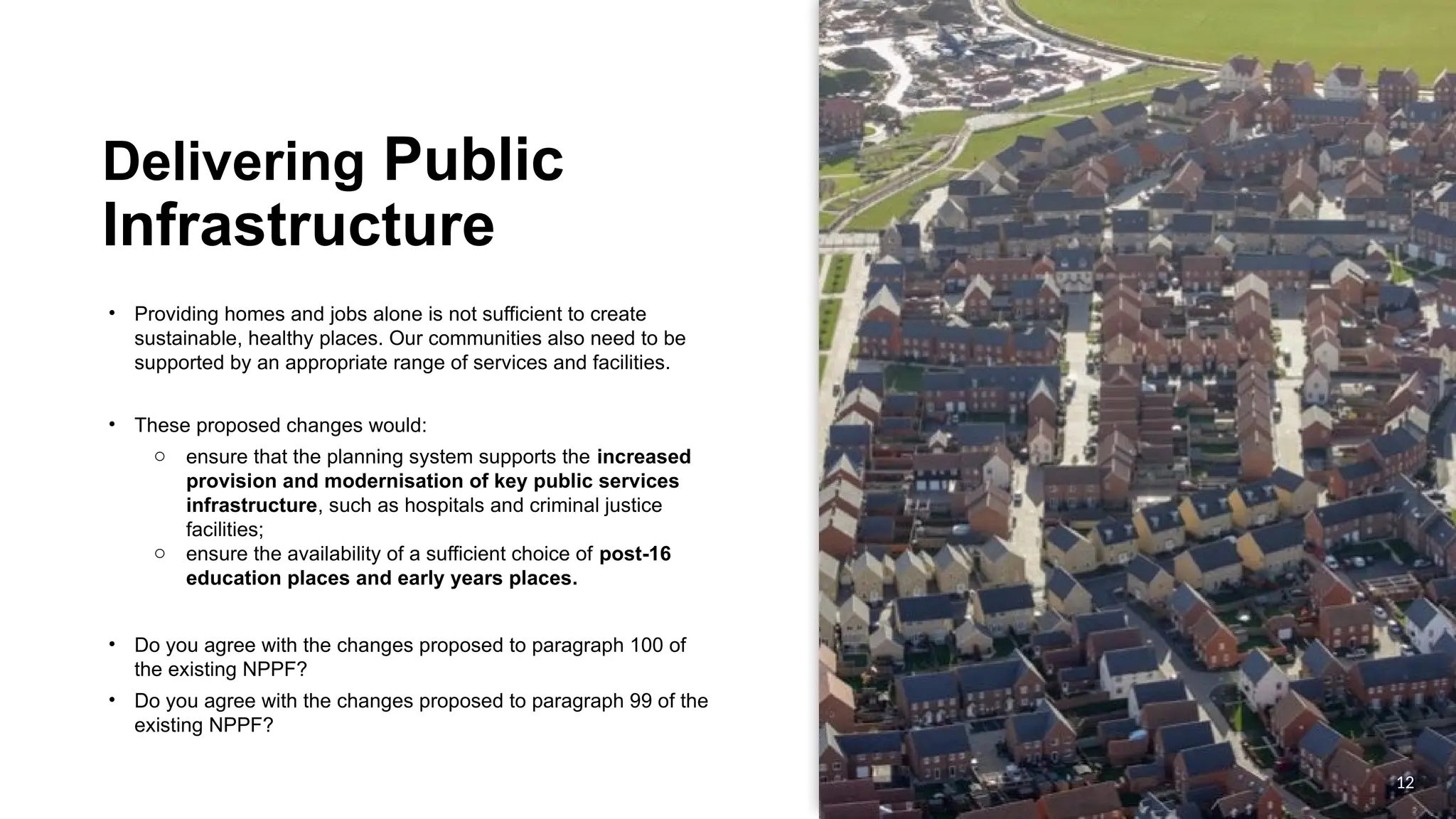
Delivering Public
Infrastructure
• Providing homes and jobs alone is not sufficient to create
sustainable, healthy places. Our communities also need to be
supported by an appropriate range of services and facilities.
• These proposed changes would:
o ensure that the planning system supports the increased
provision and modernisation of key public services
infrastructure, such as hospitals and criminal justice
facilities;
o ensure the availability of a sufficient choice of post-16
education places and early years places.
• Do you agree with the changes proposed to paragraph 100 of
the existing NPPF?
• Do you agree with the changes proposed to paragraph 99 of the
existing NPPF?
12
OFFICIAL
OFFICIAL
Vision Led Approach
to Transport Planning
• In the approach to transport planning, when assessing sites that
may be allocated for development in plans, or specific applications
for development, it should be ensured that there is safe and
suitable access to the site, the design of streets, parking areas,
other transport elements reflects current national guidance and
significant impacts from the development on the transport network
can be cost effectively mitigated to an acceptable degree
• Proposed changes to the approach to transport planning include
ensuring that there is a vision led approach to promoting
sustainable transport modes as well as considering the type of
development and its location.
• A vision-led approach to transport planning focuses on creating a
clear, inspiring vision for the future of transportation and using that
vision to guide all planning and decision-making processes.
• Do you agree with the changes proposed to paragraph 114 of the
existing NPPF?
13
OFFICIAL
OFFICIAL
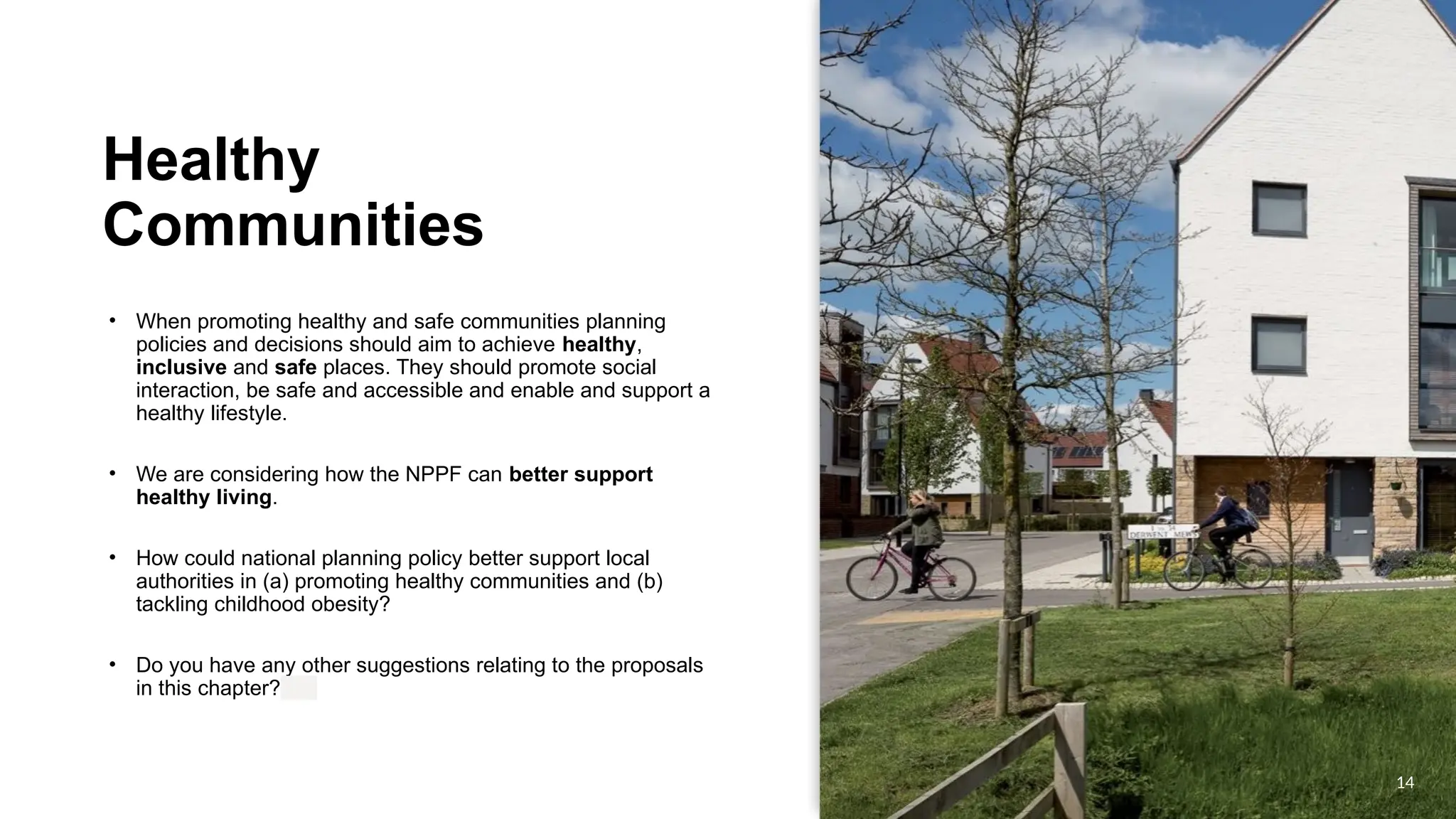
Healthy
Communities
• When promoting healthy and safe communities planning
policies and decisions should aim to achieve healthy,
inclusive and safe places. They should promote social
interaction, be safe and accessible and enable and support a
healthy lifestyle.
• We are considering how the NPPF can better support
healthy living.
• How could national planning policy better support local
authorities in (a) promoting healthy communities and (b)
tackling childhood obesity?
• Do you have any other suggestions relating to the proposals
in this chapter?
14
Questions and discussion
NPPF Policy Workshop:
National Significant Infrastructure
Suzie Willis
OFFICIAL
OFFICIAL 17
New Priorities for the NSIP system, supporting the governments Growth and Clean Energy
missions . The NSIP planning regime is not working as efficiently as needed to meet the
ambition of getting Britain building again. Expanding the NSIP regime so that it can support our
drive for cleaner energy will be dependent on making some proactive changes.
We have identified what is not working well and what can be done to improve the DCO process to meet our clean energy ambitions
as well as potentially expanding the range of major infrastructure projects entering the NSIP planning regime. As a first step in the
government's plans to reform the way the Nationally significant Infrastructure Regime applies to onshore wind, solar, data centre,
laboratories, gigafactories and water projects is a first step in the governments NSIPs reforms plans.
The governments Growth and Clean Energy missions are a major priority and delivering a set of
reforms to address some of the key issues could be potentially game changing
Introduction
OFFICIAL
OFFICIAL 18
Proposed projects falling within the fields of infrastructure covered in the Planning Act 2008 (energy, transport, water and water waste) but
below the thresholds set out in 2008 Act, the relevant SoS may , on request direct a project into the regime under S35 of the Act . Section
35 was amended in 2013 so that certain business and commercial developments (prescribed under regulations) such as offices,
sports ,leisure and tourism , which are substantial in size or have significant economic impact or are important for driving growth, could be
directed9 on request ) into the regime( subject to conditions)
Should we include data centres, gigafactories and laboratories into the NSIP consenting
planning process? Broadening the NSIP regime
Question 64: Would you support the prescription of data centres, gigafactories, and/or laboratories as types of business and commercial
development which could be capable (on request) of being directed not the NSIP consenting regime?
Question 65: If the direction power is extended to these developments ,should it be limited by scale, and what scale if so?
Question 66: Do you have any other suggestions ?
Bringing data Centre's, gigafactories and
laboratories into the NSIP planning process
OFFICIAL
OFFICIAL 19
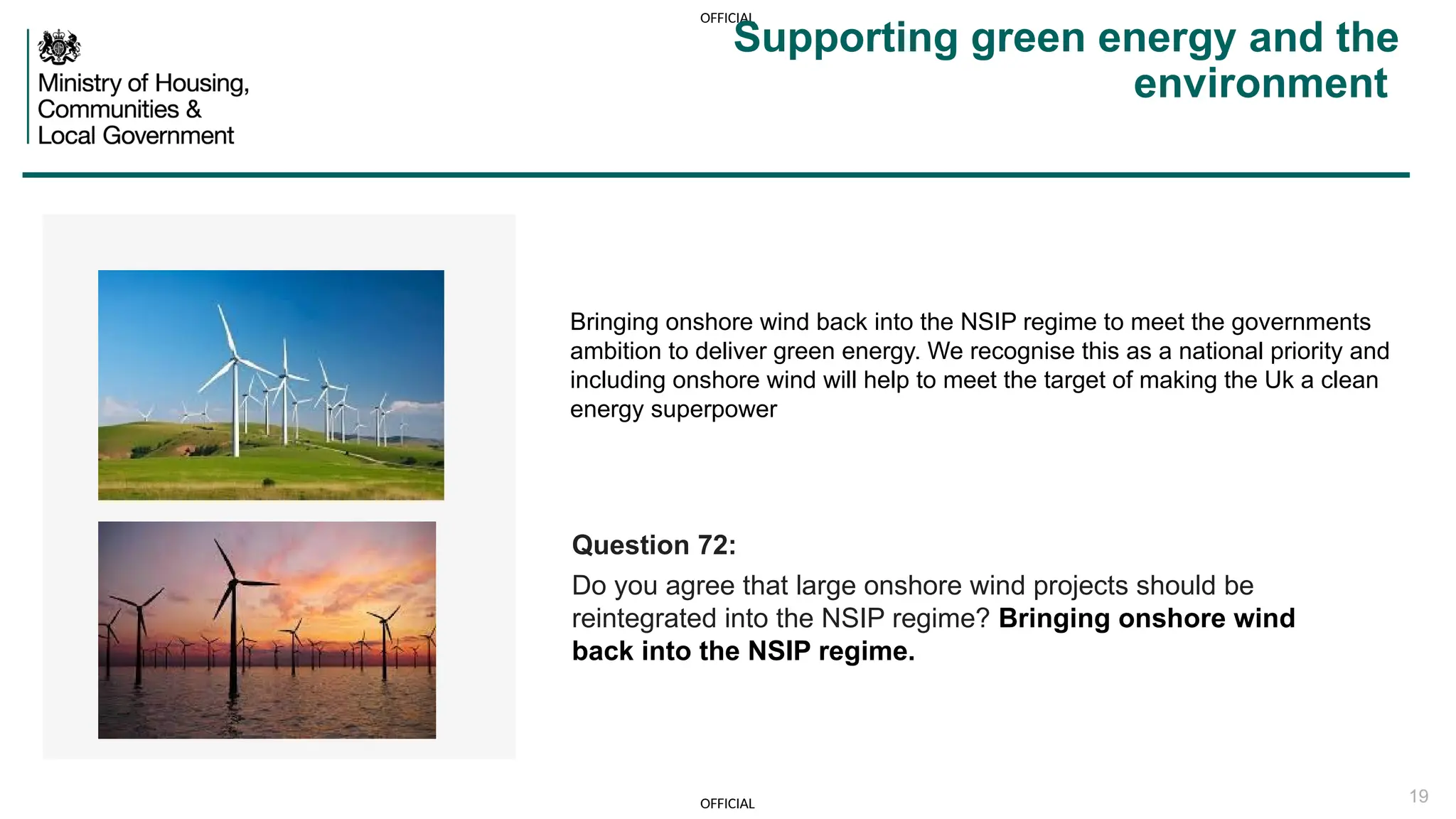
Bringing onshore wind back into the NSIP regime to meet the governments
ambition to deliver green energy. We recognise this as a national priority and
including onshore wind will help to meet the target of making the Uk a clean
energy superpower
Supporting green energy and the
environment
Question 72:
Do you agree that large onshore wind projects should be
reintegrated into the NSIP regime? Bringing onshore wind
back into the NSIP regime.
OFFICIAL
OFFICIAL 20
Supporting renewable deployment
HEX #00625E White C0 M0 Y0 K0
R255 G255 B255
HEX #000000
Question 76:
Do you agree that the threshold
at which solar projects are
deemed to be Nationally
Significant and therefore
consented by the NSIP regime
should be changed from 50MW to
150MW
Question 75:
Question 75:
Do you agree that the
threshold at which onshore
wind projects are deemed to
be Nationally significant and
therefore consented under
the NSIP regime should be
changed from 50
megawatts(MW) to 100MW
Question 77:
If you think that alternative thresholds should apply
to onshore wind and/or solar, what would these be?
OFFICIAL
OFFICIAL 21
There is currently no statutory requirement that enable local
authorities to recover costs for the specialist advice they
provide to applicants at various stages of the DCO process.
We are considering whether to make a provision to allow host
upper and lower tier( or unitary ) local authorities to have the
power to recover costs for relevant services provided in
relation to applications and proposed applications for
development consent under the PA2008, using the power of
section 54A of the Act.
Question 98: do you consider that cost recovery for
relevant services provided by local authorities in
relation to applications for development consent
orders under the Planning Act 2008 ,payable by
applicants should be introduced ?
Introducing cost recovery for local authorities related to NSIP
Questions and discussion
Bringing it all together
Supporting councils with
infrastructure planning
Governance of developer contributions:
• Over the last few years, PAS have worked with councils to improve governance related to
developer contributions https://www.local.gov.uk/pas/topics/developer-contributions
Looking ahead:
• Focusing on updating guidance for councils on developing Infrastructure Delivery Plans
(IDPs)
• Exploring UK Infrastructure – Publishing an information matrix of infrastructure types,
permission processes and funding routes
• Developing a Model IDP for councils to use
Embracing digital:
• Exploring digital solutions to better store and present infrastructure data and engage with
infrastructure providers
Our Vision for Infrastructure
Delivery Plans (IDPs)
Working with councils:
• Collaborating with councils who are developing or updating their IDPs to shape
our guidance
• Councils of different scales, type and geography and at least one group of
authorities who are looking at joint IDP working
A true delivery document:
• We want IDPs to be more than a wish list—helping councils turn them into a
deliverable strategy to support development and update more easily
Engaging with infrastructure providers:
• Enhancing collaboration with providers for better delivery
NSIP local authority
network
• Brings together LA officers
to share information,
experience & best practice
• Provides a direct link
between national and local
government practitioners
• Builds local capacity and
aims to “normalise” NSIPs
• Network of over 40 authorities and
100 plus practitioners
• Agreed a position statement and
key areas for reform
• Sharing lessons from Innovation &
Capacity Fund
• Deep dives into cost recovery,
community engagement, LA
organisation and structures
• Building links with key stakeholders
– PINS, DESNZ, SEUK, NIC, ESO
Your feedback
Polls 2 – your experience and
views on some questions
Please login to Slido again to
answer a couple more polls
Slido link:
https://app.sli.do/event/gbvHxP1S
bVNqU6d3EERZwq
Use code: 3253773
Summary and Close
NPPF Consultation
Closes 24 September 2024
Thank you! 

NPPF Deep Dive: Infrastructure September 2024

  • 1.
    NPPF Policy Workshop:Infrastructure 17 September 2024 – Online 10:00 am Please login to Slido to ask questions and respond to polls Slido link: https://app.sli.do/event/gbvHxP1SbVNqU6d3E ERZwq
  • 2.
    Welcome • Meet theteam • This is the fourth of our policy workshops • Help you to frame a response • And understand the wider context • Been to a PAS event before? • Frank, friendly • Honest – we won’t have all the answers • Interactive – please ask questions / share thoughts in the comments – log into Slido Adobe Stock
  • 3.
    Agenda • Welcome andIntroduction oSlido Polls – Your role and projects • MHCLG Presentation – Delivering community needs oQ and A and discussion on key consultation questions • MHCLG presentation – Nationally Significant Infrastructure oQ and A and discussion on key consultation questions • Bringing it all together - Group Feedback • Summary and Close
  • 4.
    PAS who are we/ what do we do? • Grant funded – MHCLG (Ministry of Housing, Communities and Local Government) • Part of the local government association (LGA) • Our grant £ = supporting Local Planning Authorities (LPAs) to: • Interpret national planning system & respond to change • Improve and innovate plan making and decision taking • Share ideas and examples of what works best
  • 5.
    Housekeeping • Opportunity toprovide constructive feedback in collaborative way • There will be some interactive polls • It is impossible to cover everything today - remember this is a consultation • We will capture, share and reflect on all of your questions and encourage you to respond using Citizen Space on MHCLG’s website • We will also send you an evaluation form afterwards – please complete this
  • 6.
    Context • Pre-election: LabourManifesto • Labour Government – Five Missions • Planning Reform – Written Ministerial Statement July 2024 • Housing delivery – 1.5 million homes Shutterstock
  • 7.
    Infrastructure and delivery •The 1.5 million homes target depends on strong infrastructure to ensure accessibility and essential services. • Developer contributions are an important sources of funding infrastructure – need to balancing delivery without stalling development. • Absence of proper infrastructure planning, can detrimentally impact existing and new communities and businesses and lead to negative perception of new development • New focus on logistics and digital infrastructure reflects broader economic shifts – more on this from MHCLG colleagues later • Effective infrastructure planning is key to delivering projects at both local and national levels.
  • 8.
    National Infrastructure Planning Nationally SignificantInfrastructure Projects (NSIP) • Major infrastructure projects introduced under the 2008 Planning Act are known as Nationally Significant Infrastructure Projects (NSIPs). Projects are classified under six general areas of energy; transport; water; wastewater; waste; and business and commercial. • The thresholds which define a NSIP for each type of infrastructure are set out in sections 15 - 30 of the Planning Act 2008. • A Development Consent Order (DCO) is granted by relevant SoS upon approval of a DCO application for a NSIP. • The development consent regime is managed by PINS and underpinned by a series of National Policy Statements (NPS).
  • 9.
    Infrastructure and delivery •The 1.5 million homes target depends on strong infrastructure to ensure accessibility and essential services. • Developer contributions are an important sources of funding infrastructure – need to balancing delivery without stalling development. • Absence of proper infrastructure planning, can detrimentally impact existing and new communities and businesses and lead to negative perception of new development • New focus on logistics and digital infrastructure reflects broader economic shifts – more on this from MHCLG colleagues later • Effective infrastructure planning is key to delivering projects at both local and national levels.
  • 10.
    About you Polls 1- your role and projects Please login to Slido to ask questions / answer polls through the session. Slido link: https://app.sli.do/event/gbvHxP1S bVNqU6d3EERZwq Use code: 3253773
  • 11.
    NPPF Policy Workshop: MeetingCommunity Needs Christina Davey, Gemma Burgess, Robert Singleton
  • 12.
    OFFICIAL OFFICIAL Delivering Public Infrastructure • Providinghomes and jobs alone is not sufficient to create sustainable, healthy places. Our communities also need to be supported by an appropriate range of services and facilities. • These proposed changes would: o ensure that the planning system supports the increased provision and modernisation of key public services infrastructure, such as hospitals and criminal justice facilities; o ensure the availability of a sufficient choice of post-16 education places and early years places. • Do you agree with the changes proposed to paragraph 100 of the existing NPPF? • Do you agree with the changes proposed to paragraph 99 of the existing NPPF? 12
  • 13.
    OFFICIAL OFFICIAL Vision Led Approach toTransport Planning • In the approach to transport planning, when assessing sites that may be allocated for development in plans, or specific applications for development, it should be ensured that there is safe and suitable access to the site, the design of streets, parking areas, other transport elements reflects current national guidance and significant impacts from the development on the transport network can be cost effectively mitigated to an acceptable degree • Proposed changes to the approach to transport planning include ensuring that there is a vision led approach to promoting sustainable transport modes as well as considering the type of development and its location. • A vision-led approach to transport planning focuses on creating a clear, inspiring vision for the future of transportation and using that vision to guide all planning and decision-making processes. • Do you agree with the changes proposed to paragraph 114 of the existing NPPF? 13
  • 14.
    OFFICIAL OFFICIAL Healthy Communities • When promotinghealthy and safe communities planning policies and decisions should aim to achieve healthy, inclusive and safe places. They should promote social interaction, be safe and accessible and enable and support a healthy lifestyle. • We are considering how the NPPF can better support healthy living. • How could national planning policy better support local authorities in (a) promoting healthy communities and (b) tackling childhood obesity? • Do you have any other suggestions relating to the proposals in this chapter? 14
  • 15.
  • 16.
    NPPF Policy Workshop: NationalSignificant Infrastructure Suzie Willis
  • 17.
    OFFICIAL OFFICIAL 17 New Prioritiesfor the NSIP system, supporting the governments Growth and Clean Energy missions . The NSIP planning regime is not working as efficiently as needed to meet the ambition of getting Britain building again. Expanding the NSIP regime so that it can support our drive for cleaner energy will be dependent on making some proactive changes. We have identified what is not working well and what can be done to improve the DCO process to meet our clean energy ambitions as well as potentially expanding the range of major infrastructure projects entering the NSIP planning regime. As a first step in the government's plans to reform the way the Nationally significant Infrastructure Regime applies to onshore wind, solar, data centre, laboratories, gigafactories and water projects is a first step in the governments NSIPs reforms plans. The governments Growth and Clean Energy missions are a major priority and delivering a set of reforms to address some of the key issues could be potentially game changing Introduction
  • 18.
    OFFICIAL OFFICIAL 18 Proposed projectsfalling within the fields of infrastructure covered in the Planning Act 2008 (energy, transport, water and water waste) but below the thresholds set out in 2008 Act, the relevant SoS may , on request direct a project into the regime under S35 of the Act . Section 35 was amended in 2013 so that certain business and commercial developments (prescribed under regulations) such as offices, sports ,leisure and tourism , which are substantial in size or have significant economic impact or are important for driving growth, could be directed9 on request ) into the regime( subject to conditions) Should we include data centres, gigafactories and laboratories into the NSIP consenting planning process? Broadening the NSIP regime Question 64: Would you support the prescription of data centres, gigafactories, and/or laboratories as types of business and commercial development which could be capable (on request) of being directed not the NSIP consenting regime? Question 65: If the direction power is extended to these developments ,should it be limited by scale, and what scale if so? Question 66: Do you have any other suggestions ? Bringing data Centre's, gigafactories and laboratories into the NSIP planning process
  • 19.
    OFFICIAL OFFICIAL 19 Bringing onshorewind back into the NSIP regime to meet the governments ambition to deliver green energy. We recognise this as a national priority and including onshore wind will help to meet the target of making the Uk a clean energy superpower Supporting green energy and the environment Question 72: Do you agree that large onshore wind projects should be reintegrated into the NSIP regime? Bringing onshore wind back into the NSIP regime.
  • 20.
    OFFICIAL OFFICIAL 20 Supporting renewabledeployment HEX #00625E White C0 M0 Y0 K0 R255 G255 B255 HEX #000000 Question 76: Do you agree that the threshold at which solar projects are deemed to be Nationally Significant and therefore consented by the NSIP regime should be changed from 50MW to 150MW Question 75: Question 75: Do you agree that the threshold at which onshore wind projects are deemed to be Nationally significant and therefore consented under the NSIP regime should be changed from 50 megawatts(MW) to 100MW Question 77: If you think that alternative thresholds should apply to onshore wind and/or solar, what would these be?
  • 21.
    OFFICIAL OFFICIAL 21 There iscurrently no statutory requirement that enable local authorities to recover costs for the specialist advice they provide to applicants at various stages of the DCO process. We are considering whether to make a provision to allow host upper and lower tier( or unitary ) local authorities to have the power to recover costs for relevant services provided in relation to applications and proposed applications for development consent under the PA2008, using the power of section 54A of the Act. Question 98: do you consider that cost recovery for relevant services provided by local authorities in relation to applications for development consent orders under the Planning Act 2008 ,payable by applicants should be introduced ? Introducing cost recovery for local authorities related to NSIP
  • 22.
  • 23.
  • 24.
    Supporting councils with infrastructureplanning Governance of developer contributions: • Over the last few years, PAS have worked with councils to improve governance related to developer contributions https://www.local.gov.uk/pas/topics/developer-contributions Looking ahead: • Focusing on updating guidance for councils on developing Infrastructure Delivery Plans (IDPs) • Exploring UK Infrastructure – Publishing an information matrix of infrastructure types, permission processes and funding routes • Developing a Model IDP for councils to use Embracing digital: • Exploring digital solutions to better store and present infrastructure data and engage with infrastructure providers
  • 25.
    Our Vision forInfrastructure Delivery Plans (IDPs) Working with councils: • Collaborating with councils who are developing or updating their IDPs to shape our guidance • Councils of different scales, type and geography and at least one group of authorities who are looking at joint IDP working A true delivery document: • We want IDPs to be more than a wish list—helping councils turn them into a deliverable strategy to support development and update more easily Engaging with infrastructure providers: • Enhancing collaboration with providers for better delivery
  • 26.
    NSIP local authority network •Brings together LA officers to share information, experience & best practice • Provides a direct link between national and local government practitioners • Builds local capacity and aims to “normalise” NSIPs • Network of over 40 authorities and 100 plus practitioners • Agreed a position statement and key areas for reform • Sharing lessons from Innovation & Capacity Fund • Deep dives into cost recovery, community engagement, LA organisation and structures • Building links with key stakeholders – PINS, DESNZ, SEUK, NIC, ESO
  • 27.
    Your feedback Polls 2– your experience and views on some questions Please login to Slido again to answer a couple more polls Slido link: https://app.sli.do/event/gbvHxP1S bVNqU6d3EERZwq Use code: 3253773
  • 28.
    Summary and Close NPPFConsultation Closes 24 September 2024 Thank you! 

Editor's Notes

  • #26 The key roles of PAS are two-fold:   To inform the DLUHC reforms programme with intelligence and experience from local authority practitioners, ie create opportunities for council officers to reflect on their work, engage directly with DLUHC and communicate their own views/insights; and To help build local authority capacity on NSIPs and the DCO process, ie introduce new local authorities to NSIPs and NSIP network, identify good practice in local authorities and roll this out more widely. NSIPS ARE GROWING – CAN WE NORMALISE AND MAINSTREAM, MAKE THEM PART OF EVERY DAY PLANNING LIFE?? We did a lot last year - wont go through it, but started to evolve how we work …. grown from 43 officers representing 26 councils to over 90 officers representing nearly 40 councils, bigger range in terms of type and geography of LA. Helped us to speak with authority on behalf of LA sector eg position statement and discussions with DLUHC/OGDs Agreed to focus on a number of issues and topics, started to go into more detail on these with Deep Dives type format ie issue-based meetings with internal and speakers on key subjects Really good relationship with MHCLG, but seeing support from colleagues in PINS, DESNZ and making links to other stakeholders
  • #27 Use Slido to run 3 and briefly reflect on results: Role/job of participants (eg policy, DM, major projects, etc) Are you preparing an IDP now or in near future? Are you a host or neighbouring authority for NSIPs?