FOCUS / SHIFT
FROM CONVENTIONAL TO ISLAMIC BANKING
AMIR ALFATAKH YUSOF
ISLAMIC BANKING
SPEAKER PROFILE
1. Started in Conventional Banking Sales for OCBC Bank Retail, Business Banking and
Corporate Banking, Kuala Lumpur Main Branch (1997-2003)
2. Grabbed opportunity to become OCBC Bank Islamic Banking Windows (IBW) Product
Developer (2003-2005)
3. Led the Islamic Banking Personal Financial Services to build business (2005-2006)
4. Jumped : Kuwait Finance House (2007), ABN AMRO for IBW (2007-2008), Al-Khaliji
Commercial Bank Qatar (2009-2011), AmIslamic Bank (2011-2012), Standard
Chartered Saadiq (2012-2015)
5. Now Acting Country Head for IBW UOB Bank (2016-Present), recently launched IBW
business (July 2016)
6. Committee Member of AIBIM’s Qard WG, Investment Account WG, Tawarruq WG.
Industry awareness task-force for BNM. IBFIM trainer (Deposits & Financing products).
7. Maintains a free-to-use website Islamic Bankers Resource Centre
(http://islamicbankers.me)
AMIR ALFATAKH
UITM, HULL (UK), IIUM
INTRODUCTION TO ISLAMIC
BANKING INDUSTRY
OUTLOOK BEYOND 2017
INTRODUCTION
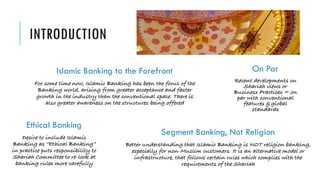
On Par
Recent developments on
Shariah views or
Business Practices = on
par with conventional
features & global
standards
Islamic Banking to the Forefront
For some time now, Islamic Banking has been the focus of the
Banking world, arising from greater acceptance and faster
growth in the industry than the conventional space. There is
also greater awareness on the structures being offered
Ethical Banking
Desire to include Islamic
Banking as “Ethical Banking”
in practice puts responsibility to
Shariah Committee to re-look at
banking rules more carefully
Segment Banking, Not Religion
Better understanding that Islamic Banking is NOT religion banking,
especially for non-Muslim customers. It is an alternative model or
infrastructure, that follows certain rules which complies with the
requirements of the Shariah
THE GLOBAL ARENA
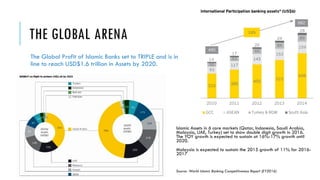
Islamic Assets in 6 core markets (Qatar, Indonesia, Saudi Arabia,
Malaysia, UAE, Turkey) set to show double digit growth in 2016.
The YOY growth is expected to sustain at 16%-17% growth until
2020.
Malaysia is expected to sustain the 2015 growth of 11% for 2016-
2017
Source: World Islamic Banking Competitiveness Report (EY2016)
The Global Profit of Islamic Banks set to TRIPLE and is in
line to reach USD$1.6 trillion in Assets by 2020.
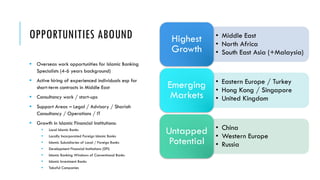
OPPORTUNITIES ABOUND • Middle East
• North Africa
• South East Asia (+Malaysia)
Highest
Growth
• Eastern Europe / Turkey
• Hong Kong / Singapore
• United Kingdom
Emerging
Markets
• China
• Western Europe
• Russia
Untapped
Potential
§ Overseas work opportunities for Islamic Banking
Specialists (4-6 years background)
§ Active hiring of experienced individuals esp for
short-term contracts in Middle East
§ Consultancy work / start-ups
§ Support Areas – Legal / Advisory / Shariah
Consultancy / Operations / IT
§ Growth in Islamic Financial Institutions:
§ Local Islamic Banks
§ Locally Incorporated Foreign Islamic Banks
§ Islamic Subsidiaries of Local / Foreign Banks
§ Development Financial Institutions (DFI)
§ Islamic Banking Windows of Conventional Banks
§ Islamic Investment Banks
§ Takaful Companies
GROWTH OF ISLAMIC
BANKING
BECOMING AN ISLAMIC
BANKING HUB
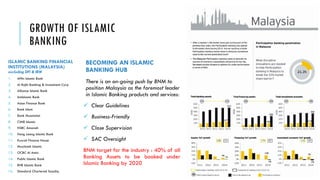
There is an on-going push by BNM to
position Malaysia as the foremost leader
in Islamic Banking products and services:
ü Clear Guidelines
ü Business-Friendly
ü Close Supervision
ü SAC Oversight
BNM target for the industry : 40% of all
Banking Assets to be booked under
Islamic Banking by 2020
ISLAMIC BANKING FINANCIAL
INSTITUTIONS (MALAYSIA)
excluding DFI & IBW
1. Affin Islamic Bank
2. Al Rajhi Banking & Investment Corp
3. Alliance Islamic Bank
4. AmIslamic Bank
5. Asian Finance Bank
6. Bank Islam
7. Bank Muamalat
8. CIMB Islamic
9. HSBC Amanah
10. Hong Leong Islamic Bank
11. Kuwait Finance House
12. Maybank Islamic
13. OCBC Al Amin
14. Public Islamic Bank
15. RHB Islamic Bank
16. Standard Chartered Saadiq
BUT WHY IS ISLAMIC BANKING GROWING?
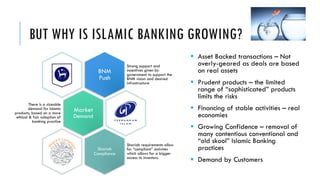
BNM
Push
Strong support and
incentives given by
government to support the
BNM vision and desired
infrastructure
Market
Demand
There is a sizeable
demand for Islamic
products, based on a more
ethical & fair adoption of
banking practice
Shariah
Compliance
Shariah requirements allow
for “compliant” activites
which allows for a bigger
access to investors.
§ Asset Backed transactions – Not
overly-geared as deals are based
on real assets
§ Prudent products – the limited
range of “sophisticated” products
limits the risks
§ Financing of stable activities – real
economies
§ Growing Confidence – removal of
many contentious conventional and
“old skool” Islamic Banking
practices
§ Demand by Customers
DEMAND BY THE CUSTOMERS
MUSLIM CUSTOMERS
i. Greater awareness of Shariah
requirements in Banking
ii. Comfort of being involved in
Shariah-compliant businesses only
iii. Good measure of fairness
iv. Prefers “simple to use” products
NON-MUSLIM CUSTOMERS
i. Attractive features of Islamic
Products (at par)
ii. Reasonable treatment for penalties
on their financing
iii. Fair terms and conditions = maximise
financial benefits
iv. No inclination to religion, just on
features and benefits
FUN FACT : ON AVERAGE, NON-MUSLIMS MAKES UP TO 80% OF CUSTOMERS-BASE FOR ISLAMIC BANKING
11%
54%
35%
Non-Muslims
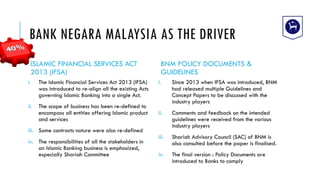
BANK NEGARA MALAYSIA AS THE DRIVER
ISLAMIC FINANCIAL SERVICES ACT
2013 (IFSA)
i. The Islamic Financial Services Act 2013 (IFSA)
was introduced to re-align all the existing Acts
governing Islamic Banking into a single Act.
ii. The scope of business has been re-defined to
encompass all entities offering Islamic product
and services
iii. Some contracts nature were also re-defined
iv. The responsibilities of all the stakeholders in
an Islamic Banking business is emphasized,
especially Shariah Committee
BNM POLICY DOCUMENTS &
GUIDELINES
i. Since 2013 when IFSA was introduced, BNM
had released multiple Guidelines and
Concept Papers to be discussed with the
industry players
ii. Comments and feedback on the intended
guidelines were received from the various
industry players
iii. Shariah Advisory Council (SAC) of BNM is
also consulted before the paper is finalised.
iv. The final version : Policy Documents are
introduced to Banks to comply
BRIDGING THE GAP
CONVERSION TO ISLAMIC BANKS
ROAD TO COMPLIANCE
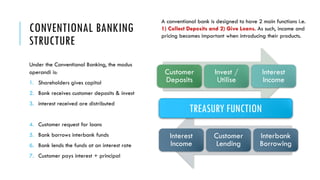
CONVENTIONAL BANKING
STRUCTURE
Customer
Deposits
Invest /
Utilise
Interest
Income
Under the Conventional Banking, the modus
operandi is:
1. Shareholders gives capital
2. Bank receives customer deposits & invest
3. interest received are distributed
4. Customer request for loans
5. Bank borrows interbank funds
6. Bank lends the funds at an interest rate
7. Customer pays interest + principal
Interest
Income
Customer
Lending
Interbank
Borrowing
TREASURY FUNCTION
A conventional bank is designed to have 2 main functions i.e.
1) Collect Deposits and 2) Give Loans. As such, income and
pricing becomes important when introducing their products.
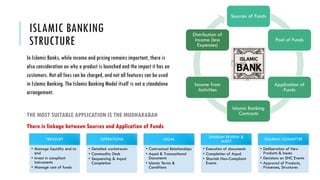
ISLAMIC BANKING
STRUCTURE
In Islamic Banks, while income and pricing remains important, there is
also consideration on why a product is launched and the impact it has on
customers. Not all fees can be charged, and not all features can be used
in Islamic Banking. The Islamic Banking Model itself is not a standalone
arrangement.
THE MOST SUITABLE APPLICATION IS THE MUDHARABAH
There is linkage between Sources and Application of Funds
Sources of Funds
Pool of Funds
Application of
Funds
Islamic Banking
Contracts
Income from
Activities
Distribution of
Income (less
Expenses)
TREASURY
• Manage liquidity end to
end
• Invest in compliant
instruments
• Manage cost of funds
OPERATIONS
• Detailed workstream
• Commodity Desk
• Sequencing & Aqad
Completion
LEGAL
• Contractual Relationships
• Aqad & Transactional
Documents
• Islamic Terms &
Conditions
SHARIAH REVIEW &
AUDIT
• Execution of documents
• Completion of Aqad
• Shariah Non-Compliant
Events
SHARIAH COMMITTEE
• Deliberation of New
Products & Issues
• Decisions on SNC Events
• Approval of Products,
Processes, Structures
CONVERSION TYPES
Infrastructure: Conventional
Bank
Description: Islamic Banking
products offered via
Conventional Banking channels
Advantage: Low cost, existing
infrastructure
Disadvantage: Dependent on
Conventional Bank
Conversion Complexity: Low.
Windows
Infrastructure: Islamic
Subsidiary leveraged on
Conventional Bank (parent)
Description: Islamic Banking
products offered via
Conventional Banking channels
& Standalone Branches
Advantage: Medium cost,
existing infrastructure.
Independent Management
Disadvantage: High cost to set
up Islamic Branches
Conversion Complexity: High
Subsidiary
Infrastructure: Islamic Bank
Description: Islamic Banking
products offered via Islamic
Banking channels
Advantage: Standalone
Management & Banking
Infrastructure.
Disadvantage: High Operating
costs
Conversion Complexity: Medium
Full Fledged
ISLAMIC BANKING
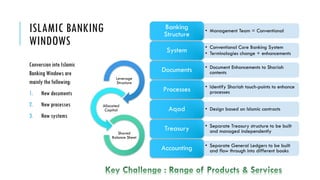
WINDOWS
• Management Team = Conventional
Banking
Structure
• Conventional Core Banking System
• Terminologies change + enhancementsSystem
• Document Enhancements to Shariah
contentsDocuments
• Identify Shariah touch-points to enhance
processesProcesses
• Design based on Islamic contractsAqad
• Separate Treasury structure to be built
and managed independentlyTreasury
• Separate General Ledgers to be built
and flow through into different booksAccounting
Conversion into Islamic
Banking Windows are
mainly the following:
1. New documents
2. New processes
3. New systems
Leverage
Structure
Allocated
Capital
Shared
Balance Sheet
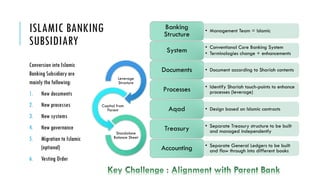
ISLAMIC BANKING
SUBSIDIARY
• Management Team = Islamic
Banking
Structure
• Conventional Core Banking System
• Terminologies change + enhancementsSystem
• Document according to Shariah contentsDocuments
• Identify Shariah touch-points to enhance
processes (leverage)Processes
• Design based on Islamic contractsAqad
• Separate Treasury structure to be built
and managed independentlyTreasury
• Separate General Ledgers to be built
and flow through into different booksAccounting
Conversion into Islamic
Banking Subsidiary are
mainly the following:
1. New documents
2. New processes
3. New systems
4. New governance
5. Migration to Islamic
(optional)
6. Vesting Order
Leverage
Structure
Capital from
Parent
Standalone
Balance Sheet
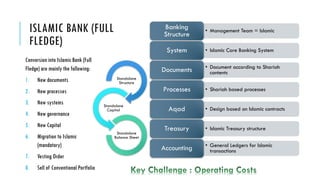
ISLAMIC BANK (FULL
FLEDGE)
• Management Team = Islamic
Banking
Structure
• Islamic Core Banking SystemSystem
• Document according to Shariah
contentsDocuments
• Shariah based processesProcesses
• Design based on Islamic contractsAqad
• Islamic Treasury structureTreasury
• General Ledgers for Islamic
transactionsAccounting
Standalone
Structure
Standalone
Capital
Standalone
Balance Sheet
Conversion into Islamic Bank (Full
Fledge) are mainly the following:
1. New documents
2. New processes
3. New systems
4. New governance
5. New Capital
6. Migration to Islamic
(mandatory)
7. Vesting Order
8. Sell of Conventional Portfolio
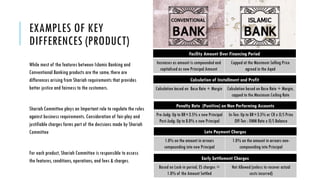
EXAMPLES OF KEY
DIFFERENCES (PRODUCT)
While most of the features between Islamic Banking and
Conventional Banking products are the same, there are
differences arising from Shariah requirements that provides
better justice and fairness to the customers.
Shariah Committee plays an Important role to regulate the rules
against business requirements. Consideration of fair-play and
justifiable charges forms part of the decisions made by Shariah
Committee
For each product, Shariah Committee is responsible to assess
the features, conditions, operations, and fees & charges.
Calculation of Installment and Profit
Calculation based on Base Rate + Margin Calculation based on Base Rate + Margin,
capped to the Maximum Ceiling Rate
Facility Amount Over Financing Period
Increases as amount is compounded and
capitalised as new Principal Amount
Capped at the Maximum Selling Price
agreed in the Aqad
Early Settlement Charges
Based on Lock-in period, ES charges =
1.0% of the Amount Settled
Not Allowed (unless to recover actual
costs incurred)
Penalty Rate (Punitive) on Non Performing Accounts
Pre-Judg: Up to BR+3.5% x new Principal
Post-Judg: Up to 8.0% x new Principal
In-Ten: Up to BR+3.5% or CR x O/S Princ
Off-Ten : IIMM Rate x O/S Balance
Late Payment Charges
1.0% on the amount in arrears
compounding into new Principal
1.0% on the amount in arrears non-
compounding into Principal
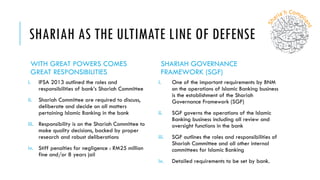
SHARIAH AS THE ULTIMATE LINE OF DEFENSE
WITH GREAT POWERS COMES
GREAT RESPONSIBILITIES
i. IFSA 2013 outlined the roles and
responsibilities of bank’s Shariah Committee
ii. Shariah Committee are required to discuss,
deliberate and decide on all matters
pertaining Islamic Banking in the bank
iii. Responsibility is on the Shariah Committee to
make quality decisions, backed by proper
research and robust deliberations
iv. Stiff penalties for negligence : RM25 million
fine and/or 8 years jail
SHARIAH GOVERNANCE
FRAMEWORK (SGF)
i. One of the important requirements by BNM
on the operations of Islamic Banking business
is the establishment of the Shariah
Governance Framework (SGF)
ii. SGF governs the operations of the Islamic
Banking business including all review and
oversight functions in the bank
iii. SGF outlines the roles and responsibilities of
Shariah Committee and all other internal
committees for Islamic Banking
iv. Detailed requirements to be set by bank.
CHALLENGES AND ISSUES MAKING THINGS WORK
WITHOUT COMPROMISE
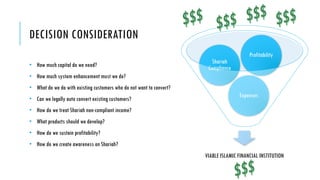
DECISION CONSIDERATION
VIABLE ISLAMIC FINANCIAL INSTITUTION
Expenses
Shariah
Compliance
Profitability
• How much capital do we need?
• How much system enhancement must we do?
• What do we do with existing customers who do not want to convert?
• Can we legally auto convert existing customers?
• How do we treat Shariah non-compliant income?
• What products should we develop?
• How do we sustain profitability?
• How do we create awareness on Shariah?
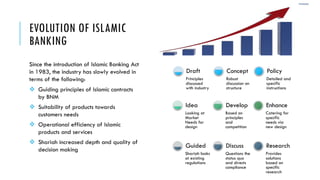
EVOLUTION OF ISLAMIC
BANKING
Since the introduction of Islamic Banking Act
in 1983, the industry has slowly evolved in
terms of the following:
v Guiding principles of Islamic contracts
by BNM
v Suitability of products towards
customers needs
v Operational efficiency of Islamic
products and services
v Shariah increased depth and quality of
decision making
Principles
discussed
with industry
Draft
Robust
discussion on
structure
Concept
Detailed and
specific
instructions
Policy
Looking at
Market
Needs for
design
Idea
Based on
principles
and
competition
Develop
Catering for
specific
needs via
new design
Enhance
Shariah looks
at existing
regulations
Guided
Questions the
status quo
and directs
compliance
Discuss
Provides
solutions
based on
specific
research
Research
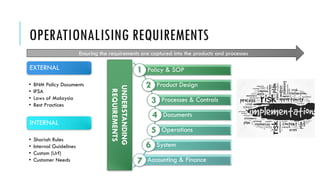
OPERATIONALISING REQUIREMENTS
EXTERNAL
• BNM Policy Documents
• IFSA
• Laws of Malaysia
• Best Practices
INTERNAL
• Shariah Rules
• Internal Guidelines
• Custom (Urf)
• Customer Needs
UNDERSTANDING
REQUIREMENTS
Policy & SOP
Product Design
Processes & Controls
Documents
Operations
System
Accounting & Finance
Ensuring the requirements are captured into the products and processes
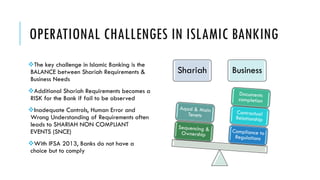
OPERATIONAL CHALLENGES IN ISLAMIC BANKING
vThe key challenge in Islamic Banking is the
BALANCE between Shariah Requirements &
Business Needs
vAdditional Shariah Requirements becomes a
RISK for the Bank if fail to be observed
vInadequate Controls, Human Error and
Wrong Understanding of Requirements often
leads to SHARIAH NON COMPLIANT
EVENTS (SNCE)
vWith IFSA 2013, Banks do not have a
choice but to comply
Shariah Business
SUMMARY Strong push from BNM for Islamic Hub
Demand for Islamic Banks = consistent
Various Options Available for Conversions
Islamic Banking Windows : Small but Efficient
Islamic Banking Subsidiary : Teenage Participant
Islamic Bank : Independent Entity
Decision on which Model = careful thinking
There is a lot of opportunities for the
development of Islamic Banks over
conventional banks.
Due to the interest in Islamic financial
institutions (especially from Middle East),
Malaysian Financial Institutions find ways
to offer an alternative structure under
Islamic Finance.
However, the Shariah Compliant
requirements must remain valid to attract
investors.
THANK YOU FOR LISTENING QUESTIONS AND ANSWERS

Shift to Islamic Banking

  • 1.
    FOCUS / SHIFT FROMCONVENTIONAL TO ISLAMIC BANKING AMIR ALFATAKH YUSOF ISLAMIC BANKING
  • 2.
    SPEAKER PROFILE 1. Startedin Conventional Banking Sales for OCBC Bank Retail, Business Banking and Corporate Banking, Kuala Lumpur Main Branch (1997-2003) 2. Grabbed opportunity to become OCBC Bank Islamic Banking Windows (IBW) Product Developer (2003-2005) 3. Led the Islamic Banking Personal Financial Services to build business (2005-2006) 4. Jumped : Kuwait Finance House (2007), ABN AMRO for IBW (2007-2008), Al-Khaliji Commercial Bank Qatar (2009-2011), AmIslamic Bank (2011-2012), Standard Chartered Saadiq (2012-2015) 5. Now Acting Country Head for IBW UOB Bank (2016-Present), recently launched IBW business (July 2016) 6. Committee Member of AIBIM’s Qard WG, Investment Account WG, Tawarruq WG. Industry awareness task-force for BNM. IBFIM trainer (Deposits & Financing products). 7. Maintains a free-to-use website Islamic Bankers Resource Centre (http://islamicbankers.me) AMIR ALFATAKH UITM, HULL (UK), IIUM
  • 3.
    INTRODUCTION TO ISLAMIC BANKINGINDUSTRY OUTLOOK BEYOND 2017
  • 4.
    INTRODUCTION On Par Recent developmentson Shariah views or Business Practices = on par with conventional features & global standards Islamic Banking to the Forefront For some time now, Islamic Banking has been the focus of the Banking world, arising from greater acceptance and faster growth in the industry than the conventional space. There is also greater awareness on the structures being offered Ethical Banking Desire to include Islamic Banking as “Ethical Banking” in practice puts responsibility to Shariah Committee to re-look at banking rules more carefully Segment Banking, Not Religion Better understanding that Islamic Banking is NOT religion banking, especially for non-Muslim customers. It is an alternative model or infrastructure, that follows certain rules which complies with the requirements of the Shariah
  • 5.
    THE GLOBAL ARENA IslamicAssets in 6 core markets (Qatar, Indonesia, Saudi Arabia, Malaysia, UAE, Turkey) set to show double digit growth in 2016. The YOY growth is expected to sustain at 16%-17% growth until 2020. Malaysia is expected to sustain the 2015 growth of 11% for 2016- 2017 Source: World Islamic Banking Competitiveness Report (EY2016) The Global Profit of Islamic Banks set to TRIPLE and is in line to reach USD$1.6 trillion in Assets by 2020.
  • 6.
    OPPORTUNITIES ABOUND •Middle East • North Africa • South East Asia (+Malaysia) Highest Growth • Eastern Europe / Turkey • Hong Kong / Singapore • United Kingdom Emerging Markets • China • Western Europe • Russia Untapped Potential § Overseas work opportunities for Islamic Banking Specialists (4-6 years background) § Active hiring of experienced individuals esp for short-term contracts in Middle East § Consultancy work / start-ups § Support Areas – Legal / Advisory / Shariah Consultancy / Operations / IT § Growth in Islamic Financial Institutions: § Local Islamic Banks § Locally Incorporated Foreign Islamic Banks § Islamic Subsidiaries of Local / Foreign Banks § Development Financial Institutions (DFI) § Islamic Banking Windows of Conventional Banks § Islamic Investment Banks § Takaful Companies
  • 7.
    GROWTH OF ISLAMIC BANKING BECOMINGAN ISLAMIC BANKING HUB There is an on-going push by BNM to position Malaysia as the foremost leader in Islamic Banking products and services: ü Clear Guidelines ü Business-Friendly ü Close Supervision ü SAC Oversight BNM target for the industry : 40% of all Banking Assets to be booked under Islamic Banking by 2020 ISLAMIC BANKING FINANCIAL INSTITUTIONS (MALAYSIA) excluding DFI & IBW 1. Affin Islamic Bank 2. Al Rajhi Banking & Investment Corp 3. Alliance Islamic Bank 4. AmIslamic Bank 5. Asian Finance Bank 6. Bank Islam 7. Bank Muamalat 8. CIMB Islamic 9. HSBC Amanah 10. Hong Leong Islamic Bank 11. Kuwait Finance House 12. Maybank Islamic 13. OCBC Al Amin 14. Public Islamic Bank 15. RHB Islamic Bank 16. Standard Chartered Saadiq
  • 8.
    BUT WHY ISISLAMIC BANKING GROWING? BNM Push Strong support and incentives given by government to support the BNM vision and desired infrastructure Market Demand There is a sizeable demand for Islamic products, based on a more ethical & fair adoption of banking practice Shariah Compliance Shariah requirements allow for “compliant” activites which allows for a bigger access to investors. § Asset Backed transactions – Not overly-geared as deals are based on real assets § Prudent products – the limited range of “sophisticated” products limits the risks § Financing of stable activities – real economies § Growing Confidence – removal of many contentious conventional and “old skool” Islamic Banking practices § Demand by Customers
  • 9.
    DEMAND BY THECUSTOMERS MUSLIM CUSTOMERS i. Greater awareness of Shariah requirements in Banking ii. Comfort of being involved in Shariah-compliant businesses only iii. Good measure of fairness iv. Prefers “simple to use” products NON-MUSLIM CUSTOMERS i. Attractive features of Islamic Products (at par) ii. Reasonable treatment for penalties on their financing iii. Fair terms and conditions = maximise financial benefits iv. No inclination to religion, just on features and benefits FUN FACT : ON AVERAGE, NON-MUSLIMS MAKES UP TO 80% OF CUSTOMERS-BASE FOR ISLAMIC BANKING 11% 54% 35% Non-Muslims
  • 10.
    BANK NEGARA MALAYSIAAS THE DRIVER ISLAMIC FINANCIAL SERVICES ACT 2013 (IFSA) i. The Islamic Financial Services Act 2013 (IFSA) was introduced to re-align all the existing Acts governing Islamic Banking into a single Act. ii. The scope of business has been re-defined to encompass all entities offering Islamic product and services iii. Some contracts nature were also re-defined iv. The responsibilities of all the stakeholders in an Islamic Banking business is emphasized, especially Shariah Committee BNM POLICY DOCUMENTS & GUIDELINES i. Since 2013 when IFSA was introduced, BNM had released multiple Guidelines and Concept Papers to be discussed with the industry players ii. Comments and feedback on the intended guidelines were received from the various industry players iii. Shariah Advisory Council (SAC) of BNM is also consulted before the paper is finalised. iv. The final version : Policy Documents are introduced to Banks to comply
  • 11.
    BRIDGING THE GAP CONVERSIONTO ISLAMIC BANKS ROAD TO COMPLIANCE
  • 12.
    CONVENTIONAL BANKING STRUCTURE Customer Deposits Invest / Utilise Interest Income Underthe Conventional Banking, the modus operandi is: 1. Shareholders gives capital 2. Bank receives customer deposits & invest 3. interest received are distributed 4. Customer request for loans 5. Bank borrows interbank funds 6. Bank lends the funds at an interest rate 7. Customer pays interest + principal Interest Income Customer Lending Interbank Borrowing TREASURY FUNCTION A conventional bank is designed to have 2 main functions i.e. 1) Collect Deposits and 2) Give Loans. As such, income and pricing becomes important when introducing their products.
  • 13.
    ISLAMIC BANKING STRUCTURE In IslamicBanks, while income and pricing remains important, there is also consideration on why a product is launched and the impact it has on customers. Not all fees can be charged, and not all features can be used in Islamic Banking. The Islamic Banking Model itself is not a standalone arrangement. THE MOST SUITABLE APPLICATION IS THE MUDHARABAH There is linkage between Sources and Application of Funds Sources of Funds Pool of Funds Application of Funds Islamic Banking Contracts Income from Activities Distribution of Income (less Expenses) TREASURY • Manage liquidity end to end • Invest in compliant instruments • Manage cost of funds OPERATIONS • Detailed workstream • Commodity Desk • Sequencing & Aqad Completion LEGAL • Contractual Relationships • Aqad & Transactional Documents • Islamic Terms & Conditions SHARIAH REVIEW & AUDIT • Execution of documents • Completion of Aqad • Shariah Non-Compliant Events SHARIAH COMMITTEE • Deliberation of New Products & Issues • Decisions on SNC Events • Approval of Products, Processes, Structures
  • 14.
    CONVERSION TYPES Infrastructure: Conventional Bank Description:Islamic Banking products offered via Conventional Banking channels Advantage: Low cost, existing infrastructure Disadvantage: Dependent on Conventional Bank Conversion Complexity: Low. Windows Infrastructure: Islamic Subsidiary leveraged on Conventional Bank (parent) Description: Islamic Banking products offered via Conventional Banking channels & Standalone Branches Advantage: Medium cost, existing infrastructure. Independent Management Disadvantage: High cost to set up Islamic Branches Conversion Complexity: High Subsidiary Infrastructure: Islamic Bank Description: Islamic Banking products offered via Islamic Banking channels Advantage: Standalone Management & Banking Infrastructure. Disadvantage: High Operating costs Conversion Complexity: Medium Full Fledged
  • 15.
    ISLAMIC BANKING WINDOWS • ManagementTeam = Conventional Banking Structure • Conventional Core Banking System • Terminologies change + enhancementsSystem • Document Enhancements to Shariah contentsDocuments • Identify Shariah touch-points to enhance processesProcesses • Design based on Islamic contractsAqad • Separate Treasury structure to be built and managed independentlyTreasury • Separate General Ledgers to be built and flow through into different booksAccounting Conversion into Islamic Banking Windows are mainly the following: 1. New documents 2. New processes 3. New systems Leverage Structure Allocated Capital Shared Balance Sheet
  • 16.
    ISLAMIC BANKING SUBSIDIARY • ManagementTeam = Islamic Banking Structure • Conventional Core Banking System • Terminologies change + enhancementsSystem • Document according to Shariah contentsDocuments • Identify Shariah touch-points to enhance processes (leverage)Processes • Design based on Islamic contractsAqad • Separate Treasury structure to be built and managed independentlyTreasury • Separate General Ledgers to be built and flow through into different booksAccounting Conversion into Islamic Banking Subsidiary are mainly the following: 1. New documents 2. New processes 3. New systems 4. New governance 5. Migration to Islamic (optional) 6. Vesting Order Leverage Structure Capital from Parent Standalone Balance Sheet
  • 17.
    ISLAMIC BANK (FULL FLEDGE) •Management Team = Islamic Banking Structure • Islamic Core Banking SystemSystem • Document according to Shariah contentsDocuments • Shariah based processesProcesses • Design based on Islamic contractsAqad • Islamic Treasury structureTreasury • General Ledgers for Islamic transactionsAccounting Standalone Structure Standalone Capital Standalone Balance Sheet Conversion into Islamic Bank (Full Fledge) are mainly the following: 1. New documents 2. New processes 3. New systems 4. New governance 5. New Capital 6. Migration to Islamic (mandatory) 7. Vesting Order 8. Sell of Conventional Portfolio
  • 18.
    EXAMPLES OF KEY DIFFERENCES(PRODUCT) While most of the features between Islamic Banking and Conventional Banking products are the same, there are differences arising from Shariah requirements that provides better justice and fairness to the customers. Shariah Committee plays an Important role to regulate the rules against business requirements. Consideration of fair-play and justifiable charges forms part of the decisions made by Shariah Committee For each product, Shariah Committee is responsible to assess the features, conditions, operations, and fees & charges. Calculation of Installment and Profit Calculation based on Base Rate + Margin Calculation based on Base Rate + Margin, capped to the Maximum Ceiling Rate Facility Amount Over Financing Period Increases as amount is compounded and capitalised as new Principal Amount Capped at the Maximum Selling Price agreed in the Aqad Early Settlement Charges Based on Lock-in period, ES charges = 1.0% of the Amount Settled Not Allowed (unless to recover actual costs incurred) Penalty Rate (Punitive) on Non Performing Accounts Pre-Judg: Up to BR+3.5% x new Principal Post-Judg: Up to 8.0% x new Principal In-Ten: Up to BR+3.5% or CR x O/S Princ Off-Ten : IIMM Rate x O/S Balance Late Payment Charges 1.0% on the amount in arrears compounding into new Principal 1.0% on the amount in arrears non- compounding into Principal
  • 19.
    SHARIAH AS THEULTIMATE LINE OF DEFENSE WITH GREAT POWERS COMES GREAT RESPONSIBILITIES i. IFSA 2013 outlined the roles and responsibilities of bank’s Shariah Committee ii. Shariah Committee are required to discuss, deliberate and decide on all matters pertaining Islamic Banking in the bank iii. Responsibility is on the Shariah Committee to make quality decisions, backed by proper research and robust deliberations iv. Stiff penalties for negligence : RM25 million fine and/or 8 years jail SHARIAH GOVERNANCE FRAMEWORK (SGF) i. One of the important requirements by BNM on the operations of Islamic Banking business is the establishment of the Shariah Governance Framework (SGF) ii. SGF governs the operations of the Islamic Banking business including all review and oversight functions in the bank iii. SGF outlines the roles and responsibilities of Shariah Committee and all other internal committees for Islamic Banking iv. Detailed requirements to be set by bank.
  • 20.
    CHALLENGES AND ISSUESMAKING THINGS WORK WITHOUT COMPROMISE
  • 21.
    DECISION CONSIDERATION VIABLE ISLAMICFINANCIAL INSTITUTION Expenses Shariah Compliance Profitability • How much capital do we need? • How much system enhancement must we do? • What do we do with existing customers who do not want to convert? • Can we legally auto convert existing customers? • How do we treat Shariah non-compliant income? • What products should we develop? • How do we sustain profitability? • How do we create awareness on Shariah?
  • 22.
    EVOLUTION OF ISLAMIC BANKING Sincethe introduction of Islamic Banking Act in 1983, the industry has slowly evolved in terms of the following: v Guiding principles of Islamic contracts by BNM v Suitability of products towards customers needs v Operational efficiency of Islamic products and services v Shariah increased depth and quality of decision making Principles discussed with industry Draft Robust discussion on structure Concept Detailed and specific instructions Policy Looking at Market Needs for design Idea Based on principles and competition Develop Catering for specific needs via new design Enhance Shariah looks at existing regulations Guided Questions the status quo and directs compliance Discuss Provides solutions based on specific research Research
  • 23.
    OPERATIONALISING REQUIREMENTS EXTERNAL • BNMPolicy Documents • IFSA • Laws of Malaysia • Best Practices INTERNAL • Shariah Rules • Internal Guidelines • Custom (Urf) • Customer Needs UNDERSTANDING REQUIREMENTS Policy & SOP Product Design Processes & Controls Documents Operations System Accounting & Finance Ensuring the requirements are captured into the products and processes
  • 24.
    OPERATIONAL CHALLENGES INISLAMIC BANKING vThe key challenge in Islamic Banking is the BALANCE between Shariah Requirements & Business Needs vAdditional Shariah Requirements becomes a RISK for the Bank if fail to be observed vInadequate Controls, Human Error and Wrong Understanding of Requirements often leads to SHARIAH NON COMPLIANT EVENTS (SNCE) vWith IFSA 2013, Banks do not have a choice but to comply Shariah Business
  • 25.
    SUMMARY Strong pushfrom BNM for Islamic Hub Demand for Islamic Banks = consistent Various Options Available for Conversions Islamic Banking Windows : Small but Efficient Islamic Banking Subsidiary : Teenage Participant Islamic Bank : Independent Entity Decision on which Model = careful thinking There is a lot of opportunities for the development of Islamic Banks over conventional banks. Due to the interest in Islamic financial institutions (especially from Middle East), Malaysian Financial Institutions find ways to offer an alternative structure under Islamic Finance. However, the Shariah Compliant requirements must remain valid to attract investors.
  • 26.
    THANK YOU FORLISTENING QUESTIONS AND ANSWERS