1SHEDLScottish Higher Education Digital LibraryNegotiating together: collaborative academic library purchasing Barbara HoustonCILIPS Shared services event, Dundee, May 2011
May 2011CILIPS event, Dundee2ContextScottish HE tradition of co-operationManageable sizeSeparate funding arrangementsResearch PoolsExamples of other consortia, IReL, FinELib
May 2011CILIPS event, Dundee3Investigative StudySCURL sponsored – Scottish Confederation of University and Research LibrariesJohn Cox Associates LtdInterviews LibrariesUniversity administrators/Universities ScotlandAcademics/Research PoolsStakeholders – Scottish Funding Council/JISC etcReport available on the SHEDL area of the SCURL website
May 2011CILIPS event, Dundee4Relationship with JISC      Collections/NESLi2Strong consensus that SHEDL should work within JISC Collections frameworkBut wish to fill in gaps, to move away from ‘opt-in’ arrangements, to ensure overall access for Research PoolsPlus possibility of wider range of deals (recognising NESLi2’s current work with ‘small/medium publishers’)
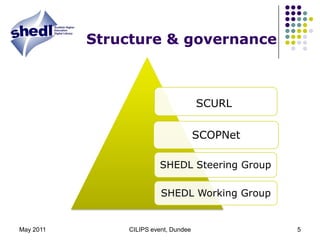
Structure & governanceMay 2011CILIPS event, Dundee5SCURL
May 2011CILIPS event, Dundee6Phase 1Initial agreement to work with 3 publishers, covering a wide range of subjectsAgreements for 2009-2011 with: American Chemical SocietyCambridge University PressSpringer
May 2011CILIPS event, Dundee7ProcessInstitutional verification of holdings and expenditure with each publisherNegotiation by JISC CollectionsLicence agreement based on JISC model licenceAdjustments to holdings – link resolvers & OPACsMonitoring of usage – locally and at consortium level
May 2011CILIPS event, Dundee8Costs Costs are fixed at the start of the contract, with agreed annual price capsSHEDL institutions continue to fund their own subscriptions, and do not expect to pay more than beforeOption to buy print at ddpReduced overheads – single payment and early payment where possible
May 2011CILIPS event, Dundee9Phase 2WG consultation resulted in 40 nominations6 publishers approached, following consultation with JISC3 new publisher agreements for 2010-2012BergEdinburgh University PressOxford University PressPortico licensed across SHEDL
May 2011CILIPS event, Dundee10Phase 3Similar consultation process resulted in 46 nominations 7 publishers identified for 2011Agreements for 2011-13IntellectProject Muse
May 2011CILIPS event, Dundee11Phase 3 - DifficultiesNegotiations more difficult in 2010Agreements with publishers with greater ‘market penetration’ already achievedPublishers still expecting market growthMore difficult for libraries to commitCollaboration more essential in world of funding cuts, but also more difficult
Phase 4 Continuation of the difficult scenario of 2010UK-wide deals for Wiley-Blackwell and Elsevier content due to be renewedRenewals of phase 1 dealsDecided on one definite, one possibility and one reserve publisherAwaiting outcomes from JISCMay 2011CILIPS event, Dundee12
May 2011CILIPS event, Dundee13Benefits – the HEIsShift to e-onlySingle payment Proof of concept  widening access increased availability of content increased usage efficiency gainsShared services agenda
May 2011CILIPS event, Dundee14Benefits – the PublishersReduced overheads – single point of contact for administration and invoicingWider dissemination of contentEncourages adoption of e-onlyCash flow – protects market share
May 2011CILIPS event, Dundee15Benefits – the usersMore content, accessible at the point of need - 2000+ titles availableAnalysis shows that previously non-subscribed titles are being usedIncrease in usage across all Phase 1 publishers, and across all institutionsUsage increased by 41% from 2008 to 2009
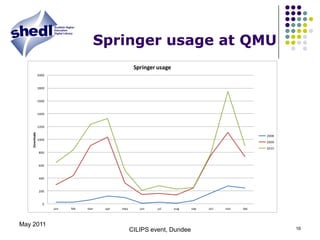
Springer usage at QMUMay 2011CILIPS event, Dundee16
May 2011CILIPS event, Dundee17Evaluation - RINReport evaluating the impact of SHEDLJohn Cox Associates/Frontline GMSUsage dataInterviews – academics/librariansSingle year of the Phase 1 agreementsRIN report
May 2011CILIPS event, Dundee18Evaluation - RINConclusions of the reportConfirmed overall usage increase of 41%, compared with 22% ‘average’ UK wide increaseWide variation in increases – single year – whether or not titles already accessibleSome evidence that Research Pool participants benefitingCost/download was variable but all institutions achieved savings
May 2011CILIPS event, Dundee19Evaluation – JISC CollectionsBloc payment mechanismsCost redistribution criteriaAlbert Prior/John CoxNot specifically SHEDLJISC Collections reportLaunched July 2010
May 2011CILIPS event, Dundee20Evaluation – JISC CollectionsNo “magic” formulaAuthoritative/credible dataJISC BandingInstitutional incomeResearch/contract incomeStaff/student numbersNot usageNot SCONUL statsNot data from the 2008 Research Assessment Exercise
May 2011CILIPS event, Dundee21Next stepsReview of activities2011 - a year to consolidateSHEDL modelAllocation of costsTypes of format procuredExpansion to other sectorsFurther Education?NHS?NLS?
May 2011CILIPS event, Dundee22Further informationWebsite – under development http://scurl.ac.uk/WG/SHEDL/index.htmlTony Kidd, Acting Chair, SHEDL Steering Grouptony.kidd@glasgow.ac.ukKidd, T. Collaboration in electronic resource provision in university libraries: SHEDL, a Scottish case study. New Review of Academic Librarianship, 15 (1), 2009, pp 97-119 http://eprints.gla.ac.uk/7637/Kidd, T. & Stevenson, L. SHEDL – the Scottish Higher Education Digital Library: an update. Serials, 23(3), 2010, pp 196-200 http://eprints.gla.ac.uk/44955/

Shedl may 11

  • 1.
    1SHEDLScottish Higher EducationDigital LibraryNegotiating together: collaborative academic library purchasing Barbara HoustonCILIPS Shared services event, Dundee, May 2011
  • 2.
    May 2011CILIPS event,Dundee2ContextScottish HE tradition of co-operationManageable sizeSeparate funding arrangementsResearch PoolsExamples of other consortia, IReL, FinELib
  • 3.
    May 2011CILIPS event,Dundee3Investigative StudySCURL sponsored – Scottish Confederation of University and Research LibrariesJohn Cox Associates LtdInterviews LibrariesUniversity administrators/Universities ScotlandAcademics/Research PoolsStakeholders – Scottish Funding Council/JISC etcReport available on the SHEDL area of the SCURL website
  • 4.
    May 2011CILIPS event,Dundee4Relationship with JISC Collections/NESLi2Strong consensus that SHEDL should work within JISC Collections frameworkBut wish to fill in gaps, to move away from ‘opt-in’ arrangements, to ensure overall access for Research PoolsPlus possibility of wider range of deals (recognising NESLi2’s current work with ‘small/medium publishers’)
  • 5.
    Structure & governanceMay2011CILIPS event, Dundee5SCURL
  • 6.
    May 2011CILIPS event,Dundee6Phase 1Initial agreement to work with 3 publishers, covering a wide range of subjectsAgreements for 2009-2011 with: American Chemical SocietyCambridge University PressSpringer
  • 7.
    May 2011CILIPS event,Dundee7ProcessInstitutional verification of holdings and expenditure with each publisherNegotiation by JISC CollectionsLicence agreement based on JISC model licenceAdjustments to holdings – link resolvers & OPACsMonitoring of usage – locally and at consortium level
  • 8.
    May 2011CILIPS event,Dundee8Costs Costs are fixed at the start of the contract, with agreed annual price capsSHEDL institutions continue to fund their own subscriptions, and do not expect to pay more than beforeOption to buy print at ddpReduced overheads – single payment and early payment where possible
  • 9.
    May 2011CILIPS event,Dundee9Phase 2WG consultation resulted in 40 nominations6 publishers approached, following consultation with JISC3 new publisher agreements for 2010-2012BergEdinburgh University PressOxford University PressPortico licensed across SHEDL
  • 10.
    May 2011CILIPS event,Dundee10Phase 3Similar consultation process resulted in 46 nominations 7 publishers identified for 2011Agreements for 2011-13IntellectProject Muse
  • 11.
    May 2011CILIPS event,Dundee11Phase 3 - DifficultiesNegotiations more difficult in 2010Agreements with publishers with greater ‘market penetration’ already achievedPublishers still expecting market growthMore difficult for libraries to commitCollaboration more essential in world of funding cuts, but also more difficult
  • 12.
    Phase 4 Continuationof the difficult scenario of 2010UK-wide deals for Wiley-Blackwell and Elsevier content due to be renewedRenewals of phase 1 dealsDecided on one definite, one possibility and one reserve publisherAwaiting outcomes from JISCMay 2011CILIPS event, Dundee12
  • 13.
    May 2011CILIPS event,Dundee13Benefits – the HEIsShift to e-onlySingle payment Proof of concept widening access increased availability of content increased usage efficiency gainsShared services agenda
  • 14.
    May 2011CILIPS event,Dundee14Benefits – the PublishersReduced overheads – single point of contact for administration and invoicingWider dissemination of contentEncourages adoption of e-onlyCash flow – protects market share
  • 15.
    May 2011CILIPS event,Dundee15Benefits – the usersMore content, accessible at the point of need - 2000+ titles availableAnalysis shows that previously non-subscribed titles are being usedIncrease in usage across all Phase 1 publishers, and across all institutionsUsage increased by 41% from 2008 to 2009
  • 16.
    Springer usage atQMUMay 2011CILIPS event, Dundee16
  • 17.
    May 2011CILIPS event,Dundee17Evaluation - RINReport evaluating the impact of SHEDLJohn Cox Associates/Frontline GMSUsage dataInterviews – academics/librariansSingle year of the Phase 1 agreementsRIN report
  • 18.
    May 2011CILIPS event,Dundee18Evaluation - RINConclusions of the reportConfirmed overall usage increase of 41%, compared with 22% ‘average’ UK wide increaseWide variation in increases – single year – whether or not titles already accessibleSome evidence that Research Pool participants benefitingCost/download was variable but all institutions achieved savings
  • 19.
    May 2011CILIPS event,Dundee19Evaluation – JISC CollectionsBloc payment mechanismsCost redistribution criteriaAlbert Prior/John CoxNot specifically SHEDLJISC Collections reportLaunched July 2010
  • 20.
    May 2011CILIPS event,Dundee20Evaluation – JISC CollectionsNo “magic” formulaAuthoritative/credible dataJISC BandingInstitutional incomeResearch/contract incomeStaff/student numbersNot usageNot SCONUL statsNot data from the 2008 Research Assessment Exercise
  • 21.
    May 2011CILIPS event,Dundee21Next stepsReview of activities2011 - a year to consolidateSHEDL modelAllocation of costsTypes of format procuredExpansion to other sectorsFurther Education?NHS?NLS?
  • 22.
    May 2011CILIPS event,Dundee22Further informationWebsite – under development http://scurl.ac.uk/WG/SHEDL/index.htmlTony Kidd, Acting Chair, SHEDL Steering Grouptony.kidd@glasgow.ac.ukKidd, T. Collaboration in electronic resource provision in university libraries: SHEDL, a Scottish case study. New Review of Academic Librarianship, 15 (1), 2009, pp 97-119 http://eprints.gla.ac.uk/7637/Kidd, T. & Stevenson, L. SHEDL – the Scottish Higher Education Digital Library: an update. Serials, 23(3), 2010, pp 196-200 http://eprints.gla.ac.uk/44955/

Editor's Notes

  • #2 Thank Gordon,Say hello and give credit to Tony Kidd for presentationStart off with context SHEDL grew out ofExploration of possibility4 years of negotationsBenefits to stakeholdersBriefly evaluation reports
  • #3 Before SHEDL came into being Scottish HE had a long tradition of collaborative procurement – SNIPES and SCABS. This is aided by the size of the HE sector in Scotland – it’s of a manageable size where people know each other, meet regularly, and trust each other's judgment. Consortia in other parts of the UK also tend to be geographically/regionally based but are not so distinctive in natureStill continues Concerns of patchy access to electronic journals, particularly for the research pools with members at different institutions having differing access to journalsLooked with interest at other national consortia from similar small countries notably - Irel in Ireland and FineLib in Finland
  • #4 In May-Oct 2007 SCURL sponsored a investigative study funded by the principals of Edinburgh and Glasgow unisExamination of access to a set of resources and interviews with relevant partiesThe report launched in October 2007 and is available on the shedl area of the SCULR website.It concluded that a digital library for scotland was a viable proposition and would address the issues raised in it’s support.
  • #5 Within institutions there was concern about how the proposed digital library would fit in with JISC Collections and their work with the NESLI2 journals collections deals also negotiated for HE. SHEDL shouldn’t replace these. The SFC and Principals were keen that SHEDL should complement the work being done for HETaking this into account SHEDL would though have it’s own identity with deals negotiated on an “all in” basis rather than “opt in” nature of nesli deals and not be solely limited to the large mainstream publishers and possibly not just journal content although at this stage that was something for the future. In fact different type of content is only now being considered with ebooks being included in this years round of negotiations.
  • #6 Structure and governance has developed over the lifetime of SHEDL and we now have the organisational set up shownWG has representative from all 19 HEIs, with a single person representing the SSIs – art colleges, SAC Steering group 6 constituencies covering the 19 HEIs, rep from NLS (interested in SHEDL but not as yet taking any deals) and the SCURL service development manager, and the CHAIRSCOPnet – scottish HE overarching procurement group consisting of the chairs of journals, ebooks, print books, SHEDL, NLS rep FE rep, Jill and chairOverseeing everything SCURL - SCOPnet chair reports to SCURL business committee, then to plenary - all HE lib directors.Procuremet advice when needed is sought from Ed/Glas procurement depts and APUC (advanced purchasing for universities and colleges0
  • #7 In the initial phase the SG and JISC selected the publishers choosing those with something to offer every institution and those who would be amenable to negotiation and interested in taking part in a new venture.Selection process for later deals is described later on.
  • #8 Process once publishers to approach has been decided is as described on the slide.Problem areas are establishing holdings and expenditure as uni records may be different from publisher – unfortunately not unusualLength of tine taken in Getting collection titles as a separate collection in link resolver knowledge bases – problem every year, and as time went on updating these to reflect titles moving to and from publishers.
  • #9 Costs are based on previous spend with any institution not having subs with a publisher, not having to contribute to the cost but still having access.Separate purchase of print issues at deeply discounted rate is diminishing, even for humanities titles.Model offers benefits in reduced overheads to both publisher and institution. Less work for library and finance staff in processing invoices. Similar savings at publisher end - which are used as negotiating tool for better pricing.
  • #11 And again, the process was re-iterated for 2010 negotiations, resulting in deals with Intellect and Project Muse. The difference between the initial numbers of publishers to approach and the final outcome is due to JISC identifying selections as unlikely to succeed if publishers can be difficult or unreceptive, or terms and costs of the offer from publisher being wildly different from the SHEDL targets and so deal rejected.
  • #12 2010 presented a totally different scenario for negotiation – libraries had either already had their electronic resource budgets cut or were expecting to or both,We’d already either approached and been successful with mainstream publishers or rejected their offers – this was important as it sent the message to the publishing world that SHEDL was not going to accept an offer regardless – poor offers would be rejectedUnfortunately despite the news stories on HE funding cuts across the UK, and repeated assertions by librarians about the state of their finances publishers still appear to believe that we have money not just to maintain subscriptions but also to increase themFor libraries needing to review their collections and justify continuing with every resource in that collection, the SHEDL model for negotiations of basing ongoing cost on historical spend has proved difficult. For example libraries may have targetted particular journals for cancellation only to then find that the publisher of those titles is a possibility for a SHEDL deal. The funding model is currently under review and discussion by the SG, but the collaborative nature of work in Scotland has aided these difficult discussions.
  • #13 2011 saw the difficulties from 2010 continue into 2011.In addition there is the renewal of Science Direct and W/B content and the difficult negotiations they will present for JISC CollectionsOur Phase 1 deals are due for renewal and we will be hoping to improve on the trems of the contractsAs a result of all of these circumstances the SG recomneded to the WG one definite, one possiblity and one reserve.We now await ews from JIOSc on how their negotations are progressing
  • #14 Benefits to the HEIs have not just been in the efficiency gains offered by single invoices, multi year deals, known price increases. It’s also facilitated the move to e-only and demonstrated engagement with the governments drive towards shared service.We have also seen increased usage across the consortium, much more content available and to a wider auduience.
  • #15 For publishers the benefits have been similar to HEIs, with the addition of also improving their cash flow.These advantages have been taken advantage of when negotiating price and terms. JISC have pointed out the benefits of a single invoice/payment for Scotland, reduced need for print copies, and most importantly the knowledge that they have a guaranteed income for a period of years of an amount known in advance and that their titles will not be subject to cancellation.
  • #16 For the users the benefit has been more titles, in some cases much more content and ease of access. As so often happens with “big “deals” non subscribed titles get used, even those where a library would never expect there to be any interest.The SHEDL model allows for institutions without any previous content from a publisher to have access to the deal content free of charge. For QMU we had no access to ACS material prior to SHEDL and have found that our nutritionists and dietetition are making great use of one of their food science titles.Examination of the early use of the Phase one publishers showed marked increase in use in the foirst year. For example QMU opnly had a few titles form Springer with the most basic level of access (1 year), we now have much more contnet at full access – show chart
  • #17 This slide dramatically illustrates the increase in use for a publisher.There are the usual peaks in the autumn and spring terms with the drop off in the summer. However use is trundling along in 2008 (pre-SHEDL) with a max at just over 200 downloads in a month. This increases for 2009 but by 2010 the peaks are at 1300 and over 1700 downloads in a month.
  • #18 In 2010 the SACURL and the Research Information Network commissioned an external report, again from John Cox aimed at evaluating the impact SHEDL has had for users and librarians.The report examined the first year of the initiative - study looked at changes in patterns of usage in different institutions and in costs per download. It also investigated factors which may be affecting patterns of usage in different subjects in institutions, and any impacts of enhanced access to journals on students and academics behaviour. Academics, library directors and librarians from all institutions were invited to attend interviews at various locations around Scotland to give their views on SHEDL and it’s success or otherwise. The report was launched at an event in Edinburgh in November 2010 attended by academics and librarians and many of the great and the good from higher education.It concluded that Overall usage of SHEDL content rose faster than the UK average increase in usage of online journal articlesUsage increased least in institutions with access to all three publishers’ content via NESLi2 deals, and increased most in those with access to none or one publisher’s content via NESLi2.• Usage in the research pools increased most among members without prior access to content via NESLi2 deals; however, the biggest increases are among non-research pool members, albeit from a low base.• Cost-per-use fell for all three publishers by between 11% and 17% in GBP, more in the currency of billing – Springer in Euro and ACS in US dollars . These savings are noticeable in almost all institutions.The report is available from the RIN website at the link given.
  • #19 It concluded that Overall usage of SHEDL content rose faster than the UK average increase in usage of online journal articlesUsage increased least in institutions with access to all three publishers’ content via NESLi2 deals, and increased most in those with access to none or one publisher’s content via NESLi2.• Usage in the research pools increased most among members without prior access to content via NESLi2 deals; however, the biggest increases are among non-research pool members, albeit from a low base.• Cost-per-use fell for all three publishers by between 11% and 17% in GBP, more in the currency of billing – Springer in Euro and ACS in US dollars . These savings are noticeable in almost all institutions.
  • #20 Round about the same time JISC Collections commissioned a report on bloc payments and big deals and possible methods of slitting costs. Although Not specifically about Shedl, this was mentioned in the report.analysis of the practicability and the effect of different models for allocating costs of journal between HEIs where journal collections have been licensed by a "bloc" of institutions for a single all-in priceAgain it was done by John Cox this time in association with Albert Prior - previously of Content Complete who did the early negotiations before being taken over by JISC Collections, and now retired. This report was launched in July 2010 but without a party in EdinburghThe report is available from the JISC Collections website.
  • #21 Despite all the work done for the report the authors decided that there was no magic solution to how to fairly divide up costs.Reccomendations they did make though covered using authoritative and unimpeachable metrics – the following were favoured, although research/contract income was the least acceptable. JISC Banding was most acceptable as being established and fair.Metrics not acceptable are as listed.Usage was rejected as it penalises libraries who promote their resource effectively needs to be robust and consistenet open to abuse by not promoting resources in order to keep costs downSCONUL stats can be incopmplete and unreliableThe RAE was just a snapshot of research at any gien time, in tehis case 2008, and rapidly becomes oboletel
  • #22 SHEDL has undoubtedly been a success but 2011 is a year to consolidate - renewals of first phase difficult financial circumstances major national negotiations for JISC Collections – SD and W/BIt’s also a year for some introspection and evaluationThe SG is looking at the SHEDL model, what it consists of and how this may be maintained, improved and grown in the future... Various options of model and funding are being explored, including maintaining the status quo. a scoping paper is being prepared which will be discussed over the summer at SCURL.
  • #23 Further information at websites indicated, or contact Tony kidd.