Neural progenitor cells - potent models of
normal and disease neurobiology
Brian Shapiro, Ph.D.
Technical Writer, Cell Biology, ATCC
November 19, 2015
Established
partner to
global
researchers
and
scientists
About ATCC
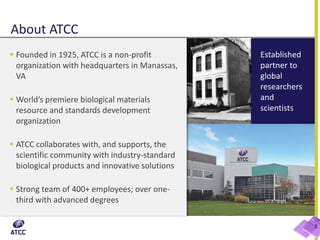
 Founded in 1925, ATCC is a non-profit
organization with headquarters in Manassas,
VA
 World’s premiere biological materials
resource and standards development
organization
 ATCC collaborates with, and supports, the
scientific community with industry-standard
biological products and innovative solutions
 Strong team of 400+ employees; over one-
third with advanced degrees
2
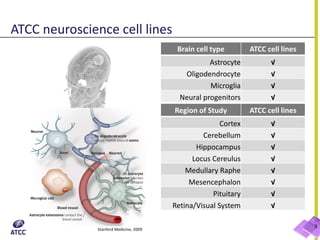
Brain cell type ATCC cell lines
Astrocyte √
Oligodendrocyte √
Microglia √
Neural progenitors √
Stanford Medicine, 2009
Region of Study ATCC cell lines
Cortex √
Cerebellum √
Hippocampus √
Locus Cereulus √
Medullary Raphe √
Mesencephalon √
Pituitary √
Retina/Visual System √
ATCC neuroscience cell lines
3
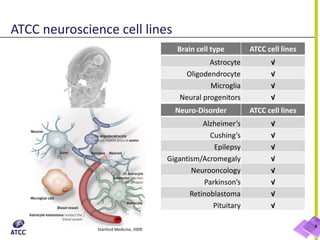
Brain cell type ATCC cell lines
Astrocyte √
Oligodendrocyte √
Microglia √
Neural progenitors √
Stanford Medicine, 2009
Neuro-Disorder ATCC cell lines
Alzheimer’s √
Cushing’s √
Epilepsy √
Gigantism/Acromegaly √
Neurooncology √
Parkinson’s √
Retinoblastoma √
Pituitary √
ATCC neuroscience cell lines
4
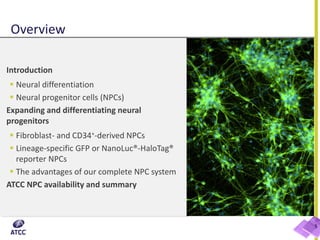
Overview
Introduction
 Neural differentiation
 Neural progenitor cells (NPCs)
Expanding and differentiating neural
progenitors
 Fibroblast- and CD34+-derived NPCs
 Lineage-specific GFP or NanoLuc®-HaloTag®
reporter NPCs
 The advantages of our complete NPC system
ATCC NPC availability and summary
5
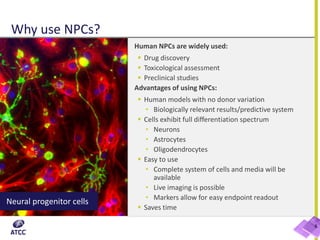
Why use NPCs?
6
Human NPCs are widely used:
 Drug discovery
 Toxicological assessment
 Preclinical studies
Advantages of using NPCs:
 Human models with no donor variation
• Biologically relevant results/predictive system
 Cells exhibit full differentiation spectrum
• Neurons
• Astrocytes
• Oligodendrocytes
 Easy to use
• Complete system of cells and media will be
available
• Live imaging is possible
• Markers allow for easy endpoint readout
 Saves time
Neural progenitor cells
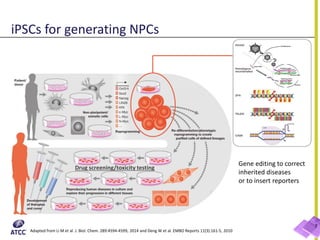
iPSCs for generating NPCs
Adapted from Li M et al. J. Biol. Chem. 289:4594-4599, 2014 and Deng W et al. EMBO Reports 11(3):161-5, 2010
Gene editing to correct
inherited diseases
or to insert reporters
7
Drug screening/toxicity testing
8
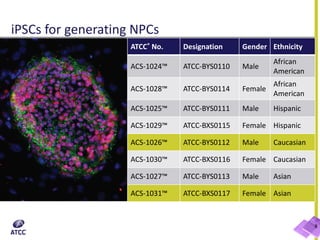
iPSCs for generating NPCs
ATCC® No. Designation Gender Ethnicity
ACS-1024™ ATCC-BYS0110 Male
African
American
ACS-1028™ ATCC-BYS0114 Female
African
American
ACS-1025™ ATCC-BYS0111 Male Hispanic
ACS-1029™ ATCC-BXS0115 Female Hispanic
ACS-1026™ ATCC-BYS0112 Male Caucasian
ACS-1030™ ATCC-BXS0116 Female Caucasian
ACS-1027™ ATCC-BYS0113 Male Asian
ACS-1031™ ATCC-BXS0117 Female Asian
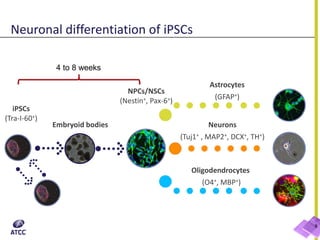
Neuronal differentiation of iPSCs
99
Astrocytes
(GFAP+)
Neurons
(Tuj1+ , MAP2+, DCX+, TH+)
Oligodendrocytes
(O4+, MBP+)
NPCs/NSCs
(Nestin+, Pax-6+)
iPSCs
(Tra-I-60+)
Embryoid bodies
4 to 8 weeks
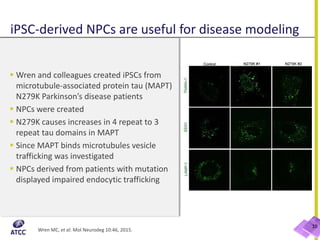
iPSC-derived NPCs are useful for disease modeling
 Wren and colleagues created iPSCs from
microtubule-associated protein tau (MAPT)
N279K Parkinson’s disease patients
 NPCs were created
 N279K causes increases in 4 repeat to 3
repeat tau domains in MAPT
 Since MAPT binds microtubules vesicle
trafficking was investigated
 NPCs derived from patients with mutation
displayed impaired endocytic trafficking
10
Wren MC, et al. Mol Neurodeg 10:46, 2015.
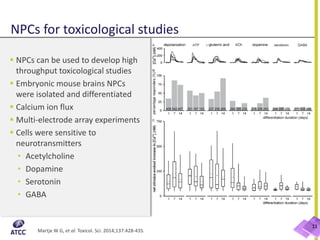
NPCs for toxicological studies
 NPCs can be used to develop high
throughput toxicological studies
 Embryonic mouse brains NPCs
were isolated and differentiated
 Calcium ion flux
 Multi-electrode array experiments
 Cells were sensitive to
neurotransmitters
• Acetylcholine
• Dopamine
• Serotonin
• GABA
11
Martje W G, et al. Toxicol. Sci. 2014;137:428-435.
Overview
Introduction
 Neural differentiation
 Neural progenitor cells (NPCs)
Expanding and differentiating neural
progenitors
 Fibroblast- and CD34+-derived NPCs
 Lineage-specific GFP or NanoLuc®-HaloTag®
Reporter NPCs
 The advantages of our complete NPC system
ATCC NPC availability and summary
12
QC testing of ATCC® NPCs
13
Post-thaw cell viability: >80%
Post-thaw viable cell number: >1x10⁶ cells/vial
Longevity: >15 PDLs or 5 passages
NPC marker expression: Nestin+, Pax-6+, and Tra-I-60-
Differentiation potential:
>70% Tuj1+ early neurons and
>10% TH+ dopaminergic neurons
Identity: STR profile matching parental iPSC line
Sterility, Mycoplasma, and viral panel testing: None detected
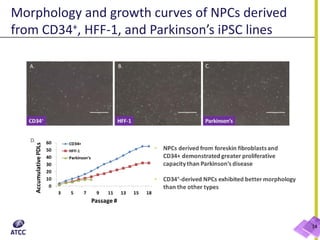
Morphology and growth curves of NPCs derived
from CD34+, HFF-1, and Parkinson’s iPSC lines
14
400 μm 400 μm 400 μm
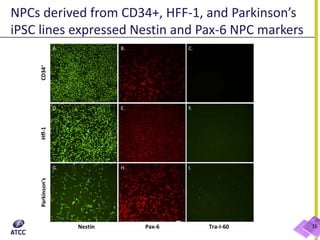
NPCs derived from CD34+, HFF-1, and Parkinson’s
iPSC lines expressed Nestin and Pax-6 NPC markers
15
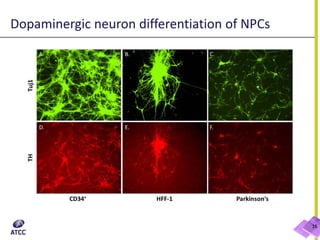
Dopaminergic neuron differentiation of NPCs
16
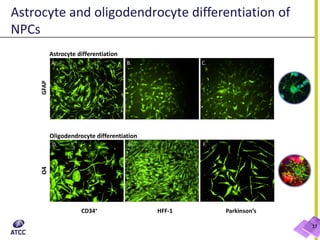
Astrocyte and oligodendrocyte differentiation of
NPCs
17
Astrocyte differentiation
Oligodendrocyte differentiation
O4
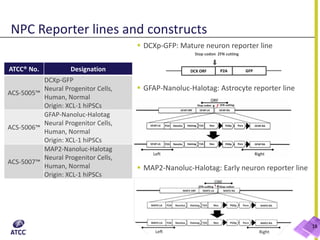
NPC Reporter lines and constructs
 DCXp-GFP: Mature neuron reporter line
Stop codon ZFN cutting
 GFAP-Nanoluc-Halotag: Astrocyte reporter line
 MAP2-Nanoluc-Halotag: Early neuron reporter line
ATCC® No. Designation
ACS-5005™
DCXp-GFP
Neural Progenitor Cells,
Human, Normal
Origin: XCL-1 hiPSCs
ACS-5006™
GFAP-Nanoluc-Halotag
Neural Progenitor Cells,
Human, Normal
Origin: XCL-1 hiPSCs
ACS-5007™
MAP2-Nanoluc-Halotag
Neural Progenitor Cells,
Human, Normal
Origin: XCL-1 hiPSCs
18
DCX ORF P2A GFP
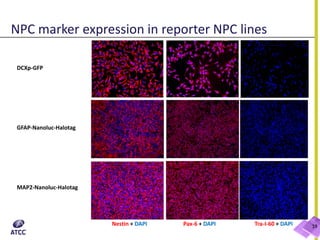
19Nestin + DAPI Pax-6 + DAPI Tra-I-60 + DAPI
DCXp-GFP
GFAP-Nanoluc-Halotag
MAP2-Nanoluc-Halotag
NPC marker expression in reporter NPC lines
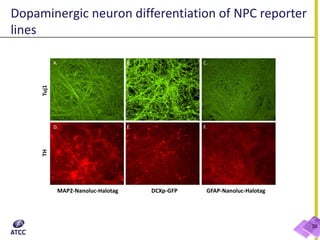
Dopaminergic neuron differentiation of NPC reporter
lines
20
MAP2-Nanoluc-Halotag DCXp-GFP GFAP-Nanoluc-Halotag
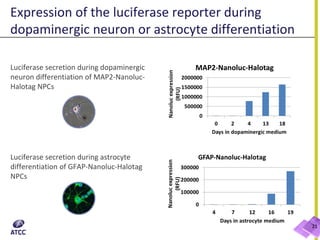
Expression of the luciferase reporter during
dopaminergic neuron or astrocyte differentiation
21
Luciferase secretion during dopaminergic
neuron differentiation of MAP2-Nanoluc-
Halotag NPCs
Luciferase secretion during astrocyte
differentiation of GFAP-Nanoluc-Halotag
NPCs
MAP2-Nanoluc-Halotag
22
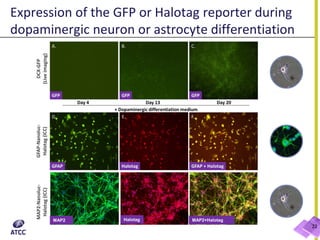
Expression of the GFP or Halotag reporter during
dopaminergic neuron or astrocyte differentiationDCX-GFP
(Liveimaging)
GFAP-Nanoluc-
Halotag(ICC)
MAP2-Nanoluc-
Halotag(ICC)
MAP2 MAP2+HalotagHalotag
23
0
2
4
6
8
10
12
14
16
18
20
3 4 5 6 7 8 9 10 11 12 13
AccumulativePDLs
0
2
4
6
8
10
12
14
16
18
20
3 4 5 6 7 8 9 10 11 12 13
AccumulativePDLs
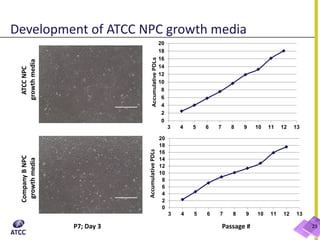
ATCCNPC
growthmedia
CompanyBNPC
growthmedia
P7; Day 3 Passage #
Development of ATCC NPC growth media
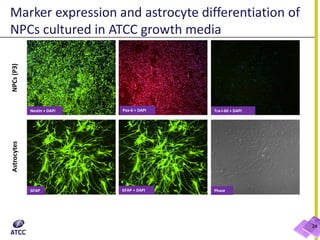
Marker expression and astrocyte differentiation of
NPCs cultured in ATCC growth media
NPCs(P3)Astrocytes
Nestin + DAPI
PhaseGFAP + DAPIGFAP
Tra-I-60 + DAPIPax-6 + DAPI
24
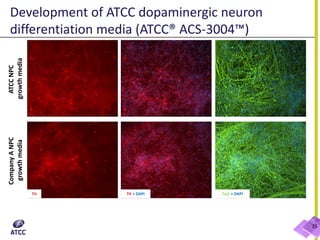
Development of ATCC dopaminergic neuron
differentiation media (ATCC® ACS-3004™)
25
ATCCNPC
growthmedia
CompanyANPC
growthmedia
TH TH + DAPI Tuj1 + DAPI
Overview
Introduction
 Neural differentiation
 Neural progenitor cells (NPCs)
Expanding and differentiating neural
progenitors
 Fibroblast- and CD34+-derived NPCs
 Lineage-specific GFP or NanoLuc®-HaloTag®
Reporter NPCs
 The advantages of our complete NPC system
ATCC NPC availability and summary
26
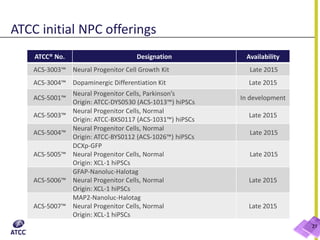
ATCC initial NPC offerings
27
ATCC® No. Designation Availability
ACS-3003™ Neural Progenitor Cell Growth Kit Late 2015
ACS-3004™ Dopaminergic Differentiation Kit Late 2015
ACS-5001™
Neural Progenitor Cells, Parkinson’s
Origin: ATCC-DYS0530 (ACS-1013™) hiPSCs
In development
ACS-5003™
Neural Progenitor Cells, Normal
Origin: ATCC-BXS0117 (ACS-1031™) hiPSCs
Late 2015
ACS-5004™
Neural Progenitor Cells, Normal
Origin: ATCC-BYS0112 (ACS-1026™) hiPSCs
Late 2015
ACS-5005™
DCXp-GFP
Neural Progenitor Cells, Normal
Origin: XCL-1 hiPSCs
Late 2015
ACS-5006™
GFAP-Nanoluc-Halotag
Neural Progenitor Cells, Normal
Origin: XCL-1 hiPSCs
Late 2015
ACS-5007™
MAP2-Nanoluc-Halotag
Neural Progenitor Cells, Normal
Origin: XCL-1 hiPSCs
Late 2015
Summary
 Developed a process enabling generation of
unlimited supply of neural progenitor cells
 Optimized culture conditions for the expansion
and tri-lineage differentiation of NPCs
 Starting iPSC lines played an important role in
morphology, proliferative capacity, and
differentiation potential of NPCs
 CD34+-derived NPCs exhibited a better
proliferative capacity and greater efficiency of
tri-lineage differentiation
 Three gene-edited NPC reporter lines expressed
GFP, NanoLuc®, or HaloTag® during lineage
specific differentiation
 ATCC complete solution of NPC products
including NPCs and culture media provides a
powerful tool for disease modeling and drug
screening
28
Acknowledgments
29
Project team:
Leelamma Jacob, M.S., Ph.D.
Michelle Spencer, M.S.
Dezhong Yin, Ph.D.
Trademarks
NanoLuc®-HaloTag® are registered trademarks
of the Promega Corporation
Thank you
Questions?

Shapiro Webinar V9

  • 1.
    Neural progenitor cells- potent models of normal and disease neurobiology Brian Shapiro, Ph.D. Technical Writer, Cell Biology, ATCC November 19, 2015
  • 2.
    Established partner to global researchers and scientists About ATCC Founded in 1925, ATCC is a non-profit organization with headquarters in Manassas, VA  World’s premiere biological materials resource and standards development organization  ATCC collaborates with, and supports, the scientific community with industry-standard biological products and innovative solutions  Strong team of 400+ employees; over one- third with advanced degrees 2
  • 3.
    Brain cell typeATCC cell lines Astrocyte √ Oligodendrocyte √ Microglia √ Neural progenitors √ Stanford Medicine, 2009 Region of Study ATCC cell lines Cortex √ Cerebellum √ Hippocampus √ Locus Cereulus √ Medullary Raphe √ Mesencephalon √ Pituitary √ Retina/Visual System √ ATCC neuroscience cell lines 3
  • 4.
    Brain cell typeATCC cell lines Astrocyte √ Oligodendrocyte √ Microglia √ Neural progenitors √ Stanford Medicine, 2009 Neuro-Disorder ATCC cell lines Alzheimer’s √ Cushing’s √ Epilepsy √ Gigantism/Acromegaly √ Neurooncology √ Parkinson’s √ Retinoblastoma √ Pituitary √ ATCC neuroscience cell lines 4
  • 5.
    Overview Introduction  Neural differentiation Neural progenitor cells (NPCs) Expanding and differentiating neural progenitors  Fibroblast- and CD34+-derived NPCs  Lineage-specific GFP or NanoLuc®-HaloTag® reporter NPCs  The advantages of our complete NPC system ATCC NPC availability and summary 5
  • 6.
    Why use NPCs? 6 HumanNPCs are widely used:  Drug discovery  Toxicological assessment  Preclinical studies Advantages of using NPCs:  Human models with no donor variation • Biologically relevant results/predictive system  Cells exhibit full differentiation spectrum • Neurons • Astrocytes • Oligodendrocytes  Easy to use • Complete system of cells and media will be available • Live imaging is possible • Markers allow for easy endpoint readout  Saves time Neural progenitor cells
  • 7.
    iPSCs for generatingNPCs Adapted from Li M et al. J. Biol. Chem. 289:4594-4599, 2014 and Deng W et al. EMBO Reports 11(3):161-5, 2010 Gene editing to correct inherited diseases or to insert reporters 7 Drug screening/toxicity testing
  • 8.
    8 iPSCs for generatingNPCs ATCC® No. Designation Gender Ethnicity ACS-1024™ ATCC-BYS0110 Male African American ACS-1028™ ATCC-BYS0114 Female African American ACS-1025™ ATCC-BYS0111 Male Hispanic ACS-1029™ ATCC-BXS0115 Female Hispanic ACS-1026™ ATCC-BYS0112 Male Caucasian ACS-1030™ ATCC-BXS0116 Female Caucasian ACS-1027™ ATCC-BYS0113 Male Asian ACS-1031™ ATCC-BXS0117 Female Asian
  • 9.
    Neuronal differentiation ofiPSCs 99 Astrocytes (GFAP+) Neurons (Tuj1+ , MAP2+, DCX+, TH+) Oligodendrocytes (O4+, MBP+) NPCs/NSCs (Nestin+, Pax-6+) iPSCs (Tra-I-60+) Embryoid bodies 4 to 8 weeks
  • 10.
    iPSC-derived NPCs areuseful for disease modeling  Wren and colleagues created iPSCs from microtubule-associated protein tau (MAPT) N279K Parkinson’s disease patients  NPCs were created  N279K causes increases in 4 repeat to 3 repeat tau domains in MAPT  Since MAPT binds microtubules vesicle trafficking was investigated  NPCs derived from patients with mutation displayed impaired endocytic trafficking 10 Wren MC, et al. Mol Neurodeg 10:46, 2015.
  • 11.
    NPCs for toxicologicalstudies  NPCs can be used to develop high throughput toxicological studies  Embryonic mouse brains NPCs were isolated and differentiated  Calcium ion flux  Multi-electrode array experiments  Cells were sensitive to neurotransmitters • Acetylcholine • Dopamine • Serotonin • GABA 11 Martje W G, et al. Toxicol. Sci. 2014;137:428-435.
  • 12.
    Overview Introduction  Neural differentiation Neural progenitor cells (NPCs) Expanding and differentiating neural progenitors  Fibroblast- and CD34+-derived NPCs  Lineage-specific GFP or NanoLuc®-HaloTag® Reporter NPCs  The advantages of our complete NPC system ATCC NPC availability and summary 12
  • 13.
    QC testing ofATCC® NPCs 13 Post-thaw cell viability: >80% Post-thaw viable cell number: >1x10⁶ cells/vial Longevity: >15 PDLs or 5 passages NPC marker expression: Nestin+, Pax-6+, and Tra-I-60- Differentiation potential: >70% Tuj1+ early neurons and >10% TH+ dopaminergic neurons Identity: STR profile matching parental iPSC line Sterility, Mycoplasma, and viral panel testing: None detected
  • 14.
    Morphology and growthcurves of NPCs derived from CD34+, HFF-1, and Parkinson’s iPSC lines 14 400 μm 400 μm 400 μm
  • 15.
    NPCs derived fromCD34+, HFF-1, and Parkinson’s iPSC lines expressed Nestin and Pax-6 NPC markers 15
  • 16.
  • 17.
    Astrocyte and oligodendrocytedifferentiation of NPCs 17 Astrocyte differentiation Oligodendrocyte differentiation O4
  • 18.
    NPC Reporter linesand constructs  DCXp-GFP: Mature neuron reporter line Stop codon ZFN cutting  GFAP-Nanoluc-Halotag: Astrocyte reporter line  MAP2-Nanoluc-Halotag: Early neuron reporter line ATCC® No. Designation ACS-5005™ DCXp-GFP Neural Progenitor Cells, Human, Normal Origin: XCL-1 hiPSCs ACS-5006™ GFAP-Nanoluc-Halotag Neural Progenitor Cells, Human, Normal Origin: XCL-1 hiPSCs ACS-5007™ MAP2-Nanoluc-Halotag Neural Progenitor Cells, Human, Normal Origin: XCL-1 hiPSCs 18 DCX ORF P2A GFP
  • 19.
    19Nestin + DAPIPax-6 + DAPI Tra-I-60 + DAPI DCXp-GFP GFAP-Nanoluc-Halotag MAP2-Nanoluc-Halotag NPC marker expression in reporter NPC lines
  • 20.
    Dopaminergic neuron differentiationof NPC reporter lines 20 MAP2-Nanoluc-Halotag DCXp-GFP GFAP-Nanoluc-Halotag
  • 21.
    Expression of theluciferase reporter during dopaminergic neuron or astrocyte differentiation 21 Luciferase secretion during dopaminergic neuron differentiation of MAP2-Nanoluc- Halotag NPCs Luciferase secretion during astrocyte differentiation of GFAP-Nanoluc-Halotag NPCs MAP2-Nanoluc-Halotag
  • 22.
    22 Expression of theGFP or Halotag reporter during dopaminergic neuron or astrocyte differentiationDCX-GFP (Liveimaging) GFAP-Nanoluc- Halotag(ICC) MAP2-Nanoluc- Halotag(ICC) MAP2 MAP2+HalotagHalotag
  • 23.
    23 0 2 4 6 8 10 12 14 16 18 20 3 4 56 7 8 9 10 11 12 13 AccumulativePDLs 0 2 4 6 8 10 12 14 16 18 20 3 4 5 6 7 8 9 10 11 12 13 AccumulativePDLs ATCCNPC growthmedia CompanyBNPC growthmedia P7; Day 3 Passage # Development of ATCC NPC growth media
  • 24.
    Marker expression andastrocyte differentiation of NPCs cultured in ATCC growth media NPCs(P3)Astrocytes Nestin + DAPI PhaseGFAP + DAPIGFAP Tra-I-60 + DAPIPax-6 + DAPI 24
  • 25.
    Development of ATCCdopaminergic neuron differentiation media (ATCC® ACS-3004™) 25 ATCCNPC growthmedia CompanyANPC growthmedia TH TH + DAPI Tuj1 + DAPI
  • 26.
    Overview Introduction  Neural differentiation Neural progenitor cells (NPCs) Expanding and differentiating neural progenitors  Fibroblast- and CD34+-derived NPCs  Lineage-specific GFP or NanoLuc®-HaloTag® Reporter NPCs  The advantages of our complete NPC system ATCC NPC availability and summary 26
  • 27.
    ATCC initial NPCofferings 27 ATCC® No. Designation Availability ACS-3003™ Neural Progenitor Cell Growth Kit Late 2015 ACS-3004™ Dopaminergic Differentiation Kit Late 2015 ACS-5001™ Neural Progenitor Cells, Parkinson’s Origin: ATCC-DYS0530 (ACS-1013™) hiPSCs In development ACS-5003™ Neural Progenitor Cells, Normal Origin: ATCC-BXS0117 (ACS-1031™) hiPSCs Late 2015 ACS-5004™ Neural Progenitor Cells, Normal Origin: ATCC-BYS0112 (ACS-1026™) hiPSCs Late 2015 ACS-5005™ DCXp-GFP Neural Progenitor Cells, Normal Origin: XCL-1 hiPSCs Late 2015 ACS-5006™ GFAP-Nanoluc-Halotag Neural Progenitor Cells, Normal Origin: XCL-1 hiPSCs Late 2015 ACS-5007™ MAP2-Nanoluc-Halotag Neural Progenitor Cells, Normal Origin: XCL-1 hiPSCs Late 2015
  • 28.
    Summary  Developed aprocess enabling generation of unlimited supply of neural progenitor cells  Optimized culture conditions for the expansion and tri-lineage differentiation of NPCs  Starting iPSC lines played an important role in morphology, proliferative capacity, and differentiation potential of NPCs  CD34+-derived NPCs exhibited a better proliferative capacity and greater efficiency of tri-lineage differentiation  Three gene-edited NPC reporter lines expressed GFP, NanoLuc®, or HaloTag® during lineage specific differentiation  ATCC complete solution of NPC products including NPCs and culture media provides a powerful tool for disease modeling and drug screening 28
  • 29.
    Acknowledgments 29 Project team: Leelamma Jacob,M.S., Ph.D. Michelle Spencer, M.S. Dezhong Yin, Ph.D. Trademarks NanoLuc®-HaloTag® are registered trademarks of the Promega Corporation
  • 30.