STD’s
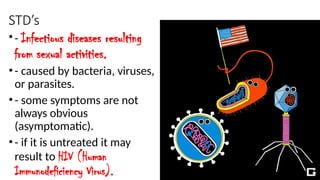
•- Infectious diseases resulting
from sexual activities.
•- caused by bacteria, viruses,
or parasites.
•- some symptoms are not
always obvious
(asymptomatic).
•- if it is untreated it may
result to HIV (Human
Immunodeficiency Virus).
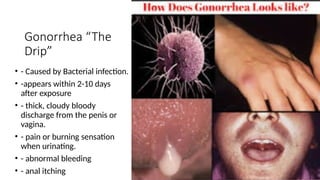
Gonorrhea “The
Drip”
• - Caused by Bacterial infection.
• -appears within 2-10 days
after exposure
• - thick, cloudy bloody
discharge from the penis or
vagina.
• - pain or burning sensation
when urinating.
• - abnormal bleeding
• - anal itching
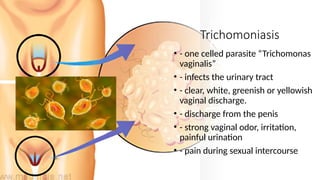
Trichomoniasis
• - one celled parasite “Trichomonas
vaginalis”
• - infects the urinary tract
• - clear, white, greenish or yellowish
vaginal discharge.
• - discharge from the penis
• - strong vaginal odor, irritation,
painful urination
• - pain during sexual intercourse
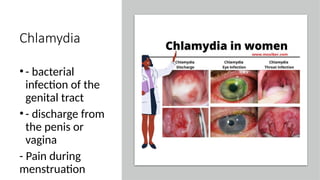
Chlamydia
•- bacterial
infection of the
genital tract
•- discharge from
the penis or
vagina
- Pain during
menstruation
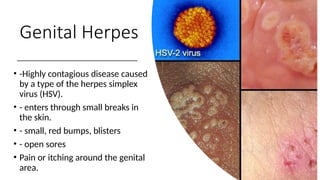
Genital Herpes
• -Highly contagious disease caused
by a type of the herpes simplex
virus (HSV).
• - enters through small breaks in
the skin.
• - small, red bumps, blisters
• - open sores
• Pain or itching around the genital
area.
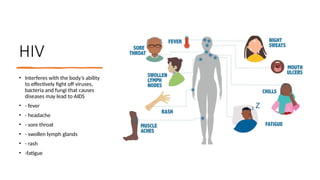
HIV
• Interferes with the body’s ability
to effectively fight off viruses,
bacteria and fungi that causes
diseases may lead to AIDS
• - fever
• - headache
• - sore throat
• - swollen lymph glands
• - rash
• -fatigue
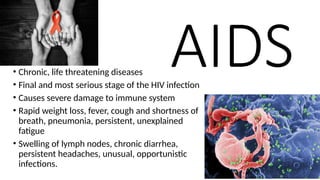
AIDS
• Chronic, life threatening diseases
• Final and most serious stage of the HIV infection
• Causes severe damage to immune system
• Rapid weight loss, fever, cough and shortness of
breath, pneumonia, persistent, unexplained
fatigue
• Swelling of lymph nodes, chronic diarrhea,
persistent headaches, unusual, opportunistic
infections.
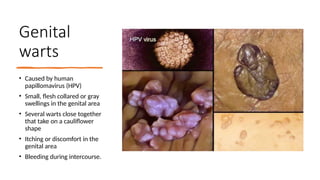
Genital
warts
• Caused by human
papillomavirus (HPV)
• Small, flesh collared or gray
swellings in the genital area
• Several warts close together
that take on a cauliflower
shape
• Itching or discomfort in the
genital area
• Bleeding during intercourse.
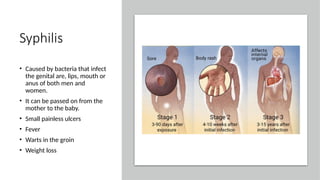
Syphilis
• Caused by bacteria that infect
the genital are, lips, mouth or
anus of both men and
women.
• It can be passed on from the
mother to the baby.
• Small painless ulcers
• Fever
• Warts in the groin
• Weight loss
RESPONSIBLE PARENTHOOD AND BIRTH
CONTROL METHODS
Birth control, also known as contraception, is designed to
prevent pregnancy. Birth control methods may work in a
number of different ways. These include:
 preventing sperm from getting to the egg – condom,
diaphragm, and intrauterine device (IUD);
 keeping the woman’s ovary from releasing an egg that could
be fertilized – birth control pills and contraceptive injection;
and
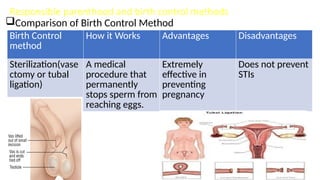
 sterilization, which permanently prevents a woman from
getting pregnant or a man from being able to get a woman
pregnant through vasectomy (male) and tubal ligation
(female).
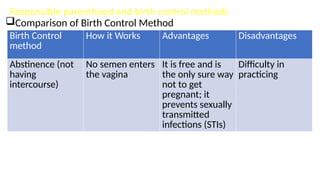
Responsible parenthood and birth control methods
Comparison of Birth Control Method
Birth Control
method
How it Works Advantages Disadvantages
Abstinence (not
having
intercourse)
No semen enters
the vagina
It is free and is
the only sure way
not to get
pregnant; it
prevents sexually
transmitted
infections (STIs)
Difficulty in
practicing
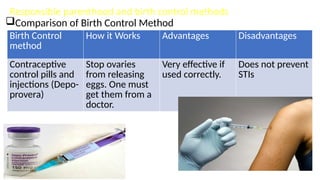
Responsible parenthood and birth control methods
Comparison of Birth Control Method
Birth Control
method
How it Works Advantages Disadvantages
Contraceptive
control pills and
injections (Depo-
provera)
Stop ovaries
from releasing
eggs. One must
get them from a
doctor.
Very effective if
used correctly.
Does not prevent
STIs
Responsible parenthood and birth control methods
Comparison of Birth Control Method
Birth Control
method
How it Works Advantages Disadvantages
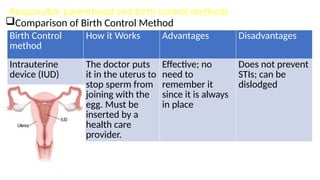
Intrauterine
device (IUD)
The doctor puts
it in the uterus to
stop sperm from
joining with the
egg. Must be
inserted by a
health care
provider.
Effective; no
need to
remember it
since it is always
in place
Does not prevent
STIs; can be
dislodged
Responsible parenthood and birth control methods
Comparison of Birth Control Method
Birth Control
method
How it Works Advantages Disadvantages
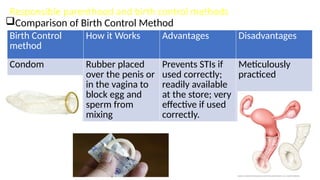
Condom Rubber placed
over the penis or
in the vagina to
block egg and
sperm from
mixing
Prevents STIs if
used correctly;
readily available
at the store; very
effective if used
correctly.
Meticulously
practiced
Responsible parenthood and birth control methods
Comparison of Birth Control Method
Birth Control
method
How it Works Advantages Disadvantages
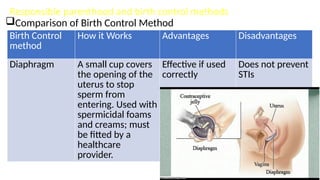
Diaphragm A small cup covers
the opening of the
uterus to stop
sperm from
entering. Used with
spermicidal foams
and creams; must
be fitted by a
healthcare
provider.
Effective if used
correctly
Does not prevent
STIs
Responsible parenthood and birth control methods
Comparison of Birth Control Method
Birth Control
method
How it Works Advantages Disadvantages
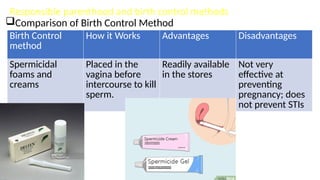
Spermicidal
foams and
creams
Placed in the
vagina before
intercourse to kill
sperm.
Readily available
in the stores
Not very
effective at
preventing
pregnancy; does
not prevent STIs
Responsible parenthood and birth control methods
Comparison of Birth Control Method
Birth Control
method
How it Works Advantages Disadvantages
Sterilization(vase
ctomy or tubal
ligation)
A medical
procedure that
permanently
stops sperm from
reaching eggs.
Extremely
effective in
preventing
pregnancy
Does not prevent
STIs
sexually transmitted diseases lesson.pptx

sexually transmitted diseases lesson.pptx

  • 2.
    STD’s •- Infectious diseasesresulting from sexual activities. •- caused by bacteria, viruses, or parasites. •- some symptoms are not always obvious (asymptomatic). •- if it is untreated it may result to HIV (Human Immunodeficiency Virus).
  • 3.
    Gonorrhea “The Drip” • -Caused by Bacterial infection. • -appears within 2-10 days after exposure • - thick, cloudy bloody discharge from the penis or vagina. • - pain or burning sensation when urinating. • - abnormal bleeding • - anal itching
  • 4.
    Trichomoniasis • - onecelled parasite “Trichomonas vaginalis” • - infects the urinary tract • - clear, white, greenish or yellowish vaginal discharge. • - discharge from the penis • - strong vaginal odor, irritation, painful urination • - pain during sexual intercourse
  • 5.
    Chlamydia •- bacterial infection ofthe genital tract •- discharge from the penis or vagina - Pain during menstruation
  • 6.
    Genital Herpes • -Highlycontagious disease caused by a type of the herpes simplex virus (HSV). • - enters through small breaks in the skin. • - small, red bumps, blisters • - open sores • Pain or itching around the genital area.
  • 7.
    HIV • Interferes withthe body’s ability to effectively fight off viruses, bacteria and fungi that causes diseases may lead to AIDS • - fever • - headache • - sore throat • - swollen lymph glands • - rash • -fatigue
  • 8.
    AIDS • Chronic, lifethreatening diseases • Final and most serious stage of the HIV infection • Causes severe damage to immune system • Rapid weight loss, fever, cough and shortness of breath, pneumonia, persistent, unexplained fatigue • Swelling of lymph nodes, chronic diarrhea, persistent headaches, unusual, opportunistic infections.
  • 10.
    Genital warts • Caused byhuman papillomavirus (HPV) • Small, flesh collared or gray swellings in the genital area • Several warts close together that take on a cauliflower shape • Itching or discomfort in the genital area • Bleeding during intercourse.
  • 11.
    Syphilis • Caused bybacteria that infect the genital are, lips, mouth or anus of both men and women. • It can be passed on from the mother to the baby. • Small painless ulcers • Fever • Warts in the groin • Weight loss
  • 12.
    RESPONSIBLE PARENTHOOD ANDBIRTH CONTROL METHODS Birth control, also known as contraception, is designed to prevent pregnancy. Birth control methods may work in a number of different ways. These include:  preventing sperm from getting to the egg – condom, diaphragm, and intrauterine device (IUD);  keeping the woman’s ovary from releasing an egg that could be fertilized – birth control pills and contraceptive injection; and  sterilization, which permanently prevents a woman from getting pregnant or a man from being able to get a woman pregnant through vasectomy (male) and tubal ligation (female).
  • 13.
    Responsible parenthood andbirth control methods Comparison of Birth Control Method Birth Control method How it Works Advantages Disadvantages Abstinence (not having intercourse) No semen enters the vagina It is free and is the only sure way not to get pregnant; it prevents sexually transmitted infections (STIs) Difficulty in practicing
  • 14.
    Responsible parenthood andbirth control methods Comparison of Birth Control Method Birth Control method How it Works Advantages Disadvantages Contraceptive control pills and injections (Depo- provera) Stop ovaries from releasing eggs. One must get them from a doctor. Very effective if used correctly. Does not prevent STIs
  • 15.
    Responsible parenthood andbirth control methods Comparison of Birth Control Method Birth Control method How it Works Advantages Disadvantages Intrauterine device (IUD) The doctor puts it in the uterus to stop sperm from joining with the egg. Must be inserted by a health care provider. Effective; no need to remember it since it is always in place Does not prevent STIs; can be dislodged
  • 16.
    Responsible parenthood andbirth control methods Comparison of Birth Control Method Birth Control method How it Works Advantages Disadvantages Condom Rubber placed over the penis or in the vagina to block egg and sperm from mixing Prevents STIs if used correctly; readily available at the store; very effective if used correctly. Meticulously practiced
  • 17.
    Responsible parenthood andbirth control methods Comparison of Birth Control Method Birth Control method How it Works Advantages Disadvantages Diaphragm A small cup covers the opening of the uterus to stop sperm from entering. Used with spermicidal foams and creams; must be fitted by a healthcare provider. Effective if used correctly Does not prevent STIs
  • 18.
    Responsible parenthood andbirth control methods Comparison of Birth Control Method Birth Control method How it Works Advantages Disadvantages Spermicidal foams and creams Placed in the vagina before intercourse to kill sperm. Readily available in the stores Not very effective at preventing pregnancy; does not prevent STIs
  • 19.
    Responsible parenthood andbirth control methods Comparison of Birth Control Method Birth Control method How it Works Advantages Disadvantages Sterilization(vase ctomy or tubal ligation) A medical procedure that permanently stops sperm from reaching eggs. Extremely effective in preventing pregnancy Does not prevent STIs