ENERGY
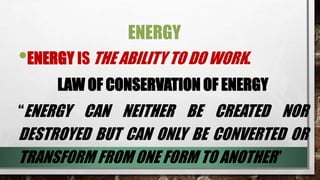
•ENERGY IS THE ABILITY TO DO WORK.
LAW OF CONSERVATION OF ENERGY
“ENERGY CAN NEITHER BE CREATED NOR
DESTROYED BUT CAN ONLY BE CONVERTED OR
TRANSFORM FROM ONE FORM TO ANOTHER”
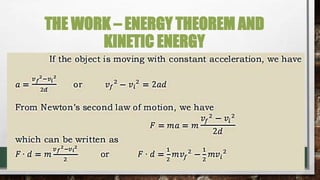
THE WORK – ENERGY THEOREM AND
KINETIC ENERGY
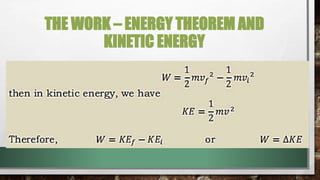
THE WORK – ENERGY THEOREM AND
KINETIC ENERGY
POTENTIAL ENERGY
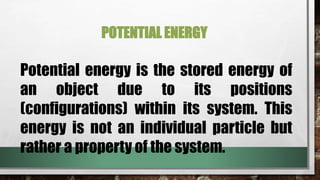
Potential energy is the stored energy of
an object due to its positions
(configurations) within its system. This
energy is not an individual particle but
rather a property of the system.
GRAVITATIONAL POTENTIAL ENERGY
THE ENERGY POSSESSED BY A BODY AS THE
RESULT OF ITS POSITION OR CONFIGURATION
(HEIGHT) IS CALLED GRAVITATIONAL POTENTIAL
ENERGY. ENERGY CAN BE STORED IN AN OBJECT TO
BE ABLE TO DO WORK, WE CAN RELATE ENERGY
AND WORK AS A SIMILAR ENTITY.
GRAVITATIONAL POTENTIAL ENERGY
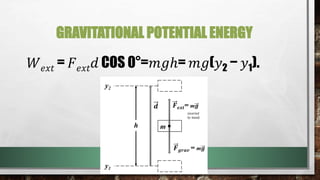
𝑊𝑒𝑥𝑡 = 𝐹𝑒𝑥𝑡𝑑 COS 0°=𝑚𝑔ℎ= 𝑚𝑔(𝑦2 − 𝑦1).
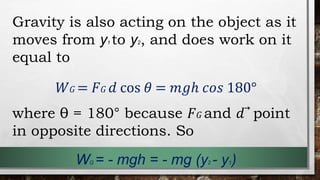
Gravity is also acting on the object as it
moves from y1 to y2, and does work on it
equal to
𝑊𝐺 = 𝐹𝐺 𝑑 cos 𝜃 = 𝑚𝑔ℎ 𝑐𝑜𝑠 180°
where θ = 180° because 𝐹𝐺 and 𝑑⃗ point
in opposite directions. So
WG = - mgh = - mg (y2 - y1)
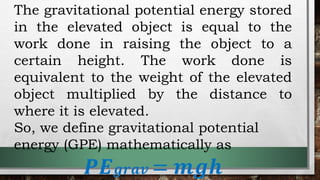
The gravitational potential energy stored
in the elevated object is equal to the
work done in raising the object to a
certain height. The work done is
equivalent to the weight of the elevated
object multiplied by the distance to
where it is elevated.
So, we define gravitational potential
energy (GPE) mathematically as
𝑷𝑬𝒈𝒓𝒂𝒗 = 𝒎𝒈𝒉
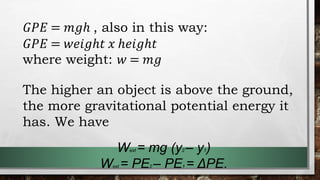
𝐺𝑃𝐸 = 𝑚𝑔ℎ , also in this way:
𝐺𝑃𝐸 = 𝑤𝑒𝑖𝑔ℎ𝑡 𝑥 ℎ𝑒𝑖𝑔ℎ𝑡
where weight: 𝑤 = 𝑚𝑔
The higher an object is above the ground,
the more gravitational potential energy it
has. We have
Wext = mg (y2 – y1)
Wext = PE2 – PE1 = ΔPE.
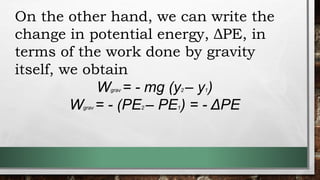
On the other hand, we can write the
change in potential energy, ΔPE, in
terms of the work done by gravity
itself, we obtain
Wgrav = - mg (y2 – y1)
Wgrav = - (PE2 – PE1) = - ΔPE
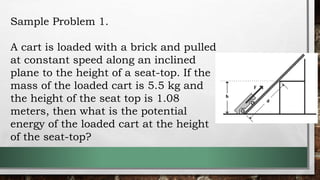
Sample Problem 1.
A cart is loaded with a brick and pulled
at constant speed along an inclined
plane to the height of a seat-top. If the
mass of the loaded cart is 5.5 kg and
the height of the seat top is 1.08
meters, then what is the potential
energy of the loaded cart at the height
of the seat-top?
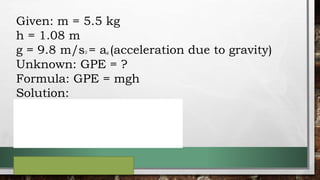
Given: m = 5.5 kg
h = 1.08 m
g = 9.8 m/s2 = ag (acceleration due to gravity)
Unknown: GPE = ?
Formula: GPE = mgh
Solution:
= (5.5 kg) (9.8 m/s2) (1.08m)
= (53.9 kg·m/s2) (1.08 m)
= (53.9 N) (1.08 m)
Answer: = 58.21 J
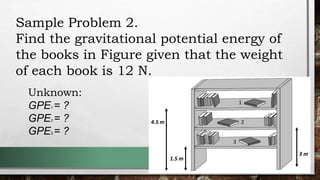
Sample Problem 2.
Find the gravitational potential energy of
the books in Figure given that the weight
of each book is 12 N.
Unknown:
GPE1 = ?
GPE2 = ?
GPE3 = ?
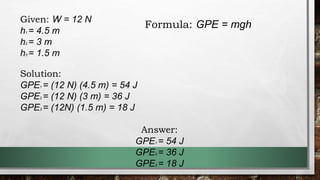
Given: W = 12 N
h1 = 4.5 m
h2 = 3 m
h3 = 1.5 m
Solution:
GPE1 = (12 N) (4.5 m) = 54 J
GPE2 = (12 N) (3 m) = 36 J
GPE3 = (12N) (1.5 m) = 18 J
Answer:
GPE1 = 54 J
GPE2 = 36 J
GPE3 = 18 J
Formula: GPE = mgh
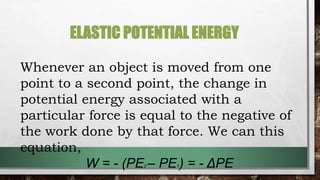
ELASTIC POTENTIAL ENERGY
Whenever an object is moved from one
point to a second point, the change in
potential energy associated with a
particular force is equal to the negative of
the work done by that force. We can this
equation,
W = - (PE2 – PE1) = - ΔPE
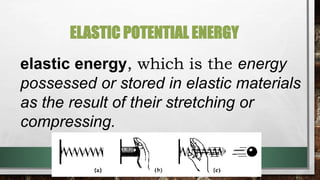
ELASTIC POTENTIAL ENERGY
elastic energy, which is the energy
possessed or stored in elastic materials
as the result of their stretching or
compressing.
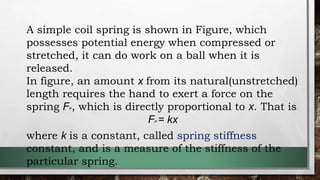
A simple coil spring is shown in Figure, which
possesses potential energy when compressed or
stretched, it can do work on a ball when it is
released.
In figure, an amount x from its natural(unstretched)
length requires the hand to exert a force on the
spring FP, which is directly proportional to x. That is
FP = kx
where k is a constant, called spring stiffness
constant, and is a measure of the stiffness of the
particular spring.
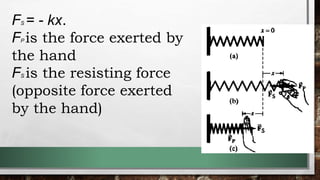
FS = - kx.
FP is the force exerted by
the hand
FS is the resisting force
(opposite force exerted
by the hand)
In calculating the potential energy of a stretched spring, take
note that the
force is changing or varies over some distance, it will also
greater as the spring stretched more. So let’s use the average
force, F, since FP varies linearly – from zero at the equilibrium
position (the position in which there is no applied force on it,
typically an assumption of natural position) to kx; when
stretched to x – the average force is F = ½ [0+kx] = ½ kx, where x
here is the final amount stretched (i.e. xi = 0 at equilibrium
position and x in kx is equal to xf ). The work done is
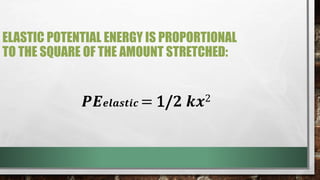
ELASTIC POTENTIAL ENERGY IS PROPORTIONAL
TO THE SQUARE OF THE AMOUNT STRETCHED:
𝑷𝑬𝒆𝒍𝒂𝒔𝒕𝒊𝒄 = 1/𝟐 𝒌𝒙2
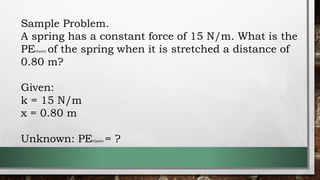
Sample Problem.
A spring has a constant force of 15 N/m. What is the
PEelastic of the spring when it is stretched a distance of
0.80 m?
Given:
k = 15 N/m
x = 0.80 m
Unknown: PEelastic = ?
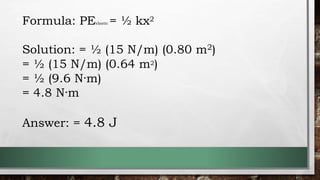
Formula: PEelastic = ½ kx2
Solution: = ½ (15 N/m) (0.80 m2)
= ½ (15 N/m) (0.64 m2)
= ½ (9.6 N·m)
= 4.8 N·m
Answer: = 4.8 J
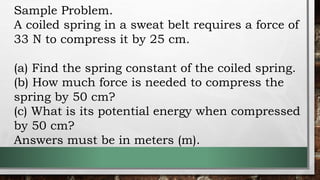
Sample Problem.
A coiled spring in a sweat belt requires a force of
33 N to compress it by 25 cm.
(a) Find the spring constant of the coiled spring.
(b) How much force is needed to compress the
spring by 50 cm?
(c) What is its potential energy when compressed
by 50 cm?
Answers must be in meters (m).
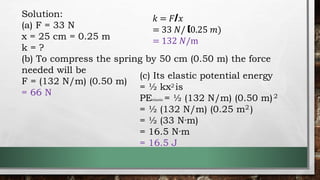
Solution:
(a) F = 33 N
x = 25 cm = 0.25 m
k = ?
(b) To compress the spring by 50 cm (0.50 m) the force
needed will be
F = (132 N/m) (0.50 m)
= 66 N
𝑘 = 𝐹/𝑥
= 33 𝑁/ (0.25 𝑚)
= 132 𝑁/m
(c) Its elastic potential energy
= ½ kx2 is
PEelastic = ½ (132 N/m) (0.50 m)2
= ½ (132 N/m) (0.25 m2 )
= ½ (33 N·m)
= 16.5 N·m
= 16.5 J

Work-and-Energy.pptx

  • 2.
    ENERGY •ENERGY IS THEABILITY TO DO WORK. LAW OF CONSERVATION OF ENERGY “ENERGY CAN NEITHER BE CREATED NOR DESTROYED BUT CAN ONLY BE CONVERTED OR TRANSFORM FROM ONE FORM TO ANOTHER”
  • 3.
    THE WORK –ENERGY THEOREM AND KINETIC ENERGY
  • 4.
    THE WORK –ENERGY THEOREM AND KINETIC ENERGY
  • 5.
    POTENTIAL ENERGY Potential energyis the stored energy of an object due to its positions (configurations) within its system. This energy is not an individual particle but rather a property of the system.
  • 6.
    GRAVITATIONAL POTENTIAL ENERGY THEENERGY POSSESSED BY A BODY AS THE RESULT OF ITS POSITION OR CONFIGURATION (HEIGHT) IS CALLED GRAVITATIONAL POTENTIAL ENERGY. ENERGY CAN BE STORED IN AN OBJECT TO BE ABLE TO DO WORK, WE CAN RELATE ENERGY AND WORK AS A SIMILAR ENTITY.
  • 7.
    GRAVITATIONAL POTENTIAL ENERGY 𝑊𝑒𝑥𝑡= 𝐹𝑒𝑥𝑡𝑑 COS 0°=𝑚𝑔ℎ= 𝑚𝑔(𝑦2 − 𝑦1).
  • 8.
    Gravity is alsoacting on the object as it moves from y1 to y2, and does work on it equal to 𝑊𝐺 = 𝐹𝐺 𝑑 cos 𝜃 = 𝑚𝑔ℎ 𝑐𝑜𝑠 180° where θ = 180° because 𝐹𝐺 and 𝑑⃗ point in opposite directions. So WG = - mgh = - mg (y2 - y1)
  • 9.
    The gravitational potentialenergy stored in the elevated object is equal to the work done in raising the object to a certain height. The work done is equivalent to the weight of the elevated object multiplied by the distance to where it is elevated. So, we define gravitational potential energy (GPE) mathematically as 𝑷𝑬𝒈𝒓𝒂𝒗 = 𝒎𝒈𝒉
  • 10.
    𝐺𝑃𝐸 = 𝑚𝑔ℎ, also in this way: 𝐺𝑃𝐸 = 𝑤𝑒𝑖𝑔ℎ𝑡 𝑥 ℎ𝑒𝑖𝑔ℎ𝑡 where weight: 𝑤 = 𝑚𝑔 The higher an object is above the ground, the more gravitational potential energy it has. We have Wext = mg (y2 – y1) Wext = PE2 – PE1 = ΔPE.
  • 11.
    On the otherhand, we can write the change in potential energy, ΔPE, in terms of the work done by gravity itself, we obtain Wgrav = - mg (y2 – y1) Wgrav = - (PE2 – PE1) = - ΔPE
  • 12.
    Sample Problem 1. Acart is loaded with a brick and pulled at constant speed along an inclined plane to the height of a seat-top. If the mass of the loaded cart is 5.5 kg and the height of the seat top is 1.08 meters, then what is the potential energy of the loaded cart at the height of the seat-top?
  • 13.
    Given: m =5.5 kg h = 1.08 m g = 9.8 m/s2 = ag (acceleration due to gravity) Unknown: GPE = ? Formula: GPE = mgh Solution: = (5.5 kg) (9.8 m/s2) (1.08m) = (53.9 kg·m/s2) (1.08 m) = (53.9 N) (1.08 m) Answer: = 58.21 J
  • 14.
    Sample Problem 2. Findthe gravitational potential energy of the books in Figure given that the weight of each book is 12 N. Unknown: GPE1 = ? GPE2 = ? GPE3 = ?
  • 15.
    Given: W =12 N h1 = 4.5 m h2 = 3 m h3 = 1.5 m Solution: GPE1 = (12 N) (4.5 m) = 54 J GPE2 = (12 N) (3 m) = 36 J GPE3 = (12N) (1.5 m) = 18 J Answer: GPE1 = 54 J GPE2 = 36 J GPE3 = 18 J Formula: GPE = mgh
  • 16.
    ELASTIC POTENTIAL ENERGY Wheneveran object is moved from one point to a second point, the change in potential energy associated with a particular force is equal to the negative of the work done by that force. We can this equation, W = - (PE2 – PE1) = - ΔPE
  • 17.
    ELASTIC POTENTIAL ENERGY elasticenergy, which is the energy possessed or stored in elastic materials as the result of their stretching or compressing.
  • 18.
    A simple coilspring is shown in Figure, which possesses potential energy when compressed or stretched, it can do work on a ball when it is released. In figure, an amount x from its natural(unstretched) length requires the hand to exert a force on the spring FP, which is directly proportional to x. That is FP = kx where k is a constant, called spring stiffness constant, and is a measure of the stiffness of the particular spring.
  • 19.
    FS = -kx. FP is the force exerted by the hand FS is the resisting force (opposite force exerted by the hand)
  • 20.
    In calculating thepotential energy of a stretched spring, take note that the force is changing or varies over some distance, it will also greater as the spring stretched more. So let’s use the average force, F, since FP varies linearly – from zero at the equilibrium position (the position in which there is no applied force on it, typically an assumption of natural position) to kx; when stretched to x – the average force is F = ½ [0+kx] = ½ kx, where x here is the final amount stretched (i.e. xi = 0 at equilibrium position and x in kx is equal to xf ). The work done is
  • 21.
    ELASTIC POTENTIAL ENERGYIS PROPORTIONAL TO THE SQUARE OF THE AMOUNT STRETCHED: 𝑷𝑬𝒆𝒍𝒂𝒔𝒕𝒊𝒄 = 1/𝟐 𝒌𝒙2
  • 22.
    Sample Problem. A springhas a constant force of 15 N/m. What is the PEelastic of the spring when it is stretched a distance of 0.80 m? Given: k = 15 N/m x = 0.80 m Unknown: PEelastic = ?
  • 23.
    Formula: PEelastic =½ kx2 Solution: = ½ (15 N/m) (0.80 m2) = ½ (15 N/m) (0.64 m2) = ½ (9.6 N·m) = 4.8 N·m Answer: = 4.8 J
  • 24.
    Sample Problem. A coiledspring in a sweat belt requires a force of 33 N to compress it by 25 cm. (a) Find the spring constant of the coiled spring. (b) How much force is needed to compress the spring by 50 cm? (c) What is its potential energy when compressed by 50 cm? Answers must be in meters (m).
  • 25.
    Solution: (a) F =33 N x = 25 cm = 0.25 m k = ? (b) To compress the spring by 50 cm (0.50 m) the force needed will be F = (132 N/m) (0.50 m) = 66 N 𝑘 = 𝐹/𝑥 = 33 𝑁/ (0.25 𝑚) = 132 𝑁/m (c) Its elastic potential energy = ½ kx2 is PEelastic = ½ (132 N/m) (0.50 m)2 = ½ (132 N/m) (0.25 m2 ) = ½ (33 N·m) = 16.5 N·m = 16.5 J

Editor's Notes

  • #2 Work and energy are closely related concepts in physics. We represent the amount of energy transformed from one form to another through the concept of work. It also tells us how much energy has been converted from one form to another in a way that the amount of work done in a system leads to the changes.
  • #6 or compressed and an iron ball elevated above the ground to a certain height.
  • #7 For example, a book at a tabletop possessed potential energy under its position. Enable to put that book on the table, we must exert force on it to be able to attain that position. We can say that the product of its force and position or height from where it was taken is equal to the work done on the object. Thus, the body stores gravitational potential energy that could result in a work, the same with the work done to raise that object.
  • #8 Refer to the figure at the right. For an object of mass m to be lifted vertically, an upward force at least equal to its weight, mg, must be exerted on it, say by a person’s hand. To lift it without acceleration a vertical displacement of height h, from position y1 to y2 in Figure (upward direction chosen positive), a person must do work equal to the product of the needed external force, Fext = mg upward, and the vertical displacement h. That is,
  • #11 That is the work done by an external force to move the object mass m from point 1 to point 2 is equal to the change in potential energy between positions 1 and 2.
  • #12 That is, the work done by gravity as the object of mass m moves from point 1 to point 2 is equal to the negative of the difference in potential energy between positions 1 and 2.
  • #17 On the other hand, we now consider another type of potential energy associated with elastic materials. Spring is an example, which when compressed or stretched, it possessed or stored potential energy. We refer to this as
  • #20 The force that the spring exerts in the direction opposite the displacement (minus sign), acting to return it to its natural length is sometimes called a “restoring force”: FS = - kx. This equation is also known as the spring equation and also as Hooke’s law.