B

M

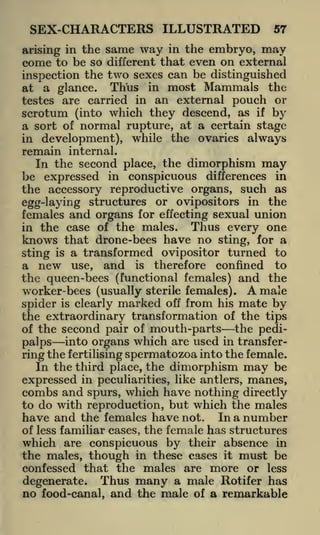
Oflt.

Iflb

BL.
UNIVERSITY OF CALIFORNIA
SAN FRANCISCO MEDICAL CENTER

LIBRARY

Please leave this Bookplate intact.
HOME UNIVERSITY LIBRARt
OF MODERN KNOWLEDGE

SEX
BY PATRICK GEDDES

AND

J.

ARTHUR THOMSO

LONDON

WILLIAMS

&

NORGATE

HENRY HOLT & Co., NEW YORK
WM. BRTGGS, TORONTO
INDIA
R. & T. WASHBOURNE, LTD

CANADA
:

:
HOME
UNIVERSITY
LIBRARY
or

MODERN KNOWLEDGE
Editors

HERBERT

:

FISHER, M.A., F.B.A., LL.D.

PROF. GILBERT

MURRAY,

D.LlTT.,

LL.D., F.B.A.

PROF.

J.

ARTHUR THOMSON,

M.A.,

LL.D.

PROF.

WILLIAM

T.

BREWSTER, M.A.

(Columbia University, U.S.A.)
SEX
BY

PATRICK GEDDES
PROFESSOR OF BOTANY, UNIVERSITY OF
ST.

J.

ANDREWS

ARTHUR THOMSON

PROFESSOR OF NATURAL HISTORY, UNIVERSITY
OF ABERDEEN
Joint

,1

Ant tiers of " The Evolution of Sex "
"
*'
Evolution (1911)
(1889), and
the volumes of kindred interest already published

Among

in this series are the following
32.

Introduction to Science.

20.

Evolution.

62.

The Origin and Nature

By

By

Prof.

,T.

:

A. Thomson.

Thomson and

Prof. P. Geddes.

of Life.

Prof. J. A.

Prof.

By

Benjamin

Moore, F.R.S.
9.

The Evolution

of Plants.

Dr. D. H. Scott, F.R.S.

By

(Illustrated.}

72.

Plant Life.

19.

The Animal World.

By Prof.

J. B.

By

Farmer, F. R. S.
Prof. F.

W.

(Illustrated.

}

Gamble, F.R.S.

(Illustrated.}
44.

By

Principles of Physiology.

Prof. J. G.

McKendrick,

F.R.S.
57.

The

Human

Body.

By

Prof.

A.

Keith,

(Illustrated.}
17.

Health and Disease.

38.

The

54.

Ethics.

School.

By

By

By

Dr.

W.

L. Mackenzie.

Prof. J. J. Findlay, Ph.D.

G. E. Moore, M.A.

Firat Printed April 1914

LL.D.
CONTENTS
CHA

I'.

I

II

THE STUDY OF SEX

....

THE EVOLUTION OF SEX

...

III

SEX-CHARACTERS ILLUSTRATED

IV

THEORY OF SEX DIMORPHISM

V
VI
VII
VIII

IX

X

WHAT DETERMINES SEX?
THE CYCLE OF SEX

.

.

.

.

,

...
.

CORRUPTIO OPTIMI PESSIMA

.

.

PROS AND CONS OF SEX-EDUCATION

THE ETHICS OF SEX
SEX AND SOCIETY
BIBLIOGRAPHY

.

.

.

.

.

7

20
56

72
98

.117

.142
.

157

.181

....
.

PACK

203

245
LIST OF ILLUSTRATIONS
(By MISS E.

L.

SHINNJE)
PAGE

FIG.

1.

Male and female Bird of Paradise

2.

Male and female spider

3.

The Bell-animalcule

(after

0.

17

Hertwig)

4a,
5.

4ft,

4c.

male (after Klein)
and spermatozoon

Ovum

.

8.

11.
12.

13.
14.

.

.

18
22

Asexual, female and
24, 25

(after E. B. Wilson)

.

....
...

Tongue Fern (OphioBruchmann)

Diagram of a flower
Freshwater Hydra

9. Fertilisation of

10.

:

in Adder's

glossum (after
7

Vorticella

Volvox colonies

6. Fertilisation

...

(after Vinson)

(after Sachs)

eggs of Starfish (after Fol

.

.

Male and female of Crested Newt (from specimens)
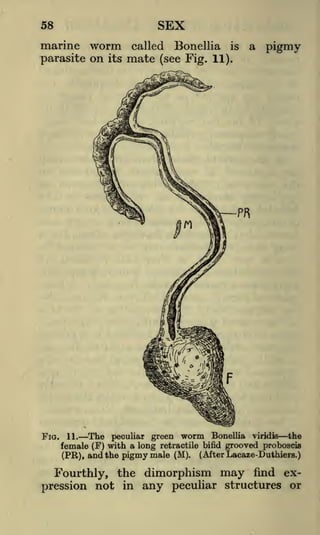
Male and female Bonellia (after Lacaze-Duthiers)
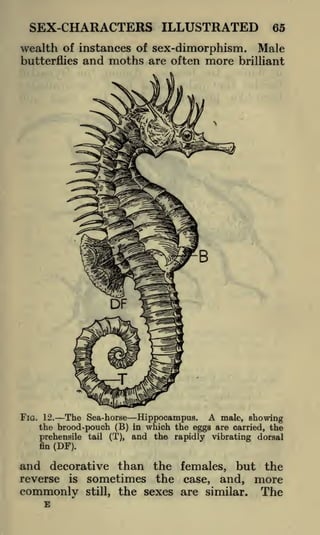
Male Sea-horse Hippocampus (from a specimen)
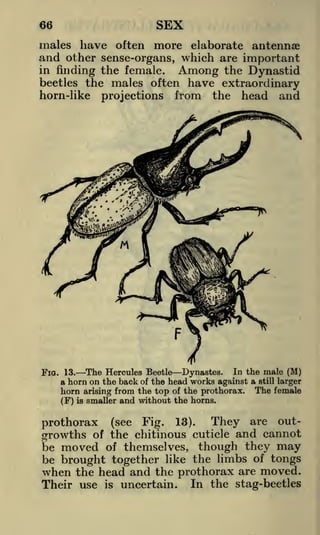
Male and female Hercules beetles (/row specimens)
Male and female fish, Phallostethus (after C.

35

36
37
46
48
51

58
65
66

.70

'

Tate Regan)
15. Forms of abdomen in female, male, and parasitised male crab (after Geoffrey Smith)
.

.

.

84

16

Male crab, Inachus, parasitised by Sacculina (after

17.

Female Paper Nautilus, Argonauta argo (from
89
a specimen)
90
Male Argonauta argo (after Muller)
Male spiders, posing and dancing (after Prof.
/
.129
and Mrs. Pekham)
Female spider carrying her cocoon (after

Geoffrey Smith)

18.
19.

.......
...
.

20.

Blackwall)

86

.

....

'

.

.

133
SEX
CHAPTER

I

THE STUDY OF SEX
What sex has meant in the
Objections to the study of sex
What sex means to-day What sex may come to
past
mean

Various ways of studying sex.

OBJECTIONS TO THE STUDY OF SEX.

many "otherwise
"
word

sex

is

sensible

abhorrent,

people,
still

To

even the

more a book

not, therefore, be
volume, but their objections
may be considered, (a) In some cases the
repugnance expresses an organic lack of
sympathy with the aim of science, for many
estimable people have no use for scientific
analysis. They are lacking in the curious
spirit, and are not worried by obscurities.
They are not interested in any theory of the
internal tides that sway them. To those
who are built on those lines, there is no more
to be said. One feels, however, that while

about

sex.
reading this

ignorance
plain

They

may

sailing,

will

be bliss when everything
some accurate knowledge

is

is

be useful when the bark of life gets
near the rocks in stormy weather. Science
is for the control of life, as well as for its
enlightenment.

likely to
SEX

8

(6) In others the repugnance comes from
the poetic and artistic side, and recalls to us
the warning tale of Amor and Psyche. Love,
they rightly say, is the most wonderful thing
in the world; to inquire into its mysterious
origins and pre-human analogues repels us.
Why thus dig at the roots of the Mystic Rose ?
Is there not risk of losing by scientific analysis
far more than one gains?
Even the savage
mother very long ago preferred what she
sometimes still prefers her poetic fancy of
the child-spirit entering her womb from the
totem-ground, where desirable qualities of
strength, swiftness, endurance, and the like
were actualised or symbolised, to an acknowledgment of the naked fact of physical
To those who feel so strongly that
paternity
"
"
is an artistic preserve
a charmed
love
corner of the Earthly Paradise where science
is a trespasser, little can be said by us bioloUnless it be this, that from their
gists.
position it is impossible to see one of the
"
!

love ", namely its evolubiggest facts about
tion.
Perhaps this also, that when the steps
of the evolution of love are faced and climbed,

the poetic and spiritual possibilities are found
to be more assured than ever, since they
appear henceforth, not merely as the dreams
of the poet, but as the promise of the race.
And what are most dreams, after all, but
coarse and fine groping or feeling
tendrils
after the hitherto unattained ?
others the repugnance is more
(c) For

and deliberate. To talk about sex,
they say, makes for morbid self-consciousness, for indelicacy, even if not impurity.
intellectual
THE STUDY OF SEX

9

bring the facts of sex into broad daylight
to disclose the organic springs
obscenity
of love is to degrade Man to the brute level
to raise into the focus of consciousness what
"
ought to remain sub-conscious is a psychical
rape." The latest and unforgivable sin of a
materialistic and scientific system of education
is thus to presume to give any instruction
whatever in regard to the process by which
And how much more
the race is continued
awful even to broach the subject of the
Scylla and Charybdis of adolescence
We should not be writing this little book
when more agreeable occupations
at all
did we not believe that the people
invite us
perish for lack of knowledge of sex; that
it is ignorance, not science, which engenders
pruriency and communicates filthy-mindedness; that for lack of a little instruction
many are made miserable when they should

To
is

;

;

!

!

be happy, many even ruined, in soul and in
body. There is too much mist about the
life-journey, from its origins and at its climax
mists dark and unwholesome, favouring errors
of judgment and errors of conduct
and of
;

the ever-brightening lights of science there
can be few better uses than here and there
to guide the wayfarer, even though they
may not yet serve to clear all the mists away.
One appeal we would make to those who
dread in sex only the dangers of the knowledge
of

good and

evil, and who, as we think, fail
lies the
towards the tree

to see that here
of life as well.

and nurses

way

Are not physicians,

alienists,

who
But

see most
are they

precisely the people

of sex in its diseased forms ?
10

SEX

thereby in anyway more tempted towards sin ?
Surely otherwise. While as to normal sex,

which essentially interests us here, and as
heart and through life zoologists and
botanists, each and both of us, what harm
have we to tell of our simply or magnificently
sexed animals, our gloriously sexed flowers?
And coming to the human species, and to our
lifelong friends the painters, above all the
sculptors, who, beyond any of us, study life
naked and unashamed, have not these exfor every age and generation, its

at

Eressed ideals,
ighest

human

or divine?

WHAT SEX HAS MEANT IN THE

PAST. There
have been a world without sex a
might
parthenopeia of which we get a hint from
the swarming generations of green-flies on
our rose-bushes and hop-vines, which, all
the summer through, increase by virgin
birth, with not a single male to be seen till
the autumn. The question thus arises, Why
might not the organic world have been run
on sexless lines ? We shall see later on how
naturally sex arose in the early days, or rather
ages, of organic evolution, and that it has
ever been one of the conditions of progress.
itself would probably have ceased
there had not been the love of mates. Strong
as is the vital impulse, it probably could not
have reached beyond a certain level had it
not evoked the deVice of sex, and thus renewed
its inspiration for the uplift of the type, as

Maternity
if

well as encouragement, through a new lifeecstasy, of its individuals.
In mankind the fact of sex has saturated
It is not improbable, as
history.

through
THE STUDY OF SEX

11

Mr. Heape has maintained, that the ancient
systems of custom and belief which we know
as Exogamy and Totemism are in origin
characteristically Male and Female expressions respectively. The specialisation of the

mother and home-maker made the consolidation of the family possible. The division
of labour between the sexes increased the
likelihood of invention and opened up different
lines of occupation, discipline, and culture,
which have often crossed and influenced one

ways, intellectual, emohas been alternate
stimulus between the sexes. There has been
a mutual culture, and sometimes a mutual
degradation. Love and passion have stimulated, if not indeed created, music and dance,
they have been
painting and other arts
among the mainsprings of poetry they have
entered into the heart of religion from the
widespread ancient phallic worships (which
have been too harshly judged, from their
defects and vices alone), down to much in the
latest cults of to-day.
Sex-prompted enthusiasms have led to high ethical endeavours,
as in chivalry and its quests, and even in
wars, though these may have left the world
the poorer after them.
To those who may think that we are making

another.
tional,

In

and

many

ethical, there

;

;

much

of the r61e of sex in history we would
that they read, for instance, Karl
suggest
Pearson's Chances of Death. From his interesting study of the Aryan terms for sex and
"
that the sex-instinct,
kinship, he concludes
as one of the two chief motors of primitive
life, has been chiefly instrumental in creating,

too
SEX

12

not only terms for relationship, but also terms
for the chief

..." Many
sense,

and

human

affections and desires."
roots have originally a sexual
are by analogy or association

afterwards used for wider household, agri"
Accordcultural, or social occupations."
ingly, if we find in the sexual impulse not only
the source of a developed terminology for
relationship, but also the first germs of the
social instincts in man, shall we not cease to
"
a most unlovely germ of apperegard it as
tite," and recognise it for what it really has
been nay, still really is the ultimate basis
of the very highest, as well as of the very
lowest, phases in human action and human
"
feeling?

WHAT SEX MEANS TO-DAY. This little
word covers half the happiness of mankind,
and half the misery too indeed, what pessimist
would not say more
It brings about the
!

re-arrangement of the whole life at adolescence, and gives the individual a fresh start
up or down. It is the organic tendril that
fastens the growing spirit to the most enduring
in art
supports in our external heritage
and literature and great example. It is the
physical basis of the most powerful emotion
in human life
the love of mates, and it is
capable of rising higher and falling lower than
any other impulse we know. It gives wings
;

or shackles

oftenest, a little of both.
side is indeed painfully obvious.
Morbidities and vices in adolescence are all
too common. Many lovers fail in continence.
Many marriages sink into commonplaceness
and stupor, into quarrelsomeness or indiffer;

The seamy
THE STUDY OF SEX

13

of those who habitually
sexual gratification are crowded.
Unnatural vices lurk in dark places. There
are many who have allowed their minds to
become unclean, who keep up the trade of
pornographic printing, or chew the cud of
filthy stories, whose thoughts are always
turning to the flesh and the lusts thereof,
who can hardly look at a woman without
becoming adulterous in heart. In many
men who are not unhealthy-minded there is
a selfish celibacy which postpones marriage
"
"
that best helps
assured position
for the
In the old stories the
a man to life-ruin.
lover galloped boldly off with his lady
but
nowadays the motor-car serves oftenest to
postpone the wife till love is past its youth.
On the other side, too, our modern wealthspirit fosters feminine selfishness, and spreads
that love of untaxed pleasure which shirks
maternity or minimises it. In too many
of the lives which prosperity has freed from
strain or struggle for existence, it seems as
if not only the lights of chivalry and romance

ence.

The ranks

buy and

sell

;

had gone out, but even
and courage also.

of

everyday affection

TO MEAN. A study
and the present should not be

WHAT SEX MAY COME

of the past

without its suggestions of the possible. What
are the lines of change that seem feasible and
not too Utopian? (1) A gradual introduction of carefully thought-out sex-education,
differentiated for age

and circumstances,

is

likely to do much towards healthy-mindedness, towards lessening morbid brooding,

towards a wholesomer view of everything
SEX

14

connected with the continuance of life. (See
Chapter VIII.)
(2) Moral education, too often neglected
or unskilled in the past, is likely to do much
in the way of renewing that vital continuity
of upward growth which is so often and
so easily distorted or broken, between the
simplest organic drearnings and stirrings
of sex-impulse and the ideals of lover and poet,
of eugenist and statesman.
The biological
setting is invaluable, but it tends fundamentally to be matter of fact; it must be complemented by an ideal setting. Hence (were
it but as the surest way to keep evil out)
the noble examples of the past, the possibilities of the future, should pre-occupy the

mind.

Only with

this dual education, organic
yet
physiologic yet poetic, can our
complex modern city life be again grown
healthily, and become, as in the best and
simplest rustic life of old, healthy from root
to flower.
(3) It seems legitimate to look forward to
a very considerable lessening of the troubles
ideal,

of adolescence, when doctor and psychologist,
teacher and parent find time to unite their
brains in the task. There can be no doubt
that the ideal of preventive medicine has not
been sufficiently borne in mind in connection
with this critical period, and that things are
left to themselves in a fatalistic fashion.
There should be more preparation for the
probable storms a preparation which many
savage tribes have tried to meet in a manner
that makes us ashamed of our own " muddling
through." It is likely that the establishment
THE STUDY OF SEX

15

of frank relations between young people and
their physician will save many from miserable

years and even from shipwreck.
It may also be suggested that one of the
gains of the study of sex will be a better

understanding of many phenomena which
burden and grieve the spirit. The saying,
"
"
is a
all

To know all, is to forgive
warning
to the intolerant; but there are yet more
useful sayings, since it is not of such great
moment whether we forgive or not. What is
important to our successors is whether Nature
What is important is the practical
forgives.
action we take in furthering or discouraging,
and it is here that understanding is of essential
importance.
It is a fact, for instance, that we have in
our midst the persistence of " fossils of several
In regard to these
stages of sexual habit."
we know better what to do or what not to

do when we see them in their historical significance.
Sex-festivals, as in some parts of
Russia, for instance, with their strange mingling
of religious emotion and sexual license, are
not inexplicable perversions of a pathological
character so much as survivals of a primeval
civilisation.

Other instances

may

be found

persistent and
deliberate ante-nuptial experimenting as to
the fertility of a proposed marriage, which
has lingered so long in northern countries.

nearer

home,

e.g.

in

that

VARIOUS WAYS OF STUDYING SEX. The
problems of sex have been attacked along
various lines of investigation, (a) There is
the historical method which traces the relations of the sexes through the ages, which
SEX

16

deals with the history of marriage, of adolescence-ceremonies, of courtship, of concubinage, of prostitution, and so on. It varies,
of course, as emphasis is laid on the anthropological, the economic, or the religious aspects
of the facts, but its method is definitely
It aims at tracing out; the evoluhistorical.
tion of the sex-relations from their pre-human
to their human, from their primitive to their
civilised expressions.

Another method is that of comparative
anthropology, which studies the customs at
present to be observed in different peoples,
(b)

especially of those who are called savages,
who may be more profitably called our " contemporary ancestors." Thus the study of
the aborigines of Central Australia, as pur-

sued by men like Spencer and Gilleri, has
yielded very valuable results, especially those
bearing on exogamy and totemism. But
without going outside our own civilisation
there is much to be gained from a comparative
study of customs, rites, and lingering superstitions.
Logically pursued, this comparative
method may be extended to a study of the
sex-relations among animals.
third method is biological the study
(c)
of sex as seen in animals and plants, and this

A

along two somewhat
the one hand, we have
physiological investigations, into the r61e of
sex-functions in the internal economy of
the organism; on the other hand, we have
the study, more observational than experimental, of the expressions of sex in plant and
animal, in insect and bird, in amphibian
is

usually

pursued

different lines.

On
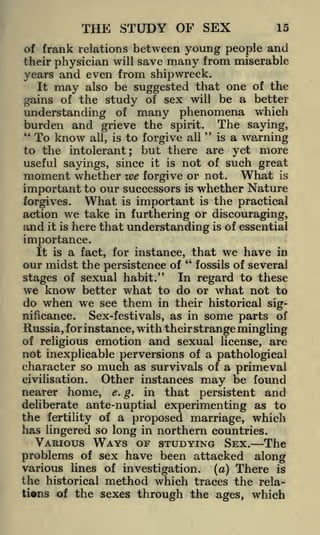
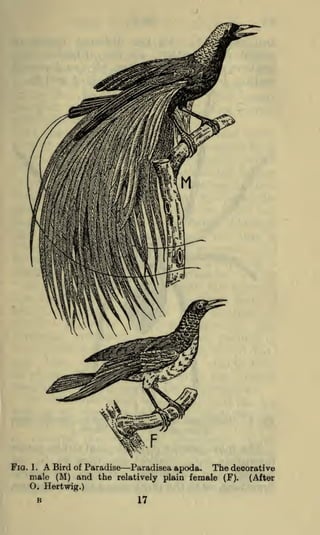
Fio.

1.

A Bird of Paradise

Paradisea apoda.

The decorative

male (M) and the relatively plain female
(X Hertwig.)
B

17

(F).

(After
SEX

18

and mammal.

the different modes of
all the different illustrations of sex-dimorphism, all the forms of
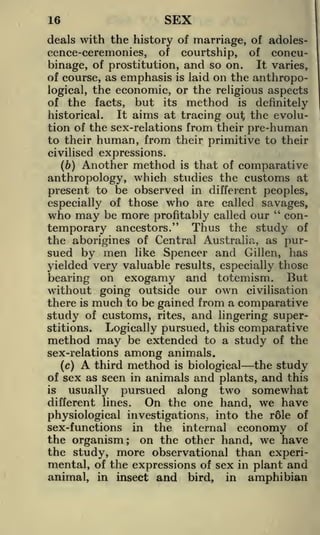
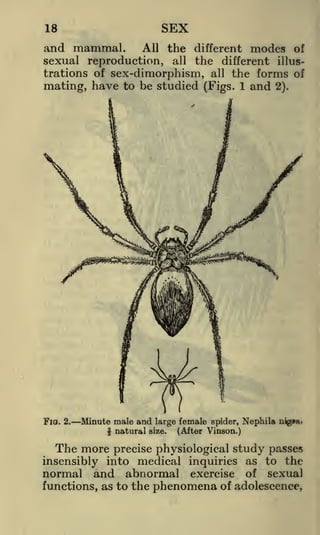
mating, have to be studied (Figs. 1 and 2).
All

sexual reproduction,

Fia. 2.

Minute male and large female spider, Nephila njga>
f natural size. (After Vinson.)

The more precise physiological study passes
insensibly into medical inquiries as to the
normal and abnormal exercise of sexual
functions, as to the phenomena of adolescence,
THE STUDY OF SEX

19

maturity and the climacteric. The more
general Natural History study passes insensibly into psychological inquiries as to the
sexual impulses, instincts, and emotions,
as to the rise and progress of that human
"
"
love ; and thence,
complex which we call
alas, into its pathology also.
In our insistence on the fundamental necesapart from
sity of the biological approach
which human nature cannot be rightly understood we are far from falling into the fallacy
of forgetting that the biological interpretation
requires to be supplemented by the psycholoWe wish to make our
gical and the social.
position in this respect quite clear. Through
and through, and back to the ovum, Man is
a mammal, with a mammal's structure and
functions, development

and pedigree, with a

mammal's strength and weaknesses. Truly,
"
all flesh is not the same flesh, but there is
one kind of flesh of men, another flesh of
beasts, another of fishes, and another of
there is specificity through and
birds,"
through; yet there is a common ground of
protoplasm that makes the whole world kin ;
and Man cannot disown his mammalian
ancestry. He is solidary with the animal
creation and with mammals in particular.
On the other hand, while Man still has his
feet, as it were, in the natal mud, he has
hitched his

wagon

of rational

own

history,

to a star.

discourse,

and

his

With

his

power

awareness of his

his capacity for controlling

conduct in relation to general ideas and
ideals, he is able to pass far beyond animal
confines.
Therefore we have sympathy with
his
SEX

20

"
a recent writer who says
The links that
bind a young man in the pride of life with a
rutting stag, or a mother and her baby with
a she-bear and her cubs, are insignificant compared with the differences that divide them.
Human conduct, human happiness, and the
present and future of the human race are
bound up with the differences between man
and animals, and not with the resemblances."
We should say " with the differences as well
as with the resemblances," and we should
"
alter the word
of less
insignificant to
" but the
moment than ;
quotation expresses
an important protest, against a too simple
"biologism," and with this protest we heartily
concur.
Yet our course of action must be not to
:

make 'ess of biology either in enquiry or in
of psyuse, but of the higher sciences more
ethics, and social science for choice.
chology,

CHAPTER

II

THE EVOLUTION OF SEX
Ancient origin of sex The case of Volvox Significance
of conjugation in the Protozoa Body-cells and germcells
Advantages of ^exual reproduction Sperm-cells
and egg-cells Significance of fertilisation Males and
females Testes and ovaries Sex-dimorphism Sexawareness Physical fondness ^Esthetic attraction
Co-operation of the sexes Love.

IN the volume Evolution

in this Library,
of the great steps in
the history of organisms the appearance of the
relatively simple Protists; the parting of

we have

discussed

some
:
THE EVOLUTION OF SEX

21

the ways between plants and animals; the

Protozoa and Protophyta
from one another and among themselves;

differentiation of

the establishment of multicellular bodies the
beginnings of brains and of behaviour; the
evolution of the dominant types of the animal
kingdom; and, finally, the emergence and
ascent of Man the supreme Mammal. We
have now to inquire into the evolution of
sex and the significance of the various steps
so far as these can be read at present.
ANCIENT ORIGIN OF SEX. The cords of
human love are complex, even in its average
;

expressions in civilised mankind.
a subtle interweaving of strands

and

psychical, aesthetic and
individual and social. Yet in
transfiguration, the flesh
persists,

and we land

There

is

physical

intellectual,
spite of all

and blood attraction
if we forget

in fallacy

that these sex-impulses which are at once
the glory and the shame of mankind and
this increasingly throughout the ages
have
a yet inconceivably longer history behind
them, and thence spring up within us with
the tremendous momentum of the organic
past.
It is a significant fact that we are confronted
with sex at the very roots of the genealogical
tree
in the primeval sub-kingdom of the Uni-

Protozoa and the Protophytes.
In these relatively simple organisms multiplication takes place by fission or by budding,
or by spore-formation but along with these
modes of multiplication there is a quite
distinct process, that combination of two
individuals which is called conjugation.
It

cellulars, the

;
SEX

22

used to be believed that the simplest organisms
showed no sexual reproduction, but subsequent researches have shown that this is
very far from being the case. Many single-

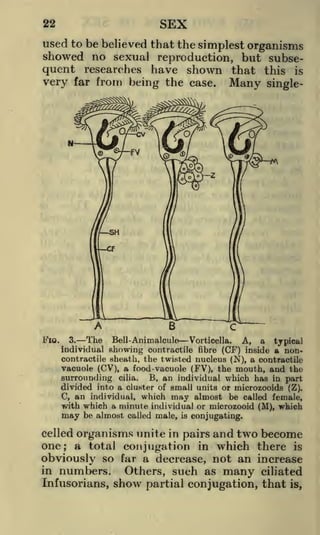
Fio.

3.
The Bell -Animalcule Vorticella. A, a typical
individual showing contractile fibre (CF) inside a noncontractile sheath, the twisted nucleus (N), a contractile
vacuole (CV), a food-vacuole (FV), the mouth, and the
surrounding cilia. B, an individual which has in part
divided into a cluster of small units or microzooids (Z).
C, an individual, which may almost be called female,
with which a minute individual or microzooid (M), which

may

be almost called male,

is

conjugating.

celled organisms unite in pairs and two become
one; a total conjugation in which there is
obviously so far a decrease, not an increase
in numbers.
Others, such as many ciliated
Infusorians, show partial conjugation, that is,
THE EVOLUTION OF SEX

23

they become closely united and exchange
nuclear elements, after which they separate
again. In other cases, the ordinary forms
produce special elements (spores) which conjugate, and these are sometimes dimorphic
macrospores and microspores corresponding
U> the eggs and sperms of higher animals.
In the life history of the common bellanimalcule, Vorticella (see Fig. 3), a smallsized free-swimming individual attaches itself
to and bores into another individual, of

normal

size,

which remains moored by

its

contractile stalk to the water-weed.
What
have we here but male and female in miniature? It is true, of course, that most of the
Protozoa remain strictly unicellular (or perhaps one should say non-cellular), so that
they can only be analogues of males and females
among multicellular creatures. They correspond, indeed, not so much to higher organisms,
as to the sex-cells of higher organisms they
are like ova and spermatozoa which have
"
not formed
bodies."
But the important
fact is that even among the Protozoa we find
examples of special reproductive units which
combine in pairs, and are dimorphic macrospores and microspores. For here we are at
the beginning of sex.
;

THE CASE OF VOLVOX. The second step
on the ladder is best illustrated by Volvox,
an Infusorian colony, not uncommon in clear
ponds, which shows us a body in the making.
It is a beautiful green ball of a thousand or
ten thousand flagellate cells, according to the
species, bound to one another by bridges of
protoplasm. It rolls itself quickly through
SEX

24

the water and feeds in part at least like a
let us consider its repro-

green plant. But
ductive relations.

It occasionally happens that a component
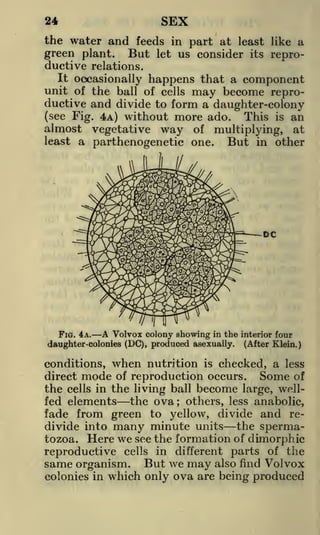
unit of the ball of cells may become reproductive and divide to form a daughter-colony
This is an
(see Fig. 4A) without more ado.
almost vegetative way of multiplying, at
least a parthenogenetic one.
But in other

A Volvox colony showing in the interior four
FIG. 4A.
daughter-colonies (DC), produced asexually. (After Klein.)
conditions, when nutrition is checked, a less
direct mode of reproduction occurs.
Some of

the cells in the living ball become large, wellfed elements the ova; others, less anabolic,
fade from green to yellow, divide and redivide into many minute units the spermatozoa. Here we see the formation of dimorphic
reproductive cells in different parts of the

same organism.

But we may

colonies in which only

also find Volvox
ova are being produced
THE EVOLUTION OF SEX

25

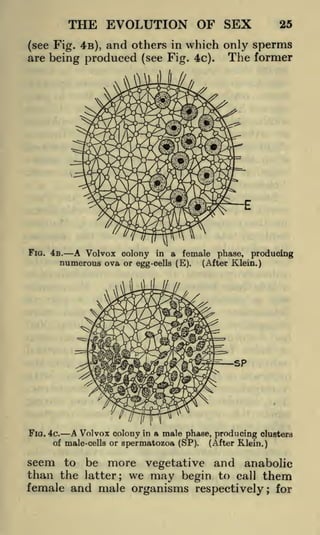
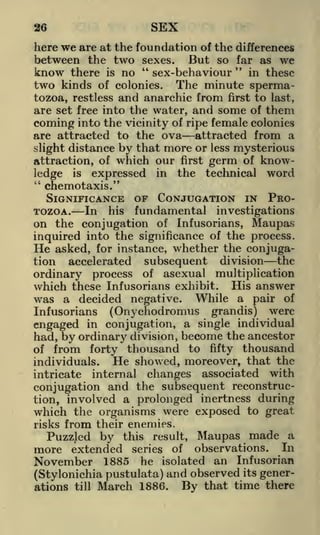
(see Fig. 4s), and others in which only sperms
are being produced (see Fig. 4c). The former

A Volvox colony in a female phase, producing
numerous ova or egg-cells (E). (After Klein.)

FIG. 4s.

FIG. 4c.

A Volvox

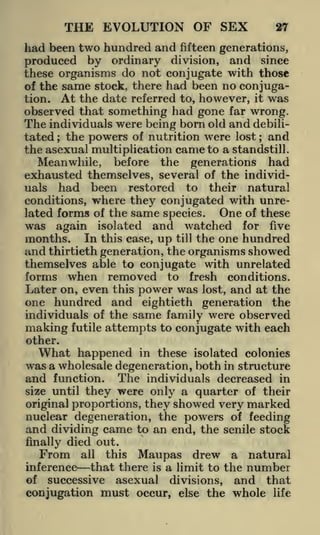
colony in a male phase, producing clusters

of male-cells or

spermatozoa (SP).

(After Klein.)

seem to be more vegetative and anabolic
than the latter we may begin to call them
female and male organisms respectively; for
;
SEX

20
here

we are at the foundation

of the differences

between the two sexes. But so far as we
know there is no " sex- behaviour " in these
two kinds of colonies. The minute spermatozoa, restless and anarchic from first to last,
are set free into the water, and some of them
coming into the vicinity of ripe female colonies
are attracted to the ova attracted from a
slight distance by that more or less mysterious
attraction, of which our first germ of knowis
expressed in the technical word
chemotaxis."
SIGNIFICANCE OF CONJUGATION IN PROTOZOA. In his fundamental investigations
on the conjugation of Infusorians, Maupas
inquired into the significance of the process.
He asked, for instance, whether the conjugation accelerated subsequent division the
ordinary process of asexual multiplication
which these Infusorians exhibit. His answer
was a decided negative. While a pair of
Infusorians (Onychodromus grandis) were
engaged in conjugation, a single individual
had, by ordinary division, become the ancestor
of from forty thousand to fifty thousand
individuals. He showed, moreover, that the
intricate internal changes associated with

ledge
"

conjugation and the subsequent reconstrucprolonged inertness during
which the organisms were exposed to great
risks from their enemies.
Puzzled by this result, Maupas made a
more extended series of observations. In
November 1885 he isolated an Infusorian
(Stylonichia pustulata) and observed its generations till March 1886. By that time there

tion, involved a
THE EVOLUTION OF SEX

27

had been two hundred and fifteen generations,
produced by ordinary division, and since
these organisms do not conjugate with those
of the same stock, there had been no conjugation. At the date referred to, however, it was
observed that something had gone far wrong.
The individuals were being born old and debilitated the powers of nutrition were lost and
the asexual multiplication came to a standstill.
Meanwhile, before the generations had
exhausted themselves, several of the individuals had been restored to their natural
conditions, where they conjugated with unreOne of these
lated forms of the same species.
;

;

was again isolated and watched for five
months. In this case, up till the one hundred
and thirtieth generation, the organisms showed
themselves able to conjugate with unrelated
forms when removed to fresh conditions.
Later on, even this power was lost, and at the
one hundred and eightieth generation the
individuals of the same family were observed
making futile attempts to conjugate with each
other.

What happened in these isolated colonies
was a wholesale degeneration, both in structure
and function. The individuals decreased in
size until they were only a quarter of their
original proportions, they showed very marked
nuclear degeneration, the powers of feeding
and dividing came to an end, the senile stock
finally died out.
From all this

Maupas drew a natural

inference that there is a limit to the number
of successive asexual divisions, and that

conjugation must occur, else the whole

life
SEX

28

ebbs. The conjugation may be dangerous for
the individual, it is a loss of time so far as

immediate multiplication is concerned, but it
is
necessary to keep up the vigour of the stock.
Without it, the Protozoa, which are otherwise
practically exempt from natural death, must
the necessary condition of
The experiments made
by Maupas were conducted with great care,
and they formed (along with other facts)
the basis for what is sometimes called the
"
"
dynamic
theory of conjugation that it
"
is
a satisfying of an inherent periodic physiological need of living matter, resulting in a
renewal of the vigour of the cell." But
subsequent experiments have given a somewhat new complexion to the facts. It has
been shown, for instance, that Infusorians
are extraordinarily sensitive to their own
waste products, and it has been suggested
that the degeneration described by Maupas
was due to self-poisoning rather than to the
absence of conjugation.
die.

Conjugation

is

their eternal youth.

Some subsequent investigators have watched
hundreds of successive asexual generations
without seeing the slightest trace of senile
degeneration.

Calkins

has

cultivated

the

slipper animalcule (Paramoecium) for over
six hundred generations without conjugation,
by giving beef extract when degeneration
threatened to set in. The same warding off
of evil has been obtained with the same
Infusorian by stimulating with infinitesimal
quantities of alcohol, strychnine and the like.
The trend of recent work has been to suggest
that in a perfect environment conjugation
THE EVOLUTION OF SEX

29

may be dispensed with. But this does not
of course contradict the view that the conjugation of unrelated forms may serve to
invigorate the constitution.
From the recent investigations of Woodruff at
Yale, we select one experiment.
"
On May 1, 1907, he started with a " wild
aurelia)
(Paramcecium
which was isolated from an aquarium. When
it had divided into two, and each of these
into two, the four individuals were isolated
to form the starting-points of four pedigree"
The pedigreed culture has been
lines.
maintained by a specimen isolated from each

slipper-animalcule

of these lines practically every day up to the
present time (May 1, 1912), thus precluding
the possibility of conjugation occurring and
facilitating an accurate record of the number
The varied cultureof generations attained."
medium was invariably boiled so as to render
"
"
wild
indithe accidental introduction of

viduals impossible.
During the five years ending May 1, 1912,
3029 generations were observed, and those
at the end were as healthy as those at the

There were 452 generations in
beginning
the first year, 690 in the second, 613 in the
third, 612 in the fourth, and 662 in the fifth.
The mean rate was over three divisions in
forty-eight hours. No periods of marked
physiological depression occurred the variations of rate that were observed being either
normal rhythms or the effects of environmental
changes of temperature and culture medium.
"
Woodruff concludes that the protoplasm of
a single cell may be self-sufficient to reproduce
!
80

SEX

under favourable environmental conditions, without recourse to conHis experiments indicate that
jugation."
senescence and the need of fertilisation are
not primary attributes of living matter.
itself indefinitely,

Without surrendering the idea that conjugation, though not necessitated by a long
succession of asexual reproductions, may
serve to re-invigorate the protoplasm when
the environment is not perfect, we are led to
look about for some other part that conjugation may play in the life of the race. The
suggestion has been made that it enables the
organism to withstand changed environmental
conditions a view which may be readily
combined with the idea of re-invigoration.
It has been suggested, also, that it may be
a process by which the average character
of the species is sustained, disadvantageous
peculiarities of any individual Protozoon
being counteracted by other characters in
the unrelated neighbour with which it conOr it may be that the process of
jugates.
conjugation is a source of variation by bringing
about new combinations among the essential
substances of the two conjugates. The recent
work of Jennings supports the view that the

significance of conjugation lies in securing
biparental inheritance, which often implies
When the conditions of life are
variation.

untoward, conjugation is apt to occur, and
may be followed by new combinations of
qualities, some of which are suited to the
altered conditions of life. Conjugation promotes variations, and some of these pay by
it

securing survival.
THE EVOLUTION OF SEX
BODY-CELLS AND GERM-CELLS.

31

The next

step in the evolution of sex was the confirming
the setting
of what forms like Volvox began
apart of special reproductive cells as distinguished from the somatic cells. In a developing embryo we see a process of division
of labour, whose structural result is called
Some cells become contractile
differentiation.
and some sensitive, some digestive and others
skeletal, and so on, but some do not share at
and these are the germall in body-making
cells that continue ihe race.
What we see beginning in Volvox is
established in almost all multicellular organisms, from sponge and polyp to bird and
mammal, from seaweed and liverwort to
fern and tree namely, sexual reproduction,
the continuance of life by means of special
In many cases it is combined
germ-cells.
with asexual reproduction by buds or fragments, and the difference between the two
methods must be carefully considered.

ADVANTAGES OF SEXUAL REPRODUCTION.
The question thus arises What are the advan:

tages of the liberation of special germ-cells as
against the process of budding, or of fragmentation where a considerable sample of the

body is set adrift ? (a) An obvious answer is
that the method of sexual reproduction
starting a new organism from a fertilised
ovum is much more economical than the
asexual process. In the one case two cells
suffice to start a new organism; in the other
thousands of cells may be required.
There is something in this answer, but it
cannot be the complete one, since many plants

cases
SEX

32

and many of the lower animals feed so easily
that economy is not of any account. A single
Hydroid polyp developed from a fertilised
ovum soon builds up asexually a great colony
of thousands of individuals.
It must also be
remembered that the economy of sexual as
against asexual reproduction is in many cases
only apparent the wastage of germ-cells
being frequently enormous, (b) A second
suggestion is that asexual reproduction is
incompatible with the complex organisation
of a higher animal.
We cannot think of a
bird multiplying by fission or of an elephant
They are too highly differgiving off a bud
No piece of a higher animal could
entiated.
serve as a representative sample of the whole,
as an excised piece of polyp does.
The
possibility of keeping pieces of tissue alive
after excision from the body is very much
greater than was formerly supposed, but a
separated piece of a higher animal is not
Now there is
in natural conditions viable.
doubtless good sense in this suggestion, but
This must
it cannot be the complete answer.
be granted when it is noted that some very
complex organisms give off buds, witness
the bulbils of the tiger-lily, a highly evolved
flowering plant, or the remarkable buds of the
beautiful tree-swimming Tunicates known as
Salps. The Salp is a very intricate animal,
with a much specialised body, and yet it
alternates reproduction by germ-cells with
reproduction by budding. This is effected
by means of a reproductive "stolon" a
!

shoot-like outgrowth containing prolongations
from most of the important organs in the
THE EVOLUTION OF SEX

33

body and becoming eventually separated into
a chain of buds. In other words, a means
has been evolved whereby an animal with a
complex body may continue to produce buds,
(c) The third sugjust as simple polyps do.
is that the distinction between germgestion
cells

and body

cells

would

justify itself in

leaving a free course for the differentiation
of body cells (as nervous, contractile, glanduIar and so on), and in securing that the reproductive cells were in some measure at least
sheltered from the influences of the accidents
and incidents of bodily life. Reproduction
by special germ-cells obviates or lessens the
risk, attendant on asexual reproduction, that
the offspring share in the acquired bodily
Of course it must
defects of the parent.
likewise operate against the transmission of
3

On the
extrinsically acquired bodily gains.
other hand, the important constitutional gains
which begin as germinal variations are more
or less securely entailed by the germ-cell
method, in virtue of what is called the continuity of the germ-plasm (see our Evolution,
p.

114).

Variations

are

indeed

common

among asexually produced plants, as we see
at a Chrysanthemum show, but the germ-cell
method is even more productive. Some recent
work suggests that the

nutritive

and other

environment of the young germ-cells within
the body may serve to provoke germinal
"

variations, acting in fact as
liberating
stimuli." Thus the risk of transmitting bodily
defects is lessened, while the supply of heritable
changes of endogenous origin is increased.
Another advantage probably lies in the fact
c
34

SEX

that the commencement of the new individual
life at the level of a
single cell means an ever
recurrent re-unification of the inheritance.
For no one can think of the germ-cell as like
an ill-packed portmanteau with a higgledyit is a living
piggledy of hereditary items
creature in a condensed form, an individuality
with a unified organisation. So far, then, an
answer to the question
In what respects
is sexual reproduction an
improvement on
asexual reproduction ?
SPERM-CELLS AND EGG-CELLS. The next
step was also a confirmation of what some
form like Volvox began the definite establishment of dimorphic germ-cells or gametes.
:

:

One type of germ-cell was relatively large,
with a good deal of cytoplasm (or general
cell-substance) in proportion to nucleus, provided with some store of nutritive material,
and therefore sluggish the Ovum. The other
type of germ-cell was relatively small, with
little cytoplasm in proportion to nucleus, with
very little reserve material, and therefore
predisposed to move towards nutritive subthe Spermatozoon. This
stances, to explore
evolution of dimorphic gametes, with antithetic but complementary qualities, was an
echo of the macro- and micro-spores of some

Protozoa, but there was, without doubt, a
made when animals with a " body "
came upon the scene.
In most animals the infinitesimally minute
and intensely active spermatozoa seek out the
ova which, though often invisible to the unaided eye, are relatively large. The spermatozoon is often only -rrnririnr f the size of
fresh start
THE EVOLUTION OF SEX

35

the ovum. In the flowerless plants, such as
and mosses, there are actively locomotor
spermatozoa or antherozooids (see Fig. 6), but
though there long seemed to be no intermediate step between this and the seeming
ferns

FIG.

5.
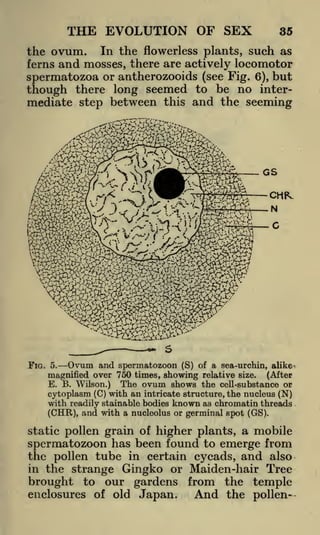
Ovum and spermatozoon (S) of a sea-urchin, alikemagnified over 760 times, showing relative size. (After
E. B. Wilson.) The ovum shows the cell-substance or
cytoplasm (C) with an intricate structure, the nucleus (N)
with readily stainable bodies known as chromatin threads
(CHR), and with a nucleolus or germinal spot (GS).

a mobile
spermatozoon has been found to emerge from
the pollen tube in certain cycads, and also
in the strange Gingko or Maiden-hair Tree
brought to our gardens from the temple
enclosures of old Japan.
And the pollenstatic pollen grain of higher plants,
SEX

36

grains of ordinary flowering plants, although
they correspond to the whole male generation,

and usually abbreviate away the formation
spermatozoa in adaptation to the loss of
watery environment, are adapted to passive
of

Fio.

6.
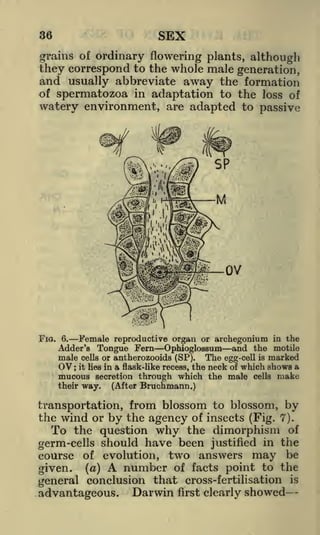
Female reproductive organ or archegonium in the
Adder's Tongue Fern Ophioglossum and the motile
male cells or antherozooids (SP). The egg-cell is marked
V ; it lies in a flask-like recess, the neck of which shows a
mucous secretion through which the male cells make

their way.

(After

Bruchmann.)

transportation, from blossom to blossom, by
the wind or by the agency of insects (Fig. 7).
To the question why the dimorphism of
germ-cells should have been justified in the
course of evolution, two answers may be
number of facts point to the
given, (a)
general conclusion that cross-fertilisation is

A

advantageous.

Darwin

first

clearly

showed-
THE EVOLUTION OF SEX

37

and despite some exaggerations his general
conclusion survives that the progeny of
cross-fertilised plants are more successful and

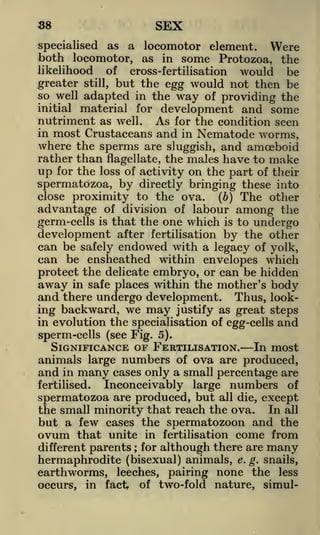
FIG. 7.

Diagram of a flower. S, sepal; P, petal; ST, stamen
with anther (A) liberating pollen grains; P, pistil; 0V,
ovary enclosing an ovule which shows an embryo-sac
with the egg-cell (E), the endosperm nucleus (N), and
the antipodal cells (C); on the stigma are seen several
pollen-grains (PG) whose pollen-tubes are growing
the style towards the egg-cell.
(After Sachs.)

more

fertile

fertilised.

than those of similar plants

down

self

Now cross-fertilisation will be more

readily secured

if

one of the germ-cells be
38

SEX

as a locomotor element. Were
both loeomotor, as in some Protozoa, the
likelihood of cross-fertilisation would be
greater still, but the egg would not then be
so well adapted in the way of providing the
initial material for development and some
nutriment as well. As for the condition seen
in most Crustaceans and in Nematode worms,
where the sperms are sluggish, and amoeboid
rather than flagellate, the males have to make
up for the loss of activity on the part of their
spermatozoa, by directly bringing these into
close proximity to the ova.
(b) The other
advantage of division of labour among the
germ-cells is that the one which is to undergo
development after fertilisation by the other
can be safely endowed with a legacy of yolk,
can be ensheathed within envelopes which
protect the delicate embryo, or can be hidden
away in safe places within the mother's body
and there undergo development. Thus, looking backward, we may justify as great steps
specialised

in evolution the specialisation of egg-cells
sperm-cells (see Fig. 5).

and

SIGNIFICANCE OF FERTILISATION. In most
animals large numbers of ova are produced,
and in many cases only a small percentage are
fertilised.
Inconceivably large numbers of
spermatozoa are produced, but all die, except
the small minority that reach the ova. In all
but a few cases the spermatozoon and the
ovum that unite in fertilisation come from
different parents ; for although there are many
hermaphrodite (bisexual) animals, e. g. snails,
earthworms, leeches, pairing none the less
occurs, in fact, of two-fold nature, simul-
THE EVOLUTION OF SEX

39

taneous or successive. There remain rare
cases, such as some of the parasitic flukes and

tapeworms, in which there is self-fertilisation
(autogamy), the ova being fertilised by spermatozoa from the same individual. The sperms
may reach the ova after these have been laid,
as in the case of salmon or just as they are
;

the case of frogs; or within the
body of the female, as in all reptiles, birds,
and mammals. It is evident, therefore, that
"
inseminathe sexual union which leads to
"
and which from observation of the
tion
higher animals long seemed to be the very
essence of the process, is really of later acquirelaid, as in

ment. The gist of fertilisation throughout
life remains as the union of two sex-cells,
however that may be accomplished. It may
be noted that artificial insemination has been
successfully effected in some of the higher
animals, such as sheep, cows, mares, white
The spermatozoa can be
mice, and hens.

kept for some time in weak salt solutions.
What does fertilisation imply ? (1) It
implies an intimate and orderly combination
of the paternal and maternal inheritances,
which are probably borne in greater part
by the nuclear elements or chromosomes of
the spermatozoon and ovum respectively,
and in some measure also by the extranuclear protoplasm of the two germ-cells.
(2) During the maturation of the spermatozoon
and ovum, the number of chromosomes (which
is always definite for each kind of organism)
is reduced to half the normal, so that fertilisation restores the normal number. (3) Besides
bearing the paternal contribution to the
SEX

40

inheritance of the offspring, the spermatozoon also introduces a minute body known
as the centrosome, which plays an important
part in the subsequent division of the fertilised
ovum. (4) It is also certain that the spermatozoon acts as a stimulus which sets the egg

dividing or, it may be, removes some inhibiting factor which was keeping the egg
from dividing. In a variety of cases what
the sperm does, whether in stimulation or in
removing a check, can be replaced artificially,

and this in many different ways. The experiments of Loeb, Delage, and others have shown
that the ova of starfish, sea-urchin, worm,
mollusc, fish, and even frog can be made to
divide without being fertilised. Alterations in
the chemical and physical state of the medium,
e. g. the addition of a little magnesium chloride
to the sea-water, may replace ordinary fertilisation, at least in so far as setting division agoing
The artificial stimuli effectively
is concerned.
used are very varied physical, chemical, and
mechanical an electric shock, a superabundance of carbonic acid gas, and even a pinThey differ for different kinds of eggs,
prick.
and even for eggs of the same kind at different
stages of ripeness. Perhaps there is some
common factor in all the effective stimuli,
it is remains unknown.
According
some experimenters, the egg responds

but what
to

directly to the external stimulus; according
to others the artificial conditions do not
directly induce segmentation, but modify the
intimate condition of the egg in such a way

that it becomes auto-parthenogenetic. The
second view is suggested by cases in which the
THE EVOLUTION OF SEX

41

egg does not begin to segment until some time
it has
been restored to its natural
medium. (5) Lastly, it is probable that, in
after

some

cases at least, fertilisation irrevocably
determines the sex of the offspring into which
the fertilised ovum will develop.
Looking backwards, we see that fertilisation
involves great waste of life-material. It must

therefore have some great advantage. When
we consider the five things above indicated
as involved in ordinary fertilisation, we may
notice that sex is sometimes determined quite
apart from fertilisation and previous to this,
that a stimulus to division may be effected

by some

artificial

change, that the

ovum

has

r
originally a centrosome of its own w hich it
In
retain, and so on.
might conceivably
short, there can be little doubt that the chief
significance of fertilisation is to be found in

the

first

two implications.

There is a mingling

of two inheritances, which may favour variations and also counteract them ; and there is
a restoration of a certain norm of nuclear

constitution subsequent to a remarkable proIn this reduction there is
cess of reduction.
a notable opportunity for variation, since the
number of chromosomes is reduced to half
the normal. Suppose the chromosomes in the

nucleus of an unripe egg were represented by
a pack of cards, the process of maturation
(usually the giving off of the first polar body)
involves a literal loss of half of the pack. The
normal number is restored by the addition
of another half-pack borne by the fertilising

spermatozoon.
Green-flies or

Aphides produce

prolifically
SEX

42
all

through the summer, without there being

any males

in existence at the time; the eggs
in a bee-hive that are not fertilised develop
into drones ; in some of the wheel-animalcules

or Rotifers the males have never been found
the same is true of some of the gall-flies and
there are numerous parthenogenetic plants.
;

;

The question

therefore, pertinent
Why
the rule, seeing that many
creatures get on very well without it. The
probable answer must be that fertilisation is
is

is,

fertilisation

in affording an
of profound racial significance
opportunity for new departures and in tending
to secure a holding fast of that which is good.
MALES AND FEMALES. The next step in
the evolution of sex above the clear differentiation of egg-cell and fertilising element is
that of two distinct types of individual the
sperm-producer and the ovum-producer, the
male and the female. In Volvox we may
find the same colony producing numerous
ova and numerous sperms, and other colonies
producing only ova or only sperms. The
hermaphrodite or bisexual organisms that
occur at many levels in the animal kingdom

and are so common among Plants, represent
in part a pristine condition, and in part a
secondary incorporation of one sex by the
other in most cases, it may be, an acquisition
of femaleness by males.
The fundamental problem is to account for
the evolution of two kinds of individuals

within the species the sperm-producers or
males and the egg-producers or females and
our view (developed many years ago in The
Evolution of Sex (1889), and briefly applied in
;
THE EVOLUTION OF SEX

43

our Evolution in the present series) is that the
between the sexes expresses the
same kind of constitutional alternative that
we see in the contrasts between spermatozoon
and ovum, between animals and plants,
difference

between active Infusorians and sluggish Sporobetween the free and the sedentary
which recur at so many levels of the
groups
animal kingdom, and in short between preponderant activity and passivity in all forms
zoa, in fact

of

life.

The

first step, at least, in the scientific
explanation of a phenomenon is to show that
it is a particular case of a general sequence,
and our theory of sex interprets the difference
between male and female as an instance of a
primeval and ever recurrent alternative in
variation namely, between increased exbetween
penditure and increased income
;

predominance of disruptive, analytic,
down-breaking processes, on the one hand,
and a relative predominance of constructive,
synthetic, up-building processes, on the other
hand; between, to put it shortly, a relative
relative

preponderance, to the extent of constitutional
bias, of one or other of these katabolic and
anabolic processes which all physiologists
agree are mingled in the life of protoplasm

and

cell,

tissue

and organ.

The

resulting bias

whole life-process, this ever-mingled
metabolism, is thus for us expressed in sex
and its subvarieties (themselves, as almost
every family shows, preponderatingly accented
one way or other), but also in the contrasts
of this

of allied species
classes,

and genera,

of families

sub-kingdoms and kingdoms.

and
Sex
44

SEX

and variation are thus deeply one, and the
variations on which Natural Selection operates
are thus fundamentally dichotomous.
Granted the advantage of cross-fertilisation

and of dimorphic sex cells, it seems clear
that, other things being equal, those species
would get on best which exhibited two

dis-

tinct constitutions or forms, sperm-producers
and egg-producers. As the difference became
defined the expression, we maintain, of a

continually recurrent dichotomy it would
doubtless react on the sex-cells. More effective ova would be produced by the more
anabolic females, and more effective spermatozoa by the more katabolic males.
Returning to Volvox, we see that some of
the cells in the ball become large, well-fed
ova; others, less anabolic, fade from green
to yellow, divide and re-divide into many
minute units the spermatozoa. The large
cells or ova of one colony are fertilised by the
small cells or spermatozoa of another colony.

The formation

of dimorphic reproductive cells
be seen going on in different parts of the
may
same colony, but it often happens that the
spermatozoa are formed first and the ova
which is like a temporal division of the
later
In other cases the eggs are formed
sexes.
Or we may find Volvox balls in which
first.
only ova are produced, or only sperms the
sexes being separate. The former seem to be
more vegetative and nutritive than the latter,
and we are at the foundation of the divergence
between the sexes. Occasionally, moreover,
ova are produced which develop parthenoIn fact, this primitive organism,
genetically.
THE EVOLUTION OF SEX
with

its

45

asexual, hermaphrodite, unisexual,

and parthenogenetic forms,

is

a very epitome

of the evolution of sex.

TESTES AND OVARIES. In a sponge, which
shows no organs in the strict sense, and only
the beginnings of tissues, the germ-cells appear
sporadically in the middle stratum (or mesogloea) of the body, and both sperms and ova
may be seen developing in the same sponge.
An important step was taken, however, when
the formation of gametes began to be localised
and when these foci of gamete-making began
to be enclosed, protected, and nourished by
adjacent tissue. At first, doubtless, the difference between the egg-multiplying gonads (or
ovaries) and the sperm-multiplying gonads
(or testes) was only to be detected with the
microscope, though it was very profound.
But gradually there came about a specialisation of the accessory parts in relation to the
deeply different functions of egg-multiplying
and sperm-multiplying, and recognisably different ovaries and testes were established.
Furthermore, there came to be associated with
ovaries and testes a good deal of auxiliary
tissue that had nothing directly to do with
or
oogenesis
spermatogenesis.
Accessory
glands and ducts were formed.
It is probable that variations or mutations
involving the tissue in the vicinity of the
reproductive organs have been from time to

time caught up into their service, and it is
not necessary to suppose that these advantageous accessions, such as having a yolkgland near the ovary, arose as pure coincidences. For it is a well-known fact (whether
SEX

46

we understand

or not) that variations are
It seems as if one germinal
have several inter-linked effects.
it

often correlated.

change

FIG.

may

S.
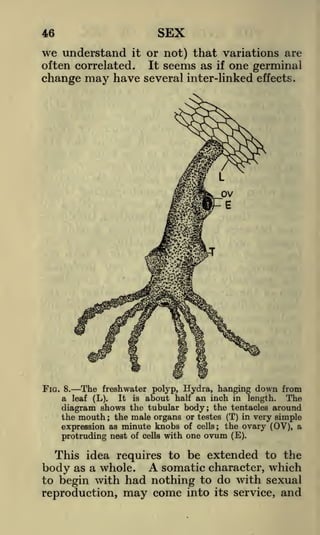
The freshwater polyp, Hydra, hanging down from
a leaf (L). It is about half an inch in length. The
diagram shows the tubular body; the tentacles around
the mouth ; the male organs or testes (T) in very simple
expression as minute knobs of cells; the ovary (0V), a
protruding nest of cells with one ovum (E).

This idea requires to be extended to the
as a whole. A somatic character, which
to begin with had nothing to do with sexual
reproduction, may come into its service, and

body
THE EVOLUTION OF SEX
be more or
its

new

less

changed

function.

Some

in connection

47

with

investigators, such

and Grosz and Kammerer, have
the length of maintaining that all sexgone
characters have arisen from the transforma"
Just as in the
tion of species-characters.
Metazoon body the cells lying next
primitive
the gametes came by change of function into
the service of reproduction, so it may have
been that more distant cell -complexes, which
had already reached some degree of structural
differentiation and subserved other functions,
as Tandler

suffered partial or even total loss of their
original function, and became auxiliary to

reproduction."

SEX DIMORPHISM.

In many of the simple
animals, the two sexes are
practically identical in appearance, and exThus without
hibit no definite sex-behaviour.
a microscope it is often impossible to tell a
male starfish from a female, or a female from
a male sea-urchin. Nor can we see that the
one sex is attracted to the other. The
fertilisation of the eggs is more or less haphazard, but it must be noted that large numbers of individuals are found living together,
and that the males and females become
mature about the same time. Both ova and
spermatozoa are set adrift in the sea, and as
there are thousands of sperms for every ovum
the chance of fertilisation is much greater
than would at first sight appear likely.
Moreover, from within a short distance there
"
"
is a
chemotactic attraction of the spermatozoa to the ova (see Fig. 9).
It should be noted that animals like sea-

backboneless
SEX

48

urchins with superficially similar sexes are
none the less in a sense very sexual, at the
breeding season at least, for they produce

enormous quantities of eggs and sperms, and
the reproductive organs are huge in proportion
to the body. Thus one of the British starfishes (Luidia ciliaris) produces at least 200
millions of eggs.

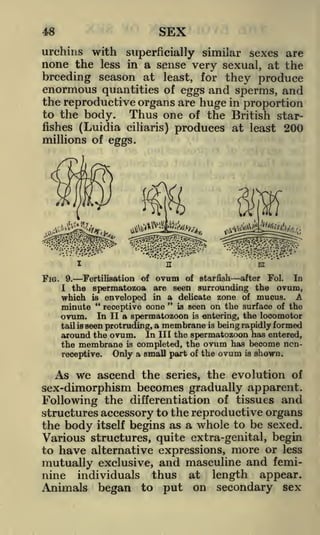
FIG.

after Fol.
In
Fertilisation of ovum of starfish
the spermatozoa are seen surrounding the ovum,
which is enveloped in a delicate zone of mucus. A
"
"
is seen on the surface of the
minute
receptive cone
ovum. In II a spermatozoon is entering, the locomotor
tail is seen protruding, a membrane is being rapidly formed
around the ovum. In III the spermatozoon has entered,
the membrane is completed, the ovum has become ncnreceptive.
Only a small part of the ovum is shown.
9.

I

As we ascend the series, the evolution of
sex-dimorphism becomes gradually apparent.
Following the differentiation of tissues and
structures accessory to the reproductive organs
the body itself begins as a whole to be sexed.
Various structures, quite extra-genital, begin
to have alternative expressions, more or less
mutually exclusive, and masculine and feminine individuals thus at length appear.
Animals began to put on secondary sex
THE EVOLUTION OF SEX
characters;

and

sex-dimorphism.
in this we find
contrast.

49

this was the great step of
It need hardly be said that
every conceivable grade of

Besides the divergence in structure, there
a functional contrast between male and
female. In face of the extraordinary variety
of the Animal Kingdom, generalisation has
its hazards; but, on the whole, we may say
that the male tends to more intense metabolism, to more exuberant expenditure of energy,
to live a keener but shorter life, to have much
less expensive reproduction, to be more impetuous, combative, and experimental, and
to be the more divergent from the youthful
and the ancestral type. Yet the female is
not, therefore, necessarily the less evolved,
since her relative nearness to the ancestral
stock, her less accented specialisation, her
is

persistent youthfulness may also carry with
the very promise of the race. Hence in
fact the divergent types of masculine and of
feminine beauty in our own species, the

it

former more strongly individualised, but the
latter by common consent more humanised,
and thus more adapted to the expression of
the ideals of racial and of social evolution.
Biology and art, mythology and poetry are
thus not the separate cultures we conventionally regard them, but correlated aspects
of the ascent of life.
SEX- AWARENESS.
Another step in the
evolutionary ladder is represented by those
animals which show sex-awareness, which
give distinct evidence that the presence or
proximity of one sex acts as a stimulus to
D
50

SEX

the other, leading, primarily or ultimately,
to the liberation of the sex-elements. When
this is the case, fertilisation is more likely to

be secured. As an example of this still very
lowly plane of sex-attraction, where there is
no sexual union, but where proximity or
contact is the liberating stimulus provoking
a discharge of germ-cells, we may take the
familiar case of the salmon,. The female fish
makes a furrow in the gravelly bed of the
river and lays her eggs there; the attendant
male is stimulated by the presence of the
ripe female and by the presence of the eggs
to liberate the sperms or milt upon them.
No doubt many of the thousands of sperms
are lost forthwith, but what occurs is an

improvement upon the primitive and wasteful
broadcast semination of the waters.
It remains, however, certain that in the
lower reaches of the animal kingdom where
no sex-behaviour exists, the fertilisation of
the eggs is more or less haphazard. This
involves the production of large numbers of
ova and huge numbers of sperms, which we
interpret as implying (1) that simple organisms are naturally very prolific, and (2) that
a survival bonus was persistently awarded to
those members of a species that were constitu:

most prolific. The constitutionally
survived, while the constitutionally
prolific
non-prolific would tend to be eliminated.
We would dwell for a moment upon this

tionally

necessarily great productivity of germ-cells
on the part of simple animals, because it
seems to us that it became a widespread
constitutional characteristic in many lines of
THE EVOLUTION OF SEX

51

and lasted long after the necessity
was past. Perhaps even man has thus
to pay for his long pedigree, for the overproduction of both eggs and sperms, though
relatively moderated as compared with lower
animals, still remains a main difficulty of
individual and of social life, albeit also a
evolution,
for it

potent factor in their progress.

PHYSICAL FONDNESS. A further step is
represented by those animals which show the

Crested Newt Triton or Molge cristatus. M, the
male with a scolloped dorsal median fin F, the female

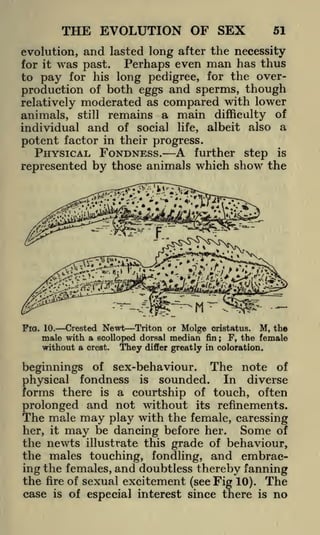
Fio. 10.

;

without a

crest.

They

differ greatly in coloration.

beginnings of sex-behaviour. The note of
physical fondness is sounded. In diverse
forms there is a courtship of touch, often
prolonged and not without its refinements.
The male may play with the female, caressing
Some of
her, it may be dancing before her.
the newts illustrate this grade of behaviour,
the males touching, fondling, and embracing the females, and doubtless thereby fanning
the fire of sexual excitement (see Fig 10). The
case is of especial interest since there is no
SEX

52

pairing in the strict sense. The male deposits
the sperms in minute packets or spermatophores which adhere to stones in the water,
and the female passes these into her body.

^ESTHETIC ATTRACTION. The next step is
to the primary tactile courtship
there is added a variety of aesthetic appeal.
We may well say variety, for it is a long
gamut that includes the song of the nightingale
and the trumpeting of the elephant, the
croaking of frogs and the instrumental serenading of the cicadas, the drumming of the
snipe and the tapping of the death-watch on
the wainscot. There are displays of other

made when

of strength, agility, and beauty, for
the blackcocks hold a tournament before their
grey hens, the cock-of-the-rock has an excited
dance, and the Argus pheasant displays his
hundred eyes. Some of the glow-worms

gifts

attract their mates by flashes of light, some
In short, to
butterflies by their fragrance.
the physical fondness of one sex for another
there is added a more or less elaborate aesthetic

and not the least interesting point is
that there is scarce a thread of this
embroidery that has not been caught up and
sublimed in the subtly woven cords of human
fringe,

this,

love.

Let us take the interesting picture that

Emery has

given us of the Italian fireThe females sit among
the grass while the males fly about in search
of them.
When a female catches sight of the
flashes of an approaching male, she allows
her splendour to shine. He sees the female's
Prof.

fly (Luciola italica).

signal,

and

is

swiftly beside her, circling round
THE EVOLUTION OF SEX

53

But one suitor is not
like a dancing elf.
enough. The female attracts a levee. In
polite rivalry her devotees form a circle and
await the coquette's choice. In the two sexes,
Emery says, the colour of the light is identical,
and the intensity seems much the same,
though the love-light of the female is more
The most noteworthy difference
restricted.
is that the luminous rhythm of the male is
more rapid, with briefer flashes while that
of the female is more prolonged, with longer
illumined symintervals, and more tremulous
The
bols of the contrast between the sexes.
female Luciola sits surrounded by her suitors
flashes of light come and go finally a choice
Whatever
is made and the party breaks up.
the luminescence may mean physiologically
in the constitution of the insect, it seems to be
a love-signal between the sexes.
It is confessedly very difficult to prove
that the courtships of animals are associated
with emotions analogous to ours, but in many
;

;

;

cases there are visible manifestations similar
to those which accompany emotion in ourTo refuse to believe that the exuberselves.
ant song of birds is associated with joyousness
is a sternness of scepticism for which we are

In many cases, apart from
gratification of sexual desire,
look as if they liked one another.

not prepared.

any immediate
the mates

They pine when they

are separated; and if
they are not pleased to be reunited, they
have an extraordinary power of behaving and
looking as if they were.
CO-OPERATION OF THE SEXES. Yet a higher
grade is illustrated by those animals which
SEX

54

work

together, and remain associated for a
considerable time it may be for life. It is
true of many birds that the cock and the hen
unite their energies in building the nest and
in providing for the young; the cock often
takes his share or more than his share of
brooding; some are faithful to one another
for a season others, like the eagles, mate for
The story of the hornbills has been
life.
often told. The female lays an egg within a
hollow tree the male closes up the entrance
with resinous material until only a small
he feeds her through this opening
slit is left
day after day until he is as lean as she is fat.
The egg is hatched, but the male, as Mr.
tells us in his fine History of Birds
Pycraft "
is reduced to a mere skeleton, so
(1910),
lowered in vitality that on a sudden fall in
the temperature, such as takes place after
;

;

;

seldom falls down exhausted and
unnecessary to beg any questions
this behaviour self-sacrifice, but
by calling
it cannot be gainsaid that the male spends
himself in a manner which is objectively

rain, he not
It is
dies."

other-regarding.

In

Mammals

also

we

find

examples of

last-

ing partnerships on a monogamous basis,
where, as it seems to us, animal love reaches
its highest level, surviving the excitements of
the reproductive period, steadying itself in
the wider sympathy which is at once the condition and the result of practical co-operation,
broadening itself, too, in its altruism as it
laps the family in its folds, surviving even
its dispersal.

LOVE.

The

differences

between

man and
THE EVOLUTION OF SEX

55

the animals are not less important than the
resemblances, and as man has come to himself the complex attraction which we call
love has been in proportion heightened and
deepened and sublimed. As man emerged
a rational creature in some measure conscious
of his instincts and his aims, capable of controlled conduct as a social person, all things
became new, including love. While the deep
organic impulse remains as a legacy from a
remote past, while the elements of physical
fondness and aesthetic attraction are not lost
without impoverishment, while practical partnership remains all but indispensable, there
are undoubtedly new elements, notably of
intellectual and ethical sympathy, and the
self-consciousness of it all
in the sentiment of love.

At the same time

which

is

expressed

it cannot but seem either
unobservant or pharisaic when men
strangely
or women resent any analogy between animal
love-making and their own. We may trade
with our legacy, but we cannot refuse it, and
it is not inconsistent with recognising human
love as a new synthesis to observe that strands,
both coarse and fine, which are prominent in
lower forms of life have been caught up and
From another point of view,
utilised in man.
this also should be said, that it is well for us
to take admiring knowledge of the artistic
character of many animal love-makings, for
they put man's often too rough-and-ready
manners to utter shame.
SEX

56

CHAPTER

III

SEX-CHARACTERS ILLUSTRATED
Illustrations of sex-charClassification of sex-characters
acters
General impressions The general contrast.

SINCE the beginning
the difficult problem
ment, and evolution
been illumined by a

of the present century
of the origin, developof sex-characters has
series of brilliant ex-

perimental researches, which have made a
reconsideration of the whole subject imThis has been facilitated by the
perative.
masterly work of Kammerer, who has gathered
together the most important data and submitted them to an analysis at once fair-

minded and

critical.

CLASSIFICATION OF SEX CHARACTERS. At
many levels in the animal kingdom there are
marked differences between the males and
females of a species so marked in some
familiar cases that different popular names
are applied to the two sexes (e. g. cock and
hen, ruff and reeve, stag and hind), so marked
in some unfamiliar cases that zoologists have

unwittingly

named

as different species

what

were afterwards recognised to be but male
and female of a single form. When the
differences between the sexes are well marked
we speak of sex-dimorphism.
The contrasted characters that go to
constitute sex-dimorphism are of different
kinds. They may concern the essential re-

productive organs the ovaries and testes of
female and male respectively, which, though
SEX-CHARACTERS ILLUSTRATED

57

arising in the same way in the embryo, may
come to be so different that even on external

inspection the two sexes can be distinguished
at a glance. Thus in most Mammals the
testes are carried in an external pouch or
scrotum (into which they descend, as if by
a sort of normal rupture, at a certain stage
in development), while the ovaries always

remain internal.
In the second place, the dimorphism may
be expressed in conspicuous differences in
the accessory reproductive organs, such as
egg-laying structures or ovipositors in the
females and organs for effecting sexual union
Thus every one
in the case of the males.
knows that drone-bees have no sting, for a
sting is a transformed ovipositor turned to
a new use, and is therefore confined to
the queen-bees (functional females) and the
worker- bees (usually sterile females). A male
spider is clearly marked off from his mate by
the extraordinary transformation of the tips
the pediof the second pair of mouth-parts
palps into organs which are used in transferring the fertilising spermatozoa into the female.
In the third place, the dimorphism may be

expressed in peculiarities, like antlers, manes,
combs and spurs, which have nothing directly
to do with reproduction, but which the males
have and the females have not. In a number
of less familiar cases, the female has structures
which are conspicuous by their absence in
the males, though in these cases it must be
confessed that the males are more or less
degenerate. Thus many a male Rotifer has
no food-canal, and the male of a remarkable
SEX

58

marine

worm

parasite on

Fio.

its

called

mate

Bonellia

is

a

pigmy

(see Fig. 11).

The peculiar green worm Bonellia viridis the
11.
female (F) with a long retractile bifid grooved proboscis
(PR), and the pigmy male (M). (After Lacaze-Duthiers.)

Fourthly, the dimorphism
pression not in

may

find

ex-

any peculiar structures or
SEX-CHARACTERS ILLUSTRATED

59

peculiar transformations of structures, but in
a more diffuse way affecting the size (females
being usually larger), the proportions of
parts, the colour (males tending to be more
brilliant), and other features, or in numerous
little ways giving a slightly different turn to
the analogous organs in the two sexes.
It is usual to classify the differences between
"
"
"
the sexes as
primary and secondary," to

"
The
which some would add
tertiary."
"
"
refer to the reprodifferences
primary
"
"
to those
ductive organs, the
secondary
that appear in other parts of the body, such
A clearer scheme
as the larynx or the hair.
of division, slightly modified from Poll's and
Kammerer's table, may be thus expressed

SEX DIFFERENCES
I.

II.

ESSENTIAL.
In the gonads

ovaries and spermaries.
ACCESSORY OR INCIDENTAL.
(a)

Subsidiary to the gonads

:

internally, as in accessory glands ;
externally, as in pairing or egg-

laying organs.
(ft)

Somatic and extra-genital

:

internally, as in vocal organs ;
externally as in colour, hair,
feathers, etc.
It is evident that most of these sex-differences have both a structural and a functional
side, a morphological and a physiological
aspect; but for practical purposes one side
may often be disregarded. Thus a chitinous
decoration or instrument on a male beetle
SEX

60

has no vital activity after it is once formed
is the structural side that is important.
On the other hand, the differences in the
blood of a male and a female, which have
been shown to be of profound importance,
may not have any detectable structural
expression. Similarly, there are many subtle
;

it

in instincts and impulses, in
physiological habit, and in length of life,
which are very real though we cannot say
much about their structural expression.
Another consideration that must be kept
in mind in the classification of sex-differences
is the degree of permanence in their expresAn adult peacock can never be confused
sion.
with a peahen, but there are many birds,
r
e. g. some ducks, w hich show great dissimilarity between the sexes at the breeding
season and great similarity at other times of
In many fishes, such as sticklebacks,
year.
the males are conspicuously different from
the females at the breeding time, but inconspicuously different at other times. In
short, there are many nuptial characters
which wax and wane according to the sexual
state of the organism.

differences

ILLUSTRATIONS OF SEX-CHARACTERS. Convenient surveys of sex-differences are to be
found in Darwin's Descent of Man and in
Cunningham's Sexual Dimorphism. For our
purpose, we do not require more than a few
typical cases.

abound.

The

Among mammals
male

gorilla

is

illustrations

larger

and

stronger than the female, with more powerful
canine teeth, and with a well-marked crest
along the top of the head, which is absent in
SEX-CHARACTERS ILLUSTRATED

61

The mandrill has, again, enormous
and the bony prominences of the
upper jaw which rise on each side of the
elongated snout, are covered with blue naked
the canines,
skin, with ridges and furrows
the prominences, the furrows and the colouring are much less marked in the females. The
male elephant seals of Kerguelen's Land have
his

mate.

canines,

;

an inflatable nasal proboscis, the free part
of which projects for six inches; and the
bladder - nosed seal of the North Atlantic
ice-fields has the base of the nose dilated on
the dorsal side to form a bladder which can
be blown up till it is as big as the head. The
male narwhal has its canine tooth on one
side produced into a spiral tusk which may
be ten feet long its fellow on the other side
normally remains about ten inches long; in
the female both are rudimentary. Stags
have their antlers, but in the reindeer these
occur in both sexes. Those of the female are
smaller and less branched, and she retains
;

them

till

she bears her young in April or

May, whereas the male loses his, as usual,
immediately after the breeding season (at the
end of November). Darwin noted that the
antlers appear in both sexes very early, in
fact, in four or five weeks after birth, whereas
it is not usual for stags to have antlers till
their second summer.
According to some
authorities, when Cervidae began to have
antlers, they were specific characters shared
by both sexes they have become secondarily
restricted to the males (except in reindeer).
;

But according

to others, the antlers were,
to begin with, restricted to the males, and
SEX

62

have become secondarily the possession of
the female reindeer. It is difficult to decide
between these rival views. To explain the
possession of antlers by the female reindeer,
Cunningham refers to the fact that the
females use them as weapons and that the
older females often lead large herds of young
males and females. In cattle, sheep and goats,
the horns usually occur in both sexes; in
antelopes, they may be confined to the males,
as in kudu and saiga, but in most cases, e. g.
eland and oryx, they occur in both sexes
in the aberrant pronghorn of the Rockies the
horns are rudimentary in the female.
The
long curved tusks of the wild boar, the exaggerated tusks of the babirusa, the tusks of
the Indian elephant, the spur on the hind-leg
of the duckmole and the echidna are other
well-known masculine features.
Among Birds sex-dimorphism reaches a
climax in the birds of Paradise, the hummingIn the males
birds, and the game-birds.
it is common to find specially decorative
feathers which can be erected and displayed
to the best advantage. Every one knows the
magnificent tail feathers of the peacock, the
wing feathers of the Argus pheasant which
are raised to form a circular fan, the curved
outermost tail feathers of the blackcock, the
brilliant tufts and elongated tail feathers of
many humming-birds, the decorations of the
;

birds of Paradise,

which

baffle

description,

the lyre-bird, and the
long neck feathers of the ruffs.
Besides more decorative plumage the male
bird often exhibits other distinctive features.

the remarkable

tail of
SEX-CHARACTERS ILLUSTRATED

63

his spur and larger comb and
the prairie cock has an inflatable
wattles;
bare orange-coloured sac on each side of the
neck the turkey-cock has his large spur, and
the fleshy process on his forehead, pendulous
but erectile, is larger than in the female the
male huia of New Zealand has a short, strong
and nearly straight bill, while that of the
female is much longer, more slender, and
curved; the great bustard has an inflatable
throat pouch at the breeding season.
In Reptiles sex-dimorphism is not usually
striking, but there are some good illustrations
among lizards. The male of the American
chamseleon (Anolis) has an erectile crest
along the back and tail, and some male
chamaeleons have bony projections in front
of the eyes.
Among Amphibians the male

The cock has

;

;

newts have more brilliant colours and crests
on their back and tail, but only, it is said, in
those species in which the male does not
clasp or embrace the female. In male frogs

and toads there are often swollen cushions
or pads on the hand, which are of service
In some cases, as
in grasping the female.

in the common edible frog of the Continent,
the male has resonating sacs formed as
pouches from the lining of the mouth, and
in Rhinoderma darwinii these are much
enlarged and form a receptable for the eggs
The eggs laid by the female are taken by the
male into his mouth and pass to the sacs
where they develop into small frogs. In Nototrema, a tree-frog of tropical America, there
is an interesting occurrence of a structure
peculiar to the female, namely, an egg-pouch
!
SEX

64

It is formed by an invagination
from behind forwards, and into
it the male pushes the eggs with his hind feet.
Among fishes the sexes are often very like
one another, but there are many illustrations

on the back.
of the skin

In some gristly fishes
the skate, the males
"
have very conspicuous
claspers."
They
are specialised parts of the pelvic fin, have
a complex musculature and skeleton, and are
In the
entirely awanting in the females.
male Chimsera, these parts are even more
"
on the head there is
complicated, and
further a remarkable knobbed and curved
spine projecting forwards, and covered at its
extremity with sharp denticles. There can be
no doubt that this also is used for holding the
female, although the exact mode in which it is
"
used has not been observed (Cunningham).
The male salmon has the tip of the lower
jaw turned up and enlarged at the breeding
season. It forms a curious blunt hook-like
process, which is possibly of use when the
males charge one another. In many cases,
such as lumpsucker and stickleback, which
are as contrasted types as one can think of,
the males are distinguished at the breeding
season by the brilliant colouring. In the
of

or

sex-dimorphism.
Selachians,

like

male sea-horse (see Fig. 12) and some of its
relatives, the most striking sex-distinction is
the possession of a pouch in which the eggs
develop. It is noteworthy that in the genus
Solenostoma, the pouch is in the female, which
is more vividly coloured and spotted than the
male. Perhaps she has to attract her mate
There is among insects an embarrassing
1
SEX-CHARACTERS ILLUSTRATED
wealth of instances of sex-dimorphism.
butterflies

and moths are often more

65

Male

brilliant

The Sea-horse Hippocampus. A male, showing
the brood-pouch (B) in which the eggs are carried, the
prehensile tail (T), and the rapidly vibrating dorsal
fin (DF).

FIG. 12.

and decorative than the females, but the
reverse is sometimes the case, and, more
commonly still, the sexes are similar. The
E
66

SEX

males have often more elaborate antennae
and other sense-organs, which are important
in finding the female.
Among the Dynastid
beetles the males often have extraordinary

horn-like

projections

from

the

head

and

In the male (M)
Fia. 13. The Hercules Beetle Dynastes.
a horn on the back of the head works against a still larger
horn arising from the top of the prothorax. The female
(F) is smaller and without the horns.

They are outprothorax (see Fig. 13).
of the chitinous cuticle and cannot
growths
be moved of themselves, though they may
be brought together like the limbs of tongs
when the head and the prothorax are moved.
Their use is uncertain. In the stag-beetles
SEX-CHARACTERS ILLUSTRATED

67

(Lucanidae) the mandibles of the males are
sometimes as long as the body, and, like the
antlers of stags, they often seem to be very
much in the way. Darwin called particular
attention to the great differences in the degree
of development of the male excrescences in
beetles, some species having them in extraordinary exuberance while others show no
dimorphism to speak of. In some cases, as
in many moths, the female beetles are sluggish
and have no wings. In the glow-worm (Lampyris noctiluca) the males have well-developed
the female has
wings and very large eyes
smaller eyes and no wings. Among spiders,
the males are often pigmies compared with
their mates, and often much more brilliantly
It has been calculated that the
coloured.
disproportion of size is sometimes such as
would be observed if a man 6 ft. high and
150 Ib. in weight were to marry a giantess of
80 ft. in height and 200,000 Ib. in weight
;

(see Fig. 2).

Among

Crustaceans

sex-dimorphism is
into account
the extraordinary cases in which the female
is parasitic and the male free-living.
One of

common, even

if

we do not take

the most striking cases is that of the giant
crab (Macrocheira) of Japanese waters, where
the male has huge forceps many times longer
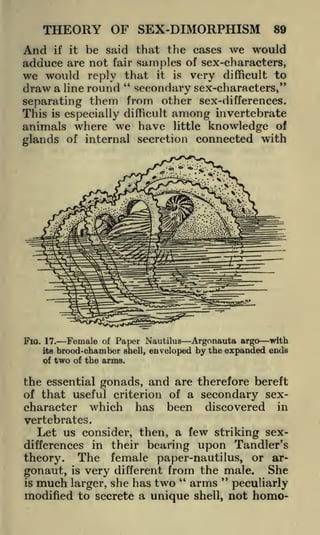
than the body, while the female is very much
smaller and has the forceps unexaggerated.
Many male crustaceans have specially developed clasping organs and are often larger
than their males. Every one knows the
common Gammarus of the shore, where the

male

is

much

larger

and stronger than

his
SEX

68

mate, whom he carries about with him for
prolonged periods. In some of the acorn-

pigmy males.
other divisions of the Animal
Kingdom there is little illustration of sexdimorphism. The male cuttlefish often has
"
arm " which becomes
a peculiarly modified
a receptacle for sperms and is liberated into
the mantle cavity of the female. In the
paper nautilus (see Fig. 17) we have one
of those exceptional cases where the female
has a positive character which is unrepreshe has two of the
sented in the male
arms remarkably modified and a very beautiful
shell used as a cradle for the developing eggs.
The male is much smaller and shows no hint
of an external shell (see Fig. 18).
Mr. Cunningham has directed attention to
shells there are

In

the

:

some examples of sex-dimorphism among
worms. In some marine Polychaetes, e. g.
species of Nereis, both sexes become extrachanged at sexual maturity so
that mature forms have been
in one genus and immature forms in
placed
another. There may be an alteration in the
shape and size of the locomotor appendages,
in the form and number of the bristles, and
in the size of the eggs and tactile structures.
ordinarily

much changed

is that these alterations are
different in the two sexes, being more pronounced in the males. In the Japanese

But the point

Palolo worm the females are deep green
above and greenish-yellow below, while the
males are light greenish-yellow above and

pinkish-white below.
We may conclude this survey with mention
SEX-CHARACTERS ILLUSTRATED

69

an interesting green worm with
a flask-shaped body an inch or two in length
and a flexible bifid proboscis much longer
But this is the female, for
(see Fig. 11).
the male is only about a hundredth of her
size and lives as a parasite within the oviduct.
of Bonellia,

one of tftie most extraordinary cases in
whole Animal Kingdom. The microscopic male embryos after swimming freely
It is

the

by means

of cilia, attach themselves to the
of a female, pass down to the gullet,
proboscis

and eventually to the oviduct. They have
not even a mouth, and are little more than
minute bags of sperms.

There is very little sex-dimorphism among
Echinoderms, but a very curious case is
reported by Koehler, an authority on the
group, who states that the males of one of the
brittle-stars, Ophiacantha vivipara, have five
arms, while the females have always more
(six to eight).

GENERAL IMPRESSIONS. Taking a retrospect, we notice that in most cases the
He
positive character is on the male side.
has an extra something which the female
does not possess in a developed state, if at
It is important therefore to recall two
three examples of the converse. The
females of the frog genus Nototrema have a
pocket on the back into which the male
pushes the eggs. So far as we know the
marsupium is never more than a rudiment in
male marsupials. In the red-necked phalarope
the female is the more decorative bird.
Drone bees have not the sting which the
all.

or

queens and workers possess.
SEX

70

We

should also note, after a survey of
sex-characters, that conspicuous difference
between the sexes is the exception, and general
In many of the higher
similarity the rule.
animals the males and females are very like
one another in external appearance. Cat,
mouse, rabbit and hare, may be mentioned
rook,
among mammals
many parrots among birds.
;

The sexes
The female (F)

kingfishers,

and

Below the

level

in a small fish

Phallostethus dunckeri.
the larger. The male (M) bears a relatively large intromittent organ projecting below the
(After C. Tate Regan.)
gill-cover.

FIG. 14.

is

of crustaceans, in animals like starfishes and
sea-urchins, marine worms, thread-worms,
jellyfish and corals, it is rare to find more than

minute sex-dimorphism.
THE GENERAL CONTRAST.

Contrariwise,

although there may not be any marked
dimorphism, there may be a profound funcThere are many facts, long
tional difference.

summarised in The Evolution of Sex,
which go to show that the metabolism of
the male and the female are very different.

since
SEX-CHARACTERS ILLUSTRATED
They

live

at

71

different

physiological rates;
is
relatively
more intense. The ratio of katabolism to
anabolism is greater in the male than in the
female.
may quote a few sentences

the

metabolism of the male

We

biologist, who expresses the
In his Sex Antagonism (1913),

from another

same view.

Mr. Walter Heape writes
"The Male and
the Female individual may be compared in
various ways with the spermatozoon and
:

The Male is active and roaming, he
hunts for his partner and is an expender of
energy the Female is passive, sedentary, one
who waits for her partner and is a conserver
of energy."
Perhaps the average differences between the
sexes may be summed up tentatively in this
ovum.

;

tabular contrast
MALE.

FEMALE.

Sperm-producer.
With less expensive reproduction.
More intense metabolism.
Relatively more katabolic.
Often with shorter life.
Often smaller.

Often
more
brilliantly
coloured and more de-

Egg-producer.

With much more expensive
reproduction.

Less intense metabolism.
Relatively more anabolic.
Often with longer life.

Often larger.
Often quieter in colour and
plainer in decoration.

corative.
Rising to more intense outbursts of energy.

Capable of more
endurance.

More impetuous and ex-

More

perimental.
More divergent from
youthful type.

Nearer the youthful type.

the

Often more variable.
Making more of sex-grati-

persistent
servative.

Often

patient

and con-

less variable.

Making more

of the family.

fication.

More combative.

Consolidating the family.
SEX

72

CHAPTER
Darwin's

IV

THEORY OF SEX-DIMORPHISM
Lamarckian theory Physiological
theory A

theories

The

role

of internal secretions

Sex-changes

Specific characters and sex-characters
Difficulty as to origins
Suggestion as to the mode of
origin of sex-characters.

in

crabs

DARWIN'S THEORY.

As everyone knows, Darwin proposed a theory of sexual selection to
account for the frequent occurrence of secondary sex characters, such as are familiar in
cases like stags, stag's-horn beetles, peacocks,
On the one hand, he
birds of Paradise.
out, there are the combats between
pointed
rival males which tend to leave those with
less perfect weapons or less ability to use them
without their fair share in parentage. On
the other hand, there is preferential mating,
in the course of which the female chooses or
seems to choose the more decorative, or agile,
or melodious, or otherwise attractive suitor,
thus tending to increase these gifts and graces
in the hereditary equipment of the race, as
far at least as the male sex is concerned.
There is considerable difficulty in regard to
the facts of the case. Where the weaker
males, worsted in combat, are killed, or expelled from the herd, or left unmated, the
elimination may be reasonably interpreted
as tending to raise the standard of those
qualities in virtue of which the successful
males succeeded. In some cases, however,
it is stated that the males unfortunate in war
are lucky in love. Much depends on the

and
THEORY OF SEX-DIMORPHISM

73

relative numbers of the sexes, and many of
the alleged cases of great numerical disparity
have been shown to be fallacious.
The late Alfred Russel Wallace was a persistent critic of the theory of sexual selection,
pointing out, for instance, that there is little
convincing evidence that the female bird
really chooses her partner, or chooses him
because of any particular excellence in colour
or plumage, song or dance. Contrariwise,
some ornithologists maintain that in some
species certain males are left definitely unmated, and that they are inferior in attractiveIn the mysterious case of spiders, where
ness.
the courtship is often elaborate, the fastidious
female sometimes kills a suitor who does not
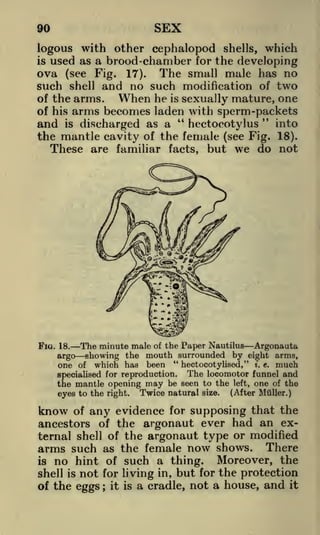
adequately please her as well as afterwards,
it may be, the one who does.
By that time,
however, the latter has had some measure,
at least, of success in reproduction and in
thus handing on to his progeny his meritorious
So that his death is of less moment
qualities.
to the race. Many of the illustrations of
sexual selection which Darwin gave remain
very convincing, but the theory requires to
be strengthened by more precise evidence
that considerable numbers of the less attractive
or less well-equipped males are either left
;

unmated, or have

less

numerous and

less suc-

cessful families as the result of their matings.

The theory may be consistently improved
by recognising what some students of comparative psychology have indicated, that the
female probably surrenders herself not to a

male selected because of some particular
but rather to the one whose

excellence,
SEX

74

ensemble most successfully excites her sexual
interest.
In some passages Darwin seems to
credit the female with a high degree of taste
or aesthetic fastidiousness he was doubtless
on safer ground when he wrote, "it is not
probable that she consciously deliberates but
;

;

she

is

most excited or attracted by the most

beautiful, or melodious, or gall.'-nt males."
useful suggestion has been made by Groos
that the displays of the excited suitorsdisplays often more reflex than controlled
have the effect of infectiously exciting the
female and of overcoming her coyness, a
character which is of no inconsiderable racial
value. An easily excited, readily persuaded
female type would not make for racial stability.
The difficulty that a particular quality of
the male could not be augmented by selection
without also affecting the corresponding character in the female progeny of successive

A

generations, will be discussed later, but we
may point out that although a quality passes
into the inheritance of both sexes, the conditions of development may prevent it finding

expression except in one sex.

Another

is raised by the fact that
some cases of pronounced sexdimorphism where there is no evidence either
Subof preferential mating or of combats.
have been invented to
sidiary hypotheses
meet these cases, such as Wallace's that
Natural Selection would tend to eliminate

there

difficulty

are

females that were conspicuous during incubation, or Giinther's that masculine characters have their justification as a means of
"
"
enemies.
bluffing
THEORY OF SEX-DIMORPHISM

75

3

erhaps the most serious difficulty is that
of the modern experimental work in
regard to selective breeding is beginning to
shake the confidence with which many have
held the Darwinian view that marked augmentations can be accounted for by the
gradual accumulation of minute increments
generation after generation. It may be that
such selection as is afforded by combats and
L

some

preferential mating is quite inadequate to
build up slight fluctuations into extraordinary
differentiations like the stag's antlers and the

peacock's

tail.

A LAMARCKIAN THEORY.

In his interesting
Sexual Dimorphism, J. T. Cunningham argues
in support of a Lamarckian interpretation
"
In either sex unisexual characters have, as
a general rule, some function or importance
in the special habits or conditions of life of
"
the sex in which they occur."
But the
important truth, which appears to have been
generally overlooked, is that in the case of
each special organ its special employment
subjects it to special, usually mechanical,
irritation or stimulation, to which other
organs of body are not subjected. Every
naturalist and every physiologist admits that
in the individual any irritation or stimulation,
:

regularly repeated, produces some definite
physiological effect, some local and special
change of tissue in the way of either growth
or absorption, enlargement or decrease, or

change of shape. Thus not only hypothetically at some former time, but actually at
present in every individual, the unisexual
organs or appendages are subjected in their
SEX

76

functional activity to special strains, contacts,

and pressures, that is, to stimulation, which
must and does have some physiological effect
on their development and mode of growth."

To

explain the restriction of sex-characters
to one sex, to the period of maturity, and
often to one period of the year, Cunningham
"
supposes that
heredity causes the development of acquired characters for the most part
only in that period of life and in that class
of individuals in which they were originally
acquired." Unisexual characters are largely
of the nature of excrescences which originated
from mechanical or other irritation in the
male or the female at particular times and
in particular states of body.
They are now
part and parcel of the inheritance, but they
are not expressed in the body except in
association with physiological conditions the
same as those under which they were originally produced.

seeks to show that sex charbe legitimately interpreted as the

Cunningham
acters

may

hereditary outcome of special irritations. The
legitimacy of this interpretation depends (1)
on the experimental evidence that can be
adduced to show that callosities, excrescences,
proliferations, etc., do arise as the direct
result of stimulation; and (2) on the case
that can be made out, on experimental or on
logical grounds, for believing that somatic
modifications may be directly transmitted
This raises the
in some degree at least.
whole question of the transmission of somatic
modifications, which are acquired by the
individual as the direct result of peculiarities
in

THEORY OF SEX-DIMORPHISM 77
function or in environment. We have

considered the pros and cons at some length
elsewhere, and it appears to us that the
seriously discussible evidence on the affirmative side is riot sufficient to warrant an
acceptance of Cunningham's position, at any
rate without the considerable degree of
restatement which the Lamarckian theory
requires though again it is to be admitted
that this re-statement is in progress and on
various sides, as from Semon to Bergson.
A PHYSIOLOGICAL THEORY. Professors
Hesse and Doflein have made the interesting
suggestion that, as reproduction is commonly
of much less organic strain to males, they have
so far a surplus of plasmic material and vital
energy at their disposal, which may account
for their frequently greater variability, for
certain characteristics of habit and temperament, and for exuberant growths of
various special kinds.
To the objection that the male is often
much smaller than the female, and that his
nutritive income is proportionally less, the
answer is that the decisive fact is one of
ratio, e.g. between the amount of material
used in reproduction and the weight of the
body in the two sexes, or between the size
of the reproductive organs and the size of the
body in the two sexes.
In cases where the sexes expend approximately equal amounts of material in reproduction, almost no sex differences occur.
Thus in many fishes, such as the herring,
the ovaries and testes are about the same
size, and enormous quantities of milt are shed
78

SEX

by the males

in the water.
In the viviparous
Cyprinodonts, on the other hand, where there
is internal fertilisation and
economy of spermmaterial, the males show both permanent and

periodic distinguishing features (see Fig. 14).
"
In his critique of this
surplusage theory,"
Kammerer indicates some serious, and indeed
fatal, objections.

(1) It

may

explain

how

the

male has a good deal to spare on decoration,
but it sheds no light on the specific line that
his disposal of the surplus takes
a mane for
the lion and antlers for the stag. (2) It is
easy to pick out cases that suit the theory,
but what of the broad fact that in hundreds

among birds and mammals, reptiles
insects, the two sexes are equal in size,
equal in numbers, and uniform in appearance,

of cases

and

although the expenditure on the male's side
remains very much less than on the female's ?
(3) The female's reproduction is more expensive, yet it is the female that tends to
fatten.
And why is it that when her reproductive expenditure is over, her accessory
sex-characters do not improve (except in
rare cases), but become less marked than
ever ? (4) There are many cases where the
male has to fertilise the eggs of many females,
and where he has no masculine peculiarities,
which is what the theory would suggest. But
there are also many cases of a similar sort,
where the polygamous male, like peacock,
pheasant, stag, bull, sea-lion, shows an
exuberance of masculine features. Indeed
it
may be argued that increased sexual
function in the male tends to increase the
masculine features, and vice versa.
THEORY OF SEX-DIMORPHISM

79

Another physiological theory was put forward by the authors in 1889 in The Evolution
of Sex, where it was maintained that the deep
constitutional difference between the male
and the female organism, which makes of the
one a sperm-producer and of the other an
egg-producer, is due to an initial difference
in the balance or rhythm of chemical changes.
That is to say, the two sexes differ fundain the life-ratio of anabolic to
katabolic changes. In the female, the balance
of income and outlay, of constructive to
disruptive changes, is the more favourable
one
the anabolic process tends to have

mentally

;

relative preponderance, and this profit may
be devoted to growth, and towards offspring,
in producing which she hence can afford to
bear the larger share. In short, the life-ratio
of anabolic to

female

is

sponding

katabolic changes, -, in the

K

normally greater than the correlife-ratio,

,

in the

male of the same

K.

Now it would be crude to suppose
species.
that structures like yolk-glands or milk-glands
are the direct outcome of the relatively greater
anabolism of the female. Nor can greater
exuberance of integumentary structures and
more abundance of pigmentation in them
be regarded as the necessary outcome of the
But
relatively katabolic male constitution.
it
may be that masculine and feminine
secondary sex-characters are on the whole
congruent with the kind of constitution which
implies maleness and femaleness respectively.

Whether a character

in the germinal inherit-
SEX

80

ance finds expression or not may depend on
whether the organism is male or female in
its fundamental metabolism; and
similarly
what degree of expression a particular character finds opportunity for in development
may be determined in the same way.
THE ROLE OF INTERNAL SECRETIONS. It
has long been recognised that the reproductive
organs exert a pervasive influence on the
body, as is conspicuously seen in the changes
that occur at adolescence, and in pregnancy,
even in remote parts of the body. The fact
"
is expressed in Helmont's aphorism
Propter
solum uterum mulier est, quod est," which
"
Chereau changed into Propter solum ovarium
mulier est, quod est."
The view of Pfliiger, that the gonads exert
an influence through the nerves associated
with them has given place to the view,
originating with Brown-Sequard, that the
influence passes into the body by the medium
of the internal secretions of the gonads.
To
"
horStarling we owe the convenient term
"
:

for the specific stimulating submones
stances in these internal secretions, and more
recently Schafer has given convincing illustrations of their subtle and multifarious
efficacy within the organism.
It may be explained that a male organ or

a higher animal consists of spermarranged in tubules, of interstitial cells of various types, the whole within
an outer envelope of connective tissue. Similarly the female organ or ovary consists of
ova disposed in groups of follicles, of interstitial cells of various kinds (the stroma of
testis in

making

cells

'
THEORY OF SEX-DIMORPHISM

81

the ovary, the follicle cells, and the corpus
luteum), all within the sheath of connective
tissue.
It has

been shown by

many

investigators

that the interstitial cells of the mammalian
testis possess a relative independence of the
germinal portion. They may be well developed at a time when the germinal part is
still embryonic
they may occur at some
distance from the seminiferous tubules; they
may be normal in old testes from which the
sex-elements have disappeared, or in diseased
testes in which only the seminiferous part is
Three functions have been assigned
affected.
to the secretion of these remarkable glandular
cells, that it is nutritive for the testis, that it
acts as a formative stimulus for the secondary
sex-characters, and that it affects genital
excitement.
It has also been shown that masculine
characters (e. g. in the horse and in man)
may develop although the sperm-making part
of the testis is degenerate, so long as the
;

remains well developed. It
follows that the stimulating internal secretion,
without which the masculine characters do

interstitial tissue

not develop, is produced by this interstitial
In mole, marmot, man and other
tissue.
waxes and
mammals, the interstitial tissue "
"
in
heat
wanes, and the recurrence of
animals is preceded by activity of the interbefore sperm-making activity
Similarly in the female, the internal
secretions that pass from the ovary have their
origin, not in the germinal, but in the interstitial part of the organ.

stitial

sets in.

tissue
SEX

82

Let us consider the case of fowls. For
three or four weeks after hatching, chickens
do not show any external marks of sex. In
size and colour of comb, in plumage and
limbs, pullets and cockerels are alike, and it
is not till towards the thirtieth day that the
external differentiation begins to be apparent.
By the forty-fifth day the comb is more
pronounced and more vividly coloured in the
male the wattles begin to develop the young
cocks crow towards the second month differences in the plumage begin to differentiate
the two sexes more and more sharply.
So far we are on familiar ground, and it
is also well-known that the removal of the
testes hinders the development of the secondary sex-characters. But a recent investigation by J. des Cilleuls has made matters
more precise. He has shown that the appearance of the secondary sex-characters in
the young cock coincides with the appearance
that the
of interstitial cells in the testes
interstitial cells and the distinctively cockcharacters increase concurrently; and that
the cock-characters continue to be accentuated till after the sixtieth day, while the
the seminal
essential part of the testes
tubules remain embryonic. It would appear
therefore, that the internal secretion of the
interstitial cells serves as a stimulus for the
development of the secondary sex-characters.
;

;

;

;

A

number

of very interesting experiin reference to the
r61e of the internal secretions in connection

great

ments have been made

with sex-characters, and while there seems
to be a tendency to hurry to very definite
THEORY OF SEX-DIMORPHISM

83

while the investigation is still
it seems legitimate to say that
in many cases the diffusion of the internal
secretion throughout the body serves as the
liberating stimulus evoking the development
of sex peculiarities which have hitherto
conclusions

very young,

remained latent or unexpressed. It must not
be supposed that the internal secretion from
the gonads causes the sex-characters, though
it may be a condition of their normal development in the individual. The gonads are the
nurses of the secondary sex-characters, but
not their producers. The sex-characters were
in the hereditary treasure -box, even though
not exhibited. But it is certainly very
remarkable that even when a gonad is absent,
the secondary sex-characters lying latent may
be called into some measure of expression by
an injection of the secretion.
SEX-CHANGES IN CRABS. It was the French
zoologist Giard who first called attention to
the extremely interesting phenomenon which
"
he called parasitic castration." Many young
e. g. of Stenorhynchus, are infested by
crabs,
other Crustaceans of the family Bopyridae,
which become mature at the time when their
hosts should also be mature.
But the gonads
of the crab have been destroyed by the
parasite, and a remarkable change has been
brought about. If the crab be a male it
exhibits some of the structural features of a
female, it loses its masculine impulse and it
actually defends its parasite as a female does
her eggs, the parasite protruding on the
outside of the tail just where a female crab
carries her eggs.
It used to be remarked as
SEX

84

very curious that only female crabs were
attacked, but Giard showed that many of the
apparent females were parasitised males. If
the victim be a female, there is no change of
structure or of instinct, except that she
cherishes the parasite instead of eggs which
are absent.
Giard's work has been extended by that
of Geoffrey Smith, in a series of researches
remarkable for their thoroughness. In the
case of male crabs of the genus Inachus, for
instance, he found that castration, brought

of Abdomen in a crab, Paehygrapsus.
A, of
B, of a male C, of a parasitised male approximating to the female type. (After Geoffrey Smith.)

FIG. 15.

Forms

a female

;

;

about by Sacculina and the

like, induced a
very striking expression of latent feminine
and female features. The crab developed
egg-carrying abdominal limbs like those of a
female and it produced eggs. The normal
crab is not in any sense a hermaphrodite,
but the effect of castration is the development
of the latent characters of the other sex.
Potts has studied the castration of male
hermit-crabs by Peltogaster and of male
shore-crabs by Sacculina. In the former,
the male characters persisted; in the latter,
though the castration was incomplete, some
THEORY OF SEX-DIMORPHISM

85

female characters appeared. Smith and Potts
are both of opinion that what happens is a
change of the metabolism of the crab on to
female lines. In Inachus, the putting on of
external feminine characters preceded the
appearance of the ovaries, so that the theory
of a specific secretion passing from the gonads
to the body is in this case excluded.
Smith's theory has an important bearing
on the significance of sex and on the rfile
ascribed to internal secretions. Without going
into technicalities, let us seek to understand
more precisely what he means by saying that
the parasite disturbs the general metabolism
and that this affects the expressions of sex.
In a normal female crab the ripening ovary
takes up lutein and fat this seems to stimulate
the liver to make more, and to lessen another
of its functions, namely, making glycogen
(or animal starch) which is used in growth.
In the ripening female the blood becomes
progressively charged with fat and lutein,
and this might be described as the distinc;

Now
tively feminine condition of the blood.
the roots of the Sacculina penetrating through
the male crab affect the metabolism just as
an ovary does in a female. They take up fat
and stimulate the liver to make more. The
glycogenic function is depressed, for there is
an absence of demand for glycogen, there
being no growing or moulting after the
Sacculina has protruded on the under side
of the crab (see Fig. 16).
It has not been
shown that the male's blood

is

actually

charged with lutein and fat, but the liver is
always coloured with lutein, and so are the
SEX

86

Sacculina roots, showing that a transference
of these materials has occurred, perhaps so
rapidly that their presence in the blood cannot
be detected.

Smith's view
alters the

FIG.

is in general that the parasite
composition of the male's blood to

Male era)) Inachus with the sac-like parasite,
16.
Sa-cculina (S) protruding between the under surfaces
of the abdomen and the cephalothorax.
Forceps and

abdomen modified towards female

type.

(After Geoffrey

Smith.)

or towards a female condition, and that this
naturally followed by the development of
female secondary characters, or by the regeneration of an ovary instead of a testis from
the indifferent germ-cells that remain at the
end of infection. In short he would suppleis
THEORY OF SEX-DIMORPHISM

87

r61e of hormones by recognising the
importance of metabolism-stimulation.
Using the terminology of The Evolution of
Sex, Geoffrey Smith says of the adaptive
regulation of the metabolism in the parasitised

ment the

male crab that

"

this adaptive regulation
consists in the production of at least a partially female condition of metabolism as op-

posed to a wholly male condition, the female
condition being preponderantly anabolic or
conservative, as opposed to the katabolic
male condition, and by this change from a
katabolic to a more anabolic condition the
animal can withstand better the drain on its
system increased by the parasite."

AND SPECIES-CHARACSEX-CHARACTERS
The interesting thesis has been already
mentioned (Tandler, Kammerer, Tandler and
Grosz), that sex-characters have been derived
from ordinary species-characters, w^hich have
TERS.

been brought into special correlation with the
their internal secrereproductive organs and "

All secondary sexTandler writes :
characters were indeed at first specific charand not primarily associated with
acters
the genital sphere." Thus the milk-gland has
doubtless arisen from a group of sebaceous
glands, common to both sexes. Later on, it
underwent transformation, and in the female,
came into the service of another function, and
under the influence of the gonads. There is
no puzzle in the fact that it is represented in
an undeveloped state in the male.
Kammerer comes to the same conclusion
"
The sex-characters simply form a particular
group of species-characters all sex-characters
tions.

.

.

.

:

:
SEX

88

are at the same time species-characters." In
this connection he refers to Mobius's thesis
that there is a sort of somatic sex, a sexdifferentiation of all the organs and tissues,
whether they show a visible difference or not,
so that one may, he notes, invert the previous

sentence and say that all species-characters
are also sex-characters. But, in any case,
there are certainly no special sex-characters,
which stand apart from other species-characters, as

things per se and autonomous.

In their recent work Tandler and Grosz are
very emphatic in their conclusion that all sex
characters have been derived from specific
"
"
characters or
systematic characters, which
in the course of time have been brought
(by the usual method of variation and selecThis oction) into the service of reproduction.
curred at different periods, as is suggested by
their different degrees of variability to-day.
And in the course of their evolution they have
come into correlation with the gonadial glands
of internal secretion which supply in a remarkable way their indispensable liberating stimuli.
"
The secondary sex-characters are, to begin

characters and they ultimately owe their development and differentiation to the harmonious co-operating of the
with, systematic

glands of internal secretion."
"
The thesis that
All secondary sexcharacters were at first specific characters,"
appears to us to be an exaggeration of a sound
:

There are, it seems to us, numerous
peculiarities of one sex or the other which
cannot be readily derived from specific characters supposed to be common to both sexes.
idea.
THEORY OF SEX-DIMORPHISM

89

And if it be said that the cases we would
adduce are not fair samples of sex-characters,
we would reply that it is very difficult to
"
draw a line round secondary sex-characters,"
separating them from other sex-differences.
This is especially difficult
animals where we have

among

invertebrate

knowledge of
of internal secretion connected with
glands

FIG. 17.
its

of

little

Female of Paper Nautilus Argonauta argo with
brood-chamber shell, enveloped by the expanded ends

two

of the arms.

the essential gonads, and are therefore bereft
of that useful criterion of a secondary sexcharacter which has been discovered in
vertebrates.
Let us consider, then, a few striking sexdifferences in their bearing upon Tandler's
theory. The female paper-nautilus, or armale. She
gonaut, is very different from the "
"
is much larger, she has two
arms peculiarly
modified to secrete a unique shell, not homo-
SEX

90

logous with other cephalopod shells, which
is used as a brood -chamber for the developing
ova (see Fig. 17). The small male has no
such shell and no such modification of two
of the arms.
When he is sexually mature, one
of his arms becomes laden with sperm-packets
"
into
and is discharged as a " hectocotylus
the mantle cavity of the female (see Fig. 18).
These are familiar facts, but we do not

FIG. 18.

argo

The minute male of the Paper Nautilus
showing the mouth surrounded by

one of

which has

been

"

Argonauta

eight arms,
hectocotylised," i. t. much

The locomotor funnel and
the mantle opening may be seen to the left, one of the
(After Miiller.)
eyes to the right. Twice natural size.
specialised for reproduction.

know

of any evidence for supposing that the
ancestors of the argonaut ever had an external shell of the argonaut type or modified
arms such as the female now shows. There
is no hint of such a thing.
Moreover, the
shell is not for living in, but for the protection
of the eggs ; it is a cradle, not a house, and it
THEORY OF SEX-DIMORPHISM

91

has no meaning except in the female. Unless
indeed one supposes that both sexes used to
carry the eggs, or that the ancestors of
Argonauta were hermaphrodites but for any
such hypotheses, there are no bases.
Let us take one of those very interesting
cases where the female has something definite
and positive which the male has not the
frog Nototrema with its dorsal pouch in which
the eggs are carried. Is there any warrant
for supposing that this was once a specific
character? Another case in point may be
found in the so-called claspers of male
In a fish like the skate they are
Selachians.

they are
very conspicuous sex-characters
highly specialised structures with complicated
musculature and skeleton. They are very
;

definitely male organs, without
There is
tion in the female.

any representano warrant for

supposing that the ancestors of our modern
Selachians had structures like these claspers
in both sexes, or even rudiments of them.
Again, in most mammals, though the ovaries
always remain internal, the testes are carried
in an external pouch or scrotum into which
at a certain stage of development they
descend, as it were by a rupture normalised.
This is a definite male peculiarity, a specialisation not necessarily present it is not hinted
at in the female and again there is no warrant
for regarding it as a transformation of any
specific character ever common to the two
In the same way the protruding eggsexes.
sacs of many female water-fleas, e. g. Cyclops,
are extra things on the female's part.
DIFFICULTY AS TO ORIGINS. Darwin's
;

;
SEX

92

theory of sexual selection suggested that a
variation in male animals in the direction of,
say, better weapons or more beautiful plumage,
would be profitable to its fortunate possessors.
They would be more successful than others in
reproduction and their stock would prevail ;
those of their kin who had not the excellence
in question would be sooner or later eliminated.
If the facts bear it out, the theory is a sound
interpretation of the survival of certain
But it did not pretend to explain
characters.
the origin of the variations assumed to have
occurred, and it is this question of origins

which makes

all

our evolutionary inquiries

difficult alike.

At this point the Lamarckian interpretation has theoretically the advantage, for if
males acquired weapons as a direct organic
response to fighting, and decorations as the
organic reward of doing their best in the way
of showing themselves off without them, or
as the result of functional changes in the
blood-pressure and in the distribution of the
blood-vessels, then the problem of origin is
And if these individual acquisitions
solved.
are entailed on the offspring, then the problem
of their becoming racial characters is also
solved.
But, as we have already hinted,
there are great difficulties in the way of this
interpretation.
If we pass to the suggestive view that
distinctive sex-characters are all derivable
from specific characters by a change of
function and by becoming correlated with
the reproductive organs, whose internal secretions

supply the physiological nexus, then
THEORY OF SEX-DIMORPHISM

93

the problem of the origin of the sex-characters
is not different from that of the origin of any
We have, indeed,
of the species-characters.
to assume that in the course of time the
species-character varied in rather a novel way,
but it seems to have been a common thing
in the course of evolution that an apparently
new organ should arise by a transformation
Thus the spinnerets
of a very old structure.
of a spider are very novel contrivances, but
they represent transformed abdominal limbs ;
the serpent's fangs are folded or channelled
teeth, and its reservoirs of venom are speciala bird's
ised glands of the mouth and lips
feather is part of a reptile's scale glorified;
and the hammer and anvil that form part of
the delicate apparatus for conveying vibrations
from the drum to the inner ear were once part
and parcel of the rougher and more commonplace mechanism of the jaws. There is abundant analogy, then, in support of the view
that ordinary species-characters may be transformed into sex-characters. But the origin
of the transformation remains obscure. Moreover, there are many sex-characters which
cannot be traced back to specific characters
common to the two sexes. Finally, care must
be taken not to invest the internal secretions
with more than a trigger-pulling and quanti;

tative influence.
Having cleared the ground, we come back
to the vague proposition that sex -characters
arise as germinal variations.
Here, it may
be, we are up against a fundamental character
of organisms, that they continually tend to
vary and often to vary creatively. But let
94

SEX

us not treat this characteristic as

if it

were

altogether and hopelessly mysterious. Without
straying far from our present path, we may
recall some of the possibilities.
Fluctuations
in the nutritive stream may evoke responsive
changes in the germ-cells. The opportunities
afforded in maturation and fertilisation may
bring about a shuffling of the chromosome
cards.
External changes may serve as variational stimuli to the highly complex germ-

plasm.

Going deeper, perhaps, we recall what
Spencer, for instance, emphasised, and what
the progress of chemistry since his day has
made even more vivid, the tendency in matter
to complexify.
Perhaps the living unit,
which we know as the germ-cell, utilises this
complexifying tendency in a progressive
differentiation of its own.
It is important at
all events to remember that a sex-cell is not
an ordinary detached cell, it is a gamete,

an individuality condensed and just as an
intact organism from Amoeba to Elephant
;

experiments, so it may be that the
implicit organism of the germ-cell tries experiments which we call variations.
tries

SUGGESTION AS TO MODE OF ORIGIN OF
SEX-CHARACTERS. Let us suppose that a

germ-cell already predisposed to develop
into a female is the seat of a variation in the
hereditary constituent corresponding to the
future ovary. Let us suppose that this
variation is in the direction of producing
an accessory yolk-gland. In the course of
development the variation, if consistent with
the rest of the constitution, is actualised and
THEORY OF SEX-DIMORPHISM

95

the beginning of a yolk-gland an
advantageous addition obviously. In the
course of time the organism reproduces and
there

its

is

germ-cells

have entailed on them

(in

accordance with the conception of germinal
continuity) the primary constituent (determinant or factor) of a yolk-gland. But the
difficulty immediately arises in the mind that
this new hereditary item will be found not
only in the germ-cells which will develop
into females (where it will be relevant), but
also in the germ-cells which will develop into
males (where it will be irrelevant). The question, then, is what will happen to the yolkgland determinant in those germ -cells that
are going to develop into males. The answer
is that it will remain latent, not because its
expression would be irrelevant, but because
it arose as a variation in a germ-cell predisposed to develop into a female. It is
solidary with femaleness, which, for us. means
a metabolism-ratio or rhythm with relatively
preponderant anabolism. Metaphorically, it
is a seed which will germinate in female soil,
which will not germinate in male soil, though
it will remain latent there.
For the sake of clearness, let us take the
same occurrence on the male side. In a
germ-cell (whether ovum or spermatozoon,
or fertilised ovum), predisposed to develop
into a male i.e. a sperm-producer, a variation
arises, say, in the direction of brilliant pigmentation of the skin. If it is consistent with
the rest of the organisation, it is realised in
development, the spermatozoa have it entailed on them, and it is transferred to a
SEX

96

But it develops only in
those fertilised ova which are going to develop
It does so develop because it
into males.
was to begin with a variation a new departure made by a male-producing gamete. It
is a seed which can germinate only in a male
soil, which will remain latent in a female soil.
Thus a germinal variation in the parthenomultitude of ova.

genetic ova of bees, which develop into
drones, will be unexpressed in the queens,
but none the less faithfully handed on by

them.

We

suggest, then, the hypothesis, that
distinctively masculine characters arose from
variations in gametes predisposed or predetermined to develop into males, that distinctively feminine characters all arose from
variations in gametes predisposed or predetermined to develop into females, and that
this primal difference in origin explains (1)
why the new gains are often confined in their

expression to one sex, and (2) why they hang
together in an hereditary congeries. The
hypothesis is in no wise inconsistent with
the view that many sex-characters are transformed species-characters, for the new departure in such cases was the transforming. Nor
does the hypothesis conflict in the least with
the facts in regard to the importance of
hormones in the individual development of
the sex-characters, which is a question in the
physiology of development. Nor does the
hypothesis conflict at all with the view that
some process of selection favoured the persistence and diffusion of the new character.
Nor does the hypothesis conflict at all with
THEORY OF SEX-DIMORPHISM

97

the view that the sex-characters behave in
inheritance as Mendelian characters. The
hypothesis concerns the origin, not the
development, or the evolution, or the mode
of inheritance.
One of the arguments that may be used
in support of our hypothesis is that used in
a slightly different connection in The Evolution
of Sex. It is this. There are numerous

distinctively masculine characters which have
measure of " family resemblance,"
which look as if they had something in
common, which are congruent with the
intenser metabolism of the male sex. To a
thorough -going Lamarckian this is readily
intelligible, for he regards the colour-display,
the exuberance of integumentary outgrowth,
the erection of parts of the body such as
crests and tail-feathers, the growth of weapons

some

on the one hand and embracing organs on the
as natural developments of the in-

other,

tensely living, lusty male, as natural individual

developments, whose results have gradually
been incorporated in the heredity-bundle.
But is not this too simple a view of the matter ?
It has not been proved that Nature works in
this direct way. The suggestion above made is
that such measure of congruence as there is in,
say, masculine sex-characters (e.g. brighter
colouring, exuberant decoration, smaller size)
may be hypothetically interpreted as due to
their having arisen as germinal variations
or mutations in germ-cells predetermined to
develop into males.

G
SEX

98

CHAPTER V
WHAT DETERMINES SEX?
The determination of sex

Different lines of inquiry
Possible influence of environment on developing organism
Possible importance of the relative condition of the

germ-cells

Are there predetermined
and female-producing germ -cells?

at fertilisation

male-producing

The Mendelian view of sex Possible influence of
environment in determining the relative numbers of
male-producing and female-producing germ-cells

A

physiological view.

THE DETERMINATION OF SEX. From ancient
much interest has been taken in the
question What settles the sex of the offspring? Many of the answers are bound up
"
"
times

:

an unscientific sort,
There are several
scores of books and pamphlets dealing with
the problem, most of which must be dismissed at once because of obviously fatal
with

theories of sex

whose name

is

of

legion.

defects in their scientific procedure. Some
lay stress on whimsical conditions, which
cannot be seriously considered; others on
unverifiable factors, such as the parental
Some are physiodesire for a male child.
logically absurd and others base a big gene;

ralisation
of cases.

on an outrageously small number

The general problem is What determines
whether a fertilised egg-cell will develop into
a male or a female organism? But let us
look at a few particular forms of the problem.
:

"
in the human
true twins
race arise from the division of an ovum into

What

are called

"

two independently developing

cells,

and they
WHAT DETERMINES SEX?
are always of the
twins,

which

same

arise

sex.

99

But ordinary

from two distinct ova

developing simultaneously, are often of different sexes. Why this difference in the two
cases

?

The eggs which the queen-bee lays without
fertilising them from her store of spermatozoa
(received from a drone in her nuptial flight)
develop into drones, but the likewise unfertilised eggs

months

by

produced during the summer
or aphides develop

green-flies

females
parthenogenetic
viviparous
females until the end of the season, when
males are produced. Why are the cases so
into

different ?

In one household the family consists of
boys and girls; in a second of boys only; in
a third of

girls only.

Why

is

this ?

DIFFERENT LINES OF INQUIRY.
Since
Darwin's day the problem has been attacked
scientifically,
(a)

along three distinct lines

Some conclusions as to the determination

of the sex of the offspring have been based
on statistics, for instance, as to the relative
numbers of male and female offspring produced in different localities, at different
times, with different ages of parents, and so
It is said, for instance, that late marriages
on.
tend to increase the proportion of boys, that
after prolonged wars when men are scarce

more boys are produced, that the younger the
mothers the more girls there are born.
(b) Some conclusions as to the determination of the sex of the offspring have been
based on the minute study of the germ-cells
in particular cases.
Thus it has been shown
100

SEX

that some animals produce two kinds of ova,
e. g. large and small, and that the larger
develop into females. This may be illustrated by Hydatina senta among Rotifers;
the large eggs develop into females, the small
ones into males.
(c) Some conclusions as to the determination of the sex of the offspring have been
based on experiment, e. g. subjecting the eggs,
or the embryos, or the parents, to peculiar
conditions of nutrition, temperature, and the
like, and observing whether the numerical
proportion of the sexes in the offspring is in
any way different from that which obtains
in ordinary conditions or by contrasting the
;

results of fertilising

immature and over-ripe

or by contrasting the results of using
or by trying particular
fresh or stale sperms
in reference to what are
breeding experiments
called sex-limited characters.

ova;

;

POSSIBLE INFLUENCE OF ENVIRONMENT ON
DEVELOPING ORGANISM. The first theory
"
"
we shall notice lays emphasis on Nurture
It supposes that in some
in the wide sense.
cases the sex of the offspring remains undetermined for a considerable time, and that
environmental conditions nutritive in particular give the bias to one side or the
other.
Yung, of Geneva, who was one of the
first to attempt the experimental study of
sex-determination, found that tadpoles, which
normally develop into about fifty-seven
females to forty-three males, yielded, when
fed with beef, fish and frog-flesh, respectively,
and ninety-two
seventy-eight, eighty-one,
females in the hundred. But Yung did not
WHAT DETERMINES SEX?
pay

101

sufficient attention to differential morand this defect in method has vitiated

tality,

a number of similar experiments.
Several experimenters, for instance, have
noticed that when a crowd of caterpillars
are under-fed, there is an unusually large proportion of males among the survivors. But
as the sex of the caterpillar is really determined before it hatches out of the egg, the
experiments only showed that there may be
great differences in the rate of juvenile
mortality in the two sexes. The females
seem to be more susceptible to starvation.
It used to be supposed that between the
beginning of the individual life (the fertilisation of the ovum) and the time when sexcharacters become clearly apparent, there is

an intervening

indifferent period.

research

has

But more

shown

in many
penetrating
cases that this so-called indifferent period,
In many
if it is a reality at all, is very short.
cases it is possible to distinguish microscopically between the male and female gonads
in the very young embryo.
It is important, however, to bear in mind
cases like that of the male crab referred to
in Chapter IV, where a testis destroyed by
a parasite was replaced by an ovary pro-

ducing eggs. There was no indefiniteness
about the crab's sex-determination; what
happened was the activation of the germs of
femaleness, and also of feminine characters,
of whose latency there is evidence in many
different kinds of males.
Now and again
these awake a little if there is a thoroughgoing
change of constitution, such as the parasitised
102

SEX

crab so well illustrates. Oftener, however, we
find cases where in a female's body normally
latent masculine characters are awakened
into expression.

A number of interesting experiments have
been made with organisms that are often,
but not always, hermaphrodite, such as the
grey freshwater polyp, Hydra grisea, and the

some ferns.
It has been shown that optimum conditions
result in a predominance of females, and that
groups wholly male can be produced by reWhat happens in these cases
lative starving.
is the inhibition or suppression of one set of
sex-organs in favour of another, and although
the frequent or normal occurrence of hermaprothallia (sexual generation) of

phroditism removes the instances given from
the case of ordinary unisexual organisms, we
submit that the facts are relevant in showing
how closely sex and metabolism are wrapped

up together.

POSSIBLE IMPORTANCE OF THE RELATIVE
CONDITION OF THE GERM-CELLS AT FERTILISA-

A second theory a favourite one
with breeders supposes that the sex of the

TION.

offspring is settled by the relative condition
of the germ-cells at the time of fertilisation.

that if the ovum come from a
young mother and the sperm from an older

Some say

father, the offspring will tend to be male.
Others say that an ovum fertilised soon after
ovulation is likely to develop into a female.
Many breeders maintain that the sex of the
offspring tends to be that of the more vigorous
parent a favourite theory with the fathers
But a solid foundation on
of many boys.
WHAT DETERMINES SEX?

103

which to base these and similar views has not
been supplied. We have, however, two very
careful

sets

of

experiments.

O.

Schultze

experimented with enormous numbers of
mice, and found that the proportions of the
sexes were not affected by differences in the
ages of the parents, by differences in apparent
vigour, by close inbreeding, or by frequency
Nor did he find that
of successive births.
any kind of nutritive change made any difference. As the outcome of prolonged experiments with frogs, Hertwig and Kuschakewitsch
found that either over-ripeness or underripeness of the eggs (due to artificially delaying
or hastening fertilisation) led to a large excess
of males.
Kuschakewitsch, working with ova
of a high degree of over-ripeness, actually got
cultures of males only, and with only 4*6 per
cent, of deaths.
It will be seen that these two sets of ex-

periments point in opposite directions. For
frogs, it appears that the state of the ovum
for mice,
at fertilisation is very important
it appears that much may be changed without
It may
affecting the proportion of the sexes.
be that the particular change of condition
that does make a difference has been hit
upon in the case of frogs, and missed, as yet,
It may be that sex is
in the case of mice.
determined in different ways and at different
times at the various levels of the scale of
;

being.

PREDETERMINED MALEARE
THERE
PRODUCING AND FEMALE-PRODUCING GERM-

CELLS ? It is possible that many ova are so
constitutionally predetermined that they will
SEX

104

develop into females only, while others will
develop into males only. We are sure that
this is possible, because in the vine-pest
Phylloxera among Insects, and in Hydatina
among Rotifers, and in other cases, there are

which develop into females, and
small ones which develop into males. In
both these cases the ova develop without
fertilisation, so that there is no question as
to the possible influence of the sperm.
Reuter has shown in one of the mites
(Pediculopsis), and Von Malsen has shown in
large eggs

a primitive

which

worm

called Dinophilus, in

both

that
there are large egg-cells which develop into
females, and small egg-cells which develop
into males. Size is never of much account
except as an index of something deeper, and
it is interesting to note that the Marchals
have proved that the asexually produced
spores of some of the mosses, though all
similar in appearance, are individually predestined, indeed, fixedly predetermined, as
of

fertilisation occurs as usual,

male-producing and female-producing units.
We have already mentioned that " identical
twins," which are developed from one ovum,
are always of the same sex. In one of the
armadillos (Praopus or Tatusia hybrida) Von
Jhering found on two occasions eight embryos,
apparently from one ovum, and all male.
In some of the parasitic Hymenoptera, such
as Encyrtus, one ovum forms a group of
embryos, all of the same sex female if the
egg be fertilised, male if it be not fertilised.
These facts suggest that the sex of the offbut
spring is already settled in the ovum,
WHAT DETERMINES SEX?
that fertilisation

may

be necessary

if

105

a female

to develop.
In about thirty different kinds of animals
there are two kinds of spermatozoa differing
is

but the significance of this
dimorphism is not known. Of greater interest

in detail of form,

is the fact that in a considerable number of
animals, especially insects and arachnids,
half of the spermatozoa have in their nucleus
the same number of nuclear rods or chromosomes as the ova have, while the others have
one fewer. This extra chromosome, which
half have and half have not, is called the Xelement or accessory chromosome, and there
are facts which go to show that the presence
of two X-elements in the fertilised ovum
implies development into a female organism,
while the presence of only one means a male.
It is possible that the amount of chromatin
is of some importance, the ova with more
chromatin developing into a female. It is
possible, as E. B. Wilson suggests quite
provisionally, that the X-element contains
factors (ferments or hormones?) that are
necessary for the development of maleness
or femaleness, and that they are so adjusted
that in the presence of a single X-element
the male character finds expression, while in
the presence of two X-elements the female
character is liberated.
THE MENDELIAN VIEW OF SEX. In the
volume on EVOLUTION a brief reference has
been made to the important discovery known
as Mendel's Law which formulates the mode
of inheritance of certain kinds of characters
called unit characters or Mendelian
SEX

106

characters. In simple clear-cut cases the gist
of the matter may be thus stated. If
be
a well-established, pure-bred variety with a
certain differentiating character (D), e. g. a

A

and if B be
colour, a crest, long fur, horns
another well-established variety with a corresponding but contrasted differentiating character (R), e. g. another colour, no crest, short
and if
and B are crossed,
fur, hornlessness
the hybrid offspring (Fj) will resemble one of
the parents only, say A, as regards the contrasted characters in question. The character (D) that prevails was called by Mendel
;

;

A

a dominant; the character (R) that remains
latent was called a recessive. (In many of
the cases now known the dominance is imperfect, more or less of the recessive character
being exhibited, but it is unnecessary to discuss this.) Now, if the hybrids be bred
together, their descendants will be of two
kinds, three-fourths of them with the dominant character and one-fourth of them with
the recessive character. When those with the
recessive character are inbred, they yield
only recessives. They are pure or homozygous as regards this recessive character.
When those with the dominant character
are inbred, a third of them yield only
dominants (to put it shortly), and two-thirds
of them yield dominants and recessives in the
previous proportion of about three to one.
That is to say, a third of the dominants
are pure or homozygous dominants; while
two-thirds of them are impure or heterozygous
Diain respect to the dominant character.

grammatically expressed, the facts are
WHAT DETERMINES SEX?

25

p.c.

D

pure dominants)

107
SEX

108

bear only the dominant
50 per cent, will bear both the
dominant and the recessive character (only
the dominant being eventually expressed or
well-expressed), and 25 per cent, will bear only
the recessive character. This is the theory
of the segregation of pure gametes and it is
the central conception of Mendelism. A
fertilised egg-cells will

character,

scheme

will

make

it

clear.

(See Evolution,

p. 135.)

1

2

impure dominants.

1

When

pure dominant.

pure recessive.

an organism produces only one kind

of germ-cell, as regards a particular character,
it is said to be homozygous ; when it produces
two kinds of germ-cells, some bearing the
factor of a given character, and others not,
it is said to be heterozygous.
Thus in our
previous scheme the forms labelled D(R)
are heterozygous, while those labelled
or

D

R are
If

homozygous.
sex, like any other character,

is

due to

some item or factor or determiner in the
chromosomes of the germ-cells (situated, it

may be, along with sex-linked characters,
in the sex chromosome already referred to),
there are three theoretical possible Mendelian
interpretations.

Both

males

and

females
WHAT DETERMINES SEX?

109

be sex-hybrids or heterozygous male
D(R) x female D(R) a view supported by
Castle; or the male alone may be heterozygous, the female being a homozygote
recessive male D(R) X female R a view
supported by Correns or the female only may
be heterozygous, the male being a homozygote
recessive
a view supported by Bateson.
The last form of the Mendelian interpretation is supported by a number of striking

may

;

especially in regard to the common
currant moth and the canary. In the case
of the currant moth (Abraxas grossulariata),
it is believed that the females are
heterozygous
(having maleness recessive) and give rise to
facts,

equal contingents of male-producing and
female-producing ova; that the male moths
are homozygous as regards sex, being without
"the femaleness-f actor/* and give rise only
to male-producing spermatozoa; that when
a male-producing spermatozoon fertilises a
male-producing ovum, the result is of course
a male; and that when a male-producing
spermatozoon fertilises a female-producing
ovum, the result is a female, femaleness being
by hypothesis dominant over maleness. If
the Mendelian interpretation of sex-inheritance
be confirmed, it will probably be found that
in some types the male is heterozygous and
in others the female.
A third possibility is
that both sexes are heterozygous or sex
hybrids. If the Mendelian view be confirmed
it means that maleness and femaleness behave
in inheritance like shortness and tallness in

dwarf and giant varieties of pea;
that there

is

some

definite

body

it

implies

perhaps of
110

SEX

the nature of a ferment which is either
present or absent in every germ-cell. This
is not at all incompatible with a physiological interpretation, for it may be that this
mysterious sex-determinant acts as an accelerant or depressor of the rate of metabolism and
it may be that the nutritive conditions within
the reproductive organs during the processes
of oogenesis and spermatogenesis exercise a discriminate selection allowing more of the maleproducers or more of the female-producers to
;

survive.

The Mendelian

interpretation accounts well
usual equality between males and
females in a given stock, less well for the
strange disproportions which occur within a
The latter may, however, be
single family.
due to a discriminate selection during the
production and maturing of the ova.
Doncaster refers to the confirmation which
the Mendelian theory of sex receives from the
In vertebrates, the
results of castration.
castration of the male may prevent the expression of masculine features, but it does
not induce the expression of feminine charThis would suggest that the male is
acters.
homozygous, that is to say, purely masculine,
without any feminine characters latent. The
castrated female, on the other hand, often
develops a striking series of masculine features,
which suggests that she is heterozygous, i. e.
with masculine characters latent. We would
point out, however, that in many cases there
is a lack of positiveness in the feminine characters as compared with the masculine ones.
So that there might be considerable femininity
for the
WHAT DETERMINES SEX?

Ill

in the castrated male, without there being
much to show for it. It would be interesting

to experiment with some exceptional case,
such as the Red-necked Phalarope, where the
female bird looks the more masculine of the two.

POSSIBLE INFLUENCE OF THE ENVIRONMENT
THE RELATIVE NUMBERS OF

IN DETERMINING

MALE PRODUCING AND FEMALE - PRODUCING
-

GERM-CELLS.

Recent observations have gone

much against the view that the sex of the young
offspring can be affected

by peculiar nurture.

It is possible, however, that nurtural conditions, such as the nutrition of the parents,
be influential at any earlier date, e. g. in determining the relative numbers of male-producing
or female-producing ova, or in determining
the percentage of survival of one kind or
the other, for there is often a struggle for

may

We

existence among germ-cells.
recall, for
instance, the green flies which produce females

the summer through, but suddenly produce males on the advent of autumn. It may
be that the seasonal change, acting on the
nutritive condition of the maternal body,
brings about the production of ova that
develop into males.
The careful experiments that Cuenot and
Schultze made on mice with a view of testing
whether altered nutrition affected the ordinary
proportion of males and females, gave no
support to that view. Schultze extended his
experiments over three generations but the
all

;

high feeding of grandparents, as well as
parents, did not seem to have any influence
on the proportion of the sexes among the
offspring.
112

On

SEX
Hi

the other side, there

is

the work of

Heape, who shows for some mammals and
birds that peculiarities in nutritive and other
environmental conditions may exert a selective
influence, affecting the numerical proportions
of male-producing and female-producing germcells.
Russo has made interesting experiments in treating rabbits with lecithin (a
very nutritive substance forming a great part
of yolk of egg), as the result of which he
thinks he is able to increase the number of
female offspring, namely, by increasing the
production of a certain type of ova, rich
in nutritive reserves.
His experiments have
been adversely criticised, and they were not

numerous enough to win conviction. Until
repetition of the experiments on a big scale
has shown that Russo w as in error, his thesis
r

should be kept in mind, that the sex of the
offspring depends on the special metabolism
of the germ-cells, and that the number of ova
which exhibit the male or the female type of
metabolism is alterable by the environmental
conditions. This is, in fact, part of the
thesis of our Evolution of Sex.
Remembering
the case of mice, however and there are
others equally negative we are prepared to
find that it is only in certain organisms that
the germ-cells are not predetermined very
early in their history.
Many investigations have yielded results
quite against the view that changes in environment can change the numerical proportion of

the male and female offpsring which is in
most cases near equality. On the other
hand, there are some investigations which
WHAT DETERMINES SEX?

118

support the view that changes in nutrition
other environmental conditions may
affect the mother so as to alter the ordinary
proportions of the sexes probably enough
by affecting the relative numbers of maleproducing and female-producing germ-cells.
Thus Issakowitsch, working with the parthenogenetic females of one of the water-fleas,
Simocephalus, and Von Malsen, working with
the primitive worm-type, Dinophilus, in which
the ova are fertilised, found that differences
of temperature affected the proportions of
the sexes, apparently by affecting the nutrition
Both sets of experiments
of the mothers.
are the more satisfactory that they seem to
be free from any fallacy due to differential
death-rate in the young of the two sexes.
A PHYSIOLOGICAL VIEW. To the view of
sex, expounded in The Evolution of Sex in
1889, a reference must again be made, for we
find ourselves unable to get away from the
conviction that there is no sex-determinant
or factor at all, in the morphological or in
the Mendelian sense, but that what settles
the sex is an initial difference in the rate or
rhythm of metabolism. This may also be
expressed as a difference in the relation of
nucleoplasm and cytoplasm, as well as in the
ratio of anabolism to katabolism.
According to this view, the deep constitutional difference between the male and the
female organism, which makes of the one a
sperm-producer and of the other an eggproducer, is due to an initial difference in the
balance of chemical changes. The female
seems to be relatively the more constructive,

and

H
SEX

114
the

The

male relatively the more disruptive*
sexes express a fundamental difference

in the

rhythm of metabolism.
young germ-cell has, metaphorically, an
alternative between two different, but equally
the male and the female.
viable, lines of life
It is shunted on to the one or the other by

A

the surrounding conditions. Influences which
favour a preponderance of anabolic processes,
which affect the nucleus-cytoplasmic relation

a manner favouring cytoplasmic assimitend to the increase of female-proInfluences that operate in
ducing eggs.
the opposite direction favour the increase of
male-producing eggs.
What we are suggesting is a physiological
way of looking at the problem, and the idea
that the sex-contrast expresses a physiological
alternative. This is confirmed in various
sometimes very
ways. For instance, there is "
a quality that
striking evidence that sex is
pervades all the cells of the organism."
E. B. Wilson notes the extraordinary fact
"
In
surely of profound importance that
the Mosses the Marchals demonstrate that
in

lation,

:

all

the products of a single spore are likewise

immutably determined, since new plants
formed by regeneration from fragments of
the protonema, or from any part of the gametophyte, are always of the same sex."
Of the association of maleness (or spermproducing) and femaleness (or ovum-producing)
with different conditions of metabolism many
illustrations might be given, but we must be
content here with two or three. Is it not
significant, for instance, that in

some

cater-
WHAT DETERMINES SEX?

115

the blood has a different colour in the
sexes, being green in the females and
bright yellow or colourless in the males ?
pillars

two

Dr. Francis Hare has made out a very good
case for the theory that menstruation represents a periodic discharge of carbonaceous
anabolic surplus in the blood which is earmarked, so to speak, for the organically
anticipated offspring. What but a physiological theory is suggested by the state of
affairs described by G. du Plessis in Grubea
protandrica, one of the Syllid worms, which is
male in autumn and winter, female in spring,
and neuter in summer ?
It is interesting to consider those cases
where the sex changes in the course of life
A case recently described by Prof. F. Braem
is very suggestive.
He experimented with
a simple Annelid worm, Ophryotrocha puerilis.
Taking a female which had ripe eggs and
!

showed no trace
divided

it

into two.

of

hermaphroditism, he
portion, with

The head

segments, was isolated. In three
had regenerated seven segments
with parapodia. It was then killed and
found to be male. The ova had mostly
disappeared from the reproductive organs,
leaving only a residue, and a functional
testicular portion had developed, which was
producing spermatozoa. Braem suggests that
in consequence of the amputation the very

thirteen

weeks

it

young, indifferent germ-cells had developed
into male cells, which require less subsistence
than ova. What is certain is that the reproductive organs had changed from producing eggs to producing sperms, and such
SEX

116

cases appear to us to favour the view that
the sex-difference is fundamentally physiological.

In conclusion, our view is that the difference
between an ovum-producer and a spermproducer is fundamentally a difference in the

balance of chemical changes, i. e. in the ratio
anabolic and kataboiic processes, which

of

of course, have its structural expression
in the relation of nucleoplasm and cytoplasm.
Nor do we leave this difference in metabolismrhythm as a mere vague phrase, for we see its

may,

the contrast between the ovum
spermatozoon, macrogamete and
microgamete, between the encysted and the
flagellate cell, between the plant and the

analogue

and

in

the

animal, and in

many

through the
in short,

a familiar contrast

all

We

series of Organisata.
adhere,
to the thesis of The Evolution of

Sex that the sex-difference is but one expression of a fundamental alternative in variation,
to be seen throughout the world of life.
But
we may add that the numerous and puzzling
minor variations, which, as we have above
seen, exist between species and species, may

be explained, not so much in terms of the
structural and the hereditary differentiations
which embryologists and Mendelians are wont
to look for or to assume, but rather in terms
of time-variations that is in acceleration or
retardation of the phases of life in adult or in
embryo, in sex-elements or in their initial
germ-cells, and in the interrelations of these.
;
THE CYCLE OF SEX

117

CHAPTER VI
THE CYCLE OF SEX
The curve of

life

Puberty in
in

love

difficult

Childhood

man

Married

Adolescence in general
among animals Falling
and parental affection The

Courtship
life

age and senescence.

THE CURVE OF LFFE. The course
individual life may he conveniently

of

an

represented by an ascending and descending curve.
There is the ascent of development and
there is the period of maturity,
growth
full strength and reproduction;
and there
is the descent of waning powers and senesIn adaptation to particular conditions
cence.
of life and as expressions of particular constitutions, there is among animal types a
remarkable diversity in the shape of the
curve. There are great differences in the
relative proportions of the successive chapters
There may be slow or rapid embryonic
in life.
development witness the contrast between
;

the salmon with

its years of growth and the
There may
blow-fly complete in a few days.
be a long larva! period, as in the frog, or none,
as in the snake; there may be a prolonged
adolescence, as in an eel, or a precocious
maturity as in a rat. Here we see a lengthening out, and there a not less remarkable

What a contrast, for instance,
telescoping.
between may-flies with a long aquatic larval
life of two or three years and a short aerial
adult life of two or three days, and the
majority of, say, amphibians with their
SEX

118

youth and their prolonged
Not only then does the general

relatively short

adult

life.

shape of the curve differ widely in the various
types, but looked closely into, it shows all
manner of minor irregularities, ups and downs
like a pulse or a barometer tracing, and the
pattern of these again differs widely from
Molluscs strikingly record
species to species.
these tides of life upon their shells, sometimes
so clearly that upon a few full-grown examples
of the top-shell (Trochus) we may not only
read the normal record of the species, but
within this again the minor fluctuations of
each individual's life history his personal
and not only his
equation as it were;
accidents, but his ailments and recoveries,

throughout adolescence, in maturity, and
above all in senescence.
CHILDHOOD. The remarkable work of
Freud, which is now being reckoned with by
alienists and physicians, emphasises the view
that in very young children there are often
experiences more or less connected with sex,
which may have considerable influence on the
subsequent life, so wing the seeds of hysteria and
obsessions.
Unless Freud's psycho-analysis
be unsound there is a more or less subconscious
sexual life in young children, which may be
exaggerated by careless caressing, exuberant
fondling and worse, into a very detrimental
precocity or into unsuccessful attempts at
repression which may find pathological means
In normal cases, happily,
of gratification.
the infantile deviations pass into oblivion;
and there is a happy period of latent sex until
puberty approaches.
THE CYCLE OF SEX
It

119

must not be overlooked that while a

pathological side may exist in very early
years, there is a still more important normal
experience, for even the infant is garnering,
it be half-conseiously, its mother's
In the subsequent play -period there is
doubtless a partly imitative and partly
instinctive, but normally quite subconscious,
expression of the deep constitutional sex-

though
love.

differences.

ADOLESCENCE IN GENERAL. Leaving the
babe to his mother and the expert in eugenics,
and the child to his play and all that is
summed up in the word " School " (see
Prof. Findlay's excellent Schooliu this Library),
here to do with the adolescent.
may regard adolescence as a main node on
the ascending curve of development, when
childish ways and childish things are put
away, when juvenile characters are for the
most part slipped off as a crab slips off its

We

we have

shard, when adult characters are gradually
put on, when the life begins to take definitive
shape, when the limit of growth comes within
sight, and when sex-impulses, at first mere
passing whispers, compel a hearing to their
mingled voices. As regards the latter it is
practically the period between fifteen and
twenty or more in boys, between fourteen and
eighteen or nineteen in girls.
may profitably compare human adoles-

We

cence with the analogous period in animal
development; for while everything became
in a sense new with Man, there is an essential
unity of life which makes the whole world
kin.

The growth

of

an organism

is

usually a
SEX

120

of the law of diminishing
an ascent whose gradient becomes steeper and steeper towards the top.
But although the early rapidity of growth is
illustration

good

return

;

it

is

never afterwards approached, there is often
in animals, as in man, a remarkable reacceleration towards adolescence. This means
a serious drain on the available energies of
the organism, and the candle cannot be burnt
at both ends. There is increasing stability

and yet increasing instability, there is great
"
slackness," and the
vigour and yet great
rapidly growing adolescent is naturally a
good deal preoccupied organically, not conwith his or her internal
sciously, preoccupied
All this means that he or she should
affairs.
of rest and plenty of play.
of adolescent animals leads us
to include in our conception of adolescence
the idea of internal change, rearrangement,

have plenty

The study

The adolescent creature
and readjustment.
becomes more complex, from its teeth to its
nerve-paths

But

it

cessful

also

there

;

becomes

more

is
if

controlled,

new

differentiation.

adolescence be suc-

more

unified,

more

strongly vertebrated, more toughly and subtly
knit together there is new integration. This
twofold progress is not achieved without cost;
"
there are
growing pains." In the transition from tadpole to frog, from caterpillar
to butterfly, there are remarkable processes of
breaking down and rebuilding, and crises of
inflammation that are sometimes fatal. Now
we must in some measure carry with us to
the study of human adolescence this idea of
;

redifferentiation

and reintegration

(i.e.

of
THE CYCLE OF SEX
new

121

complexities and new controls)
which have to be paid for. Thus it

adolescence

is

full

of

portent

as

gains
that
well as
is

promise.

A third biological fact must enter into our
conception of adolescence. It embraces the
momentous, critical time when decision is
given in regard to the individual variations
that crop up during the juvenile period. It
is
in early youth that variations or new
departures take shape the play period (poorly
;

though we provide for this) gives them some
elbow-room
but it is in adolescence that
they have to run the gauntlet, and this at
once of natural selection and of social criticism.
From one side threaten the conditions of the
organic struggle for existence, on the other
the rules of the serious game of life, and with
these come all sorts of restrictions, from the
law of the jungle to the conventions of social
behaviour; each and all closing in upon the
;

individualities, the idiosyncrasies, the peculiarities, in a word, the variations of the young
life.

The same thing

measure at
to say, those
peculiarities which are
applies, in a

least, to modifications,

that

is

bodily and mental
acquired as the result of peculiarities of
nurture. Great modifiability is characteristic
of early youth, but it is often during the later
adolescent period that it is decided whether
a piece of juvenile veneer is to persist or not.
When youthful modifications, for good or ill,
survive the adolescent period, the chances
are that they wili persist throughout life.
PUBERTY IN MAN. Puberty is not so much
an event as a result, that of a gradual process
122

SEX

of bodily ripening, which is quickened by
the maturation of sex. In illustration of the

ordinary changes which mark this stage in
the life of the body, we notice the beginning of
the coalescence of the caps of the long bones
with their shafts, and, as a negative character,
the disappearance of the thymus gland, which
is a distinctively juvenile organ.
As sexual
changes, the male shows an increased growth
of hair, an enlargement of the larynx, and
an increase in the size of the genital organs ;
the female shows a change in the shape and
size of the uterus, an enlargement of the
mammary glands, and the onset of menstruation.
While the reproductive organs, through
their internal secretions, have been influential
all through development, they come to have
a special influence when mature. And besides
the influence of the internal secretions, there
is that due to the fact that the essential or
germinal parts of the gonads have passed

more active functioning.
At the time of sexual maturity, according

into

to Steinach, the brain is greatly influenced
"
by the internal secretions, it is eroticised,"
and this has far-reaching influences on the

metabolism. Through the vaso-motor system
the changes in the brain affect the bloodsupply to various parts of the body. The
organism becomes impressionable to the other
sex in a new way. Certain sympathetic
ganglia become increasingly susceptible to
peripheral stimulation. And the brain-ganglia
become disposed to lower the tonus of certain
inhibitory centres in the spinal cord. Of
course, there are also psychical factors which,
THE CYCLE OF SEX

12*

Man's case, may be as supreme, as the
hormones and nerve-cells are fundamental.
in

It is at puberty that the conflict first
becomes serious between the life-instinct
which seeks self-preservation and advancement and the love-instinct which is not less

primordial. The former is the more egoistic,
the latter the more altruistic; the former is
linked primarily to nutrition, the latter to
reproduction. In everyday life they clash;
there is a struggle between the compulsion
of the sexual instinct and the opposing force
of sexual denial which may owe its strength
to ethical, religious, or practical inhibitions.
The outcome of the struggle may be damaged
health, a bondage to evil habits, a serious
"
neurasthenia, the establishment of
anxiety
"
neuroses
most of these being fictitious
substitutes for the activities which should
naturally accompany or follow normal sexBut the outcome may also be a
arousal.
strengthened control, an enriched life, and a
It must be remembered
love that will not die.
that other besides sexual factors are in operation during the adolescent period, for the
organism is being tried and tested in many
ways. Thus it is certain that the disorder
or disharmony is by no means wholly due to
the unsatisfied claims of the reproductive
system, but is associated with a lack of
objective, of

sound human

interests,

and

of

real responsibilities.

COURTSHIP AMONG ANIMALS. In discussing
"
the ladder of love
we have referred to
the great variety in the behaviour of the
two sexes in their relations to one another
"
124

SEX

at the breeding season. The broad facts are,
that there is often an over-mastering excitement changing the animal's character and
appearance, that there is often a seeking out
of the females by the males and rarely the
other way, that the excited males in many
cases fight fiercely with one another, and that

they often make displays of agility, mettlesomeness, of beauty, of fragrance, of musical

and so forth before the senses of their
desired mates. The difficulty is as to the
psychological interpretations to be put upon
One is apt to be uncritical in
the facts.
reading too much of man into beast; yet
again, reacting from a too generous anthropomorphism, one is apt to take a wooden view
of animal life, by depreciating the psychical
talent,

side.

In giving a few illustrations of courtship
(the subject of a recent fascinvolume by Mr. W. P. Pycraft), we may
ating
begin with the combats of rival males, since
these often take place in presence of the
females and appear to have in part the effect
of arousing or enhancing their sexual excitement, as well as expressing that of the males
themselves. Stag may fight with stag till
they drip with blood, it may even be till the
antlers interlock, and death is stronger than
them both. We have seen an old buck
antelope punishing a presumptuous upstart
with a fury that seemed almost maniacal.
The rival sea-lions slash at one another's
necks with their sharp canines and make
long wounds whose scars remain for many a

among animals

day.
THE CYCLE OF SEX

125

Among birds, the capercailzie cocks fight
savagely in the early spring till the snow is
often spotted with their blood. From the
shelter of a sheep-fold just after sunrise we
have watched the jousting of four or five
blackcock on a flat sward among the hills.
Almost transfigured they were with passion,
so that we could scarce believe they were
the same birds and how absorbed as they
bluffed one another, spreading their wings,
raising their tail, bowing till their chin touched
the ground, or vaulting into the air. From
the branches of two small alder trees numerous
females looked down on the tournament of
the cocks, and were seemingly very much
;

interested spectators.

In a lighter mood the ruffs so extraordinarily individualised that no two are
alike
fight the whole day long in the fenlands (no longer, alas ! in Britain). About
anything or nothing these glorified sandpipers fight almost as dramatically as gamecocks, seizing one another by the beak, leaping
into the air and striking with the wings ; and
it is likely that those who excel in the after
all bloodless jousts have their reward in im-

pressing the females and driving off rivals.
For the ruff is a thoroughgoing polygamist.
It is interesting to notice, also, that as with
the blackcock, the sparring between the

males

supplemented by a self-abandoning
"
"
can be
Nothing," says Wolley,
more expressive of humility and ardent love
than some of the actions of the ruff. He
throws himself prostrate on the ground, with
every feather in his body standing up and
is

display.
SEX

126

but he seems as if he were afraid
coming too near his mistress."
Some male spiders fight with apparent

quivering
of

;

seriousness at the breeding season, but the
meaning of the fighting" is doubtful. The

Peckhams, who watched hundreds of seem"
between the males in

ingly terrible battles

twelve different species, came to the con"
clusion that
they are all sham affairs gotten
for the purpose of displaying before the
up
females, who commonly stand by, interested
spectators." " And though a phrase like
"
sham fight
be somewhat too anthropomorphic, there is certainly a puzzle, for the
males in their duels seem to take very good
"
care not to hurt one another.
It seemed
cruel sport at first to put eight or ten male
spiders into a box to see them fight, but it
was soon apparent that they were very
"In fact, after
.
prudent little fellows."
two weeks of hard fighting we were unable to
discover one wounded warrior."
It is difficult to deal briefly with the
problem of the significance of the combats.
In a few cases, as in sea-lions, they may be
regarded as literal and serious combats for
the possession of females of a larger harem
In many cases, such as some antein fact.
lopes, they have the effect of driving oft
candidates who are too weak or too young
to hold their own. Some of these are left
unmated till the next season, and some are
even killed. Thus there will be worked out
a discriminate elimination of the relatively
less fit males, and here sex may be said to
operate as a factor in evolution.
.

.
THE CYCLE OF SEX

127

It is probably unwarrantable to speak of
the males getting up their tournaments in
order to impress the females. They fight
to win the females, they fight because they
are jealous, they fight because they are highstrung, they fight because of the irritability
induced by unsatisfied sexual appetite, and
so on ; but it is very unlikely that they fight
"
"
to impress. What probably
in order
happens is that certain males in their whole
behaviour excite the females more effectively
than do others, and are in consequence more

successful in reproduction. The type successful in courtship will naturally tend to
define the direction of further evolution.
Pass now from combat to song, in the old
minstrel fashion. Every one recognises that
the musical displays of singing birds play an
important role in their courtship; and it is
well nigh inevitable to draw a similar conclusion in regard to the instrumental music
of crickets, grasshoppers, cicadas, and the
like
especially in cases where the soundproducing is confined to the males. It is
difficult to believe that the noise falls on
deaf ears, and yet the evidence is far from
conclusive. Instead of collecting representative forms of animal courtship, let us linger
over this single question to illustrate the
Many insects have
difficulty of the problem.
sense-organs which may be interpreted as
auditory, but there is little direct proof of

In fact, the numerous experiments
that have been made with the hope of definitely
settling whether insects hear have not yielded
convincing results. They have shown that

this.
SEX

128

there are many sounds to which insects
credited with hearing pay no attention whatsoever.
Perhaps these sounds were not of the
sort to which insects' ears are attuned, and
Dr. Karl Peters suggests that the experi-

ments which have yielded negative results
have been too much restricted to sounds
that have no biological significance to the
creatures experimented with. He has, himself, made careful observations on a case
which strongly suggests that there may be
hearing in the strict sense, and that the
production of sound may be utilised in insectcourtship.
Peters's observations relate to an Alpine
moth which is abundant at Arolla, at a height
The males fly about
of about 2500 metres.
the females are sluggish, and sit
actively;
mostly on the tussocks of grass, where they
The males are
are very inconspicuous.
able to produce a cracking noise, which is
peculiar to them, and the females respond to
this, even when it is impossible for them to
see the males, by vibrating their body and
wings. The reaction on the female's part
begins when the male flies past overhead or
settles

down

close

by

;

it

stops

when

the

sound

avoid the conclusion that the female hears the male's loveIt seems likely that sight plays a
signal.
r61e on his part, and that the tremulous,
vibrating movements of the female attract
stops.

It

seems

difficult to

his attention.

We

cannot say more in regard to this
fascinating subject of animal courtship. In
a great variety of ways, male animals seem to
THE CYCLE OF SEX

129

express their emotions in the presence or
proximity of their desired mates. Many
male spiders have a characteristic love dance,
in which they circle round and round the
short-sighted females, as

if

they were showing

their agility and beauty.
Many birds,
such as the Argus pheasant and the peacock,
off

make elaborate displays, bending and bowing,
strutting and saluting, in a manner that
beggars description. Finest and most familiar
is

the musical appeal of

FIG.

many

birds.

We

19.
Two male spiders. A, Astia vittata posing befor
the female. B, Icius mitratus dancing before the female.
(After the Peckhams.)

must not read too much into them, for the
suitors are as it were sex-intoxicated, expressing their ardour instinctively and with abandon, rather than with deliberation or strategy.
But we must not think of them too cheaply,
or surrender them too readily to the physiologist to whom love is a mere label for the
alterations of metabolism that follow from
the brain being eroticised by hormones.
FALLING IN LOVE. Coming now to human
SEX

130
affairs,

"

there

is

a sense in which

"

falling in

may be termed instinctive, if we take
instinct to mean a reaching-out of the whole
organism impulsively rather than deliberately, synthetically rather than analytically,
We are
intuitively rather than rationally.
not referring to a passing fancy for a pretty
face, nor to a sudden impulse of the flesh,
but to something much more wonderful
which is probably the highest expression of
"
"
It is
in the Bergsonian sense.
instinct
the feeling say rather the instant and vivid
love

assurance

that this

the person

is

who

is

whom

I wish to
sight,
honour, who calls forth what I believe to be
I should like
the best in me, with
I should like
to live for and along with
to work,
and whom, therefore, at all risks

well-pleasing in

my

whom
whom

I

must win

!

In normal

human

love there

is

first

and

fundamentally the instinctive organic attraction, which in certain temperaments may be
almost subconscious. Secondly, there is the
sesthetic attraction, aroused by excellencies
other than those which may be roughly
"

We

refer to qualities of
physical."
eyes, gesture, manner, and so on,
and with these, nowadays scarce separably,
of costume also.
Thirdly, there is the senti-

called
voice,

mental attraction, which is purely psychical.
This person, as a person, is attractive to us,
winning our affection. Love is an affair of
body, soul and spirit, but compounded in
varying degrees in each individual, and these
again changing throughout the hours, seasons,

and

years.
THE CYCLE OF SEX

131

Schopenhauer recognised the value of falling in love, regarding it as an expression of
an instinct, which by the attraction of the
mutually pleasing, works for the eugenic
welfare of the race. Fere, on the other hand,
looking at the facts with a sceptical scientific
eye, declares that the most impulsive and
instinctive unions are most frequently the
worst as regards progeny. The probability
that Fere's conclusion is too much based
on the study of pathological cases, for degenerates and perverts attract one another
is

strongly.
Alienists and others who have given special
attention to the subject, whose judgment is
of more value than any number of uncritical
opinions, declare that the least successful
marriages are those which arose from a too

too purely physical,
attraction
too purely aesthetic, too purely intellectual.
Marriage based solely on the attraction for
specialised

high moral and intellectual qualities may
be as unsuccessful (particularly as regards
progeny) as marriage on a sensory basis. The
As
lasting basis is manifold, not simple.
F6r6 sa}^s, " the harmonious union of mediocre people often works out better than
the discordant union of those endowed with
superior qualities."
All this is of course but outline analysis,
but it is fundamental. The normal love of
civilised man and woman is like a tree with
deep roots, going far down into animal
nature roots that may be pruned, but never
wholly cut but with lofty branches that rise
into the sunlight and bear the fruits of the
SEX

132

We do not speak indeed of love that
does not rise off the ground, but of the normal
love of free men and women, who are neither
ashamed to be fond in due season, nor to look
forward, around, or back upon their children.
The danger is in thinking of these things
too simply, for human love has in the course
of its evolution become a very complex
The sexual attraction, at first
relationship.

spirit.

comparatively simple, becomes more subtle,
yet also more vividly impassioned; and so
"

into
love at first sight," at
best at once instinctive and poetic. To
this there has also been added the deliberate
desire for children (specific children, so to
"
it

intensifies

its

dream-children ")
speak sometimes even
to continue the dual yet united line. This,
again, may be at all levels, from mere wholesome breeding up to the Messianic hope of
Israel of old, or again towards the renewing
of old idealisms for to-morrow.
So, again,
from the simplest pairing to the recognition
of love as a supreme mingling of self-expression
and self-surrender, a mode of mutual evocation, and thus of developing fellowship and
joy, long surviving the period of racial
Here, then, is the place for
significance.
clear protest against that false (because lifeembittered) asceticism which Tolstoi so fiercely
revived purer and nobler, as well as truer
far to the normal idealism and companionship
of wedded life in its continuance and evolution,
is such poetry as that of Coventry Patmore,
is such sex-ethics as that of James Hinton.
:

MARRIED LIFE AND PARENTAL AFFECTION.
In the Animal Kingdom we find an early
THE CYCLE OF SEX

133

emergence of maternal care, as if the mother
was loath to part with these eggs or offspring
which she has created, for it has long been
recognised that the care of the young is like
a prolonging of gestation. Where the offspring are very numerous, as in fishes with
their tens of thousands, there is neither need
for nor the possibility of parental care; as
fertility diminishes the possibility of parental
care increases, the mother's energies are less

FIG.

20.
Female Spider iJoiomedes xnira bills carrying
underneath her body, attached by silk threads, the
silken cocoon containing the eggs and eventually the
(Alter Black wall.)
young spiders.

terribly exhausted, and the need for care
There is a much smaller
also increases.
margin for contingencies. And the better

the nurture, conversely, the more the number
Thus
of the offspring tends to be reduced.
the bird that spends time in making a very
secure and finely finished nest an expression
of its own high individuation
may very
successfully hold its own as a species with
a small clutch of eggs produced once a year.
Similarly in mammals, the long gestation and
SEX

134

the maternal care after birth make a reduction
of the number of the family a successful

economy.
Similarly in
is

pushed

later

mankind the age of marriage
and later as civilisation and

culture increase, partly as a matter of necessity
(analogous to infanticide and artificial abortion

among peoples living near the margin of
subsistence), and partly because of selfishness.
Partly, too, as the result of an idea, often mistaken, of giving the family a good start, but
also as a natural result of higher evolution;
that of the continued uplift of individuality, through the lengthening of childhood and
of adolescence.
Moreover, with this goes a
of the normal duration of maturity
lengthening
as well.
All investigators of the evolution of moral
sentiments are agreed in emphasising the
educative influence that children have on
their parents.
Just as we find a frequent
correlation between sociality and animal
witness rooks, cranes and parrots,
so the life of the family
be recognised as a stimulus to wits and

intelligence

beavers,

monkeys

must
to good

Fer6 points out very
feeling alike.
clearly that those who live in the relative
security of civilisation must not misjudge the
practice of infanticide among savage tribes,

who

are not thereby to be entirely denied
the virtue of parental affection. When food is
scarce and quick marches frequent, there can
be few infants. And just as the method of
infanticide was replaced by that of abortion,
so the latter has often disappeared before
a less dangerous control of conception.
THE CYCLE OF SEX

135

To some extent there is in each individual
an acquisition of culture of sympathies in
particular through the influence of family
but there has also been a selective
life;
work favouring the survival of the
more domesticated types. Thus, to take a
diagrammatic instance, where there is less
maternal sympathy there will, on the average,
be less personal nursing of infants. But that
implies, again on the average, a greater
mortality among these infants which tends
process at

towards the elimination of this sub-mamma-

Some other conditions, unhappily,
work towards its persistence.

lian type.

Maternal love

the highest product of
disinterestedness and unlimitedness, and though paternal love usually
lags far behind, the two together are often
wonderful. It is beyond our scope to treat
of parental love, but its interaction with
conjugal love is important. On the one hand,
to put it concretely, the devoted husband is
most likely to be a kind father ; and, on the
other hand, the love which realises itself in
the family often returns enhanced to the
The love of offspring and the love of
pair.
mates are alike ancient, but on the whole,
priority may be ceded to the former. Maternal
sympathy has been the very fountain of
sympathy throughout the course of evolution.
To the common human stock of altruistic
evolution

in

is

its

sympathies, the females have contributed
primarily as mothers, and the males above
all

as lovers.

Much

has been written on the history of
marriage and there is general agreement as
136

SEX

its biological and social justification.
In
early days, the man's feeling of possession
of the wife he had captured or bought, must
have tended to secure in a somewhat coercive

to

way her faithfulness; but the growth of
conjugal and family sympathy laid on him
also similar obligations.
In a variety of
ways, partly by deliberate ethical purpose,
partly by the working of natural selection,
there has been a vindication of permanent
monogamic marriage. It makes for the realisation of mutual affection which is an end
in itself, but, above all, it makes for the
welfare of the family.

As Mr. Oliphant puts it in his admirable
essay on The Relations of the Sexes : "It
matters little that the institution of marriage
was originally due, not to any prevision of its
social value, but to the need for protecting
the rights of prosperity, the wife in primitive
limes being a chattel who must be reserved
Whatever causes may have
for her lord.
underlain the custom of making the woman
the centre of a home, the happy effects on
the nurture of children must soon have
become evident, and the consciousness of
advantage must have been present in
every further step taken to preserve the
sanctity of the family. Natural selection
has secured the vogue of the monogamic
union wherever the conditions of life have
favoured an ample social development. Experience has proved that only where the selfcontained family has become the unit is the
progress of a community fully assured.
Whatever form of marriage favours most the
this
THE CYCLE OF SEX

137

successful upbringing of children is on that
ground alone to be judged the best. There
can be no doubt that in the most advanced
societies of the industrial type, children have
the best chance where they get the undivided
attention of both parents. We find here the
root of the whole matter. Whatever superstructure of convention and law and sentiment may have been built up on the relations
of the sexes, the corner-stone must always be
the well-being of the next generation. Directly

or indirectly, consciously or unconsciously,
this paramount consideration will force its
influence backward on the institutions of

every community. Where it is ignored or
inadequately realised the penalty will be
decay and possibly extinction, while those
societies

which are most impressed by

significance

will

be

the

torch-bearers

its

of

progress."
The subject of happiness in married life
is obviously too
large and complex for treatment here, but three notes may be per-

mitted
(a) Much has been made of the diversity of
the sexes and the inevitableness of antagon-

Thus Heape writes
not only the Feminine mind which is
from the Male mind it is the whole
Female organisation, her inclinations, feelings,
and intuitions which are different. It is the
woman's biolog-' al necessities, and all the
various forces wn^ch conduce to their satisfaction, which, though complementary to
ism.
"

It is
different

those of the
lives,

;

man

for a period in their joint

are quite different from,

and eventually
SEX

138

become diametrically opposed to, his needs
and to the natural forces which drive him."
Like Heape we start from a recognition of
the deep and pervasive constitutional difference between the sexes, but we regard this
as furnishing a great part of the attractiveness
of the sexes for one another, both in passion
and in love. A normal married life with
some reasonable co-operation (and appreciation of the co-operation, it must be added)
does not as a matter of fact lead to diametrical
opposition of the partners, but very generally
to a loving comradeship, which may, of course,
be relatively humdrum or high-pitched as
those involved care to make it, but which
is none the less one of the fine things in
life.

(b) Our second note is one already expressed,
that of the underlying unity of love in its
sensual and spiritual expressions alike. To
it is borne
biologists this is a commonplace
out very strikingly in the psycho-analytic
work of Freud. And part of the advice which
this expert gives us is not to forget the animal
within us and the legitimate claims of sexual
Sublimate this, indeed, and
gratification.
link it on to the best, but deny it at your
Marriage without fondness is often
peril.
;

severely punished.
(c) On the other

hand there

risk of conjugal intemperance.

men move away from

is

the opposite

It

seems likely

the traditional
patriarchal position, on the one hand, and
from the acquiescence with the sex-parasitism scandal on the other hand, women
will lead the way to a higher standard of

that as
THE CYCLE OF SEX

139

sexual temperance in married life. The
"
"
is ugly
monogamic prostitution
phrase
but it expresses an ugly fact. Bernard
enough,
Shaw touches man's animal nature on the
"
raw when he says that marriage is popular
because it combines the maximum of temptation with the maximum of opportunity."
It is likely, we venture to think, that woman's
increasing sense of self-respect (inhibited by
the survival of patriarchal ideas) and man's

respect for her, will help both
towards a higher degree of temperance in
married life, There is risk of smothering love
increasing

in physical fondness ; for the uxorious husband, the too effusive wife, seems to evoke
the very opposite quality in their respective
life-partners. The attenuation of the physical
and the accentuation of the psychical must
be regarded as characteristic of the finest

marriages ; and there is happily never a dearth
on the part of wives, espeof high examples
of love which never grows old.
cially

In

THE DIFFICULT AGE AND SENESCENCE.
many animals sexual activity is definitely

It is in evidence at the breeding
season and then ceases for the year, the
gonads often passing into a state of rest. In

periodic.

birds they become very inconspicuous
outside the breeding season.
In the punctuation of the sexual life, there

many

eventually comes a full stop, especially in
the females, which is far from coinciding
with the general life of the organism. The
production of germ-cells comes to an end,
and though desire may not fail, there is an
end to fertility.
It is possible that the
SEX

140

punctuation has been regulated in the course
of natural selection, for it is best for the race
that it should be continued by young mothers
though not immature ones. One must not
make too much of the case of Isaac.

The cessation of ovum-production in women
known as the climacteric, or menopause,
arid its symptoms bear some resemblance to

is

those which occur after castration. Ovulation,
or the liberation of ova, ceases the production
of new ova normally comes to an end; the
connective tissue of the ovary hardens, the
blood-vessels degenerate, the whole organ
shrinks. Associated with these essential internal changes there are others more superThus the skin loses its tenseness and
ficial.
tends to become wrinkled and the deposition
of fat increases, often excessively.
Hairs
may grow out on the upper lip and on the
chin, and there is often an increase in the
size of the thyroid gland.
In man there is sometimes, initially between fifty and fifty-four, but often later, a
"
" climacterium
virile, analogous to the change
It appears to be associated with
in woman.
retrogressive changes in the gonads and often
with a waning of sexual appetite.
It is
;

;

sometimes marked by unrest, anxiety, hypersensitiveness, irritability, sluggishness, sleeplessness, rushes of blood to the head, sudden
of temperature,
rises
changes of blood.
but, in fact, so many symptoms
pressure
.

.

have been recorded by medical experts that
the impression left is not very convincing.
Perhaps, it is enough to say that with a,
waning of sexual activity there is associated
THE CYCLE OF SEX

141

a considerable disturbance of the internal
secretions of the body.
It is clear that outliving the capacity of
independent sustenance is not feasible for
ordinary animals in a state of nature, and
it is not tolerated.
It is also clear that each
kind of organism will reproduce best when
it is at its prime, and that reproduction
by
organisms in their declining years would be
prejudicial to the welfare of the species.
Therefore we do not find wild animals long
outliving either their full vigour or their
effective reproductivity.
In Man, however,
there has been an age-long successful attempt
to throw off the yoke of natural selection,
and the duration of life has probably been
lengthened out far beyond the primitive
span. For although it is a remarkable fact
that the average length of human life all
over the world is much the same in different
countries and conditions, we need not suppose
that this has always been the average. It is
more likely that the waning of reproductivity
about the fiftieth year indicates the end of
an older span.
There seems to be no hard and fast rule
as to the decline of sex in males, but, as has
been indicated, it often wanes about the fiftieth
Veterans of seventy and eighty have
year.
been known to retain all the vigour of
youth, but these are very exceptional cases.
Similarly, as regards women, although the
production and liberation of ova may be
exceptionally continued and the menopause
postponed for many years, the usual punctuation is between the forty-fifth and fiftieth
SEX

142

year. The important point seems to be that
in mankind life is continued far beyond the
period of effective reproductivity, and that
there is an element of danger in this. The
waning of sexual desire after about fifty
must surely be regarded as normal, and the
fanning of its embers by artificial stimulation
as unnatural and possibly pathogenic.

CHAPTER

VII

CORRUPTIO OPTIMI PESSIMA
The

pathological side

Pathological expressions of sex-

Seasons for pathological

Freud

instability

The work of

General considerations.

THE PATHOLOGICAL SIDE.

Sex is the biological
condition of the love of lovers one of the
finest things in the world on the other hand
it yields the pathological condition of sexual
;

vice
"corruptio optimi pessima" (that corruption of the best which is worst of all).
What can be usefully said, in a book like this,
regarding the seamy side of sex? It is not
useful to give samples from the infernal circle
of sex-diseases, to speak of the horrors of
the lock-hospital, or to tell of visits to
asylums. Yet it is not honest to ignore
the terrible pathology of sex, which is never

perhaps very far from any one of us. Nor
is it even safe to leave a fool's
paradise
undisturbed.

The facts do not seem to justify the fear
which some have expressed that a scientific
discussion of evils

may suggest

to the innocent
CORRUPTIO OPTIMI PESSIMA

143

the path of vice. It appears that sexual perversions usually develop (under appropriate
stimulus) in those who are unhappily born
with a taint, such as lack of control or who
acquire or are led into bad habits in the
earliest childhood; or who have their willpower and their sense of self-respect weakened
by other vice but there is no evidence that
the appropriate stimulus is supplied by scienIt is certainly not as a path
tific treatises.
of roses that these depict the way of sexual
;

;

and perverts.
PATHOLOGICAL EXPRESSIONS

sinners

OF

SEX.

There

are various bases of classification
available in arranging the diverse forms of
pathological sex-expression. The first of these
is

naturally biological

Those which have a germinal, constie. g. extreme
tutional, or hereditary origin
sexual excitability of the congenital type,
abnormal weakness of sexual desire, general
lack of control.
(a)

:

Those

which

are modificational or
the direct results of degeneracquired, being
ative functions and surroundings
such as
exaggerated sexuality acquired through diet,
(b)

:

drink, etc.

Most inborn morbidities are of the nature
of tendencies or predispositions, and there is
hopefulness in remembering that these will
not develop into actualities unless they receive
an appropriate

"

nurture."

The hopefulness

of therapeutic treatment is increased by the
fact that after early childhood, when bad

habits

are readily, though subconsciously,
acquired, there is a long period of latency
SEX

144

work with before the sex-impulses become
naturally assertive in adolescence.
As to the acquired anomalies in the sexual
life, it is the view of Freud and others that
many of these must be traced back to perversions in early infancy, when through some
hereditary deficiency, or through some ignorance, carelessness, or vice of nurture, habits
are established which take a very prejudicial
grip of the constitution and often lead to
neurasthenia, obsessions, and other healthshattering maladies.
Let us briefly refer to some of the common

to

pathological expressions of sex.

There

may

be a disharmonious atavism what looks like
a harking back to an ancestral state of affairs.
Most cases of this in mankind seem to be

due to an arrest of development, which

may

be the result of defective nutrition during the
ante-natal

life.

Whether through arrested development, or
by a more literal atavism, or as the result of
acquired neurosis, it does happen in our midst,
often to our consternation, that there is a
breaking down of what we regard as the
normal relations of the sexes in a civilised
community. In the weak-minded, in the
criminal, or even in the old man, there may
be an exhibition of violence or of coarseness,
which is often described as below the human
is really a corruption of it.
of the vagaries of the sexual instinct
may be ranked as due to a disturbance of the
rhythm of life thus there may be precocious
expression of sexuality in young children, or
a premature disappearance of it in adults, or

level,

but

Some

:
CORRUPTIO OPTIMI PESSIMA

145

an exaggeration of

it in old age.
This probably occurs in wild nature as well as in
Thus in Herrick's very careful
civilisation.
of the European cuckoo, which leaves
study
its eggs to be hatched, and its offspring to be
nurtured by foster-parents, the suggestion is
made that there is in birds a harmonious
series or sequence of events linked to the
reproductive function, such as migration,
mating, nest-building, egg-laying in the nest,
incubation, care of the young in the nest,
care of the young out of the nest, and migraWhat may happen as a variation
tion again.
is a disturbance of the harmonious sequence
one chapter may be too long drawn out, as
when two nests are built, or another chapter
may be more or less suppressed, as when birds
:

desert their nest.
Other sexual anomalies may be classified
as exaggerations, like some of the extraordinary excitements occasionally incident
on falling in love, or like a hypersesthetic
Others
sensitiveness to erotic stimulation.
are of the very opposite character an unnatural frigidity and weakness of sexual

Or it may be that the instinct is
desire.
awakened by abnormal excitations, whether
of touch or odour), or psychical
by suffering pain).
there are the peculiar phenomena of

sensory
(e. g.

by

Again

(e. g.

inflicting pain or

sexual inversion, or attraction to the same
sex instead of to the opposite sex, which used
to be regarded as an acquired viciousness or
as the banal consequence of some lesion, but
is now known to be frequently an innate perversion of instinct. This cannot be inferred

K
SEX

146

unless it is exhibited in conditions where normal sexual gratification is practicable. In
some forms, the sexual inversion may be
traced back to perverting experiences in early

childhood; in other cases it can be referred,
part at least, to unnatural conditions,
including in that phrase the absence of
members of the opposite sex, of which our
in

civilised

societies,

even

at

their

would-be

yield so many and such
and disastrous instances. The soflagrant
"
"
called uranist
variation is sometimes associated with other peculiarities, such as vanity,

educational best,

mendacity, hyperaesthesia, and a femininity
but it seems clear that there are

in males,

occasionally uranists who are otherwise norFrom all such anomalies one turns
mal.
with relief to the opinion of Sancho Panza
the wise, who liked a man to be a man and a
woman a woman.
REASONS FOR PATHOLOGICAL INSTABILITY.
Even a slight acquaintance with the facts
the unhappiness, the struggle,
of the case
the brooding, the dread, the loss of vigour,
the bad habits, the obsessions, the evil done
to others raises the question why there is

man this apparently great liability to
pathological expression ? Some of the reasons
In wild nature there is
are not far to seek.
little disease, unless we include parasitvery
ism.
Unhealthy and defective creatures are
speedily eliminated, and there is no hereditary
accumulation of weakness or vice. In mankind this socially merciful selection is in great
in

part evaded by society

and

in

many

legal, all of

which

itself,

ways, from philanthropic to
CORRUPTIO OPTIMI PESSIMA
we

147

now

beginning seriously to criticise.
tendencies accumulate. The arti-

are

Morbid

and injuriousness of many human
must necessarily provoke peculiar
The occupational factor in the
aberrations.
of sexual vice is well known.
production
Just as man has to pay for his fine brain by
liability to nervous break-down of many sorts,
so he has to pay for that highly evolved
"
"
love
emotional complex which we call
by
"
The lunatic, the lover,
liability to vice.
and the poet are of imagination all compact. ..." Love at its best is a very complex
and subtle thing; and just because of this
As Finot says
it is very apt to go wrong.
"
The chaste, beautiful, and invisible Diana
becomes the monstrous Hecate, the foe of
ficiality

activities

:

light;

Aphrodite vanishes in the voluptuous

mysteries of Astarte."
Another point of importance is that sexual
activity is seasonally punctuated in most
animals, in most cases indeed suspended for
the greater part of the year, whereas in man
it has almost ceased to have any relation to
times and seasons. This in itself is a great
danger, and it is augmented when sexual
appetite outlives its natural span of years.
Man is, in fact, the most domesticated of
animals, though these, dogs, cats and fowls
especially, seem increasingly to acquire his
continuous sexual possibility throughout the
Nor is this altogether a wonder,
seasons.
since it is of the very nature of domestication
to overcome the peculiar difficulties of the
seasons to wild life. Moreover, this spreading
of the breeding season throughout the year
SEX

148

carries with it the advantages of that season,
in that enhanced intensity of individuality
and life of which we have given ample instance in our opening biological chapters.
Here, then, as everywhere, our difficulties of
life are also our opportunities.

But there is probably a yet deeper reason,
that the sex-impulse remains more or less
apart from the general life of civilised man.
Though it can be caught up into what is best
in him, it remains in great part pristine,
Just as the ultimate
uncivilised, untutored.
sexual functions, e. g. conception and birth
themselves, are reflex and automatic, not
controlled, so the sex-impulses retain their
Even in the best of us there has
wildness.
to be recognised a volcanic element in
surely
sex, quite underlying the rest of our nature,
and for that very reason shaking it from its
foundations with tremor, if not catastrophe.
There always must be some measure of reverand even of wholesome reversion to
the savage and the animal. The pathological
enters when this reversion sweeps us too far.
There is a terrible truth in Walt Whitman's
"
stuccoed all over
image of man emerging
sion

with reptiles and quadrupeds," and in Tenny"
Reversion ever dragging
son's picture of
Evolution in the mud."
Stanley Hall has done well to emphasise
the degree in which youth is loaded with
palseo-atavistic qualities. Many growths that
we do not like seem to spring from " the
partly lapsed and unreclaimed, partly virgin
and never cultivated Bad Lands of the state
We are influenced in our
of Man-Soul.
.

.

.
CORRUPTIO OPTIMI PESSIMA

149

deeper, more temperamental dispositions by
the life-habits and codes of conduct of we
know not what unnumbered hosts of ancestors,
which like a cloud of witnesses are present
throughout our lives, and our souls are echochambers in which their whispers reverberate."

Even in animals we sometimes see an
occasional occurrence of the abnormalities
and diseases which occur in mankind. This
is chiefly in domestic animals, for in wild
conditions abnormality and
disease
are
weeded out by natural selection.
It is
known, however, that hysteria, epilepsy,
mania, and the like may crop up among
animals, and the same is true of sexual
Thus the parental instinct
perversions.
among animals may break down, in the
madness of rut, or otherwise. Either parent
may destroy or desert the offspring, or may
act in a strange blind way under the influence
of panic or pain.
Mammals occasionally have
false pregnancies
birds often incubate on
nothing melancholia may occur in connection
with some bodily disturbance; and abortion
among sheep and cattle seems sometimes to
become contagious where no external predisposing cause can be discovered.
Quite a number of mammals display an
;

;

erotic fury, especially if their sexual appetite
unsatisfied.
Creatures ordinarily quiet
become savage and dangerous to man, as in
the case of the male elephant. Madly excited
is

males

may

sexually attack other males or

immature females. There may be satyriasis
and nymphomania among the beasts, and the
ways of monkeys are often repellent. It is
SEX

150

a noteworthy fact that the great majority of
the records of sexual perversions in animals
refer to captive or domesticated forms which
suffer

from repressive conditions.
The most important

THE WORK OF FREUD.

recent contributions to the pathology of sex
are those of Prof. Sigmund Freud ; but it is
still uncertain how many of his conclusions

will stand even his own criticism.
For like
most progressive investigators he has from

time to time modified several of

his doctrines
in the light of fresh facts.
One of the general
results of his work has been to show that some

sexual agency operates to an unexpected
extent in the causation of neurotic manifestations.

Some

of

these,

like

hysteria

and

obsessions

(" psycho-neuroses "), are traced
back by Freud to erotic experience in childhood, to the influence of unconscious or

repressed idea-complexes. Neurasthenia and
anxiety -neurosis (" true neuroses ") are referred to the present abnormal condition of
the sexual functions of
the
individual.

Hysteria, it may be said, is more psychic ; and
neurasthenia more toxic; but both have a
sexual basis.
In nervous (" neuropathic ") families there
is often sexual precocity in the young children,
even in the suckling, and there is often careless
over-fondling on the part of the parents;
constitutional weakness and precocious experience may thus combine with very detriAfter the third or fourth
mental results.
year there is the happy latent period of childhood, but the influence of early habits may
last and may warp the whole adolescence.
CORRUPTIO OPTIMI PESSIMA

151

It seems to be quite clear that repressions of
the instinctive and subconscious sexual life of
childhood make for evil, and that the therapeutic line is the culture of expression. Freud
goes the length of saying that obsessions are in
every case transformed reproaches which have
escaped from the attempted repression and
are always connected with some pleasurable
sexual arousal of childhood.
The hereditary factor counts for much, but
there seems no room for doubt that an

ignorant and voluptuous mother, an uncontrolled or careless father, or a vicious nurse,

or a precocious playmate, may give a twist
to the child's life in its earliest years.
But
Freud clearly indicates that there is no justification for fatalism;

it

depends largely on

nurture in the widest sense what shall be the
issue of the universal conflict between the
life-instinct and the love-instinct.
And he
us this sound advice as the practical
gives
conclusion of his astonishing psycho-analyses
Educate positively through love ; avoid
repressive measures, but aid the expression
of the normal
let the child establish its own
:

;

psychic and social individuality.
In regard to neurasthenia and the anxietyneuroses which find so many expressions in
modern life, such as irritability, nervousness,
"
fidgetiness," hyperaesthesia, digestive and
cardiac troubles, Freud is not inclined to
attach much importance to the direct in"
"
rush
fluence of the
of civilisation.
Much
more frequently the root of the mischief is

There is, as every one knows,
sex-repression.
too long a period between the awakening of
152

SEX

strong sexual desire in adolescence and the
Some are
possibility of regular gratification.
able to make this dis -harmony an opportunity
for discipline in nobility, and they have their
In other cases, the attempted repression of chastity is biologically a failure ;

reward.

there is injury to body and mind, and sometimes the fixation of an infantile condition.
An artificial substitute may be found for the
repressed sexual gratification, and the result
is pitiable.
In other cases the outcome is
neurasthenia due to a condition of the nervous
system induced by excessive masturbation, or
more spontaneously from frequent nocturnal
which in moderation are to be
emissions,
regarded as a wholesome safety-valve. In
yet other cases, the solution is taken in sexual
gratification before marriage, which may result
in the same neurasthenia, or in sexual disease,
or in ethical and social disaster.
But while the hot-blooded youth may land
himself in neurasthenia, it is more character"
istic of a maturer age to suffer from
anxietyIf we understand Prof. Freud
neurosis."
aright, his view is, to put it concretely, that
what is called the result of " overwork," for
instance, is often the result of a stifled or
"
"
neglected sexual life. The anxiety-neuroses "
"
which make many people a little
queer
are attempts often very curious to get at
substitutes for the omitted specific action
The
which should follow sex-excitement.
"
"
is the representation of a
anxiety-dream
suppressed or repressed sexual wish, but even
in the dream the sexual factor may have an
entirely non-sexual expression.
CORRUPTIO OPTIMI PESSIMA

153

"

"

The anxiety-neuroses may be the results
of sexual repression, or of some sudden confronting with the facts of sex (a strong argument for some common-sense awareness of
what the continuance of life implies), or of
impotent husbands, or of frigid wives, or of
diminishing potency associated with increasdammed up libido,
ing lust, and so on.
as Dr. Hitschmann says, hunts out for a weak

A

place and breaks through, expressing itself
in neurotic "substitute gratification."

But

Freud ends with the hopeful note of
those who have worked towards an in-

again,
all

creased

control of life, maintaining that
degeneration and nervousness are not in any

way

inevitable results of cultural progress,

but excrescences which are to be avoided.
Medical experts sometimes point out that
the hysterical neurosis of the unmarried may
be due not so much to unsatisfied sexual
desire, as to the absence of aims and interests
sufficiently real to take their attention off
themselves. According to Fere, sexual preoccupation in both sexes is not necessarily

an evidence
needs

;

it

of

particularly

strong

sexual

may be the expression of degeneracy.

What is blamed as a cause is thus sometimes
only a symptom. For what cause of degeneracy equals that of unemployment ? and this
for rich and poor alike, albeit operating in
slightly different ways.
GENERAL CONSIDERATIONS. Anticipating
we may suggest some general
considerations which should be borne in mind
when we stand aghast at the prevalence of
sexual vice. After the worst has been seen,

somewhat,
SEX

154

remains a fact that there is in our midst a
strong stream of clean living and clean loving.
There is, after all, a large body of men and
it

women

good will, whose whole bent is
wholesomeness and healthfulness.
Again, diseases, dreadful though they be, are
not mysterious and fateful, but simply derangements of the ordinary functioning of
life, of the up-building and down-breaking
that continually goes on in health. They are
not vengeances inflicted wholly from without,
but consequences arising deeply from within,
and they are not therefore to be met with
mere submission, but with contest for control
they are not to be endured merely but cured,
cured for the race, and at least palliated for
of

towards

;

individual.
Without this attitude of
contest, defiant of the angry gods, and ever
re-expressed through the ages in literature

the

from Prometheus
writing

his

on his rock to Henley
Infirmary Ballads, and in the

medical and surgical arts from Asclepias and
Hippocrates to Jenner and Simpson, Lister
and Ehrlich, we should never have had any
medical science at all. And it is in no small
degree to hindrance from converse errors
maintained too largely even to this day on
one side by moral and religious teachers, as
on another by immoralists that is due the
slowness of our advances in sexual and
psychological medicine. These have now, as
of old, to be organised into hygiene hygiene
material and physiological, mental arid moral

and this is already much in advance of
public appreciation and application of it.
Just as disease, then, for the physiological
CORRUPTIO OPTIMI PESSIMA
physician,

is

155

metabolism which has got out

and out of proportion,
so sexual vice is the fallen state of virtue,
and is not to be regarded as some mysterious
and catastrophic intrusion.
of time, out of place,

Another important consideration is hidden
euphemism which calls
"
the social problem." Such
sexual vice
in the conventional

indeed

it is
for just as certain diseases, like
lead-poisoning, are occupational or environ"
mental, so sexual vice, like
drinking," is
;

in some of its expressions bound up with
injurious occupational and environmental conditions and with apparently unrelated social
Sweated labour fills the ranks
deteriorations.
and its crowded living-rooms
of prostitution
blunt the sense of decency and stimulate
precocious sexuality. In all cases, of course,
the attempt must be made to distinguish
between the casual and the chronic sinner, and
between a viciousness that is inborn and a
riciousness that has been acquired.
The social aspect of rebellion against the
;

conventional regime of repression must always
be kept in mind. Sexual gratification outside
matrimony cannot be abstracted off as if it
were a purely personal and physiological
episode.
According to the form it takes, it
has a train of consequences personal, domesThere is the risk of venereal
tic and social.
disease which may, and too often does, pass
to wife and children, or break out anew in
later life as general paralysis, again often
with family ruin; there is also the risk of
induced sterility; and beside these still comparatively personal results, there is the
156

SEX

inevitable complicity in sustaining a horrible
There is the baseness at best
base thoughtlessness of seduction there is
the birth-stain of illegitimate children, and
the misery so often brought on their mother.
social system.

;

There is the personal and social rotting that
so often follows the dissimulation and meanness of adultery. And so on.
In regard to the risks of repression it cannot
be truthfully said that there is unanimity
among experts. According to Freud, for
instance, there is for many a great danger lest
the dammed-up passion seeks out a weak spot
and breaks through into neurotic substitute
He admits that conquering
gratifications.
through sublimation and the transference of
the force of the sexual instinct from sexual
ends to higher cultural aims may succeed in
some, while in others it leads to neuroses or
some other injury. Fere, on the other hand,
looks forward without alarm to an increasing
"
control of sexual appetite, to an
adjourn"
ment of sexual gratification till after mar-

No general rule can be laid down, but
safe to say that most men would be none
the worse, but all the better, of greater selfrestraint; and this not only in deed, and in
word, but also in thought. Just as the
ancients were mistaken in regarding chlorosis
as a mal d' amour, so the doctrine of the
evil effects of chastity requires very careful
It is certain that continence
criticism.
riage.

it is

neither injures the reproductive organs nor
the sentiment of love, and Fere* goes the
"
there is no pathology
length of saying that
of continence."
As the historic religions
SEX-EDUCATION
have especially shown, there
culture of continence, and
applicability; despite all that
its limitations or its failures.

CHAPTER

157
be a high

may
this

may

of wide
be said of

VIII

PROS AND CONS OF SEX-EDUCATION
Tfa

In favmir
control of life
Objections to sex-instruction
of sex-instruction The general character of sex instincts
in man Instruction by parents Instruction in school
Modes of instruction Cautions Education and sex.

THE CONTROL OF

LIFE. The idea of the
biological control of life, which had its first
theoretical basis in Darwinism, found epochmaking illustration in the achievements of
Pasteur. He showed that the days of folded

hands and resignation are over;

it is

Man's

prerogative to use science so that he may enter
more and more fully into possession of his
kingdom. Pasteur and his successors men

and Koch, Bruce and Ross have
given object-lessons on a grand scale, illuslike Lister

trating the truth of Comte's great saying
''
Knowledge is foresight, and foresight is
:

power."
As a
science
tion of

is

practical corollary, believing that
for the control as well as the illumina-

life, believing that forewarned is forearmed, we give definite instruction to young
people in regard to health and disease, foods

and poisons, exercise and rest, and so on.
As the results are well known to be useful, the
question rises

:

Why

should

we not apply the
SEX

158

same method

in regard to sex-hygiene?

We

youth in regard to the digestive
and the skin, the nervous system and
system
the muscles, but the reproductive system is
instruct

tabooed. Why this conspiracy of silence?
"
Is it not a loss that even the long used
Ele"
of so great, and in other
mentary Physiology
respects fearless, a teacher as Huxley, should
have practically assumed that physiology is
sexless ?

OBJECTIONS TO SEX-INSTRUCTION. There
perhaps, an inhibitory awkwardnesslargely a false shame in regard to all that
comes within hailing distance of the lusts of
but along with that there is some
the flesh
sound educational perception of the risks of
is,

;

bringing sexual impulses into the focus of
Let sleeping dogs lie
consciousness.
The
answer to this objection is that all care must
be taken not to anticipate interest, that the
instruction must be graduated, and that in the
case of boys the facts of sex obtrude themselves into consciousness at an early age.
The dogs are not sleeping. If correct information be not given, there is likely to be a
haphazard acquisition of what is often inaccurate and discoloured. There is also in
the conventional reticence a not unwholesome recognition of the mysticism which has
always surrounded the physical basis of love
!

in general, and has in particular enveloped
woman, especially in her progress from pu-

berty to maternity a mysticism which has
contributed much to helping man up the
steps from physical desire and fondness to
the higher sentiments of love.
SEX-EDUCATION

159

The answer to this objection is that it may
be possible to conserve the mysticism without
withholding the instruction which seems to
It touches the
be practically desirable.
imagination, for instance, to show that the
sex-impulses have had a long evolution. It
may be possible to suggest that in the control
of sex-impulses there is an opportunity for
disciplining body and mind, and enriching
the whole personality. In any case, it can
be shown that the recognition of a certain
mystery in sex rests oh its sacredness, not on
there being anything shameful about it.
It is often said that in previous generations
men and women got on very well without this
"
"
But the question
of sex-education.
fad
It has to be
is, whether they really did
remembered, moreover, that there has been
in the last half-century a marked weakening
of family control, and that in manufacturing
centres especially the emigration from the
!

home

Religious control
begins very early.
has also slackened throughout large sections
And as to the alleged
of the population.
absence of sex-instruction in the past, it should
be remembered that in many primitive peoples
there are elaborate initiation courses.

IN FAVOUR OF SEX INSTRUCTION.

The

question before us is whether it is desirable
to try to instruct young people in reference
to the facts of sex. No one will wisely give a
dogmatic answer to this question, for the basis
of experiment is still very narrow.
The
question is raised because there is so much
evil in connection with sex
foulness of

thought and speech,

pruriency,

indecency,
SEX

160

adolescent troubles, incontinence, sexual vice,
and " immorality." These evils do not necessarily form an argument in favour of sexeducation, for it is possible that we might
make bad worse. And although some
teachers have put on record that the sexeducation they give has been rewarded, it is
possible to answer that they were peculiarly
gifted, or that they worked in peculiar conditions.
And although notable workers like
Miss Jane Addams of Chicago, whose Spirit
of Youth in the City Streets we cannot too highly
recommend, have recorded the statements of
those who have gone badly astray, that it
would have been otherwise " if they had only
known," it is possible to answer that this is
a common form of excuse. Yet these cold-

blooded arguments against doing anything
at all are usually whirled away when we come
into personal contact with disaster, and are
forced to ask ourselves whether fore-warning

might not have been a safeguard.
If saying nothing were working well, most
of us would be inclined to let well alone
for
none of us like speaking about sex, and there
is certainly danger of giving instruction unwisely and of breaking in on the adolescent's
reserve of mind.
But the method of saying
is not working well
so that it seems
nothing
that more experiment in the line of sexeducation should be made. Prof. Stanley
Hall emphasises the advantage of getting the
;

;

right

presentation

mind with a

first,

dignified

preoccupying the

and frank outlook.

Otherwise the chances are many that the
adolescent gets hold of erroneous information
SEX-EDUCATION

161

of view, both often
referable to sexually perverted or precocious
acquaintances of whom there is always a
small percentage in every community, and who
seem to have abnormal success in infecting
others with their own unwholesomeness.

and assumes a wrong point

The mental content covered by the word
sex is so intimately personal that there is
truth in what some ha~ r e said in regard to the
danger of bursting into the youth's reserve
of

mind.

especially

answer

is

The danger must be admitted
reference to girls;
and the
that we must learn to give without
in

violence such instruction as experiment proves
to be most useful.

THE GENERAL CHARACTER OF SEX INSTINCTS
IN

MAN.

man

It is

important to notice that while

has

strong, innate sex-impulses, the
associated sex-instincts are general rather
than precise. Among some of the lower
animals, such as Insects, where instinctive

behaviour prevails, there are often very
reproductive instincts of a complicated sort, which sweep their possessors
through an intricate routine of courtship,
often
pairing, and preparation for the young
never seen
Among backboned animals
also (see Chapter VI) there are numerous
examples of complex reproductive instincts,
though they rarely exhibit the same degree
definite

1

intricacy that is seen in many insects.
In man, however, the reproductive and sexual
This is perinstincts remain very general.
because of man's language, prolonged
haps
family life, and social traditions, through
which the need of very precise instincts has
of
SEX

162

been superseded.

In any case, the fact is
have, in regard to sex-functions, very
little instinctive knowledge of what various
phenomena mean, or of v/hat is normal, or of
what is to be carefully avoided. A boy or
girl may slide into bad sexual habits without

that

we

being well aware of what is happening. If
"
"
is ever said by
nothing
straight
any one,
it is difficult to deny the justice of the sufferer's
"
But you never told me anything
reproach : "
about that
INSTRUCTION BY PARENTS. If it be granted
that there should be more experimenting in
!

Who is
sex-education, the question arises
to instruct? One thinks first, of course, of
the parents, who have the greatest responsibility and stake, who have, also, in many cases
the invaluable organic sympathy. For those
of tender years, every one will agree that the
wise mother is incomparably the best counBut when we face the present-day
sellor.
facts of the case we cannot believe that the
solution of the problem lies wholly with
parents. It seems that few parents give any
sex-instruction to their children, though an
increasing number are using some of the
excellent little books which have been written
in this connection both for parents and
Few parents are able to utilise the
children.
:

indirect, impersonal, biological approach which
seems to be more effective than direct advice.

As with

who

religious instruction,

feel their responsibility

many parents
keenly are too

shy to be of much direct use to their children.
Moreover, the personal aspect of the case rises
too obtrusively in a boy's mind when his
SEX-EDUCATION

163

father speaks to him on the subject of sex.
is, again, the serious fact of very early
emigration from home and home control.
It is plain, too, that those children who most
need definite instruction and warning, because
of hereditary predisposition to go wrong, are
In ideal conditions, no
least likely to get it.
doubt, the sex-instruction should be given
at home
but, as things are, it seems certain
that it must also be attempted in school.
have referred in the Bibliography to some
books which may be useful to parents who
are able and willing to discharge for themselves the duty of instructing their children
in regard to the continuance of life and the

There

;

We

It goes without saying that,
facts of sex.
without ever mentioning sex, many parents

do the best of services for their children by
garrisoning their minds with good examples
ideals of self-control and healthy-minded"
out of
ness, thus' preoccupying the heart
which are the issues of life."

and

INSTRUCTION IN SCHOOL.

As things are at

appears that the sex-education
will have to be given in school, and that it
should be linked on to such subjects as
nature study and biology, human physiology
and domestic science the linkage being left
to the teacher's discretion. As the gift of
speaking effectively about such a secret and
sacred thing as sex is probably rare, it must
be left an open question whether the instruction is to be given by the headmaster or headmistress, or by the class teacher, or by the
teacher of biology, or by the school physician,
or by the loan of books and pamphlets.
present,

it
SEX

164

a fact that there are teachers both
who at present give sexeducation consummately well, and to whom
the pupils express lasting gratitude. It is
obvious, of course, that sex-instruction may
be given blunderingly, just as
religious
instruction may be given profanely, but
teachers are not falling off in efficiency or
It is

men and women

goodwill.

MODES OF INSTRUCTION.
What forms
should the sex-education take? It will need
to be varied with reference to different
sections of the community, and with reference
to the difference between boys and girls.
The problems are indeed universal, but the
counsels given must be adapted to different
conditions and possibilities. We cannot think
for a moment of anything like a doctrinaire
scheme of instruction, coercively imposed
from without. Not only because this means
fixing what should be left elastic, and saying
farewell to spontaneity and enthusiasm, but
because it must be confessed that we have not
consulted the child. If we are
ultimately to succeed we must first be humble
enough and scientific enough to try to find
out patiently and sympathetically what the
person most concerned thinks about all this.
This inquiry has begun, but it has not gone far.
What seems practicable is to ask that
something should be done along a graduated
series of educational methods, leaving it to
the discretion of the teacher to decide how
far along the series it may be profitable to
We therefore submit a tentative gradugo.
sufficiently

ated

series.
SEX-EDUCATION

165

(a) Much may be done in adolescence by
developing external preoccupations and in-

and real responsibilities; by opening
up paths of legitimate excitement in work
and play, in art and wholesome adventure,
in dramatic and musical exercises; and by
making certain that there are disciplines in
terests

enduring hardness for instance in scouting,
in boys' brigades, in girls' guildries, in climbing

and swimming and exploring. As Stanley
says in a sentence
Develop motor
It seems good sense that in the
activities.
Hall

:

practice of these the sexes should be generally
separate, but sometimes together.
(b) General assent will also be given to a

second proposition that we should develop
all forms of education (religious, ethical, and
imaginative) which fill the mind with noble
examples which exalt the sentiment of human
love by associating it with the chivalrous, the
poetic, and the romantic; and which set a
;

premium on
respect

mutual
and healthywe must hitch the

self-control,

between

the

courtesy,

sexes,

mindedness. In short,
sex-wagon to a star.
(c) While agreeing to respect the natural
instinct of reserve in regard to sex, teachers

probably admit that it is not a very
dignified device to shy off from the facts when
they present themselves in the course of
"
studies in history and the like.
Bowd"
lerism
defeats its purpose.
What is to be
suggested is that mystery is observed because
sex is sacred, not because it is shameful.
Without drawing morals in any wooden way
will

it is

surely possible to suggest from history
SEX

166

and

biography

that

while the corruptio optimi

Without

and chastity
nations strong,
already hell.

control

make marriages happy and
is

good botany and
natural history something may be done to
remove the facts of sex and reproduction
from their human and personal setting, to
show them in their natural setting which
often has an extraordinary charm and to
disclose from the long history the gradual
ennobling and enrichment of what we call
(d)

spoiling

Even nature points the way to the
and most teachers who are interested
in the life of plants and animals are agreed
that the study puts an end to morbid inquisitiveness and lets the open air into the
"
For him to whom
whole subject of sex.
sex is impure there are no flowers in Nature."
(e) Beyond clearing-up the subject of sex
through the medium of sound botany and
love.

stars,

at

present decline to
are perhaps more
thoroughly acquainted with the facts in
regard to the troubles and mistakes often
associated with adolescence, are convinced
that, for boys in particular, it is necessary to
go further. The medical inspection of school
zoology,

advance.

many

will

Others,

who

children, though still incipient, has done good
service in showing how much suffering is
avoidable, and the idea at least has taken
possession of the public mind that, as Dr.
"
the child shall
Leslie Mackenzie puts it,
his growth, his
of
have, at every stage
maximum chance of attaining to physiological
The realisation of this ideal, already
fitness."
in progress in individual inspections, in school
SEX-EDUCATION

167

and in words of counsel, must include
attention to the sex-life of the adolescent.
Some headmasters have straight talks with
their boys, warning them against the dangers
of adolescence; others lend books or tracts
of good advice ; in many cases, as it seems to
us, the most effective counsel will be that of
the school-physician, who can speak with most
clinics,

authority and without embarrassment.
CAUTIONS. It appears to us that with sexeducation in school we shall do well to hasten
(a) Society does not move en bloc,
slowly,
and a frankness which seems quite natural
in some communities will be keenly resented
in

Whatever direct instruction is
must be carefully differentiated. In

others.

given,

it

some

of the shameful conditions of life that
obtain in our midst, the children have
nothing to learn of the seamy side of sex;
what must be done is to show them that there
is another side.
(b) Another point is that while parents can
do what they like in the way of sex-instruction
which is usually nothing school teachers
must move cautiously. They must make sure
that they are carrying the parents with them,
and in some cases this has been done with the
happiest results. As in regard to religion, so
in regard to sex, there are some who deny
that the education authorities are justified
in intruding into what ought to be a parental
still

responsibility.
(c) It seems quite plain that girls require

much

gentler sex-education than boys. By
nature and by tradition they have a deeper
reserve, and the difficulty cannot be ignored
168

SEX

that, as things are at present, many of them
will not marry.
It may be dangerous, therefore, to bring to the focus of consciousness
instincts which often remain normally at a

subconscious level.
In regard to quite young children (under
twelve), we venture to formulate certain
requirements or desirabilities. Any instruction in regard to the continuance of life should
arise out of nature-study, from the experience
of pets
rabbits and doves for choice, but

and also from cat and kittens,
and puppies; and why not from the
experience of farmyard visits, with their
innocent familiarity with the ways of its
also poultry,

bitch

While there may be
?
legitimate silence or postponement of answer,
there must be no shirking or beating about
domesticated creatures

the bush once an answer has been embarked
on.
Nothing must be said which will have
to be unlearned afterwards, for no one can do
a child much greater harm than telling it
something which it will afterwards discover
to be untrue. While some instruction must
be given nowadays, if we are not to fail of
our duty, it is safer to err in saying too little
than in saying too much. As children of the
same age vary greatly in development, and
as there is great risk of anticipating interest,
the instruction as regards mankind should
be indirect and unobtrusive, so that while it
is of use to those who have reached the stage
of natural interest, it will hardly be noticed
by those who have not. While there should
not be any suggestion of any shadow of shamefulness over the subject, it must be treated
SEX-EDUCATION

169*

with reverence and as a great mystery
certainly
It

is

as

it

is.

with no unconsidered lightness that

we advise that an attempt should be made
to give children a frank, unashamed, and
reverent outlook on the essential facts

con-

We do not
cerning the continuance of life.
the solemn warning that it were better
forget
for a man to be cast into the sea with a
millstone round his neck than that he should
cause an innocent child to offend. But the
child may be caused to offend by cowardly
reticence as well as by too great outspokenThere is a time to speak and a time ta
ness.
keep silence, and all sex-education must be
differentiated with reference to particular
It may be agreed, however, that
cases.
whether the sex-instruction is direct or indirect, through hygiene or through naturestudy; whether it is given by the parent or
by the head of the school, by the science
teacher or by lending booklets care must be
taken not to anticipate interest, not to
excite, not to say what is untrue, not to teach
what will have to be unlearned afterwards,
not to make false mysteries (such as dusting
a stigma with a pollen-laden feather might
dispel), not to deal with the pathological, not
to frighten, not to pretend that men and
women are angels ; and, above all, not to say
too much.
EDUCATION AND SEX. Let us again attack
as a common misunderstanding the idea that
the ordinary physical and intellectual life
and education is one thing, and sex-life and
education quite another. They interact and
;
SEX

170
this

in

possible way
intellectual life

every

physical and

the

type

of

and education

normalising or denormalising the sex-life,
according as we manage it, and so conversely,
the sex-life ennobling or deteriorating the
whole general education in its turn.

We have been considering how young people

be educated in regard to the facts of sex
but we must now turn the problem round, and
inquire whether the facts of sex do not point
to the need for a re-consideration and readjustment of our educational routines.
In the adolescence of the organism, during
which in mankind, the voice of education is
clamant, we have already recognised a period
There
of rapid growth and redifferentiation.

may

;

increasing stability and yet, for the time,
great instability; there is great vigour, and
"
"
slackness ; it is not a period of
yet great
of life, it is a period of
the inclined plane
taking steps. This means that the adolescent

is

have plenty of rest and plenty of
and plenty of broad human interests.
play
But when such physiological ideas become
considered in high places, what will become of
some of our most cherished present school
their leaving
and university arrangements
their entrance and scholarship
certificates,
should

"
examinations, with their standards
working
"
up as these are all so rapidly doing ?
If this progress in "raising the standard"
be continued during the next generation in
anything like the same way it has gone up in
ours, we shall have practically a recrudescence
of the ancient memory contests of the Finns,
combined with the Egyptian Trial of the Dead.
SEX-EDUCATION

171

Of course, without the poetry of the first, or
the religion of the second, but with a combination of their respective toil and terror.
Indeed, do we not already inflict far too much
of this intellectual strain, this moral anxiety,
upon many a sensitive youth and on far too
many conscientious girls; and though we
justly shudder at the ancient ritual which
could pass a child through the fire to Moloch,
are we so much gentler or wiser in passing our
children wholesale through examinations for

Mammon? And though we have not as yet
materially flattened down our children's foreheads in deference to the established fashion
of certain old-fashioned tribes, do we not more

deform them in both compressing
and depressing their growing brains ?
As from the biological standpoint of this
volume, we support the woman's cause, and
the child's, so, perhaps above all, we plead for
the adolescent, both youth and maid; and
we claim a brief hearing from parents, from
teachers and examiners, both secondary and
higher, and from the authorities to whom
these parents and teachers alike have for two
or more generations been increasingly abandoning their responsibilities and powers.
There are, indeed, increasing and hopeful
seriously

even in the world of examination (as
notably for the Rhodes Scholarships and the
Navy), of the subordination of exclusive book
and memory tests to a fuller and more allround type of examination so why may not
"
"
Estimation versus Examination
be made
the slogan of a needed general revolt ? Against
this, to do the said authorities justice, the
signs,

;
SEX

172

would neither be enthusiastic nor
fact the surrender more speedy,
more complete, more willing even, than as
resistance
strong,

in

irate besiegers

Hence

we commonly

realise.

without, of course, here entering
into educational details beyond our present
province let us re-emphasise the significance
of adolescence as the critical phase between
childhood and maturity; and this for body

and mind,

for soul

more

and

spirit

:

and plead

here,

than even Stanley Hall
has done, for a reconsideration of that whole
scholastic and academic treatment of this,
which has been organised almost entirely in
relation to the equipment of knowledge, or
if

possible

fully

at most to the exercise of certain intellectual
powers ; and, we believe, with bad psychology
even for these too highly-rated fragments of
the problem, themselves too much dissociated
in practice.

Only within comparatively recent memory
have our boarding-schools ceased seriously
to starve the growth of their boys and girls
at the very period when an ample diet is most
necessary; and even parents, who now know
sugar to be no luxury but a needed muscle
Still on the
food, are still dubious of fruit
but he
whole, the hungry boy now gets fed
is still apt to be starved of his own measure of
So let us support the family atid school
sleep.
!

;

doctor in prescribing sleep as a first treatment
for the sleepy
and even rest to those we are
;

apt to call lazy, when they are coming through
the languor of physical growth, or that yet
more pedagogically exasperating dullness and
inattention which is often but a symptom of
SEX-EDUCATION

173

the mysterious and difficult maturation of
brain.

Taking our own cities of Edinburgh and
Aberdeen, as certainly among those of largest
proportional educational quantity and endeavour and surely sometimes even quality,
as the world goes
though every one knows
the tales of boyish adolescent backwardness
of
of

Hume

men

of genius, like
their opportunities

of

and

development would they now
our day ?
It

that

Scott, what
interior
be allowed in

peaceful

of course, replied to such arguments

is,

uncommon and cannot be

is

genius

But

this is prescientific ; for
until wasted.
Every
genius
normal adolescent is something of a genius;
and our problem is to encourage his spark,
not smother it under lessons, dull it with constraints, or weary it out of use or into evil
through long terms of drudgery, weighted by
for.

provided

is

impending
ing fears
its

crises,

and scourged by approach-

!

Examine
at

common

as

close,

you will later in college life, or
and correspondingly for ap-

but leave these youngsters in
prenticeship
period of metamorphosis far more
largely than at present to nature, who never
has hastened her Psyche to unfold her wings
by shaking up the chrysalis.
:

their

True, our human metamorphosis is in
obvious external ways not thus passive, but
who yet knows but that some of its finest
elements those of the essential Psyche may
be ? Consider some of these conveniently in
our modern world take Art and Science.
:
SEX

174

both as simpler and more
concerned with the much-respected
obviously
and for our own
equipment of knowledge; "
science of biology recall the
grand old men,"
second surely to none in history Darwin,
Wallace and Hooker so lately with us, Haeckel
and Weismann happily still here. Records
of adolescent distinctions in the ordinary
sense are not much evident the very absence
First, science,

of them much more so
But these, like all
true naturalists, were boy-naturalists, having
acquired the essential feeling of their subject
in early years before adolescence, and escaping
conventional instruction at least, till they
were mature enough to take it for themselves.
1

So conspicuously it is and has been with
the great artists who have attained long life.
They remain great to the end and this we
believe, so far as we can read their biography,
;

in association with early aptitude and effort,
and adolescent choice and opportunity in
developing it whereas (and here is an essential
point) our secondary artists and scientists

is

;

are not necessarily secondary, but largely
those who have been more or less starved of
their proper opportunities in childhood

and

in

adolescence; and who have thus begun to
learn too late, after the adolescent growth

plasticity had been wasted and stiffened, in
our conventional but for them irrelevant ways.
Moreover, generalising such biographies yet
further, though, after efforts even late begun,
considerable or even high productivity may
be obtained during the age of maturity, this
tends to go off with the first or second decline
of vigour of sex, as with the advent of the

and
SEX-EDUCATION

175-

leaving on the whole only
the right pre-adolescent beginning and adolescent opportunity still
efficient after the great climacteric period of
the early sixties.
This hypothesis, even difficult to express, is
we admit, also still fully to verify; yet we
submit it, both as giving cause to think of
our pedagogic process, and hope of its improvement. This, too, at the very highest
forties or fifties,

those

who had

what we have

said for art and
also be justified; and perhaps
not less clearly from the lives of men of letters.
And must not all this apply perhaps even

levels,

science

for

may

more plainly to woman ? Does not she need
an adolescence of even more rest and happiness, and even less strain?
What, too, of
her period of highest development? not
even of young beauty, divine though its
phases be and each entrancing in turn, from
Artemis to Aphrodite, and thence to the
bright perfection of Pallas, to the full-blown
rose of Hera.
Beyond all these it is the ageing

Demeter, the matron, corn-mother and breadgiver, who most fully presides throughout
civilisation ; while beyond her again, past the
later climacteric, and in full old age, there does
at times and should more often arise that
wisdom of the Sibyl, which penetrates beyond
even that of the sage.
Such high types of woman's originality and
intelligence, though rarer than those of the

able man-educated woman one increasingly
meets, are natural and normal for all that,
since they remain also more organically
feminine, with their keen and subtle wits
SEX

176

more

directly rooted in woman's wit and in
their broader than masculine
common-sense, their warmer and more varied
sympathies being again developments of

mother-wit;

mother-sense and mother-kindness.
May we not learn something here from
Catholic tuition, with its far more emphatic
idealism of woman, and its tradition of education accordingly? Are our well-established
girls' schools and women's colleges, with their
predominant examinations and ball-games "
"
*so curiously replacing Hangnail's
Questions
"
and " the use of the globes
really as complete and final as their governing bodies and
their prize products are wont to proclaim?
May they not make their next steps in progress
by for a moment turning backwards? For
thus, in the first step, they would recover the
"
"
and
globes
meanings of the despised old
"
"
which were alive in the
accomplishments ;
time of the great ladies of the Renaissance,
who sold their jewels to fit out Columbus on
his voyage over the sphere, and later adopted
the new astronomy before either church or
universities ; and who not only helped on the
new learning, but the vernacular literature
did
.and the Renaissance arts as well.
all this?
Because at that
they accomplish
period of commanding masculine intensity
with men again like their Roman exemplars,
lords of action, and masters of thought with

How

Plato and the Greeks they were themselves
^correspondingly evolved and intensified as
women and thus, more than ever in history,
;

and

good as well as
selves queens of life.
for

evil,

they made them-
SEX-EDUCATION

177

For though at

its best these Renaissance
excelled our own, despite our better
"
educational advantages,"
in
established
sheer intellectual attainments, were not these
also associated with an intensive ideal of

ladies

feminine perfection? Men were then not a
inspired by the heroines of antiquity,
and above all by the Goddesses and Muses
If so, may we not do well to
of its ideals.
recover these, and not merely see progress in
subjecting women to the more masculine educational influences and ambitions of to-day ?
Consider now even a second step backwards,
back to the convent and its school. May
we not thus come to understand more fully,
to judge more patiently, that respect which
even some of our own scientific and freethinking friends in other countries still have
for it, with preference even for their own
daughters ? In countries so Protestant as
ours, none need fear any wholesale acceptance of what seem to us their limitations.
But may not the sympathetic study of them
help us to abate some of our own converse
little

limitations

?

Return, however, to education as we find
it at home among ourselves.
A notable sign
of progress is surely that of the rise of colleges
of Domestic Economy, with their vast crowds
in Edinburgh alone some
of girl students
four thousand, and this with but a few years'
growth. Moreover, these, from modest beginnings of household management, are growing up
prominently both in London and
Edinburgh to claim academic rank, as a new
and true Faculty of the University.

M
SEX

178

The primary schools, too, are showing the
same tendency; while special schools of
nursing, of health and gymnastics, and above
all
of child-care and mother-helping, are
increasingly commanding the respect and
attention of educationalists.
Parallel to the admirable revolutionary
outbreak of boy-scouting, there is growing
up for girls a corresponding novitiate of
domesticity; and though the first be sometimes reproached as too primarily addressed
to the youthful hunter and savage in every
boy, and the latter as sometimes too much
tending to make a Cinderella of the girl these
are doubtless but transient limitations and
exaggerations, and may soon help each other
towards a more and more human completeness.
Each of these methods, even if still
somewhat crudely expressed, is a return to
nature, to human nature, to sex-nature ; and
not simply an escape from that dull overpressure of mere second-hand knowledge,
which has too long been the fetish and the
curse of schools, but a recovery of the real
first-hand knowledge, which, however simple,
With boys made
readily grows to more.
more courageous, and girls more gentle, we
cannot surely but see our way to the next
step boys also more gentle, girls more
courageous too. Although we believe, and
"
"
would fain realise in education, that virtue
should become increasingly the same for both
sexes, it

is

well not to forget the differing

meanings of the old Latin word virtus as of
predominant courage and vigour, affection
and purity, for the sexes respectively. It is
SEX-EDUCATION

179

by accepting and starting from these differing
bases in sex and life different in the childhood of the race and of its individuals we
may thence best advance, and so make virtue,
in all its modern sense and its ethical values,
more common to both sexes : never indeed
identical,

mingled,

yet more and more subtly interand towards higher and higher

flower.

Yet let no one imagine that we would debar
the adolescent girl any more than the youth
from the university; nor propose for any an
adolescence of mere irresponsibility or idleness.

Our ideal is one of novitiate, and with fuller
and more varied opportunities and interests
and this on one side indeed of arts and graces,
refinements and pleasures of youth enriched
from nature and science,' poetry and literature,
music and dancing, yet also rich in opportunity of what valiant lad and generous girl
alike desire
ay, and more deeply -oppor;

tunities of enduring hardness, of sharing the
If there be
realities of the world's labours.
anything in the progress of civilisation and
are there not grounds for believing that we
are just entering upon a new uplift of civilisation from a too squalid and palaeotechnic
industrial age to a finer neotechnic one
from
a civilisation that is too harshly determined

and mechanical industries, by
markets, wars and mammon, to a finer age
refounded on electricity and striving towards
finer industries and arts, hygiene and education, nobler homes and cities above all ?
If,
as is the present fact, the electric age, the
housing age, the civic age, a time of moral and

by steam,
SEX

180

intellectual genius and of creative art, be all
waiting for the better education of our boys

and

begin more fully its refining
This nobler city is not that
around us, not that of the old-fashioned
"
economists, with their
necessities, comforts,
and luxuries," respectively adjusted for the
deterioration of lower, middle and upper
as the " populace, the philistines and
classes
"
the barbarians of Matthew Arnold's enduring
girls,

why not

novitiate?

sarcasm but of life and industry reorganised
towards the uplift of them all. Art and
science, health and sanity, morals and citizenship are all increasingly becoming seen to be
rooted in the realities of labour; and the
present lack or failure of them is seen to lie
in the commonly contrasted drudgery, exploitation and idleness which are the curse
of the existing classes.
Thus there appears
the necessity of nature-education, and of
and
occupation-education, for one and all
hence it is that our boy-scouts and girl-guides,
with their present limitations, are in advance
of the traditional schools, with all their
:

advantages. For Baden-Powell is among
the prophets
though that need not prevent
others from having their turn.
With this approaching renewal of social
health, the much-needed remoralisation of the
sexes will correspondingly be advanced, and
this largely in the natural ways of simpler
communities thus abating our present anxieties, perhaps even abating the necessity
of each of our purifying and even prophylactic
endeavours, urgent though we see all these to
be to-day.
;
THE ETHICS OF SEX

181

CHAPTER IX
THE ETHICS OF SEX
The

The evolutionary outlook Man's
greatness of love
distinctiveness
Self-control
Healthfulness Eeatihymindedness
the facts

MANY

Clean

Ideals

difficult

living

Two

standards

Courage and kindness

Facing
In summary.

moral problems are involved

in the fact of sex and in the relations of the
What of masculine selfsexes in mankind.
control, of chastity before marriage, of the
possibility of a uniform standard for both
sexes, of faithfulness after marriage, of sexual
temperance, of the rights and wrongs of
divorce, of enforced celibacy and spinsterdom,
of the penalties imposed on breaches of
existing conventions and laws, of the finer
relations between the sexes and the moral
evolution of these to higher issues ?
can-

We

not do more than suggest certain considerations to be borne in mind in facing these very
difficult problems.
THE GREATNESS OF LOVE. Beside the love

mother for her children, comes the love
between man and woman, one of the great
things of the world, one of the mainsprings
of a

of life.
It is a transforming force in the
individual life-history, like an enthusiasm or
like religion.
It is a spring of conduct which
has prompted much of the heroism and hard
work of the world. If we spoil it, or make
little of it, we lose one of the great possibilities
of happiness and uplift.
If we degrade it,
one of the lights of life, a very " candle of the
Lord," goes flickering, guttering out.
182

SEX

THE EVOLUTIONARY OUTLOOK. The seximpulses, at once the glory and the shame of
mankind, have an inconceivably long history
behind them, and spring up within us with a
tremendous organic momentum. Here we
have at once warning and encouragement.
Warning, because for most of us there are
brutish elements in our sex-impulses, which
are badly out of date, and which, if allowed to
develop, will be as tares strangling out the
wheat. When they become insidiously dominant we have what occupies a considerable
part of the terrible records of sex-pathology.
Few men escape paying a tax for their great
inheritance ; and the tax often takes the form
of some distressing atavism of the flesh.
It
is the case, however, that the ape and the
tiger do die down, if we do not feed them.
But besides warning there is encouragement
in the evolutionary outlook.
Looking backwards we can discern that sex-love has

evolved in fineness without losing in intensity.
It has become more complicated, more subtle,

more psychical, more

lasting.

through the animal kingdom we see
a crude stimulus being replaced by physical
fondness, and that being adorned by aesthetic

Up

Then we find the sexes, in
embroideries.
some of the birds and mammals, remaining
gladly together throughout life, working
together in harmony. Now, there is no
doubt that the human ideal of love is one in
which all the finer threads of prehuman
sex-attraction (of the delicacy of some of
which the protagonist of man's apartness
and perfection has no notion) are interwoven
THE ETHICS OF SEX

183

and sublimed

physical fondness, aesthetic
appeal, affection, intellectual sympathy, and
some capacity of working together.
are encouraged towards that ideal by knowing
that the trend of evolution is in that direction.
For most men, however, there is a long way
to travel before they get free from the risk
of a reversion which so often drags their
evolution in the mud. Perhaps man's difficulties have been increased by the absence

We

(or more commonly by the loss) of any very
definite periodicity in his sexual appetite.
see the same dropping out of periodicity in

We

domesticated or

artificially sheltered

animals,

and we know how dangerous it is.
MAN'S DISTINCTIVENESS. Man's affiliation
to the rest of creation must be kept in mind

we are to think rightly about sex ; but let
us hasten on to say that man's differences
from animals are as important as the resemif

For with man all things became new
sublimed in a rational experience. The
primary impulses and emotions (including
those of sex), the raw materials of morality,
and the springs of conduct which man inheblances.

from prehuman ancestors all became
This makes a world of difference.
Man not only loves, but he knows that he
loves.
He thinks and speaks and dreams
about love. He has ideas on the subject,
and ideals to which he would make his love
conform. He not only feels sex-impulses he
passes them, when he has got that length,
under the review of his judgment. He has
also, even in spite of himself, to think racially
and socially, to consider the gratification of
rited

new.

;
SEX

184

his sex-impulses not only in relation to himself, not only in relation to another beside
himself, but in their racial and social conse-

quences, immediate and possible.

SELF-CONTROL.

Whether

we

look

back

of evolution and see that
progress has been the reward of the controlled
and strenuous types; or take instruction
from the pathologists of the mind and learn
how easy it is to slip below the rational and
human level if the power of inhibition is

upon the course

weak or read history and biography and the
counsels of the wise we reach the conclusion
that self-control makes for individual and
;

racial progress.

While some men have very strong wills
and others have very subdued passions,
most men of average flesh and blood who
would live clean lives, need all the help they
can get, it may be from religious and moral

from artistic fastidiousness, or from a
feeling of social solidarity.
Sex-impulses rise
with so much momentum within us, which
of us is sure that he will stand?
Counsel
may be expressed in ethical or psychological,
in biological or medical phraseology, but it
ideals,

always amounts to the same thing, and there
no other way. Just as we go into training
if we are looking forward to some
big effort,
so for the critical trials of life we have to train
in self-control, in enduring hardness, in doing
difficult things, in going through with some
task we do not like. Perhaps we may venture
to say, however, that we should not think too
much about this, but go at it cheerfully as
part of the day's work. We are meant to
is
THE ETHICS OF SEX

185

be artists in fashioning our characters, not
The general experience is unanimous that discipline in control of thoughts,
words, and deeds helps a man to keep a rein
on his sex-impulses. The ethical value of
athletics and of exercises like climbing and
long tramps is great. Without being a prig,
the adolescent can keep always before him
the ideal of vigorous health, which has a very
But it is not
close connection with morals.

hodmen.

only who require discipline in
Fere refers with a touch of scorn to
those husbands who do not hesitate to inflict
a new pregnancy upon their wives a few weeks
after their delivery, and refuses to accept the
apology that otherwise they must do worse.
Those are not awanting, he says, who are able
to respect the period of pregnancy and lactation, who are neither the worse of it nor unfaithful. Yet there is a risk that the increasing
personal and political freedom of women may
"
"
force the pace
lead them to attempt to
of
moral evolution, demanding more sexual temperance than the average man can at present
stand; but against that has to be set the
desirability of coming to an end with a condition of affairs in which wives are riot allowed
the sovereignty of their own bodies. That this
is wrapped up with housing reform and the
adolescents
control.

like, is

obvious.

HEALTHFULNESS. Those who get a fair
start and have not too hard a life know that
a failure in vigorous health usually means that
there has been slackness or indulgence or carelessness in some form or other, excepting the
casualties of microbic infection,

though even
SEX

186
occurs in

instances because the
Healthfulness
is a very reliable index of moral condition
even in some of its higher reaches.
Overworking is wrong as any other excess is and
the fact that it is not in itself pleasant does
not lessen its hurtfulness. It always lowers
the standard of health and weakens the first
this

many

organism was caught napping.

;

line of defence against evil.
Therefore just
as Prof. Stanley Hall speaks of religion as a

great prophylactic against sexuality a wise
saying not to be taken superficially so the
biologist must say as much for healthfulness.
Not, of course, that being in good form means
exemption from sexual storms. But the hope
is that the discipline of self-control involved
in maintaining a high standard of physical

men to clean living. In any
case it is certain that, individually and racially,
survival is with the self-controlled.
HEALTHY-MINDEDNESS. Complete health
includes healthy-mindedness, and who would
not rather be a cripple than have an unclean
But how is healthy-mindedness to
spirit?
be fostered ? We shall never get beyond the
"
ancient counsel
Keep thy heart with all
for out of it are the issues of life."
diligence;
"
Many know the expulsive power of a new
affection," as Dr. Chalmers phrased it; many
know also the value of preoccupying the
mind with things true, honest, just, pure,
To garrison the
lovely, and of good report.
fitness will help

:

mind with high interests and lofty purposes
makes for safety.
To many comes the trouble that, through no
fault of their

own, they see obscene sights or
THE ETHICS OF SEX

187

indecent pictures, or read lascivious passages,
or hear ugly stories, which remain with them
In such cases we
as pestilential memories.
must try to bear the unwholesome impressions
out in a swift current of joyous adventure.
And if they sink as foul things will, and rise
worse than ever to the surface again, we must
change the subject persistently, and do something active. But should they still persist,
as they sometimes do, like blots in the brain,
we must look at them fair and square, and
squeeze the life out of them by understanding
them and something of the unwelcome physiological power they have over us. As long as
anything mysterious remains, they will return
to us or we to them so it may be helpful in
obdurate cases to read up some thoroughly
scientific book, such as Marshall's Physiology
of Reproduction, and get a clean, clear view of
the facts. But to read pathological literature
because of some obsession is, we believe, the
worst possible expedient.
CLEAN LIVING. Most men with a sense of
veracity will agree in confessing that the way
of absolutely normal sex-experience is a very
narrow way. Most have reason to fear, even
when they are old enough to have learned
wisdom. Even marriage may sink into monogamic prostitution. It is only a very perfect
love that casts out all fear.
It is well-known that purchase of sexual
;

may be punished by disease by
which may end in sterility, or by
gonorrhoea
syphilis which may end in general paralysis

gratification

many

years

quences there

afterwards. In
much to fear.

is

these

conse-

But we would
SEX

188

refer rather to something deeper
the fear
of moral disease.
Just because man is highly
evolved, he is liable to many instabilitieshells to match his heavens.
It is a great pity
to lapse into self-indulgence, and a great pity
to buy sexual gratification ; but it is a greater

pity when a man becomes sexually obsessed,
when an evil habit grips his body and suborns
his will, when his mind becomes preoccupied

with obscene pictures and lustful purposes.
Without becoming morbid, then, it behoves
most of us men to entertain a wholesome
awareness of danger the kind of quality a
good climber has habitually. Fortunate indeed are those who always remain gentlemen
unafraid.
But there

is

a higher argument than that

of fear, for every honest man knows that the
controlled life in all its paths is the more
"
Behold the life of ease, it drifts ;
efficient.

the

sharpened

commands

life

its

course."

means struggle, but it is the
honourable life and it brings a reward of higher
happiness. Many an intellectual athlete has
Self-restraint

got rid of his sex through his brain, as a French
saying has it. Fere, a leading authority on
sex-pathology and hygiene, denies categorically that a man is ever hurt by continence,
and affirms that he is always the stronger.
This, at any rate, is certain that a man will be
happier all his life if he can come to his wife
a passionate lover, with a clean record.
It must be borne in mind, however, that
while anatomical chastity is a moral achievement, it is not the deepest virtue. The
"
Whosoever looketh on
incisive declaration
:

:
THE ETHICS OF SEX

189

a woman to lust after her hath committed
adultery with her already in his heart,"
expresses an even more searching standard,
and modern science brings home to us the
radical importance of our reflex thoughts and
deep-down impulses, which appear to bulk
largely in moulding our lives and the lives of
those who may spring from us. Even our
dreams betray us, though we are sometimes

For it
better (as well as worse) than they.
seems well-established that a large proportion of dreams express the wish-fulfilments of
repressed sexual desires.
There is a higher argument still that man
is a social person.
No man liveth or dieth
to himself, and uncontrolled sexuality cannot
remain a purely personal vice. Indulgence in
sexual gratification outside matrimony cannot
be abstracted off and discussed as a physioWe have to think of our
logical episode.
share in the making of the next generation,
and in sustaining the tradition of clean living
and chivalry. We have to think also of the
victims of selfish and cruel betrayal, and of
the ranks of those who earn the wages of the
dust.
We must think also of the crime ot
poisoning wife and child, and of the many
hard and ugly things that men and women
do to each other (in the name of Love !) in
the clash of their lives together.
It is impossible for reasonable men to regard
prostitution as other than intolerable to their
sense of honour, or to contemplate without
shame the persistence of " the most mournful
and the most awful figure in history," who,
"
in Lecky's tragic phrase,
remains, while
190

SEX

creeds and civilisations rise and fall, the
eternal sacrifice of humanity, blasted for the
sins of the people."

Two STANDARDS. Most men of good-will
are agreed as to the ideal that men should
be as controlled and chaste as good women.
Many experts on sex-physiology have declared
that the attainment of this ideal would do
no harm. Self-controlled men, at all ages,
are daily proving that the ideal can be
realised.
Yet too many " men of the world "
declare that the ideal referred to is absurdly
for ordinary masculine flesh and
blood as known to-day. But even if it be
the case that many must consume their
living with harlots, which we do not for
a moment believe, it does not follow that
this is inevitable on the part of the more

Utopian

individuated.
It is often stated (by careful students of
sex, as well as by the careless) that the normal
Man's sexual appetites are, on an average,
far keener and more insistent than those of
the normal Woman. It is impossible for men

without much (and obviously very difficult)
consultation with good women to pronounce
on such a matter, and perhaps there is a
tendency to exaggerate the difference. Men
know one side of the comparison, women
know the other; the difficulty of collating
them is obvious. We may refer, in illustration, to the fact that a woman's desire for
sexual gratification, though it often needs clamant awakening, may become extraordinarily
tyrannous sometimes fatally tyrannous to
her husband or second husband and, on the
;
THE ETHICS OF SEX

191

other hand, to the fact that woman's greater
control over her passions for organic, ethical,
reasons, and for fear of consequences
lead man to conclude quite erroneously
that these passions are much less strong than

and social

may

his.

The view of not a few experts is forcibly
"
It is
expressed by Mr. Heape (1913)
:

the fashion to talk glibly of the need for the
suppression of brutal sexual instincts, of the
Such
control of sexual passion, and so forth.
demands are made by woman and addressed
to man as a perverted creature, as an abnormal product of civilisation. The fact is that
woman's sexuality is on quite a different
plane to that of man; she is wholly ignorant
as a rule of man's normal requirements, and
her virtuous demands, essentially designed for
her own benefit as she conceives, are opposed
to natural law."
It is evident enough from our book that we
"
do not regard the sexual instincts as brutal,"
yet we are inclined to think that women have
considerable justification for being more than
a little hard on men. What does Mr. Heape or

any one else know of man's "normal require"
Can any one seriously doubt that
ments ?
most men are the better for the aids to sexual
temperance ?
Our view of the matter
desire

is

quietened in

is

that sexual

most women because

they are more moralised than men; because
they are in the direction of sexuality more
controlled, because they do not relinquish

their first line of defence so readily as man does,
and so on : but that there is also a physiological
SEX

192

It is not so much, however, that
the sexual desire is not insistent in woman,
but that she is so constituted that from wooing
to consummation it takes longer for the brain
to become eroticised, and for this to relax the
control of the centres which normally inhibit
response to sexual appeal. Hence, of course,
the use of alcohol, which weakens all the
control centres, in the devilish art of seduction.
But quite as important is the psychical
difference, that woman is less self-regarding,
that she keeps herself better in hand, that
she is more parental, even to her lover.
What of the common argument that the
requirement of chastity should be less stringent
in its application to man, because a woman
cannot be physically the same again if she has
been a mother, and in unchastity she runs this
risk, whereas a man is physically unaffected
by becoming a father ? It can only be said
that this popular apology is at once too
abstract and too canine it leaves out human
considerations in pretending to emphasise

difference.

;

them.

FACING THE FACTS.

Never was there such

free discussion of sex questions as in these

and much there

is to alarm the timid,
indeed to repel. But here as everywhere the road lies forward, not back. We
must grapple with each question, whoever be
shocked not shirk it, gloss it, retreat from it,
We must get at the
in our feeble virtue.
facts
encouraging and disappointing understand them; and then perchance see how to
control them.
What is the ideal of life ? What but the bios-

days

;

much

;

;
THE ETHICS OF SEX

193

soming of noble (that

is, pure) individuality,
organic, into fulness, that is, of
What better symbol (that is,
love, of sex?
And what
sign) of these than the lily?
clearer word of literal revelation, what simpler
yet deeper word of initiation to both art and
science was ever spoken than in the ancient

human and

counsel and

command, " Consider the
"

how they grow

lilies,

?

Consider then the

lily;
"

face its elemental
"

Pure as a lily is not
really a phrase of hackneyed sham morals;
for it does not mean weak, bloodless, sexless.
Its purity lies in that it has something to be
pure its glory is in being the most frank and
open manifestation of sex in all the organic
biologic-moral fact.

;

Its magnificent array is to show
not conceal these wear their lucent
argent for the passion-fragrant night, and

world.
forth,

:

these roll back their swart-stained robes of
scarlet-orange to the sun-rich day ; naked and

not ashamed, glowing, breathing, warm, each
flower showers forth its opulence of golden
dust, stretches forth to welcome it in return.
This, when we consider, is
they Grow.
must face then the elemental fact of
sex and love, making much not little of it,
entering into it as into a great possession by
which our own life and that of others may be
And if there be strong love, much
enriched.

How

We

may

be forgiven

and women

even when

off their feet.

it

sweeps

men

Through

history,
love has covered even the bar-sinister with

its

gold.

For here primarily lies the secret of the
strength and courage of William the Conqueror,

N
SEX

194

here of the vivid heroism of Don John of
Austria, and many a hero more; and in the
converse ill-assorted manage de convenance
lies half the cause of the sinister devilry of
Philip II, of Pedro the Cruel, of mad czars
and imbecile kinglets without end. Here, in
the virtuous, prudent, timid, sordid cloistering of French maid and man, lies the old
decadence of the nobles of France, and
of its analogue among the
in part at least
wealthy and governing classes of to-day.
Similarly, in Scotland, in the exceptional
freedom in marriage choice, in love-choice
(illegitimacy and all), is one of the root explanations of the organic vigour, of the ingenium
perfervidum of a strenuous race. There may
of course, be base-born children without
wedlock, but there are also too many base-

born with it.
Are we therefore attacking marriage
"
sapping the foundations of morality," as
foolish people always say when they are asked
to face facts ? Not so, but defending marriage,
re-defining it making clear its fundamental
and indispensable nature the mutual selection of congruent types, at the culmination of
;

organic and psychic

We

life.

are deepening,

therefore, the foundations of morality.

Over-toleration often

means both moral and

intellectual slackness, but we submit that
social judgments on passionate lapses from
the virtue of control may be unreasonably and
unprofitably severe. When the lover and his
lass lose their heads before they marry, their
loss of self-control will certainly not make their

married

life

happier ; but

it

may have a virtue
THE ETHICS OF SEX

195

"

marriage for money," with all its
It is posrespectability, never approaches.

which the

ignoble may ignobly use our
words as a cloak for lust or for the devilry of
seduction, but our apology is for love, and we
"
side with Meredith
Say not the mad, say
the enamoured woman. Love is a madness,
having heaven's wisdom in it & spark. But
even when it is driving us on the breakers,
call it love; and be not unworthy of it, hold
sible that the

:

to it."

v

What

the incontinent lovers have done is
to spoil a very fine thing, but it does not
merit social ostracism or lasting obloquy. It
was not very long ago a general practice in
some parts of the civilised world, sometimes
lingering as a survival of barbarism, sometimes deliberately countenanced as a rough
way of discovering whether the woman chosen
could become a house-mother or not. In any
case, our point is that those lovers who lost
control have done far less harm to social
stability than does the man who cannot look
at a woman without lusting after her, and far
less harm than the syphilitic who turns from
his whoring to poison his unsuspecting wife,
and kill or blind or rot their child.

When all is said, however, it must be
admitted that irregularity in love-making is
a bad start, and that there must be some good
reason for the ancient and widespread social
infamy of the bastard. The reason is twofold.
First, because too often the psychical
element is wanting, and then there is no
marriage at all, but mere pairing of the lower
animal sort; though perhaps even this is
SEX

196

better than the pairing of the lower plant
sort which is the ideal of the mariage de
convenance.
Second, because mating, physical and psychic, can only be full and true

when

it is permanent
that is, when it goes on
evolving throughout the lives it intertwines.
We have taken one instance of the need
for a revision, or at any rate rethinking,
of social judgments, and within our limits it
must serve. But the reconsideration must be
extended to other cases, sometimes perhaps

confirming, sometimes perhaps modifying,
current views. Confirming, for instance, the
sanctity of marriage, for even apart from
the claims and bonds of offspring and of
society, the biological and psychic ideal is
of permanent monogamy; the "primitive
"
of which we used to hear so
promiscuity
much being in the main an ugly dream, a
disease-utopia of city degeneration under
domestication, and probably not at any place
or time a phase in the main line of human
evolution.
In the reconsideration which is being
forced upon us, three principles must be kept
in mind
(1) Sex is a cardinal fact of life
and one of the prime movers of progress. It
"
there is gold and
has been well said that
:

and savagery, in every loveTo increase the proportions of gold
story."
and sunlight is a task set all of us. (2) A
sexually vicious habit of mind and body is
something far more evil and destructive than
is any single or even occasional lapse in
temptation. (3) Irregularities in sexual behaviour or conduct have to be judged not
clay, sunlight
THE ETHICS OF SEX

197

effect on the individual, but
their influence on the race ; and the latter
influence may operate either organically
through the channels of inheritance, or socially
by affecting social institutions and social

merely by their

by

sentiment.

IDEALS.

Even

lovers recognise in colder

moments, and dramatist and moralist are
constantly reminding them, that the complete
many elements, and that, alas complete marriage is therefore mathematically
unattainable for humanity no such ideally
ideal has

!

and
complete physical, psychical, social
ethical culmination of life being even definitely
imaginable. For, even granting the possibility of occasional perfection in either sex,

we have a second improbability in the
simultaneous occurrence of the ideally harmonious, yet contrasted type of the opposite
sex, and a further improbability of their ever
meeting. Hence appears one of the ways in
which the ideal of celibacy is constantly
reaffirming itself, and we understand better
the monk and the nun, the misogynist and
his

counterpart.

Remembering the mighty urge of nature,
we say that this ideal of celibacy is " not
natural "; but this is to forget, for instance,
the worker bees and ants and their vicarious
parentage, the parallelism of bee-worker and
woman-worker being almost painfully obvious.
(Among the white ants half of the workers
are arrested males.) In the maidenly reluct"
ance which meets the masculine counsel,
Do
not refuse love if it be offered," with " I'll
"
never marry if I can help it
there are
198

SEX

many elements. Some of these
deplored such as miseducation,
development, hyper-fastidiousness,

may

be

arrested

and

a

selfish self-sufficiency; but there are others
of a different sort, notably two.
The reluctance to the loss of child-freedom, youth-

freedom, the shrinking from the older and
more passive maternal life is one main
element. But there is also an anticipation of
the fuller maturity which lies beyond sex-love
altogether, a recognition of a possibility (be
this spiritual or social, as education, religion
or temperament may determine) of a paradise
"
in which there is neither marrying nor
giving in marriage, but in which we are as
"
or in more
the angels of God in heaven
modern and everyday (yet happily also, not
"
Society of Friends."
unspiritual) phrase a
Is it not a little significant that it is a
religious society of that name who, taking
them all over, seem most nearly to have
For to
realised their heaven upon earth?
them the secular life of good deeds and social
intercourse is most normally accompanied by
the spiritual life. Is not this not merely in,
but also largely through, that measure of
sex-equality and sex-fellowship beyond that
of other faiths and churches ?
It should be noted, perhaps, that vigorous
attempts were made in the early monastic
and that
times to establish mixed convents
these, despite all the difficulties and disappointments, did express a true ideal,
namely of co-operation, not separation, of the
sexes.
Despite of failures and shortcomings,
this ideal has actually been realised in many
;
THE ETHICS OF SEX

199

perhaps most effectively within recent
years, albeit with a certain inevitable inhibition of distinctive sex-expression.
Here, of
course, is the great and pure, the ideal side
of the Greek Hetairae, of the ideal Abbey of
Thelema; here too lies the reasonable side
of the contentions of the freest novelists, so
far as these express the ideal of men and
women working together in frank fellowship,
making their distinctive, yet mutually improved, contributions towards the betterment of the great human hive.
But the question of questions, in which
religions alone have so constantly failed, and
which it is the task of science to help them to
answer, is : What of the actual and practical
shall we reach this fuller
present?
Where has
perfection of the human hive?
it been expressed in the world?
Rarely,

ways

How

if you will, yet surely
some measure in chivalry, which was no
mere temporal ordering of things, still less
an efflorescence of insincere sentimentality,

dimly, fantastically,

in

but in large measure the provisional religion
of Western Feudalism, which grappled more
boldly than did the too passive orientalisms
to which we have been wont to restrict the
name religion, with the fundamental problems
of our daily life.
In its noblest examples, the combination
of activity with purity was practically reached
not evaded by help of separate cloister walls,
as in the (so far profoundly less moral, however
superficially more moral) discipline of monasFor here lies the vital element of
ticisms.
chivalry, that each sex not only expresses its
;
SEX

200

own

quality, its own superiority over the
other, but uses this to develop the other.
The natural courage of the youth was not
only developed by the danger of the quest,
but refined by its discipline and patience.
For the woman also this meant more than
affection and constancy : for she might be

not his love, but his lady only, the serene
of his ideals or their arousing
voice, and thus not only suggest his general
line of action, but keep up his moral attitude
are here reaching the fullest ideal
in it.
of the woman-worker she who works not
merely or mainly for men as the help and
instrument of their purpose, but who works
with men as the instrument yet material of

expression

We

her purpose.

What to aim at
to set before man-child and
namely
maid-child, before lad and lass, man and
woman, the elemental ideals of the sexes, of
COURAGE AND KINDNESS.

is

clear,

courage and affection. Let them, get them,
them to keep these respective ideals before
each other. And so animal masculine courage
combines with affection to rise into chivalry,
magnanimous to others the instinctive feminine affection rises through gain of courage
set

;

into purity, reverential of

self.

How work this out in detail ?

It is incipient

wherever children meet at play. Here and
there a woman is sometimes facing it in her
kindergarten; a schoolmaster in his athletic
field, in his boy-scouts; but the elaboration,
the development, the organisation of all this
is the highest task of educators, of men and
women mutually trained and strengthened.
THE ETHICS OF SEX

201

And here we are reaching the secret of the
remoralisation of the sexes, of their highest
individual possibilities, and this for and by
lovers and celibates alike.
Enough, however,
for the present we keep to the children.

if

The boy's sword, the

girl's doll

;

here nature

starting-points of the educator.
Encourage, boldly develop, the game of war,
let gun and trumpet have their little day,
better now in nursery than later on imperial
thrones. Drill and march, sham-fight and

the

gives

for it means discipline and valour
means geography too, in which is all the
stuff of science; it means history, in which

snow-fight

;

;

it

is

the stuff of literature. From holding a
hill-fort as ancient Britons, or storming

mimic

as Roman conquerors, and reading their
Caesar when tired of fighting, it is possible to
advance through history with vivid, albeit
dramatisations.
and
Fortification
simple,
engineering come in, experiments in peaceful
handicraft and discipline in enduring hardness all half in play and half in earnest at
once a culture of courage and a preparation
for life in the industrial world.
Give them,
it

story and song and ballad,
individual banner and national
flag, for here is the simplest concrete symbol
of an ideal.
These things done young enough,
from war-game to peace-game the transition
too,

with

all this,

give

them

will

be easy.

But the

Where are they ?
girls meanwhile ?
Enjoying the fun, of course, first of all it is
no new physiology that laughter is trophic.
;

How their presence intensifies the fighting,
here rewards the victor, there consoles the
SEX

<202

vanquished, is surely an old story; surely,
how they teach fair-play, and in turn
learn it, as they learn courage also. These
elemental matters seen to, we are in a position
to proceed safely to higher stages.
Let us set down our proposals clearly;
Starting with the moral ideas of courage and
kindness, we would discipline these in a
corresponding practical life-drama we would
supply the corresponding intellectual instruction as need and opportunity arise; and we
too,

;

would have

this carried out, as far as reason-

ably possible (and that is far), for and by both
In short, we would reverse much in
sexes.
present codes and conventions of education,
that separate the children; that set but intellectual tasks, irrelevant to their real life
and interests, which are of play; that either
istarve practical activities or teach too tame

and mechanical

that leave the uninevitable sexual
interest, to their fate amid evil chances.
IN SUMMARY. What we must aim at is
something positive, not negative ; at the culture
not of control merely, though that is much,
but of the chivalrous spirit as well. All
through civilisation the finest spirits have held
by the tradition of subliming sex-impulses by
associating them with the best that is in
Sex is the physical condition of the finest
us.
trained

moral

skills;

life,

the

possession we have; it offers opportunities
by which we can build nobility into our

Our age is a difficult time of transition,
lives.
but we cannot believe that men are going to
drift away from the honouring of women or
from being able to love them out of a pure
SEX AND SOCIETY

203

heart fervently. To serve an apprenticeship
towards this chivalrous honour and controlled
love of women is a great opportunity, and

use it aright will by no means lose
reward. We do well to remember
"
Between two beings so
Comte's fine saying

those

who

their

:

complex and so diverse as man and woman,
the whole of life is riot too long for them to
know one another well and to learn to love
one another worthily."

CHAPTER X
SEX AND SOCIETY
Biological differences between man and woman E6le of
men and women in evolution Critical and constructive

Conclusion.

To

get a foundation from which to consider
the role of the sexes in society, we must begin
by referring to the structural and functional

between Man and Woman. Prof.
Arthur Keith's volume on The Human Body
in this Library should be consulted in this
differences

connection.

BIOLOGICAL DIFFERENCES BETWEEN MAN
We have here to do with a
particular case of the sex-dimorphism discussed in our fourth chapter. It is important
to bear this commonplace in mind, for while
there are undoubtedly differences between
man and woman which are modificational or

AND WOMAN.

nurtural the individual results of disparities
or peculiarities in their education, training,
and occupations, many of the differences
SEX

204

are constitutional, inborn not made. They
are intrinsic, not tacked on ; of ancient origin
and therefore not liable to change quickly.

They have a deep naturalness, and attempts
them are not likely to spell proSome are trivial, some important;
gress.
but they appear to be correlated. They are

to minimise

expressions which have from time to time
been given to a deep organic difference
between the sexes. They go through and
through pervasively. As Havelock Ellis says
"
A man is a man to his very thumbs and a
woman is a woman down to her little toes."
:

is said that woman's
eyelashes are in
diameter a third thicker than man's. The
differences can be read in the proportions
of the body ; in the composition of the blood ;
in the number of red blood corpuscles; in
the pulse in the periodicity of growth ; and
in the amount of salt in the composition of
the body.
There is a whole series of anatomical facts
which support the generalisation that in

It

;

certain respects man's

going further

body is more specialised,

away from the youthful and

primitive type. This cannot be explained
away as wholly due to difference in activities.
It is partly connected with the fact that man
longer in reaching maturity.
notes that the typical female form
has a relatively longer trunk, shorter arms,
to the short
legs, hands, and feet; relatively
upper arms still shorter forearms, and relatively to short thighs still shorter lower legs,
and relatively to the whole short upper
is

Ranke
SEX AND SOCIETY
extremity a

and so on.
muscular,

205

still shorter lower extremity
In short, the woman is a less

less

motor type.

The

differences in the relative length of
the limb-bones, and in the size and curves
of the component parts of the pelvis, are

observable at birth, but they may be obscured
for a time by the different growth periods
Thus the girl's period
in the boy and girl.
of most rapid increase in height falls usually in
the twelfth and thirteenth year, while the boy's
does not begin till the fourteenth and fifteenth
year, and the period of increase in weight
begins correspondingly earlier in the girl.
Much has been written about the difference
in cranial capacity, but there is no certainty
as to what that implies.
Accurate measurements of the skull have been taken many times,
and they show, according to Ranke and others,
that the circumference of the skull is absolutely
greater in the male, but relatively greater
in the female.
As to brain development,
out of all the statements by later investigators
the only half-certainty that emerges is that
the central region, the seat of the voluntary
movements, is rather more highly developed
in the male.
Physiologists have of late years devoted
attention to the investigation of the
glands of internal secretion, but it is too soon
to generalise as to sex-differences.
Bucura
lays stress on the fact that the thyroid gland

much

is

"

woman but
an enormously greater role in her
The same is true to some extent of

not only relatively larger in
plays

life."
206

SEX

the pituitary body, which never entirely loses
the increased weight gained in pregnancy.
It is to be noted that while these anatomical sex differences may be very slight in
themselves, especially in non-typical individuals, the sum of them presents a picture
which is quite unmistakable.
Tests show that the muscular strength of
men is much greater than that of women. Of
course the comparison must be made between
those physically trained. Miss Helen B.
Thompson's careful experiments confirmed the
general verdict that women have much less
muscular force than men. Feats like those

Newhaven fishwives in bygone days are well
known; but on the whole man is the more
muscular type, and especially stronger in
relation to isolated feats and spasmodic efforts.
of

Probably correlated is the quality often
"
called
energy," the characteristic masculine restlessness.
may speak of woman's
constitution and temper as more conservative,
Man is more
of man's as more unstable.

We

given to experiment both with his body and
his mind, and with other people.
Compared
with women, men show greater frequency
of genius, insanity, idiocy, crime,

and many

kinds of anomalies. In the same connection
we notice that man uses more oxygen and
combustible material, and has more waste in
consequence; that man's blood has a higher
specific gravity, more red blood-corpuscles,

more haemoglobin; that, in short, man is
the relatively more active type.
Of some significance, again, is the relatively
SEX AND SOCIETY

20T

great tenacity of life in women. They are
longer lived. Alike in infancy and in old
age they show a greater power of resistIndeed at every age, except
ing death.
fifteen to twenty, their tenacity of life is
greater than man's. Their constitution has
staying qualities, probably wrapped up with
femaleness.
We have said enough to illustrate the
differences between man and woman; three
general impressions are suggested by the
The first is that the differences
inquiry.
are correlated, they hang together, they are
outcrops of the deep fundamental distinction.
We may say that the tenacity of life, the longer
life, the characteristic endurance, the greater
resistance to disease, the smaller percentage of
genius, insanity, idiocy, suicide, and crime,
and so on, are all correlated with the distinctively female constitution, which may be
theoretically regarded as relatively more constructive in its protoplasmic metabolism.
Secondly, the correlation of differences includes the mental as well as the bodily, for we
cannot separate them.
may assert this on
general grounds which lead us to recognise
the unity of the organism; but it can also
be proved, in indirect ways at least. Thus
we may refer to Karl Pearson's beautiful
demonstration that the inheritance of welldefined psychical characters can be formulated
"
inherit
like that of physical characters.
our parents' tempers, our parents' conscientiousness, shyness, and ability, as we inherit
their stature, forearm, and
span." The

We

We
SEX

208

psychical characters are inherited in the

same

way, and at the same rate as the physical.
Thirdly, we would guard against the temptation to

sum up

the contrast of the sexes in
epigrams.
regard the woman as the
relatively more anabolic, man as the relatively
more katabolic; and whether this biological
hypothesis be a good one or not, it certainly
does no social harm. But when investigators
begin to say that woman is more infantile and
man more senile that woman is " undeveloped
man " and man an evolved woman we get
among generalisations crude if not unscientific
and practically dangerous. Not least dangerous of these generalisations is one of the
most familiar, that man is more variable than
woman, that the raw materials of evolution

We

;

;

make their appearance in greatest abundance
in man.
There seems to be no secure basis
for this generalisation; it is still doubtful
whether any generalisation of the kind is
feasible.

Karl Pearson has made seventeen

groups of measurements of different parts of
the body; in eleven groups the female is
more variable than the male, and in six the
male is more variable than the female. Moreover, the differences of variability are slight,
less than those between members of the same
race living in different conditions. Furthermore an elementary remark may be pardoned.
Since inheritance is bi -parental, and since
variation means some peculiarity in the inheritance, a greater variability in men, if true,
would not mean that men as such had any
The stimulus to variation
credit for varying.
SEX AND SOCIETY

209

may have come from the mother as well as
from the father. If proved, it would only
mean that the male constitution gives free
play to the expression of variations, which are
kept latent in the female constitution. But
is probably true is that some variations

what

expression more readily in man, and
others more readily in woman.
In regard to the mental differences between
men and women, there is great difficulty in
find

making definite statements until more experiments have accumulated. Moreover it is
in this domain particularly difficult to discriminate between extrinsic acquired differences and intrinsic innate differences. It
has been said that men have greater cerebral
variability and more originality, while women

have greater stability and more common sense.
It has been said that woman has the greater
integrating intelligence, while
"

man

is

stronger

The feminine passivity
in differentiation.
is expressed in greater patience, more openmindedness, greater appreciation of subtle
and consequently what we call more
rapid intuition. The masculine activity tends
to a greater power of maximum effort, of scientific insight, of cerebral experiment with impressions, and is associated with an unobservant
details,

or impatient disregard of minute details, but
with a stronger grasp of generalities."
Now it is " as easy as winking," as Carlyle
said, to make statements like that, but their
day is over. They are but guesses at truth without scientific precision. What we now require
is an extension of experiments
like those
SEX

210

of Miss Helen B. Thompson.
She found that
the ability to make very delicate and minutely
controlled movements was slightly better
in men-students.
But may not this be connected with the greater use of knives and
other tools ? Ability to co-ordinate movements rapidly to unforeseen stimuli is clearly
better in women.
Women-students showed a
greater power of distinguishing the higher
and the lower notes of the tuning-fork. But
may this not be due to more early training
in piano-playing or the like ?
The eye of the
man-student was on the whole more sensitive

to light.

The men perceived weak rays which
Can this

were not seen by the women.
have to do with more open-air
case of the men
colours better.

life

in the

The women distinguished
But is this not the result of
?

training ? Yet it is a proved fact that colourblindness of all degrees is more frequent in

men.

Women

showed on the whole a better
learned by heart more easily

memory; they
and retained

as well.

They required rather

less

time for the association of ideas. The men
showed a decided superiority in quickness
of perception as far as comparison could be
made. In general mental content no differences could be established, naturally enough
since all the subjects of the experiment had
attended co-educational high schools. A few
experiments are of more value than many
platitudes, but the basis is still too narrow for
safe generalisation.

Exact experiment on these

lines

first laid
SEX AND SOCIETY

211

down by Fechner and Wundt may
much valuable knowledge in regard

yield us
to sex-

differences in the senses and in mental content
at the level of consciousness, but for the
deeper psychological differences there must
be added other methods of analysis. There
is, perhaps, something to be hoped for along
"
"
"
or
the lines of the
QuestionEnquete
"
so much used in America.
method
naire

This consists in sending out carefully framed
series of questions,

and

collecting

and com-

paring the answers, thus drawing upon the
experience of teachers in schools and colleges,
physicians and others with sufficient training
and opportunity to give value to their observaTo this material must be added what
tions.
can be gathered from biographical writings,
from tradition and general observation as
crystallised in proverbs and legends.
It is, as Bucura points out, especially
in the domain of female psychology, that

knowledge is lacking. Trained psyhave hitherto been for the most
part men, and they have dealt with general
characters or with those of the male. And
where the psychology of woman has been
exact

chologists

of, two or three possible sources of
The
fallacy have to be taken into account.
male investigator may be reading his own
psychological processes" into his subject, so
that his conclusions
are more likely to
throw light on his own psychology than on
"
that of his subject ; he will tend to know
well women who are more or less alike, that
is, of the type which he personally prefers;

treated
SEX

212

and

in the case of

finally,

an

women he has the
may be very far from

physician, the

of studying
Bucura refers to a paper
"

alienist or a

opportunity
the normal,
"

by Heymans, Die
Frau
Psychologic
(Heidelberg, 1910),
as a good example of the combined method
of exact experiment and analysis.
Heymans
agrees with most other authors in regarding
women as much more emotional than men,
and he refers many of the other sex-characters
der

such as incalculability, a tendency to
sacrifice,

and

inferior sense of justice

self-

to this

greater emotionality, which has a physical
basis and is correlated with the greater, vasomotor excitability. Other so-called feminine
characters, such as dissimulation, and a lower
regard for truth, he regards, with Finot, as
merely the weapon of the weak, and maintains
that they are no more marked in women than
in men where there is a reasonable equality in
their relations to one another.
Interesting too, is Heymans' discussion of
the "divination" or "intuition" of women,
which he regards as due to the greater role
played by the subconscious in them, the
whole mental processes of association and
deduction remaining subconscious and only
the result emerging. In this connection, the
analytical method of Freud and his school,
which we have referred to in a previous chapter,
is of great interest.
Thanks to Weismann in particular, biologists
have become vividly aware of the importance
of discriminating between modifications and
variations.
Any one can see that there are
SEX AND SOCIETY

213

differences between the members of a species ;
of these can be shown to be due to pecu"
"
nurture
liarities in the individual's
(food,
atmosphere, surroundings, education, exercise,
habits, etc.); and it is only when we subtract

some

these acquired modifications from the
observed differences that we get at the inborn
variations, the germinal new departures,
which are the raw materials of evolution,
and the basis of what we call individuality.
Now it must be noted that the majority
of even the current comparisons of men and
all

women

are vitiated

biological

by ignoring

distinction.

man

Woman

this familiar
is

set

up

against woman, to the
disadvantage of one or the other, without
inquiring whether the opportunities of development, i. e. expression of the inheritance, have
been approximately equal. It is of the very
A B C of embryology that inherited characters require a succession of appropriate
If
liberating stimuli if they are to develop.
these stimuli are supplied to boy and youth;
and denied to girl and maiden, no scientific
comparison of innate ability is possible. It
is obviously incumbent on inquirers to try to
discriminate, in comparing Man and Woman,
between the innate qualities of maleness
and femaleness, masculinity and feminity, all
requiring appropriate liberating stimuli, and
those which are individually acquired as the
against man, or

of peculiarities of "nurture."
Along with these must be included the defects
that are due to disuse, or to the absence of

direct result

appropriate stimuli.
214

SEX
MEN AND WOMEN

ROLE OF
IN EVOLUTION.
Man's work and woman's work form the
warp and woof of civilisation, and the intertwining is so intricate that the discrimination
of contributions to any particular pattern is

extremely difficult. We cannot do more than
attempt to illustrate the respective roles of

man and woman in evolution. We shall refer
to the mother-age and the patriarchate of old,
and the industrial revolution still of but
yesterday. The important general idea to be
borne in mind is that our present social state
like a countryside with a complex geological
structure, with outcrops of strata of very
diverse ages.
Barbarism is not dead; the
is

mother age

still lingers ; the patriarchate is
in short, in spite of our rapid
in great force ;
social evolution there are abundant survivals
in culture.
"
"

THE MOTHER- AGE.

Prehistoric history

hazardous, but there is a good case to be
made out for the reality of a primitive
"
mother-age." This has been reconstructed
from fossils found in the folk-lore of agriculture
and housewifery, in old customs, ceremonies,
festivals, dances, games, and songs in myths
and fairy-tales and age -worn words.
Prof. Karl Pearson finds in the study of
witchcraft some of the fossils that point back
to the matriarchate.
In the older traditions
"
the witch resumes her old position as the
wise woman, the medicine woman, the leader
"
We have
of the people, the priestess."
to look upon the witch as essenaccordingly
tially the degraded form of the old priestess,

is

;
SEX AND SOCIETY

215

cunning in the knowledge of herbs and
medicine, jealous of the rights of the goddess
she serves, and preserving in spells and
incantations such wisdom as early civilisation
possessed." The witch's weather-wisdom is
congruent with the fact that women were the
earliest agriculturists her knowledge of herbs
with that of the ancient medicine woman;
her diablerie with the ancient group-relations
of the sexes so different from what we call
marriage to-day; her nocturnal dances with
the ancient choruses of marriage-ripe maidens.
The authority and the magic circle kept by
her broom are those of hearth and floor in
her primeval round-hut; and her distaff and
pitch-fork, her cauldron, her cat and dog, are
all in keeping with the role of woman in the
;

mother-age.

But there

another way, and that certainly
by which we can arrive at
some understanding of the mother-age, and
how it naturally came about, namely, by a
"
study of our
contemporary ancestors," as
have been called, that is, of peoples who
they
Such peoples,
linger on the matriarchal level.
as well as others at the still lower nomad
stage of civilisation, are to be found at this
is

not

less reliable,

day

in Australasia.

While the purely nomad stage lasted, little
progress could be made, because the possessions of a group were limited by the carrying
powers of its members. But in a favourable
forest spot a long halt was possible, the mothers
were able to drop their babies, and give a
larger part of their attention to the business
216

SEX

As before, the natural forest
and fruits, were gathered in,
but more and more time and ingenuity were
expended in making them palatable and in
drying and storing them for future use. The
plants in the neighbourhood, which were useful
of food-getting.
products roots

for food or for their healing properties, were
tended and kept free of weeds, and by and
by seeds of them were sown in cleared ground
within easy reach of the camp. Animals
gathered about the rich food-area, and were
at first tolerated certain negro tribes to-day
keep hens about their huts, though they eat
neither them nor their eggs and later encouraged as a stable source of food-supply.
The group was anchored to one spot by its
increasing possessions and thus home-making,
;

gardening, medicine, the domestication of
animals, and even agriculture, were fairly
begun. Not only were all these activities in
the hands of the women, but to them, too,
were necessarily left the care and training of
the young.
The men, meantime, went away on warlike
expeditions against other groups, and on long

hunting and fishing excursions, from which
they returned with their spoils from time to
time, to be welcomed by the women with
dancing and feasting. Hunting and war were
their only occupations, and the time between
expeditions was spent in resting and in holding
interminable palavers and dances, which we
may perhaps look on as the beginnings of

parliaments and of music-halls.
Whether this picture be accurate in detail
SEX AND SOCIETY

217

or not, there is, at any rate a considerable
"
of
matriarbody " evidence pointing to the
chate as a period during which women began
medicine, the domestication of the smaller
animals, the cultivation of vegetables, flax
and corn, the use of the distaff, the spindle,

the broom, the fire-rake and the pitchfork.
In the mother-age inheritance of property
passed through the mother; the woman gave
her children her own name; husband and
father were in the background often far
from individualised and, indeed, too shadowy
for wholesomeness
the brother and uncle
were much more important; the woman was
the depositary of custom, lore, and religious
tradition; she was at least the nominal head
of the family; and she had a large influence in
;

;

tribal affairs.

What

can be inferred in regard to primeval
seems to bear out our view that certain
days
differences of capacity between men and
women are of remote origin and became
organic very early. Man, stronger and more
agile, was a hunter and a fighter; a premium
was put on device and a certain kind of
inventiveness; he came into wider relations
than his women-folk. Male types without
these qualities would be eliminated; the
surviving type would gradually become relatively masterful, restless, pugnacious, inventive, and co-operative not by individual

though that would help indirectly,
but by the hereditary accumulation of con-

acquisition,

stitutional variations in the direction stated.

That, at

least,

is

our theory.

And

to the
SEX

218
"

But would the daughters not inherit
their father's as well as their mother's quali" we must answer that it
ties ?
is one of the
mysteries of inheritance that it is often sexlimited.
That is, it remains latent in one
sex, whether for lack of the appropriate
liberating stimulus in the environment, or
because inhibited by the constitution of the
question,

organism.
In the same way, if the theory of the
mother-age stands, we must regard woman as
becoming very early the organic repository
of other great capacities, complementary to
man's. It is very interesting, if true, that
women began domestication, agriculture,
medicine all of them what might be called
"
"
It is certain that
nurtural
activities.
woman was from the first organically more

moral than man in relation to offspring; it
is probable that she early developed a homeinstinct congruent with her nature.
The matriarchate gave way because woman

made

home-life too
population increased

comfortable,

because

and game decreased,
because man became more domesticated, and
later on, less of a huntsman and correspondMoreover, between
ingly more of a worker.
the tendency to masculine dictature always
renewed by war, and the preponderance of

the patriarchal order congruent with pastoralism, the position of the matriarchate
could never have been a very stable or secure
one.
We are thus brought to the transition
period when the matriarchate has lost its
SEX AND SOCIETY

219

distinctive features and the patriarchate has
not yet been differentiated. The kin-alderman usurps chief power in the group and

"
The property still
dominates the women.
the women, but the king has
passes through
taken possession of them. The sex-custom
of the group has become exogamous, but
property does not descend from father to
son." This is a period to which hundreds of
fairy tales refer, notably of the Ashiepattle
and Cinderella type, in which the son of the

people, helped by the wise woman to whom
he is kind in the forest, travels to another
kingdom, and, after exploits, marries the king's
daughter and inherits his domain.
PATRIARCHAL PERIOD. Let us now turn
for a little to the definitely patriarchal period,
with early phases of which the Old Testament
has made us familiar, in which descent
through the male line has been established, in
which women have lost most of their com-

munal

influence.

"

To

this

day some

will

the head of the house," going back
to the time of the tribal father with his
subject wives, when the women of the house
did not inherit property, but were property.
It is the fashion of some
women especially
to find nothing but abuse for the patriarchal
order, but the nature of things is to some
extent independent of their organisational
"
form.
For forms of government let fools
contest; whate'er is best administered is
"
best
may be a mugwump's doctrine, but
there is some sense in it. Given sound

speak of

economic conditions, wholesome occupations,
220

SEX

a country life, a healthy stock, and a goodgoing controversy between character and
ideals, and perhaps it does not matter very
much whether the framework is patriarchal
or matriarchal. But when things go wrong
and that is often then organisational form
becomes important, as a means to an end.
What is plain is that there was black and
white in all the periods. The patriarchate
may imply domestic tyranny, even unto this
day, but not necessarily. Thus Prof. Earl
Barnes reminds us that the Hebrew woman of
"
a singularly free and
the Proverbs shows us
secure industrial position." Man's jealousy
on behalf of his wife may have implied Moslemlike restrictions, but it was also a factor in
developing a tradition of respect. That
many of us look forward to more active
sexual selection on the part of women does
not hinder us from recognising that the
patriarch's sexual selection, perhaps a little
bucolic, may not have been a bad thing for
the race, nor for women either.
Again, it was probably in the early days
of the patriarchate that capable women began
the well-concealed art, in which they were
lately past-mistresses, of governing inIt is indeed remarkable to notice
directly.
how many great men who have made history,
have had their Egeria, and this in any and
every line of life, from Pericles with his
till

Aspasia to Luther and Katharina.
In the course of its evolution the patriarchal
dispensation encountered many modifying
Chief and most penetrating of
influences.
SEX AND SOCIETY

221

these was Christianity. There is room for a
long discourse here, but we can only allude to
four points. The first is the far-reaching
effect of a belief in the value of the individual
It is very noteworthy that a due
soul.
valuation of women and a due recognition of
the worth of the individual go hand in hand.
The re-assertion of the freedom of the individual at the Reformation had some complement in an improved attitude to women,
and other examples might be given. This
is one of the reasons why the Woman-cause
and the Labour-cause must go together. The
second point is simply that the genius of
Christianity which sublimed the commonplace tasks of life into an apprenticeship of
the heavenly citizen, also made for the

ennoblement

of

human relationship,
What Christianity in

every

including marriage.
essence should have

meant

for

women, must

be distinguished from what actually came
about. And again, while biologists cannot
but regard the celibate ideal as erroneous for
the individual and disastrous in

consequences by removing so

its

many

racial
of the

best ears from any share in the seed-corn,
and dissent from the false shame which did
long and lingering harm by branding sex as
animal or even devilish, we must recognise
all the great work the church did in opening
avenues of culture and of usefulness to Plato's

children of the spirit.
The period of chivalry, too, was not without
There was a beneficent
its great influence.

humanisation

of

feeling

towards

women.
SEX

222

The

ladies

were defended and honoured and

often obeyed; and the workinggot considerable protection with a new

idealised,

women

kindliness.
The well-known and diagrammatic illustration that the woman with child
had a right to game and fish from the lord's

preserves, and a right to gather in fields and
orchards, points forward to a kind of protection which the socialistic sentiments of
our modern civilisation, as they reach towards

concrete expression, may again sanction and
develop.
Some students of the chivalrous period

have pointed out, and with some authority of
scholarship as well as reason, that the dominant attitude of man to woman during the
chivalrous age was that of every militarist
period that of the Cave Man, the forceful
master. It is enough to admit the commonplace that each thesis, from that of the
matriarchate to that of the most modern
feminism, from that of the patriarchate to
that of

the

anti-suffragists,

sponding antithesis.

has

its

corre-

Christianity did much for the status of
increasing culture did much, and
women-geniuses did much, but the general
ideas of the patriarchate required another
kind of hammer to break them and that
hammer was economic. " The commercial
and industrial system, and the general diffusion of education that has accompanied it,
and which has also its roots in economic
causes, has been the chief motive force in
revolutionising the status of women."

women,
SEX AND SOCIETY

223

The ordinary household industries spinning weaving, storing and the like, which
were economically so important that they
absorbed the energies, not of the house-mother
alone, but of all the unmarried females of a
family, gradually dwindled in importance.

Enormous numbers of young women were
partly driven by necessity, but partly also
attracted by prospects of independence, into
working in or for the factories, and thus the
authority of the head of the household was
Even the house-mother herself
weakened.
was often forced into outside labour, and the
distinctive features of the patriarchal

home

disappeared.
But there were equally important if less
directly obvious effects on the relatively
comfortable classes. Many of the activities
of the middle-class woman became superfluous, since the same results could be less
expensively attained by mechanical means.

Improvements

in

household

arrangement

lightened domestic toil, and many a wife, who
could afford to have help for the harder part
of the work, found that the administrative
duties which remained afforded a wholly
insufficient outlet for her energies.
Even
the essential function of motherhood was not
left unaffected, for actual number of births
ceased to be a criterion of social worth, as
brain replaced muscle in importance. It is
interesting that this point finds definite
expression in modern literature. In Brieux's
play, Maternity, for instance, when the falling birth-rate is being discussed at a meeting
SEX

224

of mayors, when the argument that agriculture requires an increase of population is
"I
urged, the farmer among them replies
:

have a reaping and binding machine it does
the work of a dozen men, and only cost a
thousand francs. A child costs more."
;

Mrs. Olive Schreiner, in her recent book,
points out that at this stage, as at many other
times in the history of civilisation, the
danger of what she calls sex-parasitism,
became acute. We owe to this noble writer
a fine historical analysis of this corruptio
optimi pessima, though perhaps she exaggerates the economic factors at the expense
of the psychological.
By the sex-parasitism
of woman is meant the condition of dependence for support on the performance of her
"
her mere
sex-function alone, or even on
of a duty which
potentiality in the direction
Mrs. Schreiner's
she may never fulfil."
thesis is that the parasitism of the female has
periodically come in as a great middle term
between the anti-social accumulation of
wealth on the part of the dominant class or
race and the degeneracy and ineffectiveness
of the males, which is followed of course by
racial decline.

CRITICAL

AND CONSTRUCTIVE.

We

have

outlined the biological view that there is a
deep constitutional distinction between man
and woman, and that this finds expression in
a large number of detailed differences, which
are natural in origin and natural also in
having survived ages of elimination. Coming
now, to practical theses, we may notice first
SEX AND SOCIETY

225

that some of the educational and occupational
differentiations of man and woman in past
times have been harmonious and consistent
It seems
with the fundamental divergence.
consistent that men should fight, if there
must be fighting; and that women should
nurse,

when

nursing

is

necessary.

Man

hunted and explored, woman made the home
and brought up the children. Man sailed
the seas,

Woman

woman

developed

home

industries.

naturally a teacher of the young,
a domesticator, a gardener, and so on. Scores
of these harmonious differentiations still exist.
This historical commonplace need not be
elaborated; but it suggests several remarks
of importance.
(1) When we say that this
or that occupational differentiation is natural
to woman, we do not simply mean that it
has been sanctioned by convention. We
mean that it is congruent with femaleness,
that it occurs in many races and countries,
and that it has stood for a long time the test
of eliminative selection.
(2) The harmless
historical commonplace has sometimes been
used to discourage the education of women
and the widening of her share in the world's
"
Her place is in the home," it is
work.
is

To which it might be answered, firstly,
much depends on the nature of the home.
was a very many-sided home in which

said.

that
It

woman evolved. And, secondly, that in
the present condition of things, in Britain
for instance, a very large number of women
never have what most men and women mean
by a home. (3) And, again, the historical
SEX

226

commonplace has sometimes been used by
who are women's best, if not always

those

wisest, friends.
of the fact that

Some who have a

firm grip
are wives and mothers
at heart, who are also influenced by the prevalent technical education fallacy of our

women

day, have advocated a more predominantly
domestic and maternal education for girls.
But there are great dangers in exaggerating

in moderation is sound enough.
A
broadly educated intellectually alert mother
means much for the mental atmosphere of
the home, and that means much for the children.
But an over-emphasised domestic education is apt to force a premature development
of mental and perhaps bodily instincts, which

what

in

many

cases

will

no

find

realisation

in

life.

Our second

thesis is the converse of the
that coercive differentiations inconsistent with the natural distinction have
often been attempted, with unfortunate results.
This misdifferentiation of women demands,
like the harmonious differentiation of women,
a careful historical survey, but we cannot give
more than a few diagrammatic illustrations.
Women have been used to draw the plough
and to work in the mine they are still employed as coal-heavers. They are still too
often to be seen bent and worn by severe
first.

It

is

;

physical tasks. Much of this is disappearing,
it is still necessary to say that the use of
woman for functions which should be discharged by a beast of burden illustrates
It is destructive of the
misdifferentiation.

but
SEX AND SOCIETY
individual;

it

is

not

less

227

destructive of the

vigour of the race if it occur during the years
of child-bearing and child-rearing.
Let us pass to a very different instance
the taking of the veil, once regarded as the
highest devotion of a woman's life. Everyone
recognises the beautiful significance of the
step in particular cases, and the social utility
of those who age after age have been truly
called sisters of mercy; but this does not
lessen the disadvantageous influence of an
ideal that renounced most of the natural
activities of woman and involved an indubitably great loss to the quality of the race by
its segregation of many of the finest types.
But we do not require to go beyond the
Economic conpresent for illustrations.
ditions are compelling women, in competition
with men, into occupations and situations
which are too hard for them, where the strain
is too great, especially in adolescence, and
where regularity of attendance is so stringently

that health suffers. Where sex
ignored and where no allowance is made
for maternity, there is bound to be misdifferentiation.
Where mothers are concerned it is certain that the wear and tear,
the strain and continuity of the modern

enforced
is

competitive system, whether in professional
life or among hand-workers, must be prejudicial.

What to do is another matter. Much will
depend on the growing organisation of womanworkers, much will depend on the developing
social sentiment and the legislation to which
SEX

228

that leads. Just as there is the beginning of
the insurance of women against a possible
spinster-poverty, so there is the beginning of
a state-recognition of the fundamental service of motherhood.
And as there is social
sentiment that rewards the victims of war
with Glory and Pensions, is it too much to
hope for progressive social sentiment which
will equally reward the victims of Maternity ?
A stock argument used in defence of un-

equal political treatment of men and women
that men, in the long run, may be called
upon to do what women cannot be expected
is

to do
this

is

namely

fight.

the fact that

But

men

to be set against
are not expected to

bear children.
It may be said, however, that this incongruent differentiation that we have been speaking about is of less importance, seeing that
most of the women -workers are unmarried.
Of less importance, doubtless, but of great
importance still. Not only in affecting the
national expense of caring for invalids, but
also in prejudicially affecting the prevalent
feminine type the significance of which may
be realised without going deeply into social
psychology. It must be remembered that
although many of these girl-workers and
women-workers remain unmarried, it is from
among their ranks that the mass of wives
and mothers come.
To everyone, of course, it is obvious enough
that girls and women do not strain themselves
for fun, but because they are in the grip of an
apparent economic necessity. This may be
SEX AND SOCIETY

229

sadly true, but it is the biologist's business to
consider things biologically not economically,
to point out inevitable consequences irrespecAs a matter of fact, the contive of costs.
ditions of work for women, as for men, are
modifiable, and they have in many cases been
greatly improved. But what has to be steadily
faced is the fact that misadjustment leads to
biological inefficiency, which is terribly expensive for the race.
Biological efficiency is the
silver at least of our national wealth; while
money is but its bronze or nickel.
Critics of the feminist movement have
urged that one of the most obvious misdifferentiations of woman is seen in the absurd
attempts to over-educate her. This is much
more than a jibe. It must be admitted, for
instance, that one of the serious difficulties

that confronts us

is the alleged relatively
great infertility of types and stocks of high in-

tellectual

and

social efficiency

for it

is

urged

that the infertility is the nemesis of higher
education and of individuation generally.
Herbert Spencer argued that reproductivity
decreases as individuation increases, and there
is a considerable body of biological evidence
in support of this generalisation.

It

must be

observed, however, that we have no proof that
high individuation directly lessens fertility.
What the evidence from the animal kingdom
shows is this, that when birds, for instance,
were evolved with big brains and strong
parental care, it was possible to survive with
very much smaller families those types that
varied towards better brains and more parental
:
230

SEX

care on the one hand, and towards economised
reproductivity on the other, were naturally
the survivors. But it was not the heightened
individuation that directly lowered the rate
of multiplication, although as individuation
increased it became possible for the multipliIt must be observed
cation to be decreased.
also, that part of the reduced fertility may be
due to hypernutrition and the like, to the
frequent absence of love-marriages, to selfish

The
celibacy and selfish non-maternity.
highly individuated high castes of Brahmins
and Rajputs show none of the usual dwindling
tendency.
It is conceivable that the endeavour after
self-realisation at a high level of culture may
be so strenuous that it induces conditions
tending against the making of good wives
and mothers, but it can hardly be maintained
that the deplored results are inevitable or
intrinsically connected with the education.
They are partly due to fictitious obstacles
thrown in the way of feminine education.
But to admit that artificial and readily
alterable conditions may tell against what
the Germans call full motherhood and strong
children, is a very different matter from
admitting that higher education is, biologically
considered, bad for the race.
Here it may be fitting to refer to the everreturning suggestion that the intellectuals
among women should keep themselves free
for work in the world which needs them so
badly, and should leave it to their more placid,
less ambitious, less intellectual sisters to be
SEX AND SOCIETY

231

the wives and mothers. Those who admire
the bee-hive will even point to it in support
of their thesis, for the queen-mother's brain
does not develop so well as that of the workers.
But the biological objection is just the same
We cannot countenance
as against nunneries.
a theory which deliberately leaves maternity
to the less intellectual. In addition to the
clever mother's contribution to the organic
inheritance of the child, there is the hardly
less important nurtural influence in the home.
The idea of leaving maternity to a docile
and domesticated type, of cow-like placidity,
while the intellectuals run the world, is
quaintly non-biological.
We come, in conclusion, to the third side
that the lines of evolution to
of our thesis,
be followed are those which seem likely to
make the most of the deeply rooted organic
distinction between male and female, and to
make the most of those masculine and
feminine characteristics that have proved
themselves for ages of vital value.
Taking a simple illustration first, we submit
that Man both male and female is a very
slowly varying organism, though he hides
his persistence of

type under ever-changing

of acquirement and convention.
In spite of affectation and pose there is still
a wholesome abundance of that mutual
attractiveness of
which
complementaries

garments

has given a spice to

and

is

of

enormous

life

from the beginning,

importance.
that attempts to lessen the
old-fashioned natural differences are to be

We venture to say

biological
232

SEX

regarded with extreme suspicion.

There is a
wholesome natural prejudice against the masculine woman and the feminine man.
What
an engine of progress there is in sexual selection, we shall more clearly realise when
economic conditions make more discriminate
preferential mating on the woman's part
possible.

And if it be important, as we have just
hinted, that the culture of the body should
be congruent with the fundamental distinction
between male and female, and should make
the most of the normal masculine and feminine
attractions, the same is true in regard to the
contrasted intellectual qualities of, let us say,
mental experiment on the one hand, and rapid
intuitive insight on the other, as also for the

complemental moral qualities of courage and
We have perhaps got away from

affection.

the stupid survival of discussing the superiorbut we have not
ity of one sex or the other
sufficiently freed ourselves from obscurantism,
since we are so slow to act constructively, in
education, for instance, in the way of making
the most of the complementary differences.
Thus in the prolonged discussion over the
pros and cons of co-education, how rarely
has it been pointed out that neither method
is ideal, for it is quite plain that boys and girls,
men and women, should be taught together
;

for certain reasons, and taught separately
There are different
for certain other reasons.
and different modes of presentation
studies,
for the two sexes, if we are to make the most
As Alsberg
of their respective excellences.
SEX AND SOCIETY
"

233

The

real task of the feminist is
for girls so that they
shall be capable of earning their living and
sharing in the world's work and yet remain fit

has said
to devise

:

an education

wifehood and motherhood."
Another step leads us to the technical

for the future

education for the professions, and here the
that
biological counsel must be the same
we should seek to make the most of the
complementary qualities. One of the keenest
of intellectual combatants has said that,
apart from maternity, the woman of strong

physique or strong intellect may excel in any
pursuit whatever her average male compeer.
With this we entirely agree, but we submit
that it profits national efficiency more when
gifted women do what no man could do so well,
or when men and women work together as
We
naturally as they once played together.

must be content with one

It is
illustration.
well that medical schools and medical posts
should be open to women of special aptitude.
There must be free experiment if social
But from our
efficiency is to be attained.
of view, it seems that
general biological point
the most promising line of experiment would
be that of providing specialised education
"
not easier " or " lower,"
for medical women
of that sort, but different
or any nonsense
so that there might arise not duplication
of one type of medical servant in the State
but two distinct types of medical servant.
It

must be urgently emphasised, however, that

the

medical education for women is not
be that which men, in their wisdom,

fittest

likely to
SEX

234

prescribe, but that which women, with a free
hand, work out for themselves.
It is an ordinary rule of life that we try to
find out the kind of work which is natural
to us, and seek to make the most of our particular machinery, keeping economy of energy
as well as efficiency in view.
And our main
thesis is just this same simple one applied

man and woman,

that the most hopeful
is that which
seeks to make the most of the deep organic
differences which were rooted long ago in
the lowest parts of the earth. As Ellen Key
has declared, to put women to do men's work
is as foolish as to set a Beethoven or a Wagner
to do engine-driving.
If we suppose, as we may continue to do
for some time yet, that most women wish to
to

line of evolutionary

experiment

have homes and husbands and children, we
have to face the problem of combining
maternity and citizenship, production and
reproduction. As Prof. Karl Pearson wrote
"
Woman and Labour "
in his famous essay on
"
The race must degenerate if greater
(1904)
and greater stress be brought to force woman
:

during the years of child-bearing into active

and unlimited competition with man. Either
a direct premium is placed upon childlessness,
upon a crushing out of the maternal instincts
on which the stability of society essentially
depends, or woman has a double work to do
in the world, and she can only do it at the cost
of the future generation."
How, the same
author asks, can woman continue to do freely
what she alone can do for society and yet have
SEX AND SOCIETY

235

full power to control her own special
and develop her own individual life

;

activities
in short,

a free citizen of a free State ?
Just as a large class of the male community
has accepted the special protection of labour,
so, Pearson maintains, women must do when
In
their movement becomes more solidary.
feel herself

we already see capable women
points and beating them hollow.
But even at this level they might be the
better for special social protection; for instance, that a combination of professional
certain careers

giving

men

work and maternity might be possible. But
when we consider the growing ranks of working womankind dressmakers, clerks, typewe see the force of the
writers, designers, etc.
argument that a demand for special legislation
and special protection must replace the cry
for equality of opportunity which marked the
earlier stages of the woman's emancipation
movement. " To reconcile maternal activity
with the new

possibilities of self -development
open to women is par excellence the woman's
problem of the future. It is not one which
can be solved by equality of opportunity,'
but solely by the recognition of maternity as
an essentially social activity, by the institution
of some form of national insurance for motherhood, and by the correlated restriction and
'

regulation of woman's labour."
Towards these ends the enfranchisement of
women is a means, justified for that end and
also rendered almost imperative as a removal
of an inhibition which has very detrimental
effects on the minds of many men.
;
236

SEX

Whereas the British phase

of the

woman's

movement has been most marked by

the cry

one half of mankind,
the German, or wider Teutonic and Scandi"
as
navian movement may be described
based on the demands of woman the mother,
and as directed to the end of securing for her
for political justice to

the right to control and regulate the personal
and social relations which spring from her
nature as mother or possible mother." In
"
"
the cry
Votes for Women
fact instead of
"
is
Muttersehutz," for the mothering of
mothers. Of course, as Havelock Ellis says,
"
these German women fully recognise that
women are entitled to the same human
rights as men, and that until such rights are
'
has still a task to
attained
feminism
achieve."
It rests with women, in increasing measure,
to control reproduction, spacing out the childbirths, or even avoiding the production of
undesirable children. It rests with women,
in increasing measure, to secure that the
mother is no longer exhausted by too continuous maternity an alleviation of which
would also yield a better quality of babies.
It rests with women also to use the powerful
lever of sexual selection, by giving the preference to mates who are more likely to
"
"
super-men (of either sex, of course).
beget
Woman should not be too hard on the tyrants
of the patriarchate, for they probably helped
to evolve her beauty, but only a partisan will
deny that sexual selection has been one-sided
As women attain to
for many centuries.
'
SEX AND SOCIETY
economic independence, sexual selection

237
will

become better balanced.
Let us again emphasise our point that the
evolution of civilisation has brought us to
face problems which women are more capable
of solving

than men.

The

responsibilities of
"

An enare correspondingly great.
lightened culture of motherhood," eugenic
practice in regard to child-bearing, the education of the young child these are essentially
woman's problems. And if we are to look
hopefully to the future, she must face up to
taking her share in readjusting marriage laws,
in working out specialised lines of education,
in trying to lessen sweated labour, and in
helping to solve the problem now so closely
women

bound up with it of prostitution.
The scientific position must be sceptical
and careful. Civilisation is so complex and
changeful that not the wisest can see more
than a few moves ahead. It is like looking
at the development of an animal whose adult
form is unknown we see a group of cells here
and another there, and we think that they
;

if they were predestined to
organ or that, but who can be
sure ? The more living a thing is the more it
shows of the unpredictable and the unexpected. Therefore we are not in sympathy
with those who dogmatise on what they call
the fit and proper lines of feminine evolution.
Who can tell what men or women can do
Social
effectively until a fair trial is made ?
evolution is an experimental art. And one
quite unworkable plan is that man should

are shaping as

become

this
SEX

238

prescribe what the lines of woman's evolution
are henceforth to be.
On the other hand, we
are rational beings who can learn from past
history, and it is our prerogative to swim, not
can ask quesdrift, in social evolution.
tions of the past we can analyse the present ;
we can get from both some basis for deliberate
programmes for the future.

We

;

CONCLUSION.

and

We

have now summarised,

as our space allows sustained,
the claims of woman. Mainly no doubt as

so

far

approached from the organic side, with its
individual and its family aspect, as is fitting
in a book primarily biological
but also,
The
briefly upon the political side as well.
economic revendications of woman as depressed labourer have likewise been argued
for, her business capacity recognised, and far
fuller scope for her too little utilised administrative aptitude is pleaded for. Yet all
such discussions of the woman question,
varied and copious though they nowadays
are, seem to us as yet insufficient, and at
best but
preparatory towards yet larger
of
discussions those
scheming out the
of woman as active citizen; and
possibilities
;

more concretely

still, towards experimentally
opening out her goodly share in inspiring and
in conducting that renewal of cities and city
life which is at length happily incipient.
Let us state this problem in yet another
way. What may be the place of woman in the
contemporary transformation of the indusThis transition, as we are nowatrial age?
days beginning to see, is clearly distinguished
;
SEX AND SOCIETY

239

as that from paleolithic to neolithic, old stone
age to new; for our contemporary transition
is far too scantily described by the body of
contemporary economists as a mere strife

between labour and capital within the all"
dominant " Industrial Age
and still more
;

unsatisfactorily
liberal

much by

expressed, as too

politicians,

in

terms

of

its

earlier

with the renaissance or medieval
elements of society, incomplete though this

struggle

The essential
birth-struggle may still be.
transition is that in progress within the
Industrial Age itself, that between its initial
lower phase to the incipient higher one in
a word, from the past century of paleotechnic
industry, mechanical, militant, monetary, to
the opening one, that of a neotechnic civilisafounded upon more skilled and scientific
and arts, and aiming towards truer
peace than any which can be guaranteed by
armour; and towards these ends sustained
tion,

industries

alike by synthetic intelligence and by creative
idealism.
On one side is the present dominant civilisation
of coal and steam, of machinery
and cheap products, of expanding markets

and widening empires

themselves groaning
torn by
fiscal disputes, and ruled by the financiers'
assumed omnipotence. From this standpoint,
this order of things
avowedly mechanical,
militarist, and monetarist at best, and thus
too readily becoming debased, violent and
venal seems to many of us, perhaps as
yet to most, the only possible form of

under ever-increasing armaments,
SEX

240

which therefore we
temporary and
philanthropic alleviations as we can. For
this, the history of the past is but of fading
shadows; and even the "progress" of which
it has boasted so much is too little to be
estimated in quality of life, however easily
in
quantity. Towards these quantitative
estimates, we have indeed masters of statistics
and their records are convincingly impressive.
See in the Canadian news how we pull down
our corn-elevators to build greater and in
South Africa how fast the Tubercle Mine and
the Long Ankylostome are being sunk to meet
industrial civilisation, of

can but

make what

small

;

the Bottomless or now that City Improvement
and Town-planning still too much in Second
;

Empire form

how

are coming into fashion,

unprecedentedly the plan of Chicago grows,
extending the street we last lived in, from
fifteen miles of seldom-disturbed dirt by fifEach
teen more of mathematical dreariness
but
is in its way a triumph beyond question
wherever any words be said of progress in
quality of civilisation and of life towards its
ideals, then there is silence; or if that will
not answer, a very tumult of utilitarians and
"
Away
paleotects crying out with one voice
"
with these Utopians
Yet the advance quietly making, in our
own generation, since Ruskin was thus
hooted out of economics, is that his prophecies
of the final social economy we here call neotechnic are actually coming to pass. This
is still no doubt but the day of small things,
but the leaven has been at work, and the
!

;

:

1
SEX AND SOCIETY

241

good seed growing. Though there still survive
"
practical men" and self-styled utilitarians,
things beyond their paleotechnic
sneering at all "
mere Utopia," the practical
disorder as
are already at work, and even
Eutopians
drafting, as here, their historic estimate of
the receding f utilitarians.
Yet our term for the incipient order as
neotechnic is itself technic, as masculine labour

and thought must mostly be. Complemented
by feminine effort and inspiration, it becomes
eutechnic, expressing the inspiration of labour
by art and beauty. Our aims are not only
but
synthetic, as
men-philosophers say,
applied that is geoteclmie, as with practical
women, who, as the anthropologists confess,

had the

first

word in cultivation, and have
word in home-making, as

certainly the last

can see. This nascent order is seeking
be eugenic, as the patriarchal Galton,
and his well-meaning under-shepherds of the
Eugenic Society would have it but motherhood, from its simplest to its divinest levels,

all

to

;

has ever discerned that the essential condition,
alike of the new young life and of its evocation, is to be eupsychic.
Eutechnic, Geotechnie, Eupsychic is this
at length our view of progress ?
So it
has long seemed to us, as men working and
thinking, from the substages of the paleotechnic order to those of the neotechnic ; and
each in its way so far analysed and generalised.
Yes, yet no one further connection is needed
for if these were all, the paleotect may say,
and not without an element of justice, that
Q
:

;
SEX

242

these are but what he too was aiming at all
along, in the three phases we have so harshly
criticised.
Instead of denying this, let us
rather see and confess the dangers of these
new stages repeating the errors of those
they seek to replace. Once more feminine
intuition and mother-wit, and even its oldest
traditions, aid us ; for is not the right order
of these three the very reverse of that in
which we have been following the paleotects ?

Should

it

woman

not be, as every

and

knows,

eupsychic, and
thus eugenic then synthetic and geotechnie
and thus educative and healthy ? These
clearly presented in thought, and aimed at
in consistent action, there will be no fear of
eutechnics. For if we are first seeking the
ideal in society, and its expression in the
community, in the city, in the family, then
the individual mind will be sane and strong;
and if so, the body will function at its very
utmost health, and even prolong and increase
first ethical

social,

that

is

;

;

But given socially inspired and civic
purpose, vivid mind and vital muscle, then
gesture will be graceful, but that is art grip
will be stout and sure, and that is labour
this.

;

:

yet both reunited, in craft; and no longer
dissociated and futile, as at present, between
factory and studio, slum and drawing-room.
This central antithesis of paleotechnic and
neotechnic, thus involves the passage from
the predominant mechanocentric thought and
philosophy of industrial man to the originative,

biocentric

instinct

domestic woman.

and

inspiration

of
SEX AND SOCIETY

243

Thus, in a word, we find ourselves meeting
Bergson upon a fresh path and this practically
and concretely, as we began, with a reading
of the interplay of the sexes in society.
Interplay in ways beyond the sex-antagonisms,
the alternating revolts and repressions of the
moment yet not so far away as to the active
combatants at present seems.
Cherchez lafemme is no mere gibe, but as true
a word as ever was spoken in jest even today it is a working maxim for the detective
as well as a staple element of plot for his
In history we have long been
story-teller.
accustomed to think of this feminine influence
as on the whole unfavourable, from the fall
of man, the war of Troy to the latest society
But this plainly is but at most a
scandal.
half-truth, and the lower half at that.
Here lies before us a lecture-syllabus of
"
Women in the Making of History," by Miss
Alice Shield, unfortunately never now to be
a
delivered, yet surely to be handed on
noble history, of women Greek and Roman,
;

;

:

:

woman

as Christian and Martyr, women of
chivalry and romance, women in defensive
war and patriotism, women of the Renaissance and the Reformation, women of
the Cinquecento, the Grand Siecle and the
Augustine Age, women of the Revolution,
and women of Modern days. Here plainly
is a sign that the writing of history, even in
our Universities is not to be permanently

smothered in charter-chests, but is coming
forth anew, to fuller life and complete!
humanity. As professors writing history,
SEX

244
students reading it,
their old monopoly

men have
:

thus no longer
and her

for here are Clio

maidens re-writing and re-reading history
together; while her sister Calliope, the heroic
muse, is seeking how to renew her world-old
share in making it. And though thus to
some the muse of Tragedy seem also approaching, Polymnia with her wisdom is not hopelessly far away.
Does this long

argument seem far-fetched

even outside our theme of sex? Not so;
that is but the fault, and the difficulty, of
our exposition. Put most simply and broadly
it

amounts to this that
predominant phases

still

in these lower and
of modern life we

woman has no organised
drudge to machines, as campfollower to imperial armies, or as white slaves
for finance.
Whereas, in the neotechnic
order, already happily and demonstrably
call

paleotechnic,

place, save as

nascent, woman reappears as all she ever
was at her best; and it yet may be more
as eupsychic inspirer and eugenic mother,
as instinctive synthetist, as educationalist, as
orderly home-planner and citizen ; and, by her

guidance of consumption, directing industry
and skill, ennobling utility into art.
BIBLIOGRAPHY
THE following volumes

in this Library should

be consulted

:

The authors' "Evolution," Gamble's "Animal World," Keith's
"

"
"

Human Body," McKendrick's
Physiology," Marett's
"
Crime and Insanity," Leslie
Anthropology," Mercier's
"
"
Health and Disease," McDougall's
Mackenzie's
Psycho"
"
Plant Life," Fraser Harris's
Farmer's
Nerves,"
logy,"
"
"
Moore's
School,"
Origin and Nature of Life," Findlay's

and Myres's " Dawn

of History."

"

The
Perhaps the best general work on Sex is Forel's
a scientific, psychological, hygienic and
Sexual Question
English adaptasociological study for the cultured classes."
Rebman Ltd. London.
1908.
tion by C. F. Marshall.
Another general work, which has passed through many
"
Das Sexualleben unserer Zeit in
editions, is Iwan Bloch's
modernen Kultur." 9th ed. Berlin,
seinen Beziehungen zur
:

1909.

A

moderate compass will be found
"
Leben der Naturvolker
(2nd
"
ed. 1901), "Das sexuelle Leben der alten Kultur volker
"
Das sexuelle Leben der christlichen KultuBand
(1902),
historical survey within

in J. Miiller's

volker

"

Das

sexuelle

"

(1904).

Leipzig.

BIOLOGICAL
"

The Evolution of
Patrick Geddes and J. Arthur Thomson
Sex," 1889, revised ed. 1901. [With a large biblio:

graphy.]

"
Paul Kammerer
Ursprung der Geschlechtsunterschiede."
Abderhalden's Fortschritte der naturwissenschaftlichen
:

Forschung,

Vol.

V.,

1912.

245

[A very valuable

critical
BIBLIOGRAPHY

246

account of most of the modern work on the biology of
With a large bibliography.]

sex.

F. H. A. Marshall: "Physiology of Reproduction,"

[A very valuable
R.

Miiller

1910.

treatise.]

"

Sexualbiologie.
Vergleichend-entwiokelungsgeschichtliche Studien fiber das Geschlechtsleben des
Menschen und der hoheren Tiere." Berlin, 1907.
:

M. Caullery " Les Problemes de la Sexualite." Paris, 1913.
"
Artificial Parthenogenesis and Fertilisation."
Jacques Loeb
:

:

Translation by
"

W.

O.

Redman

King.

Chicago, 1913.

Morgan
Heredity and Sex." New York, 1913.
M. Hartog " Problems of Life and Reproduction." London,
1913.
[A valuable series of essays, including a criticism
of the physiological thesis of The Evolution of Sex.]

T. H.

:

:

Thomas

E.

Reed

"
:

Sex,

its

Origin and Differentiation,"

New

York, 1913. [An account of theories of sex and a
new theory of a sex rhythm in the germ-cells.]
"
Rhizocephala." Fauna des Golfes von
Geoffrey Smith
Neapel. Monograph XXIX, 1906 and very important
"
"
in
Studies in the Experimental Analysis of Sex
Science for 1909-1913.
Quarterly Journal of Microscopical
"
and Selection in
Descent of
:

;

The
Charles Darwin :
Man,
1871.
Relation to Sex."
"
Darwinism." 1889.
Alfred Russel Wallace :
"

Herbert Spencer

Principles

:

of

Biology."

Revised ed.

1908.

"

C.

J.

"
"
Habit and Instinct (1896) and Animal
Lloyd Morgan
"
Behaviour
(1900).
"
Sexual Dimorphism in the Animal
T. Cunningham
:

:

London, 1900. [A valuable collection
with a Lamarckian interpretation.]

Kingdom."
facts,

W. Bateson

"
:

Mendel's

Principles

of

Heredity,"

of

1909.

[Chapter X, Heredity and Sex.]
"
The Play of Animals." Translation, 1900.
K. Groos
:

W.

P. Pycraft:

"The Courtship of Animals."

[A charming book rich

in fresh facts.]

London, 1913.
BIBLIOGRAPHY
**

Biickner

L.

:

Liebe und

Liebesleben

in

earliest recognitions of the
plays in life.]

[One of the
"
"
love

Cresson

A.

"

L'Espece

:

et

son

247
der

Tier welt."

important part

Serviteur

(Sexualite,

Paris, 1913.
[An interesting essay
reproductive factor in evolution.]

Moralite)."

Havelock

Ellis

"
:

Man and Woman."

on the

[A scholarly account

of the differences.]
J.

"
Die biologischen Grundlagen der
Tandler and S. Grosz :
sekundaren Geschlechtscharactere." Berlin, 1913. [Perhaps the clearest recent statement of the differences
between Male and Female. With a theory of the
derivation of secondary sex-characters from somatic
characters common to both sexes.
With a scholarly
bibliography.]

Bucura : " Geschlechtsunterschiede beim Menschen.
Eine klinisch-physiologische Studie." Wien und Leipzig,
1913.
[A very careful study.]
"
H. Campbell :
Differences in the Nervous Organisation of
C.

J.

Man and Woman."

London, 1891.

PATHOLOGICAL
Ch.

"

L'Instinct sexuel, evolution et dissolution."
Fere
3rd ed. Paris, 1911. [Perhaps the best introduction
to the pathology of sex.]
:

Prince A.

Morrow

Krafft- Ebbing
P. J.

Mobius

A. Moll

"
:

:

:

" Social Diseases and
Marriage."

1904.

"

Psychopathia Sexualis."
"
Geschlecht und Krankheit."

:

Halle, 1903.

Handbuch der Sexual wissenschaften."

Leipzig,

and previous works " Untersuchungen iiber die
"
"
Libido sexualis
Die Kontrare Sexualemp(1897), and
1912,

findung" (1899).
"The Sexual Life of the Child" (Translation).
London, 1912.

A. Moll:

Sonator and Kaminer
of essays

by

"
:

experts.

Marriage and Disease."
Translation by Dulberg.

A

seriea
BIBLIOGRAPHY

248

PSYCHOLOGICAL
Havelock

Ellis

"

Studies in the Psychology of Sex."

:

Six

volumes.
"

Stanley Hall
Relation to

G.

:

Adolescence ;

Psychology, and its
Sex, Crime,

its

Physiology, Anthropology,

and Education." Two vols. London and
York, 1904. A very useful introductory book on

Religions

New

the same subject

is

"

Slaughter's

The Adolescent."

Lloyd Morgan, as already cited.

K. Groos, as already

W.

I.

Thomas

"
:

cited.

Sex and Society Studies in the Social

Psychology of Sex."

Sigmund Freud
Nervous and

Chicago, 1907.

"

Three Contributions to Sexual Theory."
Mental Disease Monographs, No. 17.
Journal of Nervous and Mental Disease. 64 West Fiftysixth Steet, New York.
:

S.

In the same series
"

W.

Freud
2nd

:

ed.

Selected Papers on Hysteria and other Topics."
1912.

"

A. White

Mental Mechanisms."

:

E. Hitschmann: "Freud's Theories of the Neuroses."

1913.

[A useful introduction to Freud's work.]
S.

Freud

:

"Zur Psychopathologie des

Alltagslebens." 3rd ed.

Berlin, 1910.

"

"

Childhood of Animals
and Mr. W. P.
"
"
can be strongly recomInfancy of Animals
Pycraft's
mended as important contributions to the biopsychology

Chalmers Mitchell's

of youth.

EDUCATIONAL
Stanley Hall

:

as already cited.

James Oliphant
Ellen

Key

"
:

M. E. Sadler
(2 vols).

:

:

as already cited.

Education of the Child." Putnam's.
"
"
Moral Instruction and Training in Schools

London, 1909.
BIBLIOGRAPHY
"

Thomas

P. F.

249

L' Education dans la Famille.

:

Lea p6ch6s

3rd ed. Paris, 1910. [An admirable
parents."
discussion of the problems of sex-education.]
des

"
The Spirit of Youth and the City Streets."
Jane Addams :
New York, 1912.
" An Introduction to the
C. B. Andrews
Study of Adolescent
Education." London, 1912.
"
Zur sexuellen Aufklarung der Kinder." Soziale
S.JFreud
Medicin and Hygiene, Vol. 2, 1907. Leipzig and Wien.
"
:

:

Canon Lyttelton

:

Sex."

London,
London, 1910.

Training of the Young in the
1910; and "Mothers and

Laws

of

Sons."

"
C. Putnam
Practicability of Instruction in the
Physiology and Hygiene of Sex as demonstrated in
several public schools."
Boston Medical and Surgical

Helen

:

Jan. 31, 1907.

Journal.

Norah March

"
:

Sex Studies in the School and Training

College," Journal of Experimental Pedagogy, Vol. II,
No. 1, 1913. Also " The Biological Approach to Sex
Studies," published by the Association of University

Women

Teachers, 59 Cambridge Street, Hyde Park.
"
Arthur Sibly
Youth and Sex.
and Safeguards for Girls and Boys." Jack's
Dangers
Qd.
People's Books.

Mary

F. J.
F. J.

Scharlieb and F.

"

Gould

Youth's Noble Path."

:

"

:

London, 1911.

the Threshold of Sex." A book for readers
aged 14 to 21. Daniel, Cursitor Street, London.

Gould

:

On

"

Papers for Boys." With a preface by the Archbishop of
Canterbury. Price 6d., to be had from the Head master
of Dover College, Dover.
"
Mrs. Wood- Allen

Chapman.

Price

Is.

Fleming

How

Revell

shall I tell

Company,

my

child."

London

and

Edinburgh.
Winfield Scott Hall:

"Instead
youth of eighteen and over.
Company.

of

Wild Oats."

Price

Is.

For the
Fleming Revell
BIBLIOGRAPHY

250

Wormeley Latimer

Caroline

the

of ten to

girl

"
:

fifteen.

The Changing
Price

Is.

Girl."
For
Fleming Bevell

Company.
Thoroughly good are two penny tracts which may be obtained
from Mrs. Bulley, Breck Hey, Liscard, Cheshire " Life.
A Pamphlet for Girls and Boys of 14," and " A Talk on
Questions of Sex. For Young Men and Girls of 18."
:

"

*4

Eighth Yearbook of National Society for the Scientific
Study of Education." New York. Deals in detail
with sex-education.
Trans. American Society for Sanitary and Moral ProphySee
laxis," Vol. 2, 1908, with many valuable papers.
also their

pamphlets

:

"
" The
Young Men's Problem
;

" "
Boy Problem

" The

Instruction in the Physiology
and Hygiene of Sex for Teachers ; " " Social Disease
;

and Marriage "
;

etc.

ETHICAL
"

James Oliphant

:

The Relation

of the Sexes."

[A valuable

dealing especially with ethical and practical
problems. Prince 6d., obtainable from Mrs. Bulley,
Breck Hey, Liscard, Cheshire.]
"
Problems of Sex." Price 6d.
Geddes and Thomson :

essay

&

Cassell

A. Forel

"
:

Co., 1912.

Sexuelle Ethik."

Miinchen, 1906.

[A valuable

lecture.]

"

of Woman
Actual and Ideal." A series of
from various points of view. London, 1911.
"
Morals and Brain." Price 6d.
Thomas Clouston

The Position

:

lectures

Sir

:

&

Cassell

Co., 1912.

Seved Ribbing

"
:

L'Hygiene Sexuelle

4th ed.

et ses consequences

[A carefully written
The problems are discussed from a medical and

morales."

book.

Paris,

1911.

ethical point of view.]

"
Love and Marriage." With an introduction
Havelock Ellis.
by
"
Love and Ethics." Price is. Putnam's.
Ellen Key
Ellen

Key

:

:
BIBLIOGRAPHY

251

SOCIAL
"

Woman

Modern Society." London, 1912.
[A short and wise discussion.]
"Woman and Labour." London, 1911.
Olive Schreiner
[A book by itself full of power and insight.]
Earl Barnes

:

in

:

W.

I.

Thomas

Jean Finot

"
:

as already cited.

:

Problems of Sex."

Translation, 1913.

[A very

and vivid statement.]

interesting

"
Three Plays." With a Preface by Bernard Shaw.
London, 1911. [Inestimable.]

Brieux

Ellen

:

Key

"

The Woman's Movement." Introduction by
"
The Century of the
Putnam's. Also

:

Havelock

Ellis.

Child."

"
A New Conscience and an Ancient Evil."
Jane Addams
New York, 1912. [An essay of great power and insight.]
:

C.

W.

"

Saleeby

Havelock

:

1912.

:

Mertens

"

Das

London, 1912.

of Social

Hygiene." London,
on The Problem of Sexual
and Love, Immorality and the

essays

Eugenics

:

and Womanhood."

The Task

[Including

Hygiene,
Law.]
E.

Woman
"

Ellis

sexuelle

Problem und seine moderne

Miinchen, 1910.
"
The Nature of
Lionel Tayler
"
Krise."

J.

:

Woman."

London, 1912.

Sex Antagonism."

Walter Heape
London, 1913.
cludes an interesting theory of Toteinism.]
:

"

Rosa Mayreder

:

Translation.
C.

A Survey of the
London, 1913.

Woman

[In-

Problem."

"

The Truth about Woman." London,
[An interesting volume, full of facts biological,
historical, and social
interpreted with a noble purpose.]

Gascquoine Hartley

:

1913.

A

select list of

be

found

works dealing with women in industry
The New Statesman's supplement

in

February 21, 1914.

will

for
BIBLIOGRAPHY

252

SEX

IN

HUMAN HISTORY

of introduction the student may read the relevant
"
part of C. Gascquoine Hartley's (Mrs. Gallichan's) Truth

By way

about

Woman."

J. Muller's

"
"
volumes on
Sexualleben
have been already

referred to.

E. B. Tylor

"

Primitive Culture."

:

"

A. E. Crawley
Marriage."
Sir

:

A

fundamental book.

The Mystic Rose, a study

of

Primitive

London, 1902.
James Donaldson " Woman ; her Position and Influence
in Greece and Rome and among the early Christians."
:

Walter Heape

:

"

J. G. Frazer

:

as already cited.

The Golden Bough."

expanded into many volumes.]
ism and Exogamy (1911).
Letourneau

"
:

2nd

ed.

1900.

[Now

See especially Totem-

Evolution of Marriage," in the Contemporary

Science Series.

W. Robertson Smith
Arabia.'"

"
:

Kinship and Marriage in Early

1885.

"
The History of Human Marriage." 3rd
E. Wester marck :
ed.
1901.
"
A. Seidel : Geschlecht und Sitte im Leben der Volker." 1912.
INDEX
Crabs, 83
Crustacean, 67

ABNORMALITIES, 145, 149
Accessory chromosomes, 105
Addams, Miss Jane, 160
Adolescence, 4, 119, 170, 172
Amphibians, 63
Anabolism, 79, 87
Argonaut, 89
Artificial insemination, 39
Artificial parthenogenesis, 40
Atavism, 144
Autogamy, 39

Cuckoo, 145
Cu&iot, 111

Cunningham, 60, 64,
Curve of Life, 117
Darwin, 60,

67,

72

Deer, 61
Delage, 40

Determination of sex, 98-116
Disease, 154

Bateson, 109
Beetles, 66
Birds, 62, 125
of Paradise, 17
Blackcock, 125
Bonellia, 58, 69

Boys and girls,
Braem, 115

68, 7a

Cuttlefish, 68

Doflein, 77
Doncaster, 110
Dreams, 8, 152

Earl Bames, 220
Echinoderms, 69

178, 200

Economic

Celibacy, 197

factors, 222, 227
Education, 151; of women,
233; and sex, 157-180
Egg-cells, 34
Ellis, Havelock, 204, 236
Emery, 52
Eroticisation, 122, 192
Ethics of sex, 181-203
Evolution, method of, 9$
Examinations, 171
Exogamy, 11

Centrosome, 40
Chemotaxis, 47
Childhood, 118, 150, 168
Chivalry, 199, 221
Christianity, 221

Falling in love, 129, 196
Fere, 131, 134, 153, 156
Fern, 36

Brieux, 223
Bucura, 205, 211
Budding, 32
Calkins, 28
Castle, 109
Castration, 110
parasitic, 83
Caterpillars, 101

Chromosomes,
Cilleuls,

Fairy

39, 41

48

Flower, 37
Flowers, 10, 193
Fondness, 51
Fowls, 82
Freud, 118, 138, 144, 150
Frogs, 100

Comte, 203

123-129

219

Fertilisation, 38,
Fire-fly, 52
Fishes, 64, 70

82

Claspers, 91
Climacteric, 140

Conjugation, 26
Continence, 156, 188
Control of life, 157
Co-operation of sexes, 53
Correns, 109
Courage, 200
Courtship among animals,

tales,

General paralysis, 155
Germ-cells, 31

74,

Giant crab, 67

253

220*,
INDEX

254

Mendelism, 105
Menopause, 140
Menstruation, 115
Meredith, 195
Mobius, 88
Modifications, 121
Monogamy, 136
Moral education, 14
Mosses, 104, 114
Mother age, 214

Giard, 83

Gingko, 35

Glow-worms, 52, 67
Green flies, 10, 41
Groos, 74
Grosz, 47, 87

Gunther, 74
Hare, Francis, 115
Healthfulness, 185
Heape, 11, 71, 112, 137, 191
Herrick, 145
Hertwig, 103
Hesse, 77
Heterozygons, 108
Heymans, 212
Homozygons, 108
Hormones, 80
Hornbill, 54
Hydra, 46, 102
Hysteria, 150

Nature and nurture, 213
Nature study, 168
Nautilus, 68
Neuroses, 150
Newts, 51

Obsessions, 150
Oliphant, 136
Oogenesis, 45

Ovary,

45,

80

Ovulation, 140

Ideals of sex, 197
Illegitimacy, 194
Incontinence, 195
Individuation and fertility, 229
Infusorians, 26

Ovum, 34

Insemination, 39
Instinct, 130
Instincts, 161
Internal secretions, 80, 141

Pathology of sex, 142-157
Patriarchal period, 219

Palolo, 68
Paper nautilus, 89

Parthenogenesis, 40, 99

Pearson, 11, 207, 208, 214, 234
Peckham, Prof, and Mrs., 126
Peters, 128
Pollen grains, 35, 169

Jennings, 30

Potts, 84

Kammerer,

47, 56, 78, 87

Promiscuity, 196
Prostitution, 155, 189

Katabolism, 79, 87
Key, Ellen, 234
Kindness, zOO
Kuschakewitsch, 103

Lamarckian theory

Puberty, 121
Pycraft, 54, 124

of sex, 75, 92

193
Loeb, 40
Love, 54, 132, 181,
evolution of, 182

Lilies.

Quakers, 198

Ranke, 204
193, 195;

Reversion, 148
Rotifers, 42
Ruffs, 125

Mackenzie, Leslie, 166
Man, 190
and woman, 203

Man's place in nature,

Religion, 186, 221
Reptiles, 63

19,

55,

183
Marshall, 186
Marriage, 131, 137, 196

Maternal care, 133, 135
Maternity, 10, 228
Maturation, 39, 41
Matriarchate, 217
Maupas, 26
Mendelian view of sex, 105-111

Sacculina, 84
Salmon, 60
Salps, 32
Schreiner, Olive, 224
Schultze, 103, 111

Scrotum, 91
Seahorse, 65
Secondary sex-characters, o9
Self-control, 184
Senescence, 139
INDEX
cycle of, 117-142; determination of, 98-116; ethics
evolution of,
181-203;
20-55; origin of, 21; pathology of, 142-157; theory of,
43; theories of, 72-80; and
105-111
and
Mendelism,
Society, 203-244
Sex-attraction, 52
Sex-awareness, 49
Sex-characters, 56-71
origin of,
94
Sex-chromosome, 105
Sex-dimorphism, 18, 47, 56, 203
Sex-determinant, 110
Sex education, 156-180
Sex festivals, 15
Sex-impulses, 184, 191
Sex-instincts, 161
Sex-parasitism, 224
Sex-repression, 151, 156

Sex,

of,

;

;

Sexes, contrast of, 49, 71
Sexual reproduction, 31

Sexual selection, 236
Shaw, G. B., 139
Smith, Geoffrey, 84
Society of Friends, 198
Song, 127
Spencer, 94, 229
Spermatozoa, 34

255

Spermatogenesis, 34-45
Sperm-cells, 34
Spiders, 18, 67, 125
Stanley Hall, 148, 160, 186
Steinach, 122
Tandler, 47, 87
Testis, 45, 80

Thompson, Helen
Totemism, 11

B., 206,

210

Twins, 98, 104
Variability of the sexes, 208
Variation, 30
Variations, 33, 93

Venereal disease, 155
Volvox, 23, 44
Vorticella, 22
Wallace, 73
Wilson, 105
Witch, 214

Woman,

175,

190;

243
workers, 227

Woodruff, 29

Yolk gland, 45
Yung, 100

in history,
RICHARD CLAY & SONS, LIMITED,
BRUNSWICK STREET, STAMFORD STREET,

AND BUNGAY, SUFFOLK.

S.E.,
The

Home

University
Modern
Knowledge

of

Jj Comprehensive Series of New
and Specially Written {Books
EDITORS
PROF.

GILBERT MURRAY,

:

D.Litt.,

LL.D., F.B.A.

HERBERT FISHER, LL.D., F.B.A.
PROF. J. ARTHUR THOMSON, M.A.
PROF. WM. T. BREWSTER, M.A.
net

I/in

2/6 net

256 Pages

cloth

History

in leather

and

THE FRENCH REVOLUTION

3.

"
By HILAIRE BELLOC, M.A. (With Maps.)
the militancy of the author's temperament."

It is

coloured with

all

Daily News.

A SHORT HISTORY OF WAR AND PEACE

4.

G. H. FERRIS. The Rt. Hon. JAMES BRYCE writes " I have read it
with much interest and pleasure, admiring the skill with which you have
managed to compress so many facts and views into so small a volume."

By

:

POLAR EXPLORATION

8.

By Dr W."S. BRUCE,
12.

By

THE OPENING- UP OF AFRICA
Sir

H.H. JOHNSTON, G.C.M.G..F.Z.S.

University Library

13.

is

(With Maps.)

"The Home

much enriched by this excellent work. "Daily Mail.

MEDIEVAL EUROPE

By H. W.
fact that
it."

"
"
F.R.S.E., Leader of the Scotia Expedition. (With
and interesting narrative." The Times.

A very freshly written

Maps.)

it

" One more
C. DAVIS, M.A. (With Maps.)
illustration of the
takes a complete master of the subject to write briefly upon

Manchester Guardian.
THE PAPACY & MODERN TIMES

14-

"Dr

By WILLIAM BARRY, D.D.
and an

artist's

power of selection."

HISTORY OF OUR TIME

23.

G. P. GOOCH, M.A.

By
and

"

Mr Gooch

to give us the flesh as well as the

(1303-1870)

Barry has a wide range of knowledge
Manchester Guardian.

(1885-1911)

contrives to breathe vitality into his story,
bones of recent happenings." Observer,

THE CIVILISATION OF CHINA

25.

By H. A.

GILES, LL.D., Professor of Chinese at Cambridge. "In all the
mass of facts, Professor Giles never becomes dull. He is always ready with a
ghost story or a street adventure for the reader's recreation." Spectator.

THE DAWN OF HISTORY

29.

By J. L. MYRES, M. A.
"There is not a page

,

F.S. A.,

Wykeham Professor of Ancient History, Oxford.

in it that is

not suggestive."

Manchester Guardian.

THE HISTORY OF ENGLAND

33.

A

Study in Political Evolution
" It takes it
Prof. A. F. POLLARD, M. A. With a Chronological Table.
"
Observer.
place at once among the authoritative works on English history.

By

CANADA

34.

" The volume makes an immediate
appeal to the man who
know something vivid and true about Canada. " Canadian Gazette.

A. G. BRADLEY.

By
wants

to

37.

PEOPLES & PROBLEMS OF INDIA

42.

ROME

By W. WARDE FOWLER, M.A.
of what

it

did for the world."

THE AMERICAN

48.

"A masterly sketch of Roman character and

The Spectator.

CIVIL

WAR

F. L. PAXSON, Professor of American History, Wisconsin University.
" A
The Guardian.
stirring study."
(With Maps.)

By

51.

WARFARE IN BRITAIN

By HILAIRE BELLOC, M.A.

" Rich

in suggestion for the historical student."

Edinburgh Evening News.

55.

MASTER MARINERS
"A continuous story of shipping progress and adventure.
romance." Glasgow Herald.

By J. R. SPEARS.
It reads like a

61.

.

NAPOLEON

By HERBERT
(With Maps.)
downfall, with

66.

.

FISHER, LL.D., F.B.A., Vice-Chancellor of Sheffield University.
The story of the great Bonaparte's youth, his career, and his
some sayings of Napoleon, a genealogy, and a bibliography.

THE NAVY AND SEA POWER

By DAVID HANNAY. The

author traces the growth of naval power from early

times,and discusses its principles and effects upon the history of theWestern world.

71.

GERMANY OF TO-DAY
"

By CHARLES TOWER.

It

would be

difficult to

name any

better

summary."

Daily News.

82.
~

PREHISTORIC BRITAIN

By ROBERT MUNRO, M.A., M.D., LL.D., F.R.S.E.
2

(Illustrated.)
and

Literature

*Art

SHAKESPEARE

2.

"We have had more learned books on Shakespeare
few years, but not one so wise." Manchester Guardian.

By JOHN MASEFIELD.
in the last

ENGLISH LITERATURE: MODERN

27.

BY

G. H. MAIR,

M.A

"Altogether a fresh and individual book."

Observer.

LANDMARKS IN FRENCH LITERATURE

35.

By G.

L. STRACHEY.

"

It is difficult to imagine how a better account of
in 250 small pages."
The Times.

French Literature could be given

ARCHITECTURE

39.

By

Prof.

W. R. LETHABY. (Over

"Delightfully bright

forty Illustrations.)

Christian World.

reading."

ENGLISH LITERATURE'. MEDIEVAL

43-

By Prof. W.
able,

and

P.

" Prof. Ker's
knowledge and taste are unimpeach-

KER, M.A.

his style

is

effective, simple, yet

The Athenaum.

never dry."

THE ENGLISH LANGUAGE

45.

"A

By L. PEARSALL SMITH, M.A.
wholly fascinating study of the different
streams that make the great river of the English speech." Daily News.

GREAT WRITERS OF AMERICA

52.

Prof. J.

ERSKINE and

Franklin to

Mark Twain,

By

W. P. TRENT. "An admirable summary, from
enlivened by a dry humour." Athen&um.

Prof.

PAINTERS AND PAINTING

63.

By

Sir

FREDERICK WEDMORE.

(With 16 half-tone

illustrations.)

From

the

Primitives to the Impressionists.

PR JOHNSON AND HIS CIRCLE

64.

By JOHN BAILEY, M.A.

"

A most delightful essay."

Christian World.

THE LITERATURE OF GERMANY

65.

By Professor J. G. ROBERTSON, M.A., Ph.D.
treatment the subject shows life and continuity. "

"Under

the author's skilful

Athenctum.

THE VICTORIAN AGE IN LITERATURE

70.

G. K. CHESTERTON. " No one will put it down without a sense of having
taken a tonic or received a series of electric shocks." The Times.

By

73-

THE WRITING OF ENGLISH.

By W.
"

T.

Sensible,

7$.

ANCIENT ART AND RITUAL.

By JANB
manner."
76.

BREWSTER, A.M., Professor of English in Columbia University.
and not over -rigidly conventional." Manchester Guardian.
"

E. HARRISON, LL.D., D.Litt.

Charming

Daily News.

in style

and learned

in

EURIPIDES AND HIS AGE

By GILBERT MURRAY, D.Litt., LL.D., F.B.A., Regius Professor of Greek at
" A
beautiful piece of work.
Just in the fulness of time, and
exactly in the right place. . . Euripides has come into his own." The Nation.
Oxford.

.

.

.

.
CHAUCER AND HIS TIMES

87.

By GRACE E. HADOW.

WILLIAM MORRIS: HIS WORK AND
INFLUENCE

89.

By A. GLUTTON BROCK.

Science

MODERN GEOGRAPHY

7.

(Illustrated.)
"Geography, again what a dull,
tedious study that was wont to be ... But Miss Marion Newbigin in vests its
dry bones with the flesh and blood of romantic interest." Daily Telegraph.

By Dr MARION NEWBIGIN.

:

!

THE EVOLUTION OF PLANTS

9.

By Dr D. H. SCOTT, M. A., F.R.S., late Hon. Keeper of the Jodrell Laboratory,
Kew. (Fully illustrated.) " Dr Scott's candid and familiar style makes the
difficult subject

17.

both fascinating and easy."

By W. LESLIE MACKENZIE, M.D.,
1 8.

Gardeners' Chronicle.

HEALTH AND DISEASE
Local Government Board, Edinburgh.

INTRODUCTION TO MATHEMATICS

By A. N. WHITEHEAD, Sc.D., F.R.S. (With Diagrams.) "Mr Whitehead
has discharged with conspicuous success the task he is so exceptionally qualified
For he is one of our great authorities upon the foundations of
to undertake.
the science."

19.

Westminster Gazette.

THE ANIMAL WORLD

By Professor F. W. GAMBLE, F.R.S. With Introduction by Sir Oliver Lodge.
"A
fascinating and suggestive survey. "Morning Post.
(Many Illustrations.)
20.

By

EVOLUTION
Professor J.

ARTHUR THOMSON and

Professor

"A

PATRICK GEDDES.

we
many-coloured and romantic panorama, opening up, like no other book
know, a rational vision of world-development." Belfast News-Letter,
22.

CRIME AND INSANITY

" Furnishes much valuable information from one
C. A. MERCIER.
occupying the highest position among medico-legal psychologists." Asylum

By Dr
News.
28.

PSYCHICAL RESEARCH

Sir W. F. BARRETT, F.R.S., Professor of Physics, Royal College of
"What he has to say on thought-reading,
Science, Dublin, 1873-1910.
and so on, will be
hypnotism, telepathy, crystal-vision, spiritualism, divinings,
with avidity." Dundee Courier.
read

By

31.

By

ASTRONOMY
,

little

32.

"

A. R. HINKS, M. A. Chief Assistant, Cambridge Observatory.

and critical
School World.

in thought, eclectic in substance,

book

is

available."

in treatment.

.

.

.

Original

No

better

INTRODUCTION TO SCIENCE

History, Aberdeen
By J ARTHUR THOMSON, M. A., Regius Professor of Natural is well known and
"

University.

Professor Thomson's delightful literary style

;

here he discourses freshly and easily on the methods of science and its relations
with philosophy, art, religion, and practical life." Aberdeen Journal.

4
CLIMATE AND WEATHER

3 6.

Prof. H. N. DICKSON, D.Sc.Oxon., M.A., F.R.S.E., President of the
" The author has succeeded
Royal Meteorological Society. (With Diagrams.)
in presenting in a very lucid and agreeable manner the causes of the movements
of the atmosphere and of the more stable winds." Manchester Guardian.

By

ANTHROPOLOGY

41.

By R. R. MARETT, M.A. Reader in

Social Anthropology in Oxford University.
absolutely perfect handbook, so clear that a child could understand it, so
and human that it beats fiction 'to a frazzle.'" Morning Leader.
fascinating
,

"An

THE PRINCIPLES OF PHYSIOLOGY

44.

By

G. MCK.ENDRICK, M.D.

Prof. J.

the impress of a creative imagination."

"Upon every page of
Glasgow Herald.

it is

stamped

MATTER AND ENERGY

46.

By F. SODDY, M.A., F.R.S. "Prof. Soddy has successfully accomplished
the very difficult task of making physics of absorbing interest on popular
lines."

Nature.

PSYCHOLOGY, THE STUDY OF BEHAVIOUR

49.

"A

happy example of the nonBy Prof. W. McDouGAi.L, F.R.S., M.B.
technical handling of an unwieldy science, suggesting rather than dogmatising.
It should whet appetites for deeper study."
Christian World.

THE MAKING OF THE EARTH

53.

By

Prof.

J.

W. GREGORY,

F.R.S.

fascinating little volume. . . .
series this takes a high place."

57.

Among

(With 38 Maps ^and Figures.)
many good things contained

the

THE HUMAN BODY

By A. KKITH, M.D., LL.D.,

Conservator of

Royal College of Surgeons.

(Illustrated.)

Museum and Hunterian Professor,

"It

It will certainly take a high place

to live.
science."

58.

"A
in the

The Atheneeum.

makes the 'dry bones'
the classics of popular

literally

among

Manchester Guardian.

ELECTRICITY

By GiSBERT KAPP, D.Eng., Professor
"

of Electrical Engineering in the Univer-

It will be appreciated greatly by learners
Birmingham. (Illustrated.)
and by the great number of amateurs who are interested in what is one of the
most fascinating of scientific studies." Glasgow Herald.

sity of

62.

THE ORIGIN AND NATURE OF LIFE

By Dr BENJAMIN MOORE,
kl

Liverpool.

67.

Professor of Bio-Chemistry, University College,
Stimulating, learned, lucid." Liverpool Courier.

CHEMISTRY

By RAPHAEL MELDOLA, F.R.S.,

Professor of Chemistry in Finsbury Technical
Presents clearly, without the detail demanded by the
College, London.
expert, the way in which chemical science has developed, and the stage it has

reached.

72.

PLANT LIFE
"

Prof. J. B. FARMER, D.Sc., F.R.S. (Illustrated.)
Professor Farmer has
contrived to convey all the most vital facts of plant physiology, and also to
the chief problems which confront investigators to-day
present a good many of
in the realms of morphology and of heredity."
Morning Post.

By

78.

THE OCEAN

A General
F.R.S.

Account of the Science of the Sea. By Sir
(Colour plates and other illustrations.)

JOHN MURRAY, K.C. B.

,
NERVES

79-

Prof. D. FRASER HARRIS, M.D., D.Sc.
(Illustrated.) A description, in
non-technical language, of the nervous system, its intricate mechanism and the
strange phenomena of energy and fatigue, with some practical reflections.

By

SEX

86.

By

Prof.

GRENVILLE COLE.

(Illus.)

and

Philosophy

"Religion

MOHAMMEDANISM

15.

By Prof. D. S. MARGOLIOUTH, M.A., D.Litt. "This generous shilling's
worth of wisdom. .
A delicate, humorous, and most responsible tractate
by an illuminative professor." Daily Mail.
40.
By the Hon. BERTRAND RUSSELL, F.R.S. "A book that the man in the
street will recognise at once to be a boon. . . .
Consistently lucid and nontechnical throughout." Christian World.
.

.

THE PROBLEMS OF PHILOSOPHY

'

'

BUDDHISM

47-

"

The author presents very attractively as well
By Mrs RHYS DAVIDS, M.A.
as very learnedly the philosophy of Buddhism." Daily News.

NONCONFORMITY:

50.

By

Principal

W.

B. SBLBIB,

M.A.

insight, clarity, and proportion."

ETHICS

54.

By G.

E.

Its

ORIGIN and PROGRESS

"The

historical part

is

brilliant in its

Christian World.

in Moral Science in Cambridge University.
though closely reasoned outline of the logic of good conduct."

MOORE, M.A., Lecturer

"A very lucid

Christian World.

THE MAKING OF THE NEW TESTAMENT

56.

Prof. B. W. BACON, LL.D., D.D.
"Professor Bacon has boldly, and
wisely, taken his own line, and has produced, as a result, an extraordinarily
and lucid book." Manchester Guardian.
vivid, stimulating,

By

MISSIONS: THEIR RISE and DEVELOPMENT

60.

By Mrs CREIGHTON.

"Very

interestingly done.

...

direct, unhackneyed, and should find appreciation
Methodist Recorder.
pious style of writing repels.
1 '

Its style is simple,

where a more fervently

COMPARA TIVE RELIGION

68.

By Prof. J.EsTLiNCARPENTER,D.Litt.,Principalof Manchester College, Oxford.
4<

Puts into the reader's hand a wealth of learning and independent thought."
Christian World.

A HISTORY OF FREEDOM OF THOUGHT

74.

B. BURY, Litt.D., LL.D., Regius Professor of Modern History at
Cambridge. "A little masterpiece, which every thinking man will enjoy."

ByJ.

The Observer.
84.

LITERATURE OF THE OLD TESTAMENT
A

Prof. GEORGE MOORE, D.D., LL.D., of Harvard.
detailed examination
of the books of the Old Testament in the light of the most recent research.

By

90.

THE CHURCH OF ENGLAND

By Canon E. W. WATSON, Regius
Oxford.

Professor of Ecclesiastical History at
Social Science
PARLIAMENT

i.

By Sir
Constitution, and Practice.
G.C.B., K. C.S.I., Clerk of the House of Commons.

Its History,

COURTENAY P. ILBERT,
" The best book on the
"

history and practice of the House of Commons since Bagehot's

'Constitution.'

Yorkshire Post.

THE STOCK EXCHANGE

5.

" To an unfinancial mind must
"
F. W. HIRST, Editor of The Economist."
The book is as clear, vigorous, and sane as Bagehot's Lombe a revelation.
bard Street,' than which there is no higher compliment." Morning Leader.

By

'

.

.

.

IRISH NATIONALITY

6.

By Mrs

J.

timely."
10.

" As
glowing as

R. GREEN.

it is

learned.

No book could be more

Daily News.

THE SOCIALIST MOVEMENT

By

J.

RAMSAY MAC.DONALD, M.P.

exposition."

"Admirably adapted

for the

purpose of

The Times.

CONSERVATISM

11.

" One of those
great little books which
By LORD HUGH CECIL, M. A., M.P.
seldom appear more than once in a generation." Morning Post.

THE SCIENCE OF WEALTH

16.

J. A.

By
21.

"

HOBSON, M.A.

living economists.

.

.

.

Mr

J.

A. Hobson holds an unique position among
and illuminating." The Nation.

Original, reasonable,

LIBERALISM

By L. T. HOBHOUSE, M.A., Professor of Sociology in the University of London.

We have nothing but praise for the rapid and
masterly summaries of the arguments from first principles which form a large
of this book." Westminster Gazette.
part

"A book of rare quality.

.

.

.

THE EVOLUTION OF INDUSTRY

24.

By D. H. MACGREGOR, M.A., Professor of Political Economy in the University
"
of Leeds.
volume so dispassionate in terms may be read with profit by all
interested in the present state of unrest." Aberdeen Journal.

A

26.

AGRICULTURE
"

It makes the results of laboratory
Prof. W. SOMERVILLE, F.L.S.
at the University accessible to the practical farmer." Athenaum.

By

30.

ELEMENTS

work

OF ENGLISH LA W

By W. M. GELDART, M.A.,
"

Oxford.

B.C.L., Vinerian Professor of English Law at
Contains a very clear account of the elementary principles underLaw." Scots Law Times.

lying the rules of English

38.

THE SCHOOL:

An Introduction to the Study of Education.

J J- FINDT.AY, M.A., Ph.D., Professor of Education in Manchester
" An
University.
amazingly comprehensive volume. ... It is a remarkable
performance, distinguished in its crisp, striking phraseology as well as its
inclusiveness of subject-matter." Morning Post.

By

59.

ELEMENTS OF POLITICAL ECONOMY

S. J. CHAPMAN, M.A., Professor of Political Economy in Manchester
"
Its importance is not to be measured by its price.
University.
Probably
the best recent critical exposition of the analytical method in economic
science." Glasgow Herald.

By
60.
-

THE NEWSPAPER
;

By G. BINNEV DIBBLEE, M.A.

organisation of the newspaper press, at

77.

The best account extant
home and abroad.

trated.)

;

(Illus-

of the

SHELLEY, GODWIN, AND THEIR CIRCLE

"Mr Brailsford sketches vividly the influence of
the French Revolution on Shelley's and Godwin's England; and the charm and
strength of his style make his book an authentic contribution to literature."
By H. N. BRAILSFORD, M.A.
The Bookman.
80.

CO-PARTNERSHIP AND PROFIT-SHARING

"A judicious but enthusiastic history, with much
interesting speculation on the future of Co-partnership." Christian World.
By ANEURIN WILLIAMS, M.A.

81.

PROBLEMS OF VILLAGE LIFE

By E. N. BENNETT, M.A.

Discusses the leading aspects of the British land
problem, including housing, small holdings, rural credit, and the minimum wage.
P of- P VINOGRADOFF,

83.

COMMON-SENSE IN LAW

85.

UNEMPLOYMENT

By

-

gyc

Prof. A. C. PIGOU,

M.A.

IN PREPARATION

ALPS IN EXPLORA TION. By ARNOLD LUNN, M.A.
ANCIENT EGYPT. By F. LL. GRIFFITH, M.A.
THE ANCIENT EAST. By D. G. HOGARTH, M.A., F.B.A.
A SHOR T HISTOR Y OF EUROPE. By HERBERT FISHER, LL.D.
THE BYZANTINE EMPIRE. By NORMAN H. BAYNES.
THE REFORMA TION. By President LINDSAY, LL.D.
A SHOR T HIS TOR Y OF R USSIA By Prof. MILYOUKOV.
MODERN TURKEY. By D. G. HOGARTH, M.A.
FRANCE OF TO-DAY. By ALBERT THOMAS.
HISTORY OF SCOTLAND. By Prof. R. S. RAIT, M.A.
CENTRAL AND SOUTH AMERICA. By Prof. W. R. SHEPHERD.
HISTORY AND LITERATURE OF SPAIN. By J. FITZMAURICE.

KELLY, F.B.A., Litt.D.

LA TIN LITER A TURE. By Prof. J. S. PHILLIMORE.
THE RENAISSANCE. By Miss EDITH SICHEL.
ITALIAN ART OF THE RENAISSANCE. By ROGER E.

FRY.

LITERARY TASTE. By THOMAS SECCOMBE.
ELIZABETHAN LITER A TURE. By J. M. ROBERTSON, M.P.
SCA NDINA VIAN HISTOR Y & LITER A TURE. By T. C. SNOW.
THE MINERAL WORLD. By Sir T. H. HOLLAND, K.C.I. E., D.Sc.
BETWEEN THE OLD AND NEW TESTAMENTS. By Canon
R. H. CHARLES, D.D.

A HISTORY OF PHILOSOPHY. By CLEMENT WEBB, M.A.
POLITICAL THOUGHT IN ENGLAND: From Bacon to Locke.
By G. P. GOOCH, M.A.
POLITICAL THOUGHT IN ENGLAND: From Bentham to J. S.
Mill.

By

Prof.

W.

L. DAVIDSON.

POLITICAL THOUGHT IN ENGLAND: From Herbert Spencer
to To-day.
By ERNEST BARKER, M.A.
THE CRIMINAL A ND THE COMMUNITY. By Viscount ST. CYRES.

THE CIVIL SERVICE. By GRAHAM WALLAS, M.A.
THE SOCIAL SETTLEMENT. By JANE ADDAMS and R. A.
GREA T INVENTIONS. By Prof. J. L. MYRES, M.A., F.S. A.

TOWN PLANNING.
London:

WOODS.

By RAYMOND UN WIN.

WILLIAMS AND NORGATE
And of all Bookshops and Bookstalls.
THE LIBRARY

FEB 181965

DIVERSITY OF CALIFORNIA
San Francisco Medical Center

THIS BOOK

IS

DUE ON THE LAST DATE STAMPE

Books not returned on time are subject to fines according to
Lending Code.
Books not in demand may be renewed if application is r
expiration of loan period.
History

Ccltectioa

30m-10,'
History
Collection

J

72556
Sex - Free Ebook

Sex - Free Ebook

  • 1.
  • 2.
    UNIVERSITY OF CALIFORNIA SANFRANCISCO MEDICAL CENTER LIBRARY Please leave this Bookplate intact.
  • 5.
    HOME UNIVERSITY LIBRARt OFMODERN KNOWLEDGE SEX BY PATRICK GEDDES AND J. ARTHUR THOMSO LONDON WILLIAMS & NORGATE HENRY HOLT & Co., NEW YORK WM. BRTGGS, TORONTO INDIA R. & T. WASHBOURNE, LTD CANADA : :
  • 6.
    HOME UNIVERSITY LIBRARY or MODERN KNOWLEDGE Editors HERBERT : FISHER, M.A.,F.B.A., LL.D. PROF. GILBERT MURRAY, D.LlTT., LL.D., F.B.A. PROF. J. ARTHUR THOMSON, M.A., LL.D. PROF. WILLIAM T. BREWSTER, M.A. (Columbia University, U.S.A.)
  • 7.
    SEX BY PATRICK GEDDES PROFESSOR OFBOTANY, UNIVERSITY OF ST. J. ANDREWS ARTHUR THOMSON PROFESSOR OF NATURAL HISTORY, UNIVERSITY OF ABERDEEN Joint ,1 Ant tiers of " The Evolution of Sex " " *' Evolution (1911) (1889), and
  • 8.
    the volumes ofkindred interest already published Among in this series are the following 32. Introduction to Science. 20. Evolution. 62. The Origin and Nature By By Prof. ,T. : A. Thomson. Thomson and Prof. P. Geddes. of Life. Prof. J. A. Prof. By Benjamin Moore, F.R.S. 9. The Evolution of Plants. Dr. D. H. Scott, F.R.S. By (Illustrated.} 72. Plant Life. 19. The Animal World. By Prof. J. B. By Farmer, F. R. S. Prof. F. W. (Illustrated. } Gamble, F.R.S. (Illustrated.} 44. By Principles of Physiology. Prof. J. G. McKendrick, F.R.S. 57. The Human Body. By Prof. A. Keith, (Illustrated.} 17. Health and Disease. 38. The 54. Ethics. School. By By By Dr. W. L. Mackenzie. Prof. J. J. Findlay, Ph.D. G. E. Moore, M.A. Firat Printed April 1914 LL.D.
  • 9.
    CONTENTS CHA I'. I II THE STUDY OFSEX .... THE EVOLUTION OF SEX ... III SEX-CHARACTERS ILLUSTRATED IV THEORY OF SEX DIMORPHISM V VI VII VIII IX X WHAT DETERMINES SEX? THE CYCLE OF SEX . . . . , ... . CORRUPTIO OPTIMI PESSIMA . . PROS AND CONS OF SEX-EDUCATION THE ETHICS OF SEX SEX AND SOCIETY BIBLIOGRAPHY . . . . . 7 20 56 72 98 .117 .142 . 157 .181 .... . PACK 203 245
  • 10.
    LIST OF ILLUSTRATIONS (ByMISS E. L. SHINNJE) PAGE FIG. 1. Male and female Bird of Paradise 2. Male and female spider 3. The Bell-animalcule (after 0. 17 Hertwig) 4a, 5. 4ft, 4c. male (after Klein) and spermatozoon Ovum . 8. 11. 12. 13. 14. . . 18 22 Asexual, female and 24, 25 (after E. B. Wilson) . .... ... Tongue Fern (OphioBruchmann) Diagram of a flower Freshwater Hydra 9. Fertilisation of 10. : in Adder's glossum (after 7 Vorticella Volvox colonies 6. Fertilisation ... (after Vinson) (after Sachs) eggs of Starfish (after Fol . . Male and female of Crested Newt (from specimens) Male and female Bonellia (after Lacaze-Duthiers) Male Sea-horse Hippocampus (from a specimen) Male and female Hercules beetles (/row specimens) Male and female fish, Phallostethus (after C. 35 36 37 46 48 51 58 65 66 .70 ' Tate Regan) 15. Forms of abdomen in female, male, and parasitised male crab (after Geoffrey Smith) . . . 84 16 Male crab, Inachus, parasitised by Sacculina (after 17. Female Paper Nautilus, Argonauta argo (from 89 a specimen) 90 Male Argonauta argo (after Muller) Male spiders, posing and dancing (after Prof. / .129 and Mrs. Pekham) Female spider carrying her cocoon (after Geoffrey Smith) 18. 19. ....... ... . 20. Blackwall) 86 . .... ' . . 133
  • 11.
    SEX CHAPTER I THE STUDY OFSEX What sex has meant in the Objections to the study of sex What sex means to-day What sex may come to past mean Various ways of studying sex. OBJECTIONS TO THE STUDY OF SEX. many "otherwise " word sex is sensible abhorrent, people, still To even the more a book not, therefore, be volume, but their objections may be considered, (a) In some cases the repugnance expresses an organic lack of sympathy with the aim of science, for many estimable people have no use for scientific analysis. They are lacking in the curious spirit, and are not worried by obscurities. They are not interested in any theory of the internal tides that sway them. To those who are built on those lines, there is no more to be said. One feels, however, that while about sex. reading this ignorance plain They may sailing, will be bliss when everything some accurate knowledge is is be useful when the bark of life gets near the rocks in stormy weather. Science is for the control of life, as well as for its enlightenment. likely to
  • 12.
    SEX 8 (6) In othersthe repugnance comes from the poetic and artistic side, and recalls to us the warning tale of Amor and Psyche. Love, they rightly say, is the most wonderful thing in the world; to inquire into its mysterious origins and pre-human analogues repels us. Why thus dig at the roots of the Mystic Rose ? Is there not risk of losing by scientific analysis far more than one gains? Even the savage mother very long ago preferred what she sometimes still prefers her poetic fancy of the child-spirit entering her womb from the totem-ground, where desirable qualities of strength, swiftness, endurance, and the like were actualised or symbolised, to an acknowledgment of the naked fact of physical To those who feel so strongly that paternity " " is an artistic preserve a charmed love corner of the Earthly Paradise where science is a trespasser, little can be said by us bioloUnless it be this, that from their gists. position it is impossible to see one of the " ! love ", namely its evolubiggest facts about tion. Perhaps this also, that when the steps of the evolution of love are faced and climbed, the poetic and spiritual possibilities are found to be more assured than ever, since they appear henceforth, not merely as the dreams of the poet, but as the promise of the race. And what are most dreams, after all, but coarse and fine groping or feeling tendrils after the hitherto unattained ? others the repugnance is more (c) For and deliberate. To talk about sex, they say, makes for morbid self-consciousness, for indelicacy, even if not impurity. intellectual
  • 13.
    THE STUDY OFSEX 9 bring the facts of sex into broad daylight to disclose the organic springs obscenity of love is to degrade Man to the brute level to raise into the focus of consciousness what " ought to remain sub-conscious is a psychical rape." The latest and unforgivable sin of a materialistic and scientific system of education is thus to presume to give any instruction whatever in regard to the process by which And how much more the race is continued awful even to broach the subject of the Scylla and Charybdis of adolescence We should not be writing this little book when more agreeable occupations at all did we not believe that the people invite us perish for lack of knowledge of sex; that it is ignorance, not science, which engenders pruriency and communicates filthy-mindedness; that for lack of a little instruction many are made miserable when they should To is ; ; ! ! be happy, many even ruined, in soul and in body. There is too much mist about the life-journey, from its origins and at its climax mists dark and unwholesome, favouring errors of judgment and errors of conduct and of ; the ever-brightening lights of science there can be few better uses than here and there to guide the wayfarer, even though they may not yet serve to clear all the mists away. One appeal we would make to those who dread in sex only the dangers of the knowledge of good and evil, and who, as we think, fail lies the towards the tree to see that here of life as well. and nurses way Are not physicians, alienists, who But see most are they precisely the people of sex in its diseased forms ?
  • 14.
    10 SEX thereby in anywaymore tempted towards sin ? Surely otherwise. While as to normal sex, which essentially interests us here, and as heart and through life zoologists and botanists, each and both of us, what harm have we to tell of our simply or magnificently sexed animals, our gloriously sexed flowers? And coming to the human species, and to our lifelong friends the painters, above all the sculptors, who, beyond any of us, study life naked and unashamed, have not these exfor every age and generation, its at Eressed ideals, ighest human or divine? WHAT SEX HAS MEANT IN THE PAST. There have been a world without sex a might parthenopeia of which we get a hint from the swarming generations of green-flies on our rose-bushes and hop-vines, which, all the summer through, increase by virgin birth, with not a single male to be seen till the autumn. The question thus arises, Why might not the organic world have been run on sexless lines ? We shall see later on how naturally sex arose in the early days, or rather ages, of organic evolution, and that it has ever been one of the conditions of progress. itself would probably have ceased there had not been the love of mates. Strong as is the vital impulse, it probably could not have reached beyond a certain level had it not evoked the deVice of sex, and thus renewed its inspiration for the uplift of the type, as Maternity if well as encouragement, through a new lifeecstasy, of its individuals. In mankind the fact of sex has saturated It is not improbable, as history. through
  • 15.
    THE STUDY OFSEX 11 Mr. Heape has maintained, that the ancient systems of custom and belief which we know as Exogamy and Totemism are in origin characteristically Male and Female expressions respectively. The specialisation of the mother and home-maker made the consolidation of the family possible. The division of labour between the sexes increased the likelihood of invention and opened up different lines of occupation, discipline, and culture, which have often crossed and influenced one ways, intellectual, emohas been alternate stimulus between the sexes. There has been a mutual culture, and sometimes a mutual degradation. Love and passion have stimulated, if not indeed created, music and dance, they have been painting and other arts among the mainsprings of poetry they have entered into the heart of religion from the widespread ancient phallic worships (which have been too harshly judged, from their defects and vices alone), down to much in the latest cults of to-day. Sex-prompted enthusiasms have led to high ethical endeavours, as in chivalry and its quests, and even in wars, though these may have left the world the poorer after them. To those who may think that we are making another. tional, In and many ethical, there ; ; much of the r61e of sex in history we would that they read, for instance, Karl suggest Pearson's Chances of Death. From his interesting study of the Aryan terms for sex and " that the sex-instinct, kinship, he concludes as one of the two chief motors of primitive life, has been chiefly instrumental in creating, too
  • 16.
    SEX 12 not only termsfor relationship, but also terms for the chief ..." Many sense, and human affections and desires." roots have originally a sexual are by analogy or association afterwards used for wider household, agri" Accordcultural, or social occupations." ingly, if we find in the sexual impulse not only the source of a developed terminology for relationship, but also the first germs of the social instincts in man, shall we not cease to " a most unlovely germ of apperegard it as tite," and recognise it for what it really has been nay, still really is the ultimate basis of the very highest, as well as of the very lowest, phases in human action and human " feeling? WHAT SEX MEANS TO-DAY. This little word covers half the happiness of mankind, and half the misery too indeed, what pessimist would not say more It brings about the ! re-arrangement of the whole life at adolescence, and gives the individual a fresh start up or down. It is the organic tendril that fastens the growing spirit to the most enduring in art supports in our external heritage and literature and great example. It is the physical basis of the most powerful emotion in human life the love of mates, and it is capable of rising higher and falling lower than any other impulse we know. It gives wings ; or shackles oftenest, a little of both. side is indeed painfully obvious. Morbidities and vices in adolescence are all too common. Many lovers fail in continence. Many marriages sink into commonplaceness and stupor, into quarrelsomeness or indiffer; The seamy
  • 17.
    THE STUDY OFSEX 13 of those who habitually sexual gratification are crowded. Unnatural vices lurk in dark places. There are many who have allowed their minds to become unclean, who keep up the trade of pornographic printing, or chew the cud of filthy stories, whose thoughts are always turning to the flesh and the lusts thereof, who can hardly look at a woman without becoming adulterous in heart. In many men who are not unhealthy-minded there is a selfish celibacy which postpones marriage " " that best helps assured position for the In the old stories the a man to life-ruin. lover galloped boldly off with his lady but nowadays the motor-car serves oftenest to postpone the wife till love is past its youth. On the other side, too, our modern wealthspirit fosters feminine selfishness, and spreads that love of untaxed pleasure which shirks maternity or minimises it. In too many of the lives which prosperity has freed from strain or struggle for existence, it seems as if not only the lights of chivalry and romance ence. The ranks buy and sell ; had gone out, but even and courage also. of everyday affection TO MEAN. A study and the present should not be WHAT SEX MAY COME of the past without its suggestions of the possible. What are the lines of change that seem feasible and not too Utopian? (1) A gradual introduction of carefully thought-out sex-education, differentiated for age and circumstances, is likely to do much towards healthy-mindedness, towards lessening morbid brooding, towards a wholesomer view of everything
  • 18.
    SEX 14 connected with thecontinuance of life. (See Chapter VIII.) (2) Moral education, too often neglected or unskilled in the past, is likely to do much in the way of renewing that vital continuity of upward growth which is so often and so easily distorted or broken, between the simplest organic drearnings and stirrings of sex-impulse and the ideals of lover and poet, of eugenist and statesman. The biological setting is invaluable, but it tends fundamentally to be matter of fact; it must be complemented by an ideal setting. Hence (were it but as the surest way to keep evil out) the noble examples of the past, the possibilities of the future, should pre-occupy the mind. Only with this dual education, organic yet physiologic yet poetic, can our complex modern city life be again grown healthily, and become, as in the best and simplest rustic life of old, healthy from root to flower. (3) It seems legitimate to look forward to a very considerable lessening of the troubles ideal, of adolescence, when doctor and psychologist, teacher and parent find time to unite their brains in the task. There can be no doubt that the ideal of preventive medicine has not been sufficiently borne in mind in connection with this critical period, and that things are left to themselves in a fatalistic fashion. There should be more preparation for the probable storms a preparation which many savage tribes have tried to meet in a manner that makes us ashamed of our own " muddling through." It is likely that the establishment
  • 19.
    THE STUDY OFSEX 15 of frank relations between young people and their physician will save many from miserable years and even from shipwreck. It may also be suggested that one of the gains of the study of sex will be a better understanding of many phenomena which burden and grieve the spirit. The saying, " " is a all To know all, is to forgive warning to the intolerant; but there are yet more useful sayings, since it is not of such great moment whether we forgive or not. What is important to our successors is whether Nature What is important is the practical forgives. action we take in furthering or discouraging, and it is here that understanding is of essential importance. It is a fact, for instance, that we have in our midst the persistence of " fossils of several In regard to these stages of sexual habit." we know better what to do or what not to do when we see them in their historical significance. Sex-festivals, as in some parts of Russia, for instance, with their strange mingling of religious emotion and sexual license, are not inexplicable perversions of a pathological character so much as survivals of a primeval civilisation. Other instances may be found persistent and deliberate ante-nuptial experimenting as to the fertility of a proposed marriage, which has lingered so long in northern countries. nearer home, e.g. in that VARIOUS WAYS OF STUDYING SEX. The problems of sex have been attacked along various lines of investigation, (a) There is the historical method which traces the relations of the sexes through the ages, which
  • 20.
    SEX 16 deals with thehistory of marriage, of adolescence-ceremonies, of courtship, of concubinage, of prostitution, and so on. It varies, of course, as emphasis is laid on the anthropological, the economic, or the religious aspects of the facts, but its method is definitely It aims at tracing out; the evoluhistorical. tion of the sex-relations from their pre-human to their human, from their primitive to their civilised expressions. Another method is that of comparative anthropology, which studies the customs at present to be observed in different peoples, (b) especially of those who are called savages, who may be more profitably called our " contemporary ancestors." Thus the study of the aborigines of Central Australia, as pur- sued by men like Spencer and Gilleri, has yielded very valuable results, especially those bearing on exogamy and totemism. But without going outside our own civilisation there is much to be gained from a comparative study of customs, rites, and lingering superstitions. Logically pursued, this comparative method may be extended to a study of the sex-relations among animals. third method is biological the study (c) of sex as seen in animals and plants, and this A along two somewhat the one hand, we have physiological investigations, into the r61e of sex-functions in the internal economy of the organism; on the other hand, we have the study, more observational than experimental, of the expressions of sex in plant and animal, in insect and bird, in amphibian is usually pursued different lines. On
  • 21.
    Fio. 1. A Bird ofParadise Paradisea apoda. The decorative male (M) and the relatively plain female (X Hertwig.) B 17 (F). (After
  • 22.
    SEX 18 and mammal. the differentmodes of all the different illustrations of sex-dimorphism, all the forms of mating, have to be studied (Figs. 1 and 2). All sexual reproduction, Fia. 2. Minute male and large female spider, Nephila njga> f natural size. (After Vinson.) The more precise physiological study passes insensibly into medical inquiries as to the normal and abnormal exercise of sexual functions, as to the phenomena of adolescence,
  • 23.
    THE STUDY OFSEX 19 maturity and the climacteric. The more general Natural History study passes insensibly into psychological inquiries as to the sexual impulses, instincts, and emotions, as to the rise and progress of that human " " love ; and thence, complex which we call alas, into its pathology also. In our insistence on the fundamental necesapart from sity of the biological approach which human nature cannot be rightly understood we are far from falling into the fallacy of forgetting that the biological interpretation requires to be supplemented by the psycholoWe wish to make our gical and the social. position in this respect quite clear. Through and through, and back to the ovum, Man is a mammal, with a mammal's structure and functions, development and pedigree, with a mammal's strength and weaknesses. Truly, " all flesh is not the same flesh, but there is one kind of flesh of men, another flesh of beasts, another of fishes, and another of there is specificity through and birds," through; yet there is a common ground of protoplasm that makes the whole world kin ; and Man cannot disown his mammalian ancestry. He is solidary with the animal creation and with mammals in particular. On the other hand, while Man still has his feet, as it were, in the natal mud, he has hitched his wagon of rational own history, to a star. discourse, and his With his power awareness of his his capacity for controlling conduct in relation to general ideas and ideals, he is able to pass far beyond animal confines. Therefore we have sympathy with his
  • 24.
    SEX 20 " a recent writerwho says The links that bind a young man in the pride of life with a rutting stag, or a mother and her baby with a she-bear and her cubs, are insignificant compared with the differences that divide them. Human conduct, human happiness, and the present and future of the human race are bound up with the differences between man and animals, and not with the resemblances." We should say " with the differences as well as with the resemblances," and we should " alter the word of less insignificant to " but the moment than ; quotation expresses an important protest, against a too simple "biologism," and with this protest we heartily concur. Yet our course of action must be not to : make 'ess of biology either in enquiry or in of psyuse, but of the higher sciences more ethics, and social science for choice. chology, CHAPTER II THE EVOLUTION OF SEX Ancient origin of sex The case of Volvox Significance of conjugation in the Protozoa Body-cells and germcells Advantages of ^exual reproduction Sperm-cells and egg-cells Significance of fertilisation Males and females Testes and ovaries Sex-dimorphism Sexawareness Physical fondness ^Esthetic attraction Co-operation of the sexes Love. IN the volume Evolution in this Library, of the great steps in the history of organisms the appearance of the relatively simple Protists; the parting of we have discussed some :
  • 25.
    THE EVOLUTION OFSEX 21 the ways between plants and animals; the Protozoa and Protophyta from one another and among themselves; differentiation of the establishment of multicellular bodies the beginnings of brains and of behaviour; the evolution of the dominant types of the animal kingdom; and, finally, the emergence and ascent of Man the supreme Mammal. We have now to inquire into the evolution of sex and the significance of the various steps so far as these can be read at present. ANCIENT ORIGIN OF SEX. The cords of human love are complex, even in its average ; expressions in civilised mankind. a subtle interweaving of strands and psychical, aesthetic and individual and social. Yet in transfiguration, the flesh persists, and we land There is physical intellectual, spite of all and blood attraction if we forget in fallacy that these sex-impulses which are at once the glory and the shame of mankind and this increasingly throughout the ages have a yet inconceivably longer history behind them, and thence spring up within us with the tremendous momentum of the organic past. It is a significant fact that we are confronted with sex at the very roots of the genealogical tree in the primeval sub-kingdom of the Uni- Protozoa and the Protophytes. In these relatively simple organisms multiplication takes place by fission or by budding, or by spore-formation but along with these modes of multiplication there is a quite distinct process, that combination of two individuals which is called conjugation. It cellulars, the ;
  • 26.
    SEX 22 used to bebelieved that the simplest organisms showed no sexual reproduction, but subsequent researches have shown that this is very far from being the case. Many single- Fio. 3. The Bell -Animalcule Vorticella. A, a typical individual showing contractile fibre (CF) inside a noncontractile sheath, the twisted nucleus (N), a contractile vacuole (CV), a food-vacuole (FV), the mouth, and the surrounding cilia. B, an individual which has in part divided into a cluster of small units or microzooids (Z). C, an individual, which may almost be called female, with which a minute individual or microzooid (M), which may be almost called male, is conjugating. celled organisms unite in pairs and two become one; a total conjugation in which there is obviously so far a decrease, not an increase in numbers. Others, such as many ciliated Infusorians, show partial conjugation, that is,
  • 27.
    THE EVOLUTION OFSEX 23 they become closely united and exchange nuclear elements, after which they separate again. In other cases, the ordinary forms produce special elements (spores) which conjugate, and these are sometimes dimorphic macrospores and microspores corresponding U> the eggs and sperms of higher animals. In the life history of the common bellanimalcule, Vorticella (see Fig. 3), a smallsized free-swimming individual attaches itself to and bores into another individual, of normal size, which remains moored by its contractile stalk to the water-weed. What have we here but male and female in miniature? It is true, of course, that most of the Protozoa remain strictly unicellular (or perhaps one should say non-cellular), so that they can only be analogues of males and females among multicellular creatures. They correspond, indeed, not so much to higher organisms, as to the sex-cells of higher organisms they are like ova and spermatozoa which have " not formed bodies." But the important fact is that even among the Protozoa we find examples of special reproductive units which combine in pairs, and are dimorphic macrospores and microspores. For here we are at the beginning of sex. ; THE CASE OF VOLVOX. The second step on the ladder is best illustrated by Volvox, an Infusorian colony, not uncommon in clear ponds, which shows us a body in the making. It is a beautiful green ball of a thousand or ten thousand flagellate cells, according to the species, bound to one another by bridges of protoplasm. It rolls itself quickly through
  • 28.
    SEX 24 the water andfeeds in part at least like a let us consider its repro- green plant. But ductive relations. It occasionally happens that a component unit of the ball of cells may become reproductive and divide to form a daughter-colony This is an (see Fig. 4A) without more ado. almost vegetative way of multiplying, at least a parthenogenetic one. But in other A Volvox colony showing in the interior four FIG. 4A. daughter-colonies (DC), produced asexually. (After Klein.) conditions, when nutrition is checked, a less direct mode of reproduction occurs. Some of the cells in the living ball become large, wellfed elements the ova; others, less anabolic, fade from green to yellow, divide and redivide into many minute units the spermatozoa. Here we see the formation of dimorphic reproductive cells in different parts of the same organism. But we may colonies in which only also find Volvox ova are being produced
  • 29.
    THE EVOLUTION OFSEX 25 (see Fig. 4s), and others in which only sperms are being produced (see Fig. 4c). The former A Volvox colony in a female phase, producing numerous ova or egg-cells (E). (After Klein.) FIG. 4s. FIG. 4c. A Volvox colony in a male phase, producing clusters of male-cells or spermatozoa (SP). (After Klein.) seem to be more vegetative and anabolic than the latter we may begin to call them female and male organisms respectively; for ;
  • 30.
    SEX 20 here we are atthe foundation of the differences between the two sexes. But so far as we know there is no " sex- behaviour " in these two kinds of colonies. The minute spermatozoa, restless and anarchic from first to last, are set free into the water, and some of them coming into the vicinity of ripe female colonies are attracted to the ova attracted from a slight distance by that more or less mysterious attraction, of which our first germ of knowis expressed in the technical word chemotaxis." SIGNIFICANCE OF CONJUGATION IN PROTOZOA. In his fundamental investigations on the conjugation of Infusorians, Maupas inquired into the significance of the process. He asked, for instance, whether the conjugation accelerated subsequent division the ordinary process of asexual multiplication which these Infusorians exhibit. His answer was a decided negative. While a pair of Infusorians (Onychodromus grandis) were engaged in conjugation, a single individual had, by ordinary division, become the ancestor of from forty thousand to fifty thousand individuals. He showed, moreover, that the intricate internal changes associated with ledge " conjugation and the subsequent reconstrucprolonged inertness during which the organisms were exposed to great risks from their enemies. Puzzled by this result, Maupas made a more extended series of observations. In November 1885 he isolated an Infusorian (Stylonichia pustulata) and observed its generations till March 1886. By that time there tion, involved a
  • 31.
    THE EVOLUTION OFSEX 27 had been two hundred and fifteen generations, produced by ordinary division, and since these organisms do not conjugate with those of the same stock, there had been no conjugation. At the date referred to, however, it was observed that something had gone far wrong. The individuals were being born old and debilitated the powers of nutrition were lost and the asexual multiplication came to a standstill. Meanwhile, before the generations had exhausted themselves, several of the individuals had been restored to their natural conditions, where they conjugated with unreOne of these lated forms of the same species. ; ; was again isolated and watched for five months. In this case, up till the one hundred and thirtieth generation, the organisms showed themselves able to conjugate with unrelated forms when removed to fresh conditions. Later on, even this power was lost, and at the one hundred and eightieth generation the individuals of the same family were observed making futile attempts to conjugate with each other. What happened in these isolated colonies was a wholesale degeneration, both in structure and function. The individuals decreased in size until they were only a quarter of their original proportions, they showed very marked nuclear degeneration, the powers of feeding and dividing came to an end, the senile stock finally died out. From all this Maupas drew a natural inference that there is a limit to the number of successive asexual divisions, and that conjugation must occur, else the whole life
  • 32.
    SEX 28 ebbs. The conjugationmay be dangerous for the individual, it is a loss of time so far as immediate multiplication is concerned, but it is necessary to keep up the vigour of the stock. Without it, the Protozoa, which are otherwise practically exempt from natural death, must the necessary condition of The experiments made by Maupas were conducted with great care, and they formed (along with other facts) the basis for what is sometimes called the " " dynamic theory of conjugation that it " is a satisfying of an inherent periodic physiological need of living matter, resulting in a renewal of the vigour of the cell." But subsequent experiments have given a somewhat new complexion to the facts. It has been shown, for instance, that Infusorians are extraordinarily sensitive to their own waste products, and it has been suggested that the degeneration described by Maupas was due to self-poisoning rather than to the absence of conjugation. die. Conjugation is their eternal youth. Some subsequent investigators have watched hundreds of successive asexual generations without seeing the slightest trace of senile degeneration. Calkins has cultivated the slipper animalcule (Paramoecium) for over six hundred generations without conjugation, by giving beef extract when degeneration threatened to set in. The same warding off of evil has been obtained with the same Infusorian by stimulating with infinitesimal quantities of alcohol, strychnine and the like. The trend of recent work has been to suggest that in a perfect environment conjugation
  • 33.
    THE EVOLUTION OFSEX 29 may be dispensed with. But this does not of course contradict the view that the conjugation of unrelated forms may serve to invigorate the constitution. From the recent investigations of Woodruff at Yale, we select one experiment. " On May 1, 1907, he started with a " wild aurelia) (Paramcecium which was isolated from an aquarium. When it had divided into two, and each of these into two, the four individuals were isolated to form the starting-points of four pedigree" The pedigreed culture has been lines. maintained by a specimen isolated from each slipper-animalcule of these lines practically every day up to the present time (May 1, 1912), thus precluding the possibility of conjugation occurring and facilitating an accurate record of the number The varied cultureof generations attained." medium was invariably boiled so as to render " " wild indithe accidental introduction of viduals impossible. During the five years ending May 1, 1912, 3029 generations were observed, and those at the end were as healthy as those at the There were 452 generations in beginning the first year, 690 in the second, 613 in the third, 612 in the fourth, and 662 in the fifth. The mean rate was over three divisions in forty-eight hours. No periods of marked physiological depression occurred the variations of rate that were observed being either normal rhythms or the effects of environmental changes of temperature and culture medium. " Woodruff concludes that the protoplasm of a single cell may be self-sufficient to reproduce !
  • 34.
    80 SEX under favourable environmentalconditions, without recourse to conHis experiments indicate that jugation." senescence and the need of fertilisation are not primary attributes of living matter. itself indefinitely, Without surrendering the idea that conjugation, though not necessitated by a long succession of asexual reproductions, may serve to re-invigorate the protoplasm when the environment is not perfect, we are led to look about for some other part that conjugation may play in the life of the race. The suggestion has been made that it enables the organism to withstand changed environmental conditions a view which may be readily combined with the idea of re-invigoration. It has been suggested, also, that it may be a process by which the average character of the species is sustained, disadvantageous peculiarities of any individual Protozoon being counteracted by other characters in the unrelated neighbour with which it conOr it may be that the process of jugates. conjugation is a source of variation by bringing about new combinations among the essential substances of the two conjugates. The recent work of Jennings supports the view that the significance of conjugation lies in securing biparental inheritance, which often implies When the conditions of life are variation. untoward, conjugation is apt to occur, and may be followed by new combinations of qualities, some of which are suited to the altered conditions of life. Conjugation promotes variations, and some of these pay by it securing survival.
  • 35.
    THE EVOLUTION OFSEX BODY-CELLS AND GERM-CELLS. 31 The next step in the evolution of sex was the confirming the setting of what forms like Volvox began apart of special reproductive cells as distinguished from the somatic cells. In a developing embryo we see a process of division of labour, whose structural result is called Some cells become contractile differentiation. and some sensitive, some digestive and others skeletal, and so on, but some do not share at and these are the germall in body-making cells that continue ihe race. What we see beginning in Volvox is established in almost all multicellular organisms, from sponge and polyp to bird and mammal, from seaweed and liverwort to fern and tree namely, sexual reproduction, the continuance of life by means of special In many cases it is combined germ-cells. with asexual reproduction by buds or fragments, and the difference between the two methods must be carefully considered. ADVANTAGES OF SEXUAL REPRODUCTION. The question thus arises What are the advan: tages of the liberation of special germ-cells as against the process of budding, or of fragmentation where a considerable sample of the body is set adrift ? (a) An obvious answer is that the method of sexual reproduction starting a new organism from a fertilised ovum is much more economical than the asexual process. In the one case two cells suffice to start a new organism; in the other thousands of cells may be required. There is something in this answer, but it cannot be the complete one, since many plants cases
  • 36.
    SEX 32 and many ofthe lower animals feed so easily that economy is not of any account. A single Hydroid polyp developed from a fertilised ovum soon builds up asexually a great colony of thousands of individuals. It must also be remembered that the economy of sexual as against asexual reproduction is in many cases only apparent the wastage of germ-cells being frequently enormous, (b) A second suggestion is that asexual reproduction is incompatible with the complex organisation of a higher animal. We cannot think of a bird multiplying by fission or of an elephant They are too highly differgiving off a bud No piece of a higher animal could entiated. serve as a representative sample of the whole, as an excised piece of polyp does. The possibility of keeping pieces of tissue alive after excision from the body is very much greater than was formerly supposed, but a separated piece of a higher animal is not Now there is in natural conditions viable. doubtless good sense in this suggestion, but This must it cannot be the complete answer. be granted when it is noted that some very complex organisms give off buds, witness the bulbils of the tiger-lily, a highly evolved flowering plant, or the remarkable buds of the beautiful tree-swimming Tunicates known as Salps. The Salp is a very intricate animal, with a much specialised body, and yet it alternates reproduction by germ-cells with reproduction by budding. This is effected by means of a reproductive "stolon" a ! shoot-like outgrowth containing prolongations from most of the important organs in the
  • 37.
    THE EVOLUTION OFSEX 33 body and becoming eventually separated into a chain of buds. In other words, a means has been evolved whereby an animal with a complex body may continue to produce buds, (c) The third sugjust as simple polyps do. is that the distinction between germgestion cells and body cells would justify itself in leaving a free course for the differentiation of body cells (as nervous, contractile, glanduIar and so on), and in securing that the reproductive cells were in some measure at least sheltered from the influences of the accidents and incidents of bodily life. Reproduction by special germ-cells obviates or lessens the risk, attendant on asexual reproduction, that the offspring share in the acquired bodily Of course it must defects of the parent. likewise operate against the transmission of 3 On the extrinsically acquired bodily gains. other hand, the important constitutional gains which begin as germinal variations are more or less securely entailed by the germ-cell method, in virtue of what is called the continuity of the germ-plasm (see our Evolution, p. 114). Variations are indeed common among asexually produced plants, as we see at a Chrysanthemum show, but the germ-cell method is even more productive. Some recent work suggests that the nutritive and other environment of the young germ-cells within the body may serve to provoke germinal " variations, acting in fact as liberating stimuli." Thus the risk of transmitting bodily defects is lessened, while the supply of heritable changes of endogenous origin is increased. Another advantage probably lies in the fact c
  • 38.
    34 SEX that the commencementof the new individual life at the level of a single cell means an ever recurrent re-unification of the inheritance. For no one can think of the germ-cell as like an ill-packed portmanteau with a higgledyit is a living piggledy of hereditary items creature in a condensed form, an individuality with a unified organisation. So far, then, an answer to the question In what respects is sexual reproduction an improvement on asexual reproduction ? SPERM-CELLS AND EGG-CELLS. The next step was also a confirmation of what some form like Volvox began the definite establishment of dimorphic germ-cells or gametes. : : One type of germ-cell was relatively large, with a good deal of cytoplasm (or general cell-substance) in proportion to nucleus, provided with some store of nutritive material, and therefore sluggish the Ovum. The other type of germ-cell was relatively small, with little cytoplasm in proportion to nucleus, with very little reserve material, and therefore predisposed to move towards nutritive subthe Spermatozoon. This stances, to explore evolution of dimorphic gametes, with antithetic but complementary qualities, was an echo of the macro- and micro-spores of some Protozoa, but there was, without doubt, a made when animals with a " body " came upon the scene. In most animals the infinitesimally minute and intensely active spermatozoa seek out the ova which, though often invisible to the unaided eye, are relatively large. The spermatozoon is often only -rrnririnr f the size of fresh start
  • 39.
    THE EVOLUTION OFSEX 35 the ovum. In the flowerless plants, such as and mosses, there are actively locomotor spermatozoa or antherozooids (see Fig. 6), but though there long seemed to be no intermediate step between this and the seeming ferns FIG. 5. Ovum and spermatozoon (S) of a sea-urchin, alikemagnified over 760 times, showing relative size. (After E. B. Wilson.) The ovum shows the cell-substance or cytoplasm (C) with an intricate structure, the nucleus (N) with readily stainable bodies known as chromatin threads (CHR), and with a nucleolus or germinal spot (GS). a mobile spermatozoon has been found to emerge from the pollen tube in certain cycads, and also in the strange Gingko or Maiden-hair Tree brought to our gardens from the temple enclosures of old Japan. And the pollenstatic pollen grain of higher plants,
  • 40.
    SEX 36 grains of ordinaryflowering plants, although they correspond to the whole male generation, and usually abbreviate away the formation spermatozoa in adaptation to the loss of watery environment, are adapted to passive of Fio. 6. Female reproductive organ or archegonium in the Adder's Tongue Fern Ophioglossum and the motile male cells or antherozooids (SP). The egg-cell is marked V ; it lies in a flask-like recess, the neck of which shows a mucous secretion through which the male cells make their way. (After Bruchmann.) transportation, from blossom to blossom, by the wind or by the agency of insects (Fig. 7). To the question why the dimorphism of germ-cells should have been justified in the course of evolution, two answers may be number of facts point to the given, (a) general conclusion that cross-fertilisation is A advantageous. Darwin first clearly showed-
  • 41.
    THE EVOLUTION OFSEX 37 and despite some exaggerations his general conclusion survives that the progeny of cross-fertilised plants are more successful and FIG. 7. Diagram of a flower. S, sepal; P, petal; ST, stamen with anther (A) liberating pollen grains; P, pistil; 0V, ovary enclosing an ovule which shows an embryo-sac with the egg-cell (E), the endosperm nucleus (N), and the antipodal cells (C); on the stigma are seen several pollen-grains (PG) whose pollen-tubes are growing the style towards the egg-cell. (After Sachs.) more fertile fertilised. than those of similar plants down self Now cross-fertilisation will be more readily secured if one of the germ-cells be
  • 42.
    38 SEX as a locomotorelement. Were both loeomotor, as in some Protozoa, the likelihood of cross-fertilisation would be greater still, but the egg would not then be so well adapted in the way of providing the initial material for development and some nutriment as well. As for the condition seen in most Crustaceans and in Nematode worms, where the sperms are sluggish, and amoeboid rather than flagellate, the males have to make up for the loss of activity on the part of their spermatozoa, by directly bringing these into close proximity to the ova. (b) The other advantage of division of labour among the germ-cells is that the one which is to undergo development after fertilisation by the other can be safely endowed with a legacy of yolk, can be ensheathed within envelopes which protect the delicate embryo, or can be hidden away in safe places within the mother's body and there undergo development. Thus, looking backward, we may justify as great steps specialised in evolution the specialisation of egg-cells sperm-cells (see Fig. 5). and SIGNIFICANCE OF FERTILISATION. In most animals large numbers of ova are produced, and in many cases only a small percentage are fertilised. Inconceivably large numbers of spermatozoa are produced, but all die, except the small minority that reach the ova. In all but a few cases the spermatozoon and the ovum that unite in fertilisation come from different parents ; for although there are many hermaphrodite (bisexual) animals, e. g. snails, earthworms, leeches, pairing none the less occurs, in fact, of two-fold nature, simul-
  • 43.
    THE EVOLUTION OFSEX 39 taneous or successive. There remain rare cases, such as some of the parasitic flukes and tapeworms, in which there is self-fertilisation (autogamy), the ova being fertilised by spermatozoa from the same individual. The sperms may reach the ova after these have been laid, as in the case of salmon or just as they are ; the case of frogs; or within the body of the female, as in all reptiles, birds, and mammals. It is evident, therefore, that " inseminathe sexual union which leads to " and which from observation of the tion higher animals long seemed to be the very essence of the process, is really of later acquirelaid, as in ment. The gist of fertilisation throughout life remains as the union of two sex-cells, however that may be accomplished. It may be noted that artificial insemination has been successfully effected in some of the higher animals, such as sheep, cows, mares, white The spermatozoa can be mice, and hens. kept for some time in weak salt solutions. What does fertilisation imply ? (1) It implies an intimate and orderly combination of the paternal and maternal inheritances, which are probably borne in greater part by the nuclear elements or chromosomes of the spermatozoon and ovum respectively, and in some measure also by the extranuclear protoplasm of the two germ-cells. (2) During the maturation of the spermatozoon and ovum, the number of chromosomes (which is always definite for each kind of organism) is reduced to half the normal, so that fertilisation restores the normal number. (3) Besides bearing the paternal contribution to the
  • 44.
    SEX 40 inheritance of theoffspring, the spermatozoon also introduces a minute body known as the centrosome, which plays an important part in the subsequent division of the fertilised ovum. (4) It is also certain that the spermatozoon acts as a stimulus which sets the egg dividing or, it may be, removes some inhibiting factor which was keeping the egg from dividing. In a variety of cases what the sperm does, whether in stimulation or in removing a check, can be replaced artificially, and this in many different ways. The experiments of Loeb, Delage, and others have shown that the ova of starfish, sea-urchin, worm, mollusc, fish, and even frog can be made to divide without being fertilised. Alterations in the chemical and physical state of the medium, e. g. the addition of a little magnesium chloride to the sea-water, may replace ordinary fertilisation, at least in so far as setting division agoing The artificial stimuli effectively is concerned. used are very varied physical, chemical, and mechanical an electric shock, a superabundance of carbonic acid gas, and even a pinThey differ for different kinds of eggs, prick. and even for eggs of the same kind at different stages of ripeness. Perhaps there is some common factor in all the effective stimuli, it is remains unknown. According some experimenters, the egg responds but what to directly to the external stimulus; according to others the artificial conditions do not directly induce segmentation, but modify the intimate condition of the egg in such a way that it becomes auto-parthenogenetic. The second view is suggested by cases in which the
  • 45.
    THE EVOLUTION OFSEX 41 egg does not begin to segment until some time it has been restored to its natural medium. (5) Lastly, it is probable that, in after some cases at least, fertilisation irrevocably determines the sex of the offspring into which the fertilised ovum will develop. Looking backwards, we see that fertilisation involves great waste of life-material. It must therefore have some great advantage. When we consider the five things above indicated as involved in ordinary fertilisation, we may notice that sex is sometimes determined quite apart from fertilisation and previous to this, that a stimulus to division may be effected by some artificial change, that the ovum has r originally a centrosome of its own w hich it In retain, and so on. might conceivably short, there can be little doubt that the chief significance of fertilisation is to be found in the first two implications. There is a mingling of two inheritances, which may favour variations and also counteract them ; and there is a restoration of a certain norm of nuclear constitution subsequent to a remarkable proIn this reduction there is cess of reduction. a notable opportunity for variation, since the number of chromosomes is reduced to half the normal. Suppose the chromosomes in the nucleus of an unripe egg were represented by a pack of cards, the process of maturation (usually the giving off of the first polar body) involves a literal loss of half of the pack. The normal number is restored by the addition of another half-pack borne by the fertilising spermatozoon. Green-flies or Aphides produce prolifically
  • 46.
    SEX 42 all through the summer,without there being any males in existence at the time; the eggs in a bee-hive that are not fertilised develop into drones ; in some of the wheel-animalcules or Rotifers the males have never been found the same is true of some of the gall-flies and there are numerous parthenogenetic plants. ; ; The question therefore, pertinent Why the rule, seeing that many creatures get on very well without it. The probable answer must be that fertilisation is is is, fertilisation in affording an of profound racial significance opportunity for new departures and in tending to secure a holding fast of that which is good. MALES AND FEMALES. The next step in the evolution of sex above the clear differentiation of egg-cell and fertilising element is that of two distinct types of individual the sperm-producer and the ovum-producer, the male and the female. In Volvox we may find the same colony producing numerous ova and numerous sperms, and other colonies producing only ova or only sperms. The hermaphrodite or bisexual organisms that occur at many levels in the animal kingdom and are so common among Plants, represent in part a pristine condition, and in part a secondary incorporation of one sex by the other in most cases, it may be, an acquisition of femaleness by males. The fundamental problem is to account for the evolution of two kinds of individuals within the species the sperm-producers or males and the egg-producers or females and our view (developed many years ago in The Evolution of Sex (1889), and briefly applied in ;
  • 47.
    THE EVOLUTION OFSEX 43 our Evolution in the present series) is that the between the sexes expresses the same kind of constitutional alternative that we see in the contrasts between spermatozoon and ovum, between animals and plants, difference between active Infusorians and sluggish Sporobetween the free and the sedentary which recur at so many levels of the groups animal kingdom, and in short between preponderant activity and passivity in all forms zoa, in fact of life. The first step, at least, in the scientific explanation of a phenomenon is to show that it is a particular case of a general sequence, and our theory of sex interprets the difference between male and female as an instance of a primeval and ever recurrent alternative in variation namely, between increased exbetween penditure and increased income ; predominance of disruptive, analytic, down-breaking processes, on the one hand, and a relative predominance of constructive, synthetic, up-building processes, on the other hand; between, to put it shortly, a relative relative preponderance, to the extent of constitutional bias, of one or other of these katabolic and anabolic processes which all physiologists agree are mingled in the life of protoplasm and cell, tissue and organ. The resulting bias whole life-process, this ever-mingled metabolism, is thus for us expressed in sex and its subvarieties (themselves, as almost every family shows, preponderatingly accented one way or other), but also in the contrasts of this of allied species classes, and genera, of families sub-kingdoms and kingdoms. and Sex
  • 48.
    44 SEX and variation arethus deeply one, and the variations on which Natural Selection operates are thus fundamentally dichotomous. Granted the advantage of cross-fertilisation and of dimorphic sex cells, it seems clear that, other things being equal, those species would get on best which exhibited two dis- tinct constitutions or forms, sperm-producers and egg-producers. As the difference became defined the expression, we maintain, of a continually recurrent dichotomy it would doubtless react on the sex-cells. More effective ova would be produced by the more anabolic females, and more effective spermatozoa by the more katabolic males. Returning to Volvox, we see that some of the cells in the ball become large, well-fed ova; others, less anabolic, fade from green to yellow, divide and re-divide into many minute units the spermatozoa. The large cells or ova of one colony are fertilised by the small cells or spermatozoa of another colony. The formation of dimorphic reproductive cells be seen going on in different parts of the may same colony, but it often happens that the spermatozoa are formed first and the ova which is like a temporal division of the later In other cases the eggs are formed sexes. Or we may find Volvox balls in which first. only ova are produced, or only sperms the sexes being separate. The former seem to be more vegetative and nutritive than the latter, and we are at the foundation of the divergence between the sexes. Occasionally, moreover, ova are produced which develop parthenoIn fact, this primitive organism, genetically.
  • 49.
    THE EVOLUTION OFSEX with its 45 asexual, hermaphrodite, unisexual, and parthenogenetic forms, is a very epitome of the evolution of sex. TESTES AND OVARIES. In a sponge, which shows no organs in the strict sense, and only the beginnings of tissues, the germ-cells appear sporadically in the middle stratum (or mesogloea) of the body, and both sperms and ova may be seen developing in the same sponge. An important step was taken, however, when the formation of gametes began to be localised and when these foci of gamete-making began to be enclosed, protected, and nourished by adjacent tissue. At first, doubtless, the difference between the egg-multiplying gonads (or ovaries) and the sperm-multiplying gonads (or testes) was only to be detected with the microscope, though it was very profound. But gradually there came about a specialisation of the accessory parts in relation to the deeply different functions of egg-multiplying and sperm-multiplying, and recognisably different ovaries and testes were established. Furthermore, there came to be associated with ovaries and testes a good deal of auxiliary tissue that had nothing directly to do with or oogenesis spermatogenesis. Accessory glands and ducts were formed. It is probable that variations or mutations involving the tissue in the vicinity of the reproductive organs have been from time to time caught up into their service, and it is not necessary to suppose that these advantageous accessions, such as having a yolkgland near the ovary, arose as pure coincidences. For it is a well-known fact (whether
  • 50.
    SEX 46 we understand or not)that variations are It seems as if one germinal have several inter-linked effects. it often correlated. change FIG. may S. The freshwater polyp, Hydra, hanging down from a leaf (L). It is about half an inch in length. The diagram shows the tubular body; the tentacles around the mouth ; the male organs or testes (T) in very simple expression as minute knobs of cells; the ovary (0V), a protruding nest of cells with one ovum (E). This idea requires to be extended to the as a whole. A somatic character, which to begin with had nothing to do with sexual reproduction, may come into its service, and body
  • 51.
    THE EVOLUTION OFSEX be more or its new less changed function. Some in connection 47 with investigators, such and Grosz and Kammerer, have the length of maintaining that all sexgone characters have arisen from the transforma" Just as in the tion of species-characters. Metazoon body the cells lying next primitive the gametes came by change of function into the service of reproduction, so it may have been that more distant cell -complexes, which had already reached some degree of structural differentiation and subserved other functions, as Tandler suffered partial or even total loss of their original function, and became auxiliary to reproduction." SEX DIMORPHISM. In many of the simple animals, the two sexes are practically identical in appearance, and exThus without hibit no definite sex-behaviour. a microscope it is often impossible to tell a male starfish from a female, or a female from a male sea-urchin. Nor can we see that the one sex is attracted to the other. The fertilisation of the eggs is more or less haphazard, but it must be noted that large numbers of individuals are found living together, and that the males and females become mature about the same time. Both ova and spermatozoa are set adrift in the sea, and as there are thousands of sperms for every ovum the chance of fertilisation is much greater than would at first sight appear likely. Moreover, from within a short distance there " " is a chemotactic attraction of the spermatozoa to the ova (see Fig. 9). It should be noted that animals like sea- backboneless
  • 52.
    SEX 48 urchins with superficiallysimilar sexes are none the less in a sense very sexual, at the breeding season at least, for they produce enormous quantities of eggs and sperms, and the reproductive organs are huge in proportion to the body. Thus one of the British starfishes (Luidia ciliaris) produces at least 200 millions of eggs. FIG. after Fol. In Fertilisation of ovum of starfish the spermatozoa are seen surrounding the ovum, which is enveloped in a delicate zone of mucus. A " " is seen on the surface of the minute receptive cone ovum. In II a spermatozoon is entering, the locomotor tail is seen protruding, a membrane is being rapidly formed around the ovum. In III the spermatozoon has entered, the membrane is completed, the ovum has become ncnreceptive. Only a small part of the ovum is shown. 9. I As we ascend the series, the evolution of sex-dimorphism becomes gradually apparent. Following the differentiation of tissues and structures accessory to the reproductive organs the body itself begins as a whole to be sexed. Various structures, quite extra-genital, begin to have alternative expressions, more or less mutually exclusive, and masculine and feminine individuals thus at length appear. Animals began to put on secondary sex
  • 53.
    THE EVOLUTION OFSEX characters; and sex-dimorphism. in this we find contrast. 49 this was the great step of It need hardly be said that every conceivable grade of Besides the divergence in structure, there a functional contrast between male and female. In face of the extraordinary variety of the Animal Kingdom, generalisation has its hazards; but, on the whole, we may say that the male tends to more intense metabolism, to more exuberant expenditure of energy, to live a keener but shorter life, to have much less expensive reproduction, to be more impetuous, combative, and experimental, and to be the more divergent from the youthful and the ancestral type. Yet the female is not, therefore, necessarily the less evolved, since her relative nearness to the ancestral stock, her less accented specialisation, her is persistent youthfulness may also carry with the very promise of the race. Hence in fact the divergent types of masculine and of feminine beauty in our own species, the it former more strongly individualised, but the latter by common consent more humanised, and thus more adapted to the expression of the ideals of racial and of social evolution. Biology and art, mythology and poetry are thus not the separate cultures we conventionally regard them, but correlated aspects of the ascent of life. SEX- AWARENESS. Another step in the evolutionary ladder is represented by those animals which show sex-awareness, which give distinct evidence that the presence or proximity of one sex acts as a stimulus to D
  • 54.
    50 SEX the other, leading,primarily or ultimately, to the liberation of the sex-elements. When this is the case, fertilisation is more likely to be secured. As an example of this still very lowly plane of sex-attraction, where there is no sexual union, but where proximity or contact is the liberating stimulus provoking a discharge of germ-cells, we may take the familiar case of the salmon,. The female fish makes a furrow in the gravelly bed of the river and lays her eggs there; the attendant male is stimulated by the presence of the ripe female and by the presence of the eggs to liberate the sperms or milt upon them. No doubt many of the thousands of sperms are lost forthwith, but what occurs is an improvement upon the primitive and wasteful broadcast semination of the waters. It remains, however, certain that in the lower reaches of the animal kingdom where no sex-behaviour exists, the fertilisation of the eggs is more or less haphazard. This involves the production of large numbers of ova and huge numbers of sperms, which we interpret as implying (1) that simple organisms are naturally very prolific, and (2) that a survival bonus was persistently awarded to those members of a species that were constitu: most prolific. The constitutionally survived, while the constitutionally prolific non-prolific would tend to be eliminated. We would dwell for a moment upon this tionally necessarily great productivity of germ-cells on the part of simple animals, because it seems to us that it became a widespread constitutional characteristic in many lines of
  • 55.
    THE EVOLUTION OFSEX 51 and lasted long after the necessity was past. Perhaps even man has thus to pay for his long pedigree, for the overproduction of both eggs and sperms, though relatively moderated as compared with lower animals, still remains a main difficulty of individual and of social life, albeit also a evolution, for it potent factor in their progress. PHYSICAL FONDNESS. A further step is represented by those animals which show the Crested Newt Triton or Molge cristatus. M, the male with a scolloped dorsal median fin F, the female Fio. 10. ; without a crest. They differ greatly in coloration. beginnings of sex-behaviour. The note of physical fondness is sounded. In diverse forms there is a courtship of touch, often prolonged and not without its refinements. The male may play with the female, caressing Some of her, it may be dancing before her. the newts illustrate this grade of behaviour, the males touching, fondling, and embracing the females, and doubtless thereby fanning the fire of sexual excitement (see Fig 10). The case is of especial interest since there is no
  • 56.
    SEX 52 pairing in thestrict sense. The male deposits the sperms in minute packets or spermatophores which adhere to stones in the water, and the female passes these into her body. ^ESTHETIC ATTRACTION. The next step is to the primary tactile courtship there is added a variety of aesthetic appeal. We may well say variety, for it is a long gamut that includes the song of the nightingale and the trumpeting of the elephant, the croaking of frogs and the instrumental serenading of the cicadas, the drumming of the snipe and the tapping of the death-watch on the wainscot. There are displays of other made when of strength, agility, and beauty, for the blackcocks hold a tournament before their grey hens, the cock-of-the-rock has an excited dance, and the Argus pheasant displays his hundred eyes. Some of the glow-worms gifts attract their mates by flashes of light, some In short, to butterflies by their fragrance. the physical fondness of one sex for another there is added a more or less elaborate aesthetic and not the least interesting point is that there is scarce a thread of this embroidery that has not been caught up and sublimed in the subtly woven cords of human fringe, this, love. Let us take the interesting picture that Emery has given us of the Italian fireThe females sit among the grass while the males fly about in search of them. When a female catches sight of the flashes of an approaching male, she allows her splendour to shine. He sees the female's Prof. fly (Luciola italica). signal, and is swiftly beside her, circling round
  • 57.
    THE EVOLUTION OFSEX 53 But one suitor is not like a dancing elf. enough. The female attracts a levee. In polite rivalry her devotees form a circle and await the coquette's choice. In the two sexes, Emery says, the colour of the light is identical, and the intensity seems much the same, though the love-light of the female is more The most noteworthy difference restricted. is that the luminous rhythm of the male is more rapid, with briefer flashes while that of the female is more prolonged, with longer illumined symintervals, and more tremulous The bols of the contrast between the sexes. female Luciola sits surrounded by her suitors flashes of light come and go finally a choice Whatever is made and the party breaks up. the luminescence may mean physiologically in the constitution of the insect, it seems to be a love-signal between the sexes. It is confessedly very difficult to prove that the courtships of animals are associated with emotions analogous to ours, but in many ; ; ; cases there are visible manifestations similar to those which accompany emotion in ourTo refuse to believe that the exuberselves. ant song of birds is associated with joyousness is a sternness of scepticism for which we are In many cases, apart from gratification of sexual desire, look as if they liked one another. not prepared. any immediate the mates They pine when they are separated; and if they are not pleased to be reunited, they have an extraordinary power of behaving and looking as if they were. CO-OPERATION OF THE SEXES. Yet a higher grade is illustrated by those animals which
  • 58.
    SEX 54 work together, and remainassociated for a considerable time it may be for life. It is true of many birds that the cock and the hen unite their energies in building the nest and in providing for the young; the cock often takes his share or more than his share of brooding; some are faithful to one another for a season others, like the eagles, mate for The story of the hornbills has been life. often told. The female lays an egg within a hollow tree the male closes up the entrance with resinous material until only a small he feeds her through this opening slit is left day after day until he is as lean as she is fat. The egg is hatched, but the male, as Mr. tells us in his fine History of Birds Pycraft " is reduced to a mere skeleton, so (1910), lowered in vitality that on a sudden fall in the temperature, such as takes place after ; ; ; seldom falls down exhausted and unnecessary to beg any questions this behaviour self-sacrifice, but by calling it cannot be gainsaid that the male spends himself in a manner which is objectively rain, he not It is dies." other-regarding. In Mammals also we find examples of last- ing partnerships on a monogamous basis, where, as it seems to us, animal love reaches its highest level, surviving the excitements of the reproductive period, steadying itself in the wider sympathy which is at once the condition and the result of practical co-operation, broadening itself, too, in its altruism as it laps the family in its folds, surviving even its dispersal. LOVE. The differences between man and
  • 59.
    THE EVOLUTION OFSEX 55 the animals are not less important than the resemblances, and as man has come to himself the complex attraction which we call love has been in proportion heightened and deepened and sublimed. As man emerged a rational creature in some measure conscious of his instincts and his aims, capable of controlled conduct as a social person, all things became new, including love. While the deep organic impulse remains as a legacy from a remote past, while the elements of physical fondness and aesthetic attraction are not lost without impoverishment, while practical partnership remains all but indispensable, there are undoubtedly new elements, notably of intellectual and ethical sympathy, and the self-consciousness of it all in the sentiment of love. At the same time which is expressed it cannot but seem either unobservant or pharisaic when men strangely or women resent any analogy between animal love-making and their own. We may trade with our legacy, but we cannot refuse it, and it is not inconsistent with recognising human love as a new synthesis to observe that strands, both coarse and fine, which are prominent in lower forms of life have been caught up and From another point of view, utilised in man. this also should be said, that it is well for us to take admiring knowledge of the artistic character of many animal love-makings, for they put man's often too rough-and-ready manners to utter shame.
  • 60.
    SEX 56 CHAPTER III SEX-CHARACTERS ILLUSTRATED Illustrations ofsex-charClassification of sex-characters acters General impressions The general contrast. SINCE the beginning the difficult problem ment, and evolution been illumined by a of the present century of the origin, developof sex-characters has series of brilliant ex- perimental researches, which have made a reconsideration of the whole subject imThis has been facilitated by the perative. masterly work of Kammerer, who has gathered together the most important data and submitted them to an analysis at once fair- minded and critical. CLASSIFICATION OF SEX CHARACTERS. At many levels in the animal kingdom there are marked differences between the males and females of a species so marked in some familiar cases that different popular names are applied to the two sexes (e. g. cock and hen, ruff and reeve, stag and hind), so marked in some unfamiliar cases that zoologists have unwittingly named as different species what were afterwards recognised to be but male and female of a single form. When the differences between the sexes are well marked we speak of sex-dimorphism. The contrasted characters that go to constitute sex-dimorphism are of different kinds. They may concern the essential re- productive organs the ovaries and testes of female and male respectively, which, though
  • 61.
    SEX-CHARACTERS ILLUSTRATED 57 arising inthe same way in the embryo, may come to be so different that even on external inspection the two sexes can be distinguished at a glance. Thus in most Mammals the testes are carried in an external pouch or scrotum (into which they descend, as if by a sort of normal rupture, at a certain stage in development), while the ovaries always remain internal. In the second place, the dimorphism may be expressed in conspicuous differences in the accessory reproductive organs, such as egg-laying structures or ovipositors in the females and organs for effecting sexual union Thus every one in the case of the males. knows that drone-bees have no sting, for a sting is a transformed ovipositor turned to a new use, and is therefore confined to the queen-bees (functional females) and the worker- bees (usually sterile females). A male spider is clearly marked off from his mate by the extraordinary transformation of the tips the pediof the second pair of mouth-parts palps into organs which are used in transferring the fertilising spermatozoa into the female. In the third place, the dimorphism may be expressed in peculiarities, like antlers, manes, combs and spurs, which have nothing directly to do with reproduction, but which the males have and the females have not. In a number of less familiar cases, the female has structures which are conspicuous by their absence in the males, though in these cases it must be confessed that the males are more or less degenerate. Thus many a male Rotifer has no food-canal, and the male of a remarkable
  • 62.
    SEX 58 marine worm parasite on Fio. its called mate Bonellia is a pigmy (see Fig.11). The peculiar green worm Bonellia viridis the 11. female (F) with a long retractile bifid grooved proboscis (PR), and the pigmy male (M). (After Lacaze-Duthiers.) Fourthly, the dimorphism pression not in may find ex- any peculiar structures or
  • 63.
    SEX-CHARACTERS ILLUSTRATED 59 peculiar transformationsof structures, but in a more diffuse way affecting the size (females being usually larger), the proportions of parts, the colour (males tending to be more brilliant), and other features, or in numerous little ways giving a slightly different turn to the analogous organs in the two sexes. It is usual to classify the differences between " " " the sexes as primary and secondary," to " The which some would add tertiary." " " refer to the reprodifferences primary " " to those ductive organs, the secondary that appear in other parts of the body, such A clearer scheme as the larynx or the hair. of division, slightly modified from Poll's and Kammerer's table, may be thus expressed SEX DIFFERENCES I. II. ESSENTIAL. In the gonads ovaries and spermaries. ACCESSORY OR INCIDENTAL. (a) Subsidiary to the gonads : internally, as in accessory glands ; externally, as in pairing or egg- laying organs. (ft) Somatic and extra-genital : internally, as in vocal organs ; externally as in colour, hair, feathers, etc. It is evident that most of these sex-differences have both a structural and a functional side, a morphological and a physiological aspect; but for practical purposes one side may often be disregarded. Thus a chitinous decoration or instrument on a male beetle
  • 64.
    SEX 60 has no vitalactivity after it is once formed is the structural side that is important. On the other hand, the differences in the blood of a male and a female, which have been shown to be of profound importance, may not have any detectable structural expression. Similarly, there are many subtle ; it in instincts and impulses, in physiological habit, and in length of life, which are very real though we cannot say much about their structural expression. Another consideration that must be kept in mind in the classification of sex-differences is the degree of permanence in their expresAn adult peacock can never be confused sion. with a peahen, but there are many birds, r e. g. some ducks, w hich show great dissimilarity between the sexes at the breeding season and great similarity at other times of In many fishes, such as sticklebacks, year. the males are conspicuously different from the females at the breeding time, but inconspicuously different at other times. In short, there are many nuptial characters which wax and wane according to the sexual state of the organism. differences ILLUSTRATIONS OF SEX-CHARACTERS. Convenient surveys of sex-differences are to be found in Darwin's Descent of Man and in Cunningham's Sexual Dimorphism. For our purpose, we do not require more than a few typical cases. abound. The Among mammals male gorilla is illustrations larger and stronger than the female, with more powerful canine teeth, and with a well-marked crest along the top of the head, which is absent in
  • 65.
    SEX-CHARACTERS ILLUSTRATED 61 The mandrillhas, again, enormous and the bony prominences of the upper jaw which rise on each side of the elongated snout, are covered with blue naked the canines, skin, with ridges and furrows the prominences, the furrows and the colouring are much less marked in the females. The male elephant seals of Kerguelen's Land have his mate. canines, ; an inflatable nasal proboscis, the free part of which projects for six inches; and the bladder - nosed seal of the North Atlantic ice-fields has the base of the nose dilated on the dorsal side to form a bladder which can be blown up till it is as big as the head. The male narwhal has its canine tooth on one side produced into a spiral tusk which may be ten feet long its fellow on the other side normally remains about ten inches long; in the female both are rudimentary. Stags have their antlers, but in the reindeer these occur in both sexes. Those of the female are smaller and less branched, and she retains ; them till she bears her young in April or May, whereas the male loses his, as usual, immediately after the breeding season (at the end of November). Darwin noted that the antlers appear in both sexes very early, in fact, in four or five weeks after birth, whereas it is not usual for stags to have antlers till their second summer. According to some authorities, when Cervidae began to have antlers, they were specific characters shared by both sexes they have become secondarily restricted to the males (except in reindeer). ; But according to others, the antlers were, to begin with, restricted to the males, and
  • 66.
    SEX 62 have become secondarilythe possession of the female reindeer. It is difficult to decide between these rival views. To explain the possession of antlers by the female reindeer, Cunningham refers to the fact that the females use them as weapons and that the older females often lead large herds of young males and females. In cattle, sheep and goats, the horns usually occur in both sexes; in antelopes, they may be confined to the males, as in kudu and saiga, but in most cases, e. g. eland and oryx, they occur in both sexes in the aberrant pronghorn of the Rockies the horns are rudimentary in the female. The long curved tusks of the wild boar, the exaggerated tusks of the babirusa, the tusks of the Indian elephant, the spur on the hind-leg of the duckmole and the echidna are other well-known masculine features. Among Birds sex-dimorphism reaches a climax in the birds of Paradise, the hummingIn the males birds, and the game-birds. it is common to find specially decorative feathers which can be erected and displayed to the best advantage. Every one knows the magnificent tail feathers of the peacock, the wing feathers of the Argus pheasant which are raised to form a circular fan, the curved outermost tail feathers of the blackcock, the brilliant tufts and elongated tail feathers of many humming-birds, the decorations of the ; birds of Paradise, which baffle description, the lyre-bird, and the long neck feathers of the ruffs. Besides more decorative plumage the male bird often exhibits other distinctive features. the remarkable tail of
  • 67.
    SEX-CHARACTERS ILLUSTRATED 63 his spurand larger comb and the prairie cock has an inflatable wattles; bare orange-coloured sac on each side of the neck the turkey-cock has his large spur, and the fleshy process on his forehead, pendulous but erectile, is larger than in the female the male huia of New Zealand has a short, strong and nearly straight bill, while that of the female is much longer, more slender, and curved; the great bustard has an inflatable throat pouch at the breeding season. In Reptiles sex-dimorphism is not usually striking, but there are some good illustrations among lizards. The male of the American chamseleon (Anolis) has an erectile crest along the back and tail, and some male chamaeleons have bony projections in front of the eyes. Among Amphibians the male The cock has ; ; newts have more brilliant colours and crests on their back and tail, but only, it is said, in those species in which the male does not clasp or embrace the female. In male frogs and toads there are often swollen cushions or pads on the hand, which are of service In some cases, as in grasping the female. in the common edible frog of the Continent, the male has resonating sacs formed as pouches from the lining of the mouth, and in Rhinoderma darwinii these are much enlarged and form a receptable for the eggs The eggs laid by the female are taken by the male into his mouth and pass to the sacs where they develop into small frogs. In Nototrema, a tree-frog of tropical America, there is an interesting occurrence of a structure peculiar to the female, namely, an egg-pouch !
  • 68.
    SEX 64 It is formedby an invagination from behind forwards, and into it the male pushes the eggs with his hind feet. Among fishes the sexes are often very like one another, but there are many illustrations on the back. of the skin In some gristly fishes the skate, the males " have very conspicuous claspers." They are specialised parts of the pelvic fin, have a complex musculature and skeleton, and are In the entirely awanting in the females. male Chimsera, these parts are even more " on the head there is complicated, and further a remarkable knobbed and curved spine projecting forwards, and covered at its extremity with sharp denticles. There can be no doubt that this also is used for holding the female, although the exact mode in which it is " used has not been observed (Cunningham). The male salmon has the tip of the lower jaw turned up and enlarged at the breeding season. It forms a curious blunt hook-like process, which is possibly of use when the males charge one another. In many cases, such as lumpsucker and stickleback, which are as contrasted types as one can think of, the males are distinguished at the breeding season by the brilliant colouring. In the of or sex-dimorphism. Selachians, like male sea-horse (see Fig. 12) and some of its relatives, the most striking sex-distinction is the possession of a pouch in which the eggs develop. It is noteworthy that in the genus Solenostoma, the pouch is in the female, which is more vividly coloured and spotted than the male. Perhaps she has to attract her mate There is among insects an embarrassing 1
  • 69.
    SEX-CHARACTERS ILLUSTRATED wealth ofinstances of sex-dimorphism. butterflies and moths are often more 65 Male brilliant The Sea-horse Hippocampus. A male, showing the brood-pouch (B) in which the eggs are carried, the prehensile tail (T), and the rapidly vibrating dorsal fin (DF). FIG. 12. and decorative than the females, but the reverse is sometimes the case, and, more commonly still, the sexes are similar. The E
  • 70.
    66 SEX males have oftenmore elaborate antennae and other sense-organs, which are important in finding the female. Among the Dynastid beetles the males often have extraordinary horn-like projections from the head and In the male (M) Fia. 13. The Hercules Beetle Dynastes. a horn on the back of the head works against a still larger horn arising from the top of the prothorax. The female (F) is smaller and without the horns. They are outprothorax (see Fig. 13). of the chitinous cuticle and cannot growths be moved of themselves, though they may be brought together like the limbs of tongs when the head and the prothorax are moved. Their use is uncertain. In the stag-beetles
  • 71.
    SEX-CHARACTERS ILLUSTRATED 67 (Lucanidae) themandibles of the males are sometimes as long as the body, and, like the antlers of stags, they often seem to be very much in the way. Darwin called particular attention to the great differences in the degree of development of the male excrescences in beetles, some species having them in extraordinary exuberance while others show no dimorphism to speak of. In some cases, as in many moths, the female beetles are sluggish and have no wings. In the glow-worm (Lampyris noctiluca) the males have well-developed the female has wings and very large eyes smaller eyes and no wings. Among spiders, the males are often pigmies compared with their mates, and often much more brilliantly It has been calculated that the coloured. disproportion of size is sometimes such as would be observed if a man 6 ft. high and 150 Ib. in weight were to marry a giantess of 80 ft. in height and 200,000 Ib. in weight ; (see Fig. 2). Among Crustaceans sex-dimorphism is into account the extraordinary cases in which the female is parasitic and the male free-living. One of common, even if we do not take the most striking cases is that of the giant crab (Macrocheira) of Japanese waters, where the male has huge forceps many times longer than the body, while the female is very much smaller and has the forceps unexaggerated. Many male crustaceans have specially developed clasping organs and are often larger than their males. Every one knows the common Gammarus of the shore, where the male is much larger and stronger than his
  • 72.
    SEX 68 mate, whom hecarries about with him for prolonged periods. In some of the acorn- pigmy males. other divisions of the Animal Kingdom there is little illustration of sexdimorphism. The male cuttlefish often has " arm " which becomes a peculiarly modified a receptacle for sperms and is liberated into the mantle cavity of the female. In the paper nautilus (see Fig. 17) we have one of those exceptional cases where the female has a positive character which is unrepreshe has two of the sented in the male arms remarkably modified and a very beautiful shell used as a cradle for the developing eggs. The male is much smaller and shows no hint of an external shell (see Fig. 18). Mr. Cunningham has directed attention to shells there are In the : some examples of sex-dimorphism among worms. In some marine Polychaetes, e. g. species of Nereis, both sexes become extrachanged at sexual maturity so that mature forms have been in one genus and immature forms in placed another. There may be an alteration in the shape and size of the locomotor appendages, in the form and number of the bristles, and in the size of the eggs and tactile structures. ordinarily much changed is that these alterations are different in the two sexes, being more pronounced in the males. In the Japanese But the point Palolo worm the females are deep green above and greenish-yellow below, while the males are light greenish-yellow above and pinkish-white below. We may conclude this survey with mention
  • 73.
    SEX-CHARACTERS ILLUSTRATED 69 an interestinggreen worm with a flask-shaped body an inch or two in length and a flexible bifid proboscis much longer But this is the female, for (see Fig. 11). the male is only about a hundredth of her size and lives as a parasite within the oviduct. of Bonellia, one of tftie most extraordinary cases in whole Animal Kingdom. The microscopic male embryos after swimming freely It is the by means of cilia, attach themselves to the of a female, pass down to the gullet, proboscis and eventually to the oviduct. They have not even a mouth, and are little more than minute bags of sperms. There is very little sex-dimorphism among Echinoderms, but a very curious case is reported by Koehler, an authority on the group, who states that the males of one of the brittle-stars, Ophiacantha vivipara, have five arms, while the females have always more (six to eight). GENERAL IMPRESSIONS. Taking a retrospect, we notice that in most cases the He positive character is on the male side. has an extra something which the female does not possess in a developed state, if at It is important therefore to recall two three examples of the converse. The females of the frog genus Nototrema have a pocket on the back into which the male pushes the eggs. So far as we know the marsupium is never more than a rudiment in male marsupials. In the red-necked phalarope the female is the more decorative bird. Drone bees have not the sting which the all. or queens and workers possess.
  • 74.
    SEX 70 We should also note,after a survey of sex-characters, that conspicuous difference between the sexes is the exception, and general In many of the higher similarity the rule. animals the males and females are very like one another in external appearance. Cat, mouse, rabbit and hare, may be mentioned rook, among mammals many parrots among birds. ; The sexes The female (F) kingfishers, and Below the level in a small fish Phallostethus dunckeri. the larger. The male (M) bears a relatively large intromittent organ projecting below the (After C. Tate Regan.) gill-cover. FIG. 14. is of crustaceans, in animals like starfishes and sea-urchins, marine worms, thread-worms, jellyfish and corals, it is rare to find more than minute sex-dimorphism. THE GENERAL CONTRAST. Contrariwise, although there may not be any marked dimorphism, there may be a profound funcThere are many facts, long tional difference. summarised in The Evolution of Sex, which go to show that the metabolism of the male and the female are very different. since
  • 75.
    SEX-CHARACTERS ILLUSTRATED They live at 71 different physiological rates; is relatively moreintense. The ratio of katabolism to anabolism is greater in the male than in the female. may quote a few sentences the metabolism of the male We biologist, who expresses the In his Sex Antagonism (1913), from another same view. Mr. Walter Heape writes "The Male and the Female individual may be compared in various ways with the spermatozoon and : The Male is active and roaming, he hunts for his partner and is an expender of energy the Female is passive, sedentary, one who waits for her partner and is a conserver of energy." Perhaps the average differences between the sexes may be summed up tentatively in this ovum. ; tabular contrast MALE. FEMALE. Sperm-producer. With less expensive reproduction. More intense metabolism. Relatively more katabolic. Often with shorter life. Often smaller. Often more brilliantly coloured and more de- Egg-producer. With much more expensive reproduction. Less intense metabolism. Relatively more anabolic. Often with longer life. Often larger. Often quieter in colour and plainer in decoration. corative. Rising to more intense outbursts of energy. Capable of more endurance. More impetuous and ex- More perimental. More divergent from youthful type. Nearer the youthful type. the Often more variable. Making more of sex-grati- persistent servative. Often patient and con- less variable. Making more of the family. fication. More combative. Consolidating the family.
  • 76.
    SEX 72 CHAPTER Darwin's IV THEORY OF SEX-DIMORPHISM Lamarckiantheory Physiological theory A theories The role of internal secretions Sex-changes Specific characters and sex-characters Difficulty as to origins Suggestion as to the mode of origin of sex-characters. in crabs DARWIN'S THEORY. As everyone knows, Darwin proposed a theory of sexual selection to account for the frequent occurrence of secondary sex characters, such as are familiar in cases like stags, stag's-horn beetles, peacocks, On the one hand, he birds of Paradise. out, there are the combats between pointed rival males which tend to leave those with less perfect weapons or less ability to use them without their fair share in parentage. On the other hand, there is preferential mating, in the course of which the female chooses or seems to choose the more decorative, or agile, or melodious, or otherwise attractive suitor, thus tending to increase these gifts and graces in the hereditary equipment of the race, as far at least as the male sex is concerned. There is considerable difficulty in regard to the facts of the case. Where the weaker males, worsted in combat, are killed, or expelled from the herd, or left unmated, the elimination may be reasonably interpreted as tending to raise the standard of those qualities in virtue of which the successful males succeeded. In some cases, however, it is stated that the males unfortunate in war are lucky in love. Much depends on the and
  • 77.
    THEORY OF SEX-DIMORPHISM 73 relativenumbers of the sexes, and many of the alleged cases of great numerical disparity have been shown to be fallacious. The late Alfred Russel Wallace was a persistent critic of the theory of sexual selection, pointing out, for instance, that there is little convincing evidence that the female bird really chooses her partner, or chooses him because of any particular excellence in colour or plumage, song or dance. Contrariwise, some ornithologists maintain that in some species certain males are left definitely unmated, and that they are inferior in attractiveIn the mysterious case of spiders, where ness. the courtship is often elaborate, the fastidious female sometimes kills a suitor who does not adequately please her as well as afterwards, it may be, the one who does. By that time, however, the latter has had some measure, at least, of success in reproduction and in thus handing on to his progeny his meritorious So that his death is of less moment qualities. to the race. Many of the illustrations of sexual selection which Darwin gave remain very convincing, but the theory requires to be strengthened by more precise evidence that considerable numbers of the less attractive or less well-equipped males are either left ; unmated, or have less numerous and less suc- cessful families as the result of their matings. The theory may be consistently improved by recognising what some students of comparative psychology have indicated, that the female probably surrenders herself not to a male selected because of some particular but rather to the one whose excellence,
  • 78.
    SEX 74 ensemble most successfullyexcites her sexual interest. In some passages Darwin seems to credit the female with a high degree of taste or aesthetic fastidiousness he was doubtless on safer ground when he wrote, "it is not probable that she consciously deliberates but ; ; she is most excited or attracted by the most beautiful, or melodious, or gall.'-nt males." useful suggestion has been made by Groos that the displays of the excited suitorsdisplays often more reflex than controlled have the effect of infectiously exciting the female and of overcoming her coyness, a character which is of no inconsiderable racial value. An easily excited, readily persuaded female type would not make for racial stability. The difficulty that a particular quality of the male could not be augmented by selection without also affecting the corresponding character in the female progeny of successive A generations, will be discussed later, but we may point out that although a quality passes into the inheritance of both sexes, the conditions of development may prevent it finding expression except in one sex. Another is raised by the fact that some cases of pronounced sexdimorphism where there is no evidence either Subof preferential mating or of combats. have been invented to sidiary hypotheses meet these cases, such as Wallace's that Natural Selection would tend to eliminate there difficulty are females that were conspicuous during incubation, or Giinther's that masculine characters have their justification as a means of " " enemies. bluffing
  • 79.
    THEORY OF SEX-DIMORPHISM 75 3 erhapsthe most serious difficulty is that of the modern experimental work in regard to selective breeding is beginning to shake the confidence with which many have held the Darwinian view that marked augmentations can be accounted for by the gradual accumulation of minute increments generation after generation. It may be that such selection as is afforded by combats and L some preferential mating is quite inadequate to build up slight fluctuations into extraordinary differentiations like the stag's antlers and the peacock's tail. A LAMARCKIAN THEORY. In his interesting Sexual Dimorphism, J. T. Cunningham argues in support of a Lamarckian interpretation " In either sex unisexual characters have, as a general rule, some function or importance in the special habits or conditions of life of " the sex in which they occur." But the important truth, which appears to have been generally overlooked, is that in the case of each special organ its special employment subjects it to special, usually mechanical, irritation or stimulation, to which other organs of body are not subjected. Every naturalist and every physiologist admits that in the individual any irritation or stimulation, : regularly repeated, produces some definite physiological effect, some local and special change of tissue in the way of either growth or absorption, enlargement or decrease, or change of shape. Thus not only hypothetically at some former time, but actually at present in every individual, the unisexual organs or appendages are subjected in their
  • 80.
    SEX 76 functional activity tospecial strains, contacts, and pressures, that is, to stimulation, which must and does have some physiological effect on their development and mode of growth." To explain the restriction of sex-characters to one sex, to the period of maturity, and often to one period of the year, Cunningham " supposes that heredity causes the development of acquired characters for the most part only in that period of life and in that class of individuals in which they were originally acquired." Unisexual characters are largely of the nature of excrescences which originated from mechanical or other irritation in the male or the female at particular times and in particular states of body. They are now part and parcel of the inheritance, but they are not expressed in the body except in association with physiological conditions the same as those under which they were originally produced. seeks to show that sex charbe legitimately interpreted as the Cunningham acters may hereditary outcome of special irritations. The legitimacy of this interpretation depends (1) on the experimental evidence that can be adduced to show that callosities, excrescences, proliferations, etc., do arise as the direct result of stimulation; and (2) on the case that can be made out, on experimental or on logical grounds, for believing that somatic modifications may be directly transmitted This raises the in some degree at least. whole question of the transmission of somatic modifications, which are acquired by the individual as the direct result of peculiarities
  • 81.
    in THEORY OF SEX-DIMORPHISM77 function or in environment. We have considered the pros and cons at some length elsewhere, and it appears to us that the seriously discussible evidence on the affirmative side is riot sufficient to warrant an acceptance of Cunningham's position, at any rate without the considerable degree of restatement which the Lamarckian theory requires though again it is to be admitted that this re-statement is in progress and on various sides, as from Semon to Bergson. A PHYSIOLOGICAL THEORY. Professors Hesse and Doflein have made the interesting suggestion that, as reproduction is commonly of much less organic strain to males, they have so far a surplus of plasmic material and vital energy at their disposal, which may account for their frequently greater variability, for certain characteristics of habit and temperament, and for exuberant growths of various special kinds. To the objection that the male is often much smaller than the female, and that his nutritive income is proportionally less, the answer is that the decisive fact is one of ratio, e.g. between the amount of material used in reproduction and the weight of the body in the two sexes, or between the size of the reproductive organs and the size of the body in the two sexes. In cases where the sexes expend approximately equal amounts of material in reproduction, almost no sex differences occur. Thus in many fishes, such as the herring, the ovaries and testes are about the same size, and enormous quantities of milt are shed
  • 82.
    78 SEX by the males inthe water. In the viviparous Cyprinodonts, on the other hand, where there is internal fertilisation and economy of spermmaterial, the males show both permanent and periodic distinguishing features (see Fig. 14). " In his critique of this surplusage theory," Kammerer indicates some serious, and indeed fatal, objections. (1) It may explain how the male has a good deal to spare on decoration, but it sheds no light on the specific line that his disposal of the surplus takes a mane for the lion and antlers for the stag. (2) It is easy to pick out cases that suit the theory, but what of the broad fact that in hundreds among birds and mammals, reptiles insects, the two sexes are equal in size, equal in numbers, and uniform in appearance, of cases and although the expenditure on the male's side remains very much less than on the female's ? (3) The female's reproduction is more expensive, yet it is the female that tends to fatten. And why is it that when her reproductive expenditure is over, her accessory sex-characters do not improve (except in rare cases), but become less marked than ever ? (4) There are many cases where the male has to fertilise the eggs of many females, and where he has no masculine peculiarities, which is what the theory would suggest. But there are also many cases of a similar sort, where the polygamous male, like peacock, pheasant, stag, bull, sea-lion, shows an exuberance of masculine features. Indeed it may be argued that increased sexual function in the male tends to increase the masculine features, and vice versa.
  • 83.
    THEORY OF SEX-DIMORPHISM 79 Anotherphysiological theory was put forward by the authors in 1889 in The Evolution of Sex, where it was maintained that the deep constitutional difference between the male and the female organism, which makes of the one a sperm-producer and of the other an egg-producer, is due to an initial difference in the balance or rhythm of chemical changes. That is to say, the two sexes differ fundain the life-ratio of anabolic to katabolic changes. In the female, the balance of income and outlay, of constructive to disruptive changes, is the more favourable one the anabolic process tends to have mentally ; relative preponderance, and this profit may be devoted to growth, and towards offspring, in producing which she hence can afford to bear the larger share. In short, the life-ratio of anabolic to female is sponding katabolic changes, -, in the K normally greater than the correlife-ratio, , in the male of the same K. Now it would be crude to suppose species. that structures like yolk-glands or milk-glands are the direct outcome of the relatively greater anabolism of the female. Nor can greater exuberance of integumentary structures and more abundance of pigmentation in them be regarded as the necessary outcome of the But relatively katabolic male constitution. it may be that masculine and feminine secondary sex-characters are on the whole congruent with the kind of constitution which implies maleness and femaleness respectively. Whether a character in the germinal inherit-
  • 84.
    SEX 80 ance finds expressionor not may depend on whether the organism is male or female in its fundamental metabolism; and similarly what degree of expression a particular character finds opportunity for in development may be determined in the same way. THE ROLE OF INTERNAL SECRETIONS. It has long been recognised that the reproductive organs exert a pervasive influence on the body, as is conspicuously seen in the changes that occur at adolescence, and in pregnancy, even in remote parts of the body. The fact " is expressed in Helmont's aphorism Propter solum uterum mulier est, quod est," which " Chereau changed into Propter solum ovarium mulier est, quod est." The view of Pfliiger, that the gonads exert an influence through the nerves associated with them has given place to the view, originating with Brown-Sequard, that the influence passes into the body by the medium of the internal secretions of the gonads. To " horStarling we owe the convenient term " : for the specific stimulating submones stances in these internal secretions, and more recently Schafer has given convincing illustrations of their subtle and multifarious efficacy within the organism. It may be explained that a male organ or a higher animal consists of spermarranged in tubules, of interstitial cells of various types, the whole within an outer envelope of connective tissue. Similarly the female organ or ovary consists of ova disposed in groups of follicles, of interstitial cells of various kinds (the stroma of testis in making cells '
  • 85.
    THEORY OF SEX-DIMORPHISM 81 theovary, the follicle cells, and the corpus luteum), all within the sheath of connective tissue. It has been shown by many investigators that the interstitial cells of the mammalian testis possess a relative independence of the germinal portion. They may be well developed at a time when the germinal part is still embryonic they may occur at some distance from the seminiferous tubules; they may be normal in old testes from which the sex-elements have disappeared, or in diseased testes in which only the seminiferous part is Three functions have been assigned affected. to the secretion of these remarkable glandular cells, that it is nutritive for the testis, that it acts as a formative stimulus for the secondary sex-characters, and that it affects genital excitement. It has also been shown that masculine characters (e. g. in the horse and in man) may develop although the sperm-making part of the testis is degenerate, so long as the ; remains well developed. It follows that the stimulating internal secretion, without which the masculine characters do interstitial tissue not develop, is produced by this interstitial In mole, marmot, man and other tissue. waxes and mammals, the interstitial tissue " " in heat wanes, and the recurrence of animals is preceded by activity of the interbefore sperm-making activity Similarly in the female, the internal secretions that pass from the ovary have their origin, not in the germinal, but in the interstitial part of the organ. stitial sets in. tissue
  • 86.
    SEX 82 Let us considerthe case of fowls. For three or four weeks after hatching, chickens do not show any external marks of sex. In size and colour of comb, in plumage and limbs, pullets and cockerels are alike, and it is not till towards the thirtieth day that the external differentiation begins to be apparent. By the forty-fifth day the comb is more pronounced and more vividly coloured in the male the wattles begin to develop the young cocks crow towards the second month differences in the plumage begin to differentiate the two sexes more and more sharply. So far we are on familiar ground, and it is also well-known that the removal of the testes hinders the development of the secondary sex-characters. But a recent investigation by J. des Cilleuls has made matters more precise. He has shown that the appearance of the secondary sex-characters in the young cock coincides with the appearance that the of interstitial cells in the testes interstitial cells and the distinctively cockcharacters increase concurrently; and that the cock-characters continue to be accentuated till after the sixtieth day, while the the seminal essential part of the testes tubules remain embryonic. It would appear therefore, that the internal secretion of the interstitial cells serves as a stimulus for the development of the secondary sex-characters. ; ; ; ; A number of very interesting experiin reference to the r61e of the internal secretions in connection great ments have been made with sex-characters, and while there seems to be a tendency to hurry to very definite
  • 87.
    THEORY OF SEX-DIMORPHISM 83 whilethe investigation is still it seems legitimate to say that in many cases the diffusion of the internal secretion throughout the body serves as the liberating stimulus evoking the development of sex peculiarities which have hitherto conclusions very young, remained latent or unexpressed. It must not be supposed that the internal secretion from the gonads causes the sex-characters, though it may be a condition of their normal development in the individual. The gonads are the nurses of the secondary sex-characters, but not their producers. The sex-characters were in the hereditary treasure -box, even though not exhibited. But it is certainly very remarkable that even when a gonad is absent, the secondary sex-characters lying latent may be called into some measure of expression by an injection of the secretion. SEX-CHANGES IN CRABS. It was the French zoologist Giard who first called attention to the extremely interesting phenomenon which " he called parasitic castration." Many young e. g. of Stenorhynchus, are infested by crabs, other Crustaceans of the family Bopyridae, which become mature at the time when their hosts should also be mature. But the gonads of the crab have been destroyed by the parasite, and a remarkable change has been brought about. If the crab be a male it exhibits some of the structural features of a female, it loses its masculine impulse and it actually defends its parasite as a female does her eggs, the parasite protruding on the outside of the tail just where a female crab carries her eggs. It used to be remarked as
  • 88.
    SEX 84 very curious thatonly female crabs were attacked, but Giard showed that many of the apparent females were parasitised males. If the victim be a female, there is no change of structure or of instinct, except that she cherishes the parasite instead of eggs which are absent. Giard's work has been extended by that of Geoffrey Smith, in a series of researches remarkable for their thoroughness. In the case of male crabs of the genus Inachus, for instance, he found that castration, brought of Abdomen in a crab, Paehygrapsus. A, of B, of a male C, of a parasitised male approximating to the female type. (After Geoffrey Smith.) FIG. 15. Forms a female ; ; about by Sacculina and the like, induced a very striking expression of latent feminine and female features. The crab developed egg-carrying abdominal limbs like those of a female and it produced eggs. The normal crab is not in any sense a hermaphrodite, but the effect of castration is the development of the latent characters of the other sex. Potts has studied the castration of male hermit-crabs by Peltogaster and of male shore-crabs by Sacculina. In the former, the male characters persisted; in the latter, though the castration was incomplete, some
  • 89.
    THEORY OF SEX-DIMORPHISM 85 femalecharacters appeared. Smith and Potts are both of opinion that what happens is a change of the metabolism of the crab on to female lines. In Inachus, the putting on of external feminine characters preceded the appearance of the ovaries, so that the theory of a specific secretion passing from the gonads to the body is in this case excluded. Smith's theory has an important bearing on the significance of sex and on the rfile ascribed to internal secretions. Without going into technicalities, let us seek to understand more precisely what he means by saying that the parasite disturbs the general metabolism and that this affects the expressions of sex. In a normal female crab the ripening ovary takes up lutein and fat this seems to stimulate the liver to make more, and to lessen another of its functions, namely, making glycogen (or animal starch) which is used in growth. In the ripening female the blood becomes progressively charged with fat and lutein, and this might be described as the distinc; Now tively feminine condition of the blood. the roots of the Sacculina penetrating through the male crab affect the metabolism just as an ovary does in a female. They take up fat and stimulate the liver to make more. The glycogenic function is depressed, for there is an absence of demand for glycogen, there being no growing or moulting after the Sacculina has protruded on the under side of the crab (see Fig. 16). It has not been shown that the male's blood is actually charged with lutein and fat, but the liver is always coloured with lutein, and so are the
  • 90.
    SEX 86 Sacculina roots, showingthat a transference of these materials has occurred, perhaps so rapidly that their presence in the blood cannot be detected. Smith's view alters the FIG. is in general that the parasite composition of the male's blood to Male era)) Inachus with the sac-like parasite, 16. Sa-cculina (S) protruding between the under surfaces of the abdomen and the cephalothorax. Forceps and abdomen modified towards female type. (After Geoffrey Smith.) or towards a female condition, and that this naturally followed by the development of female secondary characters, or by the regeneration of an ovary instead of a testis from the indifferent germ-cells that remain at the end of infection. In short he would suppleis
  • 91.
    THEORY OF SEX-DIMORPHISM 87 r61eof hormones by recognising the importance of metabolism-stimulation. Using the terminology of The Evolution of Sex, Geoffrey Smith says of the adaptive regulation of the metabolism in the parasitised ment the male crab that " this adaptive regulation consists in the production of at least a partially female condition of metabolism as op- posed to a wholly male condition, the female condition being preponderantly anabolic or conservative, as opposed to the katabolic male condition, and by this change from a katabolic to a more anabolic condition the animal can withstand better the drain on its system increased by the parasite." AND SPECIES-CHARACSEX-CHARACTERS The interesting thesis has been already mentioned (Tandler, Kammerer, Tandler and Grosz), that sex-characters have been derived from ordinary species-characters, w^hich have TERS. been brought into special correlation with the their internal secrereproductive organs and " All secondary sexTandler writes : characters were indeed at first specific charand not primarily associated with acters the genital sphere." Thus the milk-gland has doubtless arisen from a group of sebaceous glands, common to both sexes. Later on, it underwent transformation, and in the female, came into the service of another function, and under the influence of the gonads. There is no puzzle in the fact that it is represented in an undeveloped state in the male. Kammerer comes to the same conclusion " The sex-characters simply form a particular group of species-characters all sex-characters tions. . . . : :
  • 92.
    SEX 88 are at thesame time species-characters." In this connection he refers to Mobius's thesis that there is a sort of somatic sex, a sexdifferentiation of all the organs and tissues, whether they show a visible difference or not, so that one may, he notes, invert the previous sentence and say that all species-characters are also sex-characters. But, in any case, there are certainly no special sex-characters, which stand apart from other species-characters, as things per se and autonomous. In their recent work Tandler and Grosz are very emphatic in their conclusion that all sex characters have been derived from specific " " characters or systematic characters, which in the course of time have been brought (by the usual method of variation and selecThis oction) into the service of reproduction. curred at different periods, as is suggested by their different degrees of variability to-day. And in the course of their evolution they have come into correlation with the gonadial glands of internal secretion which supply in a remarkable way their indispensable liberating stimuli. " The secondary sex-characters are, to begin characters and they ultimately owe their development and differentiation to the harmonious co-operating of the with, systematic glands of internal secretion." " The thesis that All secondary sexcharacters were at first specific characters," appears to us to be an exaggeration of a sound : There are, it seems to us, numerous peculiarities of one sex or the other which cannot be readily derived from specific characters supposed to be common to both sexes. idea.
  • 93.
    THEORY OF SEX-DIMORPHISM 89 Andif it be said that the cases we would adduce are not fair samples of sex-characters, we would reply that it is very difficult to " draw a line round secondary sex-characters," separating them from other sex-differences. This is especially difficult animals where we have among invertebrate knowledge of of internal secretion connected with glands FIG. 17. its of little Female of Paper Nautilus Argonauta argo with brood-chamber shell, enveloped by the expanded ends two of the arms. the essential gonads, and are therefore bereft of that useful criterion of a secondary sexcharacter which has been discovered in vertebrates. Let us consider, then, a few striking sexdifferences in their bearing upon Tandler's theory. The female paper-nautilus, or armale. She gonaut, is very different from the " " is much larger, she has two arms peculiarly modified to secrete a unique shell, not homo-
  • 94.
    SEX 90 logous with othercephalopod shells, which is used as a brood -chamber for the developing ova (see Fig. 17). The small male has no such shell and no such modification of two of the arms. When he is sexually mature, one of his arms becomes laden with sperm-packets " into and is discharged as a " hectocotylus the mantle cavity of the female (see Fig. 18). These are familiar facts, but we do not FIG. 18. argo The minute male of the Paper Nautilus showing the mouth surrounded by one of which has been " Argonauta eight arms, hectocotylised," i. t. much The locomotor funnel and the mantle opening may be seen to the left, one of the (After Miiller.) eyes to the right. Twice natural size. specialised for reproduction. know of any evidence for supposing that the ancestors of the argonaut ever had an external shell of the argonaut type or modified arms such as the female now shows. There is no hint of such a thing. Moreover, the shell is not for living in, but for the protection of the eggs ; it is a cradle, not a house, and it
  • 95.
    THEORY OF SEX-DIMORPHISM 91 hasno meaning except in the female. Unless indeed one supposes that both sexes used to carry the eggs, or that the ancestors of Argonauta were hermaphrodites but for any such hypotheses, there are no bases. Let us take one of those very interesting cases where the female has something definite and positive which the male has not the frog Nototrema with its dorsal pouch in which the eggs are carried. Is there any warrant for supposing that this was once a specific character? Another case in point may be found in the so-called claspers of male In a fish like the skate they are Selachians. they are very conspicuous sex-characters highly specialised structures with complicated musculature and skeleton. They are very ; definitely male organs, without There is tion in the female. any representano warrant for supposing that the ancestors of our modern Selachians had structures like these claspers in both sexes, or even rudiments of them. Again, in most mammals, though the ovaries always remain internal, the testes are carried in an external pouch or scrotum into which at a certain stage of development they descend, as it were by a rupture normalised. This is a definite male peculiarity, a specialisation not necessarily present it is not hinted at in the female and again there is no warrant for regarding it as a transformation of any specific character ever common to the two In the same way the protruding eggsexes. sacs of many female water-fleas, e. g. Cyclops, are extra things on the female's part. DIFFICULTY AS TO ORIGINS. Darwin's ; ;
  • 96.
    SEX 92 theory of sexualselection suggested that a variation in male animals in the direction of, say, better weapons or more beautiful plumage, would be profitable to its fortunate possessors. They would be more successful than others in reproduction and their stock would prevail ; those of their kin who had not the excellence in question would be sooner or later eliminated. If the facts bear it out, the theory is a sound interpretation of the survival of certain But it did not pretend to explain characters. the origin of the variations assumed to have occurred, and it is this question of origins which makes all our evolutionary inquiries difficult alike. At this point the Lamarckian interpretation has theoretically the advantage, for if males acquired weapons as a direct organic response to fighting, and decorations as the organic reward of doing their best in the way of showing themselves off without them, or as the result of functional changes in the blood-pressure and in the distribution of the blood-vessels, then the problem of origin is And if these individual acquisitions solved. are entailed on the offspring, then the problem of their becoming racial characters is also solved. But, as we have already hinted, there are great difficulties in the way of this interpretation. If we pass to the suggestive view that distinctive sex-characters are all derivable from specific characters by a change of function and by becoming correlated with the reproductive organs, whose internal secretions supply the physiological nexus, then
  • 97.
    THEORY OF SEX-DIMORPHISM 93 theproblem of the origin of the sex-characters is not different from that of the origin of any We have, indeed, of the species-characters. to assume that in the course of time the species-character varied in rather a novel way, but it seems to have been a common thing in the course of evolution that an apparently new organ should arise by a transformation Thus the spinnerets of a very old structure. of a spider are very novel contrivances, but they represent transformed abdominal limbs ; the serpent's fangs are folded or channelled teeth, and its reservoirs of venom are speciala bird's ised glands of the mouth and lips feather is part of a reptile's scale glorified; and the hammer and anvil that form part of the delicate apparatus for conveying vibrations from the drum to the inner ear were once part and parcel of the rougher and more commonplace mechanism of the jaws. There is abundant analogy, then, in support of the view that ordinary species-characters may be transformed into sex-characters. But the origin of the transformation remains obscure. Moreover, there are many sex-characters which cannot be traced back to specific characters common to the two sexes. Finally, care must be taken not to invest the internal secretions with more than a trigger-pulling and quanti; tative influence. Having cleared the ground, we come back to the vague proposition that sex -characters arise as germinal variations. Here, it may be, we are up against a fundamental character of organisms, that they continually tend to vary and often to vary creatively. But let
  • 98.
    94 SEX us not treatthis characteristic as if it were altogether and hopelessly mysterious. Without straying far from our present path, we may recall some of the possibilities. Fluctuations in the nutritive stream may evoke responsive changes in the germ-cells. The opportunities afforded in maturation and fertilisation may bring about a shuffling of the chromosome cards. External changes may serve as variational stimuli to the highly complex germ- plasm. Going deeper, perhaps, we recall what Spencer, for instance, emphasised, and what the progress of chemistry since his day has made even more vivid, the tendency in matter to complexify. Perhaps the living unit, which we know as the germ-cell, utilises this complexifying tendency in a progressive differentiation of its own. It is important at all events to remember that a sex-cell is not an ordinary detached cell, it is a gamete, an individuality condensed and just as an intact organism from Amoeba to Elephant ; experiments, so it may be that the implicit organism of the germ-cell tries experiments which we call variations. tries SUGGESTION AS TO MODE OF ORIGIN OF SEX-CHARACTERS. Let us suppose that a germ-cell already predisposed to develop into a female is the seat of a variation in the hereditary constituent corresponding to the future ovary. Let us suppose that this variation is in the direction of producing an accessory yolk-gland. In the course of development the variation, if consistent with the rest of the constitution, is actualised and
  • 99.
    THEORY OF SEX-DIMORPHISM 95 thebeginning of a yolk-gland an advantageous addition obviously. In the course of time the organism reproduces and there its is germ-cells have entailed on them (in accordance with the conception of germinal continuity) the primary constituent (determinant or factor) of a yolk-gland. But the difficulty immediately arises in the mind that this new hereditary item will be found not only in the germ-cells which will develop into females (where it will be relevant), but also in the germ-cells which will develop into males (where it will be irrelevant). The question, then, is what will happen to the yolkgland determinant in those germ -cells that are going to develop into males. The answer is that it will remain latent, not because its expression would be irrelevant, but because it arose as a variation in a germ-cell predisposed to develop into a female. It is solidary with femaleness, which, for us. means a metabolism-ratio or rhythm with relatively preponderant anabolism. Metaphorically, it is a seed which will germinate in female soil, which will not germinate in male soil, though it will remain latent there. For the sake of clearness, let us take the same occurrence on the male side. In a germ-cell (whether ovum or spermatozoon, or fertilised ovum), predisposed to develop into a male i.e. a sperm-producer, a variation arises, say, in the direction of brilliant pigmentation of the skin. If it is consistent with the rest of the organisation, it is realised in development, the spermatozoa have it entailed on them, and it is transferred to a
  • 100.
    SEX 96 But it developsonly in those fertilised ova which are going to develop It does so develop because it into males. was to begin with a variation a new departure made by a male-producing gamete. It is a seed which can germinate only in a male soil, which will remain latent in a female soil. Thus a germinal variation in the parthenomultitude of ova. genetic ova of bees, which develop into drones, will be unexpressed in the queens, but none the less faithfully handed on by them. We suggest, then, the hypothesis, that distinctively masculine characters arose from variations in gametes predisposed or predetermined to develop into males, that distinctively feminine characters all arose from variations in gametes predisposed or predetermined to develop into females, and that this primal difference in origin explains (1) why the new gains are often confined in their expression to one sex, and (2) why they hang together in an hereditary congeries. The hypothesis is in no wise inconsistent with the view that many sex-characters are transformed species-characters, for the new departure in such cases was the transforming. Nor does the hypothesis conflict in the least with the facts in regard to the importance of hormones in the individual development of the sex-characters, which is a question in the physiology of development. Nor does the hypothesis conflict at all with the view that some process of selection favoured the persistence and diffusion of the new character. Nor does the hypothesis conflict at all with
  • 101.
    THEORY OF SEX-DIMORPHISM 97 theview that the sex-characters behave in inheritance as Mendelian characters. The hypothesis concerns the origin, not the development, or the evolution, or the mode of inheritance. One of the arguments that may be used in support of our hypothesis is that used in a slightly different connection in The Evolution of Sex. It is this. There are numerous distinctively masculine characters which have measure of " family resemblance," which look as if they had something in common, which are congruent with the intenser metabolism of the male sex. To a thorough -going Lamarckian this is readily intelligible, for he regards the colour-display, the exuberance of integumentary outgrowth, the erection of parts of the body such as crests and tail-feathers, the growth of weapons some on the one hand and embracing organs on the as natural developments of the in- other, tensely living, lusty male, as natural individual developments, whose results have gradually been incorporated in the heredity-bundle. But is not this too simple a view of the matter ? It has not been proved that Nature works in this direct way. The suggestion above made is that such measure of congruence as there is in, say, masculine sex-characters (e.g. brighter colouring, exuberant decoration, smaller size) may be hypothetically interpreted as due to their having arisen as germinal variations or mutations in germ-cells predetermined to develop into males. G
  • 102.
    SEX 98 CHAPTER V WHAT DETERMINESSEX? The determination of sex Different lines of inquiry Possible influence of environment on developing organism Possible importance of the relative condition of the germ-cells Are there predetermined and female-producing germ -cells? at fertilisation male-producing The Mendelian view of sex Possible influence of environment in determining the relative numbers of male-producing and female-producing germ-cells A physiological view. THE DETERMINATION OF SEX. From ancient much interest has been taken in the question What settles the sex of the offspring? Many of the answers are bound up " " times : an unscientific sort, There are several scores of books and pamphlets dealing with the problem, most of which must be dismissed at once because of obviously fatal with theories of sex whose name is of legion. defects in their scientific procedure. Some lay stress on whimsical conditions, which cannot be seriously considered; others on unverifiable factors, such as the parental Some are physiodesire for a male child. logically absurd and others base a big gene; ralisation of cases. on an outrageously small number The general problem is What determines whether a fertilised egg-cell will develop into a male or a female organism? But let us look at a few particular forms of the problem. : " in the human true twins race arise from the division of an ovum into What are called " two independently developing cells, and they
  • 103.
    WHAT DETERMINES SEX? arealways of the twins, which same arise sex. 99 But ordinary from two distinct ova developing simultaneously, are often of different sexes. Why this difference in the two cases ? The eggs which the queen-bee lays without fertilising them from her store of spermatozoa (received from a drone in her nuptial flight) develop into drones, but the likewise unfertilised eggs months by produced during the summer or aphides develop green-flies females parthenogenetic viviparous females until the end of the season, when males are produced. Why are the cases so into different ? In one household the family consists of boys and girls; in a second of boys only; in a third of girls only. Why is this ? DIFFERENT LINES OF INQUIRY. Since Darwin's day the problem has been attacked scientifically, (a) along three distinct lines Some conclusions as to the determination of the sex of the offspring have been based on statistics, for instance, as to the relative numbers of male and female offspring produced in different localities, at different times, with different ages of parents, and so It is said, for instance, that late marriages on. tend to increase the proportion of boys, that after prolonged wars when men are scarce more boys are produced, that the younger the mothers the more girls there are born. (b) Some conclusions as to the determination of the sex of the offspring have been based on the minute study of the germ-cells in particular cases. Thus it has been shown
  • 104.
    100 SEX that some animalsproduce two kinds of ova, e. g. large and small, and that the larger develop into females. This may be illustrated by Hydatina senta among Rotifers; the large eggs develop into females, the small ones into males. (c) Some conclusions as to the determination of the sex of the offspring have been based on experiment, e. g. subjecting the eggs, or the embryos, or the parents, to peculiar conditions of nutrition, temperature, and the like, and observing whether the numerical proportion of the sexes in the offspring is in any way different from that which obtains in ordinary conditions or by contrasting the ; results of fertilising immature and over-ripe or by contrasting the results of using or by trying particular fresh or stale sperms in reference to what are breeding experiments called sex-limited characters. ova; ; POSSIBLE INFLUENCE OF ENVIRONMENT ON DEVELOPING ORGANISM. The first theory " " we shall notice lays emphasis on Nurture It supposes that in some in the wide sense. cases the sex of the offspring remains undetermined for a considerable time, and that environmental conditions nutritive in particular give the bias to one side or the other. Yung, of Geneva, who was one of the first to attempt the experimental study of sex-determination, found that tadpoles, which normally develop into about fifty-seven females to forty-three males, yielded, when fed with beef, fish and frog-flesh, respectively, and ninety-two seventy-eight, eighty-one, females in the hundred. But Yung did not
  • 105.
    WHAT DETERMINES SEX? pay 101 sufficientattention to differential morand this defect in method has vitiated tality, a number of similar experiments. Several experimenters, for instance, have noticed that when a crowd of caterpillars are under-fed, there is an unusually large proportion of males among the survivors. But as the sex of the caterpillar is really determined before it hatches out of the egg, the experiments only showed that there may be great differences in the rate of juvenile mortality in the two sexes. The females seem to be more susceptible to starvation. It used to be supposed that between the beginning of the individual life (the fertilisation of the ovum) and the time when sexcharacters become clearly apparent, there is an intervening indifferent period. research has But more shown in many penetrating cases that this so-called indifferent period, In many if it is a reality at all, is very short. cases it is possible to distinguish microscopically between the male and female gonads in the very young embryo. It is important, however, to bear in mind cases like that of the male crab referred to in Chapter IV, where a testis destroyed by a parasite was replaced by an ovary pro- ducing eggs. There was no indefiniteness about the crab's sex-determination; what happened was the activation of the germs of femaleness, and also of feminine characters, of whose latency there is evidence in many different kinds of males. Now and again these awake a little if there is a thoroughgoing change of constitution, such as the parasitised
  • 106.
    102 SEX crab so wellillustrates. Oftener, however, we find cases where in a female's body normally latent masculine characters are awakened into expression. A number of interesting experiments have been made with organisms that are often, but not always, hermaphrodite, such as the grey freshwater polyp, Hydra grisea, and the some ferns. It has been shown that optimum conditions result in a predominance of females, and that groups wholly male can be produced by reWhat happens in these cases lative starving. is the inhibition or suppression of one set of sex-organs in favour of another, and although the frequent or normal occurrence of hermaprothallia (sexual generation) of phroditism removes the instances given from the case of ordinary unisexual organisms, we submit that the facts are relevant in showing how closely sex and metabolism are wrapped up together. POSSIBLE IMPORTANCE OF THE RELATIVE CONDITION OF THE GERM-CELLS AT FERTILISA- A second theory a favourite one with breeders supposes that the sex of the TION. offspring is settled by the relative condition of the germ-cells at the time of fertilisation. that if the ovum come from a young mother and the sperm from an older Some say father, the offspring will tend to be male. Others say that an ovum fertilised soon after ovulation is likely to develop into a female. Many breeders maintain that the sex of the offspring tends to be that of the more vigorous parent a favourite theory with the fathers But a solid foundation on of many boys.
  • 107.
    WHAT DETERMINES SEX? 103 whichto base these and similar views has not been supplied. We have, however, two very careful sets of experiments. O. Schultze experimented with enormous numbers of mice, and found that the proportions of the sexes were not affected by differences in the ages of the parents, by differences in apparent vigour, by close inbreeding, or by frequency Nor did he find that of successive births. any kind of nutritive change made any difference. As the outcome of prolonged experiments with frogs, Hertwig and Kuschakewitsch found that either over-ripeness or underripeness of the eggs (due to artificially delaying or hastening fertilisation) led to a large excess of males. Kuschakewitsch, working with ova of a high degree of over-ripeness, actually got cultures of males only, and with only 4*6 per cent, of deaths. It will be seen that these two sets of ex- periments point in opposite directions. For frogs, it appears that the state of the ovum for mice, at fertilisation is very important it appears that much may be changed without It may affecting the proportion of the sexes. be that the particular change of condition that does make a difference has been hit upon in the case of frogs, and missed, as yet, It may be that sex is in the case of mice. determined in different ways and at different times at the various levels of the scale of ; being. PREDETERMINED MALEARE THERE PRODUCING AND FEMALE-PRODUCING GERM- CELLS ? It is possible that many ova are so constitutionally predetermined that they will
  • 108.
    SEX 104 develop into femalesonly, while others will develop into males only. We are sure that this is possible, because in the vine-pest Phylloxera among Insects, and in Hydatina among Rotifers, and in other cases, there are which develop into females, and small ones which develop into males. In both these cases the ova develop without fertilisation, so that there is no question as to the possible influence of the sperm. Reuter has shown in one of the mites (Pediculopsis), and Von Malsen has shown in large eggs a primitive which worm called Dinophilus, in both that there are large egg-cells which develop into females, and small egg-cells which develop into males. Size is never of much account except as an index of something deeper, and it is interesting to note that the Marchals have proved that the asexually produced spores of some of the mosses, though all similar in appearance, are individually predestined, indeed, fixedly predetermined, as of fertilisation occurs as usual, male-producing and female-producing units. We have already mentioned that " identical twins," which are developed from one ovum, are always of the same sex. In one of the armadillos (Praopus or Tatusia hybrida) Von Jhering found on two occasions eight embryos, apparently from one ovum, and all male. In some of the parasitic Hymenoptera, such as Encyrtus, one ovum forms a group of embryos, all of the same sex female if the egg be fertilised, male if it be not fertilised. These facts suggest that the sex of the offbut spring is already settled in the ovum,
  • 109.
    WHAT DETERMINES SEX? thatfertilisation may be necessary if 105 a female to develop. In about thirty different kinds of animals there are two kinds of spermatozoa differing is but the significance of this dimorphism is not known. Of greater interest in detail of form, is the fact that in a considerable number of animals, especially insects and arachnids, half of the spermatozoa have in their nucleus the same number of nuclear rods or chromosomes as the ova have, while the others have one fewer. This extra chromosome, which half have and half have not, is called the Xelement or accessory chromosome, and there are facts which go to show that the presence of two X-elements in the fertilised ovum implies development into a female organism, while the presence of only one means a male. It is possible that the amount of chromatin is of some importance, the ova with more chromatin developing into a female. It is possible, as E. B. Wilson suggests quite provisionally, that the X-element contains factors (ferments or hormones?) that are necessary for the development of maleness or femaleness, and that they are so adjusted that in the presence of a single X-element the male character finds expression, while in the presence of two X-elements the female character is liberated. THE MENDELIAN VIEW OF SEX. In the volume on EVOLUTION a brief reference has been made to the important discovery known as Mendel's Law which formulates the mode of inheritance of certain kinds of characters called unit characters or Mendelian
  • 110.
    SEX 106 characters. In simpleclear-cut cases the gist of the matter may be thus stated. If be a well-established, pure-bred variety with a certain differentiating character (D), e. g. a A and if B be colour, a crest, long fur, horns another well-established variety with a corresponding but contrasted differentiating character (R), e. g. another colour, no crest, short and if and B are crossed, fur, hornlessness the hybrid offspring (Fj) will resemble one of the parents only, say A, as regards the contrasted characters in question. The character (D) that prevails was called by Mendel ; ; A a dominant; the character (R) that remains latent was called a recessive. (In many of the cases now known the dominance is imperfect, more or less of the recessive character being exhibited, but it is unnecessary to discuss this.) Now, if the hybrids be bred together, their descendants will be of two kinds, three-fourths of them with the dominant character and one-fourth of them with the recessive character. When those with the recessive character are inbred, they yield only recessives. They are pure or homozygous as regards this recessive character. When those with the dominant character are inbred, a third of them yield only dominants (to put it shortly), and two-thirds of them yield dominants and recessives in the previous proportion of about three to one. That is to say, a third of the dominants are pure or homozygous dominants; while two-thirds of them are impure or heterozygous Diain respect to the dominant character. grammatically expressed, the facts are
  • 111.
  • 112.
    SEX 108 bear only thedominant 50 per cent, will bear both the dominant and the recessive character (only the dominant being eventually expressed or well-expressed), and 25 per cent, will bear only the recessive character. This is the theory of the segregation of pure gametes and it is the central conception of Mendelism. A fertilised egg-cells will character, scheme will make it clear. (See Evolution, p. 135.) 1 2 impure dominants. 1 When pure dominant. pure recessive. an organism produces only one kind of germ-cell, as regards a particular character, it is said to be homozygous ; when it produces two kinds of germ-cells, some bearing the factor of a given character, and others not, it is said to be heterozygous. Thus in our previous scheme the forms labelled D(R) are heterozygous, while those labelled or D R are If homozygous. sex, like any other character, is due to some item or factor or determiner in the chromosomes of the germ-cells (situated, it may be, along with sex-linked characters, in the sex chromosome already referred to), there are three theoretical possible Mendelian interpretations. Both males and females
  • 113.
    WHAT DETERMINES SEX? 109 besex-hybrids or heterozygous male D(R) x female D(R) a view supported by Castle; or the male alone may be heterozygous, the female being a homozygote recessive male D(R) X female R a view supported by Correns or the female only may be heterozygous, the male being a homozygote recessive a view supported by Bateson. The last form of the Mendelian interpretation is supported by a number of striking may ; especially in regard to the common currant moth and the canary. In the case of the currant moth (Abraxas grossulariata), it is believed that the females are heterozygous (having maleness recessive) and give rise to facts, equal contingents of male-producing and female-producing ova; that the male moths are homozygous as regards sex, being without "the femaleness-f actor/* and give rise only to male-producing spermatozoa; that when a male-producing spermatozoon fertilises a male-producing ovum, the result is of course a male; and that when a male-producing spermatozoon fertilises a female-producing ovum, the result is a female, femaleness being by hypothesis dominant over maleness. If the Mendelian interpretation of sex-inheritance be confirmed, it will probably be found that in some types the male is heterozygous and in others the female. A third possibility is that both sexes are heterozygous or sex hybrids. If the Mendelian view be confirmed it means that maleness and femaleness behave in inheritance like shortness and tallness in dwarf and giant varieties of pea; that there is some definite body it implies perhaps of
  • 114.
    110 SEX the nature ofa ferment which is either present or absent in every germ-cell. This is not at all incompatible with a physiological interpretation, for it may be that this mysterious sex-determinant acts as an accelerant or depressor of the rate of metabolism and it may be that the nutritive conditions within the reproductive organs during the processes of oogenesis and spermatogenesis exercise a discriminate selection allowing more of the maleproducers or more of the female-producers to ; survive. The Mendelian interpretation accounts well usual equality between males and females in a given stock, less well for the strange disproportions which occur within a The latter may, however, be single family. due to a discriminate selection during the production and maturing of the ova. Doncaster refers to the confirmation which the Mendelian theory of sex receives from the In vertebrates, the results of castration. castration of the male may prevent the expression of masculine features, but it does not induce the expression of feminine charThis would suggest that the male is acters. homozygous, that is to say, purely masculine, without any feminine characters latent. The castrated female, on the other hand, often develops a striking series of masculine features, which suggests that she is heterozygous, i. e. with masculine characters latent. We would point out, however, that in many cases there is a lack of positiveness in the feminine characters as compared with the masculine ones. So that there might be considerable femininity for the
  • 115.
    WHAT DETERMINES SEX? Ill inthe castrated male, without there being much to show for it. It would be interesting to experiment with some exceptional case, such as the Red-necked Phalarope, where the female bird looks the more masculine of the two. POSSIBLE INFLUENCE OF THE ENVIRONMENT THE RELATIVE NUMBERS OF IN DETERMINING MALE PRODUCING AND FEMALE - PRODUCING - GERM-CELLS. Recent observations have gone much against the view that the sex of the young offspring can be affected by peculiar nurture. It is possible, however, that nurtural conditions, such as the nutrition of the parents, be influential at any earlier date, e. g. in determining the relative numbers of male-producing or female-producing ova, or in determining the percentage of survival of one kind or the other, for there is often a struggle for may We existence among germ-cells. recall, for instance, the green flies which produce females the summer through, but suddenly produce males on the advent of autumn. It may be that the seasonal change, acting on the nutritive condition of the maternal body, brings about the production of ova that develop into males. The careful experiments that Cuenot and Schultze made on mice with a view of testing whether altered nutrition affected the ordinary proportion of males and females, gave no support to that view. Schultze extended his experiments over three generations but the all ; high feeding of grandparents, as well as parents, did not seem to have any influence on the proportion of the sexes among the offspring.
  • 116.
    112 On SEX Hi the other side,there is the work of Heape, who shows for some mammals and birds that peculiarities in nutritive and other environmental conditions may exert a selective influence, affecting the numerical proportions of male-producing and female-producing germcells. Russo has made interesting experiments in treating rabbits with lecithin (a very nutritive substance forming a great part of yolk of egg), as the result of which he thinks he is able to increase the number of female offspring, namely, by increasing the production of a certain type of ova, rich in nutritive reserves. His experiments have been adversely criticised, and they were not numerous enough to win conviction. Until repetition of the experiments on a big scale has shown that Russo w as in error, his thesis r should be kept in mind, that the sex of the offspring depends on the special metabolism of the germ-cells, and that the number of ova which exhibit the male or the female type of metabolism is alterable by the environmental conditions. This is, in fact, part of the thesis of our Evolution of Sex. Remembering the case of mice, however and there are others equally negative we are prepared to find that it is only in certain organisms that the germ-cells are not predetermined very early in their history. Many investigations have yielded results quite against the view that changes in environment can change the numerical proportion of the male and female offpsring which is in most cases near equality. On the other hand, there are some investigations which
  • 117.
    WHAT DETERMINES SEX? 118 supportthe view that changes in nutrition other environmental conditions may affect the mother so as to alter the ordinary proportions of the sexes probably enough by affecting the relative numbers of maleproducing and female-producing germ-cells. Thus Issakowitsch, working with the parthenogenetic females of one of the water-fleas, Simocephalus, and Von Malsen, working with the primitive worm-type, Dinophilus, in which the ova are fertilised, found that differences of temperature affected the proportions of the sexes, apparently by affecting the nutrition Both sets of experiments of the mothers. are the more satisfactory that they seem to be free from any fallacy due to differential death-rate in the young of the two sexes. A PHYSIOLOGICAL VIEW. To the view of sex, expounded in The Evolution of Sex in 1889, a reference must again be made, for we find ourselves unable to get away from the conviction that there is no sex-determinant or factor at all, in the morphological or in the Mendelian sense, but that what settles the sex is an initial difference in the rate or rhythm of metabolism. This may also be expressed as a difference in the relation of nucleoplasm and cytoplasm, as well as in the ratio of anabolism to katabolism. According to this view, the deep constitutional difference between the male and the female organism, which makes of the one a sperm-producer and of the other an eggproducer, is due to an initial difference in the balance of chemical changes. The female seems to be relatively the more constructive, and H
  • 118.
    SEX 114 the The male relatively themore disruptive* sexes express a fundamental difference in the rhythm of metabolism. young germ-cell has, metaphorically, an alternative between two different, but equally the male and the female. viable, lines of life It is shunted on to the one or the other by A the surrounding conditions. Influences which favour a preponderance of anabolic processes, which affect the nucleus-cytoplasmic relation a manner favouring cytoplasmic assimitend to the increase of female-proInfluences that operate in ducing eggs. the opposite direction favour the increase of male-producing eggs. What we are suggesting is a physiological way of looking at the problem, and the idea that the sex-contrast expresses a physiological alternative. This is confirmed in various sometimes very ways. For instance, there is " a quality that striking evidence that sex is pervades all the cells of the organism." E. B. Wilson notes the extraordinary fact " In surely of profound importance that the Mosses the Marchals demonstrate that in lation, : all the products of a single spore are likewise immutably determined, since new plants formed by regeneration from fragments of the protonema, or from any part of the gametophyte, are always of the same sex." Of the association of maleness (or spermproducing) and femaleness (or ovum-producing) with different conditions of metabolism many illustrations might be given, but we must be content here with two or three. Is it not significant, for instance, that in some cater-
  • 119.
    WHAT DETERMINES SEX? 115 theblood has a different colour in the sexes, being green in the females and bright yellow or colourless in the males ? pillars two Dr. Francis Hare has made out a very good case for the theory that menstruation represents a periodic discharge of carbonaceous anabolic surplus in the blood which is earmarked, so to speak, for the organically anticipated offspring. What but a physiological theory is suggested by the state of affairs described by G. du Plessis in Grubea protandrica, one of the Syllid worms, which is male in autumn and winter, female in spring, and neuter in summer ? It is interesting to consider those cases where the sex changes in the course of life A case recently described by Prof. F. Braem is very suggestive. He experimented with a simple Annelid worm, Ophryotrocha puerilis. Taking a female which had ripe eggs and ! showed no trace divided it into two. of hermaphroditism, he portion, with The head segments, was isolated. In three had regenerated seven segments with parapodia. It was then killed and found to be male. The ova had mostly disappeared from the reproductive organs, leaving only a residue, and a functional testicular portion had developed, which was producing spermatozoa. Braem suggests that in consequence of the amputation the very thirteen weeks it young, indifferent germ-cells had developed into male cells, which require less subsistence than ova. What is certain is that the reproductive organs had changed from producing eggs to producing sperms, and such
  • 120.
    SEX 116 cases appear tous to favour the view that the sex-difference is fundamentally physiological. In conclusion, our view is that the difference between an ovum-producer and a spermproducer is fundamentally a difference in the balance of chemical changes, i. e. in the ratio anabolic and kataboiic processes, which of of course, have its structural expression in the relation of nucleoplasm and cytoplasm. Nor do we leave this difference in metabolismrhythm as a mere vague phrase, for we see its may, the contrast between the ovum spermatozoon, macrogamete and microgamete, between the encysted and the flagellate cell, between the plant and the analogue and in the animal, and in many through the in short, a familiar contrast all We series of Organisata. adhere, to the thesis of The Evolution of Sex that the sex-difference is but one expression of a fundamental alternative in variation, to be seen throughout the world of life. But we may add that the numerous and puzzling minor variations, which, as we have above seen, exist between species and species, may be explained, not so much in terms of the structural and the hereditary differentiations which embryologists and Mendelians are wont to look for or to assume, but rather in terms of time-variations that is in acceleration or retardation of the phases of life in adult or in embryo, in sex-elements or in their initial germ-cells, and in the interrelations of these. ;
  • 121.
    THE CYCLE OFSEX 117 CHAPTER VI THE CYCLE OF SEX The curve of life Puberty in in love difficult Childhood man Married Adolescence in general among animals Falling and parental affection The Courtship life age and senescence. THE CURVE OF LFFE. The course individual life may he conveniently of an represented by an ascending and descending curve. There is the ascent of development and there is the period of maturity, growth full strength and reproduction; and there is the descent of waning powers and senesIn adaptation to particular conditions cence. of life and as expressions of particular constitutions, there is among animal types a remarkable diversity in the shape of the curve. There are great differences in the relative proportions of the successive chapters There may be slow or rapid embryonic in life. development witness the contrast between ; the salmon with its years of growth and the There may blow-fly complete in a few days. be a long larva! period, as in the frog, or none, as in the snake; there may be a prolonged adolescence, as in an eel, or a precocious maturity as in a rat. Here we see a lengthening out, and there a not less remarkable What a contrast, for instance, telescoping. between may-flies with a long aquatic larval life of two or three years and a short aerial adult life of two or three days, and the majority of, say, amphibians with their
  • 122.
    SEX 118 youth and theirprolonged Not only then does the general relatively short adult life. shape of the curve differ widely in the various types, but looked closely into, it shows all manner of minor irregularities, ups and downs like a pulse or a barometer tracing, and the pattern of these again differs widely from Molluscs strikingly record species to species. these tides of life upon their shells, sometimes so clearly that upon a few full-grown examples of the top-shell (Trochus) we may not only read the normal record of the species, but within this again the minor fluctuations of each individual's life history his personal and not only his equation as it were; accidents, but his ailments and recoveries, throughout adolescence, in maturity, and above all in senescence. CHILDHOOD. The remarkable work of Freud, which is now being reckoned with by alienists and physicians, emphasises the view that in very young children there are often experiences more or less connected with sex, which may have considerable influence on the subsequent life, so wing the seeds of hysteria and obsessions. Unless Freud's psycho-analysis be unsound there is a more or less subconscious sexual life in young children, which may be exaggerated by careless caressing, exuberant fondling and worse, into a very detrimental precocity or into unsuccessful attempts at repression which may find pathological means In normal cases, happily, of gratification. the infantile deviations pass into oblivion; and there is a happy period of latent sex until puberty approaches.
  • 123.
    THE CYCLE OFSEX It 119 must not be overlooked that while a pathological side may exist in very early years, there is a still more important normal experience, for even the infant is garnering, it be half-conseiously, its mother's In the subsequent play -period there is doubtless a partly imitative and partly instinctive, but normally quite subconscious, expression of the deep constitutional sex- though love. differences. ADOLESCENCE IN GENERAL. Leaving the babe to his mother and the expert in eugenics, and the child to his play and all that is summed up in the word " School " (see Prof. Findlay's excellent Schooliu this Library), here to do with the adolescent. may regard adolescence as a main node on the ascending curve of development, when childish ways and childish things are put away, when juvenile characters are for the most part slipped off as a crab slips off its We we have shard, when adult characters are gradually put on, when the life begins to take definitive shape, when the limit of growth comes within sight, and when sex-impulses, at first mere passing whispers, compel a hearing to their mingled voices. As regards the latter it is practically the period between fifteen and twenty or more in boys, between fourteen and eighteen or nineteen in girls. may profitably compare human adoles- We cence with the analogous period in animal development; for while everything became in a sense new with Man, there is an essential unity of life which makes the whole world kin. The growth of an organism is usually a
  • 124.
    SEX 120 of the lawof diminishing an ascent whose gradient becomes steeper and steeper towards the top. But although the early rapidity of growth is illustration good return ; it is never afterwards approached, there is often in animals, as in man, a remarkable reacceleration towards adolescence. This means a serious drain on the available energies of the organism, and the candle cannot be burnt at both ends. There is increasing stability and yet increasing instability, there is great " slackness," and the vigour and yet great rapidly growing adolescent is naturally a good deal preoccupied organically, not conwith his or her internal sciously, preoccupied All this means that he or she should affairs. of rest and plenty of play. of adolescent animals leads us to include in our conception of adolescence the idea of internal change, rearrangement, have plenty The study The adolescent creature and readjustment. becomes more complex, from its teeth to its nerve-paths But it cessful also there ; becomes more is if controlled, new differentiation. adolescence be suc- more unified, more strongly vertebrated, more toughly and subtly knit together there is new integration. This twofold progress is not achieved without cost; " there are growing pains." In the transition from tadpole to frog, from caterpillar to butterfly, there are remarkable processes of breaking down and rebuilding, and crises of inflammation that are sometimes fatal. Now we must in some measure carry with us to the study of human adolescence this idea of ; redifferentiation and reintegration (i.e. of
  • 125.
    THE CYCLE OFSEX new 121 complexities and new controls) which have to be paid for. Thus it adolescence is full of portent as gains that well as is promise. A third biological fact must enter into our conception of adolescence. It embraces the momentous, critical time when decision is given in regard to the individual variations that crop up during the juvenile period. It is in early youth that variations or new departures take shape the play period (poorly ; though we provide for this) gives them some elbow-room but it is in adolescence that they have to run the gauntlet, and this at once of natural selection and of social criticism. From one side threaten the conditions of the organic struggle for existence, on the other the rules of the serious game of life, and with these come all sorts of restrictions, from the law of the jungle to the conventions of social behaviour; each and all closing in upon the ; individualities, the idiosyncrasies, the peculiarities, in a word, the variations of the young life. The same thing measure at to say, those peculiarities which are applies, in a least, to modifications, that is bodily and mental acquired as the result of peculiarities of nurture. Great modifiability is characteristic of early youth, but it is often during the later adolescent period that it is decided whether a piece of juvenile veneer is to persist or not. When youthful modifications, for good or ill, survive the adolescent period, the chances are that they wili persist throughout life. PUBERTY IN MAN. Puberty is not so much an event as a result, that of a gradual process
  • 126.
    122 SEX of bodily ripening,which is quickened by the maturation of sex. In illustration of the ordinary changes which mark this stage in the life of the body, we notice the beginning of the coalescence of the caps of the long bones with their shafts, and, as a negative character, the disappearance of the thymus gland, which is a distinctively juvenile organ. As sexual changes, the male shows an increased growth of hair, an enlargement of the larynx, and an increase in the size of the genital organs ; the female shows a change in the shape and size of the uterus, an enlargement of the mammary glands, and the onset of menstruation. While the reproductive organs, through their internal secretions, have been influential all through development, they come to have a special influence when mature. And besides the influence of the internal secretions, there is that due to the fact that the essential or germinal parts of the gonads have passed more active functioning. At the time of sexual maturity, according into to Steinach, the brain is greatly influenced " by the internal secretions, it is eroticised," and this has far-reaching influences on the metabolism. Through the vaso-motor system the changes in the brain affect the bloodsupply to various parts of the body. The organism becomes impressionable to the other sex in a new way. Certain sympathetic ganglia become increasingly susceptible to peripheral stimulation. And the brain-ganglia become disposed to lower the tonus of certain inhibitory centres in the spinal cord. Of course, there are also psychical factors which,
  • 127.
    THE CYCLE OFSEX 12* Man's case, may be as supreme, as the hormones and nerve-cells are fundamental. in It is at puberty that the conflict first becomes serious between the life-instinct which seeks self-preservation and advancement and the love-instinct which is not less primordial. The former is the more egoistic, the latter the more altruistic; the former is linked primarily to nutrition, the latter to reproduction. In everyday life they clash; there is a struggle between the compulsion of the sexual instinct and the opposing force of sexual denial which may owe its strength to ethical, religious, or practical inhibitions. The outcome of the struggle may be damaged health, a bondage to evil habits, a serious " neurasthenia, the establishment of anxiety " neuroses most of these being fictitious substitutes for the activities which should naturally accompany or follow normal sexBut the outcome may also be a arousal. strengthened control, an enriched life, and a It must be remembered love that will not die. that other besides sexual factors are in operation during the adolescent period, for the organism is being tried and tested in many ways. Thus it is certain that the disorder or disharmony is by no means wholly due to the unsatisfied claims of the reproductive system, but is associated with a lack of objective, of sound human interests, and of real responsibilities. COURTSHIP AMONG ANIMALS. In discussing " the ladder of love we have referred to the great variety in the behaviour of the two sexes in their relations to one another "
  • 128.
    124 SEX at the breedingseason. The broad facts are, that there is often an over-mastering excitement changing the animal's character and appearance, that there is often a seeking out of the females by the males and rarely the other way, that the excited males in many cases fight fiercely with one another, and that they often make displays of agility, mettlesomeness, of beauty, of fragrance, of musical and so forth before the senses of their desired mates. The difficulty is as to the psychological interpretations to be put upon One is apt to be uncritical in the facts. reading too much of man into beast; yet again, reacting from a too generous anthropomorphism, one is apt to take a wooden view of animal life, by depreciating the psychical talent, side. In giving a few illustrations of courtship (the subject of a recent fascinvolume by Mr. W. P. Pycraft), we may ating begin with the combats of rival males, since these often take place in presence of the females and appear to have in part the effect of arousing or enhancing their sexual excitement, as well as expressing that of the males themselves. Stag may fight with stag till they drip with blood, it may even be till the antlers interlock, and death is stronger than them both. We have seen an old buck antelope punishing a presumptuous upstart with a fury that seemed almost maniacal. The rival sea-lions slash at one another's necks with their sharp canines and make long wounds whose scars remain for many a among animals day.
  • 129.
    THE CYCLE OFSEX 125 Among birds, the capercailzie cocks fight savagely in the early spring till the snow is often spotted with their blood. From the shelter of a sheep-fold just after sunrise we have watched the jousting of four or five blackcock on a flat sward among the hills. Almost transfigured they were with passion, so that we could scarce believe they were the same birds and how absorbed as they bluffed one another, spreading their wings, raising their tail, bowing till their chin touched the ground, or vaulting into the air. From the branches of two small alder trees numerous females looked down on the tournament of the cocks, and were seemingly very much ; interested spectators. In a lighter mood the ruffs so extraordinarily individualised that no two are alike fight the whole day long in the fenlands (no longer, alas ! in Britain). About anything or nothing these glorified sandpipers fight almost as dramatically as gamecocks, seizing one another by the beak, leaping into the air and striking with the wings ; and it is likely that those who excel in the after all bloodless jousts have their reward in im- pressing the females and driving off rivals. For the ruff is a thoroughgoing polygamist. It is interesting to notice, also, that as with the blackcock, the sparring between the males supplemented by a self-abandoning " " can be Nothing," says Wolley, more expressive of humility and ardent love than some of the actions of the ruff. He throws himself prostrate on the ground, with every feather in his body standing up and is display.
  • 130.
    SEX 126 but he seemsas if he were afraid coming too near his mistress." Some male spiders fight with apparent quivering of ; seriousness at the breeding season, but the meaning of the fighting" is doubtful. The Peckhams, who watched hundreds of seem" between the males in ingly terrible battles twelve different species, came to the con" clusion that they are all sham affairs gotten for the purpose of displaying before the up females, who commonly stand by, interested spectators." " And though a phrase like " sham fight be somewhat too anthropomorphic, there is certainly a puzzle, for the males in their duels seem to take very good " care not to hurt one another. It seemed cruel sport at first to put eight or ten male spiders into a box to see them fight, but it was soon apparent that they were very "In fact, after . prudent little fellows." two weeks of hard fighting we were unable to discover one wounded warrior." It is difficult to deal briefly with the problem of the significance of the combats. In a few cases, as in sea-lions, they may be regarded as literal and serious combats for the possession of females of a larger harem In many cases, such as some antein fact. lopes, they have the effect of driving oft candidates who are too weak or too young to hold their own. Some of these are left unmated till the next season, and some are even killed. Thus there will be worked out a discriminate elimination of the relatively less fit males, and here sex may be said to operate as a factor in evolution. . .
  • 131.
    THE CYCLE OFSEX 127 It is probably unwarrantable to speak of the males getting up their tournaments in order to impress the females. They fight to win the females, they fight because they are jealous, they fight because they are highstrung, they fight because of the irritability induced by unsatisfied sexual appetite, and so on ; but it is very unlikely that they fight " " to impress. What probably in order happens is that certain males in their whole behaviour excite the females more effectively than do others, and are in consequence more successful in reproduction. The type successful in courtship will naturally tend to define the direction of further evolution. Pass now from combat to song, in the old minstrel fashion. Every one recognises that the musical displays of singing birds play an important role in their courtship; and it is well nigh inevitable to draw a similar conclusion in regard to the instrumental music of crickets, grasshoppers, cicadas, and the like especially in cases where the soundproducing is confined to the males. It is difficult to believe that the noise falls on deaf ears, and yet the evidence is far from conclusive. Instead of collecting representative forms of animal courtship, let us linger over this single question to illustrate the Many insects have difficulty of the problem. sense-organs which may be interpreted as auditory, but there is little direct proof of In fact, the numerous experiments that have been made with the hope of definitely settling whether insects hear have not yielded convincing results. They have shown that this.
  • 132.
    SEX 128 there are manysounds to which insects credited with hearing pay no attention whatsoever. Perhaps these sounds were not of the sort to which insects' ears are attuned, and Dr. Karl Peters suggests that the experi- ments which have yielded negative results have been too much restricted to sounds that have no biological significance to the creatures experimented with. He has, himself, made careful observations on a case which strongly suggests that there may be hearing in the strict sense, and that the production of sound may be utilised in insectcourtship. Peters's observations relate to an Alpine moth which is abundant at Arolla, at a height The males fly about of about 2500 metres. the females are sluggish, and sit actively; mostly on the tussocks of grass, where they The males are are very inconspicuous. able to produce a cracking noise, which is peculiar to them, and the females respond to this, even when it is impossible for them to see the males, by vibrating their body and wings. The reaction on the female's part begins when the male flies past overhead or settles down close by ; it stops when the sound avoid the conclusion that the female hears the male's loveIt seems likely that sight plays a signal. r61e on his part, and that the tremulous, vibrating movements of the female attract stops. It seems difficult to his attention. We cannot say more in regard to this fascinating subject of animal courtship. In a great variety of ways, male animals seem to
  • 133.
    THE CYCLE OFSEX 129 express their emotions in the presence or proximity of their desired mates. Many male spiders have a characteristic love dance, in which they circle round and round the short-sighted females, as if they were showing their agility and beauty. Many birds, such as the Argus pheasant and the peacock, off make elaborate displays, bending and bowing, strutting and saluting, in a manner that beggars description. Finest and most familiar is the musical appeal of FIG. many birds. We 19. Two male spiders. A, Astia vittata posing befor the female. B, Icius mitratus dancing before the female. (After the Peckhams.) must not read too much into them, for the suitors are as it were sex-intoxicated, expressing their ardour instinctively and with abandon, rather than with deliberation or strategy. But we must not think of them too cheaply, or surrender them too readily to the physiologist to whom love is a mere label for the alterations of metabolism that follow from the brain being eroticised by hormones. FALLING IN LOVE. Coming now to human
  • 134.
    SEX 130 affairs, " there is a sense inwhich " falling in may be termed instinctive, if we take instinct to mean a reaching-out of the whole organism impulsively rather than deliberately, synthetically rather than analytically, We are intuitively rather than rationally. not referring to a passing fancy for a pretty face, nor to a sudden impulse of the flesh, but to something much more wonderful which is probably the highest expression of " " It is in the Bergsonian sense. instinct the feeling say rather the instant and vivid love assurance that this the person is who is whom I wish to sight, honour, who calls forth what I believe to be I should like the best in me, with I should like to live for and along with to work, and whom, therefore, at all risks well-pleasing in my whom whom I must win ! In normal human love there is first and fundamentally the instinctive organic attraction, which in certain temperaments may be almost subconscious. Secondly, there is the sesthetic attraction, aroused by excellencies other than those which may be roughly " We refer to qualities of physical." eyes, gesture, manner, and so on, and with these, nowadays scarce separably, of costume also. Thirdly, there is the senti- called voice, mental attraction, which is purely psychical. This person, as a person, is attractive to us, winning our affection. Love is an affair of body, soul and spirit, but compounded in varying degrees in each individual, and these again changing throughout the hours, seasons, and years.
  • 135.
    THE CYCLE OFSEX 131 Schopenhauer recognised the value of falling in love, regarding it as an expression of an instinct, which by the attraction of the mutually pleasing, works for the eugenic welfare of the race. Fere, on the other hand, looking at the facts with a sceptical scientific eye, declares that the most impulsive and instinctive unions are most frequently the worst as regards progeny. The probability that Fere's conclusion is too much based on the study of pathological cases, for degenerates and perverts attract one another is strongly. Alienists and others who have given special attention to the subject, whose judgment is of more value than any number of uncritical opinions, declare that the least successful marriages are those which arose from a too too purely physical, attraction too purely aesthetic, too purely intellectual. Marriage based solely on the attraction for specialised high moral and intellectual qualities may be as unsuccessful (particularly as regards progeny) as marriage on a sensory basis. The As lasting basis is manifold, not simple. F6r6 sa}^s, " the harmonious union of mediocre people often works out better than the discordant union of those endowed with superior qualities." All this is of course but outline analysis, but it is fundamental. The normal love of civilised man and woman is like a tree with deep roots, going far down into animal nature roots that may be pruned, but never wholly cut but with lofty branches that rise into the sunlight and bear the fruits of the
  • 136.
    SEX 132 We do notspeak indeed of love that does not rise off the ground, but of the normal love of free men and women, who are neither ashamed to be fond in due season, nor to look forward, around, or back upon their children. The danger is in thinking of these things too simply, for human love has in the course of its evolution become a very complex The sexual attraction, at first relationship. spirit. comparatively simple, becomes more subtle, yet also more vividly impassioned; and so " into love at first sight," at best at once instinctive and poetic. To this there has also been added the deliberate desire for children (specific children, so to " it intensifies its dream-children ") speak sometimes even to continue the dual yet united line. This, again, may be at all levels, from mere wholesome breeding up to the Messianic hope of Israel of old, or again towards the renewing of old idealisms for to-morrow. So, again, from the simplest pairing to the recognition of love as a supreme mingling of self-expression and self-surrender, a mode of mutual evocation, and thus of developing fellowship and joy, long surviving the period of racial Here, then, is the place for significance. clear protest against that false (because lifeembittered) asceticism which Tolstoi so fiercely revived purer and nobler, as well as truer far to the normal idealism and companionship of wedded life in its continuance and evolution, is such poetry as that of Coventry Patmore, is such sex-ethics as that of James Hinton. : MARRIED LIFE AND PARENTAL AFFECTION. In the Animal Kingdom we find an early
  • 137.
    THE CYCLE OFSEX 133 emergence of maternal care, as if the mother was loath to part with these eggs or offspring which she has created, for it has long been recognised that the care of the young is like a prolonging of gestation. Where the offspring are very numerous, as in fishes with their tens of thousands, there is neither need for nor the possibility of parental care; as fertility diminishes the possibility of parental care increases, the mother's energies are less FIG. 20. Female Spider iJoiomedes xnira bills carrying underneath her body, attached by silk threads, the silken cocoon containing the eggs and eventually the (Alter Black wall.) young spiders. terribly exhausted, and the need for care There is a much smaller also increases. margin for contingencies. And the better the nurture, conversely, the more the number Thus of the offspring tends to be reduced. the bird that spends time in making a very secure and finely finished nest an expression of its own high individuation may very successfully hold its own as a species with a small clutch of eggs produced once a year. Similarly in mammals, the long gestation and
  • 138.
    SEX 134 the maternal careafter birth make a reduction of the number of the family a successful economy. Similarly in is pushed later mankind the age of marriage and later as civilisation and culture increase, partly as a matter of necessity (analogous to infanticide and artificial abortion among peoples living near the margin of subsistence), and partly because of selfishness. Partly, too, as the result of an idea, often mistaken, of giving the family a good start, but also as a natural result of higher evolution; that of the continued uplift of individuality, through the lengthening of childhood and of adolescence. Moreover, with this goes a of the normal duration of maturity lengthening as well. All investigators of the evolution of moral sentiments are agreed in emphasising the educative influence that children have on their parents. Just as we find a frequent correlation between sociality and animal witness rooks, cranes and parrots, so the life of the family be recognised as a stimulus to wits and intelligence beavers, monkeys must to good Fer6 points out very feeling alike. clearly that those who live in the relative security of civilisation must not misjudge the practice of infanticide among savage tribes, who are not thereby to be entirely denied the virtue of parental affection. When food is scarce and quick marches frequent, there can be few infants. And just as the method of infanticide was replaced by that of abortion, so the latter has often disappeared before a less dangerous control of conception.
  • 139.
    THE CYCLE OFSEX 135 To some extent there is in each individual an acquisition of culture of sympathies in particular through the influence of family but there has also been a selective life; work favouring the survival of the more domesticated types. Thus, to take a diagrammatic instance, where there is less maternal sympathy there will, on the average, be less personal nursing of infants. But that implies, again on the average, a greater mortality among these infants which tends process at towards the elimination of this sub-mamma- Some other conditions, unhappily, work towards its persistence. lian type. Maternal love the highest product of disinterestedness and unlimitedness, and though paternal love usually lags far behind, the two together are often wonderful. It is beyond our scope to treat of parental love, but its interaction with conjugal love is important. On the one hand, to put it concretely, the devoted husband is most likely to be a kind father ; and, on the other hand, the love which realises itself in the family often returns enhanced to the The love of offspring and the love of pair. mates are alike ancient, but on the whole, priority may be ceded to the former. Maternal sympathy has been the very fountain of sympathy throughout the course of evolution. To the common human stock of altruistic evolution in is its sympathies, the females have contributed primarily as mothers, and the males above all as lovers. Much has been written on the history of marriage and there is general agreement as
  • 140.
    136 SEX its biological andsocial justification. In early days, the man's feeling of possession of the wife he had captured or bought, must have tended to secure in a somewhat coercive to way her faithfulness; but the growth of conjugal and family sympathy laid on him also similar obligations. In a variety of ways, partly by deliberate ethical purpose, partly by the working of natural selection, there has been a vindication of permanent monogamic marriage. It makes for the realisation of mutual affection which is an end in itself, but, above all, it makes for the welfare of the family. As Mr. Oliphant puts it in his admirable essay on The Relations of the Sexes : "It matters little that the institution of marriage was originally due, not to any prevision of its social value, but to the need for protecting the rights of prosperity, the wife in primitive limes being a chattel who must be reserved Whatever causes may have for her lord. underlain the custom of making the woman the centre of a home, the happy effects on the nurture of children must soon have become evident, and the consciousness of advantage must have been present in every further step taken to preserve the sanctity of the family. Natural selection has secured the vogue of the monogamic union wherever the conditions of life have favoured an ample social development. Experience has proved that only where the selfcontained family has become the unit is the progress of a community fully assured. Whatever form of marriage favours most the this
  • 141.
    THE CYCLE OFSEX 137 successful upbringing of children is on that ground alone to be judged the best. There can be no doubt that in the most advanced societies of the industrial type, children have the best chance where they get the undivided attention of both parents. We find here the root of the whole matter. Whatever superstructure of convention and law and sentiment may have been built up on the relations of the sexes, the corner-stone must always be the well-being of the next generation. Directly or indirectly, consciously or unconsciously, this paramount consideration will force its influence backward on the institutions of every community. Where it is ignored or inadequately realised the penalty will be decay and possibly extinction, while those societies which are most impressed by significance will be the torch-bearers its of progress." The subject of happiness in married life is obviously too large and complex for treatment here, but three notes may be per- mitted (a) Much has been made of the diversity of the sexes and the inevitableness of antagon- Thus Heape writes not only the Feminine mind which is from the Male mind it is the whole Female organisation, her inclinations, feelings, and intuitions which are different. It is the woman's biolog-' al necessities, and all the various forces wn^ch conduce to their satisfaction, which, though complementary to ism. " It is different those of the lives, ; man for a period in their joint are quite different from, and eventually
  • 142.
    SEX 138 become diametrically opposedto, his needs and to the natural forces which drive him." Like Heape we start from a recognition of the deep and pervasive constitutional difference between the sexes, but we regard this as furnishing a great part of the attractiveness of the sexes for one another, both in passion and in love. A normal married life with some reasonable co-operation (and appreciation of the co-operation, it must be added) does not as a matter of fact lead to diametrical opposition of the partners, but very generally to a loving comradeship, which may, of course, be relatively humdrum or high-pitched as those involved care to make it, but which is none the less one of the fine things in life. (b) Our second note is one already expressed, that of the underlying unity of love in its sensual and spiritual expressions alike. To it is borne biologists this is a commonplace out very strikingly in the psycho-analytic work of Freud. And part of the advice which this expert gives us is not to forget the animal within us and the legitimate claims of sexual Sublimate this, indeed, and gratification. link it on to the best, but deny it at your Marriage without fondness is often peril. ; severely punished. (c) On the other hand there risk of conjugal intemperance. men move away from is the opposite It seems likely the traditional patriarchal position, on the one hand, and from the acquiescence with the sex-parasitism scandal on the other hand, women will lead the way to a higher standard of that as
  • 143.
    THE CYCLE OFSEX 139 sexual temperance in married life. The " " is ugly monogamic prostitution phrase but it expresses an ugly fact. Bernard enough, Shaw touches man's animal nature on the " raw when he says that marriage is popular because it combines the maximum of temptation with the maximum of opportunity." It is likely, we venture to think, that woman's increasing sense of self-respect (inhibited by the survival of patriarchal ideas) and man's respect for her, will help both towards a higher degree of temperance in married life, There is risk of smothering love increasing in physical fondness ; for the uxorious husband, the too effusive wife, seems to evoke the very opposite quality in their respective life-partners. The attenuation of the physical and the accentuation of the psychical must be regarded as characteristic of the finest marriages ; and there is happily never a dearth on the part of wives, espeof high examples of love which never grows old. cially In THE DIFFICULT AGE AND SENESCENCE. many animals sexual activity is definitely It is in evidence at the breeding season and then ceases for the year, the gonads often passing into a state of rest. In periodic. birds they become very inconspicuous outside the breeding season. In the punctuation of the sexual life, there many eventually comes a full stop, especially in the females, which is far from coinciding with the general life of the organism. The production of germ-cells comes to an end, and though desire may not fail, there is an end to fertility. It is possible that the
  • 144.
    SEX 140 punctuation has beenregulated in the course of natural selection, for it is best for the race that it should be continued by young mothers though not immature ones. One must not make too much of the case of Isaac. The cessation of ovum-production in women known as the climacteric, or menopause, arid its symptoms bear some resemblance to is those which occur after castration. Ovulation, or the liberation of ova, ceases the production of new ova normally comes to an end; the connective tissue of the ovary hardens, the blood-vessels degenerate, the whole organ shrinks. Associated with these essential internal changes there are others more superThus the skin loses its tenseness and ficial. tends to become wrinkled and the deposition of fat increases, often excessively. Hairs may grow out on the upper lip and on the chin, and there is often an increase in the size of the thyroid gland. In man there is sometimes, initially between fifty and fifty-four, but often later, a " " climacterium virile, analogous to the change It appears to be associated with in woman. retrogressive changes in the gonads and often with a waning of sexual appetite. It is ; ; sometimes marked by unrest, anxiety, hypersensitiveness, irritability, sluggishness, sleeplessness, rushes of blood to the head, sudden of temperature, rises changes of blood. but, in fact, so many symptoms pressure . . have been recorded by medical experts that the impression left is not very convincing. Perhaps, it is enough to say that with a, waning of sexual activity there is associated
  • 145.
    THE CYCLE OFSEX 141 a considerable disturbance of the internal secretions of the body. It is clear that outliving the capacity of independent sustenance is not feasible for ordinary animals in a state of nature, and it is not tolerated. It is also clear that each kind of organism will reproduce best when it is at its prime, and that reproduction by organisms in their declining years would be prejudicial to the welfare of the species. Therefore we do not find wild animals long outliving either their full vigour or their effective reproductivity. In Man, however, there has been an age-long successful attempt to throw off the yoke of natural selection, and the duration of life has probably been lengthened out far beyond the primitive span. For although it is a remarkable fact that the average length of human life all over the world is much the same in different countries and conditions, we need not suppose that this has always been the average. It is more likely that the waning of reproductivity about the fiftieth year indicates the end of an older span. There seems to be no hard and fast rule as to the decline of sex in males, but, as has been indicated, it often wanes about the fiftieth Veterans of seventy and eighty have year. been known to retain all the vigour of youth, but these are very exceptional cases. Similarly, as regards women, although the production and liberation of ova may be exceptionally continued and the menopause postponed for many years, the usual punctuation is between the forty-fifth and fiftieth
  • 146.
    SEX 142 year. The importantpoint seems to be that in mankind life is continued far beyond the period of effective reproductivity, and that there is an element of danger in this. The waning of sexual desire after about fifty must surely be regarded as normal, and the fanning of its embers by artificial stimulation as unnatural and possibly pathogenic. CHAPTER VII CORRUPTIO OPTIMI PESSIMA The pathological side Pathological expressions of sex- Seasons for pathological Freud instability The work of General considerations. THE PATHOLOGICAL SIDE. Sex is the biological condition of the love of lovers one of the finest things in the world on the other hand it yields the pathological condition of sexual ; vice "corruptio optimi pessima" (that corruption of the best which is worst of all). What can be usefully said, in a book like this, regarding the seamy side of sex? It is not useful to give samples from the infernal circle of sex-diseases, to speak of the horrors of the lock-hospital, or to tell of visits to asylums. Yet it is not honest to ignore the terrible pathology of sex, which is never perhaps very far from any one of us. Nor is it even safe to leave a fool's paradise undisturbed. The facts do not seem to justify the fear which some have expressed that a scientific discussion of evils may suggest to the innocent
  • 147.
    CORRUPTIO OPTIMI PESSIMA 143 thepath of vice. It appears that sexual perversions usually develop (under appropriate stimulus) in those who are unhappily born with a taint, such as lack of control or who acquire or are led into bad habits in the earliest childhood; or who have their willpower and their sense of self-respect weakened by other vice but there is no evidence that the appropriate stimulus is supplied by scienIt is certainly not as a path tific treatises. of roses that these depict the way of sexual ; ; and perverts. PATHOLOGICAL EXPRESSIONS sinners OF SEX. There are various bases of classification available in arranging the diverse forms of pathological sex-expression. The first of these is naturally biological Those which have a germinal, constie. g. extreme tutional, or hereditary origin sexual excitability of the congenital type, abnormal weakness of sexual desire, general lack of control. (a) : Those which are modificational or the direct results of degeneracquired, being ative functions and surroundings such as exaggerated sexuality acquired through diet, (b) : drink, etc. Most inborn morbidities are of the nature of tendencies or predispositions, and there is hopefulness in remembering that these will not develop into actualities unless they receive an appropriate " nurture." The hopefulness of therapeutic treatment is increased by the fact that after early childhood, when bad habits are readily, though subconsciously, acquired, there is a long period of latency
  • 148.
    SEX 144 work with beforethe sex-impulses become naturally assertive in adolescence. As to the acquired anomalies in the sexual life, it is the view of Freud and others that many of these must be traced back to perversions in early infancy, when through some hereditary deficiency, or through some ignorance, carelessness, or vice of nurture, habits are established which take a very prejudicial grip of the constitution and often lead to neurasthenia, obsessions, and other healthshattering maladies. Let us briefly refer to some of the common to pathological expressions of sex. There may be a disharmonious atavism what looks like a harking back to an ancestral state of affairs. Most cases of this in mankind seem to be due to an arrest of development, which may be the result of defective nutrition during the ante-natal life. Whether through arrested development, or by a more literal atavism, or as the result of acquired neurosis, it does happen in our midst, often to our consternation, that there is a breaking down of what we regard as the normal relations of the sexes in a civilised community. In the weak-minded, in the criminal, or even in the old man, there may be an exhibition of violence or of coarseness, which is often described as below the human is really a corruption of it. of the vagaries of the sexual instinct may be ranked as due to a disturbance of the rhythm of life thus there may be precocious expression of sexuality in young children, or a premature disappearance of it in adults, or level, but Some :
  • 149.
    CORRUPTIO OPTIMI PESSIMA 145 anexaggeration of it in old age. This probably occurs in wild nature as well as in Thus in Herrick's very careful civilisation. of the European cuckoo, which leaves study its eggs to be hatched, and its offspring to be nurtured by foster-parents, the suggestion is made that there is in birds a harmonious series or sequence of events linked to the reproductive function, such as migration, mating, nest-building, egg-laying in the nest, incubation, care of the young in the nest, care of the young out of the nest, and migraWhat may happen as a variation tion again. is a disturbance of the harmonious sequence one chapter may be too long drawn out, as when two nests are built, or another chapter may be more or less suppressed, as when birds : desert their nest. Other sexual anomalies may be classified as exaggerations, like some of the extraordinary excitements occasionally incident on falling in love, or like a hypersesthetic Others sensitiveness to erotic stimulation. are of the very opposite character an unnatural frigidity and weakness of sexual Or it may be that the instinct is desire. awakened by abnormal excitations, whether of touch or odour), or psychical by suffering pain). there are the peculiar phenomena of sensory (e. g. by Again (e. g. inflicting pain or sexual inversion, or attraction to the same sex instead of to the opposite sex, which used to be regarded as an acquired viciousness or as the banal consequence of some lesion, but is now known to be frequently an innate perversion of instinct. This cannot be inferred K
  • 150.
    SEX 146 unless it isexhibited in conditions where normal sexual gratification is practicable. In some forms, the sexual inversion may be traced back to perverting experiences in early childhood; in other cases it can be referred, part at least, to unnatural conditions, including in that phrase the absence of members of the opposite sex, of which our in civilised societies, even at their would-be yield so many and such and disastrous instances. The soflagrant " " called uranist variation is sometimes associated with other peculiarities, such as vanity, educational best, mendacity, hyperaesthesia, and a femininity but it seems clear that there are in males, occasionally uranists who are otherwise norFrom all such anomalies one turns mal. with relief to the opinion of Sancho Panza the wise, who liked a man to be a man and a woman a woman. REASONS FOR PATHOLOGICAL INSTABILITY. Even a slight acquaintance with the facts the unhappiness, the struggle, of the case the brooding, the dread, the loss of vigour, the bad habits, the obsessions, the evil done to others raises the question why there is man this apparently great liability to pathological expression ? Some of the reasons In wild nature there is are not far to seek. little disease, unless we include parasitvery ism. Unhealthy and defective creatures are speedily eliminated, and there is no hereditary accumulation of weakness or vice. In mankind this socially merciful selection is in great in part evaded by society and in many legal, all of which itself, ways, from philanthropic to
  • 151.
    CORRUPTIO OPTIMI PESSIMA we 147 now beginningseriously to criticise. tendencies accumulate. The arti- are Morbid and injuriousness of many human must necessarily provoke peculiar The occupational factor in the aberrations. of sexual vice is well known. production Just as man has to pay for his fine brain by liability to nervous break-down of many sorts, so he has to pay for that highly evolved " " love emotional complex which we call by " The lunatic, the lover, liability to vice. and the poet are of imagination all compact. ..." Love at its best is a very complex and subtle thing; and just because of this As Finot says it is very apt to go wrong. " The chaste, beautiful, and invisible Diana becomes the monstrous Hecate, the foe of ficiality activities : light; Aphrodite vanishes in the voluptuous mysteries of Astarte." Another point of importance is that sexual activity is seasonally punctuated in most animals, in most cases indeed suspended for the greater part of the year, whereas in man it has almost ceased to have any relation to times and seasons. This in itself is a great danger, and it is augmented when sexual appetite outlives its natural span of years. Man is, in fact, the most domesticated of animals, though these, dogs, cats and fowls especially, seem increasingly to acquire his continuous sexual possibility throughout the Nor is this altogether a wonder, seasons. since it is of the very nature of domestication to overcome the peculiar difficulties of the seasons to wild life. Moreover, this spreading of the breeding season throughout the year
  • 152.
    SEX 148 carries with itthe advantages of that season, in that enhanced intensity of individuality and life of which we have given ample instance in our opening biological chapters. Here, then, as everywhere, our difficulties of life are also our opportunities. But there is probably a yet deeper reason, that the sex-impulse remains more or less apart from the general life of civilised man. Though it can be caught up into what is best in him, it remains in great part pristine, Just as the ultimate uncivilised, untutored. sexual functions, e. g. conception and birth themselves, are reflex and automatic, not controlled, so the sex-impulses retain their Even in the best of us there has wildness. to be recognised a volcanic element in surely sex, quite underlying the rest of our nature, and for that very reason shaking it from its foundations with tremor, if not catastrophe. There always must be some measure of reverand even of wholesome reversion to the savage and the animal. The pathological enters when this reversion sweeps us too far. There is a terrible truth in Walt Whitman's " stuccoed all over image of man emerging sion with reptiles and quadrupeds," and in Tenny" Reversion ever dragging son's picture of Evolution in the mud." Stanley Hall has done well to emphasise the degree in which youth is loaded with palseo-atavistic qualities. Many growths that we do not like seem to spring from " the partly lapsed and unreclaimed, partly virgin and never cultivated Bad Lands of the state We are influenced in our of Man-Soul. . . .
  • 153.
    CORRUPTIO OPTIMI PESSIMA 149 deeper,more temperamental dispositions by the life-habits and codes of conduct of we know not what unnumbered hosts of ancestors, which like a cloud of witnesses are present throughout our lives, and our souls are echochambers in which their whispers reverberate." Even in animals we sometimes see an occasional occurrence of the abnormalities and diseases which occur in mankind. This is chiefly in domestic animals, for in wild conditions abnormality and disease are weeded out by natural selection. It is known, however, that hysteria, epilepsy, mania, and the like may crop up among animals, and the same is true of sexual Thus the parental instinct perversions. among animals may break down, in the madness of rut, or otherwise. Either parent may destroy or desert the offspring, or may act in a strange blind way under the influence of panic or pain. Mammals occasionally have false pregnancies birds often incubate on nothing melancholia may occur in connection with some bodily disturbance; and abortion among sheep and cattle seems sometimes to become contagious where no external predisposing cause can be discovered. Quite a number of mammals display an ; ; erotic fury, especially if their sexual appetite unsatisfied. Creatures ordinarily quiet become savage and dangerous to man, as in the case of the male elephant. Madly excited is males may sexually attack other males or immature females. There may be satyriasis and nymphomania among the beasts, and the ways of monkeys are often repellent. It is
  • 154.
    SEX 150 a noteworthy factthat the great majority of the records of sexual perversions in animals refer to captive or domesticated forms which suffer from repressive conditions. The most important THE WORK OF FREUD. recent contributions to the pathology of sex are those of Prof. Sigmund Freud ; but it is still uncertain how many of his conclusions will stand even his own criticism. For like most progressive investigators he has from time to time modified several of his doctrines in the light of fresh facts. One of the general results of his work has been to show that some sexual agency operates to an unexpected extent in the causation of neurotic manifestations. Some of these, like hysteria and obsessions (" psycho-neuroses "), are traced back by Freud to erotic experience in childhood, to the influence of unconscious or repressed idea-complexes. Neurasthenia and anxiety -neurosis (" true neuroses ") are referred to the present abnormal condition of the sexual functions of the individual. Hysteria, it may be said, is more psychic ; and neurasthenia more toxic; but both have a sexual basis. In nervous (" neuropathic ") families there is often sexual precocity in the young children, even in the suckling, and there is often careless over-fondling on the part of the parents; constitutional weakness and precocious experience may thus combine with very detriAfter the third or fourth mental results. year there is the happy latent period of childhood, but the influence of early habits may last and may warp the whole adolescence.
  • 155.
    CORRUPTIO OPTIMI PESSIMA 151 Itseems to be quite clear that repressions of the instinctive and subconscious sexual life of childhood make for evil, and that the therapeutic line is the culture of expression. Freud goes the length of saying that obsessions are in every case transformed reproaches which have escaped from the attempted repression and are always connected with some pleasurable sexual arousal of childhood. The hereditary factor counts for much, but there seems no room for doubt that an ignorant and voluptuous mother, an uncontrolled or careless father, or a vicious nurse, or a precocious playmate, may give a twist to the child's life in its earliest years. But Freud clearly indicates that there is no justification for fatalism; it depends largely on nurture in the widest sense what shall be the issue of the universal conflict between the life-instinct and the love-instinct. And he us this sound advice as the practical gives conclusion of his astonishing psycho-analyses Educate positively through love ; avoid repressive measures, but aid the expression of the normal let the child establish its own : ; psychic and social individuality. In regard to neurasthenia and the anxietyneuroses which find so many expressions in modern life, such as irritability, nervousness, " fidgetiness," hyperaesthesia, digestive and cardiac troubles, Freud is not inclined to attach much importance to the direct in" " rush fluence of the of civilisation. Much more frequently the root of the mischief is There is, as every one knows, sex-repression. too long a period between the awakening of
  • 156.
    152 SEX strong sexual desirein adolescence and the Some are possibility of regular gratification. able to make this dis -harmony an opportunity for discipline in nobility, and they have their In other cases, the attempted repression of chastity is biologically a failure ; reward. there is injury to body and mind, and sometimes the fixation of an infantile condition. An artificial substitute may be found for the repressed sexual gratification, and the result is pitiable. In other cases the outcome is neurasthenia due to a condition of the nervous system induced by excessive masturbation, or more spontaneously from frequent nocturnal which in moderation are to be emissions, regarded as a wholesome safety-valve. In yet other cases, the solution is taken in sexual gratification before marriage, which may result in the same neurasthenia, or in sexual disease, or in ethical and social disaster. But while the hot-blooded youth may land himself in neurasthenia, it is more character" istic of a maturer age to suffer from anxietyIf we understand Prof. Freud neurosis." aright, his view is, to put it concretely, that what is called the result of " overwork," for instance, is often the result of a stifled or " " neglected sexual life. The anxiety-neuroses " " which make many people a little queer are attempts often very curious to get at substitutes for the omitted specific action The which should follow sex-excitement. " " is the representation of a anxiety-dream suppressed or repressed sexual wish, but even in the dream the sexual factor may have an entirely non-sexual expression.
  • 157.
    CORRUPTIO OPTIMI PESSIMA 153 " " Theanxiety-neuroses may be the results of sexual repression, or of some sudden confronting with the facts of sex (a strong argument for some common-sense awareness of what the continuance of life implies), or of impotent husbands, or of frigid wives, or of diminishing potency associated with increasdammed up libido, ing lust, and so on. as Dr. Hitschmann says, hunts out for a weak A place and breaks through, expressing itself in neurotic "substitute gratification." But Freud ends with the hopeful note of those who have worked towards an in- again, all creased control of life, maintaining that degeneration and nervousness are not in any way inevitable results of cultural progress, but excrescences which are to be avoided. Medical experts sometimes point out that the hysterical neurosis of the unmarried may be due not so much to unsatisfied sexual desire, as to the absence of aims and interests sufficiently real to take their attention off themselves. According to Fere, sexual preoccupation in both sexes is not necessarily an evidence needs ; it of particularly strong sexual may be the expression of degeneracy. What is blamed as a cause is thus sometimes only a symptom. For what cause of degeneracy equals that of unemployment ? and this for rich and poor alike, albeit operating in slightly different ways. GENERAL CONSIDERATIONS. Anticipating we may suggest some general considerations which should be borne in mind when we stand aghast at the prevalence of sexual vice. After the worst has been seen, somewhat,
  • 158.
    SEX 154 remains a factthat there is in our midst a strong stream of clean living and clean loving. There is, after all, a large body of men and it women good will, whose whole bent is wholesomeness and healthfulness. Again, diseases, dreadful though they be, are not mysterious and fateful, but simply derangements of the ordinary functioning of life, of the up-building and down-breaking that continually goes on in health. They are not vengeances inflicted wholly from without, but consequences arising deeply from within, and they are not therefore to be met with mere submission, but with contest for control they are not to be endured merely but cured, cured for the race, and at least palliated for of towards ; individual. Without this attitude of contest, defiant of the angry gods, and ever re-expressed through the ages in literature the from Prometheus writing his on his rock to Henley Infirmary Ballads, and in the medical and surgical arts from Asclepias and Hippocrates to Jenner and Simpson, Lister and Ehrlich, we should never have had any medical science at all. And it is in no small degree to hindrance from converse errors maintained too largely even to this day on one side by moral and religious teachers, as on another by immoralists that is due the slowness of our advances in sexual and psychological medicine. These have now, as of old, to be organised into hygiene hygiene material and physiological, mental arid moral and this is already much in advance of public appreciation and application of it. Just as disease, then, for the physiological
  • 159.
    CORRUPTIO OPTIMI PESSIMA physician, is 155 metabolismwhich has got out and out of proportion, so sexual vice is the fallen state of virtue, and is not to be regarded as some mysterious and catastrophic intrusion. of time, out of place, Another important consideration is hidden euphemism which calls " the social problem." Such sexual vice in the conventional indeed it is for just as certain diseases, like lead-poisoning, are occupational or environ" mental, so sexual vice, like drinking," is ; in some of its expressions bound up with injurious occupational and environmental conditions and with apparently unrelated social Sweated labour fills the ranks deteriorations. and its crowded living-rooms of prostitution blunt the sense of decency and stimulate precocious sexuality. In all cases, of course, the attempt must be made to distinguish between the casual and the chronic sinner, and between a viciousness that is inborn and a riciousness that has been acquired. The social aspect of rebellion against the ; conventional regime of repression must always be kept in mind. Sexual gratification outside matrimony cannot be abstracted off as if it were a purely personal and physiological episode. According to the form it takes, it has a train of consequences personal, domesThere is the risk of venereal tic and social. disease which may, and too often does, pass to wife and children, or break out anew in later life as general paralysis, again often with family ruin; there is also the risk of induced sterility; and beside these still comparatively personal results, there is the
  • 160.
    156 SEX inevitable complicity insustaining a horrible There is the baseness at best base thoughtlessness of seduction there is the birth-stain of illegitimate children, and the misery so often brought on their mother. social system. ; There is the personal and social rotting that so often follows the dissimulation and meanness of adultery. And so on. In regard to the risks of repression it cannot be truthfully said that there is unanimity among experts. According to Freud, for instance, there is for many a great danger lest the dammed-up passion seeks out a weak spot and breaks through into neurotic substitute He admits that conquering gratifications. through sublimation and the transference of the force of the sexual instinct from sexual ends to higher cultural aims may succeed in some, while in others it leads to neuroses or some other injury. Fere, on the other hand, looks forward without alarm to an increasing " control of sexual appetite, to an adjourn" ment of sexual gratification till after mar- No general rule can be laid down, but safe to say that most men would be none the worse, but all the better, of greater selfrestraint; and this not only in deed, and in word, but also in thought. Just as the ancients were mistaken in regarding chlorosis as a mal d' amour, so the doctrine of the evil effects of chastity requires very careful It is certain that continence criticism. riage. it is neither injures the reproductive organs nor the sentiment of love, and Fere* goes the " there is no pathology length of saying that of continence." As the historic religions
  • 161.
    SEX-EDUCATION have especially shown,there culture of continence, and applicability; despite all that its limitations or its failures. CHAPTER 157 be a high may this may of wide be said of VIII PROS AND CONS OF SEX-EDUCATION Tfa In favmir control of life Objections to sex-instruction of sex-instruction The general character of sex instincts in man Instruction by parents Instruction in school Modes of instruction Cautions Education and sex. THE CONTROL OF LIFE. The idea of the biological control of life, which had its first theoretical basis in Darwinism, found epochmaking illustration in the achievements of Pasteur. He showed that the days of folded hands and resignation are over; it is Man's prerogative to use science so that he may enter more and more fully into possession of his kingdom. Pasteur and his successors men and Koch, Bruce and Ross have given object-lessons on a grand scale, illuslike Lister trating the truth of Comte's great saying '' Knowledge is foresight, and foresight is : power." As a science tion of is practical corollary, believing that for the control as well as the illumina- life, believing that forewarned is forearmed, we give definite instruction to young people in regard to health and disease, foods and poisons, exercise and rest, and so on. As the results are well known to be useful, the question rises : Why should we not apply the
  • 162.
    SEX 158 same method in regardto sex-hygiene? We youth in regard to the digestive and the skin, the nervous system and system the muscles, but the reproductive system is instruct tabooed. Why this conspiracy of silence? " Is it not a loss that even the long used Ele" of so great, and in other mentary Physiology respects fearless, a teacher as Huxley, should have practically assumed that physiology is sexless ? OBJECTIONS TO SEX-INSTRUCTION. There perhaps, an inhibitory awkwardnesslargely a false shame in regard to all that comes within hailing distance of the lusts of but along with that there is some the flesh sound educational perception of the risks of is, ; bringing sexual impulses into the focus of Let sleeping dogs lie consciousness. The answer to this objection is that all care must be taken not to anticipate interest, that the instruction must be graduated, and that in the case of boys the facts of sex obtrude themselves into consciousness at an early age. The dogs are not sleeping. If correct information be not given, there is likely to be a haphazard acquisition of what is often inaccurate and discoloured. There is also in the conventional reticence a not unwholesome recognition of the mysticism which has always surrounded the physical basis of love ! in general, and has in particular enveloped woman, especially in her progress from pu- berty to maternity a mysticism which has contributed much to helping man up the steps from physical desire and fondness to the higher sentiments of love.
  • 163.
    SEX-EDUCATION 159 The answer tothis objection is that it may be possible to conserve the mysticism without withholding the instruction which seems to It touches the be practically desirable. imagination, for instance, to show that the sex-impulses have had a long evolution. It may be possible to suggest that in the control of sex-impulses there is an opportunity for disciplining body and mind, and enriching the whole personality. In any case, it can be shown that the recognition of a certain mystery in sex rests oh its sacredness, not on there being anything shameful about it. It is often said that in previous generations men and women got on very well without this " " But the question of sex-education. fad It has to be is, whether they really did remembered, moreover, that there has been in the last half-century a marked weakening of family control, and that in manufacturing centres especially the emigration from the ! home Religious control begins very early. has also slackened throughout large sections And as to the alleged of the population. absence of sex-instruction in the past, it should be remembered that in many primitive peoples there are elaborate initiation courses. IN FAVOUR OF SEX INSTRUCTION. The question before us is whether it is desirable to try to instruct young people in reference to the facts of sex. No one will wisely give a dogmatic answer to this question, for the basis of experiment is still very narrow. The question is raised because there is so much evil in connection with sex foulness of thought and speech, pruriency, indecency,
  • 164.
    SEX 160 adolescent troubles, incontinence,sexual vice, and " immorality." These evils do not necessarily form an argument in favour of sexeducation, for it is possible that we might make bad worse. And although some teachers have put on record that the sexeducation they give has been rewarded, it is possible to answer that they were peculiarly gifted, or that they worked in peculiar conditions. And although notable workers like Miss Jane Addams of Chicago, whose Spirit of Youth in the City Streets we cannot too highly recommend, have recorded the statements of those who have gone badly astray, that it would have been otherwise " if they had only known," it is possible to answer that this is a common form of excuse. Yet these cold- blooded arguments against doing anything at all are usually whirled away when we come into personal contact with disaster, and are forced to ask ourselves whether fore-warning might not have been a safeguard. If saying nothing were working well, most of us would be inclined to let well alone for none of us like speaking about sex, and there is certainly danger of giving instruction unwisely and of breaking in on the adolescent's reserve of mind. But the method of saying is not working well so that it seems nothing that more experiment in the line of sexeducation should be made. Prof. Stanley Hall emphasises the advantage of getting the ; ; right presentation mind with a first, dignified preoccupying the and frank outlook. Otherwise the chances are many that the adolescent gets hold of erroneous information
  • 165.
    SEX-EDUCATION 161 of view, bothoften referable to sexually perverted or precocious acquaintances of whom there is always a small percentage in every community, and who seem to have abnormal success in infecting others with their own unwholesomeness. and assumes a wrong point The mental content covered by the word sex is so intimately personal that there is truth in what some ha~ r e said in regard to the danger of bursting into the youth's reserve of mind. especially answer is The danger must be admitted reference to girls; and the that we must learn to give without in violence such instruction as experiment proves to be most useful. THE GENERAL CHARACTER OF SEX INSTINCTS IN MAN. man It is important to notice that while has strong, innate sex-impulses, the associated sex-instincts are general rather than precise. Among some of the lower animals, such as Insects, where instinctive behaviour prevails, there are often very reproductive instincts of a complicated sort, which sweep their possessors through an intricate routine of courtship, often pairing, and preparation for the young never seen Among backboned animals also (see Chapter VI) there are numerous examples of complex reproductive instincts, though they rarely exhibit the same degree definite 1 intricacy that is seen in many insects. In man, however, the reproductive and sexual This is perinstincts remain very general. because of man's language, prolonged haps family life, and social traditions, through which the need of very precise instincts has of
  • 166.
    SEX 162 been superseded. In anycase, the fact is have, in regard to sex-functions, very little instinctive knowledge of what various phenomena mean, or of v/hat is normal, or of what is to be carefully avoided. A boy or girl may slide into bad sexual habits without that we being well aware of what is happening. If " " is ever said by nothing straight any one, it is difficult to deny the justice of the sufferer's " But you never told me anything reproach : " about that INSTRUCTION BY PARENTS. If it be granted that there should be more experimenting in ! Who is sex-education, the question arises to instruct? One thinks first, of course, of the parents, who have the greatest responsibility and stake, who have, also, in many cases the invaluable organic sympathy. For those of tender years, every one will agree that the wise mother is incomparably the best counBut when we face the present-day sellor. facts of the case we cannot believe that the solution of the problem lies wholly with parents. It seems that few parents give any sex-instruction to their children, though an increasing number are using some of the excellent little books which have been written in this connection both for parents and Few parents are able to utilise the children. : indirect, impersonal, biological approach which seems to be more effective than direct advice. As with who religious instruction, feel their responsibility many parents keenly are too shy to be of much direct use to their children. Moreover, the personal aspect of the case rises too obtrusively in a boy's mind when his
  • 167.
    SEX-EDUCATION 163 father speaks tohim on the subject of sex. is, again, the serious fact of very early emigration from home and home control. It is plain, too, that those children who most need definite instruction and warning, because of hereditary predisposition to go wrong, are In ideal conditions, no least likely to get it. doubt, the sex-instruction should be given at home but, as things are, it seems certain that it must also be attempted in school. have referred in the Bibliography to some books which may be useful to parents who are able and willing to discharge for themselves the duty of instructing their children in regard to the continuance of life and the There ; We It goes without saying that, facts of sex. without ever mentioning sex, many parents do the best of services for their children by garrisoning their minds with good examples ideals of self-control and healthy-minded" out of ness, thus' preoccupying the heart which are the issues of life." and INSTRUCTION IN SCHOOL. As things are at appears that the sex-education will have to be given in school, and that it should be linked on to such subjects as nature study and biology, human physiology and domestic science the linkage being left to the teacher's discretion. As the gift of speaking effectively about such a secret and sacred thing as sex is probably rare, it must be left an open question whether the instruction is to be given by the headmaster or headmistress, or by the class teacher, or by the teacher of biology, or by the school physician, or by the loan of books and pamphlets. present, it
  • 168.
    SEX 164 a fact thatthere are teachers both who at present give sexeducation consummately well, and to whom the pupils express lasting gratitude. It is obvious, of course, that sex-instruction may be given blunderingly, just as religious instruction may be given profanely, but teachers are not falling off in efficiency or It is men and women goodwill. MODES OF INSTRUCTION. What forms should the sex-education take? It will need to be varied with reference to different sections of the community, and with reference to the difference between boys and girls. The problems are indeed universal, but the counsels given must be adapted to different conditions and possibilities. We cannot think for a moment of anything like a doctrinaire scheme of instruction, coercively imposed from without. Not only because this means fixing what should be left elastic, and saying farewell to spontaneity and enthusiasm, but because it must be confessed that we have not consulted the child. If we are ultimately to succeed we must first be humble enough and scientific enough to try to find out patiently and sympathetically what the person most concerned thinks about all this. This inquiry has begun, but it has not gone far. What seems practicable is to ask that something should be done along a graduated series of educational methods, leaving it to the discretion of the teacher to decide how far along the series it may be profitable to We therefore submit a tentative gradugo. sufficiently ated series.
  • 169.
    SEX-EDUCATION 165 (a) Much maybe done in adolescence by developing external preoccupations and in- and real responsibilities; by opening up paths of legitimate excitement in work and play, in art and wholesome adventure, in dramatic and musical exercises; and by making certain that there are disciplines in terests enduring hardness for instance in scouting, in boys' brigades, in girls' guildries, in climbing and swimming and exploring. As Stanley says in a sentence Develop motor It seems good sense that in the activities. Hall : practice of these the sexes should be generally separate, but sometimes together. (b) General assent will also be given to a second proposition that we should develop all forms of education (religious, ethical, and imaginative) which fill the mind with noble examples which exalt the sentiment of human love by associating it with the chivalrous, the poetic, and the romantic; and which set a ; premium on respect mutual and healthywe must hitch the self-control, between the courtesy, sexes, mindedness. In short, sex-wagon to a star. (c) While agreeing to respect the natural instinct of reserve in regard to sex, teachers probably admit that it is not a very dignified device to shy off from the facts when they present themselves in the course of " studies in history and the like. Bowd" lerism defeats its purpose. What is to be suggested is that mystery is observed because sex is sacred, not because it is shameful. Without drawing morals in any wooden way will it is surely possible to suggest from history
  • 170.
    SEX 166 and biography that while the corruptiooptimi Without and chastity nations strong, already hell. control make marriages happy and is good botany and natural history something may be done to remove the facts of sex and reproduction from their human and personal setting, to show them in their natural setting which often has an extraordinary charm and to disclose from the long history the gradual ennobling and enrichment of what we call (d) spoiling Even nature points the way to the and most teachers who are interested in the life of plants and animals are agreed that the study puts an end to morbid inquisitiveness and lets the open air into the " For him to whom whole subject of sex. sex is impure there are no flowers in Nature." (e) Beyond clearing-up the subject of sex through the medium of sound botany and love. stars, at present decline to are perhaps more thoroughly acquainted with the facts in regard to the troubles and mistakes often associated with adolescence, are convinced that, for boys in particular, it is necessary to go further. The medical inspection of school zoology, advance. many will Others, who children, though still incipient, has done good service in showing how much suffering is avoidable, and the idea at least has taken possession of the public mind that, as Dr. " the child shall Leslie Mackenzie puts it, his growth, his of have, at every stage maximum chance of attaining to physiological The realisation of this ideal, already fitness." in progress in individual inspections, in school
  • 171.
    SEX-EDUCATION 167 and in wordsof counsel, must include attention to the sex-life of the adolescent. Some headmasters have straight talks with their boys, warning them against the dangers of adolescence; others lend books or tracts of good advice ; in many cases, as it seems to us, the most effective counsel will be that of the school-physician, who can speak with most clinics, authority and without embarrassment. CAUTIONS. It appears to us that with sexeducation in school we shall do well to hasten (a) Society does not move en bloc, slowly, and a frankness which seems quite natural in some communities will be keenly resented in Whatever direct instruction is must be carefully differentiated. In others. given, it some of the shameful conditions of life that obtain in our midst, the children have nothing to learn of the seamy side of sex; what must be done is to show them that there is another side. (b) Another point is that while parents can do what they like in the way of sex-instruction which is usually nothing school teachers must move cautiously. They must make sure that they are carrying the parents with them, and in some cases this has been done with the happiest results. As in regard to religion, so in regard to sex, there are some who deny that the education authorities are justified in intruding into what ought to be a parental still responsibility. (c) It seems quite plain that girls require much gentler sex-education than boys. By nature and by tradition they have a deeper reserve, and the difficulty cannot be ignored
  • 172.
    168 SEX that, as thingsare at present, many of them will not marry. It may be dangerous, therefore, to bring to the focus of consciousness instincts which often remain normally at a subconscious level. In regard to quite young children (under twelve), we venture to formulate certain requirements or desirabilities. Any instruction in regard to the continuance of life should arise out of nature-study, from the experience of pets rabbits and doves for choice, but and also from cat and kittens, and puppies; and why not from the experience of farmyard visits, with their innocent familiarity with the ways of its also poultry, bitch While there may be ? legitimate silence or postponement of answer, there must be no shirking or beating about domesticated creatures the bush once an answer has been embarked on. Nothing must be said which will have to be unlearned afterwards, for no one can do a child much greater harm than telling it something which it will afterwards discover to be untrue. While some instruction must be given nowadays, if we are not to fail of our duty, it is safer to err in saying too little than in saying too much. As children of the same age vary greatly in development, and as there is great risk of anticipating interest, the instruction as regards mankind should be indirect and unobtrusive, so that while it is of use to those who have reached the stage of natural interest, it will hardly be noticed by those who have not. While there should not be any suggestion of any shadow of shamefulness over the subject, it must be treated
  • 173.
    SEX-EDUCATION 169* with reverence andas a great mystery certainly It is as it is. with no unconsidered lightness that we advise that an attempt should be made to give children a frank, unashamed, and reverent outlook on the essential facts con- We do not cerning the continuance of life. the solemn warning that it were better forget for a man to be cast into the sea with a millstone round his neck than that he should cause an innocent child to offend. But the child may be caused to offend by cowardly reticence as well as by too great outspokenThere is a time to speak and a time ta ness. keep silence, and all sex-education must be differentiated with reference to particular It may be agreed, however, that cases. whether the sex-instruction is direct or indirect, through hygiene or through naturestudy; whether it is given by the parent or by the head of the school, by the science teacher or by lending booklets care must be taken not to anticipate interest, not to excite, not to say what is untrue, not to teach what will have to be unlearned afterwards, not to make false mysteries (such as dusting a stigma with a pollen-laden feather might dispel), not to deal with the pathological, not to frighten, not to pretend that men and women are angels ; and, above all, not to say too much. EDUCATION AND SEX. Let us again attack as a common misunderstanding the idea that the ordinary physical and intellectual life and education is one thing, and sex-life and education quite another. They interact and ;
  • 174.
    SEX 170 this in possible way intellectual life every physicaland the type of and education normalising or denormalising the sex-life, according as we manage it, and so conversely, the sex-life ennobling or deteriorating the whole general education in its turn. We have been considering how young people be educated in regard to the facts of sex but we must now turn the problem round, and inquire whether the facts of sex do not point to the need for a re-consideration and readjustment of our educational routines. In the adolescence of the organism, during which in mankind, the voice of education is clamant, we have already recognised a period There of rapid growth and redifferentiation. may ; increasing stability and yet, for the time, great instability; there is great vigour, and " " slackness ; it is not a period of yet great of life, it is a period of the inclined plane taking steps. This means that the adolescent is have plenty of rest and plenty of and plenty of broad human interests. play But when such physiological ideas become considered in high places, what will become of some of our most cherished present school their leaving and university arrangements their entrance and scholarship certificates, should " examinations, with their standards working " up as these are all so rapidly doing ? If this progress in "raising the standard" be continued during the next generation in anything like the same way it has gone up in ours, we shall have practically a recrudescence of the ancient memory contests of the Finns, combined with the Egyptian Trial of the Dead.
  • 175.
    SEX-EDUCATION 171 Of course, withoutthe poetry of the first, or the religion of the second, but with a combination of their respective toil and terror. Indeed, do we not already inflict far too much of this intellectual strain, this moral anxiety, upon many a sensitive youth and on far too many conscientious girls; and though we justly shudder at the ancient ritual which could pass a child through the fire to Moloch, are we so much gentler or wiser in passing our children wholesale through examinations for Mammon? And though we have not as yet materially flattened down our children's foreheads in deference to the established fashion of certain old-fashioned tribes, do we not more deform them in both compressing and depressing their growing brains ? As from the biological standpoint of this volume, we support the woman's cause, and the child's, so, perhaps above all, we plead for the adolescent, both youth and maid; and we claim a brief hearing from parents, from teachers and examiners, both secondary and higher, and from the authorities to whom these parents and teachers alike have for two or more generations been increasingly abandoning their responsibilities and powers. There are, indeed, increasing and hopeful seriously even in the world of examination (as notably for the Rhodes Scholarships and the Navy), of the subordination of exclusive book and memory tests to a fuller and more allround type of examination so why may not " " Estimation versus Examination be made the slogan of a needed general revolt ? Against this, to do the said authorities justice, the signs, ;
  • 176.
    SEX 172 would neither beenthusiastic nor fact the surrender more speedy, more complete, more willing even, than as resistance strong, in irate besiegers Hence we commonly realise. without, of course, here entering into educational details beyond our present province let us re-emphasise the significance of adolescence as the critical phase between childhood and maturity; and this for body and mind, for soul more and spirit : and plead here, than even Stanley Hall has done, for a reconsideration of that whole scholastic and academic treatment of this, which has been organised almost entirely in relation to the equipment of knowledge, or if possible fully at most to the exercise of certain intellectual powers ; and, we believe, with bad psychology even for these too highly-rated fragments of the problem, themselves too much dissociated in practice. Only within comparatively recent memory have our boarding-schools ceased seriously to starve the growth of their boys and girls at the very period when an ample diet is most necessary; and even parents, who now know sugar to be no luxury but a needed muscle Still on the food, are still dubious of fruit but he whole, the hungry boy now gets fed is still apt to be starved of his own measure of So let us support the family atid school sleep. ! ; doctor in prescribing sleep as a first treatment for the sleepy and even rest to those we are ; apt to call lazy, when they are coming through the languor of physical growth, or that yet more pedagogically exasperating dullness and inattention which is often but a symptom of
  • 177.
    SEX-EDUCATION 173 the mysterious anddifficult maturation of brain. Taking our own cities of Edinburgh and Aberdeen, as certainly among those of largest proportional educational quantity and endeavour and surely sometimes even quality, as the world goes though every one knows the tales of boyish adolescent backwardness of of Hume men of genius, like their opportunities of and development would they now our day ? It that Scott, what interior be allowed in peaceful of course, replied to such arguments is, uncommon and cannot be is genius But this is prescientific ; for until wasted. Every genius normal adolescent is something of a genius; and our problem is to encourage his spark, not smother it under lessons, dull it with constraints, or weary it out of use or into evil through long terms of drudgery, weighted by for. provided is impending ing fears its crises, and scourged by approach- ! Examine at common as close, you will later in college life, or and correspondingly for ap- but leave these youngsters in prenticeship period of metamorphosis far more largely than at present to nature, who never has hastened her Psyche to unfold her wings by shaking up the chrysalis. : their True, our human metamorphosis is in obvious external ways not thus passive, but who yet knows but that some of its finest elements those of the essential Psyche may be ? Consider some of these conveniently in our modern world take Art and Science. :
  • 178.
    SEX 174 both as simplerand more concerned with the much-respected obviously and for our own equipment of knowledge; " science of biology recall the grand old men," second surely to none in history Darwin, Wallace and Hooker so lately with us, Haeckel and Weismann happily still here. Records of adolescent distinctions in the ordinary sense are not much evident the very absence First, science, of them much more so But these, like all true naturalists, were boy-naturalists, having acquired the essential feeling of their subject in early years before adolescence, and escaping conventional instruction at least, till they were mature enough to take it for themselves. 1 So conspicuously it is and has been with the great artists who have attained long life. They remain great to the end and this we believe, so far as we can read their biography, ; in association with early aptitude and effort, and adolescent choice and opportunity in developing it whereas (and here is an essential point) our secondary artists and scientists is ; are not necessarily secondary, but largely those who have been more or less starved of their proper opportunities in childhood and in adolescence; and who have thus begun to learn too late, after the adolescent growth plasticity had been wasted and stiffened, in our conventional but for them irrelevant ways. Moreover, generalising such biographies yet further, though, after efforts even late begun, considerable or even high productivity may be obtained during the age of maturity, this tends to go off with the first or second decline of vigour of sex, as with the advent of the and
  • 179.
    SEX-EDUCATION 175- leaving on thewhole only the right pre-adolescent beginning and adolescent opportunity still efficient after the great climacteric period of the early sixties. This hypothesis, even difficult to express, is we admit, also still fully to verify; yet we submit it, both as giving cause to think of our pedagogic process, and hope of its improvement. This, too, at the very highest forties or fifties, those who had what we have said for art and also be justified; and perhaps not less clearly from the lives of men of letters. And must not all this apply perhaps even levels, science for may more plainly to woman ? Does not she need an adolescence of even more rest and happiness, and even less strain? What, too, of her period of highest development? not even of young beauty, divine though its phases be and each entrancing in turn, from Artemis to Aphrodite, and thence to the bright perfection of Pallas, to the full-blown rose of Hera. Beyond all these it is the ageing Demeter, the matron, corn-mother and breadgiver, who most fully presides throughout civilisation ; while beyond her again, past the later climacteric, and in full old age, there does at times and should more often arise that wisdom of the Sibyl, which penetrates beyond even that of the sage. Such high types of woman's originality and intelligence, though rarer than those of the able man-educated woman one increasingly meets, are natural and normal for all that, since they remain also more organically feminine, with their keen and subtle wits
  • 180.
    SEX 176 more directly rooted inwoman's wit and in their broader than masculine common-sense, their warmer and more varied sympathies being again developments of mother-wit; mother-sense and mother-kindness. May we not learn something here from Catholic tuition, with its far more emphatic idealism of woman, and its tradition of education accordingly? Are our well-established girls' schools and women's colleges, with their predominant examinations and ball-games " " *so curiously replacing Hangnail's Questions " and " the use of the globes really as complete and final as their governing bodies and their prize products are wont to proclaim? May they not make their next steps in progress by for a moment turning backwards? For thus, in the first step, they would recover the " " and globes meanings of the despised old " " which were alive in the accomplishments ; time of the great ladies of the Renaissance, who sold their jewels to fit out Columbus on his voyage over the sphere, and later adopted the new astronomy before either church or universities ; and who not only helped on the new learning, but the vernacular literature did .and the Renaissance arts as well. all this? Because at that they accomplish period of commanding masculine intensity with men again like their Roman exemplars, lords of action, and masters of thought with How Plato and the Greeks they were themselves ^correspondingly evolved and intensified as women and thus, more than ever in history, ; and good as well as selves queens of life. for evil, they made them-
  • 181.
    SEX-EDUCATION 177 For though at itsbest these Renaissance excelled our own, despite our better " educational advantages," in established sheer intellectual attainments, were not these also associated with an intensive ideal of ladies feminine perfection? Men were then not a inspired by the heroines of antiquity, and above all by the Goddesses and Muses If so, may we not do well to of its ideals. recover these, and not merely see progress in subjecting women to the more masculine educational influences and ambitions of to-day ? Consider now even a second step backwards, back to the convent and its school. May we not thus come to understand more fully, to judge more patiently, that respect which even some of our own scientific and freethinking friends in other countries still have for it, with preference even for their own daughters ? In countries so Protestant as ours, none need fear any wholesale acceptance of what seem to us their limitations. But may not the sympathetic study of them help us to abate some of our own converse little limitations ? Return, however, to education as we find it at home among ourselves. A notable sign of progress is surely that of the rise of colleges of Domestic Economy, with their vast crowds in Edinburgh alone some of girl students four thousand, and this with but a few years' growth. Moreover, these, from modest beginnings of household management, are growing up prominently both in London and Edinburgh to claim academic rank, as a new and true Faculty of the University. M
  • 182.
    SEX 178 The primary schools,too, are showing the same tendency; while special schools of nursing, of health and gymnastics, and above all of child-care and mother-helping, are increasingly commanding the respect and attention of educationalists. Parallel to the admirable revolutionary outbreak of boy-scouting, there is growing up for girls a corresponding novitiate of domesticity; and though the first be sometimes reproached as too primarily addressed to the youthful hunter and savage in every boy, and the latter as sometimes too much tending to make a Cinderella of the girl these are doubtless but transient limitations and exaggerations, and may soon help each other towards a more and more human completeness. Each of these methods, even if still somewhat crudely expressed, is a return to nature, to human nature, to sex-nature ; and not simply an escape from that dull overpressure of mere second-hand knowledge, which has too long been the fetish and the curse of schools, but a recovery of the real first-hand knowledge, which, however simple, With boys made readily grows to more. more courageous, and girls more gentle, we cannot surely but see our way to the next step boys also more gentle, girls more courageous too. Although we believe, and " " would fain realise in education, that virtue should become increasingly the same for both sexes, it is well not to forget the differing meanings of the old Latin word virtus as of predominant courage and vigour, affection and purity, for the sexes respectively. It is
  • 183.
    SEX-EDUCATION 179 by accepting andstarting from these differing bases in sex and life different in the childhood of the race and of its individuals we may thence best advance, and so make virtue, in all its modern sense and its ethical values, more common to both sexes : never indeed identical, mingled, yet more and more subtly interand towards higher and higher flower. Yet let no one imagine that we would debar the adolescent girl any more than the youth from the university; nor propose for any an adolescence of mere irresponsibility or idleness. Our ideal is one of novitiate, and with fuller and more varied opportunities and interests and this on one side indeed of arts and graces, refinements and pleasures of youth enriched from nature and science,' poetry and literature, music and dancing, yet also rich in opportunity of what valiant lad and generous girl alike desire ay, and more deeply -oppor; tunities of enduring hardness, of sharing the If there be realities of the world's labours. anything in the progress of civilisation and are there not grounds for believing that we are just entering upon a new uplift of civilisation from a too squalid and palaeotechnic industrial age to a finer neotechnic one from a civilisation that is too harshly determined and mechanical industries, by markets, wars and mammon, to a finer age refounded on electricity and striving towards finer industries and arts, hygiene and education, nobler homes and cities above all ? If, as is the present fact, the electric age, the housing age, the civic age, a time of moral and by steam,
  • 184.
    SEX 180 intellectual genius andof creative art, be all waiting for the better education of our boys and begin more fully its refining This nobler city is not that around us, not that of the old-fashioned " economists, with their necessities, comforts, and luxuries," respectively adjusted for the deterioration of lower, middle and upper as the " populace, the philistines and classes " the barbarians of Matthew Arnold's enduring girls, why not novitiate? sarcasm but of life and industry reorganised towards the uplift of them all. Art and science, health and sanity, morals and citizenship are all increasingly becoming seen to be rooted in the realities of labour; and the present lack or failure of them is seen to lie in the commonly contrasted drudgery, exploitation and idleness which are the curse of the existing classes. Thus there appears the necessity of nature-education, and of and occupation-education, for one and all hence it is that our boy-scouts and girl-guides, with their present limitations, are in advance of the traditional schools, with all their : advantages. For Baden-Powell is among the prophets though that need not prevent others from having their turn. With this approaching renewal of social health, the much-needed remoralisation of the sexes will correspondingly be advanced, and this largely in the natural ways of simpler communities thus abating our present anxieties, perhaps even abating the necessity of each of our purifying and even prophylactic endeavours, urgent though we see all these to be to-day. ;
  • 185.
    THE ETHICS OFSEX 181 CHAPTER IX THE ETHICS OF SEX The The evolutionary outlook Man's greatness of love distinctiveness Self-control Healthfulness Eeatihymindedness the facts MANY Clean Ideals difficult living Two standards Courage and kindness Facing In summary. moral problems are involved in the fact of sex and in the relations of the What of masculine selfsexes in mankind. control, of chastity before marriage, of the possibility of a uniform standard for both sexes, of faithfulness after marriage, of sexual temperance, of the rights and wrongs of divorce, of enforced celibacy and spinsterdom, of the penalties imposed on breaches of existing conventions and laws, of the finer relations between the sexes and the moral evolution of these to higher issues ? can- We not do more than suggest certain considerations to be borne in mind in facing these very difficult problems. THE GREATNESS OF LOVE. Beside the love mother for her children, comes the love between man and woman, one of the great things of the world, one of the mainsprings of a of life. It is a transforming force in the individual life-history, like an enthusiasm or like religion. It is a spring of conduct which has prompted much of the heroism and hard work of the world. If we spoil it, or make little of it, we lose one of the great possibilities of happiness and uplift. If we degrade it, one of the lights of life, a very " candle of the Lord," goes flickering, guttering out.
  • 186.
    182 SEX THE EVOLUTIONARY OUTLOOK.The seximpulses, at once the glory and the shame of mankind, have an inconceivably long history behind them, and spring up within us with a tremendous organic momentum. Here we have at once warning and encouragement. Warning, because for most of us there are brutish elements in our sex-impulses, which are badly out of date, and which, if allowed to develop, will be as tares strangling out the wheat. When they become insidiously dominant we have what occupies a considerable part of the terrible records of sex-pathology. Few men escape paying a tax for their great inheritance ; and the tax often takes the form of some distressing atavism of the flesh. It is the case, however, that the ape and the tiger do die down, if we do not feed them. But besides warning there is encouragement in the evolutionary outlook. Looking backwards we can discern that sex-love has evolved in fineness without losing in intensity. It has become more complicated, more subtle, more psychical, more lasting. through the animal kingdom we see a crude stimulus being replaced by physical fondness, and that being adorned by aesthetic Up Then we find the sexes, in embroideries. some of the birds and mammals, remaining gladly together throughout life, working together in harmony. Now, there is no doubt that the human ideal of love is one in which all the finer threads of prehuman sex-attraction (of the delicacy of some of which the protagonist of man's apartness and perfection has no notion) are interwoven
  • 187.
    THE ETHICS OFSEX 183 and sublimed physical fondness, aesthetic appeal, affection, intellectual sympathy, and some capacity of working together. are encouraged towards that ideal by knowing that the trend of evolution is in that direction. For most men, however, there is a long way to travel before they get free from the risk of a reversion which so often drags their evolution in the mud. Perhaps man's difficulties have been increased by the absence We (or more commonly by the loss) of any very definite periodicity in his sexual appetite. see the same dropping out of periodicity in We domesticated or artificially sheltered animals, and we know how dangerous it is. MAN'S DISTINCTIVENESS. Man's affiliation to the rest of creation must be kept in mind we are to think rightly about sex ; but let us hasten on to say that man's differences from animals are as important as the resemif For with man all things became new sublimed in a rational experience. The primary impulses and emotions (including those of sex), the raw materials of morality, and the springs of conduct which man inheblances. from prehuman ancestors all became This makes a world of difference. Man not only loves, but he knows that he loves. He thinks and speaks and dreams about love. He has ideas on the subject, and ideals to which he would make his love conform. He not only feels sex-impulses he passes them, when he has got that length, under the review of his judgment. He has also, even in spite of himself, to think racially and socially, to consider the gratification of rited new. ;
  • 188.
    SEX 184 his sex-impulses notonly in relation to himself, not only in relation to another beside himself, but in their racial and social conse- quences, immediate and possible. SELF-CONTROL. Whether we look back of evolution and see that progress has been the reward of the controlled and strenuous types; or take instruction from the pathologists of the mind and learn how easy it is to slip below the rational and human level if the power of inhibition is upon the course weak or read history and biography and the counsels of the wise we reach the conclusion that self-control makes for individual and ; racial progress. While some men have very strong wills and others have very subdued passions, most men of average flesh and blood who would live clean lives, need all the help they can get, it may be from religious and moral from artistic fastidiousness, or from a feeling of social solidarity. Sex-impulses rise with so much momentum within us, which of us is sure that he will stand? Counsel may be expressed in ethical or psychological, in biological or medical phraseology, but it ideals, always amounts to the same thing, and there no other way. Just as we go into training if we are looking forward to some big effort, so for the critical trials of life we have to train in self-control, in enduring hardness, in doing difficult things, in going through with some task we do not like. Perhaps we may venture to say, however, that we should not think too much about this, but go at it cheerfully as part of the day's work. We are meant to is
  • 189.
    THE ETHICS OFSEX 185 be artists in fashioning our characters, not The general experience is unanimous that discipline in control of thoughts, words, and deeds helps a man to keep a rein on his sex-impulses. The ethical value of athletics and of exercises like climbing and long tramps is great. Without being a prig, the adolescent can keep always before him the ideal of vigorous health, which has a very But it is not close connection with morals. hodmen. only who require discipline in Fere refers with a touch of scorn to those husbands who do not hesitate to inflict a new pregnancy upon their wives a few weeks after their delivery, and refuses to accept the apology that otherwise they must do worse. Those are not awanting, he says, who are able to respect the period of pregnancy and lactation, who are neither the worse of it nor unfaithful. Yet there is a risk that the increasing personal and political freedom of women may " " force the pace lead them to attempt to of moral evolution, demanding more sexual temperance than the average man can at present stand; but against that has to be set the desirability of coming to an end with a condition of affairs in which wives are riot allowed the sovereignty of their own bodies. That this is wrapped up with housing reform and the adolescents control. like, is obvious. HEALTHFULNESS. Those who get a fair start and have not too hard a life know that a failure in vigorous health usually means that there has been slackness or indulgence or carelessness in some form or other, excepting the casualties of microbic infection, though even
  • 190.
    SEX 186 occurs in instances becausethe Healthfulness is a very reliable index of moral condition even in some of its higher reaches. Overworking is wrong as any other excess is and the fact that it is not in itself pleasant does not lessen its hurtfulness. It always lowers the standard of health and weakens the first this many organism was caught napping. ; line of defence against evil. Therefore just as Prof. Stanley Hall speaks of religion as a great prophylactic against sexuality a wise saying not to be taken superficially so the biologist must say as much for healthfulness. Not, of course, that being in good form means exemption from sexual storms. But the hope is that the discipline of self-control involved in maintaining a high standard of physical men to clean living. In any case it is certain that, individually and racially, survival is with the self-controlled. HEALTHY-MINDEDNESS. Complete health includes healthy-mindedness, and who would not rather be a cripple than have an unclean But how is healthy-mindedness to spirit? be fostered ? We shall never get beyond the " ancient counsel Keep thy heart with all for out of it are the issues of life." diligence; " Many know the expulsive power of a new affection," as Dr. Chalmers phrased it; many know also the value of preoccupying the mind with things true, honest, just, pure, To garrison the lovely, and of good report. fitness will help : mind with high interests and lofty purposes makes for safety. To many comes the trouble that, through no fault of their own, they see obscene sights or
  • 191.
    THE ETHICS OFSEX 187 indecent pictures, or read lascivious passages, or hear ugly stories, which remain with them In such cases we as pestilential memories. must try to bear the unwholesome impressions out in a swift current of joyous adventure. And if they sink as foul things will, and rise worse than ever to the surface again, we must change the subject persistently, and do something active. But should they still persist, as they sometimes do, like blots in the brain, we must look at them fair and square, and squeeze the life out of them by understanding them and something of the unwelcome physiological power they have over us. As long as anything mysterious remains, they will return to us or we to them so it may be helpful in obdurate cases to read up some thoroughly scientific book, such as Marshall's Physiology of Reproduction, and get a clean, clear view of the facts. But to read pathological literature because of some obsession is, we believe, the worst possible expedient. CLEAN LIVING. Most men with a sense of veracity will agree in confessing that the way of absolutely normal sex-experience is a very narrow way. Most have reason to fear, even when they are old enough to have learned wisdom. Even marriage may sink into monogamic prostitution. It is only a very perfect love that casts out all fear. It is well-known that purchase of sexual ; may be punished by disease by which may end in sterility, or by gonorrhoea syphilis which may end in general paralysis gratification many years quences there afterwards. In much to fear. is these conse- But we would
  • 192.
    SEX 188 refer rather tosomething deeper the fear of moral disease. Just because man is highly evolved, he is liable to many instabilitieshells to match his heavens. It is a great pity to lapse into self-indulgence, and a great pity to buy sexual gratification ; but it is a greater pity when a man becomes sexually obsessed, when an evil habit grips his body and suborns his will, when his mind becomes preoccupied with obscene pictures and lustful purposes. Without becoming morbid, then, it behoves most of us men to entertain a wholesome awareness of danger the kind of quality a good climber has habitually. Fortunate indeed are those who always remain gentlemen unafraid. But there is a higher argument than that of fear, for every honest man knows that the controlled life in all its paths is the more " Behold the life of ease, it drifts ; efficient. the sharpened commands life its course." means struggle, but it is the honourable life and it brings a reward of higher happiness. Many an intellectual athlete has Self-restraint got rid of his sex through his brain, as a French saying has it. Fere, a leading authority on sex-pathology and hygiene, denies categorically that a man is ever hurt by continence, and affirms that he is always the stronger. This, at any rate, is certain that a man will be happier all his life if he can come to his wife a passionate lover, with a clean record. It must be borne in mind, however, that while anatomical chastity is a moral achievement, it is not the deepest virtue. The " Whosoever looketh on incisive declaration : :
  • 193.
    THE ETHICS OFSEX 189 a woman to lust after her hath committed adultery with her already in his heart," expresses an even more searching standard, and modern science brings home to us the radical importance of our reflex thoughts and deep-down impulses, which appear to bulk largely in moulding our lives and the lives of those who may spring from us. Even our dreams betray us, though we are sometimes For it better (as well as worse) than they. seems well-established that a large proportion of dreams express the wish-fulfilments of repressed sexual desires. There is a higher argument still that man is a social person. No man liveth or dieth to himself, and uncontrolled sexuality cannot remain a purely personal vice. Indulgence in sexual gratification outside matrimony cannot be abstracted off and discussed as a physioWe have to think of our logical episode. share in the making of the next generation, and in sustaining the tradition of clean living and chivalry. We have to think also of the victims of selfish and cruel betrayal, and of the ranks of those who earn the wages of the dust. We must think also of the crime ot poisoning wife and child, and of the many hard and ugly things that men and women do to each other (in the name of Love !) in the clash of their lives together. It is impossible for reasonable men to regard prostitution as other than intolerable to their sense of honour, or to contemplate without shame the persistence of " the most mournful and the most awful figure in history," who, " in Lecky's tragic phrase, remains, while
  • 194.
    190 SEX creeds and civilisationsrise and fall, the eternal sacrifice of humanity, blasted for the sins of the people." Two STANDARDS. Most men of good-will are agreed as to the ideal that men should be as controlled and chaste as good women. Many experts on sex-physiology have declared that the attainment of this ideal would do no harm. Self-controlled men, at all ages, are daily proving that the ideal can be realised. Yet too many " men of the world " declare that the ideal referred to is absurdly for ordinary masculine flesh and blood as known to-day. But even if it be the case that many must consume their living with harlots, which we do not for a moment believe, it does not follow that this is inevitable on the part of the more Utopian individuated. It is often stated (by careful students of sex, as well as by the careless) that the normal Man's sexual appetites are, on an average, far keener and more insistent than those of the normal Woman. It is impossible for men without much (and obviously very difficult) consultation with good women to pronounce on such a matter, and perhaps there is a tendency to exaggerate the difference. Men know one side of the comparison, women know the other; the difficulty of collating them is obvious. We may refer, in illustration, to the fact that a woman's desire for sexual gratification, though it often needs clamant awakening, may become extraordinarily tyrannous sometimes fatally tyrannous to her husband or second husband and, on the ;
  • 195.
    THE ETHICS OFSEX 191 other hand, to the fact that woman's greater control over her passions for organic, ethical, reasons, and for fear of consequences lead man to conclude quite erroneously that these passions are much less strong than and social may his. The view of not a few experts is forcibly " It is expressed by Mr. Heape (1913) : the fashion to talk glibly of the need for the suppression of brutal sexual instincts, of the Such control of sexual passion, and so forth. demands are made by woman and addressed to man as a perverted creature, as an abnormal product of civilisation. The fact is that woman's sexuality is on quite a different plane to that of man; she is wholly ignorant as a rule of man's normal requirements, and her virtuous demands, essentially designed for her own benefit as she conceives, are opposed to natural law." It is evident enough from our book that we " do not regard the sexual instincts as brutal," yet we are inclined to think that women have considerable justification for being more than a little hard on men. What does Mr. Heape or any one else know of man's "normal require" Can any one seriously doubt that ments ? most men are the better for the aids to sexual temperance ? Our view of the matter desire is quietened in is that sexual most women because they are more moralised than men; because they are in the direction of sexuality more controlled, because they do not relinquish their first line of defence so readily as man does, and so on : but that there is also a physiological
  • 196.
    SEX 192 It is notso much, however, that the sexual desire is not insistent in woman, but that she is so constituted that from wooing to consummation it takes longer for the brain to become eroticised, and for this to relax the control of the centres which normally inhibit response to sexual appeal. Hence, of course, the use of alcohol, which weakens all the control centres, in the devilish art of seduction. But quite as important is the psychical difference, that woman is less self-regarding, that she keeps herself better in hand, that she is more parental, even to her lover. What of the common argument that the requirement of chastity should be less stringent in its application to man, because a woman cannot be physically the same again if she has been a mother, and in unchastity she runs this risk, whereas a man is physically unaffected by becoming a father ? It can only be said that this popular apology is at once too abstract and too canine it leaves out human considerations in pretending to emphasise difference. ; them. FACING THE FACTS. Never was there such free discussion of sex questions as in these and much there is to alarm the timid, indeed to repel. But here as everywhere the road lies forward, not back. We must grapple with each question, whoever be shocked not shirk it, gloss it, retreat from it, We must get at the in our feeble virtue. facts encouraging and disappointing understand them; and then perchance see how to control them. What is the ideal of life ? What but the bios- days ; much ; ;
  • 197.
    THE ETHICS OFSEX 193 soming of noble (that is, pure) individuality, organic, into fulness, that is, of What better symbol (that is, love, of sex? And what sign) of these than the lily? clearer word of literal revelation, what simpler yet deeper word of initiation to both art and science was ever spoken than in the ancient human and counsel and command, " Consider the " how they grow lilies, ? Consider then the lily; " face its elemental " Pure as a lily is not really a phrase of hackneyed sham morals; for it does not mean weak, bloodless, sexless. Its purity lies in that it has something to be pure its glory is in being the most frank and open manifestation of sex in all the organic biologic-moral fact. ; Its magnificent array is to show not conceal these wear their lucent argent for the passion-fragrant night, and world. forth, : these roll back their swart-stained robes of scarlet-orange to the sun-rich day ; naked and not ashamed, glowing, breathing, warm, each flower showers forth its opulence of golden dust, stretches forth to welcome it in return. This, when we consider, is they Grow. must face then the elemental fact of sex and love, making much not little of it, entering into it as into a great possession by which our own life and that of others may be And if there be strong love, much enriched. How We may be forgiven and women even when off their feet. it sweeps men Through history, love has covered even the bar-sinister with its gold. For here primarily lies the secret of the strength and courage of William the Conqueror, N
  • 198.
    SEX 194 here of thevivid heroism of Don John of Austria, and many a hero more; and in the converse ill-assorted manage de convenance lies half the cause of the sinister devilry of Philip II, of Pedro the Cruel, of mad czars and imbecile kinglets without end. Here, in the virtuous, prudent, timid, sordid cloistering of French maid and man, lies the old decadence of the nobles of France, and of its analogue among the in part at least wealthy and governing classes of to-day. Similarly, in Scotland, in the exceptional freedom in marriage choice, in love-choice (illegitimacy and all), is one of the root explanations of the organic vigour, of the ingenium perfervidum of a strenuous race. There may of course, be base-born children without wedlock, but there are also too many base- born with it. Are we therefore attacking marriage " sapping the foundations of morality," as foolish people always say when they are asked to face facts ? Not so, but defending marriage, re-defining it making clear its fundamental and indispensable nature the mutual selection of congruent types, at the culmination of ; organic and psychic We life. are deepening, therefore, the foundations of morality. Over-toleration often means both moral and intellectual slackness, but we submit that social judgments on passionate lapses from the virtue of control may be unreasonably and unprofitably severe. When the lover and his lass lose their heads before they marry, their loss of self-control will certainly not make their married life happier ; but it may have a virtue
  • 199.
    THE ETHICS OFSEX 195 " marriage for money," with all its It is posrespectability, never approaches. which the ignoble may ignobly use our words as a cloak for lust or for the devilry of seduction, but our apology is for love, and we " side with Meredith Say not the mad, say the enamoured woman. Love is a madness, having heaven's wisdom in it & spark. But even when it is driving us on the breakers, call it love; and be not unworthy of it, hold sible that the : to it." v What the incontinent lovers have done is to spoil a very fine thing, but it does not merit social ostracism or lasting obloquy. It was not very long ago a general practice in some parts of the civilised world, sometimes lingering as a survival of barbarism, sometimes deliberately countenanced as a rough way of discovering whether the woman chosen could become a house-mother or not. In any case, our point is that those lovers who lost control have done far less harm to social stability than does the man who cannot look at a woman without lusting after her, and far less harm than the syphilitic who turns from his whoring to poison his unsuspecting wife, and kill or blind or rot their child. When all is said, however, it must be admitted that irregularity in love-making is a bad start, and that there must be some good reason for the ancient and widespread social infamy of the bastard. The reason is twofold. First, because too often the psychical element is wanting, and then there is no marriage at all, but mere pairing of the lower animal sort; though perhaps even this is
  • 200.
    SEX 196 better than thepairing of the lower plant sort which is the ideal of the mariage de convenance. Second, because mating, physical and psychic, can only be full and true when it is permanent that is, when it goes on evolving throughout the lives it intertwines. We have taken one instance of the need for a revision, or at any rate rethinking, of social judgments, and within our limits it must serve. But the reconsideration must be extended to other cases, sometimes perhaps confirming, sometimes perhaps modifying, current views. Confirming, for instance, the sanctity of marriage, for even apart from the claims and bonds of offspring and of society, the biological and psychic ideal is of permanent monogamy; the "primitive " of which we used to hear so promiscuity much being in the main an ugly dream, a disease-utopia of city degeneration under domestication, and probably not at any place or time a phase in the main line of human evolution. In the reconsideration which is being forced upon us, three principles must be kept in mind (1) Sex is a cardinal fact of life and one of the prime movers of progress. It " there is gold and has been well said that : and savagery, in every loveTo increase the proportions of gold story." and sunlight is a task set all of us. (2) A sexually vicious habit of mind and body is something far more evil and destructive than is any single or even occasional lapse in temptation. (3) Irregularities in sexual behaviour or conduct have to be judged not clay, sunlight
  • 201.
    THE ETHICS OFSEX 197 effect on the individual, but their influence on the race ; and the latter influence may operate either organically through the channels of inheritance, or socially by affecting social institutions and social merely by their by sentiment. IDEALS. Even lovers recognise in colder moments, and dramatist and moralist are constantly reminding them, that the complete many elements, and that, alas complete marriage is therefore mathematically unattainable for humanity no such ideally ideal has ! and complete physical, psychical, social ethical culmination of life being even definitely imaginable. For, even granting the possibility of occasional perfection in either sex, we have a second improbability in the simultaneous occurrence of the ideally harmonious, yet contrasted type of the opposite sex, and a further improbability of their ever meeting. Hence appears one of the ways in which the ideal of celibacy is constantly reaffirming itself, and we understand better the monk and the nun, the misogynist and his counterpart. Remembering the mighty urge of nature, we say that this ideal of celibacy is " not natural "; but this is to forget, for instance, the worker bees and ants and their vicarious parentage, the parallelism of bee-worker and woman-worker being almost painfully obvious. (Among the white ants half of the workers are arrested males.) In the maidenly reluct" ance which meets the masculine counsel, Do not refuse love if it be offered," with " I'll " never marry if I can help it there are
  • 202.
    198 SEX many elements. Someof these deplored such as miseducation, development, hyper-fastidiousness, may be arrested and a selfish self-sufficiency; but there are others of a different sort, notably two. The reluctance to the loss of child-freedom, youth- freedom, the shrinking from the older and more passive maternal life is one main element. But there is also an anticipation of the fuller maturity which lies beyond sex-love altogether, a recognition of a possibility (be this spiritual or social, as education, religion or temperament may determine) of a paradise " in which there is neither marrying nor giving in marriage, but in which we are as " or in more the angels of God in heaven modern and everyday (yet happily also, not " Society of Friends." unspiritual) phrase a Is it not a little significant that it is a religious society of that name who, taking them all over, seem most nearly to have For to realised their heaven upon earth? them the secular life of good deeds and social intercourse is most normally accompanied by the spiritual life. Is not this not merely in, but also largely through, that measure of sex-equality and sex-fellowship beyond that of other faiths and churches ? It should be noted, perhaps, that vigorous attempts were made in the early monastic and that times to establish mixed convents these, despite all the difficulties and disappointments, did express a true ideal, namely of co-operation, not separation, of the sexes. Despite of failures and shortcomings, this ideal has actually been realised in many ;
  • 203.
    THE ETHICS OFSEX 199 perhaps most effectively within recent years, albeit with a certain inevitable inhibition of distinctive sex-expression. Here, of course, is the great and pure, the ideal side of the Greek Hetairae, of the ideal Abbey of Thelema; here too lies the reasonable side of the contentions of the freest novelists, so far as these express the ideal of men and women working together in frank fellowship, making their distinctive, yet mutually improved, contributions towards the betterment of the great human hive. But the question of questions, in which religions alone have so constantly failed, and which it is the task of science to help them to answer, is : What of the actual and practical shall we reach this fuller present? Where has perfection of the human hive? it been expressed in the world? Rarely, ways How if you will, yet surely some measure in chivalry, which was no mere temporal ordering of things, still less an efflorescence of insincere sentimentality, dimly, fantastically, in but in large measure the provisional religion of Western Feudalism, which grappled more boldly than did the too passive orientalisms to which we have been wont to restrict the name religion, with the fundamental problems of our daily life. In its noblest examples, the combination of activity with purity was practically reached not evaded by help of separate cloister walls, as in the (so far profoundly less moral, however superficially more moral) discipline of monasFor here lies the vital element of ticisms. chivalry, that each sex not only expresses its ;
  • 204.
    SEX 200 own quality, its ownsuperiority over the other, but uses this to develop the other. The natural courage of the youth was not only developed by the danger of the quest, but refined by its discipline and patience. For the woman also this meant more than affection and constancy : for she might be not his love, but his lady only, the serene of his ideals or their arousing voice, and thus not only suggest his general line of action, but keep up his moral attitude are here reaching the fullest ideal in it. of the woman-worker she who works not merely or mainly for men as the help and instrument of their purpose, but who works with men as the instrument yet material of expression We her purpose. What to aim at to set before man-child and namely maid-child, before lad and lass, man and woman, the elemental ideals of the sexes, of COURAGE AND KINDNESS. is clear, courage and affection. Let them, get them, them to keep these respective ideals before each other. And so animal masculine courage combines with affection to rise into chivalry, magnanimous to others the instinctive feminine affection rises through gain of courage set ; into purity, reverential of self. How work this out in detail ? It is incipient wherever children meet at play. Here and there a woman is sometimes facing it in her kindergarten; a schoolmaster in his athletic field, in his boy-scouts; but the elaboration, the development, the organisation of all this is the highest task of educators, of men and women mutually trained and strengthened.
  • 205.
    THE ETHICS OFSEX 201 And here we are reaching the secret of the remoralisation of the sexes, of their highest individual possibilities, and this for and by lovers and celibates alike. Enough, however, for the present we keep to the children. if The boy's sword, the girl's doll ; here nature starting-points of the educator. Encourage, boldly develop, the game of war, let gun and trumpet have their little day, better now in nursery than later on imperial thrones. Drill and march, sham-fight and the gives for it means discipline and valour means geography too, in which is all the stuff of science; it means history, in which snow-fight ; ; it is the stuff of literature. From holding a hill-fort as ancient Britons, or storming mimic as Roman conquerors, and reading their Caesar when tired of fighting, it is possible to advance through history with vivid, albeit dramatisations. and Fortification simple, engineering come in, experiments in peaceful handicraft and discipline in enduring hardness all half in play and half in earnest at once a culture of courage and a preparation for life in the industrial world. Give them, it story and song and ballad, individual banner and national flag, for here is the simplest concrete symbol of an ideal. These things done young enough, from war-game to peace-game the transition too, with all this, give them will be easy. But the Where are they ? girls meanwhile ? Enjoying the fun, of course, first of all it is no new physiology that laughter is trophic. ; How their presence intensifies the fighting, here rewards the victor, there consoles the
  • 206.
    SEX <202 vanquished, is surelyan old story; surely, how they teach fair-play, and in turn learn it, as they learn courage also. These elemental matters seen to, we are in a position to proceed safely to higher stages. Let us set down our proposals clearly; Starting with the moral ideas of courage and kindness, we would discipline these in a corresponding practical life-drama we would supply the corresponding intellectual instruction as need and opportunity arise; and we too, ; would have this carried out, as far as reason- ably possible (and that is far), for and by both In short, we would reverse much in sexes. present codes and conventions of education, that separate the children; that set but intellectual tasks, irrelevant to their real life and interests, which are of play; that either istarve practical activities or teach too tame and mechanical that leave the uninevitable sexual interest, to their fate amid evil chances. IN SUMMARY. What we must aim at is something positive, not negative ; at the culture not of control merely, though that is much, but of the chivalrous spirit as well. All through civilisation the finest spirits have held by the tradition of subliming sex-impulses by associating them with the best that is in Sex is the physical condition of the finest us. trained moral skills; life, the possession we have; it offers opportunities by which we can build nobility into our Our age is a difficult time of transition, lives. but we cannot believe that men are going to drift away from the honouring of women or from being able to love them out of a pure
  • 207.
    SEX AND SOCIETY 203 heartfervently. To serve an apprenticeship towards this chivalrous honour and controlled love of women is a great opportunity, and use it aright will by no means lose reward. We do well to remember " Between two beings so Comte's fine saying those who their : complex and so diverse as man and woman, the whole of life is riot too long for them to know one another well and to learn to love one another worthily." CHAPTER X SEX AND SOCIETY Biological differences between man and woman E6le of men and women in evolution Critical and constructive Conclusion. To get a foundation from which to consider the role of the sexes in society, we must begin by referring to the structural and functional between Man and Woman. Prof. Arthur Keith's volume on The Human Body in this Library should be consulted in this differences connection. BIOLOGICAL DIFFERENCES BETWEEN MAN We have here to do with a particular case of the sex-dimorphism discussed in our fourth chapter. It is important to bear this commonplace in mind, for while there are undoubtedly differences between man and woman which are modificational or AND WOMAN. nurtural the individual results of disparities or peculiarities in their education, training, and occupations, many of the differences
  • 208.
    SEX 204 are constitutional, inbornnot made. They are intrinsic, not tacked on ; of ancient origin and therefore not liable to change quickly. They have a deep naturalness, and attempts them are not likely to spell proSome are trivial, some important; gress. but they appear to be correlated. They are to minimise expressions which have from time to time been given to a deep organic difference between the sexes. They go through and through pervasively. As Havelock Ellis says " A man is a man to his very thumbs and a woman is a woman down to her little toes." : is said that woman's eyelashes are in diameter a third thicker than man's. The differences can be read in the proportions of the body ; in the composition of the blood ; in the number of red blood corpuscles; in the pulse in the periodicity of growth ; and in the amount of salt in the composition of the body. There is a whole series of anatomical facts which support the generalisation that in It ; certain respects man's going further body is more specialised, away from the youthful and primitive type. This cannot be explained away as wholly due to difference in activities. It is partly connected with the fact that man longer in reaching maturity. notes that the typical female form has a relatively longer trunk, shorter arms, to the short legs, hands, and feet; relatively upper arms still shorter forearms, and relatively to short thighs still shorter lower legs, and relatively to the whole short upper is Ranke
  • 209.
    SEX AND SOCIETY extremitya and so on. muscular, 205 still shorter lower extremity In short, the woman is a less less motor type. The differences in the relative length of the limb-bones, and in the size and curves of the component parts of the pelvis, are observable at birth, but they may be obscured for a time by the different growth periods Thus the girl's period in the boy and girl. of most rapid increase in height falls usually in the twelfth and thirteenth year, while the boy's does not begin till the fourteenth and fifteenth year, and the period of increase in weight begins correspondingly earlier in the girl. Much has been written about the difference in cranial capacity, but there is no certainty as to what that implies. Accurate measurements of the skull have been taken many times, and they show, according to Ranke and others, that the circumference of the skull is absolutely greater in the male, but relatively greater in the female. As to brain development, out of all the statements by later investigators the only half-certainty that emerges is that the central region, the seat of the voluntary movements, is rather more highly developed in the male. Physiologists have of late years devoted attention to the investigation of the glands of internal secretion, but it is too soon to generalise as to sex-differences. Bucura lays stress on the fact that the thyroid gland much is " woman but an enormously greater role in her The same is true to some extent of not only relatively larger in plays life."
  • 210.
    206 SEX the pituitary body,which never entirely loses the increased weight gained in pregnancy. It is to be noted that while these anatomical sex differences may be very slight in themselves, especially in non-typical individuals, the sum of them presents a picture which is quite unmistakable. Tests show that the muscular strength of men is much greater than that of women. Of course the comparison must be made between those physically trained. Miss Helen B. Thompson's careful experiments confirmed the general verdict that women have much less muscular force than men. Feats like those Newhaven fishwives in bygone days are well known; but on the whole man is the more muscular type, and especially stronger in relation to isolated feats and spasmodic efforts. of Probably correlated is the quality often " called energy," the characteristic masculine restlessness. may speak of woman's constitution and temper as more conservative, Man is more of man's as more unstable. We given to experiment both with his body and his mind, and with other people. Compared with women, men show greater frequency of genius, insanity, idiocy, crime, and many kinds of anomalies. In the same connection we notice that man uses more oxygen and combustible material, and has more waste in consequence; that man's blood has a higher specific gravity, more red blood-corpuscles, more haemoglobin; that, in short, man is the relatively more active type. Of some significance, again, is the relatively
  • 211.
    SEX AND SOCIETY 20T greattenacity of life in women. They are longer lived. Alike in infancy and in old age they show a greater power of resistIndeed at every age, except ing death. fifteen to twenty, their tenacity of life is greater than man's. Their constitution has staying qualities, probably wrapped up with femaleness. We have said enough to illustrate the differences between man and woman; three general impressions are suggested by the The first is that the differences inquiry. are correlated, they hang together, they are outcrops of the deep fundamental distinction. We may say that the tenacity of life, the longer life, the characteristic endurance, the greater resistance to disease, the smaller percentage of genius, insanity, idiocy, suicide, and crime, and so on, are all correlated with the distinctively female constitution, which may be theoretically regarded as relatively more constructive in its protoplasmic metabolism. Secondly, the correlation of differences includes the mental as well as the bodily, for we cannot separate them. may assert this on general grounds which lead us to recognise the unity of the organism; but it can also be proved, in indirect ways at least. Thus we may refer to Karl Pearson's beautiful demonstration that the inheritance of welldefined psychical characters can be formulated " inherit like that of physical characters. our parents' tempers, our parents' conscientiousness, shyness, and ability, as we inherit their stature, forearm, and span." The We We
  • 212.
    SEX 208 psychical characters areinherited in the same way, and at the same rate as the physical. Thirdly, we would guard against the temptation to sum up the contrast of the sexes in epigrams. regard the woman as the relatively more anabolic, man as the relatively more katabolic; and whether this biological hypothesis be a good one or not, it certainly does no social harm. But when investigators begin to say that woman is more infantile and man more senile that woman is " undeveloped man " and man an evolved woman we get among generalisations crude if not unscientific and practically dangerous. Not least dangerous of these generalisations is one of the most familiar, that man is more variable than woman, that the raw materials of evolution We ; ; make their appearance in greatest abundance in man. There seems to be no secure basis for this generalisation; it is still doubtful whether any generalisation of the kind is feasible. Karl Pearson has made seventeen groups of measurements of different parts of the body; in eleven groups the female is more variable than the male, and in six the male is more variable than the female. Moreover, the differences of variability are slight, less than those between members of the same race living in different conditions. Furthermore an elementary remark may be pardoned. Since inheritance is bi -parental, and since variation means some peculiarity in the inheritance, a greater variability in men, if true, would not mean that men as such had any The stimulus to variation credit for varying.
  • 213.
    SEX AND SOCIETY 209 mayhave come from the mother as well as from the father. If proved, it would only mean that the male constitution gives free play to the expression of variations, which are kept latent in the female constitution. But is probably true is that some variations what expression more readily in man, and others more readily in woman. In regard to the mental differences between men and women, there is great difficulty in find making definite statements until more experiments have accumulated. Moreover it is in this domain particularly difficult to discriminate between extrinsic acquired differences and intrinsic innate differences. It has been said that men have greater cerebral variability and more originality, while women have greater stability and more common sense. It has been said that woman has the greater integrating intelligence, while " man is stronger The feminine passivity in differentiation. is expressed in greater patience, more openmindedness, greater appreciation of subtle and consequently what we call more rapid intuition. The masculine activity tends to a greater power of maximum effort, of scientific insight, of cerebral experiment with impressions, and is associated with an unobservant details, or impatient disregard of minute details, but with a stronger grasp of generalities." Now it is " as easy as winking," as Carlyle said, to make statements like that, but their day is over. They are but guesses at truth without scientific precision. What we now require is an extension of experiments like those
  • 214.
    SEX 210 of Miss HelenB. Thompson. She found that the ability to make very delicate and minutely controlled movements was slightly better in men-students. But may not this be connected with the greater use of knives and other tools ? Ability to co-ordinate movements rapidly to unforeseen stimuli is clearly better in women. Women-students showed a greater power of distinguishing the higher and the lower notes of the tuning-fork. But may this not be due to more early training in piano-playing or the like ? The eye of the man-student was on the whole more sensitive to light. The men perceived weak rays which Can this were not seen by the women. have to do with more open-air case of the men colours better. life in the The women distinguished But is this not the result of ? training ? Yet it is a proved fact that colourblindness of all degrees is more frequent in men. Women showed on the whole a better learned by heart more easily memory; they and retained as well. They required rather less time for the association of ideas. The men showed a decided superiority in quickness of perception as far as comparison could be made. In general mental content no differences could be established, naturally enough since all the subjects of the experiment had attended co-educational high schools. A few experiments are of more value than many platitudes, but the basis is still too narrow for safe generalisation. Exact experiment on these lines first laid
  • 215.
    SEX AND SOCIETY 211 downby Fechner and Wundt may much valuable knowledge in regard yield us to sex- differences in the senses and in mental content at the level of consciousness, but for the deeper psychological differences there must be added other methods of analysis. There is, perhaps, something to be hoped for along " " " or the lines of the QuestionEnquete " so much used in America. method naire This consists in sending out carefully framed series of questions, and collecting and com- paring the answers, thus drawing upon the experience of teachers in schools and colleges, physicians and others with sufficient training and opportunity to give value to their observaTo this material must be added what tions. can be gathered from biographical writings, from tradition and general observation as crystallised in proverbs and legends. It is, as Bucura points out, especially in the domain of female psychology, that knowledge is lacking. Trained psyhave hitherto been for the most part men, and they have dealt with general characters or with those of the male. And where the psychology of woman has been exact chologists of, two or three possible sources of The fallacy have to be taken into account. male investigator may be reading his own psychological processes" into his subject, so that his conclusions are more likely to throw light on his own psychology than on " that of his subject ; he will tend to know well women who are more or less alike, that is, of the type which he personally prefers; treated
  • 216.
    SEX 212 and in the caseof finally, an women he has the may be very far from physician, the of studying Bucura refers to a paper " alienist or a opportunity the normal, " by Heymans, Die Frau Psychologic (Heidelberg, 1910), as a good example of the combined method of exact experiment and analysis. Heymans agrees with most other authors in regarding women as much more emotional than men, and he refers many of the other sex-characters der such as incalculability, a tendency to sacrifice, and inferior sense of justice self- to this greater emotionality, which has a physical basis and is correlated with the greater, vasomotor excitability. Other so-called feminine characters, such as dissimulation, and a lower regard for truth, he regards, with Finot, as merely the weapon of the weak, and maintains that they are no more marked in women than in men where there is a reasonable equality in their relations to one another. Interesting too, is Heymans' discussion of the "divination" or "intuition" of women, which he regards as due to the greater role played by the subconscious in them, the whole mental processes of association and deduction remaining subconscious and only the result emerging. In this connection, the analytical method of Freud and his school, which we have referred to in a previous chapter, is of great interest. Thanks to Weismann in particular, biologists have become vividly aware of the importance of discriminating between modifications and variations. Any one can see that there are
  • 217.
    SEX AND SOCIETY 213 differencesbetween the members of a species ; of these can be shown to be due to pecu" " nurture liarities in the individual's (food, atmosphere, surroundings, education, exercise, habits, etc.); and it is only when we subtract some these acquired modifications from the observed differences that we get at the inborn variations, the germinal new departures, which are the raw materials of evolution, and the basis of what we call individuality. Now it must be noted that the majority of even the current comparisons of men and all women are vitiated biological by ignoring distinction. man Woman this familiar is set up against woman, to the disadvantage of one or the other, without inquiring whether the opportunities of development, i. e. expression of the inheritance, have been approximately equal. It is of the very A B C of embryology that inherited characters require a succession of appropriate If liberating stimuli if they are to develop. these stimuli are supplied to boy and youth; and denied to girl and maiden, no scientific comparison of innate ability is possible. It is obviously incumbent on inquirers to try to discriminate, in comparing Man and Woman, between the innate qualities of maleness and femaleness, masculinity and feminity, all requiring appropriate liberating stimuli, and those which are individually acquired as the against man, or of peculiarities of "nurture." Along with these must be included the defects that are due to disuse, or to the absence of direct result appropriate stimuli.
  • 218.
    214 SEX MEN AND WOMEN ROLEOF IN EVOLUTION. Man's work and woman's work form the warp and woof of civilisation, and the intertwining is so intricate that the discrimination of contributions to any particular pattern is extremely difficult. We cannot do more than attempt to illustrate the respective roles of man and woman in evolution. We shall refer to the mother-age and the patriarchate of old, and the industrial revolution still of but yesterday. The important general idea to be borne in mind is that our present social state like a countryside with a complex geological structure, with outcrops of strata of very diverse ages. Barbarism is not dead; the is mother age still lingers ; the patriarchate is in short, in spite of our rapid in great force ; social evolution there are abundant survivals in culture. " " THE MOTHER- AGE. Prehistoric history hazardous, but there is a good case to be made out for the reality of a primitive " mother-age." This has been reconstructed from fossils found in the folk-lore of agriculture and housewifery, in old customs, ceremonies, festivals, dances, games, and songs in myths and fairy-tales and age -worn words. Prof. Karl Pearson finds in the study of witchcraft some of the fossils that point back to the matriarchate. In the older traditions " the witch resumes her old position as the wise woman, the medicine woman, the leader " We have of the people, the priestess." to look upon the witch as essenaccordingly tially the degraded form of the old priestess, is ;
  • 219.
    SEX AND SOCIETY 215 cunningin the knowledge of herbs and medicine, jealous of the rights of the goddess she serves, and preserving in spells and incantations such wisdom as early civilisation possessed." The witch's weather-wisdom is congruent with the fact that women were the earliest agriculturists her knowledge of herbs with that of the ancient medicine woman; her diablerie with the ancient group-relations of the sexes so different from what we call marriage to-day; her nocturnal dances with the ancient choruses of marriage-ripe maidens. The authority and the magic circle kept by her broom are those of hearth and floor in her primeval round-hut; and her distaff and pitch-fork, her cauldron, her cat and dog, are all in keeping with the role of woman in the ; mother-age. But there another way, and that certainly by which we can arrive at some understanding of the mother-age, and how it naturally came about, namely, by a " study of our contemporary ancestors," as have been called, that is, of peoples who they Such peoples, linger on the matriarchal level. as well as others at the still lower nomad stage of civilisation, are to be found at this is not less reliable, day in Australasia. While the purely nomad stage lasted, little progress could be made, because the possessions of a group were limited by the carrying powers of its members. But in a favourable forest spot a long halt was possible, the mothers were able to drop their babies, and give a larger part of their attention to the business
  • 220.
    216 SEX As before, thenatural forest and fruits, were gathered in, but more and more time and ingenuity were expended in making them palatable and in drying and storing them for future use. The plants in the neighbourhood, which were useful of food-getting. products roots for food or for their healing properties, were tended and kept free of weeds, and by and by seeds of them were sown in cleared ground within easy reach of the camp. Animals gathered about the rich food-area, and were at first tolerated certain negro tribes to-day keep hens about their huts, though they eat neither them nor their eggs and later encouraged as a stable source of food-supply. The group was anchored to one spot by its increasing possessions and thus home-making, ; gardening, medicine, the domestication of animals, and even agriculture, were fairly begun. Not only were all these activities in the hands of the women, but to them, too, were necessarily left the care and training of the young. The men, meantime, went away on warlike expeditions against other groups, and on long hunting and fishing excursions, from which they returned with their spoils from time to time, to be welcomed by the women with dancing and feasting. Hunting and war were their only occupations, and the time between expeditions was spent in resting and in holding interminable palavers and dances, which we may perhaps look on as the beginnings of parliaments and of music-halls. Whether this picture be accurate in detail
  • 221.
    SEX AND SOCIETY 217 ornot, there is, at any rate a considerable " of matriarbody " evidence pointing to the chate as a period during which women began medicine, the domestication of the smaller animals, the cultivation of vegetables, flax and corn, the use of the distaff, the spindle, the broom, the fire-rake and the pitchfork. In the mother-age inheritance of property passed through the mother; the woman gave her children her own name; husband and father were in the background often far from individualised and, indeed, too shadowy for wholesomeness the brother and uncle were much more important; the woman was the depositary of custom, lore, and religious tradition; she was at least the nominal head of the family; and she had a large influence in ; ; tribal affairs. What can be inferred in regard to primeval seems to bear out our view that certain days differences of capacity between men and women are of remote origin and became organic very early. Man, stronger and more agile, was a hunter and a fighter; a premium was put on device and a certain kind of inventiveness; he came into wider relations than his women-folk. Male types without these qualities would be eliminated; the surviving type would gradually become relatively masterful, restless, pugnacious, inventive, and co-operative not by individual though that would help indirectly, but by the hereditary accumulation of con- acquisition, stitutional variations in the direction stated. That, at least, is our theory. And to the
  • 222.
    SEX 218 " But would thedaughters not inherit their father's as well as their mother's quali" we must answer that it ties ? is one of the mysteries of inheritance that it is often sexlimited. That is, it remains latent in one sex, whether for lack of the appropriate liberating stimulus in the environment, or because inhibited by the constitution of the question, organism. In the same way, if the theory of the mother-age stands, we must regard woman as becoming very early the organic repository of other great capacities, complementary to man's. It is very interesting, if true, that women began domestication, agriculture, medicine all of them what might be called " " It is certain that nurtural activities. woman was from the first organically more moral than man in relation to offspring; it is probable that she early developed a homeinstinct congruent with her nature. The matriarchate gave way because woman made home-life too population increased comfortable, because and game decreased, because man became more domesticated, and later on, less of a huntsman and correspondMoreover, between ingly more of a worker. the tendency to masculine dictature always renewed by war, and the preponderance of the patriarchal order congruent with pastoralism, the position of the matriarchate could never have been a very stable or secure one. We are thus brought to the transition period when the matriarchate has lost its
  • 223.
    SEX AND SOCIETY 219 distinctivefeatures and the patriarchate has not yet been differentiated. The kin-alderman usurps chief power in the group and " The property still dominates the women. the women, but the king has passes through taken possession of them. The sex-custom of the group has become exogamous, but property does not descend from father to son." This is a period to which hundreds of fairy tales refer, notably of the Ashiepattle and Cinderella type, in which the son of the people, helped by the wise woman to whom he is kind in the forest, travels to another kingdom, and, after exploits, marries the king's daughter and inherits his domain. PATRIARCHAL PERIOD. Let us now turn for a little to the definitely patriarchal period, with early phases of which the Old Testament has made us familiar, in which descent through the male line has been established, in which women have lost most of their com- munal influence. " To this day some will the head of the house," going back to the time of the tribal father with his subject wives, when the women of the house did not inherit property, but were property. It is the fashion of some women especially to find nothing but abuse for the patriarchal order, but the nature of things is to some extent independent of their organisational " form. For forms of government let fools contest; whate'er is best administered is " best may be a mugwump's doctrine, but there is some sense in it. Given sound speak of economic conditions, wholesome occupations,
  • 224.
    220 SEX a country life,a healthy stock, and a goodgoing controversy between character and ideals, and perhaps it does not matter very much whether the framework is patriarchal or matriarchal. But when things go wrong and that is often then organisational form becomes important, as a means to an end. What is plain is that there was black and white in all the periods. The patriarchate may imply domestic tyranny, even unto this day, but not necessarily. Thus Prof. Earl Barnes reminds us that the Hebrew woman of " a singularly free and the Proverbs shows us secure industrial position." Man's jealousy on behalf of his wife may have implied Moslemlike restrictions, but it was also a factor in developing a tradition of respect. That many of us look forward to more active sexual selection on the part of women does not hinder us from recognising that the patriarch's sexual selection, perhaps a little bucolic, may not have been a bad thing for the race, nor for women either. Again, it was probably in the early days of the patriarchate that capable women began the well-concealed art, in which they were lately past-mistresses, of governing inIt is indeed remarkable to notice directly. how many great men who have made history, have had their Egeria, and this in any and every line of life, from Pericles with his till Aspasia to Luther and Katharina. In the course of its evolution the patriarchal dispensation encountered many modifying Chief and most penetrating of influences.
  • 225.
    SEX AND SOCIETY 221 thesewas Christianity. There is room for a long discourse here, but we can only allude to four points. The first is the far-reaching effect of a belief in the value of the individual It is very noteworthy that a due soul. valuation of women and a due recognition of the worth of the individual go hand in hand. The re-assertion of the freedom of the individual at the Reformation had some complement in an improved attitude to women, and other examples might be given. This is one of the reasons why the Woman-cause and the Labour-cause must go together. The second point is simply that the genius of Christianity which sublimed the commonplace tasks of life into an apprenticeship of the heavenly citizen, also made for the ennoblement of human relationship, What Christianity in every including marriage. essence should have meant for women, must be distinguished from what actually came about. And again, while biologists cannot but regard the celibate ideal as erroneous for the individual and disastrous in consequences by removing so its many racial of the best ears from any share in the seed-corn, and dissent from the false shame which did long and lingering harm by branding sex as animal or even devilish, we must recognise all the great work the church did in opening avenues of culture and of usefulness to Plato's children of the spirit. The period of chivalry, too, was not without There was a beneficent its great influence. humanisation of feeling towards women.
  • 226.
    SEX 222 The ladies were defended andhonoured and often obeyed; and the workinggot considerable protection with a new idealised, women kindliness. The well-known and diagrammatic illustration that the woman with child had a right to game and fish from the lord's preserves, and a right to gather in fields and orchards, points forward to a kind of protection which the socialistic sentiments of our modern civilisation, as they reach towards concrete expression, may again sanction and develop. Some students of the chivalrous period have pointed out, and with some authority of scholarship as well as reason, that the dominant attitude of man to woman during the chivalrous age was that of every militarist period that of the Cave Man, the forceful master. It is enough to admit the commonplace that each thesis, from that of the matriarchate to that of the most modern feminism, from that of the patriarchate to that of the anti-suffragists, sponding antithesis. has its corre- Christianity did much for the status of increasing culture did much, and women-geniuses did much, but the general ideas of the patriarchate required another kind of hammer to break them and that hammer was economic. " The commercial and industrial system, and the general diffusion of education that has accompanied it, and which has also its roots in economic causes, has been the chief motive force in revolutionising the status of women." women,
  • 227.
    SEX AND SOCIETY 223 Theordinary household industries spinning weaving, storing and the like, which were economically so important that they absorbed the energies, not of the house-mother alone, but of all the unmarried females of a family, gradually dwindled in importance. Enormous numbers of young women were partly driven by necessity, but partly also attracted by prospects of independence, into working in or for the factories, and thus the authority of the head of the household was Even the house-mother herself weakened. was often forced into outside labour, and the distinctive features of the patriarchal home disappeared. But there were equally important if less directly obvious effects on the relatively comfortable classes. Many of the activities of the middle-class woman became superfluous, since the same results could be less expensively attained by mechanical means. Improvements in household arrangement lightened domestic toil, and many a wife, who could afford to have help for the harder part of the work, found that the administrative duties which remained afforded a wholly insufficient outlet for her energies. Even the essential function of motherhood was not left unaffected, for actual number of births ceased to be a criterion of social worth, as brain replaced muscle in importance. It is interesting that this point finds definite expression in modern literature. In Brieux's play, Maternity, for instance, when the falling birth-rate is being discussed at a meeting
  • 228.
    SEX 224 of mayors, whenthe argument that agriculture requires an increase of population is "I urged, the farmer among them replies : have a reaping and binding machine it does the work of a dozen men, and only cost a thousand francs. A child costs more." ; Mrs. Olive Schreiner, in her recent book, points out that at this stage, as at many other times in the history of civilisation, the danger of what she calls sex-parasitism, became acute. We owe to this noble writer a fine historical analysis of this corruptio optimi pessima, though perhaps she exaggerates the economic factors at the expense of the psychological. By the sex-parasitism of woman is meant the condition of dependence for support on the performance of her " her mere sex-function alone, or even on of a duty which potentiality in the direction Mrs. Schreiner's she may never fulfil." thesis is that the parasitism of the female has periodically come in as a great middle term between the anti-social accumulation of wealth on the part of the dominant class or race and the degeneracy and ineffectiveness of the males, which is followed of course by racial decline. CRITICAL AND CONSTRUCTIVE. We have outlined the biological view that there is a deep constitutional distinction between man and woman, and that this finds expression in a large number of detailed differences, which are natural in origin and natural also in having survived ages of elimination. Coming now, to practical theses, we may notice first
  • 229.
    SEX AND SOCIETY 225 thatsome of the educational and occupational differentiations of man and woman in past times have been harmonious and consistent It seems with the fundamental divergence. consistent that men should fight, if there must be fighting; and that women should nurse, when nursing is necessary. Man hunted and explored, woman made the home and brought up the children. Man sailed the seas, Woman woman developed home industries. naturally a teacher of the young, a domesticator, a gardener, and so on. Scores of these harmonious differentiations still exist. This historical commonplace need not be elaborated; but it suggests several remarks of importance. (1) When we say that this or that occupational differentiation is natural to woman, we do not simply mean that it has been sanctioned by convention. We mean that it is congruent with femaleness, that it occurs in many races and countries, and that it has stood for a long time the test of eliminative selection. (2) The harmless historical commonplace has sometimes been used to discourage the education of women and the widening of her share in the world's " Her place is in the home," it is work. is To which it might be answered, firstly, much depends on the nature of the home. was a very many-sided home in which said. that It woman evolved. And, secondly, that in the present condition of things, in Britain for instance, a very large number of women never have what most men and women mean by a home. (3) And, again, the historical
  • 230.
    SEX 226 commonplace has sometimesbeen used by who are women's best, if not always those wisest, friends. of the fact that Some who have a firm grip are wives and mothers at heart, who are also influenced by the prevalent technical education fallacy of our women day, have advocated a more predominantly domestic and maternal education for girls. But there are great dangers in exaggerating in moderation is sound enough. A broadly educated intellectually alert mother means much for the mental atmosphere of the home, and that means much for the children. But an over-emphasised domestic education is apt to force a premature development of mental and perhaps bodily instincts, which what in many cases will no find realisation in life. Our second thesis is the converse of the that coercive differentiations inconsistent with the natural distinction have often been attempted, with unfortunate results. This misdifferentiation of women demands, like the harmonious differentiation of women, a careful historical survey, but we cannot give more than a few diagrammatic illustrations. Women have been used to draw the plough and to work in the mine they are still employed as coal-heavers. They are still too often to be seen bent and worn by severe first. It is ; physical tasks. Much of this is disappearing, it is still necessary to say that the use of woman for functions which should be discharged by a beast of burden illustrates It is destructive of the misdifferentiation. but
  • 231.
    SEX AND SOCIETY individual; it is not less 227 destructiveof the vigour of the race if it occur during the years of child-bearing and child-rearing. Let us pass to a very different instance the taking of the veil, once regarded as the highest devotion of a woman's life. Everyone recognises the beautiful significance of the step in particular cases, and the social utility of those who age after age have been truly called sisters of mercy; but this does not lessen the disadvantageous influence of an ideal that renounced most of the natural activities of woman and involved an indubitably great loss to the quality of the race by its segregation of many of the finest types. But we do not require to go beyond the Economic conpresent for illustrations. ditions are compelling women, in competition with men, into occupations and situations which are too hard for them, where the strain is too great, especially in adolescence, and where regularity of attendance is so stringently that health suffers. Where sex ignored and where no allowance is made for maternity, there is bound to be misdifferentiation. Where mothers are concerned it is certain that the wear and tear, the strain and continuity of the modern enforced is competitive system, whether in professional life or among hand-workers, must be prejudicial. What to do is another matter. Much will depend on the growing organisation of womanworkers, much will depend on the developing social sentiment and the legislation to which
  • 232.
    SEX 228 that leads. Justas there is the beginning of the insurance of women against a possible spinster-poverty, so there is the beginning of a state-recognition of the fundamental service of motherhood. And as there is social sentiment that rewards the victims of war with Glory and Pensions, is it too much to hope for progressive social sentiment which will equally reward the victims of Maternity ? A stock argument used in defence of un- equal political treatment of men and women that men, in the long run, may be called upon to do what women cannot be expected is to do this is namely fight. the fact that But men to be set against are not expected to bear children. It may be said, however, that this incongruent differentiation that we have been speaking about is of less importance, seeing that most of the women -workers are unmarried. Of less importance, doubtless, but of great importance still. Not only in affecting the national expense of caring for invalids, but also in prejudicially affecting the prevalent feminine type the significance of which may be realised without going deeply into social psychology. It must be remembered that although many of these girl-workers and women-workers remain unmarried, it is from among their ranks that the mass of wives and mothers come. To everyone, of course, it is obvious enough that girls and women do not strain themselves for fun, but because they are in the grip of an apparent economic necessity. This may be
  • 233.
    SEX AND SOCIETY 229 sadlytrue, but it is the biologist's business to consider things biologically not economically, to point out inevitable consequences irrespecAs a matter of fact, the contive of costs. ditions of work for women, as for men, are modifiable, and they have in many cases been greatly improved. But what has to be steadily faced is the fact that misadjustment leads to biological inefficiency, which is terribly expensive for the race. Biological efficiency is the silver at least of our national wealth; while money is but its bronze or nickel. Critics of the feminist movement have urged that one of the most obvious misdifferentiations of woman is seen in the absurd attempts to over-educate her. This is much more than a jibe. It must be admitted, for instance, that one of the serious difficulties that confronts us is the alleged relatively great infertility of types and stocks of high in- tellectual and social efficiency for it is urged that the infertility is the nemesis of higher education and of individuation generally. Herbert Spencer argued that reproductivity decreases as individuation increases, and there is a considerable body of biological evidence in support of this generalisation. It must be observed, however, that we have no proof that high individuation directly lessens fertility. What the evidence from the animal kingdom shows is this, that when birds, for instance, were evolved with big brains and strong parental care, it was possible to survive with very much smaller families those types that varied towards better brains and more parental :
  • 234.
    230 SEX care on theone hand, and towards economised reproductivity on the other, were naturally the survivors. But it was not the heightened individuation that directly lowered the rate of multiplication, although as individuation increased it became possible for the multipliIt must be observed cation to be decreased. also, that part of the reduced fertility may be due to hypernutrition and the like, to the frequent absence of love-marriages, to selfish The celibacy and selfish non-maternity. highly individuated high castes of Brahmins and Rajputs show none of the usual dwindling tendency. It is conceivable that the endeavour after self-realisation at a high level of culture may be so strenuous that it induces conditions tending against the making of good wives and mothers, but it can hardly be maintained that the deplored results are inevitable or intrinsically connected with the education. They are partly due to fictitious obstacles thrown in the way of feminine education. But to admit that artificial and readily alterable conditions may tell against what the Germans call full motherhood and strong children, is a very different matter from admitting that higher education is, biologically considered, bad for the race. Here it may be fitting to refer to the everreturning suggestion that the intellectuals among women should keep themselves free for work in the world which needs them so badly, and should leave it to their more placid, less ambitious, less intellectual sisters to be
  • 235.
    SEX AND SOCIETY 231 thewives and mothers. Those who admire the bee-hive will even point to it in support of their thesis, for the queen-mother's brain does not develop so well as that of the workers. But the biological objection is just the same We cannot countenance as against nunneries. a theory which deliberately leaves maternity to the less intellectual. In addition to the clever mother's contribution to the organic inheritance of the child, there is the hardly less important nurtural influence in the home. The idea of leaving maternity to a docile and domesticated type, of cow-like placidity, while the intellectuals run the world, is quaintly non-biological. We come, in conclusion, to the third side that the lines of evolution to of our thesis, be followed are those which seem likely to make the most of the deeply rooted organic distinction between male and female, and to make the most of those masculine and feminine characteristics that have proved themselves for ages of vital value. Taking a simple illustration first, we submit that Man both male and female is a very slowly varying organism, though he hides his persistence of type under ever-changing of acquirement and convention. In spite of affectation and pose there is still a wholesome abundance of that mutual attractiveness of which complementaries garments has given a spice to and is of enormous life from the beginning, importance. that attempts to lessen the old-fashioned natural differences are to be We venture to say biological
  • 236.
    232 SEX regarded with extremesuspicion. There is a wholesome natural prejudice against the masculine woman and the feminine man. What an engine of progress there is in sexual selection, we shall more clearly realise when economic conditions make more discriminate preferential mating on the woman's part possible. And if it be important, as we have just hinted, that the culture of the body should be congruent with the fundamental distinction between male and female, and should make the most of the normal masculine and feminine attractions, the same is true in regard to the contrasted intellectual qualities of, let us say, mental experiment on the one hand, and rapid intuitive insight on the other, as also for the complemental moral qualities of courage and We have perhaps got away from affection. the stupid survival of discussing the superiorbut we have not ity of one sex or the other sufficiently freed ourselves from obscurantism, since we are so slow to act constructively, in education, for instance, in the way of making the most of the complementary differences. Thus in the prolonged discussion over the pros and cons of co-education, how rarely has it been pointed out that neither method is ideal, for it is quite plain that boys and girls, men and women, should be taught together ; for certain reasons, and taught separately There are different for certain other reasons. and different modes of presentation studies, for the two sexes, if we are to make the most As Alsberg of their respective excellences.
  • 237.
    SEX AND SOCIETY " 233 The realtask of the feminist is for girls so that they shall be capable of earning their living and sharing in the world's work and yet remain fit has said to devise : an education wifehood and motherhood." Another step leads us to the technical for the future education for the professions, and here the that biological counsel must be the same we should seek to make the most of the complementary qualities. One of the keenest of intellectual combatants has said that, apart from maternity, the woman of strong physique or strong intellect may excel in any pursuit whatever her average male compeer. With this we entirely agree, but we submit that it profits national efficiency more when gifted women do what no man could do so well, or when men and women work together as We naturally as they once played together. must be content with one It is illustration. well that medical schools and medical posts should be open to women of special aptitude. There must be free experiment if social But from our efficiency is to be attained. of view, it seems that general biological point the most promising line of experiment would be that of providing specialised education " not easier " or " lower," for medical women of that sort, but different or any nonsense so that there might arise not duplication of one type of medical servant in the State but two distinct types of medical servant. It must be urgently emphasised, however, that the medical education for women is not be that which men, in their wisdom, fittest likely to
  • 238.
    SEX 234 prescribe, but thatwhich women, with a free hand, work out for themselves. It is an ordinary rule of life that we try to find out the kind of work which is natural to us, and seek to make the most of our particular machinery, keeping economy of energy as well as efficiency in view. And our main thesis is just this same simple one applied man and woman, that the most hopeful is that which seeks to make the most of the deep organic differences which were rooted long ago in the lowest parts of the earth. As Ellen Key has declared, to put women to do men's work is as foolish as to set a Beethoven or a Wagner to do engine-driving. If we suppose, as we may continue to do for some time yet, that most women wish to to line of evolutionary experiment have homes and husbands and children, we have to face the problem of combining maternity and citizenship, production and reproduction. As Prof. Karl Pearson wrote " Woman and Labour " in his famous essay on " The race must degenerate if greater (1904) and greater stress be brought to force woman : during the years of child-bearing into active and unlimited competition with man. Either a direct premium is placed upon childlessness, upon a crushing out of the maternal instincts on which the stability of society essentially depends, or woman has a double work to do in the world, and she can only do it at the cost of the future generation." How, the same author asks, can woman continue to do freely what she alone can do for society and yet have
  • 239.
    SEX AND SOCIETY 235 fullpower to control her own special and develop her own individual life ; activities in short, a free citizen of a free State ? Just as a large class of the male community has accepted the special protection of labour, so, Pearson maintains, women must do when In their movement becomes more solidary. feel herself we already see capable women points and beating them hollow. But even at this level they might be the better for special social protection; for instance, that a combination of professional certain careers giving men work and maternity might be possible. But when we consider the growing ranks of working womankind dressmakers, clerks, typewe see the force of the writers, designers, etc. argument that a demand for special legislation and special protection must replace the cry for equality of opportunity which marked the earlier stages of the woman's emancipation movement. " To reconcile maternal activity with the new possibilities of self -development open to women is par excellence the woman's problem of the future. It is not one which can be solved by equality of opportunity,' but solely by the recognition of maternity as an essentially social activity, by the institution of some form of national insurance for motherhood, and by the correlated restriction and ' regulation of woman's labour." Towards these ends the enfranchisement of women is a means, justified for that end and also rendered almost imperative as a removal of an inhibition which has very detrimental effects on the minds of many men. ;
  • 240.
    236 SEX Whereas the Britishphase of the woman's movement has been most marked by the cry one half of mankind, the German, or wider Teutonic and Scandi" as navian movement may be described based on the demands of woman the mother, and as directed to the end of securing for her for political justice to the right to control and regulate the personal and social relations which spring from her nature as mother or possible mother." In " " the cry Votes for Women fact instead of " is Muttersehutz," for the mothering of mothers. Of course, as Havelock Ellis says, " these German women fully recognise that women are entitled to the same human rights as men, and that until such rights are ' has still a task to attained feminism achieve." It rests with women, in increasing measure, to control reproduction, spacing out the childbirths, or even avoiding the production of undesirable children. It rests with women, in increasing measure, to secure that the mother is no longer exhausted by too continuous maternity an alleviation of which would also yield a better quality of babies. It rests with women also to use the powerful lever of sexual selection, by giving the preference to mates who are more likely to " " super-men (of either sex, of course). beget Woman should not be too hard on the tyrants of the patriarchate, for they probably helped to evolve her beauty, but only a partisan will deny that sexual selection has been one-sided As women attain to for many centuries. '
  • 241.
    SEX AND SOCIETY economicindependence, sexual selection 237 will become better balanced. Let us again emphasise our point that the evolution of civilisation has brought us to face problems which women are more capable of solving than men. The responsibilities of " An enare correspondingly great. lightened culture of motherhood," eugenic practice in regard to child-bearing, the education of the young child these are essentially woman's problems. And if we are to look hopefully to the future, she must face up to taking her share in readjusting marriage laws, in working out specialised lines of education, in trying to lessen sweated labour, and in helping to solve the problem now so closely women bound up with it of prostitution. The scientific position must be sceptical and careful. Civilisation is so complex and changeful that not the wisest can see more than a few moves ahead. It is like looking at the development of an animal whose adult form is unknown we see a group of cells here and another there, and we think that they ; if they were predestined to organ or that, but who can be sure ? The more living a thing is the more it shows of the unpredictable and the unexpected. Therefore we are not in sympathy with those who dogmatise on what they call the fit and proper lines of feminine evolution. Who can tell what men or women can do Social effectively until a fair trial is made ? evolution is an experimental art. And one quite unworkable plan is that man should are shaping as become this
  • 242.
    SEX 238 prescribe what thelines of woman's evolution are henceforth to be. On the other hand, we are rational beings who can learn from past history, and it is our prerogative to swim, not can ask quesdrift, in social evolution. tions of the past we can analyse the present ; we can get from both some basis for deliberate programmes for the future. We ; CONCLUSION. and We have now summarised, as our space allows sustained, the claims of woman. Mainly no doubt as so far approached from the organic side, with its individual and its family aspect, as is fitting in a book primarily biological but also, The briefly upon the political side as well. economic revendications of woman as depressed labourer have likewise been argued for, her business capacity recognised, and far fuller scope for her too little utilised administrative aptitude is pleaded for. Yet all such discussions of the woman question, varied and copious though they nowadays are, seem to us as yet insufficient, and at best but preparatory towards yet larger of discussions those scheming out the of woman as active citizen; and possibilities ; more concretely still, towards experimentally opening out her goodly share in inspiring and in conducting that renewal of cities and city life which is at length happily incipient. Let us state this problem in yet another way. What may be the place of woman in the contemporary transformation of the indusThis transition, as we are nowatrial age? days beginning to see, is clearly distinguished ;
  • 243.
    SEX AND SOCIETY 239 asthat from paleolithic to neolithic, old stone age to new; for our contemporary transition is far too scantily described by the body of contemporary economists as a mere strife between labour and capital within the all" dominant " Industrial Age and still more ; unsatisfactorily liberal much by expressed, as too politicians, in terms of its earlier with the renaissance or medieval elements of society, incomplete though this struggle The essential birth-struggle may still be. transition is that in progress within the Industrial Age itself, that between its initial lower phase to the incipient higher one in a word, from the past century of paleotechnic industry, mechanical, militant, monetary, to the opening one, that of a neotechnic civilisafounded upon more skilled and scientific and arts, and aiming towards truer peace than any which can be guaranteed by armour; and towards these ends sustained tion, industries alike by synthetic intelligence and by creative idealism. On one side is the present dominant civilisation of coal and steam, of machinery and cheap products, of expanding markets and widening empires themselves groaning torn by fiscal disputes, and ruled by the financiers' assumed omnipotence. From this standpoint, this order of things avowedly mechanical, militarist, and monetarist at best, and thus too readily becoming debased, violent and venal seems to many of us, perhaps as yet to most, the only possible form of under ever-increasing armaments,
  • 244.
    SEX 240 which therefore we temporaryand philanthropic alleviations as we can. For this, the history of the past is but of fading shadows; and even the "progress" of which it has boasted so much is too little to be estimated in quality of life, however easily in quantity. Towards these quantitative estimates, we have indeed masters of statistics and their records are convincingly impressive. See in the Canadian news how we pull down our corn-elevators to build greater and in South Africa how fast the Tubercle Mine and the Long Ankylostome are being sunk to meet industrial civilisation, of can but make what small ; the Bottomless or now that City Improvement and Town-planning still too much in Second ; Empire form how are coming into fashion, unprecedentedly the plan of Chicago grows, extending the street we last lived in, from fifteen miles of seldom-disturbed dirt by fifEach teen more of mathematical dreariness but is in its way a triumph beyond question wherever any words be said of progress in quality of civilisation and of life towards its ideals, then there is silence; or if that will not answer, a very tumult of utilitarians and " Away paleotects crying out with one voice " with these Utopians Yet the advance quietly making, in our own generation, since Ruskin was thus hooted out of economics, is that his prophecies of the final social economy we here call neotechnic are actually coming to pass. This is still no doubt but the day of small things, but the leaven has been at work, and the ! ; : 1
  • 245.
    SEX AND SOCIETY 241 goodseed growing. Though there still survive " practical men" and self-styled utilitarians, things beyond their paleotechnic sneering at all " mere Utopia," the practical disorder as are already at work, and even Eutopians drafting, as here, their historic estimate of the receding f utilitarians. Yet our term for the incipient order as neotechnic is itself technic, as masculine labour and thought must mostly be. Complemented by feminine effort and inspiration, it becomes eutechnic, expressing the inspiration of labour by art and beauty. Our aims are not only but synthetic, as men-philosophers say, applied that is geoteclmie, as with practical women, who, as the anthropologists confess, had the first word in cultivation, and have word in home-making, as certainly the last can see. This nascent order is seeking be eugenic, as the patriarchal Galton, and his well-meaning under-shepherds of the Eugenic Society would have it but motherhood, from its simplest to its divinest levels, all to ; has ever discerned that the essential condition, alike of the new young life and of its evocation, is to be eupsychic. Eutechnic, Geotechnie, Eupsychic is this at length our view of progress ? So it has long seemed to us, as men working and thinking, from the substages of the paleotechnic order to those of the neotechnic ; and each in its way so far analysed and generalised. Yes, yet no one further connection is needed for if these were all, the paleotect may say, and not without an element of justice, that Q : ;
  • 246.
    SEX 242 these are butwhat he too was aiming at all along, in the three phases we have so harshly criticised. Instead of denying this, let us rather see and confess the dangers of these new stages repeating the errors of those they seek to replace. Once more feminine intuition and mother-wit, and even its oldest traditions, aid us ; for is not the right order of these three the very reverse of that in which we have been following the paleotects ? Should it woman not be, as every and knows, eupsychic, and thus eugenic then synthetic and geotechnie and thus educative and healthy ? These clearly presented in thought, and aimed at in consistent action, there will be no fear of eutechnics. For if we are first seeking the ideal in society, and its expression in the community, in the city, in the family, then the individual mind will be sane and strong; and if so, the body will function at its very utmost health, and even prolong and increase first ethical social, that is ; ; But given socially inspired and civic purpose, vivid mind and vital muscle, then gesture will be graceful, but that is art grip will be stout and sure, and that is labour this. ; : yet both reunited, in craft; and no longer dissociated and futile, as at present, between factory and studio, slum and drawing-room. This central antithesis of paleotechnic and neotechnic, thus involves the passage from the predominant mechanocentric thought and philosophy of industrial man to the originative, biocentric instinct domestic woman. and inspiration of
  • 247.
    SEX AND SOCIETY 243 Thus,in a word, we find ourselves meeting Bergson upon a fresh path and this practically and concretely, as we began, with a reading of the interplay of the sexes in society. Interplay in ways beyond the sex-antagonisms, the alternating revolts and repressions of the moment yet not so far away as to the active combatants at present seems. Cherchez lafemme is no mere gibe, but as true a word as ever was spoken in jest even today it is a working maxim for the detective as well as a staple element of plot for his In history we have long been story-teller. accustomed to think of this feminine influence as on the whole unfavourable, from the fall of man, the war of Troy to the latest society But this plainly is but at most a scandal. half-truth, and the lower half at that. Here lies before us a lecture-syllabus of " Women in the Making of History," by Miss Alice Shield, unfortunately never now to be a delivered, yet surely to be handed on noble history, of women Greek and Roman, ; ; : : woman as Christian and Martyr, women of chivalry and romance, women in defensive war and patriotism, women of the Renaissance and the Reformation, women of the Cinquecento, the Grand Siecle and the Augustine Age, women of the Revolution, and women of Modern days. Here plainly is a sign that the writing of history, even in our Universities is not to be permanently smothered in charter-chests, but is coming forth anew, to fuller life and complete! humanity. As professors writing history,
  • 248.
    SEX 244 students reading it, theirold monopoly men have : thus no longer and her for here are Clio maidens re-writing and re-reading history together; while her sister Calliope, the heroic muse, is seeking how to renew her world-old share in making it. And though thus to some the muse of Tragedy seem also approaching, Polymnia with her wisdom is not hopelessly far away. Does this long argument seem far-fetched even outside our theme of sex? Not so; that is but the fault, and the difficulty, of our exposition. Put most simply and broadly it amounts to this that predominant phases still in these lower and of modern life we woman has no organised drudge to machines, as campfollower to imperial armies, or as white slaves for finance. Whereas, in the neotechnic order, already happily and demonstrably call paleotechnic, place, save as nascent, woman reappears as all she ever was at her best; and it yet may be more as eupsychic inspirer and eugenic mother, as instinctive synthetist, as educationalist, as orderly home-planner and citizen ; and, by her guidance of consumption, directing industry and skill, ennobling utility into art.
  • 249.
    BIBLIOGRAPHY THE following volumes inthis Library should be consulted : The authors' "Evolution," Gamble's "Animal World," Keith's " " " Human Body," McKendrick's Physiology," Marett's " Crime and Insanity," Leslie Anthropology," Mercier's " " Health and Disease," McDougall's Mackenzie's Psycho" " Plant Life," Fraser Harris's Farmer's Nerves," logy," " " Moore's School," Origin and Nature of Life," Findlay's and Myres's " Dawn of History." " The Perhaps the best general work on Sex is Forel's a scientific, psychological, hygienic and Sexual Question English adaptasociological study for the cultured classes." Rebman Ltd. London. 1908. tion by C. F. Marshall. Another general work, which has passed through many " Das Sexualleben unserer Zeit in editions, is Iwan Bloch's modernen Kultur." 9th ed. Berlin, seinen Beziehungen zur : 1909. A moderate compass will be found " Leben der Naturvolker (2nd " ed. 1901), "Das sexuelle Leben der alten Kultur volker " Das sexuelle Leben der christlichen KultuBand (1902), historical survey within in J. Miiller's volker " Das sexuelle " (1904). Leipzig. BIOLOGICAL " The Evolution of Patrick Geddes and J. Arthur Thomson Sex," 1889, revised ed. 1901. [With a large biblio: graphy.] " Paul Kammerer Ursprung der Geschlechtsunterschiede." Abderhalden's Fortschritte der naturwissenschaftlichen : Forschung, Vol. V., 1912. 245 [A very valuable critical
  • 250.
    BIBLIOGRAPHY 246 account of mostof the modern work on the biology of With a large bibliography.] sex. F. H. A. Marshall: "Physiology of Reproduction," [A very valuable R. Miiller 1910. treatise.] " Sexualbiologie. Vergleichend-entwiokelungsgeschichtliche Studien fiber das Geschlechtsleben des Menschen und der hoheren Tiere." Berlin, 1907. : M. Caullery " Les Problemes de la Sexualite." Paris, 1913. " Artificial Parthenogenesis and Fertilisation." Jacques Loeb : : Translation by " W. O. Redman King. Chicago, 1913. Morgan Heredity and Sex." New York, 1913. M. Hartog " Problems of Life and Reproduction." London, 1913. [A valuable series of essays, including a criticism of the physiological thesis of The Evolution of Sex.] T. H. : : Thomas E. Reed " : Sex, its Origin and Differentiation," New York, 1913. [An account of theories of sex and a new theory of a sex rhythm in the germ-cells.] " Rhizocephala." Fauna des Golfes von Geoffrey Smith Neapel. Monograph XXIX, 1906 and very important " " in Studies in the Experimental Analysis of Sex Science for 1909-1913. Quarterly Journal of Microscopical " and Selection in Descent of : ; The Charles Darwin : Man, 1871. Relation to Sex." " Darwinism." 1889. Alfred Russel Wallace : " Herbert Spencer Principles : of Biology." Revised ed. 1908. " C. J. " " Habit and Instinct (1896) and Animal Lloyd Morgan " Behaviour (1900). " Sexual Dimorphism in the Animal T. Cunningham : : London, 1900. [A valuable collection with a Lamarckian interpretation.] Kingdom." facts, W. Bateson " : Mendel's Principles of Heredity," of 1909. [Chapter X, Heredity and Sex.] " The Play of Animals." Translation, 1900. K. Groos : W. P. Pycraft: "The Courtship of Animals." [A charming book rich in fresh facts.] London, 1913.
  • 251.
    BIBLIOGRAPHY ** Biickner L. : Liebe und Liebesleben in earliest recognitionsof the plays in life.] [One of the " " love Cresson A. " L'Espece : et son 247 der Tier welt." important part Serviteur (Sexualite, Paris, 1913. [An interesting essay reproductive factor in evolution.] Moralite)." Havelock Ellis " : Man and Woman." on the [A scholarly account of the differences.] J. " Die biologischen Grundlagen der Tandler and S. Grosz : sekundaren Geschlechtscharactere." Berlin, 1913. [Perhaps the clearest recent statement of the differences between Male and Female. With a theory of the derivation of secondary sex-characters from somatic characters common to both sexes. With a scholarly bibliography.] Bucura : " Geschlechtsunterschiede beim Menschen. Eine klinisch-physiologische Studie." Wien und Leipzig, 1913. [A very careful study.] " H. Campbell : Differences in the Nervous Organisation of C. J. Man and Woman." London, 1891. PATHOLOGICAL Ch. " L'Instinct sexuel, evolution et dissolution." Fere 3rd ed. Paris, 1911. [Perhaps the best introduction to the pathology of sex.] : Prince A. Morrow Krafft- Ebbing P. J. Mobius A. Moll " : : : " Social Diseases and Marriage." 1904. " Psychopathia Sexualis." " Geschlecht und Krankheit." : Halle, 1903. Handbuch der Sexual wissenschaften." Leipzig, and previous works " Untersuchungen iiber die " " Libido sexualis Die Kontrare Sexualemp(1897), and 1912, findung" (1899). "The Sexual Life of the Child" (Translation). London, 1912. A. Moll: Sonator and Kaminer of essays by " : experts. Marriage and Disease." Translation by Dulberg. A seriea
  • 252.
    BIBLIOGRAPHY 248 PSYCHOLOGICAL Havelock Ellis " Studies in thePsychology of Sex." : Six volumes. " Stanley Hall Relation to G. : Adolescence ; Psychology, and its Sex, Crime, its Physiology, Anthropology, and Education." Two vols. London and York, 1904. A very useful introductory book on Religions New the same subject is " Slaughter's The Adolescent." Lloyd Morgan, as already cited. K. Groos, as already W. I. Thomas " : cited. Sex and Society Studies in the Social Psychology of Sex." Sigmund Freud Nervous and Chicago, 1907. " Three Contributions to Sexual Theory." Mental Disease Monographs, No. 17. Journal of Nervous and Mental Disease. 64 West Fiftysixth Steet, New York. : S. In the same series " W. Freud 2nd : ed. Selected Papers on Hysteria and other Topics." 1912. " A. White Mental Mechanisms." : E. Hitschmann: "Freud's Theories of the Neuroses." 1913. [A useful introduction to Freud's work.] S. Freud : "Zur Psychopathologie des Alltagslebens." 3rd ed. Berlin, 1910. " " Childhood of Animals and Mr. W. P. " " can be strongly recomInfancy of Animals Pycraft's mended as important contributions to the biopsychology Chalmers Mitchell's of youth. EDUCATIONAL Stanley Hall : as already cited. James Oliphant Ellen Key " : M. E. Sadler (2 vols). : : as already cited. Education of the Child." Putnam's. " " Moral Instruction and Training in Schools London, 1909.
  • 253.
    BIBLIOGRAPHY " Thomas P. F. 249 L' Educationdans la Famille. : Lea p6ch6s 3rd ed. Paris, 1910. [An admirable parents." discussion of the problems of sex-education.] des " The Spirit of Youth and the City Streets." Jane Addams : New York, 1912. " An Introduction to the C. B. Andrews Study of Adolescent Education." London, 1912. " Zur sexuellen Aufklarung der Kinder." Soziale S.JFreud Medicin and Hygiene, Vol. 2, 1907. Leipzig and Wien. " : : Canon Lyttelton : Sex." London, London, 1910. Training of the Young in the 1910; and "Mothers and Laws of Sons." " C. Putnam Practicability of Instruction in the Physiology and Hygiene of Sex as demonstrated in several public schools." Boston Medical and Surgical Helen : Jan. 31, 1907. Journal. Norah March " : Sex Studies in the School and Training College," Journal of Experimental Pedagogy, Vol. II, No. 1, 1913. Also " The Biological Approach to Sex Studies," published by the Association of University Women Teachers, 59 Cambridge Street, Hyde Park. " Arthur Sibly Youth and Sex. and Safeguards for Girls and Boys." Jack's Dangers Qd. People's Books. Mary F. J. F. J. Scharlieb and F. " Gould Youth's Noble Path." : " : London, 1911. the Threshold of Sex." A book for readers aged 14 to 21. Daniel, Cursitor Street, London. Gould : On " Papers for Boys." With a preface by the Archbishop of Canterbury. Price 6d., to be had from the Head master of Dover College, Dover. " Mrs. Wood- Allen Chapman. Price Is. Fleming How Revell shall I tell Company, my child." London and Edinburgh. Winfield Scott Hall: "Instead youth of eighteen and over. Company. of Wild Oats." Price Is. For the Fleming Revell
  • 254.
    BIBLIOGRAPHY 250 Wormeley Latimer Caroline the of tento girl " : fifteen. The Changing Price Is. Girl." For Fleming Bevell Company. Thoroughly good are two penny tracts which may be obtained from Mrs. Bulley, Breck Hey, Liscard, Cheshire " Life. A Pamphlet for Girls and Boys of 14," and " A Talk on Questions of Sex. For Young Men and Girls of 18." : " *4 Eighth Yearbook of National Society for the Scientific Study of Education." New York. Deals in detail with sex-education. Trans. American Society for Sanitary and Moral ProphySee laxis," Vol. 2, 1908, with many valuable papers. also their pamphlets : " " The Young Men's Problem ; " " Boy Problem " The Instruction in the Physiology and Hygiene of Sex for Teachers ; " " Social Disease ; and Marriage " ; etc. ETHICAL " James Oliphant : The Relation of the Sexes." [A valuable dealing especially with ethical and practical problems. Prince 6d., obtainable from Mrs. Bulley, Breck Hey, Liscard, Cheshire.] " Problems of Sex." Price 6d. Geddes and Thomson : essay & Cassell A. Forel " : Co., 1912. Sexuelle Ethik." Miinchen, 1906. [A valuable lecture.] " of Woman Actual and Ideal." A series of from various points of view. London, 1911. " Morals and Brain." Price 6d. Thomas Clouston The Position : lectures Sir : & Cassell Co., 1912. Seved Ribbing " : L'Hygiene Sexuelle 4th ed. et ses consequences [A carefully written The problems are discussed from a medical and morales." book. Paris, 1911. ethical point of view.] " Love and Marriage." With an introduction Havelock Ellis. by " Love and Ethics." Price is. Putnam's. Ellen Key Ellen Key : :
  • 255.
    BIBLIOGRAPHY 251 SOCIAL " Woman Modern Society." London,1912. [A short and wise discussion.] "Woman and Labour." London, 1911. Olive Schreiner [A book by itself full of power and insight.] Earl Barnes : in : W. I. Thomas Jean Finot " : as already cited. : Problems of Sex." Translation, 1913. [A very and vivid statement.] interesting " Three Plays." With a Preface by Bernard Shaw. London, 1911. [Inestimable.] Brieux Ellen : Key " The Woman's Movement." Introduction by " The Century of the Putnam's. Also : Havelock Ellis. Child." " A New Conscience and an Ancient Evil." Jane Addams New York, 1912. [An essay of great power and insight.] : C. W. " Saleeby Havelock : 1912. : Mertens " Das London, 1912. of Social Hygiene." London, on The Problem of Sexual and Love, Immorality and the essays Eugenics : and Womanhood." The Task [Including Hygiene, Law.] E. Woman " Ellis sexuelle Problem und seine moderne Miinchen, 1910. " The Nature of Lionel Tayler " Krise." J. : Woman." London, 1912. Sex Antagonism." Walter Heape London, 1913. cludes an interesting theory of Toteinism.] : " Rosa Mayreder : Translation. C. A Survey of the London, 1913. Woman [In- Problem." " The Truth about Woman." London, [An interesting volume, full of facts biological, historical, and social interpreted with a noble purpose.] Gascquoine Hartley : 1913. A select list of be found works dealing with women in industry The New Statesman's supplement in February 21, 1914. will for
  • 256.
    BIBLIOGRAPHY 252 SEX IN HUMAN HISTORY of introductionthe student may read the relevant " part of C. Gascquoine Hartley's (Mrs. Gallichan's) Truth By way about Woman." J. Muller's " " volumes on Sexualleben have been already referred to. E. B. Tylor " Primitive Culture." : " A. E. Crawley Marriage." Sir : A fundamental book. The Mystic Rose, a study of Primitive London, 1902. James Donaldson " Woman ; her Position and Influence in Greece and Rome and among the early Christians." : Walter Heape : " J. G. Frazer : as already cited. The Golden Bough." expanded into many volumes.] ism and Exogamy (1911). Letourneau " : 2nd ed. 1900. [Now See especially Totem- Evolution of Marriage," in the Contemporary Science Series. W. Robertson Smith Arabia.'" " : Kinship and Marriage in Early 1885. " The History of Human Marriage." 3rd E. Wester marck : ed. 1901. " A. Seidel : Geschlecht und Sitte im Leben der Volker." 1912.
  • 257.
    INDEX Crabs, 83 Crustacean, 67 ABNORMALITIES,145, 149 Accessory chromosomes, 105 Addams, Miss Jane, 160 Adolescence, 4, 119, 170, 172 Amphibians, 63 Anabolism, 79, 87 Argonaut, 89 Artificial insemination, 39 Artificial parthenogenesis, 40 Atavism, 144 Autogamy, 39 Cuckoo, 145 Cu&iot, 111 Cunningham, 60, 64, Curve of Life, 117 Darwin, 60, 67, 72 Deer, 61 Delage, 40 Determination of sex, 98-116 Disease, 154 Bateson, 109 Beetles, 66 Birds, 62, 125 of Paradise, 17 Blackcock, 125 Bonellia, 58, 69 Boys and girls, Braem, 115 68, 7a Cuttlefish, 68 Doflein, 77 Doncaster, 110 Dreams, 8, 152 Earl Bames, 220 Echinoderms, 69 178, 200 Economic Celibacy, 197 factors, 222, 227 Education, 151; of women, 233; and sex, 157-180 Egg-cells, 34 Ellis, Havelock, 204, 236 Emery, 52 Eroticisation, 122, 192 Ethics of sex, 181-203 Evolution, method of, 9$ Examinations, 171 Exogamy, 11 Centrosome, 40 Chemotaxis, 47 Childhood, 118, 150, 168 Chivalry, 199, 221 Christianity, 221 Falling in love, 129, 196 Fere, 131, 134, 153, 156 Fern, 36 Brieux, 223 Bucura, 205, 211 Budding, 32 Calkins, 28 Castle, 109 Castration, 110 parasitic, 83 Caterpillars, 101 Chromosomes, Cilleuls, Fairy 39, 41 48 Flower, 37 Flowers, 10, 193 Fondness, 51 Fowls, 82 Freud, 118, 138, 144, 150 Frogs, 100 Comte, 203 123-129 219 Fertilisation, 38, Fire-fly, 52 Fishes, 64, 70 82 Claspers, 91 Climacteric, 140 Conjugation, 26 Continence, 156, 188 Control of life, 157 Co-operation of sexes, 53 Correns, 109 Courage, 200 Courtship among animals, tales, General paralysis, 155 Germ-cells, 31 74, Giant crab, 67 253 220*,
  • 258.
    INDEX 254 Mendelism, 105 Menopause, 140 Menstruation,115 Meredith, 195 Mobius, 88 Modifications, 121 Monogamy, 136 Moral education, 14 Mosses, 104, 114 Mother age, 214 Giard, 83 Gingko, 35 Glow-worms, 52, 67 Green flies, 10, 41 Groos, 74 Grosz, 47, 87 Gunther, 74 Hare, Francis, 115 Healthfulness, 185 Heape, 11, 71, 112, 137, 191 Herrick, 145 Hertwig, 103 Hesse, 77 Heterozygons, 108 Heymans, 212 Homozygons, 108 Hormones, 80 Hornbill, 54 Hydra, 46, 102 Hysteria, 150 Nature and nurture, 213 Nature study, 168 Nautilus, 68 Neuroses, 150 Newts, 51 Obsessions, 150 Oliphant, 136 Oogenesis, 45 Ovary, 45, 80 Ovulation, 140 Ideals of sex, 197 Illegitimacy, 194 Incontinence, 195 Individuation and fertility, 229 Infusorians, 26 Ovum, 34 Insemination, 39 Instinct, 130 Instincts, 161 Internal secretions, 80, 141 Pathology of sex, 142-157 Patriarchal period, 219 Palolo, 68 Paper nautilus, 89 Parthenogenesis, 40, 99 Pearson, 11, 207, 208, 214, 234 Peckham, Prof, and Mrs., 126 Peters, 128 Pollen grains, 35, 169 Jennings, 30 Potts, 84 Kammerer, 47, 56, 78, 87 Promiscuity, 196 Prostitution, 155, 189 Katabolism, 79, 87 Key, Ellen, 234 Kindness, zOO Kuschakewitsch, 103 Lamarckian theory Puberty, 121 Pycraft, 54, 124 of sex, 75, 92 193 Loeb, 40 Love, 54, 132, 181, evolution of, 182 Lilies. Quakers, 198 Ranke, 204 193, 195; Reversion, 148 Rotifers, 42 Ruffs, 125 Mackenzie, Leslie, 166 Man, 190 and woman, 203 Man's place in nature, Religion, 186, 221 Reptiles, 63 19, 55, 183 Marshall, 186 Marriage, 131, 137, 196 Maternal care, 133, 135 Maternity, 10, 228 Maturation, 39, 41 Matriarchate, 217 Maupas, 26 Mendelian view of sex, 105-111 Sacculina, 84 Salmon, 60 Salps, 32 Schreiner, Olive, 224 Schultze, 103, 111 Scrotum, 91 Seahorse, 65 Secondary sex-characters, o9 Self-control, 184 Senescence, 139
  • 259.
    INDEX cycle of, 117-142;determination of, 98-116; ethics evolution of, 181-203; 20-55; origin of, 21; pathology of, 142-157; theory of, 43; theories of, 72-80; and 105-111 and Mendelism, Society, 203-244 Sex-attraction, 52 Sex-awareness, 49 Sex-characters, 56-71 origin of, 94 Sex-chromosome, 105 Sex-dimorphism, 18, 47, 56, 203 Sex-determinant, 110 Sex education, 156-180 Sex festivals, 15 Sex-impulses, 184, 191 Sex-instincts, 161 Sex-parasitism, 224 Sex-repression, 151, 156 Sex, of, ; ; Sexes, contrast of, 49, 71 Sexual reproduction, 31 Sexual selection, 236 Shaw, G. B., 139 Smith, Geoffrey, 84 Society of Friends, 198 Song, 127 Spencer, 94, 229 Spermatozoa, 34 255 Spermatogenesis, 34-45 Sperm-cells, 34 Spiders, 18, 67, 125 Stanley Hall, 148, 160, 186 Steinach, 122 Tandler, 47, 87 Testis, 45, 80 Thompson, Helen Totemism, 11 B., 206, 210 Twins, 98, 104 Variability of the sexes, 208 Variation, 30 Variations, 33, 93 Venereal disease, 155 Volvox, 23, 44 Vorticella, 22 Wallace, 73 Wilson, 105 Witch, 214 Woman, 175, 190; 243 workers, 227 Woodruff, 29 Yolk gland, 45 Yung, 100 in history,
  • 260.
    RICHARD CLAY &SONS, LIMITED, BRUNSWICK STREET, STAMFORD STREET, AND BUNGAY, SUFFOLK. S.E.,
  • 261.
    The Home University Modern Knowledge of Jj Comprehensive Seriesof New and Specially Written {Books EDITORS PROF. GILBERT MURRAY, : D.Litt., LL.D., F.B.A. HERBERT FISHER, LL.D., F.B.A. PROF. J. ARTHUR THOMSON, M.A. PROF. WM. T. BREWSTER, M.A. net I/in 2/6 net 256 Pages cloth History in leather and THE FRENCH REVOLUTION 3. " By HILAIRE BELLOC, M.A. (With Maps.) the militancy of the author's temperament." It is coloured with all Daily News. A SHORT HISTORY OF WAR AND PEACE 4. G. H. FERRIS. The Rt. Hon. JAMES BRYCE writes " I have read it with much interest and pleasure, admiring the skill with which you have managed to compress so many facts and views into so small a volume." By : POLAR EXPLORATION 8. By Dr W."S. BRUCE, 12. By THE OPENING- UP OF AFRICA Sir H.H. JOHNSTON, G.C.M.G..F.Z.S. University Library 13. is (With Maps.) "The Home much enriched by this excellent work. "Daily Mail. MEDIEVAL EUROPE By H. W. fact that it." " " F.R.S.E., Leader of the Scotia Expedition. (With and interesting narrative." The Times. A very freshly written Maps.) it " One more C. DAVIS, M.A. (With Maps.) illustration of the takes a complete master of the subject to write briefly upon Manchester Guardian.
  • 262.
    THE PAPACY &MODERN TIMES 14- "Dr By WILLIAM BARRY, D.D. and an artist's power of selection." HISTORY OF OUR TIME 23. G. P. GOOCH, M.A. By and " Mr Gooch to give us the flesh as well as the (1303-1870) Barry has a wide range of knowledge Manchester Guardian. (1885-1911) contrives to breathe vitality into his story, bones of recent happenings." Observer, THE CIVILISATION OF CHINA 25. By H. A. GILES, LL.D., Professor of Chinese at Cambridge. "In all the mass of facts, Professor Giles never becomes dull. He is always ready with a ghost story or a street adventure for the reader's recreation." Spectator. THE DAWN OF HISTORY 29. By J. L. MYRES, M. A. "There is not a page , F.S. A., Wykeham Professor of Ancient History, Oxford. in it that is not suggestive." Manchester Guardian. THE HISTORY OF ENGLAND 33. A Study in Political Evolution " It takes it Prof. A. F. POLLARD, M. A. With a Chronological Table. " Observer. place at once among the authoritative works on English history. By CANADA 34. " The volume makes an immediate appeal to the man who know something vivid and true about Canada. " Canadian Gazette. A. G. BRADLEY. By wants to 37. PEOPLES & PROBLEMS OF INDIA 42. ROME By W. WARDE FOWLER, M.A. of what it did for the world." THE AMERICAN 48. "A masterly sketch of Roman character and The Spectator. CIVIL WAR F. L. PAXSON, Professor of American History, Wisconsin University. " A The Guardian. stirring study." (With Maps.) By 51. WARFARE IN BRITAIN By HILAIRE BELLOC, M.A. " Rich in suggestion for the historical student." Edinburgh Evening News. 55. MASTER MARINERS "A continuous story of shipping progress and adventure. romance." Glasgow Herald. By J. R. SPEARS. It reads like a 61. . NAPOLEON By HERBERT (With Maps.) downfall, with 66. . FISHER, LL.D., F.B.A., Vice-Chancellor of Sheffield University. The story of the great Bonaparte's youth, his career, and his some sayings of Napoleon, a genealogy, and a bibliography. THE NAVY AND SEA POWER By DAVID HANNAY. The author traces the growth of naval power from early times,and discusses its principles and effects upon the history of theWestern world. 71. GERMANY OF TO-DAY " By CHARLES TOWER. It would be difficult to name any better summary." Daily News. 82. ~ PREHISTORIC BRITAIN By ROBERT MUNRO, M.A., M.D., LL.D., F.R.S.E. 2 (Illustrated.)
  • 263.
    and Literature *Art SHAKESPEARE 2. "We have hadmore learned books on Shakespeare few years, but not one so wise." Manchester Guardian. By JOHN MASEFIELD. in the last ENGLISH LITERATURE: MODERN 27. BY G. H. MAIR, M.A "Altogether a fresh and individual book." Observer. LANDMARKS IN FRENCH LITERATURE 35. By G. L. STRACHEY. " It is difficult to imagine how a better account of in 250 small pages." The Times. French Literature could be given ARCHITECTURE 39. By Prof. W. R. LETHABY. (Over "Delightfully bright forty Illustrations.) Christian World. reading." ENGLISH LITERATURE'. MEDIEVAL 43- By Prof. W. able, and P. " Prof. Ker's knowledge and taste are unimpeach- KER, M.A. his style is effective, simple, yet The Athenaum. never dry." THE ENGLISH LANGUAGE 45. "A By L. PEARSALL SMITH, M.A. wholly fascinating study of the different streams that make the great river of the English speech." Daily News. GREAT WRITERS OF AMERICA 52. Prof. J. ERSKINE and Franklin to Mark Twain, By W. P. TRENT. "An admirable summary, from enlivened by a dry humour." Athen&um. Prof. PAINTERS AND PAINTING 63. By Sir FREDERICK WEDMORE. (With 16 half-tone illustrations.) From the Primitives to the Impressionists. PR JOHNSON AND HIS CIRCLE 64. By JOHN BAILEY, M.A. " A most delightful essay." Christian World. THE LITERATURE OF GERMANY 65. By Professor J. G. ROBERTSON, M.A., Ph.D. treatment the subject shows life and continuity. " "Under the author's skilful Athenctum. THE VICTORIAN AGE IN LITERATURE 70. G. K. CHESTERTON. " No one will put it down without a sense of having taken a tonic or received a series of electric shocks." The Times. By 73- THE WRITING OF ENGLISH. By W. " T. Sensible, 7$. ANCIENT ART AND RITUAL. By JANB manner." 76. BREWSTER, A.M., Professor of English in Columbia University. and not over -rigidly conventional." Manchester Guardian. " E. HARRISON, LL.D., D.Litt. Charming Daily News. in style and learned in EURIPIDES AND HIS AGE By GILBERT MURRAY, D.Litt., LL.D., F.B.A., Regius Professor of Greek at " A beautiful piece of work. Just in the fulness of time, and exactly in the right place. . . Euripides has come into his own." The Nation. Oxford. . . . .
  • 264.
    CHAUCER AND HISTIMES 87. By GRACE E. HADOW. WILLIAM MORRIS: HIS WORK AND INFLUENCE 89. By A. GLUTTON BROCK. Science MODERN GEOGRAPHY 7. (Illustrated.) "Geography, again what a dull, tedious study that was wont to be ... But Miss Marion Newbigin in vests its dry bones with the flesh and blood of romantic interest." Daily Telegraph. By Dr MARION NEWBIGIN. : ! THE EVOLUTION OF PLANTS 9. By Dr D. H. SCOTT, M. A., F.R.S., late Hon. Keeper of the Jodrell Laboratory, Kew. (Fully illustrated.) " Dr Scott's candid and familiar style makes the difficult subject 17. both fascinating and easy." By W. LESLIE MACKENZIE, M.D., 1 8. Gardeners' Chronicle. HEALTH AND DISEASE Local Government Board, Edinburgh. INTRODUCTION TO MATHEMATICS By A. N. WHITEHEAD, Sc.D., F.R.S. (With Diagrams.) "Mr Whitehead has discharged with conspicuous success the task he is so exceptionally qualified For he is one of our great authorities upon the foundations of to undertake. the science." 19. Westminster Gazette. THE ANIMAL WORLD By Professor F. W. GAMBLE, F.R.S. With Introduction by Sir Oliver Lodge. "A fascinating and suggestive survey. "Morning Post. (Many Illustrations.) 20. By EVOLUTION Professor J. ARTHUR THOMSON and Professor "A PATRICK GEDDES. we many-coloured and romantic panorama, opening up, like no other book know, a rational vision of world-development." Belfast News-Letter, 22. CRIME AND INSANITY " Furnishes much valuable information from one C. A. MERCIER. occupying the highest position among medico-legal psychologists." Asylum By Dr News. 28. PSYCHICAL RESEARCH Sir W. F. BARRETT, F.R.S., Professor of Physics, Royal College of "What he has to say on thought-reading, Science, Dublin, 1873-1910. and so on, will be hypnotism, telepathy, crystal-vision, spiritualism, divinings, with avidity." Dundee Courier. read By 31. By ASTRONOMY , little 32. " A. R. HINKS, M. A. Chief Assistant, Cambridge Observatory. and critical School World. in thought, eclectic in substance, book is available." in treatment. . . . Original No better INTRODUCTION TO SCIENCE History, Aberdeen By J ARTHUR THOMSON, M. A., Regius Professor of Natural is well known and " University. Professor Thomson's delightful literary style ; here he discourses freshly and easily on the methods of science and its relations with philosophy, art, religion, and practical life." Aberdeen Journal. 4
  • 265.
    CLIMATE AND WEATHER 36. Prof. H. N. DICKSON, D.Sc.Oxon., M.A., F.R.S.E., President of the " The author has succeeded Royal Meteorological Society. (With Diagrams.) in presenting in a very lucid and agreeable manner the causes of the movements of the atmosphere and of the more stable winds." Manchester Guardian. By ANTHROPOLOGY 41. By R. R. MARETT, M.A. Reader in Social Anthropology in Oxford University. absolutely perfect handbook, so clear that a child could understand it, so and human that it beats fiction 'to a frazzle.'" Morning Leader. fascinating , "An THE PRINCIPLES OF PHYSIOLOGY 44. By G. MCK.ENDRICK, M.D. Prof. J. the impress of a creative imagination." "Upon every page of Glasgow Herald. it is stamped MATTER AND ENERGY 46. By F. SODDY, M.A., F.R.S. "Prof. Soddy has successfully accomplished the very difficult task of making physics of absorbing interest on popular lines." Nature. PSYCHOLOGY, THE STUDY OF BEHAVIOUR 49. "A happy example of the nonBy Prof. W. McDouGAi.L, F.R.S., M.B. technical handling of an unwieldy science, suggesting rather than dogmatising. It should whet appetites for deeper study." Christian World. THE MAKING OF THE EARTH 53. By Prof. J. W. GREGORY, F.R.S. fascinating little volume. . . . series this takes a high place." 57. Among (With 38 Maps ^and Figures.) many good things contained the THE HUMAN BODY By A. KKITH, M.D., LL.D., Conservator of Royal College of Surgeons. (Illustrated.) Museum and Hunterian Professor, "It It will certainly take a high place to live. science." 58. "A in the The Atheneeum. makes the 'dry bones' the classics of popular literally among Manchester Guardian. ELECTRICITY By GiSBERT KAPP, D.Eng., Professor " of Electrical Engineering in the Univer- It will be appreciated greatly by learners Birmingham. (Illustrated.) and by the great number of amateurs who are interested in what is one of the most fascinating of scientific studies." Glasgow Herald. sity of 62. THE ORIGIN AND NATURE OF LIFE By Dr BENJAMIN MOORE, kl Liverpool. 67. Professor of Bio-Chemistry, University College, Stimulating, learned, lucid." Liverpool Courier. CHEMISTRY By RAPHAEL MELDOLA, F.R.S., Professor of Chemistry in Finsbury Technical Presents clearly, without the detail demanded by the College, London. expert, the way in which chemical science has developed, and the stage it has reached. 72. PLANT LIFE " Prof. J. B. FARMER, D.Sc., F.R.S. (Illustrated.) Professor Farmer has contrived to convey all the most vital facts of plant physiology, and also to the chief problems which confront investigators to-day present a good many of in the realms of morphology and of heredity." Morning Post. By 78. THE OCEAN A General F.R.S. Account of the Science of the Sea. By Sir (Colour plates and other illustrations.) JOHN MURRAY, K.C. B. ,
  • 266.
    NERVES 79- Prof. D. FRASERHARRIS, M.D., D.Sc. (Illustrated.) A description, in non-technical language, of the nervous system, its intricate mechanism and the strange phenomena of energy and fatigue, with some practical reflections. By SEX 86. By Prof. GRENVILLE COLE. (Illus.) and Philosophy "Religion MOHAMMEDANISM 15. By Prof. D. S. MARGOLIOUTH, M.A., D.Litt. "This generous shilling's worth of wisdom. . A delicate, humorous, and most responsible tractate by an illuminative professor." Daily Mail. 40. By the Hon. BERTRAND RUSSELL, F.R.S. "A book that the man in the street will recognise at once to be a boon. . . . Consistently lucid and nontechnical throughout." Christian World. . . THE PROBLEMS OF PHILOSOPHY ' ' BUDDHISM 47- " The author presents very attractively as well By Mrs RHYS DAVIDS, M.A. as very learnedly the philosophy of Buddhism." Daily News. NONCONFORMITY: 50. By Principal W. B. SBLBIB, M.A. insight, clarity, and proportion." ETHICS 54. By G. E. Its ORIGIN and PROGRESS "The historical part is brilliant in its Christian World. in Moral Science in Cambridge University. though closely reasoned outline of the logic of good conduct." MOORE, M.A., Lecturer "A very lucid Christian World. THE MAKING OF THE NEW TESTAMENT 56. Prof. B. W. BACON, LL.D., D.D. "Professor Bacon has boldly, and wisely, taken his own line, and has produced, as a result, an extraordinarily and lucid book." Manchester Guardian. vivid, stimulating, By MISSIONS: THEIR RISE and DEVELOPMENT 60. By Mrs CREIGHTON. "Very interestingly done. ... direct, unhackneyed, and should find appreciation Methodist Recorder. pious style of writing repels. 1 ' Its style is simple, where a more fervently COMPARA TIVE RELIGION 68. By Prof. J.EsTLiNCARPENTER,D.Litt.,Principalof Manchester College, Oxford. 4< Puts into the reader's hand a wealth of learning and independent thought." Christian World. A HISTORY OF FREEDOM OF THOUGHT 74. B. BURY, Litt.D., LL.D., Regius Professor of Modern History at Cambridge. "A little masterpiece, which every thinking man will enjoy." ByJ. The Observer. 84. LITERATURE OF THE OLD TESTAMENT A Prof. GEORGE MOORE, D.D., LL.D., of Harvard. detailed examination of the books of the Old Testament in the light of the most recent research. By 90. THE CHURCH OF ENGLAND By Canon E. W. WATSON, Regius Oxford. Professor of Ecclesiastical History at
  • 267.
    Social Science PARLIAMENT i. By Sir Constitution,and Practice. G.C.B., K. C.S.I., Clerk of the House of Commons. Its History, COURTENAY P. ILBERT, " The best book on the " history and practice of the House of Commons since Bagehot's 'Constitution.' Yorkshire Post. THE STOCK EXCHANGE 5. " To an unfinancial mind must " F. W. HIRST, Editor of The Economist." The book is as clear, vigorous, and sane as Bagehot's Lombe a revelation. bard Street,' than which there is no higher compliment." Morning Leader. By ' . . . IRISH NATIONALITY 6. By Mrs J. timely." 10. " As glowing as R. GREEN. it is learned. No book could be more Daily News. THE SOCIALIST MOVEMENT By J. RAMSAY MAC.DONALD, M.P. exposition." "Admirably adapted for the purpose of The Times. CONSERVATISM 11. " One of those great little books which By LORD HUGH CECIL, M. A., M.P. seldom appear more than once in a generation." Morning Post. THE SCIENCE OF WEALTH 16. J. A. By 21. " HOBSON, M.A. living economists. . . . Mr J. A. Hobson holds an unique position among and illuminating." The Nation. Original, reasonable, LIBERALISM By L. T. HOBHOUSE, M.A., Professor of Sociology in the University of London. We have nothing but praise for the rapid and masterly summaries of the arguments from first principles which form a large of this book." Westminster Gazette. part "A book of rare quality. . . . THE EVOLUTION OF INDUSTRY 24. By D. H. MACGREGOR, M.A., Professor of Political Economy in the University " of Leeds. volume so dispassionate in terms may be read with profit by all interested in the present state of unrest." Aberdeen Journal. A 26. AGRICULTURE " It makes the results of laboratory Prof. W. SOMERVILLE, F.L.S. at the University accessible to the practical farmer." Athenaum. By 30. ELEMENTS work OF ENGLISH LA W By W. M. GELDART, M.A., " Oxford. B.C.L., Vinerian Professor of English Law at Contains a very clear account of the elementary principles underLaw." Scots Law Times. lying the rules of English 38. THE SCHOOL: An Introduction to the Study of Education. J J- FINDT.AY, M.A., Ph.D., Professor of Education in Manchester " An University. amazingly comprehensive volume. ... It is a remarkable performance, distinguished in its crisp, striking phraseology as well as its inclusiveness of subject-matter." Morning Post. By 59. ELEMENTS OF POLITICAL ECONOMY S. J. CHAPMAN, M.A., Professor of Political Economy in Manchester " Its importance is not to be measured by its price. University. Probably the best recent critical exposition of the analytical method in economic science." Glasgow Herald. By
  • 268.
    60. - THE NEWSPAPER ; By G.BINNEV DIBBLEE, M.A. organisation of the newspaper press, at 77. The best account extant home and abroad. trated.) ; (Illus- of the SHELLEY, GODWIN, AND THEIR CIRCLE "Mr Brailsford sketches vividly the influence of the French Revolution on Shelley's and Godwin's England; and the charm and strength of his style make his book an authentic contribution to literature." By H. N. BRAILSFORD, M.A. The Bookman. 80. CO-PARTNERSHIP AND PROFIT-SHARING "A judicious but enthusiastic history, with much interesting speculation on the future of Co-partnership." Christian World. By ANEURIN WILLIAMS, M.A. 81. PROBLEMS OF VILLAGE LIFE By E. N. BENNETT, M.A. Discusses the leading aspects of the British land problem, including housing, small holdings, rural credit, and the minimum wage. P of- P VINOGRADOFF, 83. COMMON-SENSE IN LAW 85. UNEMPLOYMENT By - gyc Prof. A. C. PIGOU, M.A. IN PREPARATION ALPS IN EXPLORA TION. By ARNOLD LUNN, M.A. ANCIENT EGYPT. By F. LL. GRIFFITH, M.A. THE ANCIENT EAST. By D. G. HOGARTH, M.A., F.B.A. A SHOR T HISTOR Y OF EUROPE. By HERBERT FISHER, LL.D. THE BYZANTINE EMPIRE. By NORMAN H. BAYNES. THE REFORMA TION. By President LINDSAY, LL.D. A SHOR T HIS TOR Y OF R USSIA By Prof. MILYOUKOV. MODERN TURKEY. By D. G. HOGARTH, M.A. FRANCE OF TO-DAY. By ALBERT THOMAS. HISTORY OF SCOTLAND. By Prof. R. S. RAIT, M.A. CENTRAL AND SOUTH AMERICA. By Prof. W. R. SHEPHERD. HISTORY AND LITERATURE OF SPAIN. By J. FITZMAURICE. KELLY, F.B.A., Litt.D. LA TIN LITER A TURE. By Prof. J. S. PHILLIMORE. THE RENAISSANCE. By Miss EDITH SICHEL. ITALIAN ART OF THE RENAISSANCE. By ROGER E. FRY. LITERARY TASTE. By THOMAS SECCOMBE. ELIZABETHAN LITER A TURE. By J. M. ROBERTSON, M.P. SCA NDINA VIAN HISTOR Y & LITER A TURE. By T. C. SNOW. THE MINERAL WORLD. By Sir T. H. HOLLAND, K.C.I. E., D.Sc. BETWEEN THE OLD AND NEW TESTAMENTS. By Canon R. H. CHARLES, D.D. A HISTORY OF PHILOSOPHY. By CLEMENT WEBB, M.A. POLITICAL THOUGHT IN ENGLAND: From Bacon to Locke. By G. P. GOOCH, M.A. POLITICAL THOUGHT IN ENGLAND: From Bentham to J. S. Mill. By Prof. W. L. DAVIDSON. POLITICAL THOUGHT IN ENGLAND: From Herbert Spencer to To-day. By ERNEST BARKER, M.A. THE CRIMINAL A ND THE COMMUNITY. By Viscount ST. CYRES. THE CIVIL SERVICE. By GRAHAM WALLAS, M.A. THE SOCIAL SETTLEMENT. By JANE ADDAMS and R. A. GREA T INVENTIONS. By Prof. J. L. MYRES, M.A., F.S. A. TOWN PLANNING. London: WOODS. By RAYMOND UN WIN. WILLIAMS AND NORGATE And of all Bookshops and Bookstalls.
  • 270.
    THE LIBRARY FEB 181965 DIVERSITYOF CALIFORNIA San Francisco Medical Center THIS BOOK IS DUE ON THE LAST DATE STAMPE Books not returned on time are subject to fines according to Lending Code. Books not in demand may be renewed if application is r expiration of loan period. History Ccltectioa 30m-10,'
  • 271.