

Localization at
Mozilla
Robert “Bob” Reyes
WordPress User Group Philippines
31 AUG 2019 | UP Diliman
#MozillaPH
About Me
• Mozilla Rep for the PHL since 2011
• CTO at ALIAC.edu.ph
• Technopreneur at TurfSitePH.net
• Technology Columnist at MB.com.ph
• Team Manager at SIPFC.org
• @bobreyes in Twitter
• Dad of Xeon & Haswell
• Firefox user since Version 1.0
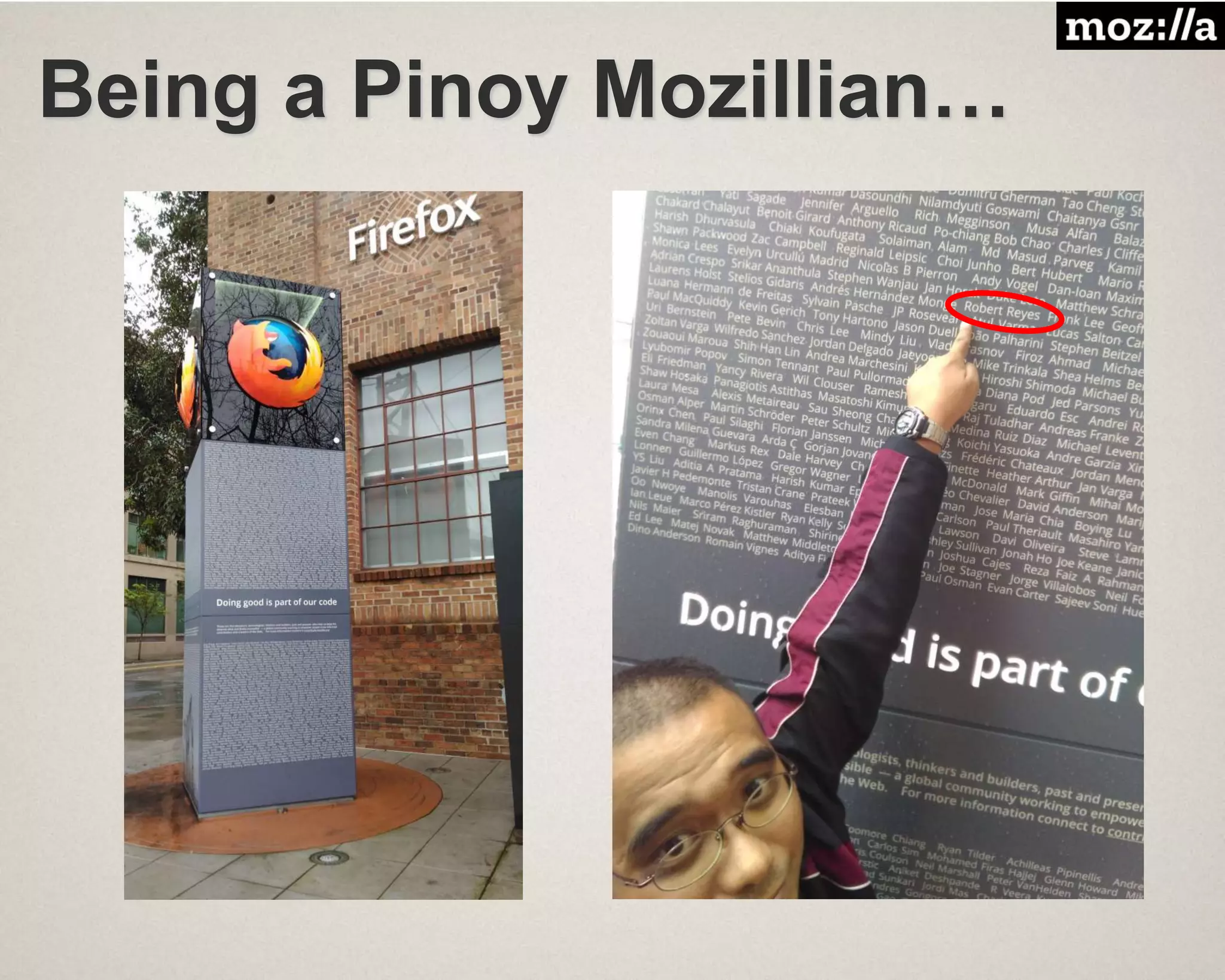
Being a Pinoy Mozillian…
What is
Mozilla?
#MozillaPH
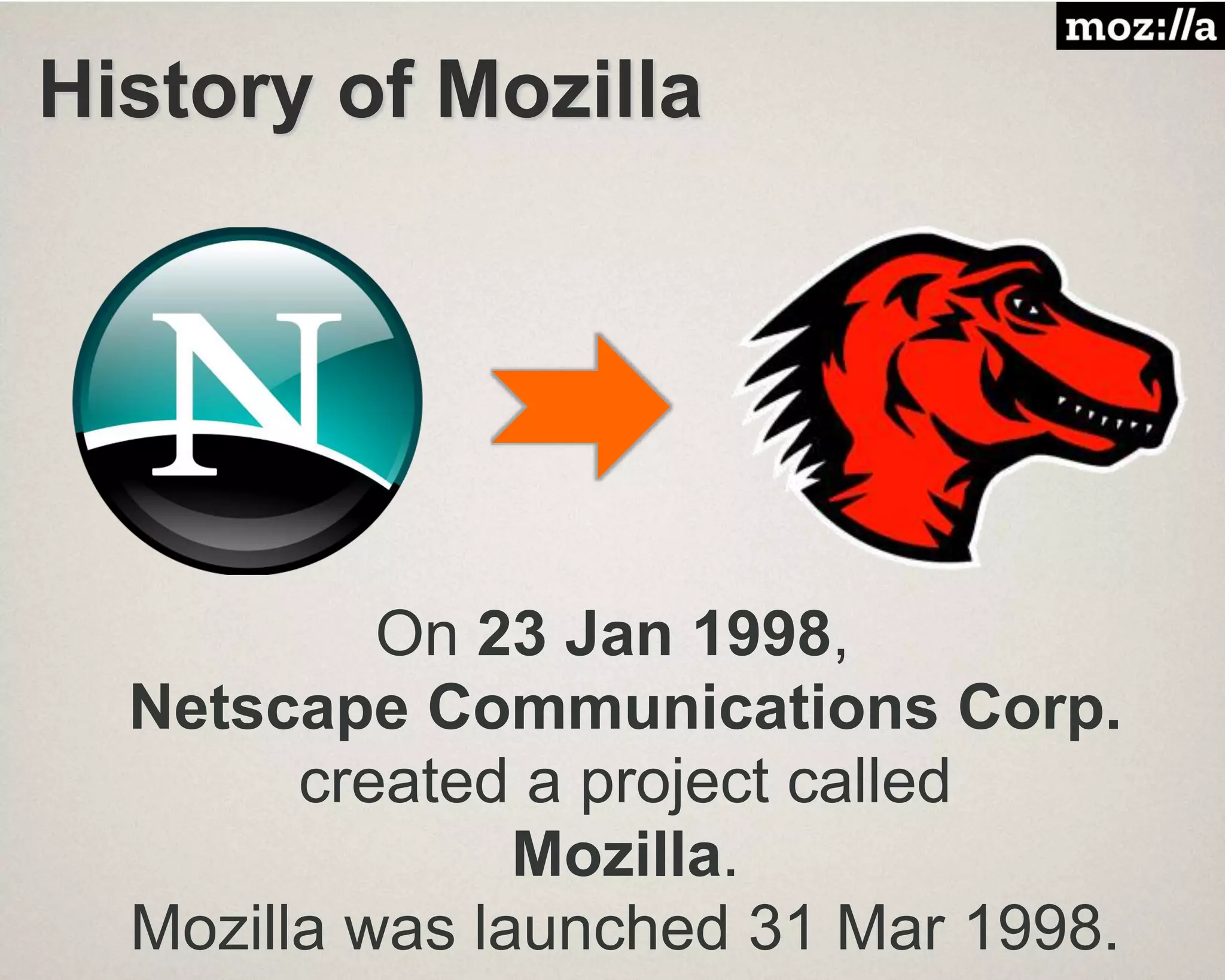
History of Mozilla
On 23 Jan 1998,
Netscape Communications Corp.
created a project called
Mozilla.
Mozilla was launched 31 Mar 1998.
The
Mozilla Mission
Mozilla’s Mission
To ensure the Internet is a global
public resource, open &
accessible to all.
An Internet that truly puts people
first, where individuals can
shape their own experience &
are empowered,
safe & independent.
The
Mozilla Manifesto
Mozilla Manifesto
We are committed to an internet
that includes all the peoples of
the earth -- where a person’s
demographic characteristics do
not determine their online
access, opportunities, or quality
of experience.
Mozilla Manifesto
We are committed to an internet
that promotes civil discourse,
human dignity, & individual
expression.
Mozilla Manifesto
We are committed to an internet
that elevates critical thinking,
reasoned argument, shared
knowledge, & verifiable facts.
Mozilla Manifesto
We are committed to an internet
that catalyzes collaboration
among diverse communities
working together for the
common good.
What is the
Open Web?
Open Web
• Encompasses technical
concepts like:
• Open-Source Code; &
• Open Standards.
• Also encompasses democratic
concepts like Free Expression
& Digital Inclusion.
An Open Web is a web by &
for all its users, not select
gatekeepers or
governments.
We have a NEW
brand identity…
We have a NEW
brand identity…
Starting with Firefox 63, all desktop versions of
Firefox include an experimental cookie policy that
blocks cookies & other site data from
third-party tracking resources.
Localization
at Mozilla
Localization
≠
Transliteration
Localization at Mozilla
• Localization (L10n) is the process of
translating software user interfaces from
one language to another & adapting it to
suit a foreign culture.
• L10n is both for developers &
all contributors at Mozilla.
• Documentation is available online via
https://developer.mozilla.org/en-
US/docs/Mozilla/Localization
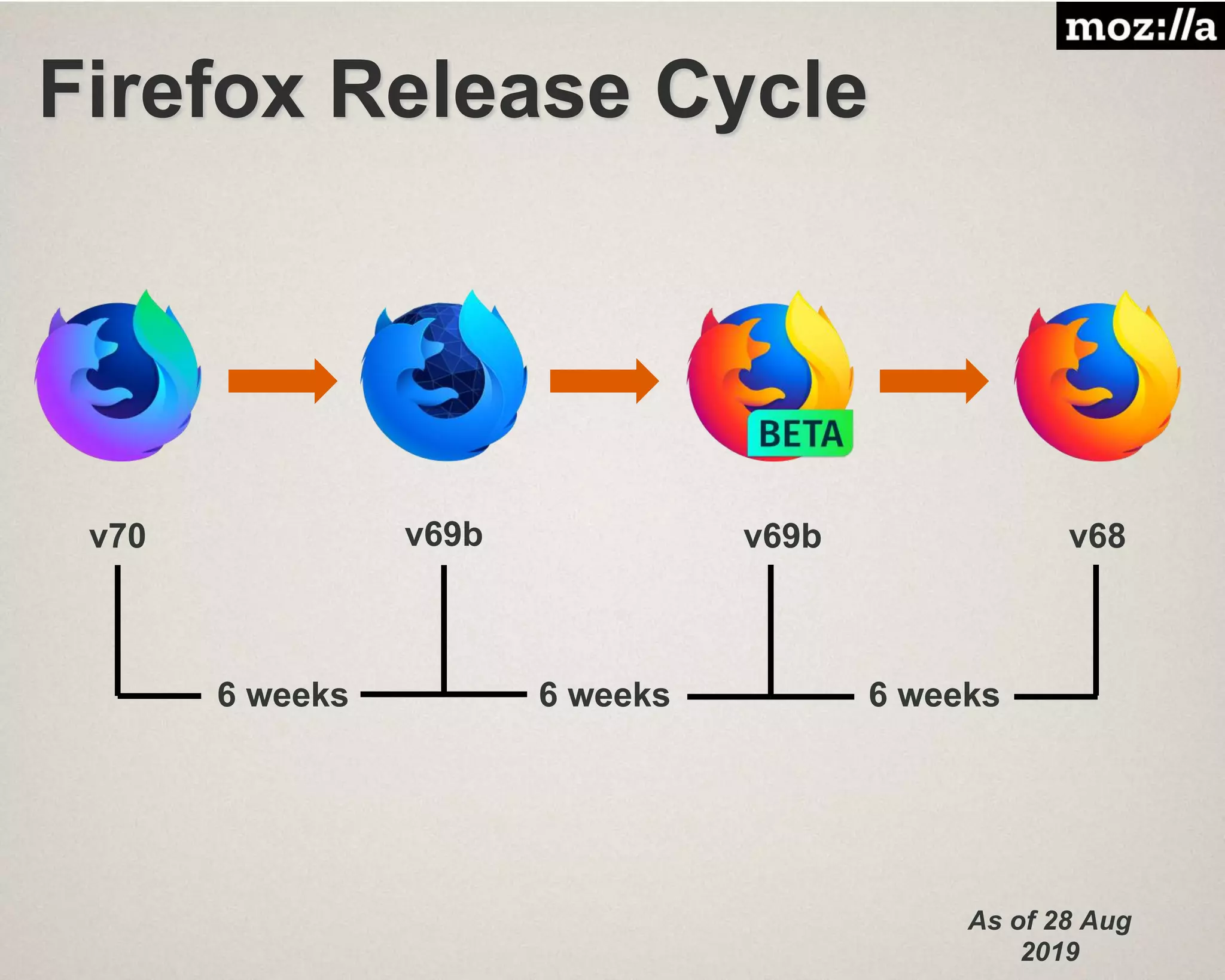
Firefox Release Cycle
v70 v69b v69b v68
6 weeks 6 weeks 6 weeks
As of 28 Aug
2019
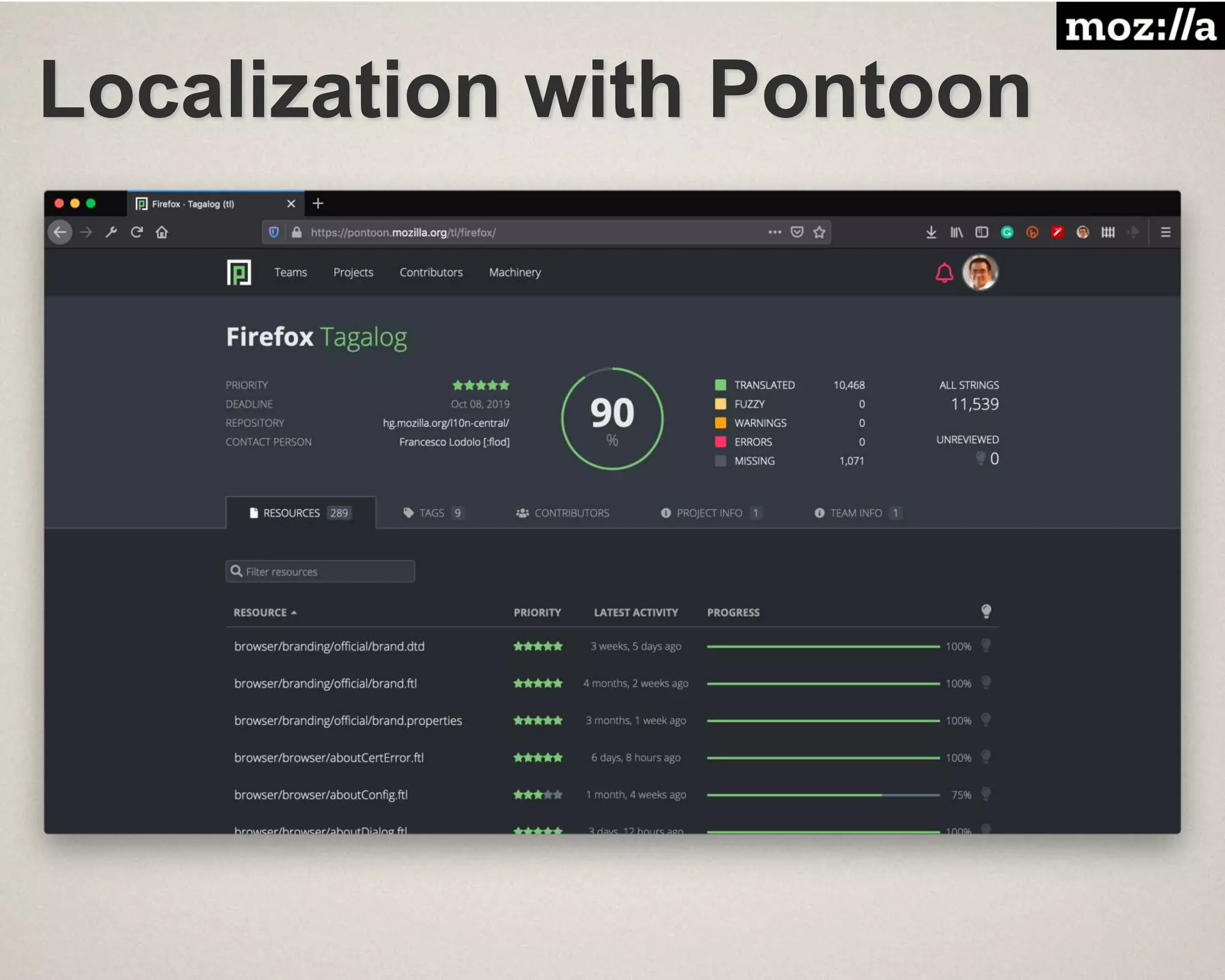
Localization with Pontoon
• Pontoon is a web-based, What-You-See-
Is-What-You-Get (WYSIWYG), l10n tool.
• We use Pontoon to localize all Mozilla
products & websites.
• Pontoon is a very simple & intuitive tool
that requires little to no technical skill to
use in the l10n workflow.
Localization with Pontoon
Localization Style Guide
• Cultural references, idioms, & slang
require a full understanding of these
references between the cultures of your
source & target languages.
• An example of a cultural reference in
English would be the phrase, "kick-off
meeting."
• More via
https://developer.mozilla.org/en-
US/docs/Mozilla/Localization/L10n_Style_Guide
Localization Style Guide
• Language-specific Mozilla style.
• It is a part of a Mozilla community's
instructions & standards for translating
strings within each project type.
• Formality & Tone; Natural expression;
Handling cultural references, idioms &
slang; Style consistency.
• Tagalog (TL) Style Guide is online via
https://mozilla-
l10n.github.io/styleguides/tl/
DEMO
Pontoon
Project Fluent
Project Fluent
• Fluent is designed to make software
translation faster, easier, & more natural-
sounding than ever before.
• Fluent is a family of file format
specifications, implementations & good
practices developed by Mozilla & currently
used in the Firefox web browser.
Project Fluent
• Firefox faces many localization
challenges which are hard to overcome
using traditional localization solutions.
• Software localization has been dominated
by an outdated paradigm: translations
map one-to-one to the source language,
which is often English.
• However, there are many grammatical &
stylistic aspects which don’t map one-to-
one between languages.
Project Fluent
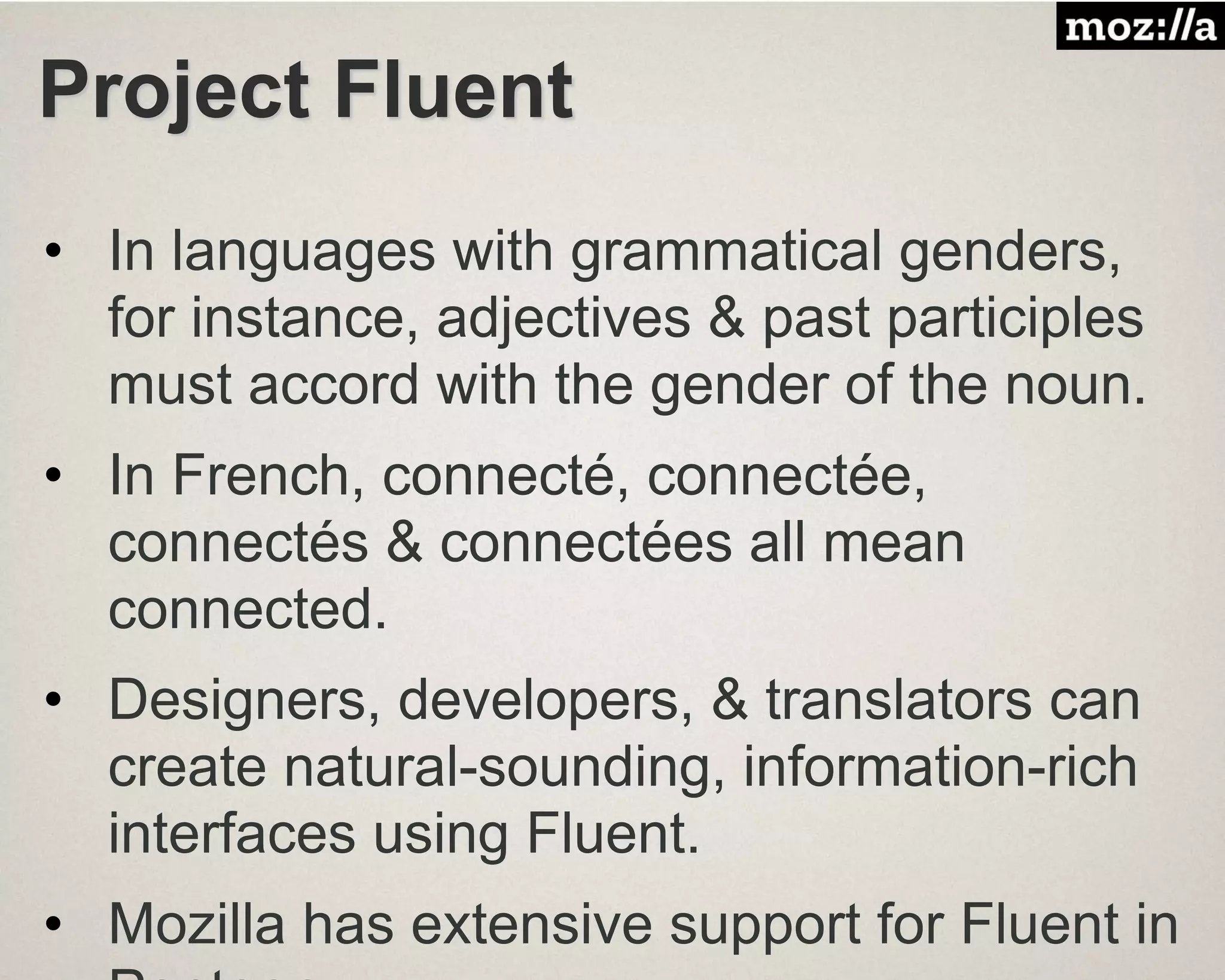
• In languages with grammatical genders,
for instance, adjectives & past participles
must accord with the gender of the noun.
• In French, connecté, connectée,
connectés & connectées all mean
connected.
• Designers, developers, & translators can
create natural-sounding, information-rich
interfaces using Fluent.
• Mozilla has extensive support for Fluent in
We Need You
Help us improve
Mozilla Localization:
https://join.mozillaph.org
We Need…
• People to use & test our products.
• People to spread the word about FOSS &
online privacy.
• You to invite us to your events
(school, conference, etc.).
• People to help us man the MozillaPH booth
at different events.
• People willing to learn & to be trained in
helping our people become web literate.
• People to be more awesome online.
https://join.mozillaph.org
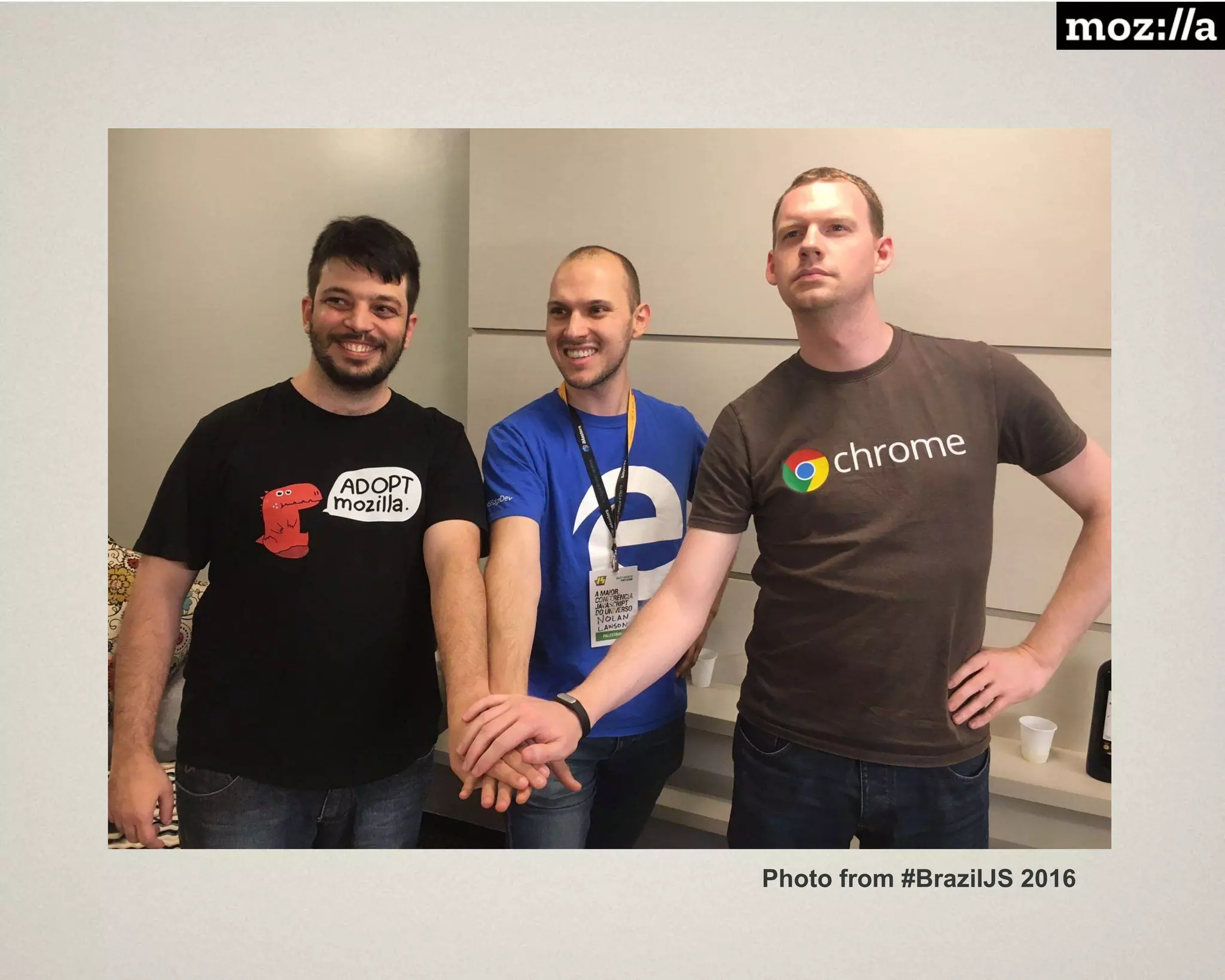
Photo from #BrazilJS 2016
Q&A
Thank you!
Maraming salamat po!
bob@mozillaph.org

Localization at Mozilla

  • 1.
    Localization at Mozilla Robert “Bob”Reyes WordPress User Group Philippines 31 AUG 2019 | UP Diliman #MozillaPH
  • 2.
    About Me • MozillaRep for the PHL since 2011 • CTO at ALIAC.edu.ph • Technopreneur at TurfSitePH.net • Technology Columnist at MB.com.ph • Team Manager at SIPFC.org • @bobreyes in Twitter • Dad of Xeon & Haswell • Firefox user since Version 1.0
  • 3.
    Being a PinoyMozillian…
  • 4.
  • 5.
  • 6.
    History of Mozilla On23 Jan 1998, Netscape Communications Corp. created a project called Mozilla. Mozilla was launched 31 Mar 1998.
  • 7.
  • 8.
    Mozilla’s Mission To ensurethe Internet is a global public resource, open & accessible to all. An Internet that truly puts people first, where individuals can shape their own experience & are empowered, safe & independent.
  • 9.
  • 10.
    Mozilla Manifesto We arecommitted to an internet that includes all the peoples of the earth -- where a person’s demographic characteristics do not determine their online access, opportunities, or quality of experience.
  • 11.
    Mozilla Manifesto We arecommitted to an internet that promotes civil discourse, human dignity, & individual expression.
  • 12.
    Mozilla Manifesto We arecommitted to an internet that elevates critical thinking, reasoned argument, shared knowledge, & verifiable facts.
  • 13.
    Mozilla Manifesto We arecommitted to an internet that catalyzes collaboration among diverse communities working together for the common good.
  • 14.
  • 15.
    Open Web • Encompassestechnical concepts like: • Open-Source Code; & • Open Standards. • Also encompasses democratic concepts like Free Expression & Digital Inclusion.
  • 16.
    An Open Webis a web by & for all its users, not select gatekeepers or governments.
  • 17.
    We have aNEW brand identity…
  • 18.
    We have aNEW brand identity…
  • 22.
    Starting with Firefox63, all desktop versions of Firefox include an experimental cookie policy that blocks cookies & other site data from third-party tracking resources.
  • 29.
  • 31.
  • 32.
    Localization at Mozilla •Localization (L10n) is the process of translating software user interfaces from one language to another & adapting it to suit a foreign culture. • L10n is both for developers & all contributors at Mozilla. • Documentation is available online via https://developer.mozilla.org/en- US/docs/Mozilla/Localization
  • 33.
    Firefox Release Cycle v70v69b v69b v68 6 weeks 6 weeks 6 weeks As of 28 Aug 2019
  • 34.
    Localization with Pontoon •Pontoon is a web-based, What-You-See- Is-What-You-Get (WYSIWYG), l10n tool. • We use Pontoon to localize all Mozilla products & websites. • Pontoon is a very simple & intuitive tool that requires little to no technical skill to use in the l10n workflow.
  • 35.
  • 36.
    Localization Style Guide •Cultural references, idioms, & slang require a full understanding of these references between the cultures of your source & target languages. • An example of a cultural reference in English would be the phrase, "kick-off meeting." • More via https://developer.mozilla.org/en- US/docs/Mozilla/Localization/L10n_Style_Guide
  • 37.
    Localization Style Guide •Language-specific Mozilla style. • It is a part of a Mozilla community's instructions & standards for translating strings within each project type. • Formality & Tone; Natural expression; Handling cultural references, idioms & slang; Style consistency. • Tagalog (TL) Style Guide is online via https://mozilla- l10n.github.io/styleguides/tl/
  • 38.
  • 39.
  • 40.
    Project Fluent • Fluentis designed to make software translation faster, easier, & more natural- sounding than ever before. • Fluent is a family of file format specifications, implementations & good practices developed by Mozilla & currently used in the Firefox web browser.
  • 41.
    Project Fluent • Firefoxfaces many localization challenges which are hard to overcome using traditional localization solutions. • Software localization has been dominated by an outdated paradigm: translations map one-to-one to the source language, which is often English. • However, there are many grammatical & stylistic aspects which don’t map one-to- one between languages.
  • 42.
    Project Fluent • Inlanguages with grammatical genders, for instance, adjectives & past participles must accord with the gender of the noun. • In French, connecté, connectée, connectés & connectées all mean connected. • Designers, developers, & translators can create natural-sounding, information-rich interfaces using Fluent. • Mozilla has extensive support for Fluent in
  • 43.
    We Need You Helpus improve Mozilla Localization: https://join.mozillaph.org
  • 44.
    We Need… • Peopleto use & test our products. • People to spread the word about FOSS & online privacy. • You to invite us to your events (school, conference, etc.). • People to help us man the MozillaPH booth at different events. • People willing to learn & to be trained in helping our people become web literate. • People to be more awesome online. https://join.mozillaph.org
  • 45.
  • 47.
  • 48.
    Thank you! Maraming salamatpo! bob@mozillaph.org

Editor's Notes

  • #11 https://www.mozilla.org/en-US/about/manifesto/
  • #12 https://www.mozilla.org/en-US/about/manifesto/
  • #13 https://www.mozilla.org/en-US/about/manifesto/
  • #14 https://www.mozilla.org/en-US/about/manifesto/
  • #15 https://www.yearofopen.org/november-open-perspective-what-is-open-web/what-is-the-open-web-and-why-is-it-important-submitted-by-mark-surman-executive-director-of-the-mozilla-foundation/
  • #16 https://www.yearofopen.org/november-open-perspective-what-is-open-web/what-is-the-open-web-and-why-is-it-important-submitted-by-mark-surman-executive-director-of-the-mozilla-foundation/
  • #17 https://www.yearofopen.org/november-open-perspective-what-is-open-web/what-is-the-open-web-and-why-is-it-important-submitted-by-mark-surman-executive-director-of-the-mozilla-foundation/
  • #46 - IDE for Rust
  • #48 - IDE for Rust